
Loving Prostitutes

comfort womenI love prostitutes.

It’s true.

Although I have never in my life “physically” loved one, I possess great compassion for them.

Sharing physical intimacy with a prostitute would have nothing to do with “love,” anyway.

My empathy for prostitutes grew significantly during the year I spent stationed with the United States Air Force in South Korea during the 1980s.

My love for them has just been reignited by an article I read about the plight of aged Korean prostitutes who are being evicted from their hovels so that developers can profit. These women, ostracized by their own society and discarded by their pimps and the soldiers, sailors and airmen who abused them, have nowhere to go.

Americans have a perverse understanding of prostitution. Calling it a “victimless crime” is incomprehensible. For every one American call girl living in comfort and able to choose her “clients,” there are probably five thousand who are beaten daily, and driven to an early (often welcome) death.

No woman, at least none with a healthy mind, wants to sell their body and forfeit their future.

The gifted author and professor, C.S. Lewis, recognized this fact.

Prostitutes are in no danger of finding their present life so satisfactory that they cannot turn to God: the proud, the avaricious, the self-righteous, are in that danger (The Problem of Pain).

I love prostitutes because God has granted me the vision to see them as he does. Jesus spoke with true love (agape love) to one unloved and physically used woman he met at a well. You can read the story here.

She had been passed from one man to another and no longer had any options. Her current partner had not even bothered to marry her. She was not unlike the poor prostitutes of South Korea.

Jesus looked into this woman’s scarred soul and offered her forgiveness, healing and peace.

South Korea is prosperous today. It was not always so. During the Second World War, and the Japanese occupation, thousands of woman were enslaved as “comfort women.” The Korean government provides these victims with special compensation. Not so the post-war “comfort women” who serviced the country’s allies.

They did not have a choice either. Which is one reason C.S. Lewis writes, “a cold, self-righteous prig who goes regularly to church may be far nearer to hell than a prostitute.” (Mere Christianity).

And now they languish. Others, working in bars and “clubs” near bases today, are in their “prime.” It won’t last. This will be their destiny as well.

Because I love prostitutes, I pray that they might be liberated from their bondage. And, I also pray, that if they remain trapped in their current plight, that their souls might be free . . . that they might encounter the Messiah who can offer them “a spring of water welling up to eternal life” (John 4:14).

The article I read, and linked to above, ends with a potent yet tragic image.

Jang Young-mi, 67, who was orphaned as a girl and worked in a military camptown for nearly two decades, lives with three mangy dogs. A bite from one of them left the long white scar on her hand, but she refuses to abandon the offending animal.

Dogs too, are often outcasts in many societies. The irony is not lost that in Korea a dog is as likely to be devoured, as it is to be embraced and protected.

_____

The WWII image of so-called “comfort women” is of Indonesian women. It is estimated that the Imperial Japanese Army enslaved a quarter of a million women in Asia to serve in this cruel and vile manner. Due to the large number of victims, many still live today, still hoping for an official apology for their suffering.

Misnaming Kids

baby namesWhy do they do it? I’m sure they considered it witty. They may have laughed as they inscribed his name on the birth certificate of their newborn son. (I doubt he shared the humor of the moment.)

Let’s think about this for just a moment. If your family name was Lemon, a totally respectable and not uncommon name, would you give your child a first name that is also a citrus?

That’s what I encountered as I completed the current issue of the military chaplaincy journal that I edit. One of the American Civil War chaplains I mentioned in the current issue of Curtana: Sword of Mercy bore the striking name “Orange V. Lemon.”

Really? Yes, really.

It reminded me of a quaint Canadian television series that my dad used to enjoy, The Red Green Show. His parents should have known that one color in a person’s name is sufficient.

Still, the temptation to be silly is irresistible to some people. Years ago I knew an attorney whose last name was Cain. Her parents had named her Candy, of course. Peculiar names are so common today, of course, that there are myriads of internet repositories for them.

Names are more important than many of us realize. I’ve written in the past about how my wife and I followed the biblical example of choosing our children’s names based on their meanings.

Even if that approach doesn’t appeal to a parents, there are an almost unlimited number of options that would not subject their children to unwanted attention.

Fortunately, when we get older, we have some control over what we are called. I was “Robbie” in my childhood, and graduated to “Rob” as soon as I could. “Robert’s” always been fine with me, since it’s my given name and what I expect someone I’ve never met to call me. “Bob,” however, is not okay. There’s nothing wrong with “Bob,” except that I’ve never been one. And when someone greets me as such it projects a very false familiarity.

Curiously, I recall reading in the Oxford dictionary of names that more primitive nicknames for Robert included Hob, Dob and Nob. So I suppose I should count my blessings when addressed as Bob.

C.S. Lewis chose his own name. Many people are surprised when they learn that he went by the name of Jack. How, they wonder, could one get “Jack” out of “Clive Staples?” Good question.

Lewis was not enamored with the name Clive. When he was only four, he decided to use the name of a pet dog that had been killed by an early motorist. The pet’s name was a human-friend designation, “Jacksie.” His brother Warren relates the event thusly, in his 1966 collection of Lewis’ letters.

Then, in the course of one holiday, my brother made the momentous decision to change his name. Disliking “Clive”, and feeling his various baby-names to be beneath his dignity, he marched up to my mother, put a forefinger on his chest, and announced “He is Jacksie.” He stuck to this next day and thereafter, refusing to answer to any other name: Jacksie it had to be, a name contracted to Jacks and then to Jack. So to his family and his intimate friends, he was Jack for life: and Jack he will be for the rest of this book.

It’s fascinating that Lewis’ family acquiesced to his demand, but it took. One small consequence, of course, is that this gifted writer is known today as “C.S.” rather than by his full names.

As for faithful Orange, I don’t know if he adopted any other name during his lifetime. He may have been quite content. It certainly did not prevent him from enjoying a meaningful life. He became a Methodist pastor and served as chaplain with the 36th Indiana Infantry.

Volcano Hurricane

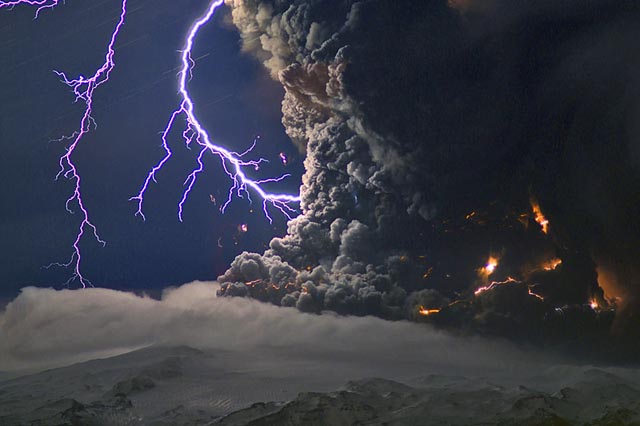
volcanoVolcano hurricane. An epic disaster film! No sharks, but copious amounts of lava flung by gale force winds across the globe. And all from the mind of a six year old boy.

Imaginations are great. They are one of the most precious gifts of God (which makes it all the more tragic when the human imagination is diverted towards carnal ends).

The minds of young boys, thankfully, have yet to turn to such lamentable matters. Their innocence shields them from the worst of human corruption. They, instead, are consumed with thoughts of spiders and other things that creep out girls . . . and especially their moms.

Our almost-seven-year-old grandson was here for the weekend with his family. We had a wonderful time. We had actually found the ideal book to include as part of his birthday celebration: How to Convince Your Parents You Can Care for a Pet Tarantula. Perfect.

Young male imaginations seem to revolve around things that shock—and also things that gross others out.

Our kids have trained their own children well. For example, they always excuse themselves when they experience flatulence. It’s a natural experience, of course, and as we mature, adults learn to ignore potentially embarrassing moments related to it. That’s part of becoming “civilized.”

Six year olds . . . not so much. Our grandson properly excuses himself, but he typically does so in the midst of enthusiastic laughter. It’s as though he relishes just how uncultured the moment seems.

During this particular visit, he leaped into my lap in a semi-ninja attack. As we wrestled, there was a minor explosion. Not quite volcanic, but close enough. He apologized, amidst great hilarity. “Sorry about my little gas,” he added.

And here’s where I made the mistake. I reinforced his innate boyhood grossness by saying, “little! . . . that sounded like it was a buffalo!”

Not quite the right thing to say, since it simply encouraged the precocious guy. But what I can say . . . time may change a boy into a man, but in most of us . . . somewhere deep in the recesses of our psyches . . . that boyhood irreverence lingers.

Not that I enjoy the crass “body humor” that pervades so much comedy (on tv and film). I steadfastly avoid it. It insults my mind and viewing it constitutes a total waste of time. Still, with my grandson wrapped in my arms, laughing away, it all seemed so genuine and innocently funny.

Of course, I recognize one needed to be there—and probably to also be related by bloodline to the participants—to find any humor in the moment. But it certainly seemed funny to us.

C.S. Lewis and Children

I was thinking about that moment as I sat down to write this post. I intended to focus on the amazing imaginations of children, and my grandson’s current preoccupation with gigantic volcanoes.

But whim or muse redirected the column. In the end, it turns out to be a reflection on the simple pleasure that we adults experience when we interact with kids. Especially when they are children who are precious to us.

I wish that C.S. Lewis had been able to experience that joy. He wasn’t. His awkwardness with children is well known. Most attribute it to the early passing of his mother, and the emotional distance his father maintained from his sons.

In a 1935 letter he wrote to a close friend, “I theoretically hold that one ought to like children, but am shy with them in practice.”

In The Abolition of Man he was even more forthcoming, sharing that, “I myself do not enjoy the society of small children: . . . I recognize this as a defect in myself.”

So, Lewis recognized his discomfort with children as a shortcoming. It was something he wished could be dispelled. Unfortunately, we can’t simply wish (or pray) away our ingrained personality traits. We’re lucky if we can tame them or reshape them.

We work hard to strengthen our positive traits and the wise deny nourishment to their weaker qualities. People often use the analogy of wearing off one’s rough edges, and that’s an apt image.

Lewis’ reticence with children makes his creation of Narnia all the more wondrous. The Chronicles of Narnia have captivated the hearts and imaginations of innumerable children, and adults alike. Certainly Lewis was correct when he wrote the following in “On Stories.”

No book is really worth reading at the age of ten which is not equally (and often far more) worth reading at the age of fifty—except, of course, books of information. The only imaginative works we ought to grow out of are those which it would have been better not to have read at all.

With his marriage, late in life, Lewis became a step-father. He did the very best he could, but was conscious of just how ill-equipped he was to raise Douglas and David. Both became successful men. Doug shares his parents’ love of Christ, and helps direct the course of various Lewisian projects today.

Allow me to close with another evidence of the greatness of C.S. Lewis. He was able to rise far above his innate uneasiness with children. In fact, his fabled correspondence included many children who had written to him seeking his attention. In 1951 he wrote to one of them, saying:

I am glad you all liked The Lion. A number of mothers, and still more, schoolmistresses, have decided that it is likely to frighten children, so it is not selling very well. But the real children like it, and I am astonished how some very young ones seem to understand it. I think it frightens some adults, but v[ery] few children.

Lewis did not disappoint the many children who wrote to him during those terribly busy years. Nor do his writings disappoint us today. Unlike the transience of youthful volcano hurricanes, Lewis’ legacy will forever remain alive in the imaginations of child and adult alike.

Humanity’s Interstellar Exodus

evoraEarth’s days are numbered. Eventually, all scientist agree, she will die . . . and all life on the planet will perish.

Even if this doesn’t occur due to a catastrophic accident like a massive asteroid impact or an alien invasion, it is inevitable. Inevitable.

If nothing else interferes, scientists tell us earth will die in the death throes of its own star. In about 2.8 billion years, the sun will destroy all life here. Before the sun consumes its nuclear fuels and transforms into a “red giant,” it will have scorched the solar system.

It’s a disturbing thought. At least, it can be to those who place their hope in the future of humanity. Christians, in contrast, look forward to the promise of a new creation, a new heaven and a new earth, where even the harmony of the cosmos will be restored.

For those who believe that ultimate meaning can only be found in the continuing evolution of humanity, it is necessary to see an opportunity to continue the race. Until we evolve into pure mind and energy forms (right!) we need to find a place on hospitable worlds where we can survive, prosper and continue to advance.

So, if we assume it’s necessary for humanity to continue to exist, and our days here on earth are numbered, what are we to do?

The answer’s obvious. We must migrate to the stars. Baby steps are already being taken, with planning for our first colonies on Mars and our own moon. Many movies have explored establishing our presence in other solar systems. In fact, it’s become a trope of the scifi genre.

Some writers and directors envision a welcoming universe. Others populate it with hostile environments and competitors.

One of the most disturbing thoughts I have heard in the past few months was voiced by a scientist contemplating this subject. In essence, he said that our observation of nature shows that it is the predators (not their gentle prey) that must become smarter than the rest of the fauna to survive. The presumption being that it is the predator, not the grazer, that would evolve farthest and potentially venture into space.

I grew up influenced by the utopian images of Star Trek. Sure, there were Klingons and other threats out there, but there were also a large number of affable races that were eager to band together and share their knowledge and culture.

Star Trek went a step further. Even our one-time enemies (like the aforementioned Klingons, the Cardassians and the Ferengi) could become our allies. Well, there’s a precedent in that here on Earth (think post-war Germany and Japan). Still, it may be a tad naïve when it comes to interstellar swashbucklers.

Of course, all this presumes that we are no “alone” in the universe. By alone, we mean, the only sentient beings to populate the stars. (That’s figurative language, of course. No one lives on the stars themselves . . . that we know of.)

The prolific writer C.S. Lewis wrote a series of books about humanity’s first encounters with life beyond our planet. The Space Trilogy will be of interest to open-minded fans of science fiction, and to people who enjoy learning more about Lewis’ broad interests.

The first book in the series is called Out of the Silent Planet. In a 1939 letter, he explained to a correspondent one of his reasons for writing the book. [The quotation refers to Professor Weston, who is the novel’s nemesis. One of his goals is to usher in the age of human colonization beyond our own orbit.]

The letter [at the end of Out of the Silent Planet] is pure fiction and the “circumstances which put the book out of date” are merely the way of preparing for a sequel. But the danger of “Westonism” I meant to be real.

What set me about writing the book was the discovery that a pupil of mine took all that dream of interplanetary colonization quite seriously, and the realization that thousands of people in one way and another depend on some hope of perpetuating and improving the human race for the whole meaning of the universe—that a “scientific” hope of defeating death is a real rival to Christianity.

With this, we return to our initial thought. If we are looking to the stars for humanity’s hope, I’m afraid we will ultimately be disappointed.

I don’t know if there is mortal life beyond our planet. If there is, I can’t predict whether it would be friendly, or inimical to us.

Who knows whether we could even communicate? It’s a mystery for now. What isn’t a mystery, is whether or not we need to look beyond this tiny blue globe. After all, it is certain this world’s days are numbered.

_____

Note: The alien at the top of the page is the Regent of the Evora species, a Federation protectorate. I used her image because of the curious marking on the crown of her head. It resembles a tattoo of a cross, but from the lines on the sides of her head I suspect they might all merely be varicose veins.

Titles You Don’t Want


eyechartThe world’s oldest man just died—and I’m not looking forward to ever becoming one of his successors. I mean, I understand the sentiments of non-Christians who quip that any day on this side of the grass is a good one, but I would only be interested in staying around here that long if I still had a keen mind and good health.



I’m not sure most of the people who eventually earn those titles have either. This gentleman was 111, and in the picture of him receiving his Guinness certificate, he actually looks like he had already expired. I mean, no offense, just a statement of simple fact.

As for his state of mind, I’m a bit more optimistic. Apparently when asked a while ago how he had lived so long, he responded, “because I haven’t died yet.” Assuming that was tongue in cheek (I recognize that is merely an assumption), he had retained his sense of humor. A good sign.

I don’t think ultra-long longevity is all it’s cracked up to be. I remember my 92 year old grandmother (my only relative who lived to be “elderly”) telling me that she was ready to go to heaven. She was in a nursing home, but not in pain, and still witty.

She said, “Robbie, I’ll miss you and everyone who is still here, but if you live long enough, more of the people you love are already in heaven than remaining here.” She had been widowed for three decades. And, unbeknownst to us at the time, three of her four children would follow her within three years of her own passing.

I am not eager to die, of course. And, unlike Polycarp, the bishop of second-century Smyrna, I’m certainly not zealous about the possibility of someday being martyred.

Still, God-willing, when I’ve come to the end of my appointed days I will make that transition peacefully, as is appropriate for a child of God who has been blessed with a full life.

When death is seen as a dark end—a soundless void—it’s understandable that many would resist it to the “bitter” end. That theme has been common in literature and cinema.

In a comic light, a character on Parks and Recreation exhibits the desire to live as long as humanly possible. He exercises without pause and takes every vitamin that exists in horse-pill doses. Soon after Chris Traeger was introduced to the show, he shared his view of life:

I take care of my body above all else. Diet, exercise, supplements, positive thinking. Scientists believe that the first human being who will live 150 years has already been born. I believe I am that human being.

Humorous. And, a respectable goal perhaps, if not driven by deep fear.

I don’t share Traeger’s goal of being the first human to reach 150. Nor, as we considered at the outset of our discussion, do I long to gain the title of World’s Oldest Man.

And I take comfort that I find myself, once again, in the comfortable camp of C.S. Lewis. In his essay “Is Progress Possible?” Lewis wrote:

Progress means movement in a desired direction, and we do not all desire the same things for our species. In “Possible Worlds” Professor Haldane pictured a future in which Man, foreseeing that Earth would soon be uninhabitable, adapted himself for migration to Venus by drastically modifying his physiology and abandoning justice, pity and happiness.

The desire here is for mere survival. Now I care far more how humanity lives than how long. Progress, for me, means increasing goodness and happiness of individual lives. For the species, as for each man, mere longevity seems to me a contemptible ideal.

More important, we believe, is the quality than the quantity, of our lives.

Navy Nerds

nerdEvery once in a while, the military has a good idea. Sure, they have a knack for technological breakthroughs in warfare . . . but what about other fields? The NAVY NeRD answers that question in the affirmative.

NeRD stands for Navy eReader Device.

Well-informed readers of Mere Inkling are already aware of the growing intensity of international cyberwarfare. It is no joke, and lives are at stake.

Draconian policies are in place to avoid the contamination of the military computer system by innocently transferred viruses. Since virtually all digital platforms allow for the transfer of data, they are potentially dangerous.

Because of that, even ereaders have been off limits in certain environments. Now, however, someone has thought outside the proverbial box and come up with a solution to that problem.

The United States Navy has devised a novel ereader that comes loaded with 300 titles, but has no ports or wireless connectivity to allow for inadvertent viral transfers.

The selection of books sounds pretty well rounded. Some public domain classics, and a number of contemporary best sellers like A Game of Thrones. Fans of J.R.R. Tolkien will be delighted to know the readers also include The Lord of the Rings.

Reading is a productive way to spend one’s free time during a lengthy period at sea. Even for those not prone to opting for it when faced with all the distractions ashore.

During WWII, C.S. Lewis wrote a letter to a former student who was serving in the Navy, “out of reach of libraries.” It acknowledges the perennial problem of sailors—lack of space for personal property. The letter was written in response to a request from Michael Rayner Thwaites for reading recommendations. Thwaites was an Australian poet and military intelligence officer.

A man who has already your linguistic training might well, I think, begin the Anglo Saxon on his own. You will need E. Wardale Old English Grammar. . . . For texts, the ordinary beginning is first Sweet’s Anglo Saxon Primer and then his Old English Reader. But you, being a classic might well, after a dip in the Primer go on to King Alfred’s trans. of Boethius De Consolatione Philosophiae . . .

Whether you can begin O.E. poetry on your own I don’t know. But try getting . . . Beowulf: and with it Clark Hall’s trans. ed. by Wrenn with preface by Tolkien . . . This edition is essential for it is Tolkien’s part of metre wh. is essential. (O.E. verse uses both quality and accent, and your ear is prob. ruined, as mine was, by the false way they teach Latin metre at schools–drastic re-education is required. . . .

As to modern literature. You must not start out to study it ‘as it reveals man’s hesitant advance to the idea of a God-created world’. Don’t you see you are laying down in advance what a phenomenon is to reveal before you have examined the phenomenon? It may reveal that: it may not. You have to find out. I don’t think I can lay down any v. definite course of reading.

All I can point out is that while you are in the navy and out of reach of libraries and new publications, this is the proper time for solid reading through the big (i.e. long) authors, critical works and histories of lit. can come later. Now is the time for Chaucer, Malory, Spenser, Sidney, Shakespeare, Dryden, Pope, Swift, Johnson, Fielding, Richardson, Cowper, Scott, Wordsworth, Byron, Dickens etc etc.

If you usually keep two books of widely different period and type going together (e.g. Faerie Queene & Tom Jones) you won’t get bored. I myself always index a good book when I read it for the first time noting (a) Linguistic phenomena. (b) Good & bad passages. (c) Customs: meal times, social classes, what they read etc. (d) Moral ideas.

All this reading, tho’ dedicated ad Dei gloriam in the long run must not be infected by any immediate theological, ethical, or philosophic reference. Your first job is simply the reception of all this work with your imagination & emotions. Each book is to be read for the purpose the author meant it to be read for: the story as a story, the joke as a joke.

Back to the NeRD

The Navy is making 385 devices at first, with more to follow, with five being sent to each submarine in the Navy to be shared among the crew.

That’s only the start, of course. One would anticipate that even for a military crew (for example, 155 personnel on a Trident sub), a mere five mini-libraries would prove insufficient. (No offense intended; yours truly is a veteran himself.)

Safer Police Chases

crashLaw Enforcement often gets a bum rap. I assume I’m overly sensitive to this because I’m a volunteer chaplain with our county Sheriff’s Office.

But my feeling is not new, so I don’t think it’s the result of my current chaplaincy duties. I’ve always felt that the media, corrupt lawyers, and certain politicians have sided with criminals at the expense of society.

An example of this is just how quick many are to condemn police whenever there is a high speed chase. While nearly all law enforcement agencies strive to keep these to a minimum, occasionally one of these pursuits will end tragically.

Whenever that occurs, it seems that the police are blamed. And the question that is too seldom asked, remains: Whose fault is it that such massive pieces of metal (i.e. the cars) were impelled down our streets at such dangerous speeds?

It is the fault of the criminals, of course.

Allow me to repeat that. It is the fault of the criminals . . . not the police officers.

The role of law enforcement professionals is to protect the public. All of the individuals in those ranks with whom I have worked (both military and civilian) have believed that. In Mere Christianity, C.S. Lewis wrote:

The State exists simply to promote and to protect the ordinary happiness of human beings in this life. A husband and wife chatting over a fire, a couple of friends having a game of darts in a pub, a man reading a book in his own room or digging in his own garden—that is what the State is there for.

And unless they are helping to increase and prolong and protect such moments, all the laws, parliaments, armies, courts, police, economics, etc., are simply a waste of time.

Overreaction to the potential dangers of police chases has led some jurisdictions to offer criminals get out of jail free cards. These are issued whenever a person desires to escape justice by committing an additional crime—fleeing the police.

As one writer says, “A ‘no pursuit’ policy practically guarantees the suspect gets away.”

But it no longer has to be that way. I recently read about a new invention that allows cops to fire a laser-guided, sticky GPS tag that will allow them to drop their speed and still be able to track the progression of the fleeing criminals.

It’s pretty amazing. You can see a video of how it works here. Although the cost is reasonable, I imagine the expense will still prevent most departments from being able to leverage this new technology.

The StarChase company says their products are available around the globe, so this isn’t simply for Americans. No matter where you live, you may want to contact your local law enforcement agencies to inquire into whether they have considered this invention.

After all, law abiding citizens want criminals captured—especially those who brazenly threaten everyone’s welfare with their highway racing—but we want them arrested safely.

Naming Inanimate Objects

PENTAX ImageDo you ever talk to inanimate or non-sentient objects? My wife often talks to her computer, and though she is never vulgar, the conversation is rarely pretty.

There is a current advertisement featuring the slightly off Gary Busey, in which he says, “If you’re like me, you like to talk to things.” His gaze drifts to the side, and he adds, “Hello lamp.” Smiling after greeting his tabletop light source, he drops his gaze and gets an expression like someone who has just encountered a long lost friend. “Hello, pants.”

It’s quite bizarre, but rather humorous in an oddly disconcerting way.

My wife and I named the first car we owned. It was an orange Gremlin. Newlyweds, and still in college, we named it Hezekiah in the hopes that it would “live” long.

In those days Hezekiah became sick and was at the point of death. And Isaiah the prophet the son of Amoz came to him and said to him, “Thus says the Lord, ‘Set your house in order, for you shall die; you shall not recover.’” Then Hezekiah turned his face to the wall and prayed to the Lord, saying, “Now, O Lord, please remember how I have walked before you in faithfulness and with a whole heart, and have done what is good in your sight.”

And Hezekiah wept bitterly. And before Isaiah had gone out of the middle court, the word of the Lord came to him: “Turn back, and say to Hezekiah the leader of my people, Thus says the Lord, the God of David your father: I have heard your prayer; I have seen your tears. Behold, I will heal you. On the third day you shall go up to the house of the Lord, and I will add fifteen years to your life. (2 Kings 20).

A recent survey in the United States found that nearly a quarter of the population give their rides a name. Younger drivers (18-34) do so more frequently than their parents, with 36 percent giving their cars a personal name. “Hello, car.”

A British poll found that women are more likely than men to attribute personality to their cars, with 60 percent naming their rides compared with 41 percent of men.

The higher likelihood of a British car being named than its American cousin does not surprise me. After all, we learned during our three years in the United Kingdom that they even name their houses. We lived on a family farm near Newbury while stationed at RAF Greenham Common. There were several domiciles on the farm, each with its respective appellation. We resided in “New House,” which was ironically a good thirty years old.

C.S. Lewis’ house in Oxford had a name. “The Kilns” received its distinctive name when it was built on the site of a former brickworks. There is a small lake nearby, which was originally the clay pit which supplied the kilns.

In the United States I suppose it’s possible to find a few places where a home has a name rather than a number. But the norm in our systematized structure is for homes to have sequential numbers. This proves quite practical for reasons such as emergency response by fire fighters, and doubtless many other countries have adopted the practice.

We’ve made the change at some cost though. Houses do have architectural character. Personalities, even. When naming houses, some might choose labels that relate to the profession of the owner. For example:

Clergy: Ascension Manor or Hosanna House

Attorney: Prosecution Place or Litigation Lodge

Physician: Resident’s Residence or Hemorrhoid Hall

If one dispenses with a requirement for alliteration as an arbitrary naming convention—the options would expand exponentially.

Sadly, we don’t get to name our houses today, unless we do so informally like one would with an automobile. We must be content for our streets to possess names while our houses must be content with numbers.

If you are interested in reading more about unusual or entertaining house names, check out this site. (It’s from the United Kingdom, of course.) Names like “Tadpole Cottage,” “Leprechaun’s Leap,” and “The Riddlepit” certainly evoke entertaining images.

Perhaps you’ll also want to consider naming your own home. It just might make your conversations with your residence a little more interesting when they no longer have to begin with “Hello, house . . .”

Married, or Not?

unificationShould a wedding ceremony during which the bride forgets the groom’s name be considered valid? That question may sound slightly preposterous, but I just witnessed it happening.

One of the network news programs just did a story on the latest “Holy Marriage Blessing Service” conducted by the Unification Church. This is the religion founded by Sun Myung Moon, whose disciples believe to be the second coming of Jesus. (Moon died in 2012, but his wife continues to lead the religion, and officiate at these regular ceremonies.)

Many of the couples who marry in these ceremonies are matched by their parents or, if they are determined to be especially blessed, they are “randomly” matched by the church leader (presently the widow of their messiah). Reportedly, each match takes about thirty seconds as the prophets place the hands of men and women together in divinely appointed relationships.

Officially, a person can decline their match after they’ve had a little time to talk with their future spouse, but it’s evident that contradicting the action of one’s savior would require immense courage.

That said, I have no doubt that—due to the earnest commitment and efforts of both parties—many of these marriages end up happy. After all, as C.S. Lewis wrote in Mere Christianity:

Knowledge can last, principles can last, habits can last; but feelings come and go… But, of course, ceasing to be “in love” need not mean ceasing to love. Love in this second sense — love as distinct from “being in love”—is not merely a feeling. It is a deep unity, maintained by the will and deliberately strengthened by habit; reinforced by (in Christian marriage) the grace which both partners ask, and receive, from God. . . . “Being in love” first moved them to promise fidelity: this quieter love enables them to keep the promise. It is on this love that the engine of marriage is run: being in love was the explosion that started it.

In the case of Unification Church members, even if the relationship lacked an emotional stage of “being in love,” it doesn’t mean that it is destined to fail. Far from it, since, as Lewis wisely points out, true love isn’t about feelings.

In the aforementioned case, the bride was from a French-speaking African nation. The husband, I believe, was from Japan. Her English was quite good, but his was poor. They were essentially unable to communicate. Then, when the interviewers revisited them immediately before the ceremony was to begin, they asked the beautifully-gowned bride what her husband’s name was. And she had forgotten.

Another peculiar thing about Unification marriage practices is that, following the wedding, there is a 40+ “separation period,” during which they are required to refrain from intimate relations. While Christians are called to practice premarital chastity, I’m unfamiliar with any other group that requires a post-wedding purification.

One last comment about the Unification marriage blessings. As if they could not be more bizarre. In 1997 the Moons presided over a ceremony in Washington, D.C. While only 2,000 of the 30,000 couples were actually being married, among the other 28,000 couples having their marriage “blessed” by the Unification messiah included a prominent American political figure—none other than Al Sharpton.

At least he and his wife, Katherine, probably knew each other’s names.

_____

The picture above comes from one of the group weddings. This young bride has to be content with the photograph of her absent groom. One wonders if the two have yet to meet.

Rescuing Orphans

orphansWar is a terrible thing. It should be avoided at (nearly) all costs. As C.S. Lewis wrote during Hitler’s atrocities, “If war is ever lawful, then peace is sometimes sinful” (“The Conditions for a Just War”).

I was writing this weekend about one of the sad consequences of war—the creation of orphans. As an adopted child of God, I possess deep compassion for children without parents in this world. Over a decade ago I was privileged to represent the United States Air Force at the dedication of the Korean War Children’s Memorial.

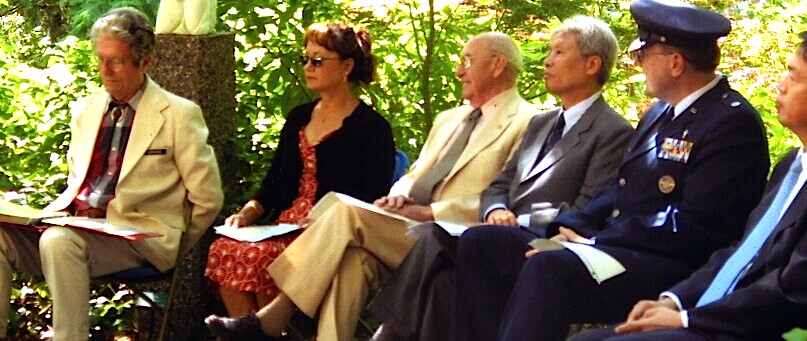
When I contacted the coordinator of that event, Dr. George Drake, he provided me with the photograph above, which shows the speakers that day. Drake appears to the left, and yours truly is in uniform, to the right. The primary speaker was Chaplain Russell Blaisdell, center, who saved the lives of at least a thousand Korean orphans during the war, delivering them from almost certain death as Seoul fell to the Communists. (My next post will reflect on his heroism and humility.)

The war in Korea was horrific. The frontlines swept across the peninsula, leaving desolation and tragedy in their wake. The number of orphans created by the violence was legion. In the cruel ebb and flow of the conflict, many perished. Still, even in the crimson terror there were expressions of mercy and grace.

Chaplains often led the way in reaching out to the children, but their efforts would have accomplished little if the compassion of the common Soldier, Marine, Sailor and Airman had not moved them as well to make sacrifices to care for the children.

Chaplains who serve in Korea today have maintained the strong bonds of support for orphanages that was so vital to the wartime chaplains represented by Blaisdell.

During my year in Taegu (Daegu), I coordinated the ministry of the airmen at Taegu Air Base in partnership with Love and Hope Orphanage. Love and Hope has a unique role, caring for the least of the least . . . children with serious physical and/or mental handicaps. There is little room for them in most societies, and Korea is no exception.

Orphans are made not by war alone, of course, but by a variety of tragic confluences of suffering. Some lose parents to accident or disease. Today, we find the greatest number of orphaned children in various parts of Africa where AIDS has devastated local adult populations. Similarly, following natural disasters such as major earthquakes and tsunamis, many orphans are left alone in the rubble or receding waters.

Some children flee abusive homes, or are rescued from dangerous environments; in one sense these were orphans even before their legal bonds with cruel predators were severed.

Many causes account for the existence of orphans. And, as long as we live in this fallen world, orphans will be among us. This is why we must never forget that, “Religion that is pure and undefiled before God, the Father, is this: to visit orphans and widows in their affliction, and to keep oneself unstained from the world” (James 1:27, ESV).

C.S. Lewis was well acquainted with the sorrow of wartime violence and the shattering of families. A veteran of World War I, he saw many friends perish just as they were embarking on adulthood. After World War II, one of his many correspondents was Don Giovanni Calabria, who operated an orphanage in devastated Italy

In 1951, Lewis sent his friend a newly translated copy of the first book in his Chronicles of Narnia. He invited the priest (who would be canonized by the Roman Catholic Church less than fifty years later) to pass the book on to one of the orphans in his care.

I am sending you my tale recently translated into Italian in which, frankly, I have rather played than worked. I have given my imagination free rein yet not, I hope, without regard for edification—for building up both my neighbour and myself. I do not know whether you will like this kind of trifle. But if you do not, perhaps some boy or girl will like it from among your “good children.”

While I imagine the volume remained close to the future “saint,” I trust that Lewis’ powerful tale delighted many of the young children in his care.

As Chaplain Blaisdell says about caring for innocent children, the act itself provides more than sufficient reward. Formal recognition is not required, and may in fact detract from the intrinsic satisfaction that accompanies the giving of oneself in service. Ninety-nine percent of those who sacrifice for the widow and orphan remain essentially anonymous to all but God, and this is just fine. (You can read more about the Kiddy Car Airlift and who received credit for it here.)