Who Should We Trust?

staffordshire cross“You can trust me, I’m a pastor.” When I was ordained thirty-three years ago, that might have been sufficient to persuade many people to give me the benefit of the doubt. Not so today.

The latest Gallup poll records the continuing decline of our trust in “clergy.” Relentless negative press (much of it recording genuinely criminal and repellent behaviors) has taken its toll. Today only 47% of Americans trust ministers (of all faiths).

The good news, if you can consider it that, is that clergy still rank as the seventh most trusted group (out of twenty-two vocations considered).

But it remains quite pitiful. And quite understandable. Even being a pastor, there are many people considered clergy who I would not trust. First of all, anyone who purchased their “ordination” over the internet, and has the audacity to pretend to be a minister. I see a credibility gap there. (I would not include those who buy one of the fake diplomas as a “joke” to be untrustworthy . . . only those who pass themselves off as a “real minister.”)

I could go on, but my purpose here is not to trash clergy, since more than enough people already devote themselves to that purpose.

I am curious just who, in our increasingly uncertain and selfish world, we should trust.

I personally am in a rather envious position. I don’t have to rely on hoping people will trust me because I’m a pastor. I am also a sworn officer of the law. Albeit, I merely serve as a volunteer chaplain with my local county Sheriff’s Office, but we honestly do swear an oath to uphold the law, and we proudly wear regular uniforms, complete with our own chaplain badges (stars).

The thing about being in law enforcement is that I can benefit from the fact that it is the sixth most respected institution. So that carries me across the halfway mark all the way to the 54% trustworthiness milestone. I guess that’s fair, since I too place a higher trust in the integrity and professionalism of the average deputy or officer than I do in the average minister.

But, as I already said, I’m in a rather unique position, in that I also qualify for an even more respected category, that of a military officer. The 69% level of trust for military officers ties that of doctors and is only 1% below grade school teachers and pharmacists. So, I guess that if I want to instill confidence in my integrity, I’d best tell people that I’m a (retired) Air Force officer, and not that I am a member of the First Estate.

Trust is important. It’s a key commodity in any relationship, and absolutely essential for intimate relationships such as those shared within a family. Trust takes a great deal of time to build, and it can be shattered in just a moment. Its fragility is the primary reason why it must be treasured and guarded.

Trusted are those who never give others a cause to doubt them. My wife and I made a promise to our children that we would never lie to them. Never. We explained there would be times when we could not tell them something, or where we could only reveal a portion of the facts about a matter . . . but we promised them that whatever we did tell them would be the absolute truth insofar as we were aware.

Because of our honesty with them, our children (all adults now, of course), have been amazingly honest with us the whole of their lives. They trust us. We trust them. And none of us take that amazing gift for granted.

In Surprised by Joy, C.S. Lewis describes his introduction to J.R.R. Tolkien. Although the two would become lifelong friends, there were obstacles that needed to be overcome. One, described by Lewis, was that Tolkien belonged to not one, but two, categories of people who Lewis had been taught to regard as suspect. He was an atheist at the time, but it wasn’t simply Tolkien’s deep faith in Christ that gave him pause.

When I began teaching for the English Faculty, I made two other friends, both Christians (these queer people seemed now to pop up on every side) who were later to give me much help in getting over the last stile. They were H.V.V. Dyson (then of Reading) and J.R.R. Tolkien.

Friendship with the latter marked the breakdown of two old prejudices. At my first coming into the world I had been (implicitly) warned never to trust a Papist, and at my first coming into the English Faculty (explicitly) never to trust a philologist. Tolkien was both.

I’m not sure where philologists ranked on Gallup’s recent poll, but I am quite sure they did not include questions about different denominations or faith groups. Before ending these thoughts I suppose I should share with you the most trusted group in the survey—nurses. Eighty-two percent of Americans trust nurses. And I too would agree with that.

The matter of who we can safely trust is of great importance. In fact, it could be argued that it is the most important question in our lives.

Ultimately, even when we assure one another we will only speak the truth . . . even then we disappoint one another. Being human, we are finite, imperfect. We cannot always be there, even for those we love. Sometimes we fail to live up to our own standards and our promises dispel like a vapor in the wind.

Johnny Cash recorded a powerful song before he died. He had lived a rough and tumble life, and had found peace in a relationship with Christ. That peace, however, did not cure all of the ills or heal all of the scars he had experienced, and his profound familiarity with this world inspired the gritty lyrics of “Hurt.”

I wear this crown of thorns

Upon my liar’s chair

Full of broken thoughts

I cannot repair

Beneath the stains of time

The feelings disappear

You are someone else

I am still right here

What have I become

My sweetest friend

Everyone I know goes away

In the end

And you could have it all

My empire of dirt

I will let you down

I will make you hurt

In a moment, I’ll share a link to his performance of this moving song. But first, the answer to the question with which we began.

Who, exactly, should we trust? Johnny Cash learned the answer to that question, and so did C.S. Lewis. I trust the same Person that they did—someone who will never disappoint. Someone who cannot lie, since he himself is the Truth. As Paul wrote in 2 Timothy 2:

Remember Jesus Christ, risen from the dead, the offspring of David . . . I endure everything for the sake of the elect, that they also may obtain the salvation that is in Christ Jesus with eternal glory. The saying is trustworthy, for:

If we have died with him, we will also live with him;

if we endure, we will also reign with him . . .

if we are faithless, he remains faithful—

for he cannot deny himself.

_____

If you wish to watch the video of Johnny Cash’s musical epitaph, you can see it here.

The pectoral cross show above is part of the Staffordshire Hoard, which is the largest collection of Anglo-Saxon metalwork ever found. It dates from the 7th or 8th century.

Libraries & Imagination

librarycardI just got a new library card. It’s emblazoned with the word “Imagination.” While that would be boring news to most, to people who value reading, it’s noteworthy. Some might wonder, why did he wait until he was nearly sixty to get a library card. That’s because there is more to the story.

I happen to live “across the water” from one of the most literacy-loving communities in the United States—Seattle. (“Across the water” means that the quickest way to get to Seattle is by taking one of our scenic, but outrageously expensive, ferries, across Puget Sound.)

Our relatively small county has superb libraries of our own, but they can’t hope to match the holdings of Seattle’s grandiose institutions. Personally, I am not enticed by the sheer volume of volumes available there. I desire access to their abundant research resources, most notably access to historic newspapers.

The great news is that Kitsap County, where I am blessed to reside, maintains reciprocal library privileges with Seattle! When I made a trip to the metropolis to enroll, not only did they expeditiously process my information, the library pulled open a drawer with a dozen colorful options and said, “which card would you like?” (Now, I see how sheltered a life I live; I didn’t know some libraries actually offered members a choice of what image they want to embellish their cards.)

I selected the one bearing the iconic image of the Space Needle. (I actually visited the Space Needle during the World’s Fair . . . but that’s a story for another day.)

Only after I selected it because of the picture, did I realize each card carried the imprint of a single word. “Imagination,” the librarian said, “a good choice.” A very good choice, I thought to myself. Since I place an extremely high value on that ephemeral trait.

Libraries, I’m afraid, are undervalued today. It’s good to see them continuing to provide a valuable service to our communities. Reading is vital to civilization, growth and culture.

C.S. Lewis enjoyed the family library in the home of his youth, and in one of his boarding schools experienced the library not only as a vestibule of knowledge, but also as a place of refuge. The upper classmen of the school subjected the younger boys to relentless hazing, but the library was off limits to their abusive behaviors.*

The other undisguised blessing of the Coll [Wyvern College] was “the Gurney,” the school library; not only because it was a library, but because it was sanctuary. As the Negro used to become free on touching English soil, so the meanest boy was “un-faggable” once he was inside the Gurney.

It was not, of course, easy to get there. In the winter terms if you were not on the list for “Clubs” you had to go out for a run. In summer you could reach sanctuary of an afternoon only under favorable conditions. You might be put down for Clubs, and that excluded you. Or there might be either a House match or a Coll match which you were compelled to watch. Thirdly, and most probably, on your way to the Gurney you might be caught and fagged for the whole afternoon.

But sometimes one succeeded in running the gauntlet of all these dangers; and then— the books, silence, leisure, the distant sound of bat and ball (“Oh the brave music of a distant drum”), bees buzzing at the open windows, and freedom. In the Gurney I found Corpus Poeticum Bo reale and tried, vainly but happily, to hammer out the originals from the translation at the bottom of the page. There too I found Milton, and Yeats, and a book on Celtic mythology, which soon became, if not a rival, yet a humble companion, to Norse. (Surprised by Joy).

While this passage described the library as a glorious sanctuary, it also reveals a tragic snapshot of the bullying that is endemic to many schools. Since I don’t wish to end these thoughts on a negative image, allow me to offer another revelation from Lewis. In a brief essay, he praises imagination, while acknowledging its limitations.

It must not be supposed that I am in any sense putting forward the imagination as the organ of truth. We are not talking of truth, but of meaning: meaning which is the antecedent condition both of truth and falsehood, whose antithesis is not error but nonsense.

I am a rationalist. For me, reason is the natural organ of truth; but imagination is the organ of meaning. Imagination, producing new metaphors or revivifying old, is not the cause of truth, but its condition. It is, I confess, undeniable that such a view indirectly implies a kind of truth or rightness in the imagination itself. (“Bluspels and Flalansferes: A Semantic Nightmare”).

“Producing new metaphors or revivifying old . . .” What an apt description of the wonders of imagination. And this insight is only one of the countless gems of wisdom I have gratefully received from C.S. Lewis.

_____

* In the language of the school the “Bloods” were the sadistic elites. The youngest and most vulnerable were labeled “fags,” and their mistreatment (forced menial drudgery) was called “fagging.”

Those interested in seeing all five of the Seattle Library options for their new cards, you can do so here.

Choosing Patience

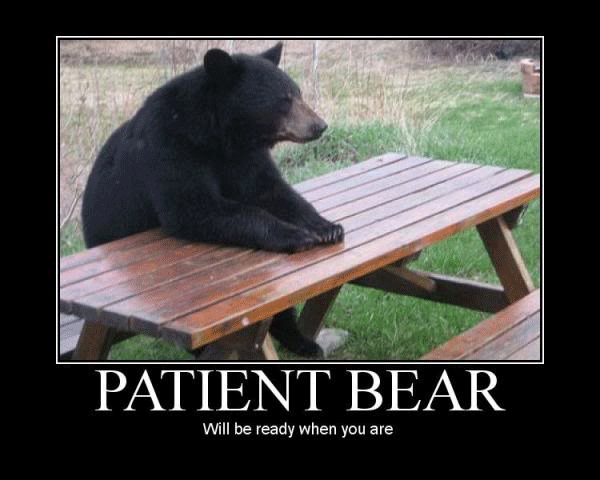
patient bearI got up very early this morning to attend a meeting that had been rescheduled from its regular monthly date. I was happy with myself for remembering the change in date, as I drove to the sunrise gathering of a group of fellow chaplains.

I felt great—until I learned after arriving that our rescheduled meeting had been rescheduled. There I was, all alone . . . and primed for a bit of unseemly disappointment with having risen more than two hours earlier my normal routine, for an aborted purpose.

Because that sort of reaction is not foreign to my nature, I was pleasantly surprised when I didn’t feel that way. Oh, for the briefest of moments (literally, less than a half a minute) I experienced what some might consider a mild case of “upset,” but it immediately gave way to my thoughts of how I could most constructively use the “extra hours” I had received.

The most amazing part of all is that I did not even have to consciously think, how can I put the best construction on this? It just happened.

Now, I’m uncertain whether this positive response was due to my increasing age, or to my growing sanctification. I suspect it’s a combination of the two. It’s such a calm and healthy way to respond to unwelcome events that I wish everyone was able to enjoy it as their norm. Thank you, Lord, for gracing me with this gift for the fall and winter decades of my life.

Being able to see the good in a seeming disappointment, is akin to possessing the virtue of patience. I once made the mistake of praying for “patience.” It was during my college days, and learning to be more patient proved quite painful; it was primarily taught to me by being deluged with a near-infinite number of things which demanded my patience. Quite painful.

In a letter C.S. Lewis wrote to Don Giovanni Calabria in 1948, he says, “We ought to give thanks for all fortune: if it is ‘good,’ because it is good, if ‘bad’ because it works in us patience, humility and the contempt of this world and the hope of our eternal country.”

This is precisely the attitude I wish to experience in my own life.

And, sometimes its fruit is easy to recognize. For example, the cancellation of today’s meeting gifted me with the time required to compose this post itself. And, for that, I am genuinely grateful.

A New Motorcycle Memory

sidecarI witnessed the ending of a life last night. It wasn’t stolen by disease. Nor did it gently surrender to the passage of many decades.

A healthy man, in the prime of his life, died tragically in a traffic accident. The vehicles involved did not appear to have been traveling particularly fast . . . but one was a truck, and the other a motorcycle.

I have many friends who absolutely love their bikes. That includes the fine deputy who I was riding with last night as we responded to the crash. My friends are all smart enough to wear helmets, just as the victim in this case was doing.

I have never personally longed to experience the freedom of riding a motorcycle on the open road. That doesn’t mean I think less of those who do. On the contrary, many of the people whose company I most enjoy consider riding bikes a blast.

I only hope that my grandchildren don’t.

I have no desire to rob my grandkids of any of the joy that life can offer—I’m just cautious and protective by nature.

Several of my friends have been in serous motorcycle accidents. Fortunately, all survived. And they have one more thing in common—none of the incidents was their fault.

As I looked at the bike, crushed beneath the front of the truck, I said a prayer for the rider whose family will never see him again. And as I gazed toward the driver of the truck, I prayed for him too, knowing that his own life would never be the same.

Like money, which is not the root of all evil (the love of money is) . . . so too, it is not motorcycles themselves that are intrinsically dangerous. They just happen to leave their riders so terribly vulnerable when the drivers of more massive vehicles fail to see them.

C.S. Lewis rode in motorcycles. I say “in,” because he was accustomed to riding in the sidecar of his brother Warnie’s cycle. The familiar account of his final conversion from theism to Christianity involves one such ride, to the Whipsnade Zoo. As Lewis wrote, “When we set out I did not believe that Jesus is the Son of God, and when we reached the zoo I did.”

The following diary entries from April 1924 relate to enjoying rides while on holiday. The shorthand “W” stands for his brother, Warnie. The “D” for Mrs. Jane King Moore, the mother of a close friend who died in WWI. The passage illustrates how at home Lewis was when traversing the countryside with his brother.

In the afternoon W generally read: I often went out to get something, or else read and wrote. After tea all three of us went for a most excellent ride in divine weather. We rode through Yatton and Wrington into the Mendips, passing within sight of D’s well beloved Winscombe—a steeple on a hillside seen for a moment in the heart of a beautiful long ridged wooded crooked country. After that we ran through a small gorge out on to the barer southern slope of the Mendips and down into the narrow little streets and beetling houses of Axbridge—glory! what a town and how placed!

Thence on to Cheddar by a road that skirts the hills. Here I saw many fields and trees quite white with blossom and daisies. At Cheddar we caught sight of the gorge up to our left quite unexpectedly: and then while I was still in a confused impression—the speed of a motor cycle is sometimes a great aesthetic advantage—W suddenly turned and ran up it. I lay back in the side car and watched the huge coloured cliffs pushing up further round us and closer till it seemed like going into a tunnel. I was quite unprepared for anything of the sort. It was a great moment.

We turned on our tracks and went on to Wells. Just before reaching it we turned off left at a signpost “To Wookey Hole” to find some quiet pub where we cd. eat our lunch. The lane wound on so long that we began to fear that Wookey Hole was a natural feature, a devil’s punch bowl or the like, and not a village. A village however it turned out to be, with a pub where we sat on a curiously comfortless bench and ate our sandwiches and drank cider.

We then went back and into Wells where W was charged 6d. for leaving the bike in Wells Square by the town authorities, who however “took no responsibility of any sort” for it. W was delighted with the outside of the Cathedral but less pleased with the interior. I think I agreed with him. I also agreed with his view that King’s Chapel, Cambridge, is the perfect building. We then strolled all round the Palace talking of all things that arose therefrom—Barchester, abbots, mediaeval siege tactics. Our ease and freedom and pleasant chat made this visit to Wells far better than my first when I came here on the motor tour with my father and the Hamiltons. In many ways W is the ideal person to go for a jaunt with . . .

On Saturday 26th we all came back to Oxford. It had been arranged that I shd. travel in the sidecar. It was obvious that one of us shd. do so to save fares and D, of course, refused to be that one. I therefore trained with her to Yatton and saw her into a through train to Bristol with the luggage, and W, Pat and I got aboard the bike. As we were making all snug outside Yatton station, a hamper, wh. had just been taken out of the train, was suddenly opened just beside us to release a cloud of pigeons that filled the air with an amazing noise before we knew what was forward. It was a curious experience for I had not suspected the hamper of containing anything live.

It was raining when we started but soon cleared up. We got into the main road shortly before Wrington and entered Bristol by Bedminster… From Faringdon we came along at a very good speed thro’ Bickland, Kingston Bagpuize, Fyfield, Bessels, Leigh, Cumnor and Botley to Oxford. It is a tame, well combed, cheerful country of tidy well growing woods, white gates, dark tarred roads, comfortable cottages, sometimes exceedingly beautiful, green hedges and flat blue distances. The speed, the sunlight, and the sense of coming home put me into an unusually prolonged fit of “joy.”

As Lewis says, “the speed [and] the sunlight” of a motorcycle trip can surely be exhilarating. Likewise, “the speed of a motor cycle is sometimes a great aesthetic advantage.” Clearly, C.S. Lewis enjoyed motorcycles greatly.

But I still hope my grandchildren are not seduced by motorcycles’ allures.

Exhibitionist Civilization

realitytvWe live in an exhibitionist era. It’s evident everywhere, but reaches a revolting crescendo in some of the extreme “reality tv” that’s become a standard feature of what passes for “entertainment” in a decadent society.

Not all reality programming is inherently vulgar. Some is potentially beneficial. For example:

Cops

Provides reinforcement for staying on the straight and narrow.

Deadliest Catch

Teaches us that whatever we’re doing, there are some jobs we could have that are even worse.

American Idol

I don’t watch it, but my impression is it basically revolves around decent entertainment and at least one prima donna judge.

The Apprentice

Teaches us the worst boss we ever had may not have been quite as bad as we recall.

So You Think You Can Dance

I don’t watch this either, but understand it’s pretty innocuous, aside from occasional humiliation.

Survivorman

Learn how to survive in the wilderness, from a guy with a fantastic surname: Les Stroud.

Among the many programs I would never watch, even if you paid me: Jersey Shore, Here Comes Honey Boo Boo, Keeping Up with the Kardashians.

A show I’m curious about—but not interested enough to waste any time investigating—is Pastors of LA. Apparently, one of the featured ministers, who committed adultery and fathered a child while still married, proclaimed: “I have not preached on any platform in any church for one year! I’ve paid my penalty for my sin!” Not quite sure where he found that equation in the scriptures, but perhaps pastors of Los Angeles megachurches determine their own penances.

I can’t understand the allure of exhibitionism. Stripping down to one’s most embarrassing and offensive qualities, and parading those before an anonymous audience, is nowhere on my bucket list.

Even stranger to me than the willingness of a minority to invite public mockery and derision is the desire of relatively significant audiences to view some of these misbegotten concepts.

C.S. Lewis helps me understand the problem. In an article entitled “After Priggery—What?” he says:

We have lost the invaluable faculty of being shocked—a faculty which has hitherto almost distinguished the Man or Woman from the beast or the child.

Lewis begins the essay by condemning “priggery,” the judging of what is bad that infers the “prig” is morally superior. He also raises the question of whether or not our failure to condemn publically demeaning or destructive behaviors results in more damage to society than does the act of making moral judgments.

The illustration he uses is that of a “wicked journalist, a man who disseminates for money falsehoods calculated to produce envy, hatred, suspicion and confusion.” (There seems no shortage of such people in our world.)

Lewis says that our toleration of these malevolent influences is a terrible mistake. The following passage criticizes the fact that we actually enable such conduct by supporting it.

If we must find out what bad men are Writing, and must therefore buy their papers, and therefore enable their papers to exist, who does not see that this supposed necessity of observing the evil is just what maintains the evil? It may in general be dangerous to ignore an evil; but not if the evil is one that perishes by being ignored.*

I find Lewis’ argument applicable to the existence of all sorts of reprehensible material, beginning perhaps, with pornography. To a lesser degree, one might even consider it to apply to exhibitionist entertainment. After all, it is not profitable to viewers and it is rarely (if ever) beneficial to the participants themselves.

And thus, culture declines. Dribble by dribble. I just heard on a newscast today, literally while I was writing this post, that a major cable channel is offering a new reality program entitled “Naked Dating.” Guess what it is about. Precisely what it says. I’m sure that the voyeurs are eagerly awaiting its debut.

In a more enlightened age, society would have ostracized those who flaunted their promiscuous, antisocial, humiliating or debauched lifestyles. Today the people who receive public disapproval seem to be those who question those very behaviors.

As for me, I’m renewing my commitment to the principle suggested by C.S. Lewis. I will do my best to consistently avoid supporting the things contributing to the erosion of modesty, respect, goodness and virtue. I suspect that means I won’t be spending an undue amount of time watching these “reality” programs that too often reflect the seamier aspects of human nature.

____

* If you would like to read the entire essay, it is available here.

Trusting Serpents

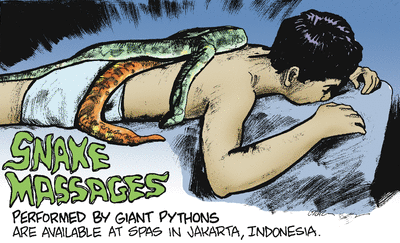
snake massageI try very hard not to be overly critical of foreign practices that initially strike me as rather odd. Instead, I attempt to understand what these activities mean in the culture where they are practiced.

Yet, for the life of me (as my mother would say), I can’t fathom why Indonesians want to have snakes give them “massages.” And, even though only a fraction of their people submit to this peculiar activity, there are apparently enough candidates for spas to offer the serpentine service.

I imagine that the snakes do indeed rub, flex and squeeze their clients, since pythons are “constrictors,” and it’s in their nature to want to circle—suffocate—crush—and devour their prey.

Ironically, this fact, compliments of Ripley’s Believe It or Not, follows in the wake of a recent news report about another man who thought he would be fine getting a shoulder massage from an apparently “undomesticated” python.

BALI, Indonesia (AP) — A python strangled a security guard near a luxury hotel on Indonesia’s resort island of Bali on Friday, and then escaped into nearby bushes following the deadly attack, police and a hotel employee who witnessed the incident said. The incident happened around 3 a.m. as the 15-foot-long python was slithering across a road near the Bali Hyatt hotel . . .

The victim, Ambar Arianto Mulyo, was a 59-year-old security guard at a nearby restaurant. He had offered to help capture the snake, which had apparently been spotted several times before near the hotel . . . Mulyo managed to secure the snake’s head and tail and put it on his shoulders, but the python wrapped itself around his body and strangled him . . .

People watching the incident were unable or unwilling to help and called the police, who came but failed to save the man. The python escaped into nearby bushes, and police were still searching for it.

The Associated Press story ends with the lame attempt to calm those who are inclined to suffer from ophidiophobia. “Deadly attacks on adult humans by pythons are rare, but have been documented before.”

Pardon me, but that’s not quite sufficient reassurance for even those of us without a snake phobia. I remember hearing from my wife about my young daughter’s class being introduced to a sizeable serpent some years ago during a fieldtrip. As everyone watched the handler manipulating its head and frontal coils, it was surreptitiously beginning to caress my little girl with its tail!*

If the Indonesian practice of python-massage crosses the Pacific, you won’t find me visiting the spa for a back rub. I understand they probably only employ well-fed, six-foot-long “baby” pythons, but I still choose to pass.

C.S. Lewis has a wonderful comment about trust. He says the true test of how deeply we believe something is the magnitude of the risk we are willing to take related to our trust in it.

You never know how much you really believe anything until its truth or falsehood becomes a matter of life and death to you. It is easy to believe a rope to be strong and sound as long as you are merely using it to cord a box. But suppose that you had to hang by that rope over a precipice. Wouldn’t you then first discover how much you really trusted it? . . . Only a real risk tests the reality of a belief. (A Grief Observed).

I don’t care how many herpetologists or masseuses assure that pythons can safely massage my bared body . . . I’m learning from the example of that poor Balinese guard who fell for the python’s trick, thinking that he held the upper hand.

_____

* Yes, snakes actually do have tails. It’s only one of their slithering secrets.

A Song has Ended

lyric christmasSix months of life with someone you love, is too brief. Far too brief.

Only last June I invited you to share our joy with the adoption into our family of Lyric, a border collie mix.

Tragically, last night the precious girl passed away. And our family is now dealing with the shock and grief that are such a painful (but inescapable) part of loving the pets who join our families.

After Lyric had been with us for several months, we saw evidence (excessive salivation and frantic, happy racing around the house) of a health concern. When we later witnessed a seizure that lasted just a minute or two, it was nearly as traumatic to us as it was to her. That feeling of helplessness is horrible, isn’t it?

Visits to the vet resulted in the suspicion that it may have been caused by the mushrooms that grow abundantly in the Pacific Northwest forest where we live. (This has been a particularly favorable year to all forms of fungi, and this is a fairly common cause of canine seizures.)

We took precautions to minimize her exposure to that source, but she had several more seizures, weeks apart. Our two vets said that if she experienced a “cluster” of seizures, there were some drugs we could try. However, we never saw any indications of that, so we remained in a monitoring status.

Tragically, late last night, while lying beside me as I was writing, she began what became a relentless series of attacks on her system. She briefly stabilized between each seizure, but they grew longer and more severe. Finally, her strong heart (mercifully) surrendered, and she was gone.

C.S. Lewis was writing about the death (and resurrection) of human beings in his essay “Some Thoughts,” but his words about the alien nature of death resonate with what I am feeling today.

Of all men, we hope most of death [as in, not being the end of all, but a passage to an even more real life]; yet nothing will reconcile us to—well, its unnaturalness. We know that we were not made for it; we know how it crept into our destiny as an intruder; and we know Who has defeated it.

Because Our Lord is risen we know that on one level it is an enemy already disarmed; but because we know that the natural level also is God’s creation we cannot cease to fight against the death which mars it, as against all those other blemishes upon it, against pain and poverty, barbarism and ignorance. Because we love something else more than this world we love even this world better than those who know no other.

Animals, of course, don’t share humanity’s souls. But when you gaze into those love-filled, adoring eyes of your dog, only someone spiritually blind would fail to recognize there is a precious spark within.

I have written in the past about the possibility of God restoring our pets to us in heaven. I won’t belabor that possibility here. After all, it’s merely conjecture. But, in these moments of grief, many find some small comfort in the possibility of God restoring to life these beloved, and innocent, victims of humanity’s disobedience in the Garden.

I began my first post about Lyric with these words:

Last night a new member joined our family. Her name is musical. We didn’t choose it; her previous family did. But we think it fits and she’ll live up to it.

It was for far too short a time, but Lyric definitely did live up to the beauty of her name.

Up in Smoke

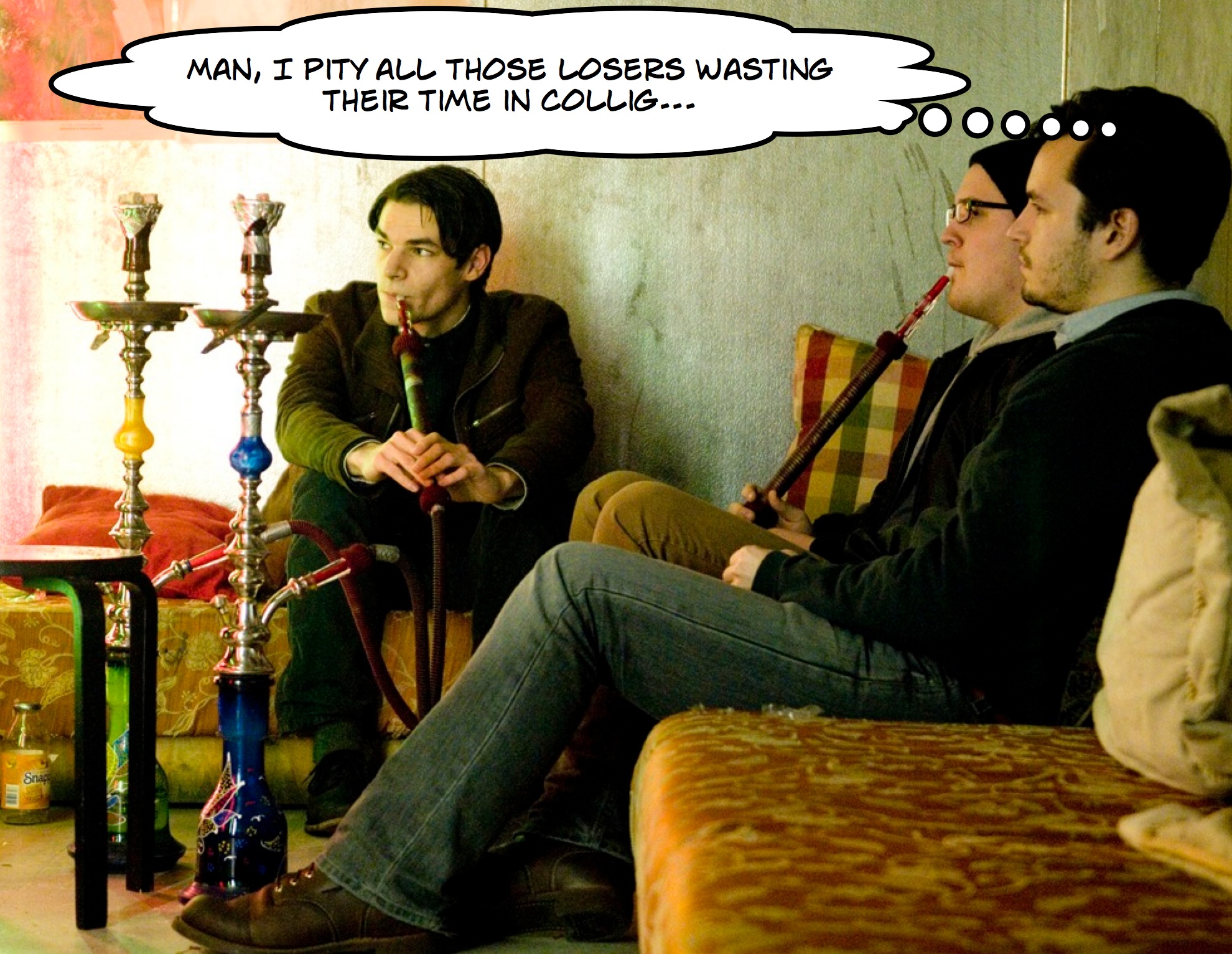
hookahsI have the misfortune of living in one of the two states that has legalized the growing, distribution, use and promotion of marijuana.

The fauna and (natural) flora of Washington are scenic beyond compare. But in order to enjoy them, I am forced to live in a location where what was inconceivable a decade ago has become commonplace.

This week, in my small town of nine thousand, they opened our first “hookah lounge.” Although the owner’s initial license only allows the sale and on premises use of various tobaccos and other weeds, it’s no secret the owner is eager to expand his offerings.

My purpose here is not, however, to debate the merits of legalizing cannabis. I want to share with you the utterly apropos name of this hookah palace. It is called “Up in Smoke.”

While I’m sure the entrepreneur thought he concocted a brilliant play on words for his establishment, I cannot help but shake my head at the irony.

After all, what does the phrase actually mean? The expression isn’t truly an “idiom,” since the words are quite straight forward. It means what it says, referring to something of potential value that has been burned and is now lost, spoiled or wasted. Of course, the last of those synonyms also has another connection to the world of drugs.

I suspect the actual meaning of the phrases pass right over the head of the owner. He certainly misses the irony, or he would not adorn his establishment with that moniker.

I assume the purveyor of lung destroying inhalants is consciously referencing the 1978 film by this name, that glorifies the drugged induced stupors of Cheech and Chong. (Not a pinnacle of cinematic achievement.)

The saddest thing about using drugs for “recreation,” or distraction from the responsibilities of life, is that it often results in lives going up in smoke. While marijuana itself is apparently used “recreationally” by many successful people, with little negative impact, that’s far from true for all who “inhale.”

As I try to recall every individual I’ve personally known who used the drug, I’m unable to think of a single person who stopped there and did not at least experiment with some other drug. From my subjective experience, it definitely proved to be a “gateway” drug.

While none of these acquaintances became what would traditionally be labeled an “addict,” I can think of several tremendously talented and gifted people who never lived up to their potential. And I attribute at least part of that regret to being distracted from school and employment as young adults.

Similarly, of all of the people I’ve counseled regarding drug-related struggles during the past three decades, I’m hard-pressed to recall a single one who did not begin his or her narcotic journey with the ubiquitous weed.

Drugs, of course, are not the only diversions that cause us to miss out on the full experience that life offers. As C.S. Lewis wrote:

We are half-hearted creatures, fooling about with drink and sex and ambition when infinite joy is offered us, like an ignorant child who wants to go on making mud pies in a slum because he cannot imagine what is meant by the offer of a holiday at the sea. We are far too easily pleased. (The Weight of Glory)

I’m not casting stones here. I too waste far too much time and energy with fruitless distractions. In doing so, I watch part of my own life go up in smoke. Still, I doubt I’ll ever experience the slightest temptation to waste the briefest moment of my life . . . in an ill-named hookah den.

Adoption = Love

coupleToday marks a very special day in our family, the anniversary of our oldest grandchild’s adoption into our family.

While seven of our grandkids are aged seven and younger, Andrew is an amazing young man who has already married a lovely young woman. My wife and I are terribly proud of the path he is on, which has taken him to Japan, where he is promoting peace as a member of the United States Air Force.

While we all naturally love children physically “born into” our families, there is a singular affection—a consciously chosen and active love—we extend to those we adopt.

Delores and I seriously investigated international adoption during my assignment to Korea in the late eighties. Unfortunately, the doors closed, and it was not to be. We believe strongly in the importance and delight of adoption.

Although adoptions bring a few unique challenges to the family mix, there is no stress free recipe for parenting. Every successful formula involves a number of the same ingredients. Among them, patience and forgiveness need to be poured out in considerable quantity.

I wish to commend each of you readers who have adopted a child, or helped others to do so. And I also pray for God’s blessing upon each of you who are foster parents.

Finally, I offer a prayer for each of you who are, yourself, adopted. May your relationship with your parents fulfill all of the hopeful dreams that were held by all on the day that you entered your “new” family.

C.S. Lewis knew a great deal about adoption. He recognized how ill-prepared he was to become a step-father and ultimately a widowed single parent. In a 1957 letter he wrote:

I have married a lady suffering from cancer. I think she will weather it this time: after that, life under the sword of Damocles. Very little chance (not exactly none) of a permanent escape. I acquire two schoolboy stepsons. My brother and I have been coping with them for their Christmas holidays. Nice boys, but gruelling work for 2 old bachelors! I’m dead tired now.

In his biography, Jack’s Life, Douglas Gresham, one of those “nice boys,” described the situation after the death of his mother, Joy.

Jack also had a new responsibility to take care of, two teenage stepsons, each presenting the typical problems associated with growing up, though each in his own unique way. As was typical of the man he had become, Jack did everything he could to help these two young men. He knew all too well from his own life’s experiences how difficult their lives had been and tried hard to do the best he could for them.

A closing thought, as we all return to our other tasks and diversions. Christians see themselves as adopted. While all humanity is created in the wondrous image of God, entrance into the community of faith, the family of God, comes through faith in his only begotten Son. Because of Jesus’ life, death and resurrection, we are able to rightly call God, “Father.”

I’m overjoyed to be adopted into that holy family. And that adoption didn’t occur because I was smart, or handsome, or witty, or praiseworthy in any way. I was adopted solely because of the mercy and love of God.

And that divine adoption provides the perfect model for us to emulate in our world today.

Clay Hearts

clay heartHonesty compels us to admit that we have clay feet. We are merely mortal, and our origin from the clay of the earth is a reminder that we are imperfect.

Stumbling due to our feet of mud is one thing. Far worse, we earthen vessels also have hearts of clay. Our affections are fickle, and too often we fail to fulfill our vows to those who have made themselves vulnerable by entrusting to us their own love.

I doubt any of us have been untouched by the pain of transient love. The ideal we long for . . . the vision we dream about . . . and the lasting intimacy we pray for often seem so very fleeting.

Saddest, to me, are those relationships that have lasted many years, where the once glowing light has dimmed and the comforting warmth has dissipated.

That is the story of a remarkable, Oscar-nominated animation I would like to commend to you. Head Over Heels is a unique 10-minute claymation film about a broken marriage and how it comes “unbroken.”

C.S. Lewis did not marry until late in life. The personal experience of marriage, of course, modified some of his bachelor perceptions about the holy estate.

Nevertheless, having been married for thirty-seven years myself, I continue to be amazed by just how perceptive Lewis was throughout his writing life. Consider the following from The Four Loves.

Lewis discusses the importance and glory of passion consecrated by marital vows, but he does not pretend that it does not wax and wane. Nor does he imagine that even between wife and husband, a focus on the passion in their relationship is without potential hazards.

Discussing erotic love (one of the four he describes), Lewis warns:

But Eros, honoured without reservation and obeyed unconditionally, becomes a demon. And this is just how he claims to be honoured and obeyed. . . . Of all loves he is, at his height, most god-like; therefore most prone to demand our worship. Of himself he always tends to turn “being in love” into a sort of religion.

Theologians have often feared, in this love, a danger of idolatry. I think they meant by this that the lovers might idolise one another. That does not seem to me to be the real danger; certainly not in marriage. The deliciously plain prose and businesslike intimacy of married life render it absurd. So does the Affection in which Eros is almost invariably clothed.

Even in courtship I question whether anyone who has felt the thirst for the Uncreated, or even dreamed of feeling it, ever supposed that the Beloved could satisfy it. As a fellow-pilgrim pierced with the very same desire, that is, as a Friend, the Beloved may be gloriously and helpfully relevant; but as an object for it—well (I would not be rude), ridiculous. The real danger seems to me not that the lovers will idolise each other but that they will idolise Eros himself.

I believe Lewis has identified something profound here. The utter familiarity, the nakedness of our souls, that is part of any genuine marriage precludes anyone sane person from idolizing their partner. We, after all, are more familiar than any other human being with their feet of clay.

However, if we succumb to the snares of Eros, cast wide across television, literature, cinema and internet, we doom ourselves. True love will not cohabit with this counterfeit.

An uncritical attention to the physical seldom results in happiness. As Lewis so accurately says, “For Eros may unite the most unsuitable yokefellows; many unhappy, and predictably unhappy, marriages were love-matches.”

The good news, celebrated by Head Over Heels, is that even when love fades away, there is still hope. Just as clay-footed human beings can experience resurrection, so too our clay-hearted relationships can be restored and blaze with renewed joy.