Explosive Clergy

What’s with pastors? As one, I probably know more than the typical person does about them – and all too often, they disappoint.

That’s a bit harsh. Most pastors are pretty selfless. That’s fairly evident in their salaries (if they even receive one). And, trust me, trying to be a faithful leader and peacemaker in any group comprised of human beings, is no easy task.

My sainted grandmother, born at the end of the nineteenth century, was the daughter of Norwegian immigrants. She was an authentic follower of Jesus, and when she was young the sermons at Fordefjord Lutheran Church* were preached in the immigrants’ tongue. We occasionally talked about how scandalized she was when one of the ministers serving the congregation pronounced “helvete vil være fullt av pastorer” (hell will be full of pastors).

Well, not “full” perhaps, but in principle he was right. And, sadly, his warning is not at all shocking to us today. We read regularly about clergy who are arrested for violating the trust of the most vulnerable. Likewise, we hear about the outrageous wealth of some ministers (including, it seems, nearly every televangelist). Even pastors in small enclaves with little access to the temptation offered by easily accessible cash, can too often succumb to the sirens of pride and power, twisting their pastoral authority into a weapon to abuse others. (It’s the opposite of the messianic promise found in Isaiah 2:4.)

It’s almost enough to drive a person from the Lord’s house. But that is not the answer, of course. Finding a truly Christian church, with a pastor earnestly (albeit imperfectly) pursuing his holy vocation, is the best course.

The Scriptures say many things about ministry, and Jesus himself provides the perfect example of willingness to lay down one’s life for the sheep.

The letter of James cautions those considering a life of “ministry” that they will face a stricter judgment than the laity (which comes from λαός which refers to the people at large).

Personally, I especially appreciate being reminded of God’s warning to religious leaders from the lips of Jeremiah. (I also appreciate the ironic tone of God’s judgment.)

“Woe to the shepherds who destroy and scatter the sheep of my pasture!” declares the Lord. Therefore thus says the Lord, the God of Israel, concerning the shepherds who care for my people: “You have scattered my flock and have driven them away, and you have not attended to them. Behold, I will attend to you for your evil deeds,” declares the Lord.

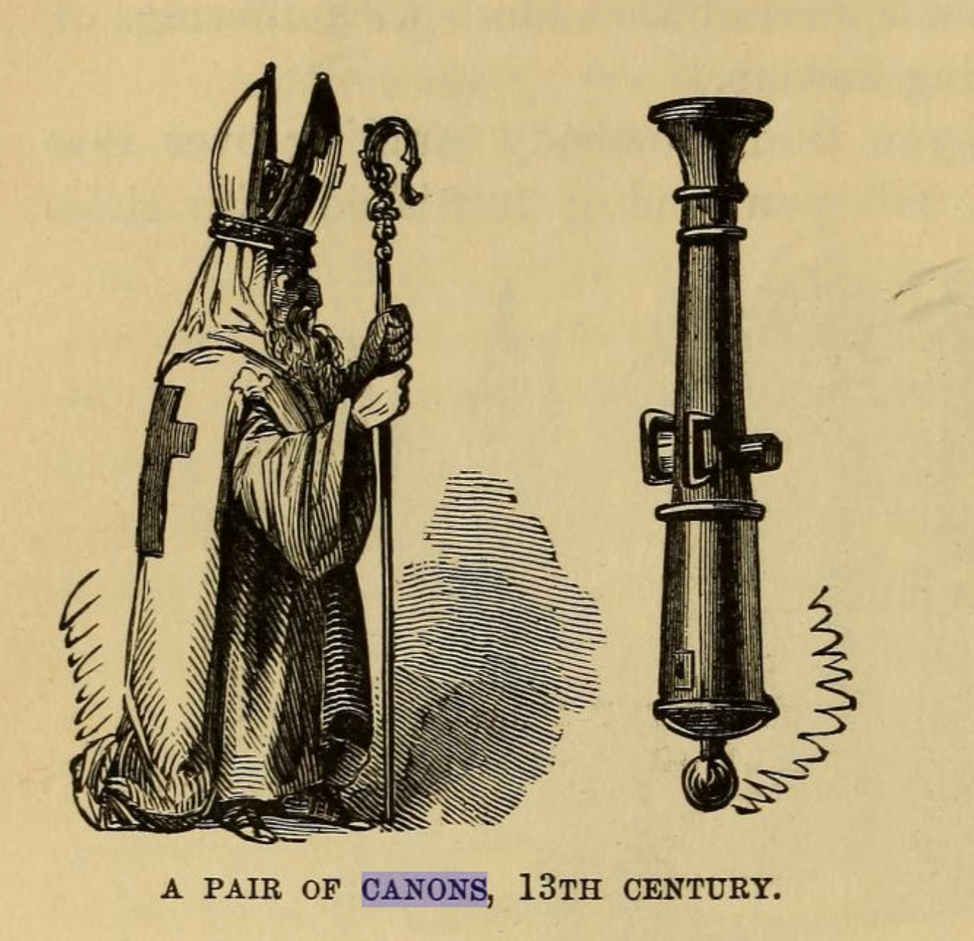
The picture at the top of this column comes from one of Mark Twain’s travelogues. It illustrates the vindictive priest Fulbert, in Twain’s retelling of the story of Abelard and Héloïse, 12th century lovers. More about that momentarily. Abelard was a prominent philosopher who tangled for several years with Saint Bernard of Clairvaux, a significant dispute ably discussed here.

Abelard and the Inklings

Abelard (c. 1079-1142) was a philosopher who, as was common during the Middle Ages, was also a theologian. Among his contributions to religion was revising the Roman Catholic doctrine of limbus infantium (Limbo for unbaptized infants).

In popular culture, Abelard’s love affair with his eventual “wife” is more prominent than his religious pursuits. Although Abelard was a famous figure during the medieval period, he did not feature significantly in C.S. Lewis’ thought. He did, however, exert a prominent influence on Charles Williams’ Place of the Lion, a volume Lewis praised.

In “Friendship in The Place of the Lion,” Dan Hamilton provides a very accessible synopsis of Williams’ book. He describes the experience of a primary character, who is writing her dissertation on “Pythagorean Influences on Abelard.” As she struggles with the appearance of supernatural phenomena, “she encounters the specter of Abelard, a major subject of her studies. But he is dead, and powerless to give her any aid, not even a meaningful word.” The “archetypes” in the story, by contrast, possess genuine power. It is a very unique book.

Returning to Mark Twain’s retelling of the popular medieval tale, we leave the realm of platonic philosophy, and enter the world of sordid human activities. Twain, you see, was not sympathetic to Abelard’s wooing of a young student and his eventual repentance. In his account, Twain desired “to show the public that they have been wasting a good deal of marketable sentiment very unnecessarily.” If you are curious as to his perspective on the events, continue reading.

Twain’s Take on Abelard and Héloïse
(not brief, but well worth reading)

In his own words, Twain’s “faithful” version of their story – but first, he begins with a description of their shared gravesite.

But among the thousands and thousands of tombs in Père la Chaise [cemetery] there is one that no man, no woman, no youth of either sex, ever passes by without stopping to examine. Every visitor has a sort of indistinct idea of the history of its dead, and comprehends that homage is due there, but not one in twenty thousand clearly remembers the story of that tomb and its romantic occupants. This is the grave of Abelard and Heloise – a grave which has been more revered, more widely known, more written and sung about and wept over, for seven hundred years, than any other in Christendom, save only that of the Saviour.

All visitors linger pensively about it; all young people capture and carry away keepsakes and mementoes of it; all Parisian youths and maidens who are disappointed in love come there to bail out when they are full of tears; yea, many stricken lovers make pilgrimages to this shrine from distant provinces to weep and wail and “grit” their teeth over their heavy sorrows, and to purchase the sympathies of the chastened spirits of that tomb with offerings of immortelles and budding flowers.

Go when you will, you find somebody snuffling over that tomb. Go when you will, you find it furnished with those bouquets and immortelles. Go when you will, you find a gravel-train from Marseilles arriving to supply the deficiencies caused by memento-cabbaging vandals whose affections have miscarried.

Yet who really knows the story of Abelard and Heloise? Precious few people. The names are perfectly familiar to every body, and that is about all. With infinite pains I have acquired a knowledge of that history, and I propose to narrate it here, [italics added] partly for the honest information of the public and partly to show that public that they have been wasting a good deal of marketable sentiment very unnecessarily.

Heloise was born seven hundred and sixty-six years ago. She may have had parents. There is no telling. She lived with her uncle Fulbert, a canon of the cathedral of Paris. I do not know what a canon of a cathedral is, but that is what he was. He was nothing more than a sort of a mountain howitzer, likely, because they had no heavy artillery in those days. Suffice it, then, that Heloise lived with her uncle the howitzer, and was happy.

She spent the most of her childhood in the convent of Argenteuil – never heard of Argenteuil before, but suppose there was really such a place. She then returned to her uncle, the old gun, or son of a gun, as the case may be, and he taught her to write and speak Latin, which was the language of literature and polite society at that period.

Just at this time, Pierre Abelard, who had already made himself widely famous as a rhetorician, came to found a school of rhetoric in Paris. The originality of his principles, his eloquence, and his great physical strength and beauty created a profound sensation. He saw Heloise, and was captivated by her blooming youth, her beauty and her charming disposition. He wrote to her; she answered. He wrote again, she answered again. He was now in love. He longed to know her – to speak to her face to face.

His school was near Fulbert’s house. He asked Fulbert to allow him to call. The good old swivel saw here a rare opportunity: his niece, whom he so much loved, would absorb knowledge from this man, and it would not cost him a cent. Such was Fulbert – penurious . . . He asked Abelard to teach her.

Abelard was glad enough of the opportunity. He came often and staid long. A letter of his shows in its very first sentence that he came under that friendly roof like a cold-hearted villain as he was, with the deliberate intention of debauching a confiding, innocent girl. This is the letter :

“I can not cease to be astonished at the simplicity of Fulbert; I was as much surprised as if he had placed a lamb in the power of a hungry wolf. Heloise and I, under pretext of study, gave ourselves up wholly to love, and the solitude that love seeks our studies procured for us. Books were open before us, but we spoke oftener of love than philosophy, and kisses came more readily from our lips than words.”

And so, exulting over an honorable confidence which to his degraded instinct was a ludicrous “simplicity,” this unmanly Abelard seduced the niece of the man whose guest he was. Paris found it out. Fulbert was told of it – told often – but refused to believe it. He could not comprehend how a man could be so depraved as to use the sacred protection and security of hospitality as a means for the commission of such a crime as that. But when he heard the rowdies in the streets singing the love-songs of Abelard to Heloise, the case was too plain – love-songs come not properly within the teachings of rhetoric and philosophy.

He drove Abelard from his house. Abelard returned secretly and carried Heloise away to Palais, in Brittany, his native country. Here, shortly afterward, she bore a son, who, from his rare beauty, was surnamed Astrolabe. . . . The girl’s flight enraged Fulbert, and he longed for vengeance, but feared to strike lest retaliation visit Heloise – for he still loved her tenderly. At length Abelard offered to marry Heloise – but on a shameful condition: that the marriage should be kept secret from the world, to the end that (while her good name remained a wreck, as before) his priestly reputation might be kept untarnished. It was like that miscreant.

Fulbert saw his opportunity and consented. He would see the parties married, and then violate the confidence of the man who had taught him that trick; he would divulge the secret and so remove somewhat of the obloquy that attached to his niece’s fame. But the niece suspected his scheme. She refused the marriage, at first; she said Fulbert would betray the secret to save her, and besides, she did not wish to drag down a lover who was so gifted, so honored by the world, and who had such a splendid career before him. It was noble, self-sacrificing love, and characteristic of the pure-souled Heloise, but it was not good sense.

But she was overruled, and the private marriage took place. Now for Fulbert! The heart so wounded should be healed at last; the proud spirit so tortured should find rest again; the humbled head should be lifted up once more. He proclaimed the marriage in the high places of the city, and rejoiced that dishonor had departed from his house. But lo! Abelard denied the marriage! Heloise denied it! The people, knowing the former circumstances, might have believed Fulbert, had only Abelard denied it, but when the person chiefly interested – the girl herself – denied it, they laughed despairing Fulbert to scorn.

The poor canon of the cathedral of Paris was spiked again. The last hope of repairing the wrong that had been done his house was gone. What next? Human nature suggested revenge. He compassed it. The historian says: “Ruffians, hired by Fulbert, fell upon Abelard by night, and inflicted upon him a terrible and nameless mutilation.”

I am seeking the last resting-place of those “ruffians.” When I find it I shall shed some tears on it, and stack up some bouquets and immortelles, and cart away from it some gravel whereby to remember that howsoever blotted by crime their lives may have been, these ruffians did one just deed, at any rate, albeit it was not warranted by the strict letter of the law.

Heloise entered a convent and gave good-bye to the world and its pleasures for all time. For twelve years she never heard of Abelard – never even heard his name mentioned. She had become prioress of Argenteuil, and led a life of complete seclusion. She happened one day to see a letter written by him, in which he narrated his own history. She cried over it, and wrote him. He answered, addressing her as his “sister in Christ.”

They continued to correspond, she in the un-weighed language of unwavering affection, he in the chilly phraseology of the polished rhetorician. She poured out her heart in passionate, disjointed sentences; he replied with finished essays, divided deliberately into heads and sub-heads, premises and argument. She showered upon him the tenderest epithets that love could devise, he addressed her from the North Pole of his frozen heart as the “Spouse of Christ!” The abandoned villain!

On account of her too easy government of her nuns, some disreputable irregularities were discovered among them, and the Abbot of St. Denis broke up her establishment. Abelard was the official head of the monastery of St. Grildas de Ruys, at that time, and when he heard of her homeless condition a sentiment of pity was aroused in his breast (it is a wonder the unfamiliar emotion did not blow his head off), and he placed her and her troop in the little oratory of the Paraclete, a religious establishment which he had founded.

She had many privations and sufferings to undergo at first, but her worth and her gentle disposition won influential friends for her, and she built up a wealthy and flourishing nunnery. She became a great favorite with the heads of the church, and also the people, though she seldom appeared in public. She rapidly advanced in esteem, in good report and in usefulness, and Abelard as rapidly lost ground. The Pope so honored her that he made her the head of her order.

Abelard, a man of splendid talents, and ranking as the first debater of his time, became timid, irresolute, and distrustful of his powers. He only needed a great misfortune to topple him from the high position he held in the world of intellectual excellence, and it came. Urged by kings and princes to meet the subtle St. Bernard in debate and crush him, he stood up in the presence of a royal and illustrious assemblage, and when his antagonist had finished he looked about him, and stammered a commencement; but his courage failed him, the cunning of his tongue was gone: with his speech unspoken, he trembled and gat down, a disgraced and vanquished champion.

He died a nobody, and was buried at Cluny, A.D., 1144. They removed his body to the Paraclete afterward, and when Heloise died, twenty years later, they buried her with him, in accordance with her last wish. He died at the ripe age of 64, and she at 63. After the bodies had remained entombed three hundred years, they were removed once more. They were removed again in 1800, and finally, seventeen years afterward, they were taken up and transferred to Pere la Chaise, where they will remain in peace and quiet until it comes time for them to get up and move again.

History is silent concerning the last acts of the mountain howitzer. Let the world say what it will about him, I, at least, shall always respect the memory and sorrow for the abused trust, and the broken heart, and the troubled spirit of the old smooth-bore. Rest and repose be his!

Such is the story of Abelard and Heloise. (Innocents Abroad).


* Later Fordefjord was unimaginatively renamed “First Lutheran Church.”

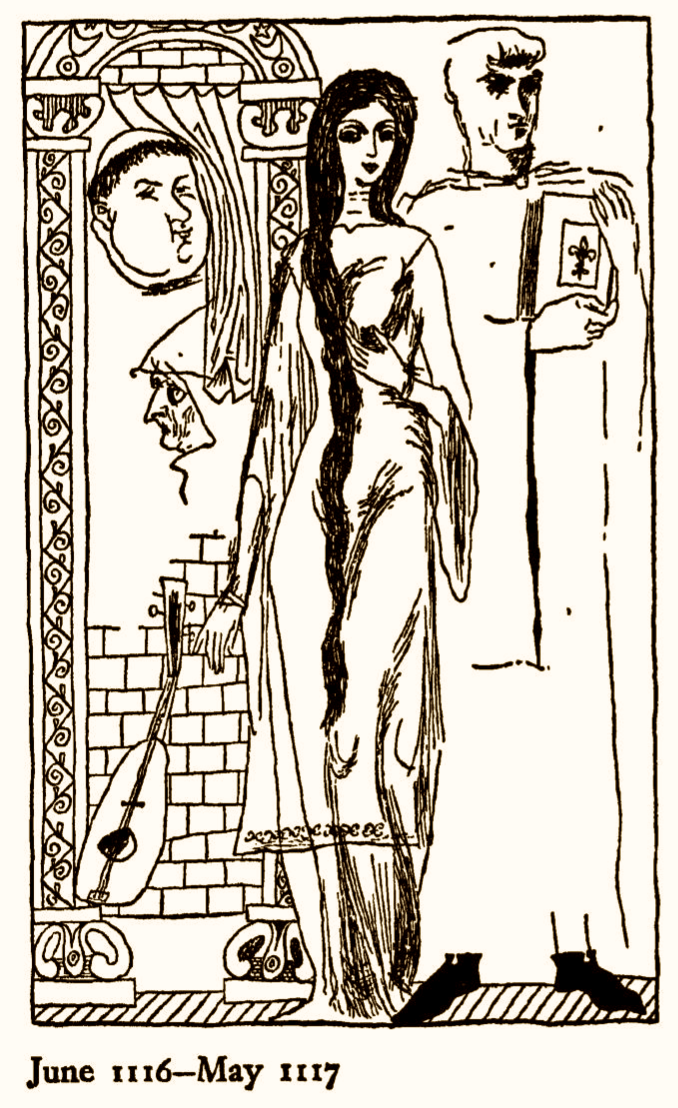
A novel entitled Peter Abelard was published in 1933 by Helen Waddell. It is available at Internet Archive for those who prefer their history via the medium of historical fiction. The illustration below, apparently imitating a fading fresco, comes from that volume.
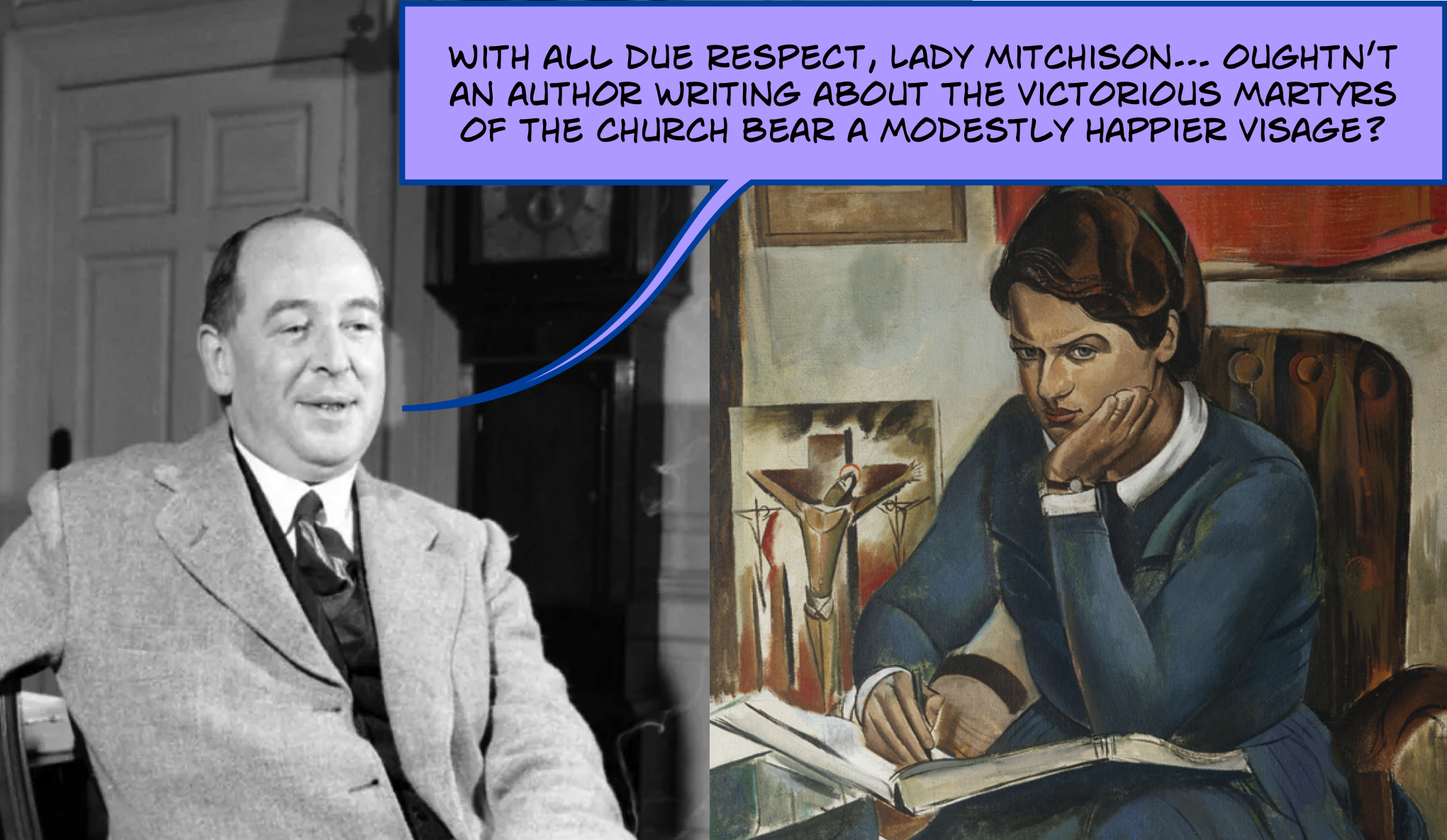
C.S. Lewis, J.R.R. Tolkien & Naomi Mitchison

Have your feelings about particular authors changed over time? C.S. Lewis’ attitude toward the work of prolific novelist Naomi Mitchison illustrates this type of progression.

Mitchison’s work possesses a direct link to another Oxford Inkling – J.R.R. Tolkien – whose Fellowship of the Ring she read in proof and favorably reviewed. Brenton Dickieson provides a priceless letter written by Tolkien to Mitchison in 1954.

Naomi Mary Margaret Mitchison was a Scottish novelist who lived more than a century (1897 – 1999). She penned more than ninety books, primarily historical fiction, and including science fiction.

With the outbreak of the First World War, Mitchison joined a Voluntary Air Detachment in a London hospital. (Other familiar women who served in a VAD included Agatha Christie and Amelia Earhart.)

Politically she identified as a Socialist. She was sufficiently leftist that George Orwell regarded her as unsuited for writing anti-Soviet materials for the United Kingdom during the Cold War.

Mitchison’s brother, J.B.S. Haldane, did not equivocate on his radical views, announcing his position as a Marxist. He was a scientist and his atheism brought him into serious disagreement with the Christian views of C.S. Lewis. (I will devote my next post to that interaction.)

Coincidentally, artist Pauline Baynes (who also worked with C.S. Lewis and J.R.R. Tolkien), provided the illustrations for at least one of Mitchison’s children’s books, Graeme and the Dragon. This quick review offers a concise synopsis and discussion of “the charming illustrations [which] go a long way toward making this a fun read.”

An additional coincidence: the same year Lewis published The Lion, the Witch and the Wardrobe, Mitchison also published a fantasy novel for children. The Big House involves time travel and some occultic themes associated with Halloween, etc.

For a thorough synopsis of The Big House and comparison to Lewis’ Chronicles of Narnia, check out this essay from the University of Glasgow. (That reviewer’s preference is clearly for Mitchison’s more complex approach with its themes related to class struggle.)

C.S. Lewis’ Perspective on Naomi Mitchison

I cannot locate any mention of C.S. Lewis by Mitchison, but he did mention her in passing in several pieces of correspondence. In essence, he praised her skill, but was put off by her graphic use of violent imagery.

In a 1932 letter to Arthur Greeves, he writes:

I thought we had talked about Naomi Mitchison before. I have only read one (Black Sparta) and I certainly agree that it ‘holds’ one: indeed I don’t know any historical fiction that is so astonishingly vivid and, on the whole, so true.

I also thought it astonishing how, despite the grimness, she got such an air of beauty–almost dazzling beauty–into it. As to the cruelties, I think her obvious relish is morally wicked, but hardly an artistic fault for she could hardly get some of her effects without it.

But it is, in Black Sparta, a historical falsehood: not that the things she describes did not probably happen in Greece, but that they were not typical–the Greeks being, no doubt, cruel by modern standards, but, by the standards of that age, extremely humane.

She gives you the impression that the cruelty was essentially Greek, whereas it was precisely the opposite. That is, she is unfair as I should be unfair if I wrote a book about some man whose chief characteristic was that he was the tallest of the pigmies, and kept on reminding the reader that he was very short. I should be telling the truth (for of course he would be short by our standards) but missing the real point about the man–viz: that he was, by the standards of his own race, a giant. 

Still, she is a wonderful writer and I fully intend to read more of her when I have a chance.

C.S. Lewis echoed his concern in a 1942 letter to another of his regular correspondents, Sister Penelope. “I gave up Naomi Mitchison some time ago because of her dwelling on scenes of cruelty. But I recognise real imagination and a sort of beauty in the writing.”

In 1951, C.S. Lewis congratulated author Idrisyn Oliver Evans (1894–1977) on the publication of The Coming of a King; A Story of the Stone Age. Ironically, speculative fiction set in this ancient era, referred to as “Prehistoric SF,” was also the setting of works such as H.G. Wells’ Story of the Stone Age series, which you can read here. Naomi Mitchison also dabbled in the prehistoric field. Lewis wrote to Evans: 

I congratulate you. And I think it is a great thing to put that idea of the Stone Age – which is at least as likely to be the true one – into boys’ heads instead of Well’s or Naomi Mitchison’s. It’s all good. The marriage customs are amusing . . . I hope it will be a great success. 

In 1959, C.S. Lewis provided some wise counsel to a young, aspiring author. The American student was contemplating a volume about the Roman subjugation of Gaul, which Lewis encouraged.

A story about Caesar in Gaul sounds very promising. Have you read Naomi Mitchison’s The Conquered? And if not, I wonder should you? It might be too strong an influence if you did (at any rate until your own book is nearly finished). On the other hand, you may need to read it in order to avoid being at any point too like it without knowing you are doing so.

I don’t know what one should read on Gaul. Apart from archaeological finds (Torques and all that) I suppose Caesar himself is our chief evidence? He will be great fun and I hope you will enjoy yourself thoroughly.

Which side will you be on? I’m all for the Gauls myself and I hate all conquerors. But I never knew a woman who was not all for Caesar – just as they were in his life-time.

C.S. Lewis’ most significant mention of Naomi Mitchison occurs in his brief 1943 essay, “Equality.”

It delivers a brilliant discussion of the subject, one that merits full reading. He commends one of Mitchison’s insights into inequality – although, ironically, she relates it to eroticism.* (You must read it in full context to understand how it supports his independent argument.)

This last point needs a little plain speaking. Men have so horribly abused their power over women in the past that to wives, of all people, equality is in danger of appearing as an ideal. But Mrs. Naomi Mitchison has laid her finger on the real point. Have as much equality as you please – the more the better – in our marriage laws, but at some level consent to inequality, nay, delight in inequality, is an erotic necessity.

Mrs. Mitchison [in The Home and a Changing Civilization] speaks of women so fostered on a defiant idea of equality that the mere sensation of the male embrace rouses an undercurrent of resentment. Marriages are thus shipwrecked.

A final reference to Mitchison brings us back around to my early note that she reviewed Fellowship of the Ring. C.S. Lewis refers to her review in his own, suggesting that she has not gone quite far enough in her praise.

Nothing quite like it was ever done before. ‘One takes it,’ says Naomi Mitchison, ‘as seriously as Malory.’ But then the ineluctable sense of reality which we feel in the Morte d’Arthur comes largely from the great weight of other men’s work built up century by century, which has gone into it.

The utterly new achievement of Professor Tolkien is that he carries a comparable sense of reality unaided. Probably no book yet written in the world is quite such a radical instance of what its author has elsewhere called ‘sub-creation.’

Sadly, Naomi Mitchison was less enamored with the subsequent volumes in The Lord of the Rings . . . but this post has already condensed more than enough information.


* An article in Michigan Feminist Studies notes how Naomi Mitchison’s recurrent references to sexual themes distracted from broader matters throughout her literary career.

Despite Mitichison’s attempts to move the discussion of her body of work from the salacious, it is the frank and open inclusion of sexuality that continues to intrigue her critics and reviewers. Racy, heated passages of Mitchison’s historical novels inspired comment from poet W.H. Auden in the 1930s (“Monstrous Sex: The Erotic in Naomi Mitchison’s Science Fiction”).

The essay’s thesis is what one might expect in a journal devoted to contemporary feminism.

I intend to demonstrate that the ribald sexuality of Mitchison’s work registers as more than merely provocative. Sexual encounters between female characters and aliens, as well as those between women, threaten an imperialising capitalism that dictates who may be loved in a gendered, racialised order.

C.S. Lewis & Emotions

Are you one of those people who pride themselves on not being particularly emotional? Probably not, since the pendulum has swung far in the opposite direction in our current day. (Consider how few clicks a Tik Tok influencer with “flat affect” would get.)

Most of us know some people (most commonly men – forgive me the generalization) who keep their emotions under tight rein.

Back when I was a child, in the mid-twentieth century, it was not uncommon for men to “guard” their notion of masculinity by acting emotionless. And various ethnicities, including my own ancestors, possessed a reputation for being staid.

I can’t recall my Norwegian grandfather, who died when I was about ten, ever expressing truly warm sentiments. I know he must have laughed, and my grandmother had a great sense of humor, but I have no memory of it.

For some reason, many people picture C.S. Lewis as an emotionally sober intellectual. Perhaps it’s because he wrote so many profound essays. The truth is that Lewis was extremely jovial and fun-loving. I have noted some of this humor in the past.

Like most of us, C.S. Lewis’ closest friends saw him most clearly. They witnessed his jocularity in their regular gatherings. His fellow Inklings witnessed it frequently, but I don’t see how anyone can read the Chronicles of Narnia, and perceive their author as reserved, much less grave.

One reason some readers misunderstand C.S. Lewis’ exquisite sense of humor is because it is British. For Americans, for example, appreciating British humor is an acquired taste. As reported by the BBC, the wit often includes elements of “sarcasm, understatement [and] self-deprecation.”

In The Screwtape Letters, C.S. offers an insight into one of the Tempter’s tactics in undermining human nature, in terms of being fashioned in the image of our Creator.

[Englishmen] take their “sense of humour” so seriously that a deficiency in this sense is almost the only deficiency at which they feel shame. Humour is for them the all-consoling and (mark this) the all-excusing, grace of life.

Hence it is invaluable as a means of destroying shame. [. . .] A thousand bawdy, or even blasphemous, jokes do not help towards a man’s damnation so much as his discovery that almost anything he wants to do can be done, not only without the disapproval but with the admiration of his fellows, if only it can get itself treated as a Joke.

And this temptation can be almost entirely hidden from your patient by that English seriousness about Humour. Any suggestion that there might be too much of it can be represented to him as “Puritanical” or as betraying a “lack of humour.”

Lewis’ humor was on full display to his intimate friends, and uninhibitedly on display to the world in a number of his writings. But his openness didn’t end there. 

Just Like the Rest of Us:
a Person of Humor and Grief

I don’t recall anyone labeling C.S. Lewis a “humorist” – likely because his corpus is so diverse and complex – but I think a literary critic could make that case.

Ironically, I once cited an autobiographical reference in which C.S. Lewis applied that very attribute to his own father, a serious solicitor.

In contrast, C.S. Lewis would mature to the point where he was willing to expose that deepest of emotions, grief, with the entire world. In A Grief Observed, he explored his pain in the wake of his wife’s untimely passing. Joy Davidman was the precious wife this confirmed bachelor never anticipated having, and her death crippled him.

His description of his thoughts, doubts, and spiritual struggle in the aftermath has helped many others to survive the nightmare of bereavement. Curiously, for privacy C.S. Lewis initially used a pen name for the volume. (You can read about that here.)

He did not wish to have his authorship of the book distract from its subject matter. He would have known that would only be a temporary tool, since pseudonyms are nearly always uncovered. Initially, however, it was so effective that when it was published, readers recognized it could speak to Lewis’ own grief, and offered him gift copies.

T.S. Eliot was one of its first advocates for the volumes publication, and you can read that story at Faber & Faber.

A Final Lewisian Observation on Emotions

Some people view the intensity of emotions associated with events to be a measure of their validity. If my passions are aroused by an activity, we incorrectly think, it must be real!

This error is particularly dangerous when related to so-called “matters of the heart” and matters of faith. 

C.S. Lewis was cautious in both realms. We already noted his resignation to live out his life as a single man. In terms of faith, he was just as circumspect. His conversion from atheism to Christianity was long, thoughtful, and reluctant. 

And this, I found, was something I had not wanted. But to recognize the ground for my evasion was of course to recognize both its shame and its futility.

I know very well when, but hardly how, the final step was taken. I was driven to Whipsnade [Zoo] one sunny morning. When we set out I did not believe that Jesus Christ is the Son of God, and when we reached the zoo I did.

Yet I had not exactly spent the journey in thought. Nor in great emotion. “Emotional” is perhaps the last word we can apply to some of the most important events.

It was more like when a man, after long sleep, still lying motionless in bed, becomes aware that he is now awake. And it was, like that moment on top of the bus, ambiguous.

Freedom, or necessity? Or do they differ at their maximum? At that maximum a man is what he does; there is nothing of him left over or outside the act.

Certainly, many people are blessed with emotional confirmation in their spiritual lives. The obvious peril, of course, is in evaluating the veracity of something by how giddy it makes us feel. 

After all, there will always come “dark nights of the soul” when the feelings have fled . . . but Jesus, still remains.  

How Precious, Is Memory

What would you do if tomorrow you awoke never again able to remember the births of your three children? Never to remember your marriage or your college years? How would you rebuild your life with children and a husband you no longer knew?

In Out of the Silent Planet, C.S. Lewis described a fundamental expectation we possess – “Every day in a life fills the whole life with expectation and memory.” this makes the fragility of the human brain and mind all the more sad.

The question above sounds like the plot to some novel or film, but this was a real life experience for Marcy Gregg. She has written a detailed account of the amazing story in Blank Canvas, and an account of the experience is available online at Focus on the Family

Before you rush to read it, though, I would like to share a few thoughts about memory. Today, increasing life expectancies make senility and dementia far too familiar to families. Dismissing such disorders related to causes such as brain injuries or drug abuse, we still hear of so many cases of Alzheimer’s and other neurodegenerative diseases. Many of us have been touched by this pain, as it has destroyed the lives of people we love. 

Happily, there are growing options for residences equipped with skilled nursing care trained especially for “memory care.” The problem, of course, is not just the availability, but also the significant cost. AARP reported that in 2021, “the average memory care monthly rent is $6,935 in the U.S.”

That’s significantly more than assisted living, which averages $5,380 a month, but a lot less than the $10,562 average monthly cost of a nursing home.

Since we identify our personhood so heavily with our minds, we do not like to think about things like the multiple types of amnesia. Some are terrible, and one is nearly universal. WebMD includes six in their list. The woman above experienced anterograde amnesia which they describe as the loss of “your ability to recall events that happened just before the event that caused your amnesia.” Fortunately, though not the case for Marcy, they add, “usually this affects recently made memories, not those from years ago.‌”

One form of amnesia listed by WebMD may come as a surprise to you, as it did to me. It is referred to as infantile or childhood amnesia. It describes how our young brains were not yet developed well enough to consolidate and store memories for retrieval. Many of us lack early memories, and rely on stories and media to fill in that long gap in our lives.‌

A brief article from the University of Queensland describes how “memories aren’t stored in just one part of the brain.” Differing types are stored “across different, interconnected brain regions.”

Cedars-Sinai has “discovered two types of brain cells that play a key role in creating memories.”

“One of the reasons we can’t offer significant help for somebody who suffers from a memory disorder is that we don’t know enough about how the memory system works,” said [a] senior author of the study, adding that memory is foundational to us as human beings.

Human experience is continuous, but psychologists believe, based on observations of people’s behavior, that memories are divided by the brain into distinct events, a concept known as event segmentation.

Forgetfulness is, for most who live long enough, an unavoidable aspect of aging. But it may not be quite so bad as it appears to us, as C.S. Lewis related in a letter written several years before his death.

About forgetting things. Dr. Johnson* said “If, on leaving the company, a young man cannot remember where he has left his hat, it is nothing. But when an old man forgets, everyone says, Ah, his memory is going.”

So with ourselves. We have always been forgetting things: but now, when we do so, we attribute it to our age.

Why, it was years ago that, on finishing my work before lunch, I stopped myself only just in time from putting my cigarette-end into my spectacle case and throwing my spectacles into the fire!

Forgetfulness is a common part of human experience, but clinical amnesia is something altogether different.

Tragically, some suffer from anterograde amnesia. One of the saintly matrons at our church carries this cross, assisted by her loving daughter and son-in-law. This cruel disease prevents the retention of new memories. While it is often linked with geriatric considerations, and can affect all of one’s memories, this article from the National Library of Medicine describes a particularly tragic case in which a child “had an abrupt onset of amnesia due to a respiratory arrest at the age of 8 years.”

Cases such as this move Christians to prayer, and many others to despair. While miracles do happen, they are rarer than we desire. Ultimately the Christian hope is in a Lord who keeps his promises, and one of these is that he will come again and will take us to himself, so that where he is, we may be also (John 14). And, in heaven, we will receive a new body like Christ’s resurrection body (Philippians 3).


* Samuel Johnson (1709-1784), a prolific and influential English writer, was often referred to simply as “Dr. Johnson.” Many volumes of the good doctor’s writings are available as free downloads from Internet Archive. For example, volume 7 of the 1810 collection, includes the following essay discussing human shallowness. He begins by contemplating the ability of animals to remember and to anticipate the future.

The Idler
Numb. 24. Saturday, September 30, 1758.

When man sees one of the inferiour creatures perched upon a tree, or basking in the sunshine, without any apparent endeavour or pursuit, he often asks himself or his companion, On what that animal can be supposed to be thinking?

Of this question, since neither bird nor beast can answer it, we must be content to live without the resolution. We know not how much the brutes recollect of the past, or anticipate of the future; what power they have of comparing and preferring; or whether their faculties may not rest in motionless indifference, till they are moved by the presence of their proper object, or stimulated to act by corporal sensations.

I am the less inclined to these superfluous inquiries, because I have always been able to find sufficient matter for curiosity in my own species. It is useless to go far in quest of that which may be found at home; a very narrow circle of observation will supply a sufficient number of men and women, who might be asked, with equal propriety, On what they can be thinking?

It is reasonable to believe, that thought, like every thing else, has its causes and effects; that, it must proceed from something known, done, or suffered; and must produce some action or event. Yet how great is the number of those in whose minds no source of thought has ever been opened, in whose life no consequence of thought is ever discovered; who have learned nothing upon which they can reflect; who have neither seen nor felt any thing which could leave its traces on the memory; who neither foresee nor desire any change of their condition, and have therefore neither fear, hope, nor design, and yet are supposed to be thinking beings.

To every act a subject is required. He that thinks must think upon something. But tell me, ye that pierce deepest into nature, ye that take the widest surveys of life, inform me, kind shades of Malbranche [Nicolas Malebranche] and of [John] Locke, what that something can be, which excites and continues thoughts in maiden aunts with small fortunes; in younger brothers that live upon annuities; in traders retired from business; in soldiers absent from their regiments; or in widows, that have no children?

Life is commonly considered as either active or contemplative; but surely this division, how long soever it has been received, is inadequate and fallacious. There are mortals whose life is certainly not active, for they do neither good nor evil; and whose life cannot be properly called contemplative, for they never attend either to the conduct of men, or the works of nature, but rise in the morning, look round them till night: in careless stupidity, go to bed and sleep, and rise again in the morning.

Johnson’s essay continues with a discussion of the soul and its distinction from the mental processes themselves. Obviously, he is not considering the subject of amnesia, but he reminds us never to become too doctrinaire, since that “supposes what cannot be proved, that the nature of mind is properly defined.” 

His purpose in the essay is not to discuss the abilities of the brain but, at least in part, to critique those who choose to be unthinking. Those who spend not a moment in reflection or contemplation.

I encourage you to read the entire essay, as it demonstrates Johnson’s brilliance. I close this extended “footnote” with a passage in his concluding section which keenly describes our common human experience with memory.

We every day do something which we forget when it is done, and know to have been done only by consequence. The waking hours are not denied to have been passed in thought; yet he that shall endeavour to recollect on one day the ideas of the former, will only turn the eye of reflection upon vacancy; he will find, that the greater part is irrevocably vanished, and wonder how the moments could come and go, and leave so little behind them.

C.S. Lewis, Dentistry & Bones

Visiting the dentist for a regular check-up is one thing. Going there to address a painful problem is quite another. That is a truth everyone – including Oxford’s great scholar, C.S. Lewis – understands.

Occasional comments in his letters reflect on his mixed attitude toward dentistry. In 1914 he related to his father this balanced attitude. Many readers will identify with his ironic opening.

This week I have enjoyed the doubtful privilege of having two teeth extracted, both of which had been bothering me a good deal off and on this term. The dentist, who is a thoroughly competent official, pronounced his verdict that as they had been tinkered with over and over again, and were now hopelessly rotten, they had better come out. So out they came, with gas, and I think it was a good job.

I too have “enjoyed the doubtful privilege.” Like Lewis, I appreciate the skill and care of dentists, but hold an aversion to the more painful of their interventions.

Typically, C.S. Lewis was able to use our complex attitudes toward dental work, one of the “necessary evils of life” (Surprised by Joy), to teach about larger truths. An interesting piece on the subject can be seen here.

Lewis says when we move toward God, it will be like going to the dentist. If we dodge and hesitate to move, our aches will only increase.

Lewis wouldn’t tell his mother about his toothache because he knew it meant fixing it, and that likely meant the pokes and prods of the dentist on other infected teeth. So he hid and endured the pain for a time. It didn’t help. And it doesn’t help when we hesitate to be upturn our lives for Jesus. “Our Lord is like the dentists,” Lewis says. “He will give you the full treatment.”

As Lewis learned from experience during his extractions, healthy teeth are inseparable from bone, which forms the “tooth sockets.”

Which segues into a subject of even more significance to C.S. Lewis and every other lifeform with a skeleton: bones. But before we discuss that subject, allow me to share a personal note.

A Patient’s Dilemma

The reason dentistry is on my mind comes from the fact that I recently endured the extraction of one of my molars. That initiated the involved (and expensive) process of getting a “dental implant.”

The molar had served me well for decades, even after having a root canal many years ago. Its full golden crown still shines radiantly. Sadly, one of its roots fractured, and an endodontist determined removal is the only option.

For those who will someday follow this regrettable path, we no longer have to resort to human (or animal) bone to restore our jaws after the extraction of the renegade teeth.

Yes, that’s right. The most common “grafting material” has historically been bone. While it’s possible to transplant some of your own, it usually comes from another source.

Autograft Tissue is from your own body. Allograft Tissue is donated by another – typically deceased – individual. I wonder if others find the thought of having cadaver bone added to one’s personal physiology unsettling.

I’ve been an organ donor since I was first able to sign up. Sadly, being stationed in England during the spread of the Mad Cow Disease (bovine spongiform encephalopathy) has reduced any future value for my redundant body parts.

The seriousness of the danger is revealed in the story of Sergeant Major James Alford, a Green Beret who contracted it during his military service.

Speaking of the armed forces, the military is on the leading edge of medical advances. Shortly before I required my own bone graft, I read a fascinating press release from the Veterans Affairs Health Care System. It describes a new system for using 3D printers to create “3-dimensional bioprinting of vascularized bone tissue.” This breakthrough promises to relieve the suffering of countless people with bone injuries and ailments.

For VA Ventures, the future of using 3D printing to build constructs from each patient’s own cells, matched to their anatomy and defect geometry will soon be a reality, offering customized bone tissue grafts at the point of care.

The connection between teeth and bones is one thing, but there are far more important bones in the human body than the sockets in our jaw bones.

C.S. Lewis & Bone Disease

C.S. Lewis died young; he was nearing his sixty-fifth birthday. Toward the end of his life, he suffered from osteoporosis. He describes his diagnosis in a 1957 letter.

My back turns out to be not slipped disc but osteoporosis – a spongy condition of the bones that is common in men of 75 but almost unknown at my age (58). After full investigation by a great Professor of Pathology the cause remains quite obscure.

It has passed the stage of spasms and screams (each was rather like having a tooth out with no anaesthetic and you never knew when they were coming!), but I still ache a good deal and need sleeping draughts.

As vividly as C.S. Lewis describes the pain created by his bone disease, it diminished to nothing in comparison to the suffering of his wife, Joy. She was dying of cancer resident primarily in her bones, when Lewis married her at her hospital bedside.

Although she would eventually succumb to the disease, she experienced a miraculous respite after an Anglican priest prayed for her healing as he laid his hands upon her frail, pain-racked body.

Peter Bide had laid hands on Joy and prayed for her healing because, some years earlier, he had discovered that when he did this people often were indeed healed: he possessed, it appears, what the Church calls the gift of healing.

In January 1959 an essay by Lewis appeared in the Atlantic Monthly; it was called “The Efficacy of Prayer,” and one of its early paragraphs goes like this: I have stood by the bedside of a woman whose thigh-bone was eaten through with cancer and who had thriving colonies of disease in many other bones as well. It took three people to move her in bed. The doctors predicted a few months of life, the nurses (who often know better), a few weeks. A good man laid his hands on her and prayed. A year later the patient was walking (uphill, too, through rough woodland) and the man who took the last x-rays was saying, “These bones are solid as rock. It’s miraculous.” (The Narnian: The Life and Imagination of C. S. Lewis).

Sadly, Joy’s remission was only that. She did, however, live for several years. Her relative health even allowed the couple to take a bona fide honeymoon.

During her terminal illness, Lewis resorted to a questionable practice to which many of us can personally relate. He prayed that God might spare his wife, and transfer her pain to him instead. This common prayer is fueled by the desperation and helplessness we feel as we witness the suffering of our loved ones.

On these grounds Lewis began [after her release from the hospital] to pray for Joy’s sufferings to be transferred to him. Soon thereafter, Joy’s bones began to heal, and Lewis’s began to weaken. He did not get cancer but rather osteoporosis; nevertheless, as the pain in her bones decreased, his increased.

To Sister Penelope he wrote about his worst period: “I was losing calcium just about as fast as Joy was gaining it, and a bargain (if it were one) for which I’m very thankful.” In the same conversation in which he told Coghill of his unexpected happiness, he explained that he believed that God had allowed him to accept in his body her pain: the way of exchange.

These were for him very strange times. When he still thought that, despite his osteoporosis, Joy was dying, he wrote to Dorothy Sayers . . . “Indeed the situation is not easy to describe. My heart is breaking and I was never so happy before; at any rate there is more in life than I knew about.”

But at this point he still had little hope, though he noticed that she seemed much better than the doctors told him she really was, despite her bedridden status. By November he could tell Sister Penelope that Joy was walking with a cane; a month later he could tell a godson that she “has made an almost miraculous, certainly an unexpected, recovery.”

In August 1958 he wrote to a friend to say that “my wife walks up the wooded hill behind our house”; it seems likely that the image of her doing so was what went into the Atlantic essay. “All goes amazingly well with us.” (The Narnian: The Life and Imagination of C. S. Lewis).

In the previously cited 1957 correspondence, C.S. Lewis describes a curious interplay between their two ailments. It notes a practical benefit to his own osteoporosis.

Joy is now home, home from hospital, completely bed-ridden. The cancer is ‘arrested,’ which means, I fear, hardly any hope for the long term issue, but for the moment, apparently perfect health, no pain, eating & sleeping like a child, spirits usually excellent, able to beat me always at Scrabble and sometimes in argument.

She runs the whole house from her bed and keeps a pack of women not only loving her but (what’s rarer) one another. We are crazily in love. . . .

My back turns out to be not slipped disc but osteoporosis . . . Can you realise the good side? Poor Joy, after being the sole object of pity & anxiety can now perform the truly wifely function of fussing over me – I’m in pain and sit it out – and of course the psychological effect is extremely good. It banishes all that wearisome sense of being no use. You see, I’m very willing to have osteoporosis at this price.

To recognize the grace in being the one “in need,” is a wonderful gift. Something only the mature can ever possess.

So, once again we see just how much we have in common with the creator of Narnia. We may lack his brilliance, and fall shy of his skills as a communicator . . . but his willingness to lay bare his own life, offers encouragement to us as we experience the same challenges – and joys.

The Right Kind of Family Love

People who are wise understand that not all forms of “love” are healthy. That’s obvious with the epidemic of faux love in today’s “hookup culture.”

But even in genuine relationships, such as families, what passes for “love” can become twisted. Even the best of motives can blind us to what’s really best for our children. This sad irony is on my mind right now, since it recently struck close to home.

The title of this post suggests that just as there is a healthy version of family love, there can also be subtle corruptions of that virtue.

Parenting is complicated. We love our children, but if we make “happiness” the primary goal we are missing the mark. This pursuit of what is more often “pleasure” than genuine joy, usually devolves into letting kids do whatever they want. Some people parent this way.

Others are willing to pay the price of helping their children learn the lessons that will lead to a truly meaningful and fulfilling life. This is love. Children raised with the first objective often end up pursuing their appetites. They seldom accomplish much in life and rarely look beyond their own desires, to see the needs of others.

One prominent organization supporting the families of addicts shares the following epiphany.

When I first came to Al‑Anon, I spent a great deal of time wrestling with the term, “enabling.” I am a mother. Surely a mother’s role is to enable her children, is it not? It has been a struggle to understand, let alone accept, that the behavior I viewed as that of a good mother was actually unhealthy!

In his brilliant book, The Four Loves, C.S. Lewis describes how this unbalanced approach can be based in love, but results in unintended consequences.

The maternal instinct . . . is a Gift-love, but one that needs to give; therefore needs to be needed. But the proper aim of giving is to put the recipient in a state where he no longer needs our gift.

We feed children in order that they may soon be able to feed themselves; we teach them in order that they may soon not need our teaching.

Thus a heavy task is laid upon this Gift-love. It must work towards its own abdication. We must aim at making ourselves superfluous. The hour when we can say “They need me no longer” should be our reward.

But the instinct, simply in its own nature, has no power to fulfil this law. The instinct desires the good of its object, but not simply; only the good it can itself give. A much higher love – a love which desires the good of the object as such, from whatever source that good comes – must step in and help or tame the instinct before it can make the abdication.

The internationally recognized Hazelden Betty Ford Foundation offers an article on the subject entitled “Five Most Common Trademarks of Codependent and Enabling Relationships.”

The concept of codependency and enabling sounds simple and straight forward – doing for a loved one what they can and should do for themselves – but it can be incredibly difficult to tell the difference between supporting and enabling a loved one.

So what’s the difference? After all, enablers want to help their loved one, too, and codependency might feel like healthy support. But enabling allows the status quo – drinking or using drugs – to continue, whereas healthy support encourages a person to address their addiction and all of its consequences.

In contrast to this indulgent version of parenting, good parents are able to say “no” to their children, when it is necessary or appropriate. Teaching healthy behavioral boundaries early on teaches kids to make their own, healthy, decisions. Letting them take shortcuts and lie leads to disaster.

God’s divine love is inexhaustible. But God’s approval and blessing are linked to the choices we make. He does not commend self-destructive actions. He still loves, but he makes quite clear the life he desires for his children and the alternative path that leads to Death. God does not prevaricate. God does not hesitate to say “no.”

In the Book of Hebrews, the writer elaborates on this truth – that discipline (not to be confused with anger or punishment) is an evidence of genuine love.

Have you forgotten the exhortation that addresses you as sons? “My son, do not regard lightly the discipline of the Lord, nor be weary when reproved by him. For the Lord disciplines the one he loves, and chastises every son whom he receives.”

It is for discipline that you have to endure. God is treating you as sons. For what son is there whom his father does not discipline? If you are left without discipline, in which all have participated, then you are illegitimate children and not sons.

Besides this, we have had earthly fathers who disciplined us and we respected them. Shall we not much more be subject to the Father of spirits and live? For they disciplined us for a short time as it seemed best to them, but he disciplines us for our good, that we may share his holiness.

For the moment all discipline seems painful rather than pleasant, but later it yields the peaceful fruit of righteousness to those who have been trained by it (Hebrews 12).

Parental Love in Lewis’ Fiction

C.S. Lewis’ classic The Great Divorce creatively illuminates errors that can come between each of us and God’s desire to bless and redeem us, and to usher us into his heavenly presence. In an “encounter” which shows how something as wonderful as familial affection can be perverted into a grotesque distortion of true love.

You should read the entire account in Lewis’ book, but hopefully the selection below will illustrate his insight.

One of the most painful meetings we witnessed was between a woman’s Ghost and a Bright Spirit who had apparently been her brother. They must have met only a moment before we ran across them, for the Ghost was just saying in a tone of unconcealed disappointment, ‘Oh…Reginald! It’s you, is it?’ ‘Yes, dear,’ said the Spirit. ‘I know you expected someone else. Can you…I hope you can be a little glad to see even me; for the present.’

‘I did think Michael would have come,’ said the Ghost . . . ‘Well. When am I going to be allowed to see him?’

‘There’s no question of being allowed, Pam. As soon as it’s possible for him to see you, of course he will. You need to be thickened up [the unredeemed are insubstantial, thus their description as “ghosts”] a bit.’

‘How?’ said the Ghost. The monosyllable was hard and a little threatening.

‘I’m afraid the first step is a hard one,’ said the Spirit. ‘But after that you’ll go on like a house on fire. You will become solid enough for Michael to perceive you when you learn to want Someone Else besides Michael. I don’t say “more than Michael,” not as a beginning. That will come later. It’s only the little germ of a desire for God that we need to start the process.’

‘Oh, you mean religion and all that sort of thing? This is hardly the moment . . . and from you, of all people. Well, never mind. I’ll do whatever’s necessary. What do you want me to do? Come on. The sooner I begin it, the sooner they’ll let me see my boy. I’m quite ready.’

‘But, Pam, do think! Don’t you see you are not beginning at all as long as you are in that state of mind? You’re treating God only as a means to Michael. But the whole thickening treatment consists in learning to want God for His own sake.’

‘You wouldn’t talk like that if you were a mother.’

‘You mean, if I were only a mother. But there is no such thing as being only a mother. You exist as Michael’s mother only because you first exist as God’s creature. That relation is older and closer. No, listen, Pam! He also loves. He also has suffered. He also has waited a long time.’

‘If He loved me He’d let me see my boy. If He loved me why did He take Michael away from me? I wasn’t going to say anything about that. But it’s pretty hard to forgive, you know.’

‘But He had to take Michael away. Partly for Michael’s sake…’

‘I’m sure I did my best to make Michael happy. I gave up my whole life . . .’

‘Human beings can’t make one another really happy for long. And secondly, for your sake. He wanted your merely instinctive love for your child (tigresses share that, you know!) to turn into something better. He wanted you to love Michael as He understands love. You cannot love a fellow-creature fully till you love God. Sometimes this conversion can be done while the instinctive love is still gratified. But there was, it seems, no chance of that in your case. The instinct was uncontrolled and fierce and monomaniac. Ask your daughter, or your husband. Ask our own mother. You haven’t once thought of her. . . .

‘This is all nonsense—cruel and wicked nonsense. What right have you to say things like that about Mother-love? It is the highest and holiest feeling in human nature.’ ‘Pam, Pam—no natural feelings are high or low, holy or unholy, in themselves. They are all holy when God’s hand is on the rein. They all go bad when they set up on their own and make themselves into false gods.’ ‘My love for Michael would never have gone bad. Not if we’d lived together for millions of years.’

‘You are mistaken. And you must know. Haven’t you met—down there—mothers who have their sons with them, in Hell? Does their love make them happy . . ?’

‘Give me my boy. Do you hear? I don’t care about all your rules and regulations. I don’t believe in a God who keeps mother and son apart. I believe in a God of love. No one had a right to come between me and my son. Not even God. Tell Him that to His face. I want my boy, and I mean to have him. He is mine, do you understand? Mine, mine, mine, for ever and ever.’

Exercising the right kind of family love is not always easy. Due to our sinful nature, it is often corrupted. Still, striving to build a healthy (and, dare I say, holy) family is quite an adventure. A final thought from C.S. Lewis.

Since the Fall no organization or way of life whatever has a natural tendency to go right. . . . The family, like the nation, can be offered to God, can be converted and redeemed, and will then become the channel of particular blessings and graces.

But, like everything else that is human, it needs redemption. Unredeemed, it will produce only particular temptations, corruptions, and miseries. Charity begins at home: so does un-charity.

By the conversion or sanctification of family life we must be careful to mean something more than the preservation of “love” in the sense of natural affection. Love (in that sense) is not enough. Affection, as distinct from charity, is not a cause of lasting happiness. Left to its natural bent affection affection becomes in the end greedy, naggingly solicitous, jealous, exacting, timorous. It suffers agony when its object is absent—but is not repaid by any long enjoyment when the object is present. . . . The greed to be loved is a fearful thing. . . .

Must we not abandon sentimental eulogies and begin to give practical advise on the high, hard, lovely, and adventurous art of really creating the Christian family? (“The Sermon and the Lunch”).

The Responsibility of Parenting

Some of us had the sad misfortune of growing up without parents. A larger number had mothers, but absent fathers. For a few, there was a dad, but the home lacked the presence of a mother. And then there are those who were blessed with the presence of a loving mother and father.

Each of these circumstances (and there are even more, of course), generates a different dynamic in a home. I am persuaded that God’s ideal of a father and mother, joined together as a “single flesh,” is best for nurturing healthy children. Thankfully, God loves every child, and living in less than ideal situations does not mean a person will grow up handicapped.

C.S. Lewis provides an amazing example of a boy who lost his mother to disease, and was raised by an emotionally distant father. Lewis’ father resorted to sending his sons off to boarding school rather than attempting to work through their shared grief together, in their home.

As an echo of that decision, C.S. Lewis sent his own sons away to school after their mother succumbed to her own battle with cancer. The situation was different, since Joy was raising the boys alone before Lewis married her, and Lewis who had imagined he would die a bachelor, was ill-equipped to provide a suitable environment for the children once their mother died.

I would be a different man today, if I had been raised in a home with parents whose love for one another overflowed. Perhaps my own family background is the reason I kept a plaque in my office that proclaimed that “the most precious gift a father can give his children is to love their mother.”

I was thinking about parenting because of a wonderful quote I read this morning in a interview with British comedian, Ricky Gervais. He was talking about growing up in a working class family, but being unconscious of their relative poverty.

I didn’t know I was poor, because my mother knitted all my jumpers, she made our Christmas presents, did all the decorating, grew things in the garden that she then cooked. I always thought, men work hard, but women work miracles.

Now that’s certainly a humorous way to express something that is quite frequently true.

What Kind of a Parent Am I?

Not all of us are blessed to be parents. Some consciously choose that path. Others, with whom I sincerely sympathize, wish to, but are never given the opportunity.

Some men simply contribute to the physical process and go merrily on their way, often carelessly impregnating others. These individuals can be considered “biological” parents, but they are not fathers. On the other hand, a woman who feels compelled by circumstances to allow her child to be raised by others, displays the compassion of a true mother.

I’ve seen some great fathers in my day. Unfortunately, I didn’t see them while I was growing up. So I had to “learn on the job.” I consider my early years as a dad “above average,” but my later years have actually been pretty decent. It’s been far easier than for many people, because my wife brings out the best in me. I wouldn’t care to postulate what kind of dad I would be without her counsel and encouragement.

I always imagined I’d be a husband and father someday. I see that is becoming less true with each generation.

If you are considering the question of “what kind of parent” you are, I’d like to caution you about two dangers. First, don’t get cocky. You aren’t perfect, not by a long stretch. There’s definitely room for some improvement.

Second, don’t get discouraged. We can all improve as parents, even after serious stumbles. Give parenting the attention it deserves. Seek advice from those who appear more successful – and are willing to be honest about their struggles. Choose schools and social activities that reinforce your efforts to raise healthy human beings. Adding prayer to the formula is often a wise choice.

There are a vast number of parental resources available online. The best of them are framed by a biblical worldview. Many address specific contexts, while others are more general. One I just visited for the first time is Philosophy for Parents.

Holly Hamilton-Bleakley teaches philosophy at the University of San Diego. Although she hasn’t posted recently, there is a wealth of thought-provoking material on her site. The most recent addresses the challenge of “Parenting in an Age of ‘Politics-as-Destruction.’”

She confronts a concern that should be at the forefront of every parents’ concern today, saying “It’s taking everything I have to protect my family from the toxic political culture in which we find ourselves.”

One of her earliest columns posed this question: “Could Parenting be More Important than Politics?” I highly recommend the piece, which begins with a pertinent passage from a letter C.S. Lewis wrote in 1955.

Quoting Lewis: “I think I can understand that feeling about a housewife’s work being like that of Sisyphus (who was the stone rolling gentleman). But it is surely in reality the most important work in the world. What do ships, railways, miners, cars, government etc. exist for except that people may be fed, warmed, and safe in their own homes? As Dr. Johnson said, ‘To be happy at home is the end of all human endeavor’ … We wage war in order to have peace, we work in order to have leisure, we produce food in order to eat it. So your job is the one for which all others exist.”

I love this quote.  I live my life by this quote.  But I think it needs some discussion.

And the discussion she provides is excellent. Regular readers of Mere Inkling know I’m no particular fan of “philosophy,” but these articles possess practical value! Something I’m confident C.S. Lewis would also commend.

C.S. Lewis as a Stepfather

Step-parenting well can be a challenge. In many cases it brings great joy to both parent and child. But in some unfortunate cases, parenting the biological child of another can seem nearly impossible.

If you needed another reason to respect C.S. Lewis—and I recognize most readers of Mere Inkling don’t—consider the case of his stepsons. I’ll refer you in a moment to an informative column by Jonathon Van Maren, but first, some background.

C.S. Lewis was a confirmed bachelor. He anticipated living out his senior years in the fraternal company of his brother and close friends. God, however, had other plans. His marriage to Joy Davidman is familiar, in part because of the 1993 film, Shadowlands.

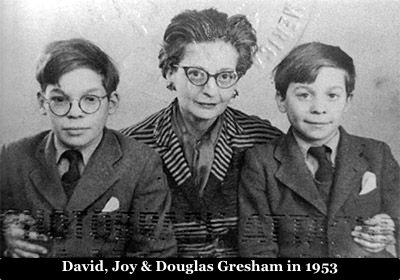
Curiously, the film itself raised a question in my mind that has not been satisfactorily answered until now. Where is David Gresham? Joy had two sons Lewis helped raise. Only David is portrayed in the film. At the time I attributed the absence to cinematic convenience. After all, since the son(s) were not the primary focus of the drama, one could easily suffice for the pair.

Some years later I corresponded (too briefly) with Doug Gresham, who has admirably championed the legacy of his stepfather’s faith and work. When I asked about his brother, Doug shared that he had elected to follow Judaism, and chosen not to be directly involved in the workings of C.S. Lewis Co. Ltd. and associated projects.

Now, following David’s death, Doug is free to share with us another insight into the patience and compassion of C.S. Lewis. The great author did not flinch from the duty he had accepted when he married Joy and brought his bride, and her children, into his home. Doug has previously written about their family in his wonderful book, Lenten Lands. He describes the adjustments.

We became a family. It didn’t happen all at once, but slowly and surely Jack and Warnie and I were building some sort of relationship. I could never claim to have been anywhere near as important to Jack [Lewis] as he was to me, but I really do believe that I did become important to him. In addition, I began to understand a little about Jack and began to be able to see the enormous wealth of compassion in him.

The marriage was too brief, lasting from March 1957* until Joy’s death in July 1960. After that, Lewis was diligent in establishing the best future for his sons. Douglas’ life has been a testimony to that commitment. David’s sadly, was not.

The Curse of Psychosis

Schizophrenia is an ugly affliction. Psychotic episodes, where a person is unable to discern between reality and illusion, can create chaos. While modern medications are helpful, in severe cases, long term hospitalization may be required. In David’s case, his life ended several years ago in just such an institution, in Switzerland. 

While schizophrenia often first manifests between the late teens and early thirties, in some cases its onset begins earlier. Such was the case in the Davidman family. And it was during these turbulent years that Lewis did his best to protect and nurture his new sons. Doug relates a shocking example of how his elder brother “was continually trying to get rid of me.” From the aforementioned column:

“I came out of the kitchen [at The Kilns] one afternoon, for example. . . As I walked out the brick arch doorway, there was a splash, and I was covered in gasoline. My brother was standing there trying to strike a match to throw at me.

I kicked his wrist so hard I nearly broke it. The matches went flying, and I took off.” Douglas told me that this sort of thing was not uncommon. “It was a difficult childhood for me,” he said. “Jack tried his very hardest for David all the time. He tried to help in every way he could—he was kind and gentle and wonderful with him.”

Those of us whose families have been scarred by the scourge of schizophrenia understand how one’s compassion and patience can be tested to their limits. C.S. Lewis passed that test. He neither surrendered to the challenge, nor shirked the burden he had willingly assumed.

After reading “C.S. Lewis and His Stepsons” at First Things, my respect for the man continues to grow. I suspect that yours will, as well.


* Their true marriage took place while Joy was hospitalized on 21 March 1957. Lewis had entered into a civil marriage with Joy a year earlier, to allow her to remain in the United Kingdom.

C.S. Lewis & Tattoos

How is this for an odd New Year resolution? Getting a new tattoo—with a connection to the writings of C.S. Lewis.

I suppose I’m betraying my age here. Being a retired pastor, my body remains a totally uninked canvas. Not that I’ve never considered getting a tattoo. In fact, if I end up making a pilgrimage to Jerusalem before I journey to the New Jerusalem, I may still opt to get inked. In Jerusalem there is a tattooist whose family traces their art back for 700 years to when their Coptic family lived in Egypt.

Our ancestors  used tattoos to mark Christian Copts with a small cross on the inside of the wrist to grant them access to churches . . and from a very young age (sometimes even a few months old) Christians would tattoo their children with the cross identifying them as Copts. . . .

One of the most famous of Christian types of tattoos, however, is still in use today—that of the pilgrimage tattoo. At least as early as the 1500s, visitors to the Holy Land . . . often acquired a Christian tattoo symbol to commemorate their visit, particularly the Jerusalem Cross.

In Bethlehem, another Christian tattooist practices his art “near the Church of the Nativity, offering pilgrims ink to permanently mark their visit.” He offers designs featuring scriptural texts in Hebrew and Aramaic, the language spoken by Jesus.

Tattoos have a fascinating history, and it should be noted some people consider Torah prohibition to bar even religious tattoos. “You shall not make any cuts on your body for the dead or tattoo yourselves: I am the Lord” (Leviticus 19:28). However, most Christians* and increasing numbers of Jews do not agree that the passage forbids the current practice.

That doesn’t mean all tattoos are appropriate, of course. Most tattoos are innocuous. Some are humorous. A small number are actually witty. Yet some tattoos can be downright malevolent.

Like so many human activities, the significance of a tattoo depends in great part on the intention of the person asking for this permanent mark. For example, my wife and I approved of our son and his wife having their wedding rings tattooed in recognition of God’s desire⁑ that a marriage will last as long as both individuals live.

What has this to do with C.S. Lewis?

Precious few writers have penned more inspiring and enlightening words than Lewis, that great scholar of Oxford and Cambridge. Because of this, it should come as no surprise that there are many Lewis-inspired tattoos gracing bodies. There is even a website devoted to C.S. Lewis-inspired body ink.

I imagine that Lewis himself would regard this as quite peculiar. I don’t believe he had any tattoos of his own, but it’s quite possible his brother Warnie—a retired veteran of the Royal Army—may have sported one or more.

In 1932, Lewis wrote to Warnie about his recent walking trip. Warnie was his frequent companion, when he was not elsewhere deployed. In this fascinating piece of correspondence, Lewis described his most recent excursion. I include a lengthy excerpt (comprising the first half of the journey) not because of its single passing mention of tattoos. Rather, because of the portrait it paints of the young and vigorous scholar in the prime of life. If you would prefer to skip to the mention of inking, see the sixth paragraph.

Since last writing I have had my usual Easter walk. It was in every way an abnormal one. First of all, Harwood was to bring a new Anthroposophical Anthroposophical member (not very happily phrased!) and I was bringing a new Christian one to balance him, in the person of my ex-pupil Griffiths. Then Harwood and his satellite ratted, and the walk finally consisted of Beckett, Barfield, Griffiths, and me.

As Harwood never missed before, and Beckett seldom comes, and Griffiths was new, the atmosphere I usually look for on these jaunts was lacking. At least that is how I explain a sort of disappointment I have been feeling ever since. Then, owing to some affairs of Barfield’s, we had to alter at the last minute our idea of going to Wales, and start (of all places!) from Eastbourne instead.

All the same, I would not have you think it was a bad walk: it was rather like Hodge who, though nowhere in a competition of Johnsonian cats, was, you will remember, ‘a very fine cat, a very fine cat indeed.’

The first day we made Lewes, walking over the bare chalky South Downs all day. The country, except for an occasional gleam of the distant sea—we were avoiding the coast for fear of hikers—is almost exactly the same as the Berkshire downs or the higher parts of Salisbury Plain. The descent into Lewes offered a view of the kind I had hitherto seen only on posters—rounded hill with woods on the top, and one side quarried into a chalk cliff: sticking up dark and heavy against this a little town climbing up to a central Norman castle.

We had a very poor inn here, but I was fortunate in sharing a room with Griffiths who carried his asceticism so far as to fling off his eiderdown—greatly to my comfort. Next day we had a delicious morning—just such a day as downs are made for, with endless round green slopes in the sunshine, crossed by cloud shadows. The landscape was less like the Plain now. The sides of the hill—we were on a ridgeway—were steep and wooded, giving rather the same effect as the narrower parts of Malvern hills beyond the Wych.

We had a fine outlook over variegated blue country to the North Downs. After we had dropped into a village for lunch and climbed onto the ridge again for the afternoon, our troubles began. The sun disappeared: an icy wind took us in the flank: and soon there came a torrent of the sort of rain that feels as if one’s face were being tattooed and turns the mackintosh on the weather side into a sort of wet suit of tights.

At the same time Griffiths began to show his teeth (as I learned afterwards) having engaged Barfield in a metaphysico-religious conversation of such appalling severity and egotism that it included the speaker’s life history and a statement that most of us were infallibly damned. As Beckett and I, half a mile ahead, looked back over that rain beaten ridgeway we could always see the figures in close discussion. Griffiths very tall, thin, high-shouldered, stickless, with enormous pack: arrayed in perfectly cylindrical knickerbockers, very tight in the crutch. Barfield, as you know, with that peculiarly blowsy air, and an ever more expressive droop and shuffle.

For two mortal hours we walked nearly blind in the rain, our shoes full of water, and finally limped into the ill omened village of Bramber. Here, as we crowded to the fire in our inn, I tried to make room for us by shoving back a little miniature billiard table which stood in our way.

I was in that state of mind in which I discovered without the least surprise, a moment too late, that it was only a board supported on trestles. The trestles, of course, collapsed, and the board crashed to the ground. Slate broken right across. I haven’t had the bill yet, but I suppose it will equal the whole expences of the tour.

Wouldn’t it have been amazing to join C.S. Lewis on one of these walking trips? A Lewisian tattoo is no substitute, to be sure, but I imagine it does offer certain people a sense of connection to the great author. Perhaps, if I were a younger man . . .


* Two recent converts to Christianity, Kanye West and Justin Bieber have made public their recent religious additions to their vast tattoo collections.

⁑ As Jesus said, “So they are no longer two but one flesh. What therefore God has joined together, let not man separate.”

The motivational poster above was created by Mere Inkling, and represents only an infinitesimal number of the misspelled tattoos adorning human bodies. What a travesty . . . one that may have been prevented by remaining sober. The tattoo below, on the other hand, strikes me (being a writer) as quite clever.

Constantine’s Augustae & C.S. Lewis’ Joy

C.S. Lewis considered war a hated necessity in a fallen world. Emperor Constantine I, in contrast, did not shirk from waging violent conflict to reunite the Roman Empire in the early fourth century. What could these two men, humble and proud, have in common?

In a New York Times essay, “C.S. Lewis’s Legacy Lives on, and Not Just Through the Wardrobe,” Mark Oppenheimer compares their influence on the expansion of the Christian Church.

Who, since the time of Jesus and his apostles, has brought more people to Christianity than anybody else?

A short list would include the Roman emperor Constantine, who legalized Christian worship in 313, and Pope Urban II, who began the First Crusade in 1095. But it would also include C.S. Lewis, who moved more hearts with a pen than others have with armies.

Oppenheimer’s Jewish perspective is likely the reason Urban II (c. 1035-1099) finds himself on this short list. After all, the Crusades were intended to liberate the Holy Land from its Muslim conquerors. Other than a handful of the genuinely religious individuals who participated, no historian (much less any educated practicing Christian) would consider the Crusades an evangelistic enterprise.

As for the similarities between C.S. Lewis and Constantine, I am hard-pressed to find many. One, however, is common to many men throughout history. The influence of women in their lives was significant. This is true in terms of both their revered mothers, and their tenacious wives.

Women in Constantine’s Life

Constantine was the first Roman emperor to convert. Because he delivered the Church from persecution and favored the religion within the empire, he is regarded by the Orthodox Church to be a saint. His transitional reign, and the foundation of Constantinople, were monumentally important. But the violence experienced within the imperial family leaves disturbing questions that cannot be answered.

Constantine’s mother, Helena, was a true saint. She lived a devout life and did many good works. Doubtless, she also tempered the volatility of her son.

Constantine had four sons. The first was born to Minervina, a wife or official concubine about whom very little is known.* However, in 307 Constantine followed the common practice of marrying the daughter of a powerful ally, in this case the Augustus (Emperor) Maximian. This wife, Fausta, gave birth to three emperors who succeeded their father and proceeded to battle one another.

The first son, Crispus, was likely the most virtuous of them all. Unfortunately, however, Constantine heeded the lies of his step-mother, Fausta, and had Crispus put to death.⁑

The image of the Roman coins at the top of this column reveals official images of Helena and Fausta. Both of the women had, by the time these were minted, been honored with the title Augusta. The photograph comes from a detailed study of the coinage minted during Constantine’s Vicennalia, which marked the twentieth year of his reign. It features two coins of each, from different mints.

“For Helena,” that author notes, “the reverse always figures Securitas, and for Fausta, either Salus or Spes.” Roman personifications were not actually regarded as “gods,” except by the most superstitious. They were images intended to represent abstract qualities or values. Securitas represented Security with Salus and Spes representing Health and Hope, respectively. The inference here is that Helena represented the stability and authenticity of the dynasty, while Fausta represented its vitality and hope for the future, particularly as she nestles in her arms two future emperors.

Women in C.S. Lewis’ Life

For symmetry, we won’t discuss Minto here. Lewis’ mother and wife did, however, exert a great influence on the man he became. Whereas, with Constantine, one a saint, and the other a murderer, Lewis’ ladies both lived their Christian faith.

Flora Augusta Hamilton Lewis (1862-1908) was the daughter of an Anglican priest in Belfast. (By odd coincidence, her name included Helena’s regal title, Augusta.) Flora was quite gifted, and taught young Jack French and Latin. Her untimely death, during her boys’ childhood, left a last mark on both of them.

My father never fully recovered from this loss. Children suffer not (I think) less than their elders, but differently. For us boys the real bereavement had happened before our mother died.

We lost her gradually as she was gradually withdrawn from our life into the hands of nurses and delirium and morphia, and as our whole existence changed into something alien and menacing, as the house became full of strange smells and midnight noises and sinister whispered conversations. (Surprised by Joy)

Despite the great loss, life continued. Everyone eventually came to view Professor Lewis as a confirmed bachelor. Himself included. That is, until Joy Davidman entered his life. She turned his life upside down. Much has been written about their deep love for one another, and how well suited they were for each other.

Some have criticized Lewis for insensitivity to women. I consider this allegation utterly fallacious. Like all interpersonal relationships in this fallen world, bonds between (and within) genders are complex.

For those who consider Lewis’ personal outlook on male/female roles to be unenlightened, might I suggest you compare them to the example of any other man. Constantine perhaps?


* Minervina may have been Constantine’s wife, or official concubine. Since Crispus was regarded as a fully legal heir, the former is most likely. She may have already died before Constantine strengthened his political position with his second marriage.

⁑ The most probable account is that Fausta falsely accused Crispus of molesting her. After mercilessly condemning his own son, Constantine learned of the deceit and had Fausta executed as well. Crispus already held the rank of Caesar, and was heir apparent to his father. The story is extremely complicated, and heartbreakingly tragic.