C.S. Lewis, the Brothers Grimm & Snow White

You may blame the recent cinematic debacle that is Snow White on a declining Film Studio or the Brothers Grimm, but C.S. Lewis is innocent.

That’s not to say the Grimms didn’t have an influence on the great Oxbridge professor, a subject we’ll explore momentarily. But it was the German folk tales published by academics Jacob and Wilhelm Grimm who published the classic fairy tales that Walt Disney mined so effectively. 

They also popularized CinderellaHansel and GretelLittle Red Riding HoodThe Princess and the Frog, and Rapunzel. Disney began the transformation of these tales into visual treasures as early as 1921 when he founded Laugh-O-Gram Studio in Kansas City, Missouri.

In addition to films, over the years Walt gleaned memorable Grimm stories for a multitude of cartoon shorts, including The Brave Little Tailor and The Four Musicians of Bremen.

Obviously, Walt Disney himself respected the source material for the stories and wielded his editorial prerogative in an appropriate manner. Tragically, the same cannot be said for his corporate heirs. Likewise, the Brothers Grimm bear no culpability in this area.

C.S. Lewis, J.R.R. Tolkien & Snow White

The truth is, although Lewis and Tolkien appreciated literary fairy tales, neither of the preeminent Inklings were enamored with Disney’s animated treatment of the stories. Curiously, the two distinguished dons actually attended the theater together to view the trailblazing novelty that was Snow White.

They were particularly disappointed with the dwarves, seeing just how different they were from the genuine legends about them. Lewis even wrote “Dwarfs ought to be ugly of course, but not in that way.” Atlas Obscura has an entertaining article about their “movie date” and notes some of the elements they also enjoyed in the feature.

In his lectures published as A preface to Paradise lost, C.S. Lewis elaborates on his response to the Disney version of the tale.

That strange blend of genius and vulgarity, the film of Snow-White, will illustrate the point. There was good unorginality in the drawing of the Queen. She was the very archetype of all beautiful, cruel queens: the thing one expected to see, save that it was truer to type than one dared to hope for.

There was bad originality in the bloated, drunken, low-comedy faces of the dwarfs. Neither the earthiness, the avarice, nor the wisdom of true dwarfs was there, but an imbecility of arbitrary invention.

But in the scene where Snow-White wakes in the woods both the right originality and the right unoriginality were used together. The good unoriginality lay in the use of small, delicate animals as comforters, in the true Märchen [fairy tale] style. The good originality lay in letting us at first mistake their eyes for the eyes of monsters.

If you want to read more about the subject, you can do no better than read Joe Christopher’s article on the subject.

For an interesting argument that fellow Brit G.K. Chesterton would have loved Snow White for the very reason that moved the Inklings to criticize it, see “Tolkien and Lewis disliked Snow White. You know who wouldn’t have?

C.S. Lewis & Grimm’s Fairy Tales

Like his friend, J.R.R. Tolkien, C.S. Lewis was a champion of classical fairy tales. Neither was apologetic for it, although Lewis admitted to being shy about it when he was young. In an essay titled “On Three Ways of Writing For Children,” he wrote,

When I was ten, I read fairy tales in secret and would have been ashamed if I had been found doing so. Now that I am fifty I read them openly. When I became a man I put away childish things, including the fear of childishness and the desire to be very grown up.

In a great post called “Old Enough For Fairy Tales: C.S. Lewis’ “The Chronicles of Narnia” the writer describes this distinction to which Lewis alludes.

The Chronicles of Narnia are not children’s stories. They are fairy tales—but that is precisely why they are not children’s stories. If you can’t understand, you haven’t been listening. Go back and read the quote from Lewis’ essay again. Children are not the only audience for fairy tales.

In 1954, C.S. Lewis apologized to a German professor for being unable to understand the nuances of his volume on philosophy. In doing so, he referred to his youthful reading of the Brothers Grimm in their original German (available at Internet Archive).

I look forward to reading the book (when the translation arrives! My German is wretched, and what there is of it belongs chiefly to the libretto of the Ring and Grimm’s Märchen – works whose style and vocabulary you very possibly do not closely follow).

If you are in the mood for reading Grimm’s Fairy tales today, and your German is sadly lacking, Project Gutenberg has just the translation for you . . . as long as you can read English.


Addendum [added 10 April 2025]

The Brothers Grimm were far more than simply folklorists. They were respected professors at the University of Göttingen. They were devout Christians and worked with other prominent Germans. 

Goethe assisted them at a crucial moment in collecting their tales, and the philosopher Friedrich Schleiermacher provided copyediting assistance. Jacob’s work on German mythology had a pronounced influence on the composer Richard Wagner (World Magazine).

They also began compiling the Deutsches Wörterbuch (Germany dictionary) in 1838, with the first volumes published in 1854. It was the first dictionary to include historical usages of each word, preceding the Oxford English Dictionary, which was initiated in 1857 with its first edition published in 1884.


Bonus Trivia: The dwarves were unnamed until their debut on Broadway in 1912. And on that day they were christened Blick, Flick, Glick, Plick, Snick, Whick and Quee.

Tinker Bell, the Inklings, and Disney

Poor Tinker Bell. The political prejudices of our day have caught up with the sparkling fairy, and relegated her to a significantly reduced presence in the Disney universe.

Inside the Magic reported “Tinker Bell seems to have left Walt Disney World and is now on her way back to Neverland following a recent change at Walt Disney World Resort.” You can read the tragic tale on their site.

. . . once more, Disney’s animated classic, Peter Pan (1953), is under scrutiny, with Disney issuing a statement regarding Captain Hook and Tinker Bell as characters with potential concerns.

Linking poor Tink to a murderous pirate seems a bit of a stretch, and she has not been fully banished, but she has definitely been demoted. According to TMZ, Disney alleges the company’s “own people felt she wasn’t a good role model for girls in the 21st century.”

Well, eventually she too will be in the public domain, like Mickey Mouse. Actually, her literary portrait as introduced in the play, coincidentally just entered the public domain this year (2024)!

However, should you reside in the United Kingdom, beware that in 1988, the copyright holder, Great Ormond Street Hospital, was granted the rights to Peter Pan “in perpetuity.”

The Creator of Tinker Bell & Peter Pan

Tinker Bell is one of the most memorable characters in Neverland, the creation of James Matthew Barrie (1860-1937). He was a prolific Scottish writer and is best known for his 1911 novel, Peter and Wendy – which initially debuted in the form of a stage play in 1904, as Peter Pan; or, the Boy Who Wouldn’t Grow Up.

Peter Pan was actually introduced to the world as a baby in The Little White Bird. Tinker Bell does not appear in the novel, but the following description of J.M. Barrie’s fairy mythology is quite fanciful.

One of the great differences between the fairies and us is that they never do anything useful. When the first baby laughed for the first time, his laugh broke into a million pieces, and they all went skipping about. That was the beginning of fairies.

They look tremendously busy, you know, as if they had not a moment to spare, but if you were to ask them what they are doing, they could not tell you in the least. They are frightfully ignorant, and everything they do is make-believe.

They have a postman, but he never calls except at Christmas with his little box, and though they have beautiful schools, nothing is taught in them; the youngest child being chief person is always elected mistress, and when she has called the roll, they all go out for a walk and never come back.

It is a very noticeable thing that, in fairy families, the youngest is always chief person, and usually becomes a prince or princess; and children remember this, and think it must be so among humans also, and that is why they are often made uneasy when they come upon their mother furtively putting new frills on the basinette.

Barrie continues, describing how infants are simply following fairy “ways” when they misbehave, and they naturally experience “exasperation, because we don’t understand [them], though [they are] talking an intelligible language . . . fairy.”

Returning to the person of Tinker Bell herself, she outgrew her supporting role as, in the words of her creator, “a common fairy.” She was literally a tinker, who died following the departure of Wendy and her brothers from Neverland. 

Presumably, some of the gatekeepers at Disney would have preferred that the affection of the crowds had not restored her to life. 

The Inklings

The Imaginative Conservative offers an interesting take on C.S. Lewis’ view of fairies. I quote a portion related to our present subject.

Lewis treats the subject of fairies in . . . The Discarded Image. . . . After explaining the medieval understanding of the heavens and planetary systems, Lewis turns to what he calls the Longaevi. He avoids the term “fairies” because it is “tarnished by pantomime and bad children’s books with worse illustrations.” (Probably referring to Barrie’s popular play and Princess Mary’s Gift Book – the book from which Elsie and Frances clipped the pictures they used in their fake photos.)

Jane Douglass, an American actress and playwright, contributed a fascinating essay to C.S. Lewis at the Breakfast Table, and Other Reminiscences. One wonderful portion of “An Enduring Friendship” describes Lewis’ thoughts about the possible dramatization of The Lion, the Witch, and the Wardrobe

C.S. Lewis deemed the prospect absurd on its face, saying “I believe plays should be plays, poems, poems, novels, novels, stories, stories, and certainly the book you mention is pure narrative.” So much for a partially surviving 1967 series, the 1979 animation, the 1988 BBC television series, and the cinematic version(s) which began in 2005. Oh, and there is the matter of the impending Netflix telling which remains a closely guarded secret. Douglass continued with a reference to Disney.

He repeated his dread of such things as radio and television apparatus and expressed his dislike of talking films. I said I quite understood this, and that nothing would distress me more than that he should think that I had in mind anything like the Walt Disney shows; I hoped nobody had suggested the book to Mr. Disney.

This seemed to relieve Mr. Lewis to such an extent that I thought perhaps Mr. Disney had been after the book, but of course I did not ask. And in his usual generous way, Mr. Lewis said, “Too bad we didn’t know Walt Disney before he was spoiled, isn’t it?”

Author Jim Denney has a nice article on “What C.S. Lewis and J.R.R. Tolkien Thought of Walt Disney” in which he describes parallels between the live of Lewis and Disney and concludes, “you might think that, with all that C.S. Lewis and Walt Disney had in common, they might have been mutual admirers – but that was not the case.”

Disney’s Snow White and the Seven Dwarfs debuted in the United States in 1937 and in the United Kingdom in 1938. . . . A few months later, Lewis went to see it again, this time with his good friend (and fellow Oxford professor) J.R.R. Tolkien.

Coincidentally, Tolkien’s first novel The Hobbit had been published in September 1937, just three months before the American debut of Snow White.

Their greatest disappointment was in Disney’s utterly comical take on dwarves and the absence of the slightest air of “the mythic nobility of the dwarves from Germanic folklore.”

Although Snow White is itself a fairy tale, fairy characters are not to be found in the film. In the same way, J.R.R. Tolkien referred to the Lord of the Rings as a “fairy story” for adults, yet they do not appear to dwell in Middle Earth.

In fact, according to The Encyclopedia of Arda, “the name ‘Faerie’ belongs to an early period of Tolkien’s writings, and is never seen in The Lord of the Rings, but it does survive in a single usage in the earlier book The Hobbit.” And even in that case, it refers not to a population, but to a place.

On the Effect of Tinker Bell

Tinker Bell’s significance in the world is not confined to literature, or the interests of children. There is a brilliant application of her legend which has been transposed into the psychological realm. 

It’s call the “Tinker Bell Effect,” and “Be(lie)ve It or Not,” from Psychology Today, offers the following description.

One theory manifesting connections among belief, psychology, and mythology is the Tinkerbell effect named for the fairy Tinker Bell of Peter Pan whose resuscitation depends upon the audience expressing their belief in fairies through clapping . . .

The Tinkerbell effect refers to those things that exist only through imaginative acts and because people believe in them. The Reverse Tinkerbell effect maintains that, somewhat paradoxically, the more people believe in something the more likely it is to disappear. 

In their article, the psychologists parenthetically offer an additional application of Tinker Bell’s nature to their area of study. (It actually appears in the paragraph above, where I replaced it with an ellipsis.)

(because she is so small that she can only hold one feeling at a time, Tinkerbell is also a model for mood disorders and difficulties with emotional self-regulation)

Fascinating. It seems to me this insight opens the door to further literary exploration of the Tinker Bell Phenomenon that would be of interest to writers and literary critics alike. I close with my proposal for a new label for an ancient plague afflicting fictional works. If it interests any scholars among you, I invite you to develop it further and claim it as your own.

Tinker Bell (var. Tinkerbell) Crippling Character Creation Complete Content Complexity Phenomenon: The invention of fictional characters who lack depth and bear no resemblance to real people. Literary tropes that are often referred to as one-dimensional or “flat” characters. (See nearly all Marvel supervillains.)

P.S. – Feel free to abbr. the admittedly verbose proposed title; keeping in mind most readers prefer brief reads.

Mickey Mouse Is Now Ours

He’s no Reepicheep, but the earliest iteration of Mickey Mouse just became public property!

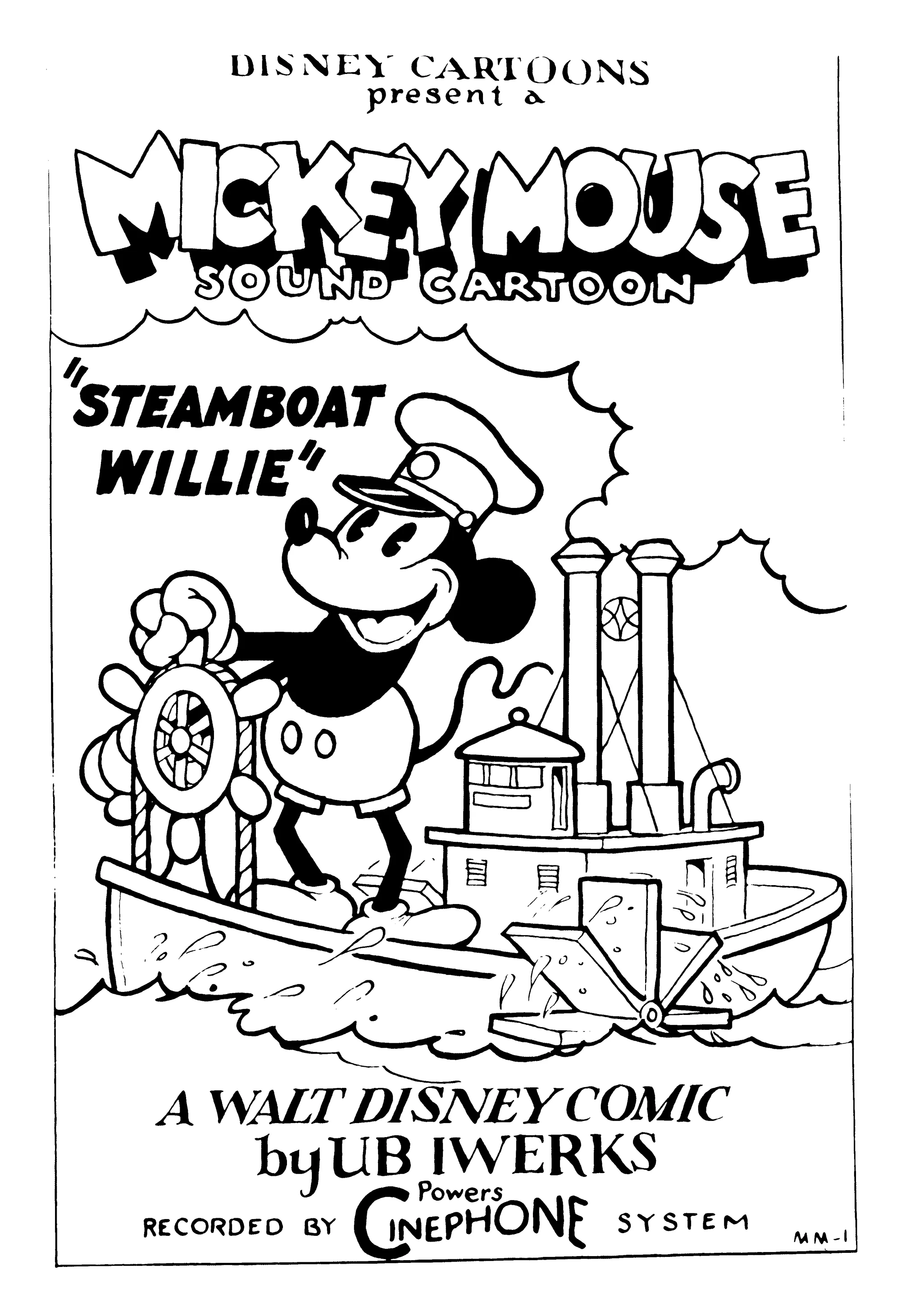
One of the little-heralded New Year’s Day events was the entry of the Steamboat Willie version of Mickey into public domain. Now anyone who desires can use the image without infringing on Disney’s copyrights.

Actually, my headline is not 100% accurate. As I just noted, it’s the earliest version of the most famous mouse in the world. However, the rodent’s name, and his subsequent graphic version remains protected. That’s because while copyrights eventually expire, trademarks don’t.

Therefore, as reported in Fortune magazine, “current artists and creators will be able to make use of Mickey, but with major limits. It is only the more mischievous, rat-like, non-speaking boat captain in ‘Steamboat Willie’ that has become public.”

The 1928 poster advertising Mickey’s cinematic debut comes from a great article at Animation Scoop. Without comparing measurements of Mickey’s initial and contemporary snouts, it doesn’t appear to me the public domain version is that much more “rat-like.”

As for differences between the two . . . well, I’m not an attorney, but it appears Mickey’s onscreen persona in 1928 wasn’t wearing his standard white gloves. The poster, nevertheless, shows a Mickey closely resembling the cartoon mouse who was part of many of our childhoods. As noted in the Fortune piece:

Not every feature or personality trait a character displays is necessarily copyrightable, however, and courts could be busy in the coming years determining what’s inside and outside Disney’s ownership.

My question, and perhaps one of you intelligent readers can answer this, is about the image’s “name.” His full name, with his surname “Mouse,” is undebatably trademarked. Can a person legally use the name “Mickey” with the 1928 likeness? My guess is that the first name is not restricted, no matter how much Disney protests.

Speaking of Disney, a company which has become a disappointment in recent years, the Inklings were not big fans. If you are interested in learning more about the Inklings’ opinion about Disney Studios, check out author Jim Denney’s “What C.S. Lewis and J.R.R. Tolkien Thought of Walt Disney.”

After identifying a number of parallels in their lives, he explores the irony that “you might think that, with all that C.S. Lewis and Walt Disney had in common, they might have been mutual admirers—but that was not the case.”

And, there is always another option. As Britannica reminds us, Mickey wasn’t even his original name. Walt’s first choice (vetoed by his wife) was “Mortimer.”

That’s it for today. Now I’m off to write a book about Mickey’s alliance with Reepicheep. Oh wait, Reepicheep won’t be in the public domain until after I’m enjoying heaven with my Lord, and with the Christian members of the Inklings.

And, even if one could pair the two up for an adventure, they wouldn’t prove compatible. The reason should be obvious, but for an enjoyable exploration of that subject, I commend to you, “Reepicheep and Mickey.” 

C.S. Lewis & a Horse Named Fledge

C.S. Lewis was not alone in recognizing horses are magnificent creatures. Many of us share his appreciation for the more than 300 breeds that comprise the equine family.

Horses hold a prominent place in Lewis’ zoologically rich fantasies. In the Chronicles of Narnia, we encounter many Talking Horses. Among them are Bree, the titular hero of The Horse and His Boy, and Hwin, the heroine who teaches Bree what it means to be a Narnian.

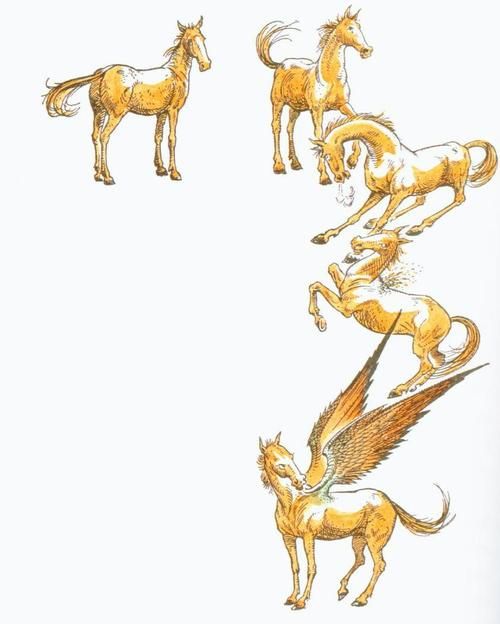
But before Bree and Hwin galloped across the fields and plains of Narnia, a horse from Earth was transported to that Land at the hour of its very creation.* And there, Aslan anointed this modest draft horse⁑ to become the progenitor of a race of pegasi. Fledge’s story is quite inspiring.

Fledge was once named Strawberry, and pulled a Hansom cab in London. But after journeying to Narnia, Aslan chose him to be one of the very first Talking Animals, and granted him wings.

Would You Like Wings?” offers an illuminating meditation on this transformation.

So Strawberry, in this first stage, goes from beast to person. From a dream to wakefulness. From slavery to freedom. From silence to speech, from witless to intelligent.

From C.S. Lewis’ account of the “miraculous” event:

He then turned to the Horse who had been standing quietly beside them all this time, swishing his tail to keep the flies off, and listening with his head on one side as if the conversation were a little difficult to understand. “My dear,” said Aslan to the Horse, “would you like to be a winged horse?”

You should have seen how the Horse shook its mane and how its nostrils widened, and the little tap it gave the ground with one back hoof. Clearly it would very much like to be a winged horse. But it only said: “If you wish, Aslan – if you really mean – I don’t know why it should be me – I’m not a very clever horse.”

“Be winged. Be the father of all flying horses,” roared Aslan in a voice that shook the ground. “Your name is Fledge.” The horse shied . . . It strained its neck back as if there were a fly biting its shoulders and it wanted to scratch them. And then, just as the beasts had burst out of the earth, there burst out from the shoulders of Fledge wings that spread and grew, larger than eagles’, larger than swans’, larger than angels’ wings in church windows. . . .

“Is it good, Fledge?” said Aslan.

“It is very good, Aslan,” said Fledge.

When Aslan sends Polly and Digory on a quest with Fledge, they camp for the night and enjoy a delightful human~animal conversation (much like I would anticipate having with the deer that visit our yard daily, should they be graced with speech).

“And my wings are beginning to ache,” said Fledge. “There’s no sign of the valley with a Lake in it, like what Aslan said. What about coming down and looking out for a decent spot to spend the night in? We shan’t reach that place tonight.”

“Yes, and surely it’s about time for supper?” said Digory. So Fledge came lower and lower. As they came down nearer to the earth and among the hills, the air grew warmer and after traveling so many hours with nothing to listen to but the beat of Fledge’s wings . . .

A warm, good smell of sun-baked earth and grass and flowers came up to them. . . . “I am hungry,” said Digory.

“Well, tuck in,” said Fledge, taking a big mouthful of grass. Then he raised his head, still chewing and with bits of grass sticking out on each side of his mouth like whiskers, and said, “Come on, you two. Don’t be shy. There’s plenty for us all.”

“But we can’t eat grass,” said Digory.

“H’m, h’m,” said Fledge, speaking with his mouth full. “Well—h’m—don’t know quite what you’ll do then. Very good grass too.”

Polly and Digory stared at one another in dismay. “Well, I do think someone might have arranged about our meals,” said Digory.

“I’m sure Aslan would have, if you’d asked him,” said Fledge. “Wouldn’t he know without being asked?” said Polly. “I’ve no doubt he would,” said the Horse (still with his mouth full). “But I’ve a sort of idea he likes to be asked.”

“But what on earth are we to do?” asked Digory.

“I’m sure I don’t know,” said Fledge. “Unless you try the grass. You might like it better than you think.” (The Magician’s Nephew).⁂

In C.S. Lewis’ first story about Narnia, The Lion, the Witch and the Wardrobe, we read about the “statues” that surround the castle of the White Witch. Edmund has been corrupted by the Witch, and told that Aslan is dangerous.

The Witch has the power to turn living creatures to stone. When Edmund discovers a lion in her garden, he is delighted. But the lion is not alone.

The relief which Edmund felt was so great that in spite of the cold he suddenly got warm all over right down to his toes, and at the same time there came into his head what seemed a perfectly lovely idea. “Probably,” he thought, “this is the great Lion Aslan that they were all talking about. She’s caught him already and turned him into stone. So that’s the end of all their fine ideas about him! Pooh! Who’s afraid of Aslan?”

And he stood there gloating over the stone lion, and presently he did something very silly and childish. He took a stump of lead pencil out of his pocket and scribbled a mustache on the lion’s upper lip and then a pair of spectacles on its eyes. Then he said, “Yah! Silly old Aslan! How do you like being a stone? You thought yourself mighty fine, didn’t you?”

But in spite of the scribbles on it the face of the great stone beast still looked so terrible, and sad, and noble, staring up in the moonlight, that Edmund didn’t really get any fun out of jeering at it. He turned away and began to cross the courtyard.

As he got into the middle of it he saw that there were dozens of statues all about – standing here and there rather as the pieces stand on a chessboard when it is halfway through the game. There were stone satyrs, and stone wolves, and bears and foxes and cat-a-mountains of stone. . . . a winged horse and a long lithe creature that Edmund took to be a dragon (The Lion, the Witch and the Wardrobe).

I find the description of the lion quite provocative. “. . . so terrible, and sad, and noble.” That is exactly what I experienced when I saw the model for a “war horse” memorial in Romsey, England. The artists have done a brilliant job. The sorrow overflows from it eyes.

True, my impression is influenced by the outstanding 2011 film titled War Horse. If you’ve never seen this Spielberg gem, I encourage you to watch it and challenge you to do so without shedding a tear.

Horses have long been used in war. That is not what God created them for, but fallen humanity has often harnessed their power for combat. Some of their names are remembered today, including Bucephalus, Copenhagen, Cincinnati, and Traveler.

Returning to Fledge, we find a horse not only experiencing the fullness of his equine nature, but receiving blessings unimagined.


* C.S. Lewis did not compose the seven volumes of the Chronicles of Narnia chronologically. This has led to different opinions on the order in which the books should be read.

⁑ Draught horse, to you Brits.

⁂ While I typed this, a doe and her two fawns were peacefully grazing on our clover-seeded lawn, just a few feet away, outside my office window. [I’m sure they would have happily shared with me.]

The White Christ, Red Thor & C.S. Lewis

If you were a Scandinavian living a millennia ago, you would be faced with a critical decision. Would you embrace Jesus Christ and a new life based on mercy, or would you cling to Odin and the Norse pantheon, with its glorification of bloodshed?

When I first heard this choice posed as a choice between the “White Christ” and the blood-drenched Thor, I assumed the white color alluded to traits commonly associated with it today—e.g. purity, innocence, and holiness.*

To my surprise, I recently learned there was a completely different to the Vikings. For them, referring to Christ as “white” was a term of derision.

Before returning to the Northmen, let’s consider for a moment the Inklings. These brilliant writers were well acquainted with white as a biblical metaphor for holiness, etc. They understood how the miracle of the Transfiguration described Jesus’ radiant face shining “like the sun” as the “bright cloud overshadowed them.”

As Mark records in his Gospel, Jesus “was transfigured before them, and his clothes became radiant, intensely white, as no one on earth could bleach them.”

It is no accident Tolkien’s Gandalf the Grey returns as Gandalf the White following his deadly battle with the Balrog.

In C.S. Lewis’ Voyage of the Dawn Treader, Aslan manifests himself to the children as an unblemished lamb.

But between them and the foot of the sky there was something so white on the green grass that even with their eagles’ eyes they could hardly look at it. They came on and saw that it was a Lamb. “Come and have breakfast,” said the Lamb in its sweet milky voice. . . .

“Please Lamb,” said Lucy, “is this the way to Aslan’s country?”

“Not for you,” said the Lamb. “For you the door into Aslan’s country is from your own world.”

“What!” said Edmund. “Is there a way into Aslan’s country from our world too?”

“There is a way into my country from all the worlds,” said the Lamb; but as he spoke his snowy white flushed into tawny gold and his size changed and he was Aslan himself, towering above them and scattering light from his mane.

On the other hand, C.S. Lewis tosses us a curve with the White Witch in his Chronicles of Narnia. The reason for her identification with white is obvious, since she is holding Narnia in an austere, perpetual winter. The witch’s hue carries other messages. Her unthreatening appearance moves Edmund to drop his defenses during their initial encounter.

[Queen Jadis was] a great lady, taller than any woman that Edmund had ever seen. She also was covered in white fur up to her throat and held a long straight golden wand in her right hand and wore a golden crown on her head. Her face was white—not merely pale, but white like snow or paper or icing-sugar, except for her very red mouth. It was a beautiful face in other respects, but proud and cold and stern.

Northern Mythologies

C.S. Lewis was enraptured by Northernness. He and Tolkien spent many hours reading Viking sagas.

However, Lewis was inspired not by the warrior Thor, but the person of Baldur. Several of my online friends and acquaintances have also written about Lewis’ affinity for Baldur. These include Brenton Dickieson, Eleanor Parker, and Bradley Birzer.

Turning from Baldur (Baldr) the Brave to Thor (Þórr), the god of thunder, we find the Norse deity with the largest number of followers. Thor was the ideal divinity for independent adventurers, warriors and violent raiders.

The story of the heroic thunder god still resonates today, as the success of the recent cinematic blockbusters attests. To suit contemporary tastes, the bloody red giant-slayer of myth has shed his more gruesome traits. They have been replaced by nobler aspects, as befitting a modern superhero protecting Midgard (Earth) from danger.

But the medieval period was not the relatively safe world we know. And pleas to turn the other cheek sounded like utter foolishness. The belligerent nature of the Germanic and Scandinavian chieftains of the era, resulted in a modification of the Gospel which was shared by some evangelists. In order to impress a militant population, the pacific nature of Jesus was downplayed. In “Why Trust the White Christ?” we read, “Not until the 1100s did the concept of the suffering Christ take root in Scandinavia; before that Christ was depicted as a triumphant prince—even on the cross!”

Eventually the Gospel would triumph, but one of its first effective renditions for the northern barbarians came in a gospel harmony⁑ entitled the Heliand. A number of references to the Gospel in J.R.R. Tolkien’s academic writings reveals his familiarity with the Old Saxon work, which he also mentioned in his lectures. The Heliand was commissioned by Charlemagne’s grandson Louis the German (806-876) to reach the Franks’ fellow Germanic tribes who remained Pagan. It was written by a Benedictine monk named Notker, who also wrote The Life of Charlemagne.⁂

The fact that this alliterative Gospel (in poetic form) was composed for the Saxon warrior class (their nobility), makes it particularly interesting.  Knowing it was recited not only in monasteries, but also mead halls, makes one’s personal reading of it feel like a journey into the ancient past.

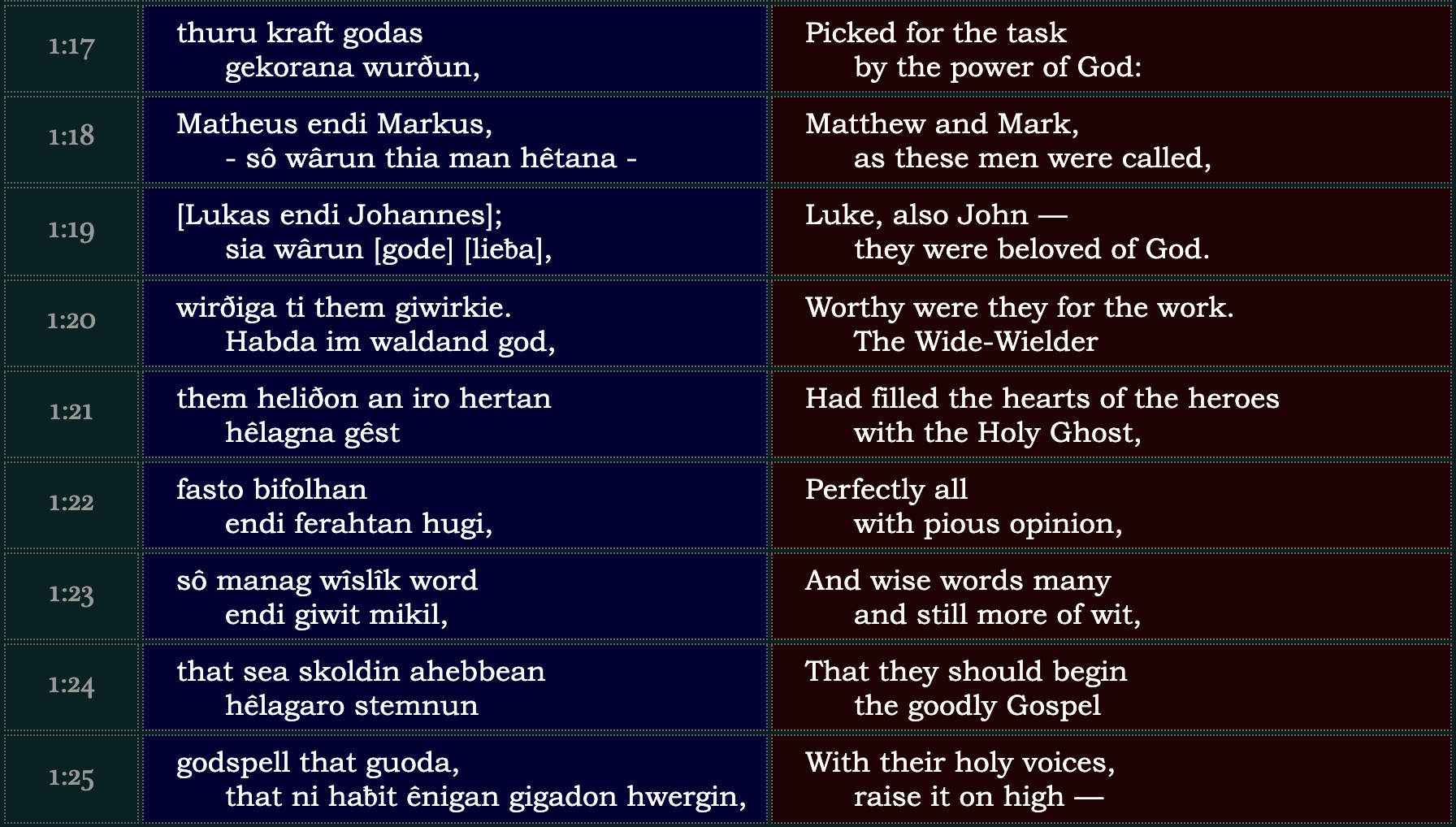
Mariana Scott’s 1966 translation ⁑⁑ is available here. This site posits her translation beside the original Old Saxon. One of my favorite passages comes in the “introduction,” as the context of the Gospel proper is set for the hearers. It is very serious and describes the four Evangelists as inspired by God.

[The Lord] had filled the hearts of the heroes,
     with the Holy Ghost.
Perfectly all,
     with pious opinion,
And wise words many
     and still more of wit.
That they should begin
     the goodly Gospel
With their holy voices,
     raise it on high—

The Question of the White Christ

Referring to Jesus as the “White Christ” may have been related to the association of white baptismal robes worn by the newly baptized. But it involved more than that.

Apparently, the appellation “white,” especially when linked to Christ, was a Pagan insult. In a Scandinavian Studies article entitled “The Contemptuous Sense of the Old Norse Adjective Hvítr, ‘White, Fair’” we learn that it possessed a pejorative sense.

The [Old Icelandic] heathen religion glorified physical strength and courage in combat, a direct antithesis to the Christian ideal of pacifism based upon the Golden Rule. Hence, the heathen Icelanders interpreted the Christian Hvítakristr ‘The White Christ’ as a cowardly, contemptible counterpart of Thor, the god of courage and strength . . .

And this negative connotation continued, even after the triumph of the new faith.

[Even] after Christianity had become established as the national religion in Iceland, this heathen conception of Christian ‘cowardice’ disappeared but left its traces in the epithet hvítr, especially when one wished to belittle or vilify a personal enemy.

. . .

The double sense (‘fair’ : ‘cowardly’)was characteristic of skaldic poetry and served to enhance the sarcastic effect.

And thus my youthful innocence about the meaning of the White Christ has been dispelled. But, at the same time, my insight into the historic prejudice against the sacrificial Son and Lamb of God has grown.

Jesus was no coward, but he is—now and forever—pure, innocent, and holy.


* It should go without being said that associating the color white with Jesus has absolutely nothing to do with ethnicity. The Incarnation of our Lord makes it abundantly clear that Jesus was a Jew born in Bethlehem and raised in Nazareth. The Bible describes nothing noteworthy about his appearance that would distinguish him from the rest of the Jewish people in ancient Palestine. Thus, whatever Jesus’ complexion, he would have looked little like the pale Anglo-Saxon messiah we have often seen in paintings and cinema.

⁑ A Gospel harmony is a blending together of the four canonical Gospels into a single account. Tatian (c. 120-180), an Assyrian theologian, compiled the Diatessaron, which was prominent in the Syrian church, and is thought to have directly influenced the Germanic harmony, the Heliand.

 ⁂ Notker (c. 840-912) who also composed hymns and poetry. As mentioned above, the Benedictine monk also wrote The Life of Charlemagne which records many fascinating stories about Frankish and Germanic Christianity. Apparently a poor precedent was set by Frankish generosity when a group of Northmen serving as envoys received baptism.

As I have mentioned the Northmen I will show by an incident drawn from the reign of your grandfather in what slight estimation they hold faith and baptism. . . .

The nobles of the palace adopted them almost as children, and each received from the emperor’s chamber a white robe and from their sponsors a full Frankish attire, of costly robes and arms and other decorations.

This was often done and from year to year they came in increasing numbers, not for the sake of Christ but for earthly advantage.

A very enlightening and sadly entertaining account. But what happens when the gifts run out?

⁑⁑ In the foreword to her translation, Scott shares some intriguing thoughts on the challenging labor of translation.

It was important for me to remember that the Heliand was originally intended for recitation. This accounts for the very great emphasis on rhythm. While the exact form of the old alliterative verse, though common to both early English and German poetry, proved too confining, a freer adaptation was possible. Let us remember that much of the effect of modern free verse depends on the interplay of sounds: assonance and alliteration.

Keeping in mind the purpose of the original, I read my translation aloud as I worked, repeating lines several times, varying and checking rhythms, trying to imitate the surge of the meter and yet avoid monotony. The end result was a line of variable feet, usually a rather free alternation of anapests and iambics with a few scattered tribrachs and spondees, divided by the traditional caesura.

I aimed for an alliteration of at least one accented syllable in the first half line with one accented syllable in the second half. If more sounded right, I was delighted. If none worked, I tried to make the rhythm carry the line along to the next cadence. Not all of it, I painedly admit, turned out to be poetry—but then not all of the Old Saxon is!

Return with Me to Middle Earth

tolkien.pngJ.R.R. Tolkien’s tales of Middle Earth will once more be displayed in all of their digital radiance when a new series begins in two years. Yes, I said “series,” because it will not be coming to theaters. Instead it will be developed for subscribers to Amazon’s subscription service.

Some fans of Tolkien are understandably wary. Will it remain faithful to Tolkien’s vision (insofar as any heathen international corporation can understand it)? However, I’m inclined to feel optimistic.

One reason for my optimism is Amazon’s commitment to the quality of the production—they anticipate investing around one billion dollars in the property during the next five years. Beyond that, I suspect Amazon will protect this massive investment by not straying too far afield from the true spirit of Middle Earth.

The Hollywood Reporter states it’s up to Peter Jackson* whether or not he will be involved in the project. His attorney said Amazon was wise to bid high for this “property.”

We are in an era where [online] streamers are bidding up the price of programming. I think Amazon is taking a page out of the studios’ emphasis on franchises. They also are realizing that with the overproduction of television, you need to get the eyeballs to the screen, and you can do that with franchise titles.

Another technology news site points to the example of Game of Thrones upping the value of the Lord of the Rings project.

In a world where Disney has laid out impressive, interconnected franchises with its Marvel and Star Wars properties, and HBO is considering anywhere between three and five spinoffs for Game of Thrones, Middle-earth could be a property that gives Amazon a significant boost in the coming streaming wars, one that could entice even more people to sign up for Amazon’s Prime service.

This is wonderfully ironic, since G.R.R. Martin readily acknowledges his debt to Tolkien. In a solid article on this subject, “Is George R.R. Martin the ‘American Tolkien?’” the author identifies a significant difference between the two writers.

Tolkien’s creation displays a sense of depth yet unrivaled in the fantasy genre. In this way, Lord of the Rings is to Game of Thrones as the Atlantic Ocean is to Lake Michigan. In contrast to the invention of Martin’s world, which is secondary to his plotline, Tolkien built his reality from the ground up starting with languages.

The Rotten Tomatoes media review site offers some tantalizing details about what we can anticipate in the new series.

Amazon’s first map rendered a number of geographic features specific to the Third Age, including the East Bight of Mirkwood Forest . . . But fans who were hoping to see some of the great stories from earlier days dramatized with Amazon’s production values are in luck.

Stories like the sinking of Númenor—Tolkien’s take on the Atlantis myth, in which Sauron corrupted an island of seafaring men to invade the forbidden shores of the world’s far West—and the founding of the kingdoms of Arnor and Gondor could make for some spectacular television. . . .

So what does this mean? For one, the series will undoubtedly focus on Númenor** over other regions of Middle-earth. To understand the island’s significance, we need to go back to the end of the First Age and the downfall of the Dark Lord Morgoth.***

Wow.

This is going to be great. And to think, we owe it all to C.S. Lewis!


* Peter Jackson, of course, is the director who brought The Hobbit and The Lord of the Rings to the big screen.

** Númenor was the great island kingdom of humankind.

*** Morgoth is the greatest of the Ainur (angels in the Middle Earth cosmology). He fell from grace when he resisted the will of the Creator. He was an even greater Evil than his servant Sauron, who plagues the world in the Lord of the Rings trilogy.

The reference to Westeros in the illustration above is to the island in the Game of Thrones ruled by the Seven Kingdoms.

Tolkien, C.S. Lewis and Music

albumHave you ever written something that inspired a musician to compose new music? J.R.R. Tolkien hoped to do so one day, and had he lived to hear the scores of the Lord of the Rings trilogy created by Howard Shore, he would have been in awe.

I was reading Tolkien’s correspondence last week and came across a fascinating letter he wrote to a musician who was requesting permission to write a serious composition based on The Hobbit.

This would have been quite different than the quaint “Ballad of Bilbo Baggins,” made famous by Leonard Nimoy. (I wish their choreographer had read the book, so we could have been spared the tiny T-Rex arms sported during the chorus by the dancers.)

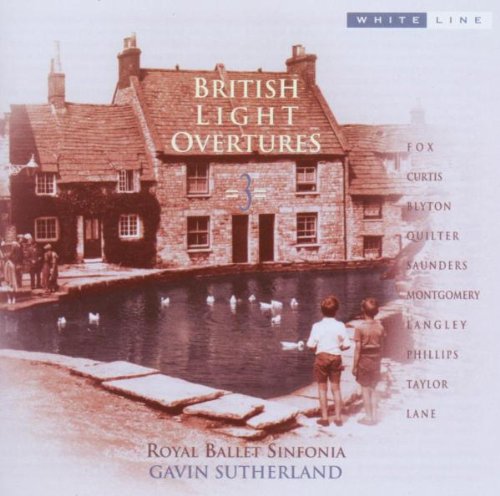
Anyway, returning to more serious musical ventures, in 1964 Tolkien received a request for permission to write a “Hobbit Overture.” It came from British composer Carey Blyton (1932-2002) who would become best known for his song “Bananas in Pyjamas.”

Tolkien’s response to the composer’s query is fascinating, on several levels. First, he is gracious in extending his permission, without any restrictions. And, in 1967 Blyton did compose “The Hobbit” Overture, opus 52a. It appears on the CD, British Light Overtures 3.

Secondly, he shares his unspoken desire that his work might someday inspire music. Then he makes a curious comment about the illustrations of Pauline Baynes, which would similarly grace the work of C.S. Lewis.

After that, Tolkien describes his own, musically impoverished, upbringing. Finally he expresses his deep appreciation for good music, despite his lack of knowledge on the subject.

And Tolkien accomplishes all of this in just a handful of sentences!

You certainly have my permission to compose any work that you wished based on The Hobbit. . . . . As an author I am honoured to hear that I have inspired a composer. I have long hoped to do so, and hoped also that I might perhaps find the result intelligible to me, or feel that it was akin to my own inspiration—as much as are, say, some (but not all) of Pauline Baynes’ illustrations. . . . .

I have little musical knowledge. Though I come of a musical family, owing to defects of education and opportunity as an orphan, such music as was in me was submerged (until I married a musician), or transformed into linguistic terms. Music gives me great pleasure and sometimes inspiration, but I remain in the position in reverse of one who likes to read or hear poetry but knows little of its technique or tradition, or of linguistic structure.

It is common for people of sincere Christian devotion, such as Tolkien and Lewis, to express an appreciation for the divine capacity of music to touch the human spirit.
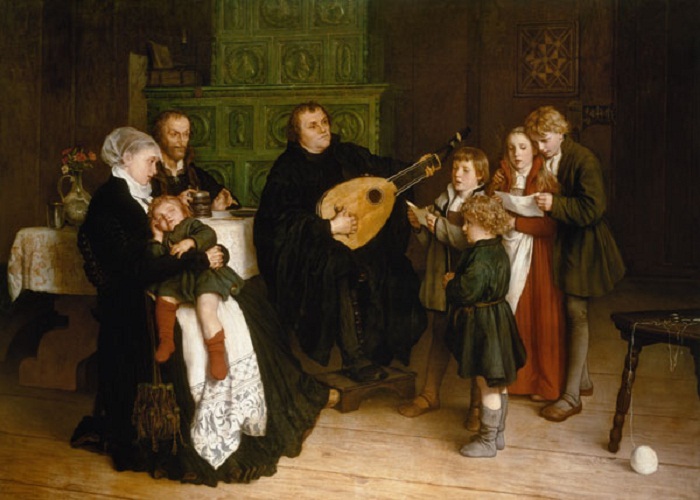
luteMartin Luther, for example, wrote much about music. “Music is God’s greatest gift,” he proclaimed. He was not only a composer of hymns, but also an acceptable player of the lute, which he used to accompany his children during their family devotions.

Music is deeply intertwined with the heart of Christian worship.

C.S. Lewis on the Subject of Music

One of the modest challenges in contrasting fellow Inklings J.R.R. Tolkien and C.S. Lewis results from the significantly different natures of their literary corpora. While they both wrote fantasy, though of a vastly different magnitude, Lewis’ vocation as one of Christianity’s chief modern apologists necessitated that he defend the faith in diverse contexts. Thus, he wrote numerous essays and a number of texts addressing a wide range of considerations that his friend Tolkien never discussed in print.

Because of this distinction, it is relatively simple to discover what Lewis thought about the nature and powers of music. Typical of the man’s practical orientation, Lewis appears little interested in the abstract attributes of music. What interests him is its confluence with human existence. The following profound insight comes from his essay “On Church Music.”

There are two musical situations on which I think we can be confident that a blessing rests. One is where a priest or an organist, himself a man of trained and delicate taste, humbly and charitably sacrifices his own (aesthetically right) desires and gives the people humbler and coarser fare than he would wish, in a belief (even, as it may be, the erroneous belief) that he can thus bring them to God. The other is where the stupid and unmusical layman humbly and patiently, and above all silently, listens to music which he cannot, or cannot fully, appreciate, in the belief that it somehow glorifies God, and that if it does not edify him this must be his own defect.

Neither such a High Brow nor such a Low Brow can be far out of the way. To both, Church Music will have been a means of grace; not the music they have liked, but the music they have disliked. They have both offered, sacrificed, their taste in the fullest sense.

But where the opposite situation arises, where the musician is filled with the pride of skill or the virus of emulation and looks with contempt on the unappreciative congregation, or where the unmusical, complacently entrenched in their own ignorance and conservatism, look with the restless and resentful hostility of an inferiority complex on all who would try to improve their taste—there, we may be sure, all that both offer is unblessed and the spirit that moves them is not the Holy Ghost.

This discussion about church music is particularly interesting due to Lewis’ personal dislike for much of the music used in worship, which I’ve written about before.

Lewis described his own church music pilgrimage in “Answers to Questions on Christianity.”

My own experience is that when I first became a Christian, about fourteen years ago, I thought that I could do it on my own, by retiring to my rooms and reading theology, and I wouldn’t go to the churches . . .

If there is anything in the teaching of the New Testament which is in the nature of a command, it is that you are obliged to take the Sacrament [holy communion], and you can’t do it without going to Church. I disliked very much their hymns, which I considered to be fifth-rate poems set to sixth-rate music. But as I went on I saw the great merit of it.

I came up against different people of quite different outlooks and different education, and then gradually my conceit just began peeling off. I realized that the hymns (which were just sixth-rate music) were, nevertheless, being sung with devotion and benefit by an old saint in elastic-side boots in the opposite pew, and then you realize that you aren’t fit to clean those boots. It gets you out of your solitary conceit.

In “The Weight of Glory,” Lewis addresses this notion that we must look beyond the music itself, to assess its influence on our humanity.

The books or the music in which we thought the beauty was located will betray us if we trust to them; it was not in them, it only came through them, and what came through them was longing. These things—the beauty, the memory of our own past—are good images of what we really desire; but if they are mistaken for the thing itself they turn into dumb idols, breaking the hearts of their worshippers.

For they are not the thing itself; they are only the scent of a flower we have not found, the echo of a tune we have not heard, news from a country we have never yet visited.

Lewis recognized the deep influence and mystery with which music communicates and inspires. It is no accident that Narnia’s creation itself comes through Aslan’s song.

The Lion was pacing to and fro about that empty land and singing his new song. It was softer and more lilting than the song by which he had called up the stars and the sun; a gentle, rippling music. And as he walked and sang the valley grew green with grass. It spread out from the Lion like a pool.

It ran up the sides of the little hills like a wave. In a few minutes it was creeping up the lower slopes of the distant mountains, making that young world every moment softer.

Returning to “On Church Music,” Lewis expands on the importance of our intentions as we approach music.

It seems to me that we must define rather carefully the way, or ways, in which music can glorify God. There is . . . a sense in which all natural agents, even inanimate ones, glorify God continually by revealing the powers He has given them. . . . An excellently performed piece of music, as natural operation which reveals in a very high degree the peculiar powers given to man, will thus always glorify God whatever the intention of the performers may be. But that is a kind of glorifying which we share with the ‘dragons and great deeps,’ with the ‘frost and snows.’

What is looked for in us, as men, is another kind of glorifying, which depends on intention. How easy or how hard it may be for a whole choir to preserve that intention through all the discussions and decisions, all the corrections and the disappointments, all the temptations to pride, rivalry and ambition, which precede the performance of a great work, I (naturally) do not know. But it is on the intention that all depends.

When it succeeds, I think the performers are the most enviable of men; privileged while mortals to honor God like angels and, for a few golden moments, to see spirit and flesh, delight and labour, skill and worship, the natural and the supernatural, all fused into that unity they would have had before the Fall. . . .

We must beware of the naïve idea that our music can ‘please’ God as it would please a cultivated human hearer. That is like thinking, under the old Law, that He really needed the blood of bulls and goats. To which an answer came, ‘mine are the cattle upon a thousand hills,’ and ‘if I am hungry, I will not tell thee.’ If God (in that sense) wanted music, He would not tell us. For all our offerings, whether of music or martyrdom, are like the intrinsically worthless present of a child, which a father values indeed, but values only for the intention.

At the outset of this column I declared Tolkien would have been “in awe” of the musical score written to accompany the Lord of the Rings movies. Lewis too, I believe, would have been impressed by the scores composed for the three Chronicles of Narnia films made thus far. We owe a debt of gratitude to three composers: Howard Shore,* Harry Gregson-Williams,** and David Arnold***.

An Historical Postscript

In the spirit of Lewis and Tolkien, who appreciated the importance of music, we’ll close now with another engaging quotation from the wry pen of Doctor Martin Luther.

I wish all lovers of the unshackled art of music grace and peace from God the Father and from our Lord Jesus Christ! I truly desire that all Christians would love and regard as worthy the lovely gift of music, which is a precious, worthy, and costly treasure given to mankind by God.

The riches of music are so excellent and so precious that words fail me whenever I attempt to discuss and describe them…. In summa, next to the Word of God, the noble art of music is the greatest treasure in the world.

A person who gives this some thought and yet does not regard music as a marvelous creation of God, must be a clodhopper indeed and does not deserve to be called a human being; he should be permitted to hear nothing but the braying of asses and the grunting of hogs.

_____

* Howard Shore has nearly a hundred credits as a composer, conductor and orchestrator on the Internet Movie Database (IMDb). In addition to the Tolkien cinema projects, he has also worked on a number of other very successful films and ninety-six episodes of Saturday Night Live. Shore won three Oscars for his work on Lord of the Rings.

** Harry Gregson-Williams has nearly a hundred credits on the IMDb, including a number of box office successes, a variety of popular video games, and several productions in the Shrek series. He won awards for his work on the Chronicles of Narnia series and another of my favorite films, Kingdom of Heaven.

*** David Arnold, wrote the score for the third Narnia film, The Chronicles of Narnia: The Voyage of the Dawn Treader. He has seventy-three credits listed on IMDb, ranging from this year’s Independence Day: Resurgence, all the way back to a BBC made for tv picture entitled Mr. Stink.

Clay Hearts

clay heartHonesty compels us to admit that we have clay feet. We are merely mortal, and our origin from the clay of the earth is a reminder that we are imperfect.

Stumbling due to our feet of mud is one thing. Far worse, we earthen vessels also have hearts of clay. Our affections are fickle, and too often we fail to fulfill our vows to those who have made themselves vulnerable by entrusting to us their own love.

I doubt any of us have been untouched by the pain of transient love. The ideal we long for . . . the vision we dream about . . . and the lasting intimacy we pray for often seem so very fleeting.

Saddest, to me, are those relationships that have lasted many years, where the once glowing light has dimmed and the comforting warmth has dissipated.

That is the story of a remarkable, Oscar-nominated animation I would like to commend to you. Head Over Heels is a unique 10-minute claymation film about a broken marriage and how it comes “unbroken.”

C.S. Lewis did not marry until late in life. The personal experience of marriage, of course, modified some of his bachelor perceptions about the holy estate.

Nevertheless, having been married for thirty-seven years myself, I continue to be amazed by just how perceptive Lewis was throughout his writing life. Consider the following from The Four Loves.

Lewis discusses the importance and glory of passion consecrated by marital vows, but he does not pretend that it does not wax and wane. Nor does he imagine that even between wife and husband, a focus on the passion in their relationship is without potential hazards.

Discussing erotic love (one of the four he describes), Lewis warns:

But Eros, honoured without reservation and obeyed unconditionally, becomes a demon. And this is just how he claims to be honoured and obeyed. . . . Of all loves he is, at his height, most god-like; therefore most prone to demand our worship. Of himself he always tends to turn “being in love” into a sort of religion.

Theologians have often feared, in this love, a danger of idolatry. I think they meant by this that the lovers might idolise one another. That does not seem to me to be the real danger; certainly not in marriage. The deliciously plain prose and businesslike intimacy of married life render it absurd. So does the Affection in which Eros is almost invariably clothed.

Even in courtship I question whether anyone who has felt the thirst for the Uncreated, or even dreamed of feeling it, ever supposed that the Beloved could satisfy it. As a fellow-pilgrim pierced with the very same desire, that is, as a Friend, the Beloved may be gloriously and helpfully relevant; but as an object for it—well (I would not be rude), ridiculous. The real danger seems to me not that the lovers will idolise each other but that they will idolise Eros himself.

I believe Lewis has identified something profound here. The utter familiarity, the nakedness of our souls, that is part of any genuine marriage precludes anyone sane person from idolizing their partner. We, after all, are more familiar than any other human being with their feet of clay.

However, if we succumb to the snares of Eros, cast wide across television, literature, cinema and internet, we doom ourselves. True love will not cohabit with this counterfeit.

An uncritical attention to the physical seldom results in happiness. As Lewis so accurately says, “For Eros may unite the most unsuitable yokefellows; many unhappy, and predictably unhappy, marriages were love-matches.”

The good news, celebrated by Head Over Heels, is that even when love fades away, there is still hope. Just as clay-footed human beings can experience resurrection, so too our clay-hearted relationships can be restored and blaze with renewed joy.

Return to Narnia

Chauvet Quote

Great news for all fans of Narnia—after a three year delay, it’s just been announced that they will be making a film based on The Silver Chair!

Voyage of the Dawn Treader was released in 2010, although it seems to many of us even more time has passed. And, due to the vagaries of film making, the fourth title in the series may not see the screen until 2018. However, there is additional good news too.

Most fans will be happy to learn that the new partner in the production is Mark Gordon. Among the films and shows Gordon has produced are Saving Private Ryan, The Patriot, Speed, The Day After Tomorrow and Grey’s Anatomy. Gordon is quoted as saying:

Like many readers, both young and old, I am a huge fan of C.S. Lewis’ beautiful and allegorical world of Narnia. These fantasy stories inspire real-world passion among millions of devoted fans around the world. As we prepare to bring the next book to life, we are humbled and excited to contribute to the outstanding legacy of Narnia.

Lewis’ son, Doug Gresham, will continue to work on the project, and strive to maintain fidelity to the author’s vision.

The Silver Chair offers a fascinating tale, much of which takes place in a subterranean realm. I’m certain the cinematography will be spectacular.

The story marks the return of Eustace Scrubb and the addition of a classmate, Jill Pole. The other major character—aside from Aslan, of course—is Puddleglum, a taciturn Marsh-wiggle. (We named the pond on our property in his honor, enjoying the alliteration.)

As the script is written, I’m most concerned about how Puddleglum will be portrayed. He’s not a cartoon character, although much that he says in utter seriousness comes across as slightly silly.

Much of the “humor” comes from the fact that Puddleglum is the archetypal pessimist, as I’ll illustrate in a moment. I just hope they don’t pursue the all too common path of setting him up as comic relief (à la Jar Jar Binks).

Puddleglum, in fact, is the hero of the story. He leads the young children on their dangerous mission to locate the son and heir of King Caspian (who we met in the two previous films). Here are a few quotations from the courageous Marsh-wiggle.

Good morning Guests . . . Though when I say good I don’t mean it won’t probably turn to rain or it might be snow, or fog, or thunder. You didn’t get any sleep, I daresay.

. . . but I’d better not tell you that story. It might lower your spirits, and that’s a thing I never do.

The bright side of it is . . . that if we break our necks getting down the cliff, then we’re safe from being drowned in the river.

Life isn’t all fricasseed frogs and eel pie.

In the climatic confrontation with the Queen of the Underland, Puddleglum champions the truth in this amazing scene.

One word, Ma’am . . . All you’ve been saying is quite right, I shouldn’t wonder. I’m a chap who always liked to know the worst and then put the best face I can on it. So I won’t deny any of what you said. But there’s one more thing to be said, even so. Suppose we have only dreamed, or made up, all those things–trees and grass and sun and moon and stars and Aslan himself. Suppose we have. Then all I can say is that, in that case, the made-up things seem a good deal more important than the real ones. Suppose this black pit of a kingdom of yours is the only world. Well, it strikes me as a pretty poor one.

And that’s a funny thing, when you come to think of it. We’re just babies making up a game, if you’re right. But four babies playing a game can make a play-world which licks your real world hollow. That’s why I’m going to stand by the play world.

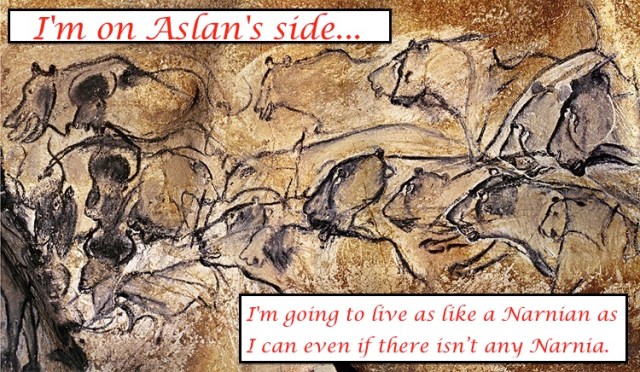
I’m on Aslan’s side even if there isn’t any Aslan to lead it. I’m going to live as like a Narnian as I can even if there isn’t any Narnia. So, thanking you kindly for our supper, if these two gentlemen and the young lady are ready, we’re leaving your court at once and setting out in the dark to spend our lives looking for Overland. Not that our lives will be very long, I should think; but that’s a small loss if the world’s as dull a place as you say.

Simply rereading these words has whet my hunger for the new addition to the Narnian cinematic canon. May it arrive soon.

During the next few years, as a script is written, the cast is chosen and the various scenes are filmed and edited, join me in offering an occasional prayer that the movie’s producers will both remain true to Lewis’ message, and produce a film worthy of the novel upon which it is based.