Some Fresh Words

Here at Mere Inkling our admiration for C.S. Lewis moves us to emulate some of his practices. Thus, we are avid readers and we also enjoy learning new words.

Some of us even enjoy inventing new words. No, we’re not so presumptuous as to desire to wend our ways into the dictionary. We just find this creative game to be both fun and useful for promoting mental health.

The challenge is providing rational definitions for our neologisms. These meanings can be serious or absurd; that doesn’t matter. Here are four I recently devised. (More, from years past, are available in the links I have included above.)

: Zambaloney : noun

A succulent cut of meat served only in skating rinks while the ice is being resurfaced during formal sporting competitions.

: Teguchigulper : noun

The indigenous name for the Honduran species of Chupacabra.

: Belladonut : noun

The presentation of poison derived from the perennial Atropa belladonna in appealing confectionaries. See also, doughnut. 

: Sinderella : noun

The Brothers Grimm story about a beneficent stepmother who learns her two biological daughters are being terrorized by their physically beautiful yet wicked stepsister.

We’re Not Alone

If you have tried your hand at this, or at least think it’s curious, you might be surprised to learn there are online “word generators” that perform at least part of this function. Let me mention a couple before sharing some more of my own inventions.

Unfortunately, some only toss out made up words, in literary isolation. This is the case of Random Word Generator, which did, however, suggest the intriguing word “picneted.”

Nonsense Word Generator “generates nonsense words based on a frequency list of phonemes as they occur in legitimate English words.” They claim “an actual word may slip through occasionally but it should mostly generate pronounceable gibberish.”

Since gibberish isn’t what I’m after, and I haven’t yet found an artificial intelligence website offering what I seek, it’s up to human beings to fill the gap. I hope you enjoy at least one or two of my other neologisms which follow.

New Words & Apropos Definitions 

: Dramadairy : noun

A business offering various products created from camelid milk. Suspense is generated by the uncertainty as to the particular species from the genus Camelus that provided the day’s primary ingredient.

: Sir Mize : proper noun

A minor noble of the Carolingian dynasty noted for his skill at accurately assessing situations despite lacking clear evidence for his hypotheses.

: Fleedom : verb

The attempt to escape restrictions imposed by an autocratic government.

: Califate : noun

The final destiny awaiting those who seek to impose their religion on others by means of violence rather than through thoughtful conversation and compassionate service.

: Hippocampus : noun

Commonly considered a region of the brain, the word originally referred to the special academies where priestesses of Taweret schooled Egypt’s hippopotami to serve Pharaoh.

: Integreation : verb

The process through which individuals or different groups are incorporated into a common whole, resulting in a truly synergistic benefit to all.

: Sinergy : noun

The crippling illusion that one should embrace diverse expressions of evil simply because they have become a standard practice under a decadent worldview.

: Laboratorinthine : adjective

Applied to extremely complex, often inescapable, research and medical facilities hosting arcane experiments on human subjects. See also, “science fiction and horror tropes.”

: Confort : noun, verb

noun : The false sense of security felt by a vulnerable individual who is being successfully deceived by a criminal. See conforter.

verb : The act of pretending to render aid or support to someone in need while laying the groundwork for a malevolent action toward them.

: Pintacostal : noun

Members of an ecstatic religious sect who allege that their ancestors arrived in America in the fifteenth century aboard one of Christopher Columbus’ smaller caravels.

: Calumknee : noun

Defamatory statements, especially directed toward athletes, related to the largest joint in a particular person’s anatomy.

: Commaraderie : noun

The collegiality felt by writers who advocate the use of the Oxford comma in lists of three or more items.

: Peripathetic : adjective

Traveling from place to place and job to job without ever finding the right fit.

: Lyberry : noun

A fruit concoction comprised of berries cleansed with minute amounts of lye water, which can be fatal if mismeasured. Not to be confused with the tragic mispronunciation of “library.”

: Indogtrination : noun

The process of training people to uncritically embrace a canine belief system and obedience to arbitrary and sometimes self-injurious commands. Antonym of catechesis.

: Banalgesic : noun

A drug designed to reduce the pain induced by participating in a banal conversation.

: Farmageddon : noun

Subterranean postapocalyptic nutrient harvesting plants specializing in either edible algae or plant-based meat alternatives (derived from algae).

: Olympipad : noun

Special edition of Apple’s iPad scheduled for release in conjunction with Olympiad XXXIV in Los Angeles in 2028.

And, as a final tribute to that great writers and saints, C.S. Lewis and J.R.R. Tolkien:

: Nearnia : noun

A fantastical world which does not require a Wardrobe to discover, but is as close as one’s own inspired imagination. See also, “Median Earth.”

Can We Ignore Modern Slavery?

I can’t answer this question for you, but I know how I want to be able to answer when I stand before our Creator. 

Many Christians include corporate confession and absolution (forgiveness) as part of their regular worship. We often ask forgiveness our sins of commission and omission – the wrongs we do, and the wrongs we are responsible for when we fail to do what we should.

God forbid that any of us would actively support slavery, but . . . how little most of us do to reduce it or free people from its deadly grasp.

In Britain, the National Society for the Prevention of Cruelty to Children, founded in 1884, recognizes modern slavery as one of the world’s greatest challenges. As they say: “Any child is at risk of child trafficking.”

Save the Children states that “children account for 27% of all the human trafficking victims worldwide, and two out of every three child victims are girls.”

Sometimes sold by a family member or an acquaintance, sometimes lured by false promises of education and a “better” life – the reality is that these trafficked and exploited children are held in slave-like conditions without enough food, shelter or clothing, and are often severely abused and cut off from all contact with their families.

The children’s condition is not “slave-like;” these precious victims literally are slaves, in every cruel sense of the word. While no unenslaved person would be so ignorant as to presume they understand slavery, C.S. Lewis mentioned in a 1939 letter several torments it inflicts. At the break of the Second World War, he was reflecting on his experiences in the First.

My memories of the last war haunted my dreams for years. Military service, to be plain, includes the threat of every temporal evil; pain and death which is what we fear from sickness; isolation from those we love which is what we fear from exile: toil under arbitrary masters, injustice, humiliation, which is what we fear from slavery: hunger, thirst and exposure which is what we fear from poverty.

The most shocking part of this description from Save the Children, is the acknowledgment that the children are “sometimes sold by a family member . . .” I discussed this grim truth in my 2014 post, “Loving Prostitutes.”

In that article I express a sentiment I hope you share: “I love prostitutes because God has granted me the vision to see them as he does.”

What You & I Can Do Today

Obviously, if this subject is new to you, you can become informed. The links I’ve provided offer a good starting point.

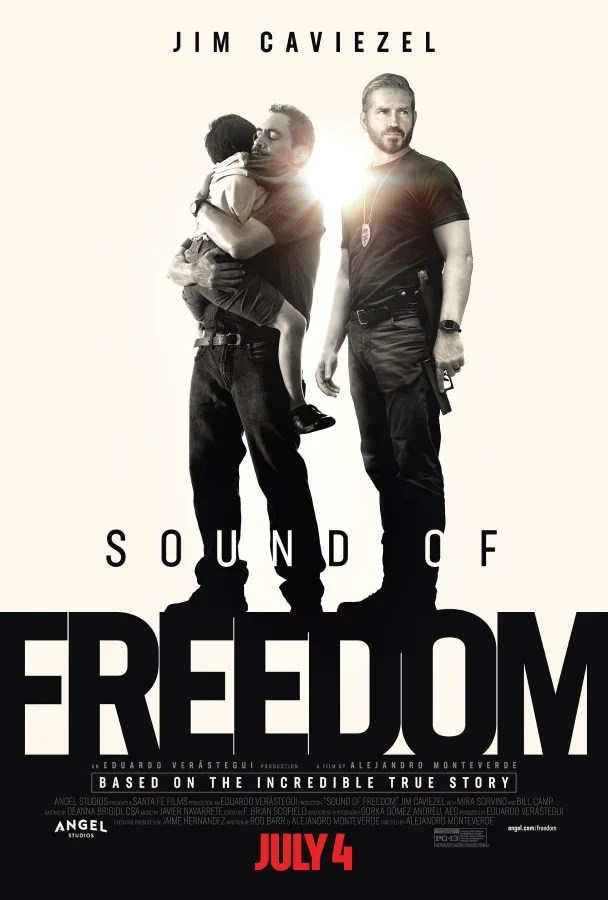
At the present moment we have a truly unique opportunity to make a contribution toward addressing this massive horror. We can support a superb, first-class film that is currently showing in hundreds of cinemas. 

Sound of Freedom is a true story with a superb cast and excellent cinematography. Despite its serious subject, the film is well worth viewing while it is still in theaters. Simply by attending, and even more by encouraging family and friends to join you, we can raise the awareness of this tragedy.

Together, you and I truly can help rescue people from this fate, and promoting this message of hope and deliverance is a small step in that journey. 

When faced with ugly things, the timid response is to turn away and pretend it doesn’t exist. In cases like this, particularly involving children, a cowardly response in ignoring the evil constitutes nothing less than a sin of omission. 

Check with your local theaters today, and reserve a seat at a showing of Sound of Freedom. (And, for those who see this suggestion months or years after the film’s 2023 release, check it out soon on a streaming service.)

Postscript & Resources:

While I was still on active duty, the United States Department of Defense initiated a long-overdue program. In recognition that military members are literally on the “front lines” of encountering modern slavery, Combating Trafficking in Persons is an official program established to confront the crime.

The program includes provisions requiring training for all DoD personnel, civilian as well as uniformed. This site describes the various levels of training required. To actually “take” the training and testing requires login privileges. However, various resources – including some very informative videos – are available to the public.

Similarly, agencies such as INTERPOL restrict their courses to members. Nevertheless, they offer a variety of educational resources and updates on current efforts to battle this crime around the globe.

While I haven’t personally vetted the following, a number of public and governmental organizations offer free training for interested individuals. Among them are: 

the U.S. Department of Homeland Security, and the Office for Victims of Crime. The U.S. Institute Against Human Trafficking lists six free classes, several of which offer certificates of completion.

The Home Office in the United Kingdom hosts a site with a number of related resources. One is “A typology of modern slavery offences in the UK” which breaks “down the broad categories of modern slavery into 17 distinct types of offences identified in the UK.” No doubt, most other enlightened nations promote similar materials.

In a 1943 essay entitled “Equality,” C.S. Lewis discusses the subject of the nature of Democracy, as a form of government. His argument includes the clearest possible reason why slavery never has been, and never could be a good, or morally neutral, thing.

I am a democrat because I believe in the Fall of Man. I think most people are democrats for the opposite reason. A great deal of democratic enthusiasm descends from the ideas of people like Rousseau, who believed in democracy because they thought mankind so wise and good that everyone deserved a share in the government.

The danger of defending democracy on those grounds is that they’re not true. . . . I find that they’re not true without looking further than myself. I don’t deserve a share in governing a hen-roost, much less a nation. . . .

The real reason for democracy is . . . Mankind is so fallen that no man can be trusted with unchecked power over his fellows. Aristotle said that some people were only fit to be slaves. I do not contradict him. But I reject slavery because I see no men fit to be masters.

I know that C.S. Lewis would add his “amen” to my challenge today that each of us might look for ways to help eradicate this plague of slavery, which has cursed humanity for millennia.

Chocolate Fuels Armies

“An army marches on its stomach.”* Military leaders have long recognized that it is difficult to arouse soldiers weakened by deprivation. Sadly, though, even a king of Israel could be foolish enough to ignore that and order his soldiers to fast before a battle.

While logisticians rarely receive the accolades of their peers who serve directly in combat, they have always been vital members of successful military ventures.

While they are concerned with securing and transporting all requirements, such as ammunition and medical supplies, there is a single necessary requirement for all campaigns. Without sustenance, soldiers will desert the flag and even the most steadfast will fall.

Nutritional value is the first priority. Palatability has historically been a distant afterthought. This has given rise to innumerable jokes made by veterans about the “combat rations” provided to them. While these “menus” have vastly improved in recent years, they remain fodder for much humor.

And even the most delicious food choices become monotonous when they are limited to a small range. In 2002, I visited a remote military detachment supplied with adequate pallets of Meals Ready to Eat, but begging for variety. They had hundreds of meals available, but only two or three different meal options! Civilians, in contrast, can readily purchase a far wider range of entrees.

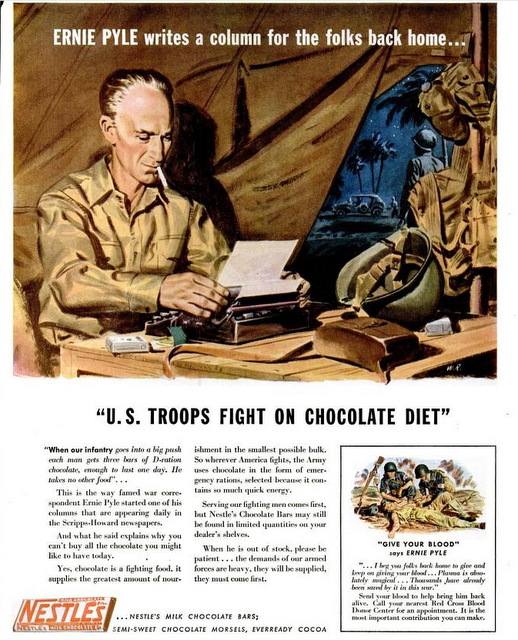
During the Second World War, the United States invested major efforts in making the combat meals more appealing. Various candies found their way into K-rations, in addition to necessities like toilet paper and cigarettes. In a comprehensive overview of the history of rations, the U.S. Army Quartermaster Foundation points to the main reason for complaint during WWII.

Like other unpopular items, misuse was a contributing factor to the waning popularity of the K ration. Although designed to be used for a period of two or three days only, the ration occasionally subsisted troops for weeks on end. . . . Continued use reduced the acceptability and diminished the value of the ration.

Adding confectionaries to rations made the meals more welcome. Chocolate was always a favorite, but the initial American versions left much to be desired.

My research was, in fact, prompted by a recent post on “Chocolate in WWII” in Pacific Paratrooper. (It is one of the very best military blogs on the internet.) They describe how the military approached a major American confectioner with a simple list of requirements (the last one is best appreciated by older veterans).

The Hershey Chocolate company was approached back in 1937 about creating a specially designed bar just for U.S. Army emergency rations. According to Hershey’s chief chemist, Sam Hinkle, the U.S. government had just four requests about their new chocolate bars: (1) they had to weigh 4 ounces; (2) be high in energy; (3) withstand high temperatures; (4) “taste a little better than a boiled potato.”

Sadly, many “who tried it said they would rather have eaten the boiled potato.” Well, it was the thought that counted, right?

There is a legend that during the war a German officer was confronted with American desserts and determined that the abundant resources of the United States signaled doom for the Nazi cause. The story likely has a fictional origin.

In the 1965 film Battle of the Bulge, Wehrmacht Colonel Hessler, shows his commanding general a treasure confiscated from American soldiers.

Hessler: “General, before you go, may I show you something?”

General: “What is it?”

Hessler: “A chocolate cake.”

Kohler: “Well?”

Hessler: “It was taken from a captured American private. It’s still fresh. If you will look at the wrapping, general, you will see it comes from Boston.”

Kohler: “And?”

Hessler: “General, do you realize what this means? It means that the Americans have fuel and planes to fly cake across the Atlantic Ocean. They have no conception of defeat.”

C.S. Lewis & Rations

Military rations during the First World War were more primitive than those provided twenty years later. One difference for the British is that they were granted a half gill of rum (or a pint of porter) each day.

This alcohol distribution was at the discretion of the commanding general, which meant that it was not available in the trenches. This was in the spirit of the American “General Order Number 1,” which typically applies to alcohol, and sometimes prohibits its presence throughout an entire theater. (I can personally attest to the ability of some elements, such as Special Ops, to circumvent such restrictions.)

C.S. Lewis wrote with some frequency about the rationing endured by the British public, during and after the world wars.⁑

Unfortunately, I’ve only uncovered one Lewisian reference to his own experience with military cuisine. In a 1917 letter to his father, he reveals that meals were not always appealing, even during training, prior to deploying to the war zone.

First of all came the week at Warwick, which was a nightmare. I was billeted with five others in the house of an undertaker and memorial sculptor. We had three beds between six of us, there was of course no bath, and the feeding was execrable.

The little back yard full of tomb stones, which we christened ‘the quadrangle,’ was infinitely preferable to the tiny dining room with its horse hair sofa and family photos.

When all six of us sat down to meals there together, there was scarcely room to eat, let alone swing the traditional cat round. Altogether it was a memorable experience.

A Hobbit, a Wardrobe, and a Great War describes how WWI affected C.S. Lewis and J.R.R. Tolkien. After relating a passage following Miraz’s defeat of Caspian’s force, when the momentarily defeated were “a gloomy company that huddled under the dripping trees to eat their scanty supper,” the author observes:

The military blunders, the fruitless acts of bravery, the bone-chilling rain, the meager rations: there were many days and nights just like these along the Western Front. Imaginary beasts aside, such scenes could have been lifted from the journal of any front-line soldier.

Like Tolkien, though, Lewis includes these images not for their own sake, but to provide the matrix for the moral and spiritual development of his characters . . .

Rations in Ukraine

Although the eyes of the world are riveted today on the war in Ukraine, there are currently 110 armed conflicts being monitored by the Geneva Academy. However, since Ukraine is in the news daily, it is worth noting both modern armies are employing military rations.

Apparently, Ukrainian troops have great Meals Ready to Eat (MREs). “Most importantly, when making, eating, or even talking about the food, the men seem to be genuinely happy.” The MRE link in this paragraph contains the details, including the note that “among the contents, you’ll find a small packet of dried apricots and a dark chocolate bar.”

There is also a vendor on ebay who sells what are purported to be captured Russian supplies, including a confiscated chocolate bar. The candy appears to be conventionally purchased, but could be part of an illicit chocolate conspiracy finding its way to the Russians from Latvia. “The Russian confectionery company ‘Pobeda’ ПОБЕДА has been producing chocolates, truffles, waffles and other types of sweets for more than six years in Ventspils, via a Latvian subsidiary.”

A month ago in Russia, “Pobeda” received thanks from an organization called the “Battle Brotherhood” for the fact that since the beginning of the Ukrainian war, the company has sent at least 15 tonnes of its products to Russian soldiers.

Chocolate does indeed appear to fuel armies. For a fascinating article on how chocolate can also be used to promote propaganda, check out this Ukrainian site.

Russian propaganda continues to dehumanize Ukrainians with the help of outright fakes.

Another “proof” of our apparent bloodthirstiness was the image of a chocolate bar with a remarkable name “Death of Alyoshka.” A portrait of a boy in a helmet with a mourning ribbon is placed on the wrapper of the confectionery. Propagandists claim that Ukrainians wish Russian children dead.

Become an MRE Connoisseur

If you are curious about the contents of various international MREs that are available for purchase by civilians, visit MREmountain, which began “in 2017 when people discovered the hobby of trying army rations.”

Most veterans, I suspect, would find the “hobby” of eating military rations rather peculiar. But then again, you can check out the French options, which the site labels “The best MRE in the world.” Only there, I imagine, could one discover “meals not found in any other MRE like Kebob Meatballs, Duck Confit, Deer Pate, Wild Boar.”

And, of course, France’s 24-hour ration also includes chocolat müesli, chocolate biscuits, five snack bars (at least one of which is pure chocolate), and a hot cacao packet. Yummy. It appears that les Français also consider chocolate to be a staple of modern soldiers.


* This quotation has been attributed to Napoleon and Frederick the Great. Whatever its modern origin, it is obvious starvation and its frequent companion, disease, have crippled as many armies as blade and shot.

⁑ “Mock Goose and Other Dishes of the War-Rations Diet” offers some interesting thoughts on this subject.

A Bible Translation for Slaves

Only three copies of an abridged Bible printed in the United Kingdom remain in existence. To some, their very existence is scandalous. To others, they evidence the desire of Christians to promote spiritual liberation, even for those shackled by human chains.

The sole copy held in North America is in the possession of Fisk University in Nashville, Tennessee. Fisk is one of the United States’ distinguished  Historically Black Colleges & Universities (HBCUs), and was founded only six months after the end of the Civil War by the American Missionary Association.

Prior to returning the volume to Fisk, this extremely rare Bible was on loan to the Museum of the Bible in Washington, D.C.* During its exhibition there, the museum described it thusly:⁑

The Slave Bible, as it would become known, is a missionary book. It was originally published in London in 1807 on behalf of the Society for the Conversion of Negro Slaves, an organization dedicated to improving the lives of enslaved Africans toiling in Britain’s lucrative Caribbean colonies.

They used the Slave Bible to teach enslaved Africans how to read while at the same time introducing them to the Christian faith.

A Liberty Fund essay on the volume describes the thought process behind the editing. “The unknown editors intended to steer clear of any revolutionary verses that might spark interest in the idea of liberty,” they say.

For example, the selections from Genesis include the first three chapters, which cover the creation of the world and Adam and Eve in Eden but omits chapter four, which tells the story of Cain and Abel and the first murder.

Even an abbreviated Bible, however, retains the power to communicate a divine message. When C.S. Lewis discussed whether the Bible will become fashionable for secular literary study, he said the challenge would come in the fact that it is, in fact, sacred.

Unless the religious claims of the Bible are again acknowledged, its literary claims will, I think, be given only “mouth honour” and that decreasingly. For it is, through and through, a sacred book.

Most of its component parts were written, and all of them were brought together, for a purely religious purpose (“The Literary Impact of the Authorised Version”).

Because of that, I believe that C.S. Lewis would agree with me that this translation (stunted though it is) would retain the power to enlighten its readers. After all, we are not considering a version of the Bible to which human words have been added. What remains is still inspired. 

But in most parts of the Bible everything is implicitly or explicitly introduced with “Thus saith the Lord.” It is, if you like to put it that way, not merely a sacred book but a book so remorselessly and continuously sacred that it does not invite, it excludes or repels, the merely aesthetic approach. . . .

It demands incessantly to be taken on its own terms: it will not continue to give literary delight very long except to those who go to it for something quite different. I predict that it will in the future be read as it always has been read, almost exclusively by Christians (“The Literary Impact of the Authorised Version”).

Thus, I believe the missionaries who devised this edited version of the Scriptures did so with good intent. They would, I am sure, have preferred to deliver to their enslaved hearers the complete Word. However, in cases where slaveowners would bar the Bible altogether because of its themes of rescue, freedom, and the judgment of the powerful, the missionaries compromised their desires.

They deemed the benefits outweighed the compromise. The benefits being the opportunity to learn to read, and even more importantly, the Light that would still shine through the portions of God’s Word to which these precious souls would have access.

As C.S. Lewis noted in a 1952 letter, “it is Christ Himself, not the Bible, who is the true word of God. The Bible, read in the right spirit and with the guidance of good teachers, will bring us to Him.” And, upon making their compromise, these formerly barred missionaries would gain access to those who might otherwise never meet humanity’s Savior, who is the Word incarnate.

So, in order to provide at least a portion of the true Bible, they risked violating the New Testament precedent established in the Book of Revelation.

I warn everyone who hears the words of the prophecy of this book: if anyone adds to them, God will add to him the plagues described in this book, and if anyone takes away from the words of the book of this prophecy, God will take away his share in the tree of life and in the holy city, which are described in this book (22:18-19).

This is a fascinating subject, the various attitudes toward the education of people held in bondage. Various books have been written on the subject, and numerous primary sources describe the differing opinions all those involved. The perspective of “freemen” is particularly poignant. A freeman (or freedman), is a person who has been delivered from a state of slavery.

In the biblical sense, as defined in the International Standard Bible Encyclopedia, it is “one who was born a slave and has received freedom” and is commonly used to describe those who were delivered from “bondage to sin [and] presented with spiritual freedom by the Lord.”

For he who was called in the Lord as a bondservant is a freedman of the Lord. Likewise he who was free when called is a bondservant of Christ (1 Corinthians 7:22).

As we used to pray in the liturgy of my childhood – Grant this, O Lord, unto us all!

Online Resources for Further Reflection

Internet Archive not only offers many public domain works for free download. They also host many great texts that you can “borrow” online. Your local library remains a great place, but they probably don’t offer the following books related to this subject.

“When I can read my title clear:” Literacy, Slavery, and Religion in the Antebellum South

Masters & Slaves in the House of the Lord: Race and Religion in the American South, 1740-1870

Memoir of Mrs. Chloe Spear, a Native of Africa, who was Enslaved in Childhood, and Died in Boston, January 3, 1815

And, even more exciting, there are some period writings you can read and even download. A quick search turned up a copy of The Duty of Masters: a Sermon, Preached in the Presbyterian Church, in Danville, Kentucky. In 1846, the Rev. John C. Young devoted a significant portion of his message to the responsibility of slaveowners to promote literacy.

The duty of attending to the religious improvement of our servants comprises among others two important particulars – teaching and encouraging them to read God’s word, and inducing them to attend his worship. Many have avowed the doctrine that it is not right to teach servants to read the Bible – and in some of the States their instruction is prohibited by law.

Our posterity will doubtless wonder how so monstrous a doctrine could ever prevail to any great extent in a Christian land; and how good men could ever delude themselves into the belief that such a doctrine was consistent with the first principles of that gospel which is sent to the bond as well as the free, and which requires all who receive it to impart a knowledge of it to the utmost of their ability to all who have it not.

Amazingly, you can even download your own copy of Select Parts of the Holy Bible for the Use of the Negro Slaves in the British West-India Islands from Internet Archives. Determine for yourself whether it was better to share with the captives in the British West Indies these “select parts” or to ignore their plight altogether. A wise man once wrote:

The Church exists for nothing else but to draw men into Christ, to make them little Christs. If they are not doing that, all the cathedrals, clergy, missions, sermons, even the Bible itself, are simply a waste of time.

God became Man for no other purpose. It is even doubtful, you know, whether the whole universe was created for any other purpose (Mere Christianity).


* Coincidentally, the Museum of the Bible will also be hosting a live performance this summer of C.S. Lewis’ “The Horse and His Boy.” Check out the promo on their site to see how they creatively present the equine stars of the book on stage!

⁑ Yes, I understand that the “-ly” appended to “thus” is superfluous, since the word itself is an adverb, but it just sounds so right to my (as C.S. Lewis might appreciate) dinosaur ears.

The picture above, “Reading the Scriptures,” was painted in 1874 by Thomas Waterman Wood. 

A Portuguese Pope & C.S. Lewis

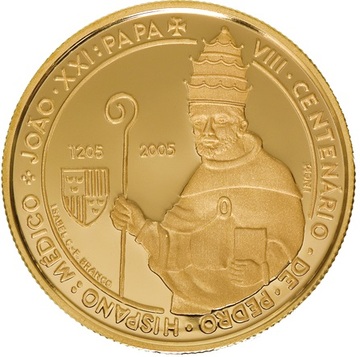
A few days ago marked the anniversary of the 1277 death of Pope John XXI. I knew nothing about this particular Pontiff, but the mention I read described his passing due to the collapse of the ceiling of his residence. That piqued my interest, but the following forced me to spend some time researching to learn more: “The name was a mistake – there was never a John XX.”

One of the very few email lists I’ve never regretted signing up for is “Today in Christian History” produced by Christianity Today.

Each day it provides brief notes about several historical events that happened on that particular day. Most of the notes describe historically watershed incidents. Others are simply curious, though they were naturally momentous to those involved.

The opening of this post offers an example from the latter category. Unlike the reign of Pope Francis, who ascended a decade ago and has indicated he has no intention of “retiring” before death (as did his humble predecessor Benedict XVI), the unfortunate John XXI sat on the papal throne for a mere nine months.

Despite this brief reign, there are several interesting things about Pedro Julião. (I’ll save the one I regard as most important for last.)

First of all, John XXI was Portuguese. Hailing from the Iberian Peninsula, he represents no less than 50% of the popes who came from Portugal. The first, Damasus I (305-84), came from the Roman province of Lusitania, which included a portion of Spain in addition to modern Portugal.

One paradox of the Papacy is that the Pope is the Bishop of the diocese of Rome, presiding over a physical geographic locale, while he is simultaneously the Bishop of the “Holy See,” meaning that he serves as the episcopal head of the entire international Roman Catholic communion.

Due to the physical location of the Roman Patriarchate, it is unsurprising that a majority of the individuals who have followed Saint Peter as Pontiff have been Italian. World Population Review says 217 of the 266 Popes have been from Italy. “A distant second is France, which has had a total of 16 popes.”

J.R.R. Tolkien was a truly devout Roman Catholic, but C.S. Lewis recognized that the church headquartered in Rome was merely one part of the Body of Christ whose unity he argued was founded in an understanding of the Mere Christianity Lewis propounded. Much to Tolkien’s chagrin, his good friend Lewis never converted to Roman Catholicism.

Roman Catholics still seek C.S. Lewis’ imprimatur. One prominent Roman Catholic apologist, Joe Heschmeyer, has a personal blog delightfully titled Shameless Popery. (I highly respect truth in advertising like his website exhibits.) In “C.S. Lewis’ Surprising Argument for the Papacy,” he argues that Lewis’ argument for a traditional view of marriage offers support to the rationale for papal authority.

Unlike some Protestants, C.S. Lewis was not tempted to construct a strawman out of the papacy. In an interesting passage from his monumental history of English Literature in the Sixteenth Century, he emphasizes the shared legacy of Roman Catholicism and robust Protestantism. 

To be sure, there are standards by which the early Protestants could be called “puritanical;” they held adultery, fornication, and perversion for deadly sins. But then so did the Pope. If that is puritanism, all Christendom was then puritanical together.

In much the same way that C.S. might argue that “all Christendom” shared not only a common moral awareness, but also a mutual understanding of God’s self-revealed Triune nature.

In addition to being a rare specimen as a Portuguese Pope, John XXI studied medicine and is thought to have been a noteworthy pharmacologist. In fact, the apartment in the papal palace in Viterbo which collapsed on him was constructed so he would have a quiet place in which to pursue his medical studies.

Second, as already mentioned, another peculiar thing about John XXI, is the choice of his papal name. There never was a Pope John XX. One would imagine the church bureaucracy would keep accurate records of these sorts of things. Even more strangely, there is more than one explanation for why Pedro Julião became John XXI at his consecration.

According to Brittanica “Marianus Scotus and other 11th-century historians mistakenly believed that there had been a pope named John between antipope Boniface VII and the true John XV.” Consequently, “they mistakenly numbered the real popes John XV to XIX as John XVI to XX” requiring that they subsequently be “renumbered XV to XIX.” Yet, for some reason, “John XXI and John XXII continue to bear numbers that they themselves formally adopted on the assumption that there had indeed been 20 Johns before them.”

As a result, the title John XX presumably remains available for any future Bishop of Rome who might wish to further confuse the matter. We may have to wait until the Parousia to learn the full facts in this convoluted matter.

A third distinctive of John XXI is that he rescinded a very common sense decree established by his predecessor Gregory X, only two years prior to John’s ascension. (Actually, Adrian V was elected pope between the two, but Ottobuono de’ Fieschi died shortly after his election, before he could even be ordained to the priesthood. (There must be another interesting tale there.)

Returning to the story of the rescinded canon . . . Apparently there was a long papal vacancy (nearly three years) before Gregory X was elected. To avoid such predicaments in the future, at the Second Council of Lyon Gregory pushed for this sensible rule: if the new pope is not elected in a reasonable time frame, encouragement would be provided to the conclave by having their episcopal meals and other rewards gradually diminish!

The entire, fascinating “constitution” is available at Eternal World Television Network. Here is the essence:

We learn from the past how heavy are the losses sustained by the Roman church in a long vacancy, how perilous it is . . . We intend in no way to detract from [previous rules primarily instituted by Pope Alexander III], but to supply by the present constitution what experience has shown to be missing.

If, which God forbid, within three days after the cardinals have entered the said conclave, the church has not been provided with a shepherd, they are to be content for the next five days, every day both at dinner and supper, with one dish only. If these days also pass without the election of a pope, henceforth only bread, wine and water are to be served to the cardinals until they do provide a pope.

While the election is in process, the cardinals are to receive nothing from the papal treasury, nor any other revenue coming from whatever source to the church while the see is vacant.

For some unrevealed reason, John XXI revoked this rule, and it was back to business as usual. The decision to do so was one of John’s few official acts.

C.S. Lewis, Once Again

One reason Christians of all denominational traditions find much to appreciate in C.S. Lewis comes from the fact he was much more interested in edifying believers than tearing them down. He preferred to promote Christian unity over division.

One of his close friends, with whom he carried on a long term correspondence was a Benedictine monk named Bede Griffiths. Ironically, while Griffiths became renowned for his embrace of elements of Hindu spirituality, the priest appeared less tolerant of C.S. Lewis’ Protestant doctrines. In a letter from 1936, Lewis’ frustration on that score comes through loud and clear.

One of the most important differences between us is our estimate of the importance of the differences. You, in your charity, are anxious to convert me: but I am not in the least anxious to convert you.

You think my specifically Protestant beliefs a tissue of damnable errors: I think your specifically Catholic beliefs a mass of comparatively harmless human tradition which may be fatal to certain souls under special conditions, but which I think suitable for you. . . .

As well – who wants to debate with a man who begins by saying that no argument can possibly move him? Talk sense, man! With other Catholics I find no difficulty in deriving much edification from religious talk on the common ground: but you refuse to show any interest except in differences.

These words were written (1) privately, to a friend, (2) in the form of an extemporaneous letter, and (3) tinged with the frustration of returning to a familiar “debate” with a recalcitrant disputant.

Fortunately, however, we possess an essay written by Lewis on the same subject which was composed in the opposite context. It was intentionally composed for a general audience, written in C.S. Lewis’ natural painstakingly logical and clear literary voice, and composed in his conciliatory spirit with a focus on affirming what is shared and illuminating – but not dwelling upon – differences.

In 1944 C.S. Lewis penned an essay entitled “Christian Reunion.” Sadly, it was never completed for publication during his lifetime. This brief work reveals his deeper thoughts on interdenominational distinctives, and the overriding unity Christians possess through our relationship in Jesus Christ. It is written primarily to a Roman Catholic audience, in a respectful and genuinely compassionate tone.

A Pilgrim in Narnia has provided the universal (“catholic” with a small “c”) Church a great service in reproducing the full text of the essay here.

Dr. Dickieson also provides a concise and helpful introduction. I offer only a selection from Lewis’ essay here, as befits the nature of our current discussion.

I know no way of bridging this gulf [between the major Christian traditions]. Nor do I think it the business of the private layman to offer much advice on bridge-building to his betters. My only function as a Christian writer is to preach “mere Christianity” not ad clerum [to the clergy] but ad populum [to the people].

Any success that has been given me has, I believe, been due to my strict observance of those limits. By attempting to do otherwise I should only add one more recruit (and a very ill qualified recruit) to the ranks of the controversialists. After that I should be no more use to anyone.

When therefore we find a certain heavenly unity existing between really devout persons of differing creeds – a mutual understanding and even a power of mutual edification which each may lack towards a lukewarm member of his own denomination – we must ascribe this to the work of Christ . . . 

Ultimately, C.S. Lewis’ reservations about Roman Catholicism rested where they do for most thinking Christians who belong to other denominations. Its focus can be distilled down to a “disagreement about the seat and nature of doctrinal Authority.” Although he does not expressly state the conviction here that Scripture supersedes the ultimate weight of a single opinion, say of someone such as Pope John XXI, that is the concern.

We will end with C.S. Lewis’ astute analysis of the two parts of the Christian family as they view one another across the proverbial Tiber. In doing so, I offer the fruits of my own recent theological quest. Precipitated by a contemporarily trivial event during the thirteenth century, it culminated in another deep draught from the wisdom of C.S. Lewis.

The difficulty that remains . . . is our disagreement about the seat and nature of doctrinal Authority. The real reason, I take it, why you cannot be in communion with us is not your disagreement with this or that particular Protestant doctrine, so much as the absence of any real “Doctrine,” in your sense of the word, at all.

It is, you feel, like asking a man to say he agrees not with a speaker but with a debating society.

And the real reason why I cannot be in communion with you is not my disagreement with this or that Roman doctrine, but that to accept your Church means, not to accept a given body of doctrine, but to accept in advance any doctrine your Church hereafter produces. It is like being asked to agree not only to what a man has said but to what he’s going to say.

Postscript

As an illustration of the C.S. Lewis’ point about authority resting in the current “successor of Peter,” consider the decisions rendered by Gregory X and John XXI about papal enclaves. It seems to me that the first admonition about not indulging those in attendance was wiser than the subsequent decision to restore the earlier policies. But then, that may simply be due to the fact that I’m a Protestant. Unless the rules have been revised since John’s passing, I assume most Roman Catholics would agree that he was led by the Holy Spirit in reversing the decree of the Second Council of Lyon.

Learning Languages

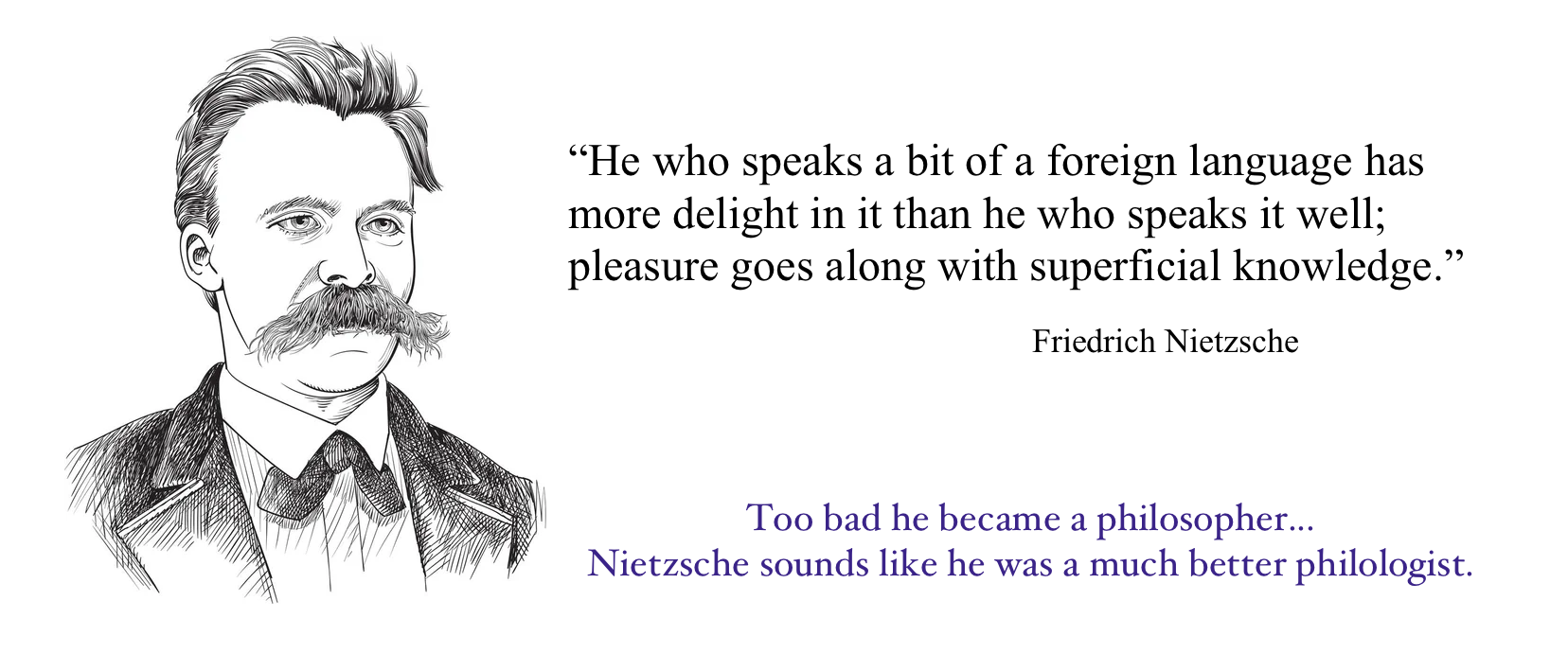
C.S. Lewis possessed a gift for languages. Although he was not a philologist like his friend J.R.R. Tolkien, Lewis was well educated and read and spoke a variety of languages.

In fact, when he and his wife played Scrabble, they allowed for the use of words from any language! For the record, though, he does confess to a German professor that his grasp of that tongue is “wretched.”

The only bona fide genius I’ve known was a classmate at the University of Washington. While I was struggling with classical Greek, in preparation for seminary, at the age of 23 Bruce already possessed four master’s degrees and was closing in on his PhD in Linguistics. He spoke fifteen languages, but could read nineteen.

Of course, that is still a small portion of the 7,168 languages Ethnologue tells us are in use today.

This enormous number – which doesn’t include unknown languages spoken among untouched people groups – accounts for the fact that thousands of Christians are laboring now in groups such as Lutheran Bible Translators to make the Scriptures available to all people.

Sometimes this involves creating a written language itself, where only an oral version exists. The largest such organization, Wycliffe Global Alliance, reports that “Bible translation is currently happening in 2,846 languages in 157 countries.”

While the Bible’s translation is certainly of utmost importance, it is wonderful to know that other valuable literature is also made available to readers who could not decipher the language in which it was originally composed. 

Lewis, in fact, was a translator in his own right. Beyond the literal translation of works from one tongue to another, Lewis also functioned as a “translator” of complex concepts and eternal truths. I once described this as C.S. Lewis’ bilingualism.

How many extremely intelligent and well educated people do you know . . . who can actually communicate with those of us possessing normal human intelligence? That talent is a rarity.

And it is precisely what makes C.S. Lewis such an unusual man. He was brilliant. Yet he could communicate with the common person – even the child – just as easily as he conversed with his fellow university dons.

C.S. Lewis mastered a number of modern languages, but it was his study of historic languages that especially inspired him. Icelandic, with its similarity to Old Norse, is one example about which I have written. 

. . . J.R.R. Tolkien and his friend C.S. Lewis established a group called Kolbitár which was devoted to reading Icelandic and Norse sagas. The word itself means “coal biter” and refers to those in a harsh environment drawing so close to the fire’s warmth they can almost bite the coals.

Another example is Old English. Along with Middle English, birthed by the Norman Conquest, these were essential elements of his training as one of the preeminent English scholars of Oxford and Cambridge. And these languages were not merely dusty relics. I encourage the curious to read “C.S. Lewis’s Unpublished Letter in Old English,” which appeared in the journal VII.

In 1926 C.S. Lewis wrote his friend Nevill Coghill a letter in Old English, a language also known as Anglo-Saxon. Unreadable for most current readers of Lewis, it understandably does not appear in his three-volume Collected Letters.

In the essay, George Musacchio provides an illuminating outline of Lewis’ diverse expertise with languages, both “foreign and domestic.” Lewis began the letter to his friend with the following salutation.

“Leowis ceorl hateð gretan Coghill eoorl luflice ond freondlice.”
Which translates as: “Lewis the churl bids to greet Coghill the earl.”

Is English Really that Difficult to Learn?

English is reputed to be one of the most challenging languages to learn. (More on this in a moment.) For example, the simple sentence which follows consists of a mere seven words, but holds seven different meanings, dependent upon which word is emphasized.

“I never said she stole my money.”

This example comes from an article entitled “English is Hard, But Can Be Understood Through Tough Thorough Thought Though.”

Rosetta Stone answers the question of how hard it is to learn English by saying “it depends on your first language.” 

In addition to the fact that “spelling is a poor indicator of pronunciation,” English possesses numerous “specific rules,” and complements this burden with the fact that “some rules have lots of exceptions.” The complexity is due to the language’s history, which also gave rise to its mammoth vocabulary.

English has a lot of words—Webster’s English Dictionary includes approximately 470,000 entries, and it’s estimated that the broader English vocabulary may include around a million words. . . .

English has such a broad vocabulary because it’s a blend of several different root languages. While English is a West Germanic language in its sounds and grammar, much of the vocabulary also stems from Romance languages, such as Latin, Italian, Spanish, and Portuguese.

One result of combining these various root languages is that the English vocabulary includes a ton of synonyms . . . And unfortunately, most of these synonyms aren’t fully interchangeable, so the exact word you choose does have an impact on the overall meaning.

It turns out English doesn’t even rank in the top three most difficult languages for the speakers of the five largest language groups. The ranked listings do include, however, Arabic, Japanese, Russian, and Mandarin.

So, let’s reverse the question for a moment. Which languages are the most difficult for a native English speaker to learn? Unbabel lists ten. Fortunately, only one of them is on my wish list.

Babbel Magazine has an article approaching that question from the opposite end. Which language is easiest for English speakers to learn.

This may come as a surprise, but we have ranked Norwegian as the easiest language to learn for English speakers. Norwegian is a member of the Germanic family of languages — just like English! This means the languages share quite a bit of vocabulary, such as the seasons vinter and sommer (we’ll let you figure out those translations).

Another selling point for Norwegian: the grammar is pretty straightforward, with only one form of each verb per tense. And the word order closely mimics English. For example, “Can you help me?” translates to Kan du hjelpe meg? — the words are in the same order in both languages, so mastering sentence structure is a breeze!

Finally, you’ll have a lot more leeway with pronunciation when learning Norwegian. That’s because there are a vast array of different accents in Norway and, therefore, more than one “correct way” to pronounce words.

An article I wrote seven years ago hints at that same conclusion. I made this informative, and mildly threatening, illustration for “Norse Linguistic Invasion.”

Oxford Royale Academy lists several reasons why English is especially challenging to new students. The following issue of “irregularities” also plagues countless native speakers.

One of the hardest things about English is that although there are rules, there are lots of exceptions to those rules – so just when you think you’ve got to [come to] grips with a rule, something comes along to shatter what you thought you knew by contradicting it.

A good example is the rule for remembering whether a word is spelt “ie” or “ei:” “I before E except after C.” Thus “believe” and “receipt.”

But this is English – it’s not as simple as that. What about “science?” Or “weird?” Or “seize?”

There are loads of irregular verbs, too, such as “fought”, which is the past tense of “fight”, while the past tense of “light” is “lit.” So learning English isn’t just a question of learning the rules – it’s about learning the many exceptions to the rules.

The numerous exceptions make it difficult to apply existing knowledge and use the same principle with a new word, so it’s harder to make quick progress.

And even some of the normative “rules” are difficult to grasp. One example is that there’s a very specific order that adjectives must be listed ahead of a noun. According to Rosetta Stone,

The adjective order is: quantity, opinion, size, age, shape, color, origin/material, qualifier, and then noun. For example, “I love my big old yellow dog.” Saying these adjectives in any other order, like “I love my yellow old big dog,” will sound wrong, even when otherwise the sentences are exactly the same and communicate the same thing. Keeping rules like this in mind can be tricky, and it takes a lot of practice to get it right.

Adjective order is seldom considered, in part because it’s not considered good writing to string too many such words together. But apparently there are right and wrong ways to organize any such list.

Royal Order of Adjectives

Most students aren’t taught about adjective order in school and instead learn it through listening and reading. In English, the rules regarding adjective order are more specific than they are in other languages; that is why saying adjectives in a specific order sounds “right,” and deviating from that order makes a statement sound “wrong,” even if it’s otherwise grammatically perfect.

And, since we’re talking about English, even this Royal Order of Adjectives rule has exceptions

The hierarchy is not absolute, and there is some wiggle room among the “fact” categories – size, age, and so on – in the middle.

Native speakers are often delighted when they learn about this law and discover how flawlessly they apply it. It even went viral in 2016 . . . The tweet attached a paragraph by etymologist Mark Forsyth . . . giving an example that uses all the categories according to the OSASCOMP hierarchy: “a lovely little old rectangular green French silver whittling knife.”

I do not ever recall being taught (or reading on my own) about the “Royal Order of Adjectives.” Nevertheless, I don’t feel too embarrassed at acknowledging my previous ignorance, since even Lewis himself was comfortable in expressing gratitude for being introduced to new words. For example, when he thanked Dorothy Sayers for enlarging his vocabulary with her work on Dante.

So, is English all that challenging? Well, C.S. Lewis did his part to make it less daunting, joining a public debate in Britain, with an unexpected argument. Discussing English’s previously noted problem with inconsistencies and confusion in spelling, the don offered a simple solution.

In a column on Lewis and the history of words, I included an extended passage from a letter Lewis wrote challenging a contemporary British effort to “reform” spelling. Surprisingly, he argued against the necessity for uniformity in spelling. After explaining why our language functions as it does, he advocates:

As things are, surely Liberty is the simple and inexpensive ‘Reform’ we need? This would save children and teachers thousands of hours’ work.

Surely all but the most diehard grammarians would be sympathetic to his argument.

Next week I plan to write about another linguistic matter closely associated with the Inklings – the creation of new words and languages.

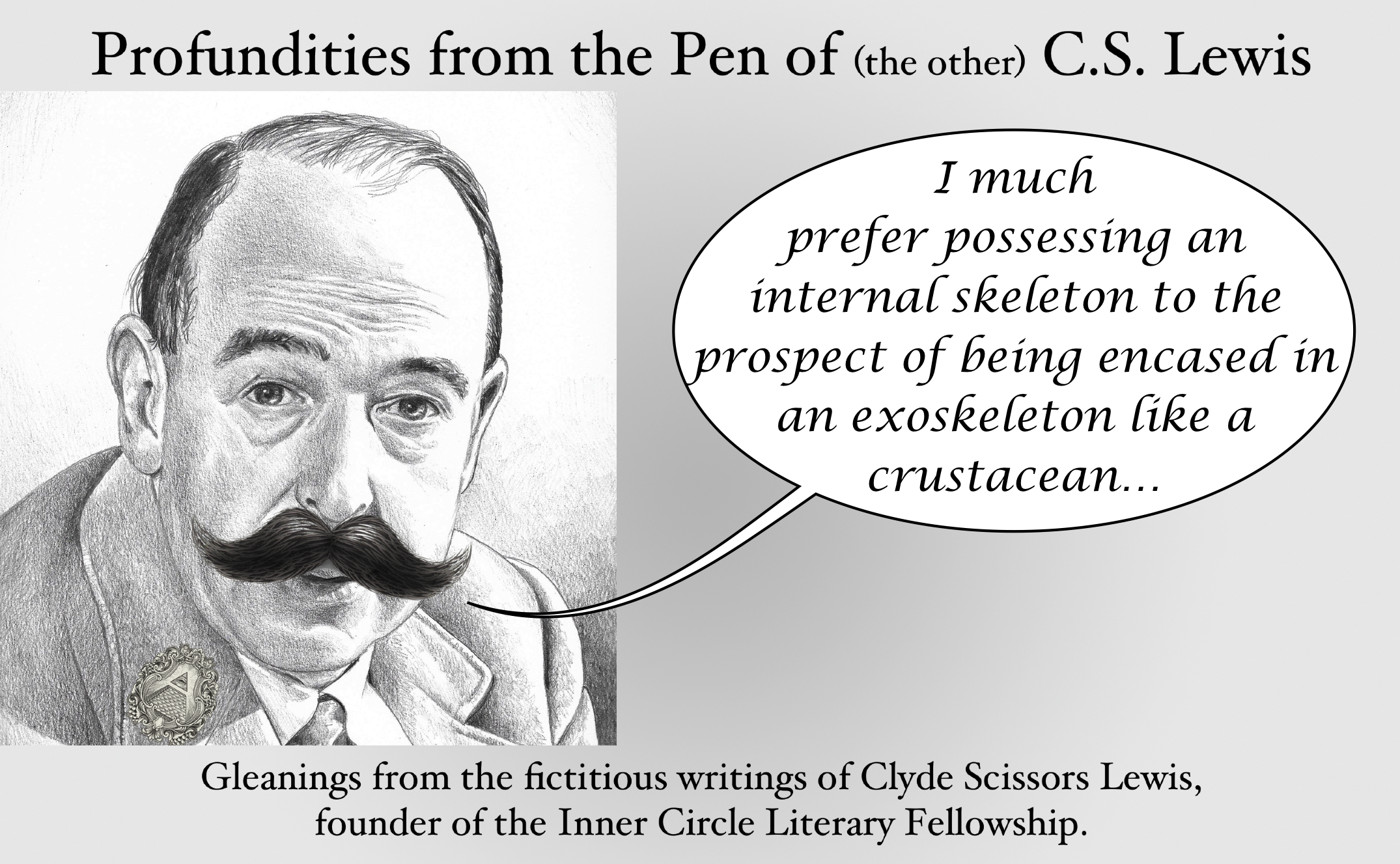
CS Lewis | Skeletons

Deep Thoughts from the Quill of the Other C.S. Lewis

Welcome to another in an occasional series of fictitious quotations from a fabricated contemporary of the great Oxbridge professor, Clive Staples Lewis.

The C.S. Lewis who authored these questionable observations, Clyde Scissors Lewis, possessed a worldview enigmatically different from that of the esteemed Christian author. Despite the fact that their two lives overlapped in a variety of ways, the similarities were superficial.

A brief biography of the lesser Lewis is available at this link.

The Other C.S. Lewis: A Brief Biography

By all means, do not confuse the wisdom of the genuine article with his shadowy counterfeit. Despite any cursory similarities between the two men, this is most definitely not the C.S. Lewis readers have come to know and love.

The Church at War

Why would Christian Scriptures commend people for waging war? War, after all, is nearly universally condemned – even as it remains a relentless curse in various corners of our world.

One young pastor was “charged” with a duty that belongs, by biblical extension, to all believers. “This charge I entrust to you [that] you may wage the good warfare, holding faith and a good conscience” (1 Timothy 1).

The reason followers of Jesus are encouraged to actively train for and engage in war is because our enemies are not other human beings. We discussed this fact in our last conversation, as we considered the theological concept of the Church Militant.

To call the Body of Christ “militant” is misleading to those who don’t understand spiritual warfare, the fact that “we do not wrestle against flesh and blood, but against . . . the cosmic powers over this present darkness . . .” (Ephesians 6).

Unfortunately, because all of us are imperfect (i.e. fallen), Christians can sometimes fail to distinguish between our true enemies and those who witlessly follow their banner. For an excellent discussion of this, from a Roman Catholic perspective, I recommend you read “The Church Militant or the Church Belligerent?

Another worthwhile read is “G.K. Chesterton and the March of the Church Militant.” There, Joseph Pearce shares Chesterton’s vivid description about how Gothic cathedrals visualize the martial aspect of the Christian Church.

The truth about Gothic [architecture] is, first, that it is alive, and second, that it is on the march. It is the Church Militant; it is the only fighting architecture.

All its spires are spears at rest; and all its stones are stones asleep in a catapult. In that instant of illusion, I could hear the arches clash like swords as they crossed each other. The might and numberless columns seemed to go swinging by like the huge feet of imperial elephants.

The graven foliage wreathed and blew like banners going into battle; the silence was deafening with all the mingled noises of a military march; the great bell shook down, as the organ shook up its thunder.

The thirsty-throated gargoyles shouted like trumpets from all the roofs and pinnacles as they passed; and from the lectern in the core of the cathedral the eagle of the awful evangelist crashed his wings of brass (“The Architect of Spears”).

As a master of words and wit, Chesterton’s writing rarely disappoints. You can download a free copy of The Man Who was Chesterton, which includes this essay, from Internet Archive.

C.S. Lewis did more to equip us for spiritual warfare with The Screwtape Letters than a thousand clergy with a hundred thousand sermons. As one Baptist theologian summed it up in an article about spiritual warfare:

On the subject of spiritual warfare, Lewis is a helpful guide. I’ll remember what he taught: There is an enemy. He seeks my destruction. And this is war.

There is a brilliant quote about this supernatural confrontation, ascribed (apparently in error) to the historical Martin Luther.

If I profess, with the loudest voice and the clearest exposition, every portion of the truth of God except precisely that little point which the world and the devil are at that moment attacking, I am not confessing Christ, however boldly I may be professing Christianity.

Where the battle rages the loyalty of the soldier is proved; and to be steady on all the battle-field besides is mere flight and disgrace to him if he flinches at that one point.

C.S. Lewis echoes this sentiment in The Magician’s Nephew. When Aslan questions the humble man whom he would crown the first King of Narnia, he poses a query which reveals the man’s courage and humility.

“And if enemies came against the land (for enemies will arise) and there was war, would you be the first in the charge and the last in the retreat?”

“Well, sir,” said the Cabby very slowly, “a chap don’t exactly know till he’s been tried. I dare say I might turn out ever such a soft ’un. Never did no fighting except with my fists. I’d try – that is, I ’ope I’d try – to do my bit.”

“Then,” said Aslan, “you will have done all that a King should do.”

If anyone would follow Christ, neutrality is not an option. Though some temporary retreats are inevitable, in God’s strength, we are empowered to continue our (in reality, the Lord’s) advance.

The battlelines are drawn, and they are real. As C.S. Lewis proclaimed in “Christianity and Culture” – “There is no neutral ground in the universe. Every square inch, every split second is claimed by God, and counterclaimed by Satan.”


The image above, “Livonian Sword Brother” (a member of a military monastic order) was created by JLazarusEB and is used here in compliance with the Creative Commons CC BY-NC-ND 3.0 License.

Thoughts on the Church Militant

C.S. Lewis understood better than most the spiritual warfare that rages, unseen for the most part, around all human beings.

And, as veterans of the bloody trenches of the First World War, Lewis and his good friend J.R.R. Tolkien had learned more than they desired about the tactics and sheer violence of combat.

Many of those wartime lessons translated directly into a spiritual context. However, I recently realized how poorly the concept of immobile trenches relates to our challenge to take up our crosses and follow our Savior.

You see, the Christian life is many things, but there is one thing discipleship never is – static. As theologian Tilemann Heshusius (1527-1588) wrote: “Christian soldiers always either advance or retreat.”

In battle there is nearly always an ebb and a flow, as forces advance on one front and temporarily shift back on another. In his essay “The World’s Last Night,” C.S. Lewis observes “In battle men save their lives sometimes by advancing and sometimes by retreating.” The same is true for the Christian life in general. We are either advancing, or falling back. Our relationship with God is not stagnant.

The New Testament includes many military metaphors and allusions, intended to equip us for victory in our spiritual battles.

The Apostle Paul refers to believers as “fellow soldiers.” In a letter to a young pastor, he extols the model of the soldier, who keeps his focus on the mission.

Share in suffering as a good soldier of Christ Jesus. No soldier gets entangled in civilian pursuits, since his aim is to please the one who enlisted him.

Then there is the familiar passage which uses the image of the “whole armor of God” to describe in detail how Christians are to be prepared for faithful service. You can read the entire passage here.

These military accoutrements are necessary because “we do not wrestle against flesh and blood, but against the rulers, against the authorities, against the cosmic powers over this present darkness, against the spiritual forces of evil in the heavenly places” (Ephesians 6:12).

This is the reason one aspect of the Christian Church’s nature has been described as the “Church Militant.” This describes the Church battling evil while awaiting Christ’s return, for the Final Judgment, when it will become the “Church Triumphant.” The former is the context for familiar hymns such as “Onward Christian Soldiers,” composed by a prolific Anglican priest in the nineteenth century.

Onward, Christian soldiers,
   marching as to war,
With the cross of Jesus
   going on before!

Christ, the royal Master,
leads against the foe;
Forward into battle,
see his banner go!
     . . .

At the sign of triumph
   Satan’s host doth flee;
On, then, Christian soldiers,
   on to victory!

Hell’s foundations quiver
   at the shout of praise;
Brothers, lift your voices,
   loud your anthems raise.

The WWI trenches are the archetype of static, immobile frontlines. Disease festered, and morale decayed like the muck sucking at the soldiers’ boots. As recognized by sixteenth century theologians and C.S. Lewis alike, wars are rarely won simply by maintaining a defensive position. Movement is an essential element of warfare.

Hopefully more of that movement consists of advances against the enemy, than retreats. But we will consider that aspect of spiritual war in our next post.

Until Then

Those interested in learning more about military strategy, particularly as explored by another veteran of the War to End All Wars, Sir B.H. Liddell Hart,* like Lewis and Tolkien, returned home to Britain from the front lines, as a casualty. (Britannica states more than a third of the British forces became casualties, in contrast to 76% of Russians, 73% of French, and 8% of Americans.)

Liddell Hart’s wisdom extends beyond the battlefield itself.

The downfall of civilized states tends to come not from the direct assaults of foes, but from internal decay combined with the consequences of exhaustion in war (“The Objective in War,” a lecture delivered in 1952 to the United States Naval War College).


* Sir Basil Henry Liddell Hart (1895-1970) was a military historian and theoretician. A number of his works are in the public domain and available for free download from Internet Archives. These include A Greater than Napoleon, Scipio Africanus and Why Don’t We Learn from History?

History in Retrospect

This title, “History in Retrospect,” is of course redundant. There is no other way to consider history than by looking back at the past – from our current vantage point.

That is why it’s impossible to view history completely objectively. Since each of us measures things from our personal worldview, the same event means vastly dissimilar things to different people.

When people are hyper-partisan, they are incapable of reasoning with others who view events differently. The history of the United States is currently the subject of intense (too often extremist) debate by its citizens. Balanced people, the type I prefer talking to, admit the shortcomings in our history, and praise the accomplishments.

There are those, sadly, who believe their nation can have done no wrong. There are others who relish condemning the country’s imperfections. Those in the latter camp remind me of the prejudice exhibited by Nathanael, one of Jesus’ future disciples, when he dismissed his brother’s enthusiasm about the Messiah with the words “can anything good come out of Nazareth?” (John 1).

C.S. Lewis was a gifted writer and academic. He was also a historian, especially an expert in literary history. His volume in the Oxford History of English Literature reflects that fact quite clearly.

Lewis was not only brilliant, in many ways he revealed great wisdom. Listen to these remarks about history from a letter he wrote to one of his casual correspondents in 1952.

You are not the kind of correspondent who is a ‘nuisance:’ if you were you would not be now thinking you are one – That kind never does.

But don’t send me any newspaper cuttings. I never believe a word said in the papers.

The real history of a period (as we always discover a few years later) has very little to do with all that, and private people like you and me are never allowed to know it while it is going on.

Educated originally as a “journalist,” I’m forced to agree completely with Lewis. Every word in print today is suspect. Those who do not read critically are on dangerous ground. And, of course, it’s not just newspapers and journals that demand caution. Digital media are even worse.

For that reason, we should never pretend any publication is 100% reliable. However, one magazine that I believe honestly strives toward that goal, is World Magazine. I appreciate the fact that it approaches subjects from my own theistic (Christian) worldview. By default, that makes it makes it untrustworthy to those who possess an anti-Christian worldview.

The open-minded individuals I referred to above, ever a minority, are willing (even eager) to read articles written by people from a range of perspectives. And it is for you, the honest and inquisitive people, that I suggest you consider adding World to your reading list.

Andrée Seu Peterson, recently wrote a provocative article discussing a recurrent historical phenomenon. It is entitled “A gathering in Switzerland: Little-known meetings can have massive outcomes.”

Down through history there have been little conferences attended by small numbers of elites that have quietly changed the world while the rest of mankind was going about its mundane business unawares. . . .

In June of 1494 King Ferdinand II of Aragon, Queen Isabella I of Castille, and King John II of Portugal drew a demarcation line like a vertical knife edge running from North to South poles, trampling established communities as it divided the Western world between Spain and Portugal.

People falling on one side of the line would henceforth speak Spanish and people on the other side would speak Portuguese.

Echoes of C.S. Lewis’ cautions about the “inner ring!”

Considering the “End of History”

History is defined in a variety of ways. To avoid politically charged definitions, let’s turn to a source in that most-neutral nation, Switzerland. In the description of their doctoral program in the field, the Universität Basel says “history examines past events, processes and structures [and] is both a cultural studies and a social sciences discipline.”

The point being that history relates to humanity, rather than our planet as an entirety. Thus, history won’t end with death of our solar system “in about 5 billion years [when] the sun will run out of hydrogen.” Even the most optimistic advocates of a starfaring future for humanity would likely admit history will end long before that.

Christians, on the other hand, foresee a future history without end. Yes, this earth will pass away, but our Creator has promised a new heaven and a new earth that will not echo the perishable nature of our fallen world.

In light of this conviction, Peterson includes a sobering observation in her essay about history.

People living in the Stone Age didn’t know they were living in the Stone Age. People alive at the time the monks in Ireland furiously copied Greek and Latin Bible manuscripts as fast as the Huns and Visigoths could torch the libraries of Europe didn’t know they were living through the near destruction of Western civilization. Such things are clear only in hindsight.

No Christian pretends to know the day of Christ’s return. In fact, Jesus expressly said “concerning that day and hour no one knows, not even the angels of heaven . . . Therefore you also must be ready, for the Son of Man is coming at an hour you do not expect” (Matthew 24).

Speculation about the Day of the Lord has rarely been beneficial. Suffice it to know that we should remain, at every possible moment, “ready.”

C.S. Lewis wrote another letter in 1952 which addresses this principle. His friend Don Giovanni Calabria (1873-1954), who was canonized by John Paul II in 1999, had written to Lewis sharing his impression that the day of the Lord’s return was drawing nearer.

Lewis reminded the priest of something Calabria already knew quite well. And it’s something well worth being reminded of today.

The times we live in are, as you say, grave: whether ‘graver than all others in history’ I do not know. But the evil that is closest always seems to be the most serious: for as with the eye so with the heart, it is a matter of one’s own perspective.

However, if our times are indeed the worst, if That Day is indeed now approaching, what remains but that we should rejoice because our redemption is now nearer and say with St John: ‘Amen; come quickly, Lord Jesus.’

Meanwhile our only security is that The Day may find us working each one in his own station and especially (giving up dissensions) fulfilling that supreme command that we love one another.

Lewis closes his letter with an affectionate prayer and promise, worthy of emulation in our own lives. “Let us ever pray for each other.” A sentiment I share with you.