Meandering Words

Sometimes we read for business. Other times we read for pleasure. Few people are so fortunate as to have these two purposes overlap.

When the goal is the former – the necessity of reading a particular document, our desire is usually to simply “get it done.” We want to arrive quickly at the point, so we can move on to some other project. In this context, digressions are definitely something to be avoided.

This is how military writers are taught to do their job. Deliver the goods immediately, with zero interest in the prose. (Well, apart from proper grammar and spelling.) This principle is frequently described with the acronym BLUF – bottom line up front. This approach makes sense, when lives can literally be on the line and the need to make sound decisions swiftly is urgent.

The Harvard Business Review puts it bluntly: “In the military, a poorly formatted email may be the difference between mission accomplished and mission failure.” Being the HBR, they naturally translate this concept for application in the business world.

If you are curious, you can freely download some of the military writing manuals available online. Warning: these manuals tend to include lots of tedious details that ironically appear to violate the BLUF principle itself!

Army Regulation 25–50 Preparing and Managing Correspondence

DOD Manual 5110.04, Correspondence Management

Canadian Armed Forces Junior Officer Development Programme

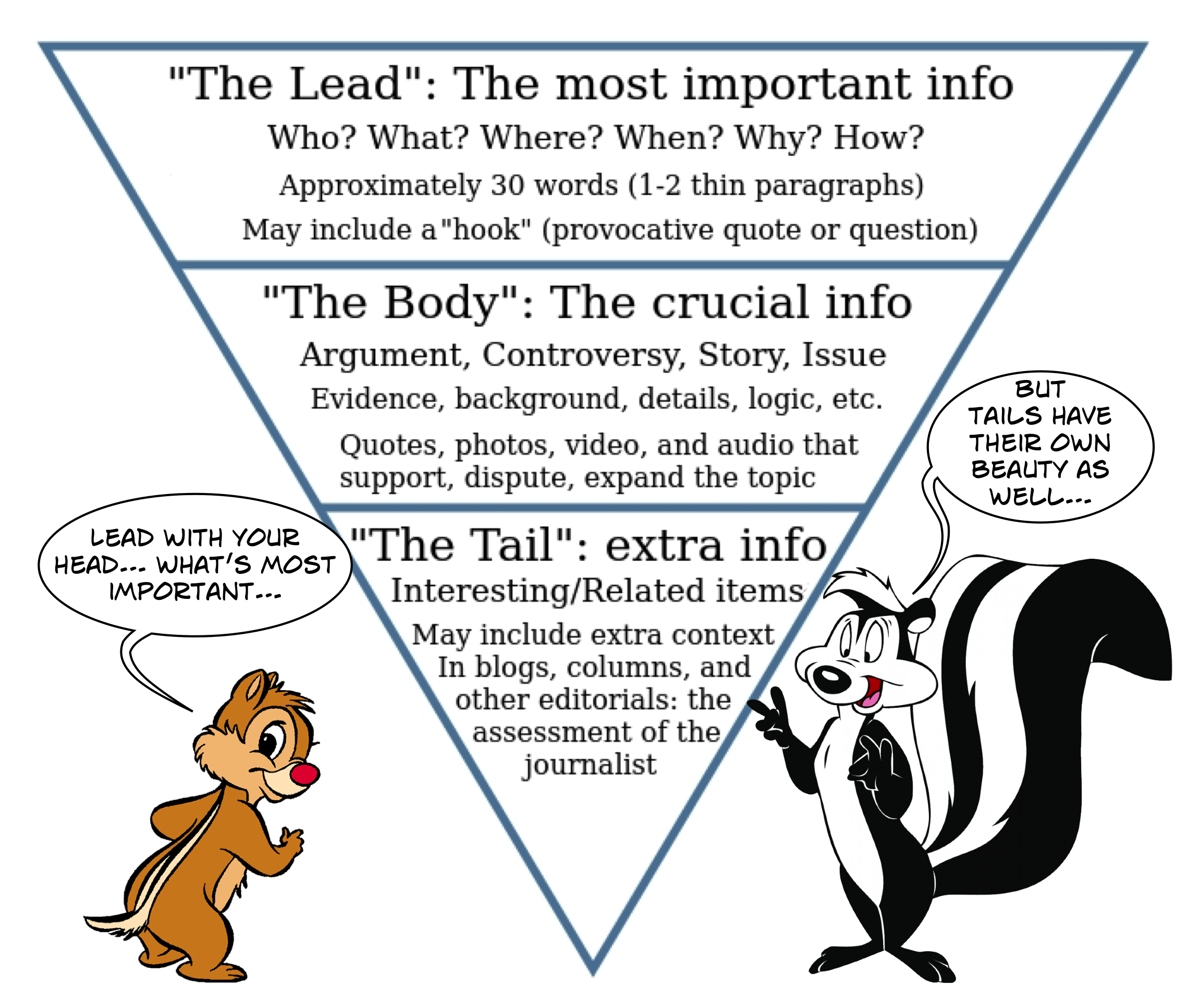
Similar to the military approach, we have the civilian version, which remains common in traditional journalism. (Even though printed newspapers continue to vanish, this approach is still found in many digital outlets.) This technique is referred to as the Inverted Pyramid Structure. Here is one concise definition:

The inverted pyramid is the model for news writing. It simply means that the heaviest or most important information should be at the top – the beginning – of your story, and the least important information should go at the bottom. And as you move from top to bottom, the information presented should gradually become less important.

The benefit of this strategy is that readers immediately learn the primary “news.” Only when they desire to supplement that information do they need to continue reading. Presumably the material follows in descending significance until they either finish the piece or it descends into minutiae of no interest to that particular reader.

The previously linked article notes one extremely important aspect of the inverted pyramid [emphasis added].

The inverted pyramid format turns traditional storytelling on its head. In a short story or novel, the most important moment – the climax – typically comes about two-thirds of the way through, closer to the end. But in news writing, the most important moment is right at the start of the lede.

And it is this traditional sort of storytelling to which we most often turn when we read for pleasure rather than as an obligation.

Reading for Enjoyment

Pleasurable reading is not, by definition, expeditious. It takes its time to tell a story, rather than rushing into a rapid information dump. In fact, when the narrative is savaged by unloading too much background or too many facts, it becomes hard to enjoy even when we want to like it.

Literature, even brief poetry, takes us on a journey. We go somewhere. We are transformed, albeit usually in an unmeasurable way. While the change may be small, it is quite distinct from the difference made by simply learning new facts.

While the journey itself may appear straightforward, in most cases there are often subtle alterations in its course. You might say a story intentionally tends to meander, which is why I titled this post as I have. Meander itself is a curious word.

Like so many words, meander has a literal and a figurative application. In a moment we will see each of these meanings entertainingly illustrated in C.S. Lewis’ correspondence.

I began thinking about this intriguing word when I recently read about its source. It begins with an ancient kingdom in Asia Minor (modern day Türkiye). Lydia was independent for half a millennia before its king, Croesus, was defeated by Cyrus of Persia. One of Lydia’s lasting contributions to civilization came in the form of the minting of coinage.

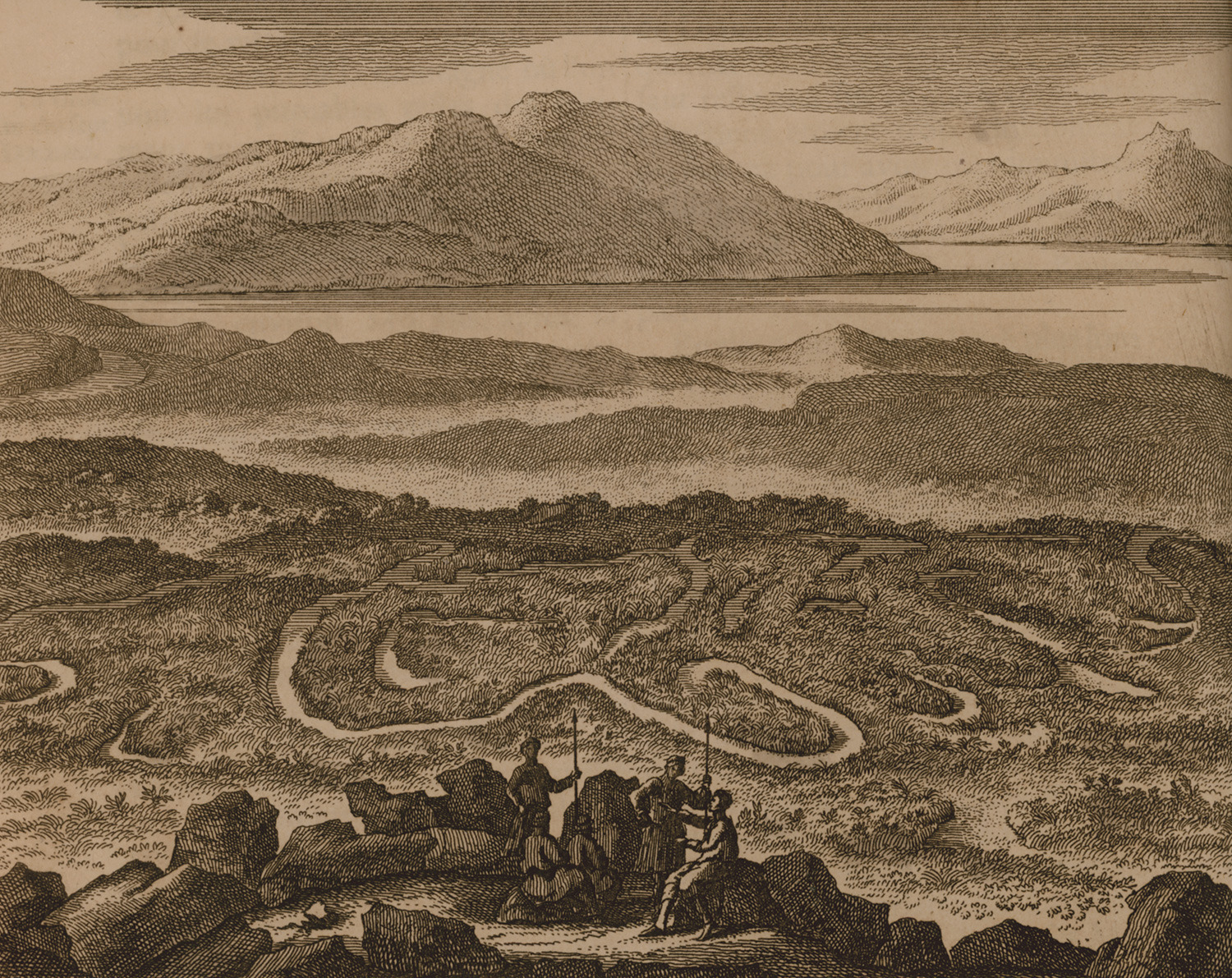
Herodotus tells us they were the first to do so. This is, of course, a captivating story in its own right.One of the images used on one of their early coins was of the Maeander River, which meandered through their kingdom. The picture above, View of Maeander Valley, was published by Flemish artist Cornelis de Bruyn in 1714.

Did C.S. Lewis Meander?

Searching through Lewis’ writings, I did not find any examples of his use of this winding word. (Let me know if you’re aware of one.)

However, here are two enjoyable examples of his informal use of “meander” in his correspondence. The first, in a 1920 letter to his father, uses the word in its figurative sense.

I have two tutors now that I am doing ‘Greats,’ one for history and one for philosophy. . . . We go to the philosophy one in pairs: then one of us reads an essay and all three discuss it. . . . it is very amusing.

Luckily I find that my previous dabbling in the subject stands me in good stead and for some time I shall have only to go over more carefully ground through which I have already meandered on my own.

In the second occurrence, we find C.S. Lewis writing to his Brother Warnie in 1932. He describes, at some humorous length, the condition of the pond on their property. You can visit this same setting today in the C.S. Lewis Nature Reserve.

I have included the full discussion below. Suburbanites (and even more so, city-dwellers) may not be able to appreciate this story the way that people who have lived in the country can. Still, those with a minute to read the entire passage will likely enjoy the way Lewis meanders through his description of events. Oh, and lest you suffer unnecessary shock, be forewarned that Lewis uses the word “bathe” here not to refer to a “bath,” but to a plunge in the pond.

You will gather from this that summer has arrived: in fact last Sunday (it is Tuesday to day) I had my first bathe. You will be displeased to hear that in spite of my constant warnings the draining of the swamp has not been carried out without a fall in the level of the pond.

I repeatedly told both [the workmen] that the depth of water in the pond was sacrosanct: that nothing which might have even the remotest tendency to interfere with that must be attempted: that I would rather have the swamp as swampy as ever than lose an inch of pond.

But of course I might have known that it is quite vain ever to get anything you want carried out: and the pond is lower. However, don’t be too alarmed. I don’t think it can get any lower than it is now.

I don’t know how much of the draining operations Minto [Janie Moore] has described to you nor whether you understood them. In fact, remembering what a mechanical process described by Minto is like I may assume that the more she has said the less you know about it.

The scheme was a series of deep holes filled with rubble and covered over with earth. Into each of these a number of trenches drain: and from each of these pipes lead into the main pipe now occupying the old ditch between the garden and the swamp, which in its turn, by pipes under the lawn, drains into the ditch beside the avenue.

It was however useless to do all this as long as the overflow outlet from the pond (you know – the tiny runnel with the tiny bridge over near the Philips end of the pond) was meandering – as it did – over all the lower parts of the swampy bit. Nor was it possible to stop this up and deny the pond any outlet, as it would then have been stagnant and stinking in summer, and overflowing in winter.

It was therefore decided to substitute a pipe outlet for the mere channel outlet – which pipe could carry the overflow from the pond, through the swampy bit without wetting it, to the rest of the drainage system. When they first laid this pipe I said that its mouth (i.e. at the pond end) was too low and that it would therefore carry off more water than the old channel and so lower the pond.

The workmen shortly denied this but I stuck to my point and actually made them raise it. Even after they had raised it I was still not sure that it wasn’t taking off more water than the old channel did: so I have now had a stopper made which is in the mouth of the pipe at this moment. I have also given the spring-tap up beyond the small pond a night turned on, and I trust that by thus controlling in-flow and outflow of water I can soon nurse the pond back to its old level.

At any rate I don’t see how it can sink as long as its escape is bunged up. As to the degree of loss at present, as there are no perpendicular banks anywhere it is hard to gauge. I should think that the most pessimistic episode could hardly be more than ¾ of a foot: i.e. a difference one is unconscious of in bathing. Still I grudge every inch.

By the way, it has just occurred to me that the sinking may not be due to the draining at all: for the old ‘channel’ escape, when I looked at it just before the operations began, had certainly widened itself extremely from what I first remembered, and must have been letting out more than it ought. In that case the new pipe may have arrested rather than created a wastage.

One criticism some short-attention-span readers levy against Tolkien’s masterpiece, Lord of the Rings, is that too much time is spent traveling. Such critics overlook the reasons the author presented his saga in the manner he did. Well, for those desiring to simply jump from battle to battle, we now have graphic novels. All of the journeying in LOR has a purpose; it is far from mere “meandering.”

Tolkien detailed the travails of the Fellowship during their quest, and his maps allow students of the mythos to discern “Frodo and Sam traveled over a thousand miles from the Shire to Mount Doom in the Lord of the Rings trilogy, over multiple landscapes and terrains.” One of the colorful words created by Tolkien, that rolls off the tongue like a babbling brook, is the name of a river that crosses the Old Forest: Withywindle. (A withy is an Old English word for a willow, or slender twigs or branches.) Its course may not have been especially winding, but it definitely sounds like it should have been.

No one can deny the influence of J.R.R. Tolkien on fantasy literature. But the aforementioned shortening attention spans do deter some readers. Make no mistake about it, however, the traveling in the writings of the Inklings is not without purpose. Nor does it disrupt the story. Still, the less skilled among us should be cautious about mimicking their techniques. One author describes this hazard in the following way.

Ultimately, when you write, your goal should be to make sure that everything you write doesn’t meander, or in other words, moves in some way towards the conclusion of your story. Be that taking care of a subplot, a character arc . . . whatever, it needs to hit a step, or move towards it, on the path to the ultimate ending of your story.

Remember both pacing and the up and down of rising and falling tension. A meandering story stretches out a low point and breaks the pacing. You always want to keep your plot on a straight line to the ending. The characters, they can wander, as long as the plot doesn’t.

Thanks for meandering with Mere Inkling today. Isn’t it wonderful that God allows us these carefree moments, and life isn’t all about “getting things done?”
Do Lay People Think?

Attending seminary was shocking. Having grown up in Lutheran communities with a high view of the Scriptures, I anticipated entering an environment where I would grow in my knowledge and regard for God’s word. A setting consistent with our Reformation theology which confessed “Sola Scriptura,” the Scriptures alone, as the ultimate authority for doctrine and life.

I was amazed at the theology taught by a few of the faculty who were disciples of Bultmann’s radically skeptical interpretation of Christianity.

One morning I was in the seminary cafeteria – the aptly named Diet of Worms – commiserating over this situation with several other students who shared my astonishment. I said something to the effect of “Is Lutheranism what liberal theologians think, or what the majority of Confessionally-grounded lay people in the pews think?”

Apparently one of the New Testament professors had overheard our conversation. He could not resist walking over, leaning over our table, and asking – “Do lay people think?”

I’ve never forgotten the vanity and unintentional irony in that rhetorical comment. As I recall, it elicited a complicit chuckle from the entourage of liberal students already falling under his spell.

The greatest Christian apologist of the twentieth century, C.S. Lewis, was neither a cleric nor a theologian. Lewis described himself as “a very ordinary layman of the Church of England” (Mere Christianity). In the same work he expressed his lifelong position. Since he was not theologically trained, he was constrained from making authoritative declarations about complex matters.

I am only a layman, and at this point we are getting into deep water. I can only tell you, for what it is worth, how I, personally, look at the matter.

Pastors & Theologians, What are they Good For?

Some will answer that question echoing the words of the 1970 classic by the Temptations: “absolutely nothing.”

In an over-reaction to the errors of the medieval Papacy, some Protestants threw out all of the legitimate practices which had developed in the early church, including the ordination of pastors. The anti-clerical communities vary in their attitudes toward higher education for “teachers and elders,” but rarely regard such studies as necessary, or even a plus.

Most denominations, however, have maintained an awareness that having future pastors devote several years to biblical and theological studies is vital to the church’s wellbeing. Add to that additional subjects such as counseling and homiletics – skills that are essential – and you should get well-rounded pastors. 

Sadly, there are plenty of exceptions. I have written about wolves in sheep’s clothing in the past. Still, discerning students attending trustworthy seminaries invariably become better equipped to fulfill the demands of pastoral ministry. Check out “The Relevance of Theological Education” in the (free) journal Themelios which is published by the Gospel Coalition. Themelios is the Greek word for “foundation.” The article begins:

Most theological students have doubts at some time about the usefulness of their theological training. Some of these doubts are justified, since most theological courses leave plenty of room for improvement. But some of our doubts reflect a lack of understanding of the purpose and function of theological training.

What about Lay People?

Before the word “lay” became associated with distinguishing the mass of people from those within particular professions, it originated to distinguish the believing “laity” who adhere to a faith from clergy of that tradition.

Are clergy holier than laypeople? Definitely not. However, in the Christian faith we acknowledge that they are expected to live with greater moral integrity than those they serve. 

“Not many of you should become teachers, my brothers, for you know that we who teach will be judged with greater strictness” (James 3:1).

It is quite sobering for those who take God’s word seriously. In Paul’s letter to Titus we read a relatively explicit description of the requirements for pastors. 

“This is why I left you in Crete, so that you might . . . appoint elders in every town as I directed you – if anyone is above reproach, the husband of one wife, and his children are believers and not open to the charge of debauchery or insubordination. For an overseer, as God’s steward, must be above reproach.

“He must not be arrogant or quick-tempered or a drunkard or violent or greedy for gain, but hospitable, a lover of good, self-controlled, upright, holy, and disciplined. He must hold firm to the trustworthy word as taught, so that he may be able to give instruction in sound doctrine . . .” (Titus 1).

Different Roles

The inspiration for my post on this subject is an article I read in the 2024 Logos Bible Software Seminary Guide. A PhD theologian wrote “Do Theological Writers Need Theological Education?” which answered its own question in its subtitle: “Yes and No.” The writer states that degrees are most definitely not required.

There is nothing sacrosanct about sitting in a classroom . . . You can be educated through other means, with diligent reading being at the top of the list.

Simultaneously, he defends the values of a solid education. I love the way that he responds to the way some people denigrate theological education (because I’ve met more of these folks than I can number).

Today’s many populists might beg to differ. They mock “edumucation” and deride the arrogant eggheads who get too much of it. They flout the norms of academic discourse . . . they seem proud of their misspellings.

It’s not as if there is no truth at all in their complaints: educated people do indeed often give in to arrogance. But it’s not at all clear to me that arrogance about one’s ignorance is any better.

I concur. I’m against arrogance altogether – along with C.S. Lewis. “Lewis on Intellectual Pride” speaks directly to the question I’ve addressed herein. Discussing Lewis’ warnings about pursuing academia, the author says:

Why is intellectual arrogance so quick to rise within us? It makes us feel important. We understand more than others (we think). That makes us better than the ignorant masses (we boast).

Martin Luther described the centrality of God’s self-revelation in determining who is most fit to teach. And that has nothing to do with an individual’s ecclesiastical status.

The Bible is alive, it speaks to me; it has feet, it runs after me; it has hands, it lays hold of me. . . . A simple layman armed with Scripture is to be believed above a pope or a cardinal without it.

So, returning to the question with which I began, do lay people think? I am as scandalized by those very words as I was when I first heard them voiced. That particular professor is no longer alive. But, sadly, his prideful thinking remains with us today. And it’s not only evident in religion; humanity is plagued by an intelligentsia that dismisses the “lay” views of common people across the board. 

The actual truth is that education has its values, and its limitations. And there are innumerable laymen and women who possess wisdom on nearly every subject which is superior to the supposed “experts.” Yes, esteemed doctor of de-supernaturalized theology, lay people can indeed comprehend and share the wisdom of God.

Following C.S. Lewis’ Military Example

Like his friend J.R.R. Tolkien, and many of the British men of their generation, C.S. Lewis served in the grim battlefields of the First World War. (However, since Lewis was actually Irish, he could not be drafted, and instead volunteered to serve.)

In recent years a number of books have appeared related to the military service of the Inklings. In A Hobbit, a Wardrobe, and a Great War, the author introduces his discussion with a succinct summary.

For a generation of men and women, [WWI] brought the end of innocence – and the end of faith. Yet for two extraordinary authors and friends, J.R.R. Tolkien and C.S. Lewis, the Great War deepened their spiritual quest. Both men served as soldiers on the Western Front, survived the trenches, and used the experience of that conflict to shape their Christian imagination. . . .

By the time of the Armistice, more than nine million soldiers lay dead and roughly thirty-seven million wounded. On average, there were about 6,046 men killed every day of the war, a war that lasted 1,566 days. In Great Britain, almost six million men—a quarter of Britain’s adult male population – passed through the ranks of the army. About one in eight perished. Tolkien and Lewis might easily have been among their number.

In 1939, a correspondent inquired if Lewis was going to reassume his commission in the army for the new conflict, and he responded with sentiments I have heard voiced by a number of other combat veterans.

No, I haven’t joined the Territorials. I am too old. It would be hypocrisy to say that I regret this. My memories of the last war haunted my dreams for years.

C.S. Lewis proceeded to graphically explain the cost of serving under such pressure. 

Military service, to be plain, includes the threat of every temporal evil: pain and death which is what we fear from sickness: isolation from those we love which is what we fear from exile: toil under arbitrary masters, injustice and humiliation, which is what we fear from slavery: hunger, thirst, cold and exposure which is what we fear from poverty.

I’m not a pacifist. If it’s got to be, it’s got to be. But the flesh is weak and selfish and I think death would be much better than to live through another war.

A new announcement from the United States’ Department of Defense brought Lewis’ situation to mind. It appears that due to a number of factors – not least of which the emphasis on Diversity, Equity and Inclusion,* which (imo) has discouraged veterans from encouraging their children to serve in the armed forces – some services are repeatedly falling short of their recruiting goals. 

In light of the fact that the world is inarguably growing more dangerous – the Doomsday Clock is set at “90 seconds to midnight” – it is alarming that we are unable to fully staff our shrunken military.

Just today my sixteen year old grandson expressed concerns about the resumption of a draft. I could not muster a persuasive argument that it won’t happen. Ironically, the last time the U.S. involuntarily conscripted troops was 1972, the year I turned eighteen. Oh, in the process of including a link to the Selective Service Sytem, I was surprised to learn that a “Medical Draft is in Standby Mode.” 

It is designed to be implemented in connection with a national mobilization in an emergency, and then only if Congress and the President approve the plan and pass and sign legislation to enact it. . . .

[The plan will] provide a fair and equitable draft of doctors, nurses, medical technicians and those with certain other health care skills if, in some future emergency, the military’s existing medical capability proved insufficient and there is a shortage of volunteers. . . .

[If implemented, the plan will] begin a mass registration of male and female health care workers between the ages of 20 and 45. . . . HCPDS [the innocuously named Health Care Personnel Delivery System] would provide medical personnel from a pool of 3.4 million doctors, nurses, specialists and allied health professionals in more than 60 fields of medicine.

No Draft Yet

Since we are not currently at war, the specter of a draft remains ephemeral. Still, the shortage of volunteers has led to a variety of initiatives, such as lowering service qualification standards. These efforts have proven inadequate, resulting in the aforementioned announcement.

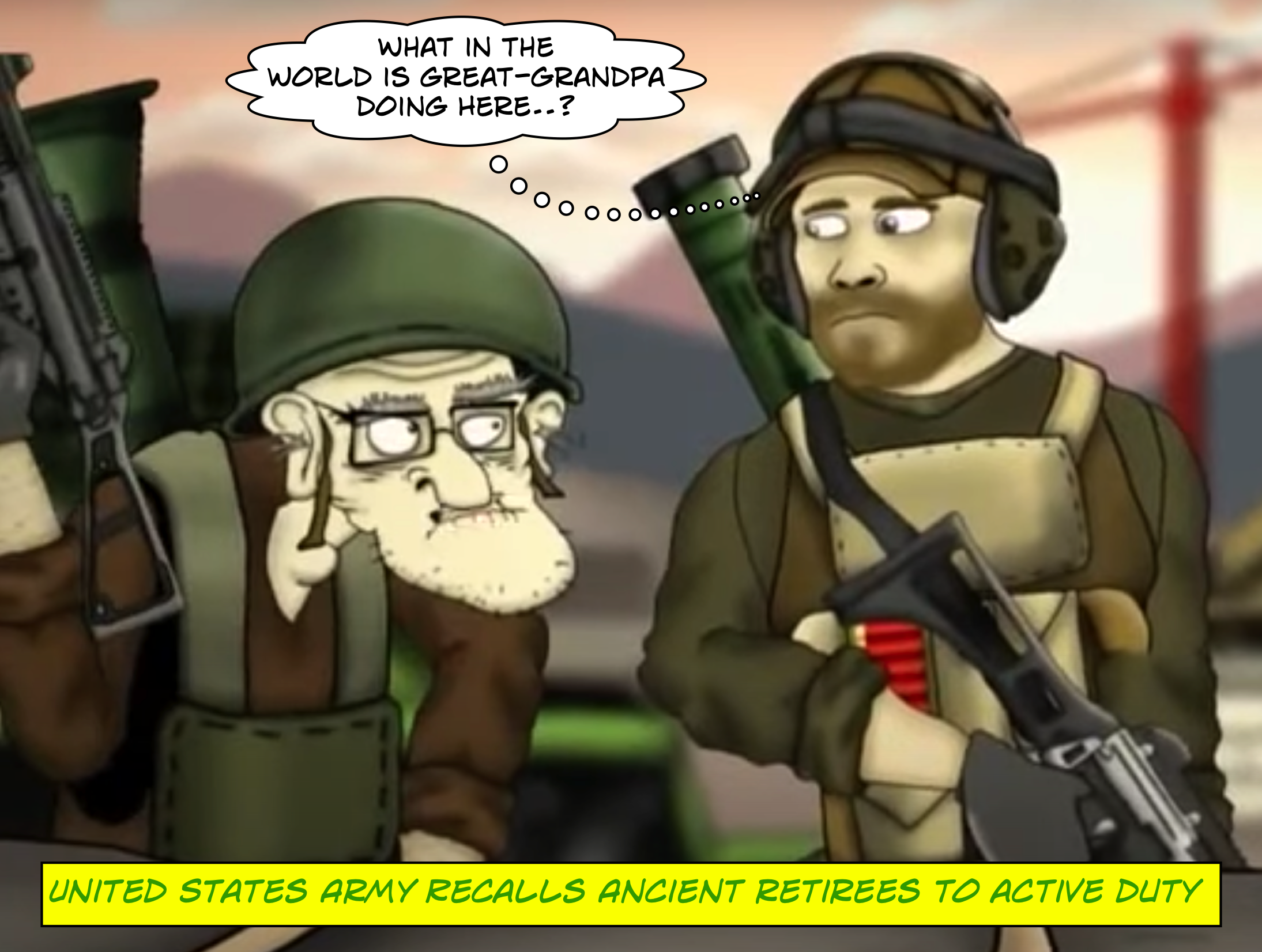
Both the Army and the Air Force have begun Retiree Recalls. Yes, that is just what it sounds like. People who have actually retired from the armed forces, normally after 20+ years of active duty, are being recalled to serve again. 

When I heard this news I was stunned. It is legally possible for the military to recall former members via a tiered process, but the first thing that came to my mind was my favorite high school teacher. He had served in Viet Nam as a draftee and finished his enlistment. He once told me that he felt safe, having survived, because now he was in the same call-up status as a “pregnant nun.” (Rather hyperbolic, but comforting to him.)

Fortunately, the current recalls are all voluntary. Only retirees whose personal circumstances make the offer appealing, will respond. As the Air Force Times reports, “Regret retiring? Here’s your shot at a second chance in the Air Force.”

I suspect that even vets who enjoyed their military service will be inclined to consider redonning the uniform as “too much of a good thing.” And if they witnessed the bloody horrors of war, as seen by C.S. Lewis, returning to the ranks would be even less tempting.

Since I, myself, have no desire to resume the demands of military life, I haven’t researched the age requirements for the Air Force recall program. Like Lewis, “I am too old.” 

But amazingly, depending on individual factors, the Army is willing to recall retired volunteers up to the age of seventy. That’s not a typo. As someone reaching that very milestone this summer, I can’t imagine returning to work side-by-side with troops half a century younger than me. 

Now, I pray for peace, knowing that being prepared for war is one way to increase that likelihood. So, I hope the military can throw off some of its political shackles and return to its necessary focus.

Furthermore, like C.S. Lewis, I have a pragmatic view of the effects of war. In “Learning in War-Time,” Lewis summarized the effects of military service during a war. As always, his insights are profound.

What does war do to death? It certainly does not make it more frequent: 100 per cent of us die, and the percentage cannot be increased. . . . Does it increase our chances of painful death? I doubt it. . . .

Does it decrease our chances of dying at peace with God? I cannot believe it. If active service does not persuade a man to prepare for death, what conceivable concatenation of circumstances would?


* This reference is to the convoluted and inequitable DEI philosophy and program(s) being mandated today. In truth, most people value diversity, and all people of goodwill believe in the importance of equity and inclusion. Along with Martin Luther King, Jr., they long for a day when people are not “judged by the color of their skin, but by the content of their character.”

Improve Your Writing with a Brevity Exercise

While we are unlikely to become another J.R.R. Tolkien or C.S. Lewis, it is quite possible to improve our literary skills.

There are numerous ways to strengthen our writing. One of my favorites is to “stretch” my abilities by engaging in exercises that push me far beyond my nonfiction comfort zone. More on the details in a moment.

C.S. Lewis prized brevity and clarity. Most readers do. I’ve written about this in “C.S. Lewis on brevity.” Before that, I had discussed brevity as a factor of “clear communication,” while focusing on the value of common semantics to avoid confusion.

I encourage you to read “In Defense of the Fairy Tale: C.S. Lewis’s Argument for the Value and Importance of the Fairy Tale.” The author cites Lewis’ reason for choosing the fairy tale as his genre for Narnia.

[Lewis] describes the invention process for the Chronicles of Narnia as first coming in mental images, “a faun carrying an umbrella, a queen on a sledge, a magnificent lion.” Next came the selection of a form in which to tell the story, one absent of a love interest or close psychology.

The form excluding these was the fairy tale. Lewis tells us that he fell in love with the form itself, “its brevity, its severe restraints on description, its flexible traditionalism, its inflexible hostility to all analysis, digression, reflections and ‘gas’” and the very limitations of the vocabulary.

He concludes, “I wrote fairy tales because the Fairy Tale seemed the ideal Form for the stuff I had to say,” not unlike the stone selected by the sculptor or the sonnet by the poet.

While I share the passage above at some length, my focus here is on Lewis’ observation that fairy tales are inherently “brief.” The fairy tale was, indeed, the “ideal Form” for C.S. Lewis’ classic stories from Narnia.

Even Briefer Genres

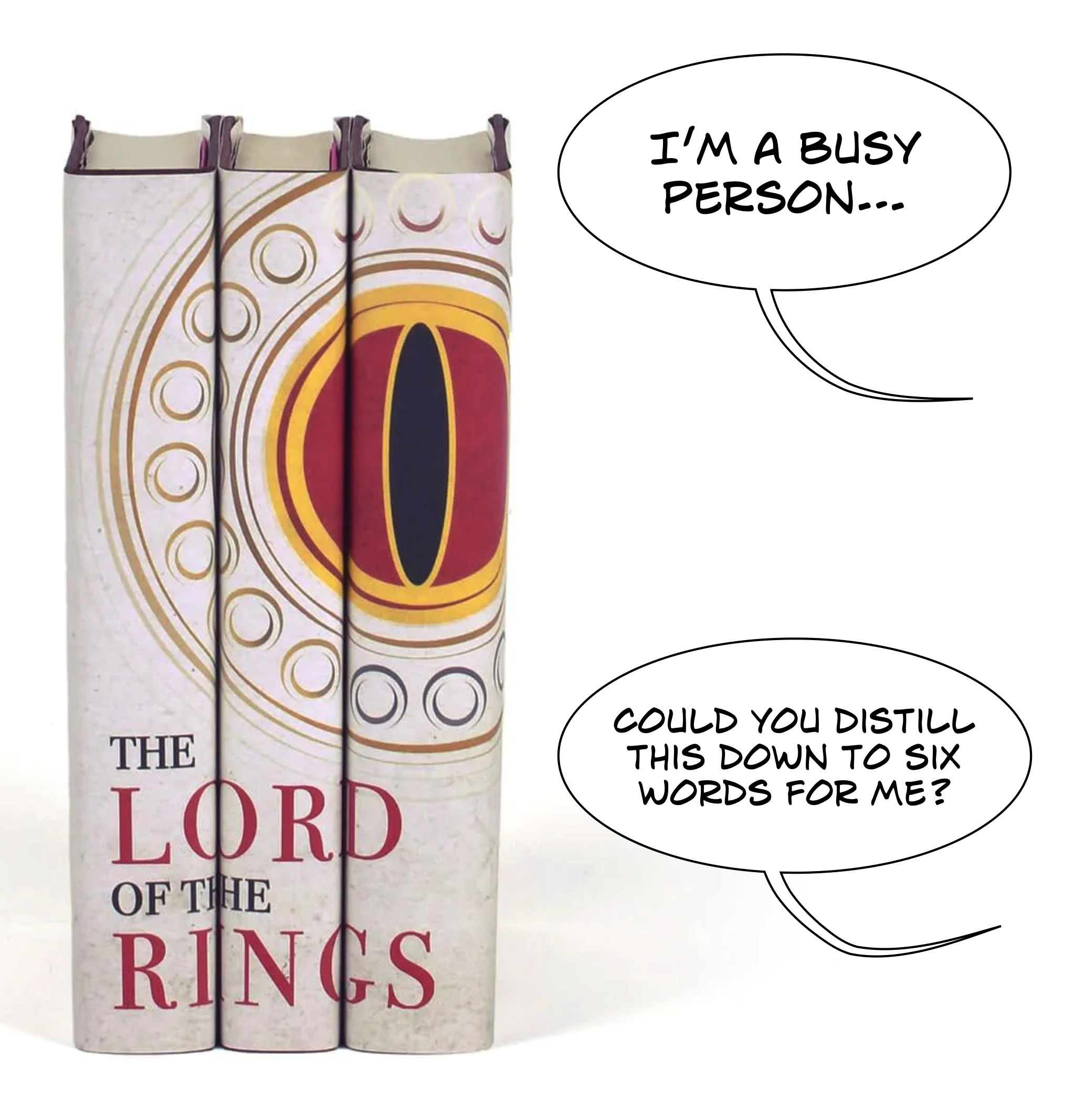
As a brevity-challenged individual (common for pastors), I like writing exercises able to make a dent in my innate verbosity. And what shorter option might one explore than a genre limited to a half dozen words?

Before embarking on my current challenge, let me give you a bit of background on the Six Word Story.

As Mark Twain famously wrote, “I didn’t have time to write a short letter, so I wrote a longer one instead.” Intense Minimalism provides similar inspiration from other earlier writers.

“Not that the story need be long, but it will take a long while to make it short.”
Henry David Thoreau,
“It is my ambition to say in ten sentences what others say in a whole book.”
Friedrich Nietzsche
“If I had more time, I would have written a shorter letter.”
Marcus Tullius Cicero (a predecessor of Samuel Clemens)
And back again to Mark Twain:
“If you want me to give you a two-hour presentation, I am ready today.  If you want only a five-minute speech, it will take me two weeks to prepare.”

C.S. Lewis was capable of writing long personal tomes to family and intimate friends. His correspondence with casual friends – such as Americans who sometimes sent food gifts during Britain’s post-WWII rationing – tended to be warm, but short. This was particularly true when his brother Warnie was not available to assist with his correspondence, as the following letters attest.

20th. January 1948
Dear Mr. Howard, This is really very handsome of you, and you could hardly have sent a more welcome gift. I have only to call your attention to the so-called ‘Superfine’ paper on which I am replying to give you some idea of the luxury of writing on a decent paper at last. But I’m afraid there is something which even American generosity cannot supply me with: an article called TIME, which was the cause of my previous letter! (its brevity I mean)

25th August 1949
Dear Dr. Allen Yet once again hearty thanks for a fine parcel which has arrived in excellent condition to-day. I don’t know how we should get on without you. My brother who drives the typewriter is away and my hand is nearly dropping off from letter writing, so you’ll forgive brevity – and the horrible scrawl! I’m none the less grateful inside!

Six Word Stories were popularized in the United States through association with Ernest Hemingway. However, it is an urban legend to credit him with this poignant example: “For sale, Baby shoes, Never worn.”

MasterClass offers a helpful lesson at “How to Write an Unforgettable Six-Word Story.” They actually suggest that you can drop a few of these into your writing day to renew your energy.  

Like other forms of short stories or flash fiction, a six-word story allows a reader to consume an entire narrative in just a moment’s time. If you’re trying to get in some short, but challenging, bursts of writing practice throughout your day, try writing six-word stories. These bite-sized narratives are fast and fun.

As for telling any sort of satisfying “story” in six words, it’s a bit of an hyperbole. However, that hasn’t stopped a number of people from making a literal career of promoting the genre. At the forefront of the movement is Six Word Memoirs.

Christians have likewise joined the club. For example, Six-Word Lessons to Discover Missional Living: 100 Lessons to Align Every Believer with the Mission of Jesus is volume  forty-three in “The Six-Word Lessons Series.”

Prior to learning about these companies, I thought it be fun to suggest that one you compose Six Words about the Christian Life. Still, since an idea can’t be copyrighted, you’re still free to market your own works in this genre.

Some of My Modest “Attempts”

One subgenre of Six Word Stories is Six Word Biographies. One website applies this to biblical personages. Among them:

Mary
“Behold the handmaid of the Lord.”
Esther
“For such a time as this.”

To which I dare to add: 

Jephthah (Judges 11-12)
“Rash vows bring about terrible tragedies.”
Jehosheba (Exodus 1-2)
“Moses’ mother, eclipsed by her daughter.”
Abednego (Daniel 1-3)
“I survived the fiery furnace too.”

Now, allow me to apply the technique to several other people. 

Jeanne d’Arc
“Heroic innocent, visionary warrior, martyred saint.”

Walt Disney
“Gifted Kingdom maker, buried, rolling over”

Grigori Rasputin
“Poisoned, shot, drowned, and ultimately, damned.”

George Washington
“Soldier, statesman, who shunned the throne.”

Bozo
“Dated humor, creepy antics, Krusty cosmetics.”

And, I close now with my personal favorite.

Larry Norman
“He was only visiting this planet.”

A half century hasn’t diminished the power of Norman’s message. (The titular lyrics are in the “Reader’s Digest” track on the record linked here.)

C.S. Lewis and Time’s Meaning

What is time, and why are we subject to its ofttimes harsh burdens? After his conversion from atheism, C.S. Lewis discovered some comforting truths about time, and the limits of time’s constraints.

Each year the four seasons seem to pass more rapidly. Before we know it, our parents have gown old, and we may well have children of our own. In retrospect, it all happens in the proverbial flash.

Ultimately, there will come a day when our lives reach their own “winter,” and even our most precious memories may drift away from us in time’s relentless breeze.

The C.S. Lewis Institute has an interesting article titled “The Point at which Time Touches Eternity.” They quote some wisdom from The Screwtape Letters, and end with a query which can help us live happier lives.

As you think about your own life, do you sometimes think too much about the Past or the Future, and not chiefly attend to the Present and Eternity?

Lewis answers that very question in his essay “Historicism.” He acknowledges that too often we become slaves to the regrets of our past and the dread of challenges awaiting us in the future. He reminds Christians that “God will supply every need of yours according to his riches in glory in Christ Jesus” (Philippians 4).* Therefore, Lewis encourages us to throw off the bondage of past and future, since “where, except in the present, can the Eternal be met?”

Janie Cheaney recently wrote “Eternity in Our Hearts” for World Magazine. Inspired by Saint Augustine and C.S. Lewis, it is subtitled “What if time astonishes us because we are meant to one day live outside of it.”

More of Lewis’ Thoughts about Time

In Mere Christianity, Lewis describes our universal human experience. “Our life comes to us moment by moment. One moment disappears before the next comes along: and there is room for very little in each. That is what Time is like.” He then describes just how limited our perspective is.

And of course you and I tend to take it for granted that this Time series – this arrangement of past, present, and future – is not simply the way life comes to us but the way all things really exist. We tend to assume that the whole universe and God himself are always moving on from past to future just as we do. But many learned men do not agree with that. Almost certainly God is not in Time. His life does not consist of moments following one another . . .

If you picture Time as a straight line along which we have to travel, then you must picture God as the whole page on which the line is drawn. We come to the parts of the line one by one: we have to leave A behind before we get to B, and cannot reach C until we leave B behind. God, from above or outside or all around, contains the whole line, and sees it all.

In Miracles, C.S. Lewis describes God’s transcendence over time as our Creator’s “eternal Now.”

It is probable that Nature is not really in Time and almost certain that God is not. Time is probably (like perspective) the mode of our perception. There is therefore in reality no question of God’s at one point in time (the moment of creation) adapting the material history of this universe in advance to free acts which you or I are to perform at a later point in Time.

To Him all the physical events and all the human acts are present in an eternal Now. The liberation of finite wills and the creation of the whole material history of the universe (related to the acts of those wills in all the necessary complexity) is to Him a single operation. In this sense God did not create the universe long ago but creates it at this minute – at every minute.

That is pretty deep. The sort of stuff that philosophers love to ponder and debate. Even before his conversion to Christianity, while still clinging to his formal atheism, Lewis contemplated time’s role in existence. In 1918 he wrote to his close friend Arthur Greeves about these matters. 

You see the conviction is gaining ground on me that after all Spirit does exist; and that we come in contact with the spiritual element by means of these “thrills.” I fancy that there is Something right outside time & place, which did not create matter, as the Christians say, but is matter’s great enemy: and that Beauty is the call of the spirit in that something to the spirit in us. You see how frankly I admit that my views have changed.

Sheldon Vanauken (1914-1996) was an American author who preserved in A Severe Mercy several of C.S. Lewis’ letters of consolation following the death of Sheldon’s wife. In some ways, the Vanauken story foreshadowed Lewis’ own marriage and widowhood. Pointing toward the Resurrection, Lewis wrote the following.

You say the materialist universe is “ugly.” I wonder how you discovered that! If you are really a product of a materialistic universe, how is it you don’t feel at home there? Do fish complain of the sea for being wet? Or if they did, would that fact itself not strongly suggest that they had not always been, or would not always be, purely aquatic creatures?

Notice how we are perpetually surprised at Time. (“How time flies! Fancy John being grown-up & married! I can hardly believe it!”) In heaven’s name, why? Unless, indeed, there is something in us which is not temporal.

C.S. Lewis writes much more about time, but we will conclude here with two passages that use the metaphor of author to describe God’s nature. The first comes from an essay entitled “The Seeing Eye.”

My point is that, if God does exist, He is related to the universe more as an author is related to a play than as one object in the universe is related to another. If God created the universe, He created space-time, which is to the universe as the metre is to a poem or the key is to music.

To look for Him as one item within the framework which He Himself invented is nonsensical. If God – such a God as any adult religion believes in – exists, mere movement in space will never bring you any nearer to Him or any farther from Him than you are at this very moment.

You can neither reach Him nor avoid Him by travelling to Alpha Centauri or even to other galaxies. A fish is no more, and no less, in the sea after it has swum a thousand miles than it was when it set out.

This final quotation appears in Mere Christianity. It is most certainly true, and my hope is that all who read this post will come to celebrate this joy. Both now, and for eternity.

God is not hurried along in the Time-stream of this universe any more than an author is hurried along in the imaginary time of his own novel. He has infinite attention to spare for each one of us.

He does not have to deal with us in the mass. You are as much alone with Him as if you were the only being He had ever created. When Christ died, He died for you individually just as much as if you had been the only man in the world.


* This gracious, eternal gift is available to all people.

Education and the Human Mind

Learning is fun. Education can be enjoyable too. But obviously, they are not the same. 

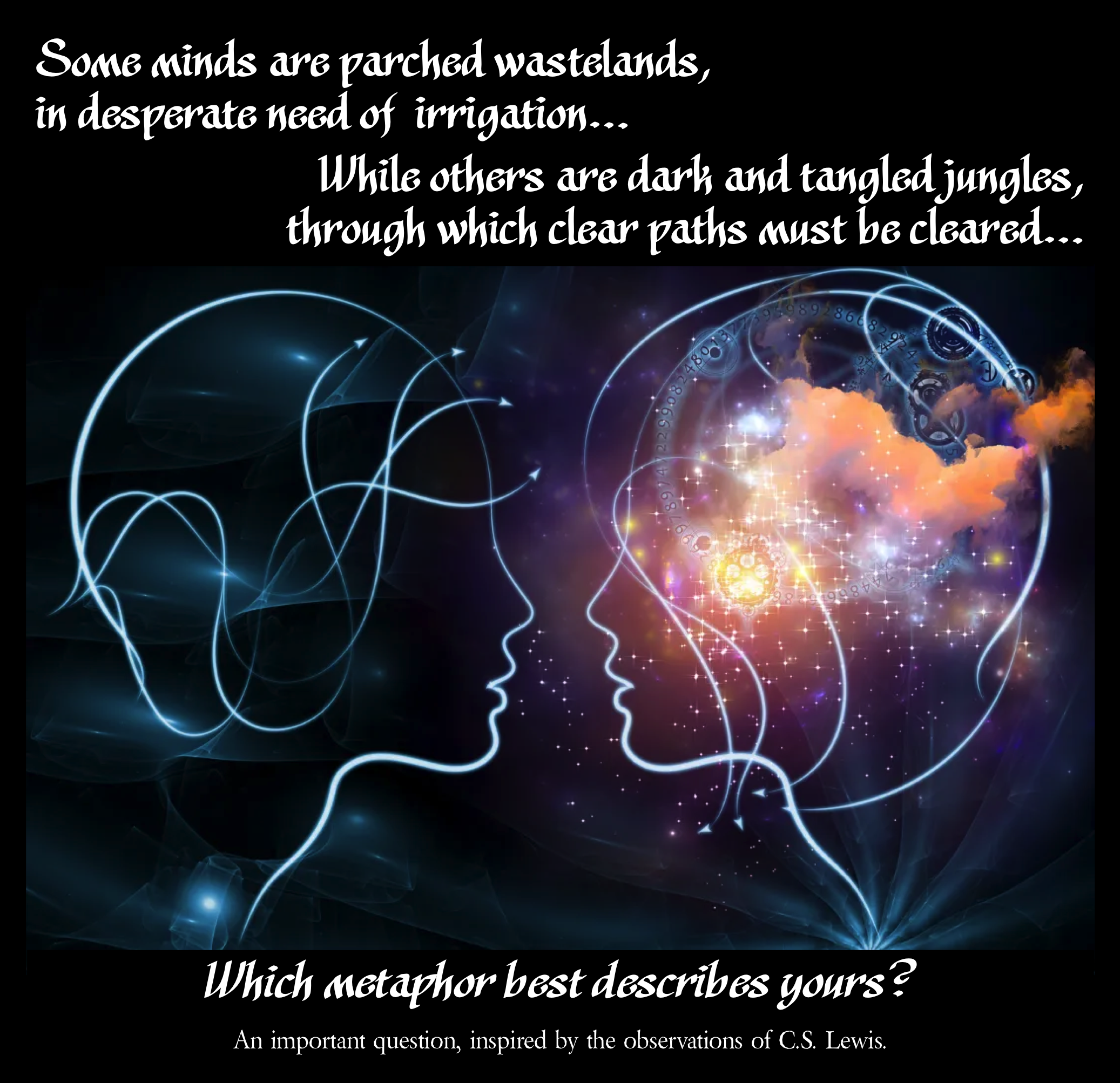
C.S. Lewis wrote a great deal about learning. A master of metaphors, he brilliantly described two distinct challenges faced by educators. In The Abolition of Man, he stated “the task of the modern educator is not to cut down jungles but to irrigate deserts.” 

Wheaton professor, Robert McKenzie, offers a concise explanation of Lewis’ keen observation.

‘Cutting down jungles,’ as I understand that phrase, means helping students with passionate convictions to evaluate critically their world views, to examine what lies beneath the personal beliefs they profess.

‘Irrigating deserts,’ conversely, involves nurturing in apathetic or cynical students the hope that there is meaning and purpose in human existence.

Quite true, and I believe Lewis’ insight is more timely today than it was during the past century.

Classical Versus Modern Education

Today I read a passage that reminded me just how dramatically contemporary curricula deviate from the traditional educational materials used before the modern era. 

While conducting research for a book about imperial Rome, which I hope to complete this year, I came upon the following passage. 

It would have been easy to swell this little volume to a very considerable bulk, by appending notes filled with quotations; but to a learned reader such notes are not necessary; for an unlearned reader they would have little interest; and the judgment passed both by the learned and by the unlearned on a work of the imagination will always depend much more on the general character and spirit of such a work than on minute details.

It appears in Lays of Ancient Rome by Thomas Babington Macaulay, which is available for free download at Internet Archive.

Macaulay (1834-59) was a prominent British historian and politician. His histories were thoroughly researched and widely respected, especially by those on the (liberal) Whig* end of the political spectrum.

A contemporary of Macaulay described his preparation for writing in poetic fashion. According to novelist William Makepeace Thackeray (1811-63), “he reads twenty books to write a sentence; he travels one hundred miles to make a line of description.”

It appears that, like C.S. Lewis, Macaulay possessed a lasting recollection of all he read. 

Returning to our beginning dichotomy – jungles versus deserts – both writers were a product of wide and critical literary study. Their minds were, in a sense, like a “rain forest.” Albeit, with C.S. Lewis it was certainly an orderly, well-tended forest. For some less stably grounded and more scatterbrained, the result is a jungle which requires radical clearing.

Alas, today’s more common problem, the unceasing pursuit of entertainment and distraction, leaves many with barren mental landscapes. In consequence, our calling as parents, educators, and friends, becomes one of irrigating the sparse flora and planting healthy new seeds in the hope that they will one day bloom.


* There is an interesting Mythlore article about C.S. Lewis’ view of history you can read here. In it, the author notes that “Lewis rejected a Whig history of unidirectional progress…” For a succinct article on the dangers of Whiggishness, I recommend “Evangelicals and Whig History” at First Things.

⁑ The brain truly can resemble a jungle, as a “digital reconstruction” reproduced on BrainFacts illustrates.

Immediately recognizable by its intricate folds and grooves, the cerebral cortex is the wrinkly, outer layer of the brain responsible for awareness, perception, and thought. Its interconnected neurons are arranged in six layers, a bit like the layers of tropical rainforests. . . . The findings may bring scientists closer to understanding how the complex jungle of cortical neurons interpret sensory information.

Elven Inspiration from Space

A newly captured image of a supernova remnant in our Milky Way galaxy has me curious about where J.R.R. Tolkien may have gained inspiration for the elegant style of his Elvish scripts.*

America’s NASA has gifted all of Earth’s citizens with an array of stunning, and enlightening images. Recently, the James Webb Space Telescope directed its focus to Cassiopeia A, created thousands of years ago when a star 11,000 light years away went supernova. 

It may be my imagination, or perhaps its an elevated mental talent for “core object recognition,” but for some inscrutable reason, I have recognized in the aftermath of the explosion faint echoes of Elvish script.

The light from Cassiopeia A (or Cas A, as we pseudo-astronomers refer to it) “first reached us around 340 years ago. As that was approximately 272 years before The Lord of the Rings was published, Tolkien had ample time to analyze the spectacular light source. Even factoring in the fact that the stories were composed between 1937 and 1949, the supernova’s existence had been known for a millennia and a half before LOR was written. 

I will leave it to other researchers to determine just how Tolkien was able to gain a detailed view of the explosion’s aftermath. My purpose here is to simply alert the public to the unexplainable parallel between the cosmic residue and Tolkien’s own renditions of Elvish writing as he perceived it. 

In a moment, I will allow the self-evident facts to speak for themselves.

Like his friend C.S. Lewis, Tolkien was a student of astronomy. As Professor Kristine Larsen says, “J.R.R. Tolkien based the stars and constellations of his created world of Middle-earth on ‘real world’ astronomy.” Dr. Larsen, a preeminent “Tolkienian Astronomer,” has published widely on the subject. 

Of particular interest to readers of Mere Inkling will be “Medieval Cosmology and Middle-earth: A Lewisian Walk Under Tolkienian Skies,” which can be downloaded here. In the essay, Larsen points out,

. . . as is well known in Tolkien scholarship, during and after writing The Lord of the Rings Tolkien made various attempts to more closely align his cosmology with 20th century astronomical knowledge.

Fortunately for those of us who are drawn to the mythological textures of his legendarium, Tolkien never completed this “radical transformation of the astronomical myth” (as son Christopher termed it), but it is important to understand that this tension existed within Tolkien’s mind.

Having narrowly escaped the snare of surrendering to twentieth century astronomical theories, Tolkien preserved the mythical spirit of his cosmology. Larsen’s essay considers “whether or not Tolkien’s subcreation would, in reality, pass muster as a medieval cosmology, as defined by Lewis.” Thesis established, she takes readers on a pleasing journey. “So let us take a stroll under Middle-earth skies, and observe just how well the Dome of Varda matches with Lewis’s challenge.”

Returning to Cas A

As the images below will clearly illustrate, the preservation of the medieval nature of Middle Earth’s heavens does not mean that Tolkien ignored the realities of interstellar space. As I said a moment ago, the visual proof is definitive.

The fluid strokes of Tolkien’s Elven scripts are clearly foreshadowed in the plumes of this cosmic canvas. 

This image speaks fluently for itself.

This pair of images from NASA contrasts the Near-Infrared and Mid-Infrared observations. It is quite possible the second influenced J.R.R. Tolkien’s perceptualization of Sauron’s eye. (Admit it, you see the dramatic similarities.)

We may never learn how Tolkien was able vividly see the details of Cassiopeia A with the earthbound telescopes accessible eighty years ago. Nevertheless, the evidence provided herein is irrefutable.

It seems fitting, when pondering the majesty of the stars as echoed in a masterpiece of literary subcreation, to close with an observation by Tolkien’s friend, C.S. Lewis. In an early letter to a close friend, Lewis described the wonder he experienced in reading Dante’s Paradise.

Here Lewis lyrically shares an experience of spiritual ecstasy which, this writer humbly suggests, can be shared by many, as we stand in awe of the majestic intricacy of the universe our Creator has fashioned.

[I read] Aristotle’s Ethics all morning, walk after lunch, and then Dante’s Paradiso for the rest of the day. The latter has really opened a new world to me. I don’t know whether it is really very different from the Inferno [Owen Barfield] says it’s as different as chalk from cheese – heaven from hell, would be more appropriate!) or whether I was specially receptive, but it certainly seemed to me that I had never seen at all what Dante was like before.

Unfortunately the impression is one so unlike anything else that I can hardly describe it for your benefit – a sort of mixture of intense, even crabbed, complexity in language and thought with (what seems impossible) at the very same time a feeling of spacious gliding movement, like a slow dance, or like flying. It is like the stars – endless mathematical subtility of orb, cycle, epicycle and ecliptic, unthinkable & unpicturable, & yet at the same time the freedom and liquidity of empty space and the triumphant certainty of movement.

I should describe it as feeling more important than any poetry I have ever read. . . . Its blend of complexity and beauty is very like Catholic theology – wheel within wheel, but wheels of glory, and the One radiated through the Many (The Letters of C.S. Lewis to Arthur Greeves).

Perhaps it was one of these very wheels – or rings – that Tolkien observed so many years ago in the heavens?


* For those who are interested in fonts for your computers, you can download Tolkien-inspired typefaces here.

A More Peaceful Time

It seems like a dream, when I recall a college course I took where Jews and Muslims peacefully discussed the turbulent history of the Middle East. And how we discussed that sad story in a cordial, and even sympathetic, manner.

The contrast between that day and 2023 – when people cannot even agree that tiny infants should not suffer for the sins of their parents – is mind-bending.

We assume that all people desire peace. Would that it were so. In his essay “First and Second Things,” C.S. Lewis offers a timely insight.

As far as peace (which is one ingredient in our idea of civilization) is concerned, I think many would now agree that a foreign policy dominated by desire for peace is one of the many roads that lead to war.

I was an undergrad at the University of Washington in the mid-1970s, when I saw a graduate level course with a fascinating title: “Wars that have Shaped the History of the Middle East.” My high school friend and I “begged” the professor to allow us into the class. He cautioned us that he would have the same requirements for us as he did for everyone else; there would be no mercy extended if we failed to meet the syllabus’ demands.

“No problem,” we said . . . although, being young procrastinators, at the end of the quarter we foolishly required a couple of all-nighters to complete our comprehensive term papers.

We, both Christians, were the only undergraduates in the small class. Our professor was Jewish, as were two of the students. One of these, was Israeli. He was, in fact, a veteran of the recent Yom Kippur War, during which he had served as the commander of a tank. I don’t recall which front on which he fought, but when you look at a map of Israel, it’s clear that every part of that small nation is a potential combat zone.

The remaining members of the class consisted of three Muslim students. One was American and a second was Iranian (back when the Shah was still in power). The third Islamic member of the class taught at a Seattle community college. He was Palestinian. And not merely Palestinian – his family was displaced during the 1948 Arab-Israeli War, which is referred to by the Israelis as the War of Independence.

You can imagine that with a group like that, opinions were deeply entrenched. Yet, although the preexisting opinions were indeed fixed, the individuals were not obstinate. Conversations were civil. Disagreements were conducted with reason rather than emotion. And, most surprisingly of all, we were able to socialize together at the end of the course.

It was a different world, apparently. It’s challenging to conceive of partisans today being capable of treating others with such respect. The last half century has marked a steep decline in the humanity of humanity.

Anti-Semitism is a Curse

It is strange to ponder how we’ve come to define antisemitism, confining it to anti-Jewish sentiment. After all, the word Semite refers to all people who speak a Semitic language, including Arabs.

Etymologically, Semite “comes via Latin from Greek Sēm ‘Shem,’ son of Noah in the Bible, from whom these people were traditionally supposed to be descended.”

If you are interested in an excellent article titled “C.S. Lewis’s Anti-Anti-Semitism in The Great Divorce,” simply follow the link embedded here.

Israel’s Wars

There has been no shortage of blood shed on the land the Romans called Judea and Arabia Petraea. And the history of the past seventy-five years have been violent indeed. For a description of all of the wars and military operations involving Israel, see this website.

We students each had to select one of the Middle Eastern regional wars to research in depth. We also had to make a detailed presentation and lead the discussion based on general readings completed by everyone.

As soon as I saw that requirement in the syllabus, my mind was mired in confusion over which of Israel’s wars would be the least controversial. Fortunately, as I read further I discovered that the purview of the course did not begin with the end of the Palestine Mandate, which was administered by Britain. Due to the influence of the Ottoman Empire, which had overshadowed the region until the end of the First World War, the professor elected to begin the course with the relatively nonconfrontational consideration of the Crimean War. I was the first student to raise my hand and voice my preference.

During the Palestine Mandate, C.S. Lewis had a number of former students serving in the Levant. In a 1940 letter to his brother Warnie, he describes a pleasant visit from one of these who went on to serve in a political capacity throughout the region for several more decades. This statesman refers to a fellow student who would go on to teach at East Anglia University.

I had a visit one night last week from Pirie-Gordon back from leave from Palestine, where (and in Egypt and Turkey) he says everything is “as good as gold.” The last riot was quelled by the cavalry regiment in which Rivière serves . . . In fact as P.G. said “I raised the riot and Rivière quelled it.”

I wonder how the members of the class would relate to one another if we were reunited for a discussion of what has transpired since 1975. With members of the American government at each other’s throats on our nation’s response to Hamas’ war, I doubt our discussions would be as respectful as they were back in the twentieth century. Still, conversations – even painful ones – need to happen if people are ever to get along with one another. That’s true not only for nations, but also for neighbors, and families.

I recommend two things to move us in the right direction. Honest communication, where we do a lot of listening. And prayer. The fact we do so poorly with the first, makes the second all that more essential.

Theological Humor

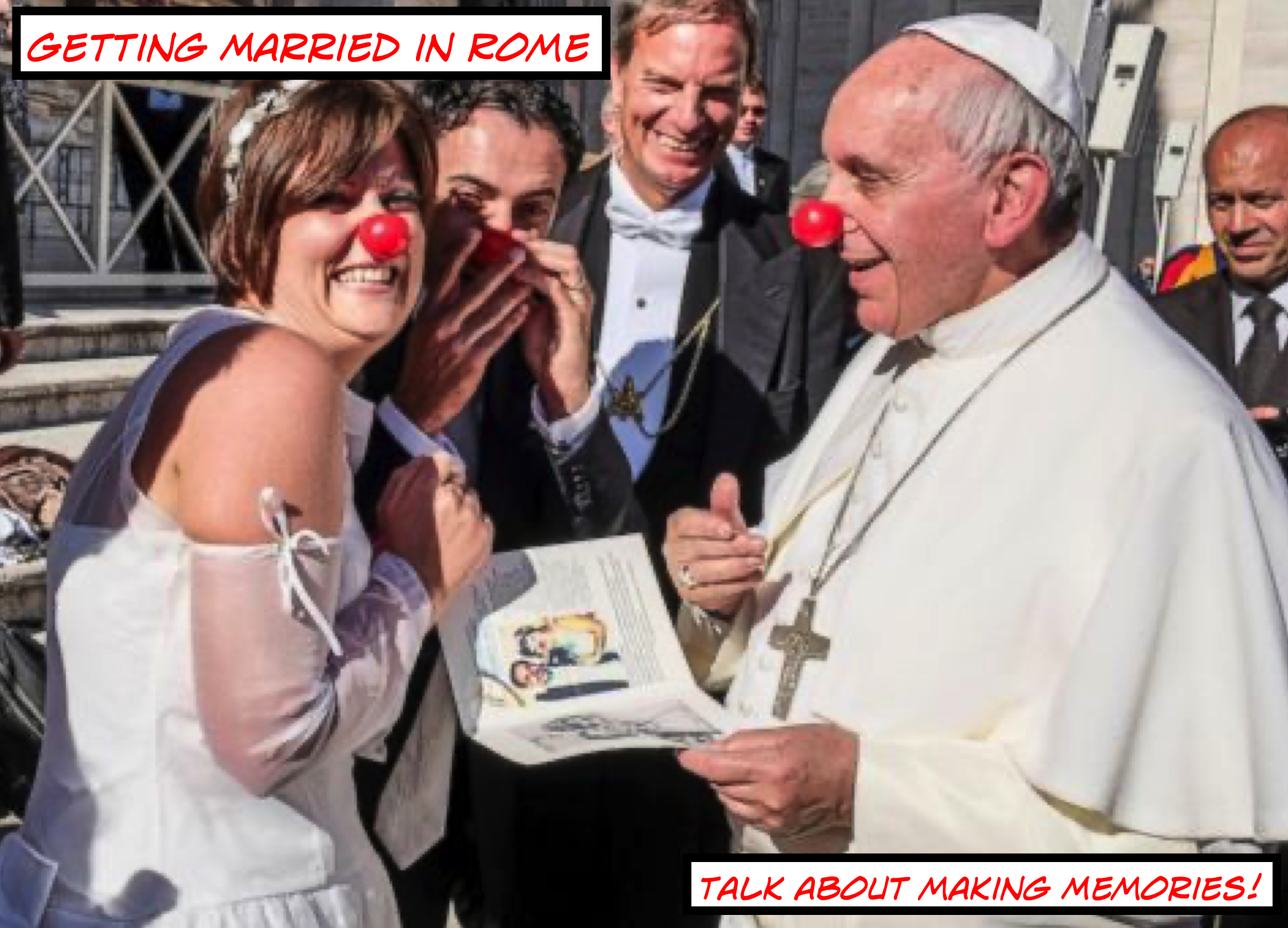
Pope Francis jokes with a newlywed couple in Rome.

Don’t be surprised, but many clergy possess keen senses of humor. Sure, there are staid, grimacing ministers who consider acting dour to be a virtue. (They’re often legalistic.) But most of the pastors and military chaplains I’ve worked beside, love to laugh. I think I’ve written enough about humor to verify that.

C.S. Lewis maintained strong bonds with a number of clergy, from a variety of denominations, and that would hardly have been true if they had lacked a sense of humor. Humor, to Lewis, is an essential part of life. He proclaims this truth from the lips of Aslan himself, as the newly created Talking Animals hear the first (accidental) joke.

“Laugh and fear not, creatures. Now that you are no longer dumb and witless, you need not always be grave. For jokes as well as justice come in with speech.” (The Magician’s Nephew)

I recently read about a fascinating incident one historian described as “perhaps the only really satisfactory practical joke in the whole history of theology.” Allow me to set the scene.

The Byzantine Empire lasted for a thousand years, before being defeated and desecrated* by Islamic armies. During the centuries surrounding its apex, it suffered from the political intrigue and competition with which we are all too familiar.

Photios I was a Byzantine scholar who was twice the Patriarch of Constantinople during the ninth century. Twice is unusual, but it was due to the machinations of emperors and empresses who meddled in the affairs of the church.

He had a troubled relationship with another priest named Ignatius, who also served two times as Patriarch. The good news is that the men were eventually reconciled and both are regarded by Orthodox Christians as saints.

The anecdote comes from the period of their rivalry. Photios, whose brilliance was widely acknowledged, and presumably envied by Ignatius, decided to pull an embarrassing public prank on his nemesis.

Photios devised a bizarre theory that human beings have two souls. His goal was to trick Ignatius into taking it seriously, whereupon Photius withdrew the thesis and admitted he had not been serious. Apparently, everyone unsatisfied with Ignatius’ leadership found it quite entertaining.

Fortunately, among clergy the humiliation of others is rarely the object of humor. Yet, sadly, I have seen it attempted. I personally repent of ever having done so myself, and regard it as sharing, along with vulgarity and blasphemy, the lowest level of “humor.” 

The Wisdom of Lewis

In Reflections on the Psalms, C.S. Lewis relates something I know to be true from my own experience.

A little comic relief in a discussion does no harm, however serious the topic may be. (In my own experience the funniest things have occurred in the gravest and most sincere conversations.) 

Clergy deal with serious topics, like death, quite frequently. Perhaps that is one reason a well-developed sense of humor is common among their ranks.


Skip this footnote if you want to end on a “happy” note.

* “Desecration” may sound like a harsh word to our interfaith-sensitive ears, but it is accurate here. Islam is rarely a gentle master for Christians, and it has been common to see churches and holy places seized and converted to foreign religious uses. For example, in the capital Constantinople (now called Istanbul), Orthodox Christianity’s most magnificent church, Hagia Sophia, saw much of its glorious and historic iconography destroyed when it was converted to a mosque. Many years later, in 1934, an enlightened Turkish government ended the insult, and chose to treat the holy place as a museum. Sadly, the current regressive government under Recep Tayyip Erdoğan, reversed that decision, and in 2020 the Church of Holy Wisdom was returned to its usage as a mosque.

Dog DNA Determines Guilt

It is surprising how inexpensive and accessible DNA testing has become. Many readers of Mere Inkling have submitted samples ourselves. But how many of us have had our pets tested?

The science of genetics is quite recent. Gregor Mendel (1822-1884) is considered the father of such studies. As Britannica describes the history, “The word genetics was introduced in 1905 by English biologist William Bateson, who was one of the discoverers of Mendel’s work and who became a champion of Mendel’s principles of inheritance.”

Molecular genetics did not begin in earnest until 1941 . . . A major landmark was attained in 1953 when American geneticist and biophysicist James D. Watson and British biophysicists Francis Crick and Maurice Wilkins devised a double helix model for DNA structure.

The Human Genome Project didn’t begin until 1990, and didn’t reach its goal until the new millennia. The astute reader will recognize that C.S. Lewis lived before these genetic studies reached their current status, so we should not expect comment from him on DNA per se. Nevertheless, as Francis Sellers Collins, director of the Human Genome Project (2009-2018), says his work is quite compatible with C.S. Lewis’ writings.

In fact, in a lecture at Cambridge, he described how Mere Christianity was pivotal in his conversion from agnosticism to Christianity. According to this preeminent geneticist, “even in the first few pages, all my arguments about faith just fell apart. It was breathtaking . . . Lewis remains my best teacher.”

There is some question as to whether the DNA testing market has peaked. Unsurprising, since it isn’t like tobacco, coffee or rich desserts that “addict” customers to generate repeated purchases. As Advisory Board says, “given one’s genetic data is unlikely to change, most consumers may not see a reason to purchase another DNA testing kit.”

So, how might these corporations remain profitable? Why, by expanding their offerings to the animal kingdom. One such company called Embark claims to offer the “most accurate dog DNA test available.” 

Some people purchase the service to satisfy their curiosity about a pet’s breed (often a blend of several). A more valuable benefit is gaining insights into their health and traits. The oddest aspect of the process appears to be Embark’s boast that they offer “the world’s first canine relative finder.”

Like many of us, C.S. Lewis loved dogs. He didn’t, however, go so far as to worship them. I suspect that C.S. Lewis would opt out of the chance to DNA-define his pets. Best to just love them and savor their companionship.

In his essay “The Personal Heresy,” C.S. Lewis proposes an interesting argument about expressing love only to those capable of receiving it.

There is a reaction at present going on against the excessive love of pet animals. We have been taught to despise the rich, barren woman who loves her lap dog too much and her neighbor too little. It may be that when once the true impulse is inhibited, a dead poet is a nobler substitute than a live Peke, but this is by no means obvious.

You can do something for the Peke, and it can make some response to you. It is at least sentient; but most poetolaters hold that a dead man has no consciousness, and few indeed suppose that he has any which we are likely to modify.*

DNA service businesses are probably licking their lips at the prospects offered by a new market. The French are blazing a new trail for the rest of us. According to Euronews, Béziers will require pet owners to “carry a ‘genetic passport’ for their dog.”

The reason is simple. Too many dog walkers are failing to perform their civic (and humane) duty of cleaning up after their pets. 

Dog excrement found on the streets would be collected and tested then sent to the police. They would match the DNA to national pet registers, locate the owner and charge them up to €122 for cleaning up the streets.

Apparently, similar efforts have been attempted in Valencia, Tel Aviv and portions of London.

It sounds like a rather extreme way to address what superficially appears to be a simple problem. But, sadly, in many places, public sanitation has declined to unbelievable depths. In San Francisco, for example, the once picturesque metropolis has voluntarily surrendered many areas to criminals and addicts who feel no compunction about defecating in public. While I can’t speak for European, Asian, African or Latin American countries, in the U.S. a similar story of decay is repeated in many urban centers.

San Franciscans can’t be criticized for not throwing money at the problem. Nevertheless, when progressive Slate magazine reported last year on the city’s newest public toilet, they said “cities shouldn’t need $1.7 million and years of design review to build a municipal toilet.” 

Not that San Francisco treats such facilities with care. One space age toilet lasted only a few days before malfunctioning. But it was expensive, stainless steel, and bore the upgraded title of “kiosk.”

A highly hyped new SF bathroom hailed as “the future of public toilets” lasted only three days into said future, as the high-tech bathroom kiosk quickly had to be relieved of its duty and found itself closed for repairs.

Since these are manufactured by a Paris-based company, perhaps they can design a canine kiosk to solve the Béziers dilemma? After all, the cost might well be equivalent to the sum of all of the DNA tests the citizens are being forced to cover. 

A Final Thought about Animal DNA

Many of us, like C.S. Lewis, are pet lovers. And many also care about the suffering of other animals, domesticated and wild. There may come a day when DNA testing offers ways to enhance the lives of these other creations of God.

However, it does seem frivolous, does it not, to apply such advanced (and not inexpensive) processes for the purpose of tracking down derelict dog walkers? Or, in other judicatories, which have not yet embraced that level of surveillance, simply to attempt to track down doggie-relatives?

As to the matter of checking pet DNA for genetic abnormalities, “Should you get your pet’s DNA tested? Scientists urge caution” counsels careful consideration.

In the interview, Elinor Karlsson, director of vertebrate genomics at the Broad Institute in Cambridge, Massachusetts says,

With genetic tests for humans, there have been so many studies that look at whether or not a certain mutation in your genes actually leads to you developing a certain disease. There just isn’t this massive body of work on dog genomes. So many of these tests are telling owners that their dog could get a certain disease without any major studies on how likely that is to happen. The science needs to catch up.

In response to the question “what are the dangers of potentially inaccurate test results?” Lisa Moses, a veterinarian affiliated with Harvard Medical School in Boston advises,

In my veterinary practice, I’ve seen more and more people coming in with results that show their dog has a chance of developing conditions like epilepsy, heart disease, and degenerative muscular disorders, and they want to make treatment decisions right away.

They’re ready to pay for more tests or medical interventions that the dog might not actually need, that could be quite expensive, and that could be invasive for the dog. In some cases, people preemptively end their dog’s life if they think their dog is predisposed to a degenerative disease, because don’t they want their pet to suffer.

So once again we see that, as they often do, silly scenarios can lead to serious subjects.


* The passage from “The Personal Heresy” continues: 

Unless you hold beliefs which enable you to obey the colophons of the old books by praying for the authors’ souls, there is nothing that you can do for a dead poet: and certainly he will do nothing for you. He did all he could for you while he lived: nothing more will ever come.

 I do not say that a personal emotion towards the author will not sometimes arise spontaneously while we read; but if it does we should let it pass swiftly over the mind like a ripple that leaves no trace. If we retain it we are cosseting with substitutes an emotion whose true object is our neighbour. Hence it is not surprising that those who most amuse themselves with personality after this ghostly fashion often show little respect for it in their parents, their servants, or their wives.