A New Source of Oxygen

Most of us have a basic affinity for oxygen. And, air quality being what it is in many places, it is probably good news that there is a newly discovered source on the bottom of the sea.

This morning I asked my ten year old grandson what I should blog about. I said it could be even something like a new discovery (since C.S. Lewis was such a renaissance man that I can find some link to diverse subjects in his writings).

Since it’s summer, and school’s on hiatus, I was surprised when he said something of which I was unaware. “I think they found oxygen coming from some minerals in the ocean.” Odd, I thought, but since he often surprises me with his knowledge, I checked it out. 

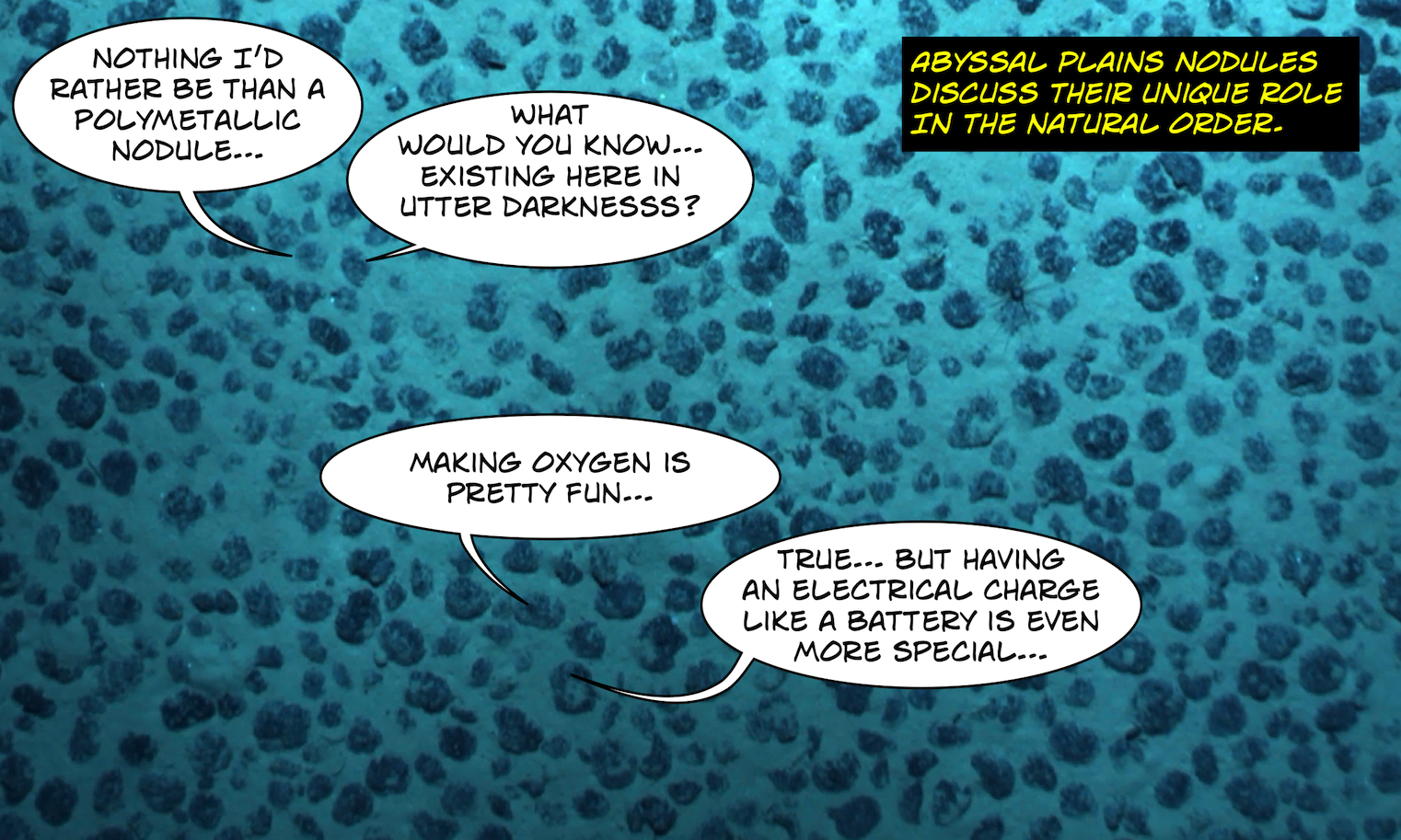
It’s true. Not only does the ocean produce huge amounts of oxygen via algae and the like, but they have recently discovered a source of “dark oxygen.” According to Smithsonian Magazine,

Twelve thousand feet under the ocean surface is a world of eternal midnight. No sunlight can penetrate to this depth to promote photosynthesis, so no plants are producing oxygen there.

Yet, the life-supporting gas is abundant in this darkness-cloaked region, thanks to an unlikely oxygen factory: potato-sized, “battery rocks” on the seafloor.

Those eager to learn more about this wonder can read the entire study, “Evidence of Dark Oxygen Production at the Abyssal Seafloor”  for free in Nature Geoscience.

The necessity of ready access to oxygen is obvious to everyone who knows basic biology. Actually, it isn’t the oxygen molecules [O], which we require, it is actually dioxygen [O2]. We also recognize our primary partners in this gloriously balanced process of exchange (where we trade off our carbon dioxide [CO2] in exchange for the O2) are the various plants God has distributed throughout our world. 

Curiously, oxygen only makes up a small portion of our atmosphere. According to the National Institute of Medicine,

The composition of environmental air is approximately 78% nitrogen, 21% oxygen, 1% argon, and trace percentages of other gases, such as carbon dioxide, neon, methane, helium, krypton, hydrogen, xenon, ozone, nitrogen dioxide, iodine, carbon monoxide, and ammonia.

I’m no scientist, but personal experience with pneumonia, and with training in a military Hypobaric (Altitude) Chamber, have taught me not to take the availability of oxygen for granted.

This fact was reinforced for C.S. Lewis during the final days of his life, as is true for many people. American Nathan Comfort Starr (1896-1981) was an Arthurian scholar. He would later write an Introduction and Commentary for Lewis’ Till We Have Faces in the Religious Dimension in Literature series. Shortly before Lewis’ death, Starr asked if he might be up to a visit from a friend. Lewis’ response evidenced a peaceful resignation to his own passing.

Term will never again begin for me. Last July I was thought to be dying, oxygen-tent and Last Unction and everything en règle.

I am now retired and immobilised on one floor of this house. But glad to be visited (an hour or so) if such an extinct volcano as I now am is worth visiting (4 September 1963).

In Out of the Silent Planet, the first volume of C.S. Lewis’ space trilogy, the protagonist travels to the planet MalacandraPhilologist Edwin Ransom is kidnapped before the voyage and his captors refuse to answer any of his questions.

“Don’t talk,” he said. “We have discussed all that is necessary. The ship does not carry oxygen enough for any unnecessary exertion; not even for talking.”

After landing, Ransom escapes and flees as far as his air lasts in the planet’s thin atmosphere. Nearing the end, a member of one of the intelligent species (Hnau) inhabiting Malacandra, rescues him. Presumably other races also sometimes require supplemental oxygen.

Stretching back into the cave, it took from the wall what looked like a cup. Then Ransom saw that it was attached to a length of flexible tube. The sorn put it into his hands.

“Smell on this,” it said. “The hrossa also need it when they pass this way.” Ransom inhaled and was instantly refreshed. His painful shortness of breath was eased and the tension of chest and temples was relaxed. . . .

“Oxygen?” he asked; but naturally the English word meant nothing to the sorn.

Oxygen is a precious gift to us from our Creator. So too is the scholar and atheist-turned-apologist, C.S. Lewis. 

Just as the revelations of natural creation are ceaselessly amazing, the lessons learned from C.S. Lewis’ life and works continue to inspire others. And, sometimes a little child’s awareness of recent news will lead others into new knowledge.

C.S. Lewis & the Colors of Heaven

What wonders await the color blind in Heaven! That thought recently occurred to me out of the proverbial blue. 

I was sitting on my patio, tossing a ball to my border collie, when she decided to explore some of the local forest scents, as she is wont to do. As I normally do, I used that peaceful, shalom moment, to pray.

I don’t recall whether I closed my eyes, or gazed at the brilliantly white clouds dancing above me. In either case, my mind and spirit were focused on prayer. Prayer for those I love, and for strangers I have never met.

What wonders await the color blind in the presence of God. Too profound for me to take credit for thinking, but perhaps one of those serendipitous epiphanies God offers unexpectedly to his children.

In The Great Divorce, C.S. Lewis describes an excursion to the foothills of Heaven. The sheer reality of Heaven exceeds fallen humanity’s ability to comprehend it.

Before me green slopes made a wide amphitheatre, enclosing a frothy and pulsating lake into which, over many-coloured rocks, a waterfall was pouring.

Here once again I realised that something had happened to my senses so that they were now receiving impressions which would normally exceed their capacity. On Earth, such a waterfall could not have been perceived at all as a whole; it was too big. Its sound would have been a terror in the woods for twenty miles. Here, after the first shock, my sensibility ‘took’ both as a well-built ship takes a huge wave. I exulted. . . .

Near the place where the fall plunged into the lake there grew a tree. Wet with the spray, half-veiled in foam-bows, flashing with the bright, innumerable birds that flew among its branches, it rose in many shapes of billowy foliage, huge as a fen-land cloud. From every point apples of gold gleamed through the leaves.

When the Narnians sail to the “edge of the world,” they are greeted by a wonder that hints at the beauty of Heaven beyond. Barring their way into that place it rose “between them and the sky, a greenish-gray, trembling, shimmering wall.”

Then up came the sun, and at its first rising they say it through the wall and it turned into wonderful rainbow colors. Then they knew that the wall was really a long, tall wave – a wave endlessly fixed in one place . . . (Voyage of the Dawn Treader).

At the end of the Chronicles of Narnia, C.S. Lewis ushers his heroes into Heaven. They too experience the overwhelming awe inspired by their divine surroundings. 

It is as hard to explain how this sunlit land was different from the old Narnia as it would be to tell you how the fruits of that country taste. Perhaps you will get some idea of it if you think like this. You may have been in a room in which there was a window that looked out on a lovely bay of the sea or a green valley that wound away among mountains.

And in the wall of that room opposite to the window there may have been a looking-glass. And as you turned away from the window you suddenly caught sight of that sea or that valley, all over again, in the looking-glass. And the sea in the mirror, or the valley in the mirror, were in one sense just the same as the real ones: yet at the same time they were somehow different – deeper, more wonderful, more like places in a story: in a story you have never heard but very much want to know.

The difference between the old Narnia and the new Narnia was like that. The new one was a deeper country: every rock and flower and blade of grass looked as if it meant more. I can’t describe it any better than that: if you ever get there you will know what I mean (The Last Battle).

I find Lewis’ fictional visions of Heaven inspiring in their self-confessed inadequacies. Heaven, no doubt, is profoundly more glorious than any human being can imagine.

The Bible employs brilliant colors to help describe Heaven’s beauty. In John’s vision of Heaven we find these descriptions:

And he who sat [upon the throne] had the appearance of jasper and carnelian, and around the throne was a rainbow that had the appearance of an emerald. Around the throne were twenty-four thrones, and seated on the thrones were twenty-four elders, clothed in white garments, with golden crowns on their heads.

From the throne came flashes of lightning, and rumblings and peals of thunder . . . and before the throne there was as it were a sea of glass, like crystal (Revelation 4).

[An angel] showed me the holy city Jerusalem coming down out of Heaven from God, having the glory of God, its radiance like a most rare jewel, like a jasper, clear as crystal. . . .

The wall was built of jasper, while the city was pure gold, like clear glass. The foundations of the wall of the city were adorned with every kind of jewel. The first was jasper, the second sapphire, the third agate, the fourth emerald, the fifth onyx, the sixth carnelian, the seventh chrysolite, the eighth beryl, the ninth topaz, the tenth chrysoprase, the eleventh jacinth, the twelfth amethyst. And the twelve gates were twelve pearls, each of the gates made of a single pearl, and the street of the city was pure gold, like transparent glass (Revelation 21).

The Power of Color

Colors are not merely aesthetic. Their influence on human perception has been studied for many years. One key researcher, Faber Birren (1900-88), served as a respected consultant on the subject for numerous businesses and even the United States government itself. 

Shades of Meaning” relates that “in 1939, Walt Disney invited Birren to work as a color consultant. He ended up advising Disney animators on the design of BambiFantasia, and Pinocchio.” 

In Color Psychology and Color Therapy, Birren begins his discussion of the subject with the proposal that “it is perhaps a mistaken notion that man in his love of color was impelled by some aesthetic urge.” He contends that:

The greatest weight of evidence points to the fact that color was involved with the supernatural and therefore had significance that went beyond what might be thought of as mere sensuous delight. . . .

Color, being a manifestation of light, held divine meaning. Historical records of color show little interest in the physical nature of color, nor yet in its abstract beauty, but in a symbolism that attempted to resolve the strange workings of creation and give it personal and human meaning.

If this spiritual aspect of color is actual, then being colorblind carries a liability beyond simply missing out on one of life’s simple pleasures.

Color Blindness Among Humanity

You may not know anyone who is color blind. That’s not surprising, since it isn’t a common subject of conversation. Nevertheless, in the general population, approximately eight percent – or 1 in 12 – men suffer from some form of it. Meanwhile, the rate of this condition, which is most frequently genetic, for women is far lower. Only about one in two hundred.

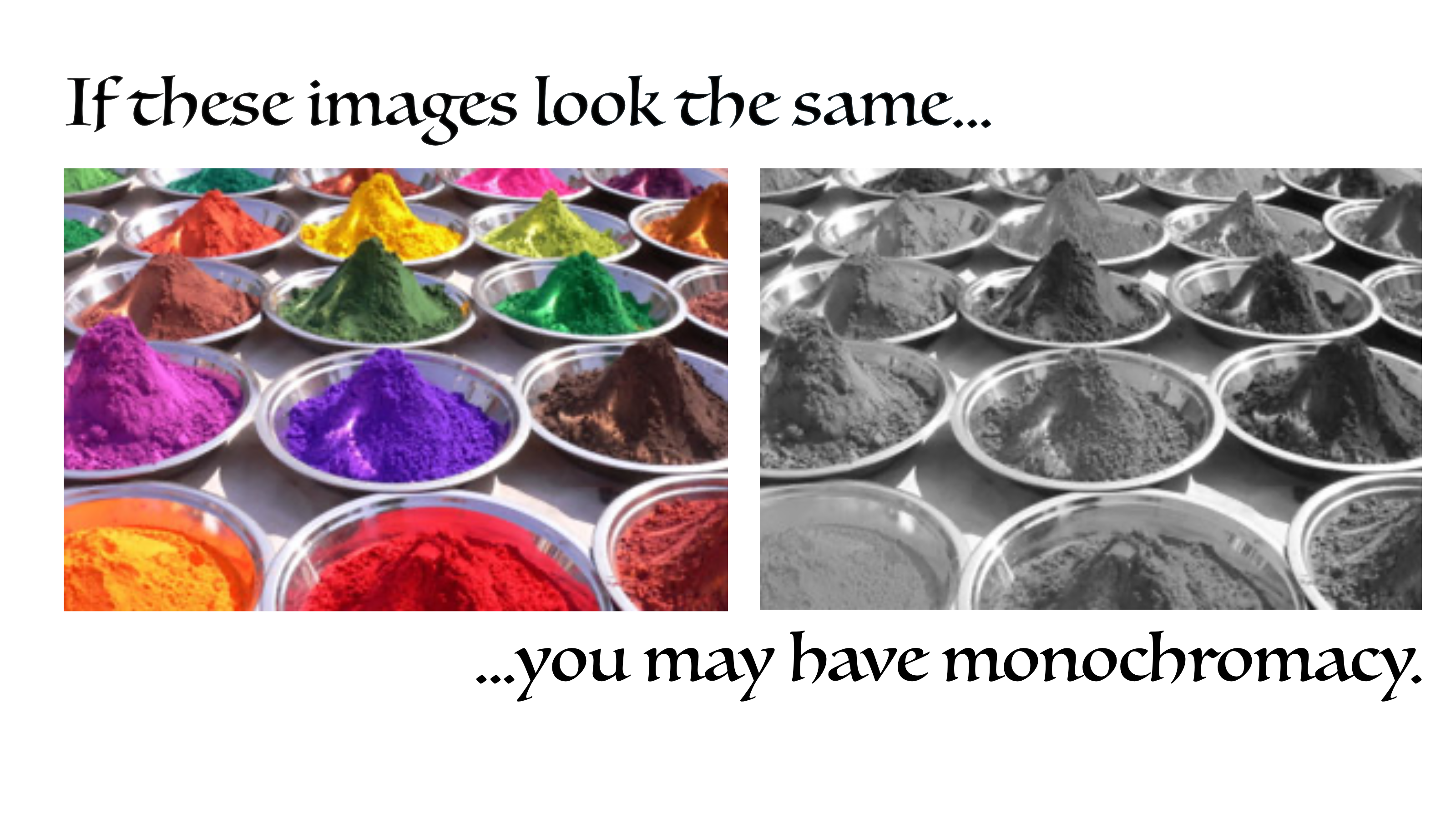
There are several varieties of color vision deficiency, with most people able to perceive some shades of certain colors. The most severe form of the problem involves a failure to see any colors. Only shades of gray distinguish between different hues. It’s called achromatopsia, and is quite rare. 

Achromatopsia is a congenital hereditary condition found in only one birth in every 33,000 to 50,000 births.  Thus less than 10,000 Americans may have achromatopsia. There are two basic forms . . . Rod Monochromatism, . . . is the most common [and] routinely occurs in both men and women. . . .

Blue Cone Monochromatism has an incidence of 1 in 50,000-100,000 births in males and could be as rare as 1 in 10 billion in females.

If you are curious about achromatopsia, you should definitely read about research on a Micronesian Island where ten percent of the people share this affliction.

Many individuals first learned of achromatopsia in 1997, when Oliver Sacks published his classic book, Island of the Color Blind.  This story beautifully chronicles Oliver Sack’s 1994 quest with Knut Nordby and Bob Wasserman to the isolated atoll of Pingelap in Micronesia, where 10% of the population have rod monochromatism. A video of the journey is available here.

Possible Visions of Heaven

Although I am quite wary of so-called near death experiences (with some being spurious, and others, spiritual deception), it is intriguing how color has entered into a number of the stories. The following examples appear in the accounts of several different individuals in Imagine Heaven: Near-Death Experiences, God’s Promises, and the Exhilarating Future that Awaits You.

The entire city was bathed in light, an opaque whiteness in which the light was intense but diffused. In that dazzling light every color imaginable seemed to exist and – what’s the right word? – played. The colors seemed to be alive, dancing in the air. I had never seen so many different colors. It was breathtaking.

Below me lay the purest, most perfect grass, precisely the right length and not a blade that was bent or even out of place. It was the most vibrant green I had ever seen. If a color can be said to be alive, the green I saw was alive, slightly transparent and emitting light and life from within each blade. The iridescent grass stretched endlessly over gently rolling hills upon which were sprinkled the most colorful wild flowers, lifting their soft-petaled beauty skyward, almost as if they were a chorus of flowers caught up in their own way of praising God.

The most gorgeous sky ever seen here on earth cannot even come close to the atmosphere in Heaven.  It is bright because of the glory of our God. . . .  The atmosphere is something you experience, not just see.  It is golden, yellow, white, and had more colors moving throughout it . . . like the Aurora Borealis lights.

The sky [and] the firmament surrounding the heavens, were a wilder and bluer yonder than you would ever believe. . . . The closest shade I can associate this otherworldly blue with is the surreal tones of the water in the Caribbean or off the coast of Hawaii at sunset. . . . That color is waiting for you and me on the other side.

The colors and lights in Heaven were simply sublime. . . . They were the deepest, richest, most gloriously lush colors I had ever seen, and some I had never seen before. Heaven is a dream-come-true for those who love all things colorful, and our home there is lit by the Father of Lights. . . . [There were] robust and bold and vigorous beams that were somehow gentle to my eyes. I simply don’t think those colors and lights exist on earth.

I saw the most dazzling colors, which was all the more surprising because I’m color-blind. I can distinguish the primary colors, but pastels all look the same to me. But suddenly I could see them, all kinds of different shades. Don’t ask me to name them because I lack the necessary experience for that.

Take a Moment to Test Your Own Color Vision

There are a number of simple, free vision tests available online. If you want to assure yourself that you can see all of the normal colors – though not necessarily all of the heavenly colors awaiting us – check out one of the following.

Color Blind Test

EnChroma Color Blind Test

X-Rite Color Challenge and Hue Test

Colorlite Collection of Tests

Final Thoughts

When I described the wonders awaiting the color blind in Heaven, I was referring to all of us. (In this life, as the Scriptures say, “For now we see in a mirror dimly . . .” (1 Corinthians 13).

All who trust in the love of Jesus Christ, and thereby enter Heaven’s environs by the unmerited grace of God’s mercy, will be overwhelmed by its beauty and wonder.

The million or more colors a person with full vision can now see, will be eclipsed by the infinite tapestry of hues in our Creator’s mind. Even those with the scientifically-presumed capability to currently perceive distinctions between up to 100 million will surely be in awe.

C.S. Lewis closes our discussion of Heaven’s colors with a fascinating thought related to the angels who worship God in that divine place. Lewis begins by noting a significant distinction between God’s angels and humanity.

But for our body one whole realm of God’s glory – all that we receive through the senses-would go unpraised. For the beasts can’t appreciate it and the angels are, I suppose, pure intelligences.

They understand colors and tastes better than our greatest scientists; but have they retinas or palates? 

I fancy the “beauties of nature” are a secret God has shared with us alone. That may be one of the reasons why we were made-and why the resurrection of the body is an important doctrine (Letters to Malcolm: Chiefly on Prayer).

C.S. Lewis & Assassinations

The brilliant author C.S. Lewis died on the same day that an American president was assassinated. The violent death of John F. Kennedy in November of 1963 eclipsed Lewis’ own passing, so many people were unaware of it for some time. Yet on that autumn day, both Camelot and Narnia lost their inspirations.

Unfortunately, Kennedy’s shooting was not the only political assassination that was connected in a manner to C.S. Lewis’ life. Archduke Franz Ferdinand Carl Ludwig Joseph Maria of Austria was the heir apparent to the throne of Austria-Hungary. A nineteen year old political activist cold-bloodedly murdered the archduke and his wife, Sofie.

Franz and Sophie had married for love, despite her inadequate social rank, which resulted in a morganatic marriage. In recent years such unions have become more common, but at the time, it was a serious matter. The archduke was forced by his uncle, the emperor, to accept that their descendants would never have a right to the throne.

In a convoluted fashion, Ferdinand’s death nearly led to C.S. Lewis’ own. The 1914 assassination was the spark that set the globe on fire during the First World War. And, during that grim conflict, C.S. Lewis was severely wounded by an artillery shell that killed friends standing nearby.

The Causes and Impact of Political Assassinations” was published by the Combating Terrorism Center at West Point. It begins with the fact that “political assassinations have been part of social reality since the emergence of communal social frameworks . . .” And so, since social frameworks will forever exist, they continue.

Humanity’s Violent History

Assassination has been a relatively common practice throughout human history. This shouldn’t surprise anyone who knows the sad story of Abel and his angry brother, Cain. 

Philip II of Macedon, the father of Alexander the Great, was killed attending the wedding of his daughter Cleopatra (no, not that Cleopatra). Later Cleopatra, as a widow, would be assassinated herself by one of her unsuccessful suitors.

Three centuries later, Julius Caesar was murdered by the political elite of Rome, who feared his growing influence. And in 453, one of Rome’s greatest enemies, Attila the Hun, was arguably murdered on his wedding night by his new bride, Ildico.

Several assassinations are recorded in the Bible. Over such a lengthy and turbulent historical period, that is unsurprising. The two excerpts below have links to the fuller accounts.

[Canaanite general] Sisera fled away on foot to the tent of Jael, the wife of Heber the Kenite, for there was peace between Jabin the king of Hazor and the house of Heber the Kenite. And Jael came out to meet Sisera and said to him, “Turn aside, my lord; turn aside to me; do not be afraid.” So he [entered] the tent, and she covered him with a rug. . . . And he said to her, “Stand at the opening of the tent, and if any man comes and asks you, ‘Is anyone here?’ say, ‘No.’” But Jael the wife of Heber took a tent peg, and took a hammer in her hand. Then she went softly to him and drove the peg into his temple until it went down into the ground while he was lying fast asleep from weariness (Judges 4).

Joab took Amasa by the beard with his right hand to kiss him. But Amasa did not observe the sword that was in Joab’s hand. So Joab struck him with it in the stomach and spilled his entrails to the ground without striking a second blow, and he died (2 Samuel 20).

As a sort of counterbalance to these “positive” instances – elimination of Israel’s enemies – you may want to read about King David’s condemnation of the assassinations of his political rivals, men to whom he would have extended mercy. When two brothers sought a reward for murdering King Ish-bosheth, Saul’s son, David declared “when wicked men have killed a righteous man in his own house on his bed, shall I not now require his blood at your hand and destroy you from the earth?” (2 Samuel 4).

All told, however, there was much violence in the ancient world. As C.S. Lewis’ wife, Joy Davidman, wrote in Smoke on the Mountain: An Interpretation of the Ten Commandments in Terms of Today:

How the ancient Jews did slaughter! They killed in hot blood and in cold; they killed for loot, for God, and for fun. . . . The tribes killed . . . by political assassination as when Ehud stabbed King Eglon in his fat belly . . . [The graphic story of Eglon’s assassination is detailed in Judges 3.]

Another historically consequential assassination occurred in the year 661, when Muhammad’s son-in-law Ali ibn Abi Talib was slain with a poison-coated sword while praying in the Great Mosque of Kufa. This incident caused Islam to separate into two major denominations, and Sunni-Shia relations continue to be contentious.

In the modern era, political murders remain unabated. Vladimir Putin  may be the current master of the deadly art. Even discounting the growing number of “suicides” among his advisers and generals following his ill-advised invasion of Ukraine, we have the case of Alexei Navalny. Navalny was one of Putin’s critics who in 2020 survived poisoning with Novichok nerve agent. Nevertheless, imprisoned in the arctic, he later died under extremely suspicious circumstances. 

In the western hemisphere, the recent attempted assassination of former President Donald Trump invites a review of the danger of serving in that particular office. Despite the (obvious) risk of inviting non-Americans to mock the United States, consider a few facts.

  • Since 1789 (when the office was established) we have had 45 presidents
  • Four sitting presidents have been assassinated while in office
  • Three other presidents (one while in office) were wounded in assassination attempts

Assassination During the Protestant Reformation

In C.S. Lewis’ landmark tome English Literature in the Sixteenth Century, recalls a peculiar passage from the History of the Reformation of Religion within the Realm of Scotland. The author, John Knox refers to the murder of Scotland’s last pre-Reformation Roman Catholic cardinal. It would be more than four centuries before the Pope appointed another.

In the cast of [Knox’s] mind, too, there is something not unlike Tacitus’ sombre pungency, though Knox’s humour, as becomes a countryman of Dunbar, is more boisterous and ferocious.

Sometimes, indeed, it is so ferocious that we should not recognize it at all if we were not told; as when after describing the murder of Cardinal Beaton down to the last grim detail of packing the corpse in salt (‘the wether was hote’) he proceeds, ‘These things we wreat mearelie: but we wold that the reader should observe Goddis just judgementis.’

He was apparently afraid lest the fun of the thing might lead us to forget that even an assassination may have its serious side.

Quite true. An assassination, even of a despised ruler such as Adolf Hitler, remains a serious matter.

Military Hymns & Ents

The United States is schizophrenic about its religious heritage, and the armed forces provide us with today’s example. Most people, including veterans themselves, are unaware of the fact that while we have official songs for the different branches of the armed forces, we don’t have any official hymns.

C.S. Lewis and J.R.R. Tolkien, both combat veterans, were quite familiar with martial music. However, as members of a (nominally) Christian kingdom, neither would have been uncomfortable with explicitly Christian elements in their military’s hymnody. Across the ocean in the former colonies, it’s a different matter. 

Here, the confusion about the “official” status of religious military hymns abounds because spiritual hymnody has been part of our nation’s martial history ever since the colonies decided to band together and seek independence. Yet, some consider that to be unlawful.

The rejection of music expressing faith in God can be attributed to the modern crusade against such hymns by strident anti-theists. Many in this camp are practicing atheists, who misinterpret the two clauses of the First Amendment which the nation’s founders did not consider mutually exclusive. 

Congress shall make no law respecting an establishment of religion, or prohibiting the free exercise thereof . . .

Since most of the creators of the Constitution – and the majority of American citizens up to this day – have been theists (believing in a Supreme Being), it is self-evident that they did not intend to exorcise all expressions of faith from the public forum. Some states, in fact, already had their own “established churches when the First Amendment was ratified.”

Up until this generation, generic references to a heavenly Father or a benevolent Creator have traditionally remained welcome at civic events.

Even the non-Christian Thomas Jefferson (who argued against religious establishment) was essentially a Deist, acknowledging “the god who gave us life, gave us liberty at the same time . . .”

Jefferson even edited the New Testament Gospels, deleting “objectionable passages” and producing his personally-sanctioned Life and Morals of Jesus of Nazareth

So, What about the Music?

My goal is not to discuss the First Amendment per se – though I included the introductory note above for the benefit of the many international readers who find their way to Mere Inkling.

Rather, I wish to discuss the premise above, that America celebrates generally secular martial music, while remaining wary of military hymnody with religious themes. 

Ironically, soldiers throughout the nation’s history passively assumed that the songs they heard at rallies and civic events had the government’s tacit imprimatur, that was questionable. Take the “Battle Hymn of the Republic,” for example. Composed in 1861 by abolitionist Julia Ward Howe, Union soldiers would have been shocked to learn that some would deem its use in the ranks as a violation of the First Amendment.

Mine eyes have seen the glory of the coming of the Lord;
He is trampling out the vintage where the grapes of wrath are stored;
He hath loosed the fateful lightning of His terrible swift sword:
His truth is marching on.

I have read a fiery gospel writ in burnished rows of steel:
“As ye deal with My contemners, so with you My grace shall deal;”
Let the Hero, born of woman, crush the serpent with His heel,
Since God is marching on.

Modern Military Hymns

The Department of Defense hosts a website titled Guide to U.S. Military Bands and Music. It describes the wide repertoire of military musicians. 

Whether you like jazz music, a marching band or orchestra music, the U.S. military has you covered. Each branch of the military boasts a diverse offering of musical talent that serves for ceremonial purposes but also for entertainment and outreach. Check out these bands to stay in tune with military music.

One Christian hymn has deep roots in the military community. The song traditionally referred to as “The Navy Hymn” in America, originated in Britain. It is also used by the French. Its maritime themes make it popular in civilian communities as well. 

Eternal Father, strong to save,
Whose arm does bind the restless wave,
Who bids the mighty ocean deep
Its own appointed limits keep;
O hear us when we cry to Thee
For those in peril on the sea.

O Savior, whose almighty word
The winds and waves submissive heard,
Who walked upon the foaming deep,
And calm amid the rage did sleep;
O hear us when we cry to Thee
For those in peril on the sea.

“There exist a myriad of alternate verses to the hymn. One, for example, was written by David B. Miller in 1965 and specially dedicated to naval submariners.”

Musicians were not just present for official ceremonies and off-duty entertainment. They could also inspire the troops in the violent din of battle. More common in distant ages, even in twentieth century Europe, we find a dramatic illustration.

In the military archives of the Irish Republican Army, Michael J. Crowley described the inspiration provided by the brigade’s musician in the heat of the battle called the “Battle of Crossbarry” and the “Crossbarry Ambush,” by the IRA and the Brits respectively.

From the opening shot of the engagement, our piper, Florrie Begley of Brandon, played warlike airs on the bagpipes until the last shot was fired.

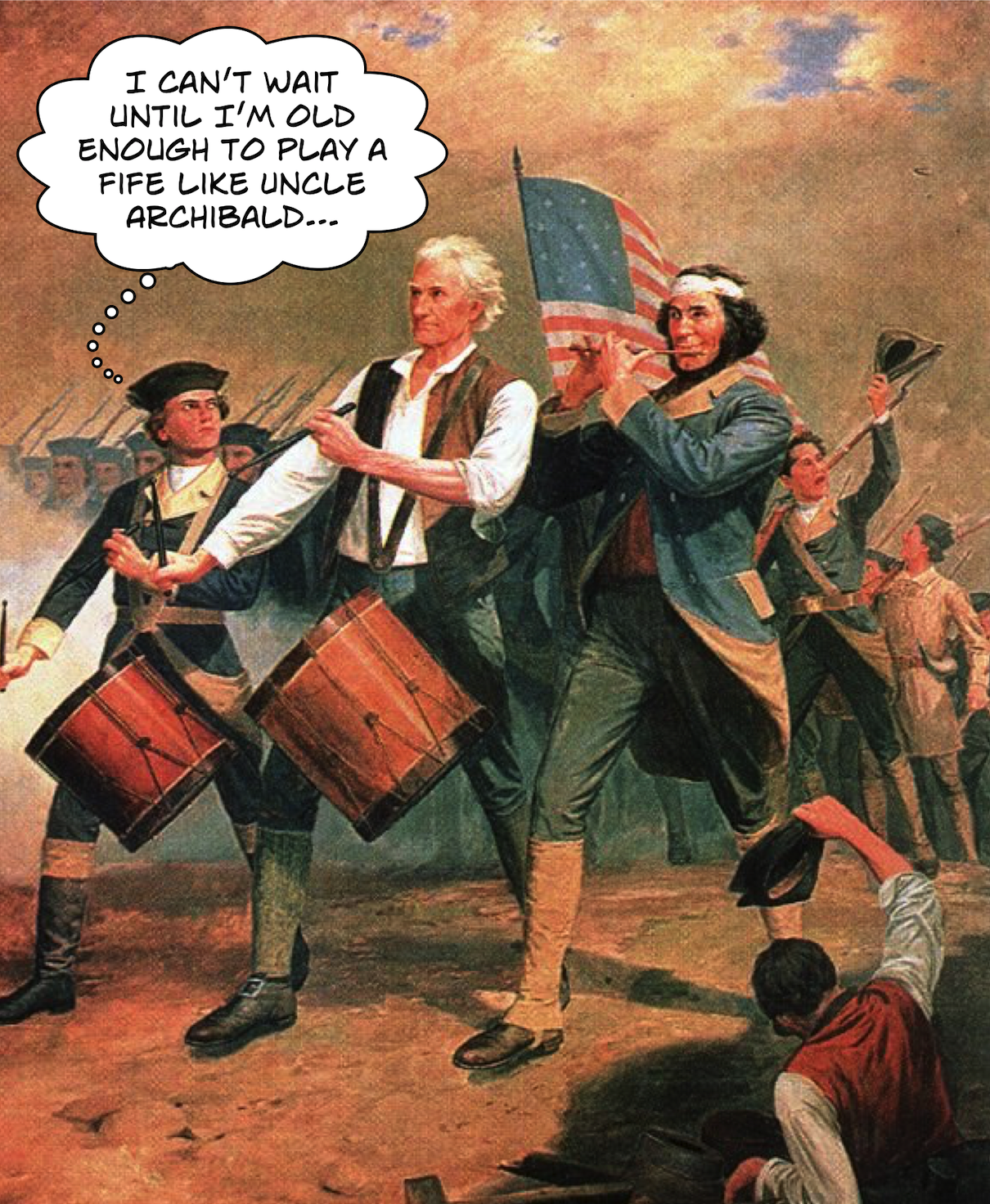
The illustration above provides an idealized portrait of military musicians bravely facing enemy fire. “The Spirit of ’76,” painted for the centenary of the American Revolution, met with tepid enthusiasm during the 1876 Centennial Exposition in Philadelphia. However, it rose in popularity when it subsequently toured the country.

For centuries, armies used music as the means to communicate the military orders of the day to soldiers. The high pitch of the fife and the sharp sound of the drum allowed messages to be heard at great distance . . .

Leaping from the Revolution to the twenty-first century, the recently birthed United States Space Force now has a hymn. Well, sort of. It is an unsolicited hymn composed by a former Air Force officer. You can hear “Creator of the Universe” here.

For more space music, check out the official anthem of “the mighty watchful eye.” Some consider this proposed anthem far more inspiring.

My personal favorite is the version of the Space Force Anthem proposed by its original, cinematic commander, General Naird, played by Steve Carell. (Carell even plays his own fife in the episode.)

The Middle Earth Military March

Howard Shore composed a powerful soundtrack for Lord of the Rings. Yet he wasn’t the first to create music for the great saga. One Tolkienist writes:

My first contact with Tolkien-inspired music dates back to the late 1980s . . . I was watching TV with my parents seeing a performance of Military Bands. Later I would discover that it was the Dutch composer Johan de Meij’s Symphony No. 1 (The Lord of the Rings) I’d heard.

From among the ranks of the Inklings, only one writer wrote an explicit military song. J.R.R. Tolkien provided the timeless Ents with a somber marching song as they face the powers of Isengard.

We come, we come with roll of drum: ta-runda runda runda rom!
We come, we come with horn and drum: ta-rūna rūna rūna rom!

To Isengard! Though Isengard be ringed and barred with doors of stone;
Though Isengard be strong and hard, as cold as stone and bare as bone,
We go, we go, we go to war, to hew the stone and break the door;
For bole and bough are burning now, the furnace roars – we go to war!
To land of gloom with tramp of doom, with roll of drum, we come, we come;
To Isengard with doom we come!
With doom we come, with doom we come!

If you have a moment, you will likely enjoy the performance of this song as arranged by Clamavi De Profundis.

Pilfering Tolkien Linguistics

When a great author, say of the magnitude of J.R.R. Tolkien, creates ingenious new words, and even entire languages, there are several common reactions. Most readers simply respond with silent awe. Others are inspired to emulate their efforts. A small number reuse those very words as a sincere homage

And a handful of “admirers” go so far as to “appropriate” the words themselves, for their personal benefit.

C.S. Lewis, no mean linguist himself, recognized his friend Tolkien’s brilliance. In his preface to That Hideous Strength he praised Tolkien’s yet-to-be-published Silmarillion. In a 1951 letter he mentions misspelling the word Numenor.

My Numinor was a mispelling: it ought to be Numenor. The private mythology to which it belongs grew out of the private language which Tolkien had invented: a real language with roots and sound-laws such as only a great philologist could invent.

He says he found that it was impossible to invent a language without at the same time inventing a mythology.

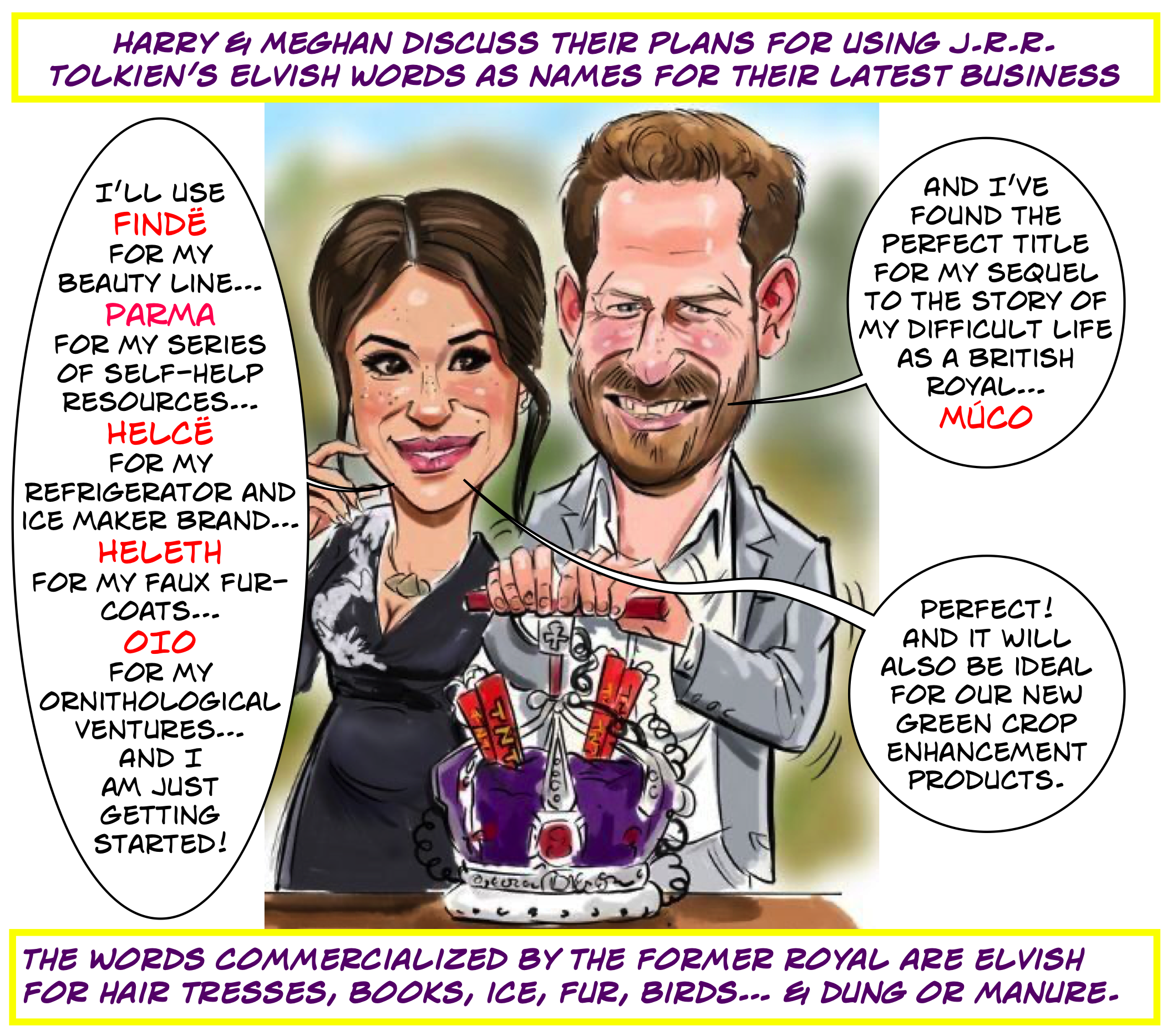
J.R.R. Tolkien was an internationally renowned philologist, and his impressive skill is one of the great wonders we encounter in Middle Earth. A number of words from his created languages – particularly his ethereal Elvish tongues – have been lifted to be used in commercial activities unconnected to Tolkien’s interests.

For example, Palantir. This was the word for the “seeing stone,” which played a prominent role in The Two Towers. In light of Tolkien’s love of nature, and corresponding suspicion of technological advancement, it is especially odd that the company adopting this label is on the leading edge of Artificial Intelligence.

Perhaps Tolkien’s dread would have been dispelled by one of Palantir’s disarming mottos: “We believe in augmenting human intelligence, not replacing it.”

A combat veteran of WWI, like his fellow Inkling C.S. Lewis, Tolkien was appalled by war’s horrors. Even in the War of the Rings, with its moments of glorious heroism and sacrifice, the bloody heart of Mars remains nearly invincible. Because of this mixed attitude toward war, some have wondered how he would have felt about a defense (i.e. military) corporation adopting one of his creations.

Andúril was the name of the most important weapon forged in Middle Earth. It was actually reforged from the broken fragments of Narsil, the longsword which defeated Sauron by severing the One Ring from his hand.

While this description from the Anduril company resonates with our modern ear, I am not convinced that it sounds very Tolkienesque. Anduril: “Transforming defense capabilities with advanced technology. The battlefield has changed. How we deter & defend needs to change too.”

For an article about a billionaire investor who is consumed by mining Tolkien’s tomes for the businesses he founds (PayPal excepted), check out “The hidden logic of Peter Thiel’s ‘Lord of the Rings’-inspired company names.”

C.S. Lewis’ Unconscious Sharing

In a 1965 letter, written after Lewis’ death, Tolkien commented on how his friend had used subtle variations of several Elvish words in several of his fictional works.

Tolkien says Lewis “had the peculiarity that he liked to be read to. All that he knew of my ‘matter’ was what his capacious but not infallible memory retained from my reading to him as sole audience.” Thus, he surmises that:

C.S. Lewis was one of the only three persons who have so far read all or a considerable part of my ‘mythology’ of the First and Second Ages, which had already been in the main lines constructed before we met. . . . His spelling numinor is a hearing error, aided, no doubt, by his association of the name with Latin nūmennūmina, and the adjective ‘numinous.’

Lewis was, I think, impressed by ‘the Silmarillion and all that,’ and certainly retained some vague memories of it and of its names in mind. For instance, since he had heard it, before he composed or thought of Out of the Silent Planet, I imagine that Eldil is an echo of the Eldar; in Perelandra ‘Tor and Tinidril’ are certainly an echo, since Tuor and Idril, parents of Eärendil, are major characters in ‘The Fall of Gondolin,’ the earliest written of the legends of the First Age. But his own mythology (incipient and never fully realized) was quite different.

An Entertaining Diversion

Years ago I linked to an entertaining game that plays on the linguistic eloquence and mystery Tolkien exhibited in naming his characters. I was delighted to see now that it is still available online.

Antidepressants or Tolkien challenges players – you can play solo, but it’s more fun with others – to guess if a given word is an antidepressant drug or the name of one of Tolkien’s characters. Don’t expect to score 100%, but do expect to smile at some of the examples.

C.S. Lewis & Longevity

How long is it good for us to live? That’s a strange question, I know. But, do you have an answer? C.S. Lewis had some thoughts on the subject that you may find provocative.

Aging is on my mind this week. I had never thought about myself becoming a septuagenarian – but this week I became one. Well, I still think of myself as being in my fifties, but that appears to be more common than one would guess. When I entered my fifties, I told my dad (then in his seventies) that “I still picture myself as being in my thirties.”

My dad responded without a moment’s thought: “That doesn’t surprise me at all. I still think of myself as being in my fifties.” 

Many people become preoccupied with age. The only time I recall it mattering to me, was when I turned eighteen – able to vote, and registered for the draft (with Vietnam still a war zone) . . . and when I turned twenty-one, for reasons I prefer not to divulge at this time.

People are living longer, and I’m not convinced that translates into living better. Listen to C.S. Lewis, as he writes in his essay “Is Progress Possible?”

I care far more how humanity lives than how long. Progress, for me, means increasing goodness and happiness of individual lives. For the species, as for each man, mere longevity seems to me a contemptible ideal.

Lewis elaborates on this concept – that long life and happiness do not always intertwine – in the Screwtape Letters. The words which follow are the advice of a senior Tempter (devil) to a less experienced junior.

The truth is that the Enemy [i.e. the true God], having oddly destined these mere animals to life in His own eternal world, has guarded them pretty effectively from the danger of feeling at home anywhere else. That is why we must often wish long life to our patients; seventy years is not a day too much for the difficult task of unravelling their souls from Heaven and building up a firm attachment to the Earth.

While they are young we find them always shooting off at a tangent. Even if we contrive to keep them ignorant of explicit religion, the incalculable winds of fantasy and music and poetry . . . are always blowing our whole structure away. They will not apply themselves steadily to worldly advancement, prudent connections, and the policy of safety first.

So inveterate is their appetite for Heaven, that our best method, at this stage, of attaching them to Earth is to make them believe that Earth can be turned into Heaven at some future date by politics or eugenics or “science” or psychology or what not.

Real worldliness is a work of time. . . . How valuable time is to us may be gauged by the fact that the Enemy allows us so little of it. . . .

We are allowed to work only on a selected minority of the race, for what humans call a “normal life” is the exception. Apparently He wants some – but only a very few – of the human animals with which He is peopling Heaven to have had the experience of resisting us through an earthly life of sixty or seventy years. Well, there is our opportunity. The smaller it is, the better we must use it. (Letter XXVIII).

Sadly, far too many people grow far too attached to this world. They lose sight of the promise of Resurrection (if they had ever known it), and as death approaches crave just one more year, another month, another week, another day, even another hour.

Now, I’m not saying long life is a negative, per se. I agree with C.S. Lewis when he wrote “I must never, like the Stoics, say that death does not matter. Nothing is less Christian than that” (“The Grand Miracle”). The danger is not in enjoying the Lord’s wonderful creation. It is in growing too attached to this fallen version of it – in losing touch with the truth proclaimed by musician Larry Norman, that this sin-stained world is not our ultimate home.

Dying

Having been at the bedside of too many people as they face their mortality, I have witnessed many final days. Some literally go, trembling and cursing. Others depart with grim resignation, and no evidence of hope. And then there are those who die with faith, experiencing true peace and joyous anticipation, despite the pain they may be enduring. 

I wish everyone could die in such a state, at peace and earnestly desiring to see the glory of God unblurred by our mortal eyes (1 Corinthians 13). 

On that day we will enter into the fullness of life, into eternal life. (Dr. Michael Zeigler offers an encouraging sermon you can read or listen to at “The Problem and Promise of Deathbed Conversion.”)

The Screwtape Letters is one of C.S. Lewis’ most imitated books. I have even experimented with his model myself. But, rather than emulate these letters, today I would be so bold as to offer an addition to this demonic epistle. 

My supplement is not intended for Christians, except as a truth they may wish to share with others who are walking through the valley of the shadow of death.

And never, my dear Wormwood, at the risk of your own torment, forget this one dire threat. Even after a long life, lived in hedonistic pleasure, deeply tethered to this decaying world, it is still possible for these wretches to be rescued from our claws.

The Enemy is so blindly compassionate that he will foolishly overlook a magnitude of savory sins sown during a carnal life. The dissolute lives we have toiled so steadfastly to soil with uncountable depravities and unrelenting selfishness, remain vulnerable until the patients’ final breath is exhaled.

The Gordian Knot we have so skillfully twisted can be undone in an instant, if they cry out to the Enemy for forgiveness. That is why we must remain vigilant to the very end. It is ideal to have them railing at the end against a God who has allowed them to suffer.

Yet it is sufficient that they die without that rage. A hopeless resignation to what they foolishly consider the end of their existence, still provides fodder for the insatiable appetite of Our Father Below quite adequately.

Final Encouragement

God’s mercy is beyond our ability to comprehend it. While there is breath, there remains hope. Even at the end of a squandered life, God’s love in Jesus Christ is sufficient to wash away every failing, and usher a penitent soul into the glory of everlasting life. 

Remember that, if you find yourself feeling too defiled to come to Christ at the end, that is a lie of Satan. Every single one of us Christians was in similar straits – “while we were still sinners, Christ died for us.”

And, should you ever have the experience of traveling beside a dying friend who sees only darkness ahead, share with them this gospel hope.

Blackout Writing

Do you have trouble coming up with ideas for your poems or stories? How about starting with an interesting collection of words and winnowing them down to a creation of your own? Read on to learn more about a simple process.

A few years ago a fellow pastor told me he could write, even short articles like blog posts. Since he had successfully completed a challenging graduate program, I was a bit shocked at this disclosure. “The problem,” he said, “is that I just can’t come up with any ideas for what to write.”

I had two reactions. First, I was amazed, since I can’t get through a day without encountering at least a handful of observations that beg to be explored. Second, I wondered just what sort of sermons his congregation was exposed to, if creative imagery and fresh ways of expressing God’s timeless truths were not coming from their pulpit.

One of the ways I attempt to improve my own writing is by stretching. In my personal shorthand, this refers to engaging in new forms of writing. Principally that means voluntarily jumping into sometimes ominous literary waters. I stretch myself by humbly engaging in genres which I may, in all honesty, find intimidating.

For example, occasionally, when bored with outlining books that may never get written, I’ll just scribble out some “impromptu verse.” Some of it turns out rather decent. (You’ll notice I didn’t say “excellent.”)

Blacking Out Words to Compose New Literature

I had heard of Blackout Poetry before, but never attempted to “write” any. Actually, it seems to me that “decompose” might be a more accurate word for this type of creating. Although most commonly used to create brief works, such as poetry, the concept can be used for narratives as well.

If you are unfamiliar with the process, you may enjoy the following, introductory articles.

Teach Kids Art” explains the basic process and then adds some visual artistry to the mix.

Blackout Poetry is a form of “found poetry” where you select words that catch your interest from a newspaper, book, or other printed text – along with a few additional words to make it flow. Then you “redact” all the words you don’t want. This is often (but not always) done with a black marker, hence the name “blackout poetry.” Your chosen words will form a new message, giving the text a whole new meaning.

Take your Blackout Poetry a step further by adding patterns, designs, or a drawing to the areas you’re “redacting.” For example, instead of just filling in around your chosen words with solid black, you could create a drawing or design that relates to your poem. Just as with any illustration, your art should support the remaining text and add to its meaning.

Looking Beyond the Comfort Zone” discusses a reservation many will have about pursuing blackout writing.

I really wanted to give it a try. There were however a few obstacles to overcome. First was my ingrained prohibition of defacing books. Although I owned a highlighter in college I rarely used it. It seemed wrong. . . .

Secondly the blackout poetry requires making the page unreadable for the original words. I felt a lot of good old-fashioned guilt in the prospect of destroying someone’s story. Lastly, I didn’t have any books that I felt so little regard for that I could take a sharpie marker to the pages.

I, personally, have eliminated the second reservation by scanning an image of each experimental page and blacking words out digitally. It would be just as simple to print out such an image, or simply use a copier with a physical book, if you prefer to create your work manually. My method eliminates another potential problem for bibliophiles, the damage often caused to a book’s spine when attempting to flatten the page for copying.

5 Tips for Creating Blackout Poetry” claims the genre is “the best cure for writer’s block.” To enhance miscellany, they suggest “when picking an article to use, it’s best not to read it too closely.”

That way, you aren’t overly influenced by the author’s original work and you can create something uniquely your own.

This suggestion will certainly be beneficial in liberating the creativity of many writers. For my own purposes, I disregarded this advice, since I intentionally desired to use words by or about particular authors. I honestly want the original context to be in my mind during the metamorphosis.

A final source, “A blackout poem on the Trinity,” reveals how a writer in Europe found inspiration in the writings of C.S. Lewis for her own poem about the Trinity. Check out Christine’s verse at the link above.

This is the first time I’ve tried a blackout poem. They work by taking a page of text and then blacking it out until only the remaining words give you the poem.

In the end, I chose “It all began with a picture . . .” published in the Junior Section of The Radio Times on 15 July 1960. It’s a short and sweet description of how Lewis was inspired to write the Narnia stories.

My Initial Attempts

As I mentioned above, I scanned printed pages that you can easily find at Internet Archives, Google Books, Project Gutenberg and various other sites.

I did not attempt to write poetry. Rather, I used each page to write a brief, new narrative. Of my first three efforts, I was most pleased with “Savage Editing,” displayed above. Below, I will place it beside the original page, from The Collected Poems Of  G.K. Chesterton.

I’ll close by passing on to you the experience of the author who composed an ode on the Trinity, using an article about C.S. Lewis. My guess is that you too – should you be so bold as to attempt writing your own blackout works – will experience a similar satisfaction.

It’s hard being constrained by the page of text in front of you. The more you black out, the less you say; but the less you black out, the less impact each word has. It’s a game of compromise, striking the balance between being artistic and understandable.

But I think the end result is a celebration of both Lewis’ work and the Trinity.


The illustration below shows my blackout, which I entitled “Savage Editing,” beside the original page, which includes a portion of “The Scouring of the Horse,” from The Collected Poems Of  G.K. Chesterton. “The Scouring” is the final book in Chesterton’s Ballad of the White Horse.

Tinker Bell, the Inklings, and Disney

Poor Tinker Bell. The political prejudices of our day have caught up with the sparkling fairy, and relegated her to a significantly reduced presence in the Disney universe.

Inside the Magic reported “Tinker Bell seems to have left Walt Disney World and is now on her way back to Neverland following a recent change at Walt Disney World Resort.” You can read the tragic tale on their site.

. . . once more, Disney’s animated classic, Peter Pan (1953), is under scrutiny, with Disney issuing a statement regarding Captain Hook and Tinker Bell as characters with potential concerns.

Linking poor Tink to a murderous pirate seems a bit of a stretch, and she has not been fully banished, but she has definitely been demoted. According to TMZ, Disney alleges the company’s “own people felt she wasn’t a good role model for girls in the 21st century.”

Well, eventually she too will be in the public domain, like Mickey Mouse. Actually, her literary portrait as introduced in the play, coincidentally just entered the public domain this year (2024)!

However, should you reside in the United Kingdom, beware that in 1988, the copyright holder, Great Ormond Street Hospital, was granted the rights to Peter Pan “in perpetuity.”

The Creator of Tinker Bell & Peter Pan

Tinker Bell is one of the most memorable characters in Neverland, the creation of James Matthew Barrie (1860-1937). He was a prolific Scottish writer and is best known for his 1911 novel, Peter and Wendy – which initially debuted in the form of a stage play in 1904, as Peter Pan; or, the Boy Who Wouldn’t Grow Up.

Peter Pan was actually introduced to the world as a baby in The Little White Bird. Tinker Bell does not appear in the novel, but the following description of J.M. Barrie’s fairy mythology is quite fanciful.

One of the great differences between the fairies and us is that they never do anything useful. When the first baby laughed for the first time, his laugh broke into a million pieces, and they all went skipping about. That was the beginning of fairies.

They look tremendously busy, you know, as if they had not a moment to spare, but if you were to ask them what they are doing, they could not tell you in the least. They are frightfully ignorant, and everything they do is make-believe.

They have a postman, but he never calls except at Christmas with his little box, and though they have beautiful schools, nothing is taught in them; the youngest child being chief person is always elected mistress, and when she has called the roll, they all go out for a walk and never come back.

It is a very noticeable thing that, in fairy families, the youngest is always chief person, and usually becomes a prince or princess; and children remember this, and think it must be so among humans also, and that is why they are often made uneasy when they come upon their mother furtively putting new frills on the basinette.

Barrie continues, describing how infants are simply following fairy “ways” when they misbehave, and they naturally experience “exasperation, because we don’t understand [them], though [they are] talking an intelligible language . . . fairy.”

Returning to the person of Tinker Bell herself, she outgrew her supporting role as, in the words of her creator, “a common fairy.” She was literally a tinker, who died following the departure of Wendy and her brothers from Neverland. 

Presumably, some of the gatekeepers at Disney would have preferred that the affection of the crowds had not restored her to life. 

The Inklings

The Imaginative Conservative offers an interesting take on C.S. Lewis’ view of fairies. I quote a portion related to our present subject.

Lewis treats the subject of fairies in . . . The Discarded Image. . . . After explaining the medieval understanding of the heavens and planetary systems, Lewis turns to what he calls the Longaevi. He avoids the term “fairies” because it is “tarnished by pantomime and bad children’s books with worse illustrations.” (Probably referring to Barrie’s popular play and Princess Mary’s Gift Book – the book from which Elsie and Frances clipped the pictures they used in their fake photos.)

Jane Douglass, an American actress and playwright, contributed a fascinating essay to C.S. Lewis at the Breakfast Table, and Other Reminiscences. One wonderful portion of “An Enduring Friendship” describes Lewis’ thoughts about the possible dramatization of The Lion, the Witch, and the Wardrobe

C.S. Lewis deemed the prospect absurd on its face, saying “I believe plays should be plays, poems, poems, novels, novels, stories, stories, and certainly the book you mention is pure narrative.” So much for a partially surviving 1967 series, the 1979 animation, the 1988 BBC television series, and the cinematic version(s) which began in 2005. Oh, and there is the matter of the impending Netflix telling which remains a closely guarded secret. Douglass continued with a reference to Disney.

He repeated his dread of such things as radio and television apparatus and expressed his dislike of talking films. I said I quite understood this, and that nothing would distress me more than that he should think that I had in mind anything like the Walt Disney shows; I hoped nobody had suggested the book to Mr. Disney.

This seemed to relieve Mr. Lewis to such an extent that I thought perhaps Mr. Disney had been after the book, but of course I did not ask. And in his usual generous way, Mr. Lewis said, “Too bad we didn’t know Walt Disney before he was spoiled, isn’t it?”

Author Jim Denney has a nice article on “What C.S. Lewis and J.R.R. Tolkien Thought of Walt Disney” in which he describes parallels between the live of Lewis and Disney and concludes, “you might think that, with all that C.S. Lewis and Walt Disney had in common, they might have been mutual admirers – but that was not the case.”

Disney’s Snow White and the Seven Dwarfs debuted in the United States in 1937 and in the United Kingdom in 1938. . . . A few months later, Lewis went to see it again, this time with his good friend (and fellow Oxford professor) J.R.R. Tolkien.

Coincidentally, Tolkien’s first novel The Hobbit had been published in September 1937, just three months before the American debut of Snow White.

Their greatest disappointment was in Disney’s utterly comical take on dwarves and the absence of the slightest air of “the mythic nobility of the dwarves from Germanic folklore.”

Although Snow White is itself a fairy tale, fairy characters are not to be found in the film. In the same way, J.R.R. Tolkien referred to the Lord of the Rings as a “fairy story” for adults, yet they do not appear to dwell in Middle Earth.

In fact, according to The Encyclopedia of Arda, “the name ‘Faerie’ belongs to an early period of Tolkien’s writings, and is never seen in The Lord of the Rings, but it does survive in a single usage in the earlier book The Hobbit.” And even in that case, it refers not to a population, but to a place.

On the Effect of Tinker Bell

Tinker Bell’s significance in the world is not confined to literature, or the interests of children. There is a brilliant application of her legend which has been transposed into the psychological realm. 

It’s call the “Tinker Bell Effect,” and “Be(lie)ve It or Not,” from Psychology Today, offers the following description.

One theory manifesting connections among belief, psychology, and mythology is the Tinkerbell effect named for the fairy Tinker Bell of Peter Pan whose resuscitation depends upon the audience expressing their belief in fairies through clapping . . .

The Tinkerbell effect refers to those things that exist only through imaginative acts and because people believe in them. The Reverse Tinkerbell effect maintains that, somewhat paradoxically, the more people believe in something the more likely it is to disappear. 

In their article, the psychologists parenthetically offer an additional application of Tinker Bell’s nature to their area of study. (It actually appears in the paragraph above, where I replaced it with an ellipsis.)

(because she is so small that she can only hold one feeling at a time, Tinkerbell is also a model for mood disorders and difficulties with emotional self-regulation)

Fascinating. It seems to me this insight opens the door to further literary exploration of the Tinker Bell Phenomenon that would be of interest to writers and literary critics alike. I close with my proposal for a new label for an ancient plague afflicting fictional works. If it interests any scholars among you, I invite you to develop it further and claim it as your own.

Tinker Bell (var. Tinkerbell) Crippling Character Creation Complete Content Complexity Phenomenon: The invention of fictional characters who lack depth and bear no resemblance to real people. Literary tropes that are often referred to as one-dimensional or “flat” characters. (See nearly all Marvel supervillains.)

P.S. – Feel free to abbr. the admittedly verbose proposed title; keeping in mind most readers prefer brief reads.

Individualism, License Plates & C.S. Lewis

One of the peculiar things about the United States is the extreme degree to which people are driven to stand out from the crowd. We are able to do this with our automobiles, for example, in a rather odd way.

C.S. Lewis was immune to the temptation discussed here, since he was never a fan of cars, as I discussed in “C.S. Lewis & Automobiles.”

In his autobiography, Lewis declared “I number it among my blessings that my father had no car, while yet most of my friends had, and sometimes took me for a drive.” Those who are curious about Lewis’ dichotomy concerning vehicles, should refer to that post.

I don’t know how many other countries do this, but in most of the United States states, people have the option of getting random numbers and letters on their license plates – or opting for so-called vanity plates.

These individually emblazoned metallic placards perform a sort of Third Estate heraldic device. They often include variations on surnames or words significant to the bearer.

Obviously, offensive words are prohibited, but they are frequently quite creative. Here are a few examples: SO 4CHN8 and its opposite, EN-V ~  GONA B L8 which is probably an insufficient excuse to the cop who pulls you over ~ IBMEUBU with its live and let live philosophy versus URAMESS ~ UH AS IF from California, of course ~ IOU DAD from a grateful child ~ BWAHAHA and the clearer message from Vermont, BBRRRR ~ TWOCUTE can either refer to attractive twins, or to an illiterate narcissist ~ BBQ=LUV celebrates a common American favorite ~ and, this provocative phrase ITS A SIN. Hundreds more examples are online if you’re curious.

It’s fascinating that Americans will pay often exorbitant surcharges to individuate their auto plates. Especially in light of the fact that we already have different plates for each of the 50 states and a Federal District (for our national capital), as well as others for Territories and Protectorates. Prepare yourself. Seriously, prepare for a shock.

All of the 8,331 License Plates in America

States now offer a vast menu of personalized plate options for a dizzying array of organizations, professions, sports teams, causes and other groups.

Such plates typically include a surcharge to support the theme identified on each choice, as for Maryland’s Beekeepers, Barbershop Quartet Singers, or the Baltimore Bicycling Club. And we mustn’t forget their plate promoting the museum of the B&O Railroad (of Monopoly fame).

How can we arrive at that unbelievable number? Well, consider Illinois, for example. They boast no fewer than forty different options related to military alone. Hawaii has the fewest overall varieties at fourteen. Maryland, likely desperate for revenue, actually has nine hundred and eighty-nine. I am curious why they bothered to stop short of an even thousand.

Add to that the fact that nineteen states do not require a license on the front of the car, which invites the substitution of an individualized alternative. Consequently, there are statutes ensuring “most states also require that you do not mount your plate upside down.” In many of these, you would be legally allowed to mount decorative or business plates, but not alternative license plates, misleadingly different from your true registration.

Individuality run amok. The chaos sadly seems strikingly American.

Which brings me to the reason I was thinking about this unusual topic. Heading to church on Sunday I saw a plate with a curious message. It was one of my state’s options for Fire Fighters. The message it bore consisted of just three letters: UGH.

What does that convey to you? Since it appeared on a vocational emblem, my thought is that it reflects the feelings of someone who has grown tired of their profession. The best construction I can imagine is someone frustrated by the fact that after every fire they suppress there will come another. Resulting in a sense of futility or ennui. If you interpret it differently, please let me know.

I mean, we’ve all had ugh-days. But to feel ugh enough about life to indelibly express it this way . . . well, all I could do was hope it was an unconventional joke, and offer a quick prayer for the driver, in case it wasn’t.

C.S. Lewis offered many insights about our God-given individuality and uniqueness. Individualism, as a driving force, however, is something different. I recently read a wonderful article about how Lewis assessed individualism’ interplay with collectivism – two relentless forces in many Western cultures. “C.S. Lewis on Individualism, Equality and the Church” focuses on a World War Two speech delivered at Oxford and published as “Membership.”

Our personal uniqueness is not accidental. As C.S. Lewis wrote in The Problem of Pain,”

[God] makes each soul unique. If He had no use for all these differences, I do not see why He should have created more souls than one. Be sure that the ins and outs of your individuality are no mystery to Him; and one day they will no longer be a mystery to you.

In contrast, hyper-individualism is normally deleterious. Yet, the fact that God regards us as precious, irreplaceable beings, and calls each of us by our personal name, is wondrous news. It can accomplish two things related to the discussion above: (1) it puts personalized license plates in their proper perspective, and (2) it reminds us that even though we occasionally feel frustrated or despondent, our overall life attitude should never be summed up with an ugh.


Editor’s Note: In the interest of journalistic transparency, yours truly, while experiencing many moves, has participated in the automotive bacchanalia described above. Twice I secured military-related plates, Alabama’s Desert Shield/Desert Storm veterans and Illinois’ POW/MIA remembrance commemorations. In addition, while stationed in Guam, I secured plates with my surname.

I have asked my children to have me hospitalized for dementia should I ever decide to order our Washington State J.P. Patches Pal license plate. The reasons for that decision are obvious.

Meandering Words

Sometimes we read for business. Other times we read for pleasure. Few people are so fortunate as to have these two purposes overlap.

When the goal is the former – the necessity of reading a particular document, our desire is usually to simply “get it done.” We want to arrive quickly at the point, so we can move on to some other project. In this context, digressions are definitely something to be avoided.

This is how military writers are taught to do their job. Deliver the goods immediately, with zero interest in the prose. (Well, apart from proper grammar and spelling.) This principle is frequently described with the acronym BLUF – bottom line up front. This approach makes sense, when lives can literally be on the line and the need to make sound decisions swiftly is urgent.

The Harvard Business Review puts it bluntly: “In the military, a poorly formatted email may be the difference between mission accomplished and mission failure.” Being the HBR, they naturally translate this concept for application in the business world.

If you are curious, you can freely download some of the military writing manuals available online. Warning: these manuals tend to include lots of tedious details that ironically appear to violate the BLUF principle itself!

Army Regulation 25–50 Preparing and Managing Correspondence

DOD Manual 5110.04, Correspondence Management

Canadian Armed Forces Junior Officer Development Programme

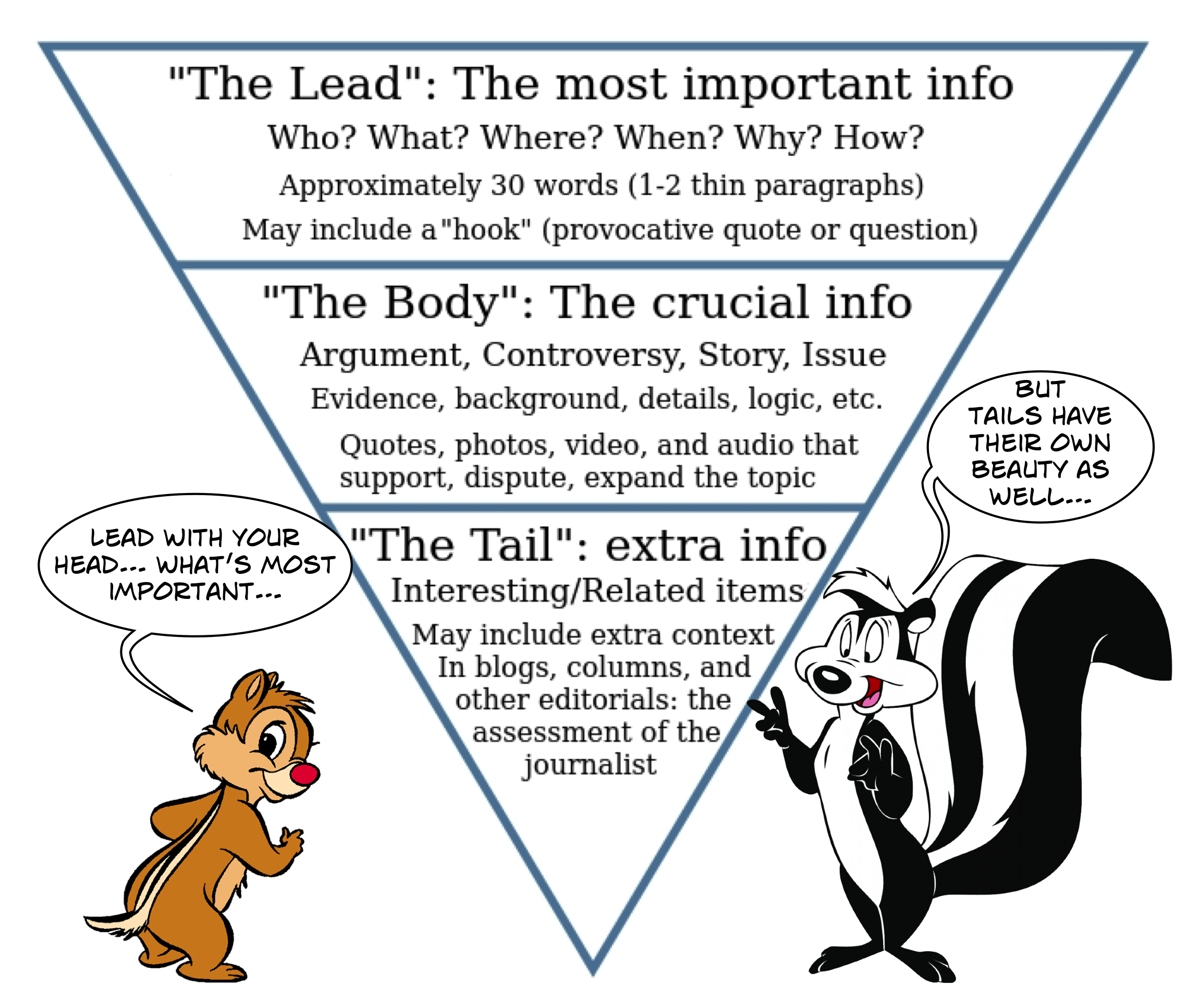
Similar to the military approach, we have the civilian version, which remains common in traditional journalism. (Even though printed newspapers continue to vanish, this approach is still found in many digital outlets.) This technique is referred to as the Inverted Pyramid Structure. Here is one concise definition:

The inverted pyramid is the model for news writing. It simply means that the heaviest or most important information should be at the top – the beginning – of your story, and the least important information should go at the bottom. And as you move from top to bottom, the information presented should gradually become less important.

The benefit of this strategy is that readers immediately learn the primary “news.” Only when they desire to supplement that information do they need to continue reading. Presumably the material follows in descending significance until they either finish the piece or it descends into minutiae of no interest to that particular reader.

The previously linked article notes one extremely important aspect of the inverted pyramid [emphasis added].

The inverted pyramid format turns traditional storytelling on its head. In a short story or novel, the most important moment – the climax – typically comes about two-thirds of the way through, closer to the end. But in news writing, the most important moment is right at the start of the lede.

And it is this traditional sort of storytelling to which we most often turn when we read for pleasure rather than as an obligation.

Reading for Enjoyment

Pleasurable reading is not, by definition, expeditious. It takes its time to tell a story, rather than rushing into a rapid information dump. In fact, when the narrative is savaged by unloading too much background or too many facts, it becomes hard to enjoy even when we want to like it.

Literature, even brief poetry, takes us on a journey. We go somewhere. We are transformed, albeit usually in an unmeasurable way. While the change may be small, it is quite distinct from the difference made by simply learning new facts.

While the journey itself may appear straightforward, in most cases there are often subtle alterations in its course. You might say a story intentionally tends to meander, which is why I titled this post as I have. Meander itself is a curious word.

Like so many words, meander has a literal and a figurative application. In a moment we will see each of these meanings entertainingly illustrated in C.S. Lewis’ correspondence.

I began thinking about this intriguing word when I recently read about its source. It begins with an ancient kingdom in Asia Minor (modern day Türkiye). Lydia was independent for half a millennia before its king, Croesus, was defeated by Cyrus of Persia. One of Lydia’s lasting contributions to civilization came in the form of the minting of coinage.

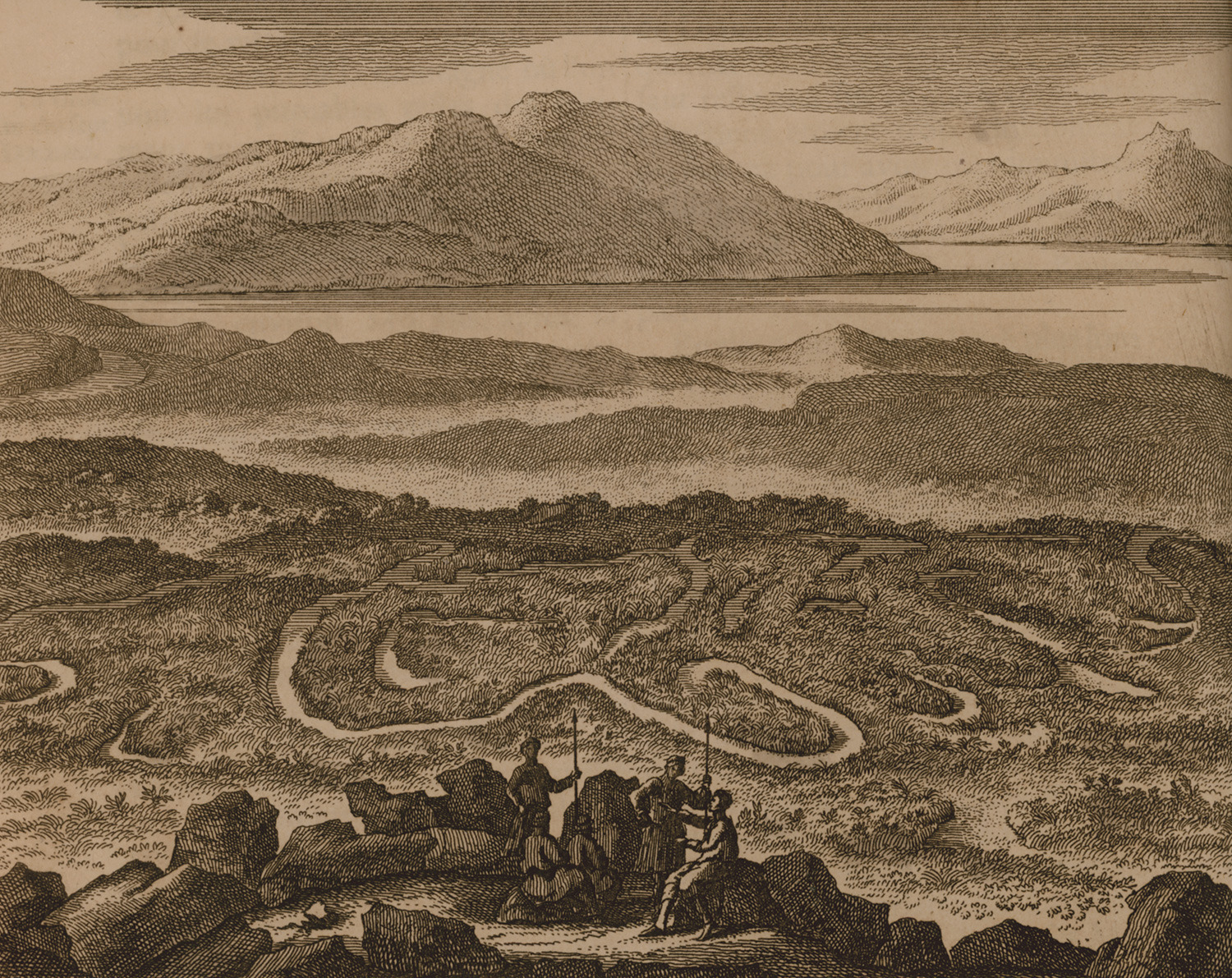
Herodotus tells us they were the first to do so. This is, of course, a captivating story in its own right.One of the images used on one of their early coins was of the Maeander River, which meandered through their kingdom. The picture above, View of Maeander Valley, was published by Flemish artist Cornelis de Bruyn in 1714.

Did C.S. Lewis Meander?

Searching through Lewis’ writings, I did not find any examples of his use of this winding word. (Let me know if you’re aware of one.)

However, here are two enjoyable examples of his informal use of “meander” in his correspondence. The first, in a 1920 letter to his father, uses the word in its figurative sense.

I have two tutors now that I am doing ‘Greats,’ one for history and one for philosophy. . . . We go to the philosophy one in pairs: then one of us reads an essay and all three discuss it. . . . it is very amusing.

Luckily I find that my previous dabbling in the subject stands me in good stead and for some time I shall have only to go over more carefully ground through which I have already meandered on my own.

In the second occurrence, we find C.S. Lewis writing to his Brother Warnie in 1932. He describes, at some humorous length, the condition of the pond on their property. You can visit this same setting today in the C.S. Lewis Nature Reserve.

I have included the full discussion below. Suburbanites (and even more so, city-dwellers) may not be able to appreciate this story the way that people who have lived in the country can. Still, those with a minute to read the entire passage will likely enjoy the way Lewis meanders through his description of events. Oh, and lest you suffer unnecessary shock, be forewarned that Lewis uses the word “bathe” here not to refer to a “bath,” but to a plunge in the pond.

You will gather from this that summer has arrived: in fact last Sunday (it is Tuesday to day) I had my first bathe. You will be displeased to hear that in spite of my constant warnings the draining of the swamp has not been carried out without a fall in the level of the pond.

I repeatedly told both [the workmen] that the depth of water in the pond was sacrosanct: that nothing which might have even the remotest tendency to interfere with that must be attempted: that I would rather have the swamp as swampy as ever than lose an inch of pond.

But of course I might have known that it is quite vain ever to get anything you want carried out: and the pond is lower. However, don’t be too alarmed. I don’t think it can get any lower than it is now.

I don’t know how much of the draining operations Minto [Janie Moore] has described to you nor whether you understood them. In fact, remembering what a mechanical process described by Minto is like I may assume that the more she has said the less you know about it.

The scheme was a series of deep holes filled with rubble and covered over with earth. Into each of these a number of trenches drain: and from each of these pipes lead into the main pipe now occupying the old ditch between the garden and the swamp, which in its turn, by pipes under the lawn, drains into the ditch beside the avenue.

It was however useless to do all this as long as the overflow outlet from the pond (you know – the tiny runnel with the tiny bridge over near the Philips end of the pond) was meandering – as it did – over all the lower parts of the swampy bit. Nor was it possible to stop this up and deny the pond any outlet, as it would then have been stagnant and stinking in summer, and overflowing in winter.

It was therefore decided to substitute a pipe outlet for the mere channel outlet – which pipe could carry the overflow from the pond, through the swampy bit without wetting it, to the rest of the drainage system. When they first laid this pipe I said that its mouth (i.e. at the pond end) was too low and that it would therefore carry off more water than the old channel and so lower the pond.

The workmen shortly denied this but I stuck to my point and actually made them raise it. Even after they had raised it I was still not sure that it wasn’t taking off more water than the old channel did: so I have now had a stopper made which is in the mouth of the pipe at this moment. I have also given the spring-tap up beyond the small pond a night turned on, and I trust that by thus controlling in-flow and outflow of water I can soon nurse the pond back to its old level.

At any rate I don’t see how it can sink as long as its escape is bunged up. As to the degree of loss at present, as there are no perpendicular banks anywhere it is hard to gauge. I should think that the most pessimistic episode could hardly be more than ¾ of a foot: i.e. a difference one is unconscious of in bathing. Still I grudge every inch.

By the way, it has just occurred to me that the sinking may not be due to the draining at all: for the old ‘channel’ escape, when I looked at it just before the operations began, had certainly widened itself extremely from what I first remembered, and must have been letting out more than it ought. In that case the new pipe may have arrested rather than created a wastage.

One criticism some short-attention-span readers levy against Tolkien’s masterpiece, Lord of the Rings, is that too much time is spent traveling. Such critics overlook the reasons the author presented his saga in the manner he did. Well, for those desiring to simply jump from battle to battle, we now have graphic novels. All of the journeying in LOR has a purpose; it is far from mere “meandering.”

Tolkien detailed the travails of the Fellowship during their quest, and his maps allow students of the mythos to discern “Frodo and Sam traveled over a thousand miles from the Shire to Mount Doom in the Lord of the Rings trilogy, over multiple landscapes and terrains.” One of the colorful words created by Tolkien, that rolls off the tongue like a babbling brook, is the name of a river that crosses the Old Forest: Withywindle. (A withy is an Old English word for a willow, or slender twigs or branches.) Its course may not have been especially winding, but it definitely sounds like it should have been.

No one can deny the influence of J.R.R. Tolkien on fantasy literature. But the aforementioned shortening attention spans do deter some readers. Make no mistake about it, however, the traveling in the writings of the Inklings is not without purpose. Nor does it disrupt the story. Still, the less skilled among us should be cautious about mimicking their techniques. One author describes this hazard in the following way.

Ultimately, when you write, your goal should be to make sure that everything you write doesn’t meander, or in other words, moves in some way towards the conclusion of your story. Be that taking care of a subplot, a character arc . . . whatever, it needs to hit a step, or move towards it, on the path to the ultimate ending of your story.

Remember both pacing and the up and down of rising and falling tension. A meandering story stretches out a low point and breaks the pacing. You always want to keep your plot on a straight line to the ending. The characters, they can wander, as long as the plot doesn’t.

Thanks for meandering with Mere Inkling today. Isn’t it wonderful that God allows us these carefree moments, and life isn’t all about “getting things done?”