C.S. Lewis & the Police

policePolice are entrusted with the power and authority to protect the innocent. That very power provides them with the opportunity to abuse that trust.

Recent events in the United States have drawn to the world’s attention the fact that human beings are incapable of providing perfect law enforcement. That should come as no surprise since, due to our fallen nature, we can do nothing perfectly.

C.S. Lewis never wrote a treatise specifically about law enforcement, but he did refer to it on a number of occasions. This week I thought it might be beneficial to consider a number of his insights. The final quotation relates a specific experience Lewis had with responsive police and a rather unresponsive judiciary.

Lewis had an impressive knack for using familiar images to illustrate biblical principles. In the following example he uses police, an occupation recognized by all, to display the absurdity of the logic of skeptics of Christianity.

If the universe is teeming with life, this, we are told, reduces to absurdity the Christian claim—or what is thought to be the Christian claim—that man is unique, and the Christian doctrine that to this one planet God came down and was incarnate for us men and our salvation.

If, on the other hand, the earth is really unique, then that proves that life is only an accidental by-productd in the universe, and so again disproves our religion. Really, we are hard to please. We treat God as the police treat a man when he is arrested; whatever He does will be used in evidence against Him. (“Dogma and the Universe”)

Let us now consider a few of the principles easily gleaned from Lewis’ writings.

Law Enforcement is a Normal Occupation

In that sense, police are no different than any other member of the community. C.S. Lewis illustrates that truth by including them in a list of “regular” occupations.

Dr. Pittenger would be a more helpful critic if he advised a cure as well as asserting many diseases. How does he himself do such work? What methods, and with what success, does he employ when he is trying to convert the great mass of storekeepers, lawyers, realtors, morticians, policemen and artisans who surround him in his own city? (“Rejoinder to Dr. Pittenger”)

Law Possesses a Vital Function

The State exists simply to promote and to protect the ordinary happiness of human beings in this life. A husband and wife chatting over a fire, a couple of friends having a game of darts in a pub, a man reading a book in his own room or digging in his own garden—that is what the State is there for. And unless they are helping to increase and prolong and protect such moments, all the laws, parliaments, armies, courts, police, economics, etc., are simply a waste of time. (Mere Christianity)

In his essay “Vivisection,” Lewis mentions in passing the role of law enforcement in society. We have assigned to them the responsibility of investigating suspicious behavior to determine whether it conforms to the law of the land. And they do so according to whatever guidelines or restrictions the government (presumably of by and for the people) levies upon them.

In justifying cruelty to animals we put ourselves also on the animal level. We choose the jungle and must abide by our choice. You will notice I have spent no time in discussing what actually goes on in the laboratories. We shall be told, of course, that there is surprisingly little cruelty. That is a question with which, at present, I have nothing to do. We must first decide what should be allowed: after that it is for the police to discover what is already being done.

In Democracies Police are Generally Trustworthy

Lewis acknowledges that there are places where the police are frequently corrupt and perhaps even brutal. But he reminds us that we who live in democratic nations should be grateful for the normal behavior of those who serve in law enforcement.

The decline of ‘religion’ is no doubt a bad thing for the ‘World.’ By it all the things that made England a fairly happy country are, I suppose, endangered: the comparative purity of her public life, the comparative humanity of her police, and the possibility of some mutual respect and kindness between political opponents.

But I am not clear that it makes conversions to Christianity rarer or more difficult: rather the reverse. It makes the choice more unescapable. When the Round Table is broken every man must follow either Galahad or Mordred: middle things are gone. (“The Decline of Religion”)

Is it inappropriate to note how prophetic Lewis’ observation was that the secularization of Western culture would also erode political civility?

“Police States,” by Contrast, are Evil

In his preface to The Screwtape Letters, Lewis divulges where he found some of his images for his infernal milieu.

I live in the Managerial Age, in a world of “Admin.” The greatest evil is not now done in those sordid “dens of crime” that Dickens loved to paint. It is not done even in concentration camps and labour camps. In those we see its final result. But it is conceived and ordered (moved, seconded, carried, and minuted) in clean, carpeted, warmed and well-lighted offices, by quiet men with white collars and cut fingernails and smooth-shaven cheeks who do not need to raise their voices. Hence, naturally enough, my symbol for Hell is something like the bureaucracy of a police state or the office of a thoroughly nasty business concern.

C.S. Lewis’ father was an attorney. But not just any sort of solicitor. He was a Police Court Solicitor, an important role which had as one of its purposes allowing a person who was arrested on suspicion of a criminal offense to consult with a lawyer while in initial police custody.

Lewis describes in his autobiography how his father regaled him and his brother Warnie with stories about curious police-court happenings. At the same time, Lewis confesses to his father’s struggle to relate to his boys after the loss of his wife when they were still young. Confessing that he frequently found his father’s conversations with his young sons confusing, he writes:

The man who, in his armchair, sometimes appeared not so much incapable of understanding anything as determined to misunderstand everything, was formidable in the police court and, I presume, efficient in his office. He was a humorist, even on occasion, a wit. (Surprised by Joy)

Corrupt Governments Corrupt the Police Force

One of the characteristics of police states is that they have extensive networks of “secret police,” who are often imbued with extraordinary prerogatives. One such malevolent presence plays just such a role in The Lion, the Witch, and the Wardrobe. Searching for Mr. Tumnus, the Pevensie children are discovered by Mr. Beaver. When they inquire of Lucy’s friend, the faun, he says:

“Ah, that’s bad,” said Mr. Beaver, shaking his head. “That’s a very, very bad business. There’s no doubt he was taken off by the police. I got that from a bird who saw it done.”

That explains the note the children had discovered at Mr. Tumnus’ ransacked home.

The former occupant of these premises, the Faun Tumnus, is under arrest and awaiting his trial on a charge of High Treason against her Imperial Majesty Jadis, Queen of Narnia, Chatelaine of Cair Paravel, Empress of the Lone Islands, etc., also of comforting her said Majesty’s enemies, harboring spies and fraternizing with Humans.

signed MAUGRIM, Captain of the Secret Police

LONG LIVE THE QUEEN!

One more passage reveals how quickly the deceitful captain can vacillate between threatening and gracious poses. Edmund has arrived at the Witch’s castle is been confronted by Maugrim.

“If you please, sir,” said Edmund, trembling so that he could hardly speak, “my name is Edmund, and I’m the Son of Adam that Her Majesty met in the wood the other day, and I’ve come to bring her the news that my brother and sisters are now in Narnia—quite close, in the Beavers’ house. She—she wanted to see them.”

“I will tell Her Majesty,” said the Wolf. “Meanwhile, stand still on the threshold, as you value your life.”

Then it vanished into the house. Edmund stood and waited, his fingers aching with cold and his heart pounding in his chest, and presently the gray wolf, Maugrim, the Chief of the Witch’s Secret Police, came bounding back and said, “Come in! Come in! Fortunate favorite of the Queen—or else not so fortunate.”

The Police Can Solve Problems

Yes, the example below comes from his novel The Silver Chair, but it is too good to overlook. Lewis is skilled at teaching through his fiction as well as in his essays.

This excerpt come from one of the Chronicles of Narnia, and Aslan has just returned Jill and Eustace to England, where there was a “corrective” encounter with some school bullies. The headmistress calls the police, and we join the scene . . .

When the police arrived and found no lion, no broken wall, and no convicts, and the Head behaving like a lunatic, there was an inquiry into the whole thing. And in the inquiry all sorts of things about Experiment House came out, and about ten people got expelled.

After that, the Head’s friends saw that the Head was no use as a Head, so they got her made an Inspector to interfere with other Heads. And when they found she wasn’t much good even at that, they got her into Parliament where she lived happily ever after.

Police are Not Soldiers

In the following passage, Lewis shows an astute awareness of the actual role of the Roman soldier in the Jerusalem of Jesus’ day. They were certainly an occupation force, but their role in garrison was not to be “soldiers,” but rather to be “peacekeepers.” They were to maintain law and order, the so-called Pax Romana.

And because the whole difficulty for us is that the natural life has to be, in a sense, ‘killed,’ [Jesus] chose an earthly career which involved the killing of His human desires at every turn—poverty, misunderstanding from His own family, betrayal by one of His intimate friends, being jeered at and manhandled by the Police, and execution by torture. (Mere Christianity)

Lewis does the same thing in his essay “Modern Translations of the Bible,” where he compares the common* nature of the Greek used to write the Scriptures with the Incarnation.

The New Testament in the original Greek is not a work of literary art: it is not written in a solemn, ecclesiastical language . . . It is a sort of `basic’ Greek; a language without roots in the soil, a utilitarian, commercial and administrative language. Does this shock us? It ought not to, except as the Incarnation itself ought to shock us.

The same divine humility which decreed that God should become a baby at a peasant-woman’s breast, and later an arrested field-preacher in the hands of the Roman police, decreed also that He should be preached in a vulgar, prosaic and unliterary literary language. If you can stomach the one, you can stomach the other.

C.S. Lewis’ Experience with the (In)Justice System

In 1957, Lewis wrote an essay** about a personal experience with the British judicial system. I choose to close with this selection because it is quintessential Lewis. He uses a fine critique of the treatment of criminals to also acknowledge his personal sinfulness. In this true story, the police do their job admirably. The judge . . . not so much.

Not long ago some of my young neighbours broke into a little pavilion or bungalow which stands in my garden and stole several objects—curious weapons and an optical instrument. This time the police discovered who they were. As more than one of them had been convicted of similar crimes before, we had high hopes that some adequately deterrent sentence would be given.

But I was warned: “It’ll all be no good if the old woman’s on the bench.” I had, of course, to attend the juvenile court and all fell out pat as the warning had said. The—let us call her—Elderly Lady presided. It was abundantly proved that the crime had been planned and that it was done for gain: some of the swag had already been sold.

The Elderly Lady inflicted a small fine. That is, she punished not the culprits but their parents. But what alarmed me more was her concluding speech to the prisoners. She told them that they must, they really must, give up these “stupid pranks.”

Of course I must not accuse the Elderly Lady of injustice. Justice has been so variously defined. If it means, as [Athenian sophist] Thrasymachus thought, “the interest of the stronger,” she was very just; for she enforced her own will and that of the criminals and they together are incomparably stronger than I.

But if her intention was—and I do not doubt that the road on which such justice is leading us all is paved with good ones—to prevent these boys from growing up into confirmed criminals, I question whether her method was well judged. If they listened to her (we may hope they did not) what they carried away was the conviction that planned robbery for gain would be classified as a “prank”—a childishness which they might be expected to grow out of.

A better way of leading them on, without any sense of frontiers crossed, from mere inconsiderate romping and plundering orchards to burglary, arson, rape and murder, would seem hard to imagine.

This little incident seems to me characteristic of our age. Criminal law increasingly protects the criminal and ceases to protect his victim. One might fear that we were moving towards a Dictatorship of the Criminals or (what is perhaps the same thing) mere anarchy. But that is not my fear; my fear is almost the opposite.

According to the classical political theory of this country we surrendered our right of self-protection to the State on condition that the State would protect us. Roughly, you promised not to stab your daughter’s murderer on the understanding that the State would catch him and hang him.

Of course this was never true as a historical account of the genesis of the State. The power of the group over the individual is by nature unlimited and the individual submits because he has to. The State, under favourable conditions (they have ceased), by defining that power, limits it and gives the individual a little freedom.

And so we see that Lewis shared a concern that has only become accentuated among many today. When the State abuses its prodigious power, and especially when it revises the role of those in law enforcement, transforming them into “enforcers,” we are in dire straits.

Thankfully, that has not yet transpired in most democratic lands. Still, the possibility of such decay has not been eliminated, and wisdom suggests that we remain vigilant should we see things sliding in that direction.

_____

* On the subject of the commonness of the language God uses to speak to us, you may wish to read my column on “Vulgar Christianity.”

** “Delinquents in the Snow” is included in the readily available collection, God in the Dock.

Is Fantasy Foolish?

lion of lyonSome of the smartest people around dismiss reading fantasy as a crazy waste of time. At the same time, many of the most brilliant people I know love nothing more than passing from their mundane lives through a magical wardrobe into a land of wonder.

On a recent episode of the television series Castle, the eponymous Richard Castle,* a best-selling author and private eye, has a great line. Castle is defending his hyperactive imagination (which frequently leads to the solving of the crime of the week).

A suspect calls him “reality-challenged.”

To which he responds, “I prefer fantasy-augmented.”

Now, there’s a description that would fit most readers of Mere Inkling. We’re “fantasy-augmented.”

It would also fit most of the Oxford Inklings. Not all of them, of course. Some of them, like C.S. Lewis’ brother Warnie, were more oriented towards factual, historical literature.

The fantasists among their ranks were not lacking as writers of nonfiction either.

However, it was the fact that they were “fantasy-augmented” that has led to the inclusion of several of their members in the first ranks of twentieth century writers.

Narnia and Middle Earth are as real to many people today as Ogre, Latvia, Humpty Do, Australia, Llanfairpwllgwyngyllgogerychwyrndrobwllllantysiliogogogoch, Wales, and Frankenstein, Missouri. (Perhaps more real!)

In 1936, C.S. Lewis wrote a letter to Charles Williams, praising his recent novel.**

A book sometimes crosses ones path which is so like the sound of ones native language in a strange country that it feels almost uncivil not to wave some kind of flag in answer.

I have just read your Place of the Lion and it is to me one of the major literary events of my life–comparable to my first discovery of George Macdonald, G. K. Chesterton, or Wm. Morris.

The following day, Williams wrote a letter of his own to C.S. Lewis. It began:

My dear Mr Lewis, If you had delayed writing another 24 hours our letters would have crossed. It has never before happened to me to be admiring an author of a book while he at the same time was admiring me. My admiration for the staff work of the Omnipotence rises every day. To be exact, I finished on Saturday looking—too hastily—at proofs of your Allegorical Love Poem.

William’s reference to coincidence is poetic. He doesn’t rely on the timeworn “divine Providence,” which is so prevalent in literature of the eighteenth and nineteenth centuries.

Returning to Lewis’ missive, we learn exactly how Williams’ fantasy so deeply impressed him.

A book sometimes crosses ones path which is so like the sound of ones native language in a strange country that it feels almost uncivil not to wave some kind of flag in answer. I have just read your Place of the Lion and it is to me one of the major literary events of my life—comparable to my first discovery of George Macdonald, G.K. Chesterton, or Wm. Morris.

There are layers and layers—first the pleasure that any good fantasy gives me: then, what is rarely (tho’ not so very rarely) combined with this, the pleasure of a real philosophical and theological stimulus: thirdly, characters: fourthly, what I neither expected nor desired, substantial edification.

It’s unlikely that any of us should ever author a work that would equally impress C.S. Lewis. Still, what a grand goal for any fantasy-augmented writer to strive for!

_____

* Castle is played by Nathan Fillion, who captained the spacecraft “Serenity,” in a delightful series entitled Firefly.

** You can download The Place of the Lion in a variety of formats at ManyBooks.

The illustration above is used with the permission of its creator, Charis Tsevis.


Not Wholly Contemptible

cornwallisEveryone loves a compliment. Allow me to rephrase that. Most people appreciate a sincere compliment when it is genuinely flattering.

Actually, “flattering” isn’t a good word choice here. Flattery has a bad rep. The way it’s currently used, it hints of exaggeration and manipulation.

So let’s return to the concept of “compliments” in general. Most, we know, are welcome. It’s nice to have someone tell us we did a commendable job or had a good idea.

Then there are those less sincere “compliments” that require a bit of intelligence or wit to offer. The go by different names, but are commonly referred to as “left-handed compliments” or “backhanded compliments.”

This type of statement might sound on its surface like a compliment, but includes an element that undermines the praise. The Urban Dictionary offers the following example:

“Boy, you’re pretty hot . . . for a fat (or skinny) chick!”

Now, that is nothing but an insult. And it’s an insult of the crassest variety. One that demands no wit at all.

The British, on the other hand, are often capable of offering highly refined backhanded compliments.

I just came across a delightful one, delivered by the commander of the King’s forces during America’s War of Independence. What makes this exquisite is that it was offered in the wake of the general’s defeat at the close of the war.

When finally brought to heel at Yorktown, Lord Cornwallis reported, “I will not say much in praise of the Militia of the Southern Colonies, but the list of British officers and Soldiers killed or wounded by them since last June, proves but too fatally that they are not wholly contemptible.”

You can read more about the context for that statement in an excellent article about the American legacy of “citizen soldiers” published in Hallowed Ground magazine. This excellent journal is published by the Civil War Trust, which works diligently to preserve battlefields from the Civil War. They have recently expanded those efforts to include the Revolutionary War.

C.S. Lewis & Compliments

Lewis included backhanded compliments in his fictional works. Two simple examples follow. The first is found in The Screwtape Letters, where the tempter frequently commends the skill of God (“the Enemy”) in redeeming the lost.

Never forget that when we are dealing with any pleasure in its healthy and normal and satisfying form, we are, in a sense, on the Enemy’s ground. I know we have won many a soul through pleasure. All the same, it is His invention, not ours.

Here is an offhanded compliment that Lewis places on the lips of Prince Corin in The Chronicles of Narnia. He is asked where Queen Susan is, on the eve of a battle and he responds like a typical young boy (which he still is at the time). He praises the martial spirit of her sister, Queen Lucy, who is a young adult at this point in the series.

At Cair Paravel. She’s not like Lucy [her sister who is in the ranks of the archers], you know, who’s as good as a man, or at any rate as good as a boy. Queen Susan is more like an ordinary grown-up lady. She doesn’t ride to wars, though she is an excellent archer. (The Horse and His Boy).

The late Bruce Edwards described how C.S. Lewis offered H.G. Wells a backhanded compliment. He did so by following the structure of Wells’ works, but devoting them to a vastly different philosophical purpose.

In Out of the Silent Planet (1938), Lewis adapted the general plot outline from H.G. Wells’s First Men in the Moon in order to tell an essentially anti-Wellsian tale. In Perelandra, Lewis pays a similar backhanded compliment to the man he admired as a speculative writer, but not as a philosopher.

The broad narrative structure of Perelandra resembles another novel by H.G. Wells, The Time Machine (1895). . . . In Wells’s novel, this narrative outline provides the basis of a quasi-Marxist fable about effete bourgeoisie and surly proletariat. In Lewis’s hands, a similar story structure tells a very different tale, one in which the ultimate battles are not economic and political, but rather cosmic and spiritual. (C.S. Lewis: Fantasist, Mythmaker, and Poet).

Compliments: the Good & the Bad

Lewis’ use of Wells’ science fiction template was not meant to slight him. It was actually a tribute. Likewise, in the examples from his fiction, Lewis is simply representing (effectively) the attitudes of the speakers.

Returning for a moment to the abject General Cornwall, we recognize as well the grudging nature of his praise of the enemy. They were certainly rabble—possessing no great military skill, in his estimation. Yet, in terms of bringing the army of the greatest power in the world at that time to its surrender, “they are not wholly contemptible.”

And that, when it came to winning the war, apparently proved quite sufficient.

Africa Comes to America

saharaYes, you read the title correctly; it’s no typo. Africa itself arrived in America this summer—and it’s an event that apparently takes place every year!

In a recent post by one of Mere Inkling’s earliest subscribers, I learned about the annual Saharan Air Layer. It is an enormous dust cloud that transits the entire Atlantic Ocean and is vital to the western hemisphere, especially the Amazonian rain forests. More about the SAL below.

I find this phenomenon fascinating. It reveals how intricately balanced and interconnected God has created this amazing ecosystem we call earth.

I appreciate this fact, even though I don’t consider myself an environmentalist. That doesn’t mean, of course, that I don’t recycle. What’s more, I would actually like to see brazen polluters incarcerated and tasked with personally cleaning toxic waste dumps . . . but that’s not the theme of this reflection.

It seems to me that part of being truly human, is possessing an appreciation—or even a love—for the world in which our Creator has allowed us to dwell. By love, I mean a deep affection for the flora and fauna, and even the mountains and valleys themselves.

I am not proposing idolatry.

I am in good company in valuing nature. C.S. Lewis found time spent walking in the countryside to be invigorating. It was renewing, for body, mind and soul.

Several years back a book was published with the peculiar subtitle, The Environmental Vision of C.S. Lewis.

The authors of Narnia and the Fields of Arbol explores the way Lewis displays his “ecological” concerns, particularly in his fiction. They also consider J.R.R. Tolkien’s similar attitude.

It is no coincidence that these two men, as soldiers during the Great War, had seen the worst violence humanity could do to nature. The ravages wrought by the orcs surrounding Isengard were echoes of the lifeless terrain of shell-shattered Western Front.

Writing this now, I recall a poem I wrote for Curtana: Sword of Mercy.

“A Foreshadowing of Epics” begins:

Filthy trenches greeted the novice soldiers’ eyes,

their two imaginations envisioned greener lands.

Crimson combat splashed red their vision,

and colored portraits one day painted with their words.

The frontlines were barren,

scarred earth stripped of all life.

Fallen trees mimicked casualties,

not even the smallest of creatures escaped death.

It may seem ironic to some that those very fields now are green, and teeming with life. It is the mercy of God that restores the scarred and heals the broken. And, as impressive as those miracles are evident in nature, they are far more wondrous when it is human lives that are transformed and resurrected.

So it is that I find the wonder of the barren and seemingly lifeless Saharan dust bringing nutrients to hungry forests on the other side of the earth amazing. No mere accident that.

If Jesus delays his return and this globe continues to spin for more centuries still, I would not be surprised to see the Americas returning to Africa a similar gift of life.

_____

Weather.com has a short video about the Saharan Air Layer here.

Crying for Attention

abcxyzAre you driven by the unquenchable thirst to be the center of everyone’s attention. Or, would you be more content to live out your life appreciated by a small cadre of friends?

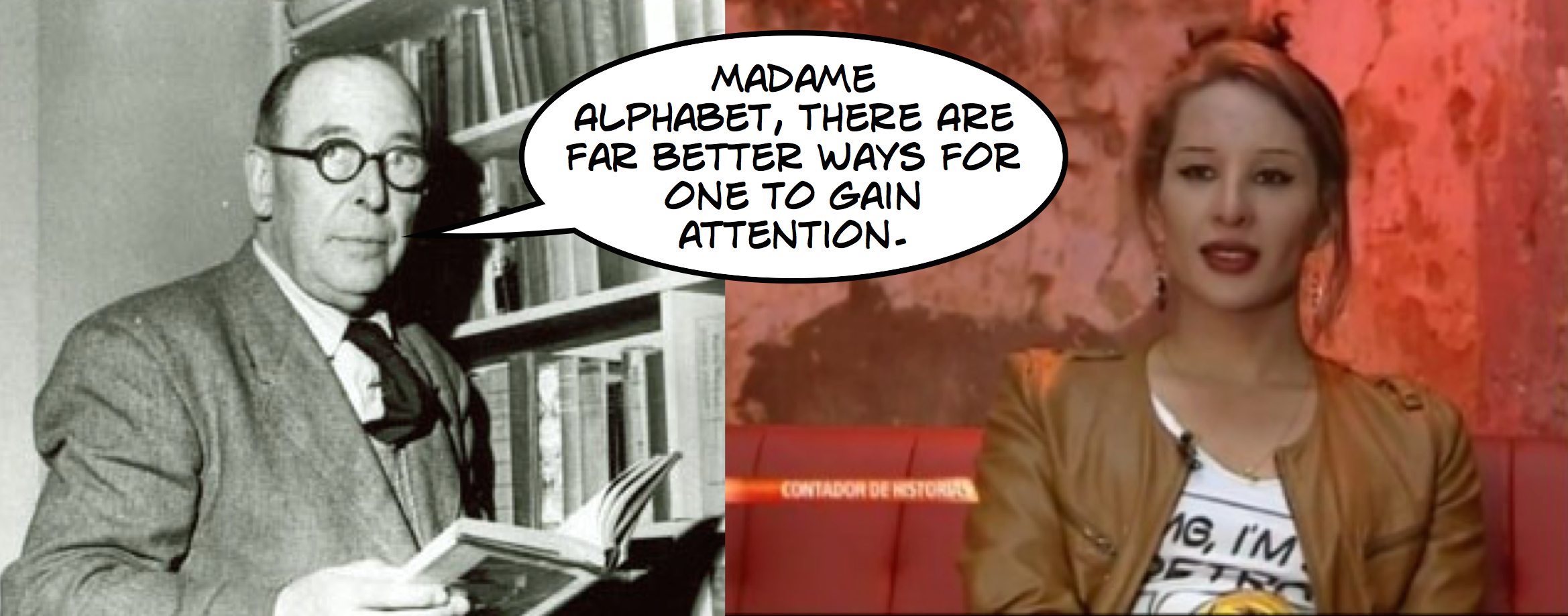
A woman in South America recently displayed an extreme case of the former impulse. She had grown tired of her name because it was too mundane. Apparently she garnered insufficient attention as Ladyzunga Cyborg.

So now her name, legally changed, is ABCDEFGHIJKLMNOPQRSTUVWXYZ.

My first thought when reading this was not that I didn’t believe it. In our foolish world, where people use symbols that aren’t even words for their names, I just shook my head. And . . . I thought “how fortunate for her that she’s not Chinese,” with its 46,964 characters as recorded in the Kangxi Dictionary.

This is not the sort of publicity Columbia needs. She’s acting bizarrely enough to be a mistaken for a Californian.

Of course, people at the opposite extreme—those who cannot bear the presence of other human beings—are also troubled. As with so many aspects of the human personality, people at either of the extreme poles are frequently deemed mentally ill.

This fetish for exhibitionism is alien to me. I would much prefer downing a pint with friends at the Eagle and Child to standing on some stage in front of “adoring crowds.”

My “introvert” quotient appears to be eclipsing my “extravert” qualities.

C.S. Lewis never sought the limelight either. He did not find his experience with notoriety pleasant. And yet, he accepted its burden graciously.

It is commonly known that some days he would spends hours (literally) corresponding with some of the thousands of readers who wrote to him as the creator of Narnia.

It was exhausting.

I assume people like Ms. Abcdefghijklmnopqrstuvwxyz seek attention because they feel insignificant or unnoticed.

I find that tragic. Tragic because their name, their true name, is known by the most important and amazing person in the universe. The God who created them.

Each and every person, including you, is unique, precious and loved.

Knowing this provides profound peace. It also delivers us from the constant compulsion to seek attention.

Jesus described the profound value of each person by contrasting God’s love for us with the attention he devotes even to a single sparrow . . . “Not one of them will fall to the ground outside your Father’s care.”

And you, that’s you, are far more precious than these.

Volcano Hurricane

volcanoVolcano hurricane. An epic disaster film! No sharks, but copious amounts of lava flung by gale force winds across the globe. And all from the mind of a six year old boy.

Imaginations are great. They are one of the most precious gifts of God (which makes it all the more tragic when the human imagination is diverted towards carnal ends).

The minds of young boys, thankfully, have yet to turn to such lamentable matters. Their innocence shields them from the worst of human corruption. They, instead, are consumed with thoughts of spiders and other things that creep out girls . . . and especially their moms.

Our almost-seven-year-old grandson was here for the weekend with his family. We had a wonderful time. We had actually found the ideal book to include as part of his birthday celebration: How to Convince Your Parents You Can Care for a Pet Tarantula. Perfect.

Young male imaginations seem to revolve around things that shock—and also things that gross others out.

Our kids have trained their own children well. For example, they always excuse themselves when they experience flatulence. It’s a natural experience, of course, and as we mature, adults learn to ignore potentially embarrassing moments related to it. That’s part of becoming “civilized.”

Six year olds . . . not so much. Our grandson properly excuses himself, but he typically does so in the midst of enthusiastic laughter. It’s as though he relishes just how uncultured the moment seems.

During this particular visit, he leaped into my lap in a semi-ninja attack. As we wrestled, there was a minor explosion. Not quite volcanic, but close enough. He apologized, amidst great hilarity. “Sorry about my little gas,” he added.

And here’s where I made the mistake. I reinforced his innate boyhood grossness by saying, “little! . . . that sounded like it was a buffalo!”

Not quite the right thing to say, since it simply encouraged the precocious guy. But what I can say . . . time may change a boy into a man, but in most of us . . . somewhere deep in the recesses of our psyches . . . that boyhood irreverence lingers.

Not that I enjoy the crass “body humor” that pervades so much comedy (on tv and film). I steadfastly avoid it. It insults my mind and viewing it constitutes a total waste of time. Still, with my grandson wrapped in my arms, laughing away, it all seemed so genuine and innocently funny.

Of course, I recognize one needed to be there—and probably to also be related by bloodline to the participants—to find any humor in the moment. But it certainly seemed funny to us.

C.S. Lewis and Children

I was thinking about that moment as I sat down to write this post. I intended to focus on the amazing imaginations of children, and my grandson’s current preoccupation with gigantic volcanoes.

But whim or muse redirected the column. In the end, it turns out to be a reflection on the simple pleasure that we adults experience when we interact with kids. Especially when they are children who are precious to us.

I wish that C.S. Lewis had been able to experience that joy. He wasn’t. His awkwardness with children is well known. Most attribute it to the early passing of his mother, and the emotional distance his father maintained from his sons.

In a 1935 letter he wrote to a close friend, “I theoretically hold that one ought to like children, but am shy with them in practice.”

In The Abolition of Man he was even more forthcoming, sharing that, “I myself do not enjoy the society of small children: . . . I recognize this as a defect in myself.”

So, Lewis recognized his discomfort with children as a shortcoming. It was something he wished could be dispelled. Unfortunately, we can’t simply wish (or pray) away our ingrained personality traits. We’re lucky if we can tame them or reshape them.

We work hard to strengthen our positive traits and the wise deny nourishment to their weaker qualities. People often use the analogy of wearing off one’s rough edges, and that’s an apt image.

Lewis’ reticence with children makes his creation of Narnia all the more wondrous. The Chronicles of Narnia have captivated the hearts and imaginations of innumerable children, and adults alike. Certainly Lewis was correct when he wrote the following in “On Stories.”

No book is really worth reading at the age of ten which is not equally (and often far more) worth reading at the age of fifty—except, of course, books of information. The only imaginative works we ought to grow out of are those which it would have been better not to have read at all.

With his marriage, late in life, Lewis became a step-father. He did the very best he could, but was conscious of just how ill-equipped he was to raise Douglas and David. Both became successful men. Doug shares his parents’ love of Christ, and helps direct the course of various Lewisian projects today.

Allow me to close with another evidence of the greatness of C.S. Lewis. He was able to rise far above his innate uneasiness with children. In fact, his fabled correspondence included many children who had written to him seeking his attention. In 1951 he wrote to one of them, saying:

I am glad you all liked The Lion. A number of mothers, and still more, schoolmistresses, have decided that it is likely to frighten children, so it is not selling very well. But the real children like it, and I am astonished how some very young ones seem to understand it. I think it frightens some adults, but v[ery] few children.

Lewis did not disappoint the many children who wrote to him during those terribly busy years. Nor do his writings disappoint us today. Unlike the transience of youthful volcano hurricanes, Lewis’ legacy will forever remain alive in the imaginations of child and adult alike.

Really Creative Writing

father christmasWhen did you first learn how to express yourself creatively? Some of us were blessed with parents who recognized the importance of things like music, art and literature. Others, alas, were not.

Most readers of Mere Inkling like to dabble in writing themselves. Many are quite skilled, and disciplined enough to persist with the demanding task of regularly composing interesting pieces for their own online columns. Some, in fact, are quite accomplished and successful in their personal literary efforts.

Becoming a good, truly good, writer requires experience. One may be born with the innate ability to become a Shakespeare or a Hemingway, but the skills need to be sharpened through effort. Study often helps, but it can never replace the necessity of practice in honing our writing.

It seems to me that the sooner we begin the process of unbridling our imaginations, translating our visions into words, and writing it all down in a way that engages the imaginings of others, the better we can become.

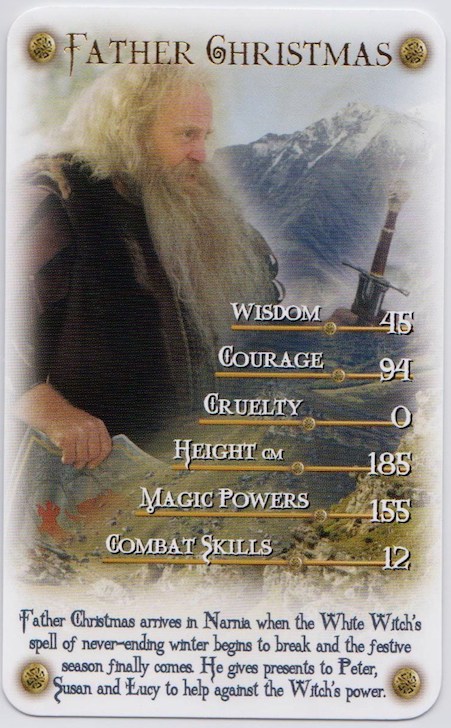
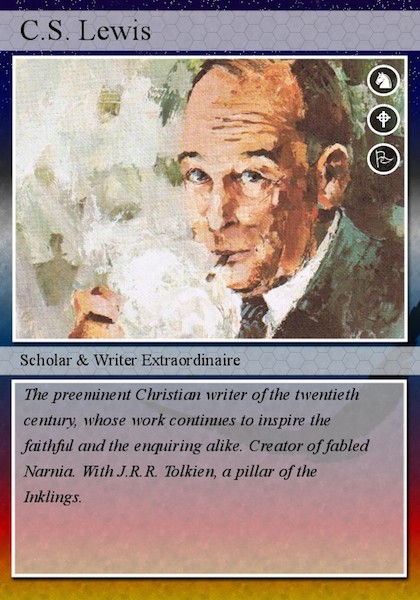
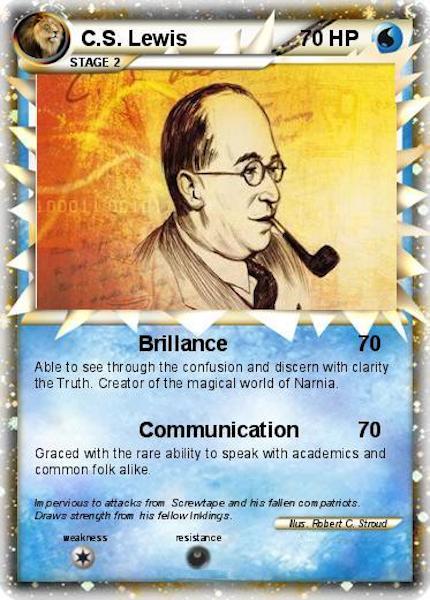
Many of you, especially Europeans, will be familiar with a gaming product that arose in the United Kingdom. They are called Top Trumps, and the cards come in a wide variety of themes. One set that I own is Narnia, from which the image at the top of this page comes.

Tolkien fans will be delighted to learn they just reissued a Lord of the Rings set that comes in an amazing Eye of Sauron tin. You can learn more about that unique item here.

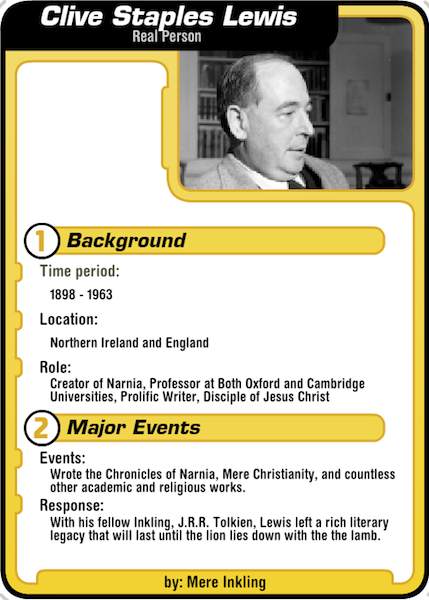
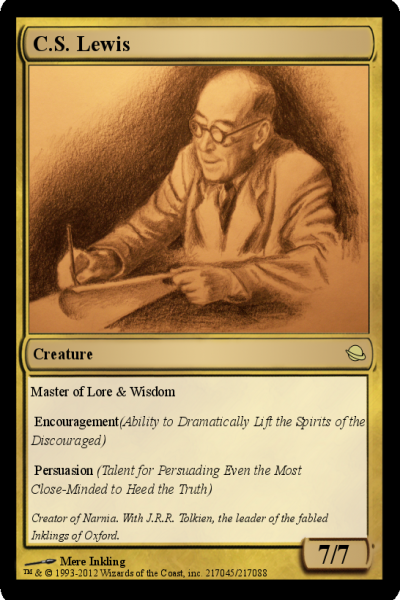
It was while thinking about my Narnia cards when I got the idea to see if there was an online mechanism for making one’s own playing cards. I was toying with the idea of fashioning a C.S. Lewis card to illustrate one of my posts.

I was actually searching online for a site where I could “create” such a card. I found several. Only later did I consider the irony of using that particular word.

For theologians, the word create bears profound significance. When it comes to the human activity of bringing together in some novel shape pre-existing images or ideas, it is not truly accurate. Lewis wrote about that in a 1943 letter to Sister Penelope.

‘Creation’ as applied to human authorship . . . seems to me an entirely misleading term. We . . . re-arrange elements He has provided. There is not a vestige of real creativity de novo in us. Try to imagine a new primary colour, a third sex, a fourth dimension, or even a monster which does not consist of bits of existing animals stuck together! Nothing happens.

And that surely is why our works (as you said) never mean to others quite what we intended: because we are re-combining elements made by Him and already containing His meanings. Because of those divine meanings in our materials it is impossible we should ever know the whole meaning of our own works, and the meaning we never intended may be the best and truest one.

Writing a book is much less like creation than it is like planting a garden or begetting a child: in all three cases we are only entering as one cause into a causal stream which works, so to speak, in its own way. I would not wish it to be otherwise.

Still, even though we are not true “creators,” it is enjoyable to rearrange the mundane elements (or words) of this life in fresh ways.

That’s one reason I was pleased to discover a website devoted to offering a “Trading Card Creator” hosted by the International Reading Association. It “gives students an alternative way to demonstrate their literacy knowledge and skill when writing about popular culture texts or real world examples.”
Why didn’t they have cool stuff like this when I was growing up? (If they did, I might be able to express myself better than by having to rely on phrases like “cool stuff.”)

Below you will find their website, along with a second option. I was thinking that my grandchildren might find it interesting to create a set of cards about our family tree. Their own sketches could be used for ancestors for whom we have no photograph. The comprehensive trading card creator maker offers a variety of templates, including for people, places, events and objects.

The template offered by the second site is generic enough that the cards can be produced in similar categories.

Unleash your imagination. And, after you’ve had some fun, consider sharing these links with a child you may know.

ReadWriteThink Trading Cards

Big Huge Labs Trading Cards

C.S. Lewis Card 3C.S. Lewis Card 2C.S. Lewis Card 1C.S. Lewis Card 4

Impromptu Poetry

eye

I had to endure a to and fro transcontinental trip this week. Endure is the right word, when flying miles above what would otherwise be a scenic, albeit lengthy, journey.

One positive thing about flying is that I have time to catch up on some of my “pleasure” reading. This week it included an article about cinquains.

A quintain is a poem with five verses. A cinquain is a specific form which has the following number of syllables in each of the lines: two, four, six, eight, and two.

I took a break from my reading and drafted a few of these small poems. I found it quite simple, and it’s likely you may as well.

I make no promises about the quality of my verse, but perhaps you’ll find one or more of them interesting. Or, at least they may inspire you to write some of your own.

Springtime
Narnian hope
Delayed by the White Witch
Borne by Aslan’s Resurrection
New dawn

Pilgrim
Traveling through
This world is not my home
Destined for a new creation
With Christ

True hope
He died for us
Emancipation now
Washed clean by the blood of the Lamb
New life

Inklings
Lewis, Tolkien
Friends rounded out the group
Imaginations unfettered
Wonder

Beware of Moths

mothI try not to hate moths. They’re obviously not so pretty as butterflies, but I remind myself that’s not their fault. They’re a nuisance around the porch lights on summer evenings, but that’s instinct, not choice.

I strive to see the best in moths, like C.S. Lewis, who was able to capitalize on their impulsiveness in his 1933 poem, “The Naked Seed.”

Oh, thou that art unwearying, that dost neither sleep

      Nor slumber, who didst take

All care for Lazarus in the careless tomb, oh keep

      Watch for me till I wake.

If thou think for me what I cannot think, if thou

      Desire for me what I

Cannot desire, my soul’s interior Form, though now

      Deep-buried, will not die,

—No more than the insensible dropp’d seed which grows

      Through winter ripe for birth

Because, while it forgets, the heaven remembering throws

      Sweet influence still on earth,

—Because the heaven, moved moth-like by thy beauty, goes

      Still turning round the earth.

I really want to give moths the benefit of the doubt . . . but that’s become virtually impossible since I learned some of them are vampiric!

Before we consider their blood-sucking rituals, I want to share a traumatic moth encounter my wife and I experienced several years ago when we lived in Eastern Washington.

We had a huge fragrant collection of plants that ran across nearly the whole of the front of our house. There was a bush at the far end, and some delightful quail nested there. The flowers brought us other welcome guests. Hummingbirds would crowd around them as sun was setting, and savor their nectars.

We loved watching them hover near the blooms, and wondered precisely what species of hummingbirds they were, since they were slightly smaller than the ones we were accustomed to.

One day I was getting a close up view of their activity and I saw something that shattered my sense of reality. Instead of a beak, these hummingbirds had tongues that curled and uncurled, not unlike those “party horns” that children blow at celebrations.

My wife said I had to be imagining what I’d seen. I assured her that I hadn’t seen anything like this in the scifi shows I regularly watched, and I was pretty sure that these abominations weren’t hummingbirds.

Eventually I persuaded her to look for herself, and she too was aghast at the question of what they might be. Some of you already know, because you’ve had the misfortune of growing up where these creepy things thrive. For the rest of you—the fortunate ones who’ve been spared the curse of hemaris sphinx moths—let me assure you, their maladapted proboscises are grotesque.

I thought they were the worst thing the world of the moths had to offer. (Well, aside from the 1961 Japanese film “Mothra.”)

That’s what I thought, until recently, when I learned that some misbegotten moths had followed mosquitoes in their descent into parasitical evil by drinking the blood of other creatures.

The calyptra moths are another proof of the fall. No longer do they flutter around from plant to plant, seeking sustenance as a proper herbivore. The aptly named “vampire moth” has chosen to adapt its proboscis to pierce the skin of other animals such as buffaloes . . . and human beings.

In the equal opportunity world of the corruption of the natural order, while female mosquitoes drink blood, it is male moths that do so. Apparently, they’ve already infested Malaysia, the Urals and Southern Europe. Now they are adjusting to the climate of Scandinavia. The question arises, where can be we safe from these monsters?

Returning to C.S. Lewis, he records an incident that occurred in Narnia involving mistaken identity.

It is a very funny thing that the sleepier you are, the longer you take about getting to bed; especially if you are lucky enough to have a fire in your room. Jill felt she couldn’t even start undressing unless she sat down in front of the fire for a bit first. And once she had sat down, she didn’t want to get up again. She had already said to herself about five times, “I must go to bed,” when she was startled by a tap on the window.

She got up, pulled the curtain, and at first saw nothing but darkness. Then she jumped and started backward, for something very large had dashed itself against the window, giving a sharp tap on the glass as it did so. A very unpleasant idea came into her head—“Suppose they have giant moths in this country! Ugh!”

But then the thing came back, and this time she was almost sure she saw a beak, and that the beak had made the tapping noise. “It’s some huge bird,” thought Jill. “Could it be an eagle?” She didn’t very much want a visit even from an eagle, but she opened the window and looked out. Instantly, with a great whirring noise, the creature alighted on the window-sill and stood there filling up the whole window, so that Jill had to step back to make room for it. It was the Owl. (The Silver Chair).

Fortunately for Jill, and the rest of the children who visited Narnia, there is no record of them ever encountering giant moths . . . vampire moths . . . or moths deceptively impersonating hummingbirds.

_____

Note: The monster moth pictured above is not (to my knowledge) a blood or flesh eater. But I still wouldn’t want one that size landing on my shoulder.

The Lion’s Command

crowned lionI recently had a few free moments while waiting for a flight, and I decided to revisit that enjoyable childhood treasure, Aesop’s Fables. It had been many years since I explored them, and I found the following tale particularly entertaining.

Aesop may have been a fable himself. Aristotle refers to him as an historical figure, but since Aesop supposedly lived three centuries before the philosopher’s day, he had already transformed into a legend.

Plutarch describes Aesop’s death as occurring when he was thrown from a cliff during a failed diplomatic mission. Presumably after insulting the city of Delphi, they accused him of stealing some temple items. (Perhaps he tried to be too witty for his own good.)

Whether he was an actual person or not, the anecdotes that have accreted around his name have entertained countless generations. On now to the story that captured my imagination.

The Kingdom of the Lion

The beasts of the field and forest had a Lion as their king. He was neither wrathful, cruel, nor tyrannical, but just and gentle as a king could be. During his reign he made a royal proclamation for a general assembly of all the birds and beasts, and drew up conditions for a universal league, in which the Wolf and the Lamb, the Panther and the Kid, the Tiger and the Stag, the Dog and the Hare, should live together in perfect peace and amity.

The Hare said, “Oh, how I have longed to see this day, in which the weak shall take their place with impunity by the side of the strong.” And after the Hare said this, he ran for his life.

The Moral: Saying something does not make it so. (Aesop’s Fables).

Although Aesop’s Lion bears a resemblance to C.S. Lewis’ own vision, he is no Aslan. Both are the kings of their respective domains. Both dictate that there be peace among their subjects.

Aslan alone, though, can make this pacific vision reality. And, because sin had entered Narnia, he had to do it by creating a new Narnia. The amazing story of the conclusion of the temporary and inauguration of the eternal is told in The Last Battle. The original plan, recorded in The Magician’s Nephew, was that the creatures live in divine harmony.

The chosen beasts who remained were now utterly silent, all with their eyes fixed intently upon the Lion. The cat-like ones gave an occasional twitch of the tail but otherwise all were still. For the first time that day there was complete silence . . .

The Lion, whose eyes never blinked, stared at the animals as hard as if he was going to burn them up with his mere stare. And gradually a change came over them. The smaller ones— the rabbits, moles, and such-like— grew a good deal larger. The very big ones— you noticed it most with the elephants— grew a little smaller. Many animals sat up on their hind legs. Most put their heads on one side as if they were trying very hard to understand.

The Lion opened his mouth, but no sound came from it; he was breathing out, a long, warm breath; it seemed to sway all the beasts as the wind sways a line of trees. Far overhead from beyond the veil of blue sky which hid them the stars sang again; a pure, cold, difficult music. Then there came a swift flash like fire (but it burnt nobody) either from the sky or from the Lion itself, and every drop of blood tingled in the children’s bodies, and the deepest, wildest voice they had ever heard was saying:

“Narnia, Narnia, Narnia, awake. Love. Think. Speak. Be walking trees. Be talking beasts.”

Such love and harmony would not last. Just as in our own world, selfishness and idolatry came to reign. Lewis recognized sin’s corruption cannot be bandaged. It needs to be excised. A broken vessel can be repaired, but it can never regain the purity of its origin without miraculous intervention.

That’s why Christians—who believe in the “resurrection of the (physical) body”—know that these restored bodies will be new.

There are heavenly bodies and earthly bodies, but the glory of the heavenly is of one kind, and the glory of the earthly is of another. There is one glory of the sun, and another glory of the moon, and another glory of the stars; for star differs from star in glory.

So is it with the resurrection of the dead. What is sown is perishable; what is raised is imperishable. It is sown in dishonor; it is raised in glory. It is sown in weakness; it is raised in power. It is sown a natural body; it is raised a spiritual body. . . . The first man [Adam] was from the earth, a man of dust; the second man [Christ] is from heaven.

As was the man of dust, so also are those who are of the dust, and as is the man of heaven, so also are those who are of heaven. Just as we have borne the image of the man of dust, we shall also bear the image of the man of heaven. (First Corinthians 15:40f).

Just as Aesop’s lion commanded, and Lewis’ Aslan ordained, the Messianic age will one day arrive. And when it does, “The wolf and the lamb shall graze together; the lion shall eat straw like the ox, and dust shall be the serpent’s food” (Isaiah 65:25).

The Moral: When God says something, that does make it so.