A Curious Papal Funerary Tradition

Several unique items are buried with modern popes when they die. Most, including their vestments, point to their spiritual role as the Bishop of Rome and patriarch of the Roman Catholic Church. One, however, highlights his secular role as the leader of the world’s smallest independent nation state.

This post is not about Pope Francis’ reign, or the papacy in general. As C.S. Lewis noted in a letter to an American poet, Mary Willis Shelburne, opinions on such matters differ in sometimes unproductive ways. In response to a comment she had written about the passing of Pope John XXIII (1881 – 1963), who had convened the Second Vatican Council, Lewis astutely observed,

God’s purposes are terribly obscure. I am thinking both of your [physical] sufferings and of the removal of such a Pope at such a moment. And the horrid conclusions which some bigots on both sides will probably draw from it.

Rather than discussing the role of the Bishop of Rome, I am considering one specific aspect of the office of the Bishop of Rome – the formalities associated with the funeral and burial/interment of a deceased pope. My focus is further restricted to a single unique facet of that process. This involves the coinage of the Vatican City State issued during their reign.

Despite its status as a nation, Vatican City has declined full membership in the United Nations. This is due to the admirable goal of remaining detached from the official political tentacles associated with having an official vote. Instead, through the Holy See, the papacy’s ecclesiastical office, the Roman Catholic Church maintains a presence and voice in the UN.

Vatican City is one of the few independent states that has not become a member of the United Nations. It does hold permanent observer status, with all the rights of a full member except for having a vote in the General Assembly.

On April 6, 1964, the Holy See became a Permanent Observer Mission to the United Nations and established its Mission in New York City. This was fitting, not only because of the growing involvement of the Holy See in UN deliberations, but above all because the four pillars of the UN as enshrined in its Charter dovetail very well with four main pillars of Catholic Social Teaching . . .

The Holy See enjoys by its own choice the status of Permanent Observer at the United Nations, rather than of a full Member. This is due primarily to the desire of the Holy See to maintain absolute neutrality in specific political problems.

In accordance with tradition, “preparations are also being made for a numismatic commemoration of the Sede Vacante.” The Latin term  means “vacant seat,” and refers to the transitional period between popes. Thus, in addition to the papal coins minted for each pope, special issues are normally released during the interims. However, due to a reorganization of the Vatican’s coinage office, CoinsWeekly reports it remains “uncertain whether a 2-euro commemorative coin” will be produced for this papal interregnum.

NumismaticNews echoes the fact that due to their rarity, Sede Vacante issues rapidly increase in value. Fortunately due to their infrequency, they “ are seldom at the center of a collector’s radar. That’s probably a good thing, as it means we are not losing popes quickly or routinely.”

A number of items are traditionally included in a pope’s casket. Unsurprisingly, these include a miter, crozier, and rosary. They also include coins minted during their reign, reflecting their role as ruler of the Papal State. This last fact surprised me.

So, precisely what is the precedent being set with Pope Francis’ funeral? First, he was not buried in the Vatican, but in a basilica dedicated to St. Mary.

There was another, more significant symbol of the simplicity that characterized his papacy. While popes traditionally have three elaborate caskets nestled inside one another, Francis asked to have only one simple wooden casket with a modest zinc inner lid.

Pope Francis’ 2017 Revision of Vatican Coinage

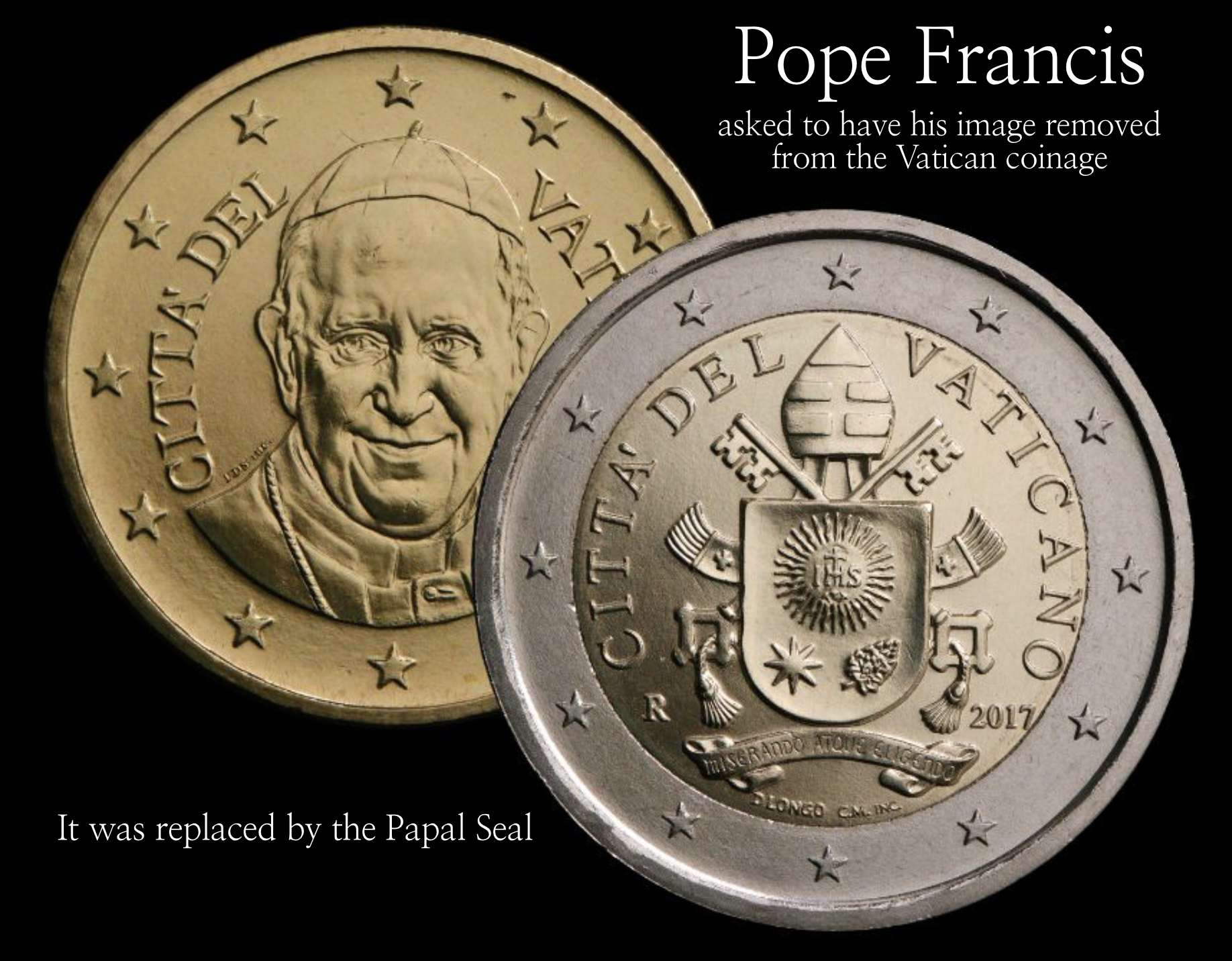
For centuries, the portrait of the current Bishop of Rome graced coins in Rome. That tradition ended with Pope Francis. In 2017, he personally requested that his visage no longer appear on coins. This is commendable, since it was presumably based on Francis’ humility. 

This then, his image has been replaced by the papal coat of arms. Notably, every other country minting euros bears the head of its head of state. It will be interesting to see whether or not Francis’ successor follows his example.

A Brief Note on Protestant Coinage

Although there have been some historical attempts to create governmental structures led by religious leaders besides Roman Catholicism, they have been the rare exception. (The claimed leadership of the Church by sovereigns such as King Henry VIII is another case.) 

In Zurich, Huldrych Zwingli (1484 – 1531) sought to establish a theocracy, and actually perished on the battlefield resisting the Roman Catholic armies of several Swiss cantons. John Calvin (1509 – 1564) pursued similar goals in Geneva, and beyond. Calvin, however, never bore arms in his effort.

Fortunately, the “two kingdoms” theology of Martin Luther became dominant in primarily Protestant realms. It is based on the declaration Jesus made during his trial before Pontius Pilate that “My kingdom is not of this world” (John 19).

For a fascinating discussion of the implications of this theological position, consider “Martin Luther’s Farewell to Arms: The Two Kingdoms and the Rejection of Crusading.”

Turning to numismatics, it is not rare to find religious leaders portrayed on historical coinage. However, these portrayals serve as commemorations of individuals who have made a cultural or ethical contribution to a particular society – not because they sat upon a throne.

For example, Switzerland minted a 20 franc coin with the images of Zwingli and Calvin during the 500th anniversary of the Reformation.

Likewise, in 1965, the Communist government of Czechoslovakia produced a 10 korun coin in honor of the 550th anniversary of the martyrdom of Jan Hus. This particular coin, like many similar pieces, was actually minted as a non-circulating coin, intended for collectors rather than daily commerce.

This leads us to note that most coin-like pieces of metal bearing the likeness of reformers are actually medallions, not coins. As such, the vast majority of the commemoratives have been fashioned by organizations, rather than governments.

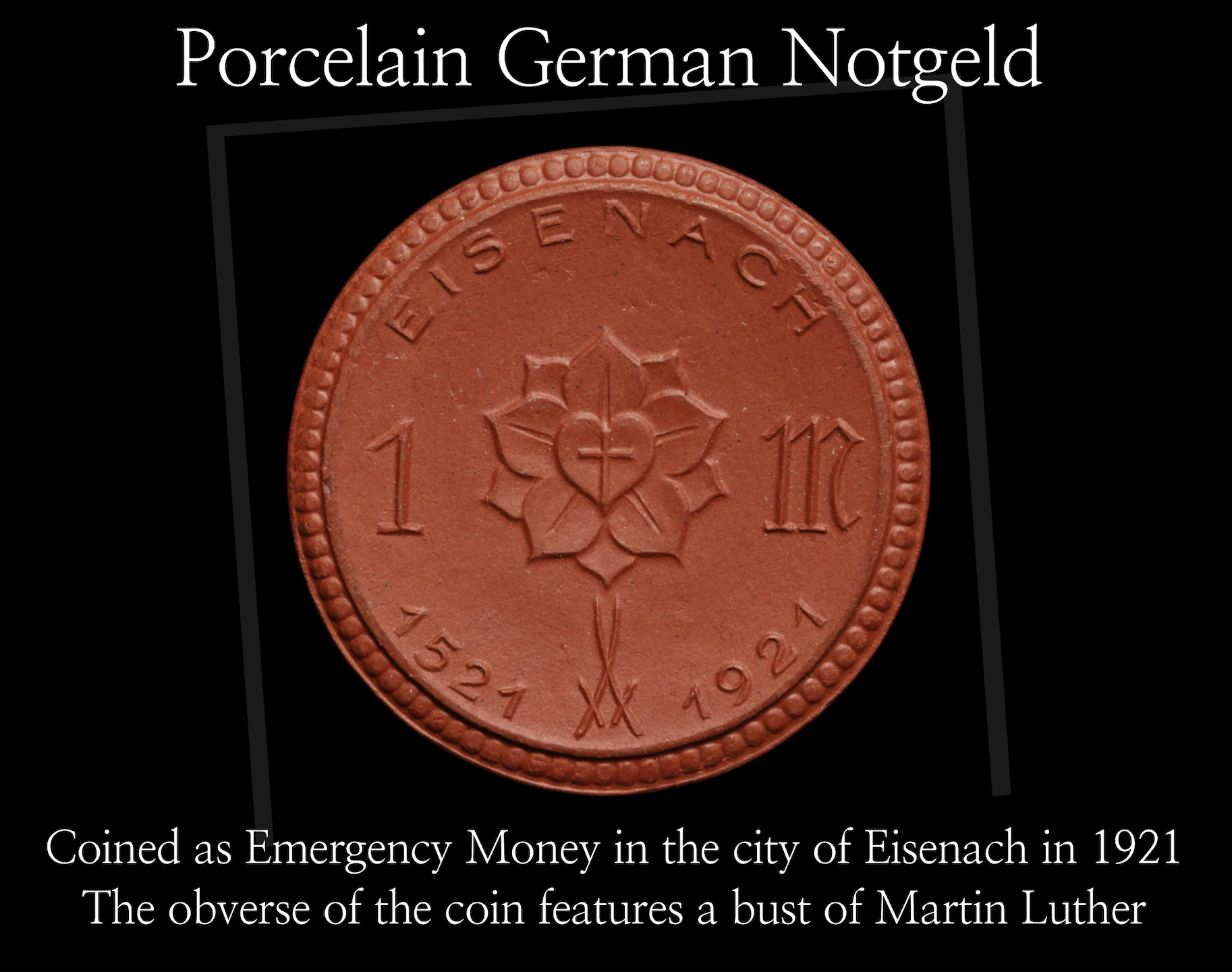
Being an amateur numismatist and a Lutheran pastor myself, I have several related items in my personal collection (none of which were costly, of course . . . since it’s just a hobby). One of my favorite items is a genuine 1 Mark coin minted in Eisenach in Weimar Germany in 1921 (pictured below). What makes it especially unusual is that due to postwar metal shortages, it was actually struck in porcelain!

This emergency coinage and currency was called “Notgeld,” which means “necessity money” because individual cities found it necessary to provide their own money when the Reichsbank succumbed to hyperinflation between the world wars.

The city of Eisenach chose the centennial of Martin Luther’s work because of his historic ties to the city. The Lutherhaus Eisenach cultural center commemorates, among other events, Luther’s early schooldays there, and his stay at Wartburg Castle where he translated the New Testament into German.

Conclusion

In light of Pope Francis’ funeral and the association it has with numismatics, it is a good time to consider how coinage has often carried a religious message. Although this was more frequent in past centuries, it still occurs today. It will be interesting to see just how many nations eventually mint coins in honor of Pope Francis. The Philippines, Samoa and the Cook Islands already have.

And even Narnia, the home of Aslan, minted coins in honor of its heroes, didn’t it?
Humorous Examinations

Could you pass this examination?

Sketch the development of human thought, estimate its significance. Compare with the development of any other kind of thought.

In contrast to the serious tone of the last two posts, today I am offering some edifying entertainment. As a gift to you, I have edited a perennial favorite of internet humorists. I recently came across my copy of this comprehensive knowledge examination, which motivated me to tweak it for Mere Inkling’s erudite audience.

You have probably seen versions of this exam in the past. The basic questions have remained surprisingly stable despite its age. I encountered it in the University of Washington campus paper in 1973. One writer claims “the Graduation Exam—Authentic Assessment has been in circulation since at least the 1950’s.”

The exam certainly makes the rounds, as this Navy veteran described.

The pressures of comprehensive exams were apparent to many, which resulted in one of the few officially sanctioned jokes in Naval Nuclear Power. In one of the official publications of Naval Reactors, someone inserted a sample “final exam” from Nuclear Power School.

In 2012 elements of the examination created confusion in the People’s Republic of China. It was included in an article about how Chinese nationals could prepare for an American State Department exam required for positions at the United States embassy in Beijing. According to China’s Global Times, “US embassy spokesman Richard Buangan made clear on his Sina microblog Sunday that an alleged ‘recruitment test for expatriate employees at the US embassy’ is fake.”

A June 2008 issue of Foreign Service Journal carried a story, which includes an English version of the [exam stating] the questions are from the US State Department’s entrance exam, in a bid to “measure the stability of perspective Foreign Service officers and to weed out the dummies.”

The Function of Examinations

Testing and documenting competence is obviously important. This is especially true for people in critical roles, such as prescribing drugs, designing aircraft engines, and manufacturing ice cream.

Of course, not everyone is able to pass every test. Which is precisely how things should be.

C.S. Lewis noted how educators truly familiar with their students readily recognize when it is a waste of time for them to continue repeating an exam they obviously cannot pass. He said an academic “master often knows, when boys and parents do not, that it is really useless to send a boy in for a certain examination again” (The Problem of Pain).

I have met very few people who enjoy being tested. Yet, for many faculty members (C.S. Lewis included), being on the “other side” of exams is not particularly enjoyable either. This delightful passage comes from a 1927 letter to his brother, Warnie.

My period of examining passed over with its usual accompaniment of neuralgia and oaths, relieved by the one excellent boy who defined ‘a genie’ correctly, yet more than correctly, as ‘an eastern spirit inhabiting bottles and buttons and rings.’ Pretty good for a boy.

I was also pleased with a youth who, being asked to write a letter to a friend recommending Guy Mannering,* wrote to his brother recommending it and saying ‘I think you would be interested in the character of Colonel Mannering, he is so like our father’: and then later in a paper on Guy Mannering in which I had set the question ‘Would you have liked Colonel Mannering as a father?’—illustrate your answer etc.—began decisively ‘I would not have liked Colonel Mannering as a father in the least.’

Well, it’s time now to offer you the opportunity to prove your worthiness. If you wish to evidence the breadth and depth of your knowledge, proceed now to the exam. (Astute readers will note I’ve added a personal twist to a couple of the exam questions.)

Comprehensive Knowledge Exam

HISTORY: Describe the history of the papacy from its origins to the present day, concentrating especially, but not exclusively, on its social, political, economic, religious, and philosophical impact on Europe, Asia, North and South America, and Africa. Be brief, concise, and specific. Now do the same for the Zoroastrian priesthood. [Bonus credit for including Antarctica in your response.]

MEDICINE: You have been provided with a razor blade, a piece of gauze and a bottle of scotch. Remove your appendix. Do not suture until your work has been inspected. You have fifteen minutes. [Option: if you feel the scotch would impair your responses to the remaining questions, you may defer this portion of the exam to the end of the exam.]

PUBLIC SPEAKING: Two thousand riot-crazed anarchists are storming the campus. Calm them. You may use any ancient language except Latin, Greek or Sanskrit. [Pig Latin is allowed.]

BIOLOGY: Postulate the 500 million year progression of a life form based on silicon, ranking its likely preference for form of government Enumerate the pros and cons it would associate with democracy, monarchy, socialism, theocracy, and totalitarianism. [Caution: any references to the Horta of Janus VI will result in disqualification of your answer, since Star Trek is a fictional resource.]

MUSIC: Write a piano concerto. Orchestrate and perform it with flute and digeridoo. You will find a piano under your seat. The wind instruments, of course, were among the items you were directed to bring with you to the examination.

PSYCHOLOGY: Based on your knowledge of their works, evaluate the emotional stability, degree of adjustment, and repressed frustrations of each of the following: Alexander of Aphrodisias, Hildegard of Bingen, Rābi’a bint Ka’b al-Quzdārī and Simeon the Stylite. Support your evaluation with quotations from each individual’s work, citing original sources. It is not necessary to translate.

SOCIOLOGY: Using the pretext of Planet of the Apes, where homo sapiens have been subordinated to various primate species, assess the prospects for achieving mutual toleration and equilibrium before one group is driven to extinction. [Caution: confusion of apes (which lack tails) and monkeys (which lack an appendix) will result in disqualification of your response.]

CHEMISTRY: Transform lead into gold. You will find a beaker, a three hundred count box of matches and five lead sinkers under your seat. Show all work including Feynman diagrams and quantum functions for all steps. [Transformation into silver will provide half credit.]

ENGINEERING: The disassembled parts of a high-powered rifle have been placed on your desk. You will also find an instruction manual, printed in Swahili. In 10 minutes a hungry Bengal tiger will be admitted to the room. [Special Consideration: Satisfactorily explain the differences between Fahrenheit and Celsius to the tiger, and it will be replaced by a rabid ferret.]

ECONOMICS: Develop a realistic plan for refinancing global debt, without hypothesizing a benevolent intergalactic alliance with unlimited resources coming to the planet’s aid. Trace the possible effects of your plan in the following areas: Cubism, the Donatist controversy, and the 1913 foundation of Hôpital Albert Schweitzer in Gabon.

POLITICAL SCIENCE: Devise an infallible, seven-step plan to transform the United Nations into an organization that will successfully foster peace and goodwill in all international relationships. [Bonus credit for providing a major role for two of the following nations: Dominica, Liechtenstein, Tuvalu.]

AGRICULTURAL SCIENCE: Outline the steps involved in breeding your own super high yield, all weather hybrid strain of wheat. Describe its chemical and physical properties and estimate its impact on world food supplies. Construct a model for dealing with world-wide surpluses. Draft your Nobel Prize acceptance speech.

PHYSICS: Explain the nature of matter. Include in your answer an evaluation of the impact of the development of mathematics on astronomy, botany and numismatics. [Bonus Credit: write today’s date in metric.]

PHILOSOPHY: Sketch the development of human thought, estimate its significance. Compare with the development of any other kind of thought. Be sure to include an analysis of the influence exerted on philosophy by Diogenes the Cynic.

CREATIVE WRITING: Compose an epic poem based on the events of your own life in which you see and footnote allusions from T.S. Eliot, Titus Lucretius Carus, Miguel de Cervantes, Dante Alighieri, Þorbjörn Hornklofi, Gilgamesh and Stephen King. Critique your poem with a full discussion of its syntax and metrics. [Bonus Credit for writing alternating stanzas between free and rhyming verse.]

EDUCATION: Formulate an examination which accurately measures an individual’s comprehensive knowledge base without cultural or linguistic prejudice. Limit the question parameters to what can reasonably be covered during a four hour testing block.

LITERATURE: Discuss in detail at least three major literary figures from each of the following civilizations: the Xia Dynasty, the Akkadian Empire, the Mayan Empire, the Aksumite Empire, the Polynesian Tuʻi Tonga Empire, and nineteenth century United Kingdom. [Caution: failure to include J.R.R. Tolkien and/or C.S. Lewis will result in disqualification of your answer to this question.]

Congratulations on finishing the exam. You are encouraged to use any remaining time to review your answers in light of the fact that grammatical errors and misspellings will significantly impact your final grade.


* You can download a personal copy of Guy Mannering, one of Sir Walter Scott’s Waverly novels, at Internet Archive.

If you should question the distinctions I noted between apes and monkeys, please know that the facts are genuine. However, for future examinations, you should be aware that not all monkeys have tails.

Beijing’s Murderous Jesus

Communist China* hates Christianity. They do everything they can to destroy the Gospel, with its power to free people from bondage. That’s because China is all about keeping human beings in bondage.

Mere Inkling is not a political blog, so I have no incentive to go through the litany of communist China’s demagoguery. Besides, listing their crimes would take far too long.

In terms of their persecution of the Christian Church, however, many agnostics know little.⁑ The Red Chinese began their war against Christianity in the days of Mao. Millions have been denied their civil rights, imprisoned, and even murdered. Even with their “enlightened” and “tolerant” policies, they continue to deface and destroy church buildings and harass and imprison believers.

But now, they have done the unimaginable.

They have sought to replace the various Chinese translations of the Bible with a new, official edition. The regime’s Bible, though, is not a genuine translation.

It is an intentional corruption of God’s Word, and it is no exaggeration that some of its inspiration comes from the Father of Lies,  an honored commissar in all Communist nations.

In a superb essay discussing the pseudo-bible, Cameron Hilditch reveals how the Communists are attempting to co-opt the Messiah and present him as the herald of the Marxist gospel.

Put simply, the Chinese Communist Party “plans to turn the Scriptures into another piece of regime propaganda by rewriting them beyond all recognition.”

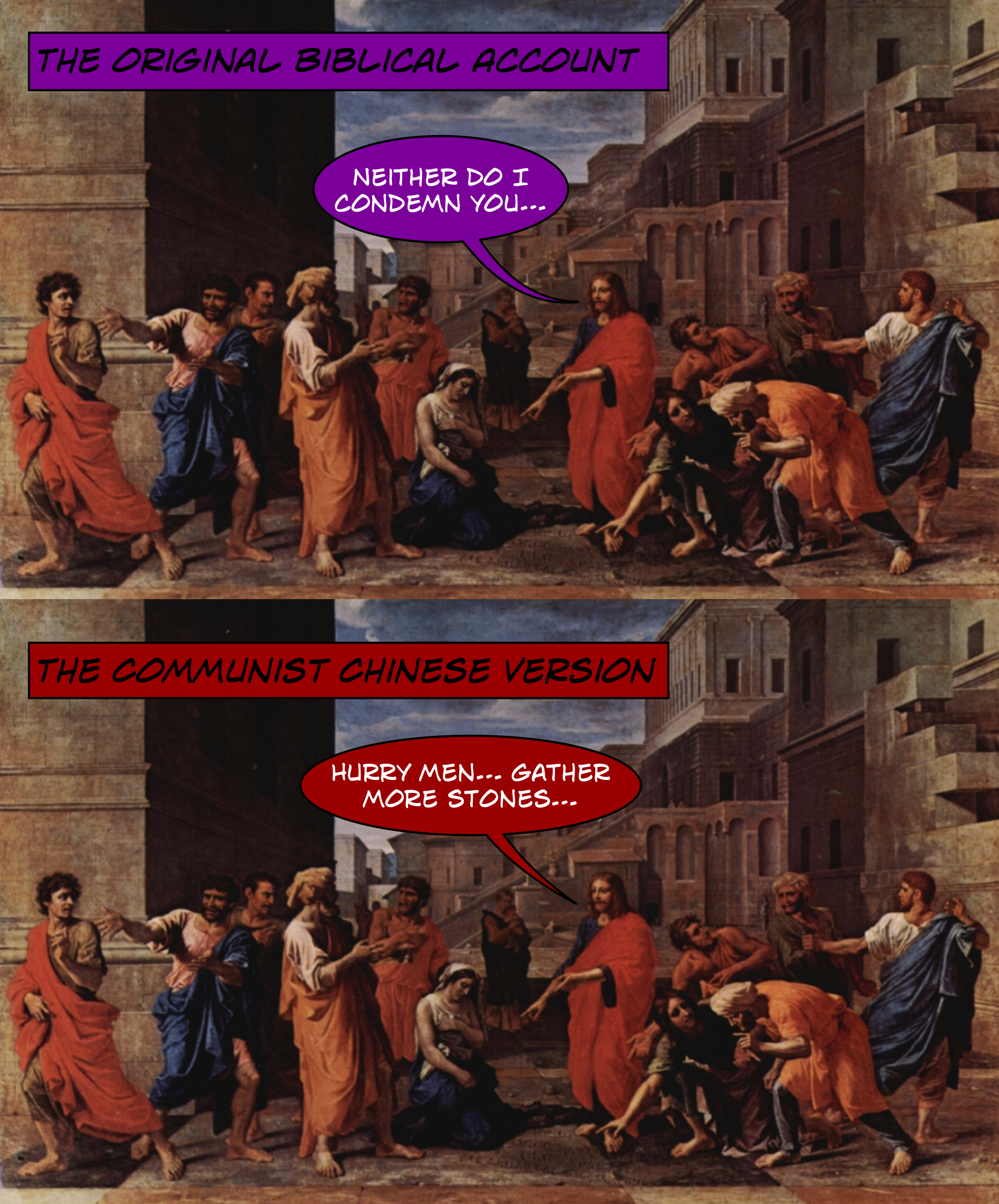
Beyond all recognition indeed. Before looking at their perversion of Jesus’ message of mercy, let’s consider the actual biblical account. We read that in Jerusalem,

Jesus went to the Mount of Olives. Early in the morning he came again to the temple. All the people came to him, and he sat down and taught them. The scribes and the Pharisees brought a woman who had been caught in adultery, and placing her in their midst they said to him, “Teacher, this woman has been caught in the act of adultery. Now in the Law, Moses commanded us to stone such women. So what do you say?”

This they said to test him, that they might have some charge to bring against him. Jesus bent down and wrote with his finger on the ground. And as they continued to ask him, he stood up and said to them, “Let him who is without sin among you be the first to throw a stone at her.”

And once more he bent down and wrote on the ground. But when they heard it, they went away one by one, beginning with the older ones, and

Jesus was left alone with the woman standing before him. Jesus stood up and said to her, “Woman, where are they? Has no one condemned you?” She said, “No one, Lord.” And Jesus said, “Neither do I condemn you; go, and from now on sin no more.”

Here is the communist mistranslation⁂ of the end of this powerful example of God’s grace and mercy.

When the crowd disappeared, Jesus stoned the sinner to death saying, “I too am a sinner. But if the law could only be executed by men without blemish, the law would be dead.”

Twisting the Scriptures

The act of translating the Scriptures is not controversial. In fact, it is necessary. C.S. Lewis noted this in his essay “Modern Translations of the Bible.”

The truth is that if we are to have translation at all we must have periodical re-translation. There is no such thing as translating a book into another language once and for all, for a language is a changing thing.

If your son is to have clothes it is no good buying him a suit once and for all: he will grow out of it and have to be re-clothed.

However, the re-translation must be an honest one.

There are several warnings in the Bible itself not to alter the words in the Scriptures either by deleting or adding to the text. Substituting the actual words, as the Communist Chinese have done, would violate both of those prohibitions.

Some people argue that mainland China exerts a benign influence on the world. “We have short memories,” says Christian attorney and advocate for the poor, Anna Waldherr. Rather than praise China for its increased engagement with the world, she reminds us of the true situation.

These days, the United States and China have mutual economic, political, and security interests.  But China remains a Communist nation with a totalitarian government and unresolved issues involving human rights.

The evil purposes of communist China’s ruling elite do not extend to their people. On the contrary the residents of that historic nation are its primary victims. The Chinese people and their culture possess much nobility. As I have written before, “C.S. Lewis held great respect for Chinese civilization. He was interested in the Chinese philosophical concept of the Tao.”

I share Lewis’ high regard for all that is good in China along with a genuine compassion for the Chinese people. May God deliver them from the dark principalities that reign over them.


* The communist People’s Republic of China is not to be confused with the democratic Republic of China, which is usually called Taiwan, due to the PRC’s coercive actions. For the same reason, the 23 million people living in the Republic of China are denied representation in the United Nations.

⁑ The Communists persecute other religious groups as well, most notably the Uighur (Islamic) people, who are being placed in vast reeducation and labor camps. In addition to rewriting the Jewish and Christian Scriptures, they are presumably also rewriting the Quran with the same, pro-regime agenda. Unsurprisingly, when asked their specific plans, “the Chinese Embassy in Washington declined to comment.”

⁂ As reported in Hilditch’s article, “China’s Communist Christ,” linked to above.

The original painting featured in the illustration above, “Christ and the Woman Taken in Adultery,” was painted in 1653 by Nicolas Poussin.