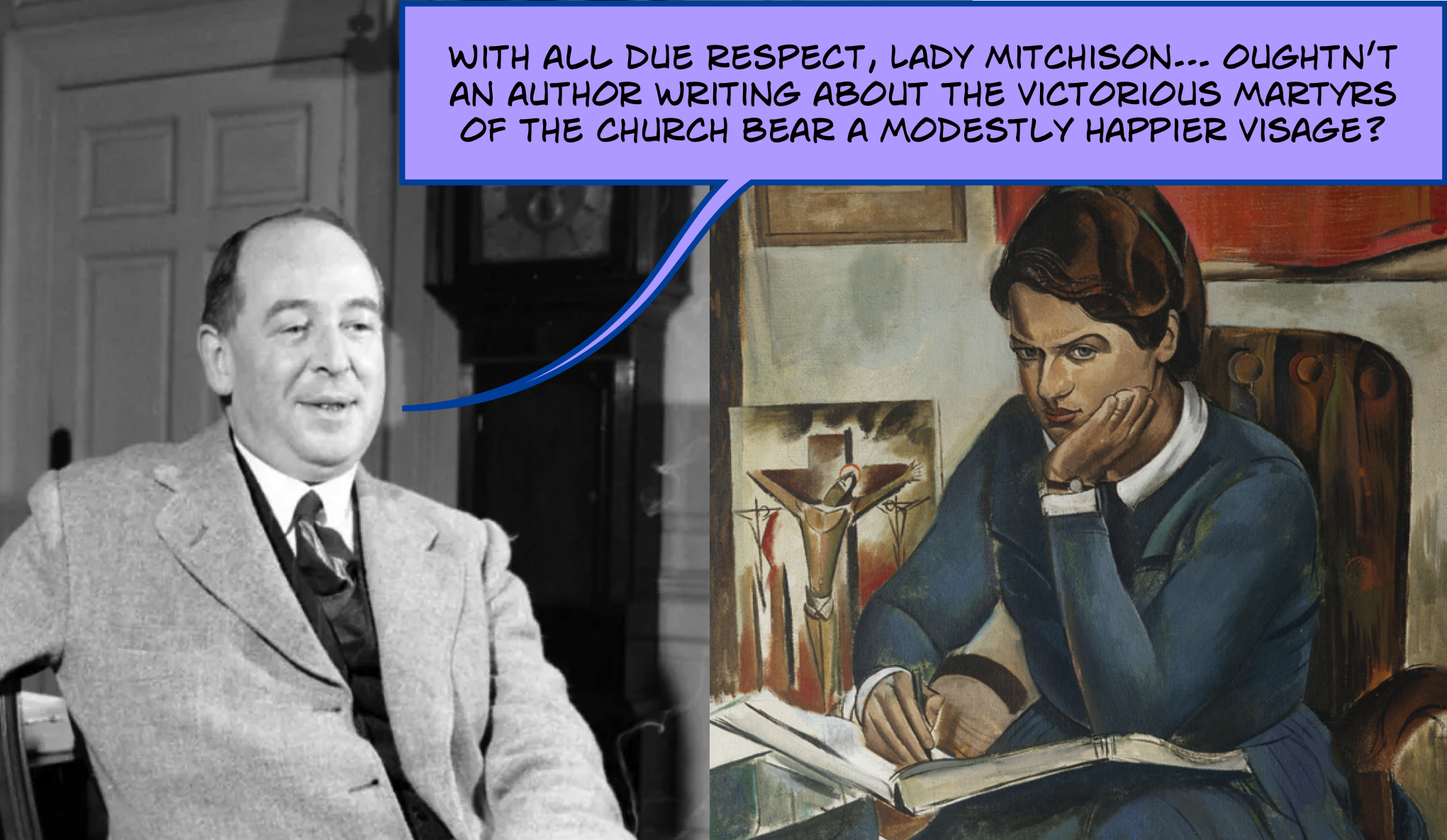
C.S. Lewis, J.R.R. Tolkien & Naomi Mitchison

Have your feelings about particular authors changed over time? C.S. Lewis’ attitude toward the work of prolific novelist Naomi Mitchison illustrates this type of progression.

Mitchison’s work possesses a direct link to another Oxford Inkling – J.R.R. Tolkien – whose Fellowship of the Ring she read in proof and favorably reviewed. Brenton Dickieson provides a priceless letter written by Tolkien to Mitchison in 1954.

Naomi Mary Margaret Mitchison was a Scottish novelist who lived more than a century (1897 – 1999). She penned more than ninety books, primarily historical fiction, and including science fiction.

With the outbreak of the First World War, Mitchison joined a Voluntary Air Detachment in a London hospital. (Other familiar women who served in a VAD included Agatha Christie and Amelia Earhart.)

Politically she identified as a Socialist. She was sufficiently leftist that George Orwell regarded her as unsuited for writing anti-Soviet materials for the United Kingdom during the Cold War.

Mitchison’s brother, J.B.S. Haldane, did not equivocate on his radical views, announcing his position as a Marxist. He was a scientist and his atheism brought him into serious disagreement with the Christian views of C.S. Lewis. (I will devote my next post to that interaction.)

Coincidentally, artist Pauline Baynes (who also worked with C.S. Lewis and J.R.R. Tolkien), provided the illustrations for at least one of Mitchison’s children’s books, Graeme and the Dragon. This quick review offers a concise synopsis and discussion of “the charming illustrations [which] go a long way toward making this a fun read.”

An additional coincidence: the same year Lewis published The Lion, the Witch and the Wardrobe, Mitchison also published a fantasy novel for children. The Big House involves time travel and some occultic themes associated with Halloween, etc.

For a thorough synopsis of The Big House and comparison to Lewis’ Chronicles of Narnia, check out this essay from the University of Glasgow. (That reviewer’s preference is clearly for Mitchison’s more complex approach with its themes related to class struggle.)

C.S. Lewis’ Perspective on Naomi Mitchison

I cannot locate any mention of C.S. Lewis by Mitchison, but he did mention her in passing in several pieces of correspondence. In essence, he praised her skill, but was put off by her graphic use of violent imagery.

In a 1932 letter to Arthur Greeves, he writes:

I thought we had talked about Naomi Mitchison before. I have only read one (Black Sparta) and I certainly agree that it ‘holds’ one: indeed I don’t know any historical fiction that is so astonishingly vivid and, on the whole, so true.

I also thought it astonishing how, despite the grimness, she got such an air of beauty–almost dazzling beauty–into it. As to the cruelties, I think her obvious relish is morally wicked, but hardly an artistic fault for she could hardly get some of her effects without it.

But it is, in Black Sparta, a historical falsehood: not that the things she describes did not probably happen in Greece, but that they were not typical–the Greeks being, no doubt, cruel by modern standards, but, by the standards of that age, extremely humane.

She gives you the impression that the cruelty was essentially Greek, whereas it was precisely the opposite. That is, she is unfair as I should be unfair if I wrote a book about some man whose chief characteristic was that he was the tallest of the pigmies, and kept on reminding the reader that he was very short. I should be telling the truth (for of course he would be short by our standards) but missing the real point about the man–viz: that he was, by the standards of his own race, a giant. 

Still, she is a wonderful writer and I fully intend to read more of her when I have a chance.

C.S. Lewis echoed his concern in a 1942 letter to another of his regular correspondents, Sister Penelope. “I gave up Naomi Mitchison some time ago because of her dwelling on scenes of cruelty. But I recognise real imagination and a sort of beauty in the writing.”

In 1951, C.S. Lewis congratulated author Idrisyn Oliver Evans (1894–1977) on the publication of The Coming of a King; A Story of the Stone Age. Ironically, speculative fiction set in this ancient era, referred to as “Prehistoric SF,” was also the setting of works such as H.G. Wells’ Story of the Stone Age series, which you can read here. Naomi Mitchison also dabbled in the prehistoric field. Lewis wrote to Evans: 

I congratulate you. And I think it is a great thing to put that idea of the Stone Age – which is at least as likely to be the true one – into boys’ heads instead of Well’s or Naomi Mitchison’s. It’s all good. The marriage customs are amusing . . . I hope it will be a great success. 

In 1959, C.S. Lewis provided some wise counsel to a young, aspiring author. The American student was contemplating a volume about the Roman subjugation of Gaul, which Lewis encouraged.

A story about Caesar in Gaul sounds very promising. Have you read Naomi Mitchison’s The Conquered? And if not, I wonder should you? It might be too strong an influence if you did (at any rate until your own book is nearly finished). On the other hand, you may need to read it in order to avoid being at any point too like it without knowing you are doing so.

I don’t know what one should read on Gaul. Apart from archaeological finds (Torques and all that) I suppose Caesar himself is our chief evidence? He will be great fun and I hope you will enjoy yourself thoroughly.

Which side will you be on? I’m all for the Gauls myself and I hate all conquerors. But I never knew a woman who was not all for Caesar – just as they were in his life-time.

C.S. Lewis’ most significant mention of Naomi Mitchison occurs in his brief 1943 essay, “Equality.”

It delivers a brilliant discussion of the subject, one that merits full reading. He commends one of Mitchison’s insights into inequality – although, ironically, she relates it to eroticism.* (You must read it in full context to understand how it supports his independent argument.)

This last point needs a little plain speaking. Men have so horribly abused their power over women in the past that to wives, of all people, equality is in danger of appearing as an ideal. But Mrs. Naomi Mitchison has laid her finger on the real point. Have as much equality as you please – the more the better – in our marriage laws, but at some level consent to inequality, nay, delight in inequality, is an erotic necessity.

Mrs. Mitchison [in The Home and a Changing Civilization] speaks of women so fostered on a defiant idea of equality that the mere sensation of the male embrace rouses an undercurrent of resentment. Marriages are thus shipwrecked.

A final reference to Mitchison brings us back around to my early note that she reviewed Fellowship of the Ring. C.S. Lewis refers to her review in his own, suggesting that she has not gone quite far enough in her praise.

Nothing quite like it was ever done before. ‘One takes it,’ says Naomi Mitchison, ‘as seriously as Malory.’ But then the ineluctable sense of reality which we feel in the Morte d’Arthur comes largely from the great weight of other men’s work built up century by century, which has gone into it.

The utterly new achievement of Professor Tolkien is that he carries a comparable sense of reality unaided. Probably no book yet written in the world is quite such a radical instance of what its author has elsewhere called ‘sub-creation.’

Sadly, Naomi Mitchison was less enamored with the subsequent volumes in The Lord of the Rings . . . but this post has already condensed more than enough information.


* An article in Michigan Feminist Studies notes how Naomi Mitchison’s recurrent references to sexual themes distracted from broader matters throughout her literary career.

Despite Mitichison’s attempts to move the discussion of her body of work from the salacious, it is the frank and open inclusion of sexuality that continues to intrigue her critics and reviewers. Racy, heated passages of Mitchison’s historical novels inspired comment from poet W.H. Auden in the 1930s (“Monstrous Sex: The Erotic in Naomi Mitchison’s Science Fiction”).

The essay’s thesis is what one might expect in a journal devoted to contemporary feminism.

I intend to demonstrate that the ribald sexuality of Mitchison’s work registers as more than merely provocative. Sexual encounters between female characters and aliens, as well as those between women, threaten an imperialising capitalism that dictates who may be loved in a gendered, racialised order.
Military Hymns & Ents

The United States is schizophrenic about its religious heritage, and the armed forces provide us with today’s example. Most people, including veterans themselves, are unaware of the fact that while we have official songs for the different branches of the armed forces, we don’t have any official hymns.

C.S. Lewis and J.R.R. Tolkien, both combat veterans, were quite familiar with martial music. However, as members of a (nominally) Christian kingdom, neither would have been uncomfortable with explicitly Christian elements in their military’s hymnody. Across the ocean in the former colonies, it’s a different matter. 

Here, the confusion about the “official” status of religious military hymns abounds because spiritual hymnody has been part of our nation’s martial history ever since the colonies decided to band together and seek independence. Yet, some consider that to be unlawful.

The rejection of music expressing faith in God can be attributed to the modern crusade against such hymns by strident anti-theists. Many in this camp are practicing atheists, who misinterpret the two clauses of the First Amendment which the nation’s founders did not consider mutually exclusive. 

Congress shall make no law respecting an establishment of religion, or prohibiting the free exercise thereof . . .

Since most of the creators of the Constitution – and the majority of American citizens up to this day – have been theists (believing in a Supreme Being), it is self-evident that they did not intend to exorcise all expressions of faith from the public forum. Some states, in fact, already had their own “established churches when the First Amendment was ratified.”

Up until this generation, generic references to a heavenly Father or a benevolent Creator have traditionally remained welcome at civic events.

Even the non-Christian Thomas Jefferson (who argued against religious establishment) was essentially a Deist, acknowledging “the god who gave us life, gave us liberty at the same time . . .”

Jefferson even edited the New Testament Gospels, deleting “objectionable passages” and producing his personally-sanctioned Life and Morals of Jesus of Nazareth

So, What about the Music?

My goal is not to discuss the First Amendment per se – though I included the introductory note above for the benefit of the many international readers who find their way to Mere Inkling.

Rather, I wish to discuss the premise above, that America celebrates generally secular martial music, while remaining wary of military hymnody with religious themes. 

Ironically, soldiers throughout the nation’s history passively assumed that the songs they heard at rallies and civic events had the government’s tacit imprimatur, that was questionable. Take the “Battle Hymn of the Republic,” for example. Composed in 1861 by abolitionist Julia Ward Howe, Union soldiers would have been shocked to learn that some would deem its use in the ranks as a violation of the First Amendment.

Mine eyes have seen the glory of the coming of the Lord;
He is trampling out the vintage where the grapes of wrath are stored;
He hath loosed the fateful lightning of His terrible swift sword:
His truth is marching on.

I have read a fiery gospel writ in burnished rows of steel:
“As ye deal with My contemners, so with you My grace shall deal;”
Let the Hero, born of woman, crush the serpent with His heel,
Since God is marching on.

Modern Military Hymns

The Department of Defense hosts a website titled Guide to U.S. Military Bands and Music. It describes the wide repertoire of military musicians. 

Whether you like jazz music, a marching band or orchestra music, the U.S. military has you covered. Each branch of the military boasts a diverse offering of musical talent that serves for ceremonial purposes but also for entertainment and outreach. Check out these bands to stay in tune with military music.

One Christian hymn has deep roots in the military community. The song traditionally referred to as “The Navy Hymn” in America, originated in Britain. It is also used by the French. Its maritime themes make it popular in civilian communities as well. 

Eternal Father, strong to save,
Whose arm does bind the restless wave,
Who bids the mighty ocean deep
Its own appointed limits keep;
O hear us when we cry to Thee
For those in peril on the sea.

O Savior, whose almighty word
The winds and waves submissive heard,
Who walked upon the foaming deep,
And calm amid the rage did sleep;
O hear us when we cry to Thee
For those in peril on the sea.

“There exist a myriad of alternate verses to the hymn. One, for example, was written by David B. Miller in 1965 and specially dedicated to naval submariners.”

Musicians were not just present for official ceremonies and off-duty entertainment. They could also inspire the troops in the violent din of battle. More common in distant ages, even in twentieth century Europe, we find a dramatic illustration.

In the military archives of the Irish Republican Army, Michael J. Crowley described the inspiration provided by the brigade’s musician in the heat of the battle called the “Battle of Crossbarry” and the “Crossbarry Ambush,” by the IRA and the Brits respectively.

From the opening shot of the engagement, our piper, Florrie Begley of Brandon, played warlike airs on the bagpipes until the last shot was fired.

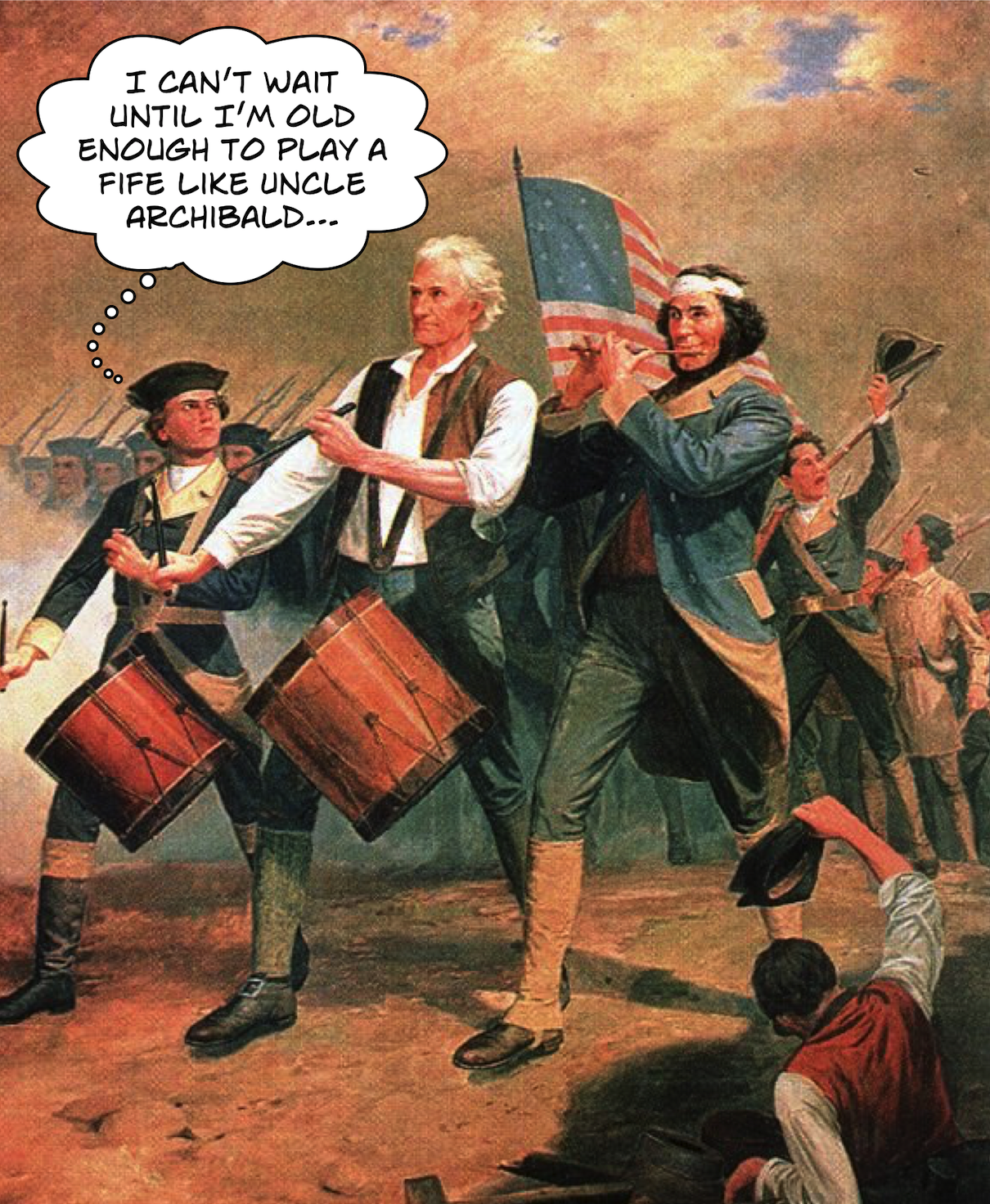
The illustration above provides an idealized portrait of military musicians bravely facing enemy fire. “The Spirit of ’76,” painted for the centenary of the American Revolution, met with tepid enthusiasm during the 1876 Centennial Exposition in Philadelphia. However, it rose in popularity when it subsequently toured the country.

For centuries, armies used music as the means to communicate the military orders of the day to soldiers. The high pitch of the fife and the sharp sound of the drum allowed messages to be heard at great distance . . .

Leaping from the Revolution to the twenty-first century, the recently birthed United States Space Force now has a hymn. Well, sort of. It is an unsolicited hymn composed by a former Air Force officer. You can hear “Creator of the Universe” here.

For more space music, check out the official anthem of “the mighty watchful eye.” Some consider this proposed anthem far more inspiring.

My personal favorite is the version of the Space Force Anthem proposed by its original, cinematic commander, General Naird, played by Steve Carell. (Carell even plays his own fife in the episode.)

The Middle Earth Military March

Howard Shore composed a powerful soundtrack for Lord of the Rings. Yet he wasn’t the first to create music for the great saga. One Tolkienist writes:

My first contact with Tolkien-inspired music dates back to the late 1980s . . . I was watching TV with my parents seeing a performance of Military Bands. Later I would discover that it was the Dutch composer Johan de Meij’s Symphony No. 1 (The Lord of the Rings) I’d heard.

From among the ranks of the Inklings, only one writer wrote an explicit military song. J.R.R. Tolkien provided the timeless Ents with a somber marching song as they face the powers of Isengard.

We come, we come with roll of drum: ta-runda runda runda rom!
We come, we come with horn and drum: ta-rūna rūna rūna rom!

To Isengard! Though Isengard be ringed and barred with doors of stone;
Though Isengard be strong and hard, as cold as stone and bare as bone,
We go, we go, we go to war, to hew the stone and break the door;
For bole and bough are burning now, the furnace roars – we go to war!
To land of gloom with tramp of doom, with roll of drum, we come, we come;
To Isengard with doom we come!
With doom we come, with doom we come!

If you have a moment, you will likely enjoy the performance of this song as arranged by Clamavi De Profundis.

Elven Inspiration from Space

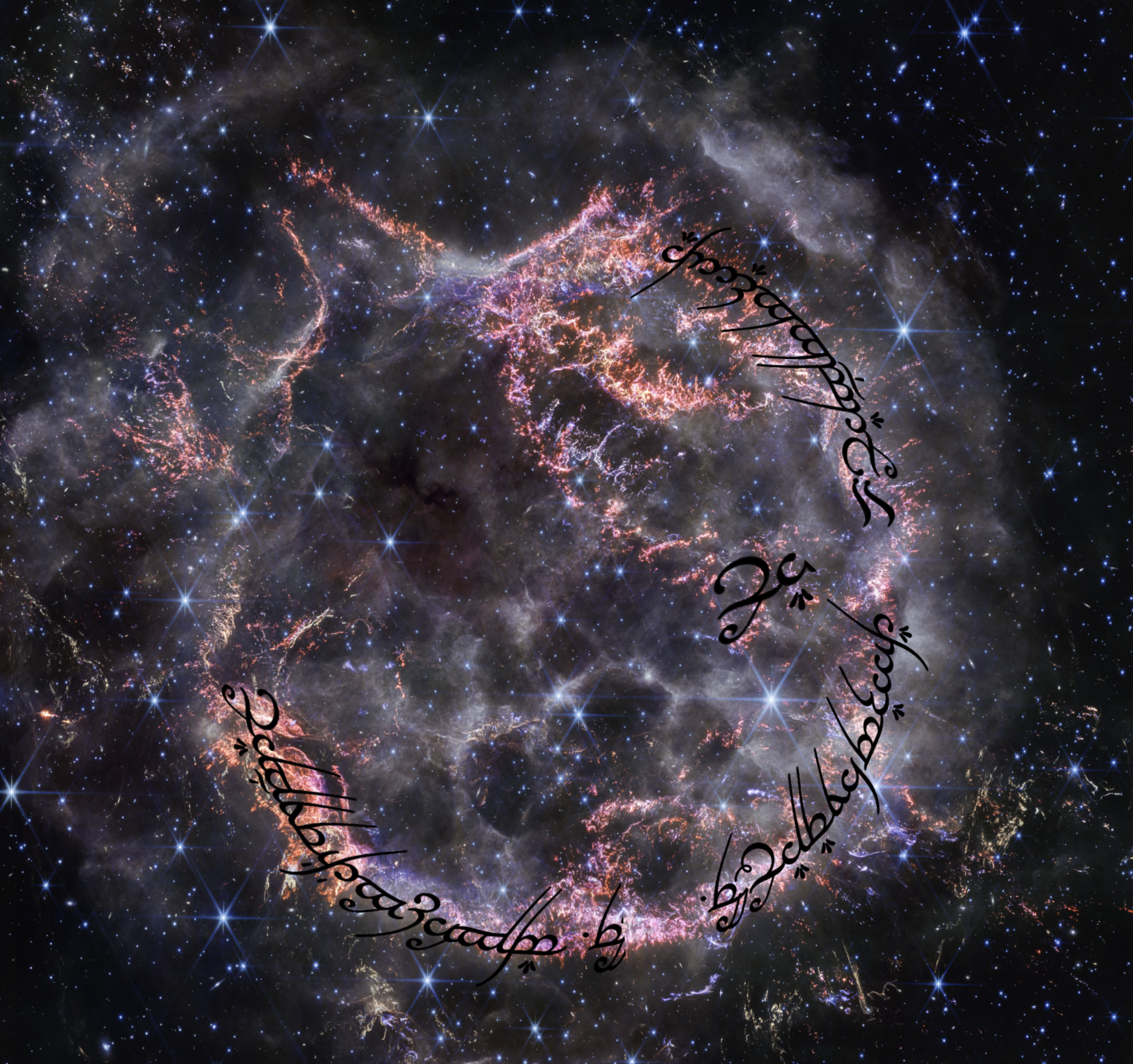
A newly captured image of a supernova remnant in our Milky Way galaxy has me curious about where J.R.R. Tolkien may have gained inspiration for the elegant style of his Elvish scripts.*

America’s NASA has gifted all of Earth’s citizens with an array of stunning, and enlightening images. Recently, the James Webb Space Telescope directed its focus to Cassiopeia A, created thousands of years ago when a star 11,000 light years away went supernova. 

It may be my imagination, or perhaps its an elevated mental talent for “core object recognition,” but for some inscrutable reason, I have recognized in the aftermath of the explosion faint echoes of Elvish script.

The light from Cassiopeia A (or Cas A, as we pseudo-astronomers refer to it) “first reached us around 340 years ago. As that was approximately 272 years before The Lord of the Rings was published, Tolkien had ample time to analyze the spectacular light source. Even factoring in the fact that the stories were composed between 1937 and 1949, the supernova’s existence had been known for a millennia and a half before LOR was written. 

I will leave it to other researchers to determine just how Tolkien was able to gain a detailed view of the explosion’s aftermath. My purpose here is to simply alert the public to the unexplainable parallel between the cosmic residue and Tolkien’s own renditions of Elvish writing as he perceived it. 

In a moment, I will allow the self-evident facts to speak for themselves.

Like his friend C.S. Lewis, Tolkien was a student of astronomy. As Professor Kristine Larsen says, “J.R.R. Tolkien based the stars and constellations of his created world of Middle-earth on ‘real world’ astronomy.” Dr. Larsen, a preeminent “Tolkienian Astronomer,” has published widely on the subject. 

Of particular interest to readers of Mere Inkling will be “Medieval Cosmology and Middle-earth: A Lewisian Walk Under Tolkienian Skies,” which can be downloaded here. In the essay, Larsen points out,

. . . as is well known in Tolkien scholarship, during and after writing The Lord of the Rings Tolkien made various attempts to more closely align his cosmology with 20th century astronomical knowledge.

Fortunately for those of us who are drawn to the mythological textures of his legendarium, Tolkien never completed this “radical transformation of the astronomical myth” (as son Christopher termed it), but it is important to understand that this tension existed within Tolkien’s mind.

Having narrowly escaped the snare of surrendering to twentieth century astronomical theories, Tolkien preserved the mythical spirit of his cosmology. Larsen’s essay considers “whether or not Tolkien’s subcreation would, in reality, pass muster as a medieval cosmology, as defined by Lewis.” Thesis established, she takes readers on a pleasing journey. “So let us take a stroll under Middle-earth skies, and observe just how well the Dome of Varda matches with Lewis’s challenge.”

Returning to Cas A

As the images below will clearly illustrate, the preservation of the medieval nature of Middle Earth’s heavens does not mean that Tolkien ignored the realities of interstellar space. As I said a moment ago, the visual proof is definitive.

The fluid strokes of Tolkien’s Elven scripts are clearly foreshadowed in the plumes of this cosmic canvas. 

This image speaks fluently for itself.

This pair of images from NASA contrasts the Near-Infrared and Mid-Infrared observations. It is quite possible the second influenced J.R.R. Tolkien’s perceptualization of Sauron’s eye. (Admit it, you see the dramatic similarities.)

We may never learn how Tolkien was able vividly see the details of Cassiopeia A with the earthbound telescopes accessible eighty years ago. Nevertheless, the evidence provided herein is irrefutable.

It seems fitting, when pondering the majesty of the stars as echoed in a masterpiece of literary subcreation, to close with an observation by Tolkien’s friend, C.S. Lewis. In an early letter to a close friend, Lewis described the wonder he experienced in reading Dante’s Paradise.

Here Lewis lyrically shares an experience of spiritual ecstasy which, this writer humbly suggests, can be shared by many, as we stand in awe of the majestic intricacy of the universe our Creator has fashioned.

[I read] Aristotle’s Ethics all morning, walk after lunch, and then Dante’s Paradiso for the rest of the day. The latter has really opened a new world to me. I don’t know whether it is really very different from the Inferno [Owen Barfield] says it’s as different as chalk from cheese – heaven from hell, would be more appropriate!) or whether I was specially receptive, but it certainly seemed to me that I had never seen at all what Dante was like before.

Unfortunately the impression is one so unlike anything else that I can hardly describe it for your benefit – a sort of mixture of intense, even crabbed, complexity in language and thought with (what seems impossible) at the very same time a feeling of spacious gliding movement, like a slow dance, or like flying. It is like the stars – endless mathematical subtility of orb, cycle, epicycle and ecliptic, unthinkable & unpicturable, & yet at the same time the freedom and liquidity of empty space and the triumphant certainty of movement.

I should describe it as feeling more important than any poetry I have ever read. . . . Its blend of complexity and beauty is very like Catholic theology – wheel within wheel, but wheels of glory, and the One radiated through the Many (The Letters of C.S. Lewis to Arthur Greeves).

Perhaps it was one of these very wheels – or rings – that Tolkien observed so many years ago in the heavens?


* For those who are interested in fonts for your computers, you can download Tolkien-inspired typefaces here.

Literary Pasta

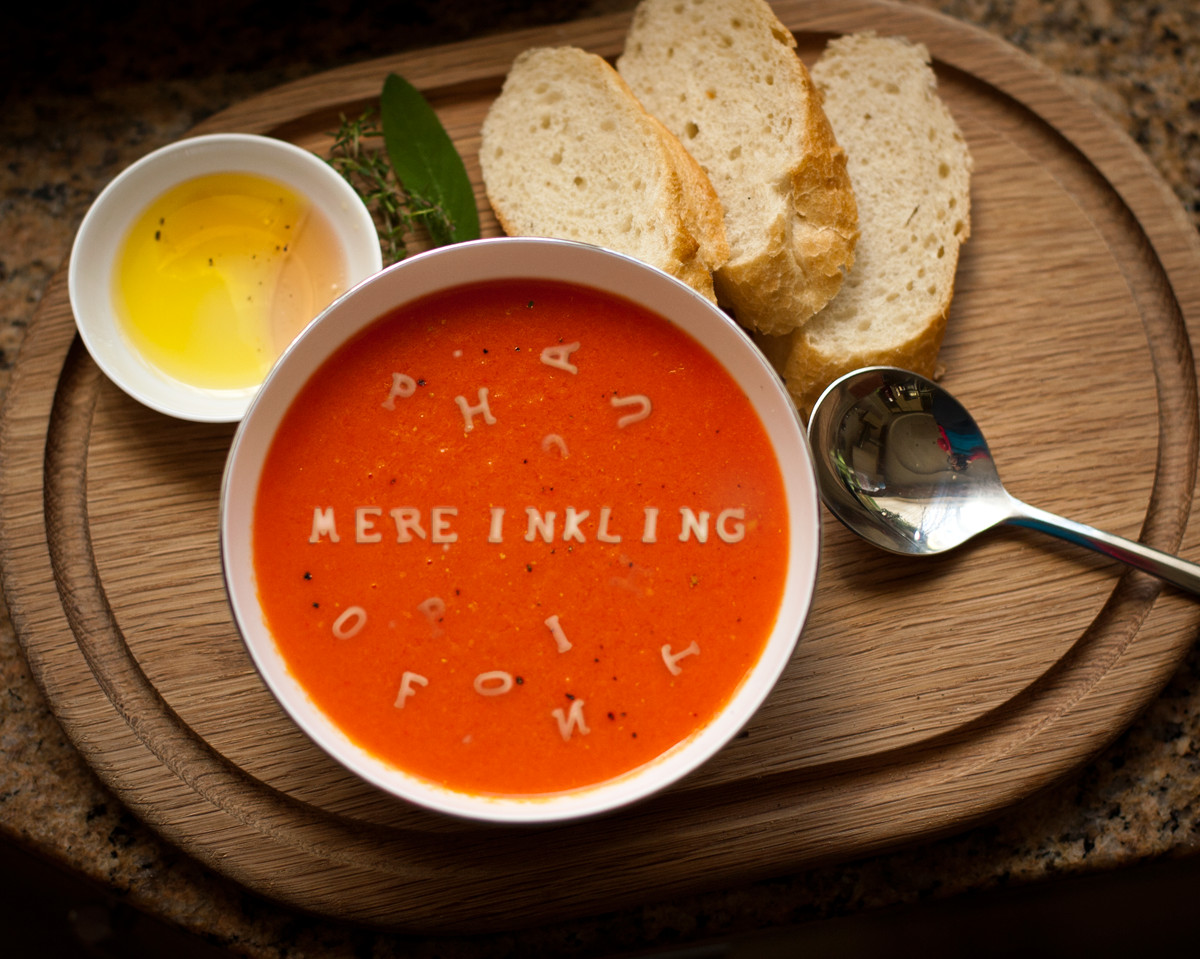
How many cans of SpaghettiOs would you need to purchase to be able to write the entire Lord of the Rings trilogy in their noodley alphabet?

What, you’ve never pondered that quandary? Well, now that the question has been posed, you may as well learn the answer.

The purveyor of this revelation is an online personality who analyzed the ratio of letters in cans of the SpaghettiOs A to Zs. He then devised a computer “program that converts books to SpaghettiOs.” [An inarguably valuable pursuit.]

It involved identifying the typical shapes of the pasta fonts.

Ah, to the solution to the puzzle. An individual seeking to replicate the Lord of the Rings would require 8,795 cans. The price would be slightly more than $2,000 and as a bonus, you would be left with more than eight million characters to devour.

Having labored to create the complex algorithms in his computer program, he has applied the versatile tool to other publications.

The King James Bible, for example, would demand 51, 214,669 cans to reproduce. At a price of approximately seventy-one billion dollars. [Editor’s note: the cost would probably be prohibitive, so don’t expect to see a physical attempt made in the near future.]

J.R.R. Tolkien was an extraordinary philologist. He loved languages, and he actually created more than one.

The creator of Middle Earth actually fashioned an alphabet for his Elven tongues. I have had my own name (by virtue of its meaning) rendered in Tengwar alphabet here.

Nevertheless, as inspired by linguistics and alphabets as he was, I doubt Tolkien would have been the least bit impressed by the canned pasta research.

In a 1956 letter, Tolkien described the process of completing his masterpiece for publication. I share the letter now, due to its reference to alphabets. However, due to its illuminating insight into the broader subject, I offer here a more extended rendition.

As ‘research students’ always discover, however long they are allowed, and careful their work and notes, there is always a rush at the end, when the last date suddenly approaches on which their thesis must be presented.

So it was with this book, and the maps. I had to call in the help of my son – the C.T. or C.J.R.T. of the modest initials on the maps – an accredited student of hobbit-lore. And neither of us had an entirely free hand.

I remember that when it became apparent that the ‘general map’ would not suffice for the final Book, or sufficiently reveal the courses of Frodo, the Rohirrim, and Aragorn, I had to devote many days, the last three virtually without food or bed, to drawing re-scaling and adjusting a large map, at which he then worked for 24 hours (6 a.m. to 6 a.m. without bed) in re-drawing just in time.

Inconsistencies of spelling are due to me. It was only in the last stages that (in spite of my son’s protests: he still holds that no one will ever pronounce Cirith right, it appears as Kirith in his map, as formerly also in the text) I decided to be ‘consistent’ and spell Elvish names and words throughout without k. There are no doubt other variations. . . .

I am, however, primarily a philologist and to some extent a calligrapher (though this letter may make that difficult to believe). And my son after me. To us far and away the most absorbing interest is the Elvish tongues, and the nomenclature based on them; and the alphabets.

My plans for the ‘specialist volume’ were largely linguistic. An index of names was to be produced, which by etymological interpretation would also provide quite a large Elvish vocabulary; this is of course a first requirement. I worked at it for months, and indexed the first two vols. (it was the chief cause of the delay of Vol iii) until it became clear that size and cost were ruinous.

Back to the noodle font. I doubt it Tolkien would have been impressed. What about his fellow Inkling, C.S. Lewis? What might he have said about the quantity of pasta-based “moveable type” required to reproduce Tolkien’s trilogy?

Allow me to take two simple words (out of context) from a letter he wrote in 1956. I think the Oxbridge don would have labeled the effort (and today’s post itself) “infinitely unimportant.”

Please forgive me if this sojourn into current trivia wasted your time. (But I hope, at least, that you enjoyed learning more about Tolkien’s linguistic and cartographic expertise.)

C.S. Lewis & Roald Dahl

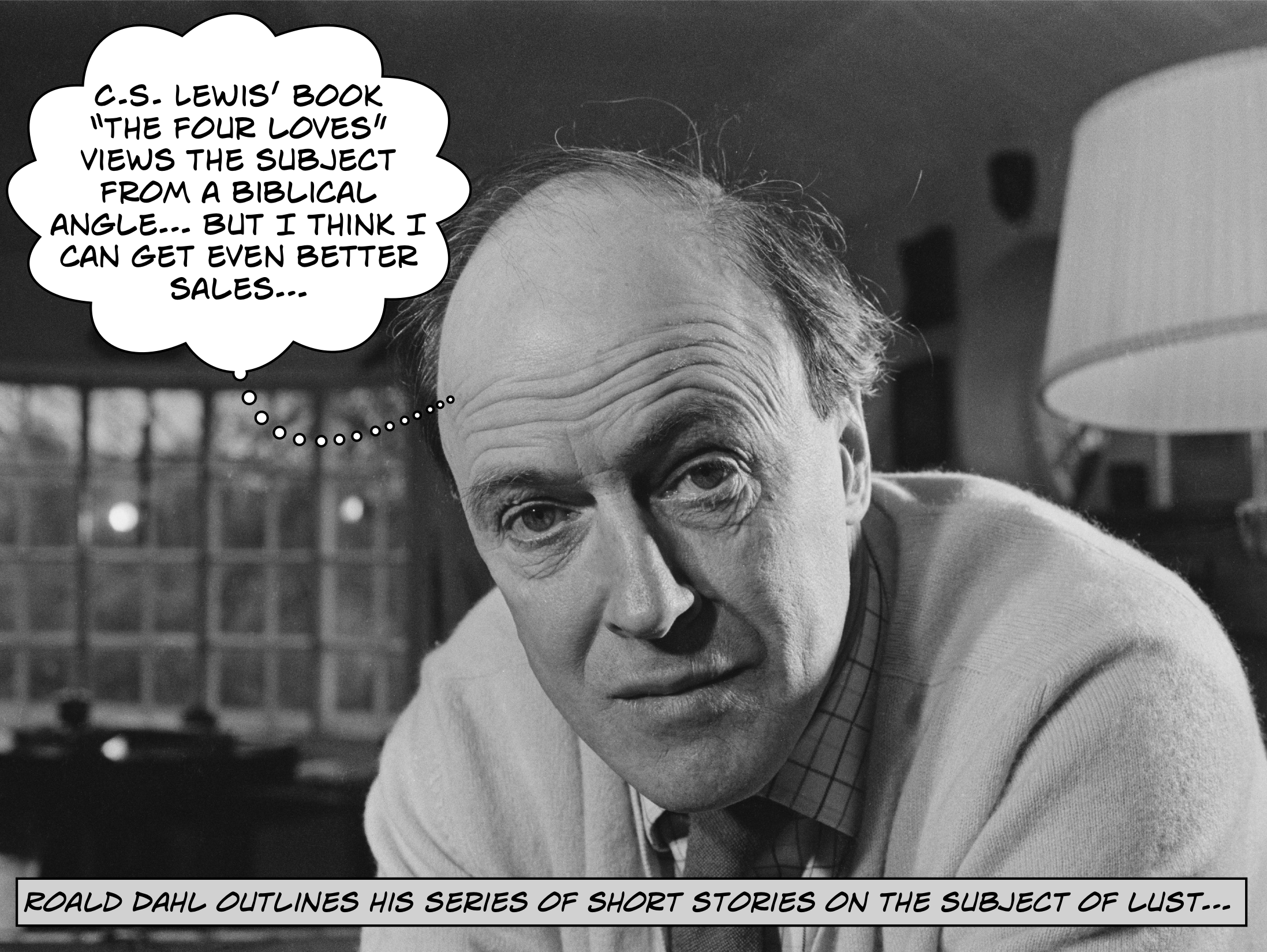
Do C.S. Lewis (1898-1963) and Roald Dahl (1916-1990) have anything in common, besides authoring books enjoyed by children?

Looking back, I must have been deprived of opportunities to read common children’s books. I recall my mom having many of Dr. Seuss’ classics, but don’t remember more advanced works such as those of Beatrix Potter or E.B. White.

I suppose that is why Roald Dahl’s name means little to me. By the time I was aware of his popular works, I was too old to appreciate them. Added to that was my intense dislike for the cinematic presentation of his Chocolate Factory, which has permanently (and probably unfairly) soured my impression of the poor man.

In Matilda, published in 1988, Dahl offers a rather curious homage to the Inklings. The young protagonist offers to her teacher the following observations.

“I like The Lion, the Witch and the Wardrobe,” Matilda said. “I think Mr. C.S. Lewis is a very good writer. But he has one failing. There are no funny bits in his books.”

“You are right there,” Miss Honey said.

“There aren’t many funny bits in Mr. Tolkien either,” Matilda said.

If you are intrigued by this brief interchange, you would probably enjoy reading “Disagreeing with Matilda on Lewis and Tolkien.”

Curiously, a number of people have offered their evaluations of Lewis and Dahl, vis-à-vis one another. Author Grudge Match: Roald Dahl vs. C.S. Lewis invited diverse contributions to the debate eight years ago on LibraryThing.

A Christian blogger offers a faith-based appraisal on an entertaining website called “Like but better.” It’s entitled “How C.S Lewis is like Roald Dahl, but better (and Aslan is like Willy Wonka, but better).”

C.S Lewis is serious about what Dahl jokes about; even as both want us to pursue a childlike wonder and joy. For Lewis these enchanted stories and our sense of wonder are small stories reflecting on the big story — the ‘myth that became history’ — the death and resurrection of Jesus.

A BBC Culture article is quite critical of Dahl, despite his popularity. The introduction to “The Dark Side of Roald Dahl” aptly describes the essay.

Roald Dahl was an unpleasant man who wrote macabre books – and yet children around the world adore them. Perhaps this shouldn’t surprise us, writes Hephzibah Anderson.

An article by a Jewish journalist refers to both of the authors discussed here. It describes his bitter introduction to the major flaws of an author whose work he enjoyed as a child. “Why I Hope My Kids Never Read Roald Dahl” is, for me, most valuable for the way in which the journalist regards the faith which underlies the tales of Narnia.

As a nerdy Jewish kid in Indiana and Tennessee in the late 1970s and 1980s, I had far better relationships with books than I did with other kids. If I liked a book, I read it again, and again and again.

And so it was with Roald Dahls “Charlie and the Chocolate Factory.” Dahl’s protagonists Charlie and later James (of the “Giant Peach”) both provided early models for how to find a better way through a hostile world where I always felt like an outsider.

Given that personal history, the announcement that Netflix has acquired Dahl’s entire catalog and plans a robust lineup of multimedia adaptations ought to feel like good news. . . .

Seeing his work still celebrated fills me with sadness, leaving me caught between attachment to something that mattered to me as a boy and commitment to the principles that, I hope, make me the man I am today.

Because I know that Roald Dahl hated Jewish people like me.

There are cases where it’s complicated to ascribe modern values to figures from the past and as a reader, my feelings, my emotions, are just not going to be consistent. I don’t share C.S. Lewis’ religious views . . . J.R.R. Tolkien’s “Lord of the Rings” trilogy is, I’m sad to say, bound up in long histories of racism.But my childhood copies of their books still occupy my shelves, some missing covers and pages, and I bought new copies for my kids and tried – with mixed success – to share my love of those stories with them. It’s hardly new for readers of one generation to struggle with the views of authors from another.But Dahl is different. He passed away in 1990, only 31 years ago. And we know he was an anti-Semite because he said so.

While I would challenge Perry’s modest critiques of the Inklings, I am delighted he is able to look beyond his adult disappointment with their imperfections to commend them to his own children. As for Dahl . . . this article reinforces my lack of regret in being unfamiliar with his work.

Enough, now, of their differences. I promised readers a surprising similarity between the two British authors.

And What Is Their Unusual Commonality?

In 1951, C.S. Lewis was approached by Prime Minister Churchill’s office to accept an honor occasionally bestowed upon renowned literary figures. He was invited to become a Commander of the Most Excellent Order of the British Empire. Lewis declined, because he felt the political implications might overshadow the nonpartisan spirit of his writings. He was, however, honored to have been offered the honour.

This decision brings us to the peculiar similarity between the two writers. It turns out that Roald Dahl also passed up the invitation to join this chivalric order.

And the two were not alone. In 2012 a list of deceased individuals who had declined related honors between 1951 and 1999 was published.

Literary names were prominent amongst those to have said no to CBEs, OBEs and knighthoods in the annual New Year or Birthday Honours list, with Dahl, Lewis, and Huxley . . . joined by fellow naysayers Eleanor Farjeon, the children’s author, the poets Philip Larkin and Robert Graves, who said no to both a CBE and a CH (Order of the Companions honour), literary critic F.R. Leavis, Booker [Prize] winner Stanley Middleton and the authors J.B. Priestley and Evelyn Waugh.

An aspiring literary historian might do well to research whether and why successful writers might be more inclined to dismiss such an honor than other British citizens. I wonder if that inclination would carry over to other nationalities or cultures.

Ultimately, I assume most writers care less about receiving honors, than having their work read. And, perchance, having their literary efforts improve the lives of one or two others along the way. [This statement inspired vigorous debate when I shared this draft with members of my critique group.]

That desire – to enrich lives – is what motivates me. I believe it is also what inspired C.S. Lewis. And I know we are not alone.

Don’t Be a Pirate

Pirates make for interesting reading. The Inklings thought so. In a 1932 letter to his brother, C.S. Lewis mentions Sir Walter Scott’s novel, The Pirate.

“I am now reading through [a Scott biography], and am just at the Shetland and Orkney diary:89 which you will constantly have been reminded of if you have read The Pirate.”

In 1952, Lewis mentioned to a colleague another pirate story. “High Wind in Jamaica which I’ve just read is better than I expected. . . . A grim book but good in its way.”

This is not to say that Lewis regarded pirate tales, as a genre, as very good. His praise of Ray Bradbury’s work includes an entertaining aside in this regard.

I have just read two books by an American ‘scientifiction’ author called Ray Bradbury. Most of that genre is abysmally bad, a mere transference of ordinary gangster or pirate fiction to the sidereal stage, and a transference which does harm not good.

Bigness in itself is of no imaginative value: the defence of a ‘galactic’ empire is less interesting than the defence of a little walled town like Troy. But Bradbury has real invention and even knows something about prose. I recommend his Silver Locusts.

With the recent exception of the Pirates of the Caribbean series, piracy does not seem to capture our cinematic imagination as it once did. Onscreen, buccaneers are often treated as heroic swashbucklers, as in the delightful Princess Bride.

However, in reality, we know real pirates were merciless.*

Some were “privateers,” authorized by a government to prey on the shipping of other countries. (Privateering was not banned until 1856.)⁑ They were simply pirates with papers, although they possessed a veneer of respectability in some circles. If you are interested in a recent argument for privateering “to fight Chinese aggression at sea,” You need to read “Unleash the Privateers!”

These oceanic criminals were not confined to exotic ports. As recently as 1614, the coast of Ireland was home to a major “pirate alliance.”

[In 1604] James I of England ended the long English naval tradition of “privateering” as part of a peace agreement with Spain. . . . Though it was risky work, many sailors preferred it to more official service on the King’s ships, which offered low pay, poor sanitary conditions, and an aging fleet.

Over time, English privateers grew in numbers, with the more successful commanding well-armed fleets of multiple ships. . . . as a consequence of the decision by James I, thousands of mariners suddenly found themselves out of work. Used to operating independently, they became prime targets to drift into piracy. Unsanctioned piracy, that is.

Long before Jack Sparrow ever considered wearing an eyepatch, pirates had become a staple Hollywood trope. In 1935 Errol Flynn appeared in Captain Blood, where he portrayed a gentlemanly physician who is falsely imprisoned and ends up becoming a hugely successful scourge of the seas.

A decade earlier, Douglas Fairbanks starred in The Black Pirate (1926) where his dashing athleticism entertained audiences. Here too the protagonist is actually a “good” person, enlisting in criminal ranks merely to punish those responsible for his father’s death.

Pirates in Inkling Literature

Both of the most famous Inklings included pirates in their best known works. J.R.R. Tolkien included an entire nation of pirates in Middle Earth. The Corsairs of Umbar were utterly despicable, and aligned along with the Haradrim on the side of Mordor. Even before we see them portrayed in the film set in the Third Age, they had carried destruction to the people of Gondor.

The second and greatest evil came upon Gondor in the reign of Telemnar, the twenty-sixth king, whose father Minardil, son of Eldacar, was slain at Pelargir by the Corsairs of Umbar. . . . a deadly plague came with dark winds out of the East. The King and all his children died, and great numbers of the people of Gondor . . . When King Telemnar died the White Tree of Minas Anor also withered and died (Annals of the Kings and Rulers).

C.S. Lewis also incorporated pirates into his own Narnian saga. The entire Telmarine population, which figures prominently in Narnian history, is descended from pirates who arrived there from Earth. In the following passage, Aslan explains this arrival to Prince Caspian.

“You, Sir Caspian,” said Aslan, “might have known that you could be no true King of Narnia unless, like the kings of old, you were a son of Adam and came from the world of Adam’s sons. And so you are. Many years ago in that world, in a deep sea of that world which is called the South Sea, a shipload of pirates were driven by storm onto an island.

And there they did as pirates would: killed the natives and took the native women for wives, and made palm wine, and drank and were drunk, and lay in the shade of the palm trees, and woke up and quarreled, and sometimes killed one another. And in one of these frays six were put to flight by the rest and fled with their women into the center of the island and up a mountain and went, as they thought, into a cave to hide.

But it was one of the magical places of that world, one of the chinks or chasms between that world and this. There were many chinks and chasms between worlds in old times, but they have grown rarer. . . . And so they fell, or rose, or blundered, or dropped right through, and found themselves in this world, in the Land of Telmar which was then unpeopled.

But why it was unpeopled is a long story: I will not tell it now. And in Telmar their descendants lived and became a fierce and proud people, and after many generations there was a famine in Telmar and they invaded Narnia, which was then in some disorder (but that also would be a long story), and conquered it and ruled it.

Epilogue: Don’t Be a Pirate

In a 1950 letter to a correspondent who had apparently argued that institutional loyalty is actually loyalty to individual leaders, Lewis disagrees.

No, I don’t agree that loyalty to an institution is simply loyalty to the personnel and their policy. If I join a ship because I like the captain I am not justified in deserting the moment he dies, nor because I dislike his successor.

There might come a point (e.g. if the new captain were using the ship for piracy) at which it would be my right, and my duty, to leave: not because I simply disliked him and his polity, but because the particular duty (keep your contracts) would now conflict with, and yield to, the higher and more universal duty (Don’t be a pirate).

Like C.S. Lewis, I assume most readers of Mere Inkling would agree that we must follow our conscience, should our earthly loyalties be directed toward an institution or person devoted to an evil end. In the military, this conundrum was addressed in the legal freedom—even mandate—to disobey “unlawful orders.”

No doubt many people are challenged on a regular basis to compromise their conscience in order to succeed in their morally-challenged environment. I would add my own voice to Lewis’ in urging them not to become a pirate.


* Much has been written about piracy, an ancient plague that still afflicts the world today. You can download a fascinating piece of history in the form of a 1724 London publication of A general history of the robberies and murders of the most notorious pyrates, and also their policies, discipline and government, from their first rise and settlement in the island of Providence, in 1717 to the present year 1724.

⁑ The vast extent of Atlantic piracy is sobering. One history site describes it thusly:

The Golden Age of piracy (c1680s–1726) was the most dramatic era of maritime marauding the world has ever known, a period which at its peak saw as many as 4,000 pirates a year wreaking havoc across the Atlantic and Indian oceans.

The age of colonial expansion meant that huge quantities of valuable cargoes were being shipped over vast ocean areas and, as European navies were reduced, many experienced sailors who were out of work turned to piracy.

Return with Me to Middle Earth

tolkien.pngJ.R.R. Tolkien’s tales of Middle Earth will once more be displayed in all of their digital radiance when a new series begins in two years. Yes, I said “series,” because it will not be coming to theaters. Instead it will be developed for subscribers to Amazon’s subscription service.

Some fans of Tolkien are understandably wary. Will it remain faithful to Tolkien’s vision (insofar as any heathen international corporation can understand it)? However, I’m inclined to feel optimistic.

One reason for my optimism is Amazon’s commitment to the quality of the production—they anticipate investing around one billion dollars in the property during the next five years. Beyond that, I suspect Amazon will protect this massive investment by not straying too far afield from the true spirit of Middle Earth.

The Hollywood Reporter states it’s up to Peter Jackson* whether or not he will be involved in the project. His attorney said Amazon was wise to bid high for this “property.”

We are in an era where [online] streamers are bidding up the price of programming. I think Amazon is taking a page out of the studios’ emphasis on franchises. They also are realizing that with the overproduction of television, you need to get the eyeballs to the screen, and you can do that with franchise titles.

Another technology news site points to the example of Game of Thrones upping the value of the Lord of the Rings project.

In a world where Disney has laid out impressive, interconnected franchises with its Marvel and Star Wars properties, and HBO is considering anywhere between three and five spinoffs for Game of Thrones, Middle-earth could be a property that gives Amazon a significant boost in the coming streaming wars, one that could entice even more people to sign up for Amazon’s Prime service.

This is wonderfully ironic, since G.R.R. Martin readily acknowledges his debt to Tolkien. In a solid article on this subject, “Is George R.R. Martin the ‘American Tolkien?’” the author identifies a significant difference between the two writers.

Tolkien’s creation displays a sense of depth yet unrivaled in the fantasy genre. In this way, Lord of the Rings is to Game of Thrones as the Atlantic Ocean is to Lake Michigan. In contrast to the invention of Martin’s world, which is secondary to his plotline, Tolkien built his reality from the ground up starting with languages.

The Rotten Tomatoes media review site offers some tantalizing details about what we can anticipate in the new series.

Amazon’s first map rendered a number of geographic features specific to the Third Age, including the East Bight of Mirkwood Forest . . . But fans who were hoping to see some of the great stories from earlier days dramatized with Amazon’s production values are in luck.

Stories like the sinking of Númenor—Tolkien’s take on the Atlantis myth, in which Sauron corrupted an island of seafaring men to invade the forbidden shores of the world’s far West—and the founding of the kingdoms of Arnor and Gondor could make for some spectacular television. . . .

So what does this mean? For one, the series will undoubtedly focus on Númenor** over other regions of Middle-earth. To understand the island’s significance, we need to go back to the end of the First Age and the downfall of the Dark Lord Morgoth.***

Wow.

This is going to be great. And to think, we owe it all to C.S. Lewis!


* Peter Jackson, of course, is the director who brought The Hobbit and The Lord of the Rings to the big screen.

** Númenor was the great island kingdom of humankind.

*** Morgoth is the greatest of the Ainur (angels in the Middle Earth cosmology). He fell from grace when he resisted the will of the Creator. He was an even greater Evil than his servant Sauron, who plagues the world in the Lord of the Rings trilogy.

The reference to Westeros in the illustration above is to the island in the Game of Thrones ruled by the Seven Kingdoms.

What We Worship

worshipping squirrel

It’s curious to consider the varieties of deities worshipped throughout history and around the globe. And it is important that we understand the god we choose to follow, as well as the nature of “faith” allows us.

This picture came from a nearby garden. The squirrel effects the pose of a worshipper, but it’s motivated by the nuts the gardener has rested in the Buddha’s lap. It’s not intended to be irreverent, and one assumes that Siddhārtha Gautama would not be offended.

The image is provocative. If you were to put yourself in the squirrel’s place, it would be of no surprise that you would be devoted to the “Provider of Nuts,” especially if you did not make the connection between the gentleman who filled and the statue that actually offers them to you.

Whether we are adherents of one of the so-called monotheistic religions, or pantheists who see the presence of god in all of universal nature, our “religion” directly affects our worldview and life choices.

And then there are the “no religious preferences,” who embrace or reject labels like “agnostic.” Some of them long to believe, but demand proof, where God calls for faith. Others opt for lives of hedonism, gambling that their notion there is no Creator is right. Many of these individuals actively hope that there is no God, and not a few of them have a nagging fear that he may just exist, and call them to account one day for their selfish lives.

C.S. Lewis was in the latter category. Before he became a Christian, Lewis entertained no desire to seek Christ out. “Amiable agnostics,” he wrote, “will talk cheerfully about ‘man’s search for God.’ To me, as I then was, they might as well have talked about the mouse’s search for the cat” (Surprised by Joy).

About the Nature of Faith

God chooses to call us into a restored relationship with himself through the mechanism of faith. If that word troubles you, think of it as “trust.” Faith is necessary, for an obvious reason. In the New Testament, we read, “without faith it is impossible to please him, for whoever would draw near to God must believe that he exists and that he rewards those who seek him” (Hebrews 11:6).

That faith is necessary may sound intimidating. However, the good news is that what God demands, he himself provides . . . even to the most reluctant of converts such as Saul of Tarsus or C.S. Lewis of Oxford.

For by grace you have been saved through faith. And this is not your own doing; it is the gift of God, not a result of works, so that no one may boast. (Ephesians 2:8-9)

In Mere Christianity, C.S. Lewis discusses the nature of faith at great length. He provides a number of helpful images. In the book he clearly distinguishes between faith (trust) and feelings or moods. I enjoy the way that the final sentence of this passage is evocative of the worshipping squirrel which inspired these reflections.

Faith, in the sense in which I am here using the word, is the art of holding on to things your reason has once accepted, in spite of your changing moods. For moods will change, whatever view your reason takes. I know that by experience.

Now that I am a Christian I do have moods in which the whole thing looks very improbable: but when I was an atheist I had moods in which Christianity looked terribly probable. This rebellion of your moods against your real self is going to come anyway.

That is why Faith is such a necessary virtue: unless you teach your moods “where they get off,” you can never be either a sound Christian or even a sound atheist, but just a creature dithering to and fro, with its beliefs really dependent on the weather and the state of its digestion.

Dithering to and fro, indeed.

A Surrealistic Postscript

I had been thinking about writing on this subject ever since I saw the photo, some months ago. I was spurred to compose it now, by a fact that recently appeared in Ripley’s Believe It or Not. It speaks for itself.

A Brazilian grandmother believed she was praying to a figurine of Saint Anthony for years, only to discover that it was an action figure of the Elf Lord Elrond from the “Lord of the Rings” films!

Tolkien, C.S. Lewis and Music

albumHave you ever written something that inspired a musician to compose new music? J.R.R. Tolkien hoped to do so one day, and had he lived to hear the scores of the Lord of the Rings trilogy created by Howard Shore, he would have been in awe.
I was reading Tolkien’s correspondence last week and came across a fascinating letter he wrote to a musician who was requesting permission to write a serious composition based on The Hobbit.

This would have been quite different than the quaint “Ballad of Bilbo Baggins,” made famous by Leonard Nimoy. (I wish their choreographer had read the book, so we could have been spared the tiny T-Rex arms sported during the chorus by the dancers.)

Anyway, returning to more serious musical ventures, in 1964 Tolkien received a request for permission to write a “Hobbit Overture.” It came from British composer Carey Blyton (1932-2002) who would become best known for his song “Bananas in Pyjamas.”

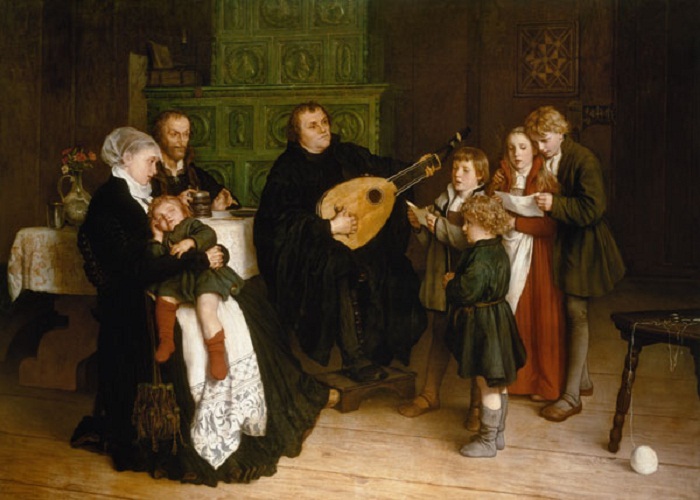
Tolkien’s response to the composer’s query is fascinating, on several levels. First, he is gracious in extending his permission, without any restrictions. And, in 1967 Blyton did compose “The Hobbit” Overture, opus 52a. It appears on the CD, British Light Overtures 3.

Secondly, he shares his unspoken desire that his work might someday inspire music. Then he makes a curious comment about the illustrations of Pauline Baynes, which would similarly grace the work of C.S. Lewis.

After that, Tolkien describes his own, musically impoverished, upbringing. Finally he expresses his deep appreciation for good music, despite his lack of knowledge on the subject.

And Tolkien accomplishes all of this in just a handful of sentences!

You certainly have my permission to compose any work that you wished based on The Hobbit. . . . . As an author I am honoured to hear that I have inspired a composer. I have long hoped to do so, and hoped also that I might perhaps find the result intelligible to me, or feel that it was akin to my own inspiration—as much as are, say, some (but not all) of Pauline Baynes’ illustrations. . . . .

I have little musical knowledge. Though I come of a musical family, owing to defects of education and opportunity as an orphan, such music as was in me was submerged (until I married a musician), or transformed into linguistic terms. Music gives me great pleasure and sometimes inspiration, but I remain in the position in reverse of one who likes to read or hear poetry but knows little of its technique or tradition, or of linguistic structure.

It is common for people of sincere Christian devotion, such as Tolkien and Lewis, to express an appreciation for the divine capacity of music to touch the human spirit.

luteMartin Luther, for example, wrote much about music. “Music is God’s greatest gift,” he proclaimed. He was not only a composer of hymns, but also an acceptable player of the lute, which he used to accompany his children during their family devotions.
Music is deeply intertwined with the heart of Christian worship.

C.S. Lewis on the Subject of Music

One of the modest challenges in contrasting fellow Inklings J.R.R. Tolkien and C.S. Lewis results from the significantly different natures of their literary corpora. While they both wrote fantasy, though of a vastly different magnitude, Lewis’ vocation as one of Christianity’s chief modern apologists necessitated that he defend the faith in diverse contexts. Thus, he wrote numerous essays and a number of texts addressing a wide range of considerations that his friend Tolkien never discussed in print.

Because of this distinction, it is relatively simple to discover what Lewis thought about the nature and powers of music. Typical of the man’s practical orientation, Lewis appears little interested in the abstract attributes of music. What interests him is its confluence with human existence. The following profound insight comes from his essay “On Church Music.”

There are two musical situations on which I think we can be confident that a blessing rests. One is where a priest or an organist, himself a man of trained and delicate taste, humbly and charitably sacrifices his own (aesthetically right) desires and gives the people humbler and coarser fare than he would wish, in a belief (even, as it may be, the erroneous belief) that he can thus bring them to God. The other is where the stupid and unmusical layman humbly and patiently, and above all silently, listens to music which he cannot, or cannot fully, appreciate, in the belief that it somehow glorifies God, and that if it does not edify him this must be his own defect.

Neither such a High Brow nor such a Low Brow can be far out of the way. To both, Church Music will have been a means of grace; not the music they have liked, but the music they have disliked. They have both offered, sacrificed, their taste in the fullest sense.

But where the opposite situation arises, where the musician is filled with the pride of skill or the virus of emulation and looks with contempt on the unappreciative congregation, or where the unmusical, complacently entrenched in their own ignorance and conservatism, look with the restless and resentful hostility of an inferiority complex on all who would try to improve their taste—there, we may be sure, all that both offer is unblessed and the spirit that moves them is not the Holy Ghost.

This discussion about church music is particularly interesting due to Lewis’ personal dislike for much of the music used in worship, which I’ve written about before.

Lewis described his own church music pilgrimage in “Answers to Questions on Christianity.”

My own experience is that when I first became a Christian, about fourteen years ago, I thought that I could do it on my own, by retiring to my rooms and reading theology, and I wouldn’t go to the churches . . .

If there is anything in the teaching of the New Testament which is in the nature of a command, it is that you are obliged to take the Sacrament [holy communion], and you can’t do it without going to Church. I disliked very much their hymns, which I considered to be fifth-rate poems set to sixth-rate music. But as I went on I saw the great merit of it.

I came up against different people of quite different outlooks and different education, and then gradually my conceit just began peeling off. I realized that the hymns (which were just sixth-rate music) were, nevertheless, being sung with devotion and benefit by an old saint in elastic-side boots in the opposite pew, and then you realize that you aren’t fit to clean those boots. It gets you out of your solitary conceit.

In “The Weight of Glory,” Lewis addresses this notion that we must look beyond the music itself, to assess its influence on our humanity.

The books or the music in which we thought the beauty was located will betray us if we trust to them; it was not in them, it only came through them, and what came through them was longing. These things—the beauty, the memory of our own past—are good images of what we really desire; but if they are mistaken for the thing itself they turn into dumb idols, breaking the hearts of their worshippers.

For they are not the thing itself; they are only the scent of a flower we have not found, the echo of a tune we have not heard, news from a country we have never yet visited.

Lewis recognized the deep influence and mystery with which music communicates and inspires. It is no accident that Narnia’s creation itself comes through Aslan’s song.

The Lion was pacing to and fro about that empty land and singing his new song. It was softer and more lilting than the song by which he had called up the stars and the sun; a gentle, rippling music. And as he walked and sang the valley grew green with grass. It spread out from the Lion like a pool.

It ran up the sides of the little hills like a wave. In a few minutes it was creeping up the lower slopes of the distant mountains, making that young world every moment softer.

Returning to “On Church Music,” Lewis expands on the importance of our intentions as we approach music.

It seems to me that we must define rather carefully the way, or ways, in which music can glorify God. There is . . . a sense in which all natural agents, even inanimate ones, glorify God continually by revealing the powers He has given them. . . . An excellently performed piece of music, as natural operation which reveals in a very high degree the peculiar powers given to man, will thus always glorify God whatever the intention of the performers may be. But that is a kind of glorifying which we share with the ‘dragons and great deeps,’ with the ‘frost and snows.’

What is looked for in us, as men, is another kind of glorifying, which depends on intention. How easy or how hard it may be for a whole choir to preserve that intention through all the discussions and decisions, all the corrections and the disappointments, all the temptations to pride, rivalry and ambition, which precede the performance of a great work, I (naturally) do not know. But it is on the intention that all depends.

When it succeeds, I think the performers are the most enviable of men; privileged while mortals to honor God like angels and, for a few golden moments, to see spirit and flesh, delight and labour, skill and worship, the natural and the supernatural, all fused into that unity they would have had before the Fall. . . .

We must beware of the naïve idea that our music can ‘please’ God as it would please a cultivated human hearer. That is like thinking, under the old Law, that He really needed the blood of bulls and goats. To which an answer came, ‘mine are the cattle upon a thousand hills,’ and ‘if I am hungry, I will not tell thee.’ If God (in that sense) wanted music, He would not tell us. For all our offerings, whether of music or martyrdom, are like the intrinsically worthless present of a child, which a father values indeed, but values only for the intention.

At the outset of this column I declared Tolkien would have been “in awe” of the musical score written to accompany the Lord of the Rings movies. Lewis too, I believe, would have been impressed by the scores composed for the three Chronicles of Narnia films made thus far. We owe a debt of gratitude to three composers: Howard Shore,* Harry Gregson-Williams,** and David Arnold***.

An Historical Postscript

In the spirit of Lewis and Tolkien, who appreciated the importance of music, we’ll close now with another engaging quotation from the wry pen of Doctor Martin Luther.

I wish all lovers of the unshackled art of music grace and peace from God the Father and from our Lord Jesus Christ! I truly desire that all Christians would love and regard as worthy the lovely gift of music, which is a precious, worthy, and costly treasure given to mankind by God.

The riches of music are so excellent and so precious that words fail me whenever I attempt to discuss and describe them…. In summa, next to the Word of God, the noble art of music is the greatest treasure in the world.

A person who gives this some thought and yet does not regard music as a marvelous creation of God, must be a clodhopper indeed and does not deserve to be called a human being; he should be permitted to hear nothing but the braying of asses and the grunting of hogs.

_____

* Howard Shore has nearly a hundred credits as a composer, conductor and orchestrator on the Internet Movie Database (IMDb). In addition to the Tolkien cinema projects, he has also worked on a number of other very successful films and ninety-six episodes of Saturday Night Live. Shore won three Oscars for his work on Lord of the Rings.

** Harry Gregson-Williams has nearly a hundred credits on the IMDb, including a number of box office successes, a variety of popular video games, and several productions in the Shrek series. He won awards for his work on the Chronicles of Narnia series and another of my favorite films, Kingdom of Heaven.

*** David Arnold, wrote the score for the third Narnia film, The Chronicles of Narnia: The Voyage of the Dawn Treader. He has seventy-three credits listed on IMDb, ranging from this year’s Independence Day: Resurgence, all the way back to a BBC made for tv picture entitled Mr. Stink.

Life in Middle Earth

theodenIf you resided in Middle Earth during the Third Age,* which of the major characters might you have been? Boromir,** Pippin, or perhaps Gandalf himself?

And, we’re only talking about the “good guys and gals.” We’ll have no one identifying with villains like Saruman, the Nazgûl ringwraiths or Grima Wormtongue here at Mere Inkling!

In a moment, I’ll help you answer that question.

Unfortunately, the internet abounds with time-consuming black holes. Pouring minutes and hours of our lives into the abyss of mindless videos or addictive games is the sad result.

Some entertaining diversions, however, possess merit. Case in point, an analysis of the leaders of Lord of the Rings, arranged according to their personality types.

Visiting a website such as this is not only fun, it offers insight into human differences. And, for the unwary, it may even reveal some new insights into our own nature.

I believe in the general validity of the best known personality inventory, the Myers-Briggs Type Indicator. I have posted in the past about C.S. Lewis’ (likely) personality type being an INFP. That appropriately identifies him with none other than Frodo, “the idealist.”

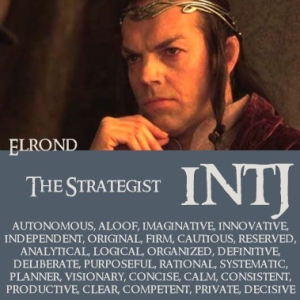
elrondMy own type is ENTJ, which matches with King Théoden above. As I age, however, I am finding myself less extraverted and more desirous of solitude. That means I am progressively becoming an INTJ, and that aligns me with Elrond. Frankly, both of the characterizations suit me quite well.

A person’s type is determined by which of four polarities is dominant.

Extraversion/Introversion

Sensing/Intuition

Thinking/Feeling

Judging/Perceiving

If you don’t know your type, and have the time to take an online assessment now, you can do so for free here.

You don’t need to do it to enjoy the Lord of the Rings chart though. So, which are Middle Earth leader are you? Find out here.

A Note of Caution

While instructive, tools such as this should never be used to put people into boxes (which is ironic, since the MBTI is graphically presented in that fashion).

The last thing we need is someone thinking they are defined by a psychological instrument such as this. After all, today’s Gimli may just well be tomorrow’s Bilbo.

_____

* The complete timeline of Middle Earth is available here.

** I have written in the past about the hero Boromir.