Damnable Typos & the Bible

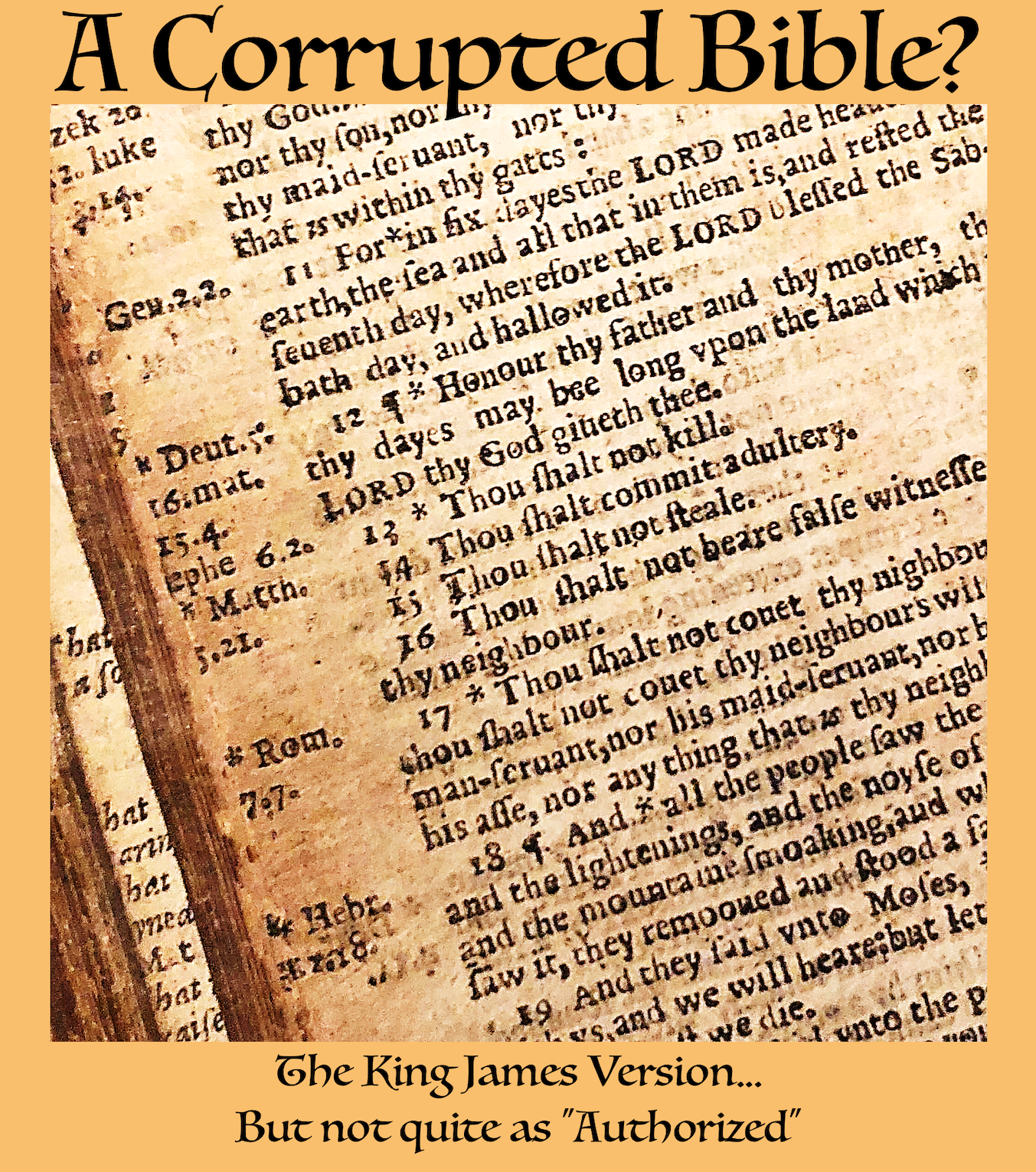
While the title of this post will be shocking to some, it’s far less scandalous than the typographical error discussed below. Due to two misprints appearing in a 1641 edition of the King James Bible (KJV), the publication has been labeled the “Wicked Bible.”

Translating the Scriptures is a necessary, and demanding, task. The early editions of the KJV (which was preceded by the Wycliffe Bible) reveal how vulnerable the words themselves were to being altered during the typesetting process.

I’ve written about this subject a number of times during the past decade, and even devoted a column to “C.S. Lewis’ School of Translation,” which is about something even more important than merely translating words. There I quote one of the great author’s deepest hopes.

What I want is to be the founder of a school of ‘translation . . .’ Where are my successors? (correspondence, 7 October 1945).

Returning to the seventeenth century book with its unfortunate errors, we witness an example of how even a solid translation can be derailed by careless (or malevolent) typesetters.

The magnitude of the mistake discovered in this particular edition caused its suppression, and most copies were destroyed. While some still exist in private hands, only fifteen remain in public collections. One of these made its way to New Zealand before being identified in 2018.

A Truly Scandalous Misprint

It would be one thing if a printer accidently dropped the final “e” from “breathe,” leaving the word “breath.” Even substituting an errant “w” for the “b,” would create an alternate word that would greatly muddle a passage . . . but still not appear remotely “wicked.” 

However, a 1631 mistake in an English Bible literally turned a passage – one of the Ten Commandments, no less – on its head. Rather than reading “Thou shalt not commit adultery,” this edition declares, “Thou shalt commit adultery” (Exodus 20:14).

The consequences of this disaster were significant, particularly for His Majesty’s official printers. In Cyprianus Anglicanus by royalist priest Peter Heylyn (1599-1662), we learn the details. (You can download a free facsimile of the volume which includes many other fascinating facts.) The passage related to the misbegotten tome reads as follows:

His Majesties Printers, at or about this time [1632], had committed a scandalous mistake in our English Bibles, by leaving out the word Not in the Seventh Commandment.

His Majesty being made acquainted with it by the Bishop of London, Order was given for calling the Printers into the High-Commission where upon the Evidence of the Fact, the whole Impression was called in, and the Printers deeply fined, as they justly merited.

Reports of Cases in the Courts of Star Chamber and High Commission, penned by Samuel Rawson Gardiner in 1886, includes a detailed account of the court’s findings. (Due to their uniqueness, I have transposed the full account, as found in two sections, as a footnote below.) One passage describes a second “gross error.”

. . . showed the two grossest errors, vizt. “Shalt commit adultery” and “great asse:” for “shalt not commit adultery” and “greatnesse…”

The second of these blunders occurs in Deuteronomy 5:24, which properly reads “Behold, the Lord our God hath shewed us his glory and his greatness.” (It should be noted that the word asse would most commonly be associated with donkeys.)

The magnitude of these mistakes can only be understood when one recognizes how reverentially the Scriptures were regarded at this time. C.S. Lewis would suggest that during an age when the Bible has been relegated to historic literature, it is difficult for us to comprehend the seriousness of this matter.

It is very generally implied that those who have rejected its theological pretensions nevertheless continue to enjoy it as a treasure house of English prose. It may be so. There may be people who, not having been forced upon familiarity with it by believing parents, have yet been drawn to it by its literary charms and remained as constant readers.

But I never happen to meet them. Perhaps it is because I live in the provinces. But I cannot help suspecting, if I may make an Irish bull, that those who read the Bible as literature do not read the Bible. (“The Literary Impact of the Authorised Version”).

In “Challenges in Printing Early English Bibles,” you can read about other Bibles featuring noteworthy mistakes. In two, “peacemakers” become “placemakers,” and “murmurers” are transformed into “murderers.” Another example, in the very first edition of the KJV, finds Jesus’ ancestor Ruth referred to by the male pronoun, due to the accidental dropping of an “s.”

More troubling is another early KJV Bible where “the text of Psalm 14 [reads], “The fool hath said in his heart there is a God,” rather than “The fool hath said in his heart there is no God.”

Worst of all, in terms of blasphemous connotations, would likely be the so-called “Judas Bible.”

In the 1609 Geneva Bible, the typesetters mistakenly replaced Jesus’s name with that of Judas. John 6:67 reads: “From that time many of his disciples went back, and walked no more with him. Then said Judas unto the twelve, Will ye also go away?”

Fortunately, modern editions of the Jewish and Christian Scriptures undergo thorough proofreading, so this sort of error is rare today. Still, typos will persist as long as the remotest possibility of error exists.

Those among us who have sought to have our writing published by traditional publishers may relate to the example with which we end. C.S. Lewis and J.R.R. Tolkien and even Mark Twain faced challenges working with some of their editors and publishers.

With all of the printing mishaps in the early English Bible, it is only appropriate that one of the editions was called “The Printers Bible.”

This text, published in about 1702, takes its name from a typesetting error found in Psalm 119, which should have read “Princes have per­secuted me without a cause” but was mistakenly printed as “Printers have persecuted me.”


Full references from Reports of Cases in the Courts of Star Chamber and High Commission by Samuel Rawson Gardiner (1886).

Mr Barker the printer. There is a cause begunne against him for false printeing of the Bible in divers places of it, in the Edition of 1631, vizt., in the 20 of Exod[us], “Thou shalt committ adultery”; and in the fifte of Deut[eronomy] “The Lord has shewed his glory, and his great asse”; and for divers other faults; and that they had printed it in very bad paper. And the Bishop of London showed that this would undoe the trade, and was a most dishonorable thing; that they of the church of Rome are soe carefull, that not a word or letter is to be found amisse in their Ladie’s Psalter and other superstitious books; and that we should not be soe carefull in printinge the sacred Scriptures; and that they in Holland, at Amsterdam, had gott up an English presse, and had printed the Bible in better paper, and with a better letter, and can undersell us 18d. in a Bible. Mr Barker and his partners endeavored in partt to excuse themselves, and had advocates to speake for them, and were willing to submitt, and promised to amend their faults; but the Court would not remitt their offense, but the cause was ordered to goe on.

The Printers having answered move the Court to passe by their oversight being the fault of the workmen but the King’s Advocate desired they might make their defense legally and the cause to go onto hearing: and that he might have liberty to put in additional articles against them. The Bishop of London would have the Church sett upright in her reputacion, that we are as carefull in printeing the Bible as they are of their Jesus’ psalter : and whereas the Printers say this is stirred up by the malice of one man against them; The Bishop saith he stirred not till the Bible was sould into his house, bought by his footman: and he saith the printinge is soe bbad and the paper too that, if it be not mended shortlie, they wilbe put downe by those of Amsterdam and their trade spoyled, and showed for the two grossest errors, vizt. “Shalt commit adultery” and “great asse:” for “shalt not commit adultery” and “greatnesse…” The Arch Bishop of Canterbury saith, that the Printers that print for his Matie have a very profitable place, and therefore should be more carefull. I knew the tyme when greater care was had about printeing, the Bibles especiallie, good compositors and the best correctors were gotten being grave and learned men, and the paper and letter rare and faire every way of the best; but now the paper is naught, the composers boyes, and the correctors unlearned: There is a farmer and he makes the benefit, and careth for nothing about it. They heretofore spent their whole time in printeing, but these looke to gaine, gaine, gaine, then they are not to be commended: Well, let them looke to it: and let the cause proceed, saith the ArchBishop. London. “There was a great deale of doo between you of this Citty and those of Cambridge heretofore about the priviledge of printeing the Bible and psalms which they of Cambridge claymed; then the Bible was exactlie printed, now you have forced the Cambridg printer to an agreement, now noe bible is right printed.

[It appears this volume itself would have benefited from having more diligent “correctors.” Perhaps most curiously, two spellings of the word printing – “printinge” and “printeing” – appear in this publication.]

Some Fresh Words

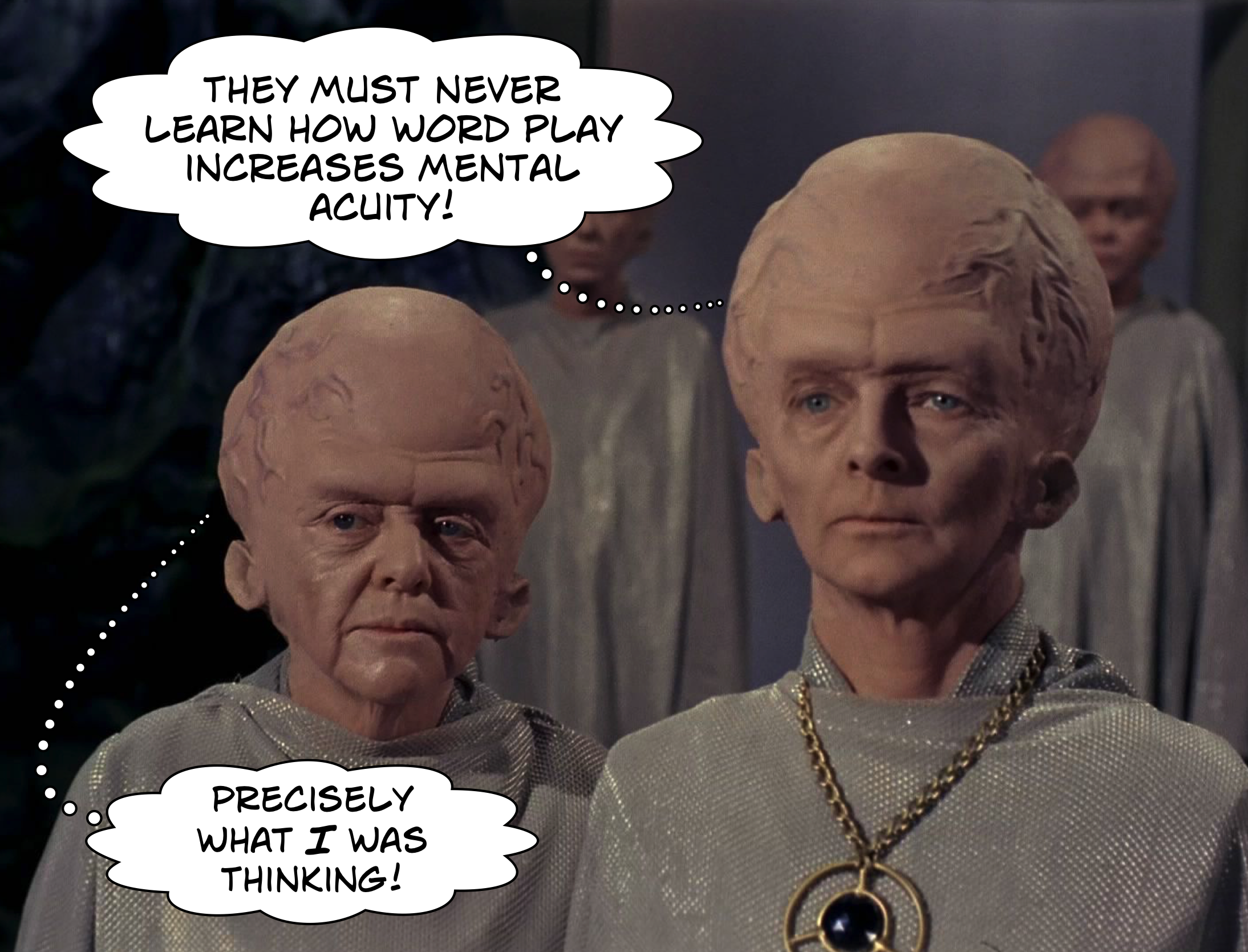
Here at Mere Inkling our admiration for C.S. Lewis moves us to emulate some of his practices. Thus, we are avid readers and we also enjoy learning new words.

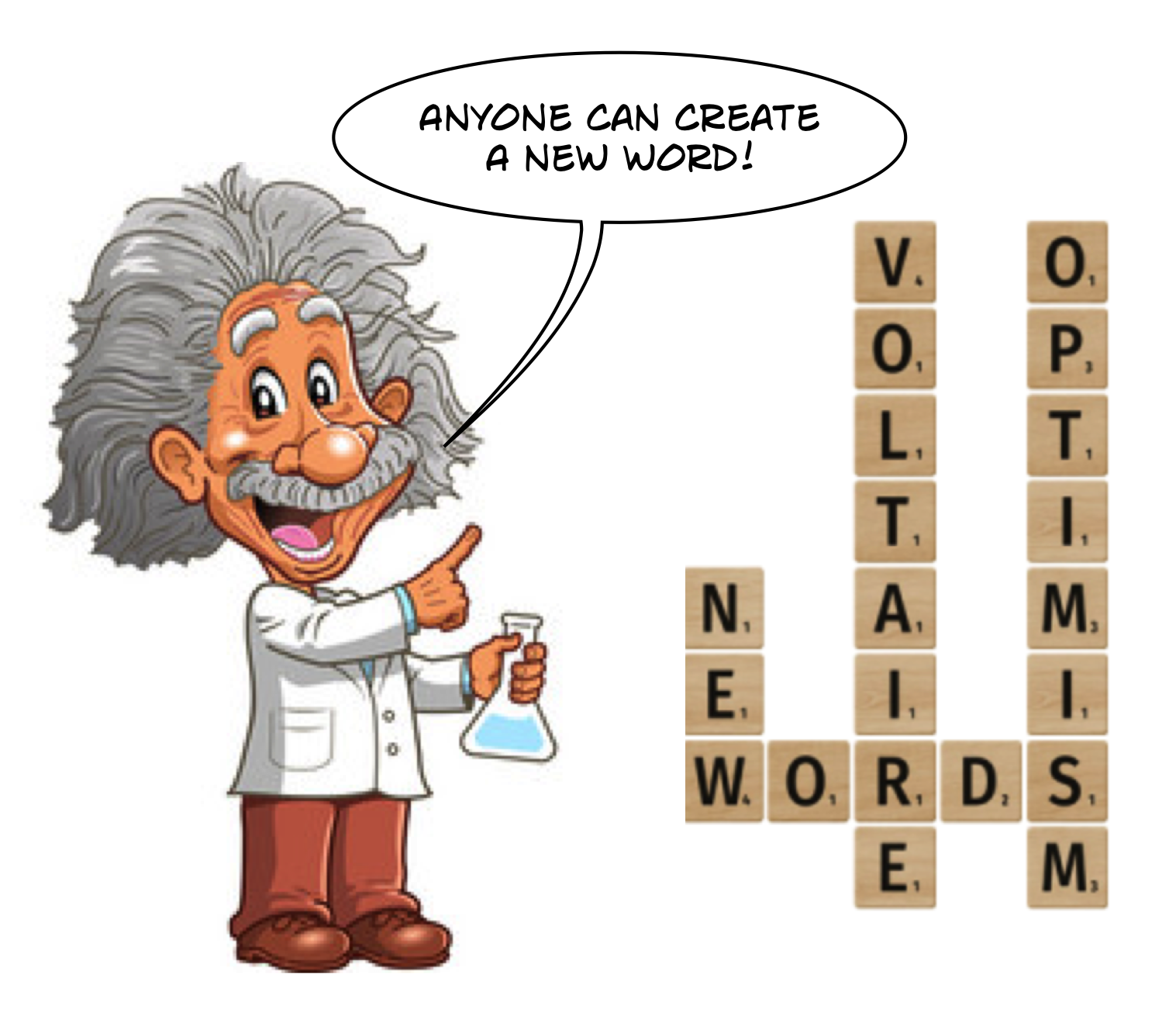
Some of us even enjoy inventing new words. No, we’re not so presumptuous as to desire to wend our ways into the dictionary. We just find this creative game to be both fun and useful for promoting mental health.

The challenge is providing rational definitions for our neologisms. These meanings can be serious or absurd; that doesn’t matter. Here are four I recently devised. (More, from years past, are available in the links I have included above.)

: Zambaloney : noun

A succulent cut of meat served only in skating rinks while the ice is being resurfaced during formal sporting competitions.

: Teguchigulper : noun

The indigenous name for the Honduran species of Chupacabra.

: Belladonut : noun

The presentation of poison derived from the perennial Atropa belladonna in appealing confectionaries. See also, doughnut. 

: Sinderella : noun

The Brothers Grimm story about a beneficent stepmother who learns her two biological daughters are being terrorized by their physically beautiful yet wicked stepsister.

We’re Not Alone

If you have tried your hand at this, or at least think it’s curious, you might be surprised to learn there are online “word generators” that perform at least part of this function. Let me mention a couple before sharing some more of my own inventions.

Unfortunately, some only toss out made up words, in literary isolation. This is the case of Random Word Generator, which did, however, suggest the intriguing word “picneted.”

Nonsense Word Generator “generates nonsense words based on a frequency list of phonemes as they occur in legitimate English words.” They claim “an actual word may slip through occasionally but it should mostly generate pronounceable gibberish.”

Since gibberish isn’t what I’m after, and I haven’t yet found an artificial intelligence website offering what I seek, it’s up to human beings to fill the gap. I hope you enjoy at least one or two of my other neologisms which follow.

New Words & Apropos Definitions 

: Dramadairy : noun

A business offering various products created from camelid milk. Suspense is generated by the uncertainty as to the particular species from the genus Camelus that provided the day’s primary ingredient.

: Sir Mize : proper noun

A minor noble of the Carolingian dynasty noted for his skill at accurately assessing situations despite lacking clear evidence for his hypotheses.

: Fleedom : verb

The attempt to escape restrictions imposed by an autocratic government.

: Califate : noun

The final destiny awaiting those who seek to impose their religion on others by means of violence rather than through thoughtful conversation and compassionate service.

: Hippocampus : noun

Commonly considered a region of the brain, the word originally referred to the special academies where priestesses of Taweret schooled Egypt’s hippopotami to serve Pharaoh.

: Integreation : verb

The process through which individuals or different groups are incorporated into a common whole, resulting in a truly synergistic benefit to all.

: Sinergy : noun

The crippling illusion that one should embrace diverse expressions of evil simply because they have become a standard practice under a decadent worldview.

: Laboratorinthine : adjective

Applied to extremely complex, often inescapable, research and medical facilities hosting arcane experiments on human subjects. See also, “science fiction and horror tropes.”

: Confort : noun, verb

noun : The false sense of security felt by a vulnerable individual who is being successfully deceived by a criminal. See conforter.

verb : The act of pretending to render aid or support to someone in need while laying the groundwork for a malevolent action toward them.

: Pintacostal : noun

Members of an ecstatic religious sect who allege that their ancestors arrived in America in the fifteenth century aboard one of Christopher Columbus’ smaller caravels.

: Calumknee : noun

Defamatory statements, especially directed toward athletes, related to the largest joint in a particular person’s anatomy.

: Commaraderie : noun

The collegiality felt by writers who advocate the use of the Oxford comma in lists of three or more items.

: Peripathetic : adjective

Traveling from place to place and job to job without ever finding the right fit.

: Lyberry : noun

A fruit concoction comprised of berries cleansed with minute amounts of lye water, which can be fatal if mismeasured. Not to be confused with the tragic mispronunciation of “library.”

: Indogtrination : noun

The process of training people to uncritically embrace a canine belief system and obedience to arbitrary and sometimes self-injurious commands. Antonym of catechesis.

: Banalgesic : noun

A drug designed to reduce the pain induced by participating in a banal conversation.

: Farmageddon : noun

Subterranean postapocalyptic nutrient harvesting plants specializing in either edible algae or plant-based meat alternatives (derived from algae).

: Olympipad : noun

Special edition of Apple’s iPad scheduled for release in conjunction with Olympiad XXXIV in Los Angeles in 2028.

And, as a final tribute to that great writers and saints, C.S. Lewis and J.R.R. Tolkien:

: Nearnia : noun

A fantastical world which does not require a Wardrobe to discover, but is as close as one’s own inspired imagination. See also, “Median Earth.”

Creative Definitions

Recently I read about an African Christian who was raised in a family that practiced ancestral worship. His grandfather was considered a witchdoctor, and it was expected that this young man would assume his duties.

The only problem is that when I initially viewed the passage, I read that his grandfather was a whichdoctor.

My once 20/20 vision is long gone. I still read without glasses (for the most part), but when I have yet to wash the sleep from my eyes, I encounter some surprising words.

“Whichdoctor” actually made some sense. I acknowledge it hasn’t been an English word (until now) but is so clear and so utilitarian that it cries out for recognition.

Whichdoctor: An interrogative used when attempting to ascertain which physician’s  attention an individual should be seeking. Especially useful in a hospital setting with numerous specialists. As in: Whichdoctor should I talk to, the podiatrist, the pediatrician, the pulmonologist, the psychiatrist, the pathologist, or the proctologist?

Last year I posted a column entitled “Create a Word Today.” It was inspired by an article I cited about making up useful words with pertinent definitions. I included 22 examples in my first column. They touched on a variety of subjects.

Mannekin: A boring, sedentary relative, who rarely rises from the couch.

Purrification: The activity of forgiveness and restoration that occurs when any cat makes a sincere confession of its sins.

Several were ecclesiastical in flavor.

Cathedroll: A large church led by a senior minister given to quaint and unintentionally comic humor.

Concupiscents: Hollywood’s obsession with including graphic sexual themes in all of their productions, resulting in the selling of their souls for pennies on the dollar.

And some related to the field of writing.

Manuskipped: The sad condition when the article or book into which you poured your blood, sweat and tears has been tossed into a slush pile to lie forgotten.

Proofreaper: Someone you invited to read your manuscript for misspellings who advises you to delete entire sections of your precious creation.

If you’re curious, there are 16 additional words included in the original post linked above.

So, allow me to offer here a few recent efforts, inspired by the misreading I referred to at the top of the page. How about 22 more?

But, before that, let’s look at a passage from C.S. Lewis’ autobiography, Surprised by Joy. As a person who has always appreciated a good vocabulary – and who is blessed to have grandchildren who are articulate beyond their years – I am saddened by Lewis’ youthful experience.

Reading much and mixing little with children of my own age, I had, before I went to school, developed a vocabulary which must (I now see) have sounded very funny from the lips of a chubby urchin in an Eton jacket.

When I brought out my “long words” adults not unnaturally thought I was showing off. In this they were quite mistaken. I used the only words I knew.

The position was indeed the exact reverse of what they supposed; my pride would have been gratified by using such schoolboy slang as I possessed, not at all by using the bookish language which (inevitably in my circumstances) came naturally to my tongue.

And there were not lacking adults who would egg me on with feigned interest and feigned seriousness – on and on till the moment at which I suddenly knew I was being laughed at.

Then, of course, my mortification was intense; and after one or two such experiences I made it a rigid rule that at “social functions” (as I secretly called them) I must never on any account speak of any subject in which I felt the slightest interest nor in any words that naturally occurred to me. And I kept my rule only too well . . .

Hooplaw: The two, vastly different legal disciplines dealing with (1) basketball contracts, and (2) litigation related to injuries caused by overly excited commotion.

Interdisciplinairy: The entire field of specialty studies related to the atmosphere.

Marvelouse: A creep or cad who considers himself something quite extraordinary.

Atrofee: The medical bills associated with the care of patients suffering an enduring coma.

Predilicktion: A preference for the sensation of taste over the other four basic human means of perceiving the world around us.

Ammunishun: The attitude of some activists seeking to restrict Second Amendment rights.

Megalowmaniac: The true stature of power hungry narcissists.

Gratuitruss: The unnecessary wear of a device to restrain a nonexistent hernia.

Calumknee: Malicious misrepresentations of political figures who frequently stumble.

Misscalibration: The awkward occasion when footwear retailers suggest to a young lady try on size 20 Air Jordans.

Patriought: The noble, often self-sacrificial, behavior of citizens who truly love their country.

Hypnothetically: The wide range of potentially embarrassing acts a person might be directed to perform under the influence of mesmerism.

Enlightenmint: The experience of achieve a spiritual pinnacle, accompanied by an aromatic scent.

Raspewtin: What Russia’s last Tsar should have done to Grigori.

Canonball: An elegant celebration lacking minuets, due the participants’ vows of celibacy, but not lacking in a wide selection of vinted and distilled beverages.

Immaculatte: A perfectly balanced beverage prepared by one of the world’s finest baristas.

Telegraft: Crimes committed over the phone by telemarketers, or via the airwaves and internet by televangelists.

Archietype: Ideas and symbols that recur in stories from many cultures and eras which bear a clear likeness to Archibald Andrews, who was often accompanied by his companion Jughead.

Syruptitious: The practice of slipping secrets past the unsuspecting by applying sticky sentimentality to one’s words.

Youphemism: The substitution of a mild or neutral description of someone to replace what you truly think of them.

Boulebard: The landscaped avenues of Stratford-upon-Avon by William Shakespeare.

Hagographer: An author who prefers to write the biographies of harpies rather than saints.

Admittedly, these words are not all top tier, but I challenge you to do better. If you have one or two winners, please cite them in the comments below. Oh, I just thought of another:

Religioscity: The religious devotion expressed by the residents of an urban environment.

Now I need to think about something else so I’ll be able to sleep tonight without jumbled word running through my mind.

As the sainted C.S. Lewis once described some troubled days in a boarding school while a youth:

Consciousness itself was becoming the supreme evil; sleep, the prime good. To lie down, to be out of the sound of voices, to pretend and grimace and evade and slink no more, that was the object of all desire—if only there were not another morning ahead—if only sleep could last for ever! (Surprised by Joy)

For the Love of Words

Most writers, including the majority of bloggers, share a common affection. We love words, don’t we?

That love extends beyond mere fondness. We can find ourselves in a state of genuine wonder as we ponder definitions, etymologies (evolutions through diverse languages), and phonesthetics (how they sound). As C.S. Lewis once wrote, “Isn’t it funny the way some combinations of words can give you – almost apart from their meaning – a thrill like music?”

This is one aspect of a great article in the current issue of The Lutheran Witness.* In “For the Love of Words,” editor Roy Askins uses C.S. Lewis’ classic The Four Loves to explore the relationship we have with words. He does so from a Christian perspective shared by the Oxford don.

Words shape us in profound ways. God formed creation and continues to sustain it by the Word of His mouth. . . . Words, then, are not incidental to our lives, but form a central part and core of our identity as God’s people. It’s certainly appropriate for us to talk about “loving words.”

The very word for a lover of words – logophile – combines the Greek logos (word) with philia, which Lewis deems priceless, like “that Philia which Aristotle classified among the virtues or that Amicitia on which Cicero wrote a book.”

[Coincidentally, I have an article about ministry to those who are mourning in the current issue of The Lutheran Witness, as well. I assure you, however, that’s not why I’m citing “For the Love of Words.”] Longtime readers of Mere Inkling are well acquainted with my personal fascination with words and wordplay.

Many of you share this predilection. C.S. Lewis describes us in Studies in Words.

I am sometimes told, that there are people who want a study of literature wholly free from philology; that is, from the love and knowledge of words. Perhaps no such people exist. If they do, they are either crying for the moon or else resolving on a lifetime of persistent and carefully guarded delusion.

Literature, Lewis argues, is not simply the sum of its words. It involves the history of the words, their complex shades of meaning, and even what those very words meant to their original writers.

The Uniquely Christian Perspective

God pours out his gifts of writing quite broadly. Countless styluses, quills and pens have been wielded by talented pagans and atheists over the centuries.

Still, as Askins’ article alludes, Christians have a unique connection to words. Not only did God speak all creation into existence through his Word, but that Logos, that Word became incarnate and suffered an innocent death so that humanity might be redeemed. Askins concludes his article with a joyful truth.

When we seek to love words, then, we do not seek to love them as words in themselves. This danger we editors and writers must mark and avoid. No, we love words because in them and by them, we hear of and share God’s love for us in Christ. He alone makes words holy and precious; He alone makes words worth loving.

I love these closing words. And I strongly believe C.S. Lewis would too.


* The Lutheran Witness is the magazine of the Lutheran Church – Missouri Synod.

Learning New Words

When you encounter an unfamiliar word, do you consider that inconvenient, or exciting?

I encountered a new word today. I read a lot, but rarely do I encounter an unfamiliar word.* I share it with you because of its peculiar meaning. You may want to use it sometime. The drawback is that it is a tad antiquated (thus its unfamiliarity). The word is “Panglossian.”

My “passing” grade in the study of Classical Greek in 1977 suggested the word might mean multi-lingual, since pan means “all,” and glossa means languages or tongues. I was wrong—but for a very odd reason.

Panglossian, you see, doesn’t refer to the literal meaning of its root words. It is based on the qualities of a character created by Voltaire for his satirical novella, Candide. Ironically, Voltaire presumably christened his professor of métaphysico-théologo-cosmolonigologie with this nomen⁑ because of its actual meaning.

The adjective Panglossian, however, has a completely distinct definition. Its difference was signaled for me by the capitalization of the first letter. Fans of Voltaire (among whom I do not count myself, or C.S. Lewis, for that matter) may already know its meaning. a definition, trust me, we shall get to momentarily.

First, I want to share C.S. Lewis’ observation about Voltaire, a Deist who was a savage critic of Christianity. In his autobiography Lewis includes the philosopher in a list of people he considered allies during his own season of atheism.

All the books were beginning to turn against me. Indeed, I must have been as blind as a bat not to have seen, long before, the ludicrous contradiction between my theory of life and my actual experiences as a reader.

George MacDonald had done more to me than any other writer; of course it was a pity he had that bee in his bonnet about Christianity. He was good in spite of it. Chesterton had more sense than all the other moderns put together; bating, of course, his Christianity. Johnson was one of the few authors whom I felt I could trust utterly; curiously enough, he had the same kink. Spenser and Milton by a strange coincidence had it too.

Even among ancient authors the same paradox was to be found. The most religious (Plato, Aeschylus, Virgil) were clearly those on whom I could really feed.

On the other hand, those writers who did not suffer from religion and with whom in theory my sympathy ought to have been complete—Shaw and Wells and Mill and Gibbon and Voltaire—all seemed a little thin; what as boys we called “tinny.” It wasn’t that I didn’t like them. They were all (especially Gibbon) entertaining; but hardly more. There seemed to be no depth in them. They were too simple. (Surprised by Joy).

Voltaire’s religious views aside, in Dr. Pangloss he devised a character energized by an incurable optimism. From that characterization, fifty years after Voltaire’s work another writer derived the adjective. If you are like me, knowing a word’s etymology—its origin and history—is intrinsically satisfying.

So, as Merriam Webster says: Pan·​gloss·​ian | pan-ˈglä-sē-ən was first used in 1831 to describe someone or something as being “marked by the view that all is for the best in this best of possible worlds: excessively optimistic.”

And, since the minting of new words is an ongoing process, it comes as no surprise panglossian has spawned variations.

According to a word research site, “writers have since made several compounds out of his name, such as Panglossic and Panglossism, but the adjective Panglossian is by far the most common and is frequently found even today.”

I encountered the word in an interesting First Things essay entitled “The Gospel According to Dickens.” The author describes Dickens’ hopeful tone and confidence, but declares “Dickens was not Panglossian, however. He expressed scorn for the society that insults and injures the weak and vulnerable.”

While I’m neither panglossic nor inclined in the least to panglossism, I’m glad such people exist. Their naiveté makes this world of ours far more interesting.⁂


* This is true, aside from specific “names” of things like an animal genus (e.g. trochilidae for hummingbirds or urochordate for the beloved sea squirt), or a pharmaceutical (e.g. Unituxin or Tecfidera). The business channel CNBC reports:

“If it seems as if drug names have been getting weirder, it’s because, in some cases, they have. . . . drug names use the letter Q three times as often as words in the English language. For Xs, it’s 16 times as much. Zs take the cake, at more than 18 times the frequency you’d find them in English words. And Ws? You’ll rarely see one in a drug name.” And, shockingly, the cost ranges from $75,000 to $250,000 for developing a single drug brand name.”

⁑ I studied Latin too, way back in 1969-71. The grades for my Latin scholarship were also “satisfactory.”

⁂ No offense intended to any readers of Mere Inkling who count themselves among the excessively optimistic! But, as for me, I’ve yet to be panglossterized.

C.S. Lewis and the History of Words

Like many of you, I love words. Like C.S. Lewis, I recognize the value of understanding each word’s etymology—its origin and history.

That’s why I was hooked right from the beginning by a short essay on “Language and the Bible” that I read in a magazine to which I subscribe. Dr. Mark Ward’s column goes by the heading Word Nerd. (Yes, I recognize the title is dweebish, but bear with me, his insights are worthwhile).

Word histories are for precocious nine-year-old homeschoolers who enjoy presenting irrelevant factoids to bemused adults. But word histories are history, and they come with all the drama that human life does.

You don’t have to be a geek to have fun with etymologies. Right here at Mere Inkling we enjoyed exploring Viking words that found their way into English. We also discussed the importance of using the etymological meanings of one’s name when determining how that name is properly rendered in the Elvish tongues of Middle Earth.

Etymology is serious business to those of us who study history and, especially, theology. The article I just cited is available online in a delightful video presentation. I’ll link to it below, for those interested in language as it relates to the Bible. Yet, even for those without these theological or historical interests, learning the life story of words can be fascinating, and even inspiring.

Listen to C.S. Lewis’ thoughts on the importance of philology, the broader study of languages which incorporates etymology.

I am sometimes told that there are people who want a study of literature wholly free from philology; that is, from the love and knowledge of words. Perhaps no such people exist. If they do, they are either crying for the moon or else resolving on a lifetime of persistent and carefully guarded delusion.

If we read an old poem with insufficient regard for change in the overtones, and even the dictionary meanings, of words since its date—if, in fact, we are content with whatever effect the words accidentally produce in our modern minds—then of course we do not read the poem the old writer intended.

What we get may still be, in our opinion, a poem; but it will be our poem, not his. If we call this tout court “reading” the old poet, we are deceiving ourselves. If we reject as “mere philology” every attempt to restore for us his real poem, we are safeguarding the deceit.

Of course any man is entitled to say he prefers the poems he makes for himself out of his mistranslations to the poems the writers intended. I have no quarrel with him. He need have none with me. Each to his taste. (Studies in Words)

Exciting News for Word Lovers

The Oxford English Dictionary (OED) provides an unrivaled treasure-trove of information about the world’s most influential language. And—it is currently being expanded. The second edition, published in 1989, consists of twenty volumes (21,728 pages). The new edition will, of course, eclipse that.

Best of all, will be the OED’s deeper exploration of each word’s etymology. As they say in the already-released Preface to the Third Edition of the OED:

The revision of the Oxford English Dictionary’s etymological component is a substantial undertaking. In the First Edition many entries whose origin was taken to be self-evident (typically native English formations) were not provided with etymologies.

In the revised material each entry has a formal etymology. . . . the most significant changes relate to the analytical content of the revised etymologies, which for the most part update text which appeared in the First Edition of the Dictionary, and therefore represented the state of scholarly knowledge approximately one hundred years ago.

Your reward for reading this far: At the beginning of this post, I quoted from the Bible Study Magazine article that inspired it. This is a link to the article itself . . . but I strongly recommend you follow this link to the video version by the author, which I mentioned earlier.

A Bonus Surprise from C.S. Lewis

I suspect most fans of C.S. Lewis would imagine him to be very fastidious, even punctilious, about spelling. The following letter will prove otherwise.

Lewis recognized the purpose of language is to communicate, and although there are valid reasons to investigate their etymologies, such pursuits need not muddy the conversation, so to speak. This letter was published on New Year’s Day in 1960 in the London Times Educational Supplement. It was written in response to a contemporary debate about “spelling reform.”

Nearly everything I have ever read about spelling reform assumes from the outset that it is necessary for us all to spell alike. Why? We got on for centuries without an agreed common orthography.

Most men of my age [i.e. officers serving during WWI] remember censoring the letters of soldiers and know that even the wildest idiosyncrasies of spelling hardly ever made them unintelligible.

Printing houses will always have, as they have now, their own rules, whether authors like them or not. Scholars, who know the ancestry of the words they use, will generally spell them accordingly.

A few hard words will still have to be learned by everyone. But for the rest, who would be a penny the worse if though and tho, existence and existance, sieze, seize and seeze were all equally tolerated?

If our spelling were either genuinely phonetic or genuinely etymological, or if any reform that made it either the one or the other were worth the trouble, it would be another matter.

As things are, surely Liberty is the simple and inexpensive ‘Reform’ we need? This would save children and teachers thousands of hours’ work. It would also force those to whom applications for jobs are made to exercise their critical faculties on the logic and vocabulary of the candidate instead of tossing his letter aside with the words “can’t even spell.”

So, console yourself today with the knowledge that C.S. Lewis would not judge you for accidentally writing “sieze,” or using personal shorthand like “tho” or “thru.” Lewis respected the value of etymology, but he also understood quite well its proper place.

C.S. Lewis & Anodyne Writing

Do you practice anodyne writing? Or, perhaps you enjoy reading anodyne literature?

Talk about a phrase with two different meanings!

I must not be reading the right publications, because until recently I was only aware of the medical sense of the word. Apparently I’m not alone in having forgotten the second usage (if I ever knew it). One “publication coach” writes:

I always welcome the chance to learn new words—or to cement the knowledge of words I should know already. Anodyne falls into this latter camp. I probably confer with my dictionary at least once a year to determine the meaning of this word and yet, despite the frequent checking, I can’t seem to hold the definition in my brain.

Like so many words, anodyne enters English, via Latin, from Greek. It’s literal meaning is “without pain.” Thus, it typically refers (as a noun) to medicines or medical treatments devoted to eliminating pain.

By extension, anodyne is also applied (as an adjective) to other things, such as writing. In this context it would refer to writing where the purpose is to comfort, or to alleviate pain. This is the good sense of the word.

An example of this use appears in “L.M. Montgomery’s The Watchman and Other Poems, a Review.” There, Brenton Dickieson expertly describes the value good-but-not-great poetry by affirming its reassuring essence in its historical context. “Any one of these poems is quite nice on its own and an anodyne to the negative poetry of many of the WWI poets.” A positive, and astute, assessment.

There is, however, a second sense in which anodyne is applied to literature.* It may mean something so inoffensive, so innocuous, that it becomes boring.

At one university writing center they describe this evolution of the word.

[An anodyne word] lets a disturbing idea be described in a soothing manner. . . .

The OED Online lists several definitions, all about a procedure or medicine that eases pain, the oldest dating from the 16th Century. Only more recently has the word come to include anything that may avoid a strong response. It can mean something so inoffensive as to be bland, the cafeteria pudding of language.

So, as for anodynic writing, it is admirable when it relieves pain and suffering. If its primary goal is to be innocuous, that’s another matter. Essentially, comfort—good, pablum—not so much.

Lewis’ Use of Anodyne

Unsurprisingly, C.S. Lewis uses this word in its positive sense of alleviating discomfort. Two occurrences in The Screwtape Letters will illustrate. (Remember, these words of the counsel of one demonic tempter to another.)

But hatred is best combined with Fear. Cowardice, alone of all the vices, is purely painful—horrible to anticipate, horrible to feel, horrible to remember; Hatred has its pleasures. It is therefore often the compensation by which a frightened man reimburses himself for the miseries of Fear.

The more he fears, the more he will hate. And Hatred is also a great anodyne for shame. To make a deep wound in his charity, you should therefore first defeat his courage.

Not only do the demons seek to foster hatred in their human targets, they encourage us to seek counterfeit solace in destructive places.

In the first place I have always found that the trough periods of the human undulation provide excellent opportunity for all sensual temptations, particularly those of sex. This may surprise you, because, of course, there is more physical energy, and therefore more potential appetite, at the peak periods; but you must remember that the powers of resistance are then also at their highest.

The health and spirits which you want to use in producing lust can also, alas, be very easily used for work or play or thought or innocuous merriment. The attack has a much better chance of success when the man’s whole inner world is drab and cold and empty. . . .

It is the same with other desires of the flesh. You are much more likely to make your man a sound drunkard by pressing drink on him as an anodyne when he is dull and weary than by encouraging him to use it as a means of merriment among his friends when he is happy and expansive.

Never forget that when we are dealing with any pleasure in its healthy and normal and satisfying form, we are, in a sense, on the Enemy’s [God’s] ground. I know we have won many a soul through pleasure. All the same, it is [God’s]  invention, not ours. He made the pleasures: all our research so far has not enabled us to produce one. All we can do is to encourage the humans to take the pleasures which our Enemy has produced, at times, or in ways, or in degrees, which He has forbidden.

Having read the majority of what C.S. Lewis published, I assert with certitude that his writing is anodyne—it is healing. Some of it may be discomforting (for a moment), and much of it may be demanding (in the sense of requiring our mental and spiritual focus to understand it), but it was all written to edify.

Postscript, Star Date 73890.7

There is one more use of the word anodyne which I did not include above, due to its fictional source. In the Star Trek universe, the starships rely on a massive number elements, including the ubiquitous “anodyne relay.”

The circuits invariably appear to be perfectly reliable during routine missions. However, they are prone to malfunctioning at critical moments and threatening the lives of everyone aboard.


* Anodyne is also applied—in both its positive and negative senses—to music and other activities.

Vulgar Christianity

vulgarityIf I were to say “vulgar Christianity is a good thing,” what would you think?

It depends, doesn’t it, on the meaning you ascribe to the word “vulgar.” For, even though it is most often used in a derogatory sense today, vulgar also means common or genuine.

Here, in modified order, are some definitions gleaned from an internet dictionary. The first three represent the most vulgar use of the word.

Vulgar, 1350-1400; Middle English < Latin vulgāris, equivalent to vulg (us) the general public + -āris -ar

  1. characterized by ignorance of or lack of good breeding or taste: vulgar ostentation.
  2. indecent; obscene; lewd: a vulgar work; a vulgar gesture.
  3. crude; coarse; unrefined: a vulgar peasant.

The next two definitions relate to the more historic, rather less crass application of the word.

  1. of, relating to, or constituting the ordinary people in a society: the vulgar masses.
  2. lacking in distinction, aesthetic value, or charm; banal; ordinary: a vulgar painting.
  3. current; popular; common: a vulgar success; vulgar beliefs.

The final definition of vulgar relates to language: “spoken by, or being in the language spoken by, the people generally; vernacular: vulgar tongue.”

The most visible adaptation of the root word likely comes in the title of the Latin translation of the Holy Scriptures completed by the ascetic saint, Jerome (347-420). The Vulgate, came to be called in Latin versio vulgata or vulgata editio, which meant the commonly used or read version.

Vulgarity in C.S. Lewis

Naturally, Lewis did not communicate in a vulgar (objectionable) way. He did, however, strive to reach the common men and women of the day, doing so more effectively than many clergy appear(ed) capable.

There are ample examples of the wide use of the word in Lewis’ works. In “Christianity and Culture,” he distinguishes between objective and subjective assessments of the value of literature.

A bad book is to be deemed a real evil in so far as it can be shown to prompt to sensuality, or pride, or murder, or to conflict with the doctrine of Divine Providence, or the like. The other dyslogistic terms dear to critics (vulgar, derivative, cheap, precious, academic, affected, bourgeois, Victorian, Georgian, “literary,” etc.) had better be kept strictly on the taste side of the account.

In discovering what attitudes are present you can be as subtle as you like. But in your theological and ethical condemnation (as distinct from your dislike of the taste) you had better be very un-subtle. You had better reserve it for plain mortal sins, and plain atheism and heresy.

For our passions are always urging us in the opposite direction, and if we are not careful criticism may become a mere excuse for taking revenge on books whose smell we dislike by erecting our temperamental antipathies into pseudo-moral judgements.

In Studies in Words, we gain an interesting insight into Lewis’ understanding of himself. He discusses how the concept of “bourgeois,” which simply means middle-class or conventional, is twisted by elitists to mean something offensive.

All my life the epithet bourgeois has been, in many contexts, a term of contempt, but not for the same reason. When I was a boy—a bourgeois boy—it was applied to my social class by the class above it; bourgeois meant “not aristocratic, therefore vulgar.”

When I was in my twenties this changed. My class was now vilified by the class below it; bourgeois began to mean “not proletarian, therefore parasitic, reactionary.” Thus it has always been a reproach to assign a man to that class which has provided the world with nearly all its divines, poets, philosophers, scientists, musicians, painters, doctors, architects, and administrators.

I am so happy, and blessed, that C.S. Lewis was a vulgar man . . . just like me.

For those who have read this far, I offer now one of Lewis’ poem with a related theme. Enjoy.

On a Vulgar Error

No. It’s an impudent falsehood. Men did not

Invariably think the newer way

Prosaic mad, inelegant, or what not.

Was the first pointed arch esteemed a blot

Upon the church? Did anybody say

How modern and how ugly? They did not.

Plate-armour, or windows glazed, or verse fire-hot

With rhymes from France, or spices from Cathay,

Were these at first a horror? They were not.

If, then, our present arts, laws, houses, food

All set us hankering after yesterday,

Need this be only an archaising mood?

Why, any man whose purse has been let blood

By sharpers, when he finds all drained away

Must compare how he stands with how he stood.

If a quack doctor’s breezy ineptitude

Has cost me a leg, must I forget straightway

All that I can’t do now, all that I could?

So, when our guides unanimously decry

The backward glance, I think we can guess why.

_____

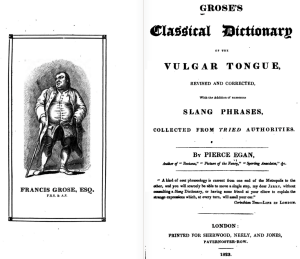
The image above is taken from Grose’s Classical Dictionary of the Vulgar Tongue by Pierce Egan (1823). Caution, even though this slang is centuries old, some of it is vulgar in every sense of the word; it may even cause one to blush.

Obscenic Words

paskalevThere is something obscene about the title of some recent recordings of a Norwegian/Bulgarian musician. He labeled the collection “Obscenic Sessions.”

Now, I realize that English may be his third or fourth language, but surely someone involved in the project knew that obscenic is not really a word. And, if a person is attempting to coin a new word, there are more creative ways than simply changing the ending of an adjective to alter it into another adjective. (I suppose there is a slim chance it’s either a Norwegian or Bulgarian word, but I suspect not.)

There’s something else about the collection that also strikes me as potentially obscene. Apparently the music was recorded during a live performance at an actual Anglican church. The full title reads: “Obscenic Sessions Live From St. Margaret’s Of Antioch (Liverpool, UK).”

Why, I wonder, would a priest allow his sanctuary to be used for obscenic sessions? Certainly no Christian congregation could be that desperate for income. They could, however, be proving their open-mindedness by hosting just such an event . . . but that’s another matter.

Now, I am aware that the use of the neologisms may simply be provocative. There might not be anything at all that’s edgy about the music or performance. I wasn’t there, and I haven’t taken the time to read the lyrics to all of the music.

Returning to the subject of coining new words, it’s a rather tricky venture. You have to be just creative or witty enough to do it well. Falling short of that is either completely confusing, or simply lame.

Some people have a knack for this. Lewis Carroll, for example, created a handful of words in a single literary piece that have remained vibrant for many years. In his 1871 Through the Looking Glass, he included the nonsense poem, “Jabberwocky.” Some of the words Carroll created as nonce words—intended for a single use—have lived on beyond their appearance in the poem.

Not long ago, as a matter of fact, I read about someone “chortling.” That would not have been possible before Carroll minted this means of communication. “Mimsy” and others have found their way into dictionaries, as well.

We have written in the past about the Bandersnatch on these very pages. C.S. Lewis described J.R.R. Tolkien’s stubborn resistance to editorial suggestions by saying “you might as well try to influence a bander-snatch.”

Returning to the music of Mr. Paskalev, if his music is more uplifting than the adjective implies, I wish him the best of luck in his career. However, if it is truly obscenic (in the sense the root of that word implies) I wish him an epiphany that will transform his work. And, finally, in light of the picture above (from his official website), I suggest that he try to get a little more rest.

Norse Linguistic Invasion

vik
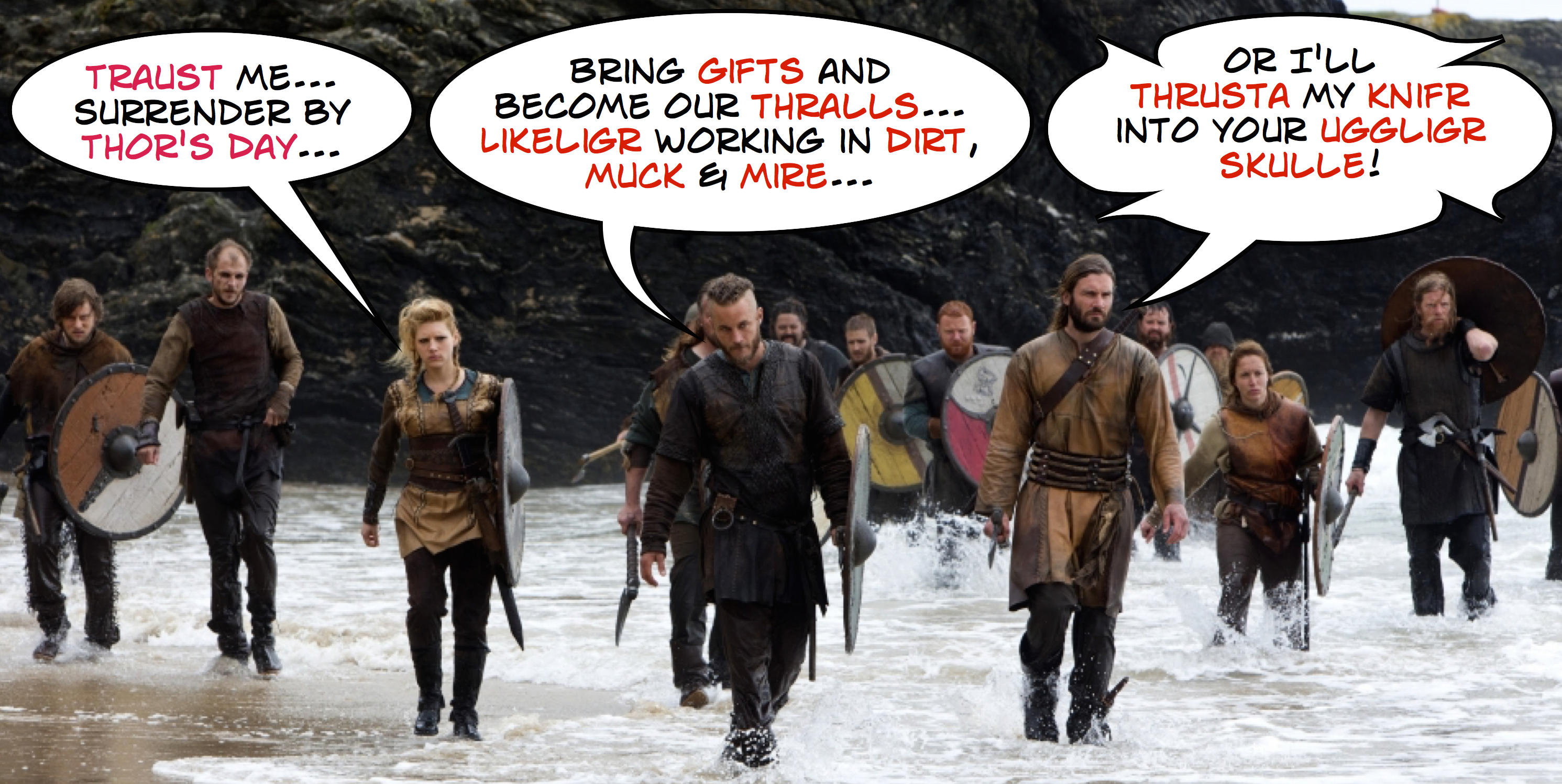
The initial Viking incursions into England were violent, but they left a colorful linguistic legacy in their wake.

Victims of the onslaught, like the unfortunate monks of Lindisfarne, paid a steep price, but the Norse eventually became farmers and craftsmen like the people they initially displaced.

Their contribution to the British gene pool was small, as was their donation to the English language, but it was not insignificant.

Some of the words fit the Viking mystique. Klubba becomes club (as in the weapon, not the association). Rannsaka may have initially meant searching the house for something like your missing keys, but the English experienced it as ransack. And slatra transfers into slaughter. The original word means “to butcher,” and one wonders if it originally applied to meal preparation. It so, the decades of Norse raids modified that focus.

Other adopted words arose from the more peaceful pursuits of the Scandinavians. Bylög meant the laws of the village and became bylaw. Law itself comes from the Norse lag. Husband, skill, thrift, litmus and loan have Viking roots. Those who enjoy a great slice of beef can thank them for their “steak” as well, since steik was their term for frying meat.

The Inkling Affection for the Sagas

J.R.R. Tolkien was actually a Professor of Anglo-Saxon at Oxford. He founded a society devoted to the study of Icelandic and Norse sagas called Kolbitar (Coalbiters).* C.S. Lewis joined him in the group, which preceded the development of the Inklings fellowship.

As a young student, Lewis was attracted to Norse myth and experimented with writing his contribution to the tales. He penned over 800 lines of a massive epic he entitled “Loki Bound.” Only fragments have survived, but the following passage is especially intriguing. In it, Loki criticizes Odin for the manner in which he created humanity.

Odin! And who art thou to make a soul

And force it into being? Who art thou

To bring forth men to suffer in the world

Without their own desire? Remember this,

In all the universe the harshest law,

No soul must ever die: it can but change

Its form and thro’ the myriad years

Must still drag on for aye its weary course,

Enduring dreadful things for thy caprice.

The echoes of teenaged angst are clear in this tirade. The words describe (well, I believe) the fatalistic despair of many people. Fortunately, this young man eventually encountered the One who rescues us from “harshest law” and “dreadful things” that are the lot of fallen mortals.

A Few More Norse>English Words

Here are some more of the seven score words that are identified as having a Scandinavian origin.

An interesting collection of verbs include: bark, blunder, choose, crawl, glitter, race, scare, stagger, stammer and whirl.

The following words associated with people: Guest, kid, lad, oaf, foot, leg, skin, freckles, ill, and weak.

The gamut of emotions: anger, awe, and happy.

And, without their Norse contribution, who knows what we would call these articles today.

axle   ~   window   ~   cake   ~   bag

glove   ~   mug   ~   plow   ~   link

they   ~   trust   ~   same   ~   gift

and even Hell

One final example, as quoted in the source of the comprehensive list of Norse words.

Even though the gun wasn’t invented until centuries after the Viking era, the word comes from Old Norse. The most common usage was in the female name Gunnhildr: gunn and hildr both can translate as “war” or “battle.” Only truly [ferocious] Vikings named their infant daughters “Warbattle.”

_____

*You can read a bit more about Kolbitar here. I have also mentioned Kolbitar in this column.