Discussing Awkward Subjects

toilet-house
Toilets may not be glamorous, but they serve a very important purpose. One might even argue they are a necessary foundation stone for civilization.

There is value in knowing something about toilets, especially when traveling, where it is worse than awkward to be caught unprepared by a “squatting pan” in Asia or a “smart toilet” in some high cost hotel. This helpful article on “sanitary ware” briefly describes the differences. And this European travel site offers critical information travelers to Europe should consider before hitting the road.

These sites offer examples of what one might call “good” toilet info. Reasonable, even helpful. There are also informative articles such as this post on “Dangerous Slang” that provide beneficial information.

Where the subject grows weird, is when curiosity transcends the boundary between sensible and peculiar. I’ll avoid calling this “bad” toilet info . . . although the label “odd” most certainly applies.

A recent piece in the newspaper pointed out a prime example of toiletology gone awry.

It described a large home in South Korea built by Sim Jae-Duck. It is modeled directly upon the shape of a toilet, something that apparently overshadowed the poor man’s entire life. It appears that he was obsessed with the device because he was born in one. (This is not as unusual as one might think. At a “mature” age, my wife’s grandmother delivered her youngest child in that fashion, unaware that she was pregnant.)

Returning to Mr. Sim, he was successful enough to eventually become mayor of Suwon and a member of Parliament. He founded the World Toilet Association and was its president until his death in 2009. One might expect the peculiar home to quickly be forgotten after its creator’s passing, but that is not the case.

Affectionately known as “Mr. Toilet House,” the structure now houses a significant museum and a “theme park” of sorts.

This collection from an Australian expert on toilet photography offers an impressive tour of the museum for those unable to travel to the Republic of Korea for a personal visit. (Just avoid clicking to the second page of photos which includes statuary that’s too realistic for anyone but the most curious toileteer.

Toilets and the Inklings

The Inklings were normal men, which means they used them . . . and they did not write about it. However, as a young man Lewis did include a humorous comment in a letter to his brother, Warnie. In 1928 he proposed a walking trip to “the most glorious village on the edge of the Stroud valley . . .”

The Bathurst estate beyond Cirencester is a place we must revisit when you come home. You can take the whole breakfast to lunch walk in the glorious woods and then emerge into the open in time to lunch at the most glorious village on the edge of the Stroud valley, which winds away as far as you can see, delightfully wooded and watered.

(The first Lord Bathhurst, I am told, was raised to the peerage for inventing a new kind of toilet paper for Queen Anne.)

A final note on the matter comes in the form of an interview about The Kilns, where the Lewis brothers resided in Oxford. The Assistant to the Warden for The C.S. Lewis Study Centre at The Kilns answered an odd query “usually [posed as] a joke.”

Question 4: Did Lewis use the current toilet in the Kilns?

You’d be surprised how often I get this question.  It’s usually a joke, but I play along with it anyway.  But the actual answer is yes and no.  He used the toilets in the home (the two original ones), but the original toilet seats have been replaced.

Narnia, Oz & an Odd Link Between the Two

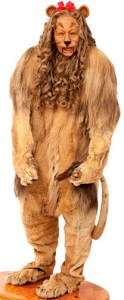
oz-lionFew people know this peculiar fact about The Wizard of Oz. And this oddity shares an interesting link to one of C.S. Lewis’ most familiar novels.

Filmmaking has changed greatly since 1939 when Dorothy first tapped together her ruby slippers. One of those modifications involves the treatment of animals.

Some of us are old enough to remember the initial appearance of the disclaimers: “No animals were injured in the making of this film.” Those announcements disappeared long ago, as people have long supposed the humane treatment of animals required.

As far as I know, no one has alleged the mistreatment of animals in The Wizard of Oz. But the odd fact mentioned above refers to one of the costumes worn by a major character in the film.

Bert Lahr played the Cowardly Lion, who continued acting until he died during the filming of The Night They Raided Minsky’s in 1968. Fortunately, he was in his prime while traipsing across Oz, because his costume weighed at least sixty pounds.

Apparently the costume designer was going for accuracy—in the case of the Cowardly Lion, if not for the citizens of Munchkinland. He opted for using an actual lion pelt. At least two, in fact, since there was a least one backup.

Cinema memorabilia often provides unbelievable dividends. MGM sold the primary costume in 1970 for a mere $2,400. In 2005, after some restoration by a taxidermist, the costume sold for $826,000. Nine years later, in 2014, it became the highest valued male performer’s costume, selling for $3,100,000.

It is quite fitting that Leo the Lion is the mascot for Metro-Goldwyn-Mayer film studio. While there have been seven “Leos” since 1916, it is doubtful that any of them contributed their hide to costuming the Cowardly Lion.

What Has Oz to do with Narnia?

Oz and Narnia resemble one another in the obvious sense that both are fantasy lands. I’m ill-equipped to compare the two beyond that, having no desire to read about the former. Here you’ll find an interesting article that offers some insights into the realm of the Wizard. The literary critics of The Telegraph offer the following contrast.

Even so, [Oz is] a strangely amorphous creation, originally reached by cyclone but in later books by shipwreck (twice), by earthquake and by simply getting lost. As a fantasy land, it has none of the depth or authority of Tolkien’s Middle Earth nor even the physicality of CS Lewis’s Narnia.

Reaching back to the turn of the millennia, you might enjoy reading “Oz vs. Narnia.” Comparing the promotion of the two realms on their respective hundredth and fiftieth anniversaries, the author finds Narnia’s treatment by HarperCollins wanting.

But however much the tribute to Oz exceeds the tribute to Narnia in sumptuousness, it can’t disguise the superiority of Lewis’ book. As a child, I loved Oz’s endless cavalcade of strange creatures and, especially, John R. Neil’s trippy art nouveau illustrations and extravagant marginalia; I still like the books today. But the first time I read “The Lion, the Witch and the Wardrobe” in second grade, I knew that I’d stumbled into a whole new league.

A Tale of Two Lions

The odd overlap in the two stories is not due to the prominent presence of lions in each world. The Cowardly Lion and Aslan have nothing in common, save perhaps, compassion for others.

But the real life costume of Oz’s lion does relate directly to one of Lewis’ most amazing fictional creations.

In the final Chronicle, The Last Battle, we find many people are led astray by a false prophet. There is a liar masquerading as the true king. The horror that he is able to mislead so many vulnerable souls is magnified by the fact that he too wears an obvious costume—the pelt of a lion.

Lewis’ account of the deception is skillful. One of the most brilliant aspects is that the “king” himself (a donkey) is actually tricked into playing the role by the true deceiver (an ape).

“All the same, Shift,” said Puzzle [the donkey], “even if the skin only belonged to a dumb, wild lion, oughtn’t we to give it a decent burial? I mean, aren’t all lions rather— well, rather solemn? Because of you know Who. Don’t you see?”

“Don’t you start getting ideas into your head, Puzzle,” said Shift. “Because, you know, thinking isn’t your strong point. We’ll make this skin into a fine warm winter coat for you.”

“Oh, I don’t think I’d like that,” said the Donkey. “It would look—I mean, the other Beasts might think—that is to say, I shouldn’t feel—”

“What are you talking about?” said Shift, scratching himself the wrong way up as Apes do.

“I don’t think it would be respectful to the Great Lion, to Aslan himself, if an ass like me went about dressed up in a lion-skin,” said Puzzle. “Now don’t stand arguing, please,” said Shift.

“What does an ass like you know about things of that sort? You know you’re no good at thinking, Puzzle, so why don’t you let me do your thinking for you?”

Obviously, a comparison between real and fictional characters wearing lion skins can only go so far. Still, I assume some readers will find the use of a lion’s pelt to camouflage a completely different species, to be a rather peculiar parallel between Oz and Narnia.

Beavers Beware

russian-typoA mere 375,000 rubles buys a fair amount of publicity in Russia; just be sure to proofread the product.

This Christmas season one Russian charity hoped to encourage readers to live good lives, but instead they published a brochure that encouraged beaver genocide.

Beavers are particularly vulnerable rodents. They are quite gentle, and even Talking Beavers are poorly equipped to defend themselves.

The lovely scene on the leaflet featured an innocent girl gazing into a snow globe. Emblazoned above it was supposed to read “Do Good.” Instead, the Russian words spelled out “Exterminate Beavers!”

It just bears out the maxim, “proofread before you publish.” In this case, one could easily add: “if the work is translated, make sure the proofreader understands both languages.”

Some errors are especially heinous.

C.S. Lewis recognized the importance of proofreading.

He was sometimes the victim of inadequate editorial review. So it comes as no surprise that he preferred to see galleys (the uncorrected typeset proofs) of his work before actual publication.

The following reference from a letter in which Lewis attributes the need for such as due to his own poor penmanship, rather than the carelessness of others. This is typical of his generosity, since part of the duties of editors (and pharmacists, for that matter) is to be able to decipher the scribblings of authors (and physicians). Mark Twain did not share Lewis’ grace in this matter.

When his friend Dorothy Sayers died in 1958, Lewis was unable to attend the funeral in London. He was, however, honored to write a panegyric for the service, which was read by one of the bishops in attendance. Following the event, Sayer’s son, Anthony Fleming thanked Lewis and asked if he might include the eulogy in possible collection.

Dear Mr. Fleming

Thank you for your most kind letter. I am relieved to find that the little speech has pleased those whose approval at such a time matters most—it is so easy to go wrong in a thing of that kind and so to give offence.

I am perfectly willing that it should be printed, but please ask whoever sees to it to be sure and let me see a proof. Even if printers made no mistakes, my villainous writing nearly always leads to some.

Lewis, of course, was referring to a literal manuscript, a document written by hand. One assumes that the Russian publisher was given a typescript, so they could not use “villainous writing” as an excuse for their error.

Still, I suspect they were given the text in one language, English perhaps, and asked to translate it for publication. In that case, who actually is responsible for the mistake?

I choose not to worry about attributing liability in this matter. I’m content to use this winter mistake to remind me of the importance of proofreading.

Oh, and on behalf of all of the beavers in Russia, I am relieved to know they will not be distributing these murderous words.

Christmas Interruptions

qaraqoshA bomb has driven worshipers from their churches and homes on Christmas. Ironically, this did not transpire in lands where war currently rages. Instead, it was a British bomb intended to end German lives.

Perhaps you’ve already seen the story?

The weapon was huge, nearly two tons in weight, and it’s explosion would have been no less lethal today than when it was originally dropped.

The bomb, known as a blockbuster, was the largest of its kind dropped by the RAF during aerial attacks on Germany in the second world war. It weighs 1.8 tonnes and, if exploded, could damage all buildings within a one-mile radius.

As I have worshipped and reflected during this Christmas season, the story of this bomb has continued to intrude on my thoughts.

On that first Christmas night a group of shepherds heard music that has now echoed for millennia.

Suddenly a great company of the heavenly host appeared with the angel, praising God and saying, “Glory to God in the highest heaven, and on earth peace to those on whom his favor rests.”

God’s call to peace on earth and his desire for good will among his children—gifts already given to the world in the birth of Jesus—cannot be negated by the weapons of man.

As C.S. Lewis wrote, “Once in our world, a stable had something in it that was bigger than our whole world” (The Last Battle).

Still, in this moment, when this long forgotten and deeply buried blockbuster bomb can disrupt the traditional Christmas schedule, we see a vivid contrast between the good God desires for us and the ill we too often bear for one another?

A Warzone Witness to the Celebration of Christ’s Nativity

The entire world is aware of the genocide of Christians and Yazidis being conducted in the Middle East by Jihadists. This Christmas, however, marked a moment of encouragement.

Two years after being driven from their city by the Islamic State, Christians were able to return to the recently liberated city of Qaraqosh to worship God.

The church structure had been desecrated, but the presence of God among his gathered people, has reconsecrated it.

Christianity in northern Iraq dates back to the first century AD. The number of Christians fell sharply during the violence which followed the 2003 overthrow of Saddam Hussein, and the Islamic State takeover of Mosul two years ago purged the city of Christians for the first time in two millennia. (Reuters)

Despite the hatred some people hold for others, and the violence they inflict, it is encouraging to recognize that no power in this world can defeat the miracle that transpired on that first Christmas Day.

C.S. Lewis & Alcohol

chaliceWe children of alcoholics often have a difficult time determining the proper place for alcohol in our lives. Because we’ve seen the damage its abuse can cause, some are tempted to condemn it all together.

At the same time, like the abused child who is likelier to grow up becoming an abuser himself, as a group we are vulnerable to misusing alcohol ourselves.

The church’s attitude towards “drink” does not always help. Many denominations overlook the fact that it is drunkenness that the Scriptures condemn, and extend the prohibition to all drink that contains alcohol.

They are like the exegete who transforms the warning about the “love of money” being the root of sin into a rejection of all mediums of exchange beyond barter itself.* They overlook the attitude towards the object, and make the object itself the objectionable thing. Thus, money becomes the problem.

In the case of alcohol, it is no longer inappropriate or damaging use that is condemned, it is the drinking of anything containing alcohol that is reasoned to be sinful. Moving the bar in this fashion is simple legalism.

But this column isn’t about legalism. I don’t have an axe to grind. And, as the saying goes, some of my best friends (and family members) abstain from all drink. Similarly, I rarely drink myself. My point is not that wariness about alcohol’s dangers may be wise, but pushing God’s cautions to the degree where we call sin that which is not, is wrong in and of itself.

The solution does not come in the form of devising a pasteurization process so we can improve on the first eighteen centuries of Christian worship and now enjoy “Dr. Welch’s Unfermented Wine” for holy communion.

At the other extreme, there are some religious communities that celebrate their freedom in the gospel to degrees that may invoke Romans 14:21. There is something uncomely, perhaps even sinful, in a church celebrating this liberty. (And I write this as a pastor in a denomination that frequently takes note of the arrival of Oktoberfest.)

Neither prohibiting what God has deemed lawful, nor uncritically embracing secular festivities is the right course. The proper solution to the question of how drinking can or should fit into our lives is found by looking at the Scriptures themselves.

The Biblical Christian View on Alcohol

The Scriptures could not be clearer on the use of alcohol. Unless God has directed an individual to a particular course (or vow) in their personal life, the general rule is this: in moderation, treated as a beverage without the goal of intoxication, drinks containing alcohol are okay.

I know that some churches teach otherwise, but from the Bible itself it is clear that merely drinking a glass of wine or beer is not a sin. It is drinking to excess, that is sinful.

C.S. Lewis provides an extremely clear explanation of this distinction in Mere Christianity. He explains how the principle of temperance is applicable to many aspects of our lives.

Temperance is, unfortunately, one of those words that has changed its meaning. It now usually means teetotalism. But in the days when the second Cardinal virtue was christened ‘Temperance,’ it meant nothing of the sort.

Temperance referred not specially to drink, but to all pleasures; and it meant not abstaining, but going the right length and no further.

It is a mistake to think that Christians ought all to be teetotallers; Mohammedanism, not Christianity, is the teetotal religion. Of course it may be the duty of a particular Christian, or of any Christian, at a particular time, to abstain from strong drink, either because he is the sort of man who cannot drink at all without drinking too much, or because he is with people who are inclined to drunkenness and must not encourage them by drinking himself.

But the whole point is that he is abstaining, for a good reason, from something which he does not condemn and which he likes to see other people enjoying.

One of the marks of a certain type of bad man is that he cannot give up a thing himself without wanting every one else to give it up.

That is not the Christian way.

An individual Christian may see fit to give up all sorts of things for special reasons—marriage, or meat, or beer, or the cinema; but the moment he starts saying the things are bad in themselves, or looking down his nose at other people who do use them, he has taken the wrong turning.

One great piece of mischief has been done by the modern restriction of the word Temperance to the question of drink. It helps people to forget that you can be just as intemperate about lots of other things. A man who makes his golf or his motor-bicycle the centre of his life, or a woman who devotes all her thoughts to clothes or bridge or her dog, is being just as ‘intemperate’ as someone who gets drunk every evening.

Of course, it does not show on the outside so easily: bridge-mania or golf-mania do not make you fall down in the middle of the road. But God is not deceived by externals.

If he were alive today, Lewis could easily add sports-mania and social media-mania to his list of excesses that voraciously consume a person.

The fact that C.S. Lewis could enjoy a pint of beer with his friends becomes a stumbling block to some who would otherwise benefit from reading his work. Likewise, some readers of Mere Inkling may consider this post an endorsement of drinking.

That could not be farther from the truth. We children of alcoholics are acutely aware of the pain and chaos caused by its abuse.

On the contrary, these words are written to caution my brothers and sisters in Christ about a potentially more destructive sin, legalism.

Fortunately, the simple solution to both problems is an unfiltered, honest reading of God’s word.

_____

* This is an exaggeration, of course. Few, if any, reject all coin and currency, even if they misquote 1 Timothy 6:10 in alleging “money is the root of many evils.”

** “It is good not to eat meat or drink wine or do anything that causes your brother to stumble” (Romans 14:21).

Do Titles Matter?

cbeThere are many sorts of titles one may accumulate, and some people pursue them with great passion. There are familial titles like “Grandmother,” military titles such as “Ensign,” academic titles like “Associate Professor,” and ecclesiastical titles as in “Archimandrite.”

And that’s only the tip of the titular iceberg. Titles are prominent in many fields, such as medicine, politics and the judiciary. And appellations such as “Coach,” are precious to multi-millionaire athletic leaders and folks working with preschoolers in the gym or on the field alike.

The best way to tell how important a person’s titles are to them, is to witness how they respond to the “misuse” of one. My wife and I have a joke when I show my identification card when we enter a military installation. If the guard courteously says, “have a good day, colonel,” after I roll up the window and proceed, I will sometimes say (for Delores’ benefit) “that’s lieutenant colonel!”

If you’re unfamiliar with the armed forces, there’s a good chance you miss the joke. A lieutenant colonel is junior in grade to a “full” colonel, although addressing one simply as “colonel” is allowed. In fact, in a sense it’s an added courtesy or sign of respect. (I should mention that it’s not uncommon for some of the civilian guards to follow up such a greeting with a glance towards my wife and the words, “and a good day to you, general.”)

I have mixed feelings about titles, a trait I believe I share with C.S. Lewis.

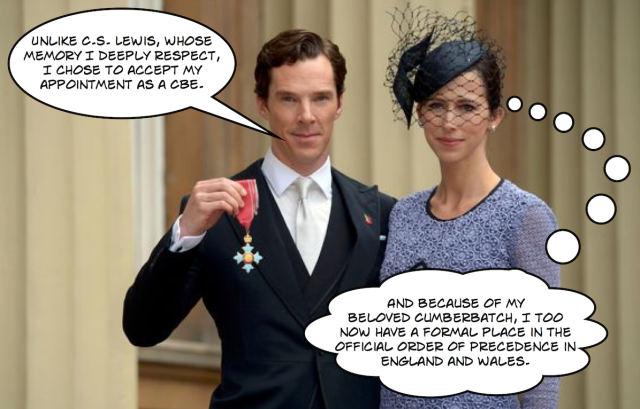
In 1952, Lewis declined appointment as a Commander (CBE) in the Order of the British Empire. He did so to avoid entangling his Christian witness with political considerations. But by declining he forsook the opportunity to be known as “Sir Lewis,” although, I doubt he lost sleep over his decision. (In fact, in his humility, Lewis never revealed the matter for public scrutiny.)

A 1959 letter to Lance Sieveking, the BBC producer who wrote the radio script for The Lion, the Witch and the Wardrobe, offers an interesting insight into Lewis’ attitude about titles. He begins with this greeting:

Dear Sieveking

(Why do you ‘Dr.’ me? Had we not dropped the honorifics?)

Volume three of Lewis’ letters reveals this was representative of his thinking. Once he had established a rapport with some correspondents, he requested that they drop the use of titles. A typical example reads, “We may both drop the honorific now, mayn’t we?.” In one case he writes in the imperative, “Dear Hooton (Do drop the honorifics!).”

So, Do Titles Matter?

My grandchildren surprised me the other day by addressing me as “Doctor Grandpa.” They proudly shared in my joy (read “relief”) at having completed my Doctor of Ministry degree.

I responded to their adulation with “actually, kids, it’s ‘Reverend Doctor Grandpa.’” This led to a fun discussion about titles during which I was able to explain to them how my pastoral title was of greater significance to me than the doctoral honorific. After which I reminded them the matter was moot because all I want them to call me is grandpa. I explained how only eight people in the entire world can call me that, and it made that title extremely precious to me.

Ultimately, the most valuable title any human being could have is to be addressed as son or daughter, by God. As Jesus’ disciple John wrote:

See what kind of love the Father has given to us, that we should be called children of God; and so we are. (1 John 3:1).

On this, I have no doubt C.S. Lewis would agree.

Despite this, there are cases where titles are critical. The military, with its “chain of command” sometimes being a life or death matter, is a prime example.

In other settings, the honorifics are less significant. I addressed all my instructors in college as “Professor,” regardless of whether they were full/associate/assistant/whatever.

I doubt that many of Lewis’ very fortunate students thought less of his lectures because of Oxford’s politics which withheld from him the full “professorship” he had certainly earned. (It would be left to the wiser University of Cambridge to rectify this oversight.)

This suggests to me that titles mean less to most people than the way others think of them. If people respect you as someone with integrity . . . if they call you “friend . . .” how much more fortunate could you be?

C.S. Lewis was Not a Dramatist

shakespeare-and-lewisC.S. Lewis’ prolific, genre-crossing success teaches us two things. First, that a very good writer can fruitfully write in a variety of fields. Second, that even the most gifted of authors cannot write with equal talent in all genres.

Students of C.S. Lewis are well acquainted with the fact that one of the great disappointments of his life was failing to succeed as a poet. Although he did write a reasonable amount of poetry, it failed to elicit the response for which he hoped.

Lewis did, of course, receive well-deserved kudos for his literary fiction and children’s stories. His fiction and nonfiction are extraordinary, and over the years I have appreciated the value of his many essays to be among the most precious of his works.

Finally, as a correspondent, Lewis stood in the first ranks. He regarded the responsibility of personally responding to the letters he received as something not to be shirked.

Fortunately, the excellent collections of his letters offer us many insights into Lewis’ life and career. For his Christian fans, they reveal insights into how a disciple of Jesus can gracefully navigate life.

The following letter was written in 1959, to a man who was apparently the editor of a small newspaper. He had requested an article from the exceedingly busy professor. Lewis’ response is quite interesting.

Dear Mr. Aylard,

Yes! my handwriting is awful. It used to be nice but my muscles have stiffened up and the strokes no longer come out as I intend. I give ‘this generation’ all I can in the way of books and articles. Particular articles by request are not usually the good ones: and, you know, I should reach more readers through other organs than your paper. I hope this doesn’t sound stand-offish or conceited, for it is not meant to be. It is really common sense to speak where one can be most widely heard.

I agree that drama is a good medium for our purpose. In this country Dorothy Sayers’ broadcast set of plays on the life and death of Our Lord (The Man Born to be King) did a great deal of good. I don’t attempt this form myself because any talent I may have is narrative, not dramatic. With all good wishes.

I draw several observations from reading this letter.

  • Lewis took the time to personally pen many of his letters, despite the fact that this presented an uncomfortable challenge to him.
  • Lewis preferred to address subjects as he felt moved by the Holy Spirit to do so, rather than on demand.
  • He did not have the time to dress it up in gentle fluff, but candidly expressed the fact that if he had sufficient time and energy to write, it would not be the wisest stewardship to send the piece to a publication with a limited distribution.
  • Even though he did not intend for that remark to be curt or “conceited,” Lewis still felt compelled to offer his “I hope this doesn’t sound…” apology.
  • Lewis appreciated drama, and recognized Sayers’ work as quite noteworthy.
  • He recognized that drama would not be his forte, and wisely preferred to stick with the type of writing wherein he was most accomplished.

Even this final thought is offered with C.S. Lewis’ characteristic—and genuine—humility.

I don’t attempt this form myself because any talent I may have is narrative, not dramatic.

As a writer myself, I find this sentence quite comforting. And not simply because my own extremely modest talents also lie in the narrative realm. Even if I were a poet or a dramatist I would recognize how liberating it is to acknowledge that one cannot be fairly expected to excel at more than one genre.

And “excel” is not really the best word to use here. Perhaps it’s sufficient that writers think of themselves like children of Lake Wobegon, where Garrison Keillor tells us “all the women are strong, all the men are good-looking, and all the children are above average.”

Ultimately, whether we consider ourselves to be adequate or exceptional writers, it is necessary to understand where our skills reside, and to transgress those boundaries only with the greatest trepidation.

Free Book on C.S. Lewis’ Humor

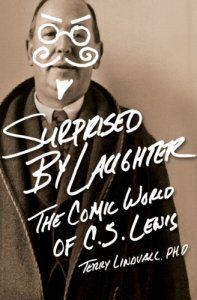
lindvallIf you want a great volume on C.S. Lewis’ humor to your library—for free—get over to Amazon and download the Kindle version of Surprised by laughter: The Comic World of C.S. Lewis right now.

I recently posted a column on Lewis’ humor, and referenced this very volume by Professor Terry Lindvall.

You never know how long these Amazon sales will last, so do hurry to secure your copy.

This volume is sure to answer any question you have about C.S. Lewis’ use of humor.

One caution, however, which the author includes at the close of his Acknowledgements. Provoking laughter within the confines of the faith community may have consequences . . .

If any cleric or monk speaks jocular words, such as provoke laughter, let him be anathema.

ORDINANCE, SECOND COUNCIL OF CONSTANCE, 1418

Get your copy here.

Devastated by Criticism

calvin-criticismHow do you feel when others criticize something you’ve written? Do you just want to tear your work up and start all over again? If you do, you have something in common with J.R.R. Tolkien, creator of Lord of the Rings. And he is not the only great writer with whom you share this hypersensitive trait.

Tolkien’s inability to accept constructive criticism is no secret; it is frequently noted in biographies.

Few people enjoy receiving criticism, and we are often suspicious of the mental health of those who do. Yet many writers actively seek out constructive criticism in order to sharpen their skills and improve their work.

That is a major reason for the existence of writers’ groups which pop up in varying expressions wherever serious writers live. While another benefit of such communities is the simple encouragement that comes from gathering with others who share your passion, it is the critical examination of each other’s manuscripts which provides the clearest concrete benefit. It’s no accident many such literary meetings are actually called critique groups.

Tolkien was a member of one of the most famous such fellowships that ever existed, the Inklings. It was in that setting where he first shared the stories of hobbits and elves who would make such a profound impact on Western literature. He said it was primarily through the encouragement of the Inklings—specifically his good friend, C.S. Lewis—that these amazing stories were ever published.

You see, Tolkien had a terrible and frequently fatal flaw . . . When his writing was criticized, he felt compelled to toss it aside and begin anew. Many other writers have been afflicted with this curse, and not all of them had a C.S. Lewis to rescue their words from the dust bin.

I have shared in the past Lewis’ description of his friend’s handicap.

No one ever influenced Tolkien—you might as well try to influence a bander-snatch. We listened to his work, but could affect it only by encouragement. He has only two reactions to criticism; either he begins the whole work over again from the beginning or else takes no notice at all.

Criticism of the Constructive Variety

As I said a moment ago, no one really craves criticism, and yet most serious writers actively solicit it. As I write this very column, it is with the intention of sharing it tomorrow with my friends in my own writing circles.

When you read it, it will likely have changed, probably in subtle, enriching ways. You can gauge the benefit of mutual critiquing by the amount and the quality of the criticism which is shared. And, should you feel violated, rebuke defensiveness and remind yourself that even the greats, like Tolkien and Lewis, gained from the comments and suggestions of their friends.

I recently learned of another individual who struggled with receiving criticism. It was John Calvin, the father of Reformed theology. Belonging to the Lutheran branch of the church universal, my readings in Reformed history have been limited. However, I’m currently reading two similarly titled books* and I discovered something that may be commonly known to Reformed clergy but was news to me.

He often tended to express his disappointment in extravagant terms. When he encountered an obstacle, his reaction was stark: he would burn his manuscript, never write again, never publish anything again. His decision to write was motivated by external factors: a request by his circle of friends and colleagues, or as the result of his emotional reaction to an event or a work that he read. . . . (John Calvin and the Printed Book)

The good news though is Calvin did not allow these obstacles to have the final say. Instead, he turned to those he trusted and sought their counsel.

Indeed, his extreme sensitivity meant that he needed to have the emotional support of close friends. As a Reformer and specifically as an author, Calvin never worked in isolation even though he was the dominant figure in his setting. While he was confident of the quality of his writings, Calvin still had no hesitation in submitting them to his colleagues before publication. (Ibid.)

Not that Calvin always welcomed suggestions. There was one particular Reformer to whom he sent some of his work whose “commend from Zurich were too numerous and detailed. Hence Calvin stopped sending his manuscripts to Bullinger prior to printing, although he maintained cordial relations with the Zurich Reformer.” I can almost read Calvin’s mind at the time: I asked for your suggestions, not a complete rewrite of the manuscript.

So, it appears those of us who feel discomfort at the sting of criticism—even when we request it—stand in good company. So don’t ever let that temporary pain discourage you from continuing to write.

____

* A 2005 volume is called John Calvin and the Printed Book, while a 2015 collection of essays is called Calvin and the Book.

C.S. Lewis & Humor – a 100% Politics Free Post

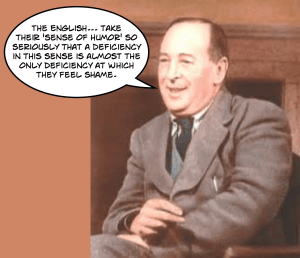
csl-humorHumor is an essential element of human existence. C.S. Lewis recognized that our very nature was molded to incorporate joy and laughter.

In a great article on the subject, “The Role of Laughter in the Christian Life,” Terry Lindvall introduces the subject with the story of an early Christian monk who wrote this truth.

In the fourth century, a monk named Evagrius identified key temptations against living the Christian life. He named eight of them, and they became the eight deadly sins. Now we know that Pope Gregory the Great reduced them to seven to fit them in with the symbolic biblical number.

But unfortunately the sin that Gregory conflated into sloth was the sin of sadness. Sadness in the face of God’s grace and mercy was a denial of faith and hope.

But it isn’t the vice that concerns me. It is its corresponding virtue, what Evagrius identified as the blessing of hilaritas as essential to Christian living, even if you were an ascetic monk and especially if you are a lawyer or accountant.

Amen. We can all, whatever our vocation, do with an extra dose of hilaritas. After all, it’s good for your health.

I highly commend Lindvall’s entertaining article, which you can read online here or download as a pdf here.

It is filled with references to C.S. Lewis, as one would expect from the author of Surprised by Laughter: The Comic World of C.S. Lewis.

One particularly beneficial section of the article is his discussion of the four types of laughter mentioned by Screwtape in his epistles.

If you don’t have access to your copy of The Screwtape Letters, the following quotation will provide the context for Lindvall’s remarks.

Because Screwtape is a devil, viewing God as the “Enemy,” his viewpoint is reversed. Keep that in mind as you read.

I divide the causes of human laughter into Joy, Fun, the Joke Proper, and Flippancy. You will see the first among friends and lovers reunited on the eve of a holiday. Among adults some pretext in the way of Jokes is usually provided, but the facility with which the smallest witticisms produce laughter at such a time shows that they are not the real cause. What that real cause is we do not know.

Something like it is expressed in much of that detestable art which the humans call Music, and something like it occurs in Heaven—a meaningless acceleration in the rhythm of celestial experience, quite opaque to us. Laughter of this kind does us no good and should always be discouraged. Besides, the phenomenon is of itself disgusting and a direct insult to the realism, dignity, and austerity of Hell . . .

But flippancy is the best of all. In the first place it is very economical. Only a clever human can make a real Joke about virtue, or indeed about anything else; any of them can be trained to talk as if virtue were funny.

Among flippant people the Joke is always assumed to have been made. No one actually makes it; but every serious subject is discussed in a manner which implies that they have already found a ridiculous side to it. If prolonged, the habit of Flippancy builds up around a man the finest armour-plating against the Enemy that I know, and it is quite free from the dangers inherent in the other sources of laughter.

It is a thousand miles away from joy: it deadens, instead of sharpening, the intellect; and it excites no affection between those who practise it,

So, a wise person will savor joy and fun, along with jokes proper that are offered in good taste. But they will remain wary of flippancy, from which more ill than good usually flows.

Have a joy-filled life.