Do Titles Matter?

cbeThere are many sorts of titles one may accumulate, and some people pursue them with great passion. There are familial titles like “Grandmother,” military titles such as “Ensign,” academic titles like “Associate Professor,” and ecclesiastical titles as in “Archimandrite.”

And that’s only the tip of the titular iceberg. Titles are prominent in many fields, such as medicine, politics and the judiciary. And appellations such as “Coach,” are precious to multi-millionaire athletic leaders and folks working with preschoolers in the gym or on the field alike.

The best way to tell how important a person’s titles are to them, is to witness how they respond to the “misuse” of one. My wife and I have a joke when I show my identification card when we enter a military installation. If the guard courteously says, “have a good day, colonel,” after I roll up the window and proceed, I will sometimes say (for Delores’ benefit) “that’s lieutenant colonel!”

If you’re unfamiliar with the armed forces, there’s a good chance you miss the joke. A lieutenant colonel is junior in grade to a “full” colonel, although addressing one simply as “colonel” is allowed. In fact, in a sense it’s an added courtesy or sign of respect. (I should mention that it’s not uncommon for some of the civilian guards to follow up such a greeting with a glance towards my wife and the words, “and a good day to you, general.”)

I have mixed feelings about titles, a trait I believe I share with C.S. Lewis.

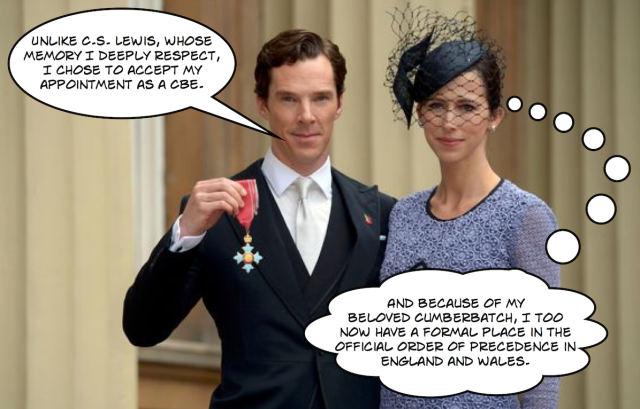
In 1952, Lewis declined appointment as a Commander (CBE) in the Order of the British Empire. He did so to avoid entangling his Christian witness with political considerations. But by declining he forsook the opportunity to be known as “Sir Lewis,” although, I doubt he lost sleep over his decision. (In fact, in his humility, Lewis never revealed the matter for public scrutiny.)

A 1959 letter to Lance Sieveking, the BBC producer who wrote the radio script for The Lion, the Witch and the Wardrobe, offers an interesting insight into Lewis’ attitude about titles. He begins with this greeting:

Dear Sieveking

(Why do you ‘Dr.’ me? Had we not dropped the honorifics?)

Volume three of Lewis’ letters reveals this was representative of his thinking. Once he had established a rapport with some correspondents, he requested that they drop the use of titles. A typical example reads, “We may both drop the honorific now, mayn’t we?.” In one case he writes in the imperative, “Dear Hooton (Do drop the honorifics!).”

So, Do Titles Matter?

My grandchildren surprised me the other day by addressing me as “Doctor Grandpa.” They proudly shared in my joy (read “relief”) at having completed my Doctor of Ministry degree.

I responded to their adulation with “actually, kids, it’s ‘Reverend Doctor Grandpa.’” This led to a fun discussion about titles during which I was able to explain to them how my pastoral title was of greater significance to me than the doctoral honorific. After which I reminded them the matter was moot because all I want them to call me is grandpa. I explained how only eight people in the entire world can call me that, and it made that title extremely precious to me.

Ultimately, the most valuable title any human being could have is to be addressed as son or daughter, by God. As Jesus’ disciple John wrote:

See what kind of love the Father has given to us, that we should be called children of God; and so we are. (1 John 3:1).

On this, I have no doubt C.S. Lewis would agree.

Despite this, there are cases where titles are critical. The military, with its “chain of command” sometimes being a life or death matter, is a prime example.

In other settings, the honorifics are less significant. I addressed all my instructors in college as “Professor,” regardless of whether they were full/associate/assistant/whatever.

I doubt that many of Lewis’ very fortunate students thought less of his lectures because of Oxford’s politics which withheld from him the full “professorship” he had certainly earned. (It would be left to the wiser University of Cambridge to rectify this oversight.)

This suggests to me that titles mean less to most people than the way others think of them. If people respect you as someone with integrity . . . if they call you “friend . . .” how much more fortunate could you be?

C.S. Lewis was Not a Dramatist

shakespeare-and-lewisC.S. Lewis’ prolific, genre-crossing success teaches us two things. First, that a very good writer can fruitfully write in a variety of fields. Second, that even the most gifted of authors cannot write with equal talent in all genres.

Students of C.S. Lewis are well acquainted with the fact that one of the great disappointments of his life was failing to succeed as a poet. Although he did write a reasonable amount of poetry, it failed to elicit the response for which he hoped.

Lewis did, of course, receive well-deserved kudos for his literary fiction and children’s stories. His fiction and nonfiction are extraordinary, and over the years I have appreciated the value of his many essays to be among the most precious of his works.

Finally, as a correspondent, Lewis stood in the first ranks. He regarded the responsibility of personally responding to the letters he received as something not to be shirked.

Fortunately, the excellent collections of his letters offer us many insights into Lewis’ life and career. For his Christian fans, they reveal insights into how a disciple of Jesus can gracefully navigate life.

The following letter was written in 1959, to a man who was apparently the editor of a small newspaper. He had requested an article from the exceedingly busy professor. Lewis’ response is quite interesting.

Dear Mr. Aylard,

Yes! my handwriting is awful. It used to be nice but my muscles have stiffened up and the strokes no longer come out as I intend. I give ‘this generation’ all I can in the way of books and articles. Particular articles by request are not usually the good ones: and, you know, I should reach more readers through other organs than your paper. I hope this doesn’t sound stand-offish or conceited, for it is not meant to be. It is really common sense to speak where one can be most widely heard.

I agree that drama is a good medium for our purpose. In this country Dorothy Sayers’ broadcast set of plays on the life and death of Our Lord (The Man Born to be King) did a great deal of good. I don’t attempt this form myself because any talent I may have is narrative, not dramatic. With all good wishes.

I draw several observations from reading this letter.

  • Lewis took the time to personally pen many of his letters, despite the fact that this presented an uncomfortable challenge to him.
  • Lewis preferred to address subjects as he felt moved by the Holy Spirit to do so, rather than on demand.
  • He did not have the time to dress it up in gentle fluff, but candidly expressed the fact that if he had sufficient time and energy to write, it would not be the wisest stewardship to send the piece to a publication with a limited distribution.
  • Even though he did not intend for that remark to be curt or “conceited,” Lewis still felt compelled to offer his “I hope this doesn’t sound…” apology.
  • Lewis appreciated drama, and recognized Sayers’ work as quite noteworthy.
  • He recognized that drama would not be his forte, and wisely preferred to stick with the type of writing wherein he was most accomplished.

Even this final thought is offered with C.S. Lewis’ characteristic—and genuine—humility.

I don’t attempt this form myself because any talent I may have is narrative, not dramatic.

As a writer myself, I find this sentence quite comforting. And not simply because my own extremely modest talents also lie in the narrative realm. Even if I were a poet or a dramatist I would recognize how liberating it is to acknowledge that one cannot be fairly expected to excel at more than one genre.

And “excel” is not really the best word to use here. Perhaps it’s sufficient that writers think of themselves like children of Lake Wobegon, where Garrison Keillor tells us “all the women are strong, all the men are good-looking, and all the children are above average.”

Ultimately, whether we consider ourselves to be adequate or exceptional writers, it is necessary to understand where our skills reside, and to transgress those boundaries only with the greatest trepidation.

Free Book on C.S. Lewis’ Humor

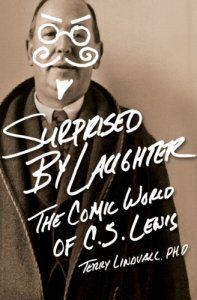
lindvallIf you want a great volume on C.S. Lewis’ humor to your library—for free—get over to Amazon and download the Kindle version of Surprised by laughter: The Comic World of C.S. Lewis right now.

I recently posted a column on Lewis’ humor, and referenced this very volume by Professor Terry Lindvall.

You never know how long these Amazon sales will last, so do hurry to secure your copy.

This volume is sure to answer any question you have about C.S. Lewis’ use of humor.

One caution, however, which the author includes at the close of his Acknowledgements. Provoking laughter within the confines of the faith community may have consequences . . .

If any cleric or monk speaks jocular words, such as provoke laughter, let him be anathema.

ORDINANCE, SECOND COUNCIL OF CONSTANCE, 1418

Get your copy here.

Devastated by Criticism

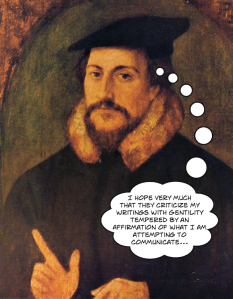
calvin-criticismHow do you feel when others criticize something you’ve written? Do you just want to tear your work up and start all over again? If you do, you have something in common with J.R.R. Tolkien, creator of Lord of the Rings. And he is not the only great writer with whom you share this hypersensitive trait.

Tolkien’s inability to accept constructive criticism is no secret; it is frequently noted in biographies.

Few people enjoy receiving criticism, and we are often suspicious of the mental health of those who do. Yet many writers actively seek out constructive criticism in order to sharpen their skills and improve their work.

That is a major reason for the existence of writers’ groups which pop up in varying expressions wherever serious writers live. While another benefit of such communities is the simple encouragement that comes from gathering with others who share your passion, it is the critical examination of each other’s manuscripts which provides the clearest concrete benefit. It’s no accident many such literary meetings are actually called critique groups.

Tolkien was a member of one of the most famous such fellowships that ever existed, the Inklings. It was in that setting where he first shared the stories of hobbits and elves who would make such a profound impact on Western literature. He said it was primarily through the encouragement of the Inklings—specifically his good friend, C.S. Lewis—that these amazing stories were ever published.

You see, Tolkien had a terrible and frequently fatal flaw . . . When his writing was criticized, he felt compelled to toss it aside and begin anew. Many other writers have been afflicted with this curse, and not all of them had a C.S. Lewis to rescue their words from the dust bin.

I have shared in the past Lewis’ description of his friend’s handicap.

No one ever influenced Tolkien—you might as well try to influence a bander-snatch. We listened to his work, but could affect it only by encouragement. He has only two reactions to criticism; either he begins the whole work over again from the beginning or else takes no notice at all.

Criticism of the Constructive Variety

As I said a moment ago, no one really craves criticism, and yet most serious writers actively solicit it. As I write this very column, it is with the intention of sharing it tomorrow with my friends in my own writing circles.

When you read it, it will likely have changed, probably in subtle, enriching ways. You can gauge the benefit of mutual critiquing by the amount and the quality of the criticism which is shared. And, should you feel violated, rebuke defensiveness and remind yourself that even the greats, like Tolkien and Lewis, gained from the comments and suggestions of their friends.

I recently learned of another individual who struggled with receiving criticism. It was John Calvin, the father of Reformed theology. Belonging to the Lutheran branch of the church universal, my readings in Reformed history have been limited. However, I’m currently reading two similarly titled books* and I discovered something that may be commonly known to Reformed clergy but was news to me.

He often tended to express his disappointment in extravagant terms. When he encountered an obstacle, his reaction was stark: he would burn his manuscript, never write again, never publish anything again. His decision to write was motivated by external factors: a request by his circle of friends and colleagues, or as the result of his emotional reaction to an event or a work that he read. . . . (John Calvin and the Printed Book)

The good news though is Calvin did not allow these obstacles to have the final say. Instead, he turned to those he trusted and sought their counsel.

Indeed, his extreme sensitivity meant that he needed to have the emotional support of close friends. As a Reformer and specifically as an author, Calvin never worked in isolation even though he was the dominant figure in his setting. While he was confident of the quality of his writings, Calvin still had no hesitation in submitting them to his colleagues before publication. (Ibid.)

Not that Calvin always welcomed suggestions. There was one particular Reformer to whom he sent some of his work whose “commend from Zurich were too numerous and detailed. Hence Calvin stopped sending his manuscripts to Bullinger prior to printing, although he maintained cordial relations with the Zurich Reformer.” I can almost read Calvin’s mind at the time: I asked for your suggestions, not a complete rewrite of the manuscript.

So, it appears those of us who feel discomfort at the sting of criticism—even when we request it—stand in good company. So don’t ever let that temporary pain discourage you from continuing to write.

____

* A 2005 volume is called John Calvin and the Printed Book, while a 2015 collection of essays is called Calvin and the Book.

C.S. Lewis & Humor – a 100% Politics Free Post

csl-humorHumor is an essential element of human existence. C.S. Lewis recognized that our very nature was molded to incorporate joy and laughter.

In a great article on the subject, “The Role of Laughter in the Christian Life,” Terry Lindvall introduces the subject with the story of an early Christian monk who wrote this truth.

In the fourth century, a monk named Evagrius identified key temptations against living the Christian life. He named eight of them, and they became the eight deadly sins. Now we know that Pope Gregory the Great reduced them to seven to fit them in with the symbolic biblical number.

But unfortunately the sin that Gregory conflated into sloth was the sin of sadness. Sadness in the face of God’s grace and mercy was a denial of faith and hope.

But it isn’t the vice that concerns me. It is its corresponding virtue, what Evagrius identified as the blessing of hilaritas as essential to Christian living, even if you were an ascetic monk and especially if you are a lawyer or accountant.

Amen. We can all, whatever our vocation, do with an extra dose of hilaritas. After all, it’s good for your health.

I highly commend Lindvall’s entertaining article, which you can read online here or download as a pdf here.

It is filled with references to C.S. Lewis, as one would expect from the author of Surprised by Laughter: The Comic World of C.S. Lewis.

One particularly beneficial section of the article is his discussion of the four types of laughter mentioned by Screwtape in his epistles.

If you don’t have access to your copy of The Screwtape Letters, the following quotation will provide the context for Lindvall’s remarks.

Because Screwtape is a devil, viewing God as the “Enemy,” his viewpoint is reversed. Keep that in mind as you read.

I divide the causes of human laughter into Joy, Fun, the Joke Proper, and Flippancy. You will see the first among friends and lovers reunited on the eve of a holiday. Among adults some pretext in the way of Jokes is usually provided, but the facility with which the smallest witticisms produce laughter at such a time shows that they are not the real cause. What that real cause is we do not know.

Something like it is expressed in much of that detestable art which the humans call Music, and something like it occurs in Heaven—a meaningless acceleration in the rhythm of celestial experience, quite opaque to us. Laughter of this kind does us no good and should always be discouraged. Besides, the phenomenon is of itself disgusting and a direct insult to the realism, dignity, and austerity of Hell . . .

But flippancy is the best of all. In the first place it is very economical. Only a clever human can make a real Joke about virtue, or indeed about anything else; any of them can be trained to talk as if virtue were funny.

Among flippant people the Joke is always assumed to have been made. No one actually makes it; but every serious subject is discussed in a manner which implies that they have already found a ridiculous side to it. If prolonged, the habit of Flippancy builds up around a man the finest armour-plating against the Enemy that I know, and it is quite free from the dangers inherent in the other sources of laughter.

It is a thousand miles away from joy: it deadens, instead of sharpening, the intellect; and it excites no affection between those who practise it,

So, a wise person will savor joy and fun, along with jokes proper that are offered in good taste. But they will remain wary of flippancy, from which more ill than good usually flows.

Have a joy-filled life.

Slipping into Illiteracy

no-readingIs it worse to be illiterate, or simply to not take advantage of your ability to read? Mark Twain is errantly credited with this wise statement: “The person who does not read has no advantage over someone who cannot read.”*

I would take this a step further. It seems to me that illiteracy need not mean the inability to read. It can also be used to describe those who choose not to read.

And, in the United States at least, we’re on a downhill slide when it comes to how much time people spend reading each day. Reading that’s not related to their jobs or educational requirements.

The data comes from the Bureau of Labor Statistics, which examines in minutiae how citizens spend their time. The most recent American Time Use Survey reveals the disturbing trend.

reading-graphicThe descent begins at the precipice, where those who are seventy-five years old or older enjoy reading for an average one hour and forty-eight minutes each day. It slams to the ground for those fifteen to nineteen who devote only thirteen minutes to leisure reading.

Amazingly, that group is not the worst. Those who are twenty to twenty-four read nearly 8% less than they do, clocking in with a mere twelve minutes. The grim details are available here.

Obviously, we may assume that older people have more leisure time. A second consideration may be that their constitutions are not up to some more physically demanding activities. To minimize the effect of the “workday” influences, the numbers cited above come from weekends or holidays

But even combined, these factors cannot account for the radical differences we see. Younger people are simply not reading.

Too Little Reading

C.S. Lewis wrote a great deal about reading. He regarded it as one of the essential joys of life. He may not have been surprised by these statistics, but he would certainly have been aghast. I have written in the past about Lewis’ views on literacy in “Knowing Our ABCs.”

For Lewis and, I suspect, many readers of Mere Inkling, the desire was always to find more time for reading. In a 1919 letter to his friend Arthur Greeves, he cited the inescapable dangers of reading too little.

If only one had time to read a little more: we either get shallow & broad or narrow and deep.

Lewis was also familiar with demands of responsibilities that devour our time and leave little for leisure of any sort. In another letter to Greeves, written eleven years later, he describes this predicament. I share it here at length because it also offers an insight into the role of reading in nurturing his reawakening faith.

All private reading has ceased, except for 20 minutes before bed (if alone) when I drink a cup of cocoa and try to wash the day off with MacDonald’s Diary of an Old Soul. I shall soon have finished it and must look round for another book.

Luckily the world is full of books of that general type: that is another of the beauties of coming, I won’t say, to religion but to an attempt at religion—one finds oneself on the main road with all humanity, and can compare notes with an endless succession of previous travellers. It is emphatically coming home: as Chaucer says “Returneth home from worldly vanitee.”

Reading can clearly be good for the soul. And it has another benefit that even unbelievers celebrate. It breaks through the isolation that plagues human life. Technology, it appears, is not delivering on its promise to dispel loneliness.

Reading, in contrast, possesses for many that very power. And a quotation frequently misattributed to Lewis,** but clearly consistent with this beliefs, captures this truth.

We read to know that we are not alone.

_____

* Although Twain is commonly cited as the originator of this phrase, the earliest written parallel appears to be a 1910 publication in which the Virginia Superintendent of Public Instruction wrote: “Who can see the barely perceptible line between the man who can not read at all and the man who does not read at all? The literate who can, but does not, read, and the illiterate who neither does nor can?”

** On the internet you will frequently find these words attributed to Lewis, and in a sense they do come from his lips. It comes from the television film Shadowlandswritten in 1985 by William Nicholson for BBC.

The image at the top of the page comes from this interesting video with a unique contemporary twist on reading:

C.S. Lewis and Metaphors

hobbit-quoteLearn how to effectively wield metaphors, and you will be powerful indeed. They are one of the most creative and intrinsically rewarding tools used by communicators.

Metaphors are not simply ornamental. Nor are they limited to abstracts subjects. The following description comes from C.S. Lewis’ book, Miracles.

It is a serious mistake to think that metaphor is an optional thing which poets and orators may put into their work as a decoration and plain speakers can do without. The truth is that if we are going to talk at all about things which are not perceived by the senses, we are forced to use language metaphorically.

Books on psychology or economics or politics are as continuously metaphorical as books of poetry or devotion. There is no other way of talking, as every philologist is aware. . . . All speech about supersensibles is, and must be, metaphorical in the highest degree.

To effectively communicate—especially about deep or profound subjects—metaphors need to be part of a readers’ or speakers’ core vocabulary. That’s what Lewis meant by saying “we are forced to use language metaphorically” when speaking about things that transcend our senses.

Former Time editor James Geary has echoed Lewis’ description of the universality of metaphors.

Metaphor is not just confined to art and literature but is at work in all fields of human endeavor, from economics and advertising, to politics and business, to science and psychology. . . .

There is no aspect of our experience not molded in some way by metaphor’s almost imperceptible touch. (I Is an Other: The Secret Life of Metaphor and How It Shapes the Way We See the World)

Without being conscious of it, we all use metaphors more frequently than we realize it. Geary claims “We utter about one metaphor for every ten to twenty-five words, or about six metaphors a minute.” Granted, most of these are routine like the four appearing in this sentence he quotes from an economic report.

“Britain’s recovery from the worst recession in decades is gaining traction but confused economic data and the high risk of a hung parliament could yet snuff out its momentum.”

Metaphors Versus Similes

Envisioning fresh metaphors may seem challenging, but it is a skill which can be practiced. One need not feel embarrassed if they find the subject of metaphors confusing. In their simplest form, they are like especially meaningful similes.

In a simile we compare two distinctly different things and declare that they are similar. For example, someone might say about the sleek new stealth destroyer, “the USS Zumwalt is like a Porsche.” This simile suggests a number of attributes and the statement contains the familiar phrase “is like.”

By contrast, a metaphor is not merely “like” something else. Using a metaphor implies that the two different things share, in a true sense, some common nature or element. So, a person might write, “the current election season is a nightmare.” Certainly, a less confident writer might weaken the power of this sentence, by diluting it into a simile, it’s “like” a nightmare.

But the bold speaker or writer recognizes how much more sharply the metaphor communicates their message. They want to state that the experience is not just nightmarish. It is a nightmare. It is (to many) horrific, frightening, and something from which we wish we could awaken to resume our lives in a world that still makes sense.

Like any rhetorical or literary tool, metaphors can be misused. They can be stretched so far that they don’t make sense, or they only appeal to individuals who share some narrow interpretation of existence.

While metaphors can be used in an ostentatious or overdone way, that simply weakens their effect. The judicious application of metaphors is a skill well worth practicing.

The Scriptures as a Treasure Trove

The subtitle above can itself be viewed as a similar or a metaphor. But that’s beside the point, since it simply introduces our discussion of the fact that the Bible is filled to overflowing with metaphors.

This is unsurprising, since almost the entire text deals with the story of an infinite Creator’s love for his fallen creation.

Put another way, our God, whose nature is utterly incomprehensible to the beings he fashioned from the earth (adamah), longs to communicate his love for we whose lives in this world are so very brief. How could the Lord accomplish this without metaphors? Thus he describes himself in this fashion:

“I am the alpha and the omega.”

“I am the bread of life.”

“I am the light of the world.”

“I am the vine; you are the branches.”

“I am the resurrection and the life.”

Metaphors are not reserved for God in the Scriptures. On the contrary, they abound, like radiant dandelions in the early days of summer.

“The teaching of the wise is a fountain of life . . .”

“The Lord is my shepherd . . .”

“O Lord . . . we are the clay, and you are our potter . . .”

“If anyone is in Christ, he is a new creation.”

All of us, “new creations” in particular, have much to learn from C.S. Lewis about metaphors. A good place to start is the brief essay “C.S. Lewis and the Apt Metaphor.”

After reflection, you may want to try your hand at creating a novel metaphor. After all, a thought-provoking metaphor is a refreshing breath in any conversation.

_____

I’ve written about metaphors in the past posts, including this one. I also wrote a a column which includes George Orwell’s advice for writers: “Never use a metaphor, simile, or other figure of speech which you are used to seeing in print.”

Roy Campbell and the Inklings

african-steerWho was the mysterious poet whose quiet, brim-shrouded attentiveness to C.S. Lewis in a pub inspired J.R.R. Tolkien to describe the hero Aragon in a similar pose?

Being neither a poet nor a literature major, I’m not ashamed to admit I have been unfamiliar with the interesting story of Roy Campbell. While his friendship with the Inklings of Oxford most intrigues me, his life itself is a fascinating story.

A South African who offered his deepest emotional devotion to Spain, his early years were influenced by the license of London’s bohemian underworld. He did, however, end up criticizing the excesses of the Bloomsbury Group.

Later, he and his wife would convert to Roman Catholicism, and even risk their lives to protect the letters of Saint John of the Cross from murderous Spanish revolutionaries who sought to burn them. They accepted responsibility for the documents shortly before the seventeen monks at the monastery were rounded up and shot in the street while their library burned.

Several days later the Campbells were visited by a search party of militiamen. Expecting such an intrusion, Roy and Mary had already taken the precaution of removing all crucifixes and religious pictures from the walls. Their main fear was that the trunk containing the Carmelite archives, including the personal letters of St John of the Cross, would be discovered.

The search, however, was not particularly thorough. At one stage some of the militiamen even leaned their rifles on the trunk without thinking of opening it. (Joseph Pearce, “The poet who saved a saint’s priceless letters”)

C.S. Lewis & Roy Campbell

C.S. Lewis considered Campbell’s championing of the Spanish fascists (who protected the Roman Catholic Church from the Leftist rebels) to be naïve. He even wrote a poem in direct response to Campbell’s lengthy “Flowering Rifle,” which is included in issue 4.2 of Curtana: Sword of Mercy.

I happen to edit the military chaplaincy journal Curtana, which is currently on hiatus. In the same issue I included another Campbell poem, “Christ in Uniform” (see pages 78-79).

In a second article, Joseph Pearce who was quoted above provides a lengthy exploration of the relationship between the two men. Its subtitle, “The Best of Friends and Enemies” reveals its theme. While Lewis remained critical of his acceptance of fascists, the two eventually became friends.

In spite of such an unpromising encounter, Lewis warmed to Campbell and invited him to meetings of the Inklings. He even offered to put Campbell up when he was in Oxford, offering him “dinner, bed and breakfast” at his home. They would exchange correspondence about the poetry of Milton, which both men admired, and settled into an altogether affable relationship.

Another peculiar thing about their friendship is how Lewis based a satirical character on Campbell in The Pilgrim’s Regress. When a song is requested, it is a one of the most savage of the men who first takes the stage.

“I will,” cried thirty voices all together: but one cried much louder than the others and its owner had stepped into the middle of the room before anyone could do anything about it.

He was one of the bearded men and wore nothing but a red shirt and a cod-piece made of the skins of crocodiles: and suddenly he began to beat on an African tom-tom and to croon with his voice, swaying his lean, half-clad body to and fro and staring at them all, out of eyes which were like burning coals.

This time John saw no picture of an Island at all. He seemed to be in a dark green place full of tangled roots and hairy vegetable tubes: and all at once he saw in it shapes moving and writhing that were not vegetable but human.

The passage continues, but it’s best read in context. Especially since it precedes an accusation that John, the pilgrim in the tale, is so unsophisticated as to be unable to distinguish between art and pornography.

The Making of a Poet

Lewis and Campbell were both poets. Campbell was successful in this pursuit, and admired by many. Lewis . . . much less so. But it was my recent reading of one of Campbell’s poems on the subject of poetry that set me to researching for this column. So it’s only fitting that I close now with his poem entitled, “The Making of a Poet.”

It’s quite visceral, evoking the savage imagery of his native Africa, and hints at what inspired Lewis to caricature him in the way we read a moment ago.

In every herd there is some restive steer
Who leaps the cows and heads each hot stampede,
Till the old bulls unite in jealous fear
To hunt him from the pastures where they feed.

Lost in the night he hears the jungles crash
And desperately, lest his courage fail,
Across his hollow flanks with sounding lash
Scourges the heavy whipcord of his tail.

Far from the phalanxes of horns that ward
The sleeping herds he keeps the wolf at bay,
At nightfall by the slinking leopard spoored,
And goaded by the fly-swarm through the day.

You can read more of Campbell’s poetry here.

Those Lazy Males

squirrelIn some places a debate rages over the question of who works the hardest, men or women. In our family, there is no such disagreement. We all recognize that the typical woman works far more than her male counterpart.

Take my case. I’m a Type A workaholic who lost (unused) leave every year of my military career. I still keep extremely busy, but when it comes to work ethic and effort, I don’t even pretend to hold a candle to my wife.

Now another example from the animal kingdom has confirmed what most people have suspected—females do far more than their share of the work.

Men have been embarrassed for generations by the example of lazy lions who rely on the lionesses to do nearly all of the hunting. Not to mention taking care of the family’s domestic responsibilities.

And now men have been betrayed by a more modest mammal—the squirrel.

I happen to like squirrels. I always have, even when they try to hijack the birdseed we always have available at our home. I hate hearing people refer to them as “tree rats,” and considered it good fortune that the street where we built our home is named “Squirrel Place.”

C.S. Lewis loved small animals. Reepicheep, a mouse, is one of the great heroes of Narnia. But it was a squirrel who played a role in one of his earliest “mystical” experiences. Fittingly, it also relates to Autumn, the season those of us in the Northern Hemisphere currently enjoy.

The following passage comes from Lewis’ autobiography, Surprised by Joy: The Shape of My Early Life. It describes the impression left on him after reading one of Beatrix Potter’s children’s books.

It will be clear that at this time—at the age of six, seven, and eight—I was living almost entirely in my imagination; or at least that the imaginative experience of those years now seems to me more important than anything else. . . .

But imagination is a vague word and I must make some distinctions. It may mean the world of reverie, daydream, wish-fulfilling fantasy. . . .

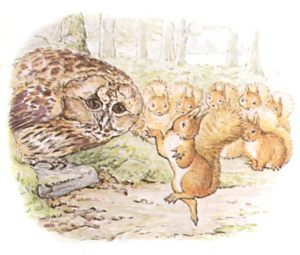
The . . . glimpse came through Squirrel Nutkin; through it only, though I loved all the Beatrix Potter books. But the rest of them were merely entertaining; it administered the shock, it was a trouble. It troubled me with what I can only describe as the Idea of Autumn.

It sounds fantastic to say that one can be enamored of a season, but that is something like what happened; and, as before, the experience was one of intense desire. And one went back to the book, not to gratify the desire (that was impossible— how can one possess Autumn?) but to reawake it.

And in this experience also there was the same surprise and the same sense of incalculable importance. It was something quite different from ordinary life and even from ordinary pleasure; something, as they would now say, “in another dimension.”

Squirrely Dads

Returning to the recent research that proved beyond any shadow of doubt that even among industrious, nut-gathering rodents, the males cop out. Don’t be put off by the study’s title—“The secret life of ground squirrels: accelerometry reveals sex-dependent plasticity in above-ground activity”—this is serious.

Apparently, while mom is down in a dark burrow nursing the kids, dad’s out lounging in the sunshine. It’s inexcusable.

And don’t try to use some lame excuse or misogynist argument that these findings are only true for Urocitellus parryii, semi-fossorial arctic ground squirrels, but they’re only fooling themselves. We all know that women work harder than men, especially when it comes to raising kids.

The female squirrels are literally so drained by the demands put upon them that they have to begin their hibernations before the males and end them after the males emerge from their hibernacula!

Following the termination of heterothermy in spring, male arctic ground squirrels remain below ground for a three to five week interval during which they consume a food cache to regain body mass lost during hibernation . . . Males intercept and mate-guard newly emergent females that become pregnant within a few days of emergence; gestation lasts for approximately 25 days, and lactation is another approximately 28–35 days.

Unlike males, females do not cache food and, with the exception of early gestation when they continue to lose body fat, they appear to fuel their reproduction using energy gained concurrently through foraging. [Note: it doesn’t appear the males share. Another strike against them.]

In addition, females are delivering energy to pups as milk during lactation . . . Once their young have been weaned, females undergo a moult and fatten; autumn immergence occurs in August [while] males that fatten and cache food later in the autumn immerge in early- to mid-October.

And there is no doubt that the people who conducted this research are right, after all, they used “collar-mounted light loggers and triaxial accelerometers!”


Dangerous Clowns

clownsThe latest concern here in the United States, aside from who will be our next president, involves “scary clowns.” And this bizarre meme got me thinking about clowndom in its broader expressions.

The current worry comes from people dressing up in sometimes morbid variations of clown attire. It’s not quite so bad as “It,” Stephen King’s 1990 miniseries about a demonic counterfeit.

It, by the way, has been updated lest the current generation be deprived of its arguable glories. The new film is in post-production and is due for release next fall.

Anyway, this film is only one of a legion of movies and cable productions that portray clowns in an ominous light.

So, it appears that the public is primed to expect the worst when people decide to dress up like jesters and do odd things in suspicious places at strange hours.

Expressed that way, there’s no reason people shouldn’t be concerned. After all, one of the most familiar elements of the criminal ensemble is a mask.

I sincerely hope that this fad doesn’t result in any serious problems. However, even if 99 out of 100 people are simply donning the make-up to be silly . . . that still leaves the 1%.

Attitudes Towards Clowns

I’ve never cared much about clowns, one way or the other. I’ve never considered them particularly eerie or entertaining.

I learned listening to the radio this week that I have that in common with Michael Medved.

Medved is a talented radio personality who coincidentally is a renowned film critic. Today, because of this media attention related to these harlequin lurkers, Medved was questioned about his attitude towards clowns.

He shared that he doesn’t particularly care one way or the other, but his family did have a negative experience many years ago. He related how one of his brothers was able to attend a taping of the San Diego expression of the “Bozo the Clown” program. Curiously, the stage for the broadcast was in Tijuana, but that’s another story.

Readers of Medved’s and my generation will immediately know who Bozo was. (To be distinguished from Bonzo, who was tucked into his blankets by President Reagan long ago.)

Returning to the clown . . . it turns out that Medved’s brother was frightened by the appearance of Bozo, and began crying. That drew the immediate attention of the actor in the intimidating suit, who said—probably in a low, threatening whisper, through the façade of the painted smile—“That’s a Bozo no-no . . .” Pretty creepy.

C.S. Lewis and Clowns

It just so happened that it was time for my next blog column. I wondered if there might be some connection I might draw with the Oxford don, or some bit of wisdom I might be able to apply to the subject at hand with minimal logical gymnastics.

It turns out I needn’t have been concerned. Here’s a wonderful description of Lewis, written the year after his death by his close friend, J.R.R. Tolkien.

C.S.L. of course had some oddities and could sometimes be irritating. He was after all and remained an Irishman of Ulster. But he did nothing for effect; he was not a professional clown, but a natural one, when a clown at all.

He was generous-minded, on guard against all prejudices, thought a few were too deep-rooted in his native background to be observed by him.

That his literary opinions were ever dictated by envy (as in the case of T.S. Eliot) is a grotesque calumny. After all it is possible to dislike Eliot with some intensity even if one has no aspirations to poetic laurels oneself.

I like that description of Lewis. As someone who is usually among the first to usher humor into a conversation or situation, I would like to think I might be described in a similar way. Not a “professional clown,” seeking to gain attention and praise. But a “natural one” who promotes laughter, good humor, and emotional health.

Those results are, I assume, the goals of all true clowns.

As for those who work to transform this image of merrymaking into something sinister . . . we can only hope and pray, that the trend exhausts itself soon.

And, at No Extra Cost

If you have never seen Bozo, you owe it to yourself to learn what your parents and grandparents called “entertainment” back in the day! (Trust me, you’ll never be the same.)