History in Retrospect

This title, “History in Retrospect,” is of course redundant. There is no other way to consider history than by looking back at the past – from our current vantage point.

That is why it’s impossible to view history completely objectively. Since each of us measures things from our personal worldview, the same event means vastly dissimilar things to different people.

When people are hyper-partisan, they are incapable of reasoning with others who view events differently. The history of the United States is currently the subject of intense (too often extremist) debate by its citizens. Balanced people, the type I prefer talking to, admit the shortcomings in our history, and praise the accomplishments.

There are those, sadly, who believe their nation can have done no wrong. There are others who relish condemning the country’s imperfections. Those in the latter camp remind me of the prejudice exhibited by Nathanael, one of Jesus’ future disciples, when he dismissed his brother’s enthusiasm about the Messiah with the words “can anything good come out of Nazareth?” (John 1).

C.S. Lewis was a gifted writer and academic. He was also a historian, especially an expert in literary history. His volume in the Oxford History of English Literature reflects that fact quite clearly.

Lewis was not only brilliant, in many ways he revealed great wisdom. Listen to these remarks about history from a letter he wrote to one of his casual correspondents in 1952.

You are not the kind of correspondent who is a ‘nuisance:’ if you were you would not be now thinking you are one – That kind never does.

But don’t send me any newspaper cuttings. I never believe a word said in the papers.

The real history of a period (as we always discover a few years later) has very little to do with all that, and private people like you and me are never allowed to know it while it is going on.

Educated originally as a “journalist,” I’m forced to agree completely with Lewis. Every word in print today is suspect. Those who do not read critically are on dangerous ground. And, of course, it’s not just newspapers and journals that demand caution. Digital media are even worse.

For that reason, we should never pretend any publication is 100% reliable. However, one magazine that I believe honestly strives toward that goal, is World Magazine. I appreciate the fact that it approaches subjects from my own theistic (Christian) worldview. By default, that makes it makes it untrustworthy to those who possess an anti-Christian worldview.

The open-minded individuals I referred to above, ever a minority, are willing (even eager) to read articles written by people from a range of perspectives. And it is for you, the honest and inquisitive people, that I suggest you consider adding World to your reading list.

Andrée Seu Peterson, recently wrote a provocative article discussing a recurrent historical phenomenon. It is entitled “A gathering in Switzerland: Little-known meetings can have massive outcomes.”

Down through history there have been little conferences attended by small numbers of elites that have quietly changed the world while the rest of mankind was going about its mundane business unawares. . . .

In June of 1494 King Ferdinand II of Aragon, Queen Isabella I of Castille, and King John II of Portugal drew a demarcation line like a vertical knife edge running from North to South poles, trampling established communities as it divided the Western world between Spain and Portugal.

People falling on one side of the line would henceforth speak Spanish and people on the other side would speak Portuguese.

Echoes of C.S. Lewis’ cautions about the “inner ring!”

Considering the “End of History”

History is defined in a variety of ways. To avoid politically charged definitions, let’s turn to a source in that most-neutral nation, Switzerland. In the description of their doctoral program in the field, the Universität Basel says “history examines past events, processes and structures [and] is both a cultural studies and a social sciences discipline.”

The point being that history relates to humanity, rather than our planet as an entirety. Thus, history won’t end with death of our solar system “in about 5 billion years [when] the sun will run out of hydrogen.” Even the most optimistic advocates of a starfaring future for humanity would likely admit history will end long before that.

Christians, on the other hand, foresee a future history without end. Yes, this earth will pass away, but our Creator has promised a new heaven and a new earth that will not echo the perishable nature of our fallen world.

In light of this conviction, Peterson includes a sobering observation in her essay about history.

People living in the Stone Age didn’t know they were living in the Stone Age. People alive at the time the monks in Ireland furiously copied Greek and Latin Bible manuscripts as fast as the Huns and Visigoths could torch the libraries of Europe didn’t know they were living through the near destruction of Western civilization. Such things are clear only in hindsight.

No Christian pretends to know the day of Christ’s return. In fact, Jesus expressly said “concerning that day and hour no one knows, not even the angels of heaven . . . Therefore you also must be ready, for the Son of Man is coming at an hour you do not expect” (Matthew 24).

Speculation about the Day of the Lord has rarely been beneficial. Suffice it to know that we should remain, at every possible moment, “ready.”

C.S. Lewis wrote another letter in 1952 which addresses this principle. His friend Don Giovanni Calabria (1873-1954), who was canonized by John Paul II in 1999, had written to Lewis sharing his impression that the day of the Lord’s return was drawing nearer.

Lewis reminded the priest of something Calabria already knew quite well. And it’s something well worth being reminded of today.

The times we live in are, as you say, grave: whether ‘graver than all others in history’ I do not know. But the evil that is closest always seems to be the most serious: for as with the eye so with the heart, it is a matter of one’s own perspective.

However, if our times are indeed the worst, if That Day is indeed now approaching, what remains but that we should rejoice because our redemption is now nearer and say with St John: ‘Amen; come quickly, Lord Jesus.’

Meanwhile our only security is that The Day may find us working each one in his own station and especially (giving up dissensions) fulfilling that supreme command that we love one another.

Lewis closes his letter with an affectionate prayer and promise, worthy of emulation in our own lives. “Let us ever pray for each other.” A sentiment I share with you.

Free Lecture Series Explores the Inklings

If you would like to learn more about C.S. Lewis, J.R.R. Tolkien, and their fellow Inklings, a free series of five lectures has just been produced. I am in the midst of the first, introductory lecture, and am eager to listen to the entire series.

You can receive links to the series from Hillsdale College by completing a small form at this link.

The subjects addressed in the series include:

  1. “Who Are the Inklings?” by Bradley J. Birzer
  2. “C.S. Lewis’s The Abolition of Man” by Michael Ward
  3. “J.R.R. Tolkien’s Scholarship” by Michael Drout
  4. “Themes of Lewis’s Fiction” by Jason Lepojärvi
  5. “Tolkien and the Christian Imagination” by Holly Ordway

Hillsdale College is an independent Christian institution, founded in 1844. They currently have 1,573 undergraduates, “representing 49 states, D.C., and 13 foreign countries,” complemented by more than one hundred graduate students.

Several years ago, they offered a free online course about C.S. Lewis, which we promoted on Mere Inkling in this post.

That course – along with thirty more – is still available at no cost. (Donations are welcome, of course.) You can learn about all of these courses here.

And, if you’re in the mood for reading a free issue of Christian History on the subject of “Heaven and the Christian Imagination,” look no further than this link. (The issue includes several references to the thought of C.S. Lewis.)

CS Lewis | Academic Tam

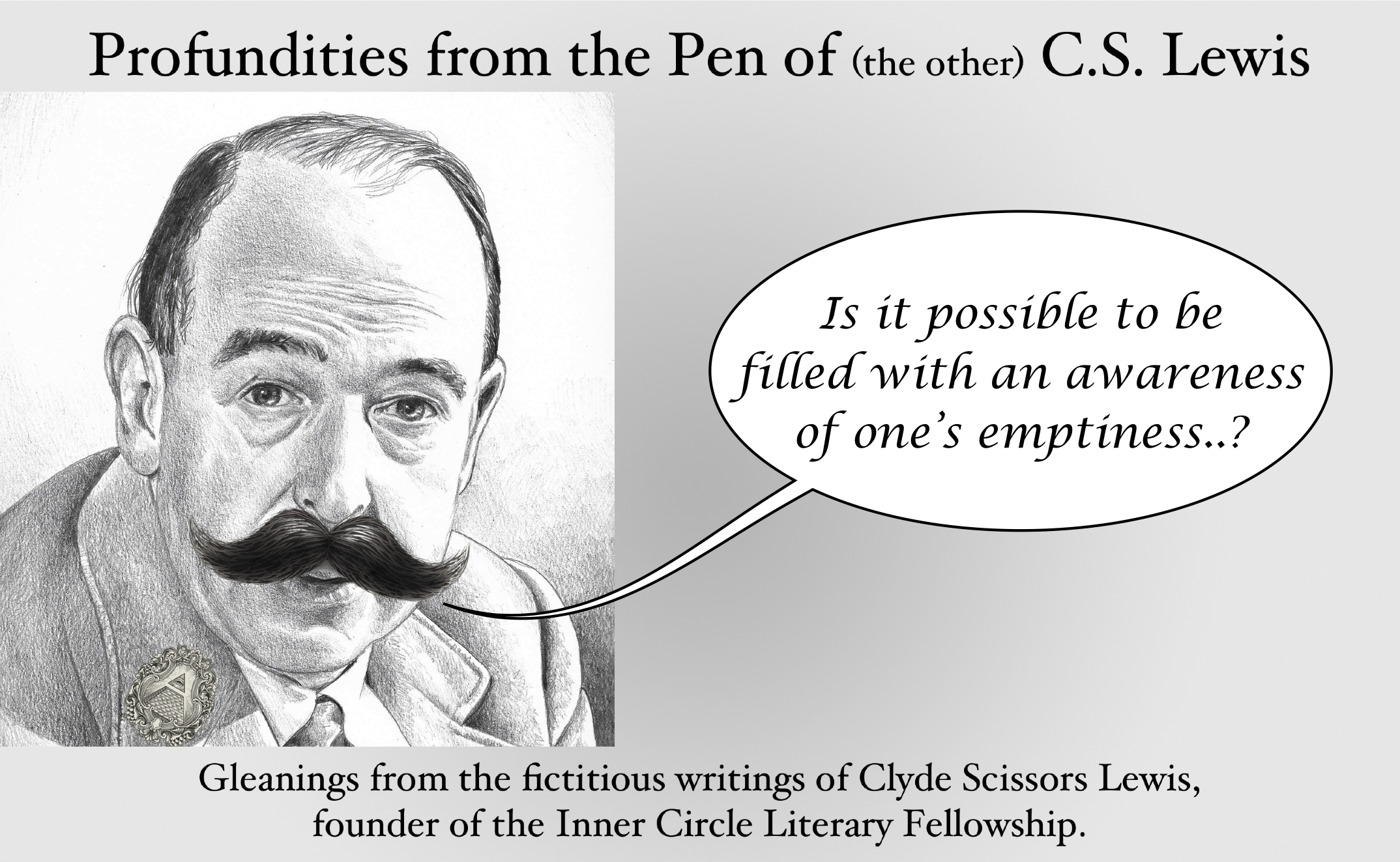
Deep Thoughts from the Quill of the Other C.S. Lewis

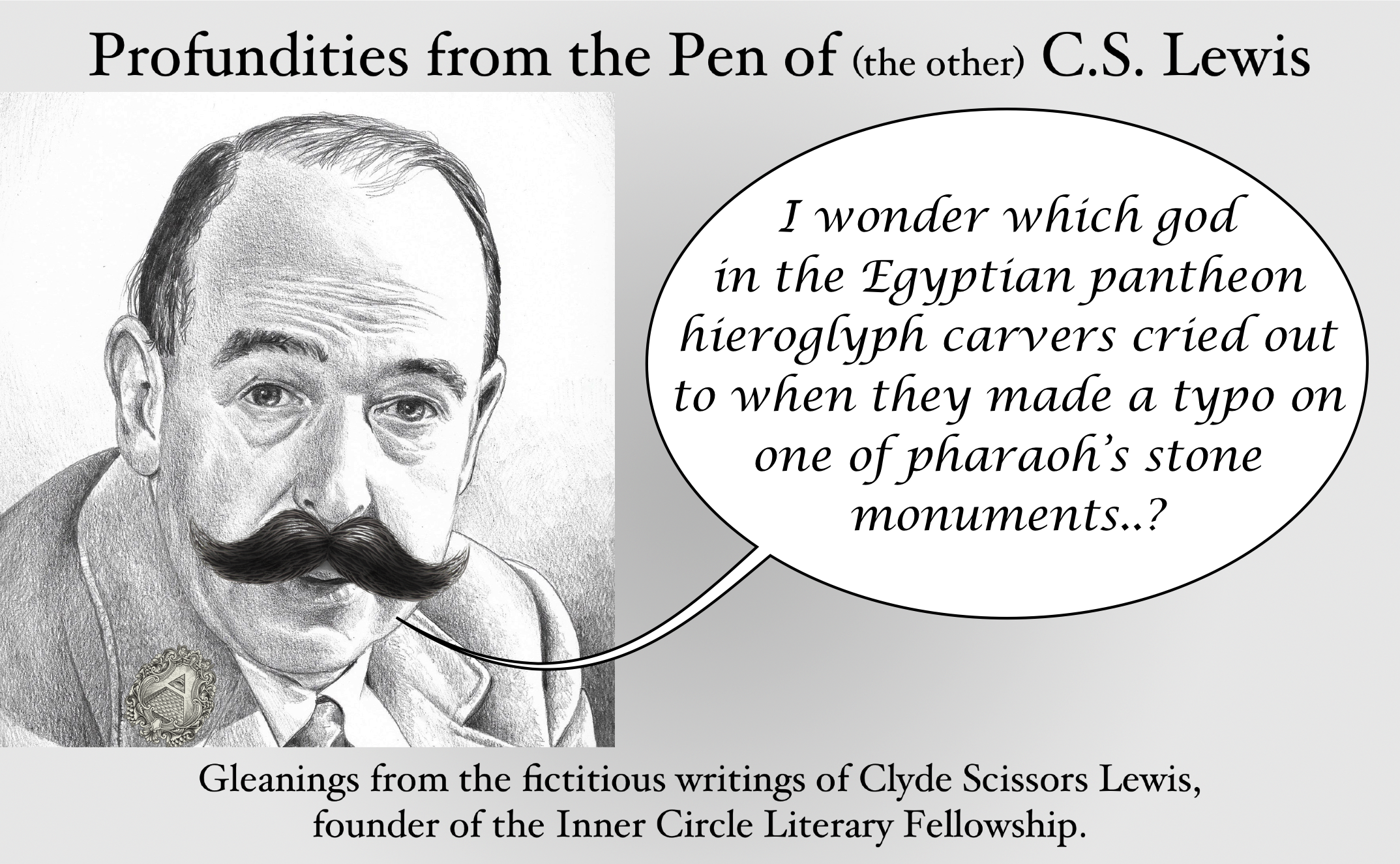
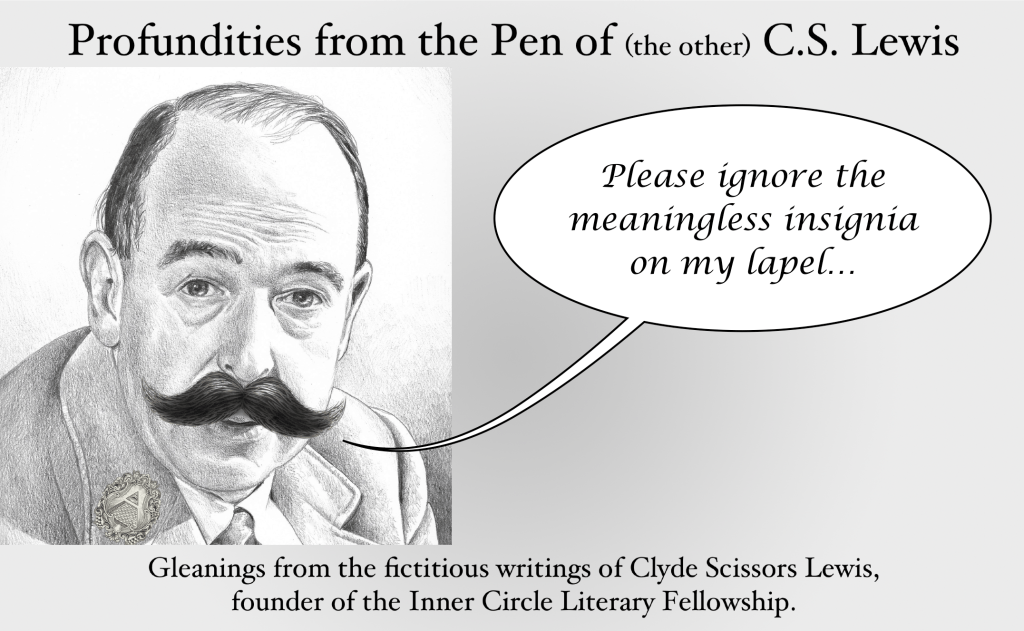
Welcome to another in an occasional series of fictitious quotations from a fabricated contemporary of the great Oxbridge professor, Clive Staples Lewis.

The C.S. Lewis who authored these questionable observations, Clyde Scissors Lewis, possessed a worldview enigmatically different from that of the esteemed Christian author. Despite the fact that their two lives overlapped in a variety of ways, the similarities were superficial.

A brief biography of the lesser Lewis is available at this link.

The Other C.S. Lewis: A Brief Biography

By all means, do not confuse the wisdom of the genuine article with his shadowy counterfeit. Despite any cursory similarities between the two men, this is most definitely not the C.S. Lewis readers have come to know and love.

An Author with the Heart of an Inkling

C.S. Lewis and Frederick Buechner never met, yet they are “friends” because they share so many similarities as authors writing from a Christian perspective. In terms of Buechner’s themes and range of his writings, this award winning American author and ordained Presbyterian minister may have as much in common with C.S. Lewis as his own British Inklings. So let me introduce Frederick Buechner and his writings.

Do you read primarily to relax and allow your imagination to soar? Or, do you normally select “useful” books, with the potential to be applicable to meeting the challenges of real life?

During my college years, I enjoyed scifi and fantasy. I still have a weak spot for alternative histories. But my seminary years had a subtle effect on my reading. With time always at a premium as a young pastor with a family, I had so many practical, pastoral books and journals to study, that I seldom had time for something so frivolous as “fiction.” Fortunately, semi-retirement has released me from that restrictive literary diet.

I’ve finally found some time to unpack a few of the boxes of books sitting in my garage. (The fact we moved them into the garage around 2010 would be embarrassing if it got out, so I ought not to mention it here.)

As one would expect, I’ve encountered many pleasant surprises. A number of books I had been missing have turned up, I’ve found some that are even more timely today than when they were stored, and—best of all in the minds of my adult children—I’ve been able to part with about two-thirds of the titles, and recently donated about 150 volumes to a local charity.

One of the titles I am currently reading is Frederick Buechner’s Telling Secrets. I had picked up a copy when it was highly recommended to me, only to discover it was a memoir. Being a “practical pastor” who always had too many utilitarian books to read, I set it aside . . . only to pick it up twenty years later.

And what a joyous surprise it has been. Buechner is in his nineties, and is widely respected. He has been a prolific writer, and has received numerous awards for his fictional works. Readers, particularly from the Reformed branch of Christianity have been especially fervent fans of the Presbyterian pastor and theologian. My friend, Brenton Dickieson is quite fond of Buechner and has written about him in A Pilgrim in Narnia on several occasions. He notes that Buechner quotes a number of the Inklings, including Tolkien, Williams and Lewis.

I vaguely recall the Lewis connection being one reason my fellow Air Force chaplain recommended Telling Secrets to me. But I had forgotten that the first section is entitled “The Dwarves in the Stable.” This is, of course, an allusion to an extremely momentous scene in The Final Battle, the final volume of the Chronicles of Narnia. It was originally published as an independent essay, as this entertaining post points out.

Buechner shares a dark family secret, the consequences of his father’s suicide in 1936. Listen to how movingly he describes the secret’s power:

His suicide was a secret we nonetheless tried to keep as best we could, and after a while my father himself became such a secret. There were times when he almost seemed a secret we were trying to keep from each other.

Buechner moves on to relate the suffering the family experienced during his daughter’s battle with anorexia. He shares few details, since “it is not mine to tell but hers.” Nevertheless, he describes setbacks in the struggle causing him to feel as though he “was in hell.”

I choose the term hell with some care. Hell is where there is no light but only darkness, and I was so caught up in my fear for her life, which had become in a way my life too, that none of the usual sources of light worked any more, and light was what I was starving for. . . .

I remained so locked inside myself that I was not really present with them at all. Toward the end of C.S. Lewis’s The Last Battle there is a scene where a group of dwarves sit huddled together in a tight little knot thinking that they are in a pitch black, malodorous stable when the truth of it is that they are out in the midst of an endless grassy countryside as green as Vermont with the sun shining and blue sky overhead.

The huge golden lion, Aslan himself, stands nearby with all the other dwarves “kneeling in a circle around his forepaws” as Lewis writes, “and burying their hands and faces in his mane as he stooped his great head to touch them with his tongue.” When Aslan offers the dwarves food, they think it is offal.

When he offers them wine, they take it for ditch water. “Perfect love casteth out fear,” John writes (1 John 4:18), and the other side of that is that fear like mine casteth out love, even God’s love. The love I had for my daughter was lost in the anxiety I had for my daughter.

This is just a single example of the sensitive wisdom Buechner shares throughout this grace-filled work.

After I finish Telling Secrets, I look forward to reading two of Buechner’s novels already on my shelf, Godric and Brendan. They are both historical fiction, telling the stories of two sainted monks from the twelfth and sixth centuries respectively.

I encourage any of you unfamiliar with his writings to explore his work. If an autobiography can be this good, I’m eager to take a journey through what I have no doubt will be quite an adventure in his fiction.

Buechner possesses an additional connection to C.S. Lewis, which has the potential to last centuries. He describes his decision to offer his personal papers to Wheaton College, where they are available in the archives. The theologian describes his decision in this humble manner.

Wheaton College [has] a great collection there of the manuscripts and papers of people like C.S. Lewis, G.K. Chesterton, George MacDonald, J.R.R. Tolkien, Dorothy Sayers, and the like, and because I could think of no more distinguished company than theirs among whom to have my own literary remains molder, a year earlier I had offered them everything I had stowed away over the years in cardboard boxes and scrapbooks and manila folders; and to my delight they said that they would be delighted to have it.

If you would enjoy learning more about the relationship between Buechner and the Inklings, check out this fine article; “C.S. Lewis and Frederick Buechner: Literary Expression of Faith” is available for download. It’s quite enlightening.


Bonus Insight

The second chapter of Telling Secrets is entitled “The White Tower.” Many Inkling fans will jump to the conclusion (especially after reading this post) that it is a reference to the citadel of Minas Tirith, the capital of Gondor. Like me, they would be incorrect.

Buechner is not alluding here to Tolkien’s masterpiece. On the contrary, he is referring to the central tower which was the old keep of the Tower of London. Ironically, that very keep, the White Tower, was built by a Norman monk who became the Bishop of Rochester. His name . . . Gundulf.

Buechner chose this metaphor for the human condition for the following reason.

I think here of the Tower of London. More particularly I think of that oldest part of it, known as the White Tower, which was built by William the Conqueror in the eleventh century. On the second floor of it there is a small Norman chapel called the Chapel of Saint John. It is very bare and very simple. It is built all of stone with twelve stone pillars and a vaulted ceiling.

There is a cool, silvery light that comes in through the arched windows. . . . The chapel is very silent, very still. It is almost a thousand years old. You cannot enter it without being struck by the feeling of purity and peace it gives. If there is any such thing in the world, it is a holy place.

But that is not all there is in the White Tower. Directly below the chapel is the most terrible of all the tower’s dungeons. It has a heavy oak door that locks out all light and ventilation. It measures only four feet square by four feet high so that a prisoner has no way either to stand upright in it or to lie down at full length. There is almost no air to breathe in it, almost no room to move. It is known as the Little Ease.

I am the White Tower of course. To one degree or another all of us are.

C.S. Lewis & the Playful God

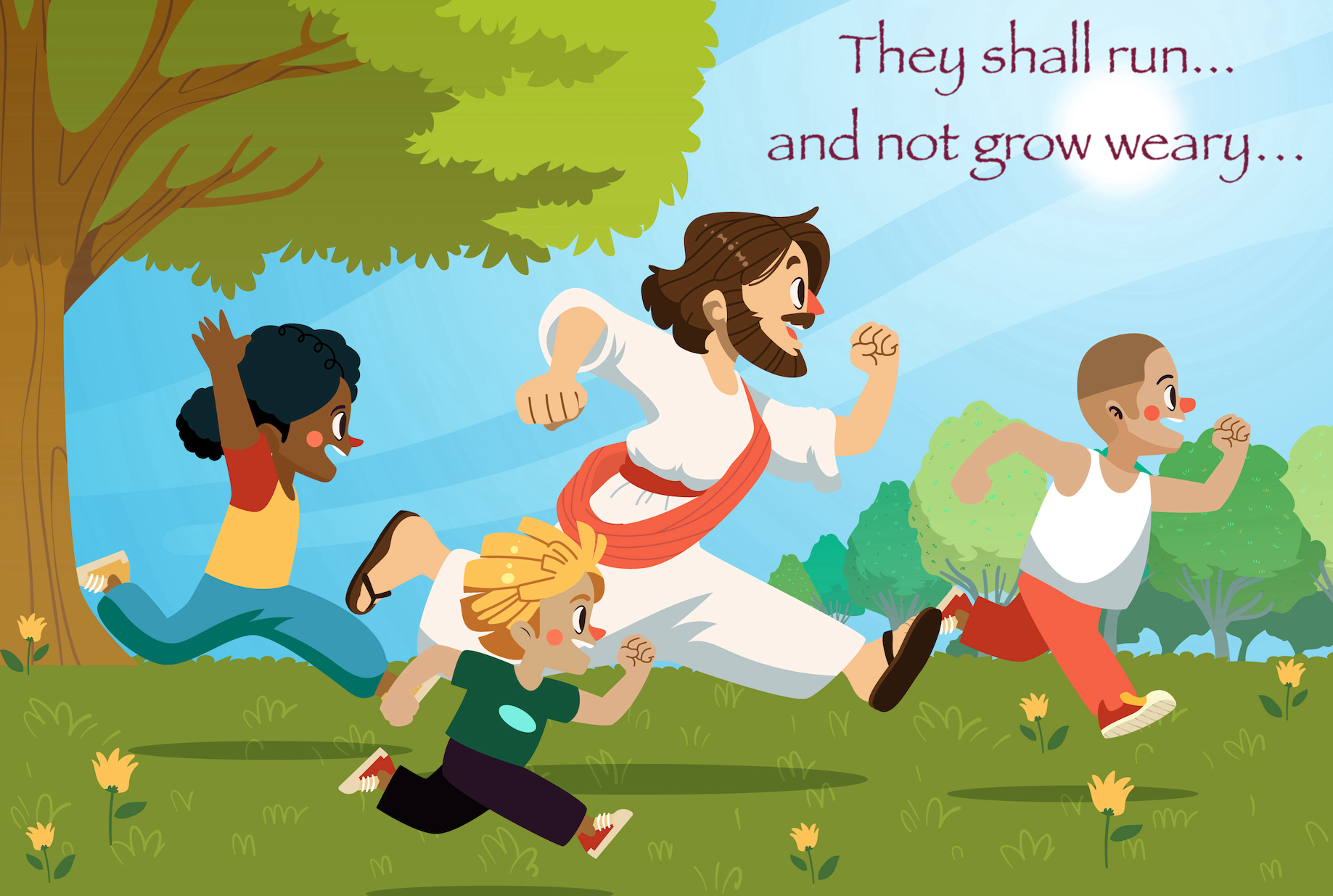
When my grandchildren were younger, we played a game where everything would be “normal” and I would without warning say “you don’t need to be afraid of me, because I’m not…” [transformational pause, followed with a growl] “… an ogre!”

The kids would squeal and hightail it for cover where they were safe while I briefly lumbered about for a moment. It was much fun, and if Jesus tarries, perhaps I’ll play a similar game with their children.

I recently read an interesting article about Martin Luther’s understanding of God’s playfulness. You can read the entire article here: “Deus Ludens: God at Play in Luther’s Theology.”

Finally, and perhaps most importantly, Luther knows a kind of unstructured play, especially between parents and children, that may involve . . . a kind of pretending which then gives way to the revelation of reality.

C.S. Lewis was a confirmed bachelor when he was surprised by encountering Joy, who would become his wife. He did a commendable job as a stepfather after her death, but wasn’t well equipped for the job.

In The Abolition of Man, Lewis confessed “I myself do not enjoy the society of small children . . . I recognize this as a defect in myself.” Yet he did enjoy other forms of play – of the mental and imaginary varieties – that many young people also savor.

One pastor encourages us to apply Lewis’ observation to ourselves.

Do you recognize that an inability to enjoy children is not representative of a defect in the children, but of a defect in us? I hope that you do. And if not, I hope that you will.

In “C.S. Lewis on Pretending,” the author touches on this theme. After quoting the following passage from Mere Christianity, he writes, “Lewis is drawing out two key elements of change. The role of imagination in faith. The necessity of visionary faith for change.”

Very often the only way to get a quality in reality is to start behaving as if you had it already. That is why children’s games are so important. They are always pretending to be grown-ups – playing soldiers, playing shop.

But all the time, they are hardening their muscles and sharpening their wits so that the pretence of being grown-up helps them grow up in earnest.”

Poet Malcolm Guite challenges (accurately, in my opinion) Lewis’ self-diagnosed disconnect from children.

That Lewis could write immortal children’s tales in late middle age, and weave into those tales such truth and vision that the children who first read them at 8 or 9 keep returning to them in adult life and finding more and more, is a sign that he retained to the end, ‘the child within,’ to borrow George Macdonald’s phrase. And yet in those very stories he provides for both children and grown-ups some very searching truths about what it is both to be a child and to grow up.

Other Christians have identified with Lewis’ challenge. One pastor repeated Lewis’ words about his “defect,” admitted he felt similarly, and responded:

Do you recognize that an inability to enjoy children is not representative of a defect in the children, but of a defect in us? I hope that you do. And if not, I hope that you will.

Because children, just like the poor, offer us another unique opportunity to see what it means to live inside God’s kingdom.

Like it or not, children are going to be who they are. With zero nuance or subtlety, they are going to be consistent – the authentic version of themselves – in every situation.

Ironically, despite his supposed handicap, C.S. Lewis directly blessed more children than it would be possible to number. The follow article, “A Playful Romp with God,” reveals an excellent example of his accomplishment.

The first time I encountered this scene – as an adult, reading the Narnia books to my own kids – I cried. The possibility that God might laugh, romp, and play with his children stopped me in my tracks. How could such a scandalous thing be true?

Growing up, I never heard a word about God laughing, joking, or doing anything for fun. No one invited me to imagine the Jesus of the Gospels smiling, much less goofing around with his disciples, playing hide-and-seek with the children who flocked to him, or basking in the sunshine on a gorgeous summer day.

The list of characteristics I associated with God – omniscience, holiness, transcendence, righteousness – did not include playfulness.

The writer of these words is not alone. Too many people have been raised with the image of a stern, humorless Christ. That’s one of the reasons I am so pleased with the new series, “The Chosen.”

While they may carry the image of Jesus’ playfulness a bit too far – who can say – it is a truly refreshing and convincing portrayal of the Lamb who came to lay down his life as a sacrifice for each of us.

C.S. Lewis portrays this aspect of God brilliantly in The Lion, the Witch, and the Wardrobe. After his resurrection, Aslan reveals himself first to Susan and Lucy. And, rather than rush off to prepare Narnia for the approaching battle with the Witch . . . he plays.

“Oh, children,” said the Lion, “I feel my strength coming back to me. Oh, children, catch me if you can!” He stood for a second, his eyes very bright, his limbs quivering, lashing himself with his tail. Then he made a leap high over their heads and landed on the other side of the Table.

Laughing, though she didn’t know why, Lucy scrambled over it to reach him. Aslan leaped again. A mad chase began. Round and round the hilltop he led them, now hopelessly out of their reach, now letting them almost catch his tail, now diving between them, now tossing them in the air with his huge and beautifully velveted paws and catching them again, and now stopping unexpectedly so that all three of them rolled over together in a happy laughing heap of fur and arms and legs.

It was such a romp as no one has ever had except in Narnia; and whether it was more like playing with a thunderstorm or playing with a kitten Lucy could never make up her mind. And the funny thing was that when all three finally lay together panting in the sun the girls no longer felt in the least tired or hungry or thirsty.

Do we have a playful God? If you still think not, you have my sympathy, my prayers, and my encouragement to read this helpful article, “The Role of Laughter in the Christian Life,” written by the author of Surprised by Laughter: The Comic World of C.S. Lewis.

When the Learnèd Deserve Gentle Ridicule

The halls of academia are a curious place. Dark wooden walls and well-worn stairways hearken back to legions of students and professors who have invested portions of their lives in the academies’ life. Some of us are drawn to the air of knowledge and residue of research that made them what they are.

At the same time, however, many universities have become parodies of what they once were. Some self-important leaders and faculty cry out for satire and parody. As one liberal American journalist, a defender of academic elitism, admitted: “academics can be condescending and arrogant.”

Through the years I’ve known many brilliant men and women who retained their humility. Sadly, I’ve also encountered many whose view of themselves was so exaggerated that one could only respond with disbelief. Do they really believe no one sees through the façade?

Rather than write a longer column here, I want to provide a link to an unusual article I recently wrote related to this subject. If you have a sense of humor, and are not afflicted with academic grandiosity, please check it out. It appeared this past week in the latest issue of CSL: The Bulletin of the New York C.S. Lewis Society.

CSL is a small but mighty (think Reepicheep) publication. It’s worth subscribing to, even for those of us thousands of miles from their regular meetings in the Empire State.

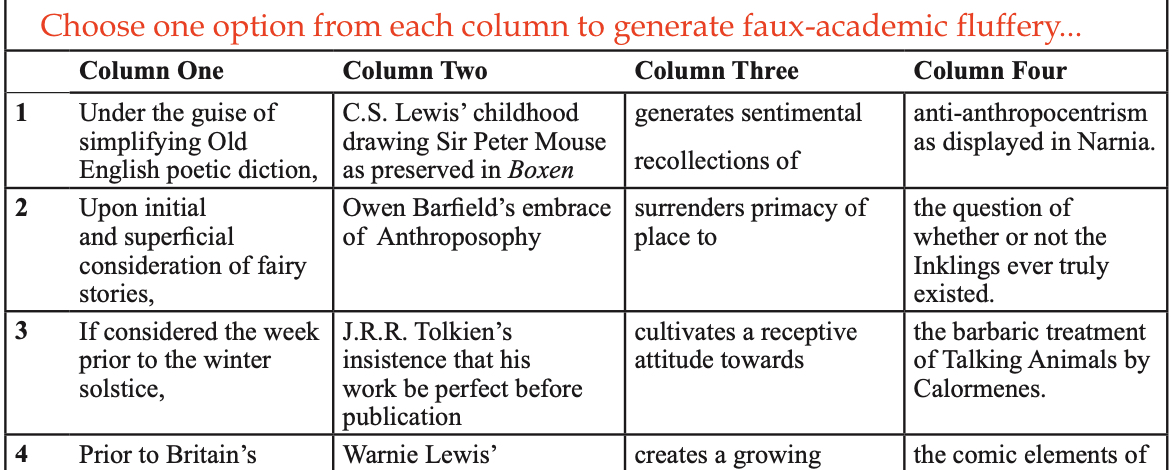
My article is brief, but it includes “the Mere Oxford Inkling Erudition Chart,” which promises countless hours of educational entertainment.

The people my satire seeks to unmask are the type of academics who attempted to make Oxford and Cambridge Universities so inhospitable to C.S. Lewis. Read this interview with one of his former student who critiques the opinions of lesser minds.

The BBC [invited him to broadcast the] talks that ultimately became Mere Christianity. The BBC was astounded by the response to these talks. As you know, Mere Christianity has never been out of print since.

He then became very unpopular with the senior faculty at Magdalen College. Magdalen was a godless college and a very famous college, very atheistical. . . . So [Lewis] got a rough ride there. He never made professor at Oxford.

So much for the civility one would expect in such environs.

You can read my modest article, “Mastering Inkling Erudition,” at this link today.

Resurrection Bodies, Angels & C.S. Lewis

And just what will those heavenly bodies be like..? And what about those angels..?

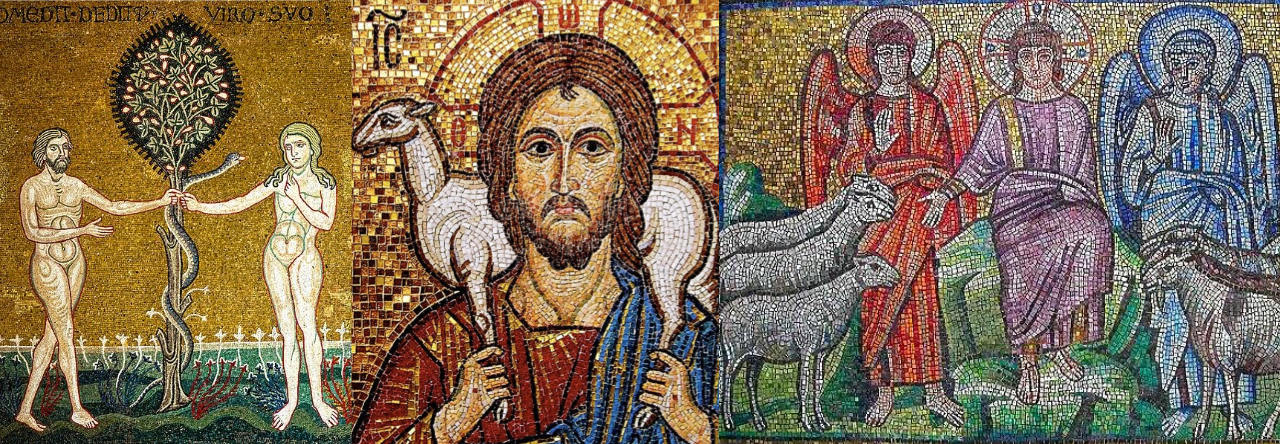
Among the many things that Christians look forward to, as an unearned gift from God, is a new body. This resurrected body will not be like our old (i.e. former) body… but it will be similar to the bodies of our first parents, Eve and Adam. So, in a sense, one might say it’s a bit like that old, old (i.e. original) body.

Sadly, there’s a lot of unnecessary confusion about what awaits us after death. While the Lord doesn’t give us all the details (which we wouldn’t be able to comprehend right now anyway), he does make the big picture clear. Here are some facts (based on the Scriptures as interpreted for 2,000 years within the orthodox Christian faith).

1.  You can’t do enough good works to deserve to enter heaven. It’s all about God’s mercy and grace.

If you think you can be good enough to get there on your own . . . sorry. If you therefore don’t think it matters at all how you live… you will end up just as sorry.

2. In heaven, God’s redeemed will not be incorporeal spirits. We’ll have bodies, just as our Maker intended from the day he breathed life into Adam’s lungs. Christians affirm belief in the “resurrection of the body.”

As to the nature of the bodies, God doesn’t leave us ignorant. One of the best New Testament descriptions is found in First Corinthians.

Even the Old Testament prophet Job proclaimed the wonders of a bodily resurrection when, in his own flesh, he would see the Lord.

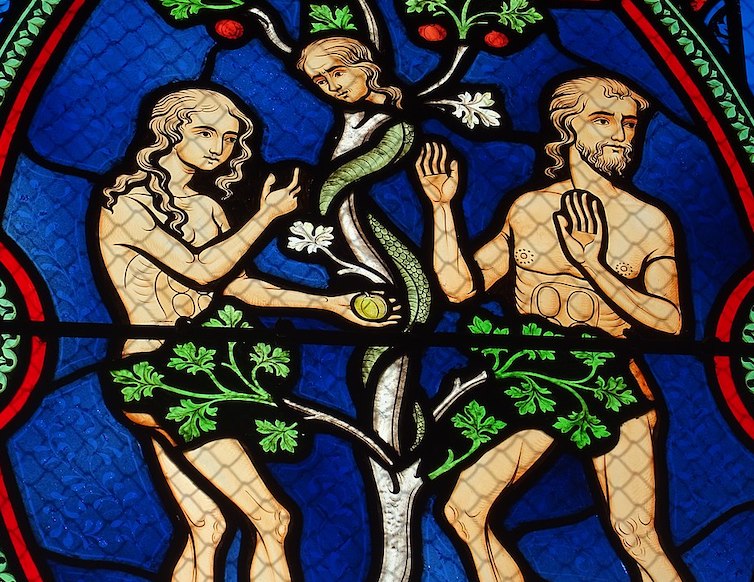
God’s written word includes more about our resurrection bodies. One, from the letter to the Christians in Philippi, says, “the Lord Jesus Christ . . . will transform our lowly body to be like his glorious body.” This verse, like the stained glass image above, inspires me to wonder what that body will be like. Like Jesus’ own resurrection body, we learn.

Perhaps also like humanity’s unfallen human bodies portrayed here in colored glass. If the artist’s vision is accurate, I’m eager to welcome back the hair that once adorned my head, and to enjoy those stunningly defined abs, that I unfortunately never possessed.

Writing to his friend Arthur Greeves, Lewis clarified the biblical definition of resurrection.

I agree that we don’t know what a spiritual body is. But I don’t like contrasting it with (your words) “an actual, physical body.” This suggests that the spiritual body wd. be the opposite of “actual” – i.e. some kind of vision or imagination. And I do think most people imagine it as something that looks like the present body and isn’t really there.

Our Lord’s eating the boiled fish seems to put the boots on that idea, don’t you think? I suspect the distinction is the other way round—that it is something compared with which our present bodies are half real and phantasmal. (19 August 1947)

3. Human beings never become angels. One of most common mistakes about heaven is that people (“good” ones, at least) become angels after they die. They don’t. Period. Angels are angels and people are people – two separate beings, each with their own nature. Angels are majestic, most certainly, but they were not blessed like humanity to be created in the very image of God.

And never forget, not all angels are good. Those fallen ones, in fact, no longer merit their identification as angels. Better to label them as what they’ve become, demons.

As for people being intrinsically distinct from angels, C.S. Lewis wrote a poem that contrasts angelic and human personhood.

On Being Human by C. S. Lewis

Angelic minds, they say, by simple intelligence
Behold the Forms of nature. They discern
Unerringly the Archetypes, all the verities
Which mortals lack or indirectly learn.
Transparent in primordial truth, unvarying,
Pure Earthness and right Stonehood from their clear,
High eminence are seen; unveiled, the seminal
Huge Principles appear.

The Tree-ness of the tree they know – the meaning of
Arboreal life, how from earth’s salty lap
The solar beam uplifts it; all the holiness
Enacted by leaves’ fall and rising sap;

But never an angel knows the knife-edged severance
Of sun from shadow where the trees begin,
The blessed cool at every pore caressing us
– An angel has no skin.

They see the Form of Air; but mortals breathing it
Drink the whole summer down into the breast.
The lavish pinks, the field new-mown, the ravishing
Sea-smells, the wood-fire smoke that whispers Rest.
The tremor on the rippled pool of memory
That from each smell in widening circles goes,
The pleasure and the pang – can angels measure it?
An angel has no nose.

The nourishing of life, and how it flourishes
On death, and why, they utterly know; but not
The hill-born, earthy spring, the dark cold bilberries.
The ripe peach from the southern wall still hot
Full-bellied tankards foamy-topped, the delicate
Half-lyric lamb, a new loaf’s billowy curves,
Nor porridge, nor the tingling taste of oranges.
– An angel has no nerves.

Far richer they! I know the senses’ witchery
Guards us like air, from heavens too big to see;
Imminent death to man that barb’d sublimity
And dazzling edge of beauty unsheathed would be.
Yet here, within this tiny, charmed interior,
This parlour of the brain, their Maker shares
With living men some secrets in a privacy
Forever ours, not theirs.

Heaven will be wondrous. Not only will we get to worship the One who created and redeemed us, there is so much more we have to look forward to. Enjoying a new, unflawed body . . . hobnobbing with angels who sang to celebrate Christ’s Nativity . . . and waiting in line to enjoy a beverage with C.S. Lewis.


The picture above is of a stained glass window in the Basilica of Our Lady of the Children in Châteauneuf-sur-Cher, France. Olive Titus, CC BY 2.0, via Wikimedia Commons

CS Lewis | Mistakes

Deep Thoughts from the Quill of the Other C.S. Lewis

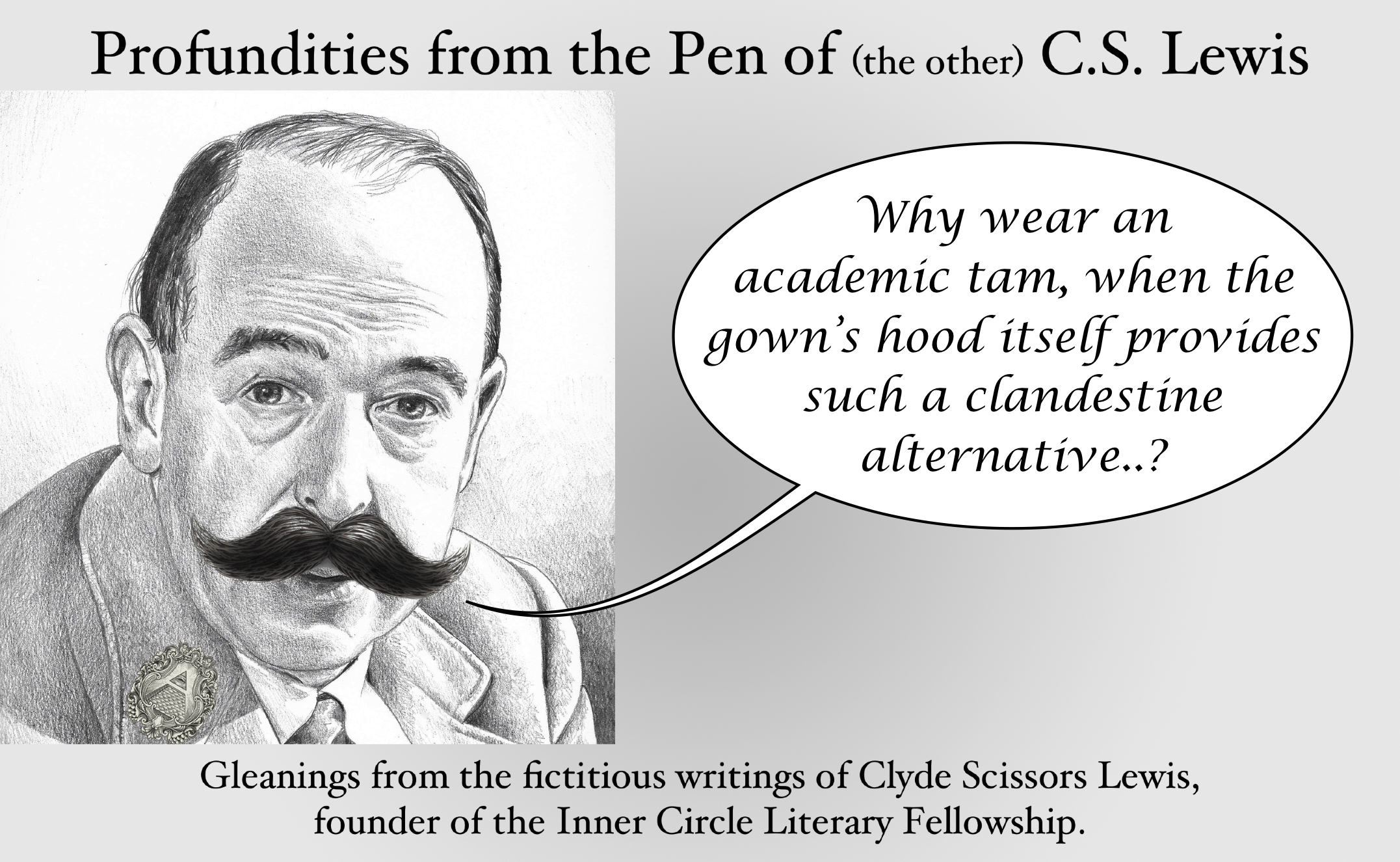
Welcome to another in an occasional series of fictitious quotations from a fabricated contemporary of the great Oxbridge professor, Clive Staples Lewis.

The C.S. Lewis who authored these questionable observations, Clyde Scissors Lewis, possessed a worldview enigmatically different from that of the esteemed Christian author. Despite the fact that their two lives overlapped in a variety of ways, the similarities were superficial.

A brief biography of the lesser Lewis is available at this link.

The Other C.S. Lewis: A Brief Biography

By all means, do not confuse the wisdom of the genuine article with his shadowy counterfeit. Despite any cursory similarities between the two men, this is most definitely not the C.S. Lewis readers have come to know and love.

CS Lewis | Emptiness

Deep Thoughts from the Quill of the Other C.S. Lewis

Welcome to another in an occasional series of fictitious quotations from a fabricated contemporary of the great Oxbridge professor, Clive Staples Lewis.

The C.S. Lewis who authored these questionable observations, Clyde Scissors Lewis, possessed a worldview enigmatically different from that of the esteemed Christian author. Despite the fact that their two lives overlapped in a variety of ways, the similarities were superficial.

A brief biography of the lesser Lewis is available at this link.

The Other C.S. Lewis: A Brief Biography

By all means, do not confuse the wisdom of the genuine article with his shadowy counterfeit. Despite any cursory similarities between the two men, this is most definitely not the C.S. Lewis readers have come to know and love.

C.S. Lewis & a Horse Named Fledge

C.S. Lewis was not alone in recognizing horses are magnificent creatures. Many of us share his appreciation for the more than 300 breeds that comprise the equine family.

Horses hold a prominent place in Lewis’ zoologically rich fantasies. In the Chronicles of Narnia, we encounter many Talking Horses. Among them are Bree, the titular hero of The Horse and His Boy, and Hwin, the heroine who teaches Bree what it means to be a Narnian.

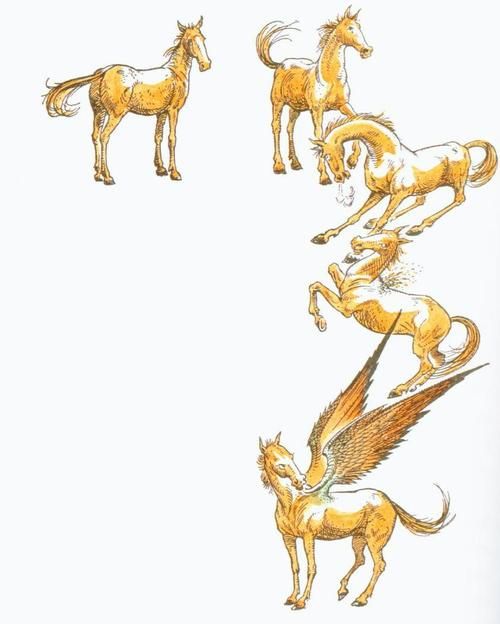
But before Bree and Hwin galloped across the fields and plains of Narnia, a horse from Earth was transported to that Land at the hour of its very creation.* And there, Aslan anointed this modest draft horse⁑ to become the progenitor of a race of pegasi. Fledge’s story is quite inspiring.

Fledge was once named Strawberry, and pulled a Hansom cab in London. But after journeying to Narnia, Aslan chose him to be one of the very first Talking Animals, and granted him wings.

Would You Like Wings?” offers an illuminating meditation on this transformation.

So Strawberry, in this first stage, goes from beast to person. From a dream to wakefulness. From slavery to freedom. From silence to speech, from witless to intelligent.

From C.S. Lewis’ account of the “miraculous” event:

He then turned to the Horse who had been standing quietly beside them all this time, swishing his tail to keep the flies off, and listening with his head on one side as if the conversation were a little difficult to understand. “My dear,” said Aslan to the Horse, “would you like to be a winged horse?”

You should have seen how the Horse shook its mane and how its nostrils widened, and the little tap it gave the ground with one back hoof. Clearly it would very much like to be a winged horse. But it only said: “If you wish, Aslan – if you really mean – I don’t know why it should be me – I’m not a very clever horse.”

“Be winged. Be the father of all flying horses,” roared Aslan in a voice that shook the ground. “Your name is Fledge.” The horse shied . . . It strained its neck back as if there were a fly biting its shoulders and it wanted to scratch them. And then, just as the beasts had burst out of the earth, there burst out from the shoulders of Fledge wings that spread and grew, larger than eagles’, larger than swans’, larger than angels’ wings in church windows. . . .

“Is it good, Fledge?” said Aslan.

“It is very good, Aslan,” said Fledge.

When Aslan sends Polly and Digory on a quest with Fledge, they camp for the night and enjoy a delightful human~animal conversation (much like I would anticipate having with the deer that visit our yard daily, should they be graced with speech).

“And my wings are beginning to ache,” said Fledge. “There’s no sign of the valley with a Lake in it, like what Aslan said. What about coming down and looking out for a decent spot to spend the night in? We shan’t reach that place tonight.”

“Yes, and surely it’s about time for supper?” said Digory. So Fledge came lower and lower. As they came down nearer to the earth and among the hills, the air grew warmer and after traveling so many hours with nothing to listen to but the beat of Fledge’s wings . . .

A warm, good smell of sun-baked earth and grass and flowers came up to them. . . . “I am hungry,” said Digory.

“Well, tuck in,” said Fledge, taking a big mouthful of grass. Then he raised his head, still chewing and with bits of grass sticking out on each side of his mouth like whiskers, and said, “Come on, you two. Don’t be shy. There’s plenty for us all.”

“But we can’t eat grass,” said Digory.

“H’m, h’m,” said Fledge, speaking with his mouth full. “Well—h’m—don’t know quite what you’ll do then. Very good grass too.”

Polly and Digory stared at one another in dismay. “Well, I do think someone might have arranged about our meals,” said Digory.

“I’m sure Aslan would have, if you’d asked him,” said Fledge. “Wouldn’t he know without being asked?” said Polly. “I’ve no doubt he would,” said the Horse (still with his mouth full). “But I’ve a sort of idea he likes to be asked.”

“But what on earth are we to do?” asked Digory.

“I’m sure I don’t know,” said Fledge. “Unless you try the grass. You might like it better than you think.” (The Magician’s Nephew).⁂

In C.S. Lewis’ first story about Narnia, The Lion, the Witch and the Wardrobe, we read about the “statues” that surround the castle of the White Witch. Edmund has been corrupted by the Witch, and told that Aslan is dangerous.

The Witch has the power to turn living creatures to stone. When Edmund discovers a lion in her garden, he is delighted. But the lion is not alone.

The relief which Edmund felt was so great that in spite of the cold he suddenly got warm all over right down to his toes, and at the same time there came into his head what seemed a perfectly lovely idea. “Probably,” he thought, “this is the great Lion Aslan that they were all talking about. She’s caught him already and turned him into stone. So that’s the end of all their fine ideas about him! Pooh! Who’s afraid of Aslan?”

And he stood there gloating over the stone lion, and presently he did something very silly and childish. He took a stump of lead pencil out of his pocket and scribbled a mustache on the lion’s upper lip and then a pair of spectacles on its eyes. Then he said, “Yah! Silly old Aslan! How do you like being a stone? You thought yourself mighty fine, didn’t you?”

But in spite of the scribbles on it the face of the great stone beast still looked so terrible, and sad, and noble, staring up in the moonlight, that Edmund didn’t really get any fun out of jeering at it. He turned away and began to cross the courtyard.

As he got into the middle of it he saw that there were dozens of statues all about – standing here and there rather as the pieces stand on a chessboard when it is halfway through the game. There were stone satyrs, and stone wolves, and bears and foxes and cat-a-mountains of stone. . . . a winged horse and a long lithe creature that Edmund took to be a dragon (The Lion, the Witch and the Wardrobe).

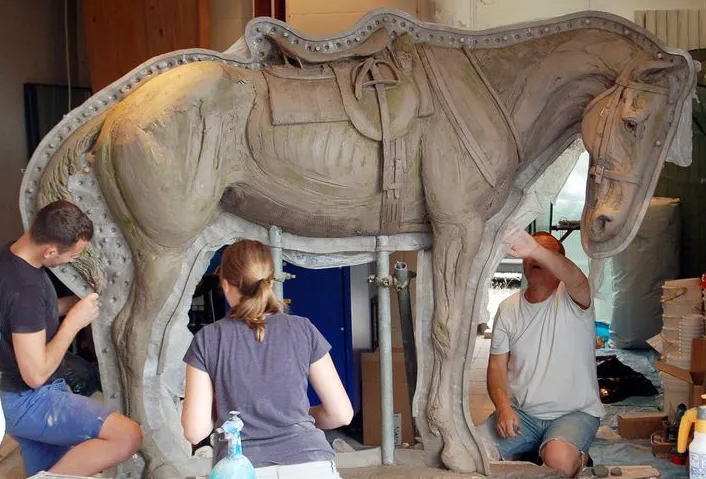
I find the description of the lion quite provocative. “. . . so terrible, and sad, and noble.” That is exactly what I experienced when I saw the model for a “war horse” memorial in Romsey, England. The artists have done a brilliant job. The sorrow overflows from it eyes.

True, my impression is influenced by the outstanding 2011 film titled War Horse. If you’ve never seen this Spielberg gem, I encourage you to watch it and challenge you to do so without shedding a tear.

Horses have long been used in war. That is not what God created them for, but fallen humanity has often harnessed their power for combat. Some of their names are remembered today, including Bucephalus, Copenhagen, Cincinnati, and Traveler.

Returning to Fledge, we find a horse not only experiencing the fullness of his equine nature, but receiving blessings unimagined.


* C.S. Lewis did not compose the seven volumes of the Chronicles of Narnia chronologically. This has led to different opinions on the order in which the books should be read.

⁑ Draught horse, to you Brits.

⁂ While I typed this, a doe and her two fawns were peacefully grazing on our clover-seeded lawn, just a few feet away, outside my office window. [I’m sure they would have happily shared with me.]