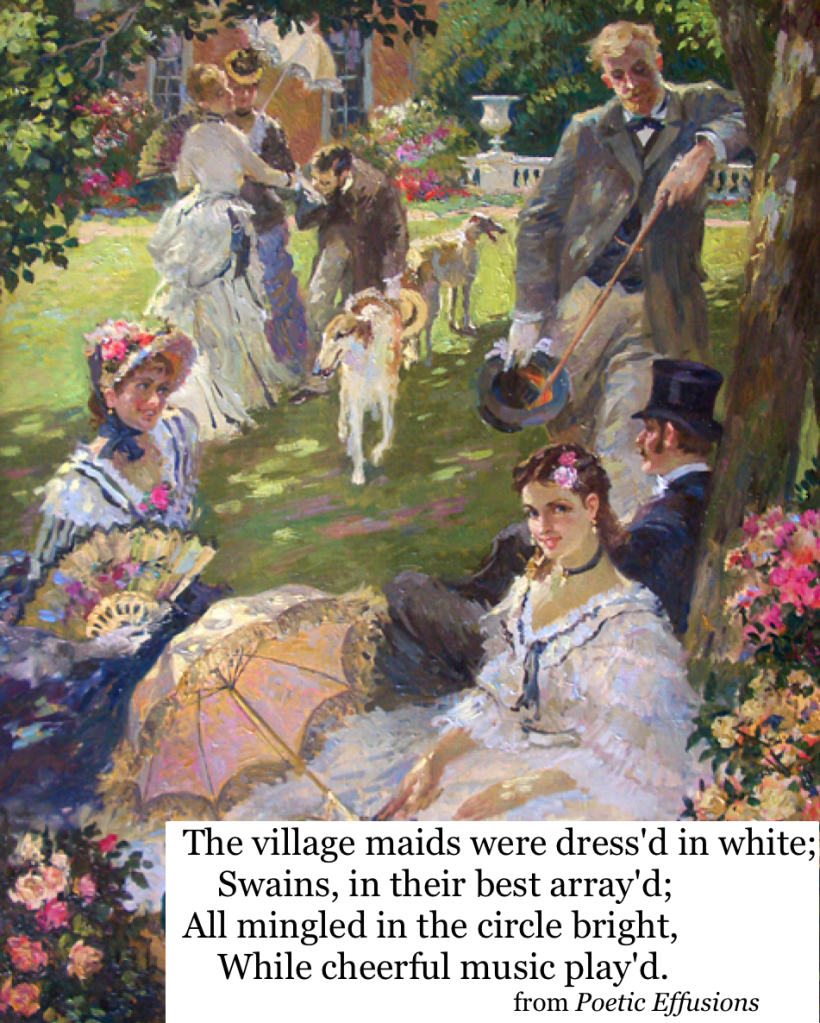
A Unique Approach to Poetry

I’m guessing that only lit majors—and possibly only a minority of them—know the literary definition of “effusions.” This despite the fact, that nearly every writer pens them.

Effusion, of course, is a common enough word. From its typical context, readers can pretty accurately determine its meaning. Its Latin root meant to “pour out,” making the word ideal for technical medical usage. Eventually, it entered the literary canon, where it refers to pouring out one’s thoughts or feelings in an unrestrained manner.

Obviously I have heard people use effusive as an adjective, as in “she received effusive praise for her treatise on the Inklings and their reliance on the Mesoamerican Codex Borbonicus.” But I don’t recall ever encountering “effusion” in the context of writing. I suspect that its relative rarity is simply due to slipping out of modern usage.

Nearly a century ago, in 1921, C.S. Lewis casually used the term in a letter to his brother Warnie. Lewis begins by explaining why he had not written recently. It turns out, Lewis was a bit miffed at his brother due to thinking Warnie had been negligent in writing to him.

My dear W., I was delighted to get your letter this morning; for some reason it had been sent first to a non-existent address in Liverpool. I had deliberately written nothing to you since those two you mention: not that I was tired of the job, but because I did not feel disposed to go on posting into the void until I had some assurance that my effusions would reach you.

That seemed a process too like prayer for my taste: as I once said to Baker—my mystical friend with the crowded poetry—the trouble about God is that he is like a person who never acknowledges one’s letters and so, in time, one comes to the conclusion either that he does not exist or that you have got the address wrong. I admitted that it was of great moment: but what was the use of going on dispatching fervent messages–say to Edinburgh–if they all came back through the dead letter office: nay more, if you couldn’t even find Edinburgh on the map.

His cryptic reply was that it would be almost worth going to Edinburgh to find out. I am glad however that you have ceased to occupy such a divine position, and will do my best to continue: tho’ I hope it won’t be for fifteen months.

These are fascinating insights into prayer, especially coming from the perspective of C.S. Lewis during his atheist period. (Which is why I quoted the letter at length.)

Effusion in a Literary Context

It appears the labeling of writing, or poetry at least, as effusive, has fallen out of style. Take the case of the poem I included in my most recent post. The source of “Easy Rules for Punctuation,” was a collection entitled Ephemeral Effusions.

I spent quite some time tracking down an actual definition for literary effusions. Eventually I found one in Samuel Taylor Coleridge (Bloom’s Modern Critical Views). Harold Bloom writes, “I have come across approximately one hundred late-eighteenth- and nineteenth-century works entitled ‘effusions.’” The following discussion about the subject will be of interest to readers and writers alike.

Between poetry and oratory stands rhetoric. I have attempted to show that Coleridge’s effusions take up residence in a middle ground criss-crossed by other literary practices. While they arguably have an identifiable character, formed in part by a Horatian tradition, Coleridge defines his effusions less by their positive identity than by their self-conscious difference from the other genres and figures (sermo, epistle, address, aversion, conversation) that impinge on and cohabit their poetic space.

As a distinct genre, however, the effusion was relatively short-lived, becoming more common as a “lady’s” genre, suitable for the expression of delicate feelings and sensibilities, though also occasionally lending itself to more “heroic” sentiments by military men. Effusions of the heart, the poets discovered, can be both literal and figurative, erotic and patriotic, tender and polemical. . . . Later, indeed, there would be a few noteworthy instances of the genre, such as Wordsworth’s 1835 “Extempore Effusion upon the Death of James Hogg,” in which Coleridge is remembered by name in a catalogue of dead poets. But no one approaches the theoretical or practical accomplishment of Coleridge in a genre so carefully positioned between poetry and non-poetry.

Coleridge’s term “effusions,” however, appears to have been unfamiliar to contemporary reviewers . . . [a reviewer in 1796] praises Coleridge’s poems: “They consist of sonnets, which, however, Mr. Coleridge chooses to call Effusions. . . .” The reviewers nowhere identify any literary tradition in which an “effusion” might stand defined.

This column marks consecutive posts related to poetry. A stunning first in Mere Inkling’s five year history. Personally, I make no claims to being a poet, although I confess I’ve dabbled in the genre.

For those desiring to download a nineteenth century collection entitled Poetic Effusions, check out this treasure by Mary Peach Collier (1799-1858). We’ll close with one of the shorter effusions in the book.

On the Death of a Little Girl

Farewell, blest Ellen I long thy spotless name
Shall deep imprinted on our memories live;
Long on the records of unsullied fame
Thy lovely innocence a charm shall give.

Farewell, thou little flow’ret of the shade
Just born to blossom, like thy kindred rose;
Early transplanted where no thorns invade,
To flourish fair in regions of repose.

Hope in the Face of Danger

We live in what some consider a scary age. Even if you avoid all the dystopian books and films, real life provides more than enough worries. Thank God that C.S. Lewis offers wise counsel to help us cope with our fears without despairing.

The Department of Defense just released its 2019 report from the Electromagnetic Defense Task Force. The 2018 Report, which lays the foundation for the latest electromagnetic pulse (EMP) study, is also available.

These reports make fascinating, though sobering, reading. Their warnings are applicable not only to the United States, but to everyone depending on modern conveniences such as electricity. The EMP threat comes, after all, not only from nuclear attacks, but also from coronal mass ejections which are spawned regularly by the sun. (NASA agrees with the potential dangers.)

As the report says, “The potentially catastrophic effects of these types of natural or man-made EMP events are not science fiction but science fact and have been well studied and documented for nearly six decades.”

Warning people about the dangers—and preparations that can easily be made in advance to survive them—is the mandate of the Task Force. I imagine one of their educational recommendations they suggest might come to resemble the “Duck and Cover” training provided to students in the 1950s and 1960s.

How Bad Could It Be?

Pretty terrible, if the worst circumstances align. The reports support the findings of a previous Congressional study that “an EMP-induced blackout could cause a long-term nationwide grid collapse and the loss of up to 90 percent of the population through starvation, disease, and societal collapse.”

Ninety percent. This would be nothing less than apocalyptic. Yet, even in such a scenario, we would not need to surrender to hopelessness. I’ve discussed this in the past.

Most of the fatalities would result from starvation, since food production would drop dramatically, and there would be no fuel available to move it to markets. The even more ominous threat would come from our fellow citizens. Describing this, one contributor to the report cites three certain factors that are not currently considered in any official plans: human desperation, starvation, and “living without the rule of law” which has its own acronym, WROL.

C.S. Lewis’ Response

The danger of EMPs was little known during Lewis’ life. Nonetheless, he did write about the possibilities for global disaster created by the existence of hydrogen bombs. And Lewis’ response was the Christian one—do not despair, since these threats change almost nothing. Even without them, we humans are mortal. Likewise, barring the creation of a new heaven (which is coming), even the expanding universe we inhabit is destined to fade away.

Our ultimate hope comes not from the material creation, which itself shares the scars of humanity’s fall. We are not simply physical beings. Created in the image of God, you and I possess a spiritual nature. And God will deliver us from this final dissolution.

Lewis describes this dilemma extremely well in his essay “On Living in an Atomic Age.” And this video helps to illustrate Lewis’ words.

As Lewis says,

If we are all going to be destroyed by [an event such as an EMP], let that [event] when it comes find us doing sensible and human things—praying, working, teaching, reading, listening to music, bathing the children, playing tennis, chatting to our friends over a pint and a game of darts—not huddled together like frightened sheep” dwelling on our vulnerability. Such terrible events “may break our bodies (a microbe can do that) but they need not dominate our minds.” (On Living in an Atomic Age)

Preparing for Disasters

When we lived in the Midwest, where winter storms could readily strand motorists for a day or more, we carried a “survival kit.” It was a wise precaution, though by the grace of God we never needed to use it.

Off the West Coast of the U.S. and Canada, lies a mounting danger. The Cascadia Subduction Zone generates earthquakes and mega-tsunamis every 500 years or so . . . Today tsunami escape routes have become a normal component of disaster preparedness for those living on the Washington and Oregon coasts.

Each individual and family must determine their own course when it comes to disaster preparation. If my family had settled in Texas where two tornadoes passed near our home while we lived there, I would not have relied on taking shelter in a hallway beneath an antique table. I would have prepared for the potential threat by having a home built with a basement designed to serve as a tornado shelter.

The problem isn’t that people take precautions that often prove unnecessary—at worst they have expended money that purchased only peace of mind. The problem is that some people become consumed by the prospect of a national or global disaster. Their fear can grow to the point where it is all they can think about and the rest of their life often ends up in ruins.

It is to people in this group—those we might call extreme doomsday preppers—that C.S. Lewis speaks most intentionally. He offers sound advice that can help restore balance to the lives of those who have been crippled by fear.

It will be very interesting to see how the recommendations of the Electromagnetic Defense Task Force are implemented. Particularly their challenge to actively educate the public. Hopefully whatever program arises will be reasonable and constructive, and avoid excessive drama. But, living in our increasingly hyperbolic world, I’m not confident that will be true. Prepare to hear more about this subject in the years ahead.


The image above was captured by NASA’s Solar Dynamics Observatory and the “Sun-flanking STERO-B spacecraft” in 2012.

Good, Bad and Ugly Hymns

There’s good “church music.” There’s mediocre church music. (And, there’s even terrible church music.) Read on and I’ll provide a link to an article I wrote about one questionable ditty that wormed its way into a military hymnal.

C.S. Lewis was not a fan of most church music. I’ve written about his musical tastes previously.

His assessment is no secret. He deemed most hymns to be “fifth-rate poems set to sixth-rate music.”

When it comes to hymns, there is general agreement on what’s good. These songs have passed the test of time. They have proven edifying and inspirational for generations. Some contemporary music is also biblically faithful and possesses the potential to join the ranks of the church’s lasting hymnody.

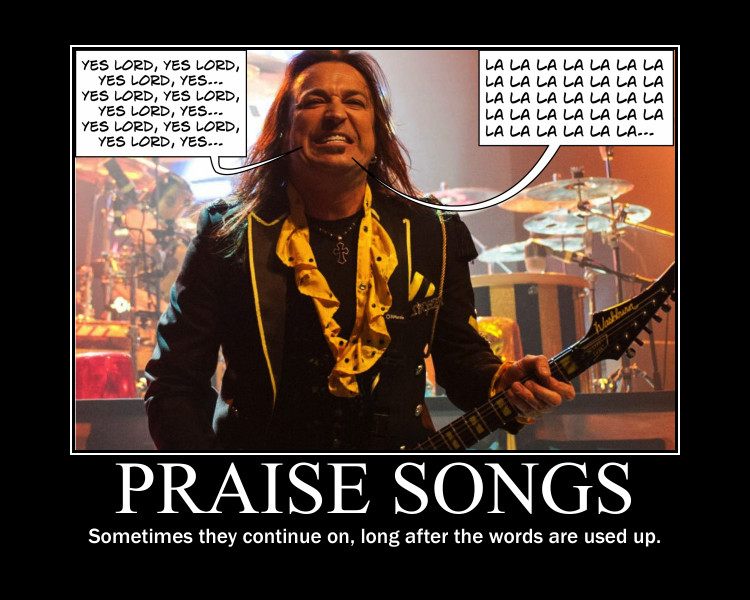
Then there are the others. Uninhibited redundancy, for example, suggests a corresponding shallowness. I forego the idiom about something being broad but shallow, since such songs are actually narrow and shallow. Case in point, the song “Yes, Lord.”

It begins promisingly enough:
I’m trading my sorrow
I’m trading my shame
I’m laying it down for the joy of the Lord

Then the theology gets a wee bit blurrier, especially for believers who still suffer after praying for healing:

I’m trading my sickness
I’m trading my pain
I’m laying it down for the joy of the Lord

But it’s the chorus that undermines the song’s edificatory potential.

And we say
Yes Lord yes Lord yes yes Lord
Yes Lord yes Lord yes yes Lord Amen

Yes Lord yes Lord yes yes Lord
Yes Lord yes Lord yes yes Lord Amen

The last two chorus breaks are replaced by the less challenging:

La la la la la la
La la la la la
La la la la la la
La la la la la
La la la la la la la la la
La la la la

La la la laLa la
La la la la la
La la la la la la
La la la la la
La la la la la la la la la
La la la laLa la la la

To those of you who adore this particular song—please accept my apologies for singling it out. Yet I stand by my view of these lyrics. And I can certainly imagine what C.S. Lewis would have thought of it.

The Power of Music

Various Christian leaders have expressed the opinion it’s more important to write the church’s hymns than its theological books. Hopefully that’s hyperbole, but few would deny the words we sing directly influence our thinking.

Arius, one of the early heretics who denied the divinity of Christ, knew this. His movement created tremendous confusion and resulted in much persecution. One of his most successful tools consisted of composing heretical songs. The words were “religious,” and the tunes were catchy, so people were singing them even when they didn’t agree with his doctrine.

C.S. Lewis & Church Music

As mentioned above, C.S. Lewis was very candid about his own disaffection for most church hymnody. In “Answers to Questions on Christianity,” Lewis answers the question of whether it’s necessary to attend worship services. He describes how duty rather than desire brought him to congregational worship.

When I first became a Christian . . . I thought that I could do it on my own, by retiring to my rooms and reading theology, and I wouldn’t go to the churches and Gospel Halls; and then later I found that it was the only way of flying your flag . . .

[However,] I disliked very much their hymns, which I considered to be fifth-rate poems set to sixth-rate music. But as I went on I saw the great merit of it. I came up against different people of quite different outlooks and different education, and then gradually my conceit just began peeling off.

I realized that the hymns (which were just sixth-rate music) were, nevertheless, being sung with devotion and benefit by an old saint in elastic-side boots in the opposite pew, and then you realize that you aren’t fit to clean those boots. It gets you out of your solitary conceit.

In light of Lewis’ attitude toward religious hymnody, it’s ironic that in 1946 he was invited to help evaluate new hymns.

The Hymn Society of Great Britain and Ireland is opening a file of new hymns to which modern hymn-writers are to be asked to contribute. I have been asked to write to you and ask if you will be a member of the panel to whom new hymns may be submitted in order that their merit may be assessed . . .

Lewis’ response to the invitation is as revealing as it is (unintentionally, I’m sure) curt.

The truth is that I’m not in sufficient sympathy with the project to help you. I know that many of the congregation like singing hymns: but I am not yet convinced that their enjoyment is of a spiritual kind. It may be: I don’t know.

To the minority, of whom I am one, the hymns are mostly the dead wood of the service. Recently in a party of six people I found that all without exception would like fewer hymns. Naturally, one holding this view can’t help you.

Two months later, the men exchanged letters again, and Lewis clarified his thoughts.

I can’t quite remember my own last letter; but I was wrong if I said or implied that . . . hymns, were bad in principle. . . . In modern England, however, we can’t sing—as the Welsh and Germans can. Also (a great pity, but a fact) the art of poetry has developed for two centuries in a private and subjective direction.

That is why I find hymns ‘dead wood.’ But I spoke only for myself and a few others. If an improved hymnody—or even the present hymnody—does edify other people, of course it is an elementary duty of charity and humility for me to submit. I have never spoken in public against the use of hymns . . .

The Gospel Coalition has an informative essay on Lewis’ broader view of worship here.

The Armed Forces Hymnal Scandal

At the outset of this column I promised readers a link to a recently published article. If you would like to read about a bizarre hymn that (temporarily) slithered into the Book of Worship for United States Forces, check it out here. The article begins on page fifteen of the new issue of Curtana: Sword of Mercy.

The hymn in question may be thought-provoking, but it belongs in a discussion group, not in a worship service. The lyrics are placed on the tongue of thief crucified beside Jesus. The criminal who was not invited by Jesus to “be with [him] in paradise” (Luke 23). The first stanza will amply illustrate the spirit of the piece.

It was on a Friday morning that they took me from my cell,
And I saw they had a carpenter to crucify as well
You can blame it on to Pilate, you can blame it on the Jews,
You can blame it on the Devil, It’s God I accuse.
(Refrain)
It’s God they ought to crucify, instead of you and me.
I said to the carpenter a-hanging on the tree.

If you read the article, and consider me unfair to the song’s writer, please leave a comment below. I would love the chance to respond. Likewise, if you think I’ve been too harsh in my evaluation of “Yes, Lord.” Given a choice between mediocre and terrible hymns, there’s no contest.

One wonders how Lewis would have rated “It was on a Friday Morning.” I suspect it would not even rise to the bar of being a “fifth-rate poem.”

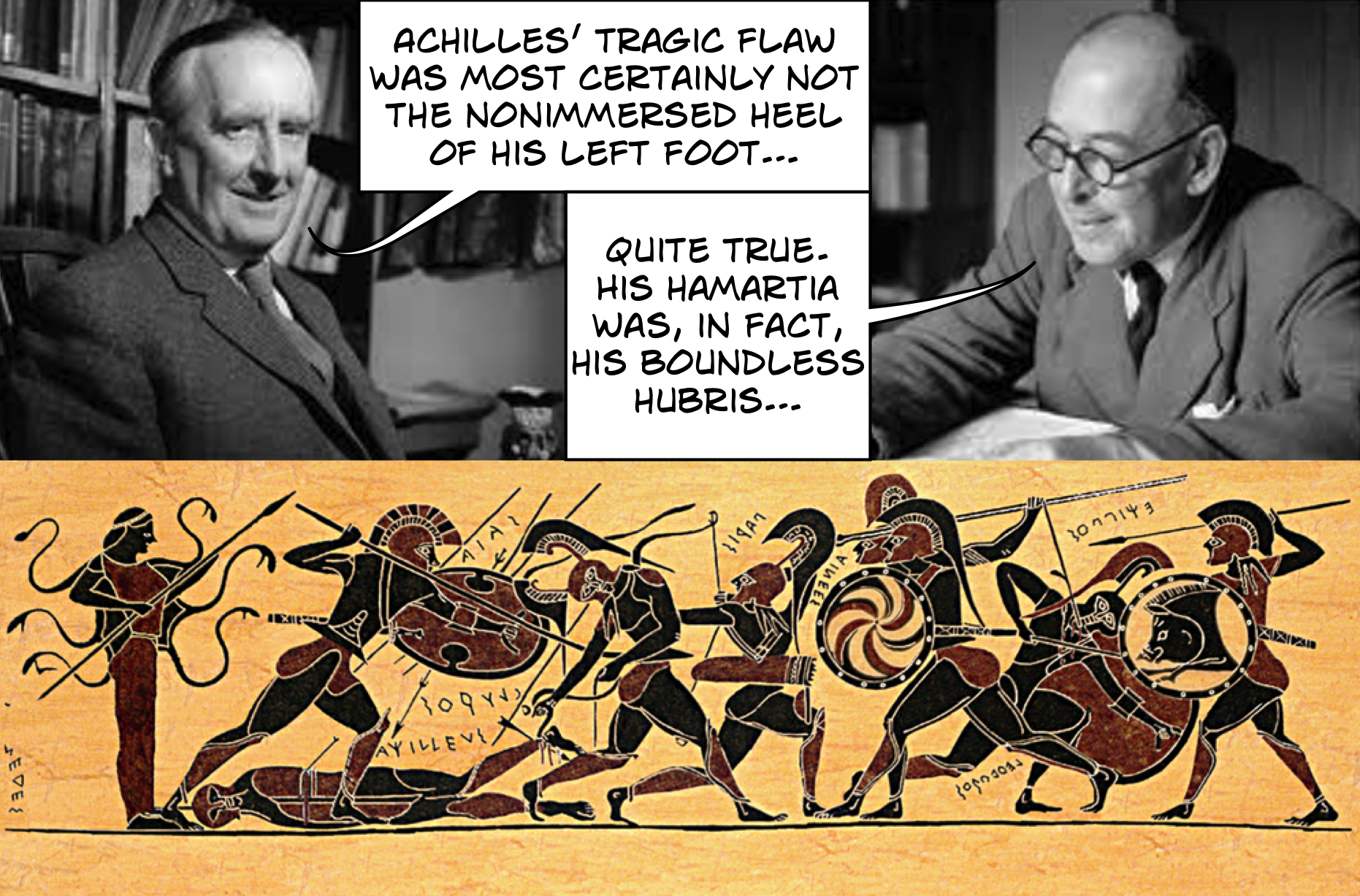
C.S. Lewis & Humanity’s Tragic Flaw

achilles

If you don’t know the meaning of “hamartia,” you’re not alone. But it’s a very important word, for more than one reason, so read on.

Hamartia describes a feature many writers of fiction or drama instill in their most memorable characters. It simply means “tragic flaw.” The deep character defect which cannot be overcome by sincere intention or persistent effort.

Merriam-Webster describes it this way.

Aristotle introduced the term in the Poetics to describe the error of judgment which ultimately brings about the tragic hero’s downfall. As you can imagine, the word is most often found in literary criticism.

However, news writers occasionally employ the word when discussing the unexplainable misfortune or missteps of übercelebrities regarded as immortal gods and goddesses before being felled by their own shortcomings.

Despite being a thespian in high school, I never formally studied drama. So I didn’t encounter the word there.

Likewise, I have written consistently since earning a Journalism degree four decades ago. However, since I have a 37:1 nonfiction to fiction ratio, I did not know this Greek word had found its way into the English lexicon.

I was surprised to discover its English meaning in my usually-familiar word of the day email (from The Free Dictionary).

While I was unfamiliar with its English usage, I already knew the word. I originally met hamartia (ἁμαρτία) while studying the New Testament in Greek. Hamartia literally refers to “missing the mark,” and it is the primary biblical Greek word for sin.

The first usage of the word in the sense of being an inner quality, occurs in Aristotle’s Poetics.  Aristotle writing as a pre-Christian philosopher, naturally perceived the literary device in a pagan manner.

The Greek word hamartia translates pretty directly as “error” or “shortcoming” without any necessary overtones of guilt or moral failure. Our modern conception of tragedy and the “tragic flaw” of the hero usually involves the concept of hubris, or overweening pride, that leads to disaster.

Macbeth, for instance, has the arrogance to think he can overstep the laws of God and state, and ultimately pays dearly for this arrogance. Macbeth is a tragic hero with a clear tragic flaw: his downfall results from a moral failing and can be seen as divine retribution proportional to his guilt. But Macbeth also contains heavy Christian overtones that would of course be found nowhere in Greek tragedy.

An understanding of Aristotle’s concept of hamartia—and indeed an understanding of Greek tragedy in general—relies on an understanding of the ethics and cosmology of the ancient Greeks. . . . Greek ethics are based more on the notion of virtue than obligation.

What of the Consequences?

In a 2014 article entitled “C.S. Lewis: The Anti-Platonic Platonist,” Grace Tiffany skillfully explores the Platonic echoes in Lewis’ writings. In discussing his literary examples of human failings, she writes:

There are of course Biblical models justifying Lewis’ “negatively capable” presentations of misguided characters . . . An older philosophical source, if not a Platonic one, also justifies mimetic representations of evil by the argument that these are morally purgative.

Imitations of hamartia, or tragic error, produce “fear and pity” (Aristotle, Poetics 1453b)—compassion for the character elicited by a skilled simulation of his psychology, naturally accompanied by a healthy fear of ourselves making similar mistakes. What ensures the fear is, of course, the dramatization of the horrible end to which hamartia has led . . . (Christianity and Literature 63.3).

In 1953, C.S. Lewis wrote to a correspondent that sin was more than merely making a mistake. In doing so, he alludes to the change in the meaning of the word ἁμαρτία.

No. I don’t think sin is completely accounted for by faulty reasoning nor that it can be completely cured by re-education. That view has, indeed, been put forward: by Socrates and, in the early 19th Century, by Godwin.

But I think it overlooked the (to me) obviously central fact that our will is not necessarily determined by our reason. If it were, then, as you say, what are called ‘sins’ would not be sins at all but only mistakes, and would require not repentances but merely correction.

Returning to the literary or dramatic definition of hamartia as a tragic flaw, it seems to me that this term offers a fitting parallel to the word sin.

Ever since humanity’s fall, we suffer the curse of bearing original sin, a tragic flaw. It is a scar that no medical or psychological treatment can cure and no amount of determination can repair. This tragic flaw will be our doom. Unless, that is, there is One who is capable and desirous of restoring us to our original health and purity. One, perhaps, in whose own image you and I were created . . .

This wonder is something well worth pondering—and perhaps one day, writing about.

C.S. Lewis & the Inklings Seated at the Round Table

arthur.png

This book belongs in the library of every fan of the Inklings and each devotee of King Arthur. The truth is that anyone interested in British literature or the Dark Ages will find much that appeals to their curiosity. King Arthur is known around the world as an archetypal hero, and he was a central fixture in the minds of the Inklings.

The Inklings & King Arthur (TIKA) is impressive in every way. However, it’s 555 rich pages should not intimidate potential readers. Editor Sørina Higgins masterfully gathered diverse insights from a score of scholars, and the individual chapters can be approached in any manner the reader desires. Even if a few of the chapter titles fail to resonate with a particular reader, the solid value of the remainder far exceed the price of the work.

Mere Inkling seldom offers reviews of books, despite the “libraries” of new Inkling literature published every year. The Inklings & King Arthur is the exception, for two reasons.*

TIKA does not require a familiarity with its subject. The academic background of the contributors allows them to usher readers into rewarding discussions without additional research. C.S. Lewis described “the task of the modern educator [as] not to cut down jungles, but to irrigate deserts.” The writers in this volume have written so clearly that even if your knowledge of King Arthur is the Mojave, and your familiarity with the Inklings is the Sahara, you will enjoy reading this book.

Truth be told, much has been written about King Arthur. Likewise, films have explored the myths, with varying degrees of faithfulness. Some make no effort at all to be faithful to the inspiring story. An extreme example would be the ludicrous storyline of the 2017 film, Transformers: The Last Knight. In striking contrast to this, the Inklings sought to penetrate the mists of time and discern the reasons Arthur’s story has inspired men and women for so many generations.

In the book’s introduction, Higgins says her hope was “to fill a sizeable hole in the field of Inkling studies” (2). She surely achieved this task. She also says “the present collection endeavors to usher the field of Inklings studies into more rigorous theoretical territory” (3). This goal, the contributors have surpassed.

Proceeding to some specific comments, my first would be to point out the accuracy of the volume’s title. It is an exploration of “the Inklings,” rather than simply Lewis and/or Tolkien. The fact that less well-known members of the literary group wrote the most Arthuriana means their works are particularly well represented in the current collection.

This fact might discourage a potential reader who is disinterested in the lesser known authors. However, the truth is, exposure to work of these friends and influencers of the two über-Inklings helps us better understand them and the confluences that flowed together in that unique literary fellowship.

Most articles consider the Inklings as group in relationship to a theme. For example, Christopher Gaertner discusses, “Shape and Direction: Human Consciousness in the Inklings’ Mythological Geographies.” The author identifies their differing viewpoints and how they influenced one another. Despite “their shared resistance to a scientistic worldview” (150), Tolkien, Lewis and Owen Barfield did not share identical understandings of how the world should be perceived.

Beyond the Eagle & Child

One pleasant surprise is the inclusion of an essay on G.K. Chesterton (1874-1936). Chesterton’s The Everlasting Man contributed to the conversion of C.S. Lewis.

In his TIKA essay “All Men Live by Tales,” J. Cameron Moore reveals how Chesterton’s poetry about Arthur is rooted in England. Arthur was important enough for Chesterton to return several times to the story of this hero who is “Mythic, Roman, and Christian (205). You can download a free copy of The Ballad of St. Barbara which includes “The Myth of Arthur” here. You can read “The Grave of Arthur” at this site.

Benjamin Shogren explores the significance of the addition of two new names—Pendragon and Fisher-king” to the protagonist of C.S. Lewis’ space trilogy. Elwin Ransom “represents Arthur by . . . evoking the primary imagery associated with the role of Arthur” (399). Ransom is now imbued with a mythological aura of royal leadership and courageous chivalry.

This volume overflows with richness. In “On Fairy Stories,” J.R.R. Tolkien describes the dense blend of mythologies present in the story of Arthur, using the image of a pot of soup with various ingredients added over time.

It seems fairly plain that Arthur, once historical (but perhaps as such not of great importance), was also put into the Pot. There he was boiled for a long time, together with many other older figures and devices, of mythology and Faerie, and even some other stray bones of history (such as Alfred’s defence against the Danes), until he emerged as a King of Faerie.

The situation is similar in the great Northern “Arthurian” court of the Shield-Kings of Denmark, the Scyldingas of ancient English tradition. King Hrothgar and his family have many manifest marks of true history, far more than Arthur; yet even in the older (English) accounts of them they are associated with many figures and events of fairy-story: they have been in the Pot.

The soup or stew pot may also serve as a fitting metaphor for The Inklings & King Arthur. This exceptional volume offers a potent mix of wisdom and insights that go beyond the boundaries of its title. Readers will be rewarded, in fact, with many satisfying literary meals.


* The first reason is that the academic weight of the work merits the undertaking. The second is because I have received a review copy, which obligates me in a sense, to providing a review—not a positive review, of course, but an honest assessment of its value, from my personal perspective.

Honest reviewers, of course, are mandated to acknowledge the fact that they received a particular volume gratis. This is done to protect one’s integrity. At the same time, a writer’s honor is also protected by their pledge to provide an honest evaluation of each work, for good or ill. This is what you will discover here.

The volume’s editor, Sørina Higgins, gathered an impressive group of Inkling scholars to contribute. She is a poet who is Chair of Language and Literature at Signum University.

It would be challenging to find any flaw in this amazing volume. Its sole weakness, in this reviewer’s opinion, is that it is so detailed and thorough, that it transcends the reading skills (or perhaps, “tastes”) of some of today’s readers. Despite that, the authors have gone to significant effort to write clearly and make their extremely detailed subject matter accessible to all.

C.S. Lewis and Typos

typos

Who among us has lived a life free of typographical errors? When we learned to type (or “keyboard”), our typing speed was influenced by the number of incorrect characters we included.

Even worse, some infernal source birthed the idea of “autocorrect,” which is occasionally useful for documents, but just as frequently deadly for emails and texts.

Lewis’ own books have included a number of typographical errors. Arend Smilde, a Dutch scholar and translator, has noted a fair number of them on his valuable website.

The truth is, it is possible for errors to creep in whenever original manuscripts are copied.

Even with the Scriptures, existing manuscripts include various minor variations, since the autographs have been lost to history.

This fact necessitates the need for “textual criticism,” and many earnest biblical scholars have devoted their lives to discerning the original text. (“Criticism” in this use, does not connote negativity. It simply refers to study, such as with “literary criticism.”)

Textual criticism diverges significantly from the so-called “higher criticisms” which frequently result in confusion and doubt.* Comparing actual texts is fundamental to the study of all literary creations.

C.S. Lewis wrote a brilliant essay entitled “Modern Theology and Biblical Criticism,” which is currently known as “Fern-Seed and Elephants.” In it, he distinguishes between the various types of criticism and affirms textual examination as utterly valid.

We think that different elements in this sort of theology have different degrees of strength. The nearer it sticks to mere textual criticism . . . the more we are disposed to believe in it. And of course, we agree that passages almost verbally identical cannot be independent. It is as we glide away from this into reconstructions of a subtler and more ambitious kind that our faith in the method waivers; and our faith in Christianity is proportionally corroborated.

The sort of statement that arouses our deepest scepticism is the statement that something in a Gospel cannot be historical because it shows a theology or an ecclesiology too developed for so early a date. For this implies that we know, first of all, that there was any development in the matter, and secondly, how quickly it proceeded.

When books are published, errors slink in. This generates errata, which are presumably corrected in any subsequent editions of the work. (It dawns on me that I’ve never seen an erratum, noting there is only one mistake in the work.)

The Genesis of Today’s Thoughts

Curiously, the article that led me to think about textual errors involves the substitution of an i for an e. The result is that for centuries, people mistakenly believed that Rome had a “Little Temple of Ridicule.” The notion was that the ancient Romans so loved humor, that they “went so far as to erect a ridiculi aedicula, or chapel of laughter.” This curious article is well worth reading (hint: it has something to do with Hannibal’s retreat).

It’s not that the idea of humor shouldn’t be celebrated. On the contrary, laughter features broadly in C.S. Lewis’ works. In a letter written shortly after his marriage to Joy, he alludes to Dante’s portrait of heaven. It is an image Lewis affirmed, and one that I happily anticipate.

Of course Heaven is leisure (“there remaineth a rest for the people of God”): but I picture it pretty vigorous too as our best leisure really is. Man was created “to glorify God and enjoy Him forever.”

Whether that is best pictured as being in love, or like being one of an orchestra who are playing a great work with perfect success, or like surf bathing, or like endlessly exploring a wonderful country or endlessly reading a glorious story—who knows? Dante says Heaven “grew drunken with its universal laughter.”


* For an informative discussion of the different forms of criticism, see this conversation. In response to the question “How is it, then, that the Higher Criticism has become identified in the popular mind with attacks upon the Bible and the supernatural character of the Holy Scriptures?” the author writes:

Some of the most powerful exponents of the modern Higher Critical theories have been Germans, and it is notorious to what length the German fancy can go in the direction of the subjective and of the conjectural. For hypothesis-weaving and speculation, the German theological professor is unsurpassed.

Some of the men who have been most distinguished as the leaders of the Higher Critical movement in Germany and Holland have been men who have no faith in the God of the Bible, and no faith in either the necessity or the possibility of a personal supernatural revelation.

C.S. Lewis & Cruelty to Animals

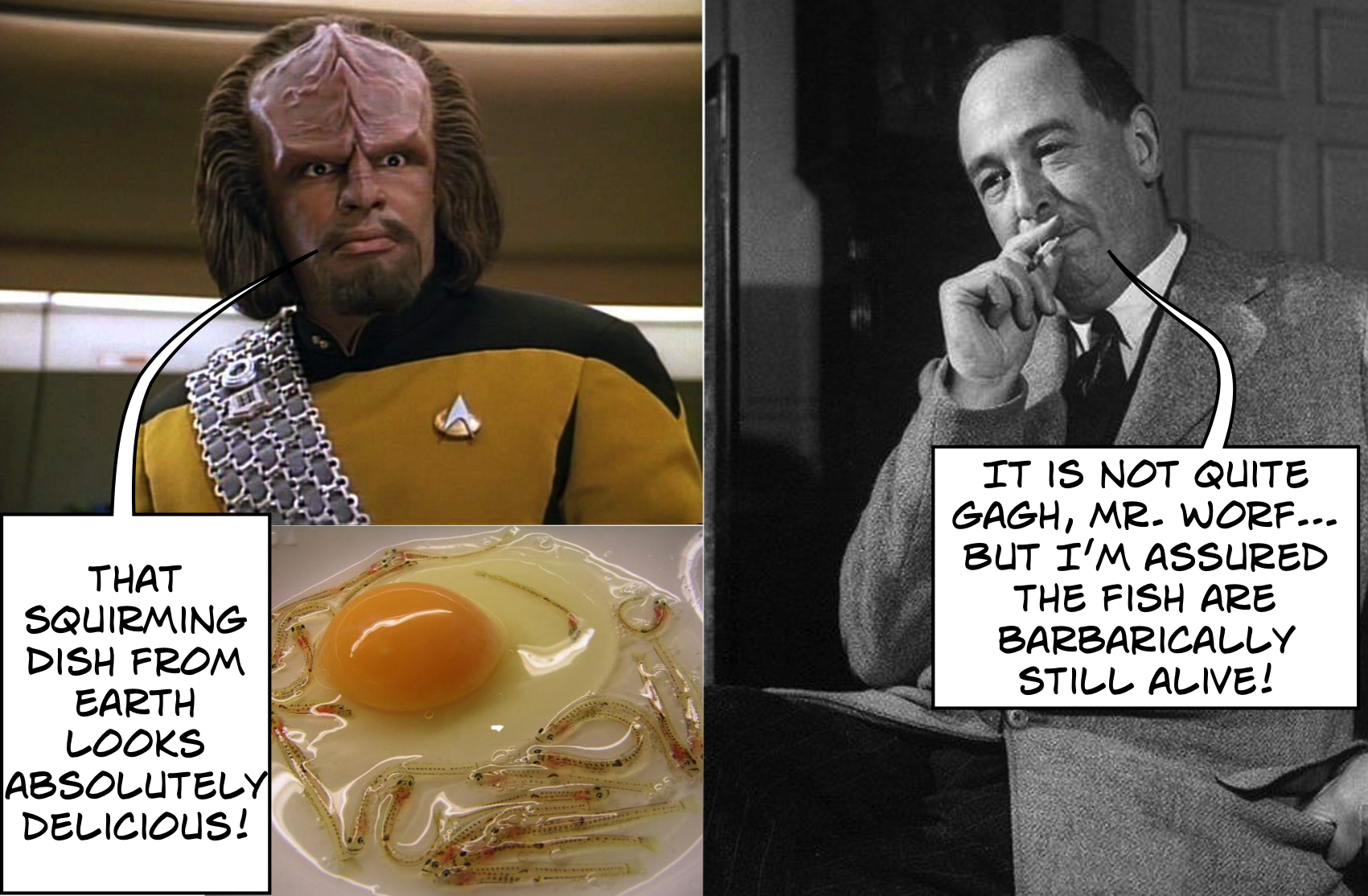
gagh.jpg

I recently read something quite disturbing about human beings. Something that revealed we have in common with Klingons and Ferengis one of their most disgusting traits. These people eat living creatures while they’re still alive (redundancy intentional).

Gene Roddenberry, creator of the Star Trek universe, foresaw a future in which humanity would rise above its omnivorous ways. “Replicated” food could still take the form of meat, but it would just be made of assorted atoms. The epitome of this view is found in Star Trek: The Next Generation. There, Commander William T. Riker declares to a diplomat from a race that consumes living mammals, “we no longer enslave animals for food purposes.”

In Roddenberry’s dream, humans have attained utopia on Earth. One way other races reveal their inferiority is by their diet. In addition to larvae and slugs, a main part of the Ferengi diet consists of squirmy Tube Grubs.* The more aggressive Klingons prefer assorted mollusks and their staple, the appropriately named Gagh. Gagh could be eaten cold or cooked, but the “serpent worms” were preferred live.**

I had deluded myself to think the devouring of living creatures was relegated to science fiction and the predators of the animal world. Sadly I recently learned about two Asian meals that merit the same stigma.

Goong ten is a Thai meal known as “dancing shrimp,” because the crustaceans are devoured alive.

In the Northeast Thailand region of Isaan, cooks often serve meat raw . . . Street vendors sometimes take the uncooked element one step further, selling a dish known as “dancing shrimp” (goong ten) from double-basket carts. On one side, seasonings await. On the other, a heap of small, translucent shrimp try in vain to escape from beneath a cloth. . . .

Those who might be anxious about eating a still-moving snack can opt to eat each bite swathed in a betel leaf. The traditional wrap conveniently prevents diners from accidentally making eye contact with their meal. Should curiosity get the better of you, however, a standard serving offers dozens of creatures you can stare down before eating alive.

In Japan, shirouo no odorigui describes another squirming delight.

Odorigui refers to the feeling of eating live sea creatures, or “dance-eating.” When it comes to shirouo no odorigui, the creatures dancing to their death are minnow-sized, transparent fish. In Japan’s Fukuoka prefecture, diners down these fish, also known as ice gobies, in shot glasses. As they’re served with nothing but a dash of soy sauce, there’s no hiding from the tiny faces of these slippery, still-moving snacks.

Eating Animals

I would be a hypocrite to condemn eating fish and other animals. However, I find myself utterly repelled by the notion of chewing something that is still alive. It seems unnecessarily cruel. I doubt I’ll ever hold membership in PETA, but I agree with their view that the abuse of animals is a grievous wrong.

C.S. Lewis would share this conviction that the abuse of these creatures is immoral. He wrote that “in justifying cruelty to animals we put ourselves also on the animal level. We choose the jungle and must abide by our choice.”

The merciful treatment of animals is one of Scripture’s most overlooked themes.

Judaism places great stress on proper treatment of animals. Unnecessary cruelty to animals is strictly forbidden, and in many cases, animals are accorded the same sensitivity as human beings. This concern for the welfare of animals is unusual in Western civilization. Most civilized nations did not accept this principle until quite recently; cruelty to animals was not outlawed until the 1800s, and even now it is not taken very seriously.

The primary principle behind the treatment of animals in Jewish law is preventing tza’ar ba’alei chayim, the suffering of living creatures. . . . Judaism has always recognized the link between the way a person treats animals and the way a person treats human beings. A person who is cruel to a defenseless animal will undoubtedly be cruel to defenseless people.

Even the slaughtering of animals is intended, under Kosher rules, “to be as fast and painless as possible . . . Hunting for sport is strictly prohibited, and hunting and trapping for legitimate needs is permissible only when it is done in the least painful way possible.

More on the Subject from Lewis

C.S. Lewis possessed a concern for suffering animals. We used to call this regard “humane,” because it reflected a natural compassion that God instills within us. Sadly, in many people it has been all but extinguished.

In 1940, Lewis included a full chapter on “Animal Pain” in The Problem of Pain. There he advocates a compassionate attitude, without being so doctrinaire as the aforementioned PETA. His concern is theological. He desires to explain how animals can suffer despite the “goodness” of God’s creation. Lewis recognizes that, in a word, the suffering of animals is an evil.

The problem of animal suffering is appalling . . . because the Christian explanation of human pain cannot be extended to animal pain. So far as we know beasts are incapable either of sin or virtue: therefore they can neither deserve pain nor be improved by it.

Lewis also confronted a distortion of biblical teaching that is often employed to justify the mistreatment of animals. Some say humanity is intended to lord over creation (including animals) however we see fit. However, in 1956 Lewis wrote to a correspondent that animals should be treasured.

I think God wants us to love Him more, not to love creatures (even animals) less. We love everything in one way too much (i.e. at the expense of our love for Him) but in another way we love everything too little. No person, animal, flower, or even pebble, has ever been loved too much—i.e. more than every one of God’s works deserves.

The Ethics & Religious Liberty Commission of the Southern Baptist Convention offers an excellent article on the positive place of animals in creation. Animals are precious to God. “They aren’t the product of happenstance or fortuitous natural processes any more than humans are.” Their ten biblical observations about animals echo the thoughts of Lewis, and are quite worthy of your consideration.

One of Lewis’ essays, “Vivisection,” upset a number of his contemporaries who had no reservations at all about experimentation on animals. It appears in the collection God in the Dock, but here are a few excerpts.

The vast majority of vivisectors have no such [Christian] theological background. They are most of them naturalistic and Darwinian. Now here, surely, we come up against a very alarming fact.

The very same people who will most contemptuously brush aside any consideration of animal suffering if it stands in the way of “research” will also, on another context, most vehemently deny that there is any radical difference between man and the other animals. On the naturalistic view the beasts are at bottom just the same sort of thing as ourselves. . . .

We sacrifice other species to our own not because our own has any objective metaphysical privilege over others, but simply because it is ours.

Once the old Christian idea of a total difference in kind between man and beast has been abandoned, then no argument for experiments on animals can be found which is not also an argument for experiments on inferior men. . . . The victory of vivisection marks a great advance in the triumph of ruthless, non-moral utilitarianism over the old world of ethical law; a triumph in which we, as well as animals, are already the victims, and of which Dachau and Hiroshima mark the more recent achievements.

In justifying cruelty to animals we put ourselves also on the animal level. We choose the jungle and must abide by our choice.

And what does this human jungle bring into being?

If we cut up beasts simply because they cannot prevent us and because we are backing our own side in the struggle for existence, it is only logical to cut up imbeciles, criminals, enemies, or capitalists for the same reasons.

If you are interested in learning more about Lewis’ view of the ethical treatment of animals, download “C.S. Lewis and Animal Experimentation” by Michael Gilmour.

It appeared in 2015 in Perspectives on Science and Christian Faith. All issues of the journal, going back to its founding in 1949, are accessible for free online.

The older I have grown, the more sympathetic to animals I have become. Admittedly, the live worms and crustaceans concern me less than the agony of mammals, which are far more conscious of their pain. And . . . I sincerely grieve for people who do not feel compassion for their suffering.


* The Ferengi also love their Slug-o-Cola, with its guaranteed “43% live algae in every bottle.”

** There are presumably more than 5- types of gagh, some of which had feet. And if that doesn’t gag you, your gut has a much higher quotient of iron than does mine.

*** For a lively discussion of whether “the human race has gone vegetarian in Star Trek,” check out this site.

C.S. Lewis and the Academics

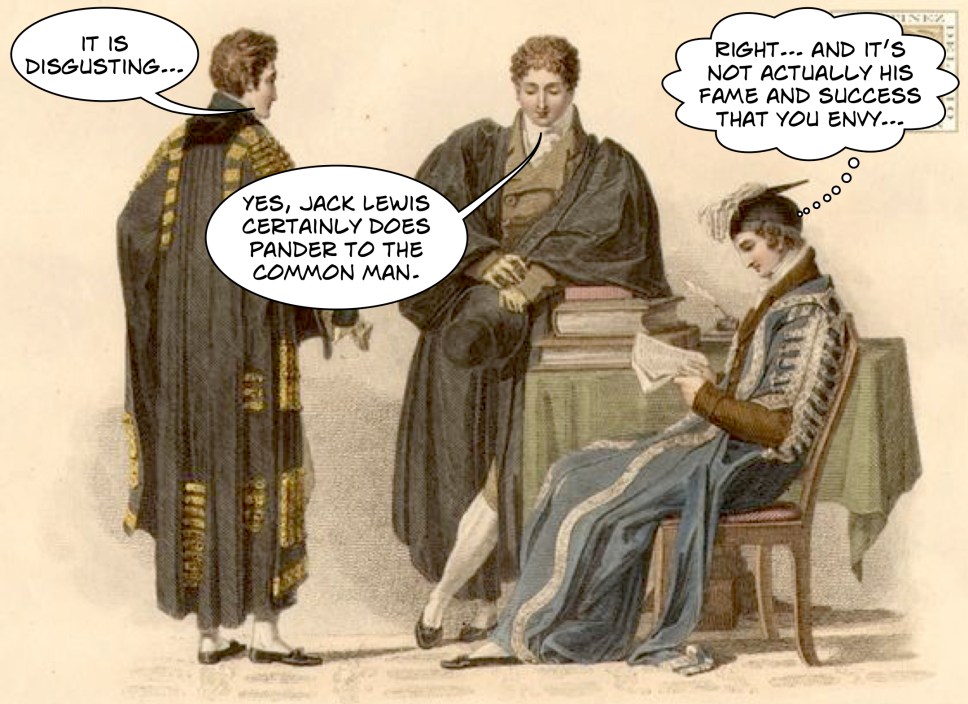
acadamians.jpg

When it comes to writing for a popular audience, the elite strata of academia possess no shortage of disdain.

C.S. Lewis was only one of many professors who found writing for the common people diminished them in the eyes of their snobbish peers. In Lewis’ case, his lay theological essays were considered bad enough. His fantasy and science fiction works were regarded as particularly gauche.

I have a personal theory about the way self-important scholars treat their colleagues who reach down to interact with the hoi polloi. It seems to me that they deride people like Lewis and J.R.R. Tolkien because of envy. The envy is twofold.

First, they covet the large audience and expanded influence of the scholar who successfully transcends the university. These elements arouse their lust far more than the potential wealth that such success might bring, although I have no doubt some resent being criminally underpaid as educators.

The second aspect of the envy is directed at the genuine talent of the belittled author. The majority of faculty would not possess the skill to write successfully for a popular audience. Thus, the significance of such publication needs to be diminished.

Harlan Ellison (1934-2018) was not an academic, but even he did not appreciate being relegated to the ranks of pulp writers. Despite writing screenplays and more than 100 books, he was best known for his science fiction. Nevertheless, he once threatened: “Call me a science fiction writer and I’ll hit you so hard your ancestors will die.”

Returning to Lewis, one biographer devotes an entire chapter to the condescending attitude of his Oxford peers. He entitles it, “A Prophet without Honour?” This is a reference to Jesus’ saying that “a prophet has no honor in his own hometown” (John 4:44)

Lewis, then, was famous by the time the Second World War ended in the summer of 1945. If the simple philosophy of life propounded by modern celebrity culture has any validity, Lewis at that point should have been a happy and fulfilled person. Yet Lewis’s personal history for the next nine years tells a quite different story. Fame may have raised Lewis’s profile, but in the first place, this just made him a more obvious target for those who disliked his religious beliefs.

And in the second, many of his academic colleagues came to believe that he had sold out to popular culture to secure that fame. He had sold his academic birthright for a populist pottage. (C.S. Lewis—A Life: Eccentric Genius, Reluctant Prophet by Alister McGrath)

The disdain of his Oxford colleagues prevented him from receiving a full professorship at the university. This is why Lewis eventually accepted a chair at Cambridge, which was much more receptive to his unashamed sharing of the Gospel. Tolkien was stunned by the “extraordinary animosity” of the English Faculty towards his friend.

An Endnote

The fact that C.S. Lewis wrote some science fiction—and encouraged his friend Tolkien to do so as well—does not mean that he had an exaggerated opinion of the genre’s quality. He was quite aware of the great range between the good and the bad. In fact, in 1955 he ended a lengthy letter to a correspondent with the sentence: “We must talk about Science Fiction some other time (most of it is atrocious).”

I have posted about Lewis’ connection to science fiction in the past. Perhaps one of these topics will interest you.

Learn about the genuine Martian crater named Malacandra in honor of Lewis’ space trilogy.

Explore the place of robots in science fiction and reality.

Ponder the ramifications of post-apocalyptic faith.

Consider Lewis’ compliment to H.G. Wells.


C.S. Lewis and the Stage

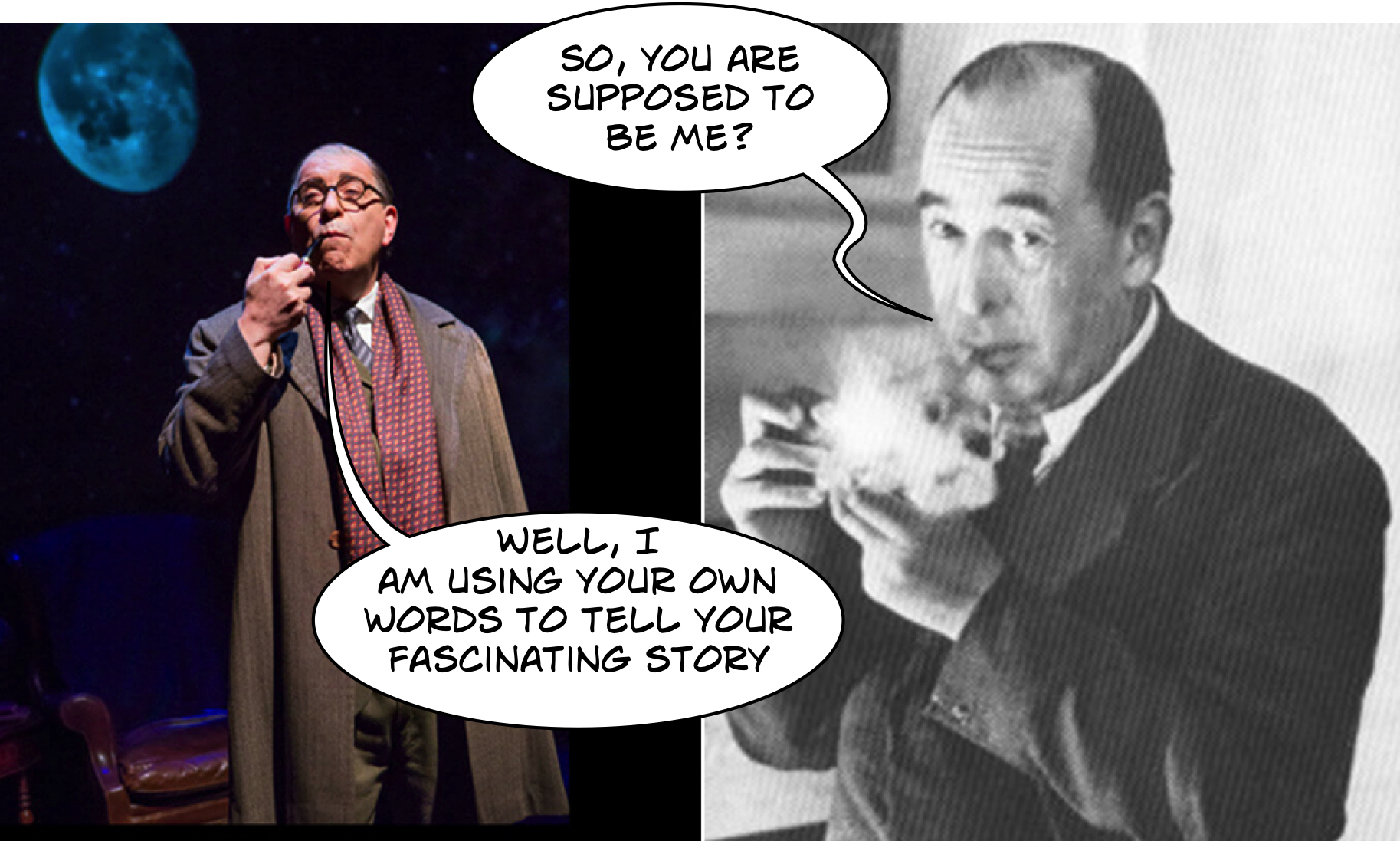
mclean csl.jpg

Sadly, we can’t presently spend an evening with C.S. Lewis . . . but what’s the next best thing?

A week ago my wife and I joined some dear friends at the Seattle performance of C.S. Lewis Onstage: The Most Reluctant Convert. It was riveting.

The presentation used Lewis’ own words—from a variety of his works beyond his autobiography—to explain his extraordinary faith pilgrimage. Lewis of course began as a simple, trusting child. Events and educational influences caused him to reject that youthful faith. For many years he was an outspoken atheist.

As God drew Lewis closer to himself, the future author of the Narnian Chronicles resisted fiercely. Eventually he surrendered to the evidence that there most certainly was some creative force. This did not make him a Christian, of course. It was merely a conversion to Theism.

Only later would Lewis recognize just what that creative force is. Not “what,” but more accurately, “who.”

Since the engaging drama focuses on Lewis’ conversion, it does not pursue other topics such as his marriage. (This is obviously due to time constraints, since a full telling of the author’s life would require meals and evening lodging.)

Max McLean himself, founder of the Fellowship for Performing Arts,  does an outstanding job as Lewis. The production team is also superb.

The proverbial icing on the cake comes with an informal discussion following the performance. McLean takes a seat on the stage and fields questions from the audience. Coincidentally, the previous performance location was in Berkeley, where they made the tickets so inexpensive for students that they comprised at least half the audience. McLean’s description of the play’s reception and the serious conversation which followed, was fascinating.

The Fellowship for Performing Arts is based in New York City, but fortunately tours each year. I have written in the past about their insightful performance of The Great Divorce,  which happens to be my personal favorite among Lewis’ amazing corpus.

I strongly encourage you to check out their future dates and locations across the country. Some venues will be treated to The Screwtape Letters this season.

In writing this piece, the question that came to mind was—what would Lewis have thought about having his life brought to the stage. Obviously, he was quite open and vulnerable in sharing his life with others. He made no pretense to holiness, beyond that which he received by grace as a child of God.

Still, having one’s words read is quite different than having yourself portrayed on stage or film. I suspect Lewis would have felt uncomfortable with the latter, and preferred that we stick to literary avenues for learning about him.

It’s not that Lewis was averse to the stage. In Surprised by Joy he describes how one of his favorite relatives assumed some responsibility for Jack and his brother Warnie after their mother’s death. Early exposure to the theater was apparently one element in his “civilization.”

Lady E. was my mother’s first cousin and perhaps my mother’s dearest friend, and it was no doubt for my mother’s sake that she took upon herself the heroic work of civilizing my brother and me.

We had a standing invitation to lunch at Mountbracken whenever we were at home; to this, almost entirely, we owe it that we did not grow up savages.

The debt is not only to Lady E. (“Cousin Mary”) but to her whole family; walks, motor drives (in those days an exciting novelty), picnics, and invitations to the theater were showered on us, year after year, with a kindness which our rawness, our noise, and our unpunctuality never seemed to weary.

We were at home there almost as much as in our own house, but with this great difference, that a certain standard of manners had to be kept up. Whatever I know (it is not much) of courtesy and savoir faire I learned at Mountbracken.

For those who wish to consider more deeply the relationship between C.S. Lewis and the theater, I recommend “Faithful Imagination in Theater.”  The author admits that “quality theatre presented from a Christian perspective is hard to find,” but offers hope from Lewis. The article concludes with a worthy challenge.

There is a great need for more imaginative engagement with “mere Christianity” in theatre. So let’s get to it.

A World Without Evil

illustration of a sheep with wolf shadow

A world without evil. Most people long for it. Some people pray for it. A few people are fooled into believing they have discovered it.

The good news is that one day evil will be eradicated, and redeemed humanity will enjoy the unmarred splendor of the world the Lord originally desired for us.

Until then, evil is ever-present. It existed before its entrance into our perfect world when our first parents disobeyed God in the Garden. The repercussions of that celestial rebellion continue to echo.

Some, however, are capable of deluding themselves into believing they can experience some sort of perfection. That is at the heart of many cults.

Their false messiahs persuade followers that they are part of such communities. In order to do so, they often move their people far from the “contaminating” influence of other people. In addition to Jonestown in Guyana, there have been utopian-turned-deadly villages in a places like Waco (Branch Davidians) and San Diego (Heaven’s Gate). More recently we’ve seen eleven children rescued from a Taos compound where they were being groomed to become “school shooters.”

Rolling Stone (no conservative publication) reports, “those drawn to these idealistic communities typically enter with the best of intentions. ‘It’s abnormal for young people not to want to make the world a better place . . .’”

The 1840s was a heyday of American utopian communities—more than 80 were founded in that decade alone, including the Brook Farm Community, which existed in Massachusetts from 1841 to 1847, Fruitlands, formed in 1843, and the Oneida Community, which lasted from 1848 to 1880.

Even the open-minded Rolling Stone notes that innocuous communes can grow dangerous. After all, virtually every cult begins with the promise of some version of utopia on earth. And if they don’t turn violent, they eventually peter out and fade away once they realize earthly utopia is a dream.

Caterers of Evil

One does not need to scurry off to a cultic campground to encounter evil. It comes to us uninvited.

I am pondering evil’s intrusions after reading about a naïve American couple who, while bicycling around the world, were killed by an Islamic terrorist in Tajikistan.

It’s a sad story, but ironic due to their misperception of reality.  One had proudly written, “You read the papers and you’re led to believe that the world is a big, scary place. People, the narrative goes, are not to be trusted.”

The idealistic biker once named his scooter after his mentor, the French philosopher, Rousseau. Like Rousseau, he believed in the innate goodness of humanity and presumably in the jettisoning of Christian revelation as an arbiter of truth. This victim of terrorism went so far as to write, “Evil is a make-believe concept we’ve invented to deal with the complexities of fellow humans holding values and beliefs and perspectives different than our own.”

As one British theologian explains Rousseau’s position:

Of course, he does not entirely deny human fallibility, error and capacity for evil. But he treats it as inessential: something that can be understood and moved away from—through trust in the wisdom of the human heart.

The Problem

It is a good thing to remember that many (likely most) people have goodwill towards their neighbors. But minimizing the fact that there are millions of human predators is a dangerous denial.

With 4-6% of American men meeting psychiatric criteria for antisocial behavior, along with 1% of women, it’s a scarier world than even many cynics realize. (While most of the men are mere sociopaths, 1% of the population may actually be classic psychopaths.)

Talk about Naïve—and Ultimately Pessimistic

Last year Cory Doctorow, a celebrated Canadian-British writer penned an absurd article defending utopian thinking. He courageously, but foolishly, ignored traditional idealistic ground and argued that even disasters can have utopian endings.

In a diatribe against the prominent role of dystopias in modern literature, he argues that if we only had a positive view of humanity, we could avoid the collapse of society. “The belief in other people’s predatory nature is the cause of dystopia.”

Doctorow plays it safe by discussing short-term difficulties, without societal collapse. The point of most dystopian stories, however, is exploring what happens once we have exhausted the extra provisions we can share with others when store shelves are permanently emptied.

The idealistic notion is that the power of positive thinking will get us through any potential destructive force. He sounds quite optimistic, until the closing paragraph reveals his self-professed “techno-agnostic” pessimism.

Disasters are part of the universe’s great unwinding, the fundamental perversity of inanimate matter’s remorseless disordering.

Evil Does Exist

Contrary to the notion that “evil is a make-believe concept,” wise people recognize its reality. C.S. Lewis explains the existence of evil quite succinctly in Mere Christianity.

And free will is what has made evil possible. Why, then, did God give them free will? Because free will, though it makes evil possible, is also the only thing that makes possible any love or goodness or joy worth having.

For this reason, God allows the existence of evil for a season. In the end, it will be swept far away from the new heavens and the new earth into a dustbin called Hell.

It’s possible a Christian reading this column may feel some sort of pride in being on the “good” side of the equation. Because of this, we must remember it is only by the grace of God that there is anything praiseworthy about us. Let us reflect on C.S. Lewis’ caution about how we must keep our eyes focused on our Lord, lest we too become corrupt.

If the Divine call does not make us better, it will make us very much worse. Of all bad men religious bad men are the worst. Of all created beings the wickedest is one who originally stood in the immediate presence of God. (Reflections on the Psalms)

Finally, although evil does indeed exist, we should not fear it or dwell upon it. Yet it is important that we be forewarned, so that we do not become vulnerable to destructive situations or people. Holding ourselves apart, while keeping our eyes open. As Jesus advises:

“Behold, I am sending you out as sheep in the midst of wolves, so be wise as serpents and innocent as doves.” (Matthew 10:16)