Errors that Seem to be True (Angels)

Many people have been taught so little about biblical Truth that they believe many errors. For example, many people (and no offense intended if you are among them) mistakenly believe that when people die, they become angels.

That connection is so blatantly contrary to the fact that angels who “see the face [of God] who is in heaven” are completely different creations than the Sons of Adam and Daughters of Eve who are actually human beings, created in the image of God.

In his preface to The Screwtape Letters, C.S. Lewis alludes to how this confusion is reinforced by humanity’s lack of familiarity with angels in their true or natural (for them) form. While there are clear examples in the Bible where God has his angels appear in the likeness of human beings (e,g. before Sodom’s judgment and at the empty tomb), there are also times when their celestial radiance is not disguised (i.e. when the shepherds are informed about birth of the Savior or in John’s visions as recorded in the Book of Revelation).

[Angels] are given human form because man is the only rational creature we know. Creatures higher in the natural order than ourselves, either incorporeal or animating bodies of a sort we cannot experience, must be represented symbolically if they are to be represented at all (Screwtape Letters).

Nevertheless, this myth permeates the thinking of our secular culture. Once, some years past, a pastor friend was relating to me that one of his distant relatives had recently died. He said it comforted him to know that she was now an angel. I started to chuckle in response to his humorous way of lightening his own mood, until I realized he wasn’t joking. This poor, genuinely compassionate minister had been tricked by the spirit of this world into buying into a lie.

C.S. Lewis famously said that anything worth reading once is worth reading again. I’m clearing out some magazines from several years ago, and rereading insightful articles as I go. In a short piece about a complex subject, “What Happens to the Dead?” Ryan Pemberton makes a troubling comment.

Pop culture has done more to shape modern views about death than biblical teaching has.

The brevity of the article prevents the author from exploring other subjects, but his observation is applicable to a wide array of concerns.

I’m confident I could state, without fear of contradiction, that contemporary culture has done more to shape modern views about marriage than biblical teaching has. And, adding only a few additional examples, more about . . . justice . . . demons . . . love . . . mental health . . . responsibility . . . heaven . . . labor . . . creation . . . and Jesus himself.

It’s Not All Bad

It should be admitted that not all contemporary insights have been 100% misguided. One area where modern sensibilities have restored balance to truthful thinking is in the area of care for the environment. Ignoring extreme notions about nature being more important than human life, we can applaud the work of Christian environmentalists who have helped restore a biblical (i.e. true) view of the world around us.

Reacting to twisted notions that humanity’s “dominion” over the earth allows for nature’s misuse and abuse, these men and women helped open our eyes to the fact that God calls us to be trustworthy stewards in our care of, and appreciation for, this amazing world he has made.

The Inklings, C.S. Lewis and J.R.R. Tolkien, in particular, possessed a profound love for nature. Their general antipathy to the ugly and polluting trappings of industrialization are grounded in their belief that the world God created was truly “good.” With that came the recognition that man does little to enhance, and much to undermine, that initial goodness.

When two ideas clash, go with the one that is correct. And, when one of those authorities is the Word of the Creator of all that exists, well, isn’t it obvious which is the right choice?

Angels & People

For more on the angelic subject with which we began, check out the provocatively titled “People Aren’t Downgraded to Angels When They Die.” As the author there so rightly explains,

When Christians die, heaven does not “get another angel.” We cannot become angels any more than we can become giraffes or ocean waves or stars. We are people and will remain so after this present life. God did not make a mistake when he made us human.

Dog DNA Determines Guilt

It is surprising how inexpensive and accessible DNA testing has become. Many readers of Mere Inkling have submitted samples ourselves. But how many of us have had our pets tested?

The science of genetics is quite recent. Gregor Mendel (1822-1884) is considered the father of such studies. As Britannica describes the history, “The word genetics was introduced in 1905 by English biologist William Bateson, who was one of the discoverers of Mendel’s work and who became a champion of Mendel’s principles of inheritance.”

Molecular genetics did not begin in earnest until 1941 . . . A major landmark was attained in 1953 when American geneticist and biophysicist James D. Watson and British biophysicists Francis Crick and Maurice Wilkins devised a double helix model for DNA structure.

The Human Genome Project didn’t begin until 1990, and didn’t reach its goal until the new millennia. The astute reader will recognize that C.S. Lewis lived before these genetic studies reached their current status, so we should not expect comment from him on DNA per se. Nevertheless, as Francis Sellers Collins, director of the Human Genome Project (2009-2018), says his work is quite compatible with C.S. Lewis’ writings.

In fact, in a lecture at Cambridge, he described how Mere Christianity was pivotal in his conversion from agnosticism to Christianity. According to this preeminent geneticist, “even in the first few pages, all my arguments about faith just fell apart. It was breathtaking . . . Lewis remains my best teacher.”

There is some question as to whether the DNA testing market has peaked. Unsurprising, since it isn’t like tobacco, coffee or rich desserts that “addict” customers to generate repeated purchases. As Advisory Board says, “given one’s genetic data is unlikely to change, most consumers may not see a reason to purchase another DNA testing kit.”

So, how might these corporations remain profitable? Why, by expanding their offerings to the animal kingdom. One such company called Embark claims to offer the “most accurate dog DNA test available.” 

Some people purchase the service to satisfy their curiosity about a pet’s breed (often a blend of several). A more valuable benefit is gaining insights into their health and traits. The oddest aspect of the process appears to be Embark’s boast that they offer “the world’s first canine relative finder.”

Like many of us, C.S. Lewis loved dogs. He didn’t, however, go so far as to worship them. I suspect that C.S. Lewis would opt out of the chance to DNA-define his pets. Best to just love them and savor their companionship.

In his essay “The Personal Heresy,” C.S. Lewis proposes an interesting argument about expressing love only to those capable of receiving it.

There is a reaction at present going on against the excessive love of pet animals. We have been taught to despise the rich, barren woman who loves her lap dog too much and her neighbor too little. It may be that when once the true impulse is inhibited, a dead poet is a nobler substitute than a live Peke, but this is by no means obvious.

You can do something for the Peke, and it can make some response to you. It is at least sentient; but most poetolaters hold that a dead man has no consciousness, and few indeed suppose that he has any which we are likely to modify.*

DNA service businesses are probably licking their lips at the prospects offered by a new market. The French are blazing a new trail for the rest of us. According to Euronews, Béziers will require pet owners to “carry a ‘genetic passport’ for their dog.”

The reason is simple. Too many dog walkers are failing to perform their civic (and humane) duty of cleaning up after their pets. 

Dog excrement found on the streets would be collected and tested then sent to the police. They would match the DNA to national pet registers, locate the owner and charge them up to €122 for cleaning up the streets.

Apparently, similar efforts have been attempted in Valencia, Tel Aviv and portions of London.

It sounds like a rather extreme way to address what superficially appears to be a simple problem. But, sadly, in many places, public sanitation has declined to unbelievable depths. In San Francisco, for example, the once picturesque metropolis has voluntarily surrendered many areas to criminals and addicts who feel no compunction about defecating in public. While I can’t speak for European, Asian, African or Latin American countries, in the U.S. a similar story of decay is repeated in many urban centers.

San Franciscans can’t be criticized for not throwing money at the problem. Nevertheless, when progressive Slate magazine reported last year on the city’s newest public toilet, they said “cities shouldn’t need $1.7 million and years of design review to build a municipal toilet.” 

Not that San Francisco treats such facilities with care. One space age toilet lasted only a few days before malfunctioning. But it was expensive, stainless steel, and bore the upgraded title of “kiosk.”

A highly hyped new SF bathroom hailed as “the future of public toilets” lasted only three days into said future, as the high-tech bathroom kiosk quickly had to be relieved of its duty and found itself closed for repairs.

Since these are manufactured by a Paris-based company, perhaps they can design a canine kiosk to solve the Béziers dilemma? After all, the cost might well be equivalent to the sum of all of the DNA tests the citizens are being forced to cover. 

A Final Thought about Animal DNA

Many of us, like C.S. Lewis, are pet lovers. And many also care about the suffering of other animals, domesticated and wild. There may come a day when DNA testing offers ways to enhance the lives of these other creations of God.

However, it does seem frivolous, does it not, to apply such advanced (and not inexpensive) processes for the purpose of tracking down derelict dog walkers? Or, in other judicatories, which have not yet embraced that level of surveillance, simply to attempt to track down doggie-relatives?

As to the matter of checking pet DNA for genetic abnormalities, “Should you get your pet’s DNA tested? Scientists urge caution” counsels careful consideration.

In the interview, Elinor Karlsson, director of vertebrate genomics at the Broad Institute in Cambridge, Massachusetts says,

With genetic tests for humans, there have been so many studies that look at whether or not a certain mutation in your genes actually leads to you developing a certain disease. There just isn’t this massive body of work on dog genomes. So many of these tests are telling owners that their dog could get a certain disease without any major studies on how likely that is to happen. The science needs to catch up.

In response to the question “what are the dangers of potentially inaccurate test results?” Lisa Moses, a veterinarian affiliated with Harvard Medical School in Boston advises,

In my veterinary practice, I’ve seen more and more people coming in with results that show their dog has a chance of developing conditions like epilepsy, heart disease, and degenerative muscular disorders, and they want to make treatment decisions right away.

They’re ready to pay for more tests or medical interventions that the dog might not actually need, that could be quite expensive, and that could be invasive for the dog. In some cases, people preemptively end their dog’s life if they think their dog is predisposed to a degenerative disease, because don’t they want their pet to suffer.

So once again we see that, as they often do, silly scenarios can lead to serious subjects.


* The passage from “The Personal Heresy” continues: 

Unless you hold beliefs which enable you to obey the colophons of the old books by praying for the authors’ souls, there is nothing that you can do for a dead poet: and certainly he will do nothing for you. He did all he could for you while he lived: nothing more will ever come.

 I do not say that a personal emotion towards the author will not sometimes arise spontaneously while we read; but if it does we should let it pass swiftly over the mind like a ripple that leaves no trace. If we retain it we are cosseting with substitutes an emotion whose true object is our neighbour. Hence it is not surprising that those who most amuse themselves with personality after this ghostly fashion often show little respect for it in their parents, their servants, or their wives. 

Aerial Inspiration

C.S. Lewis and J.R.R. Tolkien are two of the countless authors who have immortalized the beauty and majesty of eagles in their books.

In Narnia, talking eagles such as Farsight serve in Aslan’s councils of war, while their speechless brethren go about their instinctual activities. 

There would have been a splendid view . . . but among all those trees you could see nothing – only, every now and then, some huge pinnacle of rock above the tree-tops, and an eagle or two wheeling high up in the blue air.

“They smell battle,” said Corin, pointing at the birds. “They know we’re preparing a feed for them” (The Horse and His Boy).

Eagles feature even more prominently in Middle Earth. The sapient Great Eagles appear at various key moments, including the rescue of doomed heroes. After the One Ring has been destroyed, an eagle bears news of the defeat of Sauron to Minas Tirith. Its proclamation is voiced in poetry.

Sing now, ye people of the Tower of Anor,
for the Realm of Sauron is ended for ever,
and the Dark Tower is thrown down.

Sing and rejoice, ye people of the Tower of Guard,
for your watch hath not been in vain,
and the Black Gate is broken,
and your King hath passed through,
and he is victorious.

Sing and be glad, all ye children of the West,
for your King shall come again,
and he shall dwell among you
all the days of your life.

And the Tree that was withered shall be renewed,
and he shall plant it in the high places,
and the City shall be blessed.

Sing all ye people!

If that sounds biblical, don’t be surprised. Although Tolkien scrupulously avoided Judeo-Christian references, so his work would not be misconstrued as allegory, the Psalms have exerted great influence on Western literature. The Lord’s entrance into the holy city is celebrated in the following words in Psalms 33 and 24.

Rejoice in the Lord, O ye righteous:
for praise is comely for the upright.
. . . 
Lift up your heads, O ye gates; and be ye lifted up, ye everlasting doors;
and the King of glory shall come in.
Who is this King of glory?
The Lord strong and mighty, the Lord mighty in battle.
Lift up your heads, O ye gates; even lift them up, ye everlasting doors;
and the King of glory shall come in.

Eagles in Our Earthly Realm

My thoughts today rose toward the sky because of an eagle I encountered while enjoying nature with my border collie this morning.

I’m blessed to live in a community near the Hood Canal, one of America’s longest fjords, extending about fifty miles. Near my home, is a nesting ground for Bald Eagles, our national bird and one of the world’s grandest raptors. Their aeries, or nests, are massive.

Even after their crowded gathering to raise their young each year, we have eagles who remain in the area. It was one of these that I contemplated today.

I was almost mesmerized as I watched the creature circle around in the sky. Even with its unrivaled vision, it appeared to be above its normal hunting altitude. Rather, it looked for all the world like it was simply enjoying its nature, celebrating its eaglehood. 

Such sightings are impressive, but not rare. However, one thing truly amazed me. As I watched that eagle soar for many long minutes, not once did it flap its wings. It simply danced in the thermals.

During that riveting time it neither departed its unmapped path in pursuit of food, nor tired of its aerial ecstasy. It savored the gifts of its Creator, and I vicariously experienced shalom as I rested and beheld. 

The Lord is the everlasting God,
    the Creator of the ends of the earth.
He does not faint or grow weary;
    his understanding is unsearchable.
He gives power to the faint,
    and to him who has no might he increases strength.
Even youths shall faint and be weary,
    and young men shall fall exhausted;
but they who wait for the Lord shall renew their strength;
    they shall mount up with wings like eagles;
they shall run and not be weary;
    they shall walk and not faint (Isaiah 40).

Thank you, Lord, for granting me this reminder – and experience – of your holy promise this day.

Caring for Nature with an Inkling Spirit

I never thought I would become an apiarist, but living in forests of America’s Pacific Northwest made this a logical stage in my growth as a naturalist. And I’m convinced that if he had known how simple it is to promote healthy bee populations, C.S. Lewis would have joined me in the hobby.

After all, he delighted in their work ethic, describing the moment of their Narnian creation with the words, “Butterflies fluttered [and] Bees got to work on the flowers as if they hadn’t a second to lose.”

In “An Experiment in Criticism” Lewis discussed the value of seeing the world through the eyes of others. In awe of the majesty of creation he expressed a yearning to explore its myriad facets from perspectives other than his own.

The man who is contented to be only himself, and therefore less a self, is in prison. My own eyes are not enough for me, I will see through those of others. Reality, even seen through the eyes of many, is not enough. . . .

Even the eyes of all humanity are not enough. I regret that the brutes cannot write books. Very gladly would I learn what face things present to a mouse or a bee: more gladly still would I perceive the olfactory world charged with all the information and emotion it carries for a dog.

Like most people, I grew up thinking of beekeepers as the people who dress in protective gear and harvest the honey produced by those tireless little workers. Honeybees, however, are only one type of bee. The Treehugger site offers an illustrated page featuring the bee types, with Hoverflies (good, and in more than 6,000 species) and Wasps (bad, and in more that 100,000 species) thrown in.

The bees I help to encourage in our area are not honeybees or bumblebees, who form colonies. They are mason bees, who are solitary by nature. They don’t have an aggressive bone in their tiny bodies and they are excellent at their jobs. They “pollinate around 95% of the flowers they visit, whereas honey bees generally only pollinate about 5%.” 

C.S. Lewis, like his close friend J.R.R. Tolkien, loved nature. Like most people Lewis either knew nothing about solitary bees, or his attention was directed by default to the honeybees we prize for the honey refined in their hives. In 1930, he wrote to his friend Arthur Greeves about the deeper motivations that drive people such as themselves to become writers.

As for the real motives for writing after one has ‘got over’ the desire for acknowledgement . . . I found and find, that precisely at the moment when you have really put all that out of your mind and decided not to write again . . . precisely then the ideas – which came so rarely in the days when you regarded yourself officially as an author – begin to bubble and simmer, and sooner or later you will have to write . . .

Who knows . . . what will in the end reach the ear of humanity? The successes of our own age may be speedily forgotten: some poem scribbled in pencil on the fly leaf of a schoolbook may survive and be read and be an influence when English is a dead language. . . .

So . . . whether the necessity and duty of writing is laid on a man or not can soon be discovered by his own feelings. With remote consequences we have no concern. We never know enough. I think the thing is to obey the ordinary rules of morality . . . but for ultimate justifications & results to trust to God.

The bee builds its cell and the bird its nest, probably with no knowledge of what purpose they will serve: another sees to that. Nobody knows what the result of your writing, or mine . . . will be. But I think we may depend upon it that endless and devoted work on an object to which a man feels seriously impelled will tell somewhere or other: himself or others, in this world or others, will reap a harvest exactly proportional to the output.

In 1914, C.S. Lewis shared with his father a humorous anecdote from the Roman poet Virgil. 

Did you ever at Lurgan read the 4th Georgic? It is the funniest example of the colossal ignorance of a great poet that I know. It’s about bees, and Virgil’s natural history is very quaint: bees, he thinks, are all males: they find the young in the pollen of flowers. They must be soothed by flute playing when anything goes wrong etc., etc.

C.S. Lewis enjoyed his laugh at Virgil’s poetic ignorance about bees. Coincidentally, he would discuss the humble creatures in a poem of his own. It appears in his posthumous Poems collection, as the fourth and fifth of his “Five Sonnets.”

Pitch your demands heaven-high and they’ll be met.
Ask for the Morning Star and take (thrown in)
Your earthly love. Why, yes; but how to set
One’s foot on the first rung, how to begin?
The silence of one voice upon our ears
Beats like the waves; the coloured morning seems
A lying brag; the face we loved appears
Fainter each night, or ghastlier, in our dreams.
“That long way round which Dante trod was meant
For mighty saints and mystics not for me,”
So Nature cries. Yet if we once assent
To Nature’s voice, we shall be like the bee
That booms against the window-pane for hours
Thinking that way to reach the laden flowers.

“If we could speak to her,” my doctor said,
“And told her, “Not that way! All, all in vain
You weary out your wings and bruise your head,”
Might she not answer, buzzing at the pane,
“Let queens and mystics and religious bees
Talk of such inconceivables as glass;
The blunt lay worker flies at what she sees,
Look there—ahead, ahead—the flowers, the grass!”
We catch her in a handkerchief (who knows
What rage she feels, what terror, what despair?)
And shake her out—and gaily out she goes
Where quivering flowers stand thick in summer air,
To drink their hearts. But left to her own will
She would have died upon the window-sill.”

British Bees

The British are quite enamored with quaint names for their public houses. Because of that, I knew I would be able to find a suitable pub to feature at the top of this post. I was, however, caught off guard by an embarrassment of riches in the return to my google search.

In addition to “The Bumble Bee” in Quedgeley pictured above (which I chose because of the lamppost in the garden), I found images of similarly named pubs in Blackwood, Flitwick, Gloucester, Gwent, Westoning, and Fleur-de-lis, Wales.

I’m sure I could find many other tributes to buzzing pollinators, if I broadened my search to include pubs like “The Beehive” in Egham or “The Golden Bee” in Stratford-upon-Avon.

The story of one more bee will bring our reflections to an end. In his early diary, All My Road Before Me, C.S. Lewis mentioned a number of visits to Bee Cottage, where some of his friends occasionally resided. For example, one summer Sunday in 1922, he recorded:

After lunch I bicycled to Beckley and called at Bee Cottage where I found [Cecil] Harwood alone and reading in a pleasant, stumpy 18th Century Bible. He quoted from Genesis “Whatever Adam called anything, that was the name of the thing,” as an excellent definition of poetry.

Once lost to the mysteries of time, the precise location of Bee Cottage has been discovered, as we can read in Bee and Church Cottage.

Laurence Harwood, C.S. Lewis’s godson, was a lecturer at [the 2009] Summer Seminar on C.S. Lewis Remembered.  His father, Cecil Harwood, was a close personal friend of Lewis as well as fellow Inkling Owen Barfield. 

Harwood and Barfield had often rented a small cottage-Bee Cottage-in Beckley, a few miles from Lewis’s home in the Kilns, and Lewis often visited the place (perhaps while on walking tours though the countryside just like his character Elwin Ransom).  Unfortunately its precise location was lost and remained unknown.

Following the lectures, “Laurence decided that searching for the cottage would be a . . . great way to remember Lewis.” He and several friends “managed to locate the small house, and found that it looked just as anyone would have expected-the waning summer sun sinking behind it, and the bees buzzing about the lavender plants alongside the stairs.”

Bees are important members of our environment. Many would argue they are essential and famine would certainly follow if they became extinct. The Environmentor says,

If all the bees died, humans would become responsible for taking up the slack. This is already happening in China, where a majority of the bees have already died. People take buckets full of pollen and “paint” the pollen on with a paintbrush.

But, this could only be done with a few of the plants that require pollination because there simply aren’t enough humans to perform the task.

The alternative, offered by Brittanica is that we could “robo-pollinate.” But I have already written about where that ominous trend might lead. 

I think it’s best that we diligently care for bees we currently enjoy, and nurture all their future generations. And I believe C.S. Lewis would agree.

Inkling Linguistics

Last week I wrote about “Learning Languages,” and I promised to follow up with a related theme – the creation of new words and languages. Let’s consider the simple matter first.

Adding New Words

Anyone can make up a new word. The problem is whether we have enough influence to have it adopted and used by another human being. (I add this qualifier to eliminate those who might attempt to skirt the question by simply training parrots to mimic the new word.) As Scientific American relates, 

When parrots are kept as pets, they learn their calls from their adoptive human social partners. Part of their appeal as pets is their ability to sing lower notes than smaller birds and so better reproduce human voices.

So, while you may be able to trick one of your parrots into repeating a novel “word,” that doesn’t count for our purposes here.

Likewise, any other birds who mimic speech, including musk ducks and corvids (ravens, crows and their ilk). In fact, let’s exclude all nonhuman “speakers” from consideration. After all, AZ Animals introduces readers to seven specific animals of different species (only one of which is avian) whose “forebrain is . . . responsible for some animals’ ability to mimic speech.” 

So, animals aside, who embraces and disseminates newly invented new words? Some words, of course, find a partially prepared or receptive audience because they are imported from other tongues. The global influence of English makes other languages especially vulnerable to its influence, which can be deeply resented. The “corruption” of mother tongues sometimes elicits reactionary responses – such as Italy’s current effort to purge English from the Italian Republic.

And some Italians are extremely serious about the task, proposing fines up to €100000. (That is not a typo; at today’s exchange rate it would be $109,857.50.) Their animus toward English follows the path established by the French, who frequently default to Napoléon’s order to refer to Britain as “perfidious Albion.” The Académie Française goes so far as to repudiate specific words, including business, cash, digital, vintage, label, and deadline.

Vocabulary adopted from other nation’s may be “new” to their most recent users, but such importation is certainly not the same as fabricating novel words from the proverbial “whole cloth.”

True Neologisms

I wrote a moment ago that creating words is easy, but persuading others to use them is quite another thing. I’ve discussed this subject in the past, in “Create a Word Today” and “Creative Definitions.” Sadly – and fittingly – none of my personal neologisms have caught on.

Popular creative writers may, however, find their fancies adopted by larger audiences. Shakespeare’s “bedazzled” was birthed in The Taming of the Shrew. The “chortle” was first heard in Lewis Carol’s “Jabberwocky.” “Pandemonium” was revealed as the capital of Hell in Milton’s Paradise Lost. And the first “Nerd” was encountered in Dr. Seuss’ If I Ran the Zoo.

Some neologists were particularly prolific. How about these few additional examples from the Bard: 

Bandit ~ Henry VI
Dauntless ~ Henry VI
Lackluster ~ As You Like It
Dwindle ~ Henry IV

Oh, and Grammarly adds, “Shakespeare must have loved the prefix un- because he created or gave new meaning to more than 300 words that begin with it.” Can you imagine a world without:

Unaware ~ Venus & Adonis
Uncomfortable ~ Romeo & Juliet
Undress ~ Taming of the Shrew
Unearthly ~ The Winter’s Tale
Unreal ~ Macbeth

Before moving on, it would be fair to note that some voices consider this achievement by Shakespeare to be “a common myth.”

It turns out that Shakespeare’s genius was not in coining new words – it was in hearing new words and writing them down before they became widespread, and in wringing new meaning out of old, worn-out words: turning “elbow” into a verb and “where” into a noun. He didn’t invent the words, but he knew how to use them better than anyone.

C.S. Lewis was not a philologist, but he did create a few novel words. The Inkling scholar who pens A Pilgrim in Narnia has written on this subject here and here.

J.R.R. Tolkien was no slouch at inventing English words himself. Some which now reside in our common vocabulary include hobbit and orc. The latter he derived from an Old English word, orcþyrs, a devouring monster associated with Hell. More surprisingly, Tolkien created the modern word “tween,” albeit in the context of hobbits, who lived longer lives than we.

At that time Frodo was still in his tweens, as the hobbits called the irresponsible twenties between childhood and coming of age at thirty-three.

Envisioning novel words is relatively simple, but inventing an entire language, is an infinitely more complex challenge. The universally acknowledged master is J.R.R. Tolkien, whose Elvish tongue has become a “living” language.* But he was not alone in building internally consistent linguistic systems. Albeit, no philologist came near to Tolkien’s expertise, which included elaborate etymologies.

Before considering Tolkien himself, we will note several other efforts of a similar kind. And, following a discussion of Tolkien, we will conclude with a note about his good friend, C.S. Lewis. For, despite the fact that Lewis was not a philologist himself, it is interesting to note that he too dabbled in creatio linguarum.

Inventing New Languages

Some “constructed languages” are formed with practical purposes. Esperanto, birthed in 1887, incorporated elements from existing languages and was envisioned as a common “international auxiliary language.” It boasts its own flag, and claims to be the native language of approximately a thousand people.

One curious use of Esperanto came in its adoption by the United States Army as the “Aggressor Language” used in twentieth century wargames. The curious can download a copy of the now-rescinded Field Manual 30-101-1, which provided guidance for its usage “which will enhance intelligence play and add realism to field exercises.”

Another genuine constructed language is Interlingua. Developed between 1937 and 1951, it is based primarily on the shared (and simplified) grammar and vocabulary of Western European languages. 

In addition to languages constructed for international use, there are a variety of tongues created for fictional applications. “To learn Klingon or Esperanto” describes how linguistic anthropologist Christine Schreyer “invented several languages for the movie industry: the Kryptonian language for ‘Man of Steel,’ Eltarian for ‘Power Rangers,’ Beama (Cro-Magnon) for “Alpha” and Atlantean for ‘Zack Snyder’s Justice League.’” While none of these could ever rival the languages of Middle Earth, her bona fide linguistic credentials place her in a context similar to J.R.R. Tolkien. The interview reveals how Schreyer balances her creative impulses with her anthropological concerns.

I teach a course on linguistic anthropology, in which I give my students the task of creating new languages as they learn about the parts of languages. Around the time I started doing that, “Avatar” came out. The Na’vi language from that movie was very popular at the time and had made its way into many news stories about people learning the language – and doing it quickly.

My other academic research is on language revitalization, with indigenous or minority communities. One of the challenges we have is it takes people a long time to learn a language. I was interested to know what endangered-language communities could learn from these created-language fan communities, to learn languages faster.

Other fictional languages that exist include R’lyehian (from Lovecraft’s nightmare cosmos), Lapine (from Watership Down), Fremen, the Arabic/alien blending (from Dune), Parseltongue (ala Harry Potter), Dothraki (from Game of Thrones), Ewokese, etc. (from Star Wars), Goa’uld and others (from Stargate), Minbari and more (from Babylon 5), and the gutturally combative Klingon and others (from Star Trek). This brief list is far from exhaustive.

Tolkien, Lewis & New Languages

The languages forged by J.R.R. Tolkien are unrivaled by any conceivable measure one might employ. They are no mere stage dressing, like some of the aforementioned examples. Even those with developed vocabularies and consistent grammar fall far short of Tolkien’s creation. In terms of the histories of his languages, his diligent etymologies beggar all other such efforts. Of course, for Tolkien this was no competition. He was driven to make his languages as flawless – not “perfect,” but realistic – as humanly possible. It was a linchpin in his subcreative labor.

As a skilled calligrapher, Tolkien devised unique alphabets to complement his languages. The letters in his alphabets were not devised as mere adornments. Tolkien left that to lesser imaginations. Nor were his scripts restricted to Tolkien’s fiction. The Tolkien Estate offers an insightful essay on “Writing Systems.”

Tolkien also used invented scripts that were not associated with any of his fictional worlds. An early example is the Privata Kodo Skauta (Private Scout Code), which appears in a still unpublished notebook from 1909 called the Book of the Foxrook. This makes use of a phonetic code-alphabet, as well as a number of ideographic symbols representing full words. . . .

Toward the end of his life, Tolkien made use of the New English Alphabet, a phonetic script that combined the logical structural principles of the Angerthas and the Tengwar with letters that looked more like Greek or Latin. The alphabet has not yet been published in full, but examples can be seen in . . . J.R.R. Tolkien: Artist & Illustrator.

The footnote below links to some resources for those who would like to learn how to speak the languages of the elves. By way of help with pronunciations, remember the following advice:

Use an Italian accent to pull off Quenya speech patterns. In general, you can kind of sound Elvish – even without following the rules of the language – by applying an Italian accent when pronouncing Quenyan words. Native Italian speakers tend to use speech patterns from their native tongues to interpret English words, which can make your Elvish sound practiced even when it isn’t.

Speak with an Irish or Scottish accent to pull off a natural Sindarin accent. Irish and Scottish speakers tend to speak English by emphasizing sounds in the front of a word regardless of the standard pronunciation. This is a pretty good method for pronouncing Sindarin words, since the vast majority of them stress the first syllable.

For those who want to quickly capture some Elvish script without the effort of studying, consider the English to Elvish online translator, which is offered by the company that fashioned The One Ring for Peter Jackson’s cinematic epics. I decided to test the translation tool and posed the question: “Does AI translation of English to Quenya actually work?” The software swiftly complied.

It looks elegantly correct, but unfortunately, I’m unable to personally verify its accuracy. And I must confess to modest trepidation since the site advises:

USE CAUTION BEFORE COMMITTING TO ANY TATTOOS, INSCRIPTIONS AND ENGRAVINGS” [triple emphasis in original].

The Jens Hansen site sells jewelry, as befits the fasioners of The One Ring. In addition to hosting the translator, they offer a free pdf document called Elvish 101 in 5 Minutes. It’s an interesting document, but it reveals a limitation I assume is shared by the online generator. It is a resource for transliterating, not translating, words. Not quite the same thing . . . but the script still looks elegant. 

Tolkien was the master of creating languages for his subcreation, but C.S. Lewis also used the same technique in the writing of his Space Trilogy. Each work focuses on an individual planet in our solar system, which is referred to in the books as the Field of Arbol.

While a number of languages have developed over time, the original language, known as Old Solar, is retained by some, and learned by the series’ protagonist Dr. Elwin Ransom. Ransom is a philologist at Cambridge, and as he is modeled after Tolkien, it’s no surprise his first name means “elf friend.”

In Perelandra, Ransom describes how a language he learned on Mars was once shared by all.

“It appears we were quite mistaken in thinking Hressa-Hlab the peculiar speech of Mars. It is really what may be called Old Solar, Hlab-Eribol-ef-Cordi. . . . there was originally a common speech for all rational creatures inhabiting the planets of our system: those that were ever inhabited, I mean – what the eldila (angels) call the Low Worlds. . . .

That original speech was lost on Thulcandra, our own world, when our whole tragedy [the Fall] took place. No human language now known in the world is descended from it.”

Lewis’ use of Old Solar is sparing, but a partial lexicon can be found at FrathWiki. There, for example, you will learn that “honodraskrud” is Old Solar for a “Groundweed; an edible pinkish-white kind of weed, found all over the handramit” of Malacandra (Mars).

The accomplishments of Tolkien and Lewis are difficult to compare. These two brilliant scholars shared a great many interests, but wrote with far different goals. We rightfully expect genius to vary between such individuals. This is well illustrated by their differing treatments of constructed languages, as Martha Sammons describes so well in War of the Fantasy Worlds.

Tolkien began with invented languages and then developed an elaborate mythology to create a world where his languages could exist. Lewis’s works began with mental pictures; he would then find the appropriate ‘‘form’’ to tie together the images. . . .

[Tolkien’s] penchant for historical and linguistic detail is unparalleled. In contrast . . . Lewis uses just enough language, geography, and science to make his novels believable.

While either approach may inspire those among us who aspire to writing, we best avoid attempting to emulate either author. Best, I believe, to compose our epics with the language that most naturally flows from our pen.


* While some fans of Klingon and Na’vi may learn to speak in those tongues, the students of the languages of Arda, typically possess greater ardor for the languages of Middle Earth. For example, an online guide to learning Elven languages begins by answering the question, “why study Elvish?” And a free online course for learning Quenya is offered here. Among the Quenya dictionaries, the finest free example is available at Quenya-English Dictionary English-Quenya Dictionary.

CS Lewis | Mountains

Deep Thoughts from the Quill of the Other C.S. Lewis

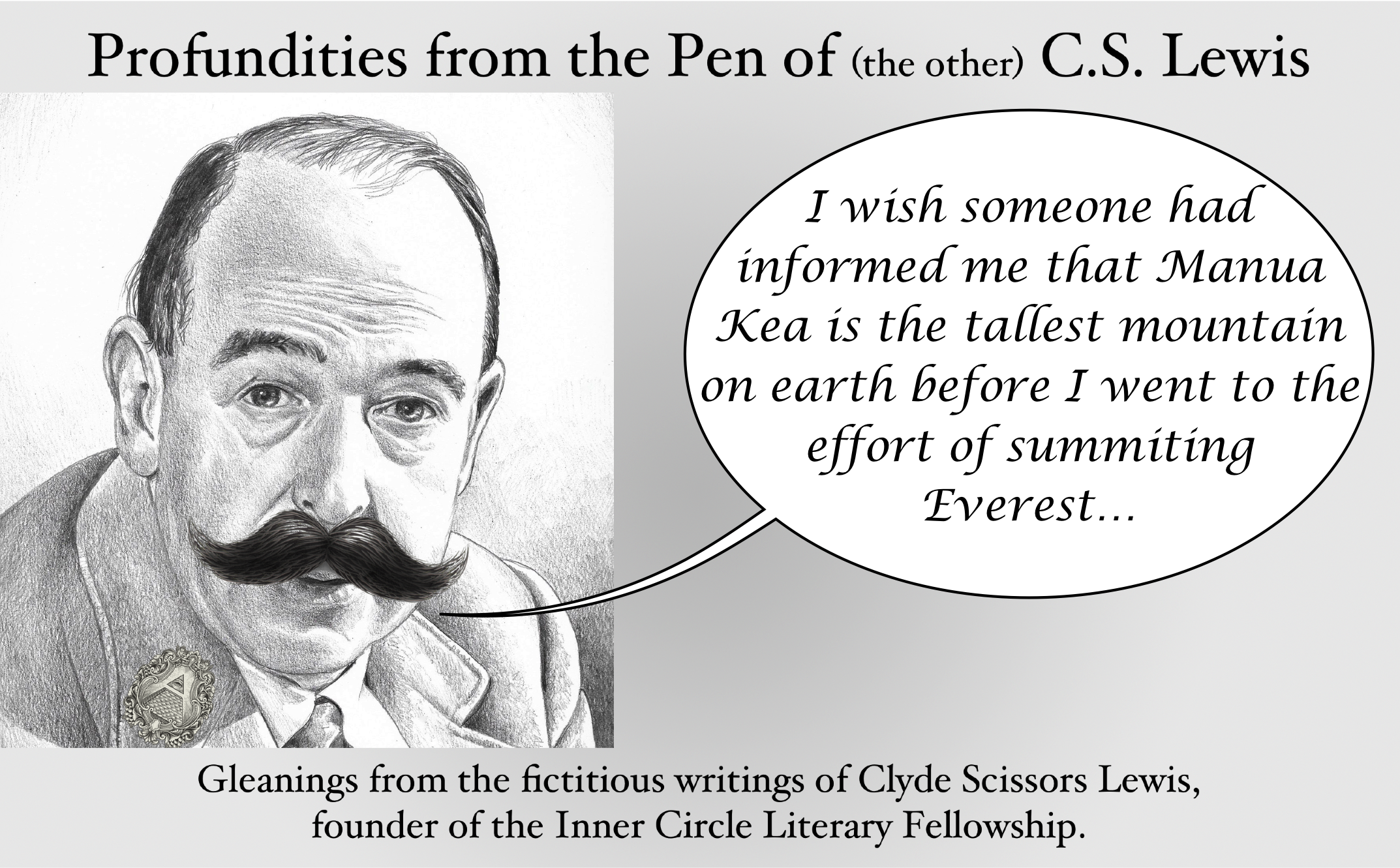
Welcome to another in an occasional series of fictitious quotations from a fabricated contemporary of the great Oxbridge professor, Clive Staples Lewis.

The C.S. Lewis who authored these questionable observations, Clyde Scissors Lewis, possessed a worldview enigmatically different from that of the esteemed Christian author. Despite the fact that their two lives overlapped in a variety of ways, the similarities were superficial.

A brief biography of the lesser Lewis is available at this link.

The Other C.S. Lewis: A Brief Biography

By all means, do not confuse the wisdom of the genuine article with his shadowy counterfeit. Despite any cursory similarities between the two men, this is most definitely not the C.S. Lewis readers have come to know and love.


If one measures from the center of the planet, due to the equatorial bulge, Mount Chimborazo in Ecuador is the “tallest” mountain on our planet.

C.S. Lewis on Stupidity

Just because someone did something extraordinarily stupid does not mean that another fool should repeat the act. And C.S. Lewis would agree.

This summer a (likely unemployed) Coloradan decided to push a peanut to the top of Pikes Peak – a 14,115 foot American landmark – using his nose. Talk about stupid. His ambition was to be the first person in the twenty-first century to accomplish this pseudo-impressive goal.

That’s right, “in the twenty-first century.” Oddly, he is the fourth man (women are too intelligent, IMHO) to waste time in this pursuit, but the others proved their mettle in the twentieth century.

Simple stupidity is not the oddest motivator of irrational actions. Some people feel compelled to pursue death-defying activities. Those of us who would prefer to avoid danger whenever possible, are confused by others who embrace it.

Quite recently, “the body of an American mountaineer whose daring achievements brought her acclaim among some of the world’s most elite climbers was found . . . on a peak in Nepal.” Apparently, she climbed the “world’s eighth-highest peak” so she could ski down from its peak.

Hilaree Nelson, 49, and her romantic and climbing partner, Jim Morrison, were trying to ski down Manaslu . . . An avalanche apparently blew her off a cliff onto the south face of the mountain, opposite of their intended route of descent.

Tragic, most would agree. Foolish, many would add.

Doing something silly falls lower on the FDS (foolishness disorder spectrum) than does taking arbitrary and utterly unnecessary risks.

C.S. Lewis offers some interesting counsel to a woman who shared concern about the marital frustrations of someone close to her. (Yes, people actively sought his advice.) He ranks ignorance very low on the scale of relationship problems.

It is a great joy to be able to ‘feel’ God’s love as a reality, and one must give thanks for it and use it. But you must be prepared for the feeling dying away again, for feelings are by nature impermanent.

The great thing is to continue to believe when the feeling is absent: & these periods do quite as much for one as those when the feeling is present. It sounds to me as if Genia had a pretty good husband on the whole.

So much matrimonial misery comes to me in my mail that I feel those whose partner has no worse fault than being stupider than themselves may be said to have drawn a prize! It hardly amounts to a Problem. (Correspondence, 1953).

So it is, that while obviously undesirable, stupidity is not a bad thing in itself. In “The World’s Last Night,” Lewis includes the trait in a curious list. And the passage suggests to me the dangers implicit in allowing one‘s ignorance to jeopardize their wellbeing.

Perfect love, we know, casteth out fear. But so do several other things – ignorance, alcohol, passion, presumption, and stupidity.

It is very desirable that we should all advance to that perfection of love in which we shall fear no longer; but it is very undesirable, until we have reached that stage, that we should allow any inferior agent to cast out our fear.

It is precisely when what I would identify as stupidity inspires dangerous activities, that C.S. Lewis would rule it to be detrimental. And this brings us to the question of why some few people do what the majority of us “saner” people would avoid.

Why Do People Pursue Risky Activities

For our discussion here, I am not including people who face danger due to their vocations. Doubtless some “first responders” and military members relish brushes with death, but they are in the minority. Most are not eager to court death.

It has been debated as to why some people are drawn to the most hazardous of so-called “extreme sports.” The uncharitable might attribute a vulnerability to the siren call of danger to mere stupidity, but there are other factors at work.

However, some people are conditioned by their upbringing to participate in unsafe behaviors (e.g. base jumping, smoking or alligator wrestling). And, in recent years, we have been hearing more about genetic dispositions to such activities. It appears there is some merit to the notion of there being a “risk taking gene.”

A major 2019 study reported in in Nature Genetics “identified . . . 99 [genetic] loci associated with general risk tolerance.” An accessible discussion of the study says, “the genetic variants identified in the study open a new avenue of research on the biological mechanisms that influence a person’s willingness to take risks.”

In any case, DNA is only one, limited factor. Researchers confirmed “non-genetic factors matter more for risk tolerance than genetic factors. The study shows evidence of shared genetic influences across both an overall measure of risk tolerance and many specific risky behaviors.”

Lacking the fear gene is not quite the same thing as being courageous. As noted above, a person may face danger because of a valid reason. Thus “first responders” and most military members I served as a chaplain were not foolhardy. They didn’t take unnecessary risks. But most were willing to place themselves between very real threats and those they were protecting.

If you personally are of an adventurous nature, I encourage you to take sensible precautions. Avoiding rafting on Class VI rapids and cave diving – anywhere – would be a good place to start..

And for the less daring among us, perhaps we can avoid foolish pursuits that are merely a waste of time. It seems apparent to me that time spent serving others in a food bank, or mowing the lawn of a disabled neighbor, constitute a far better use of our time.

We Found Hobbits in Our Yard

Yes, we found hobbits in our yard, when we weren’t even looking. True, I have a sign on our property welcoming “all true Narnians,” but true fans of the Oxford Inklings will recognize that hobbits are actually residents of Middle Earth.

I suppose, though, that doesn’t mean that Middle Earth’s hobbits, elves, and Ents can’t be Narnians at heart. As for dwarves and humans, they already reside in Narnia and are welcome here even if they are traveling through on their way to Valinor, in the Blessed Realm.

To be honest, it wasn’t actual hobbits we discovered. It is a small field of Eryngium planum, which is also known to botanists as Blue Hobbit, Sea Holly.

Noted for its petite size, Eryngium planum ‘Blue Hobbit’ (Sea Holly) is a compact perennial boasting a profusion of spiny, egg-shaped, purplish-blue flower heads throughout the summer.

They are produced on silver-blue stems and stand high above the basal rosette of deeply toothed, smooth textured leaves. Its beautiful texture, unique color, long-lasting flowering, easy care and remarkable qualities as cut flowers make it a favorite of florists, gardeners, bees and butterflies.

The plant’s size is the apparent premise for its popular name. I mean, there were Blue Wizards in Middle Earth, but no blue hobbits I can recall.

According to an interesting article in a Canadian newspaper, there are several plants “eagerly adopted by Tolkien fans, at least ones with a love of houseplants.”

The author describes his new acquisition named in honor of Gollum, a Stoor, which was an old breed of hobbits that preferred riversides and marshes. Gollum, of course, devolved from his life as Sméagol, due to the corrupting influence of the Ring.

Despite the name, the plant is kinda cute. Its full name is Crassula ovata ‘Gollum,’ and if you’re keeping up with your botanical Latin, or still have the tag stuck in one of your houseplants, you’ll know that Crassula ovata is the jade plant.

J.R.R. Tolkien and C.S. Lewis loved nature. And, not just from a distance. Their frequent cross country walks were of great delight to both scholars.

Lewis’ fascination with gardens began in his childhood. In his autobiography, he includes “a garden (which then seemed large)” as one of his initial “blessings” (Surprised by Joy). He also relates a pivotal experience in the development of his imagination.

Once in those very early days my brother brought into the nursery the lid of a biscuit tin which he had covered with moss and garnished with twigs and flowers so as to make it a toy garden or a toy forest. That was the first beauty I ever knew. What the real garden had failed to do, the toy garden did.

It made me aware of nature—not, indeed, as a storehouse of forms and colors but as something cool, dewy, fresh, exuberant. I do not think the impression was very important at the moment, but it soon became important in memory.

As long as I live my imagination of Paradise will retain something of my brother’s toy garden. And every day there were what we called “the Green Hills;” that is, the low line of the Castlereagh Hills which we saw from the nursery windows. They were not very far off but they were, to children, quite unattainable. They taught me longing—Sehnsucht; made me for good or ill, and before I was six years old, a votary of the Blue Flower.

The blue flower to which Lewis refers is not the Blue Hobbit. It is actually a symbol which grew to reference the Romanticism movement. Among other things, such as an emphasis on intense emotion, Romanticism fostered an idealized image of nature. In an essay about the German writer Novalis,* Norwegian-American author Hjalmar Hjorth Boyesen (1848-1895)⁑ offers the following description.

In the very first chapter we meet with all the conventional machinery of Romantic fiction: night, moonlight, dreams, and the longing for the blue flower. This blue flower is the watchword and the sacred symbol of the school. It is meant to symbolize the deep and nameless longings of a poet’s soul.

Romantic poetry invariably deals with longing; not a definite, formulated desire for some attainable object, but a dim, mysterious aspiration, a trembling unrest, a vague sense of kinship with the infinite, and a consequent dissatisfaction with every form of happiness which the world has to offer. The object of the Romantic longing, therefore, so far as it has any object, is the ideal—the ideal of happiness . . .

The blue flower, like the absolute ideal, is never found in this world . . .

The blue flower, as a metaphor, may remain out of reach, but selective breeding of cultivars has provided us with genuine examples in our modern era. And, since cultivars are named according to binomial nomenclature – which uses their scientific name, followed by a vernacular epithet – we may be introduced to more Inkling plants in the future.

I imagine both C.S. Lewis and J.R.R. Tolkien would be pleased to know that people have commemorated their literary creations with lovely flora. Learning of their existence, I’m thrilled to have Blue Hobbit spreading across our property. Perhaps it’s time to add a Gollum Jade plant to our home?


* For some reason, Romantic poet Georg Philipp Friedrich Freiherr von Hardenberg (1772- 1801), was commonly known by his pen name, Novalis, rather than his given name.

⁑ You can download a free copy of Boyesen’s Essays on German Literature at Internet Archive.

C.S. Lewis & Summertime

What’s your favorite season of the year? My preference is Autumn, with Spring a close second.

In the United States, Spring comes out on top. Actually, it is the preference in forty (80%) of the states. Probably due to its northern latitude, “the most popular season in the Northeast is Summer.” Unsurprisingly, Winter is the least favorite across the board, although a few hardy souls disagree. “Alaska and Vermont are the only two states that say winter is the most wonderful time of the year.”

Some years ago, Gallup published the result of polls on the subject, which are also analyzed by the ages of respondents.

Americans aged 18 to 29 are the group least likely to prefer spring (24%), while those 65 and older are most likely to prefer it (53%). Younger Americans are much more likely to prefer summer than are those in older age groups, and, in fact, summer is the top choice among this age group. [Editor: I wonder if that has anything to do with the traditional academic calendar?]

Everyone is aware of how the seasons (through length of daylight, etc.) affect our moods. In a 1914 letter to his father in Ireland, C.S. Lewis offers a curious description of the “magnificent summer” he was enjoying in England.

My mental picture of home is disturbed to a certain extent by your mention of a fire. Here, we are in the middle of a magnificent summer: day succeeds day with the same cloudless sky and parched earth, and the nights are hot and comfortless. But on the whole, fine weather is agreeable, and has, I think, a certain effect on the spirits.

At the end of September, he wrote again about the extended summer he was experiencing. It doesn’t sound like the opinion of someone whose seasonal preference was summer. “I suppose the winter has closed in at home by this time: but we are still having quite summer weather here – which I rather resent.” Sometimes, it seems, seasons do overstay their welcome.

The following year, C.S. Lewis again lamented summer’s length. In mid-November he complained to his father.

The weather here is a perfect joke, warmer than July, bright sunshine and gentle breezes. Personally I have had quite enough summer, and should not be sorry to bid it goodbye, though Kirk persistently denounces this as a most unnatural state of mind.

A year later, in 1916, Lewis’ distaste for excessive heat is seen in an October letter to his friend Arthur Greeves. One reason for this was C.S. Lewis’ passion for hiking through the countryside.

The beastly summer is at last over here, and good old Autumn colours & smells and temperatures have come back. Thanks to this we had a most glorious walk on Saturday: it was a fine cool, windy day & we set out after lunch . . .

In a poem entitled “The Day with a White Mark,” Lewis opens with vivid imagery and the notion that mood is normally related to environment and circumstances.

All day I have been tossed and whirled in a preposterous happiness:
Was it an elf in the blood? or a bird in the brain? or even part
Of the cloudily crested, fifty-league-long, loud uplifted wave
Of a journeying angel’s transit roaring over and through my heart?
My garden’s spoiled, my holidays are cancelled, the omens harden;
The plann’d and unplann’d miseries deepen; the knots draw tight.
Reason kept telling me all day my mood was out of season.
It was, too. In the dark ahead the breakers only are white.

One website offers generalized thoughts about “what your favorite season” reveals about you. For example, it says of those who share my preference:

“Delicious autumn! My very soul is wedded to it, and if I were a bird I would fly about the earth seeking the successive autumns,” George Eliot (aka Mary Ann Evans) once wrote of her affection for the fall season.

While parts of the world tend to think of spring as the season of renewal, fall is also a very good time for a fresh start. The vibrant orange colors and cooler weather of autumn appeal to your constant desire for change. The upcoming holidays inspire many to reflect back on the year that was and make plans for the year to come.

A study in England went so far as to link birth months to the frequencies of several psychiatric conditions. If it is correct, your likelihood of suffering from recurrent depressive disorder, bipolar affective disorder and even schizophrenia varies according to your birth month.

Summer does provide a welcome time for vacations and events that would be difficult to wedge into the “busier” seasons of the year. For example, it’s not too late to register for the 2022 C.S. Lewis Summer Institute. The theme is “Surprised by Love: Cultivating Intellectual Hospitality in an Age of Uncertainty.” It is slated for 28 July – 5 August 5, 2022 in Oxford.

C.S. Lewis’ Favorite Season

Last year, the United Kingdom’s National Trust* conducted a poll which determined summer (30%) as the favorite season for Brits. Curiously, for young adults, summer tied with the second overall favorite, autumn.

After autumn colour, Britons’ favourite things about the [autumn] season are spending time in nature – running, walking or cycling (13 per cent) and the weather – cold crisp days, Indian summer, or stormy days (12 per cent).

So what exactly was C.S. Lewis’ favorite season. At the end of his life he wrote the following. As he so often did, he used a familiar subject to make a profound comment about life.

Yes, autumn is really the best of the seasons; and I’m not sure that old age isn’t the best part of life. But of course, like autumn, it doesn’t last.

But then, isn’t it the flow of the seasons that makes each so welcome in turn? Charles Dickens offered just such an observation in a quote which offers a fitting end to our reflections today.

Nature gives to every time and season unique beauty; from morning to night, as  from the cradle to the grave, it’s just a succession of changes so soft and comfortable that we hardly notice the progress.


* The National Trust helps conserve sites of historic and natural significance in England, Wales, and Northern Ireland. Scotland has its own National Trust for Scotland, devoted to the same purposes.

Lewis’ good friend J.R.R. Tolkien also enjoyed autumn. In a post several years ago I shared a portion of a letter to his son where he says, “I have the autumn wanderlust upon me, and would fain be off with a knapsack on my back and no particular destination . . .” Sounds like something someone in Middle Earth might say – although, certainly not a hobbit!

An Evolutionary Fluke

Did trees evolve from apes? An odd question, to be sure, but one humorously posed by C.S. Lewis in a letter to his father.

While this column does discuss the theory of evolution, it’s not doctrinaire. So, whatever your opinion of Darwin’s notions, read on, and you may enjoy a pleasant surprise.

C.S. Lewis, the brilliant Christian apologist was not an ironclad “evangelical” in the American sense of the word. Here in the U.S., that typically requires adherence to a handful of doctrines, usually including the affirmation of the infallibility of the Scriptural autographs and of the creation of humanity in the persons of our first parents, Adam and Eve.

As important as these matters are, very few Christians would deem them salvific, in the sense that people holding less “vigorous” views on these issues will be excluded from heaven.

C.S. Lewis was one of those who focused on the core of the Christian faith, rather than secondary doctrines. He referred to this as “mere Christianity,” and it was based on a trusting relationship with God through the Person of Jesus, God present with us in the Incarnate Word.

As for doctrines per se, like all good defenders of the faith, C.S. Lewis preferred not to get bogged down with secondary matters. This is consistent with the spirit of Paul’s advice to the young pastor, Timothy.

Remind them of these things, and charge them before God not to quarrel about words, which does no good, but only ruins the hearers. . . . Have nothing to do with foolish, ignorant controversies; you know that they breed quarrels. And the Lord’s servant must not be quarrelsome but kind to everyone . . . (2 Timothy 2:14, 23-24).

Lewis’ 1927 Evolutionary Conversation

In March of 1927, C.S. Lewis wrote one of his eclectic letters to his father in Northern Ireland. As usual, he commented on his father’s previous correspondence and shared about his current health and activities. While his relationship with his father grew strained after his mother’s untimely death while he was still a child, Lewis’ letters to his father exude familial respect framed in the context of early twentieth century British sensibilities.

That said, Lewis was always eager to share curious or silly experiences he knew would amuse his solicitor father. He takes a humorous approach, for instance, to advising his father to consult a more skilled doctor to diagnose an ailment, rather than suffering with the incomplete work of the physician he has always known, he will simply be “offer[ing] up several months of pain as a sacrifice on the altar of an old acquaintance.”

At the same time, he acknowledges his personal inclination toward doing the same, stating that “if I lived at home [I] would continue to use Gillespie all my life.” Gillespie, it turns out, ran a taxi service long favored by the family despite his bumpy transportation. “I have never regretted Gillespie and his hexagonal wheel,” Lewis shares.

He returns to his argument, however, by saying his father’s health demands the attention of a competent physician rather than relying on past ties. He concludes with an illustration based on his own brother. “Hang it all, even you wouldn’t suggest that because I’ve known Warnie a long time I ought to trust him as an interpreter on a holiday in Spain.”

C.S. Lewis proceeds to share with his father current events at Magdalen College (“we are putting up a new building”) and a recent nightmare (“it was the sense of being on the moon . . . the complete desolateness, which gave the extraordinary effect”).

The letter includes other fascinating elements, but it is time now to consider the reference to evolution.

An Absurd Age

I absolutely love the way C.S. Lewis invites us to experience the following moment. His story is so vivid, it still lives a century after the described events transpired.

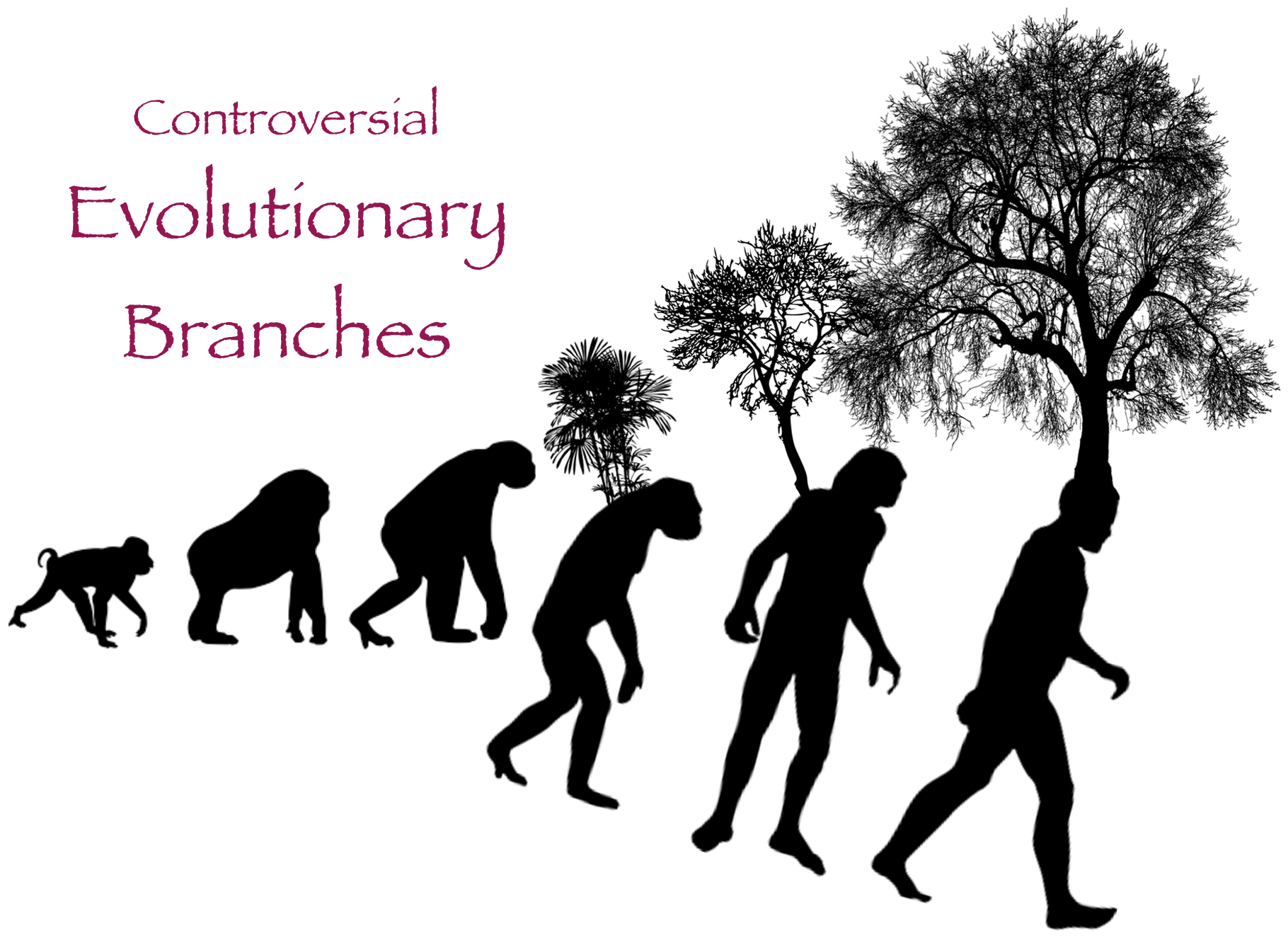
We live in the most absurd age. I met a girl the other day who had been teaching in an infant school (boys and girls up to the age of six) where the infants are taught the theory of Evolution. Or rather the Headmistress’s version of it.

Simple people like ourselves had an idea that Darwin said that life developed from simple organisms up to the higher plants and animals, finally to the monkey group, and from the monkey group to man.

The infants however seem to be taught that ‘in the beginning was the Ape’ from whom all other life developed – including such dainties as the Brontosaurus and the Iguanodon.

Whether the plants were supposed to be descendants of the ape I didn’t gather. And then people talk about the credulity of the middle ages! À propos of this can you tell me who said ‘Before you begin these studies, I should warn you that you need much more faith in science than in theology.’ It was Huxley or Clifford or one of the nineteenth century scientists, I think.

Another good remark I read long ago in one of E. Nesbitt’s fairy tales –‘Grown ups know that children can believe almost anything: that’s why they tell you that the earth is round and smooth like an orange when you can see perfectly well for yourself that it’s flat and lumpy.’

Ironically, immediately after this, Lewis introduces his next subject with the words: “Almost the only interesting thing that has happened to me lately was a visit from a young German.” You see, I wasn’t misleading you when I said his letters are filled with fascinating material.

One must assume that times have changed, and that English children are no longer being taught such simplistic distortions of actual theories. But that’s not the theme of this current post. Rather, I wish to show how wonderfully entertaining a simple family letter can be – especially when it comes from the pen of C.S. Lewis.