Learning Languages

C.S. Lewis possessed a gift for languages. Although he was not a philologist like his friend J.R.R. Tolkien, Lewis was well educated and read and spoke a variety of languages.

In fact, when he and his wife played Scrabble, they allowed for the use of words from any language! For the record, though, he does confess to a German professor that his grasp of that tongue is “wretched.”

The only bona fide genius I’ve known was a classmate at the University of Washington. While I was struggling with classical Greek, in preparation for seminary, at the age of 23 Bruce already possessed four master’s degrees and was closing in on his PhD in Linguistics. He spoke fifteen languages, but could read nineteen.

Of course, that is still a small portion of the 7,168 languages Ethnologue tells us are in use today.

This enormous number – which doesn’t include unknown languages spoken among untouched people groups – accounts for the fact that thousands of Christians are laboring now in groups such as Lutheran Bible Translators to make the Scriptures available to all people.

Sometimes this involves creating a written language itself, where only an oral version exists. The largest such organization, Wycliffe Global Alliance, reports that “Bible translation is currently happening in 2,846 languages in 157 countries.”

While the Bible’s translation is certainly of utmost importance, it is wonderful to know that other valuable literature is also made available to readers who could not decipher the language in which it was originally composed. 

Lewis, in fact, was a translator in his own right. Beyond the literal translation of works from one tongue to another, Lewis also functioned as a “translator” of complex concepts and eternal truths. I once described this as C.S. Lewis’ bilingualism.

How many extremely intelligent and well educated people do you know . . . who can actually communicate with those of us possessing normal human intelligence? That talent is a rarity.

And it is precisely what makes C.S. Lewis such an unusual man. He was brilliant. Yet he could communicate with the common person – even the child – just as easily as he conversed with his fellow university dons.

C.S. Lewis mastered a number of modern languages, but it was his study of historic languages that especially inspired him. Icelandic, with its similarity to Old Norse, is one example about which I have written. 

. . . J.R.R. Tolkien and his friend C.S. Lewis established a group called Kolbitár which was devoted to reading Icelandic and Norse sagas. The word itself means “coal biter” and refers to those in a harsh environment drawing so close to the fire’s warmth they can almost bite the coals.

Another example is Old English. Along with Middle English, birthed by the Norman Conquest, these were essential elements of his training as one of the preeminent English scholars of Oxford and Cambridge. And these languages were not merely dusty relics. I encourage the curious to read “C.S. Lewis’s Unpublished Letter in Old English,” which appeared in the journal VII.

In 1926 C.S. Lewis wrote his friend Nevill Coghill a letter in Old English, a language also known as Anglo-Saxon. Unreadable for most current readers of Lewis, it understandably does not appear in his three-volume Collected Letters.

In the essay, George Musacchio provides an illuminating outline of Lewis’ diverse expertise with languages, both “foreign and domestic.” Lewis began the letter to his friend with the following salutation.

“Leowis ceorl hateð gretan Coghill eoorl luflice ond freondlice.”
Which translates as: “Lewis the churl bids to greet Coghill the earl.”

Is English Really that Difficult to Learn?

English is reputed to be one of the most challenging languages to learn. (More on this in a moment.) For example, the simple sentence which follows consists of a mere seven words, but holds seven different meanings, dependent upon which word is emphasized.

“I never said she stole my money.”

This example comes from an article entitled “English is Hard, But Can Be Understood Through Tough Thorough Thought Though.”

Rosetta Stone answers the question of how hard it is to learn English by saying “it depends on your first language.” 

In addition to the fact that “spelling is a poor indicator of pronunciation,” English possesses numerous “specific rules,” and complements this burden with the fact that “some rules have lots of exceptions.” The complexity is due to the language’s history, which also gave rise to its mammoth vocabulary.

English has a lot of words—Webster’s English Dictionary includes approximately 470,000 entries, and it’s estimated that the broader English vocabulary may include around a million words. . . .

English has such a broad vocabulary because it’s a blend of several different root languages. While English is a West Germanic language in its sounds and grammar, much of the vocabulary also stems from Romance languages, such as Latin, Italian, Spanish, and Portuguese.

One result of combining these various root languages is that the English vocabulary includes a ton of synonyms . . . And unfortunately, most of these synonyms aren’t fully interchangeable, so the exact word you choose does have an impact on the overall meaning.

It turns out English doesn’t even rank in the top three most difficult languages for the speakers of the five largest language groups. The ranked listings do include, however, Arabic, Japanese, Russian, and Mandarin.

So, let’s reverse the question for a moment. Which languages are the most difficult for a native English speaker to learn? Unbabel lists ten. Fortunately, only one of them is on my wish list.

Babbel Magazine has an article approaching that question from the opposite end. Which language is easiest for English speakers to learn.

This may come as a surprise, but we have ranked Norwegian as the easiest language to learn for English speakers. Norwegian is a member of the Germanic family of languages — just like English! This means the languages share quite a bit of vocabulary, such as the seasons vinter and sommer (we’ll let you figure out those translations).

Another selling point for Norwegian: the grammar is pretty straightforward, with only one form of each verb per tense. And the word order closely mimics English. For example, “Can you help me?” translates to Kan du hjelpe meg? — the words are in the same order in both languages, so mastering sentence structure is a breeze!

Finally, you’ll have a lot more leeway with pronunciation when learning Norwegian. That’s because there are a vast array of different accents in Norway and, therefore, more than one “correct way” to pronounce words.

An article I wrote seven years ago hints at that same conclusion. I made this informative, and mildly threatening, illustration for “Norse Linguistic Invasion.”
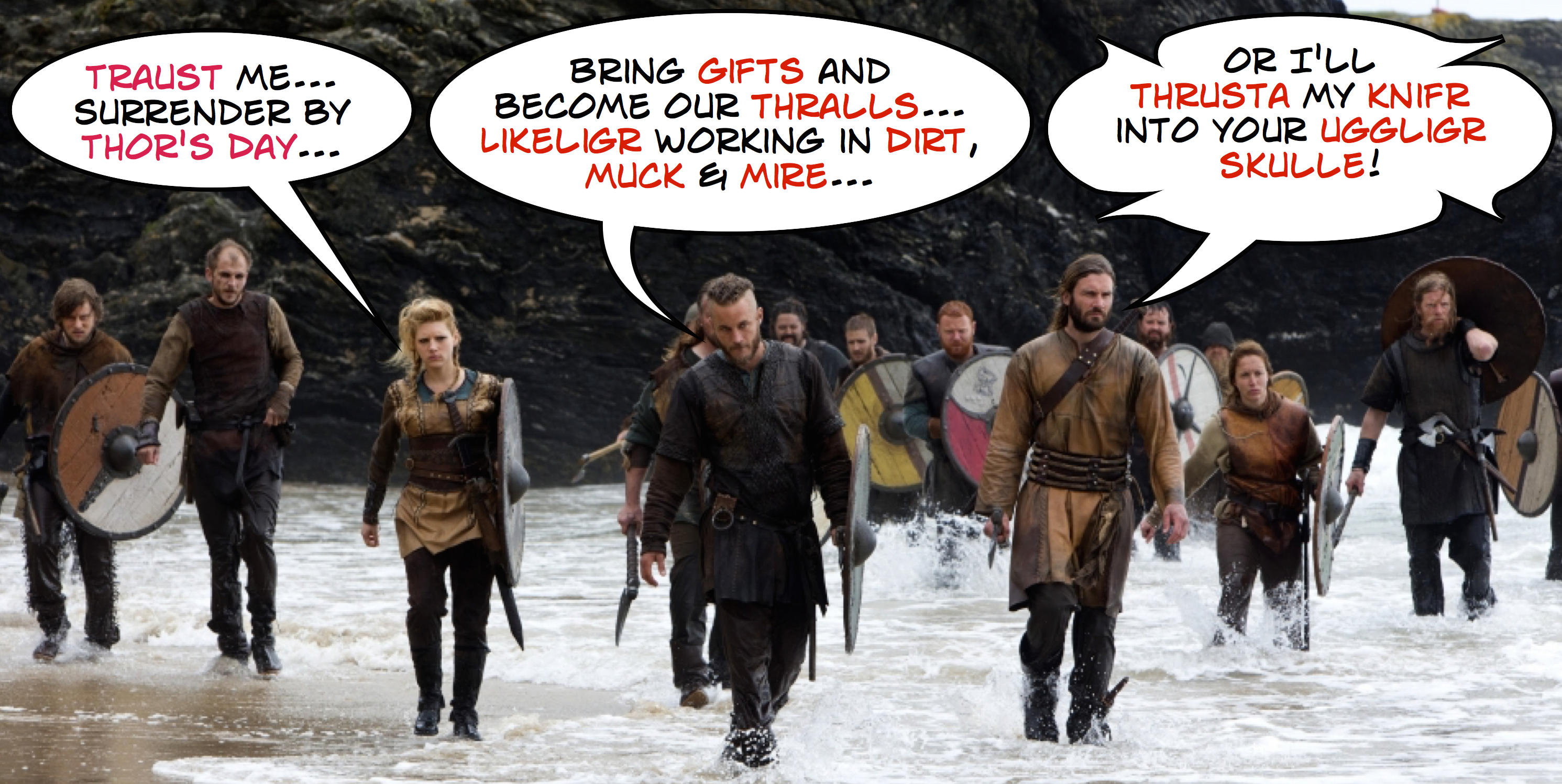
Oxford Royale Academy lists several reasons why English is especially challenging to new students. The following issue of “irregularities” also plagues countless native speakers.

One of the hardest things about English is that although there are rules, there are lots of exceptions to those rules – so just when you think you’ve got to [come to] grips with a rule, something comes along to shatter what you thought you knew by contradicting it.

A good example is the rule for remembering whether a word is spelt “ie” or “ei:” “I before E except after C.” Thus “believe” and “receipt.”

But this is English – it’s not as simple as that. What about “science?” Or “weird?” Or “seize?”

There are loads of irregular verbs, too, such as “fought”, which is the past tense of “fight”, while the past tense of “light” is “lit.” So learning English isn’t just a question of learning the rules – it’s about learning the many exceptions to the rules.

The numerous exceptions make it difficult to apply existing knowledge and use the same principle with a new word, so it’s harder to make quick progress.

And even some of the normative “rules” are difficult to grasp. One example is that there’s a very specific order that adjectives must be listed ahead of a noun. According to Rosetta Stone,

The adjective order is: quantity, opinion, size, age, shape, color, origin/material, qualifier, and then noun. For example, “I love my big old yellow dog.” Saying these adjectives in any other order, like “I love my yellow old big dog,” will sound wrong, even when otherwise the sentences are exactly the same and communicate the same thing. Keeping rules like this in mind can be tricky, and it takes a lot of practice to get it right.

Adjective order is seldom considered, in part because it’s not considered good writing to string too many such words together. But apparently there are right and wrong ways to organize any such list.

Royal Order of Adjectives

Most students aren’t taught about adjective order in school and instead learn it through listening and reading. In English, the rules regarding adjective order are more specific than they are in other languages; that is why saying adjectives in a specific order sounds “right,” and deviating from that order makes a statement sound “wrong,” even if it’s otherwise grammatically perfect.

And, since we’re talking about English, even this Royal Order of Adjectives rule has exceptions

The hierarchy is not absolute, and there is some wiggle room among the “fact” categories – size, age, and so on – in the middle.

Native speakers are often delighted when they learn about this law and discover how flawlessly they apply it. It even went viral in 2016 . . . The tweet attached a paragraph by etymologist Mark Forsyth . . . giving an example that uses all the categories according to the OSASCOMP hierarchy: “a lovely little old rectangular green French silver whittling knife.”

I do not ever recall being taught (or reading on my own) about the “Royal Order of Adjectives.” Nevertheless, I don’t feel too embarrassed at acknowledging my previous ignorance, since even Lewis himself was comfortable in expressing gratitude for being introduced to new words. For example, when he thanked Dorothy Sayers for enlarging his vocabulary with her work on Dante.

So, is English all that challenging? Well, C.S. Lewis did his part to make it less daunting, joining a public debate in Britain, with an unexpected argument. Discussing English’s previously noted problem with inconsistencies and confusion in spelling, the don offered a simple solution.

In a column on Lewis and the history of words, I included an extended passage from a letter Lewis wrote challenging a contemporary British effort to “reform” spelling. Surprisingly, he argued against the necessity for uniformity in spelling. After explaining why our language functions as it does, he advocates:

As things are, surely Liberty is the simple and inexpensive ‘Reform’ we need? This would save children and teachers thousands of hours’ work.

Surely all but the most diehard grammarians would be sympathetic to his argument.

Next week I plan to write about another linguistic matter closely associated with the Inklings – the creation of new words and languages.

Discerning Your Personality

How has your personality been changing through the years? Over the years I’ve noticed some gentle shifts in my own personality, particularly as it relates to my attitudes toward interacting with others.

C.S. Lewis records an intriguing comment about personalities in his early diary, published now as All My Road Before Me. After WWI, he fulfilled his promise to a friend who perished in the conflict, by providing for the soldier’s mother and young sister. Lewis’ relationship with Janie Moore has been debated, but he referred to her as “his mother,” his birth mother having died when he was young. 

Lewis refers to Mrs. Moore as “D” in the diary, and Maureen, her daughter, would have been a teenager at the time (January of 1923).

At supper the subject of personality arose – I said that it made one giddy to think that oneself might not have been.

Maureen said, “Yes – I was wishing the other day that you had married someone else (to D) and then I thought, Oh, it wouldn’t make any difference to me, I shouldn’t have been there.” This shows me that she thinks more than I had hoped.

The three people seated at that dinner experienced personality changes during the following years. Many of these attitudes and behaviors have been recorded for posterity. 

Some change is natural. Healthy change should be considered “growth.” People who remain rigidly static are the exception. Nevertheless, normal temperament modifications are usually quite gradual. Major alterations usually precipitated by significant emotional events. And, it’s important to recognize these SEMs can be positive – such as the birth of a child – despite our human tendency to focus on those which are traumatic.

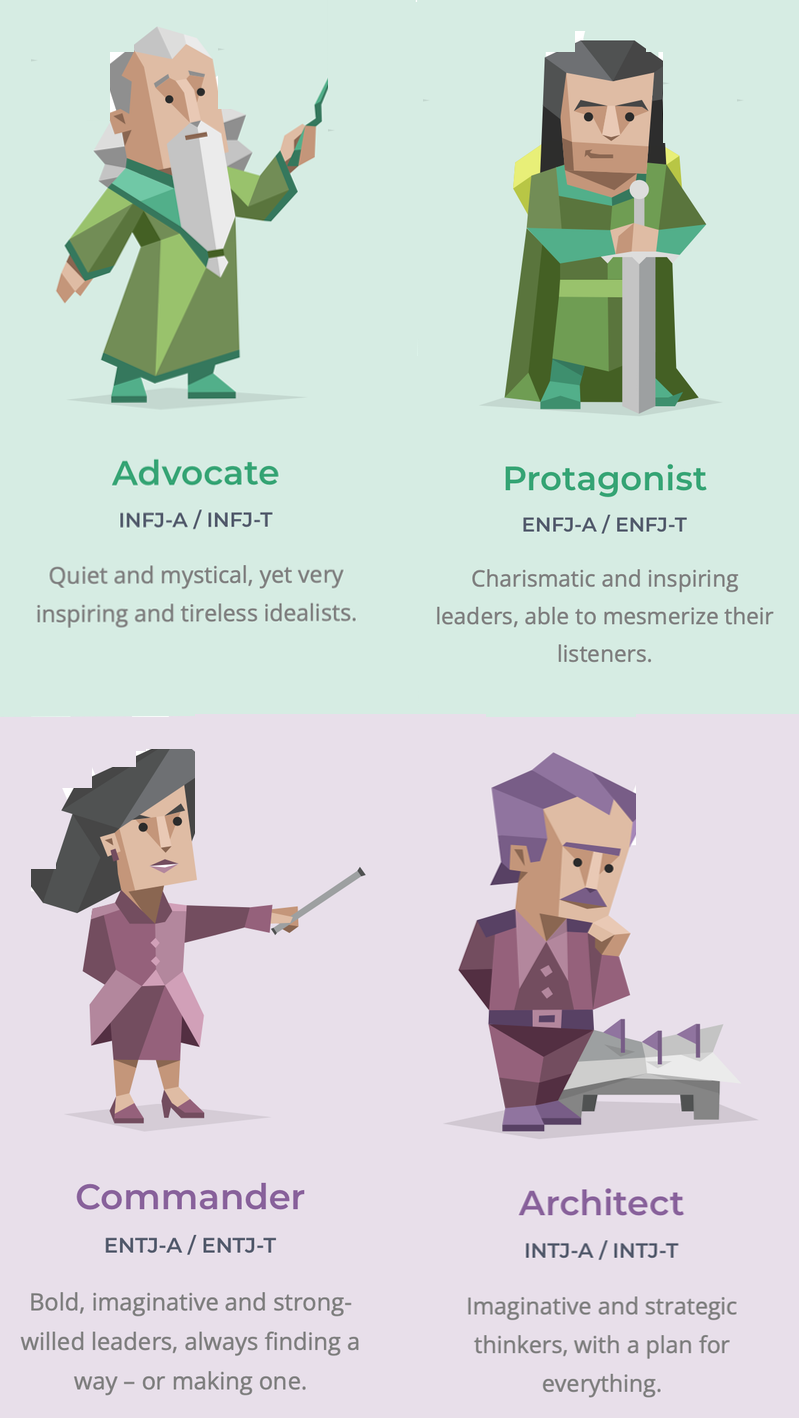
So, how does one asess their personality? There are a variety of accessible personality inventories. One of the most accessible identifies sixteen basic personality types, as popularized by Katherine Cook Briggs and Isabel Briggs Myers in the Myers Briggs Type Indicator. Using questionnaires of various length and detail, individuals discover their core personality attributes. 

It is quite common for people using one of these MBTI-based inventories to be truly surprised at the accuracy of the instrument. Many choose to embark on a quest to learn more about themselves – and others. There are resources for using these insights to improve interaction with people of other types, and even to find a compatible type of career.

I recently stumbled across a simple-to-use website that I offer for your consideration. Sixteen Personalities not only aids you in identifying your “type,” it offers a number of additional types of supplemental data – many of them for free. One clearly outlines the strengths and weaknesses of people with your personality. 

Readers will notice I’m careful to refer to the tools used as assessments or inventories, not tests. That’s because the word “test” implies that there are right and wrong answers. The fact is that there are no invalid personality types.

Each combination possesses its own strengths, and its inevitable weaknesses. Often they are two sides of the same coin. For example, the 16 Personalities site includes ten such traits for the Protagonist (ENFJ). Here are two of the examples.

A Strength – Reliable – Few things bother Protagonists more than the prospect of letting down a person or cause that they believe in. People with this personality type can be counted on to see their promises and responsibilities through – even when it’s difficult to do so.

A Weakness – Overly Empathetic – Compassion is among this personality type’s greatest strengths. But Protagonists have a tendency to take on other people’s problems as their own – a habit that can leave them emotionally and physically exhausted.

The Reality of Personality Drift

It isn’t uncommon that over a period of years, personality type (as identified by these sixteen options) can change. This is particularly true when we are near equilibrium between two competing attributes. For example, as a young pastor, I was slightly Extravert. Today, I am modestly Introverted. Some of this is due to being “worn out” by excessive interpersonal interactions. Some, I suspect, is because I’m assessing my preferences more honestly. I really do draw more positive energy from small groups, than crowds.

But pastors, of course, are expected to be people people. So many of us do consciously push ourselves to become more of an Extravert than we truly are. (And many people would be quite surprised to learn how many of the pastors they’ve admired for their personability are actually Introverts.)

In my own situation I have a pair of weak preferences – Introvert over Extravert and Thinking over Feeling – and two quite strong preferences – iNtuitive over Sensing and Judging over Perceiving. Due to the balanced aspect of two characteristics, I possess a sort of blend of four different personalities. And, I could be fairly perceived by others as any of them.

One last element of the 16 Personalities version of the MBTI, is that it includes a measurement of one’s Assertive versus Turbulent nature.

Assertive and turbulent refer to opposing personality traits sometimes added to the Myers-Briggs Type Indicator (MBTI), a personality inventory. An assertive person is more calm, confident, and laid-back, while a turbulent person is more anxious, self-conscious, and perfectionist.

The labels, when used, are appended to the standard four-letter MBTI codes to lend further nuance to the psychological types. 

No one who knows me would be surprised to learn that I peg out as Assertive. One clear evidence is that no one has ever accused me of being a Perfectionist.

Was C.S. Lewis an ESFP?

Seven years ago I wrote about this subject, and I researched the question of which personality C.S. Lewis possessed.

The consensus seemed to be that he was an INTJ. One current discussion concurs with that assessment, although it also makes the subject a bit more complex by including the “Harold Grant cognitive function stack,” something I’ve never studied.

Lewis’ identity as an INTF remains most reasonable to me. Feel free to share your thoughts on the matter.

Remember, a personality inventory is not intended to put you in some sort of restrictive box. If the tool is not helpful to you, just ignore it. And, if you are wary of how such revelations might be used “against” you, share those concerns with any authorities (e.g. educators or employers) who want you to participate in a group process.

[You might dismiss such a concern, but I can personally attest to a situation where a senior military chaplain attempted to twist the MBTI results of a Roman Catholic chaplain to suggest he had “issues.” Suffice it to say it was really the colonel who had psychological problems, not the captain.]

That sad episode was, fortunately, unique in my experience. In any case, it should not prevent someone from personally discovering their personality type. It’s free, only takes a few minutes, and the dividends could well surprise you.

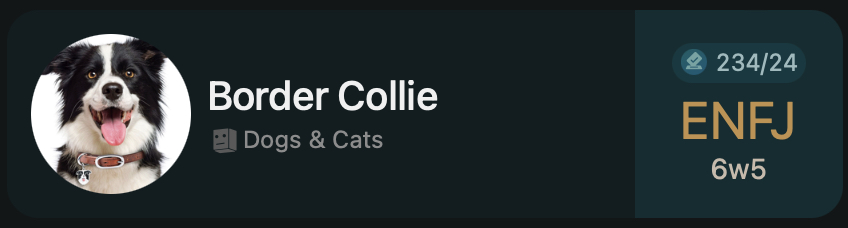
And, if you are curious about what type characterizes a particular breed of dog or cat . . . I think this site was right on in labeling our border collie an ENFJ.

Judging by Appearances

If books should not be judged by their covers, how much more true is it that we should avoid judging people by their initial appearance?

We don’t want others to be hasty in determining who we are, right? We need to take some time to get to know people before coming to “conclusions” about what they are like.

Yet we still tend to look at someone and – right away – assess whether they are trustworthy or not. I confess it is sometimes challenging for me to maintain an open mind. For example, teardrop tattoos (especially when accompanied by neck ink that combines letters and numbers), make me nervous.

First impressions are usually by their very nature superficial. Which means they often prove to be wrong. That’s true about people . . . and books.

Lewis scholar Dale Nelson recently sent me an interesting review of the book The Inklings, written by Humphrey Carpenter in 1978. The fascinating thing about the piece was that it was written by Lord David Cecil (1902-1986), who was himself an Inkling.

One of the things which drew my attention was his physical description of several of the members, especially C.S. Lewis. Without citing the maxim, he declares how misleading first impressions may be.

[Charles] Williams was the most obviously odd. Very tall, and indisputably ugly with a high forehead and with gleaming spectacles, he yet diffused a curious charm that came from an enthusiastic warmth of spirit united to a comic lack of inhibition. . . .

Lewis at first sight appeared less unusual; stocky, red-faced, loud-voiced, he might indeed have been taken for an innkeeper or even a butcher.

Such a mistake would not have displeased him, he liked to think of himself as representing the common man, in contrast to the sophisticated intellectual.

These observations were interesting, but there was something far more thought-provoking in the (excellent, by the way) review. More about that in a moment. First let’s return for a moment to the issue of book covers.

What about the Cover of the Book You are Writing?

I discussed covers, and Lewis’ thoughts thereon, in this post.

It’s unsurprising that with all of their many reprintings, the writings of C.S. Lewis have been published with a wide range of covers. Some of this can be attributed to the artistic fads of the decade in which particular editions saw print. More important, I believe, are the arbitrary tastes of publishers.

When it comes to self-publishing, authors are in complete control over the image that graces their literary creations. While I make no pretense of being an artist, I must confess at being shocked by the shoddy quality of many such works. Surely they are aware that the very best of writing can be marred by dreadful packaging. By the same token, even weak literature has received wider dissemination than it merited, due to stunning or alluring graphics.

The internet is filled with posts on this subject. These are representative:

Against Popular Advice, Books Continue to Be Judged by Their Covers” says, “for some, this can be a bitter pill to swallow, because writers want to believe that their work will speak for itself.”

The reality is that every person who steps into a book shop or browses books online is judging books by their cover, even if only subconsciously. I’m not saying that the judgment is always correct. Some books have amazing covers but are comprised of some pretty bad writing. I’d guess that many more amazing books are hiding behind bad cover art. The challenge is to get readers to pick up your book in the first place. That’s where the artwork comes in.

Another writer contends that potential readers do consider a host of matters. In “Why ‘Don’t Judge a Book by its Cover’ is Bad Advice,” the writer nevertheless admits it is the single most important element in winning an audience (short of a celebrity endorsement).

Readers are going to keep on reading and judging based on a whole host of criteria. The cover is just one of the many factors that are taken into account. Like other aspects of a book, it holds valuable information about the story kept inside.

Disregarding it is bad advice. Instead, why not try judging a book by its cover? Maybe next time you peruse the shelves of your neighborhood bookstore or scroll through the numerous titles listed online, you can select books purely based on the cover.

You never know, that could tell you everything you need to give that book a chance.

Covers are not the only factor in enhancing your book’s reception. Consider as well the nature of the paper in printed copies, as I discussed in “The Ugliest Book,” about a Mayan codex.

Now, back to the book reviewer.

David Cecil’s Thoughts on His Own Identity as an Inkling

After graduating from Oxford, Cecil briefly taught Rhetoric in London, before returning to Oxford, where he taught English. During his career, he wrote various works, including a number of literary biographies. These include: The Stricken Deer or The Life of Cowper, English Poets, Hardy the Novelist.

David Cecil was an accomplished man, and a true Oxford Inkling. The curious aspect is how, as the son of a marquess (bearing a courtesy title), socializing with a different caste, so to speak, would bond so well with the rest of the Inklings. Fortunately, Cecil briefly explains why he valued the fellowship in this book review.

Usually one of them would read aloud a piece from some book he was writing. . . . The meetings were also occasionally attended by persons who did not share The Inklings’ distinctive point of view but who liked spending an evening in their company.

I myself was one of these; I found such evenings enjoyable and stimulating; and all the more because the spirit of The Inklings was in piquant contrast to those of the Oxford circles in which I spent most of my time.

A final gift to those who treasure Lewis and his companions comes in Cecil’s incisive understanding of their unifying bond.

The qualities . . . that gave The Inklings their distinctive personality were not primarily their opinion; rather it was a feeling for literature, which united, in an unusual way, scholarship and imagination.

Their standard of learning was very high. To study a book in translation or without a proper knowledge of its historic background would have been to them unthinkable; they were academic in the best sense of the word.

But – and this is what made them different from most academics – they also read imaginatively. The great books of the past were to them living in the same way as the work of a contemporary. . . .

Simply they read their books in the spirit in which they were written. And they could communicate their sense of this spirit to their hearers so that, for these also, these great books sprang to fresh, full life.

This was a unique achievement in the Oxford of their time.

It appears the Inklings would be among the last to judge a book, or a person, by their cover.

Free Lecture Series Explores the Inklings

If you would like to learn more about C.S. Lewis, J.R.R. Tolkien, and their fellow Inklings, a free series of five lectures has just been produced. I am in the midst of the first, introductory lecture, and am eager to listen to the entire series.

You can receive links to the series from Hillsdale College by completing a small form at this link.

The subjects addressed in the series include:

  1. “Who Are the Inklings?” by Bradley J. Birzer
  2. “C.S. Lewis’s The Abolition of Man” by Michael Ward
  3. “J.R.R. Tolkien’s Scholarship” by Michael Drout
  4. “Themes of Lewis’s Fiction” by Jason Lepojärvi
  5. “Tolkien and the Christian Imagination” by Holly Ordway

Hillsdale College is an independent Christian institution, founded in 1844. They currently have 1,573 undergraduates, “representing 49 states, D.C., and 13 foreign countries,” complemented by more than one hundred graduate students.

Several years ago, they offered a free online course about C.S. Lewis, which we promoted on Mere Inkling in this post.

That course – along with thirty more – is still available at no cost. (Donations are welcome, of course.) You can learn about all of these courses here.

And, if you’re in the mood for reading a free issue of Christian History on the subject of “Heaven and the Christian Imagination,” look no further than this link. (The issue includes several references to the thought of C.S. Lewis.)

CS Lewis | Academic Tam

Deep Thoughts from the Quill of the Other C.S. Lewis

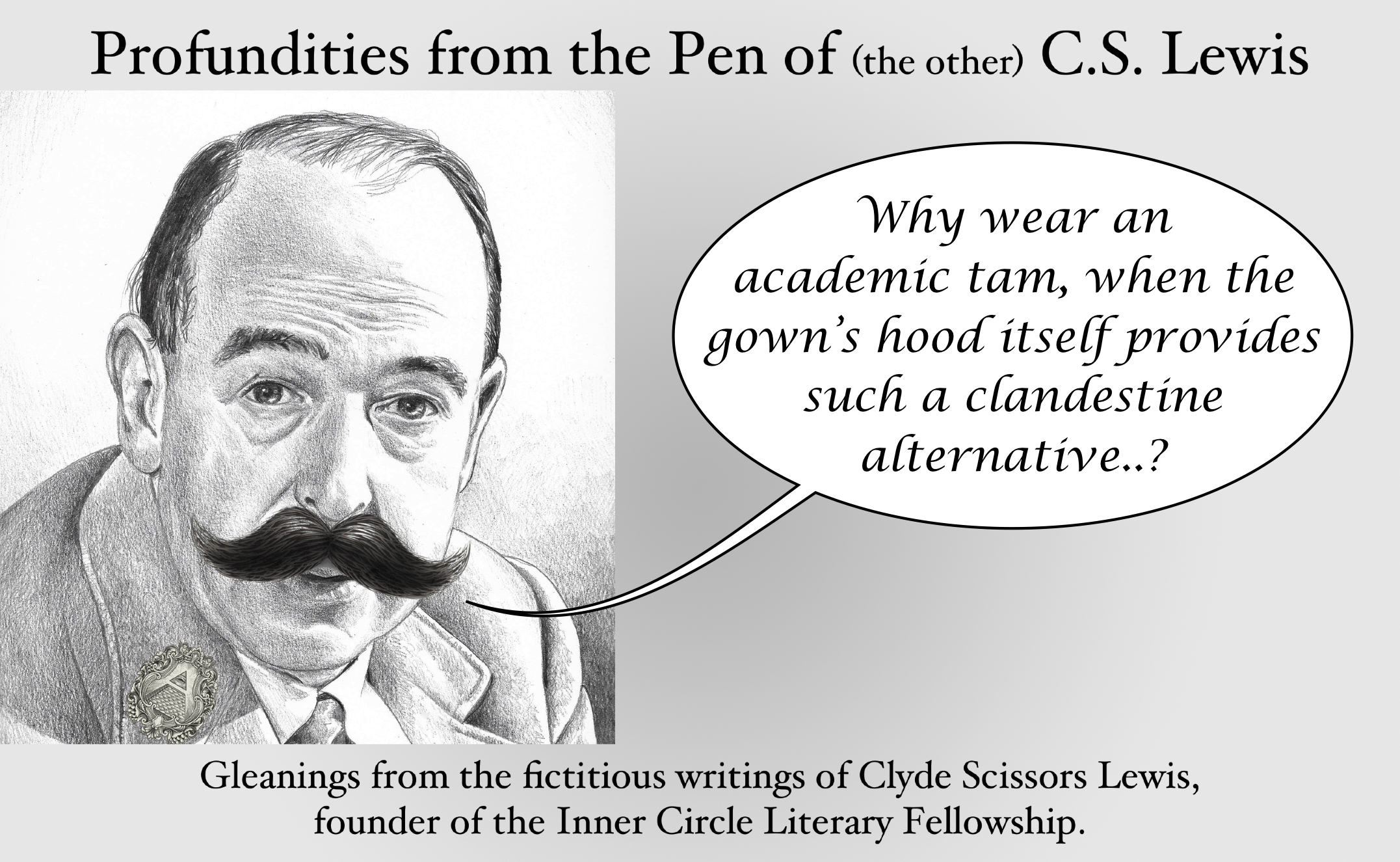
Welcome to another in an occasional series of fictitious quotations from a fabricated contemporary of the great Oxbridge professor, Clive Staples Lewis.

The C.S. Lewis who authored these questionable observations, Clyde Scissors Lewis, possessed a worldview enigmatically different from that of the esteemed Christian author. Despite the fact that their two lives overlapped in a variety of ways, the similarities were superficial.

A brief biography of the lesser Lewis is available at this link.

The Other C.S. Lewis: A Brief Biography

By all means, do not confuse the wisdom of the genuine article with his shadowy counterfeit. Despite any cursory similarities between the two men, this is most definitely not the C.S. Lewis readers have come to know and love.

Please Forgive My Sesquipedalianism

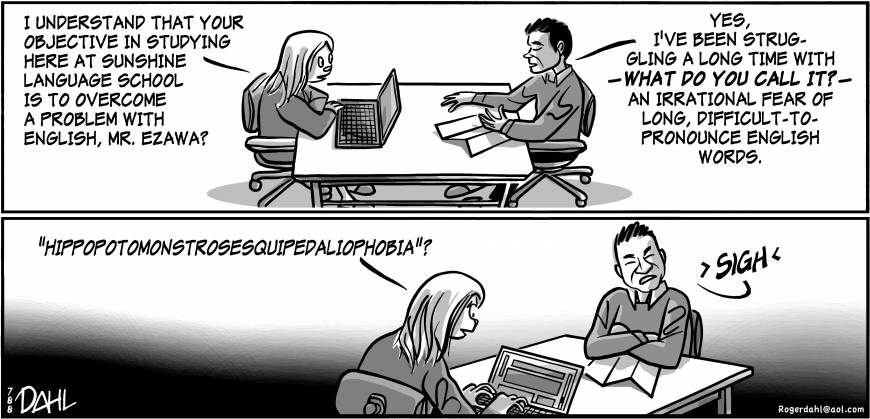
Long words can be daunting. Even for native speakers. The illustration above comes from The Japan Times, and reveals how the challenge is magnified for others.

I love learning new words. And, since these treasures frequently drift out of my vocabulary because I fail to use them, I often have the joy of re-learning unique words.

Sesquipedalianism is actually a genuine word which can be validly applied in a variety of settings. After all, haven’t we all encountered a sesquipedalianist or two, who uses especially long, and occasionally obscure words?

How many syllables are required before a word grows too long? To a monosyllabic individual, two might be deemed excessive.

Seriously, it’s not the length of a word that matters, it’s the word’s familiarity. For example, “familiarity” has six syllables, and everyone reading Mere Inkling knows its meaning. (I resisted saying “is familiar with . . .”) On the other hand, “carbuncle” is only trisyllabic, and yet the only people likely to know its definition are either those in medical professions, or unfortunate individuals who have suffered from one.

But it’s not only unfamiliarity that causes confusion; misunderstanding can result from a lack of context. Let’s take “trisyllabic,” a word even an active reader seldom encounters. As used in the paragraph above, the context (along with the prefix and root), provide us with more information than a person needs to recognize its meaning.

In a famous letter from 1956, C.S. Lewis included the following advice:

Don’t use words too big for the subject. Don’t say “infinitely” when you mean “very”; otherwise you’ll have no word left when you want to talk about something really infinite.

Great advice, just as one would expect. However, this does not constitute a blanket rejection of “big words.” Lewis is simply reminding us that our prose must not be more complicated than it needs to be. Thus, the title of this column uses a precise word – rather than saying “Please Forgive My Practice of Using Long and Sometimes Obscure Words” – since Mere Inkling readers are quite capable of uncovering a definition if a particular word is unfamiliar.

Plus, as I hinted above, many of us enjoy expanding our vocabularies.

In the aforementioned correspondence, Lewis offered additional useful advice. Another dictum is: “Always prefer the plain direct word to the long, vague one. Don’t implement promises, but keep them.”

Here too the great writer is astute. However, this caution is not actually about the length of words. Lewis’ desire for clarity in communication leads him to reject “vague” words, which coincidentally happen to be longer than those he refers to as “direct.”

Using longer words than necessary is not, of course, always a good thing. While it comprises neuron-stretching play for word lovers, it can easily be misperceived by others as “showing off.” (Note: I’m not defending those cases in which the writer or speaker really are attempting to impress others with their verbal dexterity.*)

You can easily find collections of the longest words in English. While some cheat, including “supercalifragilisticexpialidocious,” others are more scrupulous. Despite doing just that, I like the list at grammarly because of their definition of one of the words they include.

Floccinaucinihilipilification
The estimation of something as valueless. Ironically, floccinaucinihilipilification is a pretty valueless word itself; it’s almost never used except as an example of a long word.

I’m not currently planning on adding floccinaucinihilipilification to my personal vocabulary, but don’t let me dissuade you from doing so.

Learning new words often reaps extrinsic benefits. As a historian who enjoys learning about the Latin language, I found the following definition, and illustration, from the Cambridge dictionary quite interesting.

The act of considering something to be not at all important or useful – used mainly as an example of a very long word:

The honor of being the longest non-technical word goes to floccinaucinihilipilification.

The word . . . is “an 18th-century coinage that combines four Latin prefixes meaning ‘nothing.’”

Oh, and one final suggestion. When visiting the Cambridge site, in the likelihood you’ll someday wish to use this word in conversation, take a moment to make certain you learn to pronounce in the U.K. or American manner, as appropriate for your location.


* I am not here referring to the Irish bred Bay Colt for some curious reason named “Verbal Dexterity.”

When the Learnèd Deserve Gentle Ridicule

The halls of academia are a curious place. Dark wooden walls and well-worn stairways hearken back to legions of students and professors who have invested portions of their lives in the academies’ life. Some of us are drawn to the air of knowledge and residue of research that made them what they are.

At the same time, however, many universities have become parodies of what they once were. Some self-important leaders and faculty cry out for satire and parody. As one liberal American journalist, a defender of academic elitism, admitted: “academics can be condescending and arrogant.”

Through the years I’ve known many brilliant men and women who retained their humility. Sadly, I’ve also encountered many whose view of themselves was so exaggerated that one could only respond with disbelief. Do they really believe no one sees through the façade?

Rather than write a longer column here, I want to provide a link to an unusual article I recently wrote related to this subject. If you have a sense of humor, and are not afflicted with academic grandiosity, please check it out. It appeared this past week in the latest issue of CSL: The Bulletin of the New York C.S. Lewis Society.

CSL is a small but mighty (think Reepicheep) publication. It’s worth subscribing to, even for those of us thousands of miles from their regular meetings in the Empire State.

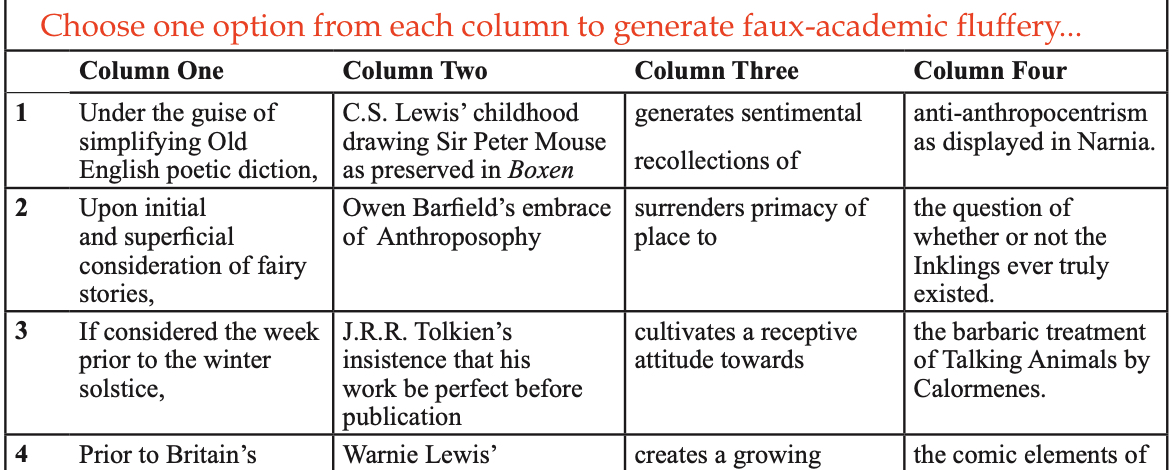
My article is brief, but it includes “the Mere Oxford Inkling Erudition Chart,” which promises countless hours of educational entertainment.

The people my satire seeks to unmask are the type of academics who attempted to make Oxford and Cambridge Universities so inhospitable to C.S. Lewis. Read this interview with one of his former student who critiques the opinions of lesser minds.

The BBC [invited him to broadcast the] talks that ultimately became Mere Christianity. The BBC was astounded by the response to these talks. As you know, Mere Christianity has never been out of print since.

He then became very unpopular with the senior faculty at Magdalen College. Magdalen was a godless college and a very famous college, very atheistical. . . . So [Lewis] got a rough ride there. He never made professor at Oxford.

So much for the civility one would expect in such environs.

You can read my modest article, “Mastering Inkling Erudition,” at this link today.

Academic Expenses

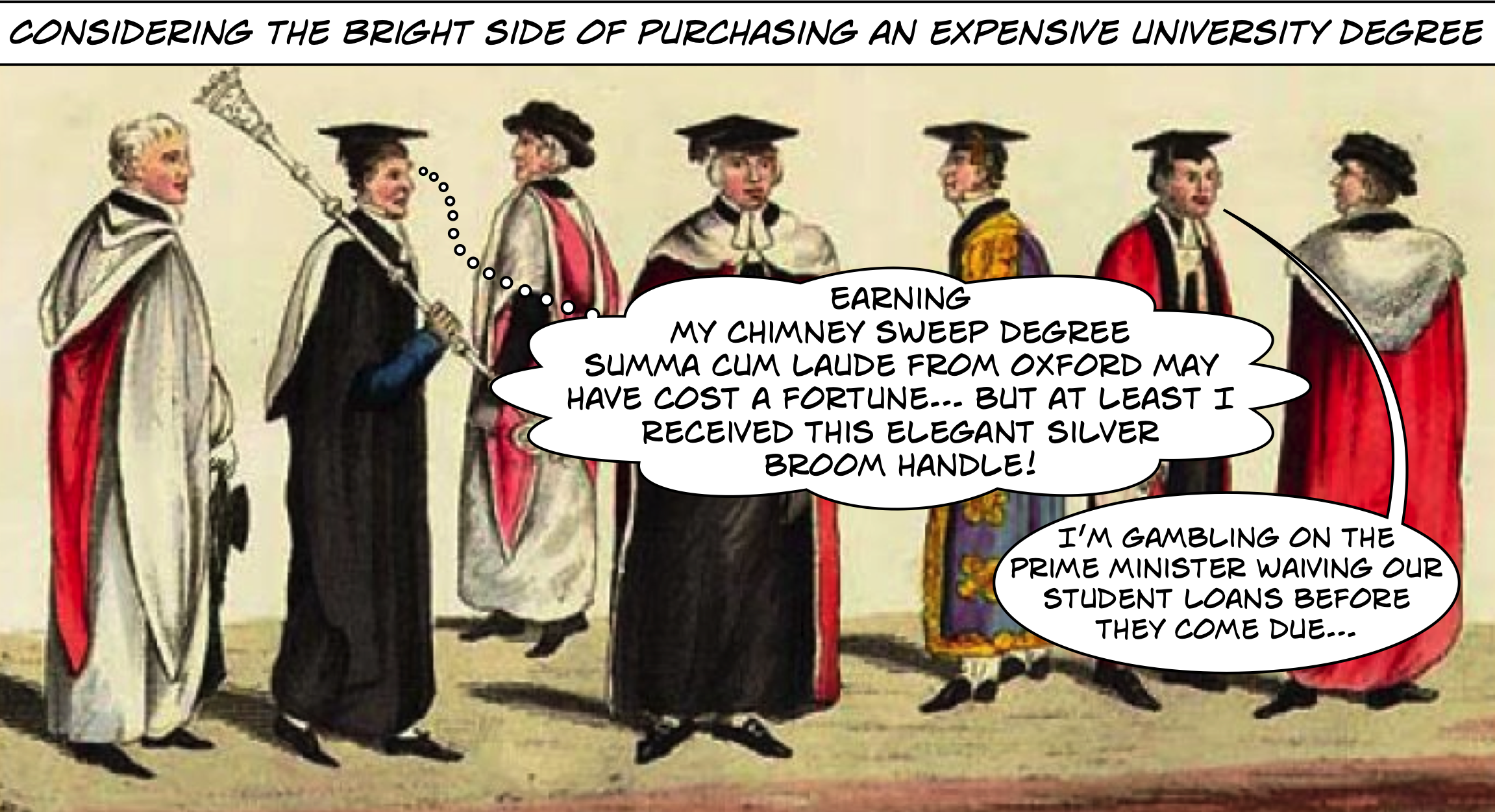
Rich people don’t need to worry about the cost of college educations. The rest of us do (or, at least, we should). C.S. Lewis could not rely on family wealth to pursue his academic dreams, and we can learn from his example.

My wife and I were the first members of our respective families to attend college. Without assistance from our parents, we did chose the most fiscally responsible path. We opted for a public university (in my own case, via “community college”) and worked as many hours a week as we could while maintaining our grades.

Even this would have been far more difficult without receiving student loans, which we diligently repaid following our graduations.

Years later, we were in a position to help our own children pursue their higher educational aspirations. Still, graduate degrees are not inexpensive, and all three of them received government-backed loans to get them to the finish line.

They have been diligently repaying that borrowed money since graduation and never complained about the debt, since no one coerced them to accept it.

Our daughter, in fact, made significant sacrifices to pay off her student loans as quickly as possible, and accomplished that goal far earlier than we imagined she would.

Here at Mere Inkling, we go to great lengths to avoid political partisanship. In addition to that, I’ve made it quite clear I have no illusions about understanding economics.

Nevertheless, it requires no genius intellect to imagine how people who sacrificed to pay off their personal debts feel about now having to (thorough their taxes) also pay off the sometimes-delinquent debts of their peers. Our middle class family is only one of presumably millions who are experiencing this personally today.

Who Paid for C.S. Lewis’ Collegiate Studies?

The world has changed much since C.S. Lewis left home for boarding school and ultimately, for the university. It was unsurprising that when his father was widowed while his sons were young, he entrusted them to schools where he assumed they would be safe, and well prepared for their future professions.

Once the boys were old enough to choose career paths, Warnie (1895-1973) pursued a military profession. Following graduation from the U.K.’s Royal Military Academy Sandhurst, he served in both World Wars. However, as one writer accurately notes, “perhaps Warnie could have accomplished far more, but his lifelong struggles with alcoholism kept him from doing so. Some have speculated Warnie’s alcoholism resulted in an earlier retirement from the military than he would have wished.”

As for the younger Lewis scion, Clive would eventually make major contributions on the faculties of both Oxford and Cambridge Universities.

Getting there took some time, and was interrupted by the First World War. After his recuperation as a seriously wounded veteran of the trenches, Lewis renewed his academic studies. Discovery Institute has an excellent article describing “C.S. Lewis and the Ceremonies at Oxford University (1917-1925).” I particularly enjoy Kathryn Lindskoog’s understatement that “Oxford University, in Lewis’s time and since, is not the best place to learn Christian humility . . .”

As a student, Lewis was reliant on continuing support from his father. Only after graduating and beginning to receive a stipend as a Fellow of Magdalen College in 1925, did Lewis consider himself financially independent. (The year prior he had received a modest salary from the college, as an employee of the College, but it was inadequate to meet his needs.)

During his college studies, despite a scholarship, he relied on his father’s generosity. His opening in a 1919 letter to his father illustrates this relationship.

Many thanks for your letter and also for the enclosed cheque for £19.12.8. That amount includes all the charges both for tuition and college expenses and may serve as a base for future calculation, tho’ of course there may be slight differences from term to term.

Still, even in the best of families, financial considerations may become a matter of concern. Five years later, as he was at the end of his life as a student, his father was wondering when he would become satisfactorily employed. (That’s a conversation replayed around the globe on a daily basis.) The first two paragraphs illustrate the theme, but you won’t be disappointed if you have the time to read the entire passage.

And now to business. The Univ. Fellowship has not been filled up. You may have read in the papers that a new ‘Chaplain Fellow’ has been elected, but that of course is a different job. If I don’t mention it, it is because there is nothing new to say about it. Just at present a new and very good vacancy at Trinity (I mean Trinity, Oxford of course) has appeared, for which an election is to be held in the summer, and I shall certainly go in for it.

As to money: I had rather you had explained in detail what you ‘don’t follow’ in my arithmetic, but I trust there is nothing seriously wrong with the figures I gave you and will proceed accordingly. What is more serious is your reference to £30 extras last year. The only part of this which I can at present identify are the extra tuition and the book bill. The former of course was purely abnormal and will not occur again. The book bill was naturally increased by my turning to a new subject.

I try to use the libraries as much as possible: but when one is reading for a particular exam there are over a hundred other people taking the same books out of the libraries – and of course there are some things one must have at command. My expenditure on books will be less in future. I have a book bill due to be paid some time soon which is under five pounds: if you will pay that I think I can undertake to find myself for books in the future – tho’ since you tell me to be frank, I will say that this may not always be easy.

The rest of the £30 you mention is, I suppose, made up by items of clothing. I presume it does not include my two suits? As to clothing, I’m afraid that even if you increase my allowance as you suggest, I cannot undertake to find myself.

I mean that my loss of the scholarship and my outlay on clothes would not be balanced by an addition of £40 or £50. I cannot see how to cut down my expenses on clothing. You know I think that it does not go to fancy waistcoats or kid gloves. And I have some ties that date from before the war!

Flannel trousers are an item that I have to repeat pretty often: they ARE ill wearing things, but if I didn’t wear them I should need suits more often than I do. On shoes I admit that I am hard and have to get a good deal of ‘soling’ done: but I am afraid this reads rather as if I were defending myself against a charge of extravagance, which you will justly reply you never made: but you must not think that. I am only trying to put down the facts of the question as they actually occur to me from day to day in order to make my conclusion more reasonable and intelligible to you.

And the conclusion is this. You ask me where £85 a term to ‘cover everything’ would be sufficient. If by ‘covering everything’ you mean covering my books, shoes, shirts, socks and other items that I have hitherto sent you, I am afraid it would not. As I said, if you wish it, I will try to undertake my own books in the future, and, at any rate to cut them down.

I will also abandon the new dinner jacket suit that was mooted, and you must not imagine that I would feel that sort of curtailment as any hardship. As for a new overcoat, the one you gave me when I left home suits and fits me so well that the question need not be considered. But I do not think that I can manage to keep myself in minor articles of clothing.

I’m afraid this may seem to you but a charter of indefinite expenses for the future. Well then, to say all, if it is too much, you must tell me so. You have done all and more than all I can expect of you, and if you tell me that these extra years are too heavy, I assure you that I shall never, even in my secret thought, criticise such a decision.

If on the other hand, you see fit to lodge £85 a year and to pay for such extras in the way of clothing, etc. as may occur, I will try to make them as little as I can. I must point out however that it is much easier to save on the big items I have mentioned – the dress suit and overcoat – than on those necessary articles which have so often to be replaced.

If you will give me a dress suit when I get a job, I ought to be able to tide over these years without any more ‘suitings’ from you at all. If, till they are over, you can lodge £85 a term and make it retrospective for the present year, while paying for my smaller articles of clothing, I think I can manage. And whether you can do this or not, I have nothing but deepest gratitude for the past.

So, once again we see that C.S. Lewis’ experiences were not all that different from our own. Most people who have accepted their parents’ financial aid during their adulthood, can identify with Lewis’ mixture of sincere gratitude and muted frustration.

Perhaps it is a very good thing that today we have so many different assistance programs for potential students. Good things, I believe, as long as they are not abused – and borrowers pay them back, as they promised.

Inklings, Libraries & Architecture

If you were to embark on a university education today, which sort of campus would you prefer?

(1) A university featuring “vaulted ceilings that draw the eye upwards and outwards . . . the frivolous artistic detail that announces the importance of the unimportant [or] the interplay of light and shade that marks the great Gothic masterpieces, the brilliant proportions of the best classical buildings, and the elaborate grandeur of the Baroque.”

(2) A modern campus comprised of “buildings entirely lacking in charm, grace, or playfulness [featuring] the boxy utilitarian grimness of official educational architecture.”

A second question clearly betrays my own preference. Which academic setting do you imagine C.S. Lewis, J.R.R. Tolkien, and their fellow Inklings would most esteem? Tolkien, after all, was not complaining in a letter to his future bride when he wrote “I have got to go to the college library now and get filthy amongst dusty books . . .”

The quotations included in the choices above come from a thought-provoking essay just posted on the website of First Things. The British writer, Niall Gooch, melds wit and genuine insight as he offers an answer to the question “Why are Universities So Ugly?” I highly commend it to you.

Libraries are of particular interest to many of us who treasure the Inkling ethos. And the article includes a delightful discussion of the treasure houses “now called ‘Information Centers’ or ‘Knowledge Hubs.’”

Books increasingly appear to be an afterthought, squeezed into the small spaces not occupied by banks of computers or the glass rooms designated as group work areas. Quiet has been banished to special Silent Study rooms, where those dangerous oddballs who wish to sit still by themselves and concentrate on one thing for a long period can be safely segregated from the normal people.

Inkling Libraries at Cambridge and Oxford

In 1959, C.S. Lewis wrote to T.S. Eliot. Both men served on the Commission to Revise the Psalter. Lewis mentions that he will be hosting an upcoming meeting of the Commission at Cambridge, and that he had secured one of the libraries for their use.

I can’t find the name and address of the secretary of our Commission on the Psalms. As you are in London could you kindly let her know that I have rescued the use of the inner library at Magdalene for our July session? It would be convenient if she told me – for the benefit of the servants – what our daily hours of sitting are likely to be. I also look forward to it.

Although Magdalene College has a distinguished history, it too has joined the revolution offering more contemporary Information Centers. They proudly declare “The New Library is . . . a purpose-built space in College for Magdalene students to meet, work, relax and find inspiration.”

As for the “Inner Library,” to which Lewis referred, I believe it to be what is presently called “The Old Library.” It fittingly includes among its special collections, “the books and manuscripts of T.S. Eliot (Honorary Fellow).”

A revealing history of “The Architectural Evolution of Libraries” begins with the question: “Can you have a civilized society without a library?”

In this article, we trace the typology of the library through history, highlighting twelve of the most important libraries in the world, from Ancient Alexandria to Raleigh, North Carolina, where robots retrieve books from storage.

A fitting close to our consideration of libraries comes from a letter written by J.R.R. Tolkien in 1966. The English Faculty of Oxford University had commissioned a bust of Tolkien – to be sculpted by his daughter-in-law. It presently resides in the English Faculty Library, which undoubtedly displays the elegant architecture of the classical university.

I feel much honoured, and so also does my daughter-in-law (the sculptress), by the Faculty’s wish to place the bust of me in the English Library in some prominent position – if on second thoughts you do not think a storied urn would be better. I shall be most pleased to present it to the Faculty.

It occurs to me that the plaster bust is rather fragile and very easily damaged. I suggest, therefore, that I should have it cast in bronze for presentation (at my own cost). I have already referred the matter to the sculptress who knows how these things are done.

Once in bronze it would then be unaffected by any dignities or indignities offered to it. I often used to hang my hat on the Tsar of Russia’s bust, which he graciously presented to Merton.


The illustration accompanying today’s post is the bust of Tolkien referred to in his correspondence. (In light of this column’s discussion, one can hardly ignore the rather utilitarian architecture revealed through the window behind the celebrated author.)

Creative Definitions

Recently I read about an African Christian who was raised in a family that practiced ancestral worship. His grandfather was considered a witchdoctor, and it was expected that this young man would assume his duties.

The only problem is that when I initially viewed the passage, I read that his grandfather was a whichdoctor.

My once 20/20 vision is long gone. I still read without glasses (for the most part), but when I have yet to wash the sleep from my eyes, I encounter some surprising words.

“Whichdoctor” actually made some sense. I acknowledge it hasn’t been an English word (until now) but is so clear and so utilitarian that it cries out for recognition.

Whichdoctor: An interrogative used when attempting to ascertain which physician’s  attention an individual should be seeking. Especially useful in a hospital setting with numerous specialists. As in: Whichdoctor should I talk to, the podiatrist, the pediatrician, the pulmonologist, the psychiatrist, the pathologist, or the proctologist?

Last year I posted a column entitled “Create a Word Today.” It was inspired by an article I cited about making up useful words with pertinent definitions. I included 22 examples in my first column. They touched on a variety of subjects.

Mannekin: A boring, sedentary relative, who rarely rises from the couch.

Purrification: The activity of forgiveness and restoration that occurs when any cat makes a sincere confession of its sins.

Several were ecclesiastical in flavor.

Cathedroll: A large church led by a senior minister given to quaint and unintentionally comic humor.

Concupiscents: Hollywood’s obsession with including graphic sexual themes in all of their productions, resulting in the selling of their souls for pennies on the dollar.

And some related to the field of writing.

Manuskipped: The sad condition when the article or book into which you poured your blood, sweat and tears has been tossed into a slush pile to lie forgotten.

Proofreaper: Someone you invited to read your manuscript for misspellings who advises you to delete entire sections of your precious creation.

If you’re curious, there are 16 additional words included in the original post linked above.

So, allow me to offer here a few recent efforts, inspired by the misreading I referred to at the top of the page. How about 22 more?

But, before that, let’s look at a passage from C.S. Lewis’ autobiography, Surprised by Joy. As a person who has always appreciated a good vocabulary – and who is blessed to have grandchildren who are articulate beyond their years – I am saddened by Lewis’ youthful experience.

Reading much and mixing little with children of my own age, I had, before I went to school, developed a vocabulary which must (I now see) have sounded very funny from the lips of a chubby urchin in an Eton jacket.

When I brought out my “long words” adults not unnaturally thought I was showing off. In this they were quite mistaken. I used the only words I knew.

The position was indeed the exact reverse of what they supposed; my pride would have been gratified by using such schoolboy slang as I possessed, not at all by using the bookish language which (inevitably in my circumstances) came naturally to my tongue.

And there were not lacking adults who would egg me on with feigned interest and feigned seriousness – on and on till the moment at which I suddenly knew I was being laughed at.

Then, of course, my mortification was intense; and after one or two such experiences I made it a rigid rule that at “social functions” (as I secretly called them) I must never on any account speak of any subject in which I felt the slightest interest nor in any words that naturally occurred to me. And I kept my rule only too well . . .

Hooplaw: The two, vastly different legal disciplines dealing with (1) basketball contracts, and (2) litigation related to injuries caused by overly excited commotion.

Interdisciplinairy: The entire field of specialty studies related to the atmosphere.

Marvelouse: A creep or cad who considers himself something quite extraordinary.

Atrofee: The medical bills associated with the care of patients suffering an enduring coma.

Predilicktion: A preference for the sensation of taste over the other four basic human means of perceiving the world around us.

Ammunishun: The attitude of some activists seeking to restrict Second Amendment rights.

Megalowmaniac: The true stature of power hungry narcissists.

Gratuitruss: The unnecessary wear of a device to restrain a nonexistent hernia.

Calumknee: Malicious misrepresentations of political figures who frequently stumble.

Misscalibration: The awkward occasion when footwear retailers suggest to a young lady try on size 20 Air Jordans.

Patriought: The noble, often self-sacrificial, behavior of citizens who truly love their country.

Hypnothetically: The wide range of potentially embarrassing acts a person might be directed to perform under the influence of mesmerism.

Enlightenmint: The experience of achieve a spiritual pinnacle, accompanied by an aromatic scent.

Raspewtin: What Russia’s last Tsar should have done to Grigori.

Canonball: An elegant celebration lacking minuets, due the participants’ vows of celibacy, but not lacking in a wide selection of vinted and distilled beverages.

Immaculatte: A perfectly balanced beverage prepared by one of the world’s finest baristas.

Telegraft: Crimes committed over the phone by telemarketers, or via the airwaves and internet by televangelists.

Archietype: Ideas and symbols that recur in stories from many cultures and eras which bear a clear likeness to Archibald Andrews, who was often accompanied by his companion Jughead.

Syruptitious: The practice of slipping secrets past the unsuspecting by applying sticky sentimentality to one’s words.

Youphemism: The substitution of a mild or neutral description of someone to replace what you truly think of them.

Boulebard: The landscaped avenues of Stratford-upon-Avon by William Shakespeare.

Hagographer: An author who prefers to write the biographies of harpies rather than saints.

Admittedly, these words are not all top tier, but I challenge you to do better. If you have one or two winners, please cite them in the comments below. Oh, I just thought of another:

Religioscity: The religious devotion expressed by the residents of an urban environment.

Now I need to think about something else so I’ll be able to sleep tonight without jumbled word running through my mind.

As the sainted C.S. Lewis once described some troubled days in a boarding school while a youth:

Consciousness itself was becoming the supreme evil; sleep, the prime good. To lie down, to be out of the sound of voices, to pretend and grimace and evade and slink no more, that was the object of all desire—if only there were not another morning ahead—if only sleep could last for ever! (Surprised by Joy)