Writing Life Scripts

ben hurI was shaped by the heroic religious films of the 1950s and 60s. The powerful messages of epic movies like Ben Hur, Quo Vadis and The Robe planted within my young Christian heart an awareness of nobility and radical self-sacrifice.

About twenty years ago, I spent a year doing graduate work in education. One of my Educational Psychology classes was taught by a professor who was a devotee of Transactional Analysis. I don’t recall too much about TA, aside from one of its principles that resonated with me.

It’s a concept called Life Scripts. Without going into great detail, it is an often subconscious notion of how we “think” our lives will or should play out. It’s adjusted throughout our lives, but the basic theme is established when we are quite young.*

A recent article says “script is broadly understood as a series of decisions, formed as coping strategies in childhood, which continue to shape the life course outside of awareness.”**

It was only as an adult that I realized just how significant an impression these virtuous stories made on me. I recalled the countless times I lay in bed at night rehearsing the story of The Robe. I was the unbelieving Roman soldier, converted by the gentle witness of the wrongfully persecuted Christians.*** Ultimately, I took my stand with them, defending them and voluntarily laying down my life for Christ.

That same plot line still echoes through my mind and soul.

I consider myself blessed to have been exposed to such positive influences while my self identity was being shaped. And I pray for children today whose parents allow them to be exposed (at terribly vulnerable ages!) to violent, fearful and morally ambiguous influences.

Those precious minds and hearts are scarred by the vulgarity and immorality that are endemic in modern cinema, television and music. May God have mercy on them.

C.S. Lewis lived during the era when the virtuous dramas such as those named above were at the peak of their influence.

In a diary entry from the mid-1920s, he mentions Quo Vadis in passing. He is describing his weekend schedule.

Saturday 22 April: Got up about 6.30 and did the same jobs as yesterday. Was settled to work by 9.5 o’clock and put in an excellent morning . . . Sheila Gonner—jolly child—came to tea. Dorothy is to come back tomorrow: so we shall no longer be servantless. At her request I lent her my crib to Tacitus’ History for her sister Rose— I wonder what makes her imagine that she would like it? Possibly early Christian novels of the Quo Vadis type. Worked again after tea, and from supper till ten o’clock, finishing Herodotus. The last few pages of the IXth Book I now read for the first time, having got tired of it on my first reading . . .

I find this diary passage intriguing, in the way that Lewis posits a reader’s potential interest in classical literature as arising from their exposure to ancient Rome via contemporary novels. That’s precisely where my own lifelong fascination with the Roman empire was born.

If you’ve never seen these three movies, I commend them to you. I would also encourage you to consider reading one or all of the novels. They are available for free download in various digital formats.

Quo Vadis

Ben Hur

The Robe

_____

* I’m a pastor and historian, not a psychologist, so I don’t pretend to understand all of the implications. Because of that, I don’t endorse TA as a fully valid theory. What’s more, in our fallen world it’s obvious that many early “life scripts” can be based on wounds inflicted on neglected or abused children. In such cases, particularly where the scripts are destructive, we are not “destined” to live out a tragedy. By the grace of God, even the saddest of stories can be redeemed and “rewritten” into tales of hope and wonder.

** From “Script or Scripture?” by Jo Stuthridge in Life Scripts edited by Richard Erskine (Karnac Books, 2010).

*** It didn’t hurt that the main Christian disciple in the film was the lovely and chaste Diana, played by the British actress Jean Simmons. But that’s another story, and it’s important to note that these life scripts are pre-pubescent creations, so they are motivated by much deeper impulses than hormones. As the previously footnoted quotation referred to them, they are fundamentally “coping strategies” for survival in the calm (or frequently turbulent) world in which children find themselves.

Claiming Divine Inspiration

inspirationSome Christian writers face a terrifying dilemma. They think God has inspired their work. That may be true. But then they proceed a step further and assume that “if God has given these words to me, they can’t be changed.”

The inference, of course, is that the message is essentially inspired in the same sense as Christians normally view the Holy Scriptures themselves. They become, in a word, inviolate.

It’s almost as though the author has appropriated the words of the Apostle John, who in his Revelation was inspired to write:

I warn everyone who hears the words of the prophecy of this book: if anyone adds to them, God will add to him the plagues described in this book, and if anyone takes away from the words of the book of this prophecy, God will take away his share in the tree of life and in the holy city, which are described in this book. (Revelation 22:18-19, ESV).

Naturally, this mindset can cause a bit of a problem when it rears its head in a writing critique group. I’ve witnessed it more times than I can recall, having been a member of such groups on several continents.

I’ve learned to be extremely cautious in how I attempt to explain to the person that while they may rightly feel that their work is inspired by their faith, it doesn’t necessarily follow that it remains in an unblemished condition . . . as it was received by our imperfect human senses, processed by our imperfect minds, and put into words via our imperfect skills and finite vocabulary.

No matter how gently this is said, most of these individuals don’t last long in writers groups. They drop out when others offer suggestions on how to improve their work, seemingly stunned that everyone else doesn’t simply fall prostrate in adoration at their words. It’s quite sad.

That’s why it was so refreshing to read the following in the preface to J. Budziszewski’s What We Can’t Not Know, which I highly recommend.

It seems to me that every writer should end with gratitude to the one who was in the beginning, and whose very name is Word. A reviewer—a friendly one—once remarked that it seemed strange to see that sort of thanks in a book, as though the author were claiming divine inspiration. Of course, for whatever is amiss in these pages (and there will be much), the blame is mine. But permit me to be grateful if anything in them is true.

I love this paragraph. In part, because I share his sentiments. It echoes my own words, spoken at my military retirement, “attribute to me all of the failings and disappointments in my work, and to God any positive or healing results that followed my ministry.”

This worldview proclaims Soli Deo Gloria,* and simultaneously acknowledges that I am not God. It is good for writers to occasionally be reminded of that fact.

It should come as no surprise that our friend C.S. Lewis offers worthwhile insight into inspiration. In his essay, “The Vision of John Bunyan,” he considers that writer’s comments about how the classic Pilgrim’s Progress came to be.

Lewis begins with a quotation, and offers his own wise insights, with which I will close.

For having now my Method by the end;

Still as I pull’d, it came.

It came. I doubt if we shall ever know more of the process called “inspiration” than those two monosyllables tell us.

Perhaps we may hazard a guess as to why it came at just that moment. My own guess is that the scheme of a journey with adventures suddenly reunited two things in Bunyan’s mind which had hitherto lain far apart.

One was his present and lifelong preoccupation with the spiritual life. The other, far further away and longer ago, left behind (he had supposed) in childhood, was his delight in old wives’ tales and such last remnants of chivalric romance as he had found in chap-books. The one fitted the other like a glove. Now, as never before, the whole man was engaged.

_____

* Glory to God alone or all glory be to God.

Shut Up He Explained

LardnerMy wife and I love that phrase, and we often recall it when we encounter particularly over-strained (or “broken”) grammar. When I encountered it as the title of a book, I was unaware of its original source.

This is where I reveal that I wasn’t an American Lit major in college. (Well, regular readers probably figured that out long ago.)

I had never heard of Ring Lardner until today. (If you don’t recognize his name either, you needn’t feel embarrassed . . . he died eighty years ago.)

Lardner was a well regarded humorist who considered himself a sports writer. One of his satires was entitled The Young Immigrunts. It was a parody of a popular English book, The Young Visitors, which was allegedly written by a young girl.

The Young Immigrunts is fictitiously ascribed to Lardner’s son, Ringgold Wilmer Lardner, Jr. His son was only four, at the time. Later he would become a successful screenwriter, winning an Academy Award for the film M*A*S*H. He also wrote prolifically for the television series.

Perhaps Lardner Junior is best remembered as one of the Communist writers blacklisted in Hollywood. But we need not go into that, since his father was merely using his young son as a surrogate author for the work.

The book takes the form of the ramblings of a child, and its quaintness will appeal to many readers. You can download a copy of it here.

It’s not my own preferred genre, so I won’t be reading it in its entirety, but in small doses, I find it rather entertaining.

A little later who should come out on the porch and set themselfs ner us but the bride and glum [pictured above].

Oh I said to myself I hope they will talk so as I can hear them as I have always wandered what newlyweds talk about on their way to Niagara Falls and soon my wishs was realized.

Some night said the young glum are you warm enough.

I am perfectly comfertible replid the fare bride tho her looks belid her words what time do we arrive in Buffalo.

9 oclock said the lordly glum are you warm enough.

I am perfectly comfertible replid the fare bride what time do we arive in Buffalo.

9 oclock said the lordly glum I am afrade it is too cold for you out here.

Well maybe it is replid the fare bride and without farther adieu they went in the spacius parlers.

I wander will he be arsking her 8 years from now is she warm enough said my mother with a faint grimace.

The weather may change before then replid my father.

Are you warm enough said my father after a slite pause.

No was my mothers catchy reply.

And now the phrase that always makes me smile.

The lease said about my and my fathers trip from the Bureau of Manhattan to our new home the soonest mended. In some way ether I or he got balled up on the grand concorpse and next thing you know we was thretning to swoop down on Pittsfield.

Are you lost daddy I arsked tenderly.

Shut up he explained.

I am curious as to whether or not C.S. Lewis was acquainted with Lardner’s work. It doesn’t quite conform to his literary tastes, but Lewis was so widely read that I think it’s possible he was at least acquainted with who he was.

My research on the matter did produce an interesting juxtaposition between the two authors. I discovered it in a book by Sherwood Wirt, perhaps the last reporter to interview C.S. Lewis (for Decision magazine, of which he was editor). I was privileged to know “Woody,” so I enjoyed finding that he mentioned both men in his book I Don’t Know what Old is, But Old is Older than Me.

With twentieth century fiction we have to be quite selective. In limiting my comments to the American scene, I will pass by many of the great names of fiction — Henry James, Stephen Crane, Edith Wharton, Jack London, Theodore Dreiser, Ring Lardner, William Faulkner, Sherwood Anderson, Sinclair Lewis, Scott Fitzgerald, Ernest Hemingway, James Baldwin, John Steinbeck, Vladimir Nabokov, Norman Mailer, and Truman Capote.

While most of these are excellent writers, I doubt whether they have much to say to today’s older readers that would make life more pleasant, more interesting, or more fruitful in the closing stretches of life’s journey. Nor do I think that these authors have anything worthwhile to say about what lies beyond death. We might better spend our reading hours riding off into the sunset with Louis L’Amour or Zane Grey, rather than punish ourselves with a ghastly tale like In Cold Blood.

We old boys and girls have been around a long time. We know what the world is like. We know sleaze when we see it, and we don’t need contemporary authors to embellish it or explain it to us.

The reading tastes of the American public have been corrupted almost beyond redemption by blasphemy, vulgarity, and scatology, all for the sake of increased book sales to prurient minds. There are, however, many twentieth-century American novels worth reading, such as Margaret Mitchell’s Gone With the Wind, Thornton Wilder’s The Bridge of San Luis Rey, Harper Lee’s To Kill a Mockingbird, Tom Clancy’s The Hunt for Red October, the Savannah quartet of Eugenia Price, and the Sebastian series of James L. Johnson, to name only a few.

Earlier in the century the Christian novels of Lloyd C. Douglas—The Magnificent Obsession, The Robe, and The Big Fisherman—inspired thousands of readers young and old, but no American has since matched his popular appeal.

The demand for detective fiction continues unabated, and no one needs my advice to read Agatha Christie. I would, therefore, limit my remarks to a reference to two British creations, G.K. Chesterton’s Father Brown and Dorothy Sayers’ Lord Peter Wimsey, since both are written from Christian backgrounds. My two favorite Wimsey stories are Busman’s Honeymoon and The Nine Tailors.

In contrast there is a wealth of devotional literature that makes wonderful reading for older people. One can start with the sermons of D.L. Moody, Charles Spurgeon, Samuel P. Jones, Joseph Parker, and T. DeWitt Talmage of the nineteenth century. The early twentieth century gave us Andrew Murray, Ole Hallesby, P.T. Forsyth, and Oswald Chambers, whose writings are hard to surpass. Amy Carmichael’s poetry and prose written in India, have blessed millions of readers. More contemporary are the writings of C.S. Lewis and A.W. Tozer, which carry seeds of greatness.

The passage above comes from the book’s chapter on “Reading.” If you would like to see more, the entire book (although published as recently as 1992) is legally available for your review online.

“Shut up he explained” may not be proper English, but literature doesn’t need to be proper to be entertaining. And even though Lardner is no longer a familiar name, perhaps his writings are worth visiting.

For the moment, knowing the context of this delightful phrase makes the words all the more entertaining to me. After all, like many others, my dad often “explained” the same thing to me!

C.S. Lewis Shrugged

csl & randI just watched another documentary about the controversial Ayn Rand, who wrote Atlas Shrugged. The program, “Ayn Rand & the Prophecy of Atlas Shrugged,” claimed that book is the number one selling hardcover in history (following the Bible, of course).

Although I haven’t read it, I witness it’s growing influence as it becomes more frequently referenced in political discussions. It is a favorite (sometimes even referred to as the “gospel”) of Libertarians.

Rand was a Soviet refugee, and much of what she anticipated, has come to pass. Unbridled government regulations, she predicted, would strangle creativity and production. The welfare state would collapse upon itself as it eroded the incentive to work. In her call for less government interference and oversight, she echoes the concerns of growing numbers of Americans on both the left and the right.

This reflects a reversal of her argument’s reception when it was published. In 1957, the dystopian novel apparently did not receive a single positive review. After William F. Buckley published a scathingly negative review, she never spoke to him again.*

And that raises one of the problems with Rand’s work. In actuality, this flaw is a failing common to all literature. It is difficult to separate what is written from its author. This is especially true when the person who wields the pen possesses a unique or outlandish personality. This was certainly the case with Rand. One of her primary goals was to be provocative.

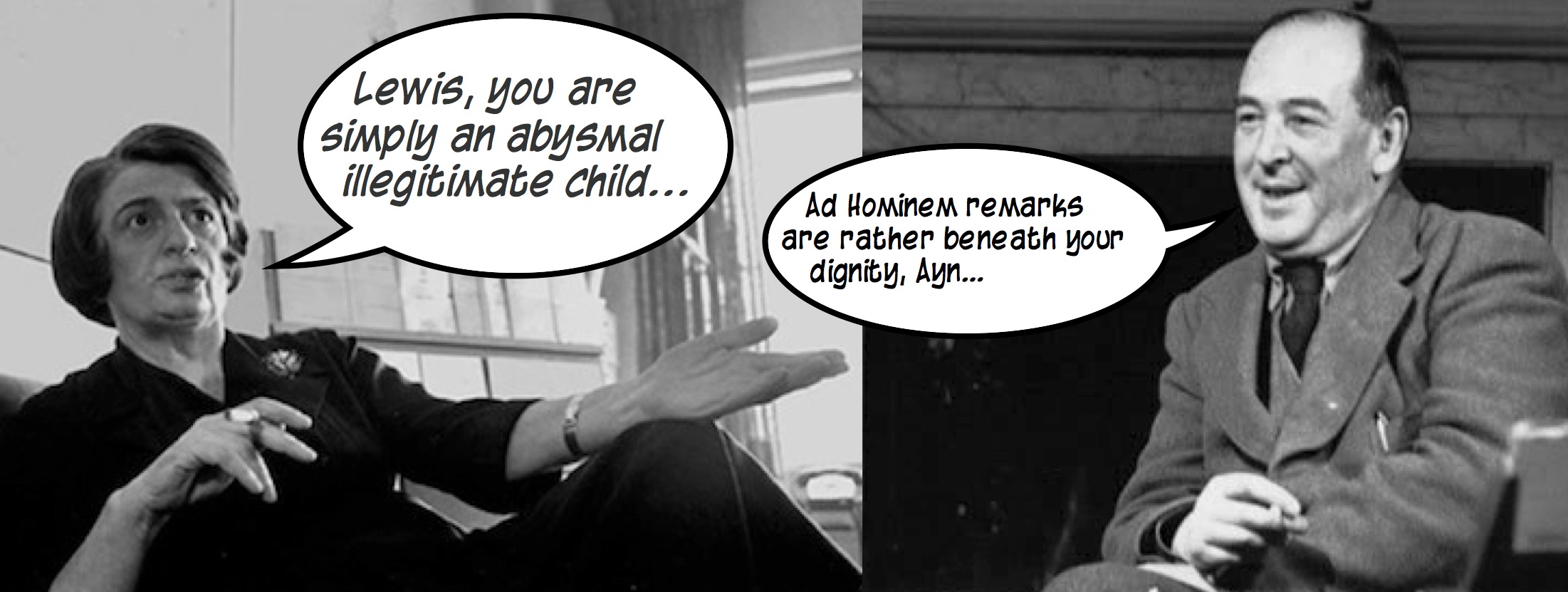
The title of this column was inspired by a recent post I read entitled, “Ayn Rand Really, Really hated C.S. Lewis.” You can read it at First Things.

In the article, Matthew Schmitz provides excerpts of Rand’s underlining and marginalia (notes) in her copy of Lewis’ Abolition of Man. His opening paragraph says it all, though. [Warning: Those offended by rude language should skip the next paragraph.]

Ayn Rand was no fan of C.S. Lewis. She called the famous apologist an “abysmal bastard,” a “monstrosity,” a “cheap, awful, miserable, touchy, social-meta­physical mediocrity,” a “pickpocket of concepts,” and a “God-damn, beaten mystic.” (I suspect Lewis would have particularly relished the last of these.)

Lewis’ indomitable spirit, as hinted at in Schmitz’ parenthetical comment, is precisely what inspired the title of my post.

So, why am I discussing Rand’s work at all, if she so despised Lewis? Well, because I want to explore just why she was so offended by his philosophy.

There is great irony present here. While Rand devotees and serious Christians would share many fears about oppressive governments . . . they are ill-suited allies.

Despite this commonality, the basic reasons for distrusting secular institutions, and more expressly, their solutions to the problem are diametrically opposed.

For Lewis, the atheist turned Christian apologist, hope comes only from God, not from a laissez faire government. While most Christians do not believe in the “coerced compassion” of unlimited taxation to support people unwilling** to work, we utterly disagree with Rand’s elevation of selfishness as virtue.

And that last phrase is not hyperbole. Rand actually wrote a book entitled The Virtue of Selfishness. She viewed altruism as inherently illogical, and thus, essentially immoral.

So, it’s no surprise she disliked Lewis. He had been delivered from a self-centered worldview, and recognized that we have been created by a loving Father for a grand, and eternal purpose.

In the Christian worldview, selfishness provides evidence of our corruption by the Fall. Our disobedience—our selfish desire to have things our way—is at the root of humanity’s problems.

Altruism, giving of oneself for the welfare of another without anticipation of benefit, is—for the disciple of Jesus—a genuine virtue.

We’ll end this brief discussion of a complex subject with a passage from C.S. Lewis. It is a discussion of altruism (in the context of Moral Law) drawn from Mere Christianity. One can only imagine what Ayn Rand would write in the margins, but I’ll take my stand with Lewis.

Some of the letters I have had show that a good many people find it difficult to understand just what this Law of Human Nature, or Moral Law, or Rule of Decent Behaviour is. For example, some people wrote to me saying, “Isn’t what you call the Moral Law simply our herd instinct and hasn’t it been developed just like all our other instincts?”

Now I do not deny that we may have a herd instinct: but that is not what I mean by the Moral Law. We all know what it feels like to be prompted by instinct—by mother love, or sexual instinct, or the instinct for food. It means that you feel a strong want or desire to act in a certain way. And, of course, we sometimes do feel just that sort of desire to help another person: and no doubt that desire is due to the herd instinct. But feeling a desire to help is quite different from feeling that you ought to help whether you want to or not.

Supposing you hear a cry for help from a man in danger. You will probably feel two desires—one a desire to give help (due to your herd instinct), the other a desire to keep out of danger (due to the instinct for self-preservation).

But you will find inside you, in addition to these two impulses, a third thing which tells you that you ought to follow the impulse to help, and suppress the impulse to run away.

Now this thing that judges between two instincts, that decides which should be encouraged, cannot itself be either of them. You might as well say that the sheet of music which tells you, at a given moment, to play one note on the piano and not another, is itself one of the notes on the keyboard. The Moral Law tells us the tune we have to play: our instincts are merely the keys.

Another way of seeing that the Moral Law is not simply one of our instincts is this. If two instincts are in conflict, and there is nothing in a creature’s mind except those two instincts, obviously the stronger of the two must win. But at those moments when we are most conscious of the Moral Law, it usually seems to be telling us to side with the weaker of the two impulses. You probably want to be safe much more than you want to help the man who is drowning: but the Moral Law tells you to help him all the same.

And surely it often tells us to try to make the right impulse stronger than it naturally is? I mean, we often feel it our duty to stimulate the herd instinct, by waking up our imaginations and arousing our pity and so on, so as to get up enough steam for doing the right thing. But clearly we are not acting from instinct when we set about making an instinct stronger than it is. The thing that says to you, “Your herd instinct is asleep. Wake it up,” cannot itself be the herd instinct. The thing that tells you which note on the piano needs to be played louder cannot itself be that note.

_____

* “Big Sister is Watching You,” written by a former atheist Soviet spy turned Quaker capitalist, is available online here.

** By “unwilling,” I am referring to people capable of supporting themselves, but consciously choosing to live off of the produce of others. While some Christians feel morally compelled to support even these, most would follow the guidance found in II Thessalonians 3:

As for other matters, brothers and sisters, pray for us that the message of the Lord may spread rapidly and be honored, just as it was with you. And pray that we may be delivered from wicked and evil people, for not everyone has faith. . . . May the Lord direct your hearts into God’s love and Christ’s perseverance. . . .

In the name of the Lord Jesus Christ, we command you, brothers and sisters, to keep away from every believer who is idle and disruptive and does not live according to the teaching you received from us. For you yourselves know how you ought to follow our example. We were not idle when we were with you, nor did we eat anyone’s food without paying for it.

On the contrary, we worked night and day, laboring and toiling so that we would not be a burden to any of you. We did this, not because we do not have the right to such help, but in order to offer ourselves as a model for you to imitate.

For even when we were with you, we gave you this rule: “The one who is unwilling to work shall not eat.” We hear that some among you are idle and disruptive. They are not busy; they are busybodies. Such people we command and urge in the Lord Jesus Christ to settle down and earn the food they eat.

Whose “Best Books” List?

reading awardsMost readers recognize significant differences exist between British and American literature.

Not only do our literary tastes often differ, there are more than a few differences in the English we use . . . for example, whether we include our punctuation inside, or outside, of “quotation marks.”

With that caveat, it’s interesting to ponder the 2008 list of favorite books in the United Kingdom, as reported in The Telegraph. I’m unsure right now whether there’s a more recent list, but it would probably remain fairly stable a lustrum later. (It would, however, be interesting to see how Rowling’s works rank in fifty or seventy years. Not to mention Pullman’s Gnostic series.)

In their balanced compendium of passages from C.S. Lewis’ works, Martindale and Root point out the transitory nature of literary fads.

A book that is number one on the New York Times Best-seller List for several weeks may be all but forgotten a decade later. Popularity in a moment of history does not guarantee that a book will endure beyond its own time. C. S. Lewis once observed that, like fashions, the more up-to-date a book is, the sooner it is out of date.

One of the peculiarities of the list is that only a single book by any particular author was allowed in the top twenty-one titles.

I read somewhere that the average reader had only read an “average” of six of the books. I’m not sure how that is calculated, since I know a fair number who have not read—if they’re being honest—a single book in the survey (those assigned for coursework included).

And, now that I’ve made that seemingly judgmental statement, I need to be particularly truthful in my own list. That means I can’t check off a title because I saw the movie or read the Classics Illustrated edition . . . even though I think it would be fair to get partial credit for either of those options.*

I’ll reproduce the entire British classics canon in a moment, but since everyone will get distracted while they read it (assessing which titles they themselves have read), I’ll share my brief list first.

I’m not too embarrassed by its brevity, since 80% of my reading is nonfiction, and the list is decidedly not that. Also, I can honestly say that there are another ten or so titles here that I have begun to read, without being sufficiently interested to finish.

The truth is that just as less than a quarter of my reading is devoted to fiction, most of that focuses on my favorite genre, alternative history. And, for some reason unknown to me, none of those titles made the list!

Here is my humble account of British must-reads that I have actually finished.

 1) The Lord of the Rings (Ranked #2).

 2) The Bible** (#6)

 3) Nineteen Eighty-Four (#8).

 4) Catch 22 (#13).

 5) The Hobbit (#16).

 6) The Great Gatsby (#22).

 7) The Chronicles of Narnia (#33).

 8) The Lion, the Witch and the Wardrobe (#36)

 — Isn’t that a tad redundant (in the American, not the British, sense)?

 9) Winnie the Pooh (#40).

10) Animal Farm (#41).

11) Lord of the Flies (#49).

12) Dune (#52).

13) Brave New World (#58).

14) Moby Dick (#70).

15) Dracula (#72).

16) A Christmas Carol (#81).

17) Charlotte’s Web (#87).

18) Heart of Darkness (#91).

Interesting—I thought it would be shorter. Their presence on this short list, by the way, doesn’t indicate my recommendation of all of these. Some were assigned reading. I’ve also read some of Shakespeare and Sherlock Holmes, of course, but neither in their entirety.***

The full list follows. Enjoy going through it yourself to see how you stack up. And, don’t be intimidated if the books you favor keep you too busy to read what others deem the most significant.

_____

* Just joking. I would never consider seeing a movie as the equivalent of reading a book; some of them bear little resemblance to their source. That acknowledged, sometimes the cinematic adaptations are better than the books.

** I know it only has a single Author, but shouldn’t this count as 66 books?

*** My lovely wife, who I sometimes compel to proofread for me, could not resist mentioning that she was able to check off many more titles on this list than I did. I chalk that up to her sharp intelligence (valedictorian, 4.0 in college and grad school, etc.), general perfectionism, speed-reading skills, tolerance for boring literature, and “compulsive” personality. All of that, plus her consuming love of reading.

Here’s the British list.

1 Pride and Prejudice – Jane Austen

2 The Lord of the Rings – JRR Tolkien

3 Jane Eyre – Charlotte Bronte

4 Harry Potter series – JK Rowling

5 To Kill a Mockingbird – Harper Lee

6 The Bible

7 Wuthering Heights – Emily Bronte

8 Nineteen Eighty Four – George Orwell

9 His Dark Materials – Philip Pullman

10 Great Expectations – Charles Dickens

11 Little Women – Louisa M Alcott

12 Tess of the D’Urbervilles – Thomas Hardy

13 Catch 22 – Joseph Heller

14 Complete Works of Shakespeare

15 Rebecca – Daphne Du Maurier

16 The Hobbit – JRR Tolkien

17 Birdsong – Sebastian Faulks

18 Catcher in the Rye – JD Salinger

19 The Time Traveller’s Wife – Audrey Niffenegger

20 Middlemarch – George Eliot

21 Gone With The Wind – Margaret Mitchell

22 The Great Gatsby – F Scott Fitzgerald

23 Bleak House – Charles Dickens

24 War and Peace – Leo Tolstoy

25 The Hitch Hiker’s Guide to the Galaxy – Douglas Adams

26 Brideshead Revisited – Evelyn Waugh

27 Crime and Punishment – Fyodor Dostoyevsky

28 Grapes of Wrath – John Steinbeck

29 Alice in Wonderland – Lewis Carroll

30 The Wind in the Willows – Kenneth Grahame

31 Anna Karenina – Leo Tolstoy

32 David Copperfield – Charles Dickens

33 Chronicles of Narnia – CS Lewis

34 Emma – Jane Austen

35 Persuasion – Jane Austen

36 The Lion, The Witch and The Wardrobe – CS Lewis

37 The Kite Runner – Khaled Hosseini

38 Captain Corelli’s Mandolin – Louis De Bernieres

39 Memoirs of a Geisha – Arthur Golden

40 Winnie the Pooh – AA Milne

41 Animal Farm – George Orwell

42 The Da Vinci Code – Dan Brown

43 One Hundred Years of Solitude – Gabriel Garcia Marquez

44 A Prayer for Owen Meaney – John Irving

45 The Woman in White – Wilkie Collins

46 Anne of Green Gables – LM Montgomery

47 Far From The Madding Crowd – Thomas Hardy

48 The Handmaid’s Tale – Margaret Atwood

49 Lord of the Flies – William Golding

50 Atonement – Ian McEwan

51 Life of Pi – Yann Martel

52 Dune – Frank Herbert

53 Cold Comfort Farm – Stella Gibbons

54 Sense and Sensibility – Jane Austen

55 A Suitable Boy – Vikram Seth

56 The Shadow of the Wind – Carlos Ruiz Zafon

57 A Tale Of Two Cities – Charles Dickens

58 Brave New World – Aldous Huxley

59 The Curious Incident of the Dog in the Night-time – Mark Haddon

60 Love In The Time Of Cholera – Gabriel Garcia Marquez

61 Of Mice and Men – John Steinbeck

62 Lolita – Vladimir Nabokov

63 The Secret History – Donna Tartt

64 The Lovely Bones – Alice Sebold

65 Count of Monte Cristo – Alexandre Dumas

66 On The Road – Jack Kerouac

67 Jude the Obscure – Thomas Hardy

68 Bridget Jones’s Diary – Helen Fielding

69 Midnight’s Children – Salman Rushdie

70 Moby Dick – Herman Melville

71 Oliver Twist – Charles Dickens

72 Dracula – Bram Stoker

73 The Secret Garden – Frances Hodgson Burnett

74 Notes From A Small Island – Bill Bryson

75 Ulysses – James Joyce

76 The Bell Jar – Sylvia Plath

77 Swallows and Amazons – Arthur Ransome

78 Germinal – Emile Zola

79 Vanity Fair – William Makepeace Thackeray

80 Possession – AS Byatt

81 A Christmas Carol – Charles Dickens

82 Cloud Atlas – David Mitchell

83 The Color Purple – Alice Walker

84 The Remains of the Day – Kazuo Ishiguro

85 Madame Bovary – Gustave Flaubert

86 A Fine Balance – Rohinton Mistry

87 Charlotte’s Web – EB White

88 The Five People You Meet In Heaven – Mitch Alborn

89 Adventures of Sherlock Holmes – Sir Arthur Conan Doyle

90 The Faraway Tree Collection – Enid Blyton

91 Heart of Darkness – Joseph Conrad

92 The Little Prince – Antoine De Saint-Exupery

93 The Wasp Factory – Iain Banks

94 Watership Down – Richard Adams

95 A Confederacy of Dunces – John Kennedy Toole

96 A Town Like Alice – Nevil Shute

97 The Three Musketeers – Alexandre Dumas

98 Hamlet – William Shakespeare

99 Charlie and the Chocolate Factory – Roald Dahl

100 Les Miserables – Victor Hugo

Reading to Children

grandparent readingAs a father whose military service required extended separations from my children, I wish technology had been about three decades more advanced than it was while I was in uniform.

As a grandfather who has most of his grandkids living hours away, I’m grateful to be alive during an era when we can still nurture close relationships despite geographic separation.

There are many wonderful ways to keep in touch across the miles. And, a new program adds a wonderful touch to the time proven joy of reading to our children. It’s called Kindoma, and more about it momentarily.

It’s a little known secret that there are few—very few—activities children love more than reading with a loved one. It’s not just about the book, it’s also about relationships and bonding.

C.S. Lewis had an interesting relationship with children. As a bachelor academic, he was not around them all that much. And when he wrote The Abolition of Man in 1943—before becoming a step-father—Lewis confessed “I myself do not enjoy the society of small children . . . I recognize this as a defect in myself—just as a man may have to recognize that he is tone deaf or colour blind.”

Eight years earlier, at the modest age of thirty-seven, he wrote to a good friend, “I theoretically hold that one ought to like children, but am shy with them in practice.” Lewis isn’t alone in possessing this unfortunate trait, which from my observation [political incorrectness alert] is more common among men than women. Of course, in our increasingly equalitarian culture it does seem that character flaw is becoming a bit more gender-balanced.

Then there is the fact that many of us who dearly love our young progeny, enjoy the children of our friends, and hold genuine compassion for young ones suffering in any variety of miserable conditions . . . do not particularly seek out the company of children. From my personal perspective, I feel like I “expend” all of my (admittedly finite) kid-patience with my own kin and the offspring of my friends. I don’t have a surplus left after spending a significant amount of time with the (precious) little ones.

And, like Lewis, “I recognize this as a defect in myself.”

At the same time as I admire teachers who can pour themselves into little ones, and I am absolutely dumbfounded by people who prefer working with young teenagers, I recognize that the world works well when some of us are better equipped to work with adults also . . . so the entire spectrum of learners is served.

Recognizing our own prejudices is a prerequisite to suppressing or evicting them. Lewis, of course, was extremely concerned about children and their upbringing, particularly their education.

Returning to the subject of how to nurture relationships with children through the intercontinental reading of books, technology has made the miraculous possible.

Kindoma is novel in the sense that it allows you to read the book together (either the child or the adult can be the actual “reader”) while you actually turn the pages of the etext together! So you get the genuine experience of reading together.

The creator of the program holds a PhD in Computer Science. So he’s not merely an idea guy (like me) who comes up with a slew of amazing concepts but doesn’t have the scientific skill to make them reality.

The program is currently available for ipod and ipad. I’m sure it’s just a matter of time before it is ported to other operating systems. Since I still use “regular” desk and lap-top computers, I haven’t experimented with it myself. The app itself is free. I’m unsure about their revenue stream, whether it will come from ads, or purchase of access to a specific library, but it’s definitely worth checking out.

The brief link below offers an introduction to the tool. I hope that you will use it if applicable to your situation, and pass it on to others you know who might benefit from it. (In the meantime, I’m thinking about approaching my wife about us making that ipad purchase I’ve been pondering.)

What Children Read

young readerI recently reread C.S. Lewis’ brief essay, “On Juvenile Tastes.” In it he ponders two basic questions.

First, what do children prefer to read? And second, why do they evidence that preference?

Lewis set the stage by discussing the state of children’s literature in 1958, which was of course, more than half a century ago. Nevertheless, like most of Lewis’ observations, there is much that is timeless about his argument.

Not long ago I saw in some periodical the statement that “Children are a distinct race”. Something like this seems to be assumed today by many who write, and still more who criticise, what are called children’s books or ‘juveniles’. Children are regarded as being at any rate a distinct literary species, and the production of books that cater for their supposedly odd and alien taste has become an industry; almost a heavy one.

It seems little has changed during the intervening decades. If anything, this concept has become much more deeply entrenched. No one can doubt that the publication of “juvenile” literature has expanded dramatically. (To maintain the entrenchment allusion, we might say it has “exploded.”)

Lewis, however, does not accept the notion that children have unique—in his picturesque words “odd and alien”—literary interests. His first argument is that their preferences are by no means monolithic.

This theory does not seem to me to be borne out by the facts. For one thing, there is no literary taste common to all children. We find among them all the same types as among ourselves. Many of them, like many of us, never read when they can find any other entertainment. Some of them choose quiet, realistic, “slice-of-life” books . . . Some like fantasies and marvels . . . Some care for little but books of information, and so do some adults. Some of them, like some of us, are omnivorous. Silly children prefer success stories about school life as silly adults like success stories about grown-up life.

So, in Lewis’ opinion, we witness great difference in the tastes of children, as well as adults. He attributes changing literary emphases to human nature, rather than chronological considerations. The difference enters with children’s focus on enjoying literature, which provides them immunity to literary fads.

Surely it would be less arrogant, and truer to the evidence, to say that the peculiarity of child readers is that they are not peculiar. It is we who are peculiar. Fashions in literary taste come and go among the adults, and every period has its own shibboleths. These, when good, do not improve the taste of children, and, when bad, do not corrupt it; for children read only to enjoy.

Of course their limited vocabulary and general ignorance make some books unintelligible to them. But apart from that, juvenile taste is simply human taste, going on from age to age, silly with a universal silliness or wise with a universal wisdom, regardless of modes, movements, and literary revolutions.

Lewis’ critique of the publishing arena follows. Since these literary phases fade in and out, it is here where contemporary literary critics may fairly evaluate things differently.

This has one curious result. When the literary Establishment—the approved canon of taste—is so extremely jejune and narrow as it is today, much has to be addressed in the first instance to children if it is to get printed at all. Those who have a story to tell must appeal to the audience that still cares for storytelling.

The literary world of today is little interested in the narrative art as such; it is preoccupied with technical novelties and with ‘ideas’, by which it means not literary, but social or psychological, ideas. The ideas (in the literary sense) on which Miss Norton’s The Borrowers or Mr. White’s Mistress Masham’s Repose are built would not need to be embodied in “juveniles” at most periods.

Lewis ends his essay by contrasting two disparate approaches to the production of so-called children’s literature. I suspect the two general categories still hold true for most. However, having only dabbled in writing for children, I’m by no means an authority on the subject. As for the creator of Narnia . . . I’m persuaded he possesses the credibility to speak with some modest influence.

It follows that there are now two very different sorts of “writers for children”. The wrong sort believe that children are “a distinct race”. They carefully “make up” the tastes of these odd creatures—like an anthropologist observing the habits of a savage tribe—or even the tastes of a clearly defined age-group within a particular social class within the “distinct race”. They dish up not what they like themselves but what that race is supposed to like. Educational and moral, as well as commercial, motives may come in.

The right sort work from the common, universally human, ground they share with the children, and indeed with countless adults. They label their books ‘For Children’ because children are the only market now recognised for the books they, anyway, want to write.

Right or wrong, like Lewis I cast my lot with those who write for children from their shared humanity with them. After all, they may be slightly less mature than most grown-ups, but they are not truly “alien” (even if they occasionally behave that way).

Literary Recycling

cecilialevy cupOur last column on providing new homes for neglected books got me thinking about the notion of “recycling” in its broader contexts.

And, even though C.S. Lewis died before the modern concept of environmentalism reached its full bloom, I wondered if he had written anything on related concerns. As prolific as Lewis was, if one is diligent there is a good chance they can find something with a (sometimes admittedly tenuous) correlation to nearly any subject.

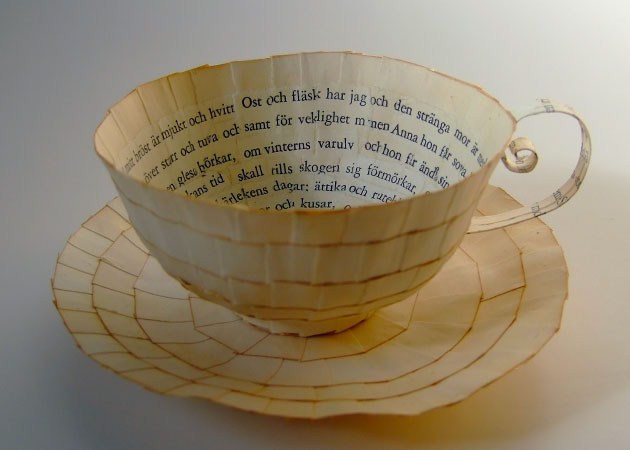
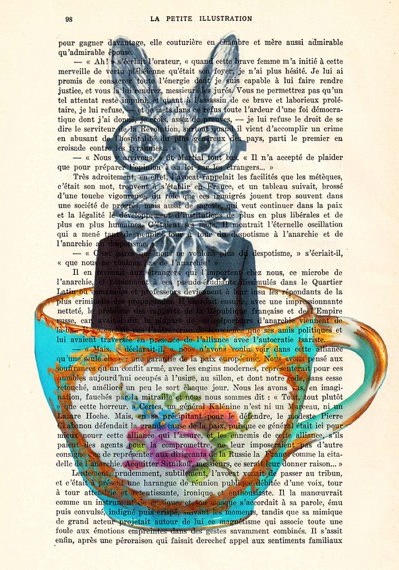
Before proceeding, I have to provide the source of the amazing illustration on this page. It is a graphic example of the creative recycling of literature. This teacup comes from the artistic vision of a Swedish artist, Cecilia Levy. You can view other examples of her artistry at her website here, and if you wish to reproduce them elsewhere, be sure to request permission (just as I did).

Returning to the concept of environmentalism, I wish to avoid political implications here. In general terms, however, I think it is fair to say the Scriptures teach that humanity is a “steward” of creation, which belongs not to us, but to its Maker. As stewards, we have been entrusted to be responsible in our management (use) of nature’s abundance. Wanton destruction should be called what it is—sin.

Now, this general principle manifests itself in a wide spectrum of responses, and attitudes are always subject to change. I vividly recall the very first Earth Day celebrated in the United States. I’m sure that being a high school student in a huge southern California school reinforced the indelible nature of the memory.

My wife and I have been diligent recyclers for many years . . . and that extends far beyond newspapers and aluminum cans. We have used countless items until their usefulness has ended. (Long past when they should have been replaced, in the opinion of our children.) I attribute much of our thriftiness to growing up in low income families where luxuries were few. But it arises not from that background alone. We also have a sense of responsibility to others, and dispatching items that are still usable to landfills just seems wrong.

I imagine Lewis possessed somewhat similar sentiments. He didn’t manifest much of a flair for extravagance. I don’t think he devoted that much thought to material possessions. I once read (but can’t find the source) that his brother and roommate Warnie was a bit frustrated by Lewis’ lack of concern for maintaining articles that were still in decent condition. Major Lewis, being a military man, focused on utilitarian considerations. The specific items of concern in the incident were some dishes or “crockery” that Warnie deemed to still be fit for service.

Both men were seasoned veterans of rationing, of course. Their skills at stretching things to go as far as possible were conditioned by years of deprivation. Americans are typically shocked to learn that rationing persisted in Europe after the end of the war. In an era characterized by excess and waste it’s difficult for us to put ourselves in their mindset.

Ironically, my hunt for a Lewisian passage on ecological concerns had nothing to do with rationing. It was rewarded when I looked at his essay “Willing Slaves of the Welfare State.” (The work is included in the delightful collection, God in the Dock.)

In this essay, Lewis is describing scientific advances as morally neutral. It is the application we choose to put our knowledge to, that determines its rightness. One of his illustrations alludes to care of the world in which we live.

The first is the advance, and increasing application, of science. As a means to the ends I care for, this is neutral. We shall grow able to cure, and to produce, more diseases—bacterial war, not bombs, might ring down the curtain—to alleviate, and to inflict, more pains, to husband, or to waste, the resources of the planet more extensively. We can become either more beneficent or more mischievous. My guess is we shall do both; mending one thing and marring another, removing old miseries and producing new ones, safeguarding ourselves here and endangering ourselves there.

Brilliant. And utterly true.

I also want to pass on an interesting observation made several years ago in another blog. The author references Lewis’ mention of the related concept of “plentitude.” You can read Tim Hagen’s full post here.

Since I’ve been reading a lot of C.S. Lewis lately, I figured I could use (and abuse?) a couple quotes from him in suggesting a philosophy of responsible waste management.  The Discarded Image is a piece that brings to light our modern misconceptions about the “Dark Ages.”  A testimony of medieval literature, for example, is how systematized their view of the universe was.  This organization grew out of classical authors such as Apuleius of Numidia, from whom Lewis draws two principles: the Triad (the idea that two entities – such as soul and body – can only meet each other through a third medium – in this case, the spirit) and Plentitude.  Lewis summarizes Plentitude in stating: “The universe must be fully exploited.  Nothing must go to waste.”  In other words, if something had the capacity to be useful, the medieval mind found a use for it.

The concept of plentitude as described here reminds me of the way people living in harsh environments cannot afford to waste anything. Eskimos, for example, are said to use every part of the seals they harvest . . . meat, blubber, bone, sinew. None of it is cast aside.

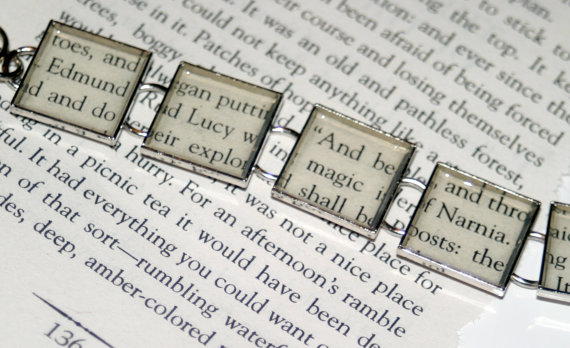
Let’s end these thoughts with another example of artistic creativity. This image shows how pages of a recycled copy of the Chronicles of Narnia can be recycled into jewelry. It comes from this commercial website which offers “one of a kind” items for sale. I don’t know whether this particular piece remains available, but I bet they would be willing to make you one of your very own if you’re interested. Then the cash from your wallet can be recycled into theirs. In exchange you’ll own a unique treasure that may become a wonderful conversation starter for many years to come.

narnia bracelet

Recycling Literature

recycled pageMany subscribers to Mere Inkling share a common trait with C.S. Lewis. Like your humble blogger, you are lovers of books. We don’t need to apologize for it; it’s in our DNA.

We carry that astonishing gene that manifests itself in a passion for the written word. (It’s frequently inherited from a parent who possessed the same ardor.)

If you’re one of this corpus of literary addicts, you just nod your head in agreement whenever you hear Lewis’ oft-quoted, “You can never get a cup of tea large enough or a book long enough to suit me.”

If you love books, if you don’t mind owning copies that others before you have enjoyed, and if you are on a tight budget, you might want to join me in becoming a customer of Better World Books.

[I have no interest in this nonprofit organization other than genuinely commending them to you as a wonderful source of inexpensive books. Most books have been officially removed from library collections . . . and require new homes. The “profits” are directed towards libraries and literacy programs.]

Many of us have enjoyed walking through rows of books on sale in local settings. This is a little like that, except that you can do digital searches and they have tons more titles available. (Literally.)

One of my recent purchases was Latin for the Illiterati. I purchased it the same day I bought The Anchor Book of Latin Quotations (for a secret project I’m working on).

Latin for the Illiterati includes “common phrases and familiar sayings,” that the reader is now able to decipher when encountered in classical literature. References do not have to be ancient to be included. For example, “salus populi suprema lex esto,” which means “the welfare of the people is the supreme law.” (But I didn’t need to translate that for you residents of Missouri, since it’s your own state motto.)

Quick test, which state has this as its motto? “Vox audita perit, litera scripta manet,” which means “the voice that is heard perishes, the letter that is written remains.” Actually, I cheated a bit, I don’t think it is any government’s motto, but it certainly is a truism that will resonate with readers!

C.S. Lewis valued rereading good books. In a 1915 letter, he wrote, “There is something awfully nice about reading a book again, with all the half-unconscious memories it brings back.”

In that same spirit, the following year he wrote to the same friend, “You really lose a lot by never reading books again.”

As I said, he was explicitly referring to revisiting a work already read. Nevertheless, I believe he would agree with the broader sense of his words . . . that it is a sad thing to see a book destined never to be read again.

Whether or not I am correct is irrelevant. The fact is that there are hundreds of thousands of books awaiting new homes. I don’t doubt that many of them “deserve” to be recycled for their raw materials. However, I also believe that the majority of them remain capable of teaching and inspiring. After all, litera scripta manet, right?

Newest Pet Craze

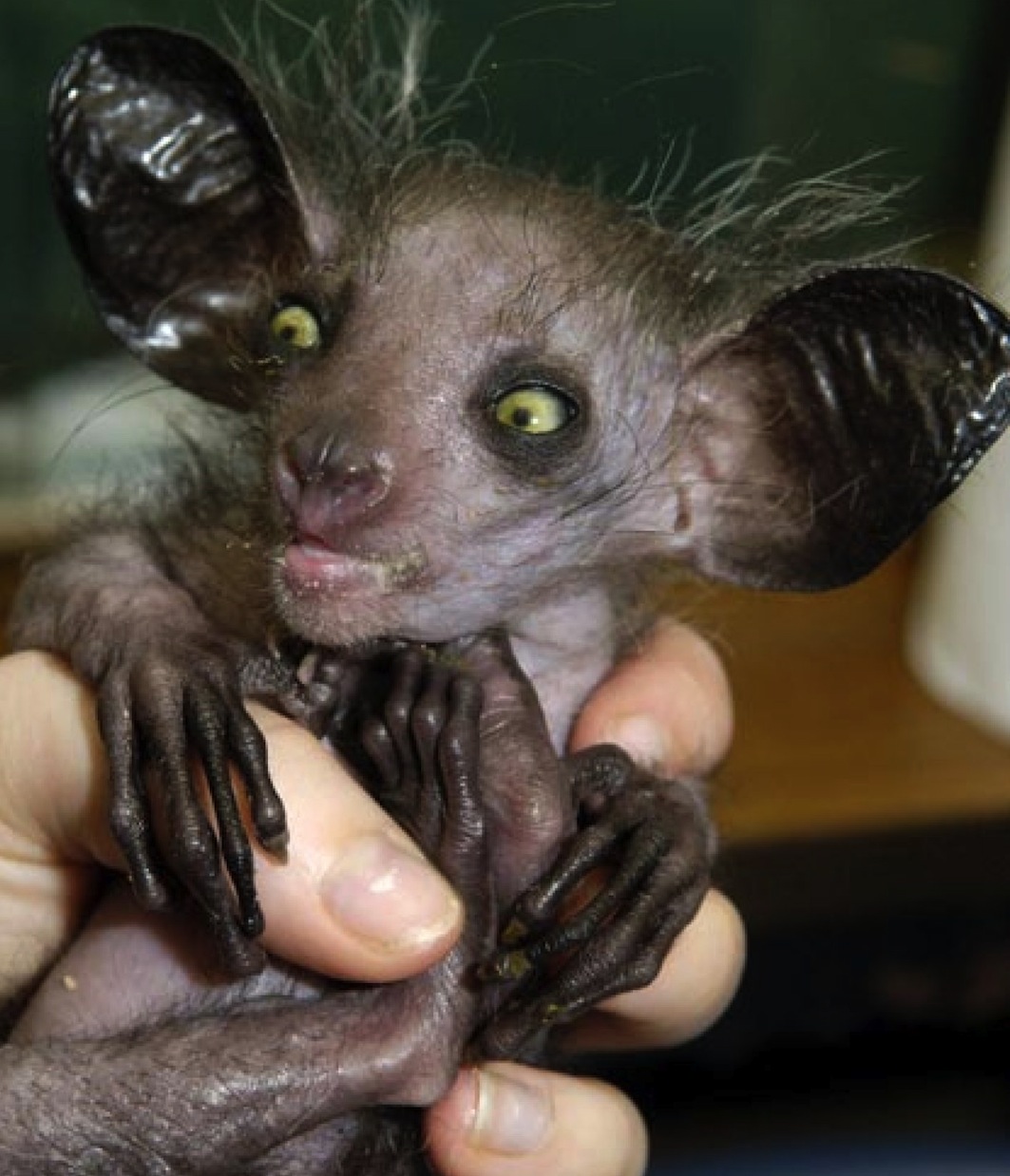
aye-aye 1Have you seen pictures of these delightful little creatures? They’re called Aye-ayes, and they are widely distributed across the jungles of Madagascar. (Any genetic link between aye-ayes and Gollum remains unconfirmed.)

The International Union for Conservation of Nature has classified these harmless mammals as “Near Threatened.” So, helping them reproduce, as an aye-aye breeder, may also keep the species from becoming extinct.

Actually, I don’t believe you can import Aye-ayes as pets—unless you’re one of those rich or famous people to whom the laws for regular people don’t apply. But, if it is possible to adopt an aye-aye, I offer the following pros and cons for your consideration.

Pro: Some people think they look cuddly.

Con: Some people think they look creepy.

Pro: They don’t demand attention all day long.

Con: They’re nocturnal and might keep you up at night.

Pro: People will think you’re on the cutting edge.

Con: People will think you’re one odd cookie.

Pro: They have tiny mouths.

Con: They are omnivores, and eat other animals.

Pro: Most people consider them exotic animals.

Con: They clearly resemble devilish gremlins.

Pro: Daubentonia madagascariensis are lemurs.

Con: They’re not nearly as cute as their lemur cousins.

Pro: In an emergency, they’re edible.

Con: In an emergency, they’re edible.

Pro: Aye-ayes may reveal God’s imagination & humor.

Con: Aye-ayes just may have a less heavenly origin.

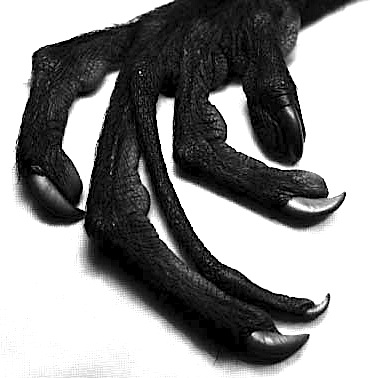
aye-aye 3The picture to the right, a close up view of the aye-aye’s “hand” lends credence to the last conjecture, above. It also evokes nightmarish memories of a story that traumatized my youth, “The Monkey’s Paw.”

You can either read it here, or view a recent treatment of it here.

C.S. Lewis acknowledges the danger posed by possessing too much love—an idolatrous affection—for pets. Of course, there are other things we can love that way with even less justification than an animal.

There is a reaction at present going on against the excessive love of pet animals. We have been taught to despise the rich, barren woman who loves her lap dog too much and her neighbor too little. It may be that when once the true impulse is inhibited, a dead poet is a nobler substitute than a live Peke, but this is by no means obvious.

You can do something for the Peke, and it can make some response to you. It is at least sentient; but most poetolaters hold that a dead man has no consciousness, and few indeed suppose that he has any which we are likely to modify. Unless you hold beliefs which enable you to obey the colophons of the old books by praying for the authors’ souls, there is nothing that you can do for a dead poet: and certainly he will do nothing for you.

He did all he could for you while he lived: nothing more will ever come. I do not say that a personal emotion towards the author will not sometimes arise spontaneously while we read; but if it does we should let it pass swiftly over the mind like a ripple that leaves no trace. If we retain it we are cosseting with substitutes an emotion whose true object is our neighbour.

Hence it is not surprising that those who most amuse themselves with personality after this ghostly fashion often show little respect for it in their parents, their servants, or their wives. (“The Personal Heresy: A Controversy”).

Yes, as Lewis so ably points out, it’s far more important to care about the personhood of our neighbor today . . . rather than a departed writer. (Coincidentally, Lewis would object with equal eloquence to Lewisolatry.)

If we cannot express our goodwill to other people, it’s better directed towards dogs and aye-ayes than someone departed from this world.

Which brings us back to the subject at hand. These furry little creature may not be the objects of the latest pet craze now, but it may be possible for you to initiate a new fad!

To make that possibility a bit more likely, allow me to close this column with a picture of a lovely aye-aye in its natural habitat. Now, that’s an animal one could easily consider cute and cuddly (as long as it keeps its paws to itself).

Ksukol ocasatý (Daubentonia madagascariensis)