Really Creative Writing

father christmasWhen did you first learn how to express yourself creatively? Some of us were blessed with parents who recognized the importance of things like music, art and literature. Others, alas, were not.

Most readers of Mere Inkling like to dabble in writing themselves. Many are quite skilled, and disciplined enough to persist with the demanding task of regularly composing interesting pieces for their own online columns. Some, in fact, are quite accomplished and successful in their personal literary efforts.

Becoming a good, truly good, writer requires experience. One may be born with the innate ability to become a Shakespeare or a Hemingway, but the skills need to be sharpened through effort. Study often helps, but it can never replace the necessity of practice in honing our writing.

It seems to me that the sooner we begin the process of unbridling our imaginations, translating our visions into words, and writing it all down in a way that engages the imaginings of others, the better we can become.

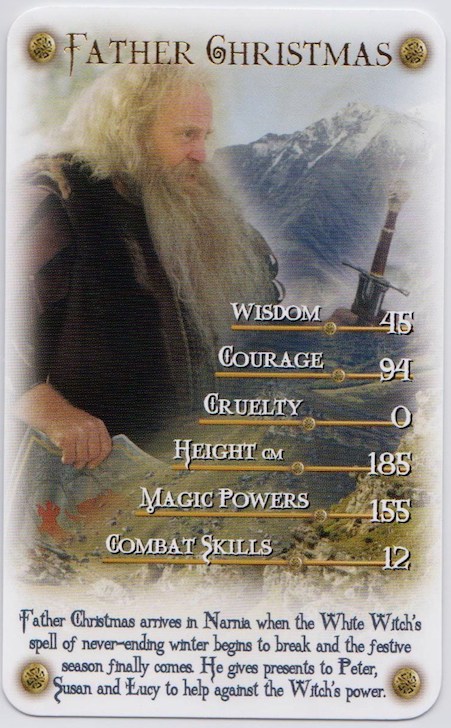
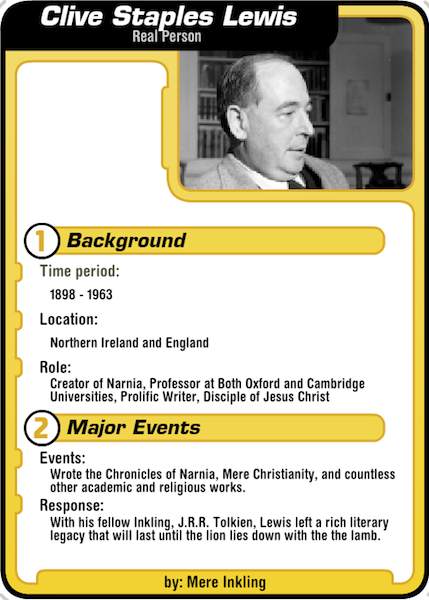
Many of you, especially Europeans, will be familiar with a gaming product that arose in the United Kingdom. They are called Top Trumps, and the cards come in a wide variety of themes. One set that I own is Narnia, from which the image at the top of this page comes.

Tolkien fans will be delighted to learn they just reissued a Lord of the Rings set that comes in an amazing Eye of Sauron tin. You can learn more about that unique item here.

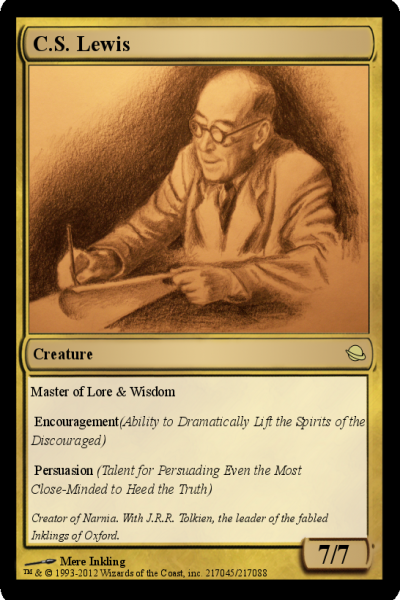
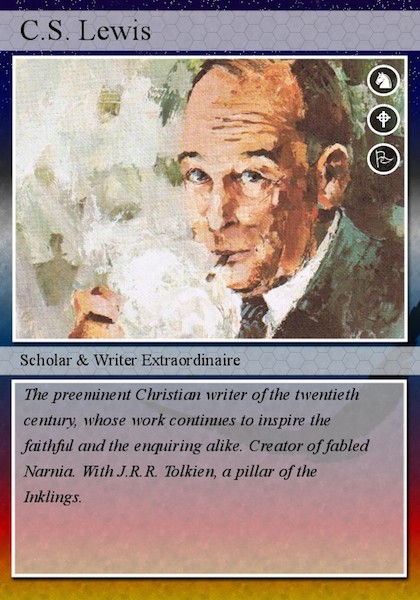
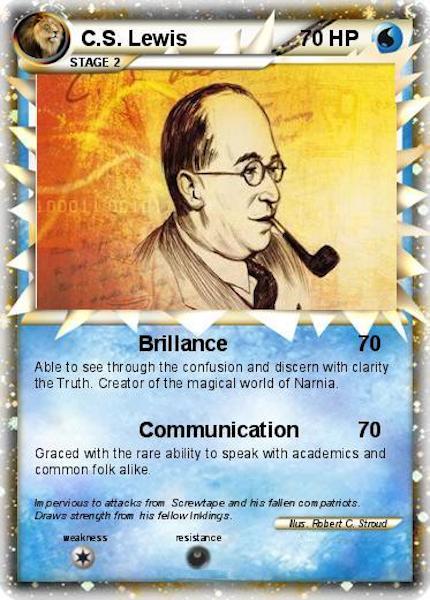
It was while thinking about my Narnia cards when I got the idea to see if there was an online mechanism for making one’s own playing cards. I was toying with the idea of fashioning a C.S. Lewis card to illustrate one of my posts.

I was actually searching online for a site where I could “create” such a card. I found several. Only later did I consider the irony of using that particular word.

For theologians, the word create bears profound significance. When it comes to the human activity of bringing together in some novel shape pre-existing images or ideas, it is not truly accurate. Lewis wrote about that in a 1943 letter to Sister Penelope.

‘Creation’ as applied to human authorship . . . seems to me an entirely misleading term. We . . . re-arrange elements He has provided. There is not a vestige of real creativity de novo in us. Try to imagine a new primary colour, a third sex, a fourth dimension, or even a monster which does not consist of bits of existing animals stuck together! Nothing happens.

And that surely is why our works (as you said) never mean to others quite what we intended: because we are re-combining elements made by Him and already containing His meanings. Because of those divine meanings in our materials it is impossible we should ever know the whole meaning of our own works, and the meaning we never intended may be the best and truest one.

Writing a book is much less like creation than it is like planting a garden or begetting a child: in all three cases we are only entering as one cause into a causal stream which works, so to speak, in its own way. I would not wish it to be otherwise.

Still, even though we are not true “creators,” it is enjoyable to rearrange the mundane elements (or words) of this life in fresh ways.

That’s one reason I was pleased to discover a website devoted to offering a “Trading Card Creator” hosted by the International Reading Association. It “gives students an alternative way to demonstrate their literacy knowledge and skill when writing about popular culture texts or real world examples.”
Why didn’t they have cool stuff like this when I was growing up? (If they did, I might be able to express myself better than by having to rely on phrases like “cool stuff.”)

Below you will find their website, along with a second option. I was thinking that my grandchildren might find it interesting to create a set of cards about our family tree. Their own sketches could be used for ancestors for whom we have no photograph. The comprehensive trading card creator maker offers a variety of templates, including for people, places, events and objects.

The template offered by the second site is generic enough that the cards can be produced in similar categories.

Unleash your imagination. And, after you’ve had some fun, consider sharing these links with a child you may know.
ReadWriteThink Trading Cards

Big Huge Labs Trading Cards

C.S. Lewis Card 3C.S. Lewis Card 2C.S. Lewis Card 1C.S. Lewis Card 4

Navy Nerds

nerdEvery once in a while, the military has a good idea. Sure, they have a knack for technological breakthroughs in warfare . . . but what about other fields? The NAVY NeRD answers that question in the affirmative.

NeRD stands for Navy eReader Device.

Well-informed readers of Mere Inkling are already aware of the growing intensity of international cyberwarfare. It is no joke, and lives are at stake.

Draconian policies are in place to avoid the contamination of the military computer system by innocently transferred viruses. Since virtually all digital platforms allow for the transfer of data, they are potentially dangerous.

Because of that, even ereaders have been off limits in certain environments. Now, however, someone has thought outside the proverbial box and come up with a solution to that problem.

The United States Navy has devised a novel ereader that comes loaded with 300 titles, but has no ports or wireless connectivity to allow for inadvertent viral transfers.

The selection of books sounds pretty well rounded. Some public domain classics, and a number of contemporary best sellers like A Game of Thrones. Fans of J.R.R. Tolkien will be delighted to know the readers also include The Lord of the Rings.

Reading is a productive way to spend one’s free time during a lengthy period at sea. Even for those not prone to opting for it when faced with all the distractions ashore.

During WWII, C.S. Lewis wrote a letter to a former student who was serving in the Navy, “out of reach of libraries.” It acknowledges the perennial problem of sailors—lack of space for personal property. The letter was written in response to a request from Michael Rayner Thwaites for reading recommendations. Thwaites was an Australian poet and military intelligence officer.

A man who has already your linguistic training might well, I think, begin the Anglo Saxon on his own. You will need E. Wardale Old English Grammar. . . . For texts, the ordinary beginning is first Sweet’s Anglo Saxon Primer and then his Old English Reader. But you, being a classic might well, after a dip in the Primer go on to King Alfred’s trans. of Boethius De Consolatione Philosophiae . . .

Whether you can begin O.E. poetry on your own I don’t know. But try getting . . . Beowulf: and with it Clark Hall’s trans. ed. by Wrenn with preface by Tolkien . . . This edition is essential for it is Tolkien’s part of metre wh. is essential. (O.E. verse uses both quality and accent, and your ear is prob. ruined, as mine was, by the false way they teach Latin metre at schools–drastic re-education is required. . . .

As to modern literature. You must not start out to study it ‘as it reveals man’s hesitant advance to the idea of a God-created world’. Don’t you see you are laying down in advance what a phenomenon is to reveal before you have examined the phenomenon? It may reveal that: it may not. You have to find out. I don’t think I can lay down any v. definite course of reading.

All I can point out is that while you are in the navy and out of reach of libraries and new publications, this is the proper time for solid reading through the big (i.e. long) authors, critical works and histories of lit. can come later. Now is the time for Chaucer, Malory, Spenser, Sidney, Shakespeare, Dryden, Pope, Swift, Johnson, Fielding, Richardson, Cowper, Scott, Wordsworth, Byron, Dickens etc etc.

If you usually keep two books of widely different period and type going together (e.g. Faerie Queene & Tom Jones) you won’t get bored. I myself always index a good book when I read it for the first time noting (a) Linguistic phenomena. (b) Good & bad passages. (c) Customs: meal times, social classes, what they read etc. (d) Moral ideas.

All this reading, tho’ dedicated ad Dei gloriam in the long run must not be infected by any immediate theological, ethical, or philosophic reference. Your first job is simply the reception of all this work with your imagination & emotions. Each book is to be read for the purpose the author meant it to be read for: the story as a story, the joke as a joke.

Back to the NeRD

The Navy is making 385 devices at first, with more to follow, with five being sent to each submarine in the Navy to be shared among the crew.

That’s only the start, of course. One would anticipate that even for a military crew (for example, 155 personnel on a Trident sub), a mere five mini-libraries would prove insufficient. (No offense intended; yours truly is a veteran himself.)

Is More Better?

everettThat’s a trick question. More of some things certainly is better . . . more peace, more compassion. But more—even of good things—can sometimes become too much.

Case in point: words.

I continue to frustrate one of my critique group friends because I write “like a historian rather than a journalist.” The distinction being:

Journalist – Just the facts, please.
Historian – Lover of descriptions, details, esoterica, and trivia.

Guilty as charged.

C.S. Lewis commends the literary virtue of brevity. The following passage is found in his aptly named essay, “Before We Can Communicate.”

In the very process of eliminating from your matter all that is technical, learned, or allusive, you will discover, perhaps for the first time, the true value of learned language: namely, brevity. It can say in ten words what popular speech can hardly get into a hundred.

Last year marked the 150th Anniversary of one of the world’s most famous speeches. Not only Americans are familiar with Abraham Lincoln’s Gettysburg Address. It has become a monument to succinctness and power.

Rereading it recently I began to wonder about the other speech delivered at the event . . . the two hour oration delivered by Edward Everett, one of the era’s most highly regarded public speakers.*

The journalists and audience at the dedication of the Gettysburg National Cemetery were extremely impressed by Everett’s presentation, and surprised by the brevity of Lincoln’s remarks.

Following the event, both men lauded each other’s message. Lincoln responded to Everett’s note which praised him for the “eloquent simplicity & appropriateness” of his remarks. Everett said, “I should be glad, if I could flatter myself that I came as near to the central idea of the occasion, in two hours, as you did in two minutes.”

Your kind note of to-day is received. In our respective parts yesterday, you could not have been excused to make a short address, nor I a long one. I am pleased to know that, in your judgment, the little I did say was not entirely a failure. Of course I knew Mr. Everett would not fail; and yet, while the whole discourse was eminently satisfactory, and will be of great value, there were passages in it which transcended my expectation. The point made against the theory of the general government being only an agency, whose principals are the States, was new to me, and, as I think, is one of the best arguments for the national supremacy. The tribute to our noble women for their angel-ministering to the suffering soldiers, surpasses, in its way, as do the subjects of it, whatever has gone before.

I tracked down an online copy of Everett’s Gettysburg speech. I’ve skimmed it, and it is rather interesting. With the course of the war still undetermined at the time it was presented, it is easy to see how its stirring words could inspire an already war-weary nation. As he elaborates on the efforts of the Confederates to establish a new nation, he begs for patience. “Pardon me, my friends, for dwelling on these wretched sophistries.” Sophistries indeed.

The speech offers a partisan analysis of the entire course of the war up to that time. International readers of Mere Inkling may find the references to other countries interesting. He describes “civil wars” in England, Germany, Italy and France. Since he spoke during an era when Italy was still disunited, allow me to quote that portion of the speech.

In Italy, on the breaking up of the Roman Empire, society might be said to be resolved into its original elements–into hostile atoms, whose only movement was that of mutual repulsion. Ruthless barbarians had destroyed the old organizations, and covered the land with a merciless feudalism. As the new civilization grew up, under the wing of the Church, the noble families and the walled towns fell madly into conflict with each other; the secular feud of Pope and Emperor scourged the land; province against province, city against city, street against street, waged remorseless war with each other from father to son, till Dante was able to fill his imaginary hell with the real demons of Italian history.

So ferocious had the factions become, that the great poet-exile himself, the glory of his native city and of his native language, was, by a decree of the municipality, condemned to be burned alive if found in the city of Florence. But these deadly feuds and hatreds yielded to political influences, as the hostile cities were grouped into States under stable governments; the lingering traditions of the ancient animosities gradually died away, and now Tuscan and Lombard, Sardinian and Neapolitan, as if to shame the degenerate sons of America, are joining in one cry for a united Italy.

For those who are interested, this paragraph from Everett’s speech is only fifty-five words shorter than the entire Gettysburg Address.

Of course, just as being loquacious does not guarantee irrelevance, neither does brevity ensure quality.

The key is using the right number of words. That will vary from person to person.

In the twenty-first century, though, a good rule of thumb is to follow the example of Lincoln rather than his speechifying colleague.

_____
* Everett had a prolific political career. It included: U.S. House of Representatives, Governor of Massachusetts, U.S. Ambassador to the United Kingdom, U.S. Secretary of State, U.S. Senator. Oh, and he was also President of Harvard University, a job that probably included at least as much politics as his previous endeavors.

Impromptu Poetry

eye

I had to endure a to and fro transcontinental trip this week. Endure is the right word, when flying miles above what would otherwise be a scenic, albeit lengthy, journey.

One positive thing about flying is that I have time to catch up on some of my “pleasure” reading. This week it included an article about cinquains.

A quintain is a poem with five verses. A cinquain is a specific form which has the following number of syllables in each of the lines: two, four, six, eight, and two.

I took a break from my reading and drafted a few of these small poems. I found it quite simple, and it’s likely you may as well.

I make no promises about the quality of my verse, but perhaps you’ll find one or more of them interesting. Or, at least they may inspire you to write some of your own.

Springtime
Narnian hope
Delayed by the White Witch
Borne by Aslan’s Resurrection
New dawn

Pilgrim
Traveling through
This world is not my home
Destined for a new creation
With Christ

True hope
He died for us
Emancipation now
Washed clean by the blood of the Lamb
New life

Inklings
Lewis, Tolkien
Friends rounded out the group
Imaginations unfettered
Wonder

Harry Potter in the Bible

potterSo much for the effectiveness of “state churches.” The European ones appear to have become abject failures. There is ample evidence that the “establishment” of religions has rarely served either church or state very well.

Here’s the latest proof from the United Kingdom. The BBC recently reported a study that shows three in ten teenaged Brits don’t know the Nativity of Jesus came from the Bible. Similar numbers had never heard about the Crucifixion or Adam and Eve.

I imagine they’ll consider the new Noah film just another work of Hollywood fiction. (Actually, half of them didn’t know that very story comes from the Bible.)

What’s more—their parents are nearly as ignorant.

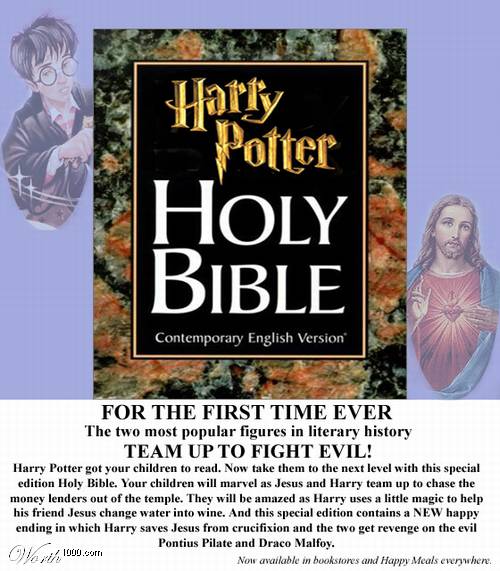
Many of the teens did, however, think that the plotlines from the Harry Potter series were based on Bible stories.

As a person who was genuinely inspired by England’s magnificent cathedrals while I lived there, it is painful to contemplate the terrible loss. The great-great-grandchildren of saints who suffered and sacrificed for the Gospel have disregarded the good news.

And, lest any readers think I’m pointing fingers as a “self-righteous” American, let me assure you I take no pride in my own nation’s slide into apostasy. The words of Micah’s prophecy seem closer to fulfillment each day. “The faithful have been swept from the land; not one upright person remains.”

C.S. Lewis saw this coming. Consider the following from his 1950 essay, “The Literary Impact of the Authorised Version.”

It may be asked whether now, when only a minority of Englishmen regard the Bible as a sacred book, we may anticipate an increase of its literary influence. I think we might if it continued to be widely read. But this is not very likely. Our age has, indeed, coined the expression “the Bible as literature.” It is very generally implied that those who have rejected its theological pretensions nevertheless continue to enjoy it as a treasure house of English prose.

It may be so. There may be people who, not having been forced upon familiarity with it by believing parents, have yet been drawn to it by its literary charms and remained as constant readers. But I never happen to meet them. Perhaps it is because I live in the provinces. But I cannot help suspecting, if I may make an Irish bull, that those who read the Bible as literature do not read the Bible.

Speaking of reading the Bible “as literature,” that’s not a bad thing. It informs so much Western literature, that an ignorance of the Scriptures is tantamount to possessing an inadequate education. An excellent online resource for exploring this truth can be found at the Bible Literacy Project.

The site includes a copy of a comprehensive 2006 study of English professors from America’s top-rated schools, including Yale, Harvard, Princeton, Stanford, Texas A&M, UC-Berkeley and others. In the study, not a single professor disagreed with the statement that: “Regardless of a person’s faith, an educated person needs to know the Bible.”

If some people could get past their prejudices against the Bible, they would recognize the truth of this statement. Everyone should be reading the Bible, even if only as a significant literary work.

Perhaps, if this widespread study comes to pass, one day people will be able to recognize the difference between the Scriptures and Harry Potter.

Beware of Moths

mothI try not to hate moths. They’re obviously not so pretty as butterflies, but I remind myself that’s not their fault. They’re a nuisance around the porch lights on summer evenings, but that’s instinct, not choice.

I strive to see the best in moths, like C.S. Lewis, who was able to capitalize on their impulsiveness in his 1933 poem, “The Naked Seed.”

Oh, thou that art unwearying, that dost neither sleep

      Nor slumber, who didst take

All care for Lazarus in the careless tomb, oh keep

      Watch for me till I wake.

If thou think for me what I cannot think, if thou

      Desire for me what I

Cannot desire, my soul’s interior Form, though now

      Deep-buried, will not die,

—No more than the insensible dropp’d seed which grows

      Through winter ripe for birth

Because, while it forgets, the heaven remembering throws

      Sweet influence still on earth,

—Because the heaven, moved moth-like by thy beauty, goes

      Still turning round the earth.

I really want to give moths the benefit of the doubt . . . but that’s become virtually impossible since I learned some of them are vampiric!

Before we consider their blood-sucking rituals, I want to share a traumatic moth encounter my wife and I experienced several years ago when we lived in Eastern Washington.

We had a huge fragrant collection of plants that ran across nearly the whole of the front of our house. There was a bush at the far end, and some delightful quail nested there. The flowers brought us other welcome guests. Hummingbirds would crowd around them as sun was setting, and savor their nectars.

We loved watching them hover near the blooms, and wondered precisely what species of hummingbirds they were, since they were slightly smaller than the ones we were accustomed to.

One day I was getting a close up view of their activity and I saw something that shattered my sense of reality. Instead of a beak, these hummingbirds had tongues that curled and uncurled, not unlike those “party horns” that children blow at celebrations.

My wife said I had to be imagining what I’d seen. I assured her that I hadn’t seen anything like this in the scifi shows I regularly watched, and I was pretty sure that these abominations weren’t hummingbirds.

Eventually I persuaded her to look for herself, and she too was aghast at the question of what they might be. Some of you already know, because you’ve had the misfortune of growing up where these creepy things thrive. For the rest of you—the fortunate ones who’ve been spared the curse of hemaris sphinx moths—let me assure you, their maladapted proboscises are grotesque.

I thought they were the worst thing the world of the moths had to offer. (Well, aside from the 1961 Japanese film “Mothra.”)

That’s what I thought, until recently, when I learned that some misbegotten moths had followed mosquitoes in their descent into parasitical evil by drinking the blood of other creatures.

The calyptra moths are another proof of the fall. No longer do they flutter around from plant to plant, seeking sustenance as a proper herbivore. The aptly named “vampire moth” has chosen to adapt its proboscis to pierce the skin of other animals such as buffaloes . . . and human beings.

In the equal opportunity world of the corruption of the natural order, while female mosquitoes drink blood, it is male moths that do so. Apparently, they’ve already infested Malaysia, the Urals and Southern Europe. Now they are adjusting to the climate of Scandinavia. The question arises, where can be we safe from these monsters?

Returning to C.S. Lewis, he records an incident that occurred in Narnia involving mistaken identity.

It is a very funny thing that the sleepier you are, the longer you take about getting to bed; especially if you are lucky enough to have a fire in your room. Jill felt she couldn’t even start undressing unless she sat down in front of the fire for a bit first. And once she had sat down, she didn’t want to get up again. She had already said to herself about five times, “I must go to bed,” when she was startled by a tap on the window.

She got up, pulled the curtain, and at first saw nothing but darkness. Then she jumped and started backward, for something very large had dashed itself against the window, giving a sharp tap on the glass as it did so. A very unpleasant idea came into her head—“Suppose they have giant moths in this country! Ugh!”

But then the thing came back, and this time she was almost sure she saw a beak, and that the beak had made the tapping noise. “It’s some huge bird,” thought Jill. “Could it be an eagle?” She didn’t very much want a visit even from an eagle, but she opened the window and looked out. Instantly, with a great whirring noise, the creature alighted on the window-sill and stood there filling up the whole window, so that Jill had to step back to make room for it. It was the Owl. (The Silver Chair).

Fortunately for Jill, and the rest of the children who visited Narnia, there is no record of them ever encountering giant moths . . . vampire moths . . . or moths deceptively impersonating hummingbirds.

_____

Note: The monster moth pictured above is not (to my knowledge) a blood or flesh eater. But I still wouldn’t want one that size landing on my shoulder.

Libraries & Imagination

librarycardI just got a new library card. It’s emblazoned with the word “Imagination.” While that would be boring news to most, to people who value reading, it’s noteworthy. Some might wonder, why did he wait until he was nearly sixty to get a library card. That’s because there is more to the story.

I happen to live “across the water” from one of the most literacy-loving communities in the United States—Seattle. (“Across the water” means that the quickest way to get to Seattle is by taking one of our scenic, but outrageously expensive, ferries, across Puget Sound.)

Our relatively small county has superb libraries of our own, but they can’t hope to match the holdings of Seattle’s grandiose institutions. Personally, I am not enticed by the sheer volume of volumes available there. I desire access to their abundant research resources, most notably access to historic newspapers.

The great news is that Kitsap County, where I am blessed to reside, maintains reciprocal library privileges with Seattle! When I made a trip to the metropolis to enroll, not only did they expeditiously process my information, the library pulled open a drawer with a dozen colorful options and said, “which card would you like?” (Now, I see how sheltered a life I live; I didn’t know some libraries actually offered members a choice of what image they want to embellish their cards.)

I selected the one bearing the iconic image of the Space Needle. (I actually visited the Space Needle during the World’s Fair . . . but that’s a story for another day.)

Only after I selected it because of the picture, did I realize each card carried the imprint of a single word. “Imagination,” the librarian said, “a good choice.” A very good choice, I thought to myself. Since I place an extremely high value on that ephemeral trait.

Libraries, I’m afraid, are undervalued today. It’s good to see them continuing to provide a valuable service to our communities. Reading is vital to civilization, growth and culture.

C.S. Lewis enjoyed the family library in the home of his youth, and in one of his boarding schools experienced the library not only as a vestibule of knowledge, but also as a place of refuge. The upper classmen of the school subjected the younger boys to relentless hazing, but the library was off limits to their abusive behaviors.*

The other undisguised blessing of the Coll [Wyvern College] was “the Gurney,” the school library; not only because it was a library, but because it was sanctuary. As the Negro used to become free on touching English soil, so the meanest boy was “un-faggable” once he was inside the Gurney.

It was not, of course, easy to get there. In the winter terms if you were not on the list for “Clubs” you had to go out for a run. In summer you could reach sanctuary of an afternoon only under favorable conditions. You might be put down for Clubs, and that excluded you. Or there might be either a House match or a Coll match which you were compelled to watch. Thirdly, and most probably, on your way to the Gurney you might be caught and fagged for the whole afternoon.

But sometimes one succeeded in running the gauntlet of all these dangers; and then— the books, silence, leisure, the distant sound of bat and ball (“Oh the brave music of a distant drum”), bees buzzing at the open windows, and freedom. In the Gurney I found Corpus Poeticum Bo reale and tried, vainly but happily, to hammer out the originals from the translation at the bottom of the page. There too I found Milton, and Yeats, and a book on Celtic mythology, which soon became, if not a rival, yet a humble companion, to Norse. (Surprised by Joy).

While this passage described the library as a glorious sanctuary, it also reveals a tragic snapshot of the bullying that is endemic to many schools. Since I don’t wish to end these thoughts on a negative image, allow me to offer another revelation from Lewis. In a brief essay, he praises imagination, while acknowledging its limitations.

It must not be supposed that I am in any sense putting forward the imagination as the organ of truth. We are not talking of truth, but of meaning: meaning which is the antecedent condition both of truth and falsehood, whose antithesis is not error but nonsense.

I am a rationalist. For me, reason is the natural organ of truth; but imagination is the organ of meaning. Imagination, producing new metaphors or revivifying old, is not the cause of truth, but its condition. It is, I confess, undeniable that such a view indirectly implies a kind of truth or rightness in the imagination itself. (“Bluspels and Flalansferes: A Semantic Nightmare”).

“Producing new metaphors or revivifying old . . .” What an apt description of the wonders of imagination. And this insight is only one of the countless gems of wisdom I have gratefully received from C.S. Lewis.

_____

* In the language of the school the “Bloods” were the sadistic elites. The youngest and most vulnerable were labeled “fags,” and their mistreatment (forced menial drudgery) was called “fagging.”

Those interested in seeing all five of the Seattle Library options for their new cards, you can do so here.

A Pair of Brilliant Writers

csl & chesterton

Sadly, politics are by definition nearly always polarizing. In the linguistic battleground of political warfare, we seem to more and more frequently encounter a “take no prisoners” attitude. It’s ominous.

I recently read the following words which describe, quite well I think, the positions of the two main rivals in virtually all political campaigns. (And, in this sentence, I’m referring to the military definition of “campaign.”)

“The whole modern world has divided itself into Conservatives and Progressives. The business of Progressives is to go on making mistakes. The business of the Conservatives is to prevent the mistakes from being corrected.”

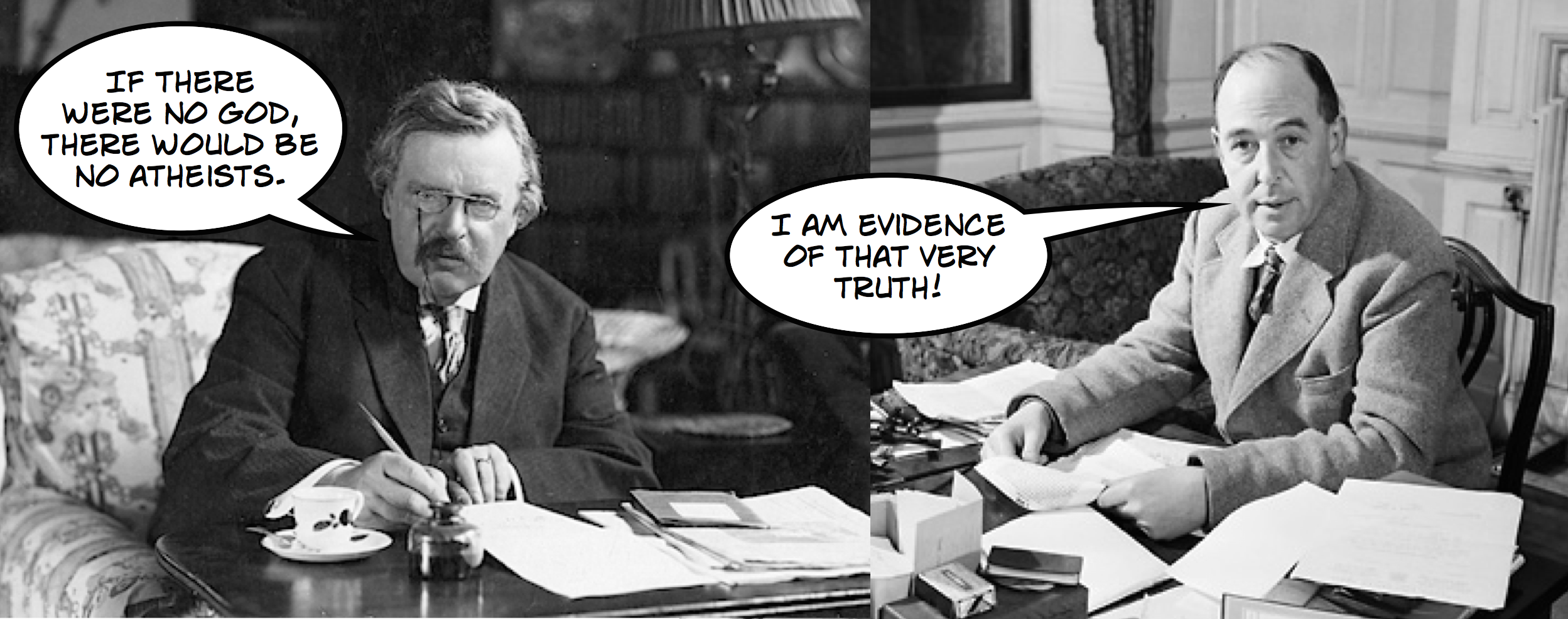
Some things never change. This cutting critique appeared nearly a century ago (in the 19 April 1924 issue of the Illustrated London News). It was penned by G.K. Chesterton, a British writer who was admired by many of his contemporaries, from a number of different perspectives. George Bernard Shaw, a Socialist, considered the conservative journalist a “man of colossal genius.”

Chesterton was one of the Christian writers whose faith made a significant impression on the unbelieving C.S. Lewis. Before encountering Jesus, the atheist Lewis resented the “intrusions” of Christian references into the writings of authors he otherwise enjoyed. He describes this conundrum delightfully in Surprised by Joy.

All the books were beginning to turn against me. Indeed, I must have been as blind as a bat not to have seen, long before, the ludicrous contradiction between my theory of life and my actual experiences as a reader. George MacDonald had done more to me than any other writer; of course it was a pity he had that bee in his bonnet about Christianity. He was good in spite of it.

Chesterton had more sense than all the other moderns put together; bating, of course, his Christianity. Johnson was one of the few authors whom I felt I could trust utterly; curiously enough, he had the same kink. Spenser and Milton by a strange coincidence had it too.

Even among ancient authors the same paradox was to be found. The most religious (Plato, Aeschylus, Virgil) were clearly those on whom I could really feed.

On the other hand, those writers who did not suffer from religion and with whom in theory my sympathy ought to have been complete—Shaw and Wells and Mill and Gibbon and Voltaire—all seemed a little thin; what as boys we called “tinny.” It wasn’t that I didn’t like them. They were all (especially Gibbon) entertaining; but hardly more. There seemed to be no depth in them. They were too simple. The roughness and density of life did not appear in their books. . . .

The upshot of it all could nearly be expressed in a perversion of Roland’s great line in the Chanson—Christians are wrong, but all the rest are bores. The natural step would have been to inquire a little more closely whether the Christians were, after all, wrong.

And C.S. Lewis, to his eternal joy, did just that. He inquired more deeply into the faith held by the writers he so respected. This included, of course, Chesterton. Echoes of Chesterton’s masterful expressions of Christian faith recur in the work of Lewis. For example, in his essay “Membership,” Lewis writes:

Equality is a quantitative term and therefore love often knows nothing of it. . . . Even in the life of the affections, much more in the body of Christ, we step outside that world which says “I am as good as you.” . . . We become, as Chesterton said, taller when we bow; we become lowlier when we instruct.

Similarly, in A Preface to Paradise Lost, Lewis describes how best to savor the historical work of writers from different eras. Although the reference to Chesterton here is given in passing, I will reproduce the larger passage in light of its insight into how best to benefit from what we read.

The things which separate one age from another are superficial. Just as, if we stripped the armour off a medieval knight or the lace off a Caroline courtier, we should find beneath them an anatomy identical with our own, so, it is held, if we strip off from Virgil his Roman imperialism, from Sidney his code of honour, from Lucretius his Epicurean philosophy, and from all who have it their religion, we shall find the Unchanging Human Heart, and on this we are to concentrate.

I held this theory myself for many years, but I have now abandoned it. I continue, of course, to admit that if you remove from people the things that make them different, what is left must be the same, and that the Human Heart will certainly appear as Unchanging if you ignore its changes. . . .

Instead of stripping the knight of his armour you can try to put his armour on yourself; instead of seeing how the courtier would look without his lace, you can try to see how you would feel with his lace; that is, with his honour, his wit, his royalism, and his gallantries out of the Grand Cyrus. I had much rather know what I should feel like if I adopted the beliefs of Lucretius than how Lucretius would have felt if he had never entertained them. The possible Lucretius in myself interests me more than the possible C.S. Lewis in Lucretius.

There is in G.K. Chesterton’s Avowals and Denials a wholly admirable essay called “On Man: Heir of All the Ages.” An heir is one who inherits and “any man who is cut off from the past . . . is a man most unjustly disinherited.” . . .

You must, so far as in you lies, become an Achaean chief while reading Homer, a medieval knight while reading Malory, and an eighteenth century Londoner while reading Johnson. Only thus will you be able to judge the work “in the same spirit that its author writ” and to avoid chimerical criticism.

G.K. Chesterton is well worth reading, and most fans of Lewis will appreciate his prodigious work. The best thing about Chesterton, is that since he entered the presence of his Lord in 1936, nearly everything he wrote is in the public domain. His essays, poetry, apologetic works—and even the tales of his fictional detective Father Brown—are readily accessible online.

For a friendly introduction to the relationship between Lewis and Chesterton, I recommend “Chesterton and Lewis, Side by Side.” In an issue devoted entirely to comparing the two pillars of Twentieth Century Christian apologetics, the St. Austin Review, we read:

In 1946, ten years after Chesterton died, Lewis wrote a short article defending Chesterton against the two charges with which he is still attacked—or dismissed—by most academicians: one, that he was popular, and two, that he was dated. Of course, Lewis is attacked for the same two reasons.

The entire article is available here. Those interested in one of the areas where Chesterton’s writing overlapped with that of Lewis and his good friend, J.R.R. Tolkien, will also enjoy “G.K. Chesterton: Fairy Tale Philosopher,” which is available here.

Unintentional Acrostics

letterSome writers sweat to find precisely the right word, the one that expresses the unique meaning and tone we seek to convey. We often fail, as the reference to perspiration in my first sentence readily reveals. A recent observation from the executive editor of First Things  provides me with another crippling concern.

“This for those interested in how magazines work. My son Christopher pointed out that the initial capital letters on a two-page spread . . . spelled “a wit.” Which was kind of nice. Accidental, but nice. And then I thought: Suppose some day we accidentally spelled out a rude four-letter word? Now, after the magazine is laid out, one of the junior fellows reads through the magazine to make sure we haven’t accidentally made a word that will embarrass us. It’s a small thing, and probably paranoid, but here paranoia equals prudence.”

Unless each writer maintains constant vigilance, since most of us don’t have “junior fellows” to assign the duty, it’s quite possible for unintentional acrostics to slip into our work. Like the seamen in the crow’s nest of the Titanic—I just watched a new documentary on the subject last night—we can easily miss the veiled iceberg which threatens to sink our best effort.

Prone as we are to playing with the depths of individual words, we are normally sensitive to the fact more than 90% of a word’s value in a particular context may lie beneath the surface. That does not mean, however, that we always see the larger picture.

It is not uncommon for a writer to become almost paralyzed while composing something, when the ideal word continues to elude us. It is almost “literally” painful to have to settle for a substitute, when we suspect the perfect word is floating somewhere just beyond our reach.

Dodging mundane words is not easy. They are common, in part at least, because they are so simple and easy to plug into sentences. And so, we “go” to the store, when we might just as easily “drive,” “walk,” “ride,” or even “hitchhike.” A movie is described as “good,” when readers would value a vivid word, such as, “suspenseful,” “hilarious,” “complex,” “moving,” or even “groundbreaking.”

Reflections on the Psalms, one of C.S. Lewis’ gems, explores the beauty of the Bible’s hymnal. “The Psalms,” he notes, “are poems, and poems intended to be sung: not doctrinal treatises, nor even sermons.” Because of this, they have nourished the worship lives of Jew and Christian alike, for thousands of years.

Even without a theological education, Lewis offers great insight into the Psalms. “I am no Hebraist, no higher critic, no ancient historian, no archaeologist.” He candidly discusses passages he initially found difficult to embrace, as well as those which soar to spiritual and poetic heights. The following comes from his discussion of Psalm 119, which is skillfully composed around an alphabetic acrostic.

“As everyone knows, the Psalm specially devoted to the Law is 119, the longest in the whole collection. And everyone has probably noticed that from the literary or technical point of view, it is the most formal and elaborate of them all. The technique consists in taking a series of words which are all, for purposes of this poem, more or less synonyms (word, statutes, commandments, testimonies, etc.), and ringing the changes on them through each of its eight-verse sections—which themselves correspond to the letters of the alphabet. . . . this poem is not, and does not pretend to be, a sudden outpouring of the heart like, say, Psalm 18. It is a pattern, a thing done like embroidery, stitch by stitch, through long, quiet hours, for love of the subject and for the delight in leisurely, disciplined craftsmanship.”

Done like embroidery, stitch by stitch.” Many writers, I suspect, will appreciate that description. While we are sometimes forced to throw something together in a rush, the patchwork results offend our sensitivities.

Even when writing rather pedestrian things like much of our email correspondence, most writers seek to employ lively verbiage. It’s a valuable exercise, after all, to consider the pace of all of our work, and not simply those words we hope to see “published.” And, having written something worth reading, there is one more consideration.

Reviewing what we have written is well worth the time required. And, as Editor David Mills suggested in First Things, our examination should include any unintentional acrostics we may have created. After all, no respectable writer would ever wish to, even accidentally, offend their readers.

Jews Following Jesus

interfaithJewish poetry is breathtaking. The Psalms have nourished people of faith, as well as secularists, for millennia. C.S. Lewis wrote this about the providence of God in using the Jewish people as his conduit for blessing the world.

My enjoyment of the Psalms has been greatly increased lately. The point has been made before, but let me make it again: what an admirable thing it is in the divine economy that the sacred literature of the world should have been entrusted to a people whose poetry, depending largely on parallelism, should remain poetry in any language you translate it into.

He alluded to this in a letter to Sister Penelope, an Anglican nun and writer. In 1941 she sent him a copy of her new book, Windows on Jerusalem: A Study in the Mystery of Redemption. Lewis responded with gratitude. (Contemporary authors will find the detail of Lewis’ informal critique of her book illustrative of what he brought to the meetings of the Inklings.)

Thank you very much for the book. It has given me real help. What I particularly enjoy in all your work, specially this, is the avoidance of that curious drabness which characterises so many ‘little books on religion.’ Partly it is due to your Hebraic background which I envy you: partly, no doubt, to deeper causes.

Things that particularly pleased me were the true meanings of Beloved (p. 8) and Son (p. 9), the whole account of the Transfiguration (pp. 16 et seq), the passage on Sacrifice (p. 32), the passage ‘This was a shock’ (on p. 35), on our inability to understand sin (41 and 47), the very important bit about Hebrew & Roman ideas of ransom (52, 53): the really splendid account of how God can’t help deceiving the devil (56) and the allegorical close. There are, in fact, a good many Gifford Lectures and other such weighty tomes out of which I’ve got less meat (and indeed less efficient cookery!).

Judaism & Christianity

Jews and Christians have a complex relationship. This is even more true for Jewish people who come to accept Jesus as the promised Messiah. For most Jews, this automatically results in their expulsion from the Jewish community. However, for a growing number, there is a more gracious attitude developing.

A recent survey conducted by the Pew Research Center revealed some interesting statistics. Note the percentage of United States Jews considering the following to be essential:

Remembering the Holocaust – 73%

Leading an Ethical & Moral Life – 69%

Caring about Israel – 43%

Having a Good Sense of Humor – 42%

Observing Jewish Law – 19%

Here is the most surprising part of the survey. Thirty-four percent of American Jews consider believing Jesus is the Messiah, is compatible with being Jewish.

Let me repeat that . . . 34% of Jews in the United States (35% of the ultra-Orthodox Jews) believe that “Messianic Jews” remain Jewish.

I find that amazing. I also find it encouraging, since it’s consistent with the understanding of the Jews in first century Judea who worshipped beside the followers of Jesus in Jerusalem until its fall.

Some years ago I heard a lecture by a prominent Jewish theologian who described how historical Judaism rarely rejected those who considered any particular rabbi to be the Messiah. Apparently this remains true today, as some modern Jews, for example, consider  Menachem Mendel Schneerson (1902-1994) to be the Messiah.

Returning to the case of Jesus of Nazareth, the improving attitude is encouraging to see. In part, because most Messianic Jews say accepting Jesus as the Messiah has made them more Jewish. By that, most mean that they now practice the traditions of their Jewish heritage more faithfully than they previously did.

Following his conversion, C.S. Lewis grew in his positive consideration of the Jewish faith and people. In 1933, as Hitler’s hatred for Judaism became more evident, he wrote in a letter:

I might agree that the Allies are partly to blame, but nothing can fully excuse the iniquity of Hitler’s persecution of the Jews, or the absurdity of his theoretical position. Did you see that he said “The Jews have made no contribution to human culture and in crushing them I am doing the will of the Lord.”

Now as the whole idea of the “Will of the Lord” is precisely what the world owes to the Jews, the blaspheming tyrant has just fixed his absurdity for all to see in a single sentence, and shown that he is as contemptible for his stupidity as he is detestable for his cruelty. For the German people as a whole we ought to have charity: but for dictators, “Nordic” tyrants and so on . . .

All of the civilized people of the world share Lewis’ revulsion with Hitler and his agenda. In that we definitely agree with the vast majority of Jews who regard “Remembering the Holocaust” as something essential.

Postscript:

As positive a sign as the 34% support of Messianic Jews remaining Jewish is, the survey includes a more sobering corollary. Exactly twice that number, 68%, agreed that you can remain Jewish even if you don’t believe in the existence of God. Shocking. But that’s a subject for another day.