Fleeting Fame

fameIt’s likely that the names of 98.6% of authors who top the bestseller charts today will be unremembered a century from now.

This weekend I posted the latest issue of Curtana: Sword of Mercy, a journal I edit about military chaplains. (If you are interested in checking it out, you can download a free copy here.)

The current issue includes an interesting article about two chaplains from Vermont who served during the War of 1812. (For international readers, that was the war following the winning of America’s independence when they British got their revenge—they captured our national capital and burned the capitol.)

In the biographical portion of the article, the author included a final summary of the life of one of the chaplains. Solomon Aiken (1758-1833) left his civilian pulpit to serve soldiers and sailors.

Aiken was quite prominent in his day. Not only was he a well known preacher and writer, he actually served as a member of Vermont’s legislature. Yet, I doubt that even Vermonters would recognize his name today.

Here is the quotation from a nineteenth century tribute published after his passing.

Mr. Aiken enjoyed uncommon health and vigor. He never took a particle of medicine, or lost a relish for food, until his final and brief sickness—a pleurisy fever. He possessed peculiar power as a logician, and was very popular as a preacher. He was kind-hearted and benevolent, almost to a fault. But it is chiefly as a political writer that Mr. Aiken is remembered. He was sent as a representative for two years, by the town of Dracut. He published several sermons and pamphlets, chiefly upon political themes, which excited much attention in their season.

The words that seized my attention were the conclusion, “. . . which excited much attention in their season.”

“In their season . . .” That season must have been brief, since the history was written just twenty years after Aiken’s death. By then his works had either withered or, more optimistically, gone to seed. In either case, their day was passed.

Translating that to our modern era, where things become obsolete almost as soon as they are envisioned, it would imply that our “season” of fame or reputation will last little more than a handful of months. And that, of course, assumes that a person actually achieves some level of renown.

Fame is fleeting. It has always been so, and the good Reverend Aiken is simply another example of that truth.

Thank God (literally) that there is more to life than notoriety.

C.S. Lewis is one of the 1.4% whose fame lasts. His has not diminished; it continues to grow. Just a year ago, on the fiftieth anniversary of his death, he was honored by having a plaque dedicated in Poet’s Corner in Westminster Abbey.

Lewis never sought fame, as the following discussion from his essay “The Weight of Glory” clearly reveals.

I turn next to the idea of glory. There is no getting away from the fact that this idea is very prominent in the New Testament and in early Christian writings. Salvation is constantly associated with palms, crowns, white robes, thrones, and splendour like the sun and stars. All this makes no immediate appeal to me at all, and in that respect I fancy I am a typical modern.

Glory suggests two ideas to me, of which one seems wicked and the other ridiculous. Either glory means to me fame, or it means luminosity. As for the first, since to be famous means to be better known than other people, the desire for fame appears to me as a competitive passion and therefore of hell rather than heaven. As for the second, who wishes to become a kind of living electric light bulb?

When I began to look into this matter I was stocked to find such different Christians as Milton, Johnson and Thomas Aquinas taking heavenly glory quite frankly in the sense of fame or good report. But not fame conferred by our fellow creatures—fame with God, approval or (I might say) “appreciation’ by God.

And then, when I had thought it over, I saw that this view was scriptural; nothing can eliminate from the parable the divine accolade, “Well done, thou good and faithful servant.” With that, a good deal of what I had been thinking all my life fell down like a house of cards.

This exceptional work merits consideration not only by people of faith. It invites all honest readers to gaze within themselves at their deepest yearnings.

Another passage from C.S. Lewis that relates strongly to the subject at hand comes from The Great Divorce. You can read the entire passage here, but the heart of it is this. Lewis views a simple woman, presently in heaven, receiving magnificent praise and celebration. He naturally assumes she must have been some well known saint.

He is, however, informed that she lived an obscure life, despite the fact that she touched countless nondescript people and animals with her compassion. Lewis’ heavenly guide is rather surprised that the Oxford professor has overlooked a simple truth:

Fame in heaven “and fame on Earth are two quite different things.”

Only the second will last.

Parachute Optional

c141Under what circumstances would you tell an airman that pulling their rip cord if they exit the plane is optional? I never knew of any until I read an article about resupply missions to the South Pole.

The current issue of Air Force Magazine includes a fascinating article about resupplying McMurdo Station and a second temporary site at the Pole itself. Because of the extreme cold, 100 degrees below zero Fahrenheit (that’s -73.333 degrees Celsius), any airman who accidentally fell from the plane as the pallets were dropped, could not expect to be rescued before freezing to death.

Parachute-laden crewmen standing near open doors of a C-141B Starlifter during a midwinter Antarctic airdrop in 1983 were told they could pull the D-ring ripcord if they fell overboard—or just not bother. The chance of being safely recovered in the darkness and [bone-freezing] temperatures was practically nonexistent.

Putting things in historical perspective, we can consider the fate of WWI pilots in Germany. Theirs was the first nation to provide standard parachutes, and during the first 70 bail outs, a third of the pilots perished. With those statistics, one wonders how many airmen followed the “just not bother” course of action and chose to remain with their plunging aircraft.

C.S. Lewis had a friend named Leo Baker who had served in France as a pilot of the 80th Squadron of the Royal Air Force. The two combat veterans hit it off because of shared interests, including their mutual love of poetry. Here is how Lewis initially described Baker to his lifelong friend, Arthur Greeves, in 1920.

You ask about Baker, and I hardly know how to describe him. He was at a mixed school of a very modern type, where everyone seems to have written, painted and composed. He is so clairvoyant that in childhood “he was afraid to look round the room for fear of what he might see.” He got a decoration in France for doing some work in an aeroplane over the lines under very deadly fire: but he maintains that he did nothing, for he was “out of his body” and could see his own machine with “someone” in it, “roaring with laughter.” He has a bad heart.

He was a conscientious objector, but went to the war “because this degradation and sin might be just the very sacrifice which was demanded of him.” He maintains that everything in Algernon Blackwood [writer of ghost stories] is quite possible: and though the particular cases may be fictitious, “things of that sort” are quite common. He is engaged to be married.

In appearance, he is about my height, with very fair hair, glasses, remarkable eyes and according to the Minto [Janie Moore], rather like you. I like and admire him very much, though at times I have doubts on his sanity.

Like Lewis, Baker had been seriously wounded during the war. He was awarded the Distinguished Flying Cross. Fortunately, it appears he did not have to rely on a primitive parachute. Or, if he did, he was one of the fortunate survivors.

Returning to Antarctica for just a moment, it seems that South Pole mission would have been an exciting adventure in which to share. Terrifying too, perhaps. Fortunately, like Lewis and Baker (and Tolkien, as well), all of the service members returned home safely, mission accomplished.

_____

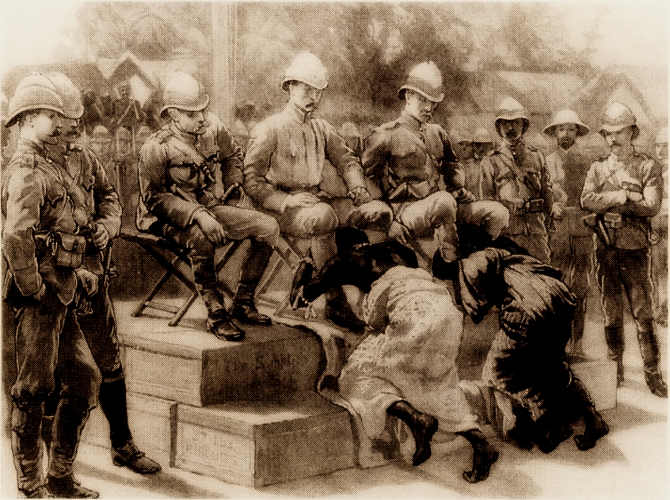
The picture above is a military photograph of a pair of Emperor penguins observing an American C-141 resupply mission during the summer months.

Sanctified Languages

petrusOne major difference between Christianity and Islam is their view of language. For the Muslim, Arabic is the language by which the Quran is to be known. For the Christian, there is a great impulse to translate the Scriptures into every tongue in the world.

In Islamic worship, the Quran is properly recited only in Arabic, whether the individual understands Arabic or not. This is similar to the way that most Hindus chant mantras in ancient Sanskrit.

A parallel can be drawn with the medieval practice in the Western branches of Christianity where Latin continued to be used for worship, even after it lost its role as the shared language.

The fact, however, that the Bible had even been translated into Latin was due to the Christian desire to make God’s word accessible to all people. Jerome, an early Christian theologian, became a linguistic scholar with the goal of translating the Vulgate, into the common language of his day.

It would have been a great shock to him, and to Pope Damasus I who commissioned his effort, to see the Latin so ingrained in the church’s usage that their heirs in leadership lost sight of the desire to bring the Lord’s words directly to the people so that all could understand them.

One of the great successes of the Reformation was the successful translation and distribution of the Scriptures into the vernacular of various language groups. Martin Luther’s translation, in fact, standardized the German language which had evolved into several different dialects.

Coincidentally, Lutherans have remained at the forefront of Bible translation, and Lutheran Bible Translators continue that vital work today. They currently have twenty-two Bible translations in process. LBT works in conjunction with Wycliffe Bible Translators, which is an even larger organization.

C.S. Lewis delivered a lecture at the University of London entitled “The Literary Impact of The Authorised Version.” In one portion he addressed the influence of the King James translation on the English language. While not nearly so pronounced as Luther’s on German, it is measurable.

The history of the Authorised Version has been told so often that I will not attempt to re-tell it, and its beauties praised so lavishly that I will not praise them. Instead, I will proceed at once to its influence as an English book. I shall attempt to define that influence, for I think there has been misunderstanding about it and even a little exaggeration.

Lewis’ argument is that the Bible has a profound influence on English literature, the particular translation, less so.

Ideally, all Christians would understand Hebrew and Greek, and be able to read the Scriptures in their original languages. However, there is no stigma in reading a translation. In fact, there are small pockets of people who do not understand the history of the Bible who believe that one particular translation (i.e. the King James Version) is the only authoritative text.

Sadly, I once saw an advertisement in a newspaper inviting worshipers that read: “Are you tired of people changing the Authorized Version of God’s Word with Greek and other languages? If so, come and join us at . . .”

Fortunately, the vast majority of Jesus’ disciples celebrate the translation of God’s word of life into every language spoken today.

Meanwhile, memorization of the Quran in Arabic (even when that is not the reciter’s actual language) remains highly regarded in Islam. Arabic has been regarded as so holy, in fact, that there was great reluctance to contaminate the Quran by using a printing press.

During the Ottoman Empire, until 1729, printing anything in Arabic was a crime. Somewhat ironically, the first printing utilizing Arabic movable type was done by Pope Julius II in the first decade of the sixteenth century. It was created for the benefit of Christians living in Arabic lands.

To provide a powerful illustration of a Christian validation of the authentic inspiration and power of God’s words—in any language—we turn once again to the German reformer.

Since it becomes Christians then to make good use of the Holy Scriptures as their one and only book and it is a sin and a shame not to know our own book or to understand the speech and words of our God, it is a still greater sin and loss that we do not study languages, especially in these days when God is offering and giving us men and books and every facility and inducement to this study, and desires his Bible to be an open book. . . .

In proportion then as we value the gospel, let us zealously hold to the languages. For it was not without purpose that God caused his Scriptures to be set down in these two languages alone—the Old Testament in Hebrew, the New in Greek. Now if God did not despise them but chose them above all others for his word, then we too ought to honor them above all others. St. Paul declared it to be the peculiar glory and distinction of Hebrew that God’s word was given in that language, when he said in Romans 3, “What advantage or profit have those who are circumcised? Much indeed. To begin with, God’s speech is entrusted to them. . . .”

Similarly, the Greek language too may be called sacred, because it was chosen above all others as the language in which the New Testament was to be written, and because by it other languages too have been sanctified as it spilled over into them like a fountain through the medium of translation. (Martin Luther, “To the Councilmen of Germany”).

_____

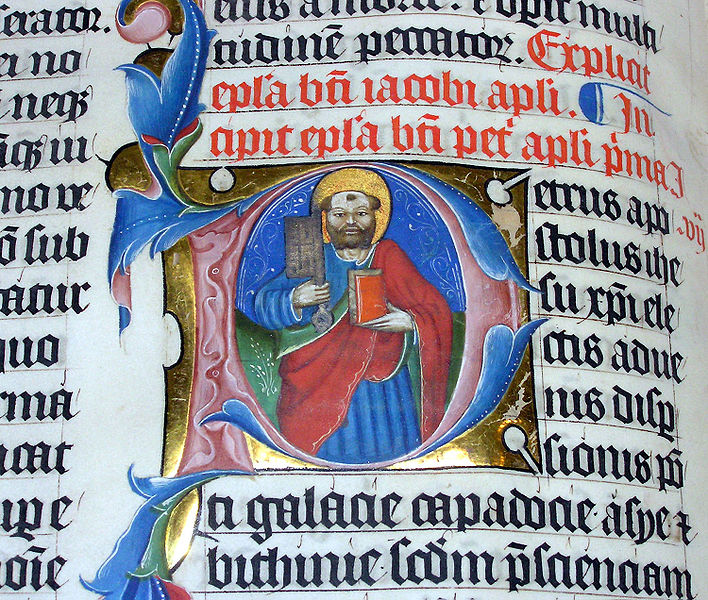
The image above is an illuminated “P” which begins the name Petrus (Peter). The manuscript is displayed in Malmesbury Abbey in England, but was originally transcribed in Belgium circa 1400.

Literary Martial Arts

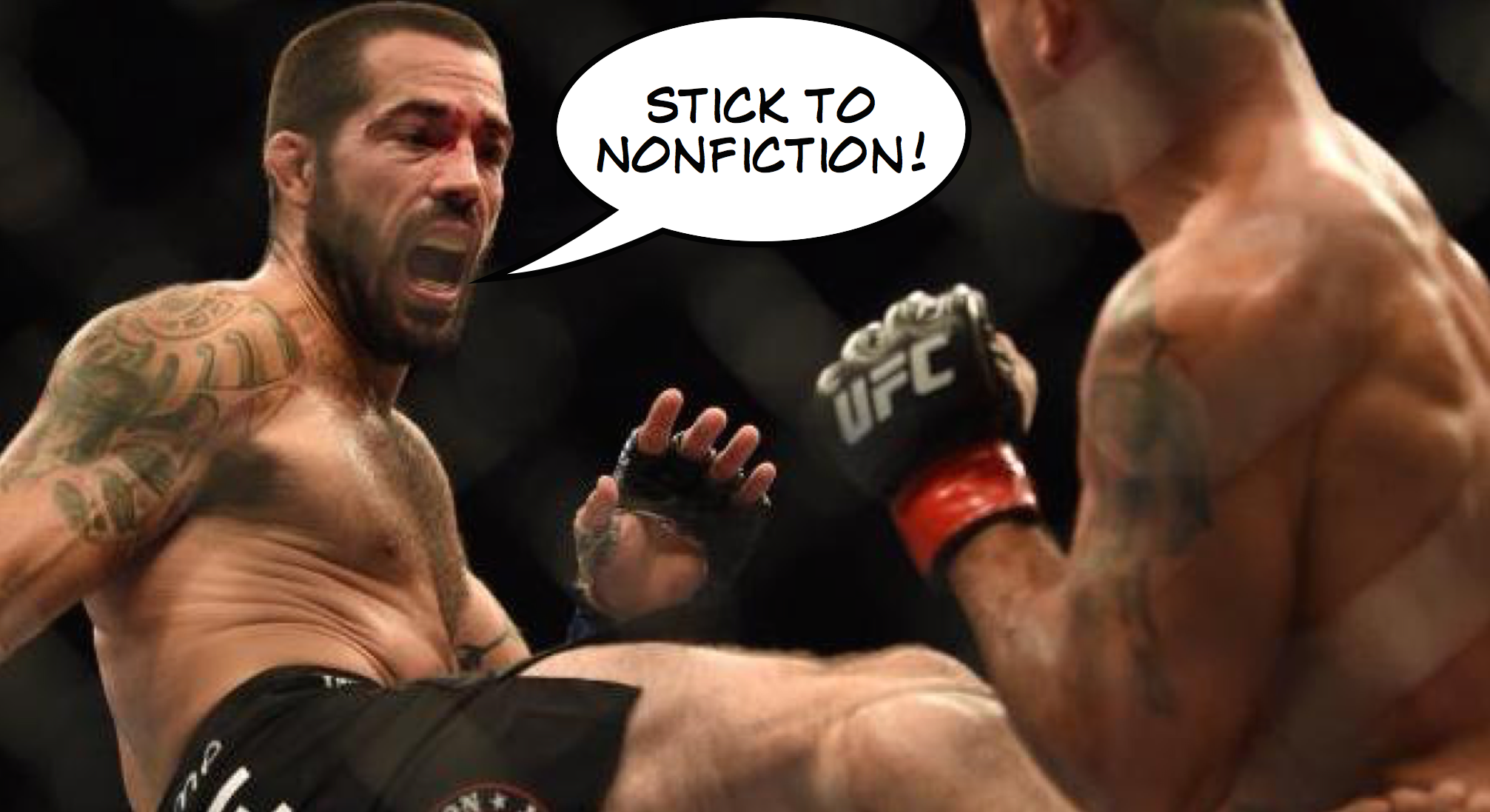
nonficOne of the lowest moments in my writing life occurred when a creative writing professor advised me to “stick with nonfiction.” Oh, she said it gently, but it still struck me with the power of a mixed martial arts (MMA) hammerfist.

I was majoring in editorial journalism at the University of Washington. Attempting to expand my scope, I took a short story writing course. It was a mistake.

I thought I had done adequately during the course. I was even moderately pleased with a couple of my stories. The instructor, on the other hand, well let’s just say she was not impressed with my effort.

She was right. At the time, my ear for good fiction was quite immature. I do not claim that it’s particularly well developed today, but I have written a story about a medieval pilgrimage that I hope to unveil in a year or two.

I was reminded of my literature professor’s grim assessment as I recently read an interview with a pastor, who is also a lawyer, and happens to be a writer as well. His name is Randy Singer.

Singer describes the similarity of his professions by saying “They all require skills in persuasion, in telling stories to illustrate things.” I guess he’s right.

The difference being that pastors tell true stories, authors of fiction write imaginary stories, and attorneys weave tales that lie somewhere in between.

The part of the interview, which appeared in World Magazine, that I found particularly insightful was this:

When your only desire is to tell the story so people don’t even notice the wording, at that point you’ve become a fiction author.

Singer’s description struck me with the force of an MMA ridge hand (a reverse knife-hand). When I came to, I finally knew why composing fiction does not come naturally to me.

I love words too much. Too much to sacrifice them simply for the sake of the story. Oh, I value the message also, but getting there is half the fun.

Although I don’t love words to the degree many poets lust after them, I still possess an affection that does not allow me to view them through purely utilitarian lenses.

To add insult to his literary injury, Singer adds the following, in response to the question of what he learned while writing several successful novels.

Third, to be less verbose and let the action carry the story instead of thinking, “What are some really flowery and cool phrases and words that I can weave into this?”

That’s enough, friend. You made your point. I would have responded a bit more colorfully and fragrantly, but I hear you.

Singer doesn’t cite C.S. Lewis in the interview, but his counsel is consistent with that of the Oxford don. Lewis advised using clear and concrete language, “so as to make quite clear what you mean and make sure your sentence couldn’t mean anything else.” (Personal Correspondence, 1956).

Similarly, Lewis would always argue for the words not to draw attention to themselves. Essentially, they need to get out of the way so the message can come through. “Don’t use adjectives which merely tell us how you want us to feel about the things you are describing. I mean, instead of telling us a thing was “terrible,” describe it so that we’ll be terrified.”

It’s wisdom like that which causes us to recognize C.S. Lewis as the brilliant, gifted, creative, versatile and anointed writer that he was.

As for Singer, perhaps I’ll have to check out one of his legal thrillers. The latest is set in antiquity, with a Roman jurist defending Paul before Nero. Should be quite interesting. Not so good as a nonfiction account of such a trial would be . . . but probably worth reading.

Free Books

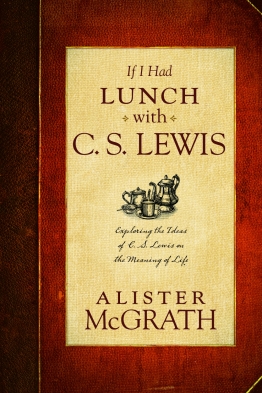
lunchIf you would like to pick up a free kindle copy of a very recent book on C.S. Lewis, you need to hurry. No telling how long the offer will last.

If I Had Lunch with C. S. Lewis by Alister McGrath has a normal (U.S.) price of $17.99, so it’s quite an offer.

But read on for another great deal. Ugh, that sounded like what a shill—which I am not—might say. Allow me to rephrase.

But keep reading. That’s not the only special offer for kindle readers right now. (And remember, even if you don’t own a kindle reader, Amazon offers a free program for use on your computer.)

I rarely look for free kindle titles, since it’s a genuine effort to sort through the chaff to find the grains of wheat. Today, however, I took a quick look, and I’m glad I did.

When this book was first released, just this year, I thought it looked interesting. Only last year, McGrath wrote the biography, C.S. Lewis A Life: Eccentric Genius, Reluctant Prophet.

The free title offers a thematic introduction to Lewis. It’s subtitle reads, Exploring the Ideas of C.S. Lewis on the Meaning of Life. It may be something you might want to suggest to your acquaintances unfamiliar with the Oxford Inkling.

Often, when items or services are offered without cost, it indicates a lack of value. This is why the maxim “you get what you pay for” arose.

However, the rapidly morphing publishing business contradicts the usual accuracy of that principle.

In order to promote their work, and expand their paying audience, a new distribution model has writers offering their books for free. And, alert readers can take advantage of the opportunities.

In light of that, allow me to share with you another time sensitive offer that I found as I browsed further. Right now you can purchase the kindle version of volume three of Lewis’ correspondence for a mere ninety-nine cents. I can’t recall now what I paid for my hardback and kindle copies of the volume, but trust me . . . this is an amazing deal.

Free Bonus Book

Students of C.S. Lewis will recall the significant impression that George MacDonald (1824-1905) made on his life. Right now you can download a collection of 365 quotations from MacDonald’s works for free.

365 Meditations from George MacDonald’s Fiction is edited by David Wilson-Okamura. This work, he writes, “was inspired by George MacDonald, An Anthology: 365 Readings, edited by C. S. Lewis (1946).”

A Caveat about Caveats

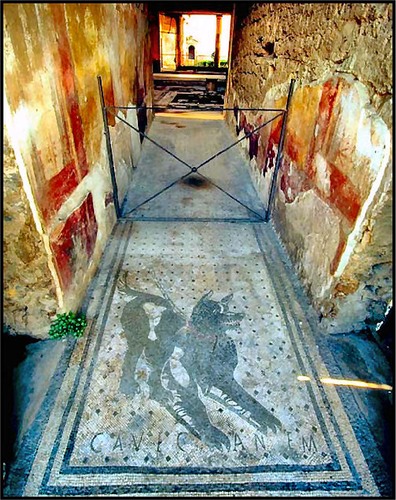
cave canemA caveat, most readers will know, is a warning. One of my favorite usages comes from ancient Rome, where many villa owners procured guard dogs to protect their property. Cave Canem–beware of the dog–became a common motif for entryway mosaics.

One of the most familiar caveats is caveat emptor—buyer beware. Not only is this warning well known, it is absolutely true. Without an express warranty, you may have little hope recouping your loss when something you purchase fails.

Caveats, however, need not infer that the subjects they refer to are dangerous.

For example, the guard dog may well be an affectionate “member of the family,” who warms up quickly, even to strangers who have been invited into the home. Likewise, the new car I’m contemplating purchasing may be ideal for me. Fairly priced, economical to drive, and not so dated in appearance that it shouts, “yes, I’m a grandpa.”

Caveats don’t mean “stay away.” They merely advise us all to think before we act. (And, as universal rules go, this is a very good one.) Caveats, and good parenting, remind us to read the “fine print” before signing anything.

I want to encourage all readers of Mere Inkling to use their God-given intelligence to evaluate what you read on these pages. In the same way, I hope you will all apply your God-instilled conscience to measure my words.

In light of this sincere desire, I encourage you to read the gentle caveats offered below.

General Caveats for Readers

What should readers of Mere Inkling keep in mind as they peruse these posts? First of all, there are a number of general considerations—applicable to everything each of us reads and hears.

1.  Understand the perspective of the writer. What are the assumptions and worldview of the person who wrote the piece? It can be hazardous to simply assume that a writer shares your own values—or even definitions. Many people would be shocked at the diversity of definitions for a word like “church” that roam the internet.

2.  Ensure we read what we think we did. By this I mean that we should reread sections that we find confusing or offensive. It may be we have misread what the author intended. (This is especially true when a writer seeks to play with the English language, and uses phrasing unfamiliar to our ear.) In cases where we have normally enjoyed the writing, but now find ourselves bothered by something, it is always good to ask the writer to clarify what they meant. More often than not, I’ve found this opportunity to elaborate dispels the problem.

3.  Reject the myth that anything you read is absolutely objective. Objectivity, except for mathematics, is essentially impossible. Our education, values, experiences and mood all affect the words we write. The best we can hope for in what we read—something Mere Inkling strives for—is personal honesty and fairness.

Mere Inkling Caveats

1.  Mere Inkling’s author is a fallen human being. By definition, that means that I am imperfect. Not all-knowing, nor always gracious. Imperfect though I am, I try my best to speak here in a forthright, considerate, modestly entertaining and, most importantly, a truthful way. When I fall short of that, feel free to write to me about it.

2.  I am a Christian. I certainly don’t apologize for this. Nor do I apologize for the wish of all disciples of Jesus that everyone might know the joy, forgiveness and peace that comes from abiding in the Vine (a metaphor for Jesus, as described in John 15).

3.  Your host at Mere Inkling is an evangelical Christian. This is a hazy adjective, often used in mutually contradictory ways. I apply it here to myself in the context of holding fast to the basic Christian truths, including the aforementioned desire of God that all people might come to him through his only begotten Son.

4.  I am a catholic Christian. Not a Roman Catholic (with a capital C), but catholic in the word’s creedal sense—a member of the one universal Church. As a catholic Christian, I subscribe to the ecumenical creeds, agreed upon as the fundamental doctrines of the faith during its earliest years. These include the Triune nature of God, the Incarnation miracle, and the atonement. Like my mentor, C.S. Lewis, here at Mere Inkling we focus on “Mere Christianity,” the common core of the faith. I consistently attempt to qualify my words on subjects where there is not a clear consensus.

Each of us has his individual emphasis: each holds, in addition to the Faith, many opinions which seem to him to be consistent with it and true and important. And so perhaps they are. But as apologists it is not our business to defend them. We are defending Christianity; not “my religion.” When we mention our personal opinions we must always make quite clear the difference between them and the Faith itself. (C.S. Lewis, “Christian Apologetics”).

5.  I am a Lutheran Christian. Again, I do not apologize. Lutherans understand we are only a small part of the “one holy catholic and apostolic faith.” Each denomination (indeed, each individual) possesses a distinctive interpretation of the Christian faith. We are free, of course, to associate with that community we believe follows God’s leading most faithfully. (It is a given that no community is without flaw, since no human being is.) I have written more on this aspect of my identity in the next point, and on the “Mercy” tab you will find at the top of the page.

6.  I am an evangelical Lutheran Christian. This is not a formal category, but means that I subscribe to historic Lutheranism as it has been taught and held since the Reformation, rather than some of the current expressions of “religion” that may be labeled Lutheran. In essence, this can be summarized in the “solas” of Lutheran doctrine.

Sola Scripture – Scripture Alone meaning that the Bible, the Jewish and Christian Scriptures, are the ultimate authority for determining true faith.

Sola Gratia – Grace Alone meaning salvation is an unearned gift of God, given not because we have earned it.

Sola Fides – Faith Alone meaning that God’s grace is apprehended not through wisdom, good works, or any means other than a simple trust in the promise. Ironically, this faith itself is also a gift of God.

7.  I am a pastor. While pastors with seminary educations do study Greek, Hebrew, Theology and assorted other subjects, we are not the same as what most people mean by the word “theologians.” Pastoral Theology is distinct from Systematic Theology. The former focuses on practical ministry to individuals, while the latter is most concerned with abstract matters. While I also possess a second graduate degree, my Master of Theology degree (much different than an M.A. in theology) was earned in the study of Early Church History. My concern remained the work of God among everyday human beings, rather than scholastic philosophy.

8.  While I never intentionally write anything with the goal of offending any reader, I recognize it is impossible to avoid all offense. (Even the least controversial prose is capable of offending.)

Allow me to illustrate how simple truths can elicit dramatically different responses, with two simple declarations.

God loves all people. This is true, and inoffensive. Most people today, and all orthodox (biblical) Christians would agree with the statement.

Not all people will go to heaven. This too is true. However, it provokes great outcries from many quarters, including some religious organizations that arise out of the Judeo-Christian tradition. Jesus himself offered “hard sayings” that elicited grumbling. John’s Gospel records a powerful account of this, occurring immediately after the Feeding of the Five Thousand.

When many of his disciples heard it, they said, “This is a hard saying; who can listen to it?” But Jesus, knowing in himself that his disciples were grumbling about this, said to them, “Do you take offense at this? . . . The words that I have spoken to you are spirit and life. But there are some of you who do not believe.” . . . “This is why I told you that no one can come to me unless it is granted him by the Father.” After this many of his disciples turned back and no longer walked with him.

C.S. Lewis referred to the alienating nature of some truths when he wrote the essay, “Cross-Examination.”

I believe that there are many accommodating preachers, and too many practitioners in the church who are not believers. Jesus Christ did not say “Go into all the world and tell the world that it is quite right.” The Gospel is something completely different. In fact, it is directly opposed to the world.

9.  I am an American. Again, no apologies. I applaud much of what this nation has valued and shared during its history. I regret many of the mistakes the United States has made, and continues to make. I recognize how fortunate I have been to live in a nation with access to educational and medical resources not available to all. I genuinely appreciate other cultures and have been privileged to live in Europe, Asia and the Pacific. The right I treasure most—and one I pray will be extended to all people—is freedom of religion.

10.  I welcome offline correspondence. I recognize many people are reluctant to post a comment on a blog, which is visible to the public. I also realize that some readers would appreciate privately offering a comment or posing a question. I welcome this, and encourage you to use the form below to write to me. I will respond from my personal email account and we can discuss sensitive matters in greater depth. I must say in advance, however, that I do not have the leisure time to aid with any research. Similarly, while I am happy to offer general pastoral advice, only a fool or con artist would presume to conduct serious counseling or therapy via email. (You need a local pastor or counselor for that.) That said, I do enjoy spirited and honest discourse, so d feel free to contact me.

← Back

Thank you for your response. ✨

_____

The picture at the top of the page comes from the entryway to the “House of the Tragic Poet” in Pompeii.

Avoiding Gadzookeries

gadzookeryWriting quality historical fiction is challenging. This is especially true if one wishes to avoid the common crutch that a talented writer of the last century first labeled “gadzookery.”

And just what is this faux pas we should avoid when writing about the past? Well, it relates most directly to the dialog placed on the lips of historical figures. The offensive technique involves the overuse of archaic expressions or phrases. (Some would argue it includes any use of any archaisms.)

If the word gadzookery sounds a tad, how shall I put it, “goofy” to you, you may prefer using another word that means the same thing: “tushery.” Tushery was coined by Robert Louis Stevenson. Way back in the nineteenth century.

Gadzookery is a newer version, insulting the same lazy writing technique. I believe it may have been coined by Rosemary Sutcliff (1920-1992). Sutcliff’s historical influence has exerted a literary influence on my life second only to C.S. Lewis.*

The article about Sutcliff in The Oxford Encyclopedia of Children’s Literature praises her work, saying, “She carefully creates dialogue in her novels that recollects the speech of a bygone era without falling into what she termed ‘gadzookery.’”

Having tested the waters of historical fiction myself, I know this to be far more difficult that it may sound.

Sutcliff had several things in common with C.S. Lewis. Both wrote for adults and for children. (It was her young adult series about the decline of Roman influence in Britain that sparked my own lifelong interest in Rome.)

Both authors also received the Carnegie Medal for their work. When Lewis was awarded his, he received a congratulatory letter from Pauline Baynes, who had illustrated several of his books. He responded quite graciously.

Dear Miss Baynes, Very nice to hear from you again, and thanks for sending on the book, which I have returned to Lane. Thanks for your congratulations on the Carnegie, but is it not rather ‘our’ Medal? I’m sure the illustrations were taken into consideration as well as the text. I am well, and as happy as a man can be whose wife is desperately ill.

Although C.S. Lewis had married, quite late in life, the two authors were alike in spending most of their life single. Sutcliff, in fact, lived with her parents during most of her life, having suffered crippling arthritis as a child. She did not resent remaining unmarried. In a 1992 interview she said,

Beatrix Potter wrote all her gorgeous stories when she was very lonely and not very happy—after she married, she never wrote another thing. Nothing worth reading, anyway.

Another similarity between the two was that they both fell under the powerful sway of myth during their childhoods. They used their familiarity with its rich echoes to imbue their own work with themes that flowed far beyond the familiar channels travelled by other writers.

Each of them took their readers seriously, and refused to speak down to them. That is why they share one more quality I wish to mention in closing—their high standards. Neither Lewis nor Sutcliff could tolerate poor writing. And their finely tuned skills meant neither ever needed to resort to gadzookery.

______

* Excepting, of course, the Bible itself, which is literature of an entirely different sort. I don’t consider it fair to compare mortal writers, no matter how inspired, to a volume I regard as God’s written word.

Introducing Anatole France

papeThere’s always a new author to meet. Some are more worth meeting than others.

I was introduced to Anatole France (1844-1924) when I saw him listed on the “must read” list of F. Scott Fitzgerald.

I’m not a big Fitzgerald fan, but as an amateur literary historian, I was curious about how this particular list was recovered. Apparently, he had dictated it to one of his nurses, several years before his death. However, the list only turned up last year, having lain unnoticed in the nurse’s effects.

The France title that Fitzgerald deemed essential was The Revolt of the Angels. Its importance to him is highlighted by the fact that this relatively short list only included twenty-two titles. And one of that mere score of selections was The Revolt of the Angels.

The angelic dimension of the work is what intrigued me. Angels, of course, are real beings. They’re distinct from people (contrary to the pervasive contemporary notion that when people die they “become” angels).

There actually was an angelic revolt, and there are several references to it in the Scriptures. “How you are fallen from heaven,
O Day Star, son of Dawn!” (Isaiah 14:12).

I was curious whether France was writing about this ancient event. I was also intrigued by Fitzgerald’s interest in the volume, given its subject.

I was disappointed.

It turns out that, like Mark Twain, France was sympathetic to the Devil. I’m sure he thought himself quite the wit when he wrote, in reference to the Bible, “We have never heard the devil’s side of the story, God wrote the whole book.”

I don’t have time to read texts like this—when there is more than enough good literature to keep me occupied for several lifetimes. However, it appears to be based on Gnostic concepts with God (the Creator of this world) viewed as an imperfect demiurge. His incompetence, it seems, justifies the heavenly revolt.

Suffice it to say, the book is commended for reading by the Freedom From Religion Foundation. That sort of endorsement speaks volumes.

Here, however, is a random paragraph. It may be illustrative of the tone of the work, even though pulled from its context. The speaker is, I believe, one of the positive characters in the book. While France himself was an atheist, his sympathetic character summarizes a pagan cosmology quite elegantly.

Young Maurice’s guardian angel [said] “I argue, like you, in the language of human beings. And what is human language but the cry of the beasts of the forests or the mountains, complicated and corrupted by arrogant anthropoids. How then . . . can one be expected to argue well with a collection of angry or plaintive sounds like that?

Angels do not reason at all; men, being superior to the angels, reason imperfectly. I will not mention the professors who think to define the absolute with the aid of cries that they have inherited from the pithecanthropoid monkeys, marsupials, and reptiles, their ancestors! It is a colossal joke! How it would amuse the demiurge, if he had any brains!”

That is actually a rather provocative quote, and I’m sure it may lead some to explore the text even further. I certainly don’t object to that, and would be curious to hear back from anyone familiar with the book. I would especially like to see the reaction of Christians to The Revolt of the Angels.

If you are interested in a more creative fictional treatment of fallen angels, be sure to read C.S. Lewis’ The Screwtape Letters. While the presentation is truly groundbreaking, Lewis’ take on the motives and nature of these defeated beings is actually based on reality. Cast from the heavens they are consumed with rage and hatred of God.

A positive note about Anatole France

Whatever I think about the writer’s theology, I did read several wise quotations attributed to him. I’d like to close with these, as they may be more edifying than our discussion of Gnostic cosmology.

“Nine tenths of education is encouragement.”

“Some succeed because they are destined to; most succeed because they are determined to.”

“If 50 million people say a foolish thing, it is still a foolish thing.”

“When a thing has been said and well said, have no scruple; take it and copy it.”

And my favorite:

“Until one has loved an animal, a part of one’s soul remains unawakened.”

_____

The illustration above is the work of Frank C. Papé (1874-1972) an English book illustrator. It comes from another of France’s “religious” works.

Corrupted Poetry

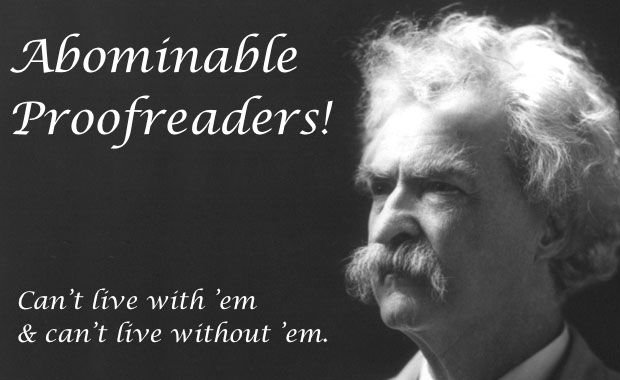
proofreadersA sloppy proofreader can ruin the most praiseworthy writing. (Just ask Mark Twain.)

If you’ve ever seen something you wrote poorly edited—or including introduced errors—you know personally just how criminal this is.

My choice of adjectives reveals that these tragedies are nearly always mistakes, and not malevolent. Despite that fact, they disrupt the flow and impugn the skill of truly good writers.

I was thinking about this subject today after running across the following passage during my research of the American Civil War. An 1861 newspaper lifted the following from an issue of the Boston Courier.

The Errors of the Press—“Really,” said a printer, in conversing with a literary man about errors of the press, “gentlemen should not place such unlimited confidence in the eyesight of our hard worked and half-blinded reader of proofs; for I am ashamed to say that we utterly ruined one poet through a ludicrous misprint.”

“Indeed! and what was the unhappy line?”

“Why, sir, the poet intended to say:

     ‘See the pale martyr in a sheet of fire;’

instead of which we made him say:

     ‘See the pale martyr with his shirt on fire.’”

The critics were down fierce on the poet; but we don’t see why. A man “with his shirt on fire” must be a highly poetical object, as his life would be in imminent danger.—Boston Courier.

I can easily picture the exhausted proofreader unintentionally substituting a burning garment for a consuming inferno. It made sense to him. And, since he was unlikely to have an ear tuned to poetic imagery, the practical reference to ignited clothing must be what the poet actually meant.

This reminds me that it’s impossible to have too many eyes cast upon the final draft of a work before it goes to print. Take care of your friends and family who offer you the gift of proofreading; their talents deserve to be appreciated and rewarded.

Mark Twain’s Thoughts on the Subject

Samuel Clemens got his own start in the newspaper business and knew firsthand how challenging proofreading was. However, that did not prevent him from venting about the poor proofreading of his novel More Tramps Abroad.

The following was written to his publishers in regard to the printer’s shortcomings. The 1897 letter clearly reveals Twain’s colorful (and occasionally vulgar) writing.

I give it up. These printers pay no attention to my punctuation. Nine-tenths of the labor & vexation put upon me by [them] consists in annihilating their ignorant & purposeless punctuation & restoring my own.

This latest batch [also has] my punctuation ignored & their insanities substituted for it. I have read two pages of it—I can’t stand any more. If they will restore my punctuation themselves & then send the purified pages to me I will read it for errors of grammar & construction—that is enough to require of another who writes as legible a hand as I do, & who knows more about punctuation in two minutes than any damned bastard of a proof-reader can learn in two centuries.

Conceive of this tumble-bug interesting himself in my punctuation—which is none of his business & with which he has nothing to do—& then instead of correcting mis-spelling, which is in his degraded line, striking a mark under the word & silently confessing that he doesn’t know what the hell to do with it!

The following year he wrote a mellower review of the work of the proofreader. Not in the heat of correcting a muddled manuscript, he was able to comment on the benefits afforded by good proofreading.

You think you are reading proof, whereas you are merely reading your own mind; your statement of the thing is full of holes & vacancies but you don’t know it, because you are filling them from your mind as you go along.

Sometimes—but not often enough—the printer’s proof-reader saves you–& offends you—with this cold sign in the margin: (?) & you search the passage & find that the insulter is right—it doesn’t say what you thought it did: the gas-fixtures are there, but you didn’t light the jets.

I must say that I have been rescued by my proofreaders far more frequently than I have been abused by them. May God grant you the same blessing.

Civilized Savages

civilization-and-savageryWhat are the proper criteria for determining who is civilized? If you asked a score of people, you would probably end up with twenty different opinions.

In continuing my research about America’s first woman chaplain, I encountered an early American teaching resource that offered great insight into education during the early nineteenth century.

Some of it was quaint—“goats were made as profitable to the farmer as sheep.”

Some of it was insightful—“In America the Grecian architecture is prevailing, as it is better adapted than the Gothic to small buildings, and does not require splendid edifices to display its beauty.”

The text, Peter Parley’s Universal History, on the Basis of Geography, was used in schools and homes.

After finding confirmation of the point I was researching, I couldn’t resist skimming through the volume. Out of its myriad lessons, the one that got me thinking most seriously was a discussion of relative levels of civilization.

At the end of each lesson, several questions are posed. In this case:

Questions: What would you observe in traveling through other countries? What of people in a savage state? What of people in the barbarous state? What of people in the civilized state? What of people in the highest state of civilization?

Preceding these questions is the lesson proper, from which I now quote passages that correspond to the questions just listed.

In some countries the people live in huts built of mud or sticks, and subsist by hunting with bow and arrow. These are said to be in the savage state . . .

In some countries the people live in houses partly of stone and mud. They have few books, no churches or meeting-houses, and worship idols. . . . These are said to be in the barbarous state . . .

In some countries the inhabitants live in tolerable houses, and the rich have fine palaces. The people have many ingenious arts, but the schools are poor, and but a small portion are taught to read and write. . . . which may be called a civilized state.

In many parts of Europe, and in the United States, the people live in good houses; they have good furniture, many books, good schools, churches, meeting-houses, steamboats and railroads. These are in the highest state of civilization.

It appears that Peter Parley (the pseudonym of Samuel Griswold Goodrich) considered two factors to be the clearest measures of civilization—the quality of a society’s domiciles, and the access to learning and increase in literacy.

These are not inappropriate measures, although the latter dwarfs the former in significance.

I realize these lessons are intended for elementary education, so I don’t fault Goodrich for failing to address the subject from a more philosophical or mature angle. Nevertheless, I could not help wondering whether the societies that have attained the “highest state of civilization” are truly the least barbaric.

In some ways, the societies that have attained the loftiest technological levels might also be considered among the most savage.

I don’t have the time or inclination to pursue this thought any further in Mere Inkling, but I offer it to you. Some readers will agree that it merits reflections and others will consider it absurd.

Before moving on the Inklings, though, I wish to share a pertinent bit of wisdom from economist Thomas Sowell. “Each new generation born is in effect an invasion of civilization by little barbarians, who must be civilized before it is too late.”

C.S. Lewis thought, and wrote, a great deal about civilization. In English Literature in the Sixteenth Century there is a delightful remark, made in passing, that it is possible to retreat from civilization, once attained.

From the varied excellence of the fourteenth century to the work of the early sixteenth it is a history of decay; so that in turning from the Scotch poetry of the age to the English we pass from civilization to barbarism.

I end with a longer citation from C.S. Lewis which connects uniquely with the mindset with which Goodrich penned his textbook. Lewis also affirms true education, and the advancement of humanity towards that for which it was created, as the genuine mark of civilization.

One of the most dangerous errors instilled into us by nineteenth-century progressive optimism is the idea that civilization is automatically bound to increase and spread. The lesson of history is the opposite; civilization is a rarity, attained with difficulty and easily lost. The normal state of humanity is barbarism, just as the normal surface of our planet is salt water. Land looms large in our imagination of the planet and civilization in our history books, only because sea and savagery are, to us, less interesting.

And if you press to know what I mean by civilization, I reply “Humanity,” by which I do not mean kindness so much as the realization of the human idea. Human life means to me the life of beings for whom the leisured activities of thought, art, literature, conversation are the end, and the preservation and propagation of life merely the means. That is why education seems to me so important: it actualizes that potentiality for leisure, if you like for amateurishness, which is man’s prerogative.

You have noticed, I hope, that man is the only amateur animal; all the others are professionals. They have no leisure and do not desire it. When the cow has finished eating she chews the cud; when she has finished chewing she sleeps; when she has finished sleeping she eats again. She is a machine for turning grass into calves and milk—in other words, for producing more cows. The lion cannot stop hunting, nor the beaver building dams, nor the bee making honey. When God made the beasts dumb He saved the world from infinite boredom, for if they could speak they would all of them, all day, talk nothing but shop. (“Our English Syllabus”).

_____

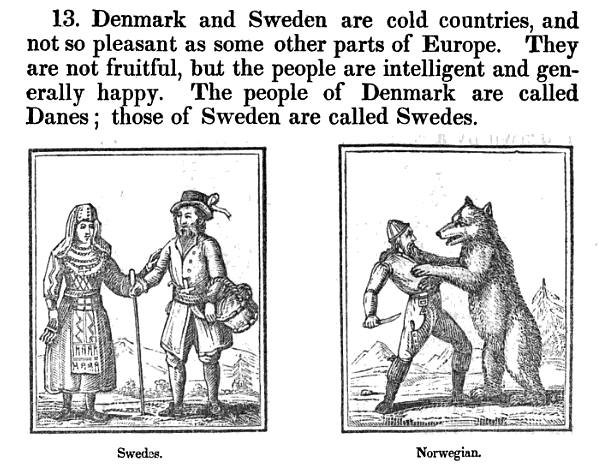
An illustration from the book, which taught generations of Americans that the heirs of the Vikings were still a picturesque and virile people.

scandinavians