C.S. Lewis, the Brothers Grimm & Snow White

You may blame the recent cinematic debacle that is Snow White on a declining Film Studio or the Brothers Grimm, but C.S. Lewis is innocent.

That’s not to say the Grimms didn’t have an influence on the great Oxbridge professor, a subject we’ll explore momentarily. But it was the German folk tales published by academics Jacob and Wilhelm Grimm who published the classic fairy tales that Walt Disney mined so effectively. 

They also popularized CinderellaHansel and GretelLittle Red Riding HoodThe Princess and the Frog, and Rapunzel. Disney began the transformation of these tales into visual treasures as early as 1921 when he founded Laugh-O-Gram Studio in Kansas City, Missouri.

In addition to films, over the years Walt gleaned memorable Grimm stories for a multitude of cartoon shorts, including The Brave Little Tailor and The Four Musicians of Bremen.

Obviously, Walt Disney himself respected the source material for the stories and wielded his editorial prerogative in an appropriate manner. Tragically, the same cannot be said for his corporate heirs. Likewise, the Brothers Grimm bear no culpability in this area.

C.S. Lewis, J.R.R. Tolkien & Snow White

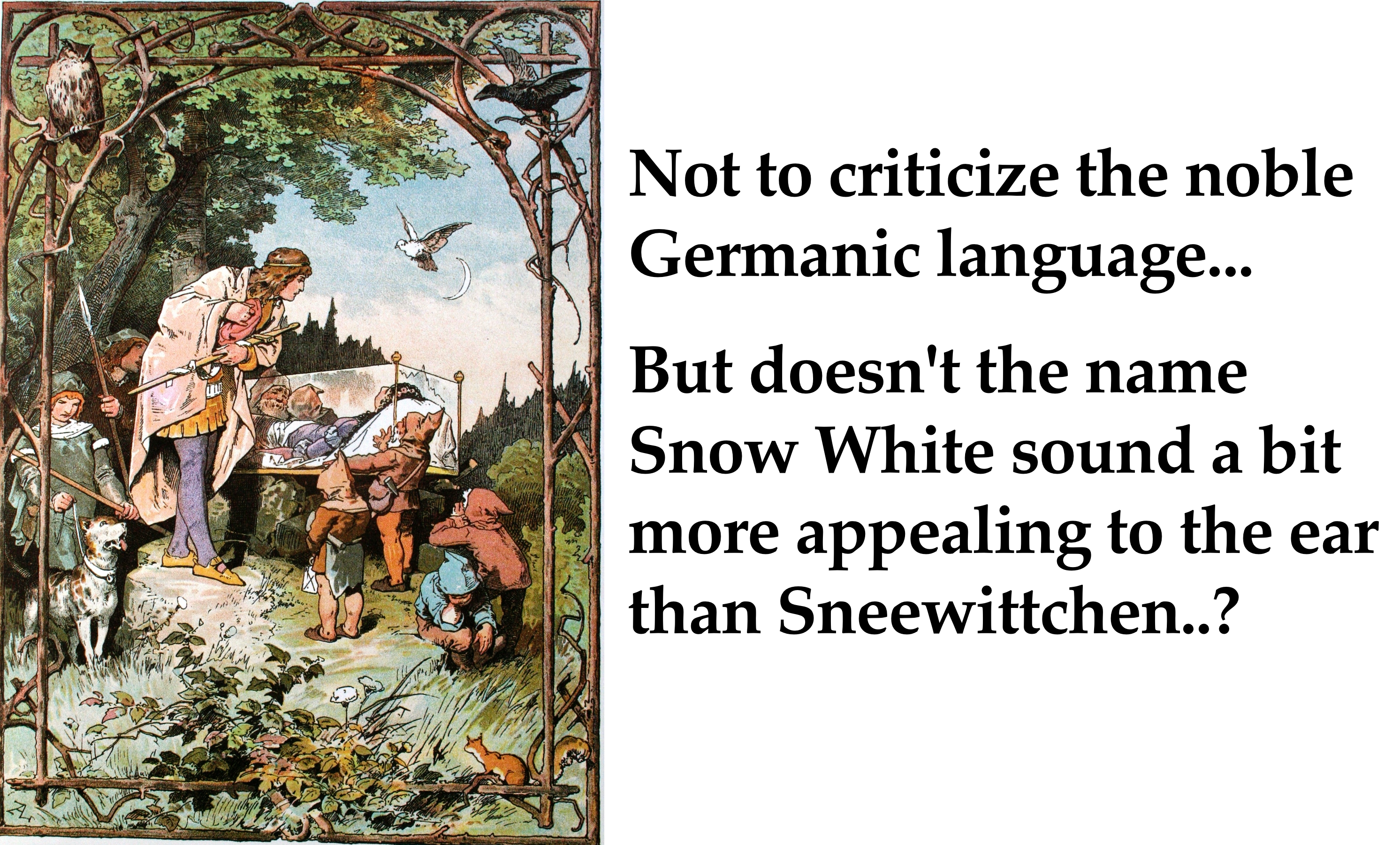
The truth is, although Lewis and Tolkien appreciated literary fairy tales, neither of the preeminent Inklings were enamored with Disney’s animated treatment of the stories. Curiously, the two distinguished dons actually attended the theater together to view the trailblazing novelty that was Snow White.

They were particularly disappointed with the dwarves, seeing just how different they were from the genuine legends about them. Lewis even wrote “Dwarfs ought to be ugly of course, but not in that way.” Atlas Obscura has an entertaining article about their “movie date” and notes some of the elements they also enjoyed in the feature.

In his lectures published as A preface to Paradise lost, C.S. Lewis elaborates on his response to the Disney version of the tale.

That strange blend of genius and vulgarity, the film of Snow-White, will illustrate the point. There was good unorginality in the drawing of the Queen. She was the very archetype of all beautiful, cruel queens: the thing one expected to see, save that it was truer to type than one dared to hope for.

There was bad originality in the bloated, drunken, low-comedy faces of the dwarfs. Neither the earthiness, the avarice, nor the wisdom of true dwarfs was there, but an imbecility of arbitrary invention.

But in the scene where Snow-White wakes in the woods both the right originality and the right unoriginality were used together. The good unoriginality lay in the use of small, delicate animals as comforters, in the true Märchen [fairy tale] style. The good originality lay in letting us at first mistake their eyes for the eyes of monsters.

If you want to read more about the subject, you can do no better than read Joe Christopher’s article on the subject.

For an interesting argument that fellow Brit G.K. Chesterton would have loved Snow White for the very reason that moved the Inklings to criticize it, see “Tolkien and Lewis disliked Snow White. You know who wouldn’t have?

C.S. Lewis & Grimm’s Fairy Tales

Like his friend, J.R.R. Tolkien, C.S. Lewis was a champion of classical fairy tales. Neither was apologetic for it, although Lewis admitted to being shy about it when he was young. In an essay titled “On Three Ways of Writing For Children,” he wrote,

When I was ten, I read fairy tales in secret and would have been ashamed if I had been found doing so. Now that I am fifty I read them openly. When I became a man I put away childish things, including the fear of childishness and the desire to be very grown up.

In a great post called “Old Enough For Fairy Tales: C.S. Lewis’ “The Chronicles of Narnia” the writer describes this distinction to which Lewis alludes.

The Chronicles of Narnia are not children’s stories. They are fairy tales—but that is precisely why they are not children’s stories. If you can’t understand, you haven’t been listening. Go back and read the quote from Lewis’ essay again. Children are not the only audience for fairy tales.

In 1954, C.S. Lewis apologized to a German professor for being unable to understand the nuances of his volume on philosophy. In doing so, he referred to his youthful reading of the Brothers Grimm in their original German (available at Internet Archive).

I look forward to reading the book (when the translation arrives! My German is wretched, and what there is of it belongs chiefly to the libretto of the Ring and Grimm’s Märchen – works whose style and vocabulary you very possibly do not closely follow).

If you are in the mood for reading Grimm’s Fairy tales today, and your German is sadly lacking, Project Gutenberg has just the translation for you . . . as long as you can read English.


Addendum [added 10 April 2025]

The Brothers Grimm were far more than simply folklorists. They were respected professors at the University of Göttingen. They were devout Christians and worked with other prominent Germans. 

Goethe assisted them at a crucial moment in collecting their tales, and the philosopher Friedrich Schleiermacher provided copyediting assistance. Jacob’s work on German mythology had a pronounced influence on the composer Richard Wagner (World Magazine).

They also began compiling the Deutsches Wörterbuch (Germany dictionary) in 1838, with the first volumes published in 1854. It was the first dictionary to include historical usages of each word, preceding the Oxford English Dictionary, which was initiated in 1857 with its first edition published in 1884.


Bonus Trivia: The dwarves were unnamed until their debut on Broadway in 1912. And on that day they were christened Blick, Flick, Glick, Plick, Snick, Whick and Quee.
C.S. Lewis, J.R.R. Tolkien & Naomi Mitchison

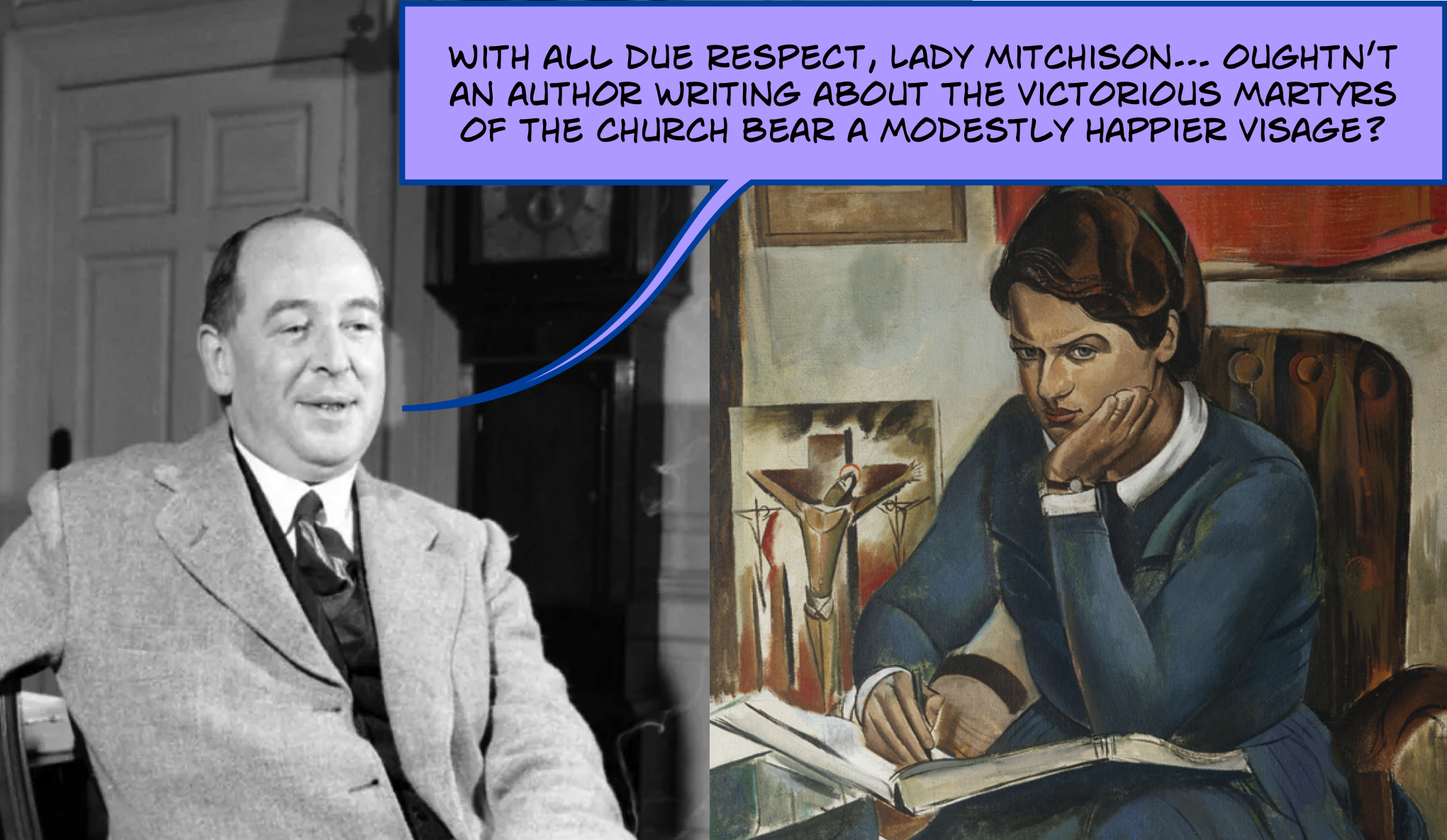
Have your feelings about particular authors changed over time? C.S. Lewis’ attitude toward the work of prolific novelist Naomi Mitchison illustrates this type of progression.

Mitchison’s work possesses a direct link to another Oxford Inkling – J.R.R. Tolkien – whose Fellowship of the Ring she read in proof and favorably reviewed. Brenton Dickieson provides a priceless letter written by Tolkien to Mitchison in 1954.

Naomi Mary Margaret Mitchison was a Scottish novelist who lived more than a century (1897 – 1999). She penned more than ninety books, primarily historical fiction, and including science fiction.

With the outbreak of the First World War, Mitchison joined a Voluntary Air Detachment in a London hospital. (Other familiar women who served in a VAD included Agatha Christie and Amelia Earhart.)

Politically she identified as a Socialist. She was sufficiently leftist that George Orwell regarded her as unsuited for writing anti-Soviet materials for the United Kingdom during the Cold War.

Mitchison’s brother, J.B.S. Haldane, did not equivocate on his radical views, announcing his position as a Marxist. He was a scientist and his atheism brought him into serious disagreement with the Christian views of C.S. Lewis. (I will devote my next post to that interaction.)

Coincidentally, artist Pauline Baynes (who also worked with C.S. Lewis and J.R.R. Tolkien), provided the illustrations for at least one of Mitchison’s children’s books, Graeme and the Dragon. This quick review offers a concise synopsis and discussion of “the charming illustrations [which] go a long way toward making this a fun read.”

An additional coincidence: the same year Lewis published The Lion, the Witch and the Wardrobe, Mitchison also published a fantasy novel for children. The Big House involves time travel and some occultic themes associated with Halloween, etc.

For a thorough synopsis of The Big House and comparison to Lewis’ Chronicles of Narnia, check out this essay from the University of Glasgow. (That reviewer’s preference is clearly for Mitchison’s more complex approach with its themes related to class struggle.)

C.S. Lewis’ Perspective on Naomi Mitchison

I cannot locate any mention of C.S. Lewis by Mitchison, but he did mention her in passing in several pieces of correspondence. In essence, he praised her skill, but was put off by her graphic use of violent imagery.

In a 1932 letter to Arthur Greeves, he writes:

I thought we had talked about Naomi Mitchison before. I have only read one (Black Sparta) and I certainly agree that it ‘holds’ one: indeed I don’t know any historical fiction that is so astonishingly vivid and, on the whole, so true.

I also thought it astonishing how, despite the grimness, she got such an air of beauty–almost dazzling beauty–into it. As to the cruelties, I think her obvious relish is morally wicked, but hardly an artistic fault for she could hardly get some of her effects without it.

But it is, in Black Sparta, a historical falsehood: not that the things she describes did not probably happen in Greece, but that they were not typical–the Greeks being, no doubt, cruel by modern standards, but, by the standards of that age, extremely humane.

She gives you the impression that the cruelty was essentially Greek, whereas it was precisely the opposite. That is, she is unfair as I should be unfair if I wrote a book about some man whose chief characteristic was that he was the tallest of the pigmies, and kept on reminding the reader that he was very short. I should be telling the truth (for of course he would be short by our standards) but missing the real point about the man–viz: that he was, by the standards of his own race, a giant. 

Still, she is a wonderful writer and I fully intend to read more of her when I have a chance.

C.S. Lewis echoed his concern in a 1942 letter to another of his regular correspondents, Sister Penelope. “I gave up Naomi Mitchison some time ago because of her dwelling on scenes of cruelty. But I recognise real imagination and a sort of beauty in the writing.”

In 1951, C.S. Lewis congratulated author Idrisyn Oliver Evans (1894–1977) on the publication of The Coming of a King; A Story of the Stone Age. Ironically, speculative fiction set in this ancient era, referred to as “Prehistoric SF,” was also the setting of works such as H.G. Wells’ Story of the Stone Age series, which you can read here. Naomi Mitchison also dabbled in the prehistoric field. Lewis wrote to Evans: 

I congratulate you. And I think it is a great thing to put that idea of the Stone Age – which is at least as likely to be the true one – into boys’ heads instead of Well’s or Naomi Mitchison’s. It’s all good. The marriage customs are amusing . . . I hope it will be a great success. 

In 1959, C.S. Lewis provided some wise counsel to a young, aspiring author. The American student was contemplating a volume about the Roman subjugation of Gaul, which Lewis encouraged.

A story about Caesar in Gaul sounds very promising. Have you read Naomi Mitchison’s The Conquered? And if not, I wonder should you? It might be too strong an influence if you did (at any rate until your own book is nearly finished). On the other hand, you may need to read it in order to avoid being at any point too like it without knowing you are doing so.

I don’t know what one should read on Gaul. Apart from archaeological finds (Torques and all that) I suppose Caesar himself is our chief evidence? He will be great fun and I hope you will enjoy yourself thoroughly.

Which side will you be on? I’m all for the Gauls myself and I hate all conquerors. But I never knew a woman who was not all for Caesar – just as they were in his life-time.

C.S. Lewis’ most significant mention of Naomi Mitchison occurs in his brief 1943 essay, “Equality.”

It delivers a brilliant discussion of the subject, one that merits full reading. He commends one of Mitchison’s insights into inequality – although, ironically, she relates it to eroticism.* (You must read it in full context to understand how it supports his independent argument.)

This last point needs a little plain speaking. Men have so horribly abused their power over women in the past that to wives, of all people, equality is in danger of appearing as an ideal. But Mrs. Naomi Mitchison has laid her finger on the real point. Have as much equality as you please – the more the better – in our marriage laws, but at some level consent to inequality, nay, delight in inequality, is an erotic necessity.

Mrs. Mitchison [in The Home and a Changing Civilization] speaks of women so fostered on a defiant idea of equality that the mere sensation of the male embrace rouses an undercurrent of resentment. Marriages are thus shipwrecked.

A final reference to Mitchison brings us back around to my early note that she reviewed Fellowship of the Ring. C.S. Lewis refers to her review in his own, suggesting that she has not gone quite far enough in her praise.

Nothing quite like it was ever done before. ‘One takes it,’ says Naomi Mitchison, ‘as seriously as Malory.’ But then the ineluctable sense of reality which we feel in the Morte d’Arthur comes largely from the great weight of other men’s work built up century by century, which has gone into it.

The utterly new achievement of Professor Tolkien is that he carries a comparable sense of reality unaided. Probably no book yet written in the world is quite such a radical instance of what its author has elsewhere called ‘sub-creation.’

Sadly, Naomi Mitchison was less enamored with the subsequent volumes in The Lord of the Rings . . . but this post has already condensed more than enough information.


* An article in Michigan Feminist Studies notes how Naomi Mitchison’s recurrent references to sexual themes distracted from broader matters throughout her literary career.

Despite Mitichison’s attempts to move the discussion of her body of work from the salacious, it is the frank and open inclusion of sexuality that continues to intrigue her critics and reviewers. Racy, heated passages of Mitchison’s historical novels inspired comment from poet W.H. Auden in the 1930s (“Monstrous Sex: The Erotic in Naomi Mitchison’s Science Fiction”).

The essay’s thesis is what one might expect in a journal devoted to contemporary feminism.

I intend to demonstrate that the ribald sexuality of Mitchison’s work registers as more than merely provocative. Sexual encounters between female characters and aliens, as well as those between women, threaten an imperialising capitalism that dictates who may be loved in a gendered, racialised order.

C.S. Lewis & Assassinations

The brilliant author C.S. Lewis died on the same day that an American president was assassinated. The violent death of John F. Kennedy in November of 1963 eclipsed Lewis’ own passing, so many people were unaware of it for some time. Yet on that autumn day, both Camelot and Narnia lost their inspirations.

Unfortunately, Kennedy’s shooting was not the only political assassination that was connected in a manner to C.S. Lewis’ life. Archduke Franz Ferdinand Carl Ludwig Joseph Maria of Austria was the heir apparent to the throne of Austria-Hungary. A nineteen year old political activist cold-bloodedly murdered the archduke and his wife, Sofie.

Franz and Sophie had married for love, despite her inadequate social rank, which resulted in a morganatic marriage. In recent years such unions have become more common, but at the time, it was a serious matter. The archduke was forced by his uncle, the emperor, to accept that their descendants would never have a right to the throne.

In a convoluted fashion, Ferdinand’s death nearly led to C.S. Lewis’ own. The 1914 assassination was the spark that set the globe on fire during the First World War. And, during that grim conflict, C.S. Lewis was severely wounded by an artillery shell that killed friends standing nearby.

The Causes and Impact of Political Assassinations” was published by the Combating Terrorism Center at West Point. It begins with the fact that “political assassinations have been part of social reality since the emergence of communal social frameworks . . .” And so, since social frameworks will forever exist, they continue.

Humanity’s Violent History

Assassination has been a relatively common practice throughout human history. This shouldn’t surprise anyone who knows the sad story of Abel and his angry brother, Cain. 

Philip II of Macedon, the father of Alexander the Great, was killed attending the wedding of his daughter Cleopatra (no, not that Cleopatra). Later Cleopatra, as a widow, would be assassinated herself by one of her unsuccessful suitors.

Three centuries later, Julius Caesar was murdered by the political elite of Rome, who feared his growing influence. And in 453, one of Rome’s greatest enemies, Attila the Hun, was arguably murdered on his wedding night by his new bride, Ildico.

Several assassinations are recorded in the Bible. Over such a lengthy and turbulent historical period, that is unsurprising. The two excerpts below have links to the fuller accounts.

[Canaanite general] Sisera fled away on foot to the tent of Jael, the wife of Heber the Kenite, for there was peace between Jabin the king of Hazor and the house of Heber the Kenite. And Jael came out to meet Sisera and said to him, “Turn aside, my lord; turn aside to me; do not be afraid.” So he [entered] the tent, and she covered him with a rug. . . . And he said to her, “Stand at the opening of the tent, and if any man comes and asks you, ‘Is anyone here?’ say, ‘No.’” But Jael the wife of Heber took a tent peg, and took a hammer in her hand. Then she went softly to him and drove the peg into his temple until it went down into the ground while he was lying fast asleep from weariness (Judges 4).

Joab took Amasa by the beard with his right hand to kiss him. But Amasa did not observe the sword that was in Joab’s hand. So Joab struck him with it in the stomach and spilled his entrails to the ground without striking a second blow, and he died (2 Samuel 20).

As a sort of counterbalance to these “positive” instances – elimination of Israel’s enemies – you may want to read about King David’s condemnation of the assassinations of his political rivals, men to whom he would have extended mercy. When two brothers sought a reward for murdering King Ish-bosheth, Saul’s son, David declared “when wicked men have killed a righteous man in his own house on his bed, shall I not now require his blood at your hand and destroy you from the earth?” (2 Samuel 4).

All told, however, there was much violence in the ancient world. As C.S. Lewis’ wife, Joy Davidman, wrote in Smoke on the Mountain: An Interpretation of the Ten Commandments in Terms of Today:

How the ancient Jews did slaughter! They killed in hot blood and in cold; they killed for loot, for God, and for fun. . . . The tribes killed . . . by political assassination as when Ehud stabbed King Eglon in his fat belly . . . [The graphic story of Eglon’s assassination is detailed in Judges 3.]

Another historically consequential assassination occurred in the year 661, when Muhammad’s son-in-law Ali ibn Abi Talib was slain with a poison-coated sword while praying in the Great Mosque of Kufa. This incident caused Islam to separate into two major denominations, and Sunni-Shia relations continue to be contentious.

In the modern era, political murders remain unabated. Vladimir Putin  may be the current master of the deadly art. Even discounting the growing number of “suicides” among his advisers and generals following his ill-advised invasion of Ukraine, we have the case of Alexei Navalny. Navalny was one of Putin’s critics who in 2020 survived poisoning with Novichok nerve agent. Nevertheless, imprisoned in the arctic, he later died under extremely suspicious circumstances. 

In the western hemisphere, the recent attempted assassination of former President Donald Trump invites a review of the danger of serving in that particular office. Despite the (obvious) risk of inviting non-Americans to mock the United States, consider a few facts.

  • Since 1789 (when the office was established) we have had 45 presidents
  • Four sitting presidents have been assassinated while in office
  • Three other presidents (one while in office) were wounded in assassination attempts

Assassination During the Protestant Reformation

In C.S. Lewis’ landmark tome English Literature in the Sixteenth Century, recalls a peculiar passage from the History of the Reformation of Religion within the Realm of Scotland. The author, John Knox refers to the murder of Scotland’s last pre-Reformation Roman Catholic cardinal. It would be more than four centuries before the Pope appointed another.

In the cast of [Knox’s] mind, too, there is something not unlike Tacitus’ sombre pungency, though Knox’s humour, as becomes a countryman of Dunbar, is more boisterous and ferocious.

Sometimes, indeed, it is so ferocious that we should not recognize it at all if we were not told; as when after describing the murder of Cardinal Beaton down to the last grim detail of packing the corpse in salt (‘the wether was hote’) he proceeds, ‘These things we wreat mearelie: but we wold that the reader should observe Goddis just judgementis.’

He was apparently afraid lest the fun of the thing might lead us to forget that even an assassination may have its serious side.

Quite true. An assassination, even of a despised ruler such as Adolf Hitler, remains a serious matter.

Tinker Bell, the Inklings, and Disney

Poor Tinker Bell. The political prejudices of our day have caught up with the sparkling fairy, and relegated her to a significantly reduced presence in the Disney universe.

Inside the Magic reported “Tinker Bell seems to have left Walt Disney World and is now on her way back to Neverland following a recent change at Walt Disney World Resort.” You can read the tragic tale on their site.

. . . once more, Disney’s animated classic, Peter Pan (1953), is under scrutiny, with Disney issuing a statement regarding Captain Hook and Tinker Bell as characters with potential concerns.

Linking poor Tink to a murderous pirate seems a bit of a stretch, and she has not been fully banished, but she has definitely been demoted. According to TMZ, Disney alleges the company’s “own people felt she wasn’t a good role model for girls in the 21st century.”

Well, eventually she too will be in the public domain, like Mickey Mouse. Actually, her literary portrait as introduced in the play, coincidentally just entered the public domain this year (2024)!

However, should you reside in the United Kingdom, beware that in 1988, the copyright holder, Great Ormond Street Hospital, was granted the rights to Peter Pan “in perpetuity.”

The Creator of Tinker Bell & Peter Pan

Tinker Bell is one of the most memorable characters in Neverland, the creation of James Matthew Barrie (1860-1937). He was a prolific Scottish writer and is best known for his 1911 novel, Peter and Wendy – which initially debuted in the form of a stage play in 1904, as Peter Pan; or, the Boy Who Wouldn’t Grow Up.

Peter Pan was actually introduced to the world as a baby in The Little White Bird. Tinker Bell does not appear in the novel, but the following description of J.M. Barrie’s fairy mythology is quite fanciful.

One of the great differences between the fairies and us is that they never do anything useful. When the first baby laughed for the first time, his laugh broke into a million pieces, and they all went skipping about. That was the beginning of fairies.

They look tremendously busy, you know, as if they had not a moment to spare, but if you were to ask them what they are doing, they could not tell you in the least. They are frightfully ignorant, and everything they do is make-believe.

They have a postman, but he never calls except at Christmas with his little box, and though they have beautiful schools, nothing is taught in them; the youngest child being chief person is always elected mistress, and when she has called the roll, they all go out for a walk and never come back.

It is a very noticeable thing that, in fairy families, the youngest is always chief person, and usually becomes a prince or princess; and children remember this, and think it must be so among humans also, and that is why they are often made uneasy when they come upon their mother furtively putting new frills on the basinette.

Barrie continues, describing how infants are simply following fairy “ways” when they misbehave, and they naturally experience “exasperation, because we don’t understand [them], though [they are] talking an intelligible language . . . fairy.”

Returning to the person of Tinker Bell herself, she outgrew her supporting role as, in the words of her creator, “a common fairy.” She was literally a tinker, who died following the departure of Wendy and her brothers from Neverland. 

Presumably, some of the gatekeepers at Disney would have preferred that the affection of the crowds had not restored her to life. 

The Inklings

The Imaginative Conservative offers an interesting take on C.S. Lewis’ view of fairies. I quote a portion related to our present subject.

Lewis treats the subject of fairies in . . . The Discarded Image. . . . After explaining the medieval understanding of the heavens and planetary systems, Lewis turns to what he calls the Longaevi. He avoids the term “fairies” because it is “tarnished by pantomime and bad children’s books with worse illustrations.” (Probably referring to Barrie’s popular play and Princess Mary’s Gift Book – the book from which Elsie and Frances clipped the pictures they used in their fake photos.)

Jane Douglass, an American actress and playwright, contributed a fascinating essay to C.S. Lewis at the Breakfast Table, and Other Reminiscences. One wonderful portion of “An Enduring Friendship” describes Lewis’ thoughts about the possible dramatization of The Lion, the Witch, and the Wardrobe

C.S. Lewis deemed the prospect absurd on its face, saying “I believe plays should be plays, poems, poems, novels, novels, stories, stories, and certainly the book you mention is pure narrative.” So much for a partially surviving 1967 series, the 1979 animation, the 1988 BBC television series, and the cinematic version(s) which began in 2005. Oh, and there is the matter of the impending Netflix telling which remains a closely guarded secret. Douglass continued with a reference to Disney.

He repeated his dread of such things as radio and television apparatus and expressed his dislike of talking films. I said I quite understood this, and that nothing would distress me more than that he should think that I had in mind anything like the Walt Disney shows; I hoped nobody had suggested the book to Mr. Disney.

This seemed to relieve Mr. Lewis to such an extent that I thought perhaps Mr. Disney had been after the book, but of course I did not ask. And in his usual generous way, Mr. Lewis said, “Too bad we didn’t know Walt Disney before he was spoiled, isn’t it?”

Author Jim Denney has a nice article on “What C.S. Lewis and J.R.R. Tolkien Thought of Walt Disney” in which he describes parallels between the live of Lewis and Disney and concludes, “you might think that, with all that C.S. Lewis and Walt Disney had in common, they might have been mutual admirers – but that was not the case.”

Disney’s Snow White and the Seven Dwarfs debuted in the United States in 1937 and in the United Kingdom in 1938. . . . A few months later, Lewis went to see it again, this time with his good friend (and fellow Oxford professor) J.R.R. Tolkien.

Coincidentally, Tolkien’s first novel The Hobbit had been published in September 1937, just three months before the American debut of Snow White.

Their greatest disappointment was in Disney’s utterly comical take on dwarves and the absence of the slightest air of “the mythic nobility of the dwarves from Germanic folklore.”

Although Snow White is itself a fairy tale, fairy characters are not to be found in the film. In the same way, J.R.R. Tolkien referred to the Lord of the Rings as a “fairy story” for adults, yet they do not appear to dwell in Middle Earth.

In fact, according to The Encyclopedia of Arda, “the name ‘Faerie’ belongs to an early period of Tolkien’s writings, and is never seen in The Lord of the Rings, but it does survive in a single usage in the earlier book The Hobbit.” And even in that case, it refers not to a population, but to a place.

On the Effect of Tinker Bell

Tinker Bell’s significance in the world is not confined to literature, or the interests of children. There is a brilliant application of her legend which has been transposed into the psychological realm. 

It’s call the “Tinker Bell Effect,” and “Be(lie)ve It or Not,” from Psychology Today, offers the following description.

One theory manifesting connections among belief, psychology, and mythology is the Tinkerbell effect named for the fairy Tinker Bell of Peter Pan whose resuscitation depends upon the audience expressing their belief in fairies through clapping . . .

The Tinkerbell effect refers to those things that exist only through imaginative acts and because people believe in them. The Reverse Tinkerbell effect maintains that, somewhat paradoxically, the more people believe in something the more likely it is to disappear. 

In their article, the psychologists parenthetically offer an additional application of Tinker Bell’s nature to their area of study. (It actually appears in the paragraph above, where I replaced it with an ellipsis.)

(because she is so small that she can only hold one feeling at a time, Tinkerbell is also a model for mood disorders and difficulties with emotional self-regulation)

Fascinating. It seems to me this insight opens the door to further literary exploration of the Tinker Bell Phenomenon that would be of interest to writers and literary critics alike. I close with my proposal for a new label for an ancient plague afflicting fictional works. If it interests any scholars among you, I invite you to develop it further and claim it as your own.

Tinker Bell (var. Tinkerbell) Crippling Character Creation Complete Content Complexity Phenomenon: The invention of fictional characters who lack depth and bear no resemblance to real people. Literary tropes that are often referred to as one-dimensional or “flat” characters. (See nearly all Marvel supervillains.)

P.S. – Feel free to abbr. the admittedly verbose proposed title; keeping in mind most readers prefer brief reads.

Tortured Writing & the Inklings

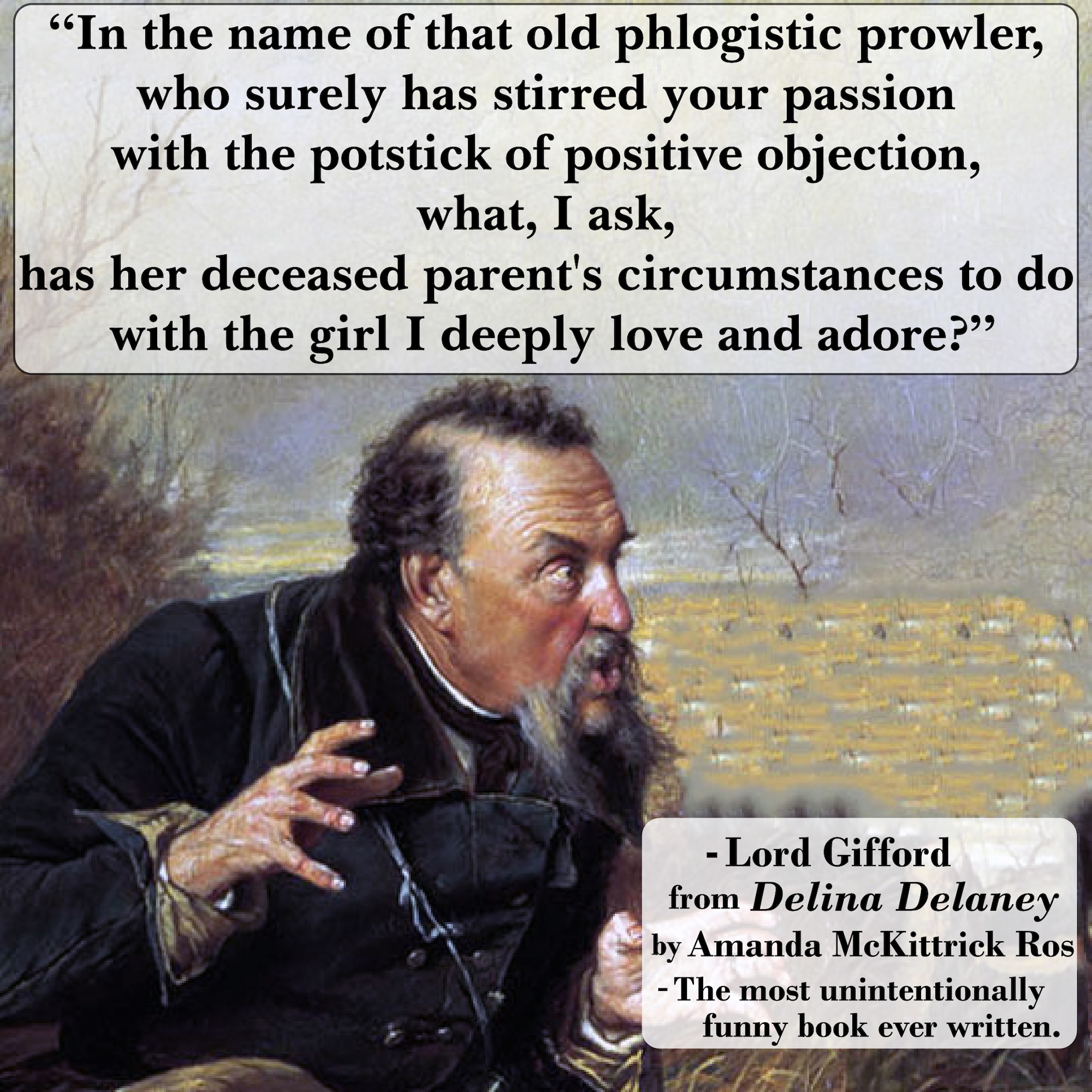
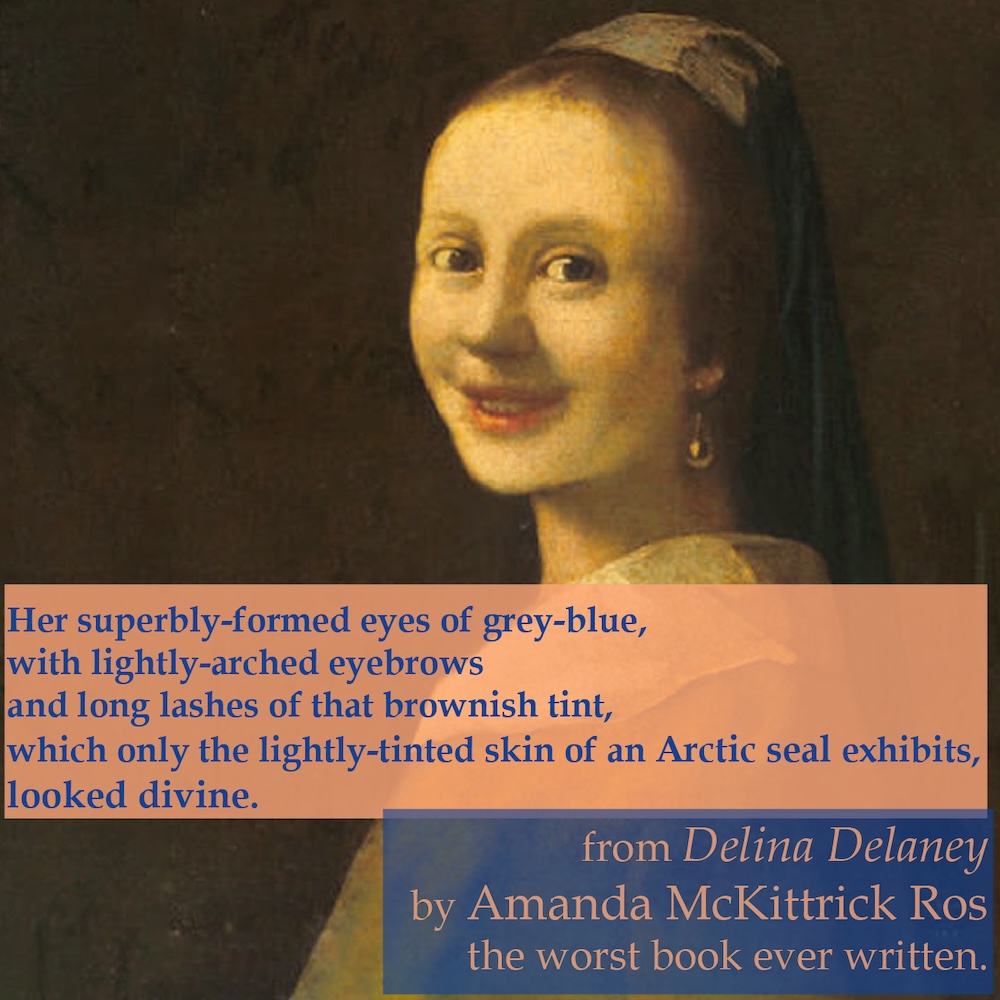
Amanda McKittrick Ros (1860-1939) was an Irish poet and novelist beloved by the Oxford Inklings. “Beloved” here is used in the sense of treasured for its distinctiveness, rather than admired for its artistry.

An article about Ros in Smithsonian Magazine is subtitled: “Amanda McKittrick Ros predicted she would achieve lasting fame as a novelist. Unfortunately, she did.”

So how is it that a writer described by the Oxford Companion to Irish Literature (OCIL) as authoring “unconscious comedy of a very high order” came to occupy a special place within the company of C.S. Lewis, J.R.R. Tolkien and their literary fellows? Why did they begin reading her works as a sort of contest, with the challenge of neither laughing nor smiling as they did so?

It was not because her mother (or she herself) christened her after a character in The Children of the Abbey, published in 1796. (Her initial name was “Anna.”)

No, it was due to an intrinsic element of her frequently alliterative artistry, described by OCIL in the following manner.

She published two sentimental romances, Irene Iddlesleigh (1897) and Delina Delany (1898), both in an idiosyncratic manner that provides unconscious comedy of a very high order. . . .

Most of her published writings appeared posthumously as a result of literary curiosity.

Many writers would agree that writing comedy is quite challenging. Comedy Crowd is devoted to helping writers gain some skill in this arena, and if you take a moment to check out their video about failed puns – after you finish reading this post – you won’t be disappointed. 

As one commenter on SleuthSayers puts it, “. . . writing humor isn’t easy. It’s even dangerous: trying to be funny and failing would be almost as bad as being funny when you’re trying to be serious.” Sadly, the worst of these options proved to be the fortune of poor Amanda.

Even her native Northern Ireland Library Authority confesses that her “writing style can only be described as elaborate, melodramatic, using startling descriptions with mixed metaphors and inappropriate alliteration with the result being unintentionally hilarious.”

In her collection “Poems of Puncture,” I came across a piece titled “Reverend Goliath Ginbottle.” Being a reverend myself, I eagerly listened to a LibriVox recording of the poem (which you can download for free from Internet Archive), and I was not disappointed. Her description of this “viper of vanity” and her joy at his ultimate judgment was delightfully colorful. Or, should you prefer to hear a diatribe against a corrupt lawyer, listen to Mickey Monkeyface McBlear, who bore “a mouth like a moneybox.”

TV Tropes has an article about Ros which attributes a dozen tropes to her pen.

In the Style of: Aldous Huxley noted that Ros wrote in the 16th century style of Euphuism. Susan Sontag decades later stated that Euphuism was the progenitor of camp, which would explain why literary greats found her writing so hilarious.

Those curious about euphuism can read John Lyly’s Euphues: the Anatomy of Wit; Euphues and His England which is filled with delights unnumbered. Originally two volumes, the books were published in the sixteenth century.

C.S. Lewis was a serious enough “fan” of Ros’ writings to share his affection for them with Cambridge Classicist Nan Dunbar. C.S. Lewis scholar Joel Heck has written a worthwhile article about the ongoing friendship between the two professors.

For a detailed study of the literary relationship between Amanda McKittrick Ros and the Inklings, I highly recommend the article by Anita Gorman and Leslie R. Mateer which appeared in Mythlore.

As they describe, even before the Inklings added occasional readings of her work to their gatherings, as early as 1907 there was in Oxford a society devoted to weekly readings of her works. The authors pose, and then proceed to answer, the following question.

What . . . impelled C.S. Lewis and his mates to read aloud Ros’s work? Yes, the improbable plots, silly characters, and nonexistent themes may have played a role, but were those enough to captivate the Inklings and to give rise to Delina Delaney dinners and Amanda Ros societies?

After all, many writers have written improbable plots about improbable people, and these writers have enjoyed short-lived reputations, if any reputations at all. Yet Amanda lives on.

For Those with Stout Constitutions

Mere Inkling offers one final look back at the transcendent poetry of Amanda McKittrick Ros. This infamous selection can be found at the aptly named Pity the Readers: Horribly Excellent Writing website.

“Visiting Westminster Abbey”
(from Fumes of Formation)

Holy Moses! Have a look!
Flesh decayed in every nook!
Some rare bits of brain lie here,
Mortal loads of beef and beer,

Some of whom are turned to dust,
Every one bids lost to lust;
Royal flesh so tinged with ‘blue’
Undergoes the same as you.

These morose words bring to mind another verse, composed in the form of a song by the artists of Monty Python. It appeared on Monty Python’s Contractual Obligation Album as “Decomposing Composers.”

They’re decomposing composers.
There’s nothing much anyone can do.
You can still hear Beethoven,
But Beethoven cannot hear you. . . .

Verdi and Wagner delighted the crowds
With their highly original sound.
The pianos they played are still working,
But they’re both six feet underground.

They’re decomposing composers.
There’s less of them every year.
You can say what you like to Debussy,
But there’s not much of him left to hear.

Yes, similarly morbid verse, but offered here to provide a sharp contrast between types of humor. Monty Python is the epitome of Camp, which according to Susan Sontag,

sees everything in quotation marks. It’s not a lamp, but a “lamp;” not a woman, but a “woman.” To perceive Camp in objects and persons is to understand Being-as-Playing-a-Role. It is the farthest extension, in sensibility, of the metaphor of life as theater.

Although Sontag notes “one must distinguish between naïve and deliberate Camp,” she argues the “pure examples of Camp are unintentional.” She considers self-conscious efforts, such as Noel Coward (and presumably Monty Python as well) as “usually less satisfying.”

Another perspective offers a helpful dichotomy to distinguish between “intentionality: whether camp deliberately cultivated (‘high’ camp) is the same to that of the unintentional kind (‘low’ camp).”

Personally, I often enjoy high (nonvulgar) camp humor – witty silliness that scoffs at life’s peculiarities. As for unintentional, “low” camp such as we find in Ros, I typically feel a flash of guilt at hurting (even posthumously) the feelings of a writer. Most of us writers are, after all, a sensitive and vulnerable breed.


The enlightening illustrations accompanying this article are from Amanda McKittrick Ros Society Promotional Memes, ably captained by Dan Morgan.

Books Enjoyed by C.S. Lewis

Reading is not only one of life’s pleasures, the content and ethos of what we read, subtly influences the shape of our very lives.

C.S. Lewis loved books with genuine passion. While many people only perceive books as compilations of information or as sources of fleeting entertainment, he knew them as far more. Only someone sharing Lewis’ affection and wisdom will identify with the following passage from his essay “An Experiment in Criticism.”

The man who is contented to be only himself, and therefore less a self, is in prison. My own eyes are not enough for me, I will see through those of others. Reality, even seen through the eyes of many, is not enough. I will see what others have invented. . . .

Literary experience heals the wound, without undermining the privilege, of individuality. There are mass emotions which heal the wound; but they destroy the privilege. In them our separate selves are pooled and we sink back into sub-individuality.

But in reading great literature I become a thousand men and yet remain myself. Like the night sky in the Greek poem, I see with a myriad eyes, but it is still I who see. Here, as in worship, in love, in moral action, and in knowing, I transcend myself; and am never more myself than when I do.

Lewis scholar and emeritus professor of English, Dale J. Nelson, has been providing a wonderful service in recent years as he explores the books which found a place in C.S. Lewis’ personal library. “Jack and the Bookshelf” is a continuing series which appears in CSL, journal of the New York C.S. Lewis Society. Founded in 1969, the organization “is the oldest society for the ​appreciation and discussion of C.S. Lewis in the world.”

Nelson’s task of editorially archiving C.S. Lewis’ library is complemented by the work of our mutual friend, Dr. Brenton Dickieson. In a “comment” praising Dickieson’s compilation of “C.S. Lewis’ Teenage Bookshelf,” Nelson offers a commendation with which I fully concur.

Thank you for assembling that list of books . . . I’d encourage Lewis’s admirers to take their appreciation of CSL to the next step and delve into the things he liked to read throughout his life.

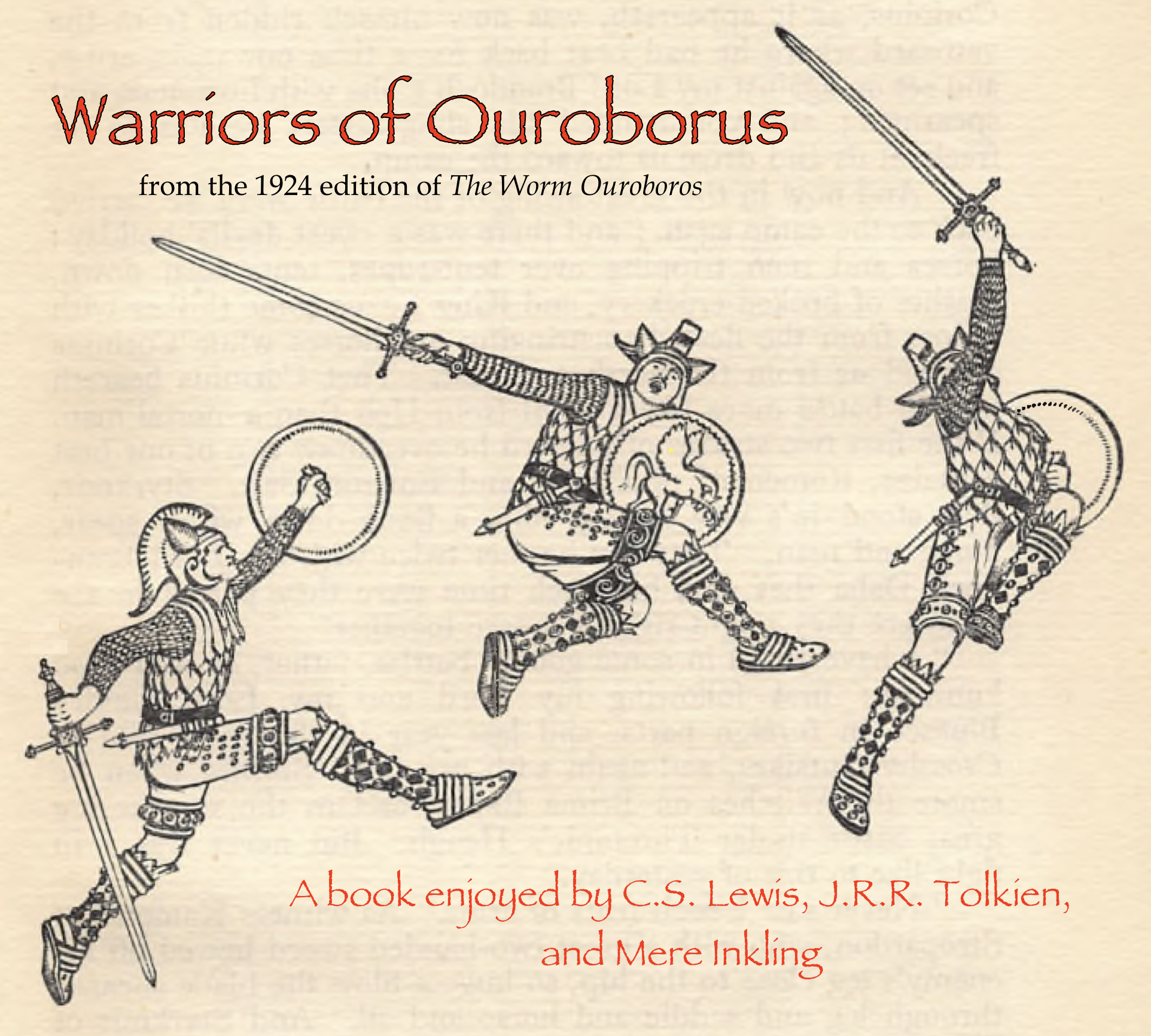
Nelson’s contribution to the December 2023 issue is the fifty-ninth in his series, and discusses a fantasy work titled The Worm Ouroboros by E.R. Eddison. Eddison (1882-1945) was a Norse scholar, and his fascination with mountains combined with that, to resonate with Lewis’ passion for northernness.

Dr. Nelson, who has added an array of science fiction to his own academic work, possesses superb credentials for exploring the connection between Lewis and Eddison. 

Nelson relates that, at C.S. Lewis’ invitation, Eddison attended two gatherings of the Inklings. At the second, Eddison – who relished critiques of his works in progress, as do many serious writers – read from a project which would not be published due to his death the following year.

Eddison’s themes more closely resembled J.R.R. Tolkien’s than Lewis’ own. In Nelson’s words, both “Tolkien and Eddison wrote masterpieces of heroic fantasy whose values differed markedly.” 

Another distinction is that while Tolkien’s Lord of the Rings has maintained its mythic rigor, Eddison’s oeuvre feels rather anchored to the formative years of the genre, prior to the so-called Golden Age of science fiction (and fantasy).

If you would like to read this book, which was enjoyed by both Lewis and Tolkien, you can download a copy of it at Internet Archive. If you enjoy dwarves, goblins, manticores and hippogriffs, you are unlikely to be disappointed.

The Church at War

Why would Christian Scriptures commend people for waging war? War, after all, is nearly universally condemned – even as it remains a relentless curse in various corners of our world.

One young pastor was “charged” with a duty that belongs, by biblical extension, to all believers. “This charge I entrust to you [that] you may wage the good warfare, holding faith and a good conscience” (1 Timothy 1).

The reason followers of Jesus are encouraged to actively train for and engage in war is because our enemies are not other human beings. We discussed this fact in our last conversation, as we considered the theological concept of the Church Militant.

To call the Body of Christ “militant” is misleading to those who don’t understand spiritual warfare, the fact that “we do not wrestle against flesh and blood, but against . . . the cosmic powers over this present darkness . . .” (Ephesians 6).

Unfortunately, because all of us are imperfect (i.e. fallen), Christians can sometimes fail to distinguish between our true enemies and those who witlessly follow their banner. For an excellent discussion of this, from a Roman Catholic perspective, I recommend you read “The Church Militant or the Church Belligerent?

Another worthwhile read is “G.K. Chesterton and the March of the Church Militant.” There, Joseph Pearce shares Chesterton’s vivid description about how Gothic cathedrals visualize the martial aspect of the Christian Church.

The truth about Gothic [architecture] is, first, that it is alive, and second, that it is on the march. It is the Church Militant; it is the only fighting architecture.

All its spires are spears at rest; and all its stones are stones asleep in a catapult. In that instant of illusion, I could hear the arches clash like swords as they crossed each other. The might and numberless columns seemed to go swinging by like the huge feet of imperial elephants.

The graven foliage wreathed and blew like banners going into battle; the silence was deafening with all the mingled noises of a military march; the great bell shook down, as the organ shook up its thunder.

The thirsty-throated gargoyles shouted like trumpets from all the roofs and pinnacles as they passed; and from the lectern in the core of the cathedral the eagle of the awful evangelist crashed his wings of brass (“The Architect of Spears”).

As a master of words and wit, Chesterton’s writing rarely disappoints. You can download a free copy of The Man Who was Chesterton, which includes this essay, from Internet Archive.

C.S. Lewis did more to equip us for spiritual warfare with The Screwtape Letters than a thousand clergy with a hundred thousand sermons. As one Baptist theologian summed it up in an article about spiritual warfare:

On the subject of spiritual warfare, Lewis is a helpful guide. I’ll remember what he taught: There is an enemy. He seeks my destruction. And this is war.

There is a brilliant quote about this supernatural confrontation, ascribed (apparently in error) to the historical Martin Luther.

If I profess, with the loudest voice and the clearest exposition, every portion of the truth of God except precisely that little point which the world and the devil are at that moment attacking, I am not confessing Christ, however boldly I may be professing Christianity.

Where the battle rages the loyalty of the soldier is proved; and to be steady on all the battle-field besides is mere flight and disgrace to him if he flinches at that one point.

C.S. Lewis echoes this sentiment in The Magician’s Nephew. When Aslan questions the humble man whom he would crown the first King of Narnia, he poses a query which reveals the man’s courage and humility.

“And if enemies came against the land (for enemies will arise) and there was war, would you be the first in the charge and the last in the retreat?”

“Well, sir,” said the Cabby very slowly, “a chap don’t exactly know till he’s been tried. I dare say I might turn out ever such a soft ’un. Never did no fighting except with my fists. I’d try – that is, I ’ope I’d try – to do my bit.”

“Then,” said Aslan, “you will have done all that a King should do.”

If anyone would follow Christ, neutrality is not an option. Though some temporary retreats are inevitable, in God’s strength, we are empowered to continue our (in reality, the Lord’s) advance.

The battlelines are drawn, and they are real. As C.S. Lewis proclaimed in “Christianity and Culture” – “There is no neutral ground in the universe. Every square inch, every split second is claimed by God, and counterclaimed by Satan.”


The image above, “Livonian Sword Brother” (a member of a military monastic order) was created by JLazarusEB and is used here in compliance with the Creative Commons CC BY-NC-ND 3.0 License.

Music, Muses & C.S. Lewis

Why do so many modern musicians – including some who are commercially successful – appear to suffer from amusia?

Well, I suppose that diagnosis is a matter of opinion, since “amusia” has come to refer to a particular medical disorder related to “the inability to recognize musical tones or to reproduce them.” More on that in a moment. First let’s consider the original meaning of the word.

It begins with the Greek Muses. While “muse” has morphed into anything that inspires a creative soul, it did not begin that way. The Muses began as personifications devoted to nine children of Zeus and Mnemosyne (Memory). During Europe’s revival of Classical themes, they were associated not only with the arts, but with culture and refinement in general.

In Surprised by Joy, C.S. Lewis records his admiration for one of his early teachers. This man taught him to love poetry, and although he practiced corporal punishment (standard for the era), embodied “perfect courtesy.” On an occasion he was sent to the headmaster, who misperceived that Lewis had acted inappropriately. After dispelling the confusion, this teacher, who treated his students as “gentlemen,” matter-of-factly said “you will have to be whipped if you don’t do better at your Greek Grammar next week, but naturally that has nothing to do with your manners or mine.”

The idea that the tone of conversation between one gentleman and another should be altered by a flogging (any more than by a duel) was ridiculous. His manner was perfect: no familiarity, no hostility, no threadbare humor; mutual respect; decorum.

“Never let us live with amousia” was one of his favorite maxims: amousia, the absence of the Muses. And he knew, as Spenser knew, that courtesy was of the Muses. 

Muses, from this perspective, undergird civilization. But the Muses are fickle. One cannot create their own Muse. Inspiration comes to us of its own volition. It can’t be commanded.

Nearly four years ago, I posed this question in Mere Inkling: “Who is Your Muse?” Various literary figures have written paeans to the muses which inspire their work. In that column I also noted how our animal companions* often exert an influence on our own creativity.

The link between inspirational Muses and music itself is strongly intertwined. Consider, for instance, Friedrich Nietzsche (1844-1900), who was brilliant, but much to be pitied. He despised God, but he did love music. In “Amousia: Living Without the Muses,” Classicist Stephen Halliwell discusses the importance of music for enjoying a meaningful existence. He begins with a quote from Nietzsche, and points out a Platonic corollary. 

Without music life would be a mistake . . . So, famously, wrote Friedrich Nietzsche in . . . Twilight of the Idols. As always, Nietzsche had deeply personal reasons for the force and pathos of this aphorism; music did indeed help to keep him alive. . . .

[W]e can detect in Nietzsche’s stark utterance, I would like to suggest, a trace and resonance of Greek feeling. We might even wonder whether in formulating his maxim Nietzsche was subconsciously remembering the passage in Plato’s Philebus where Protarchus, asked by Socrates whether music, as one of the ‘impure’ arts, is needed for the mixture of a humanly desirable life, says that he certainly takes it to be necessary – ‘at any rate,’ as he puts it, ‘if our life is really to be a life of some kind.’

Without music, Protarchus . . . seems to take the idea to be practically self-evident, human ‘life’ would hardly be worth the name at all.

Amusia as a Medical Condition

I suggested above that the caterwauling of some musicians suggests they are tone deaf, but in fact there is a genuine medical condition called amusia. It traces its beginning to the Muses we have been speaking about, and suggests their absence.

In “The Genetics of Congenital Amusia (Tone Deafness),” we learn that “congenital amusia . . . is a lifelong impairment of music perception that affects 4% of the population.” What’s more, “the pitch disorder has a hereditary component.”

In amusic families, 39% of first-degree relatives have the same cognitive disorder, whereas only 3% have it in the control families.

As the husband of a gifted music teacher, the father-in-law of another, and the grandfather of a number of extremely talented children, I understand the Greek principle. While I would miss music’s grace if I was stricken with amusia, I know a number of precious people for whom that would be one of the most terrible fates imaginable.

C.S. Lewis and Music

Like most of us, C.S. Lewis enjoyed some forms of music while others left him exasperated. Wagner, bravo. Church hymnody, not so much. A recent article by John MacInnis, a professor of music, goes so far as to claim: “music listening and discussion factored regularly in C.S. Lewis’s relationships, and love for music inspired his creative endeavors and prompted his best thinking.”

I agree with the first part of this, and will attribute the “best thinking” declaration to the hyperbole of one who has devoted his own life to music.

The author of “A Medium for Meeting God” explores in  detail the effect of Wagner’s work, and the sense of Northernness it imprinted on Lewis’ psyche.

In 1934, Lewis, along with his brother Warnie and J.R.R. Tolkien read Wagner’s operas together in German, in anticipation of attending performances of the Ring cycle. MacInnis points out that Lewis enjoyed the music of Sibelius (also “evocative of Northern landscapes) and likened it to Wagner as an expression of natural or earthy music. This he contrasted to Beethoven, which he also enjoyed, and thought of as “noble” and even spiritual.

As for church music, Lewis had mixed feelings. I’ve written about that in the past, in “Good, Bad and Ugly Hymns.” Most of us would agree that music enriches our lives. Our tastes vary, of course, just as they do with literature.

And, speaking of which, just as there are tone deaf individuals who should avoid recording music . . . most of us have encountered writers who suffer from a literary variant of amusia. And, lacking the influence of anything remotely like a muse, would not the world be a more harmonious place if they simply laid down their pens.


* When we got our youngest border collie as a puppy, I named her Calli. Actually, that’s what we call her, but her given name is actually Calliope. I named her after the Muse of epic poetry with the hope she might inspire my writing.

Since she’s our fifth border collie, I should have known better. The very last thing Calli wants me to do is sit at the computer composing documents (no matter how interesting or edifying). “Get out of that chair and get some exercise with me,” she says plaintively with her body, voice, and pleading eyes.

She’s plenty loving, and her insistence on activity may well add years to my life, but if I look to her to help me write more productively, I’m guaranteed disappointment.

We Found Hobbits in Our Yard

Yes, we found hobbits in our yard, when we weren’t even looking. True, I have a sign on our property welcoming “all true Narnians,” but true fans of the Oxford Inklings will recognize that hobbits are actually residents of Middle Earth.

I suppose, though, that doesn’t mean that Middle Earth’s hobbits, elves, and Ents can’t be Narnians at heart. As for dwarves and humans, they already reside in Narnia and are welcome here even if they are traveling through on their way to Valinor, in the Blessed Realm.

To be honest, it wasn’t actual hobbits we discovered. It is a small field of Eryngium planum, which is also known to botanists as Blue Hobbit, Sea Holly.

Noted for its petite size, Eryngium planum ‘Blue Hobbit’ (Sea Holly) is a compact perennial boasting a profusion of spiny, egg-shaped, purplish-blue flower heads throughout the summer.

They are produced on silver-blue stems and stand high above the basal rosette of deeply toothed, smooth textured leaves. Its beautiful texture, unique color, long-lasting flowering, easy care and remarkable qualities as cut flowers make it a favorite of florists, gardeners, bees and butterflies.

The plant’s size is the apparent premise for its popular name. I mean, there were Blue Wizards in Middle Earth, but no blue hobbits I can recall.

According to an interesting article in a Canadian newspaper, there are several plants “eagerly adopted by Tolkien fans, at least ones with a love of houseplants.”

The author describes his new acquisition named in honor of Gollum, a Stoor, which was an old breed of hobbits that preferred riversides and marshes. Gollum, of course, devolved from his life as Sméagol, due to the corrupting influence of the Ring.

Despite the name, the plant is kinda cute. Its full name is Crassula ovata ‘Gollum,’ and if you’re keeping up with your botanical Latin, or still have the tag stuck in one of your houseplants, you’ll know that Crassula ovata is the jade plant.

J.R.R. Tolkien and C.S. Lewis loved nature. And, not just from a distance. Their frequent cross country walks were of great delight to both scholars.

Lewis’ fascination with gardens began in his childhood. In his autobiography, he includes “a garden (which then seemed large)” as one of his initial “blessings” (Surprised by Joy). He also relates a pivotal experience in the development of his imagination.

Once in those very early days my brother brought into the nursery the lid of a biscuit tin which he had covered with moss and garnished with twigs and flowers so as to make it a toy garden or a toy forest. That was the first beauty I ever knew. What the real garden had failed to do, the toy garden did.

It made me aware of nature—not, indeed, as a storehouse of forms and colors but as something cool, dewy, fresh, exuberant. I do not think the impression was very important at the moment, but it soon became important in memory.

As long as I live my imagination of Paradise will retain something of my brother’s toy garden. And every day there were what we called “the Green Hills;” that is, the low line of the Castlereagh Hills which we saw from the nursery windows. They were not very far off but they were, to children, quite unattainable. They taught me longing—Sehnsucht; made me for good or ill, and before I was six years old, a votary of the Blue Flower.

The blue flower to which Lewis refers is not the Blue Hobbit. It is actually a symbol which grew to reference the Romanticism movement. Among other things, such as an emphasis on intense emotion, Romanticism fostered an idealized image of nature. In an essay about the German writer Novalis,* Norwegian-American author Hjalmar Hjorth Boyesen (1848-1895)⁑ offers the following description.

In the very first chapter we meet with all the conventional machinery of Romantic fiction: night, moonlight, dreams, and the longing for the blue flower. This blue flower is the watchword and the sacred symbol of the school. It is meant to symbolize the deep and nameless longings of a poet’s soul.

Romantic poetry invariably deals with longing; not a definite, formulated desire for some attainable object, but a dim, mysterious aspiration, a trembling unrest, a vague sense of kinship with the infinite, and a consequent dissatisfaction with every form of happiness which the world has to offer. The object of the Romantic longing, therefore, so far as it has any object, is the ideal—the ideal of happiness . . .

The blue flower, like the absolute ideal, is never found in this world . . .

The blue flower, as a metaphor, may remain out of reach, but selective breeding of cultivars has provided us with genuine examples in our modern era. And, since cultivars are named according to binomial nomenclature – which uses their scientific name, followed by a vernacular epithet – we may be introduced to more Inkling plants in the future.

I imagine both C.S. Lewis and J.R.R. Tolkien would be pleased to know that people have commemorated their literary creations with lovely flora. Learning of their existence, I’m thrilled to have Blue Hobbit spreading across our property. Perhaps it’s time to add a Gollum Jade plant to our home?


* For some reason, Romantic poet Georg Philipp Friedrich Freiherr von Hardenberg (1772- 1801), was commonly known by his pen name, Novalis, rather than his given name.

⁑ You can download a free copy of Boyesen’s Essays on German Literature at Internet Archive.

C.S. Lewis, the Psalms, and Penitence

When do you feel closest to God? When you’ve been about holy business all day and are now praying at your bedside? Or, when everything in your life seems to have imploded, and you look about you helplessly, with nowhere else to turn than your heavenly Father?

In The Four Loves, C.S. Lewis provides a brilliant insight into the nature of our souls.

Man approaches God most nearly when he is in one sense least like God. For what can be more unlike than fullness and need, sovereignty and humility, righteousness and penitence, limitless power and cry for help?

This rings true as I ponder my own spiritual pilgrimage. Tribulation and suffering clear my vision of material distractions in a way that allows me to recognize more vividly my need for God’s grace. And, in relying more consciously on his mercy and compassion, I draw closer to my Lord.

It’s no accident, in my opinion, that among the Psalms of David most treasured by God’s people, are those in which he cries out to the Lord for deliverance and salvation. Verses where David places no trust in his own strength or even in God’s previous beneficence. Poetry where this anointed king acknowledges that even the drawing of his next breath depends wholly on the providence of his Creator.

Seven of David’s songs are traditionally identified as the Penitential Psalms.* The great Saint Augustine’s regard for these Psalms is revealed in the manner in which he spent his final days.

As Augustine lay dying . . . he ordered those psalms of David which are especially penitential to be copied out [for example, “Have mercy on me according to thy steadfast love . . . For I know my transgressions, and my sin is ever before me,” Psalm 51], and when he was very weak, he used to lie in bed facing the wall where the sheets of paper were put up, gazing at them and reading, and copiously and continually weeping as he read (Robert Wilken, The First Thousand Years).

Like this ancient saint, C.S. Lewis knew the Psalms – and the English language – intimately. This led to his appointment to a distinguished “Committee to Revise the Psalter” for the Anglican Book of Common Prayer. Joint service on this committee facilitated the healing of a previously strained relationship with the poet T.S. Eliot.

Lewis had largely taken on this task in order to discourage revisions, since he thought the Miles Coverdale version that had been in use for four hundred years more than adequate.

His opinion was shared by another member of the committee, T.S. Eliot, whom Lewis finally got to know. (They had met only once, very briefly, in the forties, though they had corresponded for a while about Charles Williams after their mutual friend’s death.)

The two men got along very well indeed; bygones could at last be bygones, it seems. (The Narnian: The Life and Imagination of C. S. Lewis)

One of C.S. Lewis’ books is devoted to his thoughts about various themes in the Psalms. One such theme is judgment.

The “just” judge, then, is primarily he who rights a wrong in a civil case. He would, no doubt, also try a criminal case justly, but that is hardly ever what the Psalmists are thinking of. Christians cry to God for mercy instead of justice;’ they cried to God for justice instead of injustice. The Divine Judge is the defender, the rescuer. (Reflections on the Psalms)

In the introduction to this work, Lewis explains, “This is not a work of scholarship. I am no Hebraist, no higher critic, no ancient historian, no archaeologist. I write for the unlearned about things in which I am unlearned myself.” This, readers, is not false humility. It’s the real thing.

One of his most valuable observations comes in the following passage:

What must be said, however, is that the Psalms are poems, and poems intended to be sung: not doctrinal treatises, nor even sermons. Those who talk of reading the Bible “as literature” sometimes mean, I think, reading it without attending to the main thing it is about; like reading Burke with no interest in politics, or reading the Aeneid with no interest in Rome. That seems to me to be nonsense.

But there is a saner sense in which the Bible, since it is after all literature, cannot properly be read except as literature; and the different parts of it as the different sorts of literature they are. Most emphatically the Psalms must be read as poems; as lyrics, with all the licences and all the formalities, the hyperboles, the emotional rather than logical connections, which are proper to lyric poetry.

They must be read as poems if they are to be understood; no less than French must be read as French or English as English. Otherwise we shall miss what is in them and think we see what is not (Reflections on the Psalms).

In C.S. Lewis’ monumental study of English Literature in the Sixteenth Century (Excluding Drama), Lewis does not discuss the Psalms per se. He does, however, refer to them as the occasional subjects of Renaissance writers.

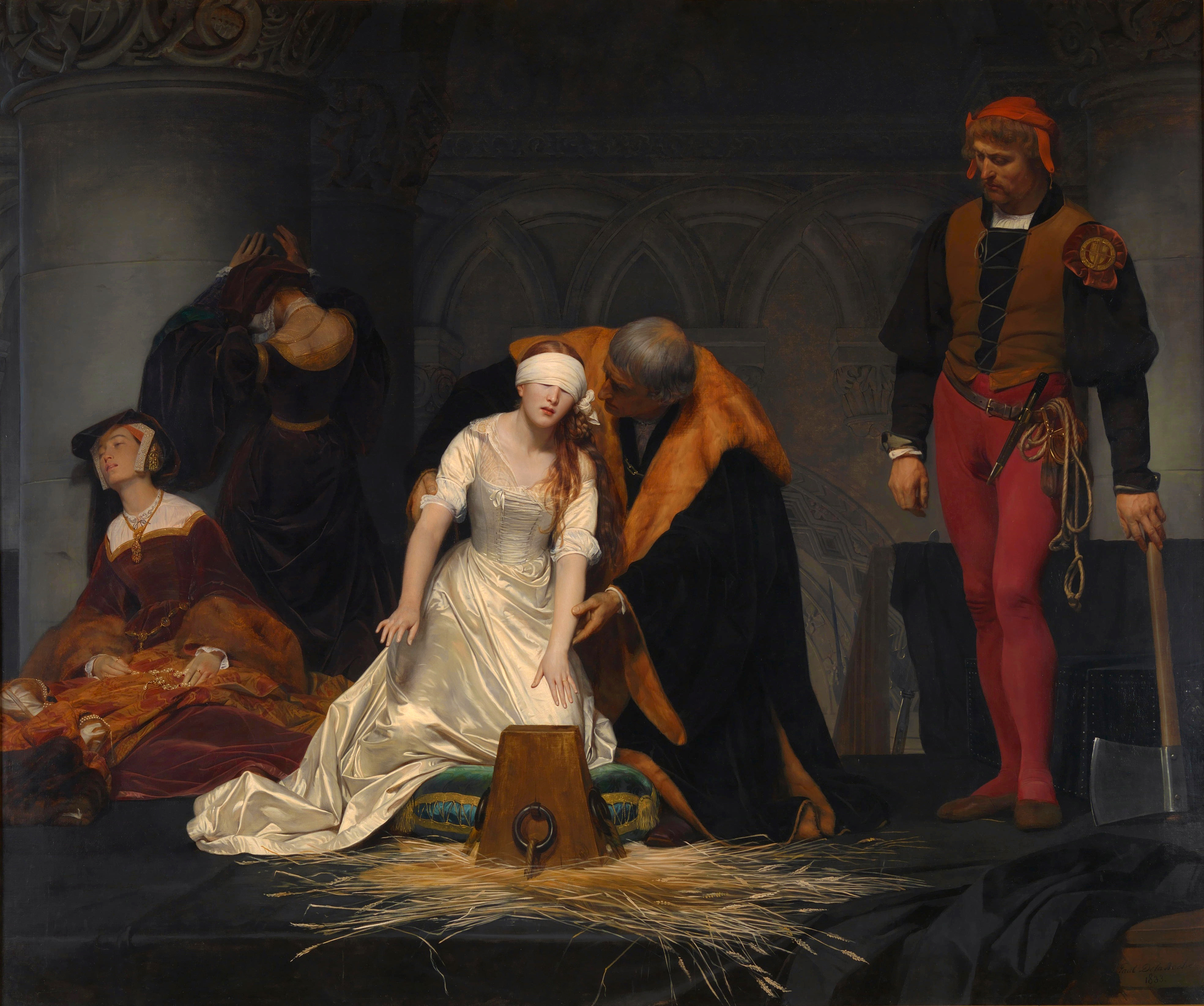
The most interesting such discussion involves John Fisher (1469-1535), a Roman Catholic bishop who was executed by Henry VIII. Fisher was a scholar, whose works included Commentary on the Seven Penitential Hymns.⁑

His vernacular works include devotional treatises – a Consolation to his sister and The Ways to Perfect Religion – and sermons, a series on the Penitential Psalms, funeral orations for Henry VII, and for the Countess of Richmond, and the famous sermon against [Martin] Luther in 1521.

Fisher’s style is grave and a little diffuse, never comic (though the pulpit then admitted that excellence), mildly rhetorical, and at times really eloquent. . . . His chief weakness is that he is too leisurely he is in no hurry to end a sentence or to let an idea go. . . .

Some of the medieval sweetness and richness still hangs about the prose of Fisher . . . but for our present purpose he matters less as a literary figure than as a convenient representative of the religion in possession at the very beginning of the English Reformation. He was a bishop and died for his faith. In him we ought to find what men like Tyndale were attacking. It was not in all respects what they imagined it to be. The Pelagianism of which they implicitly accused the Roman Church is, like the antinomianism of which the Papists accused them, a figment of controversy.

Some of Fisher’s statements seem, at least to a layman, to be very close to Tyndale’s own, as when Fisher writes: ‘From the eyen of almyghty God whiche may be called his grace shyneth forth a meruaylous bryghtnes lyke as the beme that cometh from the sonne. And that lyght of grace stereth and setteth forthwarde the soules to brynge forth the fruyte of good werkes.’ (Sermon on Psalm xxxii)

And again, on Psalm li, ‘no creature of himself hath power to do good werkes without the grace and help of God’ What Tyndale would have regarded as the cloven hoof appears chiefly when Fisher is talking of penance By penance, on his view, sinners can ‘make due satysfacion’ so as to be ‘clene out of dette’ (Sermon on Psalm xxxii), and so ‘mstyfyed by the sacrament of penaunce’ that ‘God can ask no more of them’ (ibid). . . .

One merit, very unusual in that age, Fisher can claim he is hardly at all scurrilous. His attack on Luther is not, indeed, masked under those forms of politeness which are usual between theological (though not between political) opponents today. But there is hardly any real abuse, compared with More, or even with Tyndale, Fisher is almost courteous.

Many readers of Mere Inkling already possess a high regard for the Psalms. In light of the affection felt for them by saints (including C.S. Lewis) for millennia, perhaps those who do not yet appreciate them, will reconsider their appraisals.


* They are Psalms 6, 32, 38, 51, 102, 130 and 143. The opening of the first expresses a theme common to all: “O Lord, rebuke me not in your anger, nor discipline me in your wrath” (ESV).

Likewise, the beginning of Psalm 130: “Out of the depths I cry to you, O Lord! O Lord, hear my voice! Let your ears be attentive to the voice of my pleas for mercy!” (ESV).

⁑ You can download John Fisher’s Commentary in two volumes at no cost, from Internet Archive (1 and 2).

Renaissance Fashions

Although it does not relate to the topic of this post directly, the following information from the “Medieval Manuscripts Blog” of the British Library is quite interesting. It describes “Girdle Books,” which frequently included selections from the Psalms.

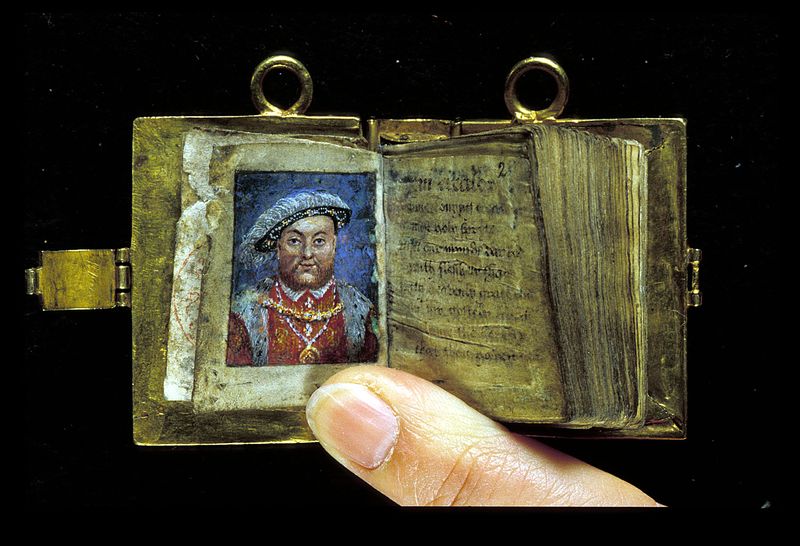
In the 16th century, it became fashionable for aristocratic women to wear miniature prayer books bound in elaborate metalwork covers hanging from their girdles (i.e. belts). These girdle books provided them with handy reading material as well as fashionable dress accessories, allowing them to display their literacy and piety to the world.

The images on the page are fascinating. Of special historical interest is one that once belonged to Anne Boleyn (shown above), a gift from her murderous husband.

A particularly luxurious example is a girdle book with covers of gold filigree . . . It contains selected Psalms in English verse, translated and apparently written out by John Croke, one of Henry VIII’s clerks in Chancery, with a portrait of Henry VIII at the beginning.

The volume is traditionally thought to have belonged to Anne Boleyn, who is said to have handed it to one of her maids of honour when she was standing on the scaffold before her execution in 1536.