Timing the Reformation

wristwatch

I had an entrepreneurial epiphany on how to get rich during the 500th anniversary of the Reformation, and since I’m not an entrepreneur, I’m passing the idea on gratis, to readers of Mere Inkling.

Inspired by the shocking success of the Playmobil Martin Luther—their fastest-selling item ever—I wondered what other commemorative items might result in a windfall for investors.

The insight struck like the lightning bolt that dropped Luther to his knees and sent him off to the monastery.

Since this celebration hearkens back to the beginning of the Reformation . . . back to the day when the 95 Theses were nailed to the door of the Castle Church in Wittenberg . . . it dawned on me that we so indebted to what happened that moment that we are, in a true sense, living on Wittenberg time.

What better item to remind us of the significance of this than to turn to expert horologists* and design a Wittenberg Watch? Ideally it would be permanently linked to Wittenberg time. The wearer would also benefit from learning more about time zones and mathematics, trying to sort out the local time, especially when traveling.

More about the details in a moment.

C.S. Lewis and the Importance of Time

The nature and passage of time was of great importance to C.S. Lewis. He devoted an entire chapter to the subject in Mere Christianity. In “Time and Beyond Time,” he explores how God acts within history, but is not subject to time’s constraints.

If you picture Time as a straight line along which we have to travel, then you must picture God as the whole page on which the line is drawn. We come to the parts of the line one by one: we have to leave A behind before we get to B, and cannot reach C until we leave B behind. God, from above or outside or all round, contains the whole line, and sees it all.

Lewis then proceeds to explain his understanding by saying this “idea has helped me a good deal. If it does not help you, leave it alone. It is a ‘Christian idea’ in the sense that great and wise Christians have held it and there is nothing in it contrary to Christianity. But it is not in the Bible or any of the creeds. You can be a perfectly good Christian without accepting it, or indeed without thinking of the matter at all.”

Another difficulty we get if we believe God to be in time is this. Everyone who believes in God at all believes that He knows what you and I are going to do tomorrow. But if He knows I am going to do so-and-so, how can I be free to do otherwise?

Well, here once again, the difficulty comes from thinking that God is progressing along the Time-line like us: the only difference being that He can see ahead and we cannot. Well, if that were true, if God foresaw our acts, it would be very hard to understand how we could be free not to do them.

But suppose God is outside and above the Time-line. In that case, what we call “tomorrow” is visible to Him in just the same way as what we call “today.” All the days are “Now” for Him. He does not remember you doing things yesterday; He simply sees you doing them, because, though you have lost yesterday, He has not. He does not “foresee” you doing things tomorrow; He simply sees you doing them: because, though tomorrow is not yet there for you, it is for Him.

You never supposed that your actions at this moment were any less free because God knows what you are doing. Well, He knows your tomorrow’s actions in just the same way—because He is already in tomorrow and can simply watch you.

In a sense, He does not know your action till you have done it: but then the moment at which you have done it is already “Now” for Him.

Since God was/is witness to that day in Wittenberg, just as he knows our tomorrows today, we see his placing of creation within the linear progression of history is intentional. It does not restrict our Lord in any way, but it enables us to comprehend our existence. And thus, we are compelled to mark the passage of time.

What Might the Wittenberg Watch be Like?

Something elegant and tasteful, yet modest and unobtrusive. A watch like the one pictured above. It’s produced by Swisstime and has the added benefit that it is part of their “Rebellion” line, which means that Roman Catholics shouldn’t be excluded from the market. The only minor drawback is the price, $930,000.

It seems to me that a wise businessperson could undercut that by thirty or forty thousand, and only need to sell two or three watches to retire in comfort.

An alternative to this timepiece, for the less prosperous, would be to get a regular Timex or Casio and just set the time to that of Wittenberg! That’s the key anyway—the Wittenberg Watch measures the hour based on the time there in hallowed birthplace of the Reformation. (For those who like details, that would be the Central European Time Zone, UTC/GMT +1.)

An astute investor will recognize that the Wittenberg Watch concept easily translates for an ecumenical audience. One easily imagines other editions for various denominations.

Aldersgate Watch for Methodists (Greenwich Mean, GMT)

Azuza Street Timepiece for Pentecostals (Pacific Standard, UTC/GMT -9)

Canterbury Timepiece for Anglicans (Greenwich Mean, GMT)

Geneva Timepiece for Calvinists (Central European, UTC/GMT +1)

Edinburgh Edition for Presbyterians (Greenwich Mean, GMT)

Hollywood Timepiece for Televangelists** (Pacific Standard, UTC/GMT -9)

London Chronometer for Quakers (Greenwich Mean, GMT)

Münster Timepiece for Anabaptists (Central European, UTC/GMT +1)

Rome Timepiece for Roman Catholics (Central European, UTC/GMT +1)

Anyone who desires can feel free to run with this idea. I relinquish all rights to the concept of religious timepieces.

As for now, I’ve been rethinking the idea altogether. I’ve decided it’s best for me to reset my own watch to Jerusalem time.

_____

* Horology relates to the science of measuring time and making timepieces. (Yes, I had to look it up also, even though I remembered enough Latin to know hora means hour.)

** It’s quite possible that televangelists already own the Rebellion Reb 5 Diamond timepiece pictured above, however, the members of their digital congregations may be in the market for something more modest.
Christmas Interruptions

qaraqoshA bomb has driven worshipers from their churches and homes on Christmas. Ironically, this did not transpire in lands where war currently rages. Instead, it was a British bomb intended to end German lives.

Perhaps you’ve already seen the story?

The weapon was huge, nearly two tons in weight, and it’s explosion would have been no less lethal today than when it was originally dropped.

The bomb, known as a blockbuster, was the largest of its kind dropped by the RAF during aerial attacks on Germany in the second world war. It weighs 1.8 tonnes and, if exploded, could damage all buildings within a one-mile radius.

As I have worshipped and reflected during this Christmas season, the story of this bomb has continued to intrude on my thoughts.

On that first Christmas night a group of shepherds heard music that has now echoed for millennia.

Suddenly a great company of the heavenly host appeared with the angel, praising God and saying, “Glory to God in the highest heaven, and on earth peace to those on whom his favor rests.”

God’s call to peace on earth and his desire for good will among his children—gifts already given to the world in the birth of Jesus—cannot be negated by the weapons of man.

As C.S. Lewis wrote, “Once in our world, a stable had something in it that was bigger than our whole world” (The Last Battle).

Still, in this moment, when this long forgotten and deeply buried blockbuster bomb can disrupt the traditional Christmas schedule, we see a vivid contrast between the good God desires for us and the ill we too often bear for one another?

A Warzone Witness to the Celebration of Christ’s Nativity

The entire world is aware of the genocide of Christians and Yazidis being conducted in the Middle East by Jihadists. This Christmas, however, marked a moment of encouragement.

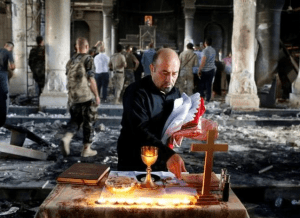
Two years after being driven from their city by the Islamic State, Christians were able to return to the recently liberated city of Qaraqosh to worship God.

The church structure had been desecrated, but the presence of God among his gathered people, has reconsecrated it.

Christianity in northern Iraq dates back to the first century AD. The number of Christians fell sharply during the violence which followed the 2003 overthrow of Saddam Hussein, and the Islamic State takeover of Mosul two years ago purged the city of Christians for the first time in two millennia. (Reuters)

Despite the hatred some people hold for others, and the violence they inflict, it is encouraging to recognize that no power in this world can defeat the miracle that transpired on that first Christmas Day.

C.S. Lewis & Humor – a 100% Politics Free Post

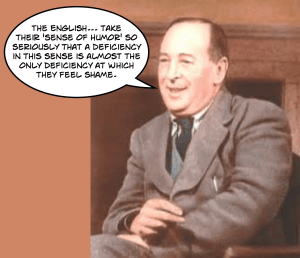
csl-humorHumor is an essential element of human existence. C.S. Lewis recognized that our very nature was molded to incorporate joy and laughter.

In a great article on the subject, “The Role of Laughter in the Christian Life,” Terry Lindvall introduces the subject with the story of an early Christian monk who wrote this truth.

In the fourth century, a monk named Evagrius identified key temptations against living the Christian life. He named eight of them, and they became the eight deadly sins. Now we know that Pope Gregory the Great reduced them to seven to fit them in with the symbolic biblical number.

But unfortunately the sin that Gregory conflated into sloth was the sin of sadness. Sadness in the face of God’s grace and mercy was a denial of faith and hope.

But it isn’t the vice that concerns me. It is its corresponding virtue, what Evagrius identified as the blessing of hilaritas as essential to Christian living, even if you were an ascetic monk and especially if you are a lawyer or accountant.

Amen. We can all, whatever our vocation, do with an extra dose of hilaritas. After all, it’s good for your health.

I highly commend Lindvall’s entertaining article, which you can read online here or download as a pdf here.

It is filled with references to C.S. Lewis, as one would expect from the author of Surprised by Laughter: The Comic World of C.S. Lewis.

One particularly beneficial section of the article is his discussion of the four types of laughter mentioned by Screwtape in his epistles.

If you don’t have access to your copy of The Screwtape Letters, the following quotation will provide the context for Lindvall’s remarks.

Because Screwtape is a devil, viewing God as the “Enemy,” his viewpoint is reversed. Keep that in mind as you read.

I divide the causes of human laughter into Joy, Fun, the Joke Proper, and Flippancy. You will see the first among friends and lovers reunited on the eve of a holiday. Among adults some pretext in the way of Jokes is usually provided, but the facility with which the smallest witticisms produce laughter at such a time shows that they are not the real cause. What that real cause is we do not know.

Something like it is expressed in much of that detestable art which the humans call Music, and something like it occurs in Heaven—a meaningless acceleration in the rhythm of celestial experience, quite opaque to us. Laughter of this kind does us no good and should always be discouraged. Besides, the phenomenon is of itself disgusting and a direct insult to the realism, dignity, and austerity of Hell . . .

But flippancy is the best of all. In the first place it is very economical. Only a clever human can make a real Joke about virtue, or indeed about anything else; any of them can be trained to talk as if virtue were funny.

Among flippant people the Joke is always assumed to have been made. No one actually makes it; but every serious subject is discussed in a manner which implies that they have already found a ridiculous side to it. If prolonged, the habit of Flippancy builds up around a man the finest armour-plating against the Enemy that I know, and it is quite free from the dangers inherent in the other sources of laughter.

It is a thousand miles away from joy: it deadens, instead of sharpening, the intellect; and it excites no affection between those who practise it,

So, a wise person will savor joy and fun, along with jokes proper that are offered in good taste. But they will remain wary of flippancy, from which more ill than good usually flows.

Have a joy-filled life.

On Being Aptly Named

terrorIf you were going to embark on a lengthy, dangerous journey of exploration, how would you feel about signing onto the crew of the HMS Terror? Doesn’t that strike anyone else as a tad ominous?

The HMS Terror suffered a horrific fate. No surprise there. Its demise was so great, though, that it ranks among the worst ever suffered by the Royal Navy. And its ultimate fate remained unconfirmed until this past week when the wreck was found, resting on the ocean floor, 168 years after it perished during the ill-fated Franklin Expedition.

Along with the HMS Erebus, the Terror was supposed to traverse the Northwest Passage. The evidence shows, however, the ice trapped the ships, and both crews perished trying to make their way south across the floes. (There is evidence of cannibalism during that doomed journey, something attested to by Inuit oral traditions.)

The voyage had begun well enough. The vessels had been fitted for the harsh environment after a rather auspicious exploration of the coast of Antarctica. There they had discovered the Ross Ice Shelf, and in honor of their mission, two Antarctic features were named for them Mounts Erebus & Terror, on Ross Island.

Upon their return to London, iron plate was added to their hulls and coal-fueled steam engines were installed.

Sadly, the Arctic proved less hospitable, and their entrance into Baffin Bay in August 1845 marked the final time either ship was seen until now. An extensive search at the time proved futile. Their respective discoveries are announced here, and here.

Around 130 men abandoned the ships when they became icebound. Some of their bones were recovered from King William Island. The sad story has been recited in many places, including this article which was written when the wreck of the Erebus was discovered.

As in the Antarctic, here too the ships were honored by having natural features named after them. Fittingly, Erebus Bay and Terror Bay hug the west coast of King William Island, just north of which marked the estimated position where the ships were abandoned.

Read on, and learn something quite interesting about the names of these two ill-fated ships.

Naming Ships

I have written about the importance of names in the past.*

There are a variety of conventions for christening ships. Some result in creative names, but others are quite mundane. In the United States, with plenty of exceptions, the contemporary patterns for naming ships vary by their type of class. For example:

Aircraft Carriers – are now named after Presidents

Amphibious Assault Ships – early Ships or USMC Battles

Ballistic Missile Submarines – States

Fast Attack Submarines – Cities

Cruisers – Past Battles

Frigates – Navy, Marine or Coast Guard Heroes

Patrol Boats – Weather Phenomena like Squall, Monsoon and Cyclone

Of course, like everything else in the United States, the naming of ships is prone to becoming politicized, as this entertaining article reveals.

Other nations have followed comparable christening patterns throughout recent centuries. Grouping similarly functioning vessels with particular themes makes sense. That way if you encountered a ship named Blue Dwarf or Yellow Dwarf, you could make a well educated guess that the vessel was a mining ship, and part of the Jupiter Mining conglomerate.

I suppose even garbage scows are named in some logical fashion, perhaps after politicians?

Unsurprisingly, in addition to battles, heroes, and major cities, aquatic life has been a common feature. Thus pre-Soviet Russian subs were named things like Walrus or Shark (albeit, in Cyrillic).

The Royal Navy shared an affinity for marine life, and Dolphin was a popular example. There were no fewer than a dozen ships, thus named, although some were fairly modest (including a convict ship used in the first have of the nineteenth century).

I actually possess the altar rail from the ship’s chapel in the HMS Dolphin that was commissioned in 1882. But that’s a sea tale for another day . . .

C.S. Lewis christened a ship of his own. He even included its name in the title of the Chronicle of Narnia which describes its quest: The Voyage of the Dawn Treader. The ship herself was modest, but marked a new age of Narnia exploration.

The name of the ship was Dawn Treader. She was only a little bit of a thing compared with one of our ships, or even with the cogs, dromonds, carracks and galleons which Narnia had owned when Lucy and Edmund had reigned there under Peter as the High King, for nearly all navigation had died out in the reigns of Caspian’s ancestors. . . .

But now Caspian had begun to teach the Narnians to be sea-faring folk once more, and the Dawn Treader was the finest ship he had built yet.

She was so small that, forward of the mast, there was hardly any deck room between the central hatch and the ship’s boat on one side and the hen-coop (Lucy fed the hens) on the other.

But she was a beauty of her kind, a “lady” as sailors say, her lines perfect, her colors pure, and every spar and rope and pin lovingly made.

In his Middle Earth sagas, J.R.R. Tolkien includes the names of a number of ships.

Eärrámë – Sea Wing

Númerrámar – Sunset Wings

Palarran – Far-Wanderer

Vingilótë – Foam Flower

Hirilondë – Haven Finder

Entulessë – Return (sailed by Vëantur during the Númenórean’s return to Middle Earth)

The Inklings appear to have given the decision of naming their ships the attention the activity merits.

More about the HMS Terror and the HMS Erebus

The name of the HMS Terror was, of course, not chosen to jinx its future. It was thus named to instill fear in those it opposed. This was natural, since it was originally commissioned as a warship, as was the Erebus. In fact, the two vessels were the same exact type of warship.

So, how might “Terror” and “Erebus,” the mythological Greek deity of darkness, who shared his name with an abode of the dead? It becomes clearer when we learn that both of the ships originally served as “bomb ships.” Like later battleships, these vessels were designed to rain fire from the sky—something terrifying to stationary garrisons.

The names of some of their sister ships whose mortars fired upon enemies of the British Empire included Thunder, Vesuvius, and Hecla (the Icelandic volcano).

The HMS Terror actually saw combat, prior to its conversion to peaceful pursuits. Amazingly, it was among the bomb ships—accompanied by the Volcano, Meteor, Devastation and Aetna—during the Battle of Baltimore in the War of 1812. Thus, the Terror is also memorialized in the national anthem of the United States: “the bombs bursting in air.”

Curiously, the predecessor of the HMS Erebus we have been discussing, a “rocket vessel” with the same name, inspired the lyrics “by the rocket’s red glare,” at the same historic battle.

_____

* The importance of naming has led me to address the subject from a number of angles through the years.

The Power of Names

Crying for Attention

From Ear to Quill

Pet Names

Powerful Names

Sharing Surnames

Fleeting Fame

red-dwarfAnd, for those who recognized the homage to Red Dwarf


The Urgent Need for Chivalry

chivalryWith all the nations of the world engaged in power struggles—or cowering behind the protection of their more courageous allies—C.S. Lewis’ essay on “The Necessity of Chivalry” demands our attention.

Yes, the very word “chivalry” reeks of a bygone era that has been superseded and relegated to history books. But those who consider the concept outdated impoverish their lives and quite possibly contribute to the violent spirit of our age.

Warfare is not an abstract concept to the millions—yes, millions—of people who are surrounded by vicious threats every hour. Britain itself was in this position when Lewis penned these words during the Battle of Britain.

As he wrote, three days before Winston Churchill’s most famous speech, Lewis commended those same few to whom so many owed so much. It was 1940, and Germany’s advance had yet to be halted. Ultimate victory in the world conflagration would remain uncertain for years.

It is in this milieu, but not only for this context, that Lewis challenges us to combine the chivalrous values of meekness and ferocity.

Lewis argues that in the chivalrous “knight,” true humility and the capacity for great (but moral) violence are merged. The result is not a schizophrenic warrior, but a noble defender of what is good.

Indeed, even apart from wartime, it is vital that society has heroes to protect sheep from wolves. In a moment I will share with you a brief video featuring an amazing artistic rendering of this essay on chivalry.*

In the essay, Lewis’ examples span Western history. He uses Launcelot as the archetype of the chivalrous man. And he offers the hope and evidence that chivalry is not extinct. A veteran of the previous war, he wrote at the outset of the Second World War:

Launcelot is not yet irrecoverable. To some of us this war brought a glorious surprise in the discovery that after twenty years of cynicism and cocktails the heroic virtues were still unimpaired in the younger generation and ready for exercise the moment they were called upon. Yet with this “sternness” there is much “meekness;” from all I hear, the young pilots in the R.A.F. (to whom we owe our life from hour to hour) are not less, but more, urbane and modest than the 1915 model. (“The Necessity of Chivalry”)

And accordingly, in our own day there are many serving in uniform who exemplify the same virtues. Would, though, that all who bear arms could be described thusly.

Some who are reading these words may regard chivalry as a “sexist” concept. It is not. Certainly no more than courage, strength and virtue could be deemed such. The fact that Lewis’ historical examples of society’s defenders are men simply reflects history.

In the seventy-five years since he wrote, it has become evident that women too can easily embody both meekness and unyielding courage. One need look no further than the ranks of the military and law enforcement to see this borne out.

Chivalry for the Civilian

It would be a tragic mistake to think that chivalry is only required during war. It is a vital, daily necessity of all social life. And the increasing incivility of the world suggests its erosion. (Many attribute this in part to the anonymity of the internet, which allows bullies to savage others anonymously and without mercy.)

This is what Lewis was saying when he described Launcelot as being “not a compromise or happy mean between ferocity and meekness; he is fierce to the nth and meek to the nth.”

After all, it is not the bland or “lukewarm” person who makes this world a better place. It is upon chivalrous men and women that the majority of the vulnerable must ever rely.

Each of us needs to be willing to examine our own lives for the union of these two traits: courage that does not surrender to what is wrong, and meekness that is gentle, calm and patient with others.

These are the values that we need to promote in our communities, media and schools. Because what we instill in receptive minds is precisely that which will take root. To use more contemporary terms, the “programming” these young minds are subject to will directly influence the behaviors that they “output.”

Let us do all we are capable of, to be, and to raise up, what is chivalrous. After all, despite all of the utopian promises of those who believe humanity is capable of purifying itself, the evidence shows otherwise. As Lewis said,

There was, to be sure, a rumour in the last century that wolves would gradually become extinct by some natural process; but this seems to have been an exaggeration.

Enjoy this fine presentation of  “The Necessity of Chivalry.”

_____

* This video is a creation of CSLewisDoodle, about which I have written before. (Their name may sound quaint, but the expertise with which they visualize Lewis’ words is astounding.)

Tolkien, Lewis & Barth on Myth

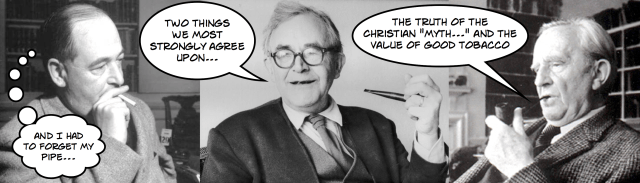
barthOne wonders what sort of fireworks might have erupted if J.R.R. Tolkien and C.S. Lewis had spent an evening with theologian Karl Barth. Although their lives overlapped, and all three were Christian academics, it is questionable how much they would have agreed upon.

And yet, there were several subjects where I think they would have enjoyed firm consensus.

Tolkien (1892-1973) was a devout Roman Catholic. Lewis (1898-1963) was a committed “low church” Anglican. Barth (1886-1968) was a Reformed theologian who rejected the liberalism that had become dominant in European academies. All three thus believed in the reality of the Christian gospel of salvation through Jesus Christ.

All three men hated war, and the two Brits had served in the trenches of WWI. All opposed Nazism and Barth was the primary author of the Barmen Declaration which challenged the Christian faith of all who supported the Nazi government.

And we’ll consider another shared attribute in just a moment.

First, though, we need to acknowledge that presumably the Inklings never met the Swiss clergyman. Their circles did not overlap. I have not been able to uncover any evidence of Tolkien referring to Barth, or of Barth mentioning either of the Inklings.

Lewis did, however mention Barth in his prolific correspondence. From his exposure to Barth it’s clear he did not share the opinion of Pope Pius XII that he was “the greatest theologian since Thomas Aquinas.” Heady praise . . . especially coming from a Roman Catholic.

In a 1940 letter to his brother Warren, Lewis reacted against what he perceived as legalism in some quarters of Protestantism that was alien to his understanding of the liberty of the Christian.

I am afraid the truth is . . . that the world, as it is now becoming and has partly become, is simply too much for people of the old square-rigged type like you and me. I don’t understand its economics, or its politics, or . . . Even its theology—for that is a most distressing discovery I have been making these last two terms as I have been getting to know more and more of the Christian element in Oxford.

Did you fondly believe—as I did—that where you got among Christians, there, at least, you would escape (as behind a wall from a keen wind) from the horrible ferocity and grimness of modern thought.

Not a bit of it. I blundered into it all, imagining that I was the upholder of the old, stern doctrines against modern quasi-Christian slush: only to find that my ‘sternness’ was their ‘slush.’ They’ve all been reading a dreadful man called Karl Barth, who seems the right opposite number to Karl Marx. ‘Under judgment’ is their great expression.

They all talk like Covenanters or Old Testament prophets. They don’t think human reason or human conscience of any value at all: they maintain, as stoutly as Calvin, that there’s no reason why God’s dealings should appear just (let alone, merciful) to us: and they maintain the doctrine that all our righteousness is filthy rags with a fierceness and sincerity which is like a blow in the face.

Sometimes the results are refreshing: as when Canon Raven (whom you and Dyson and I sat under at Ely) is sharply told in a review in Theology that ‘it is high time persons of this sort learned that the enjoyment of a chair of theology at Cambridge does not carry with it a right to criticise the Word of God’—that’s the kind of rap on the knuckles which has not been delivered for a hundred years!

Comparing Their Thoughts on the Nature of Myth

Many readers of Mere Inkling will know Tolkien and Lewis were deeply influenced by the significance of myth. They were also, in the creation of Middle Earth and Narnia, active in the act of mythopoeia, creating imaginary lands whose stories convey profound meaning.

But, despite the fact their literary products are fictional, that does not mean that all myth is “untrue,” in the sense of being unhistorical. Myth, for these great thinkers, is something far more complex and wonderful.

Without going into depth on this involved subject, I offer here the familiar story of how Lewis’ epiphany about true myth was key to his conversion.

I was by now too experienced in literary criticism to regard the Gospels as myths. They had not the mythical taste. And yet the very matter which they set down in their artless, historical fashion . . . was precisely the matter of the great myths. If ever a myth had become fact, had been incarnated, it would be just like this. And nothing else in all literature was just like this.

Myths were like it in one way. Histories were like it in another. But nothing was simply like it.

And no person was like the Person it depicted; as real, as recognizable, through all that depth of time, as Plato’s Socrates . . . yet also numinous, lit by a light from beyond the world, a god.

But if a god—we are no longer polytheists—then not a god, but God. Here and here only in all time the myth must have become fact; the Word, flesh; God, Man. This is not “a religion,” nor “a philosophy.” It is the summing up and actuality of them all. (Surprised by Joy)

This epiphany took place in 1931, during an all-night discussion (it lasted until 4:00 am) with Tolkien, and other Inkling, Hugo Dyson. Here’s how Lewis related the moment to his lifelong friend, Arthur Greeves.

It was really a memorable talk. We began (in Addison’s walk just after dinner) on metaphor and myth–interrupted by a rush of wind which came so suddenly on the still, warm evening and sent so many leaves pattering down that we thought it was raining.

We all held our breath, the other two appreciating the ecstasy of such a thing almost as you would. We continued (in my room) on Christianity: a good long satisfying talk in which I learned a lot . . .

A month later he elaborated on how the insights gained that evening were gestating in his mind and heart.

Now what Dyson and Tolkien showed me was this: that if I met the idea of sacrifice in a Pagan story I didn’t mind it at all: again, that if I met the idea of a god sacrificing himself to himself (cf. the quotation opposite the title page of Dymer) I liked it very much and was mysteriously moved by it: again, that the idea of the dying and reviving god (Balder, Adonis, Bacchus) similarly moved me provided I met it anywhere except in the Gospels.

The reason was that in Pagan stories I was prepared to feel the myth as profound and suggestive of meanings beyond my grasp even tho’ I could not say in cold prose ‘what it meant.’

Now the story of Christ is simply a true myth: a myth working on us in the same way as the others, but with this tremendous difference that it really happened: and one must be content to accept it in the same way, remembering that it is God’s myth where the others are men’s myths: i.e. the Pagan stories are God expressing Himself through the minds of poets, using such images as He found there, while Christianity is God expressing Himself through what we call ‘real things.’

Therefore it is true, not in the sense of being a ‘description’ of God (that no finite mind could take in) but in the sense of being the way in which God chooses to (or can) appear to our faculties. The ‘doctrines’ we get out of the true myth are of course less true: they are translations into our concepts and ideas of that which God has already expressed in a language more adequate, namely the actual incarnation, crucifixion, and resurrection.

Does this amount to a belief in Christianity? At any rate I am now certain (a) That this Christian story is to be approached, in a sense, as I approach the other myths. (b) That it is the most important and full of meaning. I am also nearly certain that it really happened.

In a different setting, Barth argued for the very same truth. His context was a theological environment greatly influenced by the liberal doctrines of Rudolf Bultmann, who dismissively regarded anything miraculous in the Scriptures as primitive and ignorant thinking.

The Christian Church confesses that [what the world calls] “myth” is history itself. She recognizes herself by this myth, she recognizes her life, her true reality. She is the witness of witnesses, she recognizes through the Holy Spirit that this is the one really interesting story.

Then she turns back the historians’ weapon: She says to them: What you call “myth,” that is history! She will also add: What you call history, that is a myth! A myth, a made-up history, that fancies the fate of man as depending on his earthly vicissitudes, a myth, a made-up history, that confuses the immediate success of a cause with its truth, and so on.

The only true history is the history of Christ, in which the Church participates, and which is already the secret reality of all history, since it is history itself. (The Faith of the Church)

Now, there’s an argument the Inklings could truly have appreciated.

A Bonus, for Fans of Dietrich Bonhoeffer

Barth was not the only Christian seminary professor who rejected the heresies of Bultmann, who sought to “demythologize” the Scriptures. Dietrich Bonhoeffer, a fellow German, repudiated Bultmann’s rejection of the supernatural in God’s Word. In a recent book, Taking Hold of the Real, Barry Harvey writes:

In a prison letter [Bonhoeffer] criticizes Rudolf Bultmann for excising the “mythological” elements in an attempt to reduce Christianity to its “essence.” “My view,” he writes, “is that the full content, including the ‘mythological’ concepts, must remain—the New Testament is not a mythological dressing up of a universal truth, but this mythology (resurrection and so forth) is the thing itself.”

Bonhoeffer thus acknowledges that describing a way of seeing the world as mythic thus does not summarily dismiss it either as deceptive or as an archaic and feeble attempt at doing “science.” Indeed, a truthful description of the world and especially of human existence ultimately requires mythic form.

The tales that women and men have fashioned and passed down through the centuries to discern the overall sense and significance of their existence are “never just ‘lies,’” says Tolkien, as “there is always something of the truth in them.”

C.S. Lewis Versus Socialism

chavezSocialism is in the news, and we need not wonder what the prolific and wise C.S. Lewis would have thought about it.


In the United States, for example, one of the serious contenders for the presidential election this fall belonged to neither the Democrat nor Republican parties.

Bernie Sanders dropped the “D” descriptor he had, for political convenience, worn for several months. He did so soon after Hillary clinched the Democrat nomination, saying he was elected as an “Independent,” and would return to the Senate as one.

Elsewhere in the world we see one of the most recent experiments in socialism following the historic pattern. Venezuela has fallen from the ranks of successful nation states into the abyss of socialist turmoil.

Even liberal (progressive) voices are acknowledging the abject failure of socialism in a formerly comfortable country.

When a Venezuelan entrepreneur we know launched a manufacturing company in western Venezuela two decades ago, he never imagined he’d one day find himself facing jail time over the toilet paper in the factory’s restrooms. But Venezuela has a way of turning yesterday’s unimaginable into today’s normal.

The entrepreneur’s ordeal started about a year ago, when the factory union began to insist on enforcing an obscure clause in its collective-bargaining agreement requiring the factory’s restrooms to be stocked with toilet paper at all times. The problem was that, amid deepening shortages of virtually all basic products (from rice and milk to deodorant and condoms) finding even one roll of toilet paper was nearly impossible in Venezuela—let alone finding enough for hundreds of workers. When the entrepreneur did manage to find some TP, his workers, understandably, took it home: It was just as hard for them to find it as it was for him.

Toilet-paper theft may sound like a farce, but it’s a serious matter for the entrepreneur: Failing to stock the restrooms puts him in violation of his agreement with the union, and that puts his factory at risk of a prolonged strike, which in turn could lead to its being seized by the socialist government under the increasingly unpopular President Nicolas Maduro.

So the entrepreneur turned to the black market, where he found an apparent solution: a supplier able to deliver, all at once, enough TP to last a few months. (We’re not naming the entrepreneur lest the government retaliate against him.) The price was steep but he had no other option—his company was at risk.

But the problem wasn’t solved.

No sooner had the TP delivery reached the factory than the secret police swept in. Seizing the toilet paper, they claimed they had busted a major hoarding operation, part of a U.S.-backed “economic war” the Maduro government holds responsible for creating Venezuela’s shortages in the first place. The entrepreneur and three of his top managers faced criminal prosecution and possible jail time.

Yes, it “may sound like a farce,” but thinkers like C.S. Lewis have recognized all along that socialism doesn’t work.

Europe took years to recover from the ravages of World War II. One consequence, common to many nations throughout the world during the war, was severe rationing.

The war’s end signaled a swift return to normal life in the United States and Canada. Meanwhile, in places like the United Kingdom, rationing continued, and some products (notably potatoes) were added to the list.

Rationing in the U.K. did not end until 1954, and one of Britain’s staples—tea!—was still rationed in 1952.

It’s in this context that we read the following letter that Lewis penned to one of his American correspondents. Vera Gebbert and her husband were among the Americans who occasionally forwarded food gifts which Lewis generously shared with others.

In 1954 he thanks her for her generosity and acknowledges the welcome end of rationing. In the same letter he offers a humorous political aside—at the expense of socialism.

Dear Mrs. Gebbert, Many thanks for your nice letter of the 15th, though it would have given both of us more pleasure if your account of your own state had been better: which I hope it now is.*

And I’m so glad that the Horse helped to see you through an illness, which I trust is now a thing of the past. My brother thanks you too for all the kind things you say of the Century,** and says he hopes to have another book out either late this year or early next, of which you shall have a copy.

I’m afraid it would be sheer dishonesty to pretend that we now have any kitchen needs; this government has done a magnificent job in getting us on our feet again, and a few weeks back, we solemnly burnt our Ration Books. Everything is now ‘off ration,’ and though at first of course, prices went up with a rush, they are now dropping.

But cheer up, if our friends the Socialists get back into power, you will be able to exercise your unfailing kindness once more by supplying us, not with little luxuries, but with the necessities of life!

‘How is Cambridge?’ Well, so to speak, it isn’t; in other words, I have not yet begun my Cambridge career. And when I do, the break will not be so big as you might imagine; for I shall be non-resident. Cambridge will be content with my presence there from Tuesdays to Saturdays in term time, so I shall be able to keep on the house at Oxford and become what I think you call a ‘commutor’ don’t you? Our sister college, Magdalene, has been good enough to give me a set of rooms, so I shall be very snug during the week.

The subject addressed above is not simply about toiletry scarcities or the eccentricities of antediluvian politicians. It dramatically affects the lives of real people.

Our thoughts and prayers should be offered on behalf of the victims of socialism. Just as we should recognize that unbridled capitalism does not nurture a paradise, either. However, it is unfathomable to imagine a contemporary democracy (based on capitalism) imposing serfdom on its citizens, as Venezuela is now doing.

So, it seems Lewis was correct about the propensity of socialism to undermine order and dishevel systems of proven success. After all, those supermarket shelves were not always empty before the Chaveznistas took over.

_____

* Gebbert had shared with Lewis about her domestic problems which were culminating in an imminent divorce.

** The Splendid Century: Life in the France of Louis XIV, was a well-received study Warnie had written.

C.S. Lewis & Brexit

brexitThe United Kingdom’s vote to leave the European Union has shocked the world . . . and it caused me to wonder just what C.S. Lewis would think of the narrow decision to reaffirm their national identity.

It turns out, I’m not the first to ponder the question.

A quick internet search led me to an interesting post by a British academic who addresses this very point. The political philosophy of the Inklings is not the focus of his essay, but in response to a question posed by Arthurian writer David Llewellyn Dodds, he writes the following:

Dodds: I don’t have a sense of what, if anything, the major post-1945 Inklings said about things like the Council of Europe, the ECSC, the EEC,and Euratom (all within Lewis’s lifetime), the Merger Treaty, the UK joining the European Communities (within which Tolkien lived his last nine months), and all the further developments through and within which Barfield lived. Has anyone surveyed this?

. . . I hope and pray the re-emergence of the UK from the EU will indeed be taken up to its own good, the true good of Europe, the Commonwealth, and the world, and in that the resistance to the ongoing strivings (conscious or usefully idiotic) for ‘the Abolition of Man.’*

Bruce Charlton: I think I have probably read all the relevant material about Tolkien and Lewis. Tolkien would certainly and Lewis very probably have been against Britain or England subordinating itself to Europe. About Barfield and Williams, I am not sure.

This matches my own sense of what Lewis and Tolkien would say about the decision to reassert the United Kingdom’s historical identity. They would applaud it.

While neither man was a supporter of the many excesses to which nationalism is prone, they would recognize the listless European experiment as the bloated and doomed effort it has become.

In The Screwtape Letters we witness how the Tempter skillfully recognizes that the abuse of any principle can twist it into something destructive. Since Lewis was writing during a global war (a reality in our modern world as well) he used the powerful dichotomy between patriotic supporter of the nation’s war and pacifist.

I had not forgotten my promise to consider whether we should make the patient an extreme patriot or an extreme pacifist. All extremes, except extreme devotion to the Enemy, are to be encouraged. Not always, of course, but at this period. Some ages are lukewarm and complacent, and then it is our business to soothe them yet faster asleep. Other ages, of which the present is one, are unbalanced and prone to faction, and it is our business to inflame them. . . .

Whichever he adopts, your main task will be the same. Let him begin by treating the Patriotism or the Pacifism as a part of his religion. Then let him, under the influence of partisan spirit, come to regard it as the most important part. Then quietly and gradually nurse him on to the stage at which the religion becomes merely part of the ‘cause,’ in which Christianity is valued chiefly because of the excellent arguments it can produce in favour of the British war-effort or of Pacifism.

The attitude which you want to guard against is that in which temporal affairs are treated primarily as material for obedience. Once you have made the World an end, and faith a means, you have almost won your man, and it makes very little difference what kind of worldly end he is pursuing. Provided that meetings, pamphlets, policies, movements, causes, and crusades, matter more to him than prayers and sacraments and charity, he is ours—and the more ‘religious’ (on those terms) the more securely ours. I could show you a pretty cageful down here . . .

Returning to the Brexit column, which I encourage you to read in full, the author is Bruce Charlton. He teaches Psychology at Newcastle University and is a Visiting Professor of Theoretical Medicine at the University of Buckingham.

Here are a couple of quotations to whet your appetite for his astute analysis of the political and religious climate in the United Kingdom.

Unsurprisingly, the situation seems to be that the majority of those with highest status, power, education and wealth (i.e. the Secular Left, Politically Correct Social Justice Warriors) want to remain in the EU—everybody else, not.

The referendum campaign in the mass media was overwhelmingly-dominated by Remain—but the effects of decades of corruption and self-destruction in this class was very evident—in that the Remain campaign held all the cards, but was ineffectual to the point of counter-productive in its tactics. . . .

One scenario is that pretty soon, the fickle, mass media-addicted majority will soon forget this vote, just like they have forgotten many other (should-have-been) highly significant events over the past decades. (The mass media, after all, are overwhelmingly in favour of Remain.)

. . . What will happen now depends on whether the majority vote is evidence of a positive and strategic resolve towards a new future for England: this would have to be some kind of ‘spiritual’ movement, a new destiny for the nation; because that is the only kind of thing which motivates large populations over long periods of time. I have said, many times, that net-positive change entails some kind of religious (and specifically Christian) revival—because I believe that ‘nationalism’ is a spent-force in the history of The West.

After further exploring the alternatives ahead, Charlton closes with a pertinent Lewis reference.

Either way, things have now ‘come to a point’ as CS Lewis put it (in That Hideous Strength)—the issues are becoming very clear, the sides are very distinct. The next few days, weeks and months will be crucial.

Indeed, they shall.

_____

* You can read The Abolition of Man here.

Vulgar Christianity

vulgarityIf I were to say “vulgar Christianity is a good thing,” what would you think?

It depends, doesn’t it, on the meaning you ascribe to the word “vulgar.” For, even though it is most often used in a derogatory sense today, vulgar also means common or genuine.

Here, in modified order, are some definitions gleaned from an internet dictionary. The first three represent the most vulgar use of the word.

Vulgar, 1350-1400; Middle English < Latin vulgāris, equivalent to vulg (us) the general public + -āris -ar

  1. characterized by ignorance of or lack of good breeding or taste: vulgar ostentation.
  2. indecent; obscene; lewd: a vulgar work; a vulgar gesture.
  3. crude; coarse; unrefined: a vulgar peasant.

The next two definitions relate to the more historic, rather less crass application of the word.

  1. of, relating to, or constituting the ordinary people in a society: the vulgar masses.
  2. lacking in distinction, aesthetic value, or charm; banal; ordinary: a vulgar painting.
  3. current; popular; common: a vulgar success; vulgar beliefs.

The final definition of vulgar relates to language: “spoken by, or being in the language spoken by, the people generally; vernacular: vulgar tongue.”

The most visible adaptation of the root word likely comes in the title of the Latin translation of the Holy Scriptures completed by the ascetic saint, Jerome (347-420). The Vulgate, came to be called in Latin versio vulgata or vulgata editio, which meant the commonly used or read version.

Vulgarity in C.S. Lewis

Naturally, Lewis did not communicate in a vulgar (objectionable) way. He did, however, strive to reach the common men and women of the day, doing so more effectively than many clergy appear(ed) capable.

There are ample examples of the wide use of the word in Lewis’ works. In “Christianity and Culture,” he distinguishes between objective and subjective assessments of the value of literature.

A bad book is to be deemed a real evil in so far as it can be shown to prompt to sensuality, or pride, or murder, or to conflict with the doctrine of Divine Providence, or the like. The other dyslogistic terms dear to critics (vulgar, derivative, cheap, precious, academic, affected, bourgeois, Victorian, Georgian, “literary,” etc.) had better be kept strictly on the taste side of the account.

In discovering what attitudes are present you can be as subtle as you like. But in your theological and ethical condemnation (as distinct from your dislike of the taste) you had better be very un-subtle. You had better reserve it for plain mortal sins, and plain atheism and heresy.

For our passions are always urging us in the opposite direction, and if we are not careful criticism may become a mere excuse for taking revenge on books whose smell we dislike by erecting our temperamental antipathies into pseudo-moral judgements.

In Studies in Words, we gain an interesting insight into Lewis’ understanding of himself. He discusses how the concept of “bourgeois,” which simply means middle-class or conventional, is twisted by elitists to mean something offensive.

All my life the epithet bourgeois has been, in many contexts, a term of contempt, but not for the same reason. When I was a boy—a bourgeois boy—it was applied to my social class by the class above it; bourgeois meant “not aristocratic, therefore vulgar.”

When I was in my twenties this changed. My class was now vilified by the class below it; bourgeois began to mean “not proletarian, therefore parasitic, reactionary.” Thus it has always been a reproach to assign a man to that class which has provided the world with nearly all its divines, poets, philosophers, scientists, musicians, painters, doctors, architects, and administrators.

I am so happy, and blessed, that C.S. Lewis was a vulgar man . . . just like me.

For those who have read this far, I offer now one of Lewis’ poem with a related theme. Enjoy.

On a Vulgar Error

No. It’s an impudent falsehood. Men did not

Invariably think the newer way

Prosaic mad, inelegant, or what not.

Was the first pointed arch esteemed a blot

Upon the church? Did anybody say

How modern and how ugly? They did not.

Plate-armour, or windows glazed, or verse fire-hot

With rhymes from France, or spices from Cathay,

Were these at first a horror? They were not.

If, then, our present arts, laws, houses, food

All set us hankering after yesterday,

Need this be only an archaising mood?

Why, any man whose purse has been let blood

By sharpers, when he finds all drained away

Must compare how he stands with how he stood.

If a quack doctor’s breezy ineptitude

Has cost me a leg, must I forget straightway

All that I can’t do now, all that I could?

So, when our guides unanimously decry

The backward glance, I think we can guess why.

_____

The image above is taken from Grose’s Classical Dictionary of the Vulgar Tongue by Pierce Egan (1823). Caution, even though this slang is centuries old, some of it is vulgar in every sense of the word; it may even cause one to blush.

Tolkien’s Inspiration

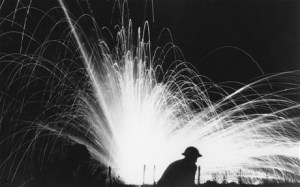
night patrolThe poetry of a dead veteran spoke to me today. He was a close friend of J.R.R. Tolkien, and in a sense his life lives on in the descriptions of Middle Earth.

In a recent column my Canadian friend Brenton Dickieson, introduced me to one of the many poets whose lives tragically ended on the battlefields of WWI.

Professor Dickieson describes the context of a new film about the impact of the war on J.R.R. Tolkien. It is called Tolkien’s Great War. It is based on the book Tolkien and the Great War: The Threshold of Middle-earth.

You will find a link to the half hour documentary below, and I strongly—yes, strongly—encourage you to watch it. It is quite moving.

Like most members of their generation, Tolkien and C.S. Lewis were deeply moved by the horrors of the First World War. Both served on the front lines, in the grim trenches, during the bloody conflict. And they lost friends. I’ve written in the past about their military service, including posts herehere, and here.

The Deceased Poet

The documentary describes the untimely deaths of two of Tolkien’s closest friends during the war. One of them, Geoffrey Bache Smith, was a poet.

Following his death, Tolkien gathered together his writings and published them as a tribute to his friend. It was one of the earliest contributions to a wealth of soldier’s poetry that would deluge grieving Europeans by the close of the conflict.

Due to the brevity of his life, the collection, published as A Spring Harvest, is short. Tolkien also penned an introduction to the work which is equally Spartan. The literary austerity is fitting, given the sad reason for the volume’s brevity. The introduction, in full, reads:

The poems of this book were written at very various times, one (“Wind over the Sea”) I believe even as early as 1910, but the order in which they are here given is not chronological beyond the fact that the third part contains only poems written after the outbreak of the war. Of these some were written in England (at Oxford in particular), some in Wales and very many during a year in France from November 1915 to December 1916, which was broken by one leave in the middle of May.

“The Burial of Sophocles,” which is here placed at the end, was begun before the war and continued at odd times and in various circumstances afterwards; the final version was sent me from the trenches.

Beyond these few facts no prelude and no envoi is needed other than those here printed as their author left them.

J.R.R.T., 1918.

The poems themselves run the gamut of emotions. This is unsurprising, given that some were born during the idyll dreams of youth, while others were forged by the anvil of war.

The limited press run of the book has made it difficult to find. Fortunately, it is now available for free via Project Gutenberg.

While the poems include the familiar references to the “old gods” so common to the period, there are also some moving references to a more Christian ethos.

Creator Spiritus

The wind that scatters dying leaves

And whirls them from the autumn tree

Is grateful to the ship that cleaves

With stately prow the scurrying sea.

Heedless about the world we play

Like children in a garden close:

A postern bars the outward way

And what’s beyond it no man knows:

For careless days, a life at will,

A little laughter, and some tears,

These are sufficiency to fill

The early, vain, untroubled years,

Till at the last the wind upheaves

His unimagined strength, and we

Are scattered far, like autumn leaves,

Or proudly sail, like ships at sea.

Tolkien and Smith formed half of the T.C.B.S., a communion knit together during the school years. The war would cut that number in half, as poignantly described in Tolkien and the Great War. The first of the companions had already died, and five months later Smith was spending the final moments of his own life encouraging his friend to press on, whatever might befall him.

Before reading Smith’s “So We Lay Down the Pen,” consider his final letter to Tolkien. He wrote it as he prepared to lead a night scout through dead man’s land at the front. It was dangerous duty which did indeed, that very evening, cost him his life.

My chief consolation is that if I am scuppered [ambushed and killed] tonight—I am off on duty in a few minutes—there will still be left a member of the great T.C.B.S. to voice what I dreamed and what we all agreed upon. For the death of one of its members cannot, I am determined, dissolve the T.C.B.S.

Death can make us loathsome and helpless as individuals, but it cannot put an end to the immortal four! A discovery I am going to communicate to Rob before I go off tonight. And do you write it also to Christopher. May God bless you my dear John Ronald and may you say things I have tried to say long after I am not there to say them if such be my lot.

Yours ever,

G.B.S.

Tolkien compiled Smith’s poems as a tribute. And, when he wrote his masterpieces, there is a profound sense in which he truly did say things his friends had tried to say, long after they were not there to say them.

So We Lay Down the Pen

So we lay down the pen,

So we forbear the building of the rime,

And bid our hearts be steel for times and a time

Till ends the strife, and then,

When the New Age is verily begun,

God grant that we may do the things undone.