Teaching English in China

CSL China

If C.S. Lewis had desired to teach English in China he would probably have succeeded. However, due to some rather peculiar requirements, he may not have passed muster.

In that Asian nation, you need four years of college to become a teacher. At 山西师范大学 (Shaanxi Normal University) they include another odd requirement. Shaanxi has a minimal height standard. Men must be at least 5-foot-1 and women must be no shorter than 4-foot-7.

C.S. Lewis would have passed this mandate; he was just shy of 5-foot-11. But who knows what other arbitrary dictates may have barred him from sharing his brilliant mind.

The university’s policy came to international attention when the plight of a young student who completed her studies only to be informed that she was four inches too short to receive her diploma. As the BBC reports, there is a waiver for those who wish to teach the very young.

Those wanting to teach at nursery are able to apply for special accreditation if they are five centimetres shorter.

The school’s, albeit flimsy, rationale is that teachers may need to reach high on blackboards when they are teaching their students. (So much for using modern technology to compensate.)*

It would be bad enough if they failed to admit such candidates to their program, but obviously some are not informed of the standard until they have completed their university studies. One can hardly imagine how that unfortunate graduate felt.

C.S. Lewis spent his academic life at Oxford and Cambridge. Although he lectured in a variety of venues, no international university was blessed to have him serve as a visiting scholar.

Fortunately, however, his words reached far beyond the campuses of Oxbridge. And, even though Lewis never taught in China (or in Chinese), his words are available today via translation. At Wheaton College, the Marion E. Wade Center preserves a great deal of information about the Inklings, including some original material.

The Wade’s translation collection has a diverse amount of languages represented, even if only by one book. The languages at the Wade include: Afrikaans, Albanian, Arabic, Bulgarian, Catalan, Chinese, Croatian, Czech,  Danish, Dutch, Esperanto, Estonian, Faroese, Finnish, French, Gaelic, German, Greek, Hebrew, Hungarian, Indonesian, Italian, Japanese, Korean, Latin, Latvian, Lithuanian, Norwegian, Polish, Portuguese, Romanian, Russian, Serbian, Slovak, Slovenian, Spanish, Swedish, Thai, Turkish, Ukrainian, and Welsh.

A Two-Way Street

Those of us who have taught realize better than others that teachers often learn as much from their students as they offer to them. Preparing to teach demands that we study to know the subject matter as intimately as we can, so we might convey it effectively to others.

Although he was a brilliant teacher, C.S. Lewis was also a diligent lifelong learner.

Lewis held great respect for Chinese civilization. He was interested in the Chinese philosophical concept of the Tao. I’ve written about his thoughts on this subject before.

Lewis viewed the Tao as being similar to what Christian theologians traditionally refer to as Natural Law.

The Tao, which others may call Natural Law or Traditional Morality or the First Principles of Practical Reason or the First Platitudes, is not one among a series of possible systems of value. It is the sole source of all value judgments.

If it is rejected, all value is rejected. If any value is retained, it is retained. The effort to refute it and raise a new system of value in its place is self-contradictory. There has never been, and never will be, a radically new judgment of value in the history of the world.

What purport to be new systems or . . . ideologies . . . all consist of fragments from the Tao itself, arbitrarily wrenched from their context in the whole and then swollen to madness in their isolation, yet still owing to the Tao and to it alone such validity as they possess. (The Abolition of Man)

Lewis was an advocate of what some refer to as Classical Education. It involves loftier goals than simply communicating data. In his essay “Our English Syllabus,” Lewis “propagated education’s end, rather than as the filling of students’ heads with information or their muscles with habits, as the inculcation of virtue.”

Lewis treasured the essence of knowledge rather than its trappings. He was patient with those genuinely hungry for knowledge. But you could also readily apply to him the maxim that he did not suffer fools gladly.

It does not take a genius to discern what C.S. Lewis would have thought about this Chinese height requirement. To prevent a motivated and capable educator from pursuing her vocation simply because she may lack the reach of someone taller, does not pass the test of common sense.


* “The first interactive whiteboard was released in 1991,” and I assume The People’s Republic “magically” secured that very technology no later than 1992.

 

C.S. Lewis & the Inklings Seated at the Round Table

arthur.png

This book belongs in the library of every fan of the Inklings and each devotee of King Arthur. The truth is that anyone interested in British literature or the Dark Ages will find much that appeals to their curiosity. King Arthur is known around the world as an archetypal hero, and he was a central fixture in the minds of the Inklings.

The Inklings & King Arthur (TIKA) is impressive in every way. However, it’s 555 rich pages should not intimidate potential readers. Editor Sørina Higgins masterfully gathered diverse insights from a score of scholars, and the individual chapters can be approached in any manner the reader desires. Even if a few of the chapter titles fail to resonate with a particular reader, the solid value of the remainder far exceed the price of the work.

Mere Inkling seldom offers reviews of books, despite the “libraries” of new Inkling literature published every year. The Inklings & King Arthur is the exception, for two reasons.*

TIKA does not require a familiarity with its subject. The academic background of the contributors allows them to usher readers into rewarding discussions without additional research. C.S. Lewis described “the task of the modern educator [as] not to cut down jungles, but to irrigate deserts.” The writers in this volume have written so clearly that even if your knowledge of King Arthur is the Mojave, and your familiarity with the Inklings is the Sahara, you will enjoy reading this book.

Truth be told, much has been written about King Arthur. Likewise, films have explored the myths, with varying degrees of faithfulness. Some make no effort at all to be faithful to the inspiring story. An extreme example would be the ludicrous storyline of the 2017 film, Transformers: The Last Knight. In striking contrast to this, the Inklings sought to penetrate the mists of time and discern the reasons Arthur’s story has inspired men and women for so many generations.

In the book’s introduction, Higgins says her hope was “to fill a sizeable hole in the field of Inkling studies” (2). She surely achieved this task. She also says “the present collection endeavors to usher the field of Inklings studies into more rigorous theoretical territory” (3). This goal, the contributors have surpassed.

Proceeding to some specific comments, my first would be to point out the accuracy of the volume’s title. It is an exploration of “the Inklings,” rather than simply Lewis and/or Tolkien. The fact that less well-known members of the literary group wrote the most Arthuriana means their works are particularly well represented in the current collection.

This fact might discourage a potential reader who is disinterested in the lesser known authors. However, the truth is, exposure to work of these friends and influencers of the two über-Inklings helps us better understand them and the confluences that flowed together in that unique literary fellowship.

Most articles consider the Inklings as group in relationship to a theme. For example, Christopher Gaertner discusses, “Shape and Direction: Human Consciousness in the Inklings’ Mythological Geographies.” The author identifies their differing viewpoints and how they influenced one another. Despite “their shared resistance to a scientistic worldview” (150), Tolkien, Lewis and Owen Barfield did not share identical understandings of how the world should be perceived.

Beyond the Eagle & Child

One pleasant surprise is the inclusion of an essay on G.K. Chesterton (1874-1936). Chesterton’s The Everlasting Man contributed to the conversion of C.S. Lewis.

In his TIKA essay “All Men Live by Tales,” J. Cameron Moore reveals how Chesterton’s poetry about Arthur is rooted in England. Arthur was important enough for Chesterton to return several times to the story of this hero who is “Mythic, Roman, and Christian (205). You can download a free copy of The Ballad of St. Barbara which includes “The Myth of Arthur” here. You can read “The Grave of Arthur” at this site.

Benjamin Shogren explores the significance of the addition of two new names—Pendragon and Fisher-king” to the protagonist of C.S. Lewis’ space trilogy. Elwin Ransom “represents Arthur by . . . evoking the primary imagery associated with the role of Arthur” (399). Ransom is now imbued with a mythological aura of royal leadership and courageous chivalry.

This volume overflows with richness. In “On Fairy Stories,” J.R.R. Tolkien describes the dense blend of mythologies present in the story of Arthur, using the image of a pot of soup with various ingredients added over time.

It seems fairly plain that Arthur, once historical (but perhaps as such not of great importance), was also put into the Pot. There he was boiled for a long time, together with many other older figures and devices, of mythology and Faerie, and even some other stray bones of history (such as Alfred’s defence against the Danes), until he emerged as a King of Faerie.

The situation is similar in the great Northern “Arthurian” court of the Shield-Kings of Denmark, the Scyldingas of ancient English tradition. King Hrothgar and his family have many manifest marks of true history, far more than Arthur; yet even in the older (English) accounts of them they are associated with many figures and events of fairy-story: they have been in the Pot.

The soup or stew pot may also serve as a fitting metaphor for The Inklings & King Arthur. This exceptional volume offers a potent mix of wisdom and insights that go beyond the boundaries of its title. Readers will be rewarded, in fact, with many satisfying literary meals.


* The first reason is that the academic weight of the work merits the undertaking. The second is because I have received a review copy, which obligates me in a sense, to providing a review—not a positive review, of course, but an honest assessment of its value, from my personal perspective.

Honest reviewers, of course, are mandated to acknowledge the fact that they received a particular volume gratis. This is done to protect one’s integrity. At the same time, a writer’s honor is also protected by their pledge to provide an honest evaluation of each work, for good or ill. This is what you will discover here.

The volume’s editor, Sørina Higgins, gathered an impressive group of Inkling scholars to contribute. She is a poet who is Chair of Language and Literature at Signum University.

It would be challenging to find any flaw in this amazing volume. Its sole weakness, in this reviewer’s opinion, is that it is so detailed and thorough, that it transcends the reading skills (or perhaps, “tastes”) of some of today’s readers. Despite that, the authors have gone to significant effort to write clearly and make their extremely detailed subject matter accessible to all.

C.S. Lewis and Typos

typos

Who among us has lived a life free of typographical errors? When we learned to type (or “keyboard”), our typing speed was influenced by the number of incorrect characters we included.

Even worse, some infernal source birthed the idea of “autocorrect,” which is occasionally useful for documents, but just as frequently deadly for emails and texts.

Lewis’ own books have included a number of typographical errors. Arend Smilde, a Dutch scholar and translator, has noted a fair number of them on his valuable website.

The truth is, it is possible for errors to creep in whenever original manuscripts are copied.

Even with the Scriptures, existing manuscripts include various minor variations, since the autographs have been lost to history.

This fact necessitates the need for “textual criticism,” and many earnest biblical scholars have devoted their lives to discerning the original text. (“Criticism” in this use, does not connote negativity. It simply refers to study, such as with “literary criticism.”)

Textual criticism diverges significantly from the so-called “higher criticisms” which frequently result in confusion and doubt.* Comparing actual texts is fundamental to the study of all literary creations.

C.S. Lewis wrote a brilliant essay entitled “Modern Theology and Biblical Criticism,” which is currently known as “Fern-Seed and Elephants.” In it, he distinguishes between the various types of criticism and affirms textual examination as utterly valid.

We think that different elements in this sort of theology have different degrees of strength. The nearer it sticks to mere textual criticism . . . the more we are disposed to believe in it. And of course, we agree that passages almost verbally identical cannot be independent. It is as we glide away from this into reconstructions of a subtler and more ambitious kind that our faith in the method waivers; and our faith in Christianity is proportionally corroborated.

The sort of statement that arouses our deepest scepticism is the statement that something in a Gospel cannot be historical because it shows a theology or an ecclesiology too developed for so early a date. For this implies that we know, first of all, that there was any development in the matter, and secondly, how quickly it proceeded.

When books are published, errors slink in. This generates errata, which are presumably corrected in any subsequent editions of the work. (It dawns on me that I’ve never seen an erratum, noting there is only one mistake in the work.)

The Genesis of Today’s Thoughts

Curiously, the article that led me to think about textual errors involves the substitution of an i for an e. The result is that for centuries, people mistakenly believed that Rome had a “Little Temple of Ridicule.” The notion was that the ancient Romans so loved humor, that they “went so far as to erect a ridiculi aedicula, or chapel of laughter.” This curious article is well worth reading (hint: it has something to do with Hannibal’s retreat).

It’s not that the idea of humor shouldn’t be celebrated. On the contrary, laughter features broadly in C.S. Lewis’ works. In a letter written shortly after his marriage to Joy, he alludes to Dante’s portrait of heaven. It is an image Lewis affirmed, and one that I happily anticipate.

Of course Heaven is leisure (“there remaineth a rest for the people of God”): but I picture it pretty vigorous too as our best leisure really is. Man was created “to glorify God and enjoy Him forever.”

Whether that is best pictured as being in love, or like being one of an orchestra who are playing a great work with perfect success, or like surf bathing, or like endlessly exploring a wonderful country or endlessly reading a glorious story—who knows? Dante says Heaven “grew drunken with its universal laughter.”


* For an informative discussion of the different forms of criticism, see this conversation. In response to the question “How is it, then, that the Higher Criticism has become identified in the popular mind with attacks upon the Bible and the supernatural character of the Holy Scriptures?” the author writes:

Some of the most powerful exponents of the modern Higher Critical theories have been Germans, and it is notorious to what length the German fancy can go in the direction of the subjective and of the conjectural. For hypothesis-weaving and speculation, the German theological professor is unsurpassed.

Some of the men who have been most distinguished as the leaders of the Higher Critical movement in Germany and Holland have been men who have no faith in the God of the Bible, and no faith in either the necessity or the possibility of a personal supernatural revelation.

C.S. Lewis’ Nemesis: F.R. Leavis

leavis.png

When C.S. Lewis died, one of his Cambridge colleagues uttered a shocking statement—to his Cambridge students.

“C.S. Lewis is dead,” announced F.R. Leavis to his English literature students at Cambridge University a few days later, while the world mourned for Kennedy (the President was assassinated the same day).

American novelist and essayist D. Keith Mano, then studying at Cambridge, remembers Leavis continuing his brief commentary on Lewis’ passing as follows: “They said in the Times that we will miss him. We will not. We will not.

Who knew the world of literary criticism could be so ill-mannered?

In my readings about C.S. Lewis and his life I’ve noted references to a fellow English professor at Cambridge who waged a lengthy academic argument with Lewis over the heart of English education.

The challenger to Lewis’ history-oriented approach advocated a critical position, which diluted concern for the intentions of the original writers. I’m not a lit major, so I’ll leave the description at that.*

F.R. Leavis, a dynamic influence at Cambridge, dreaded the arrival of Lewis when he moved from Oxford to a distinguished chair tailor-made for him. The two scholars shared several traits which might have disposed them to friendship.

Both were veterans of the Great War.** One difference between the veterans is curious. Leavis declined to join the Officers’ Training Corps while a student, and chose ambulance service when conscription began. Lewis, on the other hand, voluntarily joined the OTC, even though he (as an Irishman) was exempt from the conscription.***

Another similarity between the two was that they inspired many students. Far from the caricature of droning academicians, Lewis and Leavis drew fans and even disciples from the student body. (In a recent post I mentioned the affectionate nickname some of the former’s students had for him: Papa Lewis.)

The Problem

Most writers believe this second “similarity” factored into the strained relationship between the two. Both had strong personalities, and bold convictions. They did not, however, share a common temperament. Lewis was normally respectful of his philosophical adversaries. Leavis, not so much. The following comes from “C.S. Lewis and the Art of Disagreement.”

The fact that Lewis could approve of atheists [and] liberals . . . reinforces Brewer’s point that Lewis would not allow disagreement to become personal. He could always distinguish the man from the man’s opinion, and he knew the difference between an argument and a quarrel. He would not allow himself to be betrayed into aggression, but would, where necessary, draw rein on a dispute with a wry smile and an agreement to disagree.

His public written controversy on literature with E.M.W. Tillyard (later published as The Personal Heresy) was conducted with pugnacity but without personal animus. And though Lewis laid into the arguments of another colleague, F.R. Leavis, with great forcefulness in the pages of An Experiment in Criticism, he never named Leavis within those pages, but covered his opponent in a thoughtfully woven cloak of pseudonymity.

Contrast that to Leavis’ comment with which we began, in which he “celebrates” Lewis’ passing.

Lewis was quite aware of Leavis’ animosity. In a 1961 letter to the publisher of The Screwtape Letters and Screwtape Proposes a Toast, the author strikes the Cambridge Review from the publications scheduled to receive review copies.

I’ve not additions to make, but one subtraction. Delete Cambridge Review. It’s mainly in the hands of Leavisites who will blackguard any book of mine, and I don’t know why we should let them have a free copy for their sport!

Lewis scholar Brenton Dickieson wrote a column about George Watson’s critique of Lewis. Watson met Lewis at Oxford and later joined him on the faculty at Cambridge.

Here are George Watson’s first evaluative words of Lewis: “Like F.R. Leavis, he was an offensive critic.” Awesome. I think it is an evaluation that would have made Lewis chuckle, particularly in his positive comparison with Leavis, the closest thing Lewis ever got to having a Sherlockian arch-nemesis.

However, Watson (note the name) is careful to remind us that Lewis “reveled in diversity as much as Leavis detested it.” That diversity in Lewis is one of the features that (I believe) most draws and repels readers today.

In the aforementioned article, “Lewis and Cambridge,” Barbour candidly describes the disparity between the spirit of the two nemeses.

“[Lewis’] controversies were always impersonal and often ended with the participants finding a good deal of common ground, whereas Leavis’s controversies . . . tended to end in anathematizing and deeply personal wounding.”

Leavis’ reputation for engendering conflict was so pronounced The Guardian actually included the following in his obituary:

Perhaps the most telling counter-assault on him was by C.S. Lewis, who said that the use of subliminal code words like “maturity” and “relevance” smuggled in an entire value system that was never made explicit for scrutiny. Others accused him of being a crypto-Marxist.

Leavis never replied, which was a pity, but then his weapons during his long career of humiliations in the Cambridge English faculty also included silence, internal exile and cunning.

His most murderous and underestimated weapon was ridicule, which he deployed in lectures with the virtuosity of a music-hall star and with an insensitivity verging on paranoia.

The Essence of Their Differences

Exploding English: Criticism, Theory, Culture includes a chapter entitled “Leavis, Lewis, and Other Oppositions.” It’s précis suggests one reason Lewis’ criticisms have possessed a longer lifespan than those of Leavis.

Lewis and Leavis . . . were the dominant figures in literary study in the middle decades of the twentieth century. . . . it is Lewis’s arguments and assumptions that seem to be the more challenging and which have something to contribute to contemporary debates.

This assessment echoes Lewis’ own view that the Leavis tsunami may have crested. Just a month before his death, he wrote to Basil Willey about his retirement. Willey would retire from his own chair two years later.

My dear Basil . . . I have an idea that Cambridge ten years’ hence might suit us both [better] than the Cambridge we have known. . . .

I hope your success will follow you . . . [if not], then our English school, with its neglect of language, becomes purely a school of literary criticism. And criticism, thus isolated, seems to me a positively mischievous instrument of education.

In “C.S. Lewis, Literary Critic: A Reassessment,” which appeared in Mythlore, William Calin describes Lewis’ passionate defense of English authors whose reputations were in jeopardy.

A Preface to Paradise Lost does for Milton what The Allegory of Love did for Spenser, and Lewis does for epic what he had previously done for allegory and fin’ amor [courtly love]. . . . In sum, Lewis defends his authors language from the strictures of Eliot and Leavis; he defends his worldview and its artistic embodiment from the prejudice of 1930s agnostic university faculty in English. . . .

When he tells students “Don’t read criticism” [Lewis] alludes again to Leavis and his disciples, who fetishized the term “critic.” Lewis would have called himself a scholar or an historian.

The following passage from A Preface to Paradise Lost is telling. Leavis is the unnamed standard bearer for the worldview he rejects. It reveals Lewis’ keen discernment in understanding of his unbridgeable difference with Leavis.

It is not that [Leavis] and I see different things when we look at Paradise Lost. He sees and hates the very same that I see and love. Hence the disagreement between us tends to escape from the realm of literary criticism.

We differ not about the nature of Milton’s poetry, but about the nature of man, or even the nature of joy itself.

The Apostle Paul described this difference in his correspondence with the Corinthians.

Now we have received not the spirit of the world, but the Spirit who is from God, that we might understand the things freely given us by God. . . .

The natural person does not accept the things of the Spirit of God, for they are folly to him, and he is not able to understand them because they are spiritually discerned. . . . But we have the mind of Christ.

In an excellent article entitle “Three Great Critics: F.R. Leavis, T.S. Eliot, and C.S. Lewis,” Michael Aeschliman**** closes with a gospel-oriented thought.

It is pleasing to conclude by imagining C.S. Lewis, T.S. Eliot, and F.R. Leavis now conversing together amicably, recollecting emotion in tranquility, in another and better and more luminous realm, toward which all three of them were fervent pilgrims throughout their embattled but noble lives.


* There are ample online sources available to describe the contrast in detail. For example, Brian Barbour’s Modern Philology essay, “Lewis and Cambridge,” provides a superb explanation of the struggle in its broader context.

** Lewis served in the trenches, where he was seriously wounded. Leavis was fortunate enough to avoid frontline combat by serving in the Friends Ambulance Unit. This site provides a helpful account of his service on an Ambulance Train which shuttled the wounded to ports.

*** There is no record of which ambulance train carried Lewis homeward after his injury, but wouldn’t it be ironic he and Leavis had unknowingly encountered one another at that time?

**** Aeschliman is the author of The Restitution of Man: C.S. Lewis and the Case Against Scientism.

Medical Science and God

regenerator.png

In his essay entitled “Miracles,” C.S. Lewis described during World War II the Christian viewpoint that God is the author of healing. After discussing the natural order of creation, he argues that God is at work in restoring the health of the those who are ailing.

The miracles of healing [are] sometimes obscured for us by the somewhat magical view we tend to take of ordinary medicine. The doctors themselves do not take this view. The magic is not in the medicine but in the patient’s body.

What the doctor does is to stimulate Nature’s functions in the body, or to remove hindrances. In a sense, though we speak for convenience of healing a cut, every cut heals itself; no dressing will make skin grow over a cut on a corpse.

That same mysterious energy which we call gravitational when it steers the planets and biochemical when it heals a body is the efficient cause of all recoveries, and if God exists, that energy, directly or indirectly, is His. All who are cured are cured by Him . . .

No veteran of World War I trenches would have been unacquainted with the horrors of grievous wounds. Much less a soldier, like C.S. Lewis, who was wounded by an artillery shell that killed a friend standing next to him.

That is why every combat veteran can stand in joyful awe at a science fiction healing tool that is being created a century after the war to end all wars. (Peter Jackson, of Middle Earth fame, just released a moving film about the war. You can listen to Michael Medved’s review of “They Shall Not Grow Old.”.)

The Healing of a Cut

I recently learned about an amazing wave of research related to the relatively new concept of 3D Printing. Even as new applications for these three-dimensional printers are exploding (they even make prostheses!), a variation of the technology is being developed to heal living skin.

Now, this is not like a medicine or bandage of some type. The process actually involves “printing” new skin by laying down layer after layer of one’s own cells over a wound.

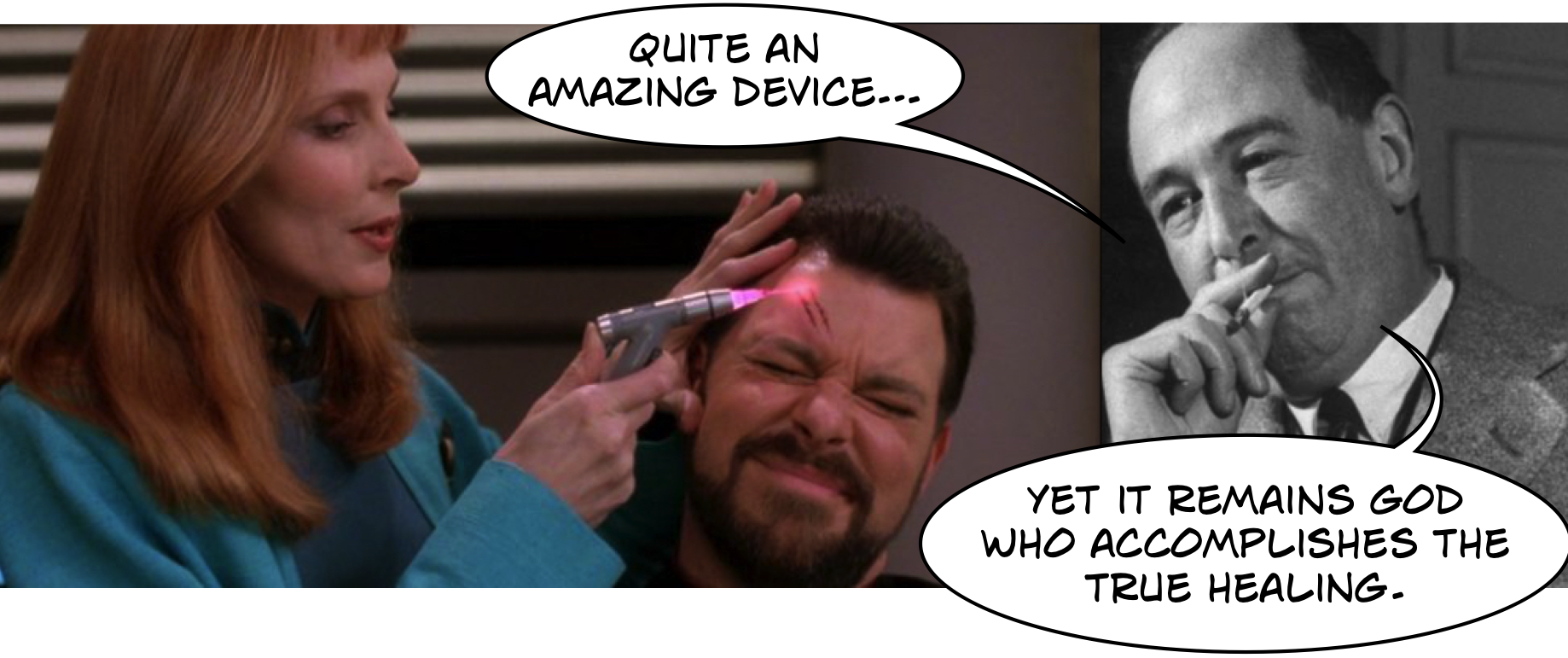
Sounds like science fiction, doesn’t it? In fact, my first thought upon reading about it, went to the most elementary of Star Trek healing devices—the dermal regenerator. And, apparently, I wasn’t alone.

In the Star Trek universe, dermal regenerators are so commonplace that no one has a second thought as gaping wounds are closed in the blink of an eye—by merely pointing a high-tech tool at the injury. (You may be thinking it sounds a bit like a magic wand . . . because fantasy and science fiction are close cousins.)

You can read a description of the scientific report in Nature magazine.

In contrast to manual cell seeding or cell spraying, bioprinting has the capability to deliver cells to specific target sites using layer-by-layer freeform fabrication, and it has been applied in numerous applications.

If you’ve ever known someone who suffered from severe burns, you will be pleased to learn “this technology has a wide application, and its application will be expanded to not only treat full-thickness wounds, but also for other types of wounds such as burns and ulcers, and even for deep tissue injuries.”

The Power of Science

Science is a precious gift from God, so long as it “uses its powers for good.” When people begin to look to science for answers it cannot provide, they can devolve into the sort of “scientism” that C.S. Lewis decried.

Science, however, in its purest and most true form, is a wondrous thing. In English Literature in the Sixteenth Century, Lewis discusses the work of Richard Hooker (1554-1600). It’s clear they share this same sentiment.

All good things, reason as well as revelation, nature as well as Grace, the commonwealth as well as the Church, are equally though diversely, “of God.” . . . All kinds of knowledge, all good arts, sciences, and disciplines come from the Father of lights and are “as so many sparkles resembling the bright fountain from which they rise”

In that spirit, I invite you to include in your prayers not only medical personnel and caregivers, but all of those brilliant minds and skilled hands devoted to using science to heal and to support God’s gift of life.

C.S. Lewis & Conversation

Luther & Mic.jpg

The most effective way to influence another person is through a fruitful conversation. This is especially true when one is attempting to persuade someone that a given point is true.

One drawback to conversations is that they are, by definition, rather intimate. After all, a person can only carry on a genuine conversation with a small audience. The ebb and flow of the spoken words, exchanged between parties, is utterly different than a speech or sermon. (This is one reason I prefer to teach in a conversational manner—soliciting questions, insights and even challenges during the delivery of whatever material I had prepared in advance.)

I recently read an interview conducted with a friend of mine who is an officer and a gentleman in the literal sense of those two words. Michael Zeigler and I served together at Fairchild AFB, after which he entered the ministry.

What most struck me in the interview, was a part of his response to a question about a book he has written. In it, he mentioned a theologian that I too have had the joy of studying under. That professor offered some invaluable advice for those of us who write. As Michael related:

My teacher [Seminary Professor Emeritus] Robert Kolb told us that, when we write, we should not seek to have the last word, but to contribute to the conversation.

This is contrary to the way most writers approach the keyboard. Having the last word is precisely what so many of us strive to do. And that very attitude undermines the opportunity for truly productive conversations.

Writing is inherently prone to unidirectional communication. Conversation can enter in through comments to authors, and this is one of the things that makes blogging somewhat more emotionally satisfying than traditional publishing.

The radio offers another example of one-way communication.* There are, of course, ways to offer feedback to commentators, but these are rather limited, and always consequent to the original message. But, it does possess a singular advantage over the printed media.

The graphic above pictures Martin Luther at a microphone. Had he lived in the appropriate era, I have no doubt he would have engaged in broadcasting . . . just as he embraced Gutenberg’s press to spread his message.

Lewis’ Broadcasts

My friend Michael has recently embarked on a new journey with a widely respected radio ministry. And, in this, he bears a striking resemblance to the great C.S. Lewis.

(Evan Rosa offers a rare example of Lewis’ broadcasts here.)

The similarity between Zeigler and Lewis is that their broadcasts are conversations, rather than presentations. Their conversational essence extends far beyond their friendly, approachable tone. They are truly engaged with their hearers. You know that they would welcome an actual interchange beyond the limitations of their microphones.

It is a rare talent to be able to touch the individual members of a mass audience so they feel like you are speaking to them alone. With both of the aforementioned individuals, I believe a key element of their effectiveness is their unfeigned humility. In 1941 Lewis wrote to a correspondent about his upcoming BBC radio talks.

I’ve given talks to the RAF [Royal Air Force] at Abingdon already, and so far as I can judge they were a complete failure. . . . Yes, jobs one dare neither refuse nor perform.

One must take comfort in remembering that God used an ass to convert the prophet; perhaps if we do our poor best we shall be allowed a stall near it in the celestial stable.

This is a good reminder not only to broadcasters, but to all who write as well. Picking up our pens in a spirit of humility goes a long way towards receiving a warm welcome for our words. And, if we are truly fortunate, our readers will recognize we are not seeking to have the last word, but merely hoping to contribute to the conversation.

Addendum

The Rev. Dr. Michael Zeigler is a long-time friend. We met years ago when he was a young Air Force officer, a first-class product of the Air Force Academy. After completing his active duty commitment, Michael and his wife journeyed to Concordia Seminary where he first earned his M.Div. and continued on to receive a Ph.D. For years they served a wonderfully diverse urban congregation in St. Louis.

Now Michael has received a singular “honor” in being chosen as the speaker for The Lutheran Hour.

The Lutheran Hour is the world’s longest running continuously broadcast Christian radio program. It began in 1930 and currently airs on more than 1,800 stations. Lutheran Hour Ministries currently reaches into more than 50 countries through its various ministries.

You can sign up to listen to podcasts of the program for free on iTunes here.


* I wish I could take some credit for Michael’s pursuit of a pastoral vocation, but I can’t. It was purely a matter of the Holy Spirit calling him to ministry. However, I cling to the notion that at least my example as a chaplain did not discourage him from answering God’s call.

** The exceptions would be when there is a studio audience or a “call in” option. However, one would be hard-pressed to identify radio or television broadcasts as “dialog.”

C.S. Lewis and the Academics

acadamians.jpg

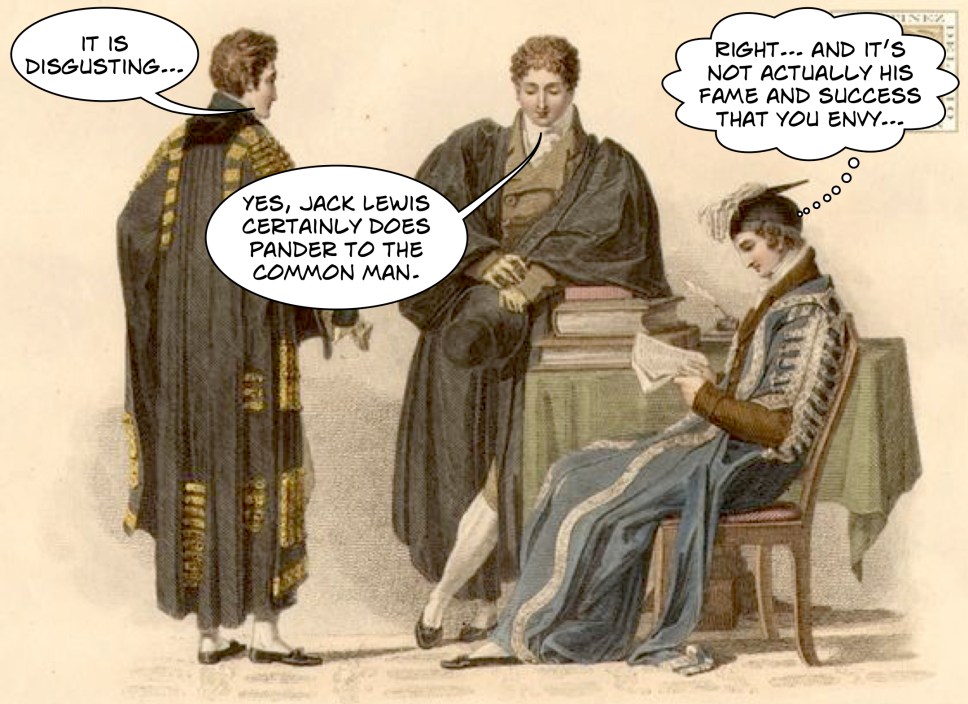
When it comes to writing for a popular audience, the elite strata of academia possess no shortage of disdain.

C.S. Lewis was only one of many professors who found writing for the common people diminished them in the eyes of their snobbish peers. In Lewis’ case, his lay theological essays were considered bad enough. His fantasy and science fiction works were regarded as particularly gauche.

I have a personal theory about the way self-important scholars treat their colleagues who reach down to interact with the hoi polloi. It seems to me that they deride people like Lewis and J.R.R. Tolkien because of envy. The envy is twofold.

First, they covet the large audience and expanded influence of the scholar who successfully transcends the university. These elements arouse their lust far more than the potential wealth that such success might bring, although I have no doubt some resent being criminally underpaid as educators.

The second aspect of the envy is directed at the genuine talent of the belittled author. The majority of faculty would not possess the skill to write successfully for a popular audience. Thus, the significance of such publication needs to be diminished.

Harlan Ellison (1934-2018) was not an academic, but even he did not appreciate being relegated to the ranks of pulp writers. Despite writing screenplays and more than 100 books, he was best known for his science fiction. Nevertheless, he once threatened: “Call me a science fiction writer and I’ll hit you so hard your ancestors will die.”

Returning to Lewis, one biographer devotes an entire chapter to the condescending attitude of his Oxford peers. He entitles it, “A Prophet without Honour?” This is a reference to Jesus’ saying that “a prophet has no honor in his own hometown” (John 4:44)

Lewis, then, was famous by the time the Second World War ended in the summer of 1945. If the simple philosophy of life propounded by modern celebrity culture has any validity, Lewis at that point should have been a happy and fulfilled person. Yet Lewis’s personal history for the next nine years tells a quite different story. Fame may have raised Lewis’s profile, but in the first place, this just made him a more obvious target for those who disliked his religious beliefs.

And in the second, many of his academic colleagues came to believe that he had sold out to popular culture to secure that fame. He had sold his academic birthright for a populist pottage. (C.S. Lewis—A Life: Eccentric Genius, Reluctant Prophet by Alister McGrath)

The disdain of his Oxford colleagues prevented him from receiving a full professorship at the university. This is why Lewis eventually accepted a chair at Cambridge, which was much more receptive to his unashamed sharing of the Gospel. Tolkien was stunned by the “extraordinary animosity” of the English Faculty towards his friend.

An Endnote

The fact that C.S. Lewis wrote some science fiction—and encouraged his friend Tolkien to do so as well—does not mean that he had an exaggerated opinion of the genre’s quality. He was quite aware of the great range between the good and the bad. In fact, in 1955 he ended a lengthy letter to a correspondent with the sentence: “We must talk about Science Fiction some other time (most of it is atrocious).”

I have posted about Lewis’ connection to science fiction in the past. Perhaps one of these topics will interest you.

Learn about the genuine Martian crater named Malacandra in honor of Lewis’ space trilogy.

Explore the place of robots in science fiction and reality.

Ponder the ramifications of post-apocalyptic faith.

Consider Lewis’ compliment to H.G. Wells.


The Ugliest Book

mayan image.png

Every reader knows “not all books are created equal.” This fact has two applications. Most importantly, since books are built from words, the comparison refers to comparing the content or message of different works. In a totally distinct sense, it may distinguish between the differing presentation or physical aspects of the book itself.

Fifty-four years after its discovery, the oldest surviving Mayan text has been officially authenticated. One of the reasons for the delay was that “for a long time, critics of the codex said the style wasn’t Mayan and that it was ‘the ugliest’ of them in terms of figures and color.”

What does that mean? It means that just because the tree bark pages were composed by a less skilled artist . . . in a more primitive age . . . living in a relatively impoverished region . . . with a smaller pallet of colors available . . . its authenticity was questioned.

Not quite what I would consider top flight analysis. Fortunately, Mexico’s National Institute of History and Anthropology has finally righted that wrong. They declared, “The Mayan Codex is authentic and the oldest, legible pre-Hispanic manuscript in the Americas,”

Seriously, the only flaw I can find in the facsimile of the pictograph portrayed above is the attachment of a right hand to a left arm. Then again, if Mark Twain could make the very same mistake roughly eight centuries later, I can forgive the ancient Mayan illustrator.

Illustrative Options

Frankly, the more one learns about the publishing industry, the less responsible we can hold authors for the final look of their works. Rarely do they even get to choose the cover art for their books, although sometimes particularly prominent authors such as J.R.R. Tolkien or C.S. Lewis are granted that privilege. That is how the artwork of Pauline Baynes became intimately associated with the two Oxbridge giants.

The lucky few may even be able to select their own fonts, with many wisely opting for the more trustworthy serif families.

For the common woman or man, we are lucky if our publishers even let us have a veto over the artwork that they commission. The exception to this comes with the nature of the self-publishing industry, where the author possesses sole authority in choosing their cover, illustrations, fonts and format.

Still, those hoping for “traditional” publication should recognize in advance how much control over their book they will forfeit to editors and publishers.

With Paper at a Premium

Even with influence in the selection of artwork, some aspects of publishing lie outside the control of writers. A perfect example of this is found in rationing of paper in Britain during the Second World War. The British War Economy Standard meant books visually declined in production quality.

Paper was rationed, beginning in March 1940, when publishers were allowed only 60 percent of what they had used in 1938-39. The proportion fell to 37.5 percent by January 1, 1942, when the Book Production War Economy Agreement took effect.

rationing

The scheme mandated smaller type, less white space, and inferior papers and bindings. It resulted in some remarkably ugly books, but it conserved raw materials. (“Modernity and Print I: Britain 1890-1970” by Jonathan Rose)

A number of Lewis’ books appeared in these wartime editions. They are quite collectible.

Scarce first impression of the true first edition, produced on wartime economy standard paper, and thin boards, published during the Second World War, especially hard to find in its complete original dustwrapper in collectable condition.

Let’s consider an unlikely scenario. In eight centuries, C.S. Lewis’ writings have been forgotten. Then, one archaeologist stumbles across a rare physical copy of a book, that survived the universal “grand purging” following the transfer of such items to some post-digital, post-electronic format.

What would historians assume about the value placed on Lewis’ work if it was a wartime edition compared to other “regular” books by other authors? They could not be faulted for assuming that the people of our day valued the inferior publication less than the “nicer” editions. (This is assuming that the acid-laden paper of the war years would not simply flake apart in their hands.)

The quality of the paper and print make a strong impression on readers. Just as we often judge books by their cover.

C.S. Lewis, a true bibliophile, illustrates how even a modest book (in terms of content) can be deemed “exquisite.” In a 1935 letter to his friend Arthur Greeves, he humorously describes the impending publication of The Allegory of Love.

I have finished my book which is called The Allegorical Love Poem, and is dedicated to Barfield. The Clarendon Press have accepted it and hope to have it out by May.

As I am to get 12 free copies (Dents only give one 6) you and Tchanie shall each have one and save your silver: and whatever you think of the matter, I hope, from experience of the Clarendon Press, that binding, paper etc will be—in our old formula—excellent, exquisite, and admirable.

In other words, if you can’t read it, you will enjoy looking at it, smelling it, and stroking it. If not a good book, it will be a good pet! It will be about 400 pp, they say. (It will be funny, after this, if they do it in double columns and a paper cover.)

Returning to the Mayan pages with which we began, we sadly are unable to judge them by their original codex in its pristine state. However, the extant pieces possess great historical value, even if scholars took a long time determining the fact . . . and whether or not they would ever consider it to be “a good pet.”


In case you are interested, Mere Inkling has explored Mayan books before, in “One Weakness of Modern Books.”


C.S. Lewis the Irishman

irish aslan

Contrary to the common assumption that C.S. Lewis was English, he was actually an Irishman. He was born in Belfast, and those who know him attested to how his Irish-ness lasted the whole of his life.

Lewis was proud of his roots, and celebrated them. When he first journeyed to England, he experienced a culture shock. “No Englishman will be able to understand my first impressions of England,” he wrote in Surprised by Joy.

Lewis always loved Ireland. He vacationed there regularly, and chose the island for his honeymoon, late in life. One of his Irish students, David Bleakley, related that the transplant professor declared, “Heaven is Oxford lifted and placed in the middle of County Down.” (C.S. Lewis at home in Ireland)

Several years ago, David Clare of the University of Limerick wrote “C.S. Lewis: An Irish Writer.” It appeared in Irish Studies Review, and the abstract is illuminating.

This article examines the effect of C.S. Lewis’s Irish background on his work. It attempts to contradict the assumption that this Belfast-born writer should be included in the English and not the Irish canon. It emphasises that Lewis saw himself as Irish, was seen by others as Irish, and that his Irish background, contrary to what some have written, was important to him throughout his lifetime.

It goes on to demonstrate the ways in which his work was influenced by his youth in Ireland and by the Irish mythology that he loved. Furthermore, this article maintains that, as a child of pre-partition Ireland with roots throughout the island, Lewis was influenced by the country as a whole, not just his native Ulster. Finally, it attempts to understand why Lewis, a proud Irishman, did not do more to promote himself as an Irish writer.

Clare’s argument is necessary because of Irish political correctness. In Surprised by C.S. Lewis, Alister McGrath describes the prejudice.

So why is Lewis not celebrated as one of the greatest Irish writers of all time? Why is there no entry for “Lewis, C.S.” in the 1,472 pages of the supposedly definitive Dictionary of Irish Literature (1996)? The real issue is that Lewis does not fit—and, indeed, must be said partly to have chosen not to fit—the template of Irish identity that has dominated the late twentieth century.

In some ways, Lewis represents precisely the forces and influences which the advocates of a stereotypical Irish literary identity wished to reject. One of the reasons why Ireland has largely chosen to forget about Lewis is that he was the wrong kind of Irishman. . . .

Lewis may have chosen to rise above the provinciality of Irish literature; he nevertheless remains one of its most luminous and famous representatives.

It should be noted, of course, that countless Irish men and women are proud of Lewis, and count him as one of their own.

There’s No Other Place Quite Like Ireland

On a less serious note, and at the risk of contributing to a stereotype, I want to share with you an incident that occurred in Dublin.

First some context. Some people suggest that people in Ireland have a particular affinity for alcohol. This may be a bit of an exaggeration, since they are only ranked twenty-first in the world (for alcohol consumption).

The 1875 tragedy goes by several names, but one is the “Dublin Whiskey Fire.” A malt house and a whiskey warehouse caught fire, and as thousands of gallons of their contents poured down the street in a fiery channel, the blaze spread to many homes and businesses.

Miraculously, the fire did not take any lives. That does not mean, however, that there were not a number of fatalities. A dozen people died from alcohol poisoning. Tempted by unrestricted access to the alcohol, many Dubliners cupped their hands or used their boots to gather up the liquid and drink themselves into oblivion.

You can read an account of the bizarre occurrence in The Irish Times.

I wonder what Lewis thought about this revolting event, since he was surely aware of it. The deranged consumption of filthy and burning alcohol would be condemned by any sane person.

Among teetotalers, however, even a sip of alcohol is objectionable. Many attribute their aversion to their faith. While the Christian Scriptures strongly condemn drunkenness, some verses tacitly affirm the drinking of wine in moderation.*

C.S. Lewis and Drink

C.S. Lewis was among the majority of Christians who accept drinking while avoiding drunkenness. I have written on this subject at length.

In Mere Christianity, Lewis says,

Temperance is, unfortunately, one of those words that has changed its meaning. It now usually means teetotalism. But in the days when the second Cardinal virtue was christened ‘Temperance,’ it meant nothing of the sort. Temperance referred not specially to drink, but to all pleasures; and it meant not abstaining, but going the right length and no further.

It is a mistake to think that Christians ought all to be teetotallers . . . Of course it may be the duty of a particular Christian, or of any Christian, at a particular time, to abstain from strong drink, either because he is the sort of man who cannot drink at all without drinking too much, or because he is with people who are inclined to drunkenness and must not encourage them by drinking himself.

But the whole point is that he is abstaining, for a good reason, from something which he does not condemn and which he likes to see other people enjoying. One of the marks of a certain type of bad man is that he cannot give up a thing himself without wanting every one else to give it up. That is not the Christian way.

An individual Christian may see fit to give up all sorts of things for special reasons—marriage, or meat, or beer, or the cinema; but the moment he starts saying the things are bad in themselves, or looking down his nose at other people who do use them, he has taken the wrong turning.

This is wise counsel. Recapturing the original meaning of temperance—and living as temperate people—results in happier lives and a more peaceful world.


* For those who God expressly commands not to drink, should avoid it completely. For example, an angel told Zechariah that John the Baptist, “must not drink wine or strong drink, and he will be filled with the Holy Spirit, even from his mother’s womb.” (Luke 1:15). John’s cousin Jesus, on the other hand, miraculously created wine for a wedding party, and offered the Passover wine to his disciples with the words “this cup that is poured out for you is the new covenant in my blood.” (Luke 22:20)


C.S. Lewis and American Fjords

fjord

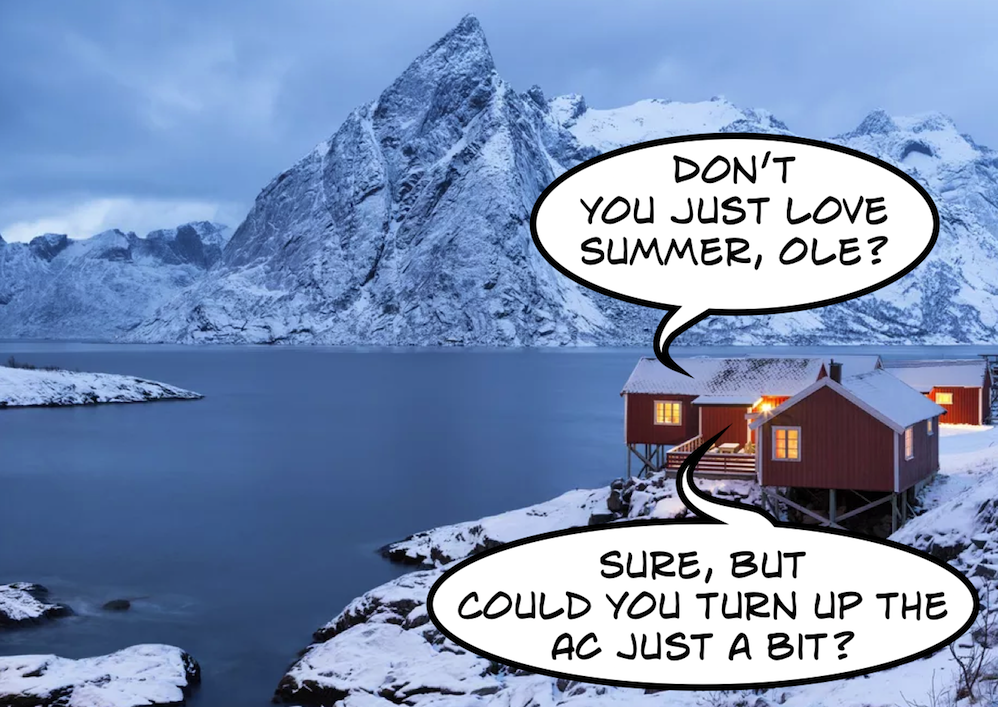
Norwegian immigrants to North America were a hardy breed, and some of their descendants continue to display that resilience.

When they came to the United States, they scoffed at the thought of heading southward where any average human being could survive. Instead, they flowed in great numbers to Minnesota and the Dakotas. Spawned near the arctic, they appreciated the balmy temperature of places like Sioux Falls and Fargo.

The Norwegianest of the immigrants chided their countrymen and women for settling in the tropics, and aimed higher than the United States. They opted to move to Canada, which was nearer their native land’s latitude. To make up for being closer to the equator, they compensated by settling in Canada’s harsh heartland where no ocean currents mediated the bitter cold.

Meanwhile, back in the States . . . as farmers continued to settle further west, some of them eventually happened upon paradise on earth. They crossed over the Rockies and Cascades and came to Puget Sound, a land with abundant coasts and shorelines which reminded them of the fjords back home. There the Norse placed deep roots.

Fjords are inherently impressive. In The Voyage of the Dawn Treader, C.S. Lewis describes encountering just such a body of water.

When morning came, with a low, gray sky but very hot, the adventurers found they were in a bay encircled by such cliffs and crags that it was like a Norwegian fjord.

In front of them, at the head of the bay, there was some level land heavily overgrown with trees that appeared to be cedars, through which a rapid stream came out. Beyond that was a steep ascent ending in a jagged ridge and behind that a vague darkness of mountains which ran into dull-colored clouds so that you could not see their tops.

The nearer cliffs, at each side of the bay, were streaked here and there with lines of white which everyone knew to be waterfalls, though at that distance they did not show any movement or make any noise.

Indeed the whole place was very silent and the water of the bay as smooth as glass. It reflected every detail of the cliffs.

Some of my own ancestors settled in the late 1800s in Poulsbo, a modest community that came to be known as “Little Norway.” They bore the familiar surname Olsen (Ole’s son). My grandfather married one of their descendants and our family name became Nesby (so revised because English’s stunted alphabet lacked two of the original name’s letters: Næsbø).

Following my retirement from the United States Air Force, I moved near to my family’s American homestead. However, I ended up living next to a rare geographic feature, a fjord.

It sounds reasonable that America would have fjords in Alaska, but Washington is home to a number of them as well. Much of Puget Sound was carved by glaciers that deeply scored the western portion of the state. Independent of these is a long inlet called Hood Canal. It is part of the Salish Sea.

This amazing fjord extends for approximately fifty miles. That makes it almost the length of Romsdalsfjord, Norway’s ninth longest fjord.

I absolutely love surveying the waters of Hood Canal. I suspect I was genetically preordained to feel at home here.

Fjords Appealed to C.S. Lewis Too

In 1958, C.S. Lewis described a visit he and his wife Joy had recently made to Ireland. They were awestruck by the scenery.

Yes, my wife and I had a glorious trip to Ireland. For one thing, we flew and it was for both of us a new experience. I can quite believe that for really long journies it can be dull and monotonous.

But one’s first sight of the cloud-scape from above—then, when the clouds cleared, the coastlines looking (as I’d never really quite believed) just as they do on maps—the first bit of Ireland shining out on the dark sea like enamel work—all this was indescribably beautiful. . . .

As for beauty . . . we saw mountains, heather just beginning to bloom, loughs (= fjords), yellow sand, fuchsia, seas Mediterraneanly blue, gulls, peat, ruins, and waterfalls as many as we could digest.

Lewis’ words serve as a reminder that while we may not all be so fortunate as to live beside a fjord, there is nothing to prevent us from visiting one to savor its wonder.