C.S. Lewis and the Five Senses

One of the earliest lessons children learn is how many senses the human being possesses. You know the answer off the top of your head, right? Five. But, apparently, that’s no longer correct. Oh, you may think I must be including that long-time poser, extrasensory perception (ESP), which purports to be a sense of sorts beyond the five we all experience. If you thought that . . . sorry, but you are wrong again.

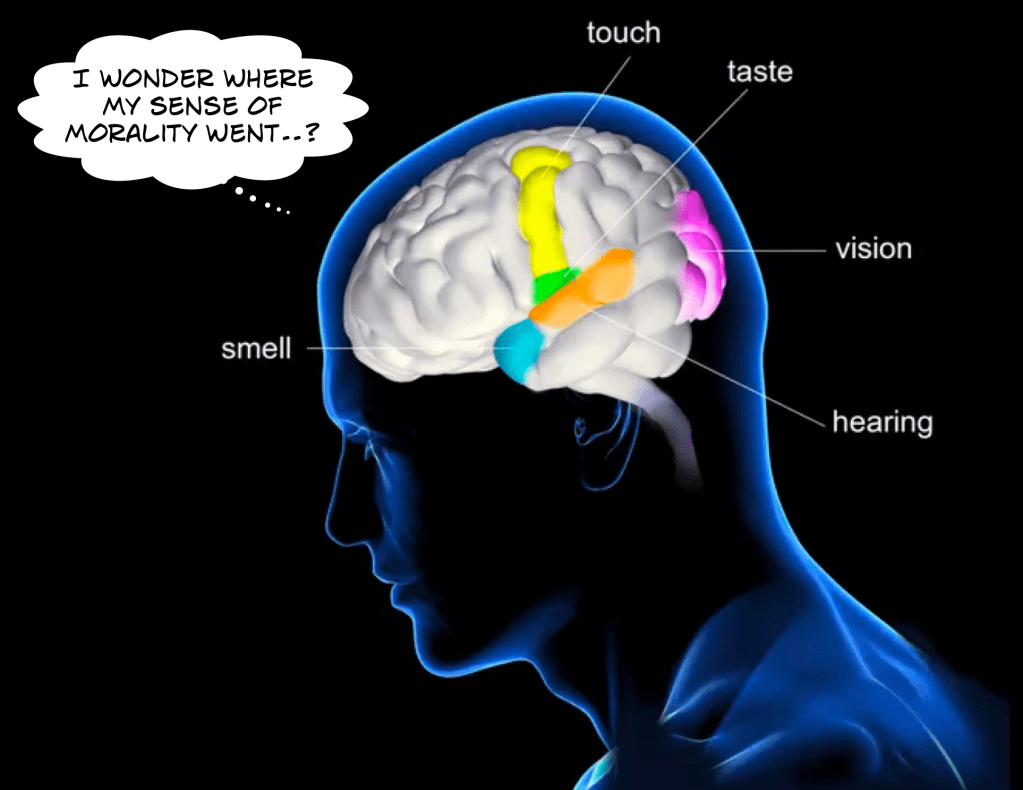
We all agree on the basic five: the faculties of sight, hearing, taste, smell, and touch. To this list, science has recently added several other senses we experience. They’re not actually new; Adam and Eve knew them too (with the possible exception of nociception). They actually make sense (in the other use of the word), as well. Here they are:

Proprioception – perceiving where your body parts are relative to one another, and the strength of effort being employed in movement

Thermoception – sensing temperature

Equilibrioception – perception of balance

Chronoception – sensing the passage of time

Interoception – feeling internal needs such as hunger and thirst

Nociception – experiencing pain

More expansive lists exist as well. Some are discussed online at The United Kingdom’s Sensory Trust. The Trust is devoted to “sensory design . . . [using] nature and the outdoors to improve the health and wellbeing of people living with disability and health issues.” They describe how “neurological classification” can result in numbers up to fifty-three. (It makes one long for the simplicity of the past when we followed Aristotle’s citation of only five.)

C.S. Lewis’ Celebration of Life

You can pick up nearly any one of Lewis’ essays or fiction, open to any page of his autobiography, read almost any of his letters, and you will see his love for nature. And Lewis is often quite vivid in his description of his encounter with God’s creation. The sights, sounds and smells he describes make the depictions real. Consider his description of Tash, the “god” worshipped by the Calormenes, in The Last Battle.

[King Tirian said] “What foul smell is this?”

“Phew!” gasped Eustace. “It’s like something dead. Is there a dead bird somewhere about? And why didn’t we notice it before?”

With a great upheaval Jewel [the unicorn] scrambled to his feet and pointed with his horn. “Look!” he cried. “Look at it! Look, look!” Then all six of them saw; and over all their faces there came an expression of uttermost dismay.

In the shadow of the trees on the far side of the clearing something was moving. It was gliding very slowly Northward. At a first glance you might have mistaken it for smoke, for it was gray and you could see things through it. But the deathly smell was not the smell of smoke. Also, this thing kept its shape instead of billowing and curling as smoke would have done. It was roughly the shape of a man but it had the head of a bird; some bird of prey with a cruel, curved beak. . . . It floated on the grass instead of walking, and the grass seemed to wither beneath it. . . .

[They] watched it for perhaps a minute, until it streamed away into the thicker trees on their right and disappeared. Then the sun came out again, and the birds once more began to sing. Everyone started breathing properly again and moved. They had all been still as statues while it was in sight.

From a more philosophical, even metaphysical perspective, Lewis ponders the senses experienced by angels in his poem, “On Being Human.” He describes the differences between how angels and humanity experience God’s creation. Lewis suggests that in exchange for their unblurred perception of cosmic reality, they lack the more mundane (i.e. earthly) experience of physical perception of creation.*

Angelic minds, they say, by simple intelligence
Behold the Forms of nature. They discern
Unerringly the Archtypes, all the verities
Which mortals lack or indirectly learn.
Transparent in primordial truth, unvarying,
Pure Earthness and right Stonehood from their clear,
High eminence are seen; unveiled, the seminal
Huge Principles appear.

The Tree-ness of the tree they know—the meaning of
Arboreal life, how from earth’s salty lap
The solar beam uplifts it, all the holiness
Enacted by leaves’ fall and rising sap;
But never an angel knows the knife-edged severance
Of sun from shadow where the trees begin,
The blessed cool at every pore caressing us
—An angel has no skin.

They see the Form of Air; but mortals breathing it
Drink the whole summer down into the breast.
The lavish pinks, the field new-mown, the ravishing
Sea-smells, the wood-fire smoke that whispers Rest.
The tremor on the rippled pool of memory
That from each smell in widening circles goes,
The pleasure and the pang—can angels measure it?
An angel has no nose.

The nourishing of life, and how it flourishes
On death, and why, they utterly know; but not
The hill-born, earthy spring, the dark cold bilberries
The ripe peach from the southern wall still hot,
Full-bellied tankards foamy-topped, the delicate
Half-lyric lamb, a new loaf’s billowy curves,
Nor porridge, nor the tingling taste of oranges—
An angel has no nerves.

Far richer they! I know the senses’ witchery
Guards us, like air, from heavens too big to see;
Imminent death to man that barb’d sublimity
And dazzling edge of beauty unsheathed would be.
Yet here, within this tiny, charm’d interior,
This parlour of the brain, their Maker shares
With living men some secrets in a privacy
Forever ours, not theirs.

This notion that we comprehend things the angels cannot—for example, the indwelling of God’s Holy Spirit—is expressed in the spirit of the First Epistle of Peter. These wondrous miracles are “things into which angels long to look.”

As amazing as our human senses are, we should never delude ourselves into thinking they are infallible. Far from it. As precious as they are, due to our fallen nature, they possess two shortcomings. First, they may misperceive reality. Such is the case with allodynia, in which a person “feels pain from non-painful stimuli,” such as a light touch or a cool temperature.⁑

The second limitation comes in the obvious fact of our finite nature. We are simply incapable of perceiving, much less processing, all the information that washes over us. Perhaps you would join me in identifying with C.S. Lewis’ description of himself in A Grief Observed.

Five senses; an incurably abstract intellect; a haphazardly selective memory; a set of preconceptions and assumptions so numerous that I can never examine more than a minority of them-never become even conscious of them all. How much of total reality can such an apparatus let through?

The number of human senses is not important. Our recognition of their divine source is, however, of eternal import.


* Chris Armstrong, Senior Editor of the Christian History Institute, wrote an exceptional article on the importance of our senses. Citing C.S. Lewis’ “On Being Human,” he declares our senses are the only means by which we can “know God.”

Nor is sense-knowledge about God through his Creation, second-class knowledge. Lewis expresses this idea memorably in his poem “On Being Human,” which compares the angels’ incorporeal way of knowing with our way—to the advantage of the latter.

The Christian History Institute publishes the exceptional Christian History magazine, which is offered for a simple donation. They also provide free, downloadable copies of past issues. I strongly encourage your support of this superb ministry.

⁑ From Medical News Today. “Some people feel extreme pain from something minor, such as a paper cut. Feeling increased pain or being hypersensitive to mild pain is called hyperalgesia. Individuals with allodynia, however, feel pain when something is ordinarily painless.”

C.S. Lewis and Times of Crisis

Dark days demand two seemingly contradictory things. Serious reflection and diversion (often in the form of entertainment).

Things are serious. The ultimate toll of the current pandemic remains unknown. Even if we regard ourselves as safe due to age, health and isolation, the simple fact is thousands are dying. Beyond our compassionate concern for those who are suffering, only a fool would fail to reflect on their own mortality during this plague.

Christians, who recently “celebrated” Good Friday are quite conscious of the fact that “we are dust and to dust we shall return” (Genesis 3:19).

Yet this awareness doesn’t leave us in despair, because Easter has come. Our Lord’s resurrection means that for those who trust in him, death does not have the final word.

I pray for those who are overcome by worry during these days. Because dwelling solely on the negative robs life of its present joys, and worsens the impact of the pandemic on individual lives.

Rather than feed your anxiety with troubling reports and thoughts, I urge you to take the opportunity to read, watch a classic program, or play a game. Distracting activities are healthy, as long as they do not displace serious awareness of our circumstances.

Seriously Assessing Our Predicament

Others have written eloquently about Lewis’ response to situations such as that in which we find ourselves today.

For example, the Gospel Coalition offers an excerpt from C.S. Lewis’ 72 year old essay about atomic weapons. They suggest we “just replace ‘atomic bomb’ with ‘coronavirus.’” Lewis’ advice holds up well in our turbulent era.

Annie Holmquist of Intellectual Takeout elaborates on Lewis’ essay. “How C.S. Lewis Would Tell Us to Handle Coronavirus” is well worth a read.

Several weeks ago, the Wade Center (which hosts the Western Hemisphere’s finest Inkling collection) struck the balance I am suggesting. They acknowledged the danger, and offered advice on spending our time well. Their blog included an excellent suggestion in “Those Who Lived to see Such Times: Suggested Readings from the Wade Authors during Times of Uncertainty.” The Wade Center provides links to a number of fine text and audio resources that will offer encouragement from authors who “witnessed both world wars, and . . . lived to see the unsettling days of nuclear weapons.”

Enjoying Life Despite the Danger

Those who are working during this time remain in need of our prayerful support. For the majority of us, however, the cancellation of most of our normal social activities has provided us with an abundance of leisure time. In addition to attacking postponed chores around the house, we should fill some of this interval by enjoying old pleasures and discovering new interests.

Take advantage of treasures such as those mentioned in the Wade Center post. Hundreds—even thousands—of free, public domain books are available online. For those whose preference is visual, there are plenty of free video options, including many vintage television shows you can view on YouTube.

If you’re craving a humorous treat, check out the great satire at The Babylon Bee and The Salty Cee.

A recent article on the former site reveals the sad tale of a boy whose childhood has been ruined by modern online games. It’s entitled, “Boy Discovers Wondrous Land Of Narnia, Leaves Negative Yelp Review.”

Lutherans (and self-confident Christians of other traditions) will enjoy the Lutheran Satire site. For people who don’t object to listening in on a demonic press conference, a fictional Easter interview on their main page is enlightening.

A bit lighter, is this rendition of Saint Patrick explaining the Trinity to the Irish pagans. It will help you sharpen your Christology.

There is a vast, unexplored world of literature out there. I recently read this illuminating post about one of George MacDonald’s fairy tales. MacDonald exerted a great influence on C.S. Lewis. With a curious twist on light and dark, the post also provides a link to a film based on MacDonald’s The Light Princess. I haven’t viewed it yet—but if you have a high tolerance for 1980s BBC productions combining animation and live action, you could be in for a treat.

Where to Begin?

Before exploring some of these links I’ve included, I encourage you to view “The Age of the Coronavirus.” The videographer has done what was suggested in one of the articles mentioned above. He has substituted the virus for the threat of nuclear war in C.S. Lewis’ abbreviated essay.

The video is good enough that you may well desire to share it with others. It can help to know the threats of our day are not unique to history. I suggest that you also include the amazing C.S. Lewis Doodle which offers an illustrated version of the entire essay.

C.S. Lewis and Self-Awareness

Who are you? If you were to fully answer that question, it would require serious introspection. However, if you were to answer it completely, it would also require an honesty that is extremely rare.

That’s because anyone who reveals everything about themself, comes to a point where the qualities and actions are no longer flattering. They ultimately arrive at the place where the exposé becomes a confession.

The truth is that no one actually knows everything about themself. But some of the things we are aware of . . . some of the secrets we desire to hide, even from ourselves . . . are seldom shared. That is one great value of the “confessional.” There, one can unburden themselves and face their demons, so to speak, in a setting where they know their confidence won’t be violated.

As a Protestant pastor, who has never used a physical confessional stall or screen, I note that I have nevertheless heard thousands of confessions. They are, as one would expect, a common element of counseling as people seek to experience healing and restoration. As a Lutheran, I belong to a tradition that guarantees the privacy of these confessions, or what is considered “privileged communication.” Moreover, as a military chaplain, I was grateful to serve a nation that enshrines the same promise in the Uniform Code of Military Justice.

As Lewis wrote, “if there is a particular sin on your conscience, repent and confess it” (Letters to an American Lady). Once that is done, the pastor (or any “confessor”) can assist the individual with working to make as right as possible in the future what was damaged or destroyed by their choices in the past.

From the Psychological Vantage Point

If you have never encountered it before, I commend to you the model called the Johari Window. I have written about it in the past in the context of honesty and dishonesty.

The model illustrates just how complex our personalities are. The arrows on the model below reveal how we can expand the “open” part of ourselves. Naturally, there are some “hidden” aspects that should only be disclosed in certain contexts.

When it comes to the darkness in our lives, that which we strive to keep veiled, psychologists describe it in a variety of ways. One chaplain with whom I worked was particularly enamored with the work of Carl Jung. He loved to toss around the word “shadow,” and suggest there was some dark psychological significance to even the most offhand comment or expression. In essence, the shadow is the part of our personality we don’t want to admit to having. In terms of the Johari Window, you might think of it as the sinister stuff in the Hidden quadrant.*

C.S. Lewis wrote about Jung in an essay entitled “Psycho-Analysis and Literary Criticism.” Lewis disparages the Freudian theory, saying “poetry is not a substitute for sexual satisfaction, nor sexual satisfaction for poetry.” Jung, he argues, presents “a much more civil and humane interpretation of myth and imagery.” Of course, Lewis is discussing these psychoanalysts from the perspective of a literary critic, not a psychologist. In that regard, we can appreciate his assessment of one of Jung’s major works.

Thanks to my training I can suspend my judgement about the scientific value of Jung’s essay on “Mind and the Earth:” but I perceive at once that even if it turns out to be bad science it is excellent poetry.

From the Christian Point of View

I have already described how confession can serve as a means of expanding our self-awareness in a constructive and healing way. That’s why confession and absolution are a formal part of many worship service, going back to the earliest times. If we want to read the finest primer on confession, we need look no further than the book of Psalms.

As King David, in recognition of this great sins, prays in the fifty-first psalm:

Have mercy on me, O God,
according to your steadfast love;
according to your abundant mercy
    blot out my transgressions.
Wash me thoroughly from my iniquity,
    and cleanse me from my sin!

One of the earliest Christian classics (outside the Bible itself) was aptly entitled Confessions. It was written by Augustine, the bishop of a North African city called Hippo. His description of our self-awareness is so deep and profound, it will likely require more than a single reading.

No one knows what he himself is made of, except his own spirit within him, yet there is still some part of him which remains hidden even from his own spirit; but you, Lord, know everything about a human being because you have made him . . .

Let me, then, confess what I know about myself, and confess too what I do not know, because what I know of myself I know only because you shed light on me, and what I do not know I shall remain ignorant about until my darkness becomes like bright noon before your face. (Augustine, The Confessions, translation by Maria Boulding)

One of C.S. Lewis’ many correspondents was a man who was acutely troubled by his own self-awareness, and in particular, the consciousness of his own selfishness and egotism. Lewis offered some comforting and sound spiritual direction to the man. Since I believe the letter has a message for us all, I choose to close with it.

You are of course perfectly right in defining your problem (which is also mine and everyone’s) as “excessive selfness.” But perhaps you don’t fully realise how far you have got by so defining it. All have this disease: fortunate are the minority who know they have it.

To know that one is dreaming is to be already nearly awake, even if, for the present, one can’t wake up fully. And you have actually got further than that. You have got beyond the illusion (very common) that to recognise a chasm is the same thing as building a bridge over it.

Your danger now is that of being hypnotized by the mere sight of the chasm, of constantly looking at this excessive selfness. The important thing now is to go steadily on acting, so far as you can—and you certainly can to some extent, however small—as if it wasn’t there. You can, and I expect you daily do—behave with some degree of unselfishness. You can and do make some attempt at prayer.

The continual voice which tells you that your best actions are secretly filled with subtle self-regard, and your best prayers still wholly egocentric—must for the most part be simply disregarded—as one disregards the impulse to keep on looking under the bandage to see whether the cut is healing. If you are always fidgeting with the bandage, it never will

A text you should keep much in mind is I John iii, 20: “If our heart condemns us God is greater than our heart.” I sometimes pray “Lord give me no more and no less self-knowledge than I can at this moment make a good use of.” Remember He is the artist and you are only the picture. You can’t see it. So quietly submit to be painted—i.e. keep on fulfilling all the obvious duties of your station (you really know quite well enough what they are!), asking forgiveness for each failure and then leaving it alone. You are in the right way. Walk—don’t keep on looking at it.


* In contrast to the insignificant or embarrassing things we are aware of that we may prefer to keep to ourselves. For example, although I sing decently, I am an exceptionally poor instrumentalist. This despite the fact I married a talented and patient music teacher. It’s not my lack of talent which motivates my secrecy, it is the sad fact that I am a total sluggard when it comes to practicing. And this reveals a major flaw in my personality—if something is not inherently fun or doesn’t come easily to me, I have a terribly difficult time applying myself to the task. (And this shortcoming has very real consequences, both in terms of professional success and interpersonal relationships.)

⁑ Several years ago, a member of our Mere Inkling described in her blog how everyone experiences seasons of restlessness.

In his Confessions, Augustine wrote, “Thou hast made us for thyself, O Lord, and our heart is restless until it finds its rest in thee.” Yet even those who have found Christ feel restless at certain times, and these times lead us to a salutary discovery.

Augustine’s Confessions is a Christian classic. You can download a free copy here.

C.S. Lewis & Nuns

One of the great disappointments of Roman Catholic fans of C.S. Lewis is that he never converted to their communion. Lewis did, however, sincerely respect Roman Catholic nuns. In fact, he considered the reverence and joy of the nuns he encountered to be one of the church’s most commendable elements.

In 1947 he wrote to one of his regular correspondents who wondered why he had not forsaken his “low church” loyalties for a more elevated perspective. His response reveals his perception of the virtues of consecrated nuns.

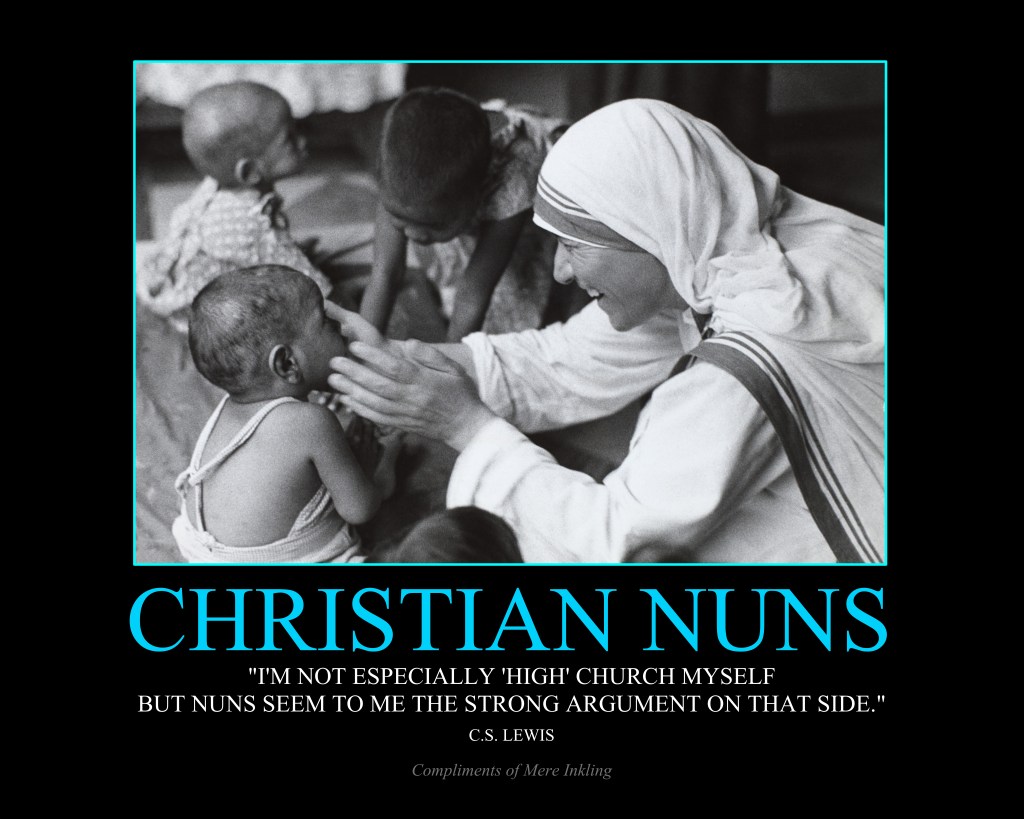
I am particularly pleased to have been of any help as a bridge between the parish and the convent. I’m not especially ‘high’ Church myself but Nuns seem to me the strong argument on that side.

They are in my experience almost invariably so very nice—and so happy: much more so either than the same number of married women picked at random or the same number of monks. I don’t know why this should be so.

One does not have to be Catholic to appreciate people who consecrate their lives to God, willing to make radical sacrifices like living a life of celibacy. Nearly four decades ago, while I was serving a congregation in Citrus Heights, California, I earned a (post-M.Div.) Master of Theology degree. Since I was focused on Patristics, I was enrolled at a Jesuit seminary in the Bay area.

One day during my studies, an Episcopal priest and I were having lunch with a half dozen Roman Catholics, most of whom were religious sisters.* The conversation turned to a celebration by the sisters present that they no longer had to wear habits. The respectful person I am, I remained silent as they discussed their “family” business. Apparently, though, I was softly grinning, because of one them (it may even have been my thesis advisor) asked, “what are you smiling about?”

My response was that it wasn’t my place to offer an opinion, but when they pressed, I said, “well, throughout my life, whenever I’ve seen a nun in her habit, it’s been an encouraging thing, and I think—there goes a life that is consecrated to God.” My companions were shocked and at a loss for words. In retrospect, I believe that C.S. Lewis might have offered a similar comment.

Due to the century during which he lived, and his setting in the British Isles, Lewis encountered nuns far more frequently than I do. In fact, since their “liberation” from the habit, we can’t know precisely how many religious sisters cross our paths. In 1947 he describes to a close friend a trip to see his brother who was hospitalized in Ireland. His colorful description of the town he visited ends with an uplifting remark.

My Brother, thank God, was out of danger when I reached him on Monday morning last but was at the unearthly city of Drogheda where almost every building is a church or a tavern⁑  and what men do but pray and drink or how life is supported in their bodies I can’t conceive. . . . And you hear more wit and humour in one day of London than in a week of Drogheda. My Brother was in the care of the most charming nuns.

Nuns are found in various Christian traditions. In addition to those who take such vows in the Roman Catholic Church, the Eastern Orthodox churches trace the lineage of these female monastics back to the ancient eremites. ⁂ There are also Anglican and Lutheran convents. In fact, one of C.S. Lewis’ close friends was an Anglican nun. Sister Penelope, CSMV (1890-1977), was a member of the Community of St Mary the Virgin. Lewis dedicated his novel, Perelandra, “to some ladies at Wantage,” her convent.

In a 1941 letter to the BBC, Lewis pleads that he is unable to add to his current speaking commitments. These apparently included specific presentations to nuns.  

I’m afraid in view of my other commitments I should be ‘over-talked’ if I accepted the job you kindly suggest for me. I’m talking already to the R.A.F., to the general public, to nuns, to undergraduates, to societies. The gramophone will wear out if I don’t take care! With thanks and much regret.

Lewis’ Three Theses

Mary Willis Shelburne was a widow in Washington, D.C., with whom Lewis corresponded for a number of years. Beginning in 1950, they exchanged more than a hundred letters, which were collected in the volume Letters to an American Lady. Lewis arranged for her to receive financial support from the sales of his books in the United States. This support continued after his own passing. In 1952 Shelburne converted to Roman Catholicism, and proposed that Lewis follow her example. His response was gracious.

It is a little difficult to explain how I feel that tho’ you have taken a way which is not for me. I nevertheless can congratulate you—I suppose because your faith and joy are so obviously increased. Naturally, I do not draw from that the same conclusions as you—but there is no need for us to start a controversial correspondence! I believe we are very near to one another, but not because I am at all on the Romeward frontier of my own communion.

In a short note written four years later, Lewis thanks her for a picture of herself and a nun. He uses the occasion to voice his sentiment that nuns are happy and pleasant. He then proposes three curious theses, noting that his presumption is subjective and she may disagree with him. Do you agree with his opinions here?

Problem: why are nuns nicer than monks and schoolgirls nicer than schoolboys, when women are not in general nicer than men? But perhaps you deny all three statements! All blessings.

My own experience with the first category are limited, but the monks I’ve met have all been very kind, as have the nuns. I fully agree with his second contention. Girls are much nicer than boys. That seems to me a no-brainer . . . although I assume there are many girls who have been bullied by their peers and would disagree.

As for the final thesis, that neither women nor men are better than each other as a group, I would strongly disagree. While it is only a generalization, of course, I believe men tend far more toward cruelty and greed than do women. On the other end of the spectrum, experience tells me that women are significantly more disposed toward virtues such as nurture, mercy and compassion, than their Y chromosome counterparts.

Obviously, C.S. Lewis proposed this question to his correspondent off the cuff. Given the opportunity to discuss it at greater length, say over a pint at the Eagle and Child, it’s certainly possible he could persuade me that his ideas on this matter are correct. After all, we both share a respect for women who feel called to a religious life.


* The essential difference between nuns and sisters is that the former normally live in monasteries, while the latter takes a more tempered vow and often serves in a non-cloistered setting.

⁑ Although this article focuses on England, it provides details on a sad trend in which church buildings are being converted for use as pubs and bars.

⁂ Eremites are Christian hermits. This was the earliest form of monasticism, with individuals removing themselves from secular society. Communal monasticism developed later.

Constantine’s Augustae & C.S. Lewis’ Joy

C.S. Lewis considered war a hated necessity in a fallen world. Emperor Constantine I, in contrast, did not shirk from waging violent conflict to reunite the Roman Empire in the early fourth century. What could these two men, humble and proud, have in common?

In a New York Times essay, “C.S. Lewis’s Legacy Lives on, and Not Just Through the Wardrobe,” Mark Oppenheimer compares their influence on the expansion of the Christian Church.

Who, since the time of Jesus and his apostles, has brought more people to Christianity than anybody else?

A short list would include the Roman emperor Constantine, who legalized Christian worship in 313, and Pope Urban II, who began the First Crusade in 1095. But it would also include C.S. Lewis, who moved more hearts with a pen than others have with armies.

Oppenheimer’s Jewish perspective is likely the reason Urban II (c. 1035-1099) finds himself on this short list. After all, the Crusades were intended to liberate the Holy Land from its Muslim conquerors. Other than a handful of the genuinely religious individuals who participated, no historian (much less any educated practicing Christian) would consider the Crusades an evangelistic enterprise.

As for the similarities between C.S. Lewis and Constantine, I am hard-pressed to find many. One, however, is common to many men throughout history. The influence of women in their lives was significant. This is true in terms of both their revered mothers, and their tenacious wives.

Women in Constantine’s Life

Constantine was the first Roman emperor to convert. Because he delivered the Church from persecution and favored the religion within the empire, he is regarded by the Orthodox Church to be a saint. His transitional reign, and the foundation of Constantinople, were monumentally important. But the violence experienced within the imperial family leaves disturbing questions that cannot be answered.

Constantine’s mother, Helena, was a true saint. She lived a devout life and did many good works. Doubtless, she also tempered the volatility of her son.

Constantine had four sons. The first was born to Minervina, a wife or official concubine about whom very little is known.* However, in 307 Constantine followed the common practice of marrying the daughter of a powerful ally, in this case the Augustus (Emperor) Maximian. This wife, Fausta, gave birth to three emperors who succeeded their father and proceeded to battle one another.

The first son, Crispus, was likely the most virtuous of them all. Unfortunately, however, Constantine heeded the lies of his step-mother, Fausta, and had Crispus put to death.⁑

The image of the Roman coins at the top of this column reveals official images of Helena and Fausta. Both of the women had, by the time these were minted, been honored with the title Augusta. The photograph comes from a detailed study of the coinage minted during Constantine’s Vicennalia, which marked the twentieth year of his reign. It features two coins of each, from different mints.

“For Helena,” that author notes, “the reverse always figures Securitas, and for Fausta, either Salus or Spes.” Roman personifications were not actually regarded as “gods,” except by the most superstitious. They were images intended to represent abstract qualities or values. Securitas represented Security with Salus and Spes representing Health and Hope, respectively. The inference here is that Helena represented the stability and authenticity of the dynasty, while Fausta represented its vitality and hope for the future, particularly as she nestles in her arms two future emperors.

Women in C.S. Lewis’ Life

For symmetry, we won’t discuss Minto here. Lewis’ mother and wife did, however, exert a great influence on the man he became. Whereas, with Constantine, one a saint, and the other a murderer, Lewis’ ladies both lived their Christian faith.

Flora Augusta Hamilton Lewis (1862-1908) was the daughter of an Anglican priest in Belfast. (By odd coincidence, her name included Helena’s regal title, Augusta.) Flora was quite gifted, and taught young Jack French and Latin. Her untimely death, during her boys’ childhood, left a last mark on both of them.

My father never fully recovered from this loss. Children suffer not (I think) less than their elders, but differently. For us boys the real bereavement had happened before our mother died.

We lost her gradually as she was gradually withdrawn from our life into the hands of nurses and delirium and morphia, and as our whole existence changed into something alien and menacing, as the house became full of strange smells and midnight noises and sinister whispered conversations. (Surprised by Joy)

Despite the great loss, life continued. Everyone eventually came to view Professor Lewis as a confirmed bachelor. Himself included. That is, until Joy Davidman entered his life. She turned his life upside down. Much has been written about their deep love for one another, and how well suited they were for each other.

Some have criticized Lewis for insensitivity to women. I consider this allegation utterly fallacious. Like all interpersonal relationships in this fallen world, bonds between (and within) genders are complex.

For those who consider Lewis’ personal outlook on male/female roles to be unenlightened, might I suggest you compare them to the example of any other man. Constantine perhaps?


* Minervina may have been Constantine’s wife, or official concubine. Since Crispus was regarded as a fully legal heir, the former is most likely. She may have already died before Constantine strengthened his political position with his second marriage.

⁑ The most probable account is that Fausta falsely accused Crispus of molesting her. After mercilessly condemning his own son, Constantine learned of the deceit and had Fausta executed as well. Crispus already held the rank of Caesar, and was heir apparent to his father. The story is extremely complicated, and heartbreakingly tragic.

Christians and Contemporary Culture

How should Christians relate to modern culture? Should they try to identify with culture so they are indistinguishable from their secular peers? Or, would it be better for them to stand aloof from a society espousing a worldview diametrically opposed to their own?

C.S. Lewis would recommend a different course. He would be saddened by Christians who felt compelled to pander to the ideals of contemporary culture. At the same time, he would be offended by disciples of Jesus who deemed themselves too enlightened—or, God forbid, holy—to stoop to engage with modern civilization.

In his essay “Christianity and Culture,”* Lewis begins by pointing out that the omnipresence of culture makes us unconscious of its independence from our religious worldview.

At an early age I came to believe that the life of culture (that is, of intellectual and aesthetic activity) was very good for its own sake, or even that it was good for man. After my conversion, which occurred in my later twenties, I continued to hold this belief without consciously asking how it could be reconciled with my new belief that the end of human life was salvation in Christ and the glorifying of God.

After this epiphany, Lewis began to consciously explore the proper relationship a believer should have with culture. And, his conclusion rejected both of the aforementioned extremes.

Culture has been on my mind since reading the 2019-20 schedule of the Fellowship of Performing Arts. I have written about two of the Lewis-related plays presented by this wonderful theatrical community in the past. The Great Divorce and C.S. Lewis Onstage: The Most Reluctant Convert were both superb. I’m hoping that The Screwtape Letters will return to Seattle soon. All of their work is deeply inspiring.

The founder of FPA, Max McLean, affirms how their mission—producing quality “theatre from a Christian worldview meant to engage a diverse audience”—continues to guide their efforts. This includes a new rendition of Paradise Lost which will debut on Theater Row in New York in January. You won’t get to see the new play outside of New York City, but check this site for a list of their touring casts to see what wondrous performances may be available near you.

McLean writes, “In the arts world, Christians are seen as cultural critics, not culture makers. Mainstream opinion is that Christianity is a regressive idea that has nothing to add to the cultural conversation.”

McLean, like C.S. Lewis, encourages us to challenge this misinterpretation. After all, even if some Christian communions have retreated from the modern Areopagus, most of the great cultural accomplishments of the Western world owe a great deal to Christianity. And that is a debt of gratitude we can increase when we choose.

Culture is Not Our Enemy

Lewis posed an interesting contrast in “Christianity and Culture.” Speaking of the positive aspects of culture (for there are assuredly many shortcomings), he writes:

Culture is a storehouse of the best (sub-Christian) values. These values are in themselves of the soul, not the spirit. But God created the soul. Its values may be expected, therefore, to contain some reflection or antepast of the spiritual values. They will save no man. They resemble the regenerate life only as affection resembles charity, or honour resembles virtue, or the moon the sun.

But though “like is not the same,” it is better than unlike. Imitation may pass into initiation. For some it is a good beginning. For others it is not; culture is not everyone’s road into Jerusalem, and for some it is a road out.

This final observation—that immersion in culture can lead one on a path away from Life—is profound. I have witnessed this in the action of some who make cultural sophistication an end in itself.

In a far different essay, “Learning in War-Time,” C.S. Lewis elucidates how culture is a given. Even the most earnest prayers of the eremites can dispel it. No cloister has walls so impenetrable that they make culture irrelevant.

In the context, then, of education, Lewis describes the necessity of Christians engaging deeply with culture.

If all the world were Christian, it might not matter if all the world were uneducated. But, as it is, a cultural life will exist outside the Church whether it exists inside or not. To be ignorant and simple now—not to be able to meet enemies on their own ground—would be to throw down our weapons, and to betray our uneducated brethren who have, under God, no defence but us against the intellectual attacks of the heathen.

Good philosophy must exist, if for no other reason, because bad philosophy needs to be answered. The cool intellect must work not only against cool intellect on the other side, but against the muddy heathen mysticisms which deny intellect altogether.

Most of all, perhaps, we need intimate knowledge of the past. Not that the past has any magic about it, but because we cannot study the future, and yet need something to set against the present, to remind us that the basic assumptions have been quite different in different periods and that much which seems certain to the uneducated is merely temporary fashion.

A man who has lived in many places is not likely to be deceived by the local errors of his native village: the scholar has lived in many times and is therefore in some degree immune from the great cataract of nonsense that pours from the press and the microphone of his own age. The learned life then is, for some, a duty.

And so, just as the “learned life” is a duty for some, so too is an “artistic life.” It is a good thing, perhaps even an excellent thing, when Christians excel at the arts and talents esteemed by one’s local culture.

What might change if Christians decided to forego their identity as mere cultural critics and strove to become cultural leaders? Now that’s a question worth pondering.


* T.S. Eliot wrote a book with the same title. Published seventy years ago, he assessed a cultural conflict that has only grown more acute.

The problem of leading a Christian life in a non-Christian society is now very present to us, and it is a very different problem from that of the accommodation between an Established Church and dissenters. It is not merely the problem of a minority in a society of individuals holding an alien belief.

It is the problem constituted by our implication in a network of institutions from which we cannot dissociate ourselves: institutions the operation of which appears no longer neutral, but non-Christian. And as for the Christian who is not conscious of his dilemma—and he is in the majority—he is becoming more and more de-Christianized by all sorts of unconscious pressure: paganism holds all the most valuable advertising space.

The Most Vulnerable Astronauts

Before human beings ventured into space, the possibility of surviving in this alien realm was tested by sending animals as their surrogates. Fruit flies blazed the trail, as passengers on a V-2 launch in 1947.

In our previous cosmic conversation, we considered space debris cemeteries. Today we will consider space exploration’s cost in lives, as it was driven by the space race.

Two years after the fruit flies passed beyond Earth’s atmosphere, Albert II, a rhesus monkey became the first primate to survive space, only to have his parachute fail upon reentry. His predecessor, Albert I, had failed to reach space when his rocket failed before reaching the 50-mile boundary which marks the space threshold.* Monkeys were probably not great fans of the early space race, since about two-thirds of their space veterans failed to survive the experience.

Presumably for emotional distance, animals were frequently given impersonal names. For example, the first monkeys to survive a spaceflight (in 1959) were Able and Baker.** Out of deference to their gender, their full names were Miss Able and Miss Baker. They were accompanied on their flight by onions, yeast, and sea urchin eggs.

Miss Baker was an exception to the rule of increased mortality for astronauts. She lived until 1984 and her tombstone at the United States Space and Rocket Center is often adorned with memorial bananas.

Human astronauts and cosmonauts competed among their peers for space flights. The animals who journeyed there, did not. Animals in Space: From Research Rockets to the Space Shuttle journals their stories. The volume does not shy away from the costs of the experiments, but it focuses on the rewards. The story of Ham, the first chimpanzee to return from space is told in a detailed and entertaining manner.

A little wobbly in the legs and slightly dehydrated, Ham was otherwise in excellent physical condition . . . The next day he was flown back to Cape Canaveral where hordes of reporters and photographers were eagerly waiting . . . for a glimpse of America’s newest space hero. Ham was quick to show his displeasure at this noisy, unwanted intrusion . . .

The handlers tried to get the reluctant chimp to pose next to a Mercury training capsule but he rebelled; he didn’t want to go anywhere near the darned thing. . . .

Ham later trained for a second mission, but it seems he’d had his taste of glory and showed very little enthusiasm for another ride on a rocket. Another chimp would make the flight.

Ham retired and died in 1983, in the company of two female chimps half his age. But other animals, including monkeys perished in accidents in the United States and the Soviet Union. Some were euthanized prior to takeoff. It is a complex story, and painful for a lover of animals to hear.

The Sad Story of Laika (Лайка)

One of the first animals to fly in space was a small dog who perished on Sputnik 2, in 1957. Laika is celebrated as a hero and a memorial with her likeness was erected near the research facility in which she was trained. In Moscow, the Monument to the Conquerors of Space also bears her image.

Sadly, Laika carried a one way ticket aboard Sputnik. There was no provision made for her survival. It is unfortunate enough that her body incinerated along with the spacecraft upon reentry, but her actual death was perhaps even more horrific. The Soviet government falsely reported that she was euthanized prior to the depletion of the oxygen. In fact, the temperature aboard the spacecraft rose to unsurvivable rates and little Laika was . . . well, it was certainly terrifying for the trusting dog strapped into tight restraints.

Laika had been a stray roaming Moscow. The Soviets felt that homeless dogs possessed stronger constitutions than those cared for by families. This website describes “10 Tragic Facts about Laika.”

The day before the launch, Dr. Vladimir Yazdovsky brought Laika home. For the last four weeks, he had been closer to her than anyone. He had led the team that picked Laika. After [life on]the streets, he’d trained her, and he’d personally chosen her to go into space.

Dr. Yazdovsky brought her home so that his children could play with her. For one last moment before her last day on Earth, he let her experience life as a domesticated dog with a loving family. “I wanted to do something nice for her,” Dr. Yazdovsky said. “She had so little time left to live.”

As if Laika’s final hours were not poignant enough, the pitiable canine was restrained in her space coffin for three days before Sputnik 2 was able to launch. For seventy-two relentless hours she was trapped in the spacecraft as they made repairs to conclude the launch protocols. One can only imagine what fear and confusion she suffered as she waited for her human friends to remove her from the duress.

Although it would be years before the full details of Laika’s pain would be revealed, there were many animal lovers who recognized the barbarity of the event from day one. C.S. Lewis was a man who loved dogs. And not only dogs, Lewis was opposed to all cruelty to animals.

Several months after Laika’s death, Lewis referred to her passing in a letter to a friend. His comment is offered sardonically, but it reveals his genuine compassion for the innocent victim of humanity’s actions.

I shall be glad when people begin talking about other things than Sputniks, won’t you? One gets quite sick of the whole subject. The pity is that some cosmic rays didn’t produce a mutation in the dog which would have made it super-rational: then it might have found its way back alive and started taking revenge on the humans!⁂

When I witness tragedy in terms of the suffering of people and sentient animals, I grieve. At those times I seek comfort in God’s promise of the redemption not only of humanity, but also of nature.

For I consider that the sufferings of this present time are not worth comparing with the glory that is to be revealed to us. For the creation waits with eager longing for the revealing of the sons of God. For the creation was subjected to futility, not willingly, but because of him who subjected it, in hope that the creation itself will be set free from its bondage to corruption and obtain the freedom of the glory of the children of God.

For we know that the whole creation has been groaning together in the pains of childbirth until now. And not only the creation, but we ourselves, who have the first fruits of the Spirit, groan inwardly as we wait eagerly for adoption as sons, the redemption of our bodies. (Romans 8:18-25)

I’ve discussed in the past whether animals will be welcomed into heaven. I am not alone in pondering this subject. Likewise, I suspect I am not alone in hoping that innocent Laika will join us where the tears are wiped away from all of our eyes.


* The United States boundary for space is 50 miles, while the international threshold is the Kármán Line, established at 100 kilometers.

** Able was a resus macaque and Baker was a squirrel monkey. Able did not survive the postflight medical procedures.

⁂ This revenge of the animal kingdom against humankind is the premise of a television series entitled “Zoo,” which aired 2015-17. For those who find the notion provocative, be forewarned. The series does not live up to its potential.

C.S. Lewis, Ghosts & Anthroposophy

C.S. Lewis begins his essay “Miracles” with a rather odd analogy. “I have known only one person in my life,” he writes, “who claimed to have seen a ghost.” As he tells the rest of the story, it works well to illustrate his point about the necessity of faith for recognizing miracles.

It was a woman; and the interesting thing is that she disbelieved in the immortality of the soul before seeing the ghost and still disbelieves after having seen it. She thinks it was a hallucination. In other words, seeing is not believing. This is the first thing to get clear in talking about miracles. Whatever experiences we may have, we shall not regard them as miraculous if we already hold a philosophy which excludes the supernatural.

In our previous post, we explored a number of references to ghosts in C.S. Lewis’ works and correspondence. Most of these notes relate to encountering these disembodied spirits in literature.

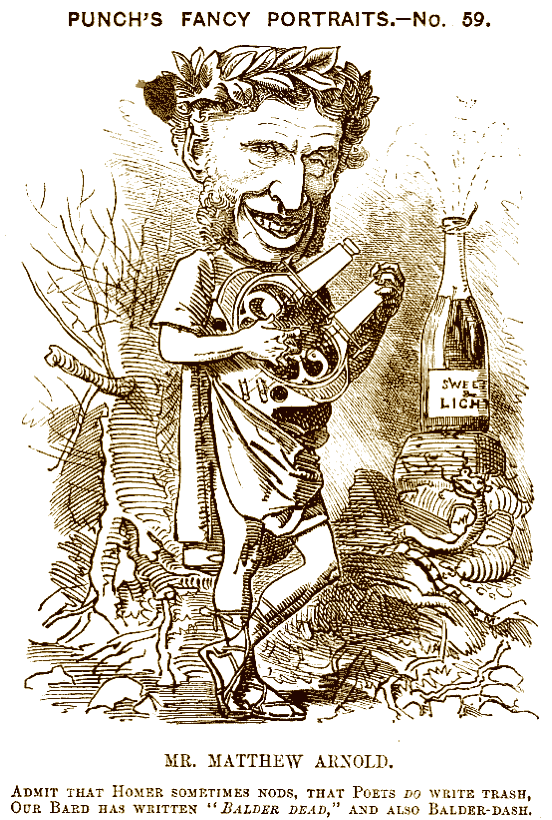
For example, as a young man, he commended a poem by Matthew Arnold (1822-1888) to his friend Arthur Greeves.

I was sure that you wd. like “Balder Dead . . .” it is a topping piece of work, especially the journey, as you say, and the description of the ghosts, and the ending with its impressive pause before the glorious line “At last he sighed & set forth back to Heaven.” Doesn’t it all make you think of the dear old days when we were writing our great opera on Loki & Odin & the rest?

It is easy to see how “Balder Dead” resonated with Lewis, given his affinity for “Northernness.”

And doleful are the ghosts, the troops of dead,
Whom Hela with austere control presides…
And all the nobler souls of mortal men
On battle-field have met their death, and now
Feast in Valhalla, in my father’s hall;
Only the inglorious sort are there below…

In 1952, C.S. Lewis was invited to comment on a volume written by Phyllis Elinor Sandeman. The sensitive Inkling displayed the virtues of every good member of a writing critique group. Lewis begins with praise, and offers a single, concrete constructive comment, to aid the author.

Dear Mrs. Sandeman, I have read Treasure on Earth and I don’t believe you have any notion how good it is. . . . The only page that I can’t enter into at all is p. 83. I can’t conceive not being afraid, as a child, of those unseen presences. I should have behaved like little Jane Eyre in the Red Room when she dried her tears for fear a ghostly voice should awake to comfort her. One would rather be scolded by a mortal than comforted by a ghost.

Lewis is referring to a passage in which a specific location in her childhood home presumably granted the author immunity from fears: “Stories of ghosts and witches so delightful in cheerful company returned to trouble her when alone in the dark. It was impossible ever to feel fear in the drawing-room—there could surely never be a room more conducive to peace of mind.”

Two months later, Lewis again wrote Sandeman, perhaps to address her disappointment at receiving his comment about ghosts.

You were perfectly right to put in the bit about the friendly ghosts. I think the absence of fear is, as far as it goes, probable evidence that the experience was not merely imaginary. Everyone fears lest he should meet a ghost, but there seems to be some ground for supposing that those who really meet them are often quite unafraid.

Notice that angels, on the other hand, seem in Scripture to be nearly always terrifying & have to begin by saying “Fear not.”

In Ireland I stayed at a lonely bungalow last summer which the peasants avoided not because a ghost had been seen near it (they didn’t mind ghosts) but because the Good People, the Faerie, frequented that bit of coast. So apparently ghosts are the least alarming kind of spirit.

In a letter to another correspondent, Lewis describes the same stay at the isolated Irish lodging. “I have been really in quiet and almost unearthly spots in my native Ireland. I stayed for a fortnight in a bungalow which none of the peasants will approach at night because the desolate coast on which it stands is haunted by ‘the Good People.’ There is also a ghost but (and this is interesting) they don’t seem to mind him: the faerie are a more serious danger.”

The Anthroposophist Connection

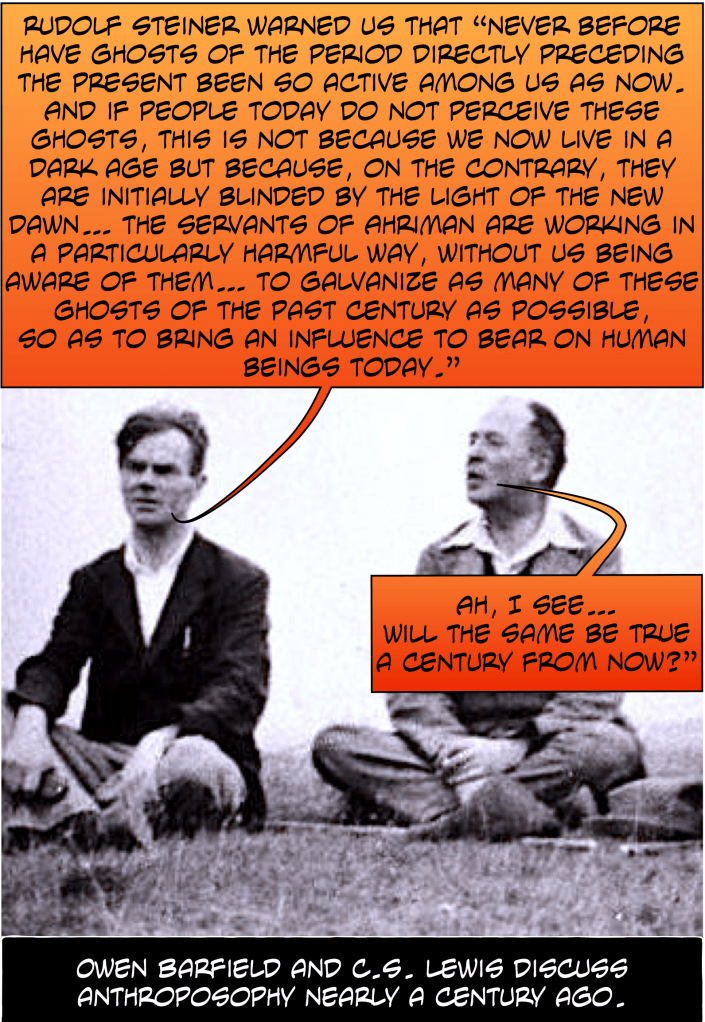
Anthroposophy is a religious philosophy created by Rudolf Steiner (1861-1925). It is diametrically opposed to Christian revelation, and was the cause of one of C.S. Lewis’ greatest disappointments. Tragically, his dear friend and fellow Inkling, Owen Barfield, subscribed to Steiner’s doctrines. C.S. Lewis’ “Great War” with Owen Barfield describes a five year period when the two young scholars argued about the religion. Unfortunately, this was prior to Lewis’ own conversion, so he did not bring a Christian faith to the battle.

Steiner’s religion is complex and confusing. There are, in his view, a plurality of gods. And the god to whom he refers as humanity’s Creator is not the God of Genesis. Steiner argues we have lost sight of the true knowledge or gnosis.

During this [contemporary] era, people no longer see Christ as the being who came down from the stars, because they do not understand the stars themselves as an expression of the spirit as it weaves in the cosmos. For humanity today, there is no God or Christ in the cosmos. (The Three Eras of Human Religious Education)

Naturally, since Barfield was such a good friend of Lewis, there is much that is commendable in him . . . despite his esoteric beliefs. Lewis, after all, entrusted Barfield to be the executor of his estate. Despite their differing theologies, Lewis wrote nakedly about his deep sorrow in the wake of the death of their fellow Inkling, Charles Williams.  

My dear Barfield Thanks for writing. It has been a very odd experience. This, the first really severe loss I have suffered, has (a) Given corroboration to my belief in immortality such as I never dreamed of. It is almost tangible now. (b) Swept away all my old feelings of mere horror and disgust at funerals, coffins, graves etc.

If need had been I think I could have handled that corpse with hardly any unpleasant sensations. (c) Greatly reduced my feeling about ghosts. I think (but who knows?) that I should be, tho afraid, more pleased than afraid, if his turned up. In fact, all very curious. Great pain but no mere depression.

In this letter C.S. Lewis is speaking wistfully about the ghost of a friend. He is well aware of the fact that—despite the British fascination with spiritualism—that is not how the afterlife works. Those who die “in Christ” join him in Paradise, just as he promised the believing thief who perished beside him.

Ghosts do not wander around the earth. Those are different types of spirits, to be discussed another day. By contrast here are some Steinerian thoughts on the subject.

When human beings cling too strongly to earthly things it may be difficult for them to find their bearings in the sphere of the Moon Beings [which] may cause human beings who have to pass after death into the Moon sphere—the soul-world—but are unable to understand the Moon Beings, to be trapped . . . and they can actually be seen . . . wandering about as ghosts, as spectral shades. (Steiner, Karmic Relationships)

The accumulation in the etheric body caused through these [wicked] experiences of the soul . . . brings about detachments from the beings working in the spiritual worlds and these likewise are now to be found in our environment—they are the “specters” or “ghosts.” (Steiner, Nature Spirits)

Ghosts, as they are generally called, are spirits which have acquired a sensory-physical character (or have become tangible) through the human organisation, whereas impulses, instincts, desires and passions are modern spectres pointing towards the future, spectres which have not yet been raised to spirituality. (The Contrasting World-Conceptions of East and West)

But enough of quotations that foster more confusion than understanding. Let’s look at a letter C.S. Lewis wrote to his friend Arthur Greeves in 1920. In it Lewis describes a visit with Leo Kingsley Baker (1898-1986). Like Lewis, Baker was a young veteran of the First World War. Both served in France, Lewis in the trenches and Baker as a pilot in the RAF. Baker also happened to be an Anthroposophist, and it was in fact Baker who introduced C.S. Lewis and Owen Barfield.

I was in [Leo] Baker’s rooms with [Rodney] Pasley last night: Pasley departed early and the conversation between us two fell on shadowy subjects–ghosts and spirits and Gods. You may or may not disbelieve what followed.

Baker began to tell me about himself: how he had seen things ever since he was a child, and had played about with hypnotism and automatic writing: how he had finally given it all up, till now “things” were coming back of their own accord. “At one time” he said “I was afraid to look round the room for fear of what I might see.”

He also stated confidently that anyone could compel a ghost to appear, that there were definite ways of doing it: though of course the thing you “fished up” might not be what you wanted—indeed quite the contrary.

The greater part of his views I will reserve for our next meeting: what I wanted to tell you was the effect on me. I got, as it were, dazed and drunk in all he said: then I noticed his eyes: presently I could hardly see anything else: and everything he said was real—incredibly real.

When I came away, I moved my eyes off his, with a jerk, so to speak, and suddenly found that I had a splitting headache and was tired and nervous and pulled to pieces. I fancy I was a bit hypnotised. At any rate I had such a fit of superstitious terror as I have never known since childhood and have consequently conceived, for the present, a violent distaste for mysteries and all that kind of business. Perhaps he is a bit mad.

It comes as little surprise that an encounter such as this would leave one with a serious headache. Likewise, further consideration of these arcane matters here at Mere Inkling would likely promote similar cranial vexation. Suffice it to say, as we close, that we who trust in Christ need not fear any spirit or demon we might encounter, because “greater is he who is in [us] than he who is in the world” (1 John 4:4).

C.S. Lewis and Ghost Stories

C.S. Lewis did not write ghost stories, but he lived in a country that celebrated the strange genre. For some bizarre reason, the telling of ghost stories became associated with Christmas Eve. It’s a wonder to me why Lewis didn’t include this impropriety in his brilliant essay on Xmas.

“Christmas Eve was traditionally the time to tell scary stories round the hearth,” opens an article in The Guardian. I had never before associated Charles Dickens’ A Christmas Carol with this bizarre tradition. Nor had I connected it with Amy Grant’s “It’s the Most Wonderful Time of the Year.” (Far better the theme of Grant’s Nativity song “Breath of Heaven.”)

I presume I can thank my Scandinavian heritage for the absence of ghost stories in our Christmas season traditions. Mercifully we also avoided the plague of seasonal trolls and gnomes.

One of the most noted of authors of ghost stories had much in common with C.S. Lewis. M.R. James (1862-1936) was a medievalist scholar who taught at Cambridge. In fact, “James came to sharpen his craft – by telling his stories after the Christmas service at King’s College, Cambridge (where he was provost) to an audience of uneasy fellows.” In the same article no less than H.P. Lovecraft himself is cited as describing James as “a literary weird fictionist of the very first rank.”

I suppose it is a sign of his minimal interest in ghost stories that I cannot find any reference to James’ fiction in C.S. Lewis’ writing. Lewis does, however, refer to one of James’ scholarly works, The Apocryphal New Testament: Being the Apocryphal Gospels, Acts, Epistles and Apocalypses.

In a 1955 letter, Lewis describes how experiencing a relationship with Christ is different than simply knowing about him.

Yes, Jesus Himself, of course: the heart. Not only the God in Him but the historical Man. I don’t know that I ever got much from reading things about Him. Perhaps, in a queer way, I got most from reading the Apocryphal Gospels (The whole Apocryphal N.T. is done in one vol. ed. M.R. James). For there you find things attributed to Him that couldn’t be true. You even find wise & beautiful sayings which nevertheless just don’t ring true. And have you noticed–reading the true sayings in the real Gospels–how hardly one of them could have been guessed in advance?*

References to Ghosts

As befits a person writing over a fifty year period, C.S. Lewis’ comments about ghosts vary. This is emphasized by the change in his worldview which accompanied his conversion from atheism to Christianity.

A 1915 letter to Arthur Greeves reveals Lewis’ affinity for the supernatural. He is describing his reading of “Roots of the Mountains” by William Morris (1834-1896).

Tho’ more ordinary than the [“Well at the World’s End” here and here], it is still utterly different from any novel you ever read. Apart from the quaint and beautiful old English, which means so much to me, the supernatural element, tho’ it does not enter into the plot, yet hovers on the margin all the time: we have ‘the wildwood wherein dwell wights that love not men, to whom the groan of the children of men is as the scrape of a fiddle-bow: there too abide the kelpies, and the ghosts of them that rest not . . .’

In Lewis’ essay “The Novels of Charles Williams,” he describes the uniqueness of Williams’ work.

We meet in them, on the one hand, very ordinary modern people who talk the slang of our own day, and live in the suburbs: on the other hand, we also meet the supernatural—ghosts, magicians, and archetypal beasts.

The first thing to grasp is that this is not a mixture of two literary kinds . . . Williams is really writing a third kind of book which belongs to neither class and has a different value from either.

He is writing that sort of book in which we begin by saying, ‘Let us suppose that this everyday world were, at some point, invaded by the marvellous. Let us, in fact, suppose a violation of frontier.’

In 1939 he wrote to his brother about a play by W.B. Yeats featuring a ghost.

The plays were worth seeing: one, by Yeats [“Purgatory” in Last Poems and Two Plays], his last one, was really powerful: conversation between a tramp and his son outside the ruins of a great house and then the ghost of its last mistress at the window, re-enacting her past life-she being the one who had finally let the whole thing down, marrying a horse-dealer . . . all the usual tragedy of the Irish aristocracy.

Not quite true, of course, because probably most of the preceding generations had been pretty good wasters too: but an effective play.

I have previously explored C.S. Lewis’ actual encounter with Yeats. It was quite odd. In 1921, he had written to his father.

I have been taken recently to see the mighty Yeats. It was the weirdest show you ever saw, and I fear he is a Kod [slang, I believe, for a fraud or a hoaxer]. You sit on hard antique chairs by candlelight in an oriental looking room and listen in silence while the great man talks about magic and ghosts and mystics . . .

What fluttering of the dovecote! It is a pity that the real romance of meeting a man who has written great poetry and who has known William Morris and Tagore and Symons should be so overlaid with the sham romance of flame coloured curtains and mumbo-jumbo.

In 1940 Lewis shared with Warnie his notion that if the seances were real — they had been popular during England’s flirtations with spiritualism — it did not suggest the spirits are particularly bright.

Part of Thursday afternoon I spent with unusual pleasure in the dark, pleasantly smelling, warmth of the old library with a slow dampish snow falling outside-flakes the size of matchboxes. I had gone in to look for something quite different, but became intrigued by the works of Dr Dee [(1527-1608) of Trinity College Cambridge], a mysterious magician and astrologer of Queen Elizabeth’s time.

The interesting thing about this was the fact that it was so uninteresting: I mean that the spirit conversations displayed, so far as I could see from turning over a few pages, just exactly the same fatuity which one observes in those recorded by modern spiritualists. What can be the explanation of this?

I suppose that both are hallucinations resulting from the same kind of mental weakness which, at all periods, produces the same rubbish. One can’t help, however, toying with the hypothesis that they are all real spirits in the case, and that we tap either a ghostly college of buffoons or a ghostly home for imbeciles.

In 1946 he complimented Ruth Pitter (1897-1992), a longtime friend and correspondent. Pitter’s First Poems are available here.

I’m not sure I’ve understood The Bridge as a whole: but I love ‘shapes of sorrow and empty vessels,’ etc. Nice things in Seaborn. The Cygnet comes off as well as things like air-raids can come off in poetry. I don’t mean because they’re modern.

But as a rule, the bigger a thing is, physically the less it works in literature. One ghost is always more disquieting than ten: no good fight in a story can have more than a dozen or so combatants: the death of a million men is less tragic than that of one.

By the way, that final comment will prove of great value to any modern writer!

I’ve accumulated several other Lewisian references to ghosts, so what say we continue this discussion in our next post? In the meantime, perhaps you will care to read some of the linked volumes, or to comment on the odd link between ghost stories and Christmas Eve.


* The Apocrypha Anecdota: A Collection of Thirteen Apocryphal Books and Fragments by Montague Rhodes James is available here. He also wrote The Lost Apocrypha of the Old Testament: Their Titles and Fragments.

Several of James’ ghost stories are available in these collections: The Five Jars and A Thin Ghost and Others. Dr. Dewi Evans has compiled The Collected Ghost Stories of M.R. James and made them available in several formats on his website.

Does Sincerity Result in Good Writing?

Most aspiring writers are sincere. The question is, does the earnestness of their work translate into excellence? In other words, does honesty correlate to quality?

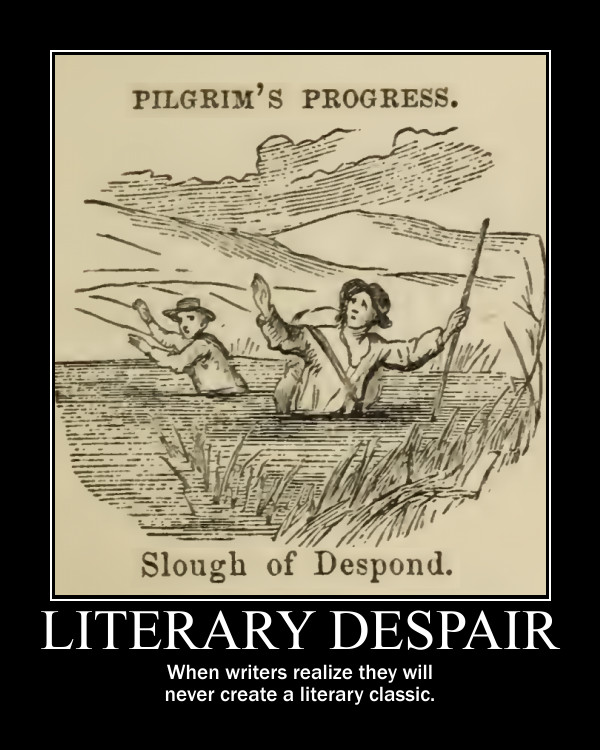
C.S. Lewis addressed this question in an essay about John Bunyan (1628-1688). Bunyan was the English writer and Puritan preacher best known for The Pilgrim’s Progress. At the outset of the allegory Bunyan attempts to “show the profit of my book,” and encourage its reading.

This book is writ in such a dialect
As may the minds of listless men affect:
It seems a novelty, and yet contains
Nothing but sound and honest gospel strains.

While C.S. Lewis respected this classic work, he argues that its value is not simply a consequence of Bunyan’s honesty.

The other thing we must not say is that Bunyan wrote well because he was a sincere, forthright man who had no literary affectations and simply said what he meant. I do not doubt that is the account of the matter that Bunyan would have given himself. But it will not do. (“The Vision of John Bunyan”)

Lewis is not, of course, challenging Bunyan’s claim to honesty. What Lewis does, in fact, is challenge a common misconception. He dismantles the excuse for any who would dismiss grammar and literary rules as unimportant because they are writing earnestly. Basically, Lewis suggests we cannot justify creating a mediocre product and by burnishing it with the declaration that “it is an outpouring of our deepest passion.”

“If [candid honesty] were the real explanation,” states Lewis, “then every sincere, forthright, unaffected man could write as well.”

And we all know that is not the case. Lewis proceeds to offer an illuminating and curious illustration. It recalls the days of the First World War when one of the responsibilities of the officers was to review the correspondence of the troops before they accidentally divulged classified military information to their family at home.

But most people of my age learned from censoring the letters of the troops, when we were subalterns [lieutenants] in the first war, that unliterary people, however sincere and forthright in their talk, no sooner take a pen in hand than cliché and platitude flow from it. The shocking truth is that, while insincerity may be fatal to good writing, sincerity, of itself, never taught anyone to write well. It is a moral virtue, not a literary talent. We may hope it is rewarded in a better world: it is not rewarded on Parnassus.*

Lewis continues, praising Bunyan’s writing.

We must attribute Bunyan’s style to a perfect natural ear, a great sensibility for the idiom and cadence of popular speech, a long experience in addressing unlettered audiences, and a freedom from bad models. I do not add ‘to an intense imagination,’ for that also can shipwreck if a man does not find the right words.

A Lesson for Modern Writers

C.S. Lewis’ keen analysis of Bunyan’s writing is more than a mere history lesson. It offers a lesson to those of us who take up the pen today. By all means, we should exercise the moral virtue of sincerity in our writing. However, we should not rest on the strength of our integrity to ensure the quality of our writing.

We should hone our skills. Likewise, we should welcome the constructive criticism of our peers, as did the Inklings themselves.

Our work will also benefit when we intently listen. Learning the idiom and cadence of our characters (real or fictional) enables them to rise alive from the page.

Lewis’ essay on Bunyan offers another suggestion I would highlight. This will be true for any writer, but I think it is of particular import to Christian authors. Lewis affirms a forthright, honest, and powerful presentation of the truth as we perceive it. He cautions against pulling our punches because we are timid about how the austere truth may be received.

For some readers the ‘unpleasant side’ of The Pilgrim’s Progress [lies] in the intolerable terror which is never far away. Indeed unpleasant is here a ludicrous understatement. The dark doctrine has never been more horrifyingly stated than in the words that conclude Part I: Then I saw that there was a way to Hell, even from the Gates of Heaven, as well as from the City of Destruction.

In my opinion the book would be immeasurably weakened as a work of art if the flames of Hell were not always flickering on the horizon. I do not mean merely that if they were not it would cease to be true to Bunyan’s own vision and would therefore suffer all the effects which a voluntary distortion or expurgation of experience might be expected to produce. I mean also that the image of this is necessary to us while we read.

The urgency, the harsh woodcut energy, the continual sense of momentousness, depend on it. We might even say that, just as Bunyan’s religious theme demanded for its vehicle this kind of story, so the telling of such a story would have required on merely artistic grounds to be thus loaded with a further significance, a significance which is believed by only some, but can be felt (while they read) by all, to be of immeasurable importance.

Keeping this in mind—that we should be faithful to the truth of what we are professing—will serve us well in the final accounting. After all, it is the compromises of the tepid of which we must beware.


* Parnassus refers to a Greek mountain associated by the ancients with Apollo, the Muses and poetry.

The Pilgrim’s Progress is available in a variety of free versions.

The Pilgrim’s Progress, an Allegory features a “Biographical Sketch of the author, by Lord Macaullay.”

In an 1834 edition, we have Bunyan’s Pilgrim’s Progress, Metrically Condensed: In Six Cantos.

The version with the most entertaining title has to be: The Pilgrim’s Progress [by John Bunyan] In Words of One Syllable.

The Child’s Pilgrim’s Progress can be downloaded in not one, but two volumes. It was published in 1860, with the preface:

No endeavour has been made in this little book to improve Bunyan’s Pilgrim’s Progress. To do so would be simply absurd. To bring prominently into view scenes supposed most attractive to children has been attempted; and, while the Dreamer’s narrative is preserved, others of less striking character have been thrown into the back ground. The quaint, simple language of the incomparable Bunyan is, for the most part, retained.

The Pilgrim’s Progress: for the Young was published in 1850. Its introduction includes commentary that echoes the theme of the post above.

John Bunyan, though a very pious and good man, was not a learned one ; for he was by trade a tinker, and had no opportunity to learn much more than to read, in his youth, and when a boy he was wild and wicked. But he made very good use afterward of what he knew ; and very diligently studied his Bible and other good books.

He was also what is called a genius, which means that he had great natural talent. He wrote many works, and one of his books, called the Pilgrim’s Progress, has been read and admired by more people than any other book except the Bible. Learned and unlearned men have read it again and again, and it has been translated into all modern languages.