Vulgar Christianity

vulgarityIf I were to say “vulgar Christianity is a good thing,” what would you think?

It depends, doesn’t it, on the meaning you ascribe to the word “vulgar.” For, even though it is most often used in a derogatory sense today, vulgar also means common or genuine.

Here, in modified order, are some definitions gleaned from an internet dictionary. The first three represent the most vulgar use of the word.

Vulgar, 1350-1400; Middle English < Latin vulgāris, equivalent to vulg (us) the general public + -āris -ar

  1. characterized by ignorance of or lack of good breeding or taste: vulgar ostentation.
  2. indecent; obscene; lewd: a vulgar work; a vulgar gesture.
  3. crude; coarse; unrefined: a vulgar peasant.

The next two definitions relate to the more historic, rather less crass application of the word.

  1. of, relating to, or constituting the ordinary people in a society: the vulgar masses.
  2. lacking in distinction, aesthetic value, or charm; banal; ordinary: a vulgar painting.
  3. current; popular; common: a vulgar success; vulgar beliefs.

The final definition of vulgar relates to language: “spoken by, or being in the language spoken by, the people generally; vernacular: vulgar tongue.”

The most visible adaptation of the root word likely comes in the title of the Latin translation of the Holy Scriptures completed by the ascetic saint, Jerome (347-420). The Vulgate, came to be called in Latin versio vulgata or vulgata editio, which meant the commonly used or read version.

Vulgarity in C.S. Lewis

Naturally, Lewis did not communicate in a vulgar (objectionable) way. He did, however, strive to reach the common men and women of the day, doing so more effectively than many clergy appear(ed) capable.

There are ample examples of the wide use of the word in Lewis’ works. In “Christianity and Culture,” he distinguishes between objective and subjective assessments of the value of literature.

A bad book is to be deemed a real evil in so far as it can be shown to prompt to sensuality, or pride, or murder, or to conflict with the doctrine of Divine Providence, or the like. The other dyslogistic terms dear to critics (vulgar, derivative, cheap, precious, academic, affected, bourgeois, Victorian, Georgian, “literary,” etc.) had better be kept strictly on the taste side of the account.

In discovering what attitudes are present you can be as subtle as you like. But in your theological and ethical condemnation (as distinct from your dislike of the taste) you had better be very un-subtle. You had better reserve it for plain mortal sins, and plain atheism and heresy.

For our passions are always urging us in the opposite direction, and if we are not careful criticism may become a mere excuse for taking revenge on books whose smell we dislike by erecting our temperamental antipathies into pseudo-moral judgements.

In Studies in Words, we gain an interesting insight into Lewis’ understanding of himself. He discusses how the concept of “bourgeois,” which simply means middle-class or conventional, is twisted by elitists to mean something offensive.

All my life the epithet bourgeois has been, in many contexts, a term of contempt, but not for the same reason. When I was a boy—a bourgeois boy—it was applied to my social class by the class above it; bourgeois meant “not aristocratic, therefore vulgar.”

When I was in my twenties this changed. My class was now vilified by the class below it; bourgeois began to mean “not proletarian, therefore parasitic, reactionary.” Thus it has always been a reproach to assign a man to that class which has provided the world with nearly all its divines, poets, philosophers, scientists, musicians, painters, doctors, architects, and administrators.

I am so happy, and blessed, that C.S. Lewis was a vulgar man . . . just like me.

For those who have read this far, I offer now one of Lewis’ poem with a related theme. Enjoy.

On a Vulgar Error

No. It’s an impudent falsehood. Men did not

Invariably think the newer way

Prosaic mad, inelegant, or what not.

Was the first pointed arch esteemed a blot

Upon the church? Did anybody say

How modern and how ugly? They did not.

Plate-armour, or windows glazed, or verse fire-hot

With rhymes from France, or spices from Cathay,

Were these at first a horror? They were not.

If, then, our present arts, laws, houses, food

All set us hankering after yesterday,

Need this be only an archaising mood?

Why, any man whose purse has been let blood

By sharpers, when he finds all drained away

Must compare how he stands with how he stood.

If a quack doctor’s breezy ineptitude

Has cost me a leg, must I forget straightway

All that I can’t do now, all that I could?

So, when our guides unanimously decry

The backward glance, I think we can guess why.

_____

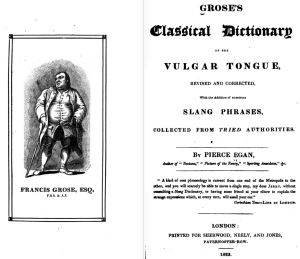
The image above is taken from Grose’s Classical Dictionary of the Vulgar Tongue by Pierce Egan (1823). Caution, even though this slang is centuries old, some of it is vulgar in every sense of the word; it may even cause one to blush.


Who Said That?

thoms and lewisWho said that? It’s a question people ask when they recall a familiar saying and don’t remember the source.

Occasionally when we are reminded of the source, we shake our heads and think that’s right; how could I have forgotten!

At other times though, discovering the source of the maxim doesn’t help at all. It could be because the proverb is anonymous, or it might be due to the fact that it’s originator was not particularly well known.

That’s the case of the following statement, which is familiar to many Christians.

“Be careful how you live; you will be the only Bible some people ever read.”

When I thought of this phrase several weeks ago, I had a bit of trouble tracking it down. I actually found it on a number of sites, but the problem was that the author’s name was so unfamiliar it was almost always misspelled.

He was usually cited as “William Toms.” Yet I was pretty sure the saying hadn’t originated, however, with an Irish footballer.*

Just when I assumed I had encountered a clichéd brick wall, I stumbled upon the truth. Like so many classic maxims, the quotation did indeed originate from the British Isles.

The British writer William J. Thoms penned this thoughtful maxim, and it isn’t the only wise thing he wrote.

William John Thoms (1803 – 1885) was a British writer credited with coining the term “folklore” in the 1840s. Thoms’ investigation of folklore and myth led to a later career of debunking longevity myths. Hence, he is an early advocate of “validation research” when examining demographics.

Several of Thoms’ works are available online. They include:

C.S. Lewis had more in common with Thoms than simply being British and engaging in literary pursuits. The two men shared an interest in simple tales that intrigued and inspired men and women through the ages.

It was Thoms, in fact, who in 1846 introduced into English the term “folklore.”

A shared interest in legends and even the supernatural, suggests that the two may well have enjoyed one another’s company, had their lives intersected.

Sadly, Thoms’ desire to compile a comprehensive “Folk-Lore of England” was never realized, as this superb article describes.

The two scholars shared another trait of bookish people. (“Bookish,” by the way, is a compliment here at Mere Inkling.) Neither man sought out the frivolities of popular society. They were both content to socialize with similar minds in more intimate community. The following description of Thoms, from the Dictionary of National Biography,could just as naturally have been written about Lewis.

Thoms went little into society, but at congenial resorts, such as the ‘Cocked Hat Club,’ he was remarkable for a ready play of wit and an almost inexhaustible fund of humorous anecdote and reminiscence.

Can’t you just picture the Cocked Hat Club meeting at one table in the Eagle and Child while the Inklings shared their own warm friendship at their table at the other end of the pub?

_____

* Not that I follow English football, but I learned an athlete by that name played forward for Plymouth Argyle and Manchester United.

** The Book of the Court, published in 1838 with the second edition, linked here, printed six years later, has the delightful, if rather lengthy, subtitle: Exhibiting the History, Duties, and Privileges of the Several Ranks of the English Nobility and Gentry, Particularly of the Great Officers of State and members of the Royal Household; Including Vaious Forms of Court Etiquette, Tables of Precedency, Rules to be Observed at Levers and Drawing Rooms, Etc.

Robotic Religion

robot monkClergy can be irritating. I know that better than most . . . because I am one.

While a tiny minority bear some striking similarities to humble saints of the past, far more carry all of the common marks of fallen humanity. They can be argumentative, vain, manipulative, and even vindictive.

It’s not pretty.

Ministers aren’t unique. Being on the “inside” of any community—be it construction workers, educators, soldiers, bankers and politicians—allows one to see unpleasant attributes that are often shielded from the general population.

But, getting back to clergy . . . Since their role is unique in conveying “divine” counsel to others, it is especially important that they be approachable and amicable.

Scientists in China are working on a means of getting around the built-in limitations of the human mediation of divine wisdom.*

They have devised a “robot monk.” It is quite versatile. Not only can it chant Buddhist mantras, something an iPod could do at least as well, it is able to carry on a conversation! Well, the conversation is presently limited to 20 set questions about Buddhism. And the use of a touch screen “held” against his chest makes the comparison with an iPad a bit more accurate.

The automaton’s creator predicts the robot in the yellow robe of a novice will have a major impact, even though he spends most of his day “meditating” on an office shelf.

Enthusiastically agreeing, one worshiper said, “He looks really cute and adorable. He’ll spread Buddhism to more people, since they will think he’s very interesting, and will make them really want to understand Buddhism.”

Now, how can a Christian pastor hope to compete with that. After all, not many are considered to be “cute and adorable.”

What Would C.S. Lewis Think?

That’s a question I sometimes ponder when confronted by particularly odd realities that few of his day could have foreseen.

Lewis was quite respectful of clergy. Read, for example, this account of the way that even religious leaders can succumb to a type of patriotism that is far from biblical.

Patriotism . . . is not a sentiment but a belief: a firm, even prosaic belief that our own nation, in sober fact, has long been, and still is markedly superior to all others. I once ventured to say to an old clergyman who was voicing this sort of patriotism, “But, sir, aren’t we told that every people thinks its own men the bravest and its own women the fairest in the world?”

He replied with total gravity—he could not have been graver if he had been saying the Creed at the altar—“Yes, but in England it’s true.” To be sure, this conviction had not made my friend (God rest his soul) a villain; only an extremely lovable old ass. It can however produce asses that kick and bite. On the lunatic fringe it may shade off into that popular Racialism which Christianity and science equally forbid. (The Four Loves)

Now, it was not the personality or demeanor of this elderly priest that made his comment inappropriate. It was the comment itself. But for a prime example of clerical pride that drives people away from the Gospel, one needs look no farther than the “Episcopal Ghost” in Lewis’ The Great Divorce.

In Mere Christianity, Lewis concisely states the distinctive purpose of clergy. “The clergy are those particular people within the whole Church who have been specially trained and set aside to look after what concerns us as creatures who are going to live for ever.”

Could any other role demand so much integrity and goodwill? I think not. And it is precisely because this role is so unique and significant, that our shortcomings are doubly damning.

Perhaps, given the failings of sinful (i.e. all) ministers, it’s time to consider substituting a robot?

shermanI have no doubt that in no few cases it would be an improvement.

Of course, Christian churches would require a different model. Perhaps one that looks like Sherman on the Mount (minus the bird)?

_____

* You can read a Reuters article about this marvel of Chinese technology here.

The Nones Have It

noneThe arrival of the “post-Christian” Western world is ahead of schedule. Great Britain just passed the point where those with “no religious preference” actually outnumber those who profess to be Christians.

With Europe leading the way, can North America be far behind?

You know what makes this even more shocking? The results come from a survey where all the people claiming to be disciples of Jesus needed to do, was simply check a box. One wonders how many among that 48% would still claim to be Christians if they lived in Iraq.

Ponder for a moment the sobering title of an article in London’s The Spectator.

“Britain Really is Ceasing to be a Christian Country.”

The secularization of the United Kingdom was a matter of great concern to C.S. Lewis. And this erosion was well underway during his lifetime.

The truth is that although Lewis excelled as a Christian apologist (defender of the faith), it was not a role he coveted. He much preferred to write speculative fiction, literary criticism and devotional works.

Yet, because the need to reach people with the simple truth of the Gospel had grown so dire, Lewis felt forced to offer a persuasive rationale for belief. Consider the following description of his self-understanding. These words were written in response to a public attack of his work by a theologian. The final sentence bears directly on the subject of this column.

When I began, Christianity came before the great mass of my unbelieving fellow-countrymen either in the highly emotional form offered by revivalists or in the unintelligible language of highly cultured clergymen.

Most men were reached by neither. My task was therefore simply that of a translator—one turning Christian doctrine, or what he believed to be such, into the vernacular, into language that unscholarly people would attend to and could understand. For this purpose a style more guarded, more nuance, finelier shaded, more rich in fruitful ambiguities . . . would have been worse than useless. It would not only have failed to enlighten the common reader’s understanding; it would have aroused his suspicion. He would have thought, poor soul, that I was facing both ways, sitting on the fence, offering at one moment what I withdrew the next, and generally trying to trick him.

I may have made theological errors. My manner may have been defective. Others may do better hereafter. I am ready, if I am young enough, to learn. Dr. Pittenger would be a more helpful critic if he advised a cure as well as asserting many diseases. How does he himself do such work? What methods, and with what success, does he employ when he is trying to convert the great mass of storekeepers, lawyers, realtors, morticians, policemen and artisans who surround him in his own city? One thing at least is sure.

If the real theologians had tackled this laborious work of translation about a hundred years ago, when they began to lose touch with the people (for whom Christ died), there would have been no place for me. (“Rejoinder to Dr. Pittenger”)

It is the duty of each generation of Christians to share the faith with their neighbors. Likewise, it is the responsibility of each new generation of clergy to teach faithfully . . . and to live a God-pleasing life.

Whenever we fail to tackle the “laborious work of translation,” God is able to raise up another to do it. Still, men and women of the caliber of C.S. Lewis are few and far between.

May God have mercy on Britain, America, and all of those lands where we have taken for granted the heritage of faith bequeathed to us.

_____

If this subject interests you in the least, take a moment to read “Having Pity on Pittenger.” Anglican priest Dwight Longenecker describes a chance encounter with Dr. Pittenger decades after Lewis’ death.

I was alerted to this news account by Gene Veith’s fine blog, Cranach. The good doctor does an outstanding job of bringing newsworthy stories to the attention of those interested in Church and State relations.

A Mother Knows Her Child

calfWhen we lived in England, we witnessed the birth of a calf in a peculiar setting. We were driving along winding country roads, turned a corner, and saw a newborn calf lying in the middle of the road, covered in her still-warm afterbirth.

During the decades since that day, our (now adult) children complained: “why do you always get to save the baby cows?” (They had been restricted to the safety of our car, pulled off of the road with flashers blazing.)

To describe it succinctly, we were able to set up warnings along the rapprochements and lift the newborn infant into farm-familiar hands. While I attended to approaching traffic, a neighbor farmer picked up the little one and carried him or her to their mother who was mournfully mooing on the hillside above.

You see, she had backed up near the fence that surrounded her pasture, and when the infant was delivered, it slid down the fifteen-foot embankment onto the road.

I directed the traffic, while my wife Delores assisted the farmer in conveying the child to its mother.

I was surprised by what I saw as we climbed up into the field. There was the mother of the lost infant, crying out in her misery for her terrible misfortune. And gathered around her were the rest of her herd, mooing in anguished sympathy for her loss.

When we laid the bloodstained calf on the ground behind its forlorn mother, we called out to it to turn and recognize the deliverance that had dawned. The mother approached the calf, with the rest of the cattle hanging respectfully in her wake.

She sniffed at her little one and began immediately to lick it clean and smother it with love. The plaintive cries gave way to soothing moos, and a holy calm fell upon that field.

It was a glorious moment I will never forget. One of those where we recognize the privilege God has granted us to simply be in his presence as we gaze in awe at his creation.

C.S. Lewis and the Wonder of Cattle

In July 1930, Lewis wrote to his dear friend Arthur Greeves, complaining about the burden of “marking papers” at the end of the academic year. He then gently rebukes his friend for thinking that the discussion of the mundane matters of home life are insignificant.

Thank you for writing–I enjoyed your two letters enormously. Do stop apologising for them and wondering archly . . . how I can read them. Surely it needs no great imagination for you to realise that every mention of things at home now comes to me with the sweetness that belongs only to what is irrevocable.

Those who have left the rural life for academia can relate to the sentiments of C.S. Lewis. He loved the ambiance of Oxford, but missed the simplicity of the common world.

Lewis thanks Greeves for his description of the birth of a calf and confesses his own moral shortcoming in not celebrating without reservation the wondrous moment.

Oh you can’t imagine the poignancy with which your account of the sunny windy day near the dry tree fell across a dreary, dusty afternoon of those sordid papers, when my head was aching and the boys’ horrid handwriting seemed to jump on the page.

I don’t know quite what I feel about your assistance at the accouchement of our sister the cow.

I know what I ought to feel—simply the same thrill that I feel at the first coming up of a flower.

Physical disgust is a sensation which I have very often and of which I am always ashamed. If one lets it grow upon one it will in the end cut one out from all delighted participation in the life of nature. For God is gross and never heard of decency and cares nothing for refinement: nor do children, nor most women, nor any of the beasts, nor men either except in certain sophisticated classes.

And yet its hard to feel that the faculty of disgust is a sheer evil from beginning to end. I don’t know what to make of it. (Perhaps in one way it is, in another, it isn’t!)

Lewis closes his letter with an entertaining reflection on the amazing scenes such as I witnessed long ago in the English countryside.

At any rate there can be no two opinions about the delightfulness of seeing the other cows coming round to inspect the infant. Did they show any signs of congratulating the mother? for I notice that when one of our hens lays an egg, all join in the noise—whether that is congratulation or simply that they regard themselves as a single individual and announce “We have laid an egg.”

If you have another free moment, check out this great post on the spiritual value of maternal instincts . . . You can read Gloria Furman’s thoughts at desiringGod.

Enlarging C.S. Lewis’ Vocabulary

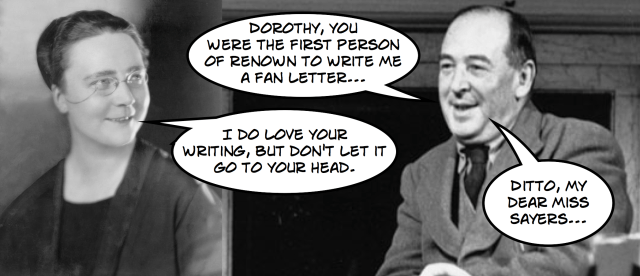
csl sayersCan you imagine receiving a compliment like this from C.S. Lewis? Your work “even enlarged my vocabulary.”

Shocking . . . but another writer did receive that rare praise.

In 1954, Lewis wrote a lengthy letter to his friend Dorothy Sayers, praising her recent publication of Introductory Papers on Dante. Lewis’ opening sentence reveals his delight. “Your Introductory Papers have given me a regular feast.”

Lewis specifically comments on a number of insights he found particularly worthwhile. And remember, Lewis was an expert on Dante in his own right.

One evidence that Lewis’ praise is sincere, and not mere flattery, comes in his comment that “every essay and nearly every page enriched me.” Not every page, mind you, but very nearly every one of them.

Offering Gentle Criticism

Consistent with the nature of friendly literary criticism (like one receives in a healthy writers group), Lewis does offer some specific advice on how to strengthen a specific point that he regards as overemphasized. In this case it relates to a classical Latin phrase.

At one point Lewis expresses awe about a portion of the book, and then immediately proceeds to make an enjoyable comment about the limitations of the English language.

P. 52 is a blaze of (just) splendour. (Drat our homophones: by just I don’t mean ‘nothing but,’ I mean ‘justified,’ ‘veracious.’)

Toward the close of his letter, Lewis raises a profound notion about our perception of humor. He cautions Sayers, in her interpretation of Dante’s Comedy, not to read it directly through the lens of our own day. “I’ve a feeling that in handling particular passages you are too certain that whatever is comic to us was, and was meant to be, comic at the time.” He continues:

Because, as any one can see even from the old Punches,* nothing changes so quickly as the sense of humour: so that in reading any old book there is nothing we are less sure of than which places wd. welcome a smile. And oughtn’t we to start by a recognition that our generation (yours & mine) was quite abnormally ‘tickle o’ the sere’** (already the young people are less so).

A Poetic Postscript

Lewis ends his letter to Sayers with some advice for her subsequent work with Dante. He courteously writes, “Don’t give me the next set, I’ll buy it.”

Then he makes a suggestion to protect her from the spurious criticisms of ignorant literary critics. (Note that he doesn’t use the choice descriptive in a vulgar sense common today, but in more classical sense of extreme foolishness.)

And do put in an essay on D. as ‘poet’ in the old, narrowest sense—his sheer poeticalness. Otherwise we shall have some ass saying that because you like so many other qualities, you are oblivious to that.

_____

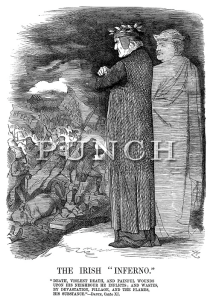
* Punch Magazine was published in England until 1992. The 1881 image below is inspired by Dante’s Inferno, and applied to the violence in Ireland.

** Easily made to laugh. From Hamlet: “The clown shall makes those laugh whose lungs are tickle o’ the sere.” The seare, or sere, was part of the trigger of old matchlock guns, so arranged that the slightest movement would make the gun discharge. Lungs, then, “tickle o’ the sere,” are those easily moved to laughter.

punch dante

C.S. Lewis’ Personality

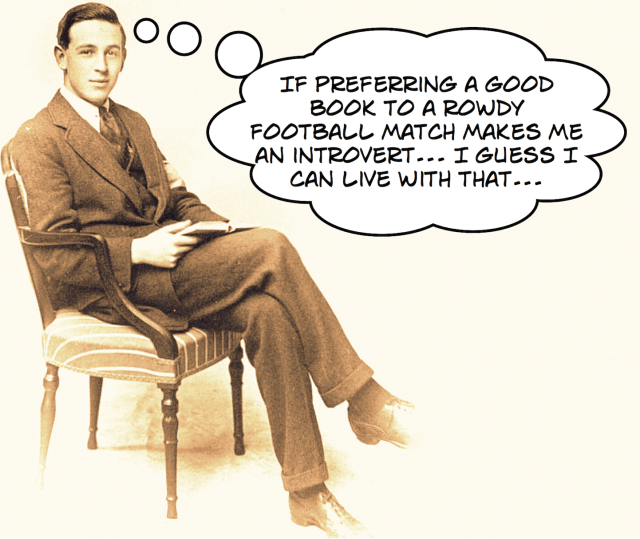
csl introvertLearning about ourselves is a lifelong quest. And the more actively we pursue self-knowledge, the wiser we become.

A well known sixteenth century Christian mystic wrote:

“Self-knowledge is so important that even if you were raised right up to the heavens, I should like you never to relax your cultivation of it.” (Saint Teresa of Ávila, Interior Castle).

This self-knowledge leads to a greater recognition of our dependence on God. She continues, “so long as we are on this earth, nothing matters more to us than humility. . . . As I see it, we shall never succeed in knowing ourselves unless we seek to know God: let us think of His greatness and then come back to our own baseness; by looking at His purity we shall see our foulness; by meditating on His humility, we shall see how far we are from being humble.”

C.S. Lewis echoes this sentiment.

If anyone would like to acquire humility, I can, I think, tell him the first step. The first step is to realise that one is proud. And a biggish step, too. At least, nothing whatever can be done before it. If you think you are not conceited, it means you are very conceited indeed. (Mere Christianity).

As part of my self-examination, I have recently revisited my “personality type” as assessed by the well known Myers Briggs Personality Indicator (MBTI).

Without over-explaining the MBTI, it measures an individual’s preference related to four ways by which we experience and make sense of the world. (News Flash: Not everyone perceives reality the same way!)

These dichotomies are:

Extraversion (E) or Introversion (I)

Whether your preferred focus is outward or inward.

Sensing (S) or Intuition (N)

How you focus on information and process it.

Thinking (T) or Feeling (F)

Primary preference in your decision-making.

Judging (J) or Perceiving (P)

Your orientation towards making sense of existence.

You can get some additional authoritative information here. There are also numerous “unofficial” websites related to the subject.

Sixteen combinations are possible, and each has its respective strengths. (None are “better” than others, of course, since we’re all created in the image of God.)

Speaking of which, I’ve also been studying the different combinations that are more common to Christian ministers than they are within the general population.

For example, the following types (with their shorthand title) range from two to six times more common for male clergy than the general male American population:

ENFJ (The Teacher)

ENFP (The Provider)

INFP (The Healer)

INFJ (The Counselor)

ENTJ (The Field Marshal)

Which type of pastor do you prefer?

Online Surveys to Visit after you finish this post

There are a number of free MBTI-type tests online. Naturally, they are not as reliable as the official inventory given through a certified provider. Nevertheless, the following sites did render accurate assessments for me, based on my formal scoring.

I have mentioned in the past that I am an *NTJ… with the asterisk representing that my I/E preference is too close to call. A previous post shows how that makes me a blend of Middle Earth’s Elrond and Théoden.

Humanmetrics Jung Typology Test

CelebrityTypes Personality Type Test

So, What Is C.S. Lewis’ Personality Type?

This is a subjective question. The MBTI is a self-reported assessment, so guessing the type of another person is by nature dicey.

In Lewis’ case, however, there is a fair degree of consensus. This is due to his openness about his personal life and his extensive writings. The general agreement does not mean though that there are not minority opinions.

The most common argument is that C.S. Lewis was INTJ. I find the reasons persuasive, and not just because it matches my own type!

One student of the subject says “Check out this quote—how INTJ is this?!”

Five senses; an incurably abstract intellect; a haphazardly selective memory; a set of preconceptions and assumptions so numerous that I can never examine more than a minority of them—never become even conscious of them all. How much of total reality can such an apparatus let through? (A Grief Observed)

One blogger writes, “There is no doubt in my mind that Lewis was an INTJ. It seeps off all his writing and is blatant in his behavior in all of his biographies.” She continues:

Highly imaginative child who lived in a dream world? Check.

Someone highly emotional/sensitive but that never showed it on the surface? Check.

A prolific writer who blazed through finishing projects at an astounding rate, who was so successful at everything he did, despite never having done it before, that he quickly rose to the top? Check.

Another site considers both C.S. Lewis and his fellow inkling J.R.R. Tolkien to be INFPs. The aptly titled CelebrityTypes.com offers a brief selection of quotations to illustrate the reasons for their identification.

If the site’s identifications are accurate, the two are in good company. Other writers include John Milton, Augustine of Hippo, Hans Christian Andersen, William Shakespeare, Søren Kierkegaard, George Orwell, A.A. Milne, Edgar Allan Poe, William Blake, J.K. Rowling and George R.R. Martin.

A Warning from Lewis Himself

Understanding ourselves better than we already do, is a good thing.

Being overly curious about the personality of someone who is deceased is another matter. Lewis’ point in the passage that follows is that such concerns must never supersede our regard for others, in the spirit of Matthew 8:22.*

There is a reaction at present going on against the excessive love of pet animals. We have been taught to despise the rich, barren woman who loves her lap dog too much and her neighbor too little. It may be that when once the true impulse is inhibited, a dead poet is a nobler substitute than a live Peke, but this is by no means obvious.

You can do something for the Peke, and it can make some response to you. It is at least sentient; but most poetolaters [worshippers of poets] hold that a dead man has no consciousness, and few indeed suppose that he has any which we are likely to modify. Unless you hold beliefs which enable you to obey the colophons of the old books by praying for the authors’ souls, there is nothing that you can do for a dead poet: and certainly he will do nothing for you. He did all he could for you while he lived: nothing more will ever come.

I do not say that a personal emotion towards the author will not sometimes arise spontaneously while we read; but if it does we should let it pass swiftly over the mind like a ripple that leaves no trace. If we retain it we are cosseting with substitutes an emotion whose true object is our neighbour.

Hence it is not surprising that those who most amuse themselves with personality after this ghostly fashion often show little respect for it in their parents, their servants, or their wives. (The Personal Heresy: A Controversy).

Reflecting on our own nature, and pondering the personalities of those we respect, are worthwhile activities. However, it’s best to remember that all we can see are mere glimpses into the depths of who we truly are.**

_____

* Matthew 8:22 quotes Jesus’ response to a disciple who demurred that he could not follow the Lord until after he attended to his father’s burial. “And Jesus said to him, ‘Follow me, and leave the dead to bury their own dead.’”

** As Paul words in Romans 8:27 are paraphrased in The Message Bible: God “knows us far better than we know ourselves . . .”

Is Fantasy Foolish?

lion of lyonSome of the smartest people around dismiss reading fantasy as a crazy waste of time. At the same time, many of the most brilliant people I know love nothing more than passing from their mundane lives through a magical wardrobe into a land of wonder.

On a recent episode of the television series Castle, the eponymous Richard Castle,* a best-selling author and private eye, has a great line. Castle is defending his hyperactive imagination (which frequently leads to the solving of the crime of the week).

A suspect calls him “reality-challenged.”

To which he responds, “I prefer fantasy-augmented.”

Now, there’s a description that would fit most readers of Mere Inkling. We’re “fantasy-augmented.”

It would also fit most of the Oxford Inklings. Not all of them, of course. Some of them, like C.S. Lewis’ brother Warnie, were more oriented towards factual, historical literature.

The fantasists among their ranks were not lacking as writers of nonfiction either.

However, it was the fact that they were “fantasy-augmented” that has led to the inclusion of several of their members in the first ranks of twentieth century writers.

Narnia and Middle Earth are as real to many people today as Ogre, Latvia, Humpty Do, Australia, Llanfairpwllgwyngyllgogerychwyrndrobwllllantysiliogogogoch, Wales, and Frankenstein, Missouri. (Perhaps more real!)

In 1936, C.S. Lewis wrote a letter to Charles Williams, praising his recent novel.**

A book sometimes crosses ones path which is so like the sound of ones native language in a strange country that it feels almost uncivil not to wave some kind of flag in answer.

I have just read your Place of the Lion and it is to me one of the major literary events of my life–comparable to my first discovery of George Macdonald, G. K. Chesterton, or Wm. Morris.

The following day, Williams wrote a letter of his own to C.S. Lewis. It began:

My dear Mr Lewis, If you had delayed writing another 24 hours our letters would have crossed. It has never before happened to me to be admiring an author of a book while he at the same time was admiring me. My admiration for the staff work of the Omnipotence rises every day. To be exact, I finished on Saturday looking—too hastily—at proofs of your Allegorical Love Poem.

William’s reference to coincidence is poetic. He doesn’t rely on the timeworn “divine Providence,” which is so prevalent in literature of the eighteenth and nineteenth centuries.

Returning to Lewis’ missive, we learn exactly how Williams’ fantasy so deeply impressed him.

A book sometimes crosses ones path which is so like the sound of ones native language in a strange country that it feels almost uncivil not to wave some kind of flag in answer. I have just read your Place of the Lion and it is to me one of the major literary events of my life—comparable to my first discovery of George Macdonald, G.K. Chesterton, or Wm. Morris.

There are layers and layers—first the pleasure that any good fantasy gives me: then, what is rarely (tho’ not so very rarely) combined with this, the pleasure of a real philosophical and theological stimulus: thirdly, characters: fourthly, what I neither expected nor desired, substantial edification.

It’s unlikely that any of us should ever author a work that would equally impress C.S. Lewis. Still, what a grand goal for any fantasy-augmented writer to strive for!

_____

* Castle is played by Nathan Fillion, who captained the spacecraft “Serenity,” in a delightful series entitled Firefly.

** You can download The Place of the Lion in a variety of formats at ManyBooks.

The illustration above is used with the permission of its creator, Charis Tsevis.


I Don’t Need No Forgiveness

repentanceC.S. Lewis foresaw one of the greatest plagues of the post-modern world. He knew that humanity’s insistence on its own “goodness” would undermine our love for God

Believing the lie that we do not require forgiveness causes us to rely on a deception that will ultimately disappoint. As Lewis wrote, “a man who admits no guilt can accept no forgiveness” (The Problem of Pain).

In the United States we have a sad propensity to worship celebrity. Famous people possess an allure that many find irresistible.

I am amazed so many people who lived for American Idol never recognized the irony of the program’s name.*

I suspect most famous people recognize fame’s fickle and fleeting nature. Some avoid the dangers of fame’s flames, but many rush headlong into the furnace.

Some allow the illusory nature of celebrity to deceive them into thinking they rise above the concerns of normal human beings. Why, you might even find one of them professing to be a Christian while denying the very core of the faith.

One of our presidential candidates (unnamed here, because this post is not about politics) went so far as to profess his love for God and when asked if he has ever asked God for forgiveness responded, “I am not sure I have. I just go on and try to do a better job from there. I don’t think so. . . . I don’t bring God into that picture.”**

It is vitally important for all of us to understand that (1) we need forgiveness and (2) God is eager to extend it to us.

Most Christians understand this.

It is second nature, for example, to orthodox Lutherans. Lutheran preaching is based on the Law/Gospel dialectic. While it’s often short on the “How Then Shall We Live?” counsel, it goes to great lengths to avoid any intermingling of the Law and the Gospel.

This sharp divide between the two is proclaimed throughout the Scriptures, but clearly seen in the following passage: “For the wages of sin is death, but the free gift of God is eternal life in Christ Jesus our Lord” (Romans 7:23).

A proper understanding of the Law, and our sinfulness, lays the solid foundation for understanding the Gospel. It declares we cannot—under any circumstances—rescue ourselves.

“None is righteous, no, not one; no one understands; no one seeks for God. All have turned aside; together they have become worthless; no one does good, not even one. . . . But now the righteousness of God has been manifested apart from the law, although the Law and the Prophets bear witness to it the righteousness of God through faith in Jesus Christ for all who believe. For there is no distinction: for all have sinned and fall short of the glory of God, and are justified by his grace as a gift, through the redemption that is in Christ Jesus, whom God put forward as a propitiation by his blood, to be received by faith. (Romans 3:10-12, 21-25).

Or, as the Apostle John cautions us: “If we say we have no sin, we deceive ourselves, and the truth is not in us. 9 If we confess our sins, he is faithful and just to forgive us our sins and to cleanse us from all unrighteousness. 10 If we say we have not sinned, we make him a liar, and his word is not in us” (1 John 1:8-10).

I need not belabor here our need for God’s mercy. God help those who choose to rely on their own corrupt “holiness!”

C.S. Lewis’ Take on Rejecting Mercy

In one of Lewis’ most amazing books, The Great Divorce, he addresses a common excuse for atheism. How could a loving God allow Hell to exist? He illustrates with a number of fascinating vignettes the sad truth.

There are only two kinds of people in the end: those who say to God, “Thy will be done,” and those to whom God says, in the end, “Thy will be done.” All that are in Hell, choose it. Without that self-choice there could be no Hell. No soul that seriously and constantly desires joy will ever miss it. Those who seek, find. Those who knock, it is opened.

My favorite encounter in the book involves a liberal, atonement-denying theologian, but there is another that perfectly illustrates the point of this column.

We all require mercy.

One of the lost souls has been approached by a redeemed saint who attempts to persuade him to continue journeying towards the presence of God. It so happens that the “ghost” (as the insubstantial disbelievers are called, knew the forgiven man while both were alive. And the redeemed person had committed murder. The perceived “injustice” of the forgiveness of that sin only reinforces the intransigence of the ghost towards God’s mercy.

‘Look at me, now,’ said the Ghost, slapping its chest (but the slap made no noise). ‘I gone straight all my life. I don’t say I was a religious man and I don’t say I had no faults, far from it. But I done my best all my life, see? I done my best by everyone, that’s the sort of chap I was. I never asked for anything that wasn’t mine by rights. If I wanted a drink I paid for it and if I took my wages I done my job, see? That’s the sort I was and I don’t care who knows it.’

‘It would be much better not to go on about that now.’

‘Who’s going on? I’m not arguing. I’m just telling you the sort of chap I was, see? I’m asking for nothing but my rights. . . . But I got to have my rights same as you, see?’

‘Oh no. It’s not so bad as that. I haven’t got my rights, or I should not be here. You will not get yours either. You’ll get something far better. Never fear.’

‘That’s just what I say. I haven’t got my rights. I always done my best and I never done nothing wrong. . . . I’m only telling you the sort of chap I am. I only want my rights. I’m not asking for anybody’s bleeding charity.’

‘Then do. At once. Ask for the Bleeding Charity. Everything is here for the asking and nothing can be bought.’

‘That may do very well for you, I daresay. If they choose to let in a bloody murderer all because he makes a poor mouth at the last moment, that’s their look out. But I don’t see myself going in the same boat as you, see? Why should I? I don’t want charity. I’m a decent man and if I had my rights I’d have been here long ago and you can tell them I said so.’

Every time I read those words I am reminded of the truth that I am not a perfect man . . . I don’t want to pay the price the Law demands . . . I want, and need, to receive the bloody Charity of God that flowed from the wounds of my Lord on Golgotha.

It is my hope and prayer that you share this joy with me.

_____

* Yes, I realize it was based on a British show with a similar title; that may suggest that some other Western nations succumbed even more dangerously to secularism than America. Talent competitions make fine entertainment, but a little more thought should have gone into naming the two series.

** Ironically, this individual professes to be Presbyterian, and I am confident that if Calvin were still alive, he would have a few facts he would like to teach him.

Not Wholly Contemptible

cornwallisEveryone loves a compliment. Allow me to rephrase that. Most people appreciate a sincere compliment when it is genuinely flattering.

Actually, “flattering” isn’t a good word choice here. Flattery has a bad rep. The way it’s currently used, it hints of exaggeration and manipulation.

So let’s return to the concept of “compliments” in general. Most, we know, are welcome. It’s nice to have someone tell us we did a commendable job or had a good idea.

Then there are those less sincere “compliments” that require a bit of intelligence or wit to offer. The go by different names, but are commonly referred to as “left-handed compliments” or “backhanded compliments.”

This type of statement might sound on its surface like a compliment, but includes an element that undermines the praise. The Urban Dictionary offers the following example:

“Boy, you’re pretty hot . . . for a fat (or skinny) chick!”

Now, that is nothing but an insult. And it’s an insult of the crassest variety. One that demands no wit at all.

The British, on the other hand, are often capable of offering highly refined backhanded compliments.

I just came across a delightful one, delivered by the commander of the King’s forces during America’s War of Independence. What makes this exquisite is that it was offered in the wake of the general’s defeat at the close of the war.

When finally brought to heel at Yorktown, Lord Cornwallis reported, “I will not say much in praise of the Militia of the Southern Colonies, but the list of British officers and Soldiers killed or wounded by them since last June, proves but too fatally that they are not wholly contemptible.”

You can read more about the context for that statement in an excellent article about the American legacy of “citizen soldiers” published in Hallowed Ground magazine. This excellent journal is published by the Civil War Trust, which works diligently to preserve battlefields from the Civil War. They have recently expanded those efforts to include the Revolutionary War.

C.S. Lewis & Compliments

Lewis included backhanded compliments in his fictional works. Two simple examples follow. The first is found in The Screwtape Letters, where the tempter frequently commends the skill of God (“the Enemy”) in redeeming the lost.

Never forget that when we are dealing with any pleasure in its healthy and normal and satisfying form, we are, in a sense, on the Enemy’s ground. I know we have won many a soul through pleasure. All the same, it is His invention, not ours.

Here is an offhanded compliment that Lewis places on the lips of Prince Corin in The Chronicles of Narnia. He is asked where Queen Susan is, on the eve of a battle and he responds like a typical young boy (which he still is at the time). He praises the martial spirit of her sister, Queen Lucy, who is a young adult at this point in the series.

At Cair Paravel. She’s not like Lucy [her sister who is in the ranks of the archers], you know, who’s as good as a man, or at any rate as good as a boy. Queen Susan is more like an ordinary grown-up lady. She doesn’t ride to wars, though she is an excellent archer. (The Horse and His Boy).

The late Bruce Edwards described how C.S. Lewis offered H.G. Wells a backhanded compliment. He did so by following the structure of Wells’ works, but devoting them to a vastly different philosophical purpose.

In Out of the Silent Planet (1938), Lewis adapted the general plot outline from H.G. Wells’s First Men in the Moon in order to tell an essentially anti-Wellsian tale. In Perelandra, Lewis pays a similar backhanded compliment to the man he admired as a speculative writer, but not as a philosopher.

The broad narrative structure of Perelandra resembles another novel by H.G. Wells, The Time Machine (1895). . . . In Wells’s novel, this narrative outline provides the basis of a quasi-Marxist fable about effete bourgeoisie and surly proletariat. In Lewis’s hands, a similar story structure tells a very different tale, one in which the ultimate battles are not economic and political, but rather cosmic and spiritual. (C.S. Lewis: Fantasist, Mythmaker, and Poet).

Compliments: the Good & the Bad

Lewis’ use of Wells’ science fiction template was not meant to slight him. It was actually a tribute. Likewise, in the examples from his fiction, Lewis is simply representing (effectively) the attitudes of the speakers.

Returning for a moment to the abject General Cornwall, we recognize as well the grudging nature of his praise of the enemy. They were certainly rabble—possessing no great military skill, in his estimation. Yet, in terms of bringing the army of the greatest power in the world at that time to its surrender, “they are not wholly contemptible.”

And that, when it came to winning the war, apparently proved quite sufficient.