Devastated by Criticism

calvin-criticismHow do you feel when others criticize something you’ve written? Do you just want to tear your work up and start all over again? If you do, you have something in common with J.R.R. Tolkien, creator of Lord of the Rings. And he is not the only great writer with whom you share this hypersensitive trait.

Tolkien’s inability to accept constructive criticism is no secret; it is frequently noted in biographies.

Few people enjoy receiving criticism, and we are often suspicious of the mental health of those who do. Yet many writers actively seek out constructive criticism in order to sharpen their skills and improve their work.

That is a major reason for the existence of writers’ groups which pop up in varying expressions wherever serious writers live. While another benefit of such communities is the simple encouragement that comes from gathering with others who share your passion, it is the critical examination of each other’s manuscripts which provides the clearest concrete benefit. It’s no accident many such literary meetings are actually called critique groups.

Tolkien was a member of one of the most famous such fellowships that ever existed, the Inklings. It was in that setting where he first shared the stories of hobbits and elves who would make such a profound impact on Western literature. He said it was primarily through the encouragement of the Inklings—specifically his good friend, C.S. Lewis—that these amazing stories were ever published.

You see, Tolkien had a terrible and frequently fatal flaw . . . When his writing was criticized, he felt compelled to toss it aside and begin anew. Many other writers have been afflicted with this curse, and not all of them had a C.S. Lewis to rescue their words from the dust bin.

I have shared in the past Lewis’ description of his friend’s handicap.

No one ever influenced Tolkien—you might as well try to influence a bander-snatch. We listened to his work, but could affect it only by encouragement. He has only two reactions to criticism; either he begins the whole work over again from the beginning or else takes no notice at all.

Criticism of the Constructive Variety

As I said a moment ago, no one really craves criticism, and yet most serious writers actively solicit it. As I write this very column, it is with the intention of sharing it tomorrow with my friends in my own writing circles.

When you read it, it will likely have changed, probably in subtle, enriching ways. You can gauge the benefit of mutual critiquing by the amount and the quality of the criticism which is shared. And, should you feel violated, rebuke defensiveness and remind yourself that even the greats, like Tolkien and Lewis, gained from the comments and suggestions of their friends.

I recently learned of another individual who struggled with receiving criticism. It was John Calvin, the father of Reformed theology. Belonging to the Lutheran branch of the church universal, my readings in Reformed history have been limited. However, I’m currently reading two similarly titled books* and I discovered something that may be commonly known to Reformed clergy but was news to me.

He often tended to express his disappointment in extravagant terms. When he encountered an obstacle, his reaction was stark: he would burn his manuscript, never write again, never publish anything again. His decision to write was motivated by external factors: a request by his circle of friends and colleagues, or as the result of his emotional reaction to an event or a work that he read. . . . (John Calvin and the Printed Book)

The good news though is Calvin did not allow these obstacles to have the final say. Instead, he turned to those he trusted and sought their counsel.

Indeed, his extreme sensitivity meant that he needed to have the emotional support of close friends. As a Reformer and specifically as an author, Calvin never worked in isolation even though he was the dominant figure in his setting. While he was confident of the quality of his writings, Calvin still had no hesitation in submitting them to his colleagues before publication. (Ibid.)

Not that Calvin always welcomed suggestions. There was one particular Reformer to whom he sent some of his work whose “commend from Zurich were too numerous and detailed. Hence Calvin stopped sending his manuscripts to Bullinger prior to printing, although he maintained cordial relations with the Zurich Reformer.” I can almost read Calvin’s mind at the time: I asked for your suggestions, not a complete rewrite of the manuscript.

So, it appears those of us who feel discomfort at the sting of criticism—even when we request it—stand in good company. So don’t ever let that temporary pain discourage you from continuing to write.

____

* A 2005 volume is called John Calvin and the Printed Book, while a 2015 collection of essays is called Calvin and the Book.


C.S. Lewis & Humor – a 100% Politics Free Post

csl-humorHumor is an essential element of human existence. C.S. Lewis recognized that our very nature was molded to incorporate joy and laughter.

In a great article on the subject, “The Role of Laughter in the Christian Life,” Terry Lindvall introduces the subject with the story of an early Christian monk who wrote this truth.

In the fourth century, a monk named Evagrius identified key temptations against living the Christian life. He named eight of them, and they became the eight deadly sins. Now we know that Pope Gregory the Great reduced them to seven to fit them in with the symbolic biblical number.

But unfortunately the sin that Gregory conflated into sloth was the sin of sadness. Sadness in the face of God’s grace and mercy was a denial of faith and hope.

But it isn’t the vice that concerns me. It is its corresponding virtue, what Evagrius identified as the blessing of hilaritas as essential to Christian living, even if you were an ascetic monk and especially if you are a lawyer or accountant.

Amen. We can all, whatever our vocation, do with an extra dose of hilaritas. After all, it’s good for your health.

I highly commend Lindvall’s entertaining article, which you can read online here or download as a pdf here.

It is filled with references to C.S. Lewis, as one would expect from the author of Surprised by Laughter: The Comic World of C.S. Lewis.

One particularly beneficial section of the article is his discussion of the four types of laughter mentioned by Screwtape in his epistles.

If you don’t have access to your copy of The Screwtape Letters, the following quotation will provide the context for Lindvall’s remarks.

Because Screwtape is a devil, viewing God as the “Enemy,” his viewpoint is reversed. Keep that in mind as you read.

I divide the causes of human laughter into Joy, Fun, the Joke Proper, and Flippancy. You will see the first among friends and lovers reunited on the eve of a holiday. Among adults some pretext in the way of Jokes is usually provided, but the facility with which the smallest witticisms produce laughter at such a time shows that they are not the real cause. What that real cause is we do not know.

Something like it is expressed in much of that detestable art which the humans call Music, and something like it occurs in Heaven—a meaningless acceleration in the rhythm of celestial experience, quite opaque to us. Laughter of this kind does us no good and should always be discouraged. Besides, the phenomenon is of itself disgusting and a direct insult to the realism, dignity, and austerity of Hell . . .

But flippancy is the best of all. In the first place it is very economical. Only a clever human can make a real Joke about virtue, or indeed about anything else; any of them can be trained to talk as if virtue were funny.

Among flippant people the Joke is always assumed to have been made. No one actually makes it; but every serious subject is discussed in a manner which implies that they have already found a ridiculous side to it. If prolonged, the habit of Flippancy builds up around a man the finest armour-plating against the Enemy that I know, and it is quite free from the dangers inherent in the other sources of laughter.

It is a thousand miles away from joy: it deadens, instead of sharpening, the intellect; and it excites no affection between those who practise it,

So, a wise person will savor joy and fun, along with jokes proper that are offered in good taste. But they will remain wary of flippancy, from which more ill than good usually flows.

Have a joy-filled life.

Slipping into Illiteracy

no-readingIs it worse to be illiterate, or simply to not take advantage of your ability to read? Mark Twain is errantly credited with this wise statement: “The person who does not read has no advantage over someone who cannot read.”*

I would take this a step further. It seems to me that illiteracy need not mean the inability to read. It can also be used to describe those who choose not to read.

And, in the United States at least, we’re on a downhill slide when it comes to how much time people spend reading each day. Reading that’s not related to their jobs or educational requirements.

The data comes from the Bureau of Labor Statistics, which examines in minutiae how citizens spend their time. The most recent American Time Use Survey reveals the disturbing trend.

reading-graphicThe descent begins at the precipice, where those who are seventy-five years old or older enjoy reading for an average one hour and forty-eight minutes each day. It slams to the ground for those fifteen to nineteen who devote only thirteen minutes to leisure reading.

Amazingly, that group is not the worst. Those who are twenty to twenty-four read nearly 8% less than they do, clocking in with a mere twelve minutes. The grim details are available here.

Obviously, we may assume that older people have more leisure time. A second consideration may be that their constitutions are not up to some more physically demanding activities. To minimize the effect of the “workday” influences, the numbers cited above come from weekends or holidays

But even combined, these factors cannot account for the radical differences we see. Younger people are simply not reading.

Too Little Reading

C.S. Lewis wrote a great deal about reading. He regarded it as one of the essential joys of life. He may not have been surprised by these statistics, but he would certainly have been aghast. I have written in the past about Lewis’ views on literacy in “Knowing Our ABCs.”

For Lewis and, I suspect, many readers of Mere Inkling, the desire was always to find more time for reading. In a 1919 letter to his friend Arthur Greeves, he cited the inescapable dangers of reading too little.

If only one had time to read a little more: we either get shallow & broad or narrow and deep.

Lewis was also familiar with demands of responsibilities that devour our time and leave little for leisure of any sort. In another letter to Greeves, written eleven years later, he describes this predicament. I share it here at length because it also offers an insight into the role of reading in nurturing his reawakening faith.

All private reading has ceased, except for 20 minutes before bed (if alone) when I drink a cup of cocoa and try to wash the day off with MacDonald’s Diary of an Old Soul. I shall soon have finished it and must look round for another book.

Luckily the world is full of books of that general type: that is another of the beauties of coming, I won’t say, to religion but to an attempt at religion—one finds oneself on the main road with all humanity, and can compare notes with an endless succession of previous travellers. It is emphatically coming home: as Chaucer says “Returneth home from worldly vanitee.”

Reading can clearly be good for the soul. And it has another benefit that even unbelievers celebrate. It breaks through the isolation that plagues human life. Technology, it appears, is not delivering on its promise to dispel loneliness.

Reading, in contrast, possesses for many that very power. And a quotation frequently misattributed to Lewis,** but clearly consistent with this beliefs, captures this truth.

We read to know that we are not alone.

_____

* Although Twain is commonly cited as the originator of this phrase, the earliest written parallel appears to be a 1910 publication in which the Virginia Superintendent of Public Instruction wrote: “Who can see the barely perceptible line between the man who can not read at all and the man who does not read at all? The literate who can, but does not, read, and the illiterate who neither does nor can?”

** On the internet you will frequently find these words attributed to Lewis, and in a sense they do come from his lips. It comes from the television film Shadowlandswritten in 1985 by William Nicholson for BBC.

The image at the top of the page comes from this interesting video with a unique contemporary twist on reading:

C.S. Lewis and Metaphors

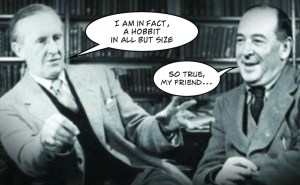
hobbit-quoteLearn how to effectively wield metaphors, and you will be powerful indeed. They are one of the most creative and intrinsically rewarding tools used by communicators.

Metaphors are not simply ornamental. Nor are they limited to abstracts subjects. The following description comes from C.S. Lewis’ book, Miracles.

It is a serious mistake to think that metaphor is an optional thing which poets and orators may put into their work as a decoration and plain speakers can do without. The truth is that if we are going to talk at all about things which are not perceived by the senses, we are forced to use language metaphorically.

Books on psychology or economics or politics are as continuously metaphorical as books of poetry or devotion. There is no other way of talking, as every philologist is aware. . . . All speech about supersensibles is, and must be, metaphorical in the highest degree.

To effectively communicate—especially about deep or profound subjects—metaphors need to be part of a readers’ or speakers’ core vocabulary. That’s what Lewis meant by saying “we are forced to use language metaphorically” when speaking about things that transcend our senses.

Former Time editor James Geary has echoed Lewis’ description of the universality of metaphors.

Metaphor is not just confined to art and literature but is at work in all fields of human endeavor, from economics and advertising, to politics and business, to science and psychology. . . .

There is no aspect of our experience not molded in some way by metaphor’s almost imperceptible touch. (I Is an Other: The Secret Life of Metaphor and How It Shapes the Way We See the World)

Without being conscious of it, we all use metaphors more frequently than we realize it. Geary claims “We utter about one metaphor for every ten to twenty-five words, or about six metaphors a minute.” Granted, most of these are routine like the four appearing in this sentence he quotes from an economic report.

“Britain’s recovery from the worst recession in decades is gaining traction but confused economic data and the high risk of a hung parliament could yet snuff out its momentum.”

Metaphors Versus Similes

Envisioning fresh metaphors may seem challenging, but it is a skill which can be practiced. One need not feel embarrassed if they find the subject of metaphors confusing. In their simplest form, they are like especially meaningful similes.

In a simile we compare two distinctly different things and declare that they are similar. For example, someone might say about the sleek new stealth destroyer, “the USS Zumwalt is like a Porsche.” This simile suggests a number of attributes and the statement contains the familiar phrase “is like.”

By contrast, a metaphor is not merely “like” something else. Using a metaphor implies that the two different things share, in a true sense, some common nature or element. So, a person might write, “the current election season is a nightmare.” Certainly, a less confident writer might weaken the power of this sentence, by diluting it into a simile, it’s “like” a nightmare.

But the bold speaker or writer recognizes how much more sharply the metaphor communicates their message. They want to state that the experience is not just nightmarish. It is a nightmare. It is (to many) horrific, frightening, and something from which we wish we could awaken to resume our lives in a world that still makes sense.

Like any rhetorical or literary tool, metaphors can be misused. They can be stretched so far that they don’t make sense, or they only appeal to individuals who share some narrow interpretation of existence.

While metaphors can be used in an ostentatious or overdone way, that simply weakens their effect. The judicious application of metaphors is a skill well worth practicing.

The Scriptures as a Treasure Trove

The subtitle above can itself be viewed as a similar or a metaphor. But that’s beside the point, since it simply introduces our discussion of the fact that the Bible is filled to overflowing with metaphors.

This is unsurprising, since almost the entire text deals with the story of an infinite Creator’s love for his fallen creation.

Put another way, our God, whose nature is utterly incomprehensible to the beings he fashioned from the earth (adamah), longs to communicate his love for we whose lives in this world are so very brief. How could the Lord accomplish this without metaphors? Thus he describes himself in this fashion:

“I am the alpha and the omega.”

“I am the bread of life.”

“I am the light of the world.”

“I am the vine; you are the branches.”

“I am the resurrection and the life.”

Metaphors are not reserved for God in the Scriptures. On the contrary, they abound, like radiant dandelions in the early days of summer.

“The teaching of the wise is a fountain of life . . .”

“The Lord is my shepherd . . .”

“O Lord . . . we are the clay, and you are our potter . . .”

“If anyone is in Christ, he is a new creation.”

All of us, “new creations” in particular, have much to learn from C.S. Lewis about metaphors. A good place to start is the brief essay “C.S. Lewis and the Apt Metaphor.”

After reflection, you may want to try your hand at creating a novel metaphor. After all, a thought-provoking metaphor is a refreshing breath in any conversation.

_____

I’ve written about metaphors in the past posts, including this one. I also wrote a a column which includes George Orwell’s advice for writers: “Never use a metaphor, simile, or other figure of speech which you are used to seeing in print.”

Roy Campbell and the Inklings

african-steerWho was the mysterious poet whose quiet, brim-shrouded attentiveness to C.S. Lewis in a pub inspired J.R.R. Tolkien to describe the hero Aragon in a similar pose?

Being neither a poet nor a literature major, I’m not ashamed to admit I have been unfamiliar with the interesting story of Roy Campbell. While his friendship with the Inklings of Oxford most intrigues me, his life itself is a fascinating story.

A South African who offered his deepest emotional devotion to Spain, his early years were influenced by the license of London’s bohemian underworld. He did, however, end up criticizing the excesses of the Bloomsbury Group.

Later, he and his wife would convert to Roman Catholicism, and even risk their lives to protect the letters of Saint John of the Cross from murderous Spanish revolutionaries who sought to burn them. They accepted responsibility for the documents shortly before the seventeen monks at the monastery were rounded up and shot in the street while their library burned.

Several days later the Campbells were visited by a search party of militiamen. Expecting such an intrusion, Roy and Mary had already taken the precaution of removing all crucifixes and religious pictures from the walls. Their main fear was that the trunk containing the Carmelite archives, including the personal letters of St John of the Cross, would be discovered.

The search, however, was not particularly thorough. At one stage some of the militiamen even leaned their rifles on the trunk without thinking of opening it. (Joseph Pearce, “The poet who saved a saint’s priceless letters”)

C.S. Lewis & Roy Campbell

C.S. Lewis considered Campbell’s championing of the Spanish fascists (who protected the Roman Catholic Church from the Leftist rebels) to be naïve. He even wrote a poem in direct response to Campbell’s lengthy “Flowering Rifle,” which is included in issue 4.2 of Curtana: Sword of Mercy.

I happen to edit the military chaplaincy journal Curtana, which is currently on hiatus. In the same issue I included another Campbell poem, “Christ in Uniform” (see pages 78-79).

In a second article, Joseph Pearce who was quoted above provides a lengthy exploration of the relationship between the two men. Its subtitle, “The Best of Friends and Enemies” reveals its theme. While Lewis remained critical of his acceptance of fascists, the two eventually became friends.

In spite of such an unpromising encounter, Lewis warmed to Campbell and invited him to meetings of the Inklings. He even offered to put Campbell up when he was in Oxford, offering him “dinner, bed and breakfast” at his home. They would exchange correspondence about the poetry of Milton, which both men admired, and settled into an altogether affable relationship.

Another peculiar thing about their friendship is how Lewis based a satirical character on Campbell in The Pilgrim’s Regress. When a song is requested, it is a one of the most savage of the men who first takes the stage.

“I will,” cried thirty voices all together: but one cried much louder than the others and its owner had stepped into the middle of the room before anyone could do anything about it.

He was one of the bearded men and wore nothing but a red shirt and a cod-piece made of the skins of crocodiles: and suddenly he began to beat on an African tom-tom and to croon with his voice, swaying his lean, half-clad body to and fro and staring at them all, out of eyes which were like burning coals.

This time John saw no picture of an Island at all. He seemed to be in a dark green place full of tangled roots and hairy vegetable tubes: and all at once he saw in it shapes moving and writhing that were not vegetable but human.

The passage continues, but it’s best read in context. Especially since it precedes an accusation that John, the pilgrim in the tale, is so unsophisticated as to be unable to distinguish between art and pornography.

The Making of a Poet

Lewis and Campbell were both poets. Campbell was successful in this pursuit, and admired by many. Lewis . . . much less so. But it was my recent reading of one of Campbell’s poems on the subject of poetry that set me to researching for this column. So it’s only fitting that I close now with his poem entitled, “The Making of a Poet.”

It’s quite visceral, evoking the savage imagery of his native Africa, and hints at what inspired Lewis to caricature him in the way we read a moment ago.

In every herd there is some restive steer
Who leaps the cows and heads each hot stampede,
Till the old bulls unite in jealous fear
To hunt him from the pastures where they feed.

Lost in the night he hears the jungles crash
And desperately, lest his courage fail,
Across his hollow flanks with sounding lash
Scourges the heavy whipcord of his tail.

Far from the phalanxes of horns that ward
The sleeping herds he keeps the wolf at bay,
At nightfall by the slinking leopard spoored,
And goaded by the fly-swarm through the day.

You can read more of Campbell’s poetry here.

Those Lazy Males

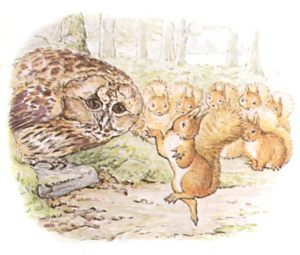
squirrelIn some places a debate rages over the question of who works the hardest, men or women. In our family, there is no such disagreement. We all recognize that the typical woman works far more than her male counterpart.

Take my case. I’m a Type A workaholic who lost (unused) leave every year of my military career. I still keep extremely busy, but when it comes to work ethic and effort, I don’t even pretend to hold a candle to my wife.

Now another example from the animal kingdom has confirmed what most people have suspected—females do far more than their share of the work.

Men have been embarrassed for generations by the example of lazy lions who rely on the lionesses to do nearly all of the hunting. Not to mention taking care of the family’s domestic responsibilities.

And now men have been betrayed by a more modest mammal—the squirrel.

I happen to like squirrels. I always have, even when they try to hijack the birdseed we always have available at our home. I hate hearing people refer to them as “tree rats,” and considered it good fortune that the street where we built our home is named “Squirrel Place.”

C.S. Lewis loved small animals. Reepicheep, a mouse, is one of the great heroes of Narnia. But it was a squirrel who played a role in one of his earliest “mystical” experiences. Fittingly, it also relates to Autumn, the season those of us in the Northern Hemisphere currently enjoy.

The following passage comes from Lewis’ autobiography, Surprised by Joy: The Shape of My Early Life. It describes the impression left on him after reading one of Beatrix Potter’s children’s books.

It will be clear that at this time—at the age of six, seven, and eight—I was living almost entirely in my imagination; or at least that the imaginative experience of those years now seems to me more important than anything else. . . .

But imagination is a vague word and I must make some distinctions. It may mean the world of reverie, daydream, wish-fulfilling fantasy. . . .

The . . . glimpse came through Squirrel Nutkin; through it only, though I loved all the Beatrix Potter books. But the rest of them were merely entertaining; it administered the shock, it was a trouble. It troubled me with what I can only describe as the Idea of Autumn.

It sounds fantastic to say that one can be enamored of a season, but that is something like what happened; and, as before, the experience was one of intense desire. And one went back to the book, not to gratify the desire (that was impossible— how can one possess Autumn?) but to reawake it.

And in this experience also there was the same surprise and the same sense of incalculable importance. It was something quite different from ordinary life and even from ordinary pleasure; something, as they would now say, “in another dimension.”

Squirrely Dads

Returning to the recent research that proved beyond any shadow of doubt that even among industrious, nut-gathering rodents, the males cop out. Don’t be put off by the study’s title—“The secret life of ground squirrels: accelerometry reveals sex-dependent plasticity in above-ground activity”—this is serious.

Apparently, while mom is down in a dark burrow nursing the kids, dad’s out lounging in the sunshine. It’s inexcusable.

And don’t try to use some lame excuse or misogynist argument that these findings are only true for Urocitellus parryii, semi-fossorial arctic ground squirrels, but they’re only fooling themselves. We all know that women work harder than men, especially when it comes to raising kids.

The female squirrels are literally so drained by the demands put upon them that they have to begin their hibernations before the males and end them after the males emerge from their hibernacula!

Following the termination of heterothermy in spring, male arctic ground squirrels remain below ground for a three to five week interval during which they consume a food cache to regain body mass lost during hibernation . . . Males intercept and mate-guard newly emergent females that become pregnant within a few days of emergence; gestation lasts for approximately 25 days, and lactation is another approximately 28–35 days.

Unlike males, females do not cache food and, with the exception of early gestation when they continue to lose body fat, they appear to fuel their reproduction using energy gained concurrently through foraging. [Note: it doesn’t appear the males share. Another strike against them.]

In addition, females are delivering energy to pups as milk during lactation . . . Once their young have been weaned, females undergo a moult and fatten; autumn immergence occurs in August [while] males that fatten and cache food later in the autumn immerge in early- to mid-October.

And there is no doubt that the people who conducted this research are right, after all, they used “collar-mounted light loggers and triaxial accelerometers!”


Dangerous Clowns

clownsThe latest concern here in the United States, aside from who will be our next president, involves “scary clowns.” And this bizarre meme got me thinking about clowndom in its broader expressions.

The current worry comes from people dressing up in sometimes morbid variations of clown attire. It’s not quite so bad as “It,” Stephen King’s 1990 miniseries about a demonic counterfeit.

It, by the way, has been updated lest the current generation be deprived of its arguable glories. The new film is in post-production and is due for release next fall.

Anyway, this film is only one of a legion of movies and cable productions that portray clowns in an ominous light.

So, it appears that the public is primed to expect the worst when people decide to dress up like jesters and do odd things in suspicious places at strange hours.

Expressed that way, there’s no reason people shouldn’t be concerned. After all, one of the most familiar elements of the criminal ensemble is a mask.

I sincerely hope that this fad doesn’t result in any serious problems. However, even if 99 out of 100 people are simply donning the make-up to be silly . . . that still leaves the 1%.

Attitudes Towards Clowns

I’ve never cared much about clowns, one way or the other. I’ve never considered them particularly eerie or entertaining.

I learned listening to the radio this week that I have that in common with Michael Medved.

Medved is a talented radio personality who coincidentally is a renowned film critic. Today, because of this media attention related to these harlequin lurkers, Medved was questioned about his attitude towards clowns.

He shared that he doesn’t particularly care one way or the other, but his family did have a negative experience many years ago. He related how one of his brothers was able to attend a taping of the San Diego expression of the “Bozo the Clown” program. Curiously, the stage for the broadcast was in Tijuana, but that’s another story.

Readers of Medved’s and my generation will immediately know who Bozo was. (To be distinguished from Bonzo, who was tucked into his blankets by President Reagan long ago.)

Returning to the clown . . . it turns out that Medved’s brother was frightened by the appearance of Bozo, and began crying. That drew the immediate attention of the actor in the intimidating suit, who said—probably in a low, threatening whisper, through the façade of the painted smile—“That’s a Bozo no-no . . .” Pretty creepy.

C.S. Lewis and Clowns

It just so happened that it was time for my next blog column. I wondered if there might be some connection I might draw with the Oxford don, or some bit of wisdom I might be able to apply to the subject at hand with minimal logical gymnastics.

It turns out I needn’t have been concerned. Here’s a wonderful description of Lewis, written the year after his death by his close friend, J.R.R. Tolkien.

C.S.L. of course had some oddities and could sometimes be irritating. He was after all and remained an Irishman of Ulster. But he did nothing for effect; he was not a professional clown, but a natural one, when a clown at all.

He was generous-minded, on guard against all prejudices, thought a few were too deep-rooted in his native background to be observed by him.

That his literary opinions were ever dictated by envy (as in the case of T.S. Eliot) is a grotesque calumny. After all it is possible to dislike Eliot with some intensity even if one has no aspirations to poetic laurels oneself.

I like that description of Lewis. As someone who is usually among the first to usher humor into a conversation or situation, I would like to think I might be described in a similar way. Not a “professional clown,” seeking to gain attention and praise. But a “natural one” who promotes laughter, good humor, and emotional health.

Those results are, I assume, the goals of all true clowns.

As for those who work to transform this image of merrymaking into something sinister . . . we can only hope and pray, that the trend exhausts itself soon.

And, at No Extra Cost

If you have never seen Bozo, you owe it to yourself to learn what your parents and grandparents called “entertainment” back in the day! (Trust me, you’ll never be the same.)


Physical (and Spiritual) Deafness

kellerSome are born deaf. Others lose their hearing due to accident or illness. Still others find our hearing failing us gradually, as it is displaced by the persistent presence of that unwelcome visitor, tinnitus.

As I was pondering the slow decay of my own hearing, I recalled one of C.S. Lewis’ most brilliant insights.

We can ignore even pleasure. But pain insists upon being attended to. God whispers to us in our pleasures, speaks in our conscience, but shouts in our pains: it is his megaphone to rouse a deaf world. (The Problem of Pain)

Even as I am concerned about the inevitable decline of my hearing—and more so, my vision—I try to conscientiously follow my wife’s guidance about vitamins and behaviors that will keep these senses around as long as possible.

At the same time, being a realist, I have decided to disengage my emotions from the matter as much as I am able, and simply accept the unavoidable. In fact, I have learned to enjoy some of the inaccuracies of hearing that I more and more often experience.

Hardly a day passes when I do not get a good laugh out of something I misheard. What I mean is that my brain translates the garbled sounds into actual words that constitute some sense that is in reality nonsensical. It hasn’t cause any problems yet, so I just smile or chuckle. If the mishearing is especially humorous, I sometimes share it with my family.

Recently, I smiled when my pastor went on about how great “Lutheran circuses” are, and how important it was that we invite others to attend our “Lutheran worship circuses” (services). That substitution was easy to recognize; it’s far funnier when I mishear something and what I think they said makes an odd sense that could almost be true . . . but is actually ludicrous.

I don’t share my personal way of dealing with the weakening of my sense of hearing with the intention of belittling the seriousness of a cross many have to bear as their lives are detrimentally impacted by these afflictions.

The Original Plan

Certainly, the impairment of any of the senses God has given us is cause for sadness. After all, when our first parents were created, their senses of sight, hearing, touch, smell and taste were undiminished. That’s the way that the Lord intended for us to enjoy the rest of his creation.

Actually, some people argue that there are seven senses, adding two that do make sense:

Vestibular – the sense of balance, perceiving our body in relationship to gravity and movement (equilibrioception)

Proprioception – the sense of the relative position of different parts of the body, particularly as it pertains to movement (kinesthesia)

Another source declares there are nine senses, adding to the palette

Thermoception – the sensation of the presence or absence of heat

Nociception – “nonconscious perception of nerve or tissue damage”

I personally imagine that when “the day of the Lord” arrives, and we witness the restoration of a new heaven and a new earth, that our restored bodies* will possess a myriad of other senses we are not even capable of fathoming at this present moment.

Yes, it is a tragedy when people have to live with their senses crippled. This is especially true when it is the young who are afflicted. To be born without sight or hearing rightly seems like a curse to many. The testimony of Helen Keller, who actually lost her vision and hearing at the age of nineteen months, illustrates how the human spirit is capable of transcending even these severe limitations.**

In 1952, C.S. Lewis wrote a letter to a young teacher at the Manchester Royal School for the Deaf.

The work you are engaged in is a magnificent one (much in my mind because, as it falls out, I’ve just been reading Helen Keller’s book): hard, no doubt, but you can never be attacked by the suspicion that it is not worth doing. There are jolly few professions of which we can say that.

The translation of great stories into a limited vocabulary will, incidentally, be a wonderful discipline: you will learn a lot about thought and language in general before you are done. I hope you will sometimes let me know how you get on. God bless you.

In writing this column I learned something of which I had been unaware. Keller was also a poet.

And, while I’m a poor judge of verse, I found my brief exploration of hers to be moving. However, here is a review from The New York Times which declares, “Modern psychology cannot account for Miss Keller nor explain the psychic sense by which she apprehends the minutest phases of a beauty she has never witnessed.”

You can download a copy of the book The Song of the Stone Wallhere.

Across the meadow, by the ancient pines,

Where I, the child of life that lived that spring,

Drink in the fragrances of the young year,

The field-wall meets one grimly squared and straight

Beyond it rise the old tombs, gray and restful,

And the upright slates record the generations.

Stiffly aslant before the northern blasts.

Like the steadfast, angular beliefs

Of those whom they commemorate, the head-stones stand,

Cemented deep with moss and invisible roots.

The rude inscriptions charged with faith and love,

Graceless as Death himself, yet sweet as Death,

Are half erased by the impartial storms.

As children lisping words which move to laughter

Are themselves poems of unconscious melody,

So the old gravestones with their crabbed muse

Are beautiful for their halting words of faith,

Their groping love that had no gift of song.

But all the broken tragedy of life

And all the yearning mystery of death

Are celebrated in sweet epitaphs of vines and violets.

Helen Keller’s life is a witness to the fact that God can intervene in our brokenness and make us whole. It is also a foretaste of that complete restoration that awaits disciples of Jesus on the Last Day.

And one more thing her life proves is the truth of C.S. Lewis’ insight that in our suffering we become more attuned to our need, and God “shouts in our pains: it is his megaphone to rouse a deaf world.”

_____

The image at the top of the page shows Helen Keller as she looked on the day of her graduation from college.

* This transition from these fragile and perishing bodies to the new is described here. And, here’s a link to a readable essay on the subject of the resurrected or new body Christians are promised.

** Helen Keller found hope in the good news of Jesus Christ, albeit through the extremely peculiar teachings of the philosopher Emanuel Swedenborg. Helen Keller’s book My Religion is available for free download here.

On Being Aptly Named

terrorIf you were going to embark on a lengthy, dangerous journey of exploration, how would you feel about signing onto the crew of the HMS Terror? Doesn’t that strike anyone else as a tad ominous?

The HMS Terror suffered a horrific fate. No surprise there. Its demise was so great, though, that it ranks among the worst ever suffered by the Royal Navy. And its ultimate fate remained unconfirmed until this past week when the wreck was found, resting on the ocean floor, 168 years after it perished during the ill-fated Franklin Expedition.

Along with the HMS Erebus, the Terror was supposed to traverse the Northwest Passage. The evidence shows, however, the ice trapped the ships, and both crews perished trying to make their way south across the floes. (There is evidence of cannibalism during that doomed journey, something attested to by Inuit oral traditions.)

The voyage had begun well enough. The vessels had been fitted for the harsh environment after a rather auspicious exploration of the coast of Antarctica. There they had discovered the Ross Ice Shelf, and in honor of their mission, two Antarctic features were named for them Mounts Erebus & Terror, on Ross Island.

Upon their return to London, iron plate was added to their hulls and coal-fueled steam engines were installed.

Sadly, the Arctic proved less hospitable, and their entrance into Baffin Bay in August 1845 marked the final time either ship was seen until now. An extensive search at the time proved futile. Their respective discoveries are announced here, and here.

Around 130 men abandoned the ships when they became icebound. Some of their bones were recovered from King William Island. The sad story has been recited in many places, including this article which was written when the wreck of the Erebus was discovered.

As in the Antarctic, here too the ships were honored by having natural features named after them. Fittingly, Erebus Bay and Terror Bay hug the west coast of King William Island, just north of which marked the estimated position where the ships were abandoned.

Read on, and learn something quite interesting about the names of these two ill-fated ships.

Naming Ships

I have written about the importance of names in the past.*

There are a variety of conventions for christening ships. Some result in creative names, but others are quite mundane. In the United States, with plenty of exceptions, the contemporary patterns for naming ships vary by their type of class. For example:

Aircraft Carriers – are now named after Presidents

Amphibious Assault Ships – early Ships or USMC Battles

Ballistic Missile Submarines – States

Fast Attack Submarines – Cities

Cruisers – Past Battles

Frigates – Navy, Marine or Coast Guard Heroes

Patrol Boats – Weather Phenomena like Squall, Monsoon and Cyclone

Of course, like everything else in the United States, the naming of ships is prone to becoming politicized, as this entertaining article reveals.

Other nations have followed comparable christening patterns throughout recent centuries. Grouping similarly functioning vessels with particular themes makes sense. That way if you encountered a ship named Blue Dwarf or Yellow Dwarf, you could make a well educated guess that the vessel was a mining ship, and part of the Jupiter Mining conglomerate.

I suppose even garbage scows are named in some logical fashion, perhaps after politicians?

Unsurprisingly, in addition to battles, heroes, and major cities, aquatic life has been a common feature. Thus pre-Soviet Russian subs were named things like Walrus or Shark (albeit, in Cyrillic).

The Royal Navy shared an affinity for marine life, and Dolphin was a popular example. There were no fewer than a dozen ships, thus named, although some were fairly modest (including a convict ship used in the first have of the nineteenth century).

I actually possess the altar rail from the ship’s chapel in the HMS Dolphin that was commissioned in 1882. But that’s a sea tale for another day . . .

C.S. Lewis christened a ship of his own. He even included its name in the title of the Chronicle of Narnia which describes its quest: The Voyage of the Dawn Treader. The ship herself was modest, but marked a new age of Narnia exploration.

The name of the ship was Dawn Treader. She was only a little bit of a thing compared with one of our ships, or even with the cogs, dromonds, carracks and galleons which Narnia had owned when Lucy and Edmund had reigned there under Peter as the High King, for nearly all navigation had died out in the reigns of Caspian’s ancestors. . . .

But now Caspian had begun to teach the Narnians to be sea-faring folk once more, and the Dawn Treader was the finest ship he had built yet.

She was so small that, forward of the mast, there was hardly any deck room between the central hatch and the ship’s boat on one side and the hen-coop (Lucy fed the hens) on the other.

But she was a beauty of her kind, a “lady” as sailors say, her lines perfect, her colors pure, and every spar and rope and pin lovingly made.

In his Middle Earth sagas, J.R.R. Tolkien includes the names of a number of ships.

Eärrámë – Sea Wing

Númerrámar – Sunset Wings

Palarran – Far-Wanderer

Vingilótë – Foam Flower

Hirilondë – Haven Finder

Entulessë – Return (sailed by Vëantur during the Númenórean’s return to Middle Earth)

The Inklings appear to have given the decision of naming their ships the attention the activity merits.

More about the HMS Terror and the HMS Erebus

The name of the HMS Terror was, of course, not chosen to jinx its future. It was thus named to instill fear in those it opposed. This was natural, since it was originally commissioned as a warship, as was the Erebus. In fact, the two vessels were the same exact type of warship.

So, how might “Terror” and “Erebus,” the mythological Greek deity of darkness, who shared his name with an abode of the dead? It becomes clearer when we learn that both of the ships originally served as “bomb ships.” Like later battleships, these vessels were designed to rain fire from the sky—something terrifying to stationary garrisons.

The names of some of their sister ships whose mortars fired upon enemies of the British Empire included Thunder, Vesuvius, and Hecla (the Icelandic volcano).

The HMS Terror actually saw combat, prior to its conversion to peaceful pursuits. Amazingly, it was among the bomb ships—accompanied by the Volcano, Meteor, Devastation and Aetna—during the Battle of Baltimore in the War of 1812. Thus, the Terror is also memorialized in the national anthem of the United States: “the bombs bursting in air.”

Curiously, the predecessor of the HMS Erebus we have been discussing, a “rocket vessel” with the same name, inspired the lyrics “by the rocket’s red glare,” at the same historic battle.

_____

* The importance of naming has led me to address the subject from a number of angles through the years.

The Power of Names

Crying for Attention

From Ear to Quill

Pet Names

Powerful Names

Sharing Surnames

Fleeting Fame

red-dwarfAnd, for those who recognized the homage to Red Dwarf


The Urgent Need for Chivalry

chivalryWith all the nations of the world engaged in power struggles—or cowering behind the protection of their more courageous allies—C.S. Lewis’ essay on “The Necessity of Chivalry” demands our attention.

Yes, the very word “chivalry” reeks of a bygone era that has been superseded and relegated to history books. But those who consider the concept outdated impoverish their lives and quite possibly contribute to the violent spirit of our age.

Warfare is not an abstract concept to the millions—yes, millions—of people who are surrounded by vicious threats every hour. Britain itself was in this position when Lewis penned these words during the Battle of Britain.

As he wrote, three days before Winston Churchill’s most famous speech, Lewis commended those same few to whom so many owed so much. It was 1940, and Germany’s advance had yet to be halted. Ultimate victory in the world conflagration would remain uncertain for years.

It is in this milieu, but not only for this context, that Lewis challenges us to combine the chivalrous values of meekness and ferocity.

Lewis argues that in the chivalrous “knight,” true humility and the capacity for great (but moral) violence are merged. The result is not a schizophrenic warrior, but a noble defender of what is good.

Indeed, even apart from wartime, it is vital that society has heroes to protect sheep from wolves. In a moment I will share with you a brief video featuring an amazing artistic rendering of this essay on chivalry.*

In the essay, Lewis’ examples span Western history. He uses Launcelot as the archetype of the chivalrous man. And he offers the hope and evidence that chivalry is not extinct. A veteran of the previous war, he wrote at the outset of the Second World War:

Launcelot is not yet irrecoverable. To some of us this war brought a glorious surprise in the discovery that after twenty years of cynicism and cocktails the heroic virtues were still unimpaired in the younger generation and ready for exercise the moment they were called upon. Yet with this “sternness” there is much “meekness;” from all I hear, the young pilots in the R.A.F. (to whom we owe our life from hour to hour) are not less, but more, urbane and modest than the 1915 model. (“The Necessity of Chivalry”)

And accordingly, in our own day there are many serving in uniform who exemplify the same virtues. Would, though, that all who bear arms could be described thusly.

Some who are reading these words may regard chivalry as a “sexist” concept. It is not. Certainly no more than courage, strength and virtue could be deemed such. The fact that Lewis’ historical examples of society’s defenders are men simply reflects history.

In the seventy-five years since he wrote, it has become evident that women too can easily embody both meekness and unyielding courage. One need look no further than the ranks of the military and law enforcement to see this borne out.

Chivalry for the Civilian

It would be a tragic mistake to think that chivalry is only required during war. It is a vital, daily necessity of all social life. And the increasing incivility of the world suggests its erosion. (Many attribute this in part to the anonymity of the internet, which allows bullies to savage others anonymously and without mercy.)

This is what Lewis was saying when he described Launcelot as being “not a compromise or happy mean between ferocity and meekness; he is fierce to the nth and meek to the nth.”

After all, it is not the bland or “lukewarm” person who makes this world a better place. It is upon chivalrous men and women that the majority of the vulnerable must ever rely.

Each of us needs to be willing to examine our own lives for the union of these two traits: courage that does not surrender to what is wrong, and meekness that is gentle, calm and patient with others.

These are the values that we need to promote in our communities, media and schools. Because what we instill in receptive minds is precisely that which will take root. To use more contemporary terms, the “programming” these young minds are subject to will directly influence the behaviors that they “output.”

Let us do all we are capable of, to be, and to raise up, what is chivalrous. After all, despite all of the utopian promises of those who believe humanity is capable of purifying itself, the evidence shows otherwise. As Lewis said,

There was, to be sure, a rumour in the last century that wolves would gradually become extinct by some natural process; but this seems to have been an exaggeration.

Enjoy this fine presentation of  “The Necessity of Chivalry.”

_____

* This video is a creation of CSLewisDoodle, about which I have written before. (Their name may sound quaint, but the expertise with which they visualize Lewis’ words is astounding.)