Similes & Metaphors

agdeiSimiles are wonderful literary tools. Being able to compare two dissimilar things in a way that brings out subtle nuances and insights is quite enjoyable.

Here are a couple of examples off the top of my head. (I don’t pretend others haven’t written these things, but I didn’t plagiarize them.).

A politician is like a weathervane.

Arguing theology is like having indigestion.

Disliking Narnia is like hating a feast.

Metaphors, of course, are far more powerful than similes. When we consider a metaphor we are pondering how two different things actually share some fundamental quality.

Comprehending metaphors requires the ability to think abstractly. A child—confined to a world of concrete concepts—cannot begin to think of their nation as a “motherland” or “fatherland,” as the case may be. Yet, those are powerful nurturing and bonding words that countless patriots have embraced throughout the centuries.

A simile might say “our country is like a family.” A metaphor suggests far more. In this case, it might convey that one’s allegiance to their nation should exceed their loyalty to their biological kin.

Nowhere is the magnificence of metaphors more manifest than in the way we talk about God. One of the most famous biblical passages is a straight forward example. “God is love” (1 John 4:8).

Jesus the Christ said of himself, “I am the Way, the Truth and the Life” (John 14:6). He also called himself the “Light of the world. Whoever follows me,” he added, “will not walk in darkness, but will have the light of life” (John 8:12).

It is a sad thing when a symbol loses its meaning. There is a prime example of that phenomenon in Oxford. And you can see it in the sign that hangs above a pub frequented by the Inklings.

No, not the Eagle and Child, which they affectionately referred to as the Bird and Baby.

After renovations to the Eagle and Child eliminated their privacy, the writers transitioned across the street to the Lamb and Flag. Both pubs trace their history back to the seventeenth century, and the latter is actually owned by St. John’s College. (It’s profits fund student scholarships.) In a 1963 letter, Lewis colorfully described the move thusly:

Mon 11 March it is. But note that our causeries de lundi are now permanently transferred to the Lamb & Flag. We were sorry to break with tradition, but the B & B had become too intolerably cold, dark, noisy, and child-pestered.

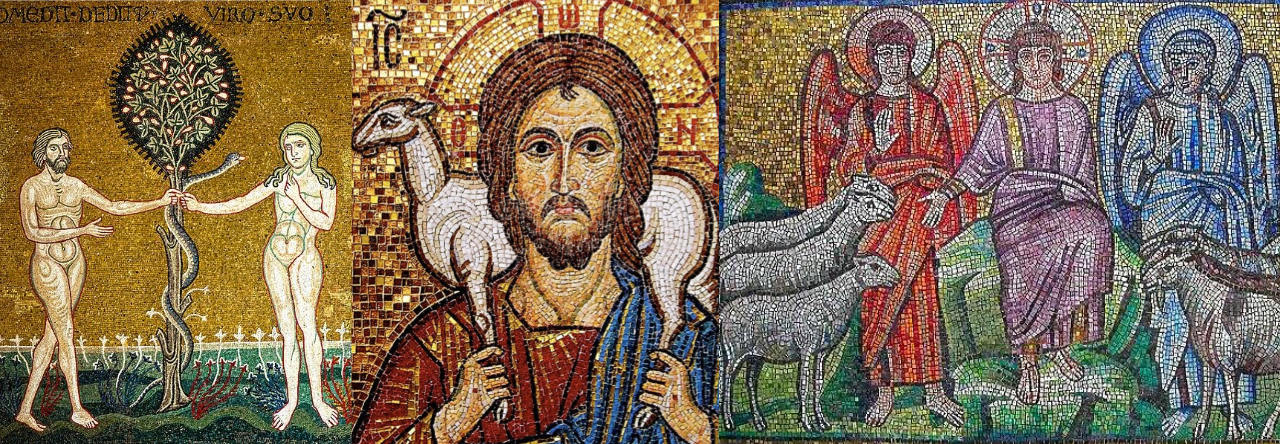
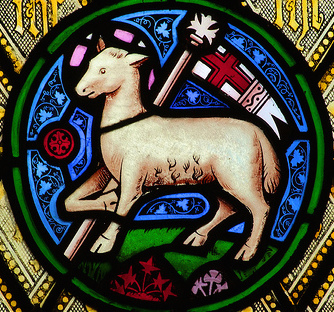
Sadly, when many people look at the Lamb on the pub’s sign, they fail to recognize it’s significance. The lamb carrying a cross-emblazoned banner is nothing other than the Agnus Dei, the Lamb of God.

What, some may wonder, is the Lamb of God? The better question is “who” is the lamb. The symbol represents Jesus Christ himself. It hearkens to the declaration of John the Baptizer as Jesus approached the Jordan: “Behold, the Lamb of God, who takes away the sin of the world!” (John 1:29).

To understand what it means to say “Jesus is the Lamb,” requires two things. First, a recognition that it is more than a simile; it is not simply that he possesses some of the attributes we would naturally associate with a lamb, such as gentleness. The second requisite is that we understand something about the Jewish sacrificial system.

For, Jesus being the Lamb of God means nothing less than that he is the true, complete, ultimate and final sacrifice for the sins of humanity.

And that is a wonder definitely worth pondering during this Christmas season.
C.S. Lewis’ Bilingualism

csl bilingualHow many extremely intelligent and well educated people do you know . . . who can actually communicate with those of us possessing normal human intelligence?

That talent is a rarity.

And it is precisely what makes C.S. Lewis such an unusual man. He was brilliant. Yet he could communicate with the common person—even the child—just as easily as he conversed with his fellow university dons.

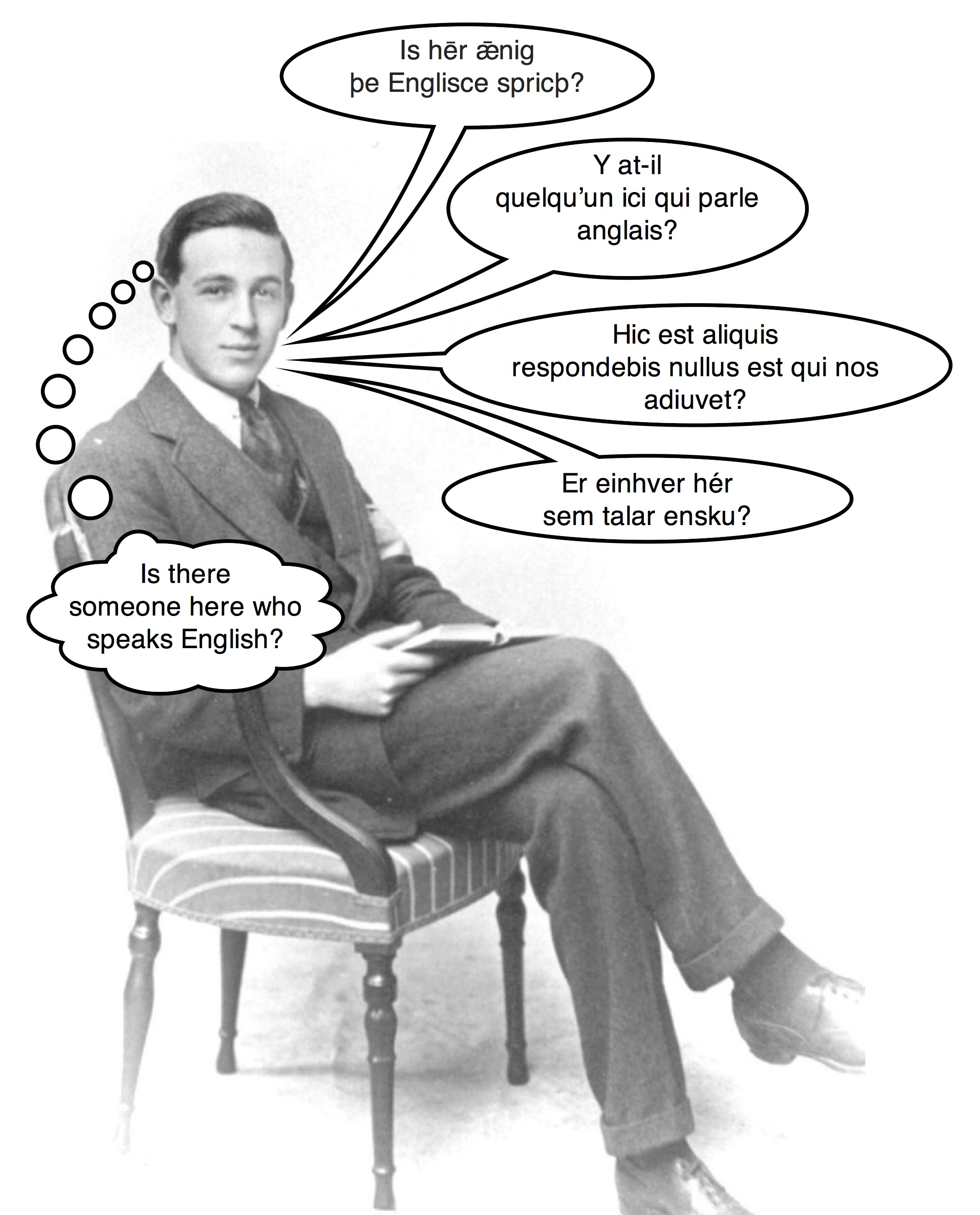
Lewis, of course, could comprehend a number of languages, so he was more than merely “bilingual.” But that is not exactly the sense in which I am using the word today. I mean it in the sense of my opening paragraphs. It is the ability to communicate (even with the same “language”) to distinctly different groups who would normally not be able to readily understand one another.

In an interview that appeared in Christianity Today, Detroit pastor Christopher Brooks was asked about the challenges of urban ministry.

How have you included both righteousness and justice in your setting?

I think about C.S. Lewis, who had the challenge of building the bridge between the culture of Oxford and Cambridge and the culture of the church. These cultures were worlds apart by his time, but he was bilingual, in a sense: able to speak the language of Oxford to the church and the language of the church to the intellectuals and naturalists.

One of the titles for ancient Roman priests that was adopted by their Christian successors is “pontifex.” It means “bridge-maker.” The Pontifex Maximus was, of course, referred to the greatest of these offices.

In light of Brooks’ words about Lewis as building bridges between elite academia and Christianity, I have added that dimension to my view of him. C.S. Lewis, Pontifex Maximus. (I doubt it would make him happy, so I’ll keep it under wraps . . . and probably never mention it again.) But I am genuinely happy about his skill in building these bridges of understanding.

Before signing off, a special treat. If you call someone who speaks two languages “bilingual,” and someone who speaks three “trilingual,” what do you call someone who only speaks one language? Why, an American, of course.

That joke would not be as funny if it were not so sadly true. While the rest of the world almost assumes that people know at least two languages, most Americans stumble their way through the study of a second language for two or three years and never develop a comfort level with it. But that’s a story for another day.

Is More Better?

everettThat’s a trick question. More of some things certainly is better . . . more peace, more compassion. But more—even of good things—can sometimes become too much.

Case in point: words.

I continue to frustrate one of my critique group friends because I write “like a historian rather than a journalist.” The distinction being:

Journalist – Just the facts, please.
Historian – Lover of descriptions, details, esoterica, and trivia.

Guilty as charged.

C.S. Lewis commends the literary virtue of brevity. The following passage is found in his aptly named essay, “Before We Can Communicate.”

In the very process of eliminating from your matter all that is technical, learned, or allusive, you will discover, perhaps for the first time, the true value of learned language: namely, brevity. It can say in ten words what popular speech can hardly get into a hundred.

Last year marked the 150th Anniversary of one of the world’s most famous speeches. Not only Americans are familiar with Abraham Lincoln’s Gettysburg Address. It has become a monument to succinctness and power.

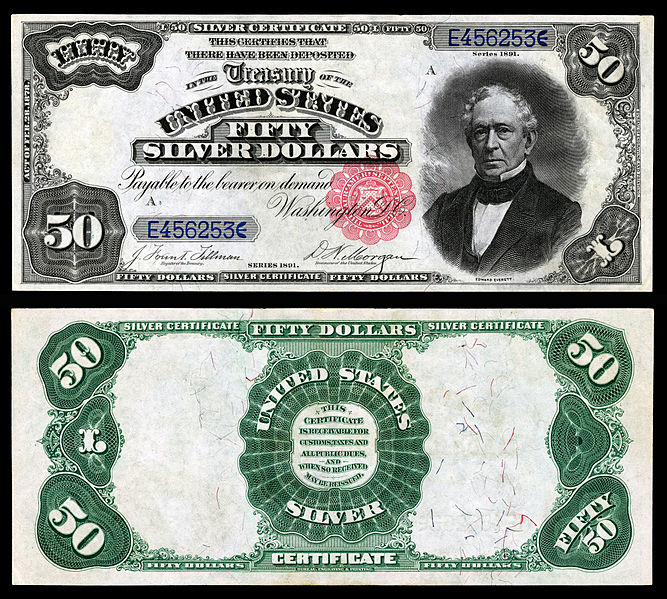
Rereading it recently I began to wonder about the other speech delivered at the event . . . the two hour oration delivered by Edward Everett, one of the era’s most highly regarded public speakers.*

The journalists and audience at the dedication of the Gettysburg National Cemetery were extremely impressed by Everett’s presentation, and surprised by the brevity of Lincoln’s remarks.

Following the event, both men lauded each other’s message. Lincoln responded to Everett’s note which praised him for the “eloquent simplicity & appropriateness” of his remarks. Everett said, “I should be glad, if I could flatter myself that I came as near to the central idea of the occasion, in two hours, as you did in two minutes.”

Your kind note of to-day is received. In our respective parts yesterday, you could not have been excused to make a short address, nor I a long one. I am pleased to know that, in your judgment, the little I did say was not entirely a failure. Of course I knew Mr. Everett would not fail; and yet, while the whole discourse was eminently satisfactory, and will be of great value, there were passages in it which transcended my expectation. The point made against the theory of the general government being only an agency, whose principals are the States, was new to me, and, as I think, is one of the best arguments for the national supremacy. The tribute to our noble women for their angel-ministering to the suffering soldiers, surpasses, in its way, as do the subjects of it, whatever has gone before.

I tracked down an online copy of Everett’s Gettysburg speech. I’ve skimmed it, and it is rather interesting. With the course of the war still undetermined at the time it was presented, it is easy to see how its stirring words could inspire an already war-weary nation. As he elaborates on the efforts of the Confederates to establish a new nation, he begs for patience. “Pardon me, my friends, for dwelling on these wretched sophistries.” Sophistries indeed.

The speech offers a partisan analysis of the entire course of the war up to that time. International readers of Mere Inkling may find the references to other countries interesting. He describes “civil wars” in England, Germany, Italy and France. Since he spoke during an era when Italy was still disunited, allow me to quote that portion of the speech.

In Italy, on the breaking up of the Roman Empire, society might be said to be resolved into its original elements–into hostile atoms, whose only movement was that of mutual repulsion. Ruthless barbarians had destroyed the old organizations, and covered the land with a merciless feudalism. As the new civilization grew up, under the wing of the Church, the noble families and the walled towns fell madly into conflict with each other; the secular feud of Pope and Emperor scourged the land; province against province, city against city, street against street, waged remorseless war with each other from father to son, till Dante was able to fill his imaginary hell with the real demons of Italian history.

So ferocious had the factions become, that the great poet-exile himself, the glory of his native city and of his native language, was, by a decree of the municipality, condemned to be burned alive if found in the city of Florence. But these deadly feuds and hatreds yielded to political influences, as the hostile cities were grouped into States under stable governments; the lingering traditions of the ancient animosities gradually died away, and now Tuscan and Lombard, Sardinian and Neapolitan, as if to shame the degenerate sons of America, are joining in one cry for a united Italy.

For those who are interested, this paragraph from Everett’s speech is only fifty-five words shorter than the entire Gettysburg Address.

Of course, just as being loquacious does not guarantee irrelevance, neither does brevity ensure quality.

The key is using the right number of words. That will vary from person to person.

In the twenty-first century, though, a good rule of thumb is to follow the example of Lincoln rather than his speechifying colleague.

_____
* Everett had a prolific political career. It included: U.S. House of Representatives, Governor of Massachusetts, U.S. Ambassador to the United Kingdom, U.S. Secretary of State, U.S. Senator. Oh, and he was also President of Harvard University, a job that probably included at least as much politics as his previous endeavors.

Thesaurus Club

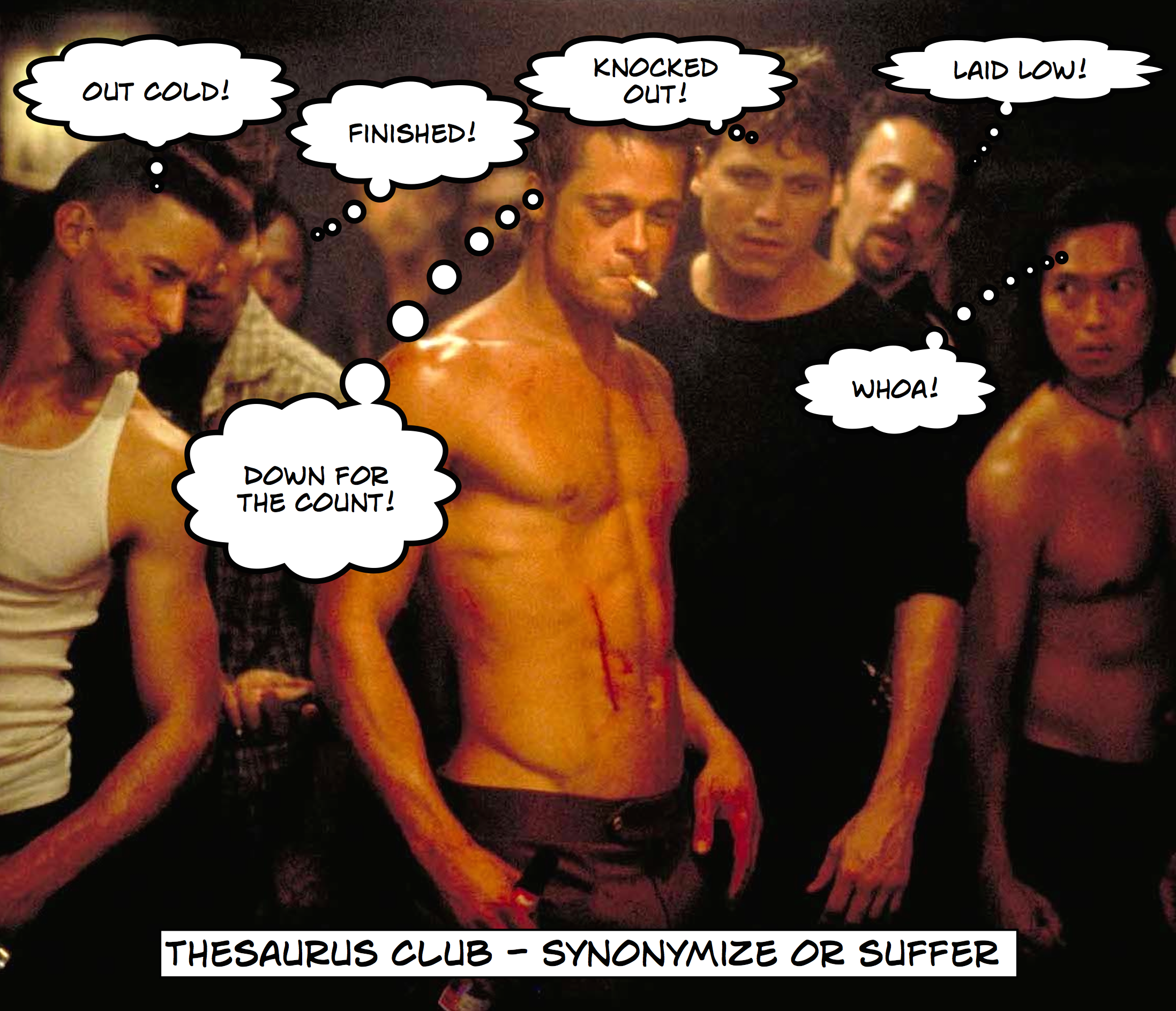
thesaurus club“The first rule is: If this is your first night at Thesaurus Club, you have to synonymize!”

“The second rule of Thesaurus Club is: You don’t talk about, mention, comment on, allude to, speak of, discuss, converse about, whisper of, gossip about, or chat or chinwag about Thesaurus Club!”

Only a true logophile (word lover) could enjoy the scene described above . . . but if you’re as captivated as I am by wordplay, you may appreciate the creativity. Of course, understanding the reference to the film Fight Club reveals more clearly its wit.

Words are fun to play with.

Although we tend to think of cartoonists as artists, the fact is they are usually just as skillful in their artistry with words. (The successful ones, at least.)

Not long ago I saw a single panel cartoon showing a seated man in a suit addressing a secretary, steno pad in hand. Nothing funny about the picture, of course, but the caption said, “One more thing: Remember to introduce me as a lawyer, not a liar.” Nice.

Even funnier if you think about synonyms. (No offense intended to Mere Inkling’s readers who are attorneys.)

Words are powerful. But they are also finite. C.S. Lewis noted their limits in an essay entitled “Prudery and Philology.”

We are sometimes told that everything in the world can come into literature. This is perhaps true in some sense. But it is a dangerous truth unless we balance it with the statement that nothing can go into literature except words, or (if you prefer) that nothing can go in except by becoming words. And words, like every other medium, have their own proper powers and limitations.

Lewis was quite sensitive to the abuse of language. It doesn’t require a graduate degree to know what he would think of today’s word processing programs with their built in thesauri.

No doubt these fingertip resources have contributed immensely to the modern proclivity of many writers to write artificial prose. I’m confident Lewis would have mourned their creation.

That’s precisely why joining the Thesaurus Club would be so daunting. There you stand, stripped of your ever-present literary crutches, proving just what you’re made of. Will you find victory (triumph, success) or will you taste defeat (downfall, failure)?

_____

I wish I could take credit for the concept at the top of this page, but I stumbled upon the notion elsewhere and modified it for Mere Inkling. (I did make the graphic, though.)

Discordant Dictionaries

dictionary 1Most “word people” like dictionaries. Some writers go so far as to love dictionaries, but I don’t wish to quibble about where one rests on the affection spectrum in terms of these repositories of words.

This guy, though, has to be pegged on the extreme (idolatry) end of the meter. Ammon Shea wrote Reading the OED: One Man, One Year, 21,730 Pages after having done just that. The Oxford English Dictionary, you may know, comprises 25 volumes, and Shea warns that reading it at such a rapid pace took a toll on his eyesight. It’s not surprising, that he admits he is not your typical reader.

One could say that I collect word books, since by last count I have about a thousand volumes of dictionaries, thesauri, and assorted glossaries. . . . I do not collect these words because I want to impress friends and colleagues with my erudition. . . .

My friends know that I read dictionaries for fun, and have come to accept this proclivity with relative good grace, but they are not terribly interested in or impressed by my word collection.

Pierre Jules Théophile Gautier advised his fellow poets to read the dictionary. No better way to enrich one’s language, he claimed, although he also read cook books, almanacs and the like. In fact, his biographer offered this fascinating observation.

He found pleasure in the most indifferent novels, as he did in books of the highest philosophical conceptions, and in works of pure science. He was devoured with the desire to learn, and said: “No conception is so poor, no twaddle so detestable that it cannot teach us something by which we may profit.”

C.S. Lewis indicated that so-called “definitions” offered outside the ordinances of the dictionary must be approached warily. “When we leave the dictionaries we must view all definitions with grave distrust” (Studies in Words). He offers a very sensible reason for such precautions.

It is the greatest simplicity in the world to suppose that when, say, Dryden defines wit or Arnold defines poetry, we can use their definition as evidence of what the word really meant when they wrote. The fact that they define it at all is itself a ground for scepticism.

Unless we are writing a dictionary, or a text-book of some technical subject, we define our words only because we are in some measure departing from their real current sense. Otherwise there would be no purpose in doing so (Studies in Words).

Dictionaries are, of course, their own genre. Lectionaries, collections of words and meanings, are different than any other type of written composition. For example, glossaries may draw together specialized vocabulary—say for medical or theological purposes—but by their very nature they are not intended to blaze any new literary pathways.

There is, invariably, an exception to this rule. Some “dictionaries” are creative exercises. They are works of fiction, and some are entertaining indeed.

The most famous of these satirical works is Ambrose Bierce’s Devil’s Dictionary (originally published as The Cynic’s Word Book). The volume is not expressly irreverent, although people of faith will encounter some offensive examples in its pages. However, a number of the entries are brilliant.

Kilt

  1. A costume sometimes worn by Scotchmen in America and Americans in Scotland.

Rank

  1. Relative elevation in the scale of human worth.

He held at court a rank so high

That other noblemen asked why.

“Because,” ’twas answered, “others lack

His skill to scratch the royal back.”

Emancipation

  1. A bondman’s change from the tyranny of another to the despotism of himself.

He was a slave: at word he went and came;

     His iron collar cut him to the bone.

Then Liberty erased his owner’s name,

     Tightened the rivets and inscribed his own.

Goose

  1. A bird that supplies quills for writing. These, by some occult process of nature, are penetrated and suffused with various degrees of the bird’s intellectual energies and emotional character, so that when inked and drawn mechanically across paper by a person called an “author,” there results a very fair and accurate transcript of the fowl’s thought and feeling. The difference in geese, as discovered by this ingenious method, is considerable: many are found to have only trivial and insignificant powers, but some are seen to be very great geese indeed.

Another Frenchman, Gustave Flaubert, composed his Dictionary of Received Ideas, which found humor in peculiarities of common understandings.

Absinthe

Extra-violent poison: one glass and you’re dead. Newspapermen drink it as they write their copy. Has killed more soldiers than the Bedouin.

Archimedes

On hearing his name, shout “Eureka!” Or else: “Give me a fulcrum and I will move the world.” There is also Archimedes’ screw, but you are not expected to know what it is.

Omega

Second letter of the Greek alphabet. [Note: this would only apply to biblically literate societies.]

The earliest such example of a satirical dictionary was that by the Persian writer Nezam od-Din Ubeydollah Zâkâni. I have not located a copy of his 14th century lexicon, but it apparently includes entries that are still understandable in our modern world.

Thought

What uselessly makes people ill.

Orator

A donkey.

Word lovers can easily get caught up in conversations like this. In fact, I’m certain more than one Mere Inkling reader has contemplated compiling their own creative dictionary! It’s not an insurmountable project, since it’s accomplished one word at a time.

_____

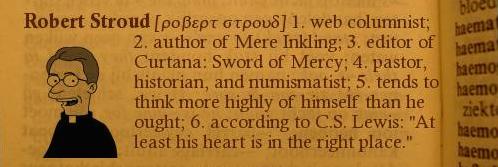
For those desiring to create their own dictionary “entries” such as the one that graces the top of this blog, there a free meme generator you can use online. Available here, it’s a fun little tool. It’s also suitable for creating a little self-deprecating humor.

dictionary 2

Unintentional Acrostics

letterSome writers sweat to find precisely the right word, the one that expresses the unique meaning and tone we seek to convey. We often fail, as the reference to perspiration in my first sentence readily reveals. A recent observation from the executive editor of First Things  provides me with another crippling concern.

“This for those interested in how magazines work. My son Christopher pointed out that the initial capital letters on a two-page spread . . . spelled “a wit.” Which was kind of nice. Accidental, but nice. And then I thought: Suppose some day we accidentally spelled out a rude four-letter word? Now, after the magazine is laid out, one of the junior fellows reads through the magazine to make sure we haven’t accidentally made a word that will embarrass us. It’s a small thing, and probably paranoid, but here paranoia equals prudence.”

Unless each writer maintains constant vigilance, since most of us don’t have “junior fellows” to assign the duty, it’s quite possible for unintentional acrostics to slip into our work. Like the seamen in the crow’s nest of the Titanic—I just watched a new documentary on the subject last night—we can easily miss the veiled iceberg which threatens to sink our best effort.

Prone as we are to playing with the depths of individual words, we are normally sensitive to the fact more than 90% of a word’s value in a particular context may lie beneath the surface. That does not mean, however, that we always see the larger picture.

It is not uncommon for a writer to become almost paralyzed while composing something, when the ideal word continues to elude us. It is almost “literally” painful to have to settle for a substitute, when we suspect the perfect word is floating somewhere just beyond our reach.

Dodging mundane words is not easy. They are common, in part at least, because they are so simple and easy to plug into sentences. And so, we “go” to the store, when we might just as easily “drive,” “walk,” “ride,” or even “hitchhike.” A movie is described as “good,” when readers would value a vivid word, such as, “suspenseful,” “hilarious,” “complex,” “moving,” or even “groundbreaking.”

Reflections on the Psalms, one of C.S. Lewis’ gems, explores the beauty of the Bible’s hymnal. “The Psalms,” he notes, “are poems, and poems intended to be sung: not doctrinal treatises, nor even sermons.” Because of this, they have nourished the worship lives of Jew and Christian alike, for thousands of years.

Even without a theological education, Lewis offers great insight into the Psalms. “I am no Hebraist, no higher critic, no ancient historian, no archaeologist.” He candidly discusses passages he initially found difficult to embrace, as well as those which soar to spiritual and poetic heights. The following comes from his discussion of Psalm 119, which is skillfully composed around an alphabetic acrostic.

“As everyone knows, the Psalm specially devoted to the Law is 119, the longest in the whole collection. And everyone has probably noticed that from the literary or technical point of view, it is the most formal and elaborate of them all. The technique consists in taking a series of words which are all, for purposes of this poem, more or less synonyms (word, statutes, commandments, testimonies, etc.), and ringing the changes on them through each of its eight-verse sections—which themselves correspond to the letters of the alphabet. . . . this poem is not, and does not pretend to be, a sudden outpouring of the heart like, say, Psalm 18. It is a pattern, a thing done like embroidery, stitch by stitch, through long, quiet hours, for love of the subject and for the delight in leisurely, disciplined craftsmanship.”

Done like embroidery, stitch by stitch.” Many writers, I suspect, will appreciate that description. While we are sometimes forced to throw something together in a rush, the patchwork results offend our sensitivities.

Even when writing rather pedestrian things like much of our email correspondence, most writers seek to employ lively verbiage. It’s a valuable exercise, after all, to consider the pace of all of our work, and not simply those words we hope to see “published.” And, having written something worth reading, there is one more consideration.

Reviewing what we have written is well worth the time required. And, as Editor David Mills suggested in First Things, our examination should include any unintentional acrostics we may have created. After all, no respectable writer would ever wish to, even accidentally, offend their readers.

Vampire Poetry

vpoetryI was afraid to read it. I had just listened to the poem during an online newscast, and it included it so many jarring and disturbing images that I thought I must have misheard it.

Then again, it was written by a successful Hollywood star, so it certainly must be worthy of publication.

So, motivated by two impulses, I sought out the text. My first reason was that I did not wish to misjudge the writer, based on my shallow initial impression. The second was that I really did want to discover if it was as odd as I perceived it to be.

It is from the heart and pen of Kristen Stewart, who played the leading role in the Twilight series. It is described as a “love poem,” which is helpful to know in advance . . . since that might not be how one might inadvisably approach it.

I reared digital moonlight

You read its clock, scrawled neon across that black

Kismetly . . . ubiquitously crest fallen

Thrown down to strafe your foothills

. . . I’ll suck the bones pretty.

Your nature perforated the abrasive organ pumps

Spray painted everything known to man,

Stream rushed through and all out into

Something Whilst the crackling stare down sun snuck

Through our windows boarded up

He hit your flint face and it sparked.

And I bellowed and you parked

We reached Marfa.

One honest day up on this freedom pole

Devils not done digging

He’s speaking in tongues all along the pan handle

And this pining erosion is getting dust in

My eyes

And I’m drunk on your morsels

And so I look down the line

Your every twitch hand drum salute

Salutes mine . . .

Overwhelming. I was actually tempted to use the word “pretentious,” until I read the following note about the magazine interview during which she shared the verse.

Before reading the poem, Kristen told the mag, “I don’t want to sound so f—ing utterly pretentious…but after I write something, I go, ‘Holy f—, that’s crazy.’ It’s the same thing with acting: If I do a good scene, I’m always like, ‘Whoa, that’s really dope.’”

After seeing that comment, with its sadly limited vocabulary, I can picture her composing her poetry dictionary and thesaurus in hand.

The poem’s significance takes a moment to sink into one’s mind . . . even if our brains are not clouded by being drunk on someone’s morsels. The poem is, in fact, so rich in meaning that it required two distinct titles: “Freedom Pole” and “My Heart is a Wiffle Ball.”

I dabble in poetry, but don’t consider myself a poet. So, I’m probably not the one to judge.

I would be curious to know what the newest addition to the Poet’s Corner at Westminster Abbey would think of Stewart’s work. C.S. Lewis wrote poetry himself, of course, although he is much better known for his other literary contributions.

In English Literature in the Sixteenth Century, Lewis describes the poetry of Samuel Daniel. “Though Daniel’s poetry is often uninspired, sometimes obscure, and not seldom simply bad, he has two strong claims on our respect.” I wonder if Lewis’ gracious nature might lead him to discern two strengths in Stewart’s poetic corpus.

In contrast to the previous evaluation, Lewis considered the poetry of Dante Alighieri to be masterful. In Studies in Medieval and Renaissance Literature, Lewis writes:

I think Dante’s poetry, on the whole, the greatest of all the poetry I have read: yet when it is at its highest pitch of excellence, I hardly feel that Dante has very much to do. . . . I draw the conclusion that the highest reach of the whole poetic art turns out to be a kind of abdication, and is attained when the whole image of the world the poet sees has entered so deeply into his mind that henceforth he has only to get himself out of the way, to let the seas roll and the mountains shake their leaves or the light shine and the spheres revolve, and all this will be poetry, not things you write poetry about.

Dare I confess that after Dante even Shakespeare seems to me a little factitious? It almost sounds as if he were “just making it up.” But one cannot feel that about Dante even when one has stopped reading him.

That’s the sort of verse that poets should always strive for—“the highest reach of the whole poetic art [which] turns out to be a kind of abdication.” Word dabblers such as myself are unlikely to ever attain such a lofty goal.

It may be that Stewart has kismetly attained these heights. But then again, perhaps she still has a little farther to travel before she reaches Marfa.

Posing Like a Corpse

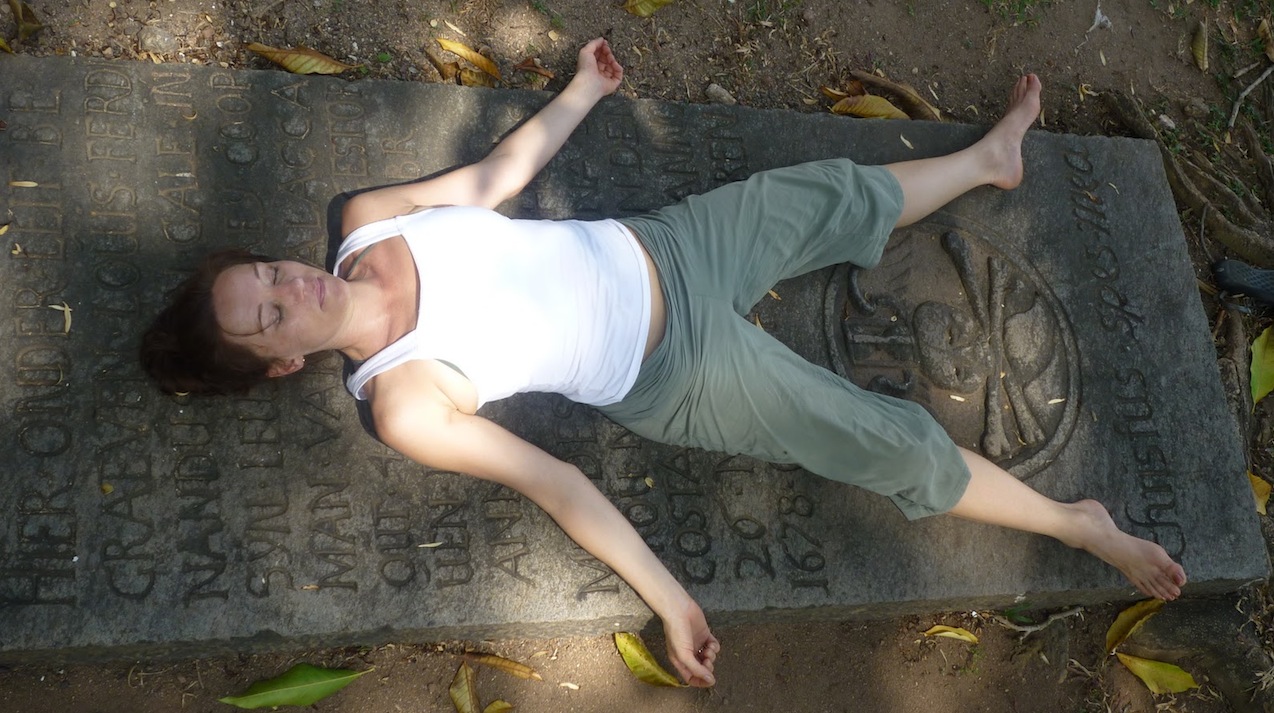
savasanaThere are some things you should never tell an elderly person to do. And, I recently came across a faux pas that certainly belongs in that number.

It may just be me, but I think one should never, ever tell a senior citizen to pose like a corpse.

Nevertheless, in a recent article in a periodical expressly written for “mature” Americans,* readers were advised to assume the “corpse pose.” My discomfort with that directive was not allayed by the description that followed.

Lie flat on your back, pillow under your head, eyes closed. Allow your feet to play to the sides. Rest your arms alongside your body, palms facing up. Then relax, surrender to the floor, and breathe deeply.

Up until being told to “breathe,” one might rightly be confused with precisely how we are emulating a corpse.

While I make no claim to understand what it means to “surrender to the floor,” I can understand how body posture has become a valued part of yoga. After all, even without the counsel of a yogi, I learned at an early age the sheer joy and peace of lying on my back with eyes closed.

I don’t wish to impugn the benefits of yoga; I wish that I were able to master my physical body half as well as many of them do. However, I would like to suggest to the yoga community that they re-label their corpse pose.

Admittedly, advocates for maintaining this verbiage can state it is clearly not intended to refer to a literal cadaver. In arguing this they are simply being human. As C.S. Lewis wrote in “Studies in Words”—“Like all philosophers, Aristotle gives words the definitions which will be most useful for his own purpose.” This approach is not, of course, the domain of philosophers alone.

The fact is that there are perfectly good words that could be substituted which do not reference a lifeless body. “Reclined,” “Reposed,” or even “Resting” or “Sleeping” come readily to mind.

Of course, I may be missing something here. Perhaps the allusion to a corpse is intentional? Perhaps the image of dissipation of energy and effort is expressly intended to be similar to a comatose state? Perhaps that is what becoming one with the floor is hinting at? Flesh to floor . . . ashes to ashes, dust to dust.

In this case, it might be clearer if we were provided with a definition of what the title of the pose actually means. I suppose that practitioners may learn this as part of their lessons, but to those on the “outside,” the label seems slightly off-putting.

As Lewis wrote in the aforementioned essay:

The fact that [writers] define it at all is itself a ground for scepticism. Unless we are writing a dictionary, or a text-book of some technical subject, we define our words only because we are in some measure departing from their real current sense. Otherwise there would be no purpose in doing so.

Thus, if “corpse” here doesn’t mean what we normally understand it to, we might benefit from a brief definition or explanation of the users’ intent.

This matter—the proper use of the precise word that will be clearly understood—is a concern for all communicators. Writers need to remain vigilant that their own vocabulary or metaphors do not confuse.

One last caveat for those who practice yoga. If you seek to master the corpse pose, be cautious in just how well you perfect it. Please stop short of emulating death so well that your resting body is discovered and a crime scene established.

_____

savasana 2* AARP the Magazine is published by the organization formerly known as the American Association of Retired People. Apparently, the sound “AARP” is considered more dignified than the original title. It remains a requirement, however, that members have survived at least a half century before applying for membership.

Chinese Complexity

Chinese ChroniclesSome people consider “writing” difficult. It’s not. When you add the adverb “well,” it does become much rarer. Still, writing in English is not challenging at all when you compare it to the hurdle traditional Chinese authors face.

One of the most popular television programs in the People’s Republic of China is essentially a “spelling bee.” During a recent episode the studio audience was embarrassed by the fact only one-third of them were able to correctly write “gan ga,” which means “embarrassed.”

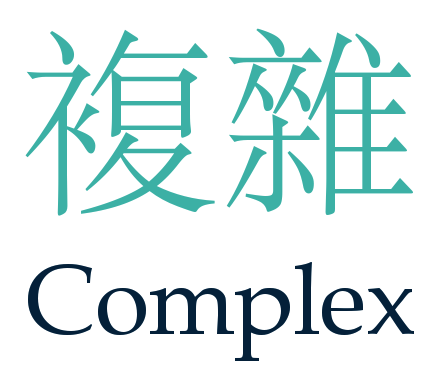
Chinese ComplexThe problem is apparently two-fold. First, Chinese characters are “complex.” That’s why I selected that very word to include here.

The most comprehensive Chinese dictionary, Zhonghua Zihai, was compiled in 1994. It includes 85,568 characters. When compared to the Latin alphabet of 26 characters, it’s no surprise that a poll in China found 99% of the population admitting they forget how to write words. (To be fair, I’m not sure we could find even 1% in the West claiming that they never forget how to spell a word.)

The second reason for the growing national writing crisis in China is the amazing phenomenon called pinyin. Pinyin is the official phonetic system for transcribing the sound of Chinese characters into Latin script. It was created in 1958 by mainland China and has been adopted by the Republic of China as well.

The influence of pinyin has grown dramatically with the advent of computing, and many young Chinese have become dependent on the shortcut. Some educators have labeled the crippling practice “a type of social disease.”

Fortunately for aspiring Chinese authors, knowing a meager 4,000 distinct characters makes one “functionally” literate. Still, even that seems rather daunting. I’ll no longer take for granted my good fortune in having a mere 26 characters to strive to master.

C.S. Lewis offered some fascinating observations about the Chinese worldview. While he discussed the subject in a variety of places, he presents his thoughts most extensively in The Abolition of Man. He finds the concept of “Tao” a useful corollary to what Christians usually refer to as Natural Law.

The Chinese also speak of a great thing (the greatest thing) called the Tao. It is the reality beyond all predicates, the abyss that was before the Creator Himself. It is Nature, it is the Way, the Road. It is the Way in which the universe goes on, the Way in which things everlastingly emerge, stilly and tranquilly, into space and time. It is also the Way which every man should tread in imitation of that cosmic and supercosmic progression, conforming all activities to that great exemplar.

“In ritual,” say the Analects, “it is harmony with Nature that is prized.” The ancient Jews likewise praise the Law as being “true.” This conception in all its forms, Platonic, Aristotelian, Stoic, Christian, and Oriental alike, I shall henceforth refer to for brevity simply as “the Tao.”

Some of the accounts of it which I have quoted will seem, perhaps, to many of you merely quaint or even magical. But what is common to them all is something we cannot neglect. It is the doctrine of objective value, the belief that certain attitudes are really true, and others really false, to the kind of thing the universe is and the kind of things we are.

Although the following story does not relate to C.S. Lewis directly, it offers an interesting insight into the subject of this post. It appears in the book Remembering C.S. Lewis: Recollections of Those who Knew Him, and refers to J.A. Smith, one of Lewis’ fellow professors at Magdalen.

“At the Breakfast Table” was written by another member of the faculty, Adam Fox. Both men knew Lewis well, since they were part of a breakfast foursome in the Common Room at the college.

Now J.A. had fallen into the way of speculating on odd little problems, which apparently assailed him in bed when sleep deserted him. I remember him coming down one morning and telling us that he had been thinking in the night what a dreadful thing it would be for a learned Chinese to go blind. I do not know if the other members of the party knew why it would be more dreadful for a Chinese than for any other learned person.

I had no idea, but I knew my place, and when I asked why this was so, it appeared, according to J.A., that many of the ideograms that make Chinese writing so beautiful conveyed meaning to the eye but had no sound attached to them. Reading in Chinese was in part at least like looking at a picture book, and for that reason, of course, a blind man is fatally handicapped.

As an epilogue of sorts, I can’t resist including one of my favorite Chinese characters. Perhaps you’ll enjoy it also.

Chinese Verbose

Ironically, since it required sixty-four strokes, the word zhé fell from common usage around the fifth century.

Obstreperous Language

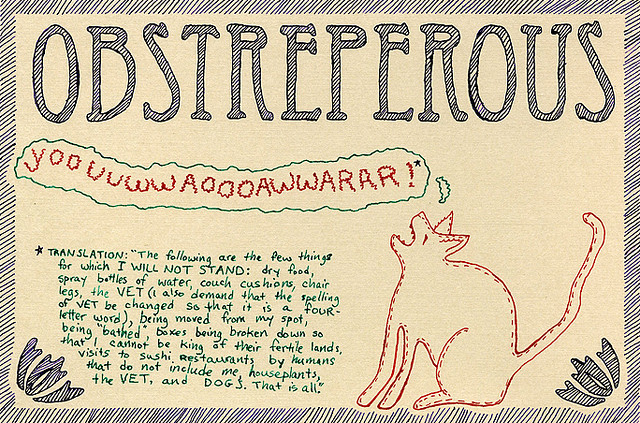
obstreperous

© Stella Belikiewicz and used by permission.

Despite my many shortcomings, I do “pride” myself on possessing a rather considerable vocabulary. My 97th percentile score of the GRE* reinforced my impression that I knew a lot about words.

One technique which has increased my vocabulary is to never let an unknown word pass by without making an effort to learn its meaning. This is simple when I’m working at the computer. If I’m unsure of a definition, I immediately look it up in an online dictionary such as this.

Very rarely do I “guess” at a meaning, based upon its context. This mainly occurs if I’m listening to the radio while I’m driving, and I don’t have recourse to a dictionary. Even then I try to impress the new word on my memory so that I can research it when I return home.

The word in this column’s title motivated me to discuss the importance of accurately understanding word definitions. When I encountered “obstreperous,” it rang vague bells of recollection. And, I was able to discern the word’s general meaning from the context of the article. While some readers of Mere Inkling are already familiar with its meaning—and perhaps use it in daily conversations—allow me to share the context in which I encountered it.

I was reading an article in a military journal about the “battle over ballistic missiles” which was fought inside the Air Force as the manned-bombers-only mindset had to be breached so the United States could advance into the ICBM age. The champions of the two positions were two successive Air Force Chiefs of Staff, Thomas White and Curtis LeMay.

White struggled with how to control the obstreperous LeMay. He knew he didn’t have the political power to force LeMay out, nor could he outwait his [Strategic Air Command] chief. LeMay received his fourth star in 1951 at age 44, which made him the youngest four-star U.S. general since Ulysses S. Grant.**

I’m rarely content with possessing an amorphous definition of a word, so I looked it up. My general impressions of its meaning were confirmed, and I added another word to my personal vocabulary. (The fact that I may never use it beyond its appearance in this post is irrelevant.) Here’s the dictionary entry:

ob·strep·er·ous [uhb-strep-er-uhs]

adjective

1. resisting control or restraint in a difficult manner; unruly.

2. noisy, clamorous, or boisterous: obstreperous children.

Parents give their children a precious gift by encouraging the growth of their own vocabularies. In the pre-computer days, we had a dictionary not far away when we had dinner, and it wasn’t uncommon for it to find its way to the table during our conversations.

Consciously adding new words to our vocabulary is a skill especially vital to writers.

C.S. Lewis wrote about how common usage of familiar words requires no contextual definition. However, he warns of the danger of accepting subjective “definitions” offered outside the context of credible dictionaries.

When we leave the dictionaries we must view all definitions with grave distrust. It is the greatest simplicity in the world to suppose that when, say, Dryden defines wit or Arnold defines poetry, we can use their definition as evidence of what the word really meant when they wrote.

The fact that they define it at all is itself a ground for scepticism. Unless we are writing a dictionary, or a text-book of some technical subject, we define our words only because we are in some measure departing from their real current sense. Otherwise there would be no purpose in doing so. . . .

The word wit will illustrate this. We . . . find old critics giving definitions of it which are contradicted not only by other evidence but out of the critics’ own mouths. Off their guard they can be caught using it in the very sense their definition was contrived to exclude.

A student who should read the critical debate of the seventeenth century on wit under the impression that what the critics say they mean by wit is always, or often, what they really mean by wit would end in total bewilderment.

He must understand that such definitions are purely tactical. They are attempts to appropriate for one side, and to deny to the other, a potent word. You can see the same “war of positions” going on today.

A certain type of writer begins “The essence of poetry is” or “All vulgarity may be defined as,” and then produces a definition which no one ever thought of since the world began, which conforms to no one’s actual usage, and which he himself will probably have forgotten by the end of the month. (Studies in Words)

I find it rather fitting to include this passage from Lewis, with its martial imagery, in a column inspired by a description of a surly advocate of massive nuclear bombing as the best deterrence of World War III.

Writers, particularly those attempting to be persuasive, are wise to ponder Lewis’ wise counsel. We cannot surrender the battlefield to those who would revise the clear and historic meanings of words in an effort “to appropriate for one side, and to deny to the other, a potent word.”

_____

* The Graduate Record Exam is a standardized test used as part of the admission process for many university graduate programs in the United States. We won’t be discussing my mathematics score here . . .

** If the source article interests you, you can read it at Air Force Magazine.

The artwork above is copyrighted by its creator, Stella Belikiewicz, and used with her permission.