C.S. Lewis & Kindness

People don’t get along as well as they used to. In the past you could chalk up that sort of observation to the speaker being of the senior variety, and simply complaining about how things are not like the mythical “good old days.”

But today it appears to be a universally acknowledged tragedy. The social fabric previous generations took for granted – national tapestries that were once knit together with such care to promote beauty and harmony – have frayed and torn.

And I don’t perceive this dreadful condition as limited to the United States. Nor do I believe that it’s simply limited to the realm of politics . . . although it is most certainly manifest in that contentious realm. 

Sadly, there is a shortage of truly kind people. Benjamin Franklin hinted at this when he penned, “he that has done you a kindness will be more ready to do you another, than he whom you yourself have obliged.” Essentially, kind people are the ones who act kindly. Rings true, doesn’t it?

It’s not only in politics where kindness is in a shortage. C.S. Lewis described the dilemma in “The Decline of Religion”

The decline of “religion” is no doubt a bad thing for the “World.” By it all the things that made England a fairly happy country are, I suppose, endangered: the comparative purity of her public life, the comparative humanity of her police, and the possibility of some mutual respect and kindness between political opponents.

But I am not clear that it makes conversions to Christianity rarer or more difficult: rather the reverse. It makes the choice more unescapable. When the Round Table is broken every man must follow either Galahad or Mordred: middle things are gone.

The increasing rarity of kindness doesn’t mark its demise. It will never become extinct while a single soul is kind. As the Greek storyteller Aesop declared twenty-five centuries ago, “no act of kindness, no matter how small is ever wasted.”

A Hopeful Note

Kindness may be hard-pressed in our current day, but the battle isn’t lost. 

The grinch graphic above is the creation of the Random Acts of Kindness Foundation. Their worthwhile goal is to encourage and support lives of kindness. One of their resources, “The Science of Kindness,” describes their uplifting purpose.

And, if you want to experience and emanate not only kindness, the best place to look is to our Creator. Knowing God and trusting the atoning work of Jesus fills us with the very Holy Spirit of our Lord.

As C.S. Lewis discovered when he ceased running away from God while pursuing the empty promises of atheism, the Lord’s desire for humanity is purely good. “The fruit of the Spirit is love, joy, peace, patience, kindness, goodness, faithfulness, gentleness, self-control . . .” (Galatians 5).

C.S. Lewis, Stereotypes & Polarization

Do you think in terms of stereotypes? Be careful before answering, since nary an adult is free of them. (Case in point, you may well have preconceptions or prejudices about a writer who would use the word “nary” in an opening sentence.)

Stereotyping is common, despite the fact most of us would disavow its use. Most of us would agree with C.S. Lewis who described how stereotypes bar us from embracing new knowledge. In his inaugural lecture on the faculty of Cambridge University, he cautioned that “a stereotyped image can obliterate a man’s own experience” (“De Desciptione Temporum”).

Oddly, while most of us would intuit that thinking stereotypically is a pattern for “the less intelligent,” it appears the reverse is true. According to one study,

Superior cognitive abilities are often associated with positive outcomes, such as academic achievement and social mobility . . . However, our work shows that some cognitive abilities can have negative consequences – specifically, that people who are adept at detecting patterns are especially quick to learn and apply social stereotypes.

Fortunately, although “people with better pattern detection abilities are at greater risk of picking up on and applying stereotypes about social groups,” there is still hope for those “afflicted” with cognitive skill. Fortunately, “these individuals are better able to diminish their stereotyping when presented with new patterns that challenge existing stereotypical associations.”

Another study argues that “our brains want our expectations to be supported . . . Because of that reward engagement, we can start becoming addicted, in a way, to stereotyping.” The researchers offer this suggestion for combatting the addiction: “simply understanding that this happens is an important way to check those assumptions and not let them influence your judgment.”

Generalizing by way of stereotypes can indeed be addictive, if its endemic presence in western culture is any indication. In America, for example, if there is ever a season when nasty stereotypes run unbridled, it is during political campaigns. Especially during presidential elections, where a person of faith would hope to witness the greatest amount of compassion and earnest intercession for God’s guidance.

Stereotypes give way to even uglier projections when we come to despise others. Several years ago I wrote an article about how wartime propaganda often strives to portray a nation’s enemies as evil, and unworthy of treatment in a humane way. It is titled “Demonizing Our Enemies & Dehumanizing Ourselves.”

When nations war, it is in the interests of the leaders of the opposing causes to engage their people in that effort heart, mind and (if possible) soul. A soldier who cognitively recognizes the need for fighting, but does not  possess a visceral animus for the foe, will only be a half-hearted warrior.

On the other hand, if rulers can generate a mental and emotional disgust, or even hatred, for the enemy, they have a winning formula. Soldiers who not only understand their cause, but also desire the utter destruction of their opponent, are single-minded in their purpose. Such fighters win wars.

You can see this sort of us/them polarization during peacetime too, even in non-election years. Sadly, it seems to be manifesting more and more frequently. And, surprisingly, it appears to have become just as common within national populations, as in international contexts. The results can be catastrophic, which is why First Lady Eleanor Roosevelt pled: 

Pit race against race, religion against religion, prejudice against prejudice. Divide and conquer! We must not let that happen here.

Stereotyping the Inklings

Although none of the Inklings have been spared, I believe C.S. Lewis has been the subject of the worst stereotyping. (I have an educated suspicion why that is true.)

Diana Pavlac Glyer has an excellent article which addresses this injustice head on.

There’s a rumor going around that C. S. Lewis was an irritable introvert, isolated and lonely and scared to death of girls. Maybe it all comes from some grim stereotype of smart people or college professors or, maybe, published writers.

That whole image is completely wrong. Lewis wasn’t an introvert. Or a loner. No – he was a large man with a booming voice, a hearty laugh, a robust enjoyment of everyday life. And that is why he was a man with friends.

At A Pilgrim in Narnia, Brenton Dickieson dispels another common misperception of the great author – that he was narrow-minded. 

So much of C.S. Lewis’ uniqueness comes down to his sheer love of diversity. He loved variability, colour, the exchange, the alienation of encounter and unity with others. His weird dystopia That Hideous Strength was, in many ways, a protest against the tendency of totalitarianism to create monoculture by erasing the individual. . . .

Lewis loved difference and diversity and freedom of expression–doctrines in danger in today’s culture war. It doesn’t take long within any of today’s major social movements to find out that diversity is fine and great as long as everyone acts like us or looks like us or thinks like us or uses the same secret words we use.

Most readers of Mere Inkling would be exceptions to the rule that human beings (especially those with “superior cognitive abilities”) default to stereotyping. Most of you, I sincerely believe, share my appreciation for respectful conversation and debate with others who do not share my opinions. 

Such interaction – with unique individuals, and not cardboard caricatures – often result in my own growth. And I dare to hope that those with whom I dialog might also feel the same.

C.S. Lewis & Assassinations

The brilliant author C.S. Lewis died on the same day that an American president was assassinated. The violent death of John F. Kennedy in November of 1963 eclipsed Lewis’ own passing, so many people were unaware of it for some time. Yet on that autumn day, both Camelot and Narnia lost their inspirations.

Unfortunately, Kennedy’s shooting was not the only political assassination that was connected in a manner to C.S. Lewis’ life. Archduke Franz Ferdinand Carl Ludwig Joseph Maria of Austria was the heir apparent to the throne of Austria-Hungary. A nineteen year old political activist cold-bloodedly murdered the archduke and his wife, Sofie.

Franz and Sophie had married for love, despite her inadequate social rank, which resulted in a morganatic marriage. In recent years such unions have become more common, but at the time, it was a serious matter. The archduke was forced by his uncle, the emperor, to accept that their descendants would never have a right to the throne.

In a convoluted fashion, Ferdinand’s death nearly led to C.S. Lewis’ own. The 1914 assassination was the spark that set the globe on fire during the First World War. And, during that grim conflict, C.S. Lewis was severely wounded by an artillery shell that killed friends standing nearby.

The Causes and Impact of Political Assassinations” was published by the Combating Terrorism Center at West Point. It begins with the fact that “political assassinations have been part of social reality since the emergence of communal social frameworks . . .” And so, since social frameworks will forever exist, they continue.

Humanity’s Violent History

Assassination has been a relatively common practice throughout human history. This shouldn’t surprise anyone who knows the sad story of Abel and his angry brother, Cain. 

Philip II of Macedon, the father of Alexander the Great, was killed attending the wedding of his daughter Cleopatra (no, not that Cleopatra). Later Cleopatra, as a widow, would be assassinated herself by one of her unsuccessful suitors.

Three centuries later, Julius Caesar was murdered by the political elite of Rome, who feared his growing influence. And in 453, one of Rome’s greatest enemies, Attila the Hun, was arguably murdered on his wedding night by his new bride, Ildico.

Several assassinations are recorded in the Bible. Over such a lengthy and turbulent historical period, that is unsurprising. The two excerpts below have links to the fuller accounts.

[Canaanite general] Sisera fled away on foot to the tent of Jael, the wife of Heber the Kenite, for there was peace between Jabin the king of Hazor and the house of Heber the Kenite. And Jael came out to meet Sisera and said to him, “Turn aside, my lord; turn aside to me; do not be afraid.” So he [entered] the tent, and she covered him with a rug. . . . And he said to her, “Stand at the opening of the tent, and if any man comes and asks you, ‘Is anyone here?’ say, ‘No.’” But Jael the wife of Heber took a tent peg, and took a hammer in her hand. Then she went softly to him and drove the peg into his temple until it went down into the ground while he was lying fast asleep from weariness (Judges 4).

Joab took Amasa by the beard with his right hand to kiss him. But Amasa did not observe the sword that was in Joab’s hand. So Joab struck him with it in the stomach and spilled his entrails to the ground without striking a second blow, and he died (2 Samuel 20).

As a sort of counterbalance to these “positive” instances – elimination of Israel’s enemies – you may want to read about King David’s condemnation of the assassinations of his political rivals, men to whom he would have extended mercy. When two brothers sought a reward for murdering King Ish-bosheth, Saul’s son, David declared “when wicked men have killed a righteous man in his own house on his bed, shall I not now require his blood at your hand and destroy you from the earth?” (2 Samuel 4).

All told, however, there was much violence in the ancient world. As C.S. Lewis’ wife, Joy Davidman, wrote in Smoke on the Mountain: An Interpretation of the Ten Commandments in Terms of Today:

How the ancient Jews did slaughter! They killed in hot blood and in cold; they killed for loot, for God, and for fun. . . . The tribes killed . . . by political assassination as when Ehud stabbed King Eglon in his fat belly . . . [The graphic story of Eglon’s assassination is detailed in Judges 3.]

Another historically consequential assassination occurred in the year 661, when Muhammad’s son-in-law Ali ibn Abi Talib was slain with a poison-coated sword while praying in the Great Mosque of Kufa. This incident caused Islam to separate into two major denominations, and Sunni-Shia relations continue to be contentious.

In the modern era, political murders remain unabated. Vladimir Putin  may be the current master of the deadly art. Even discounting the growing number of “suicides” among his advisers and generals following his ill-advised invasion of Ukraine, we have the case of Alexei Navalny. Navalny was one of Putin’s critics who in 2020 survived poisoning with Novichok nerve agent. Nevertheless, imprisoned in the arctic, he later died under extremely suspicious circumstances. 

In the western hemisphere, the recent attempted assassination of former President Donald Trump invites a review of the danger of serving in that particular office. Despite the (obvious) risk of inviting non-Americans to mock the United States, consider a few facts.

  • Since 1789 (when the office was established) we have had 45 presidents
  • Four sitting presidents have been assassinated while in office
  • Three other presidents (one while in office) were wounded in assassination attempts

Assassination During the Protestant Reformation

In C.S. Lewis’ landmark tome English Literature in the Sixteenth Century, recalls a peculiar passage from the History of the Reformation of Religion within the Realm of Scotland. The author, John Knox refers to the murder of Scotland’s last pre-Reformation Roman Catholic cardinal. It would be more than four centuries before the Pope appointed another.

In the cast of [Knox’s] mind, too, there is something not unlike Tacitus’ sombre pungency, though Knox’s humour, as becomes a countryman of Dunbar, is more boisterous and ferocious.

Sometimes, indeed, it is so ferocious that we should not recognize it at all if we were not told; as when after describing the murder of Cardinal Beaton down to the last grim detail of packing the corpse in salt (‘the wether was hote’) he proceeds, ‘These things we wreat mearelie: but we wold that the reader should observe Goddis just judgementis.’

He was apparently afraid lest the fun of the thing might lead us to forget that even an assassination may have its serious side.

Quite true. An assassination, even of a despised ruler such as Adolf Hitler, remains a serious matter.

History in Retrospect

This title, “History in Retrospect,” is of course redundant. There is no other way to consider history than by looking back at the past – from our current vantage point.

That is why it’s impossible to view history completely objectively. Since each of us measures things from our personal worldview, the same event means vastly dissimilar things to different people.

When people are hyper-partisan, they are incapable of reasoning with others who view events differently. The history of the United States is currently the subject of intense (too often extremist) debate by its citizens. Balanced people, the type I prefer talking to, admit the shortcomings in our history, and praise the accomplishments.

There are those, sadly, who believe their nation can have done no wrong. There are others who relish condemning the country’s imperfections. Those in the latter camp remind me of the prejudice exhibited by Nathanael, one of Jesus’ future disciples, when he dismissed his brother’s enthusiasm about the Messiah with the words “can anything good come out of Nazareth?” (John 1).

C.S. Lewis was a gifted writer and academic. He was also a historian, especially an expert in literary history. His volume in the Oxford History of English Literature reflects that fact quite clearly.

Lewis was not only brilliant, in many ways he revealed great wisdom. Listen to these remarks about history from a letter he wrote to one of his casual correspondents in 1952.

You are not the kind of correspondent who is a ‘nuisance:’ if you were you would not be now thinking you are one – That kind never does.

But don’t send me any newspaper cuttings. I never believe a word said in the papers.

The real history of a period (as we always discover a few years later) has very little to do with all that, and private people like you and me are never allowed to know it while it is going on.

Educated originally as a “journalist,” I’m forced to agree completely with Lewis. Every word in print today is suspect. Those who do not read critically are on dangerous ground. And, of course, it’s not just newspapers and journals that demand caution. Digital media are even worse.

For that reason, we should never pretend any publication is 100% reliable. However, one magazine that I believe honestly strives toward that goal, is World Magazine. I appreciate the fact that it approaches subjects from my own theistic (Christian) worldview. By default, that makes it makes it untrustworthy to those who possess an anti-Christian worldview.

The open-minded individuals I referred to above, ever a minority, are willing (even eager) to read articles written by people from a range of perspectives. And it is for you, the honest and inquisitive people, that I suggest you consider adding World to your reading list.

Andrée Seu Peterson, recently wrote a provocative article discussing a recurrent historical phenomenon. It is entitled “A gathering in Switzerland: Little-known meetings can have massive outcomes.”

Down through history there have been little conferences attended by small numbers of elites that have quietly changed the world while the rest of mankind was going about its mundane business unawares. . . .

In June of 1494 King Ferdinand II of Aragon, Queen Isabella I of Castille, and King John II of Portugal drew a demarcation line like a vertical knife edge running from North to South poles, trampling established communities as it divided the Western world between Spain and Portugal.

People falling on one side of the line would henceforth speak Spanish and people on the other side would speak Portuguese.

Echoes of C.S. Lewis’ cautions about the “inner ring!”

Considering the “End of History”

History is defined in a variety of ways. To avoid politically charged definitions, let’s turn to a source in that most-neutral nation, Switzerland. In the description of their doctoral program in the field, the Universität Basel says “history examines past events, processes and structures [and] is both a cultural studies and a social sciences discipline.”

The point being that history relates to humanity, rather than our planet as an entirety. Thus, history won’t end with death of our solar system “in about 5 billion years [when] the sun will run out of hydrogen.” Even the most optimistic advocates of a starfaring future for humanity would likely admit history will end long before that.

Christians, on the other hand, foresee a future history without end. Yes, this earth will pass away, but our Creator has promised a new heaven and a new earth that will not echo the perishable nature of our fallen world.

In light of this conviction, Peterson includes a sobering observation in her essay about history.

People living in the Stone Age didn’t know they were living in the Stone Age. People alive at the time the monks in Ireland furiously copied Greek and Latin Bible manuscripts as fast as the Huns and Visigoths could torch the libraries of Europe didn’t know they were living through the near destruction of Western civilization. Such things are clear only in hindsight.

No Christian pretends to know the day of Christ’s return. In fact, Jesus expressly said “concerning that day and hour no one knows, not even the angels of heaven . . . Therefore you also must be ready, for the Son of Man is coming at an hour you do not expect” (Matthew 24).

Speculation about the Day of the Lord has rarely been beneficial. Suffice it to know that we should remain, at every possible moment, “ready.”

C.S. Lewis wrote another letter in 1952 which addresses this principle. His friend Don Giovanni Calabria (1873-1954), who was canonized by John Paul II in 1999, had written to Lewis sharing his impression that the day of the Lord’s return was drawing nearer.

Lewis reminded the priest of something Calabria already knew quite well. And it’s something well worth being reminded of today.

The times we live in are, as you say, grave: whether ‘graver than all others in history’ I do not know. But the evil that is closest always seems to be the most serious: for as with the eye so with the heart, it is a matter of one’s own perspective.

However, if our times are indeed the worst, if That Day is indeed now approaching, what remains but that we should rejoice because our redemption is now nearer and say with St John: ‘Amen; come quickly, Lord Jesus.’

Meanwhile our only security is that The Day may find us working each one in his own station and especially (giving up dissensions) fulfilling that supreme command that we love one another.

Lewis closes his letter with an affectionate prayer and promise, worthy of emulation in our own lives. “Let us ever pray for each other.” A sentiment I share with you.

C.S. Lewis & Rigmarole

I hope my confusion is not due to a decline in my mental faculties. But it seems to me politicians are becoming even more incoherent than they’ve always been.

Is it me? Or, are you also amazed at how some of them appear to be babbling half the time?

C.S. Lewis was a master of communication. And some of his observations about how poorly some people communicate can be insightful.

Listen to this verse from a poem entitled “The Prudent Jailer” which he wrote in 1947. (It deserves to be read out loud.)

Some walls cannot a prison make
Half so secure as rigmarole.*

Lewis wasn’t referring to political jargon when he wrote this poem, but it seems quite apropos in a number of contexts.

For example, consider a recent article from the American Institute for Economic Research. Jon Sanders applies Lewis’ poem to foreboding aspects the government’s response to the pandemic.

The poem originated not in political allegory, but as a critique of unimaginative literary criticism. Notwithstanding, the Jailer is a diabolical figure, and his prudence is this: he imprisons with words, not walls. . . .

The Jailer has them imprisoned by their own thoughts, while he keeps them focused ever on the presumption of a prison. He doesn’t want them thinking of anything else.

This post isn’t about politics. I detest the subject as a whole, and find it particularly corrosive to conversation as elections draw near.

The verse I cited above simply evoked for me the power of words to distort and, yes, imprison. Lewis’ use of rigmarole⁑ (a word sadly out of vogue) highlights the fact that the crippling words themselves are often nonsensical.

Other colorful synonyms that we might hear in the company of our seniors could include balderdash, poppycock, or perhaps even malarkey.

In a 1940 letter to Dom Bede Griffiths, Lewis applies “balderdash” to describe art and literature done “for their own sake.”

I do most thoroughly agree with what you say about Art and Literature. To my mind they are only healthy when they are either (a) Definitely the handmaids of religious, or at least moral, truth – or (b) Admittedly aiming at nothing but innocent recreation or entertainment. . . .

But the great serious irreligious art – art for art’s sake – is all balderdash; and, incidentally, never exists when art is really flourishing.

Fortunately, such words rarely become completely obsolete.

A noteworthy mythopoeic⁂ scholar, Brenton Dickieson, used “balderdash” quite skillfully not that long ago.

“The Prudent Jailer” was originally published in 1947 under the mundane title, “The Romantics.”

Since you’ve read this column to its conclusion, allow me to reward your diligence by presenting the poem in its entirety.

The Prudent Jailer

Always the old nostalgia? Yes.
We still remember times before
We had learned to wear the prison dress
Or steel rings rubbed our ankles sore.

Escapists? Yes. Looking at bars
And chains, we think of files; and then
Of black nights without moon or stars
And luck befriending hunted men.

Still when we hear the trains at night
We envy the free travelers, whirled
In how few moments past the sight
Of the blind wall that bounds our world.

Our Jailer (well may he) prefers
Our thoughts should keep a narrower range.
‘The proper study of prisoners
is prison,’ he tells us. Is it strange?

And if old freedom in our glance
Betrays itself, he calls it names
‘Dope’-‘Wishful thinking’-or ‘Romance,’
Till tireless propaganda tames.

All but the strong whose hearts they break,
All but the few whose faith is whole.
Some walls cannot a prison make
Half so secure as rigmarole.


* Thank you to Jon whose comment below pointed out the connection between Lewis’ allusion to the very famous poem “To Althea, from Prison,” written by Richard Lovelace in 1642. “Stone walls doe not a prison make, Nor iron bars a cage…”

⁑ Some people in the States will be more familiar with the variant “rigamarole.”

⁂ Mythopoeia is a modern literary genre in which the author creates a fictional mythology. The finest example of such writing comes from the pen of J.R.R. Tolkien, the creator of Middle Earth.

The Responsibility of Parenting

Some of us had the sad misfortune of growing up without parents. A larger number had mothers, but absent fathers. For a few, there was a dad, but the home lacked the presence of a mother. And then there are those who were blessed with the presence of a loving mother and father.

Each of these circumstances (and there are even more, of course), generates a different dynamic in a home. I am persuaded that God’s ideal of a father and mother, joined together as a “single flesh,” is best for nurturing healthy children. Thankfully, God loves every child, and living in less than ideal situations does not mean a person will grow up handicapped.

C.S. Lewis provides an amazing example of a boy who lost his mother to disease, and was raised by an emotionally distant father. Lewis’ father resorted to sending his sons off to boarding school rather than attempting to work through their shared grief together, in their home.

As an echo of that decision, C.S. Lewis sent his own sons away to school after their mother succumbed to her own battle with cancer. The situation was different, since Joy was raising the boys alone before Lewis married her, and Lewis who had imagined he would die a bachelor, was ill-equipped to provide a suitable environment for the children once their mother died.

I would be a different man today, if I had been raised in a home with parents whose love for one another overflowed. Perhaps my own family background is the reason I kept a plaque in my office that proclaimed that “the most precious gift a father can give his children is to love their mother.”

I was thinking about parenting because of a wonderful quote I read this morning in a interview with British comedian, Ricky Gervais. He was talking about growing up in a working class family, but being unconscious of their relative poverty.

I didn’t know I was poor, because my mother knitted all my jumpers, she made our Christmas presents, did all the decorating, grew things in the garden that she then cooked. I always thought, men work hard, but women work miracles.

Now that’s certainly a humorous way to express something that is quite frequently true.

What Kind of a Parent Am I?

Not all of us are blessed to be parents. Some consciously choose that path. Others, with whom I sincerely sympathize, wish to, but are never given the opportunity.

Some men simply contribute to the physical process and go merrily on their way, often carelessly impregnating others. These individuals can be considered “biological” parents, but they are not fathers. On the other hand, a woman who feels compelled by circumstances to allow her child to be raised by others, displays the compassion of a true mother.

I’ve seen some great fathers in my day. Unfortunately, I didn’t see them while I was growing up. So I had to “learn on the job.” I consider my early years as a dad “above average,” but my later years have actually been pretty decent. It’s been far easier than for many people, because my wife brings out the best in me. I wouldn’t care to postulate what kind of dad I would be without her counsel and encouragement.

I always imagined I’d be a husband and father someday. I see that is becoming less true with each generation.

If you are considering the question of “what kind of parent” you are, I’d like to caution you about two dangers. First, don’t get cocky. You aren’t perfect, not by a long stretch. There’s definitely room for some improvement.

Second, don’t get discouraged. We can all improve as parents, even after serious stumbles. Give parenting the attention it deserves. Seek advice from those who appear more successful – and are willing to be honest about their struggles. Choose schools and social activities that reinforce your efforts to raise healthy human beings. Adding prayer to the formula is often a wise choice.

There are a vast number of parental resources available online. The best of them are framed by a biblical worldview. Many address specific contexts, while others are more general. One I just visited for the first time is Philosophy for Parents.

Holly Hamilton-Bleakley teaches philosophy at the University of San Diego. Although she hasn’t posted recently, there is a wealth of thought-provoking material on her site. The most recent addresses the challenge of “Parenting in an Age of ‘Politics-as-Destruction.’”

She confronts a concern that should be at the forefront of every parents’ concern today, saying “It’s taking everything I have to protect my family from the toxic political culture in which we find ourselves.”

One of her earliest columns posed this question: “Could Parenting be More Important than Politics?” I highly recommend the piece, which begins with a pertinent passage from a letter C.S. Lewis wrote in 1955.

Quoting Lewis: “I think I can understand that feeling about a housewife’s work being like that of Sisyphus (who was the stone rolling gentleman). But it is surely in reality the most important work in the world. What do ships, railways, miners, cars, government etc. exist for except that people may be fed, warmed, and safe in their own homes? As Dr. Johnson said, ‘To be happy at home is the end of all human endeavor’ … We wage war in order to have peace, we work in order to have leisure, we produce food in order to eat it. So your job is the one for which all others exist.”

I love this quote.  I live my life by this quote.  But I think it needs some discussion.

And the discussion she provides is excellent. Regular readers of Mere Inkling know I’m no particular fan of “philosophy,” but these articles possess practical value! Something I’m confident C.S. Lewis would also commend.

Pandemic Politicians & Dinosaurs

One would think that with over two million deaths and counting, along with a global economy in freefall, that politicians would have no trouble focusing on what is important.

Of course, if you base your assumption on the logic of the matter—you would be wrong.

Politicians, nearly all of them it seems, possess an unlimited capacity for ignoring vital concerns and focusing on petty matters. Today’s example comes via the long-extinct theropod, Suciasaurus.

In the United States and, I suppose, various other nations, we have the quaint custom of adopting specific flora, fauna, etc. as their own. So, for example, the state tree of New Jersey is dogwood. The state fish of Wisconsin is the muskellunge.

I recently discovered a number of states have their own dinosaur (sometimes referred to as a fossil, which most are). Some, like Colorado, choose a familiar giant, in their case the stegosaurus. Others, such as Kentucky, opt for something more humble, in their case a brachiopod. (They look like clams, but are not molluscs.)*

Since dinosaurs are fashionable—even J.R.R. Tolkien has one—states without them are rushing to claim one before the best are all gone. Which brings us to our point.

Why, with life and death concerns competing for a government’s actions, would legislators waste their time with such inconsequential concerns?

In the “one-party” state in which I live, Washington, the legislative majority has already (in 2021) sought to schedule time to elevate the public stature of Suciasaures. (The minority party has suggested instead that COVID-19 cries out for attention before turning to dinosaurs, who have inarguably been waiting without complaint for some time.) More on dinos below.

C.S. Lewis’ Thoughts on the Subject

C.S. Lewis shared my ever-expanding disdain for most politicians. In The Literary Legacy of C.S. Lewis, we read that his stepson Douglas “Gresham pictures Lewis as completely skeptical of politicians . . .”

In The Allegory of Love, Lewis describes the power of politics to subvert a person from their earnest beliefs. “Some politicians hold that the only way to make a revolutionary safe is to give him a seat in Parliament.” Get people invested in the system, reaping the “rewards” of power and office, and it may come to own many of them.

C.S. Lewis’ clearest warning about politicians may come in his essay “Willing Slaves of the Welfare State.” It is worth reading in full, but I share here the pertinent section.

Here, I think, lies [humanity’s] real dilemma. Probably we cannot, certainly we shall not, retrace our steps [to freer, less governed ages]. We are tamed animals (some with kind, some with cruel, masters) and should probably starve if we got out of our cage. That is one horn of the dilemma. But in an increasingly planned society, how much of what I value can survive? That is the other horn.

I believe a man is happier, and happy in a richer way, if he has “the freeborn mind.” But I doubt whether he can have this without economic independence, which the new society is abolishing. For economic independence allows an education not controlled by Government; and in adult life it is the man who needs, and asks, nothing of Government who can criticise its acts and snap his fingers at its ideology.

Read Montaigne; that’s the voice of a man with his legs under his own table, eating the mutton and turnips raised on his own land. Who will talk like that when the State is everyone’s schoolmaster and employer? Admittedly, when man was untamed, such liberty belonged only to the few. I know. Hence the horrible suspicion that our only choice is between societies with few freemen and societies with none.

Again, the new oligarchy must more and more base its claim to plan us on its claim to knowledge. If we are to be mothered, mother must know best. This means they must increasingly rely on the advice of scientists, till in the end the politicians proper become merely the scientists’ puppets.

Technocracy is the form to which a planned society must tend. Now I dread specialists in power because they are specialists speaking outside their special subjects. Let scientists tell us about sciences. But government involves questions about the good for man, and justice, and what things are worth having at what price; and on these a scientific training gives a man’s opinion no added value. Let the doctor tell me I shall die unless I do so-and-so; but whether life is worth having on those terms is no more a question for him than for any other man.

It is shocking to realize the prescient Oxbridge professor wrote this essay more than sixty years ago. For further discussion of Lewis’ political thoughts, read this fine review of C.S. Lewis on Politics and the Natural Law.⁑

C.S. Lewis, the Dinosaur

C.S. Lewis made no apology about holding fast to what he deemed the treasures of the past. In this regard, he famously referred to himself as a dinosaur. In an essay entitled “De Descriptione Temporum,” he described the unique lessons that can be taught by dinosaurs.

If a live dinosaur dragged its slow length into the laboratory, would we not all look back as we fled? What a chance to know at last how it really moved and looked and smelled and what noises it made! And if the Neanderthaler could talk, then, though his lecturing technique might leave much to be desired, should we not almost certainly learn from him some things about him which the best modern anthropologist could never have told us . . .

I would give a great deal to hear any ancient Athenian, even a stupid one, talking about Greek tragedy. He would know in his bones so much that we seek in vain. At any moment some chance phrase might, unknown to him, show us where modern scholarship had been on the wrong track for years.

Ladies and gentlemen, I stand before you somewhat as that Athenian might stand. I read as a native, texts you must read as foreigners. You see why I said that the claim was not really arrogant; who can be proud of speaking fluently his mother tongue or knowing his way about his father’s house. . .

Where I fail as a critic, I may yet be useful as a specimen. I would even dare to go further. Speaking not only for myself but for all other Old Western men whom you may meet, I would say, use your specimens while you can. There are not going to be many more dinosaurs.

C.S. Lewis, the Dinosaur?

And, finally, there is a curious mention of dinosaurs in C.S. Lewis’ book, Miracles. While affirming the bodily resurrection, he dismisses the peculiar notion held by some that bodies will be comprised of the very cells that comprised the [original] body of each individual person. Lewis alludes to the recycling of atoms for other uses,⁂ which is an overwhelming concept.

The general resurrection involves the reverse process universalised—a rush of matter towards organisation at the call of spirits which require it. It is presumably a foolish fancy (not justified by the words of Scripture) that each spirit should recover those particular units of matter which he ruled before.

For one thing, they would not be enough to go round: we all live in second-hand suits and there are doubtless atoms in my chin which have served many another man, many a dog, many an eel, many a dinosaur.

Nor does the unity of our bodies even in this present life, consist in retaining the same particles. My form remains one, though the matter in it changes continually. I am, in that respect like a curve in a waterfall.

Well, that’s certainly something to ponder. But don’t ask any politicians to read this post; they have far more serious matters that demand their attention.


* Talk about digressions . . . now we have trivia within trivia.

⁑  From the review of C.S. Lewis on Politics and the Natural Law:

Lewis contends the roots of the rejection of natural law were formed by the ideas put forth in the 16th century. At the beginning of that century, “eternal verities” were abolished and by the end, man was abolished himself completely ruled by his passions and void of reason. Lewis termed these people, “men without chests,” an apt description for many politicians driven more by their passion for power and popularity than by reason.

⁂ Apparently, according to “Atomic Tune-up,” up to “98 percent of our atoms are replaced every year.” If you are willing to consider some freakish mathematical calculations related to the atoms recycled from the hydrogen and oxygen atoms that we breathe and become a part of us, check this out.

. . . there are hundreds of billions of King Tut’s atoms inside you right now, hundreds of billions of Hitler’s or Caesar’s atoms inside of you, and if you want to go even farther back, trillions of atoms that were a part of the Tyrannosaurus Rex, Sue, at the moment she died.

Chesterton, Tertullian and C.S. Lewis on Arguments

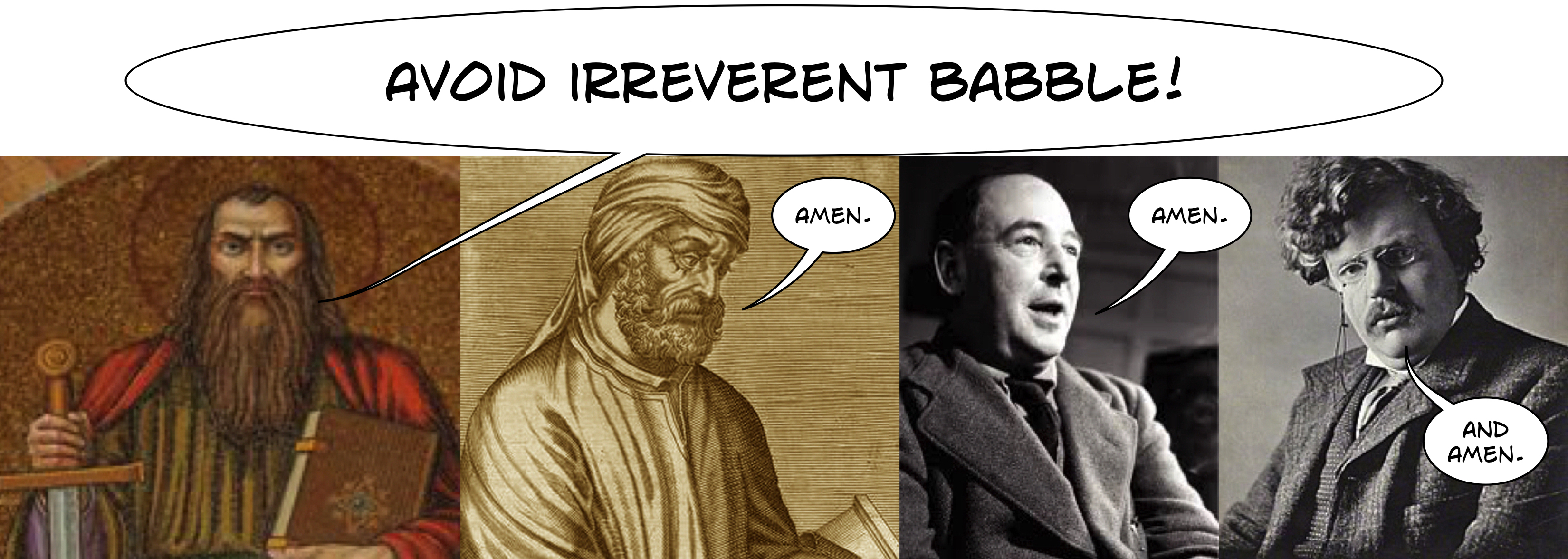
babble.jpg

With civil discourse in such short supply today, it may be beneficial to consider some wisdom from the past about disagreeing calmly.

If you’re a thoughtful person, and you interact with other rational people, it’s inevitable that you will sometimes disagree. These differences of opinion are not bad things, in and of themselves. They help us sharpen our thinking and occasionally result in someone (from either side) recognizing the errors in their opinions.

There are times, however, when disagreements are not handled respectfully. In such situations, they seldom result in a positive end. In cases where quarrels arise, people don’t persuade others. They do the opposite—they motivate them to entrench themselves and hide behind mental and verbal barricades that reinforce their “errors.”

You can go all the way back to the Scriptures to find the recognition that this sort of debate is destructive. Here is the counsel of the apostle Paul to his protégée Timothy, a young pastor:

Remind them of these things, and charge them before God not to quarrel about words, which does no good, but only ruins the hearers. Do your best to present yourself to God as one approved, a worker who has no need to be ashamed, rightly handling the word of truth. But avoid irreverent babble, for it will lead people into more and more ungodliness, and their talk will spread like gangrene. (2 Timothy 2:14-17)

In the second century, Tertullian, a brilliant North African Christian scholar, penned one of my favorite passages in all of patristic literature.

I might be bringing forward this objection from a want of confidence, or from a wish to enter upon the case in dispute in a different manner from the heretics, were not a reason to be found at the outset in that our Faith owes obedience to the Apostle who forbids us to enter into questionings, or to lend our ears to novel sayings, or to associate with a heretic after one admonition—he does not say after discussion.

Indeed, he forbade discussion by fixing on admonition as the reason for meeting a heretic. And he mentions this one admonition, because a heretic is not a Christian, and . . . because argumentative contests about the Scriptures profit nothing, save of course to upset the stomach or the brain.

This or that heresy rejects certain of the Scriptures, and those which it receives it perverts both by additions and excisions to agree with its own teaching. For even when it receives them it does not receive them entire, and if it does in some cases receive them entire, it none the less perverts them by fabricating heterodox interpretations.

A spurious interpretation injures the Truth quite as much as a tampered text. Baseless presumptions naturally refuse to acknowledge the means of their own refutation. They rely on passages which they have fraudulently rearranged or received because of their obscurity.

What wilt thou effect, though thou art most skilled in the Scriptures, if what thou maintainest is rejected by the other side and what thou rejectest is maintained? Thou wilt indeed lose nothing—save thy voice in the dispute; and gain nothing—save indignation at the blasphemy. (On the Prescription of Heretics, 16-17)

If you would like to read a fascinating scholarly article on this passage you can download one here. In “Accusing Philosophy of Causing Headaches: Tertullian’s Use of a Comedic Topos,” J. Albert Harrill writes:

Among the most famous passages in Tertullian’s De praescriptione haereticorum (ca. 203) is what appears to be nothing more than a throwaway line. After declaring that ‘heretics’ have no right to use Christian Scripture, he writes, ‘Besides, arguments over Scripture achieve nothing but a stomachache or a headache.’

Previous scholarship has assumed the protest to epitomize Tertullian’s fideism and general anti-intellectualism. However, I argue that the line evokes a comedic stereotype within a medical topos about ‘excessive’ mental activity causing disease in the body, going back to Plato and Aristophanes.

The passage is, therefore, not a throwaway line but an important part of Tertullian’s attempt to caricature his opponents with diseased superstitio (excessive care and ‘curiosity’).

More Recent Variations of this Theme

Those who have attempted serious, rational argument with someone who is unserious or irrational know very well what Tertullian was describing. If you are earnest and calm in your advocacy, only to have your counterpart act flippant or ignorantly obstinate, it really can make one feel nauseous.

G.K. Chesterton, who was an articulate defender of Christianity during the beginning of the twentieth century, described the frustration in a predictably entertaining manner.

If you argue with a madman, it is extremely probable that you will get the worst of it; for in many ways his mind moves all the quicker for not being delayed by things that go with good judgment.

He is not hampered by a sense of humour or by clarity, or by the dumb certainties of experience. He is the more logical for losing certain sane affections.

Indeed, the common phrase for insanity is in this respect a misleading one. The madman is not the man who has lost his reason. The madman is the man who has lost everything except his reason.” (Orthodoxy)

As Chesterton suggests, the madman has retained his ability to reason, but is no longer inhibited by reason itself. I would liken it to retaining the appearance of reasoning, bereft of its essence. It parallels what we read in 2 Timothy 3.

In the last days . . . people will be lovers of self, lovers of money, proud, arrogant, abusive, disobedient to their parents, ungrateful, unholy,  heartless, unappeasable, slanderous, without self-control, brutal, not loving good,  treacherous, reckless, swollen with conceit, lovers of pleasure rather than lovers of God, having the appearance of godliness, but denying its power. Avoid such people. (Italics added.)

C.S. Lewis also addresses the inability of many who are wrong to conduct rational conversations. Whenever they meet a reasoned argument, they are disarmed.

Unfortunately, their lack of logic does not prevent them from charging into the disputation. They assume their passion or their appeal to subjectivity (i.e. that “everyone” is right) will win the day.

Lewis grew so frustrated by the phenomenon that he coined a new word to identify it. He regrets the passing of the day when you persuade someone of their error before you could legitimately explain why your own position is correct on a given issue.

The modern method is to assume without discussion that he is wrong and then distract his attention from this (the only real issue) by busily explaining how he became so silly.

In the course of the last fifteen years I have found this vice so common that I have had to invent a name for it. I call it Bulverism.

Some day I am going to write the biography of its imaginary inventor, Ezekiel Bulver, whose destiny was determined at the age of five when he heard his mother say to his father – who had been maintaining that two sides of a triangle were together greater than the third – `Oh you say that because you are a man.’

“At that moment,” E. Bulver assures us, “there flashed across my opening mind the great truth that refutation is no necessary part of argument. Assume that your opponent is wrong, and then explain his error, and the world will be at your feet.

“Attempt to prove that he is wrong or (worse still) try to find out whether he is wrong or right, and the national dynamism of our age will thrust you to the wall.” That is how Bulver became one of the makers of the Twentieth Century.

I find the fruits of his discovery almost everywhere. Thus I see my religion dismissed on the grounds that “the comfortable able parson had every reason for assuring the nineteenth century worker that poverty would be rewarded in another world.” Well, no doubt he had. On the assumption that Christianity is an error, I can see early enough that some people would still have a motive for inculcating it.

I see it so easily that I can, of course, play the game the other way round, by saying that “the modern man has every reason for trying to convince himself that there are no eternal sanctions behind the morality he is rejecting.”

For Bulverism is a truly democratic game in the sense that all can play it all day long, and that it gives no unfair privilege to the small and offensive minority who reason. But of course it gets us not one inch nearer to deciding whether, as a matter of fact, the Christian religion is true or false. . . . I see Bulverism at work in every political argument.

Until Bulverism is crushed, reason can play no effective part in human affairs. Each side snatches it early as a weapon against the other; but between the two reason itself is discredited. (“‘Bulverism:’ Or the Foundation of Twentieth Century Thought”)

So, there we have it. We may derive some comfort from the fact that irrational arguing has frequently displaced civil discourse since the dawn of human communication.

As for me, I intend to avoid the Bulverites as much as possible. The last thing I need is a migraine or a serious case of indigestion.

C.S. Lewis Versus Socialism

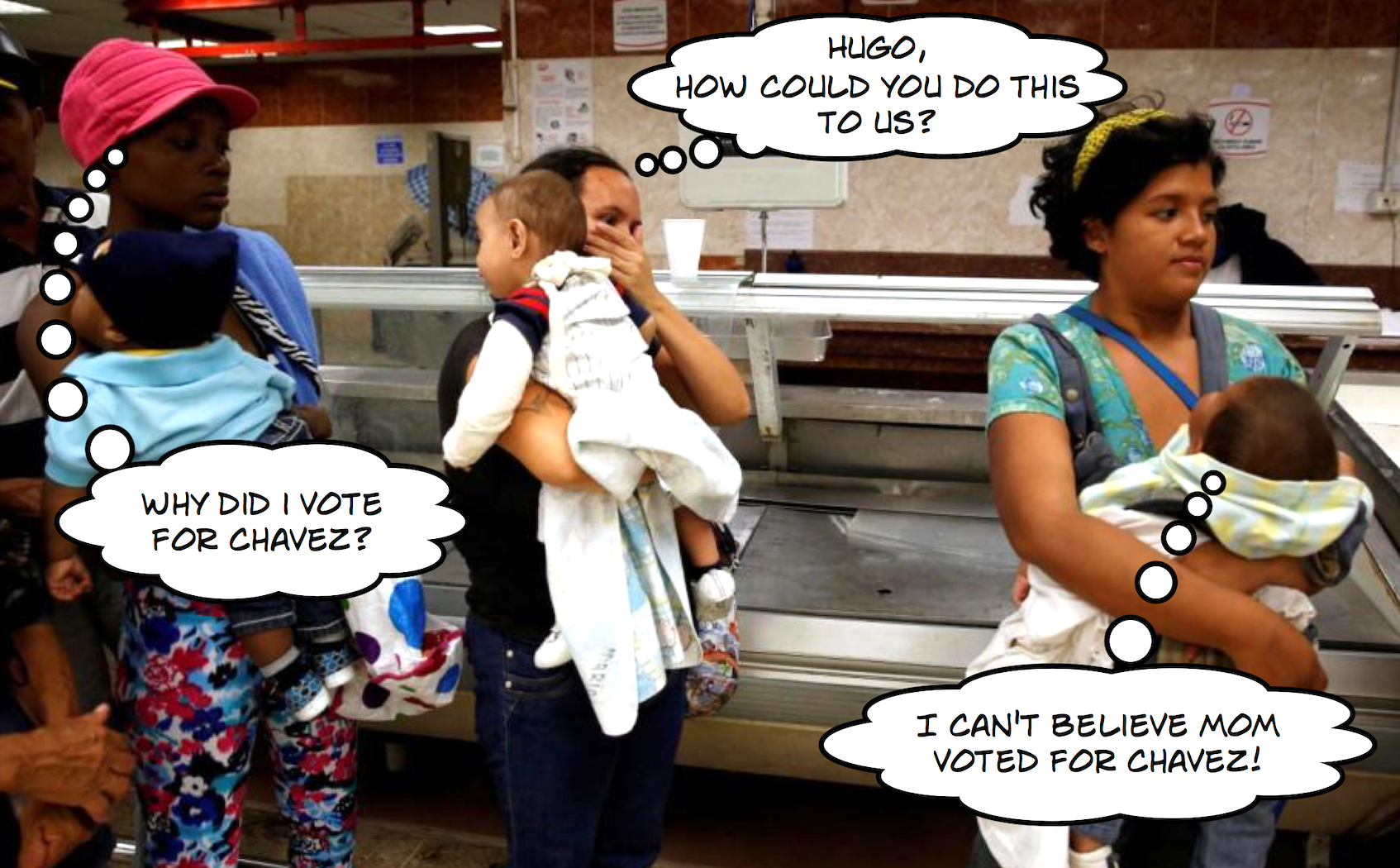
chavezSocialism is in the news, and we need not wonder what the prolific and wise C.S. Lewis would have thought about it.

In the United States, for example, one of the serious contenders for the presidential election this fall belonged to neither the Democrat nor Republican parties.

Bernie Sanders dropped the “D” descriptor he had, for political convenience, worn for several months. He did so soon after Hillary clinched the Democrat nomination, saying he was elected as an “Independent,” and would return to the Senate as one.

Elsewhere in the world we see one of the most recent experiments in socialism following the historic pattern. Venezuela has fallen from the ranks of successful nation states into the abyss of socialist turmoil.

Even liberal (progressive) voices are acknowledging the abject failure of socialism in a formerly comfortable country.

When a Venezuelan entrepreneur we know launched a manufacturing company in western Venezuela two decades ago, he never imagined he’d one day find himself facing jail time over the toilet paper in the factory’s restrooms. But Venezuela has a way of turning yesterday’s unimaginable into today’s normal.

The entrepreneur’s ordeal started about a year ago, when the factory union began to insist on enforcing an obscure clause in its collective-bargaining agreement requiring the factory’s restrooms to be stocked with toilet paper at all times. The problem was that, amid deepening shortages of virtually all basic products (from rice and milk to deodorant and condoms) finding even one roll of toilet paper was nearly impossible in Venezuela—let alone finding enough for hundreds of workers. When the entrepreneur did manage to find some TP, his workers, understandably, took it home: It was just as hard for them to find it as it was for him.

Toilet-paper theft may sound like a farce, but it’s a serious matter for the entrepreneur: Failing to stock the restrooms puts him in violation of his agreement with the union, and that puts his factory at risk of a prolonged strike, which in turn could lead to its being seized by the socialist government under the increasingly unpopular President Nicolas Maduro.

So the entrepreneur turned to the black market, where he found an apparent solution: a supplier able to deliver, all at once, enough TP to last a few months. (We’re not naming the entrepreneur lest the government retaliate against him.) The price was steep but he had no other option—his company was at risk.

But the problem wasn’t solved.

No sooner had the TP delivery reached the factory than the secret police swept in. Seizing the toilet paper, they claimed they had busted a major hoarding operation, part of a U.S.-backed “economic war” the Maduro government holds responsible for creating Venezuela’s shortages in the first place. The entrepreneur and three of his top managers faced criminal prosecution and possible jail time.

Yes, it “may sound like a farce,” but thinkers like C.S. Lewis have recognized all along that socialism doesn’t work.

Europe took years to recover from the ravages of World War II. One consequence, common to many nations throughout the world during the war, was severe rationing.

The war’s end signaled a swift return to normal life in the United States and Canada. Meanwhile, in places like the United Kingdom, rationing continued, and some products (notably potatoes) were added to the list.

Rationing in the U.K. did not end until 1954, and one of Britain’s staples—tea!—was still rationed in 1952.

It’s in this context that we read the following letter that Lewis penned to one of his American correspondents. Vera Gebbert and her husband were among the Americans who occasionally forwarded food gifts which Lewis generously shared with others.

In 1954 he thanks her for her generosity and acknowledges the welcome end of rationing. In the same letter he offers a humorous political aside—at the expense of socialism.

Dear Mrs. Gebbert, Many thanks for your nice letter of the 15th, though it would have given both of us more pleasure if your account of your own state had been better: which I hope it now is.*

And I’m so glad that the Horse helped to see you through an illness, which I trust is now a thing of the past. My brother thanks you too for all the kind things you say of the Century,** and says he hopes to have another book out either late this year or early next, of which you shall have a copy.

I’m afraid it would be sheer dishonesty to pretend that we now have any kitchen needs; this government has done a magnificent job in getting us on our feet again, and a few weeks back, we solemnly burnt our Ration Books. Everything is now ‘off ration,’ and though at first of course, prices went up with a rush, they are now dropping.

But cheer up, if our friends the Socialists get back into power, you will be able to exercise your unfailing kindness once more by supplying us, not with little luxuries, but with the necessities of life!

‘How is Cambridge?’ Well, so to speak, it isn’t; in other words, I have not yet begun my Cambridge career. And when I do, the break will not be so big as you might imagine; for I shall be non-resident. Cambridge will be content with my presence there from Tuesdays to Saturdays in term time, so I shall be able to keep on the house at Oxford and become what I think you call a ‘commutor’ don’t you? Our sister college, Magdalene, has been good enough to give me a set of rooms, so I shall be very snug during the week.

The subject addressed above is not simply about toiletry scarcities or the eccentricities of antediluvian politicians. It dramatically affects the lives of real people.

Our thoughts and prayers should be offered on behalf of the victims of socialism. Just as we should recognize that unbridled capitalism does not nurture a paradise, either. However, it is unfathomable to imagine a contemporary democracy (based on capitalism) imposing serfdom on its citizens, as Venezuela is now doing.

So, it seems Lewis was correct about the propensity of socialism to undermine order and dishevel systems of proven success. After all, those supermarket shelves were not always empty before the Chaveznistas took over.

_____

* Gebbert had shared with Lewis about her domestic problems which were culminating in an imminent divorce.

** The Splendid Century: Life in the France of Louis XIV, was a well-received study Warnie had written.

C.S. Lewis & Brexit

brexitThe United Kingdom’s vote to leave the European Union has shocked the world . . . and it caused me to wonder just what C.S. Lewis would think of the narrow decision to reaffirm their national identity.

It turns out, I’m not the first to ponder the question.

A quick internet search led me to an interesting post by a British academic who addresses this very point. The political philosophy of the Inklings is not the focus of his essay, but in response to a question posed by Arthurian writer David Llewellyn Dodds, he writes the following:

Dodds: I don’t have a sense of what, if anything, the major post-1945 Inklings said about things like the Council of Europe, the ECSC, the EEC,and Euratom (all within Lewis’s lifetime), the Merger Treaty, the UK joining the European Communities (within which Tolkien lived his last nine months), and all the further developments through and within which Barfield lived. Has anyone surveyed this?

. . . I hope and pray the re-emergence of the UK from the EU will indeed be taken up to its own good, the true good of Europe, the Commonwealth, and the world, and in that the resistance to the ongoing strivings (conscious or usefully idiotic) for ‘the Abolition of Man.’*

Bruce Charlton: I think I have probably read all the relevant material about Tolkien and Lewis. Tolkien would certainly and Lewis very probably have been against Britain or England subordinating itself to Europe. About Barfield and Williams, I am not sure.

This matches my own sense of what Lewis and Tolkien would say about the decision to reassert the United Kingdom’s historical identity. They would applaud it.

While neither man was a supporter of the many excesses to which nationalism is prone, they would recognize the listless European experiment as the bloated and doomed effort it has become.

In The Screwtape Letters we witness how the Tempter skillfully recognizes that the abuse of any principle can twist it into something destructive. Since Lewis was writing during a global war (a reality in our modern world as well) he used the powerful dichotomy between patriotic supporter of the nation’s war and pacifist.

I had not forgotten my promise to consider whether we should make the patient an extreme patriot or an extreme pacifist. All extremes, except extreme devotion to the Enemy, are to be encouraged. Not always, of course, but at this period. Some ages are lukewarm and complacent, and then it is our business to soothe them yet faster asleep. Other ages, of which the present is one, are unbalanced and prone to faction, and it is our business to inflame them. . . .

Whichever he adopts, your main task will be the same. Let him begin by treating the Patriotism or the Pacifism as a part of his religion. Then let him, under the influence of partisan spirit, come to regard it as the most important part. Then quietly and gradually nurse him on to the stage at which the religion becomes merely part of the ‘cause,’ in which Christianity is valued chiefly because of the excellent arguments it can produce in favour of the British war-effort or of Pacifism.

The attitude which you want to guard against is that in which temporal affairs are treated primarily as material for obedience. Once you have made the World an end, and faith a means, you have almost won your man, and it makes very little difference what kind of worldly end he is pursuing. Provided that meetings, pamphlets, policies, movements, causes, and crusades, matter more to him than prayers and sacraments and charity, he is ours—and the more ‘religious’ (on those terms) the more securely ours. I could show you a pretty cageful down here . . .

Returning to the Brexit column, which I encourage you to read in full, the author is Bruce Charlton. He teaches Psychology at Newcastle University and is a Visiting Professor of Theoretical Medicine at the University of Buckingham.

Here are a couple of quotations to whet your appetite for his astute analysis of the political and religious climate in the United Kingdom.

Unsurprisingly, the situation seems to be that the majority of those with highest status, power, education and wealth (i.e. the Secular Left, Politically Correct Social Justice Warriors) want to remain in the EU—everybody else, not.

The referendum campaign in the mass media was overwhelmingly-dominated by Remain—but the effects of decades of corruption and self-destruction in this class was very evident—in that the Remain campaign held all the cards, but was ineffectual to the point of counter-productive in its tactics. . . .

One scenario is that pretty soon, the fickle, mass media-addicted majority will soon forget this vote, just like they have forgotten many other (should-have-been) highly significant events over the past decades. (The mass media, after all, are overwhelmingly in favour of Remain.)

. . . What will happen now depends on whether the majority vote is evidence of a positive and strategic resolve towards a new future for England: this would have to be some kind of ‘spiritual’ movement, a new destiny for the nation; because that is the only kind of thing which motivates large populations over long periods of time. I have said, many times, that net-positive change entails some kind of religious (and specifically Christian) revival—because I believe that ‘nationalism’ is a spent-force in the history of The West.

After further exploring the alternatives ahead, Charlton closes with a pertinent Lewis reference.

Either way, things have now ‘come to a point’ as CS Lewis put it (in That Hideous Strength)—the issues are becoming very clear, the sides are very distinct. The next few days, weeks and months will be crucial.

Indeed, they shall.

_____

* You can read The Abolition of Man here.