Caring for Nature with an Inkling Spirit

I never thought I would become an apiarist, but living in forests of America’s Pacific Northwest made this a logical stage in my growth as a naturalist. And I’m convinced that if he had known how simple it is to promote healthy bee populations, C.S. Lewis would have joined me in the hobby.

After all, he delighted in their work ethic, describing the moment of their Narnian creation with the words, “Butterflies fluttered [and] Bees got to work on the flowers as if they hadn’t a second to lose.”

In “An Experiment in Criticism” Lewis discussed the value of seeing the world through the eyes of others. In awe of the majesty of creation he expressed a yearning to explore its myriad facets from perspectives other than his own.

The man who is contented to be only himself, and therefore less a self, is in prison. My own eyes are not enough for me, I will see through those of others. Reality, even seen through the eyes of many, is not enough. . . .

Even the eyes of all humanity are not enough. I regret that the brutes cannot write books. Very gladly would I learn what face things present to a mouse or a bee: more gladly still would I perceive the olfactory world charged with all the information and emotion it carries for a dog.

Like most people, I grew up thinking of beekeepers as the people who dress in protective gear and harvest the honey produced by those tireless little workers. Honeybees, however, are only one type of bee. The Treehugger site offers an illustrated page featuring the bee types, with Hoverflies (good, and in more than 6,000 species) and Wasps (bad, and in more that 100,000 species) thrown in.

The bees I help to encourage in our area are not honeybees or bumblebees, who form colonies. They are mason bees, who are solitary by nature. They don’t have an aggressive bone in their tiny bodies and they are excellent at their jobs. They “pollinate around 95% of the flowers they visit, whereas honey bees generally only pollinate about 5%.” 

C.S. Lewis, like his close friend J.R.R. Tolkien, loved nature. Like most people Lewis either knew nothing about solitary bees, or his attention was directed by default to the honeybees we prize for the honey refined in their hives. In 1930, he wrote to his friend Arthur Greeves about the deeper motivations that drive people such as themselves to become writers.

As for the real motives for writing after one has ‘got over’ the desire for acknowledgement . . . I found and find, that precisely at the moment when you have really put all that out of your mind and decided not to write again . . . precisely then the ideas – which came so rarely in the days when you regarded yourself officially as an author – begin to bubble and simmer, and sooner or later you will have to write . . .

Who knows . . . what will in the end reach the ear of humanity? The successes of our own age may be speedily forgotten: some poem scribbled in pencil on the fly leaf of a schoolbook may survive and be read and be an influence when English is a dead language. . . .

So . . . whether the necessity and duty of writing is laid on a man or not can soon be discovered by his own feelings. With remote consequences we have no concern. We never know enough. I think the thing is to obey the ordinary rules of morality . . . but for ultimate justifications & results to trust to God.

The bee builds its cell and the bird its nest, probably with no knowledge of what purpose they will serve: another sees to that. Nobody knows what the result of your writing, or mine . . . will be. But I think we may depend upon it that endless and devoted work on an object to which a man feels seriously impelled will tell somewhere or other: himself or others, in this world or others, will reap a harvest exactly proportional to the output.

In 1914, C.S. Lewis shared with his father a humorous anecdote from the Roman poet Virgil. 

Did you ever at Lurgan read the 4th Georgic? It is the funniest example of the colossal ignorance of a great poet that I know. It’s about bees, and Virgil’s natural history is very quaint: bees, he thinks, are all males: they find the young in the pollen of flowers. They must be soothed by flute playing when anything goes wrong etc., etc.

C.S. Lewis enjoyed his laugh at Virgil’s poetic ignorance about bees. Coincidentally, he would discuss the humble creatures in a poem of his own. It appears in his posthumous Poems collection, as the fourth and fifth of his “Five Sonnets.”

Pitch your demands heaven-high and they’ll be met.
Ask for the Morning Star and take (thrown in)
Your earthly love. Why, yes; but how to set
One’s foot on the first rung, how to begin?
The silence of one voice upon our ears
Beats like the waves; the coloured morning seems
A lying brag; the face we loved appears
Fainter each night, or ghastlier, in our dreams.
“That long way round which Dante trod was meant
For mighty saints and mystics not for me,”
So Nature cries. Yet if we once assent
To Nature’s voice, we shall be like the bee
That booms against the window-pane for hours
Thinking that way to reach the laden flowers.

“If we could speak to her,” my doctor said,
“And told her, “Not that way! All, all in vain
You weary out your wings and bruise your head,”
Might she not answer, buzzing at the pane,
“Let queens and mystics and religious bees
Talk of such inconceivables as glass;
The blunt lay worker flies at what she sees,
Look there—ahead, ahead—the flowers, the grass!”
We catch her in a handkerchief (who knows
What rage she feels, what terror, what despair?)
And shake her out—and gaily out she goes
Where quivering flowers stand thick in summer air,
To drink their hearts. But left to her own will
She would have died upon the window-sill.”

British Bees

The British are quite enamored with quaint names for their public houses. Because of that, I knew I would be able to find a suitable pub to feature at the top of this post. I was, however, caught off guard by an embarrassment of riches in the return to my google search.

In addition to “The Bumble Bee” in Quedgeley pictured above (which I chose because of the lamppost in the garden), I found images of similarly named pubs in Blackwood, Flitwick, Gloucester, Gwent, Westoning, and Fleur-de-lis, Wales.

I’m sure I could find many other tributes to buzzing pollinators, if I broadened my search to include pubs like “The Beehive” in Egham or “The Golden Bee” in Stratford-upon-Avon.

The story of one more bee will bring our reflections to an end. In his early diary, All My Road Before Me, C.S. Lewis mentioned a number of visits to Bee Cottage, where some of his friends occasionally resided. For example, one summer Sunday in 1922, he recorded:

After lunch I bicycled to Beckley and called at Bee Cottage where I found [Cecil] Harwood alone and reading in a pleasant, stumpy 18th Century Bible. He quoted from Genesis “Whatever Adam called anything, that was the name of the thing,” as an excellent definition of poetry.

Once lost to the mysteries of time, the precise location of Bee Cottage has been discovered, as we can read in Bee and Church Cottage.

Laurence Harwood, C.S. Lewis’s godson, was a lecturer at [the 2009] Summer Seminar on C.S. Lewis Remembered.  His father, Cecil Harwood, was a close personal friend of Lewis as well as fellow Inkling Owen Barfield. 

Harwood and Barfield had often rented a small cottage-Bee Cottage-in Beckley, a few miles from Lewis’s home in the Kilns, and Lewis often visited the place (perhaps while on walking tours though the countryside just like his character Elwin Ransom).  Unfortunately its precise location was lost and remained unknown.

Following the lectures, “Laurence decided that searching for the cottage would be a . . . great way to remember Lewis.” He and several friends “managed to locate the small house, and found that it looked just as anyone would have expected-the waning summer sun sinking behind it, and the bees buzzing about the lavender plants alongside the stairs.”

Bees are important members of our environment. Many would argue they are essential and famine would certainly follow if they became extinct. The Environmentor says,

If all the bees died, humans would become responsible for taking up the slack. This is already happening in China, where a majority of the bees have already died. People take buckets full of pollen and “paint” the pollen on with a paintbrush.

But, this could only be done with a few of the plants that require pollination because there simply aren’t enough humans to perform the task.

The alternative, offered by Brittanica is that we could “robo-pollinate.” But I have already written about where that ominous trend might lead. 

I think it’s best that we diligently care for bees we currently enjoy, and nurture all their future generations. And I believe C.S. Lewis would agree.
Looking Toward the New Year with the Inklings

If we were to ask C.S. Lewis, J.R.R. Tolkien and the rest of the Inklings for insights about a New Year, what wisdom might they share?

Read on. Mere Inkling answers that question with a few select quotations from their writings. We also include comments from several other writers associated, in spirit, with the Oxford Inklings.

While some of the pithiest of the quotations below are well represented at quotation websites, your humble host has secured the less familiar quotations through the diligent search of obscure manuscripts.

J.R.R. Tolkien:

From a holiday letter to a friend.

“There is small chance of this reaching you tomorrow Jan. 1 to wish you a Happy New Year. I hope you have plenty of food in store! It is my birthday on Jan. 3rd, and I look like spending it in the isolation of a house turned igloo; but the companionship of several bottles of what has turned out a most excellent burgundy (since I helped to select it in its infancy) will no doubt mitigate that: Clos de Tart 1949, just at its top. With that hobbit-like note I will close, wishing you and your wife and children all blessings in 1962.”

As the world conflict raged on, Tolkien wrote to his son Christopher who was serving in the Royal Air Force. “This empty year is fading into a dull grey mournful darkness: so slow-footed and yet so swift and evanescent. What of the new year and the spring? I wonder.”

Christopher Tolkien:

A scholar in his own right, Christopher devoted much of his life to editing his father’s published and unpublished works. In The End of the Third Age, he reminds us that sometimes the jobs on which we embark end up being far more involved than we anticipated. “With this book, my account of the writing of The Lord of the Rings is completed. I regret that I did not manage to keep it even within the compass of three fat volumes.

C.S. Lewis:

“What wonderful adventures we shall have, now that we are all in it together.”

“You are never too old to set another goal or dream a new dream.”

“Isn’t it funny how day by day nothing changes, but when you look back, everything is different.”

“I must keep alive in myself the desire for my true country, which I shall not find till after death; I must never let it get snowed under or turned aside; I must make it the main object of life to press on to that other country and help others to do the same.”

“If you live for the next world, you get this one in the deal; but if you live only for this world, you lose them both.”

“There are far, far better things ahead than any we leave behind.”

“I think that if God forgives us we must forgive ourselves. Otherwise, it is almost like setting up ourselves as a higher tribunal than Him.”

Charles Williams:

“I think in order to move forward into the future, you need to know where you’ve been.”

“Play and pray; but on the whole do not pray when you are playing and do not play when you are praying.”

Owen Barfield:

“. . . the poet, while creating anew, is likely to be in a sense restoring something old.”

In a short story entitled “The Devastated Area,” Barfield, a veteran of WWI, described the way a soldier can view an uncertain future. “Armistice day; the last shot; and the hushed, doubtful little group in the dug-out at 11 o’clock. He is sitting there in uniform, willing for the first time in three years to let his thoughts run on into the future. But they will go back to the past instead . . .”

Adam Fox:

In his history of English hymnody, Fox praises his nation’s people and offers timely advice regarding musical accompaniment. “It takes no long argument to prove that Hymn Singing is a national institution in Great Britain. It is so rather in the same way as cricket. . . . The singing is usually accompanied on an organ, or if there is no organ, then on a piano. The harmonium, though sometimes used for the purpose, cannot be recommended, and is falling into disuse.”

Jack A.W. Bennett:

In The Humane Medievalist, Bennett praises his friend and fellow Inkling, C.S. Lewis. Coincidentally, this essay was his own inaugural lecture as he assumed the Cambridge chair which had been created for Lewis himself. “C.S. Lewis died a year ago today, and the year has deepened not diminished our sense of loss. Those of us who had the good fortune to call him master must feel as the prentice Hoccleve felt about Chaucer: ‘Fain he would me have taught, But I was dull, and learned little or naught.’”

Lord David Cecil:

He begins his biography of Lord Melbourne with a curious sentence suggesting that even we who have lived the most average of lives, may still have great things ahead of us. “William Lamb, second son of the first Viscount Melbourne, had arrived at the age of forty-seven without achieving anything of significance in the world.”

Hugo Dyson:

Discussing the Tragedies written by Shakespeare, Dyson reminds us to recognize potential blessings in the coming year’s challenges. “Our awareness both of ourselves and of the world at large is intensified by confrontation with an unexpected or serious or painful situation. Our wits and imaginations alike grow more acute under difficulties.”

Nevill Coghill:

Referring to Chaucer’s portrayal of the Knight, Coghill describes an ongoing goal for those who will to live nobly. “There is a fundamental answer to those who want to think the Knight’s moral nature . . . was too good to be true, and so can be no better than a romantic illusion. People who think thus can never have thought about Christianity at all; that we can live up to the moral demands that it makes on us, and that at any moment we may fall into the pit that opens beneath us, does not lessen the love we are taught . . . to have, and to attempt. Christianity plainly tells us to be perfect, impossible as it seems, impossible as it proves; but this does not make that demand less real, or even less realistic . . . Coming to the aid of human imperfection, there is grace.”

A Special Bonus for Mere Inkling Readers as the Year Ends

And a few additional thoughts from writers with connections to our favorite Inklings.

George MacDonald:

“A man’s real belief is that which he lives by. What a man believes is the thing he does, not the thing he thinks.”

A reminder to trust God for his daily provision. “It is not the cares of today, but the cares of tomorrow, that weigh a man down. For the needs of today we have corresponding strength given. For the morrow we are told to trust. It is not ours yet. It is when tomorrow’s burden is added to the burden of today that the weight is more than a man can bear.”

“Past tears are present strength.”

Dorothy Sayers:

“Paradoxical as it may seem, to believe in youth is to look backward; to look forward we must believe in age.”

G.K. Chesterton:

“When it comes to life, the critical thing is whether you take things for granted or take them with gratitude.”

Joy Davidman:

“Being a fool for God was not merely alright but liberating.”

“We do not need a world in which there is nothing to be afraid of . . . Nor can we have such a world, for all our strivings; no matter pleasant and safe we make the journey, the end of it is death. What we do need is to remember that we have been redeemed from death and the fear of death, and at a rather high price too.”

Douglas Gresham:

“I am beginning to realize that every point in one’s life at which one loses everything is far more a beginning than an end, for one has lost merely the past, and one has yet to gain the future, and eternity itself.”

And, encouragement for those among us who are writers: “Don’t forget, the rejection by a publisher of a book that you’ve written is not a failure.”

One Final Bit of Wisdom for the New Year

The internet offers lots of valuable information, accessible with the click of a key. Unfortunately, a significant amount of it is unsubstantiated, and downright false. This includes the quotations attributed to various people.

Some largescale quotation “aggregators” consider attribution on other unvalidated sites sufficient justification for loading the questionable citations to their own pages. For example, check out the quotations attributed online to Lord David Cecil. Or, better yet, don’t.

During my research for this post I discovered many of them – or, at least those most beneficial to reflective minds – actually come from the pen of Richard Cecil (1748-1810), an Anglican priest. Here is a grand example of misattribution, particularly appealing to a pastor such as myself: “It requires as much reflection and wisdom to know what is not to be put into a sermon, as what is.”

We’ll close now with an apocryphal C.S. Lewis quote. Despite scores of sites attributing the following thought to Lewis, no one can find it anywhere in his work. It is, however, consistent with his wisdom, and leaves us with an optimistic truth as 2021 draws to a close.

“You can’t go back and change the beginning, but you can start where you are and change the ending.”

Amen. Lord, grant all those who read these words of wisdom, both now and during years to come, a blessed New Year.

Free Books Offered Monthly

Would you like to receive free books for the simple exchange of a short, honest review of them? If so, join me at LibraryThing. Best of all, they offer additional benefits for readers (and writers).

You may already have a free account there, since they offer a book cataloging system connecting you to fellow readers, which appeals to many book lovers.

They also offer TinyCat, which is a sophisticated cataloging system designed for small libraries. And it is free for personal use! I don’t have the time to input my own library, despite all of their tools for making that easy, but it could well work for you. [Warning: if your library includes more than 20,000 items, it may be a tad too large.]

Requesting a book for review is simple. Each month they list a bunch of new, mostly self-published titles that are available. You express your interest and they distribute the quantity that are available. You can see current offerings here: LibraryThing Early Reviewers.

The truth is that I rarely request a title. The vast majority are fiction, while my tastes strongly lean toward nonfiction. Even there, available time restricts my interests to a handful of topics. Still, I wrote a review about a book I received entitled  A Curmudgeon’s Guide to Postmodern Times: Aphorisms. (I am a sucker for thought-provoking maxims, especially if they are witty.) More on my review in a moment.

In the past I’ve written book reviews for military and theological journals. Most publications offer specific guidelines as to what they desire in a review. If you opt to ignore these, you are wasting everyone’s time. Most online sites are more tolerant.

Writing Book Reviews

Writing effective reviews is an art in itself. To do it well requires some conscious effort. To simply describe something as “good” or “boring” is basically not worth the effort. You need to think about what you, as a potential reader, are interested in knowing about a title before you invest your time and money in procuring it.

It appears there are hundreds of online sites describing the process. This one from Grammarly is a quick, clear read. One piece of their advice relates directly to my latest review.

Remember that you’re reviewing a book that another human poured their heart and soul into to write. Express your honest opinion, but don’t be nasty about it.

That sentiment is similar to one I just read in an old magazine I was perusing.

Concerning satire, I’ve always followed the rule laid down by an old college professor: “I only pick on those I love.” If I have trouble loving someone, it’s better if I refrain from jokes, satire, and teasing.

C.S. Lewis & the Art of Reviewing Books

If one were to tally all the reviews that have been written about the works of C.S. Lewis, their number might rival the grains of sand spread around the world’s beaches.*

It is unsurprising that Lewis, being a professor of English literature, wrote a significant number of book reviews himself. Some of the most notable are gathered in Image and Imagination. While the volume includes a number of valuable essays, it is the collection of his published book reviews which are of interest to us today.

You see, in Image and Imagination we encounter ten of his reviews written about books authored by his fellow Inklings. These include Owen Barfield, J.R.R. Tolkien and Charles Williams. The volume is edited by Walter Hooper, who ably introduces each of the reviews, and provides unique insight. For example, he notes C.S. Lewis’ ongoing debate with Owen Barfield about anthroposophy.

Barfield’s conversion to Anthroposophy . . . marked the beginning of . . . the ‘Great War’ between [the two friends]. . . . While the ‘Great War’ had ended years before, the problem Lewis faced in reviewing Romanticism Comes of Age is that it contains in the Introduction and other places Barfield’s ‘case’ for Anthroposophy (“Who Gaf Me Drink?”).

Lewis’ review of the culmination of the Lord of the Rings is worth the full price of the collection. Doesn’t the following ring true?

The other excellence is that no individual, and no species, seems to exist only for the sake of the plot. All exist in their own right and would have been worth creating for their mere flavour even if they had been irrelevant.

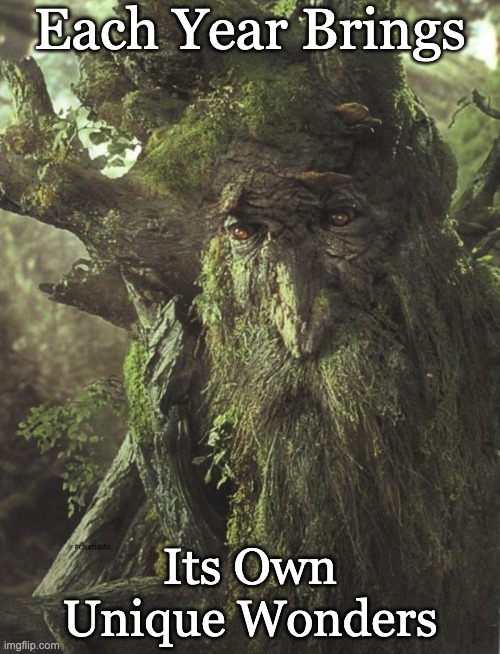
Treebeard would have served any other author (if any other could have conceived him) for a whole book. His eyes are ‘filled up with ages of memory and long, slow, steady thinking.’

Through those ages his name has grown with him, so that he cannot now tell it; it would, by now, take too long to pronounce. When he learns that the thing they are standing on is a hill, he complains that this is but ‘a hasty word’ for that which has so much history in it (“The Dethronement of Power”).

On My Review of the Curmudgeon’s Concerns

My recent review (to which I referred above) was not easy to write. What made it difficult was my mixed opinion of the aphorisms chosen for the publication. Most were quite interesting, and a few were downright brilliant. The problem was the strong bias of the author when he addressed two “controversial” topics – politics and religion.

Unlike Mark Twain, to whom I refer in the review, this author forsakes humor when he deplores subjects with which he disagrees. Twain made it clear how he stood, but usually in a manner that left even his opponents entertained. This particular book is much more “curmudgeonly,” in that some of it is delivered in an ill-tempered, alienating manner.

If you are curious in seeing how I threaded the needle of honestly reviewing a book with problematic material, you can read it here. While praising many aspects of the book, I did make one critical observation related to an aphorism related to The Chronicles of Narnia.

Greene even invokes my favorite author to mischaracterize Christianity. “C.S. Lewis depicted God as a lion. The lion, of course, is a predator.” So much for agnus dei and Aslan’s manifestation as a lamb.

A Final Encouragement

If you are a writer, or an aspiring writer, consider writing some book reviews. It can provide a more welcoming entrée into the publishing world than other features. Write it in a style similar to the reviews they normally run, and be sure to read any guidelines they provide for contributions. As with other submissions, it’s best to query first. Best of luck!


* The World Atlas estimate of 2.5 to 10 sextillions may suggest this estimate of Lewisian reviews may be hyperbole. But at least I did not refer to the number of stars, which is estimated at 10 to 200 sextillion.

Inkling Action Figures

Have you ever dreamt of having an action figure made in your honor? No, neither have I.

Well, that was until I saw this picture of product knockoffs published last week by The Power of Story.

One of the characters portrayed above raised the notion in my mind because of the counterfeit’s “name.” No, it wasn’t the muscular hero with the S emblazoned on his chest (even though my family frequently reminds me that I am “special”).

The figure that inspired me was Robert Cop. Not because I wore a police uniform for seven years (as a volunteer chaplain for the Kitsap County Sheriff’s Office). But because Robert is my own name.

By the way, the Social Security Administration says that it’s still the 80th most popular boy’s name in America (down from 29th twenty years ago). For those curious about the frequency of their own names, I’ll provide a link to the SSA website below.*

“Robert” was number three in the 1950s when I received it (superseded only by James and Michael). That’s not to suggest frequency of usage bears any significance. One could easily argue that having a less common name makes a person more “special.”

Take C.S. Lewis, for example. His full name was Clive Staples Lewis—Clive came from Major-General Robert Clive (1725-1774) and Staples was a great-grandmother’s family name.

In fact, Lewis published his two early poetic works, (Spirits in Bondage in 1919 and Dymer in 1926) under the name Clive Hamilton, using his mother’s original surname.

Later, Lewis chose to use his first two initials for publication and official purposes. To his family and friends, however, he was always known as “Jack.” This oddity was a consequence of his conscious decision as a very young (and, apparently, precocious) child to choose his own name.

In his ‘Memoir’ of his brother, Warren – or ‘Warnie’ as he was known – said that when Clive was about four years old he “made the momentous decision to change his name. Disliking ‘Clive’…he marched up to my mother, put a forefinger on his chest, and announced ‘He is Jacksie.’ He stuck to this next day, and thereafter . . . a name contracted to Jacks and then to Jack” (C.S. Lewis: Apostle to the Sceptics).

C.S. Lewis also, like most of us, had a variety of nicknames. I’ve written about some of them here.

Inkling Action Figures

Sure, heroic characters from Narnia and Middle Earth have been memorialized as action figures. Many have even made it into the hallowed halls of Lego figurines.

But where are their creators (or subcreators, to use Tolkien’s parlance)? I know I’m not alone in yearning for some great Inkling figures. (And I’m confident there must be at least two or three other potential customers.)

Just think of all the dynamic action poses a creative manufacturer could include. You could have C.S. Lewis lecturing at a podium. Or J.R.R. Tolkien busy at his desk working on his translation of Beowulf.

You might pose Charles Williams proofreading a volume of the Oxford English Dictionary. Or Owen Barfield conscientiously administrating C.S. Lewis’ estate. What about Hugo Dyson lecturing about Shakespeare on a 1960s television soundstage?

And these exciting scenes around the campus environment are merely the beginning. Can you imagine a group of them seated around a table at the Eagle and Child pub? Or, getting them off of their bums [British usage], you could pose them in the midst of one of their thrilling walks.

Seriously, several of the Inklings did exhibit heroic actions that would provide forceful images. Take Tolkien and Lewis, for example, during their combat service during the First World War.

Warnie Lewis was a veteran as well, and a career Royal Army officer to boot. Nevill Coghill served in the artillery during the First World War, and occasional member Christopher Tolkien was in the Royal Air Force during the second global conflict.

In one of his essays, Lewis described the use of particular things for alternative purposes. In making his case, he illustrates it with several examples. One is apropos here. And, although he would never have dreamed of it being applied to him personally, I believe it fits the manner in which many of us regard him and his friend Tolkien.

You can use a poet, not as a poet, but as a saint or hero; and if your poet happens to have been a saintly or heroic man as well as a poet you may even be acting wisely. (The Personal Heresy).

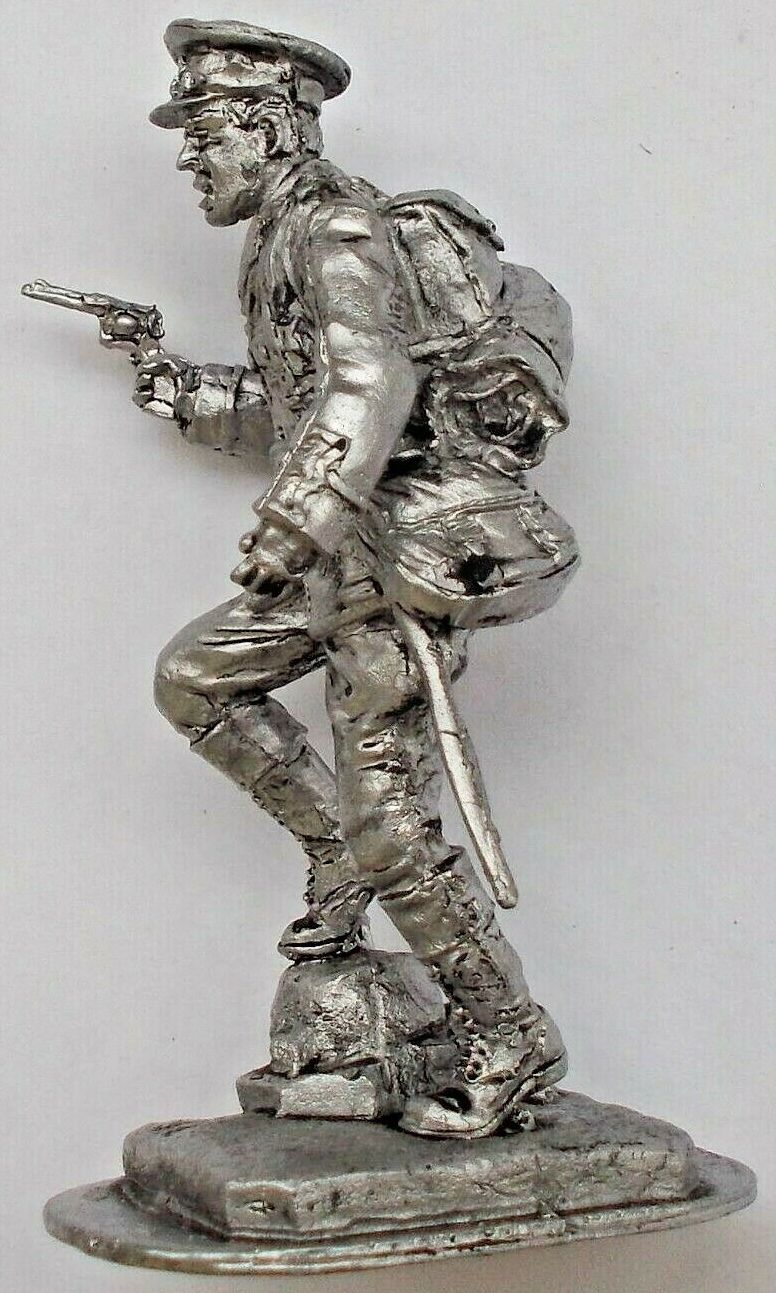
Both men were talented writers. Each was a sincere disciple of Jesus. And both responded to their nation’s call to face the horrors of the Western Front. In light of their service, it seems a skillful designer could base exciting Tolkien and Lewis figurines on something like this generic WWI British officer.

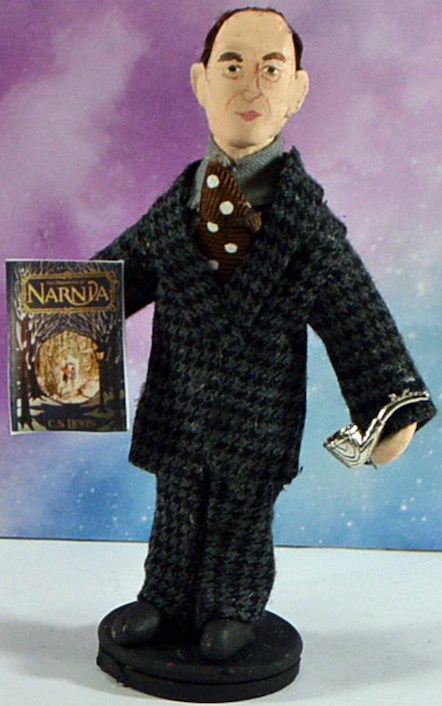
Just do everyone a favor, please don’t use a doll as a template for my literary and spiritual hero.

After all, real heroes are not always cuddly. But they are definitely epic! Just like Robert Cop and Special Man.


* If you are curious about where your first name ranks in popularity, now or during various decades back to the 1880s, you can find out here.

The Patina of the Inklings

Some antiques boast lovely patinas. Some old words do, as well. In fact, I would argue the legacy of, and the deep respect for, the Oxford fellowship known as the Inklings, has created a rich patina of its own.*

The community gifted scholars, especially in the persons of J.R.R. Tolkien and C.S. Lewis, accrued a reputation that continues to gain a deeper luster with each new generation.

When I was a young man, I collected American coins. I also studied what Americans call “World coins.” The latter reinforced my love for geography as well as history.

To me, the most fascinating period of history has long been that of the Roman empire.

 So you can imagine my awe when I learned how simple it was to collect genuine Roman coins.

 This remains true today for common coins, such as bronzes of the fourth century (when the first Christian emperors reigned). This article describes “Collecting Roman Coins on a Budget.”

A surprising number of ancient coins, all readily identifiable and of historical interest, can be acquired for less than $100—and often in the $5-to-$25 range. This is especially true with Roman coins . . .

When I began collecting ancient coins, I learned the multifaceted meaning of a word unfamiliar to me at the time. That word was “patina” (pə’tēnə). As you probably know, it literally refers to the green or brown film (not rust) that appears on bronze and other metals under suitable conditions over a period of time. A handful of coins in my collection possess stunning patinas.

Metaphorical Patina

Many people are also acquainted with the figurative use of the word, as I employed it in my introduction It refers to an appearance or impression of distinction or luster associated with a person, idea or object. It is often linked to esteem held for the past. The following provocative quote comes from a contemporary Swiss artist.

“Life is one long decay, no? There’s a lot of beauty in it. Like the patina in an old city” (Urs Fischer).

Chad Walsh applied it to one of C.S. Lewis’ early books in The Literary Legacy of C.S. Lewis. Writing more than forty years ago, in a discussion of Pilgrim’s Regress, he said:

Regress has permanent value. It is, first of all, a spiritual autobiography, no matter how much Lewis may wish to minimize the personal quality of the quest and make his John into a potential Everyman. . . .

The Regress is already taking on a patina of age, a pleasant chronological quaintness, but time does not render it obsolete.

Four decades after he offered this comment, I believe I am correct in ascribing a warm patina to the Inklings as a fellowship.

Patinas can be added to items, to affect a more aged appearance. While “acquired” patina is always considered desirable, “applied” patina is often quite acceptable. It does not become problematic until the application is used to intentionally misrepresent the age of an item. An example of the proper use of applied patina is seen in these modern busts of C.S. Lewis.

In reviewing Lewis’ writings, I only uncovered one occasion where he used the concept of patina. It occurred in a 1946 letter to his friend, Ruth Pitter. Lewis is contributing to one of their ongoing conversations.

The truth is that there are a great many different kinds of poetry and extreme roughness (or smoothness) evocative epithet (or plain statement), the metaphorical (or literal) the colloquial (or rhetorical) may all, in their place, rise to perfection. . . .

 Once more, read Barfield on Poetic Diction.⁑ That is why Spender’s objection to the ‘willed quality’ in Milton seems to me so bats’-eyed. It is the glory of one kind of poetry to sound un-willed, as if it had dropped out of the sky like Blake or else arisen spontaneously in conversation like Donne.

But then it is equally the glory of another kind to sound willed: to sound as if one were watching, or even sharing, the building of a huge tower.

To demand that Milton should have the spontaneity of Catullus or Blake is like demanding that a King at his coronation or a celebrant approaching the altar should have the same charm as a child dancing in the waves. Don’t we want both: both frolics and rituals? At any rate I do. . . .

Of course you are very right about Patina–again see Barfield. No old French poetry got that peculiar Old-Frenchness which is to us part of the charm. Half the beauties of the Old Testament did not exist for the writers. I wouldn’t be too sure, though, that it is wholly a question of our ‘projecting’ qualities into the old lines.

Ending on a Numismatic Note

Although I have not actively collected coins for many years, I commend it as a rewarding pastime. Seven years ago⁂ I wrote a column about religious likenesses on coins, which included a moving poem written by C.S. Lewis. You can read it here.

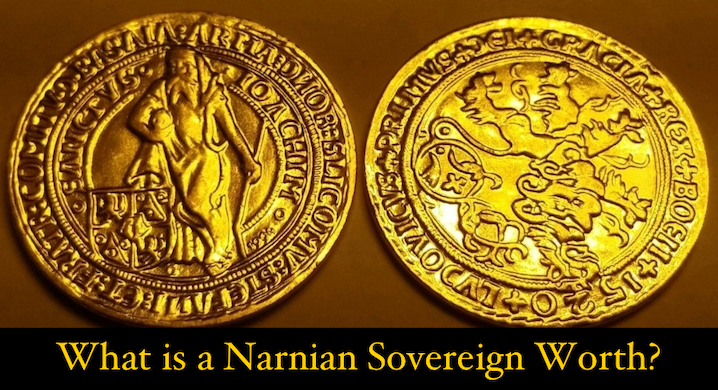
While writing this column I came across some genuine Narnian coins that were minted in New Zealand. They are genuine in the sense that they possess actual face values for legal tender in the island nation, which minted similar coins in honor of Middle Earth.

In terms of Narnian coins which circulated in Narnia itself, I learned that you can purchase “coins” which were used as actual props “appearing” in the recent Chronicles of Narnia films.

For an Inkling cinema buff such as myself, deciding to grab one for my personal collection was a no-brainer.


* The writings of the Inklings have even enhanced the patina of Oxford itself. This is especially true for those who live “across the pond,” and will never journey to the city itself. In a succinct review of The Inklings of Oxford: C.S. Lewis, J.R.R. Tolkien, and their Friends, one Aussie architect refers to the stately oxidation of the city’s copper, brass and bronze: Picturesque book of picturesque Oxford focusing on C.S. Lewis and J.R.R. Tolkien and the elegant, much patina-ed Oxford environment that they lived in.” I imagine he would concur with my suggestion that the Inklings themselves also bear a splendid patina.

⁑ Owen Barfield dedicated this book to his good friend with the inscription: “To C.S. Lewis ‘Opposition is true friendship’”

⁂ Seven years of blogging does sound like a lengthy time, but it’s not long enough for even the best of posts to accrue a patina of their own.

C.S. Lewis, Ghosts & Anthroposophy

C.S. Lewis begins his essay “Miracles” with a rather odd analogy. “I have known only one person in my life,” he writes, “who claimed to have seen a ghost.” As he tells the rest of the story, it works well to illustrate his point about the necessity of faith for recognizing miracles.

It was a woman; and the interesting thing is that she disbelieved in the immortality of the soul before seeing the ghost and still disbelieves after having seen it. She thinks it was a hallucination. In other words, seeing is not believing. This is the first thing to get clear in talking about miracles. Whatever experiences we may have, we shall not regard them as miraculous if we already hold a philosophy which excludes the supernatural.

In our previous post, we explored a number of references to ghosts in C.S. Lewis’ works and correspondence. Most of these notes relate to encountering these disembodied spirits in literature.

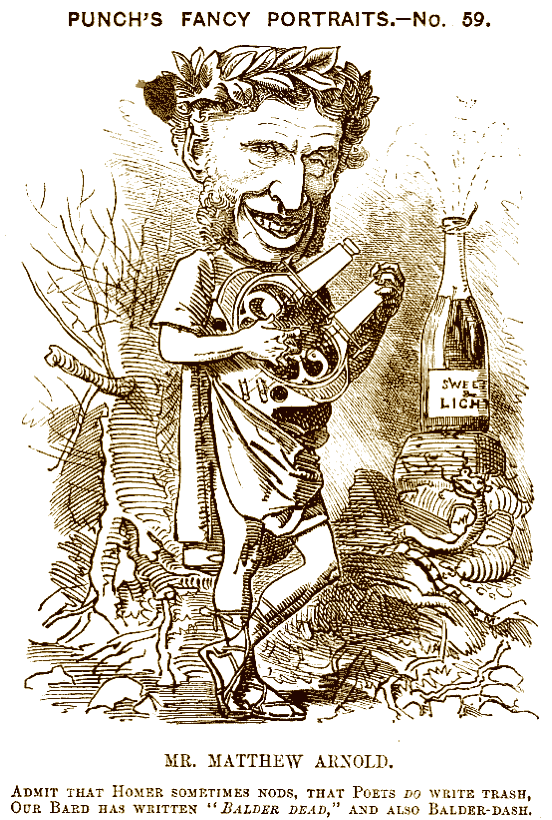
For example, as a young man, he commended a poem by Matthew Arnold (1822-1888) to his friend Arthur Greeves.

I was sure that you wd. like “Balder Dead . . .” it is a topping piece of work, especially the journey, as you say, and the description of the ghosts, and the ending with its impressive pause before the glorious line “At last he sighed & set forth back to Heaven.” Doesn’t it all make you think of the dear old days when we were writing our great opera on Loki & Odin & the rest?

It is easy to see how “Balder Dead” resonated with Lewis, given his affinity for “Northernness.”

And doleful are the ghosts, the troops of dead,
Whom Hela with austere control presides…
And all the nobler souls of mortal men
On battle-field have met their death, and now
Feast in Valhalla, in my father’s hall;
Only the inglorious sort are there below…

In 1952, C.S. Lewis was invited to comment on a volume written by Phyllis Elinor Sandeman. The sensitive Inkling displayed the virtues of every good member of a writing critique group. Lewis begins with praise, and offers a single, concrete constructive comment, to aid the author.

Dear Mrs. Sandeman, I have read Treasure on Earth and I don’t believe you have any notion how good it is. . . . The only page that I can’t enter into at all is p. 83. I can’t conceive not being afraid, as a child, of those unseen presences. I should have behaved like little Jane Eyre in the Red Room when she dried her tears for fear a ghostly voice should awake to comfort her. One would rather be scolded by a mortal than comforted by a ghost.

Lewis is referring to a passage in which a specific location in her childhood home presumably granted the author immunity from fears: “Stories of ghosts and witches so delightful in cheerful company returned to trouble her when alone in the dark. It was impossible ever to feel fear in the drawing-room—there could surely never be a room more conducive to peace of mind.”

Two months later, Lewis again wrote Sandeman, perhaps to address her disappointment at receiving his comment about ghosts.

You were perfectly right to put in the bit about the friendly ghosts. I think the absence of fear is, as far as it goes, probable evidence that the experience was not merely imaginary. Everyone fears lest he should meet a ghost, but there seems to be some ground for supposing that those who really meet them are often quite unafraid.

Notice that angels, on the other hand, seem in Scripture to be nearly always terrifying & have to begin by saying “Fear not.”

In Ireland I stayed at a lonely bungalow last summer which the peasants avoided not because a ghost had been seen near it (they didn’t mind ghosts) but because the Good People, the Faerie, frequented that bit of coast. So apparently ghosts are the least alarming kind of spirit.

In a letter to another correspondent, Lewis describes the same stay at the isolated Irish lodging. “I have been really in quiet and almost unearthly spots in my native Ireland. I stayed for a fortnight in a bungalow which none of the peasants will approach at night because the desolate coast on which it stands is haunted by ‘the Good People.’ There is also a ghost but (and this is interesting) they don’t seem to mind him: the faerie are a more serious danger.”

The Anthroposophist Connection

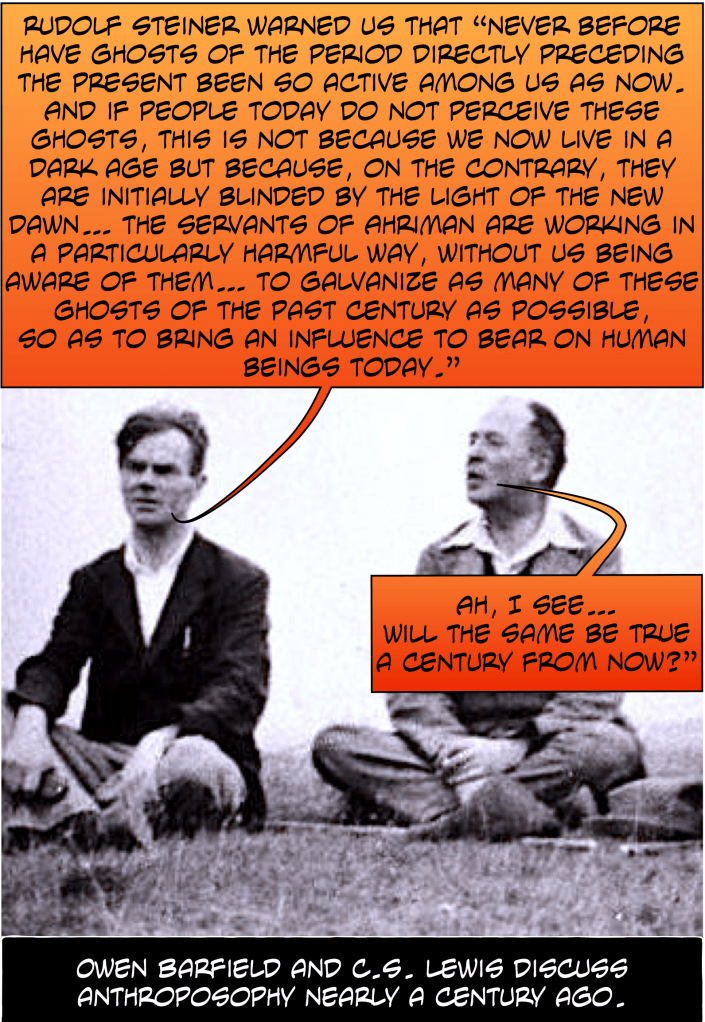
Anthroposophy is a religious philosophy created by Rudolf Steiner (1861-1925). It is diametrically opposed to Christian revelation, and was the cause of one of C.S. Lewis’ greatest disappointments. Tragically, his dear friend and fellow Inkling, Owen Barfield, subscribed to Steiner’s doctrines. C.S. Lewis’ “Great War” with Owen Barfield describes a five year period when the two young scholars argued about the religion. Unfortunately, this was prior to Lewis’ own conversion, so he did not bring a Christian faith to the battle.

Steiner’s religion is complex and confusing. There are, in his view, a plurality of gods. And the god to whom he refers as humanity’s Creator is not the God of Genesis. Steiner argues we have lost sight of the true knowledge or gnosis.

During this [contemporary] era, people no longer see Christ as the being who came down from the stars, because they do not understand the stars themselves as an expression of the spirit as it weaves in the cosmos. For humanity today, there is no God or Christ in the cosmos. (The Three Eras of Human Religious Education)

Naturally, since Barfield was such a good friend of Lewis, there is much that is commendable in him . . . despite his esoteric beliefs. Lewis, after all, entrusted Barfield to be the executor of his estate. Despite their differing theologies, Lewis wrote nakedly about his deep sorrow in the wake of the death of their fellow Inkling, Charles Williams.  

My dear Barfield Thanks for writing. It has been a very odd experience. This, the first really severe loss I have suffered, has (a) Given corroboration to my belief in immortality such as I never dreamed of. It is almost tangible now. (b) Swept away all my old feelings of mere horror and disgust at funerals, coffins, graves etc.

If need had been I think I could have handled that corpse with hardly any unpleasant sensations. (c) Greatly reduced my feeling about ghosts. I think (but who knows?) that I should be, tho afraid, more pleased than afraid, if his turned up. In fact, all very curious. Great pain but no mere depression.

In this letter C.S. Lewis is speaking wistfully about the ghost of a friend. He is well aware of the fact that—despite the British fascination with spiritualism—that is not how the afterlife works. Those who die “in Christ” join him in Paradise, just as he promised the believing thief who perished beside him.

Ghosts do not wander around the earth. Those are different types of spirits, to be discussed another day. By contrast here are some Steinerian thoughts on the subject.

When human beings cling too strongly to earthly things it may be difficult for them to find their bearings in the sphere of the Moon Beings [which] may cause human beings who have to pass after death into the Moon sphere—the soul-world—but are unable to understand the Moon Beings, to be trapped . . . and they can actually be seen . . . wandering about as ghosts, as spectral shades. (Steiner, Karmic Relationships)

The accumulation in the etheric body caused through these [wicked] experiences of the soul . . . brings about detachments from the beings working in the spiritual worlds and these likewise are now to be found in our environment—they are the “specters” or “ghosts.” (Steiner, Nature Spirits)

Ghosts, as they are generally called, are spirits which have acquired a sensory-physical character (or have become tangible) through the human organisation, whereas impulses, instincts, desires and passions are modern spectres pointing towards the future, spectres which have not yet been raised to spirituality. (The Contrasting World-Conceptions of East and West)

But enough of quotations that foster more confusion than understanding. Let’s look at a letter C.S. Lewis wrote to his friend Arthur Greeves in 1920. In it Lewis describes a visit with Leo Kingsley Baker (1898-1986). Like Lewis, Baker was a young veteran of the First World War. Both served in France, Lewis in the trenches and Baker as a pilot in the RAF. Baker also happened to be an Anthroposophist, and it was in fact Baker who introduced C.S. Lewis and Owen Barfield.

I was in [Leo] Baker’s rooms with [Rodney] Pasley last night: Pasley departed early and the conversation between us two fell on shadowy subjects–ghosts and spirits and Gods. You may or may not disbelieve what followed.

Baker began to tell me about himself: how he had seen things ever since he was a child, and had played about with hypnotism and automatic writing: how he had finally given it all up, till now “things” were coming back of their own accord. “At one time” he said “I was afraid to look round the room for fear of what I might see.”

He also stated confidently that anyone could compel a ghost to appear, that there were definite ways of doing it: though of course the thing you “fished up” might not be what you wanted—indeed quite the contrary.

The greater part of his views I will reserve for our next meeting: what I wanted to tell you was the effect on me. I got, as it were, dazed and drunk in all he said: then I noticed his eyes: presently I could hardly see anything else: and everything he said was real—incredibly real.

When I came away, I moved my eyes off his, with a jerk, so to speak, and suddenly found that I had a splitting headache and was tired and nervous and pulled to pieces. I fancy I was a bit hypnotised. At any rate I had such a fit of superstitious terror as I have never known since childhood and have consequently conceived, for the present, a violent distaste for mysteries and all that kind of business. Perhaps he is a bit mad.

It comes as little surprise that an encounter such as this would leave one with a serious headache. Likewise, further consideration of these arcane matters here at Mere Inkling would likely promote similar cranial vexation. Suffice it to say, as we close, that we who trust in Christ need not fear any spirit or demon we might encounter, because “greater is he who is in [us] than he who is in the world” (1 John 4:4).

The Inklings of Mount Hermon

mount hermon.png

Few writers attain their full potential without the advice and encouragement of others.

C.S. Lewis and J.R.R. Tolkien recognized that fact.

For many years they gathered regularly with a number of other keen minds, almost all of whom shared their Christian faith. (Notably, Owen Barfield who was an Anthroposophist, was a notable exception.)  Some writers visited the community as guests.

I’ve written in the past about the great benefit provided by Inkling-style literary criticism. It’s all about synergy.

Mount Hermon Christian Writer’s Conference is one of the premier gatherings of its sort. After many years of hoping to attend, my wife and I journeyed to California for its Fiftieth Anniversary this past week. What a blessing!

In addition to hundreds of zealous writers, the conference was attended by twoscore publishers, agents and writing experts who generously shared their vast knowledge. And I use that word “generously” in a literal sense. The faculty made itself accessible to a degree I have never before witnessed (and I am a veteran of innumerable professional conferences). The speakers were sincerely interested in encouraging each and every participant.

Classes were available for writing novices, journeymen and experts. I found the track on screenwriting to be the most helpful for my own current needs. I hope to put these new lessons into practice in the next few years.

I can confidently assure you that Mount Hermon will also offer the sort of advice and encouragement that you need to advance your own skills to the proverbial “next level.” If you are interested in attending Mount Hermon, you can learn more here.

Back on the Home Front

If you have never enjoyed the benefits of gathering locally with other writers, I strongly encourage you to consider it now.

If you’re on a critique-group-hiatus due to past disappointments, why not look for a fresh group with a healthier focus?

I sincerely believe most of us become better writers while growing together, than we do wandering on our own. Mount Hermon reinforced that conviction.

I encourage each of you to reach your own full potential—with a little help from some new friends.

C.S. Lewis and his Secretary

hooper

Upon Lewis’ death, Walter Hooper assisted Inkling Owen Barfield (1898-1997) in overseeing Lewis’ literary estate. He continues to serve as a literary advisor to the estate. Hooper’s Lewisian contributions have grown in magnitude over the years.

He began by co-authoring a biography of Lewis in 1974, written jointly with Roger Lancelyn Green (1918-87). Green had been a student of Lewis, and a member of the Inklings. After writing several other works through the years, in the late nineties he penned C.S. Lewis: A Companion and Guide and C.S. Lewis: A Complete Guide to His Life and Works. Priceless resources!

The list of material edited by Hooper is quite impressive. He dutifully, and brilliantly, edited many of Lewis’ writings. The world should be particularly grateful for the three-volume compilation of Lewis’ correspondence. A humble man, Hooper writes sincerely in the preface to the volumes: “The eight years I have spent editing the letters would not have been as fruitful nor as pleasant were it not for the help of many others. My debts are numerous, and nothing I can say can adequately reflect my gratitude.”

Hooper’s meeting with Lewis was providential, coming as it did so near the end of the great author’s life. The following letter describes their arrangement. It reveals how much Lewis appreciated the initial assistance provided by Hooper, and how hopeful he was that Hooper would be able to resume his secretarial duties in the summer of 1963. Lewis remained, however, concerned about how he would meet all of his financial responsibilities in the wake of his medical retirement.

[The Kilns] 20 Sept 63

My dear Walter

We get on reasonably well, tho’ we all greatly miss, not only your utility, but your companionship. No one has ever so endeared himself to the whole household.

The noble Arthurian volumes continue to arrive, but are not yet on the shelves. The work of arranging all my books in their new homes, tho’ delightful, goes on v[ery] slowly, for I am not strong enough to do more than a little each day.

Now, about the future. It is entirely reasonable that you shd have a salary and a darn good one, and I feel I have been rather sponging on your kindness. But what it may be proper for you to ask may also be impossible for me to do.

I dare not at present increase my expenses. In this country one is taxed each year on the income of the previous year. One’s first year in retirement is therefore very alarming. And if, on top of the drop in income, there are the expenses of an illness, and some rather heavy and unexpected expenses for David–well you see.

I am v. ashamed, not of confessing the situation, but of refusing the wholly just demand from a man to whom I already owe more than any money could repay.

But you see, having you as a paid secretary wd. be a luxury, and I’ve no right to imperil those who depend on me for the sake of a luxury to myself.

On other grounds, I couldn’t recommend you to come in January. Mrs Miller and I talked it over and both concluded that an English house in an English winter wd. be misery for you. Our central-heating apparatus is v. primitive (nothing like yours) and we can afford to use it only during very cold snaps.

If you can afford to come in June, you will be thrice welcome. W. is still away. I fear he’ll kill himself if this goes on much longer.

Our plums are splendid this year. With all our loves. Yours Jack

A Wonderful Interview with Hooper

Walter Hooper has been very content to remain behind the scene, and deep in the shadow of the man whose memory he preserves.

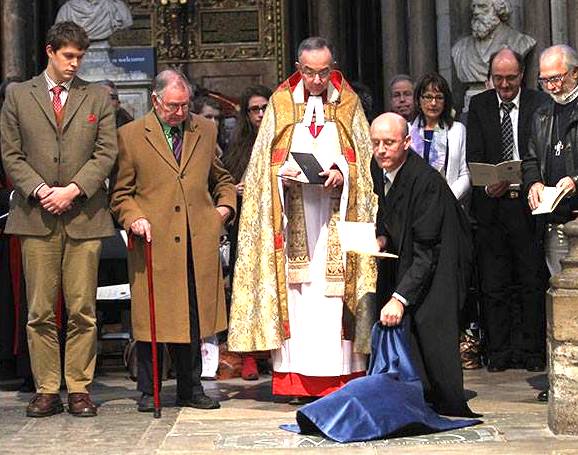
Fortunately, in addition to his personal writings and editorial work, Hooper has been willing to speak in various settings. The photograph at the top of the page comes from the unveiling of Lewis’ memorial in Westminster Abbey’s Poets’ Corner.

We owe a debt of gratitude to “Socrates in the City: Conversations on the Examined Life,” which is produced by Eric Metaxas, a Christian writer and syndicated radio host.

Metaxas took his program from the city of New York, to the city of Oxford to avail himself of the wealth of brilliant speakers accessible there. Among those he interviewed in this casual setting is Walter Hooper. Wonderfully, the Hooper interview was substantial enough that it is presented in three parts. Do check it out.

Suspicious Séances

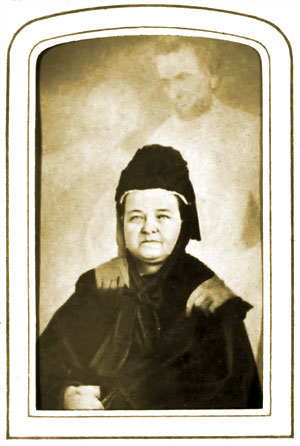
lincolnsDid you hear about the séances that were held at the White House? It’s true, but it’s not recent news. They were conducted for Mary Todd Lincoln, and her husband, the president, apparently joined in attendance at some of them.

The Lincoln’s had lost their eleven year old son Willie to Typhoid in February 1862. Nearly all historians describing Mary’s grief accurately use the word “inconsolable”.

Since the Lincoln’s were not Christian, Mary sought the illusion of comfort in spiritualism, a thriving movement in the mid-nineteenth century. Spiritualism typically contends that the spirits of the dead survive in a manner where they can, and do, communicate with the living. This interchange is typically facilitated by a “medium,” someone particularly attuned to the “spirit world.”

Mediums sometimes allow themselves to become physical vessels for these spirits.

Christians either dismiss such experiences as fraud, or as demonic possession. Which depends on their own worldview. Some Christians dismiss the spiritual realm, while others recognize it is quite real.

C.S. Lewis would be in the latter camp, as his preface to The Screwtape Letters amply illustrates.

There are two equal and opposite errors into which our race can fall about the devils. One is to disbelieve in their existence. The other is to believe, and to feel an excessive and unhealthy interest in them. They themselves are equally pleased by both errors and hail a materialist or a magician with the same delight.

Christians who acknowledge the spiritual warfare which is waged beyond our physical senses understand the meaning of Paul’s words: “For we do not wrestle against flesh and blood, but against the rulers, against the authorities, against the cosmic powers over this present darkness, against the spiritual forces of evil in the heavenly places” (Ephesians 6:12).

Returning to the 1800s

The reason I have been thinking about Mary Lincoln—who would later be institutionalized and attempted suicide—is because I’m finishing up an article for the online journal I edit about the military chaplaincy. It’s called Curtana: Sword of Mercy, and the new issue will be posted by the end of the month.*

The specific article relates the story of Ellen Elvira Gibson (Hobart),** who was the first woman chaplain in the American military. She served a Wisconsin regiment, and her story is nothing short of fascinating.

Hobart was a spiritualist, and “ordained” by a group of the same who banded together to provide just such credentials. Interestingly, although she gave hundreds of (paid) lectures in a spiritual “trance” state, she would ultimately reject spiritualism. She turned to a more radical and secular “freethinking” as spiritualism was waning in popularity, but still a formidable presence.

Chaplain Hobart would gain renown in anti-Christian circles for her book The Godly Women of the Bible by an Ungodly Woman of the Nineteenth Century. Numerous atheist websites cite a quotation from the volume. “The abominable laws respecting [women in the Bible] . . . are a disgrace to civilization and English literature; and any family which permits such a volume to lie on their parlor-table ought to be ostracized from all respectable society. . .”

Contemporary readers will find it odd that one of the reasons spiritualism received a warm welcome in Europe and America was precisely because it seemed to offer measurable, “scientific” evidence of the afterlife. In This Republic of Suffering: Death and the American Civil War, Drew Faust writes:

To an age increasingly caught up in the notion of science as the measure of truth, spiritualism offered belief that seemed to rely on empirical evidence rather than revelation and faith. If the dead could cause tables to rise, telegraph messages from the world beyond, and even communicate in lengthy statements through spirit mediums, an afterlife clearly must exist. Here was, in the words of one popular spiritualist advocate, ‘proof palpable of immortality’” (180-81).

Returning to the Inklings

One of Lewis’ dearest friends was Owen Barfield. Sadly, the two remained separated throughout life by their religious beliefs. Barfield had helped Lewis come to believe in God (i.e. theism) but could not journey with Lewis on to Christianity. Barfield, instead, became one of the greatest of Anthroposophist evangelists.

Anthroposophy possesses elements of philosophy, but is also inarguably a religion in its own right. It also holds a view of the afterlife distinct from both Christianity and historic spiritualism.

But the nature of the religion created by Rudolf Steiner (which evolved from his involvement in Theosophy) is not the subject of our reflections here. However, if one is interested in learning more about Owen Barfield, a 1992 documentary can be viewed here.

_____
The image above is a famous example of “spirit photography” taken by William Mulmer, who made it popular. He was once placed on trial for fraud, but the case was dismissed for lack of evidence.

* I may delay publication of this particular article since the issue will already carry the biography of another chaplain.

** The reason “Hobart” is bracketed, is because it was her married name at the time of her military service. However, the marriage was short lived, and most of her life she went by “Ella E. Gibson.”