Curious Christian Trivia

beatlesHow many of these Christian trivia questions can you answer?

In my last post I shared a number of fascinating facts that I learned reviewing Catéchic, “the Catholic trivia game” by Tyco®. Read on and discover some intriguing information about the history and theology of the largest denomination in the Christian world.

How are the following for odd facts?

Question: What Iowa city has a name which means “of the monks” in French?

Answer: Des Moines

Here in Washington State we have city named Des Moines (pronounced with the final “s”) which is named after the Iowa township and not the monks who first helped established it.

What New York museum was built entirely from stones of Christian shrines imported from France by John D. Rockefeller?

The Cloisters

Leave it to the Americans to denude a country of their historic shrines to aggrandize a civil monument to a political dynasty.

Was St. Patrick Irish?

No

Now there’s a fact with which many Irishmen would take umbrage. The truth is, of course, that Patrick was Romano-British, enslaved by the Irish, who willingly chose to return to Ireland after his liberation to share the Gospel with his former captors.

The game includes a fair representation of literary questions. Two of them even deal with the esteemed author of The Chronicles of Narnia. Just one for now, with the promise of more literary insights in my next, and final, column about trivia.

Who is the Anglican children’s author that wrote the apologia The Case for Christianity?

C.S. Lewis

I can overlook the inappropriately limiting label “children’s author” since they have had the wisdom to include this reference to the Oxford don.

Students of history, including recent history, will have an advantage in answering the following questions.

Who designed the colorful uniforms of the Swiss Guard at the Vatican?

Michelangelo

They still look dandy. Fortunately for the security of the Papal See, they have advanced from relying on pikes to using modern weaponry.

Who was the most famous Bishop of Hippo?
Saint Augustine

Who in the world could name any other Bishop of Hippo?

Besides Richard M. Nixon, what other U.S. president was a Quaker?

Herbert Hoover

Didn’t know that. And, as memorable as Herbert Hoover was, I fear I’ve already forgotten . . .

Who was the Catholic, four-term mayor of Chicago known as “Boss?”

Richard J. Daley

Ugh. Two dishonest politicians in a row! I don’t believe I would want to claim Daley as a Roman Catholic if I was one . . . or Nixon as a Quaker, if I professed that creed.

According to the Beatles song “Let It Be,” who whispers words of wisdom?

Mother Mary

This must have been before the Beatles jettisoned any lip service to Christianity, claimed their renown exceeded that of Jesus, and entrusted their spiritual destiny to the philosophy of Maharishi Mahesh Yogi.

Naturally the questions include a variety of details about Roman Catholic faith and practices themselves.

Should Catholics genuflect whenever they enter a Catholic Church?

No, only if the blessed Sacrament is present in the church.

Interesting. I had never thought about it, but it makes sense, since the obeisance is actually being offered to Jesus, present in the consecrated elements.

For what group is the annual Red Mass celebrated?

Lawyers

Observation: What? Whose idea was that, and do Roman Catholics grace all other professions with their own dedicated masses? If so, what color Masses are dedicated to insurance brokers, microbiologists and wig makers?

What was the name of the portable throne once used to carry the pope so that everyone could see him?

Sedia Gestatoria

Replaced by the bulletproof Popemobile.

When was the last time that a pope proclaimed a Catholic teaching infallible?

1954 (the Assumption, Pope Pius XII)

A good reminder to countless misguided Protestants who think Roman Catholics believe that most or all of what the popes say is “infallible.” The lesson would be better taught, however, if the cited instance was not for an extra-biblical doctrine with which most Protestants strongly disagree.

What is the day on which Judas received his payment for betraying Jesus sometimes called?

Spy Wednesday

That’s a new one for me, but it sounds like a great title for a new movie about the wayward disciple.

Who was the first Roman Emperor to convert to Christianity?

Constantine the Great

It is good to see Constantine’s conversion affirmed here, although it is often maligned by critics. (Constantine was a child of his brutal age and after his conversion remained an imperfect sinner, just like the rest of us.) Only in the Eastern (Orthodox) Church is Constantine acclaimed a saint.

I will end with a question that holds a special place in my life, since I have spent the majority of my public ministry as a military chaplain.

What was the name of the Catholic chaplain on the TV show M*A*S*H?

Father Mulcahy

My favorite chaplain. I had the “blessed” experience of interviewing him for an article. I posted on William Christopher here and you can download a copy of the interview here.
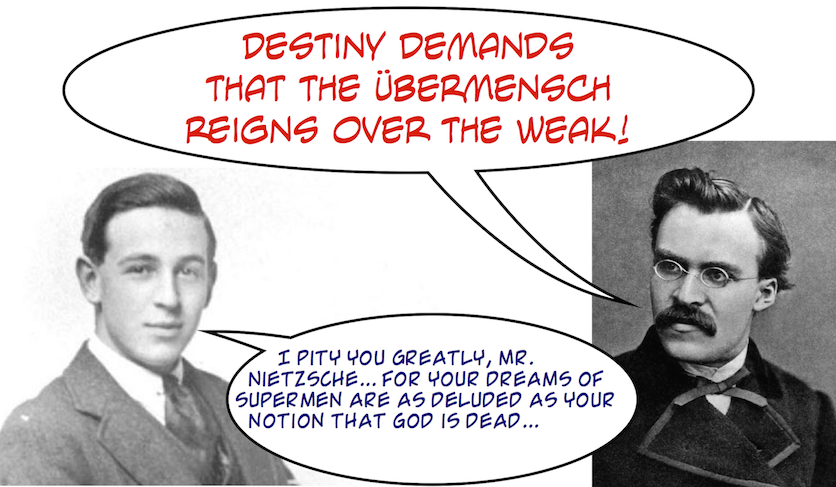
C.S. Lewis and Supermen

NietzscheI unexpectedly encountered C.S. Lewis while unpacking a box today.

I’m ashamed to admit it, but five years after moving into our retirement home, I have yet to unpack half of my library.

The text that stood out among the two score volumes restored to the light today is called The Cult of the Superman. It was written in 1944 by Eric Bentley.

The 1969 edition which I possess includes “An Appreciation” by C.S. Lewis. Before emigrating to the United States, Bentley had studied under Lewis at Oxford. He spent his own professorial career at Columbia University.*

I have yet to find the time to read the volume, but it’s subtitle clarifies the profound subject it addresses: A Study of the Idea of Heroism in Carlyle and Nietzsche, With Notes on Other Hero-Worshippers of Modern Times. Thomas Carlyle and Nietzsche, in elevating the exceptionality of the hero or superman who “shapes history,” diminish the value of the vast majority of human beings who seek no such domineering role.

This view, so warmly embraced by the Nazis, is directly opposed to the Christian worldview.

The news that God lifts the lowly will come as a disappointment to any supermen or superwomen who are reading this.

However, to those of us who do not yearn to rule over the masses, it is joyous news. “Blessed are the poor in spirit, for theirs is the kingdom of heaven.”

In Jesus’ own words, “Whoever exalts himself will be humbled, and whoever humbles himself will be exalted.”

Nietzsche would revile those words, yet his knee too will one day bow before the One who “emptied himself, by taking the form of a servant, being born in the likeness of men.”

In his “Appreciation,” Lewis declares that Bentley is the right man to address this challenging topic.

The Author, though sternly critical, has a sympathy which I cannot emulate with those elements in Heroic Vitalism which really deserve a serious answer, and this enables him to make a constructive book out of what might easily have become a mere chamber of horrors.

Sheep or Wolves?

This aggrandizement of those who seize their self-ordained right to lord over others can certainly lead to horrors. One example I recently saw was a violent criminal’s justification for his actions. “There are sheep and there are wolves. I’m a wolf. The sheep only exist for my benefit.”

Those of us who comprise the lambs find it inconceivable that evil people believe we exist only to be preyed upon. Yet, this is precisely what predators think. And this Nietzschean notion can justify any atrocity, based as it is upon the maxim that “might makes right.”

Coincidentally, as I was writing this column, “Fishers of Men” by The Newsboys began playing. The first lyrics in the song coincide perfectly with the biblical promise above that every single person—including you—is precious to God.

Seven billion people on a spinning ball,

And they all mean the world to You.

So much for those who would consider themselves super-men . . .

_____

* Lewis’ praise for Bentley’s work is also found in a letter included as an expression of appreciation in ‪The Play and Its Critic: Essays for Eric Bentley.

For an interesting assessment of Lewis’ influence on Bentley’s vocation as a drama critique, Donald Cunningham writes in his Ph.D. dissertation:

Dissent and debate were seen by Lewis as a method for testing ideas, and so he felt that discussion of an ideological sort could only strengthen a grasp on truth. . . . It is possible, then, that Bentley’s positive attitude toward conflict and its necessary presence in a pluralistic, growth-oriented world was learned at Oxford.

True Friendship

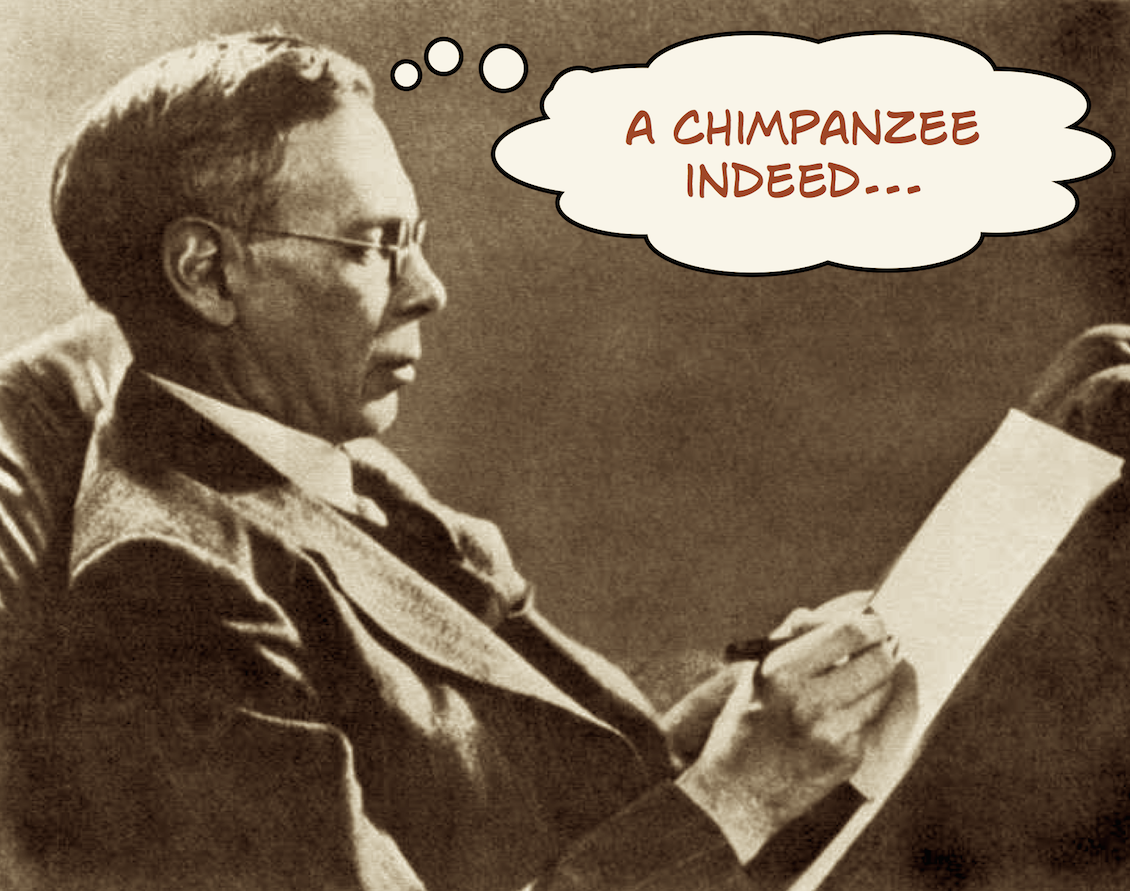
charles williamsIt seems odd to describe someone you deeply respect with the words “ugly as a chimpanzee,” but that’s precisely what C.S. Lewis once did.

Yet, reading the description in full, we find that Lewis considered the physical unattractiveness of his mentor to be a positive thing. In a sense, it accented his impressive persona.

Describing Charles Williams to his childhood friend, Arthur Greeves, Lewis wrote:

As for the man: he is about 52, of humble origin (there are still traces of cockney in his voice), ugly as a chimpanzee but so radiant (he emanates more love than any man I have ever known) that as soon as he begins talking whether in private or in a lecture he is transfigured and looks like an angel. He sweeps some people quite off their feet and has many disciples. Women find him so attractive that if he were a bad man he could do what he liked either as a Don Juan or a charlatan.

I find this description evocative of the words about Jesus’ physical appearance. You can read the full passage about Jesus, the promised Messiah, here.

For he grew up before him like a young plant, and like a root out of dry ground; he had no form or majesty that we should look at him, and no beauty that we should desire him.

Lewis continues with his description of Williams, revealing a more intimate relationship than the previous words might suggest. Williams, you see, was one of the Inklings.

He works in the Oxford University Press. In spite of his “angelic” quality he is also quite an earthy person and when Warnie, Tolkien, he and I meet for our pint in a pub in Broad Street, the fun is often so fast and furious that the company probably thinks we’re talking bawdy when in fact we’re very likely talking Theology. He is married and, I think, youthfully in love with his wife still.

I find it amazing how vivid Lewis’ portrait of his colleague is. He briefly passes over his physical appearance (the least important of human traits, despite what the modern era intimates). And, even though his words are not flattering, the rest of the description reveals they are expressed with deep affection.

Lewis then quickly presses on to a poetic depiction of Williams’ oratorical skills, and concludes with a personable picture of the man among brothers. The final sentence, given Lewis’ perception that he himself would remain a lifelong bachelor, is quite perceptive.

Mutual respect—especially when tempered with affection—generates bonds that allow for honest assessments of both weaknesses and strengths.

A Personal Experience

I recall receiving a lovely engraved glass plaque as a memento of my tour at the United States Air Force Chaplain School. Most of my duties related to writing, but it was common knowledge that there were few subjects on which I did not have something to say.

When the Commandant of the Institute read the inscription during the presentation (it was the first time he had seen it), he paused in embarrassed silence thinking he must have read it wrong. It didn’t sound like the flattery that traditionally adorns such tokens.

“He says in a book what others say in a sentence.”

You can only offer such a dialectical “compliment” to a friend.

It was true, of course, and it was to much laughter that I immediately responded, “True, and it is a book well worth reading.”

When I read this description of the literary friend who made such a profound impression on Lewis, it makes me smile. It is all the more poignant, since it was written just a year before Williams’ death.

There are far, far worse things a person can experience than having someone who respects and loves them say they resemble a chimpanzee . . . or that they tend to be just a little bit verbose.

Easter, Updike & Lewis

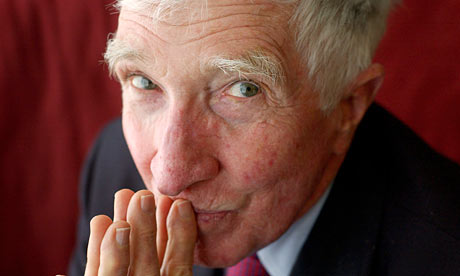
updikeHappy Easter Monday. Even if you do not believe Jesus has risen from the dead, I sincerely hope you are experiencing a special season of hope and peace.

For Christians, however, the bodily resurrection of Jesus is not an optional doctrine.

The Scriptures affirm the truth that, “. . . if Christ has not been raised, then our preaching is in vain and your faith is in vain. . . . if Christ has not been raised, your faith is futile and you are still in your sins. Then those also who have fallen asleep in Christ have perished. If in Christ we have hope in this life only, we are of all people most to be pitied” (1 Corinthians 15:14-19, ESV).

John Updike (1932-2009) recognized this truth and wrote an oft-quoted poem about it.*

“Seven Stanzas at Easter”

Make no mistake: if he rose at all

It was as His body;

If the cell’s dissolution did not reverse, the molecule reknit,

The amino acids rekindle,

The Church will fall.

It was not as the flowers,

Each soft spring recurrent;

It was not as His Spirit in the mouths and fuddled eyes of the

Eleven apostles;

It was as His flesh; ours.

The same hinged thumbs and toes

The same valved heart

That—pierced—died, withered, paused, and then regathered

Out of enduring Might

New strength to enclose.

Let us not mock God with metaphor,

Analogy, sidestepping, transcendence,

Making of the event a parable, a sign painted in the faded

Credulity of earlier ages:

Let us walk through the door.

The stone is rolled back, not papier-mache,

Not a stone in a story,

But the vast rock of materiality that in the slow grinding of

Time will eclipse for each of us

The wide light of day.

And if we have an angel at the tomb,

Make it a real angel,

Weighty with Max Planck’s quanta, vivid with hair, opaque in

The dawn light, robed in real linen

Spun on a definite loom.

Let us not seek to make it less monstrous,

For our own convenience, our own sense of beauty,

Lest, awakened in one unthinkable hour, we are embarrassed

By the miracle,

And crushed by remonstrance.

Updike & Lewis

Poetry and faith were not the only interests shared by Updike and C.S. Lewis. Both men were literary critics, as well as authors in their own right. Updike’s description of his approach to criticism echoes many of the same principles displayed by Lewis.

1. Try to understand what the author wished to do, and do not blame him for not achieving what he did not attempt.

2. Give enough direct quotation—at least one extended passage—of the book’s prose so the review’s reader can form his own impression, can get his own taste.

3. Confirm your description of the book with quotation from the book, if only phrase-long, rather than proceeding by fuzzy précis.

4. Go easy on plot summary, and do not give away the ending.

5. If the book is judged deficient, cite a successful example along the same lines, from the author’s œuvre or elsewhere. Try to understand the failure. Sure it’s his and not yours?**

Updike wrote, “I read C.S. Lewis for comfort and pleasure,” praise that has been included in advertising campaigns. A fuller account of his appreciation for Lewis’ work comes in the following passage, from Conversations with John Updike.

The provableness of God is a subject Updike may have mused upon during the many Sunday mornings he has spent in church. Updike is a lifelong churchgoer. He was raised a Lutheran, became a Congregationalist during his first marriage, and has recently joined the Episcopal church.

“I don’t see anything else around really addressing, for me, one’s basic sense of dread and strangeness other than the Christian church,” he said. “I’ve written maybe all too much about religion here and there. But there have been times when I read a lot of theology. The year I spent in England [after graduation from Harvard] I was very nervous and frightened, standing more or less on the threshold of my adult life and career, if any.

“One of the ways I assuaged my anxiety was to read a lot of G.K. Chesterton and C.S. Lewis, some Kierkegaard, and when I moved to New England, I read a lot of Karl Barth. My intensive theology reading extends from about the age of 22 to, say, 30. I get great pleasure out of reading theology.”

Reading Theology

Updike was correct. Contemplating holy matters can certainly be pleasurable. That is true even when we are chewing on complex subjects, difficult to digest. After all, “everyone who lives on milk is unskilled in the word of righteousness, since he is a child. But solid food is for the mature, for those who have their powers of discernment trained by constant practice to distinguish good from evil” Hebrews 5:13-14, ESV).

The resurrection of Jesus may be one of these truths not simple for all to believe. I pray for those who find this a challenge. But, God forbid that any of us should reject the most significant event in human history, “Lest, awakened in one unthinkable hour, we are embarrassed by the miracle, and crushed by remonstrance.”

_____

* For the interesting story of how this poem won first place in a competition at his church, you can read his pastor’s recollections here.

** Updike’s list concludes with these words: “To these concrete five might be added a vaguer sixth, having to do with maintaining a chemical purity in the reaction between product and appraiser. Do not accept for review a book you are predisposed to dislike, or committed by friendship to like. Do not imagine yourself a caretaker of any tradition, an enforcer of any party standards, a warrior in any ideological battle, a corrections officer of any kind. Never, never . . . try to put the author ‘in his place,’ making of him a pawn in a contest with other reviewers. Review the book, not the reputation. Submit to whatever spell, weak or strong, is being cast. Better to praise and share than blame and ban. The communion between reviewer and his public is based upon the presumption of certain possible joys of reading, and all our discriminations should curve toward that end.”

Professor Bob Dylan

dylanCan you imagine having singer Bob Dylan as your high school history teacher?

According to a recent interview,* it could have happened.

Still actively touring in his seventies and considered an American musical icon. I was stunned to hear what he said about another path his life may have taken. The interviewer posted the remark this way:

Bob Dylan: His True Calling

“If I had to do it all over again, I’d be a schoolteacher—probably teach Roman history or theology.”

I didn’t realize he and I had so much in common! When I did my undergrad studies in history, I took every Roman history course the University of Washington offered. As for theology . . . well, having become a pastor, my interest in the study of God’s revelation of himself to the world is a given.

Can you imagine Dylan lecturing on apotheosis in the early empire? [Apotheosis is the elevation of a person to godhood, and was a formal event after the death of some emperors. The emperors themselves knew it was a farce, of course. Seneca wrote that emperor Vespasian, on his deathbed, actually said, “Alas, I think I’m becoming a God.”]

Bob Dylan’s interest in spiritual matters is genuine. He has high praise in the interview for Billy Graham. “This guy was rock ‘n’ roll personified. He filled football stadiums before Mick Jagger did.”

In 1979, Dylan released the first of three “Christian” albums, “Slow Train Coming.” It has a number of great pieces, and I listen to the album at least once a month. One song, “Gotta Serve Somebody,” won him the Grammy that year for “Best Male Vocalist.” It’s lyrics are sobering, and everyone should hear it at least once.

And, Speaking of C.S. Lewis

Well, we weren’t actually. But, here at Mere Inkling we usually do.

These two men bear some obvious parallels. They are masters of words. Poets extraordinaire. Lewis and Dylan both possess enviable creative imaginations. Each has accumulated a vast legacy in their work, which will continue to inspire for many generations to come.

I also learned this on the internet—they share the same Myers-Briggs personality type. At least, this site claims they are both INFPs. (I’m an ENTJ myself, a common personality aggregate for pastors.)

And, they had at least one more thing in common. They knew that in this life, there is no such thing as spiritual neutrality. When we ultimately stand before the throne of our Creator, it will not suffice to say, “Well, I didn’t do anything truly evil.”

In a moment we will listen to Dylan’s ballad about the choice before us. First, though, consider how Lewis uses the imagery of the war engulfing the world in the 1940s to describe this truth.

Why is God landing in this enemy-occupied world in disguise and starting a sort of secret society to undermine the devil? Why is He not landing in force, invading it? Is it that He is not strong enough? Well, Christians think He is going to land in force; we do not know when. But we can guess why He is delaying. He wants to give us the chance of joining His side freely. I do not suppose you and I would have thought much of a Frenchman who waited till the Allies were marching into Germany and then announced he was on our side.

God will invade. But I wonder whether people who ask God to interfere openly and directly in our world quite realize what it will be like when He does. When that happens, it is the end of the world.

When the author walks on to the stage the play is over. God is going to invade, all right: but what is the good of saying you are on His side then, when you see the whole natural universe melting away like a dream and something else—something it never entered your head to conceive—comes crashing in; something so beautiful to some of us and so terrible to others that none of us will have any choice left? For this time it will be God without disguise; something so overwhelming that it will strike either irresistible love or irresistible horror into every creature.

It will be too late then to choose your side. There is no use saying you choose to lie down when it has become impossible to stand up. That will not be the time for choosing; it will be the time when we discover which side we really have chosen, whether we realized it before or not. Now, today, this moment, is our chance to choose the right side. God is holding back to give us that chance. It will not last forever. We must take it or leave it. (Mere Christianity).

Now, as promised, “Gotta Serve Somebody.”

https://www.youtube.com/watch?v=C8sI5WekW78

_____

*You can read the entire interview in the current issue of AARP The Magazine, available here.

Similes & Metaphors

agdeiSimiles are wonderful literary tools. Being able to compare two dissimilar things in a way that brings out subtle nuances and insights is quite enjoyable.

Here are a couple of examples off the top of my head. (I don’t pretend others haven’t written these things, but I didn’t plagiarize them.).

A politician is like a weathervane.

Arguing theology is like having indigestion.

Disliking Narnia is like hating a feast.

Metaphors, of course, are far more powerful than similes. When we consider a metaphor we are pondering how two different things actually share some fundamental quality.

Comprehending metaphors requires the ability to think abstractly. A child—confined to a world of concrete concepts—cannot begin to think of their nation as a “motherland” or “fatherland,” as the case may be. Yet, those are powerful nurturing and bonding words that countless patriots have embraced throughout the centuries.

A simile might say “our country is like a family.” A metaphor suggests far more. In this case, it might convey that one’s allegiance to their nation should exceed their loyalty to their biological kin.

Nowhere is the magnificence of metaphors more manifest than in the way we talk about God. One of the most famous biblical passages is a straight forward example. “God is love” (1 John 4:8).

Jesus the Christ said of himself, “I am the Way, the Truth and the Life” (John 14:6). He also called himself the “Light of the world. Whoever follows me,” he added, “will not walk in darkness, but will have the light of life” (John 8:12).

It is a sad thing when a symbol loses its meaning. There is a prime example of that phenomenon in Oxford. And you can see it in the sign that hangs above a pub frequented by the Inklings.

No, not the Eagle and Child, which they affectionately referred to as the Bird and Baby.

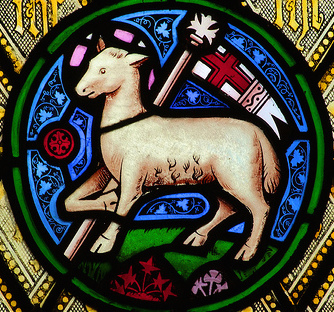
After renovations to the Eagle and Child eliminated their privacy, the writers transitioned across the street to the Lamb and Flag. Both pubs trace their history back to the seventeenth century, and the latter is actually owned by St. John’s College. (It’s profits fund student scholarships.) In a 1963 letter, Lewis colorfully described the move thusly:

Mon 11 March it is. But note that our causeries de lundi are now permanently transferred to the Lamb & Flag. We were sorry to break with tradition, but the B & B had become too intolerably cold, dark, noisy, and child-pestered.

Sadly, when many people look at the Lamb on the pub’s sign, they fail to recognize it’s significance. The lamb carrying a cross-emblazoned banner is nothing other than the Agnus Dei, the Lamb of God.

What, some may wonder, is the Lamb of God? The better question is “who” is the lamb. The symbol represents Jesus Christ himself. It hearkens to the declaration of John the Baptizer as Jesus approached the Jordan: “Behold, the Lamb of God, who takes away the sin of the world!” (John 1:29).

To understand what it means to say “Jesus is the Lamb,” requires two things. First, a recognition that it is more than a simile; it is not simply that he possesses some of the attributes we would naturally associate with a lamb, such as gentleness. The second requisite is that we understand something about the Jewish sacrificial system.

For, Jesus being the Lamb of God means nothing less than that he is the true, complete, ultimate and final sacrifice for the sins of humanity.

And that is a wonder definitely worth pondering during this Christmas season.

The World’s End

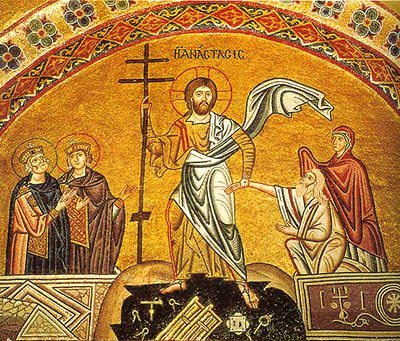
christ arisenMany years ago, while attending seminary, I was invited to preach at a Pentecostal congregation in my home town. One of the conversations I had that day taught me more about the importance of sound biblical preaching than every homiletics course I ever took (combined).

Lutherans, I must admit, are not big advocates of “end times” concerns. The reasons for this are far too complicated to address in a brief column now. Ironically, however, although we confess our confidence that Jesus “will come again to judge the living and the dead” every week, we seldom talk about the details of that arrival.

At the aforementioned service, I did preach on the second coming of the Messiah. And, to distill it down to a single message, I suggested that the Scriptures teach us to live in a sort of tension. We should live with a conscious awareness and urgency that the parousia could happen at any moment . . . and, prepare for the future as though the return of Christ (and subsequent new creation) will not take place for another thousand years.

Shortly after the service ended, a woman approached me and shared how she “wished she could have heard that sermon thirty years earlier.” She related how different her life would have been.

She said in her youth she had longed to attend college, but she never did . . . because she knew Jesus would return before she graduated.

When she and her husband bought a home, she wished the property had some fruit trees, but she never planted any . . . because she knew Jesus would return before they bore fruit.

Saddest of all, she told me that when her children were born, she never raised them to become mature adults . . . because she knew Jesus would return before they grew into the men and women they became.

Nearly forty years later I am more convinced than ever that living with the “tension” I described is the proper course of disciples of Jesus.

So, how does this work out in reality?

While a few of us know people who become so preoccupied with the end of the world that their lives go askew, it’s the other error to which most of us are prone. We tend to think that the return of Christ bears little or no connection to the age in which we live.

We are so preoccupied with our present responsibilities and dreams that we invest precious little time in contemplating how these things will matter in the scope of eternity.

I highly recommend to you a recent article on this subject that will remedy this dilemma. Andrée Seu Peterson, a gifted writer I have commended before at Mere Inkling, reminds us all of the fact that Jesus’ second coming may be just around the corner. Andrée writes:

Who would have thought that after centuries of modernity, beheading would once again be a means of persecuting the people of God? Does it not send a chill up our spine to read all about it in Revelation 20:4 even as we hear about it on CNN? “Then I saw thrones, and seated on them were those to whom the authority to judge was committed. Also I saw the souls of those who had been beheaded for the testimony of Jesus.”

C.S. Lewis famously described two errors people fall into when considering the occult. Either we get caught up in unhealthy expressions of the supernatural, or we dismiss the reality of demons and their destructive agenda altogether.

I believe humanity’s impulsive nature makes us vulnerable to the same extremes when it comes to the final days of the world we call home.

I strongly encourage you to read Peterson’s article here, as a timely reminder that you were created for far more wonderful and amazing things than we can ever know in this life. Even the best this world offers is but a hint and a foretaste of what awaits those who trust in God.

A Symbol of Death & Life

nن – Arabic letter nun (n)

You may never have seen this symbol or, if you did, its foreign context may not have impressed it on your mind.

This Arabic letter is now being used to mark people for persecution and death. Yet, at the very same moment, this same symbol is also being transformed into an emblem that stands for courage and life.

The Islamic State has martyred or enslaved many Christians. Survivors have had all of their property stolen from them and been marked for death if they do not reject Christ and embrace the Muslim religion.

They have gone throughout the neighborhoods of their new conquests and placed this mark, the nun, on homes to mark them for evacuation or death. The “N” stands for “Nazarene,” referring to Jesus’ home town.

With the passage of time, we will likely see once again the truth proclaimed by Tertullian, that the blood of the martyrs is the seed of the church. In the meantime, everyone of good will (Christian, Jew, Muslim, Agnostic alike) should rally to the support of the suffering.

We do not yet know the magnitude of the atrocities committed by ISIS/ISIL. Like Nazi concentration camps, the complete story will not be revealed until the sites of the horror are liberated from their vile control. And, like the Mogen David (Star of David) which marked its bearers as Jews, the nun marks its bearers as Christians and targets of militant Islam.

C.S. Lewis recognized the horror of Nazism early on. In 1933 he wrote about the cruelty, and stupidity of Hitler’s attack on Judaism.

Did you see that [Hitler] said “The Jews have made no contribution to human culture and in crushing them I am doing the will of the Lord.” Now as the whole idea of the “Will of the Lord” is precisely what the world owes to the Jews, the blaspheming tyrant has just fixed his absurdity for all to see in a single sentence, and shown that he is as contemptible for his stupidity as he is detestable for his cruelty.

One can only imagine what Lewis would write about the leaders of Islamofascism today.

There are a number of organizations that support Christians currently experiencing violent persecution. None, however, approaches this work from the same perspective of Voice of the Martyrs. I wholeheartedly commend their labors to you.

They are currently offering shirts emblazoned with the letter nun. They are even more important as a witnessing tool, than as a fundraiser. Please read more about them here and share the link with your friends. Also, please take a few minutes to explore their website once you are there.

To boldly state “I am N” is to identify with the oppressed. It is to show the world you understand that each disciple of Jesus must be prepared to take up his or her own cross. Dying for one’s faith in Jesus is not a myth; it is a daily reality.

The ن symbol, intended as a mark of derision, humiliation and rejection, has assumed a new meaning. It has become a mark of hope, courage, and deliverance.

What the persecutors in Iraq and Syria intended to be a label of death has been transformed by the Holy Spirit and the faithfulness of Christians into a symbol of life.

Death by Crocodile

200350761-001Suicide is always a tragedy. Many families have been touched by its pain.

The moral implications of this are vast, of course, and not the topic of this column. Today I am more intrigued by the modes that people select as they act on their suicidal impulses (or long-deliberated decisions).

As a pastor and military chaplain, I have worked with families in the aftermath of suicide. As a volunteer law enforcement chaplain, I have responded to the actual event.

Life is precious. It should never be squandered. Contrary to the notions of reincarnationists, “it is appointed for man to die once, and after that comes judgment” (Hebrews 9:27). That judgment need not be feared, for those sheltered in the mercy of God. Still, I doubt the Lord desires to see us ushered into his presence for that judgment by our own hand.

Even the darkest of lives can be rescued and recreated with new hope. That’s the testimony of many people, like Joni Eareckson Tada, who became a quadriplegic at only seventeen.

There are diverse ways people choose to end their days on earth.

Some European countries have made the passing a gentle, numbing for the most part, painless transition. In their euthanasia clinics, powerful drugs can be used to simply suppress one’s breathing until they “fall asleep” permanently.

Others make drug concoctions of their own, and some die in agony because of miscalculation, or are “rescued” to live debilitated by their failed attempt.

Some, for twisted macho reasons perhaps, decide to go out with a literal bang. Here too the attempt can fail and leave the individual in a horrific condition. And, even when it is “successful,” it leaves a sickening aftermath.

Perhaps the worst of all are those who desire to leave a “mark” on this “cruel world” as they depart. They may lash out at people they know—or even strangers—seeking to leave a lasting scar as a memory. Most of these people are likely insane. Not so the fanatic “suicide bombers.” Those disciples of evil comprehend what they are doing. The magnitude of their vile acts do not escape them.

Not the Why, but the How

As I said above, I’m not thinking today about the reasons a person would end their life. I am wondering about the means they choose to do so.

I was shocked by the recent suicide by a sixty-five year old Thai woman who calmly removed her shoes and then leapt into a ten-foot-deep pond which is home to more than a thousand crocodiles. A dozen were on her immediately.

I cannot stand to watch nature shows that portray crocodiles viciously dragging antelopes or zebras to their grim deaths. Just thinking of this woman’s final moments leaves me in emotional disbelief.

C.S. Lewis hinted at humanity’s archetypal antipathy to crocodiles. In a 1949 letter he wrote:

I don’t think the idea that evil is an illusion helps. Because surely it is a (real) evil that the illusion of evil should exist. When I am pursued in a nightmare by a crocodile the pursuit and the crocodile are illusions: but it is a real nightmare, and that seems a real evil.

Just as shocking as this poor woman’s death itself, is the fact that a decade ago another woman committed suicide at the Samutprakarn Crocodile Farm and Zoo in the same way.

The only reason I can conceive of for a person choosing such a terrible manner of death, is that they believed they deserved to suffer. Aside from that, only insanity can provide an answer.

For those who believe their guilt for real or imagined sins demands such a path, I have a life-saving alternative. There is One who can forgive those crimes and failings, and offer us a new beginning.

In the same passage from Hebrews cited above, we read the following good news.

[Jesus] has appeared once for all at the end of the ages to put away sin by the sacrifice of himself. And just as it is appointed for man to die once, and after that comes judgment, so Christ, having been offered once to bear the sins of many, will appear a second time, not to deal with sin but to save those who are eagerly waiting for him.

Share this hope with your friends and family—especially with those you know who may be contemplating the untimely end of their lives.

_____

I have written on the subject of suicide in the past. If you are interested in considering the subject from a different perspective, please read “The Anguish of Suicide.”

Loving Prostitutes

comfort womenI love prostitutes.

It’s true.

Although I have never in my life “physically” loved one, I possess great compassion for them.

Sharing physical intimacy with a prostitute would have nothing to do with “love,” anyway.

My empathy for prostitutes grew significantly during the year I spent stationed with the United States Air Force in South Korea during the 1980s.

My love for them has just been reignited by an article I read about the plight of aged Korean prostitutes who are being evicted from their hovels so that developers can profit. These women, ostracized by their own society and discarded by their pimps and the soldiers, sailors and airmen who abused them, have nowhere to go.

Americans have a perverse understanding of prostitution. Calling it a “victimless crime” is incomprehensible. For every one American call girl living in comfort and able to choose her “clients,” there are probably five thousand who are beaten daily, and driven to an early (often welcome) death.

No woman, at least none with a healthy mind, wants to sell their body and forfeit their future.

The gifted author and professor, C.S. Lewis, recognized this fact.

Prostitutes are in no danger of finding their present life so satisfactory that they cannot turn to God: the proud, the avaricious, the self-righteous, are in that danger (The Problem of Pain).

I love prostitutes because God has granted me the vision to see them as he does. Jesus spoke with true love (agape love) to one unloved and physically used woman he met at a well. You can read the story here.

She had been passed from one man to another and no longer had any options. Her current partner had not even bothered to marry her. She was not unlike the poor prostitutes of South Korea.

Jesus looked into this woman’s scarred soul and offered her forgiveness, healing and peace.

South Korea is prosperous today. It was not always so. During the Second World War, and the Japanese occupation, thousands of woman were enslaved as “comfort women.” The Korean government provides these victims with special compensation. Not so the post-war “comfort women” who serviced the country’s allies.

They did not have a choice either. Which is one reason C.S. Lewis writes, “a cold, self-righteous prig who goes regularly to church may be far nearer to hell than a prostitute.” (Mere Christianity).

And now they languish. Others, working in bars and “clubs” near bases today, are in their “prime.” It won’t last. This will be their destiny as well.

Because I love prostitutes, I pray that they might be liberated from their bondage. And, I also pray, that if they remain trapped in their current plight, that their souls might be free . . . that they might encounter the Messiah who can offer them “a spring of water welling up to eternal life” (John 4:14).

The article I read, and linked to above, ends with a potent yet tragic image.

Jang Young-mi, 67, who was orphaned as a girl and worked in a military camptown for nearly two decades, lives with three mangy dogs. A bite from one of them left the long white scar on her hand, but she refuses to abandon the offending animal.

Dogs too, are often outcasts in many societies. The irony is not lost that in Korea a dog is as likely to be devoured, as it is to be embraced and protected.

_____

The WWII image of so-called “comfort women” is of Indonesian women. It is estimated that the Imperial Japanese Army enslaved a quarter of a million women in Asia to serve in this cruel and vile manner. Due to the large number of victims, many still live today, still hoping for an official apology for their suffering.