Devastated by Criticism

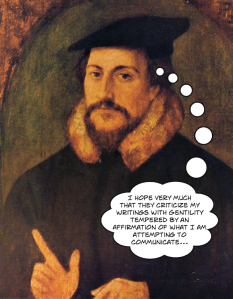
calvin-criticismHow do you feel when others criticize something you’ve written? Do you just want to tear your work up and start all over again? If you do, you have something in common with J.R.R. Tolkien, creator of Lord of the Rings. And he is not the only great writer with whom you share this hypersensitive trait.

Tolkien’s inability to accept constructive criticism is no secret; it is frequently noted in biographies.

Few people enjoy receiving criticism, and we are often suspicious of the mental health of those who do. Yet many writers actively seek out constructive criticism in order to sharpen their skills and improve their work.

That is a major reason for the existence of writers’ groups which pop up in varying expressions wherever serious writers live. While another benefit of such communities is the simple encouragement that comes from gathering with others who share your passion, it is the critical examination of each other’s manuscripts which provides the clearest concrete benefit. It’s no accident many such literary meetings are actually called critique groups.

Tolkien was a member of one of the most famous such fellowships that ever existed, the Inklings. It was in that setting where he first shared the stories of hobbits and elves who would make such a profound impact on Western literature. He said it was primarily through the encouragement of the Inklings—specifically his good friend, C.S. Lewis—that these amazing stories were ever published.

You see, Tolkien had a terrible and frequently fatal flaw . . . When his writing was criticized, he felt compelled to toss it aside and begin anew. Many other writers have been afflicted with this curse, and not all of them had a C.S. Lewis to rescue their words from the dust bin.

I have shared in the past Lewis’ description of his friend’s handicap.

No one ever influenced Tolkien—you might as well try to influence a bander-snatch. We listened to his work, but could affect it only by encouragement. He has only two reactions to criticism; either he begins the whole work over again from the beginning or else takes no notice at all.

Criticism of the Constructive Variety

As I said a moment ago, no one really craves criticism, and yet most serious writers actively solicit it. As I write this very column, it is with the intention of sharing it tomorrow with my friends in my own writing circles.

When you read it, it will likely have changed, probably in subtle, enriching ways. You can gauge the benefit of mutual critiquing by the amount and the quality of the criticism which is shared. And, should you feel violated, rebuke defensiveness and remind yourself that even the greats, like Tolkien and Lewis, gained from the comments and suggestions of their friends.

I recently learned of another individual who struggled with receiving criticism. It was John Calvin, the father of Reformed theology. Belonging to the Lutheran branch of the church universal, my readings in Reformed history have been limited. However, I’m currently reading two similarly titled books* and I discovered something that may be commonly known to Reformed clergy but was news to me.

He often tended to express his disappointment in extravagant terms. When he encountered an obstacle, his reaction was stark: he would burn his manuscript, never write again, never publish anything again. His decision to write was motivated by external factors: a request by his circle of friends and colleagues, or as the result of his emotional reaction to an event or a work that he read. . . . (John Calvin and the Printed Book)

The good news though is Calvin did not allow these obstacles to have the final say. Instead, he turned to those he trusted and sought their counsel.

Indeed, his extreme sensitivity meant that he needed to have the emotional support of close friends. As a Reformer and specifically as an author, Calvin never worked in isolation even though he was the dominant figure in his setting. While he was confident of the quality of his writings, Calvin still had no hesitation in submitting them to his colleagues before publication. (Ibid.)

Not that Calvin always welcomed suggestions. There was one particular Reformer to whom he sent some of his work whose “commend from Zurich were too numerous and detailed. Hence Calvin stopped sending his manuscripts to Bullinger prior to printing, although he maintained cordial relations with the Zurich Reformer.” I can almost read Calvin’s mind at the time: I asked for your suggestions, not a complete rewrite of the manuscript.

So, it appears those of us who feel discomfort at the sting of criticism—even when we request it—stand in good company. So don’t ever let that temporary pain discourage you from continuing to write.

____

* A 2005 volume is called John Calvin and the Printed Book, while a 2015 collection of essays is called Calvin and the Book.

Roy Campbell and the Inklings

african-steerWho was the mysterious poet whose quiet, brim-shrouded attentiveness to C.S. Lewis in a pub inspired J.R.R. Tolkien to describe the hero Aragon in a similar pose?

Being neither a poet nor a literature major, I’m not ashamed to admit I have been unfamiliar with the interesting story of Roy Campbell. While his friendship with the Inklings of Oxford most intrigues me, his life itself is a fascinating story.

A South African who offered his deepest emotional devotion to Spain, his early years were influenced by the license of London’s bohemian underworld. He did, however, end up criticizing the excesses of the Bloomsbury Group.

Later, he and his wife would convert to Roman Catholicism, and even risk their lives to protect the letters of Saint John of the Cross from murderous Spanish revolutionaries who sought to burn them. They accepted responsibility for the documents shortly before the seventeen monks at the monastery were rounded up and shot in the street while their library burned.

Several days later the Campbells were visited by a search party of militiamen. Expecting such an intrusion, Roy and Mary had already taken the precaution of removing all crucifixes and religious pictures from the walls. Their main fear was that the trunk containing the Carmelite archives, including the personal letters of St John of the Cross, would be discovered.

The search, however, was not particularly thorough. At one stage some of the militiamen even leaned their rifles on the trunk without thinking of opening it. (Joseph Pearce, “The poet who saved a saint’s priceless letters”)

C.S. Lewis & Roy Campbell

C.S. Lewis considered Campbell’s championing of the Spanish fascists (who protected the Roman Catholic Church from the Leftist rebels) to be naïve. He even wrote a poem in direct response to Campbell’s lengthy “Flowering Rifle,” which is included in issue 4.2 of Curtana: Sword of Mercy.

I happen to edit the military chaplaincy journal Curtana, which is currently on hiatus. In the same issue I included another Campbell poem, “Christ in Uniform” (see pages 78-79).

In a second article, Joseph Pearce who was quoted above provides a lengthy exploration of the relationship between the two men. Its subtitle, “The Best of Friends and Enemies” reveals its theme. While Lewis remained critical of his acceptance of fascists, the two eventually became friends.

In spite of such an unpromising encounter, Lewis warmed to Campbell and invited him to meetings of the Inklings. He even offered to put Campbell up when he was in Oxford, offering him “dinner, bed and breakfast” at his home. They would exchange correspondence about the poetry of Milton, which both men admired, and settled into an altogether affable relationship.

Another peculiar thing about their friendship is how Lewis based a satirical character on Campbell in The Pilgrim’s Regress. When a song is requested, it is a one of the most savage of the men who first takes the stage.

“I will,” cried thirty voices all together: but one cried much louder than the others and its owner had stepped into the middle of the room before anyone could do anything about it.

He was one of the bearded men and wore nothing but a red shirt and a cod-piece made of the skins of crocodiles: and suddenly he began to beat on an African tom-tom and to croon with his voice, swaying his lean, half-clad body to and fro and staring at them all, out of eyes which were like burning coals.

This time John saw no picture of an Island at all. He seemed to be in a dark green place full of tangled roots and hairy vegetable tubes: and all at once he saw in it shapes moving and writhing that were not vegetable but human.

The passage continues, but it’s best read in context. Especially since it precedes an accusation that John, the pilgrim in the tale, is so unsophisticated as to be unable to distinguish between art and pornography.

The Making of a Poet

Lewis and Campbell were both poets. Campbell was successful in this pursuit, and admired by many. Lewis . . . much less so. But it was my recent reading of one of Campbell’s poems on the subject of poetry that set me to researching for this column. So it’s only fitting that I close now with his poem entitled, “The Making of a Poet.”

It’s quite visceral, evoking the savage imagery of his native Africa, and hints at what inspired Lewis to caricature him in the way we read a moment ago.

In every herd there is some restive steer
Who leaps the cows and heads each hot stampede,
Till the old bulls unite in jealous fear
To hunt him from the pastures where they feed.

Lost in the night he hears the jungles crash
And desperately, lest his courage fail,
Across his hollow flanks with sounding lash
Scourges the heavy whipcord of his tail.

Far from the phalanxes of horns that ward
The sleeping herds he keeps the wolf at bay,
At nightfall by the slinking leopard spoored,
And goaded by the fly-swarm through the day.

You can read more of Campbell’s poetry here.

Dangerous Clowns

clownsThe latest concern here in the United States, aside from who will be our next president, involves “scary clowns.” And this bizarre meme got me thinking about clowndom in its broader expressions.

The current worry comes from people dressing up in sometimes morbid variations of clown attire. It’s not quite so bad as “It,” Stephen King’s 1990 miniseries about a demonic counterfeit.

It, by the way, has been updated lest the current generation be deprived of its arguable glories. The new film is in post-production and is due for release next fall.

Anyway, this film is only one of a legion of movies and cable productions that portray clowns in an ominous light.

So, it appears that the public is primed to expect the worst when people decide to dress up like jesters and do odd things in suspicious places at strange hours.

Expressed that way, there’s no reason people shouldn’t be concerned. After all, one of the most familiar elements of the criminal ensemble is a mask.

I sincerely hope that this fad doesn’t result in any serious problems. However, even if 99 out of 100 people are simply donning the make-up to be silly . . . that still leaves the 1%.

Attitudes Towards Clowns

I’ve never cared much about clowns, one way or the other. I’ve never considered them particularly eerie or entertaining.

I learned listening to the radio this week that I have that in common with Michael Medved.

Medved is a talented radio personality who coincidentally is a renowned film critic. Today, because of this media attention related to these harlequin lurkers, Medved was questioned about his attitude towards clowns.

He shared that he doesn’t particularly care one way or the other, but his family did have a negative experience many years ago. He related how one of his brothers was able to attend a taping of the San Diego expression of the “Bozo the Clown” program. Curiously, the stage for the broadcast was in Tijuana, but that’s another story.

Readers of Medved’s and my generation will immediately know who Bozo was. (To be distinguished from Bonzo, who was tucked into his blankets by President Reagan long ago.)

Returning to the clown . . . it turns out that Medved’s brother was frightened by the appearance of Bozo, and began crying. That drew the immediate attention of the actor in the intimidating suit, who said—probably in a low, threatening whisper, through the façade of the painted smile—“That’s a Bozo no-no . . .” Pretty creepy.

C.S. Lewis and Clowns

It just so happened that it was time for my next blog column. I wondered if there might be some connection I might draw with the Oxford don, or some bit of wisdom I might be able to apply to the subject at hand with minimal logical gymnastics.

It turns out I needn’t have been concerned. Here’s a wonderful description of Lewis, written the year after his death by his close friend, J.R.R. Tolkien.

C.S.L. of course had some oddities and could sometimes be irritating. He was after all and remained an Irishman of Ulster. But he did nothing for effect; he was not a professional clown, but a natural one, when a clown at all.

He was generous-minded, on guard against all prejudices, thought a few were too deep-rooted in his native background to be observed by him.

That his literary opinions were ever dictated by envy (as in the case of T.S. Eliot) is a grotesque calumny. After all it is possible to dislike Eliot with some intensity even if one has no aspirations to poetic laurels oneself.

I like that description of Lewis. As someone who is usually among the first to usher humor into a conversation or situation, I would like to think I might be described in a similar way. Not a “professional clown,” seeking to gain attention and praise. But a “natural one” who promotes laughter, good humor, and emotional health.

Those results are, I assume, the goals of all true clowns.

As for those who work to transform this image of merrymaking into something sinister . . . we can only hope and pray, that the trend exhausts itself soon.

And, at No Extra Cost

If you have never seen Bozo, you owe it to yourself to learn what your parents and grandparents called “entertainment” back in the day! (Trust me, you’ll never be the same.)


On Being Aptly Named

terrorIf you were going to embark on a lengthy, dangerous journey of exploration, how would you feel about signing onto the crew of the HMS Terror? Doesn’t that strike anyone else as a tad ominous?

The HMS Terror suffered a horrific fate. No surprise there. Its demise was so great, though, that it ranks among the worst ever suffered by the Royal Navy. And its ultimate fate remained unconfirmed until this past week when the wreck was found, resting on the ocean floor, 168 years after it perished during the ill-fated Franklin Expedition.

Along with the HMS Erebus, the Terror was supposed to traverse the Northwest Passage. The evidence shows, however, the ice trapped the ships, and both crews perished trying to make their way south across the floes. (There is evidence of cannibalism during that doomed journey, something attested to by Inuit oral traditions.)

The voyage had begun well enough. The vessels had been fitted for the harsh environment after a rather auspicious exploration of the coast of Antarctica. There they had discovered the Ross Ice Shelf, and in honor of their mission, two Antarctic features were named for them Mounts Erebus & Terror, on Ross Island.

Upon their return to London, iron plate was added to their hulls and coal-fueled steam engines were installed.

Sadly, the Arctic proved less hospitable, and their entrance into Baffin Bay in August 1845 marked the final time either ship was seen until now. An extensive search at the time proved futile. Their respective discoveries are announced here, and here.

Around 130 men abandoned the ships when they became icebound. Some of their bones were recovered from King William Island. The sad story has been recited in many places, including this article which was written when the wreck of the Erebus was discovered.

As in the Antarctic, here too the ships were honored by having natural features named after them. Fittingly, Erebus Bay and Terror Bay hug the west coast of King William Island, just north of which marked the estimated position where the ships were abandoned.

Read on, and learn something quite interesting about the names of these two ill-fated ships.

Naming Ships

I have written about the importance of names in the past.*

There are a variety of conventions for christening ships. Some result in creative names, but others are quite mundane. In the United States, with plenty of exceptions, the contemporary patterns for naming ships vary by their type of class. For example:

Aircraft Carriers – are now named after Presidents

Amphibious Assault Ships – early Ships or USMC Battles

Ballistic Missile Submarines – States

Fast Attack Submarines – Cities

Cruisers – Past Battles

Frigates – Navy, Marine or Coast Guard Heroes

Patrol Boats – Weather Phenomena like Squall, Monsoon and Cyclone

Of course, like everything else in the United States, the naming of ships is prone to becoming politicized, as this entertaining article reveals.

Other nations have followed comparable christening patterns throughout recent centuries. Grouping similarly functioning vessels with particular themes makes sense. That way if you encountered a ship named Blue Dwarf or Yellow Dwarf, you could make a well educated guess that the vessel was a mining ship, and part of the Jupiter Mining conglomerate.

I suppose even garbage scows are named in some logical fashion, perhaps after politicians?

Unsurprisingly, in addition to battles, heroes, and major cities, aquatic life has been a common feature. Thus pre-Soviet Russian subs were named things like Walrus or Shark (albeit, in Cyrillic).

The Royal Navy shared an affinity for marine life, and Dolphin was a popular example. There were no fewer than a dozen ships, thus named, although some were fairly modest (including a convict ship used in the first have of the nineteenth century).

I actually possess the altar rail from the ship’s chapel in the HMS Dolphin that was commissioned in 1882. But that’s a sea tale for another day . . .

C.S. Lewis christened a ship of his own. He even included its name in the title of the Chronicle of Narnia which describes its quest: The Voyage of the Dawn Treader. The ship herself was modest, but marked a new age of Narnia exploration.

The name of the ship was Dawn Treader. She was only a little bit of a thing compared with one of our ships, or even with the cogs, dromonds, carracks and galleons which Narnia had owned when Lucy and Edmund had reigned there under Peter as the High King, for nearly all navigation had died out in the reigns of Caspian’s ancestors. . . .

But now Caspian had begun to teach the Narnians to be sea-faring folk once more, and the Dawn Treader was the finest ship he had built yet.

She was so small that, forward of the mast, there was hardly any deck room between the central hatch and the ship’s boat on one side and the hen-coop (Lucy fed the hens) on the other.

But she was a beauty of her kind, a “lady” as sailors say, her lines perfect, her colors pure, and every spar and rope and pin lovingly made.

In his Middle Earth sagas, J.R.R. Tolkien includes the names of a number of ships.

Eärrámë – Sea Wing

Númerrámar – Sunset Wings

Palarran – Far-Wanderer

Vingilótë – Foam Flower

Hirilondë – Haven Finder

Entulessë – Return (sailed by Vëantur during the Númenórean’s return to Middle Earth)

The Inklings appear to have given the decision of naming their ships the attention the activity merits.

More about the HMS Terror and the HMS Erebus

The name of the HMS Terror was, of course, not chosen to jinx its future. It was thus named to instill fear in those it opposed. This was natural, since it was originally commissioned as a warship, as was the Erebus. In fact, the two vessels were the same exact type of warship.

So, how might “Terror” and “Erebus,” the mythological Greek deity of darkness, who shared his name with an abode of the dead? It becomes clearer when we learn that both of the ships originally served as “bomb ships.” Like later battleships, these vessels were designed to rain fire from the sky—something terrifying to stationary garrisons.

The names of some of their sister ships whose mortars fired upon enemies of the British Empire included Thunder, Vesuvius, and Hecla (the Icelandic volcano).

The HMS Terror actually saw combat, prior to its conversion to peaceful pursuits. Amazingly, it was among the bomb ships—accompanied by the Volcano, Meteor, Devastation and Aetna—during the Battle of Baltimore in the War of 1812. Thus, the Terror is also memorialized in the national anthem of the United States: “the bombs bursting in air.”

Curiously, the predecessor of the HMS Erebus we have been discussing, a “rocket vessel” with the same name, inspired the lyrics “by the rocket’s red glare,” at the same historic battle.

_____

* The importance of naming has led me to address the subject from a number of angles through the years.

The Power of Names

Crying for Attention

From Ear to Quill

Pet Names

Powerful Names

Sharing Surnames

Fleeting Fame

red-dwarfAnd, for those who recognized the homage to Red Dwarf


Tolkien, Lewis & Barth on Myth

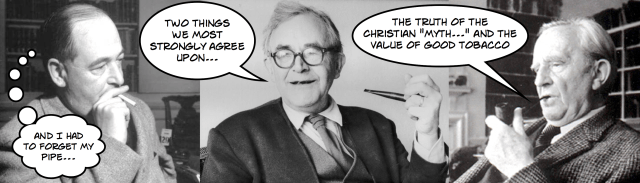
barthOne wonders what sort of fireworks might have erupted if J.R.R. Tolkien and C.S. Lewis had spent an evening with theologian Karl Barth. Although their lives overlapped, and all three were Christian academics, it is questionable how much they would have agreed upon.

And yet, there were several subjects where I think they would have enjoyed firm consensus.

Tolkien (1892-1973) was a devout Roman Catholic. Lewis (1898-1963) was a committed “low church” Anglican. Barth (1886-1968) was a Reformed theologian who rejected the liberalism that had become dominant in European academies. All three thus believed in the reality of the Christian gospel of salvation through Jesus Christ.

All three men hated war, and the two Brits had served in the trenches of WWI. All opposed Nazism and Barth was the primary author of the Barmen Declaration which challenged the Christian faith of all who supported the Nazi government.

And we’ll consider another shared attribute in just a moment.

First, though, we need to acknowledge that presumably the Inklings never met the Swiss clergyman. Their circles did not overlap. I have not been able to uncover any evidence of Tolkien referring to Barth, or of Barth mentioning either of the Inklings.

Lewis did, however mention Barth in his prolific correspondence. From his exposure to Barth it’s clear he did not share the opinion of Pope Pius XII that he was “the greatest theologian since Thomas Aquinas.” Heady praise . . . especially coming from a Roman Catholic.

In a 1940 letter to his brother Warren, Lewis reacted against what he perceived as legalism in some quarters of Protestantism that was alien to his understanding of the liberty of the Christian.

I am afraid the truth is . . . that the world, as it is now becoming and has partly become, is simply too much for people of the old square-rigged type like you and me. I don’t understand its economics, or its politics, or . . . Even its theology—for that is a most distressing discovery I have been making these last two terms as I have been getting to know more and more of the Christian element in Oxford.

Did you fondly believe—as I did—that where you got among Christians, there, at least, you would escape (as behind a wall from a keen wind) from the horrible ferocity and grimness of modern thought.

Not a bit of it. I blundered into it all, imagining that I was the upholder of the old, stern doctrines against modern quasi-Christian slush: only to find that my ‘sternness’ was their ‘slush.’ They’ve all been reading a dreadful man called Karl Barth, who seems the right opposite number to Karl Marx. ‘Under judgment’ is their great expression.

They all talk like Covenanters or Old Testament prophets. They don’t think human reason or human conscience of any value at all: they maintain, as stoutly as Calvin, that there’s no reason why God’s dealings should appear just (let alone, merciful) to us: and they maintain the doctrine that all our righteousness is filthy rags with a fierceness and sincerity which is like a blow in the face.

Sometimes the results are refreshing: as when Canon Raven (whom you and Dyson and I sat under at Ely) is sharply told in a review in Theology that ‘it is high time persons of this sort learned that the enjoyment of a chair of theology at Cambridge does not carry with it a right to criticise the Word of God’—that’s the kind of rap on the knuckles which has not been delivered for a hundred years!

Comparing Their Thoughts on the Nature of Myth

Many readers of Mere Inkling will know Tolkien and Lewis were deeply influenced by the significance of myth. They were also, in the creation of Middle Earth and Narnia, active in the act of mythopoeia, creating imaginary lands whose stories convey profound meaning.

But, despite the fact their literary products are fictional, that does not mean that all myth is “untrue,” in the sense of being unhistorical. Myth, for these great thinkers, is something far more complex and wonderful.

Without going into depth on this involved subject, I offer here the familiar story of how Lewis’ epiphany about true myth was key to his conversion.

I was by now too experienced in literary criticism to regard the Gospels as myths. They had not the mythical taste. And yet the very matter which they set down in their artless, historical fashion . . . was precisely the matter of the great myths. If ever a myth had become fact, had been incarnated, it would be just like this. And nothing else in all literature was just like this.

Myths were like it in one way. Histories were like it in another. But nothing was simply like it.

And no person was like the Person it depicted; as real, as recognizable, through all that depth of time, as Plato’s Socrates . . . yet also numinous, lit by a light from beyond the world, a god.

But if a god—we are no longer polytheists—then not a god, but God. Here and here only in all time the myth must have become fact; the Word, flesh; God, Man. This is not “a religion,” nor “a philosophy.” It is the summing up and actuality of them all. (Surprised by Joy)

This epiphany took place in 1931, during an all-night discussion (it lasted until 4:00 am) with Tolkien, and other Inkling, Hugo Dyson. Here’s how Lewis related the moment to his lifelong friend, Arthur Greeves.

It was really a memorable talk. We began (in Addison’s walk just after dinner) on metaphor and myth–interrupted by a rush of wind which came so suddenly on the still, warm evening and sent so many leaves pattering down that we thought it was raining.

We all held our breath, the other two appreciating the ecstasy of such a thing almost as you would. We continued (in my room) on Christianity: a good long satisfying talk in which I learned a lot . . .

A month later he elaborated on how the insights gained that evening were gestating in his mind and heart.

Now what Dyson and Tolkien showed me was this: that if I met the idea of sacrifice in a Pagan story I didn’t mind it at all: again, that if I met the idea of a god sacrificing himself to himself (cf. the quotation opposite the title page of Dymer) I liked it very much and was mysteriously moved by it: again, that the idea of the dying and reviving god (Balder, Adonis, Bacchus) similarly moved me provided I met it anywhere except in the Gospels.

The reason was that in Pagan stories I was prepared to feel the myth as profound and suggestive of meanings beyond my grasp even tho’ I could not say in cold prose ‘what it meant.’

Now the story of Christ is simply a true myth: a myth working on us in the same way as the others, but with this tremendous difference that it really happened: and one must be content to accept it in the same way, remembering that it is God’s myth where the others are men’s myths: i.e. the Pagan stories are God expressing Himself through the minds of poets, using such images as He found there, while Christianity is God expressing Himself through what we call ‘real things.’

Therefore it is true, not in the sense of being a ‘description’ of God (that no finite mind could take in) but in the sense of being the way in which God chooses to (or can) appear to our faculties. The ‘doctrines’ we get out of the true myth are of course less true: they are translations into our concepts and ideas of that which God has already expressed in a language more adequate, namely the actual incarnation, crucifixion, and resurrection.

Does this amount to a belief in Christianity? At any rate I am now certain (a) That this Christian story is to be approached, in a sense, as I approach the other myths. (b) That it is the most important and full of meaning. I am also nearly certain that it really happened.

In a different setting, Barth argued for the very same truth. His context was a theological environment greatly influenced by the liberal doctrines of Rudolf Bultmann, who dismissively regarded anything miraculous in the Scriptures as primitive and ignorant thinking.

The Christian Church confesses that [what the world calls] “myth” is history itself. She recognizes herself by this myth, she recognizes her life, her true reality. She is the witness of witnesses, she recognizes through the Holy Spirit that this is the one really interesting story.

Then she turns back the historians’ weapon: She says to them: What you call “myth,” that is history! She will also add: What you call history, that is a myth! A myth, a made-up history, that fancies the fate of man as depending on his earthly vicissitudes, a myth, a made-up history, that confuses the immediate success of a cause with its truth, and so on.

The only true history is the history of Christ, in which the Church participates, and which is already the secret reality of all history, since it is history itself. (The Faith of the Church)

Now, there’s an argument the Inklings could truly have appreciated.

A Bonus, for Fans of Dietrich Bonhoeffer

Barth was not the only Christian seminary professor who rejected the heresies of Bultmann, who sought to “demythologize” the Scriptures. Dietrich Bonhoeffer, a fellow German, repudiated Bultmann’s rejection of the supernatural in God’s Word. In a recent book, Taking Hold of the Real, Barry Harvey writes:

In a prison letter [Bonhoeffer] criticizes Rudolf Bultmann for excising the “mythological” elements in an attempt to reduce Christianity to its “essence.” “My view,” he writes, “is that the full content, including the ‘mythological’ concepts, must remain—the New Testament is not a mythological dressing up of a universal truth, but this mythology (resurrection and so forth) is the thing itself.”

Bonhoeffer thus acknowledges that describing a way of seeing the world as mythic thus does not summarily dismiss it either as deceptive or as an archaic and feeble attempt at doing “science.” Indeed, a truthful description of the world and especially of human existence ultimately requires mythic form.

The tales that women and men have fashioned and passed down through the centuries to discern the overall sense and significance of their existence are “never just ‘lies,’” says Tolkien, as “there is always something of the truth in them.”

Tolkien, C.S. Lewis and Music

albumHave you ever written something that inspired a musician to compose new music? J.R.R. Tolkien hoped to do so one day, and had he lived to hear the scores of the Lord of the Rings trilogy created by Howard Shore, he would have been in awe.

I was reading Tolkien’s correspondence last week and came across a fascinating letter he wrote to a musician who was requesting permission to write a serious composition based on The Hobbit.

This would have been quite different than the quaint “Ballad of Bilbo Baggins,” made famous by Leonard Nimoy. (I wish their choreographer had read the book, so we could have been spared the tiny T-Rex arms sported during the chorus by the dancers.)

Anyway, returning to more serious musical ventures, in 1964 Tolkien received a request for permission to write a “Hobbit Overture.” It came from British composer Carey Blyton (1932-2002) who would become best known for his song “Bananas in Pyjamas.”

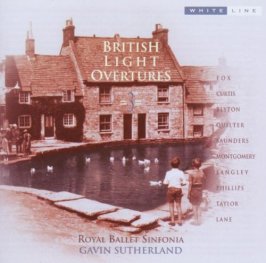
Tolkien’s response to the composer’s query is fascinating, on several levels. First, he is gracious in extending his permission, without any restrictions. And, in 1967 Blyton did compose “The Hobbit” Overture, opus 52a. It appears on the CD, British Light Overtures 3.

Secondly, he shares his unspoken desire that his work might someday inspire music. Then he makes a curious comment about the illustrations of Pauline Baynes, which would similarly grace the work of C.S. Lewis.

After that, Tolkien describes his own, musically impoverished, upbringing. Finally he expresses his deep appreciation for good music, despite his lack of knowledge on the subject.

And Tolkien accomplishes all of this in just a handful of sentences!

You certainly have my permission to compose any work that you wished based on The Hobbit. . . . . As an author I am honoured to hear that I have inspired a composer. I have long hoped to do so, and hoped also that I might perhaps find the result intelligible to me, or feel that it was akin to my own inspiration—as much as are, say, some (but not all) of Pauline Baynes’ illustrations. . . . .

I have little musical knowledge. Though I come of a musical family, owing to defects of education and opportunity as an orphan, such music as was in me was submerged (until I married a musician), or transformed into linguistic terms. Music gives me great pleasure and sometimes inspiration, but I remain in the position in reverse of one who likes to read or hear poetry but knows little of its technique or tradition, or of linguistic structure.

It is common for people of sincere Christian devotion, such as Tolkien and Lewis, to express an appreciation for the divine capacity of music to touch the human spirit.

luteMartin Luther, for example, wrote much about music. “Music is God’s greatest gift,” he proclaimed. He was not only a composer of hymns, but also an acceptable player of the lute, which he used to accompany his children during their family devotions.

Music is deeply intertwined with the heart of Christian worship.

C.S. Lewis on the Subject of Music

One of the modest challenges in contrasting fellow Inklings J.R.R. Tolkien and C.S. Lewis results from the significantly different natures of their literary corpora. While they both wrote fantasy, though of a vastly different magnitude, Lewis’ vocation as one of Christianity’s chief modern apologists necessitated that he defend the faith in diverse contexts. Thus, he wrote numerous essays and a number of texts addressing a wide range of considerations that his friend Tolkien never discussed in print.

Because of this distinction, it is relatively simple to discover what Lewis thought about the nature and powers of music. Typical of the man’s practical orientation, Lewis appears little interested in the abstract attributes of music. What interests him is its confluence with human existence. The following profound insight comes from his essay “On Church Music.”

There are two musical situations on which I think we can be confident that a blessing rests. One is where a priest or an organist, himself a man of trained and delicate taste, humbly and charitably sacrifices his own (aesthetically right) desires and gives the people humbler and coarser fare than he would wish, in a belief (even, as it may be, the erroneous belief) that he can thus bring them to God. The other is where the stupid and unmusical layman humbly and patiently, and above all silently, listens to music which he cannot, or cannot fully, appreciate, in the belief that it somehow glorifies God, and that if it does not edify him this must be his own defect.

Neither such a High Brow nor such a Low Brow can be far out of the way. To both, Church Music will have been a means of grace; not the music they have liked, but the music they have disliked. They have both offered, sacrificed, their taste in the fullest sense.

But where the opposite situation arises, where the musician is filled with the pride of skill or the virus of emulation and looks with contempt on the unappreciative congregation, or where the unmusical, complacently entrenched in their own ignorance and conservatism, look with the restless and resentful hostility of an inferiority complex on all who would try to improve their taste—there, we may be sure, all that both offer is unblessed and the spirit that moves them is not the Holy Ghost.

This discussion about church music is particularly interesting due to Lewis’ personal dislike for much of the music used in worship, which I’ve written about before.

Lewis described his own church music pilgrimage in “Answers to Questions on Christianity.”

My own experience is that when I first became a Christian, about fourteen years ago, I thought that I could do it on my own, by retiring to my rooms and reading theology, and I wouldn’t go to the churches . . .

If there is anything in the teaching of the New Testament which is in the nature of a command, it is that you are obliged to take the Sacrament [holy communion], and you can’t do it without going to Church. I disliked very much their hymns, which I considered to be fifth-rate poems set to sixth-rate music. But as I went on I saw the great merit of it.

I came up against different people of quite different outlooks and different education, and then gradually my conceit just began peeling off. I realized that the hymns (which were just sixth-rate music) were, nevertheless, being sung with devotion and benefit by an old saint in elastic-side boots in the opposite pew, and then you realize that you aren’t fit to clean those boots. It gets you out of your solitary conceit.

In “The Weight of Glory,” Lewis addresses this notion that we must look beyond the music itself, to assess its influence on our humanity.

The books or the music in which we thought the beauty was located will betray us if we trust to them; it was not in them, it only came through them, and what came through them was longing. These things—the beauty, the memory of our own past—are good images of what we really desire; but if they are mistaken for the thing itself they turn into dumb idols, breaking the hearts of their worshippers.

For they are not the thing itself; they are only the scent of a flower we have not found, the echo of a tune we have not heard, news from a country we have never yet visited.

Lewis recognized the deep influence and mystery with which music communicates and inspires. It is no accident that Narnia’s creation itself comes through Aslan’s song.

The Lion was pacing to and fro about that empty land and singing his new song. It was softer and more lilting than the song by which he had called up the stars and the sun; a gentle, rippling music. And as he walked and sang the valley grew green with grass. It spread out from the Lion like a pool.

It ran up the sides of the little hills like a wave. In a few minutes it was creeping up the lower slopes of the distant mountains, making that young world every moment softer.

Returning to “On Church Music,” Lewis expands on the importance of our intentions as we approach music.

It seems to me that we must define rather carefully the way, or ways, in which music can glorify God. There is . . . a sense in which all natural agents, even inanimate ones, glorify God continually by revealing the powers He has given them. . . . An excellently performed piece of music, as natural operation which reveals in a very high degree the peculiar powers given to man, will thus always glorify God whatever the intention of the performers may be. But that is a kind of glorifying which we share with the ‘dragons and great deeps,’ with the ‘frost and snows.’

What is looked for in us, as men, is another kind of glorifying, which depends on intention. How easy or how hard it may be for a whole choir to preserve that intention through all the discussions and decisions, all the corrections and the disappointments, all the temptations to pride, rivalry and ambition, which precede the performance of a great work, I (naturally) do not know. But it is on the intention that all depends.

When it succeeds, I think the performers are the most enviable of men; privileged while mortals to honor God like angels and, for a few golden moments, to see spirit and flesh, delight and labour, skill and worship, the natural and the supernatural, all fused into that unity they would have had before the Fall. . . .

We must beware of the naïve idea that our music can ‘please’ God as it would please a cultivated human hearer. That is like thinking, under the old Law, that He really needed the blood of bulls and goats. To which an answer came, ‘mine are the cattle upon a thousand hills,’ and ‘if I am hungry, I will not tell thee.’ If God (in that sense) wanted music, He would not tell us. For all our offerings, whether of music or martyrdom, are like the intrinsically worthless present of a child, which a father values indeed, but values only for the intention.

At the outset of this column I declared Tolkien would have been “in awe” of the musical score written to accompany the Lord of the Rings movies. Lewis too, I believe, would have been impressed by the scores composed for the three Chronicles of Narnia films made thus far. We owe a debt of gratitude to three composers: Howard Shore,* Harry Gregson-Williams,** and David Arnold***.

An Historical Postscript

In the spirit of Lewis and Tolkien, who appreciated the importance of music, we’ll close now with another engaging quotation from the wry pen of Doctor Martin Luther.

I wish all lovers of the unshackled art of music grace and peace from God the Father and from our Lord Jesus Christ! I truly desire that all Christians would love and regard as worthy the lovely gift of music, which is a precious, worthy, and costly treasure given to mankind by God.

The riches of music are so excellent and so precious that words fail me whenever I attempt to discuss and describe them…. In summa, next to the Word of God, the noble art of music is the greatest treasure in the world.

A person who gives this some thought and yet does not regard music as a marvelous creation of God, must be a clodhopper indeed and does not deserve to be called a human being; he should be permitted to hear nothing but the braying of asses and the grunting of hogs.

_____

* Howard Shore has nearly a hundred credits as a composer, conductor and orchestrator on the Internet Movie Database (IMDb). In addition to the Tolkien cinema projects, he has also worked on a number of other very successful films and ninety-six episodes of Saturday Night Live. Shore won three Oscars for his work on Lord of the Rings.

** Harry Gregson-Williams has nearly a hundred credits on the IMDb, including a number of box office successes, a variety of popular video games, and several productions in the Shrek series. He won awards for his work on the Chronicles of Narnia series and another of my favorite films, Kingdom of Heaven.

*** David Arnold, wrote the score for the third Narnia film, The Chronicles of Narnia: The Voyage of the Dawn Treader. He has seventy-three credits listed on IMDb, ranging from this year’s Independence Day: Resurgence, all the way back to a BBC made for tv picture entitled Mr. Stink.

Desiring Silence

coptic quietDo you enjoy noise, or do your mind and soul long for moments of silence? If you appreciate escaping the cacophony of sounds that weigh against you, you’re in good company. The Inklings were men who respected the value of silence.

I attended a funeral for a former parishioner today. The fact that I did not conduct the service allowed me to sit beside my wife who shared my sincere fondness for the saint we were bidding farewell.

The service was comforting, being resurrection-focused as such matters ought to be. Despite our singing three hymns during its course, it was also quiet. Quiet in the sense of calm and peaceful like a deep brook that rushes along in relative silence, compared to its chattering companions that dance across the rocks in a shallow creek.

Joe was a humble man, though he was one of the rare breed who truly deserve the accolade of being part of the “greatest generation.” Though he never bragged about it, he served throughout the Second World War, and survived D-Day while landing in just the second wave at Omaha Beach.

It was a service that befitted a humble ninety-two-year-old man who faithfully ushered at his church up until his death. A man who had spent most of his life in activities serving others, and who kept his marital vows to his now widowed bride for seventy years.

Reflecting on that quality this afternoon, I recalled how silence was appreciated by the Inklings. C.S. Lewis expressed this thought on many occasions. One of the best known comes from The Weight of Glory.

We live, in fact, in a world starved for solitude, silence, and private: and therefore starved for meditation and true friendship.

Lewis’ opinion of noise went beyond disdain. He even included a description in The Screwtape Letters of how noise itself could serve malevolent purposes.

My dear Wormwood: Music and silence—how I detest them both! How thankful we should be that ever since our Father [Lucifer] entered Hell . . . no square inch of infernal space and no moment of infernal time has been surrendered to either of those abominable forces, but all has been occupied by Noise–Noise, the grand dynamism, the audible expression of all that is exultant, ruthless, and virile—Noise which alone defends us from silly qualms, despairing scruples, and impossible desires.

We will make the whole universe a noise in the end. We have already made great strides in this direction as regards the Earth. The melodies and silences of Heaven will be shouted down in the end. But I admit we are not yet loud enough, or anything like it. Research is in progress.

The world has only gotten noisier since Lewis wrote those words. And silence is in ever-shorter supply. That’s one of the reasons, I suppose, why I appreciate living in the forest, where even the tentacles of cable television do not reach. Their absence contributes to an involuntary amplification of the silence that resides around our home.

Tolkien Shared Lewis’ Opinion

Since I’ve been reading some of J.R.R. Tolkien’s correspondence recently, the following excerpt came to my mind.

Like many thinkers, and nearly all writers, Tolkien found noise distracting. In a 1964 letter, he wrote the following description of the sounds that assaulted him in his neighborhood. (The last sentence is particularly delightful.)

Headington is no paradise of peace. Sandfield Road was a cul-de-sac when I came here, but was soon opened at the bottom end, and became for a time an unofficial lorry by-pass, before Headley Way was completed. Now it is a car-park for the field of ‘Oxford United’ at the top end. While the actual inhabitants do all that radio, tele, dogs, scooters, buzzbikes, and cars of all sizes but the smallest, can do to produce noise from early morn to about 2 a.m.

In addition in a house three doors away dwells a member of a group of young men who are evidently aiming to turn themselves into a Beatle Group.

What a vivid description. But one would expect nothing less from the creator of Middle Earth.

The same year as the Allied attack on Normandy, Tolkien wrote to his son Christopher who was in South Africa earning his wings with the Royal Air Force. A veteran of the First World War, the concerned father knew all too well what might lie ahead. In 1944 he wrote the following:

I have the autumn wanderlust upon me, and would fain be off with a knapsack on my back and no particular destination, other than a series of quiet inns. One of the too long delayed delights we must promise ourselves, when it pleases God to release us and reunite us, is just such a perambulation, together, preferably in mountainous country, not too far from the sea, where the scars of war, felled woods and bulldozed fields, are not too plain to see.

Like Tolkien, C.S. Lewis was also a veteran of the “war to end all wars.” The Inklings, like all Europeans of their generation, were acutely acquainted with warfare and its costs. Still, because of their wisdom and faith, Tolkien and Lewis were confident the Allies would prevail. They trusted that the blessed silence of peace would ultimately triumph over war’s cries.

In that light, we continue reading from Tolkien’s letter to Christopher. Immediately after his suggestion to Christopher that the two of them take a walking tour, Tolkien describes the plans the Inklings had already established to celebrate the eventual end of the war.

The Inklings have already agreed that their victory celebration, if they are spared to have one, will be to take a whole inn in the country for at least a week, and spend it entirely in beer and talk, without reference to any clock!

I don’t recall reading about their intentions before, but it has made me curious as to whether or not these dreams were ever realized. If they were, I am certain that the absence of other guests, and the removal of all clocks, would have made for a calm, quiet and renewing week indeed.

_____

The image above comes from an eighth century Coptic fresco.

A more modern image of silence, although originating all the way back in 1965, would be the “cone of silence,” which will be familiar to fans of the series Get Smart. For reflections on that theme, you might want to check out the this article.

If you aren’t familiar with the aforementioned cone, take two minutes to rectify that shortcoming by watching this video.

C.S. Lewis & Brexit

brexitThe United Kingdom’s vote to leave the European Union has shocked the world . . . and it caused me to wonder just what C.S. Lewis would think of the narrow decision to reaffirm their national identity.

It turns out, I’m not the first to ponder the question.

A quick internet search led me to an interesting post by a British academic who addresses this very point. The political philosophy of the Inklings is not the focus of his essay, but in response to a question posed by Arthurian writer David Llewellyn Dodds, he writes the following:

Dodds: I don’t have a sense of what, if anything, the major post-1945 Inklings said about things like the Council of Europe, the ECSC, the EEC,and Euratom (all within Lewis’s lifetime), the Merger Treaty, the UK joining the European Communities (within which Tolkien lived his last nine months), and all the further developments through and within which Barfield lived. Has anyone surveyed this?

. . . I hope and pray the re-emergence of the UK from the EU will indeed be taken up to its own good, the true good of Europe, the Commonwealth, and the world, and in that the resistance to the ongoing strivings (conscious or usefully idiotic) for ‘the Abolition of Man.’*

Bruce Charlton: I think I have probably read all the relevant material about Tolkien and Lewis. Tolkien would certainly and Lewis very probably have been against Britain or England subordinating itself to Europe. About Barfield and Williams, I am not sure.

This matches my own sense of what Lewis and Tolkien would say about the decision to reassert the United Kingdom’s historical identity. They would applaud it.

While neither man was a supporter of the many excesses to which nationalism is prone, they would recognize the listless European experiment as the bloated and doomed effort it has become.

In The Screwtape Letters we witness how the Tempter skillfully recognizes that the abuse of any principle can twist it into something destructive. Since Lewis was writing during a global war (a reality in our modern world as well) he used the powerful dichotomy between patriotic supporter of the nation’s war and pacifist.

I had not forgotten my promise to consider whether we should make the patient an extreme patriot or an extreme pacifist. All extremes, except extreme devotion to the Enemy, are to be encouraged. Not always, of course, but at this period. Some ages are lukewarm and complacent, and then it is our business to soothe them yet faster asleep. Other ages, of which the present is one, are unbalanced and prone to faction, and it is our business to inflame them. . . .

Whichever he adopts, your main task will be the same. Let him begin by treating the Patriotism or the Pacifism as a part of his religion. Then let him, under the influence of partisan spirit, come to regard it as the most important part. Then quietly and gradually nurse him on to the stage at which the religion becomes merely part of the ‘cause,’ in which Christianity is valued chiefly because of the excellent arguments it can produce in favour of the British war-effort or of Pacifism.

The attitude which you want to guard against is that in which temporal affairs are treated primarily as material for obedience. Once you have made the World an end, and faith a means, you have almost won your man, and it makes very little difference what kind of worldly end he is pursuing. Provided that meetings, pamphlets, policies, movements, causes, and crusades, matter more to him than prayers and sacraments and charity, he is ours—and the more ‘religious’ (on those terms) the more securely ours. I could show you a pretty cageful down here . . .

Returning to the Brexit column, which I encourage you to read in full, the author is Bruce Charlton. He teaches Psychology at Newcastle University and is a Visiting Professor of Theoretical Medicine at the University of Buckingham.

Here are a couple of quotations to whet your appetite for his astute analysis of the political and religious climate in the United Kingdom.

Unsurprisingly, the situation seems to be that the majority of those with highest status, power, education and wealth (i.e. the Secular Left, Politically Correct Social Justice Warriors) want to remain in the EU—everybody else, not.

The referendum campaign in the mass media was overwhelmingly-dominated by Remain—but the effects of decades of corruption and self-destruction in this class was very evident—in that the Remain campaign held all the cards, but was ineffectual to the point of counter-productive in its tactics. . . .

One scenario is that pretty soon, the fickle, mass media-addicted majority will soon forget this vote, just like they have forgotten many other (should-have-been) highly significant events over the past decades. (The mass media, after all, are overwhelmingly in favour of Remain.)

. . . What will happen now depends on whether the majority vote is evidence of a positive and strategic resolve towards a new future for England: this would have to be some kind of ‘spiritual’ movement, a new destiny for the nation; because that is the only kind of thing which motivates large populations over long periods of time. I have said, many times, that net-positive change entails some kind of religious (and specifically Christian) revival—because I believe that ‘nationalism’ is a spent-force in the history of The West.

After further exploring the alternatives ahead, Charlton closes with a pertinent Lewis reference.

Either way, things have now ‘come to a point’ as CS Lewis put it (in That Hideous Strength)—the issues are becoming very clear, the sides are very distinct. The next few days, weeks and months will be crucial.

Indeed, they shall.

_____

* You can read The Abolition of Man here.

Tolkien’s Inspiration

night patrolThe poetry of a dead veteran spoke to me today. He was a close friend of J.R.R. Tolkien, and in a sense his life lives on in the descriptions of Middle Earth.

In a recent column my Canadian friend Brenton Dickieson, introduced me to one of the many poets whose lives tragically ended on the battlefields of WWI.

Professor Dickieson describes the context of a new film about the impact of the war on J.R.R. Tolkien. It is called Tolkien’s Great War. It is based on the book Tolkien and the Great War: The Threshold of Middle-earth.

You will find a link to the half hour documentary below, and I strongly—yes, strongly—encourage you to watch it. It is quite moving.

Like most members of their generation, Tolkien and C.S. Lewis were deeply moved by the horrors of the First World War. Both served on the front lines, in the grim trenches, during the bloody conflict. And they lost friends. I’ve written in the past about their military service, including posts herehere, and here.

The Deceased Poet

The documentary describes the untimely deaths of two of Tolkien’s closest friends during the war. One of them, Geoffrey Bache Smith, was a poet.

Following his death, Tolkien gathered together his writings and published them as a tribute to his friend. It was one of the earliest contributions to a wealth of soldier’s poetry that would deluge grieving Europeans by the close of the conflict.

Due to the brevity of his life, the collection, published as A Spring Harvest, is short. Tolkien also penned an introduction to the work which is equally Spartan. The literary austerity is fitting, given the sad reason for the volume’s brevity. The introduction, in full, reads:

The poems of this book were written at very various times, one (“Wind over the Sea”) I believe even as early as 1910, but the order in which they are here given is not chronological beyond the fact that the third part contains only poems written after the outbreak of the war. Of these some were written in England (at Oxford in particular), some in Wales and very many during a year in France from November 1915 to December 1916, which was broken by one leave in the middle of May.

“The Burial of Sophocles,” which is here placed at the end, was begun before the war and continued at odd times and in various circumstances afterwards; the final version was sent me from the trenches.

Beyond these few facts no prelude and no envoi is needed other than those here printed as their author left them.

J.R.R.T., 1918.

The poems themselves run the gamut of emotions. This is unsurprising, given that some were born during the idyll dreams of youth, while others were forged by the anvil of war.

The limited press run of the book has made it difficult to find. Fortunately, it is now available for free via Project Gutenberg.

While the poems include the familiar references to the “old gods” so common to the period, there are also some moving references to a more Christian ethos.

Creator Spiritus

The wind that scatters dying leaves

And whirls them from the autumn tree

Is grateful to the ship that cleaves

With stately prow the scurrying sea.

Heedless about the world we play

Like children in a garden close:

A postern bars the outward way

And what’s beyond it no man knows:

For careless days, a life at will,

A little laughter, and some tears,

These are sufficiency to fill

The early, vain, untroubled years,

Till at the last the wind upheaves

His unimagined strength, and we

Are scattered far, like autumn leaves,

Or proudly sail, like ships at sea.

Tolkien and Smith formed half of the T.C.B.S., a communion knit together during the school years. The war would cut that number in half, as poignantly described in Tolkien and the Great War. The first of the companions had already died, and five months later Smith was spending the final moments of his own life encouraging his friend to press on, whatever might befall him.

Before reading Smith’s “So We Lay Down the Pen,” consider his final letter to Tolkien. He wrote it as he prepared to lead a night scout through dead man’s land at the front. It was dangerous duty which did indeed, that very evening, cost him his life.

My chief consolation is that if I am scuppered [ambushed and killed] tonight—I am off on duty in a few minutes—there will still be left a member of the great T.C.B.S. to voice what I dreamed and what we all agreed upon. For the death of one of its members cannot, I am determined, dissolve the T.C.B.S.

Death can make us loathsome and helpless as individuals, but it cannot put an end to the immortal four! A discovery I am going to communicate to Rob before I go off tonight. And do you write it also to Christopher. May God bless you my dear John Ronald and may you say things I have tried to say long after I am not there to say them if such be my lot.

Yours ever,

G.B.S.

Tolkien compiled Smith’s poems as a tribute. And, when he wrote his masterpieces, there is a profound sense in which he truly did say things his friends had tried to say, long after they were not there to say them.

So We Lay Down the Pen

So we lay down the pen,

So we forbear the building of the rime,

And bid our hearts be steel for times and a time

Till ends the strife, and then,

When the New Age is verily begun,

God grant that we may do the things undone.


C.S. Lewis’ Personality

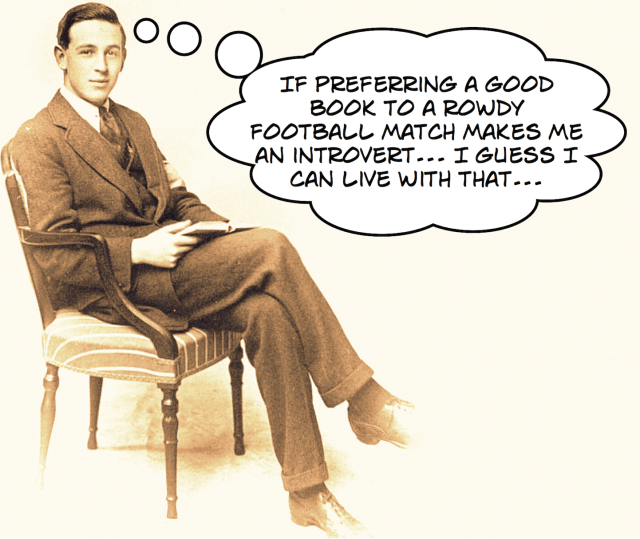
csl introvertLearning about ourselves is a lifelong quest. And the more actively we pursue self-knowledge, the wiser we become.

A well known sixteenth century Christian mystic wrote:

“Self-knowledge is so important that even if you were raised right up to the heavens, I should like you never to relax your cultivation of it.” (Saint Teresa of Ávila, Interior Castle).

This self-knowledge leads to a greater recognition of our dependence on God. She continues, “so long as we are on this earth, nothing matters more to us than humility. . . . As I see it, we shall never succeed in knowing ourselves unless we seek to know God: let us think of His greatness and then come back to our own baseness; by looking at His purity we shall see our foulness; by meditating on His humility, we shall see how far we are from being humble.”

C.S. Lewis echoes this sentiment.

If anyone would like to acquire humility, I can, I think, tell him the first step. The first step is to realise that one is proud. And a biggish step, too. At least, nothing whatever can be done before it. If you think you are not conceited, it means you are very conceited indeed. (Mere Christianity).

As part of my self-examination, I have recently revisited my “personality type” as assessed by the well known Myers Briggs Personality Indicator (MBTI).

Without over-explaining the MBTI, it measures an individual’s preference related to four ways by which we experience and make sense of the world. (News Flash: Not everyone perceives reality the same way!)

These dichotomies are:

Extraversion (E) or Introversion (I)

Whether your preferred focus is outward or inward.

Sensing (S) or Intuition (N)

How you focus on information and process it.

Thinking (T) or Feeling (F)

Primary preference in your decision-making.

Judging (J) or Perceiving (P)

Your orientation towards making sense of existence.

You can get some additional authoritative information here. There are also numerous “unofficial” websites related to the subject.

Sixteen combinations are possible, and each has its respective strengths. (None are “better” than others, of course, since we’re all created in the image of God.)

Speaking of which, I’ve also been studying the different combinations that are more common to Christian ministers than they are within the general population.

For example, the following types (with their shorthand title) range from two to six times more common for male clergy than the general male American population:

ENFJ (The Teacher)

ENFP (The Provider)

INFP (The Healer)

INFJ (The Counselor)

ENTJ (The Field Marshal)

Which type of pastor do you prefer?

Online Surveys to Visit after you finish this post

There are a number of free MBTI-type tests online. Naturally, they are not as reliable as the official inventory given through a certified provider. Nevertheless, the following sites did render accurate assessments for me, based on my formal scoring.

I have mentioned in the past that I am an *NTJ… with the asterisk representing that my I/E preference is too close to call. A previous post shows how that makes me a blend of Middle Earth’s Elrond and Théoden.

Humanmetrics Jung Typology Test

CelebrityTypes Personality Type Test

So, What Is C.S. Lewis’ Personality Type?

This is a subjective question. The MBTI is a self-reported assessment, so guessing the type of another person is by nature dicey.

In Lewis’ case, however, there is a fair degree of consensus. This is due to his openness about his personal life and his extensive writings. The general agreement does not mean though that there are not minority opinions.

The most common argument is that C.S. Lewis was INTJ. I find the reasons persuasive, and not just because it matches my own type!

One student of the subject says “Check out this quote—how INTJ is this?!”

Five senses; an incurably abstract intellect; a haphazardly selective memory; a set of preconceptions and assumptions so numerous that I can never examine more than a minority of them—never become even conscious of them all. How much of total reality can such an apparatus let through? (A Grief Observed)

One blogger writes, “There is no doubt in my mind that Lewis was an INTJ. It seeps off all his writing and is blatant in his behavior in all of his biographies.” She continues:

Highly imaginative child who lived in a dream world? Check.

Someone highly emotional/sensitive but that never showed it on the surface? Check.

A prolific writer who blazed through finishing projects at an astounding rate, who was so successful at everything he did, despite never having done it before, that he quickly rose to the top? Check.

Another site considers both C.S. Lewis and his fellow inkling J.R.R. Tolkien to be INFPs. The aptly titled CelebrityTypes.com offers a brief selection of quotations to illustrate the reasons for their identification.

If the site’s identifications are accurate, the two are in good company. Other writers include John Milton, Augustine of Hippo, Hans Christian Andersen, William Shakespeare, Søren Kierkegaard, George Orwell, A.A. Milne, Edgar Allan Poe, William Blake, J.K. Rowling and George R.R. Martin.

A Warning from Lewis Himself

Understanding ourselves better than we already do, is a good thing.

Being overly curious about the personality of someone who is deceased is another matter. Lewis’ point in the passage that follows is that such concerns must never supersede our regard for others, in the spirit of Matthew 8:22.*

There is a reaction at present going on against the excessive love of pet animals. We have been taught to despise the rich, barren woman who loves her lap dog too much and her neighbor too little. It may be that when once the true impulse is inhibited, a dead poet is a nobler substitute than a live Peke, but this is by no means obvious.

You can do something for the Peke, and it can make some response to you. It is at least sentient; but most poetolaters [worshippers of poets] hold that a dead man has no consciousness, and few indeed suppose that he has any which we are likely to modify. Unless you hold beliefs which enable you to obey the colophons of the old books by praying for the authors’ souls, there is nothing that you can do for a dead poet: and certainly he will do nothing for you. He did all he could for you while he lived: nothing more will ever come.

I do not say that a personal emotion towards the author will not sometimes arise spontaneously while we read; but if it does we should let it pass swiftly over the mind like a ripple that leaves no trace. If we retain it we are cosseting with substitutes an emotion whose true object is our neighbour.

Hence it is not surprising that those who most amuse themselves with personality after this ghostly fashion often show little respect for it in their parents, their servants, or their wives. (The Personal Heresy: A Controversy).

Reflecting on our own nature, and pondering the personalities of those we respect, are worthwhile activities. However, it’s best to remember that all we can see are mere glimpses into the depths of who we truly are.**

_____

* Matthew 8:22 quotes Jesus’ response to a disciple who demurred that he could not follow the Lord until after he attended to his father’s burial. “And Jesus said to him, ‘Follow me, and leave the dead to bury their own dead.’”

** As Paul words in Romans 8:27 are paraphrased in The Message Bible: God “knows us far better than we know ourselves . . .”