C.S. Lewis & the Colors of Heaven

What wonders await the color blind in Heaven! That thought recently occurred to me out of the proverbial blue. 

I was sitting on my patio, tossing a ball to my border collie, when she decided to explore some of the local forest scents, as she is wont to do. As I normally do, I used that peaceful, shalom moment, to pray.

I don’t recall whether I closed my eyes, or gazed at the brilliantly white clouds dancing above me. In either case, my mind and spirit were focused on prayer. Prayer for those I love, and for strangers I have never met.

What wonders await the color blind in the presence of God. Too profound for me to take credit for thinking, but perhaps one of those serendipitous epiphanies God offers unexpectedly to his children.

In The Great Divorce, C.S. Lewis describes an excursion to the foothills of Heaven. The sheer reality of Heaven exceeds fallen humanity’s ability to comprehend it.

Before me green slopes made a wide amphitheatre, enclosing a frothy and pulsating lake into which, over many-coloured rocks, a waterfall was pouring.

Here once again I realised that something had happened to my senses so that they were now receiving impressions which would normally exceed their capacity. On Earth, such a waterfall could not have been perceived at all as a whole; it was too big. Its sound would have been a terror in the woods for twenty miles. Here, after the first shock, my sensibility ‘took’ both as a well-built ship takes a huge wave. I exulted. . . .

Near the place where the fall plunged into the lake there grew a tree. Wet with the spray, half-veiled in foam-bows, flashing with the bright, innumerable birds that flew among its branches, it rose in many shapes of billowy foliage, huge as a fen-land cloud. From every point apples of gold gleamed through the leaves.

When the Narnians sail to the “edge of the world,” they are greeted by a wonder that hints at the beauty of Heaven beyond. Barring their way into that place it rose “between them and the sky, a greenish-gray, trembling, shimmering wall.”

Then up came the sun, and at its first rising they say it through the wall and it turned into wonderful rainbow colors. Then they knew that the wall was really a long, tall wave – a wave endlessly fixed in one place . . . (Voyage of the Dawn Treader).

At the end of the Chronicles of Narnia, C.S. Lewis ushers his heroes into Heaven. They too experience the overwhelming awe inspired by their divine surroundings. 

It is as hard to explain how this sunlit land was different from the old Narnia as it would be to tell you how the fruits of that country taste. Perhaps you will get some idea of it if you think like this. You may have been in a room in which there was a window that looked out on a lovely bay of the sea or a green valley that wound away among mountains.

And in the wall of that room opposite to the window there may have been a looking-glass. And as you turned away from the window you suddenly caught sight of that sea or that valley, all over again, in the looking-glass. And the sea in the mirror, or the valley in the mirror, were in one sense just the same as the real ones: yet at the same time they were somehow different – deeper, more wonderful, more like places in a story: in a story you have never heard but very much want to know.

The difference between the old Narnia and the new Narnia was like that. The new one was a deeper country: every rock and flower and blade of grass looked as if it meant more. I can’t describe it any better than that: if you ever get there you will know what I mean (The Last Battle).

I find Lewis’ fictional visions of Heaven inspiring in their self-confessed inadequacies. Heaven, no doubt, is profoundly more glorious than any human being can imagine.

The Bible employs brilliant colors to help describe Heaven’s beauty. In John’s vision of Heaven we find these descriptions:

And he who sat [upon the throne] had the appearance of jasper and carnelian, and around the throne was a rainbow that had the appearance of an emerald. Around the throne were twenty-four thrones, and seated on the thrones were twenty-four elders, clothed in white garments, with golden crowns on their heads.

From the throne came flashes of lightning, and rumblings and peals of thunder . . . and before the throne there was as it were a sea of glass, like crystal (Revelation 4).

[An angel] showed me the holy city Jerusalem coming down out of Heaven from God, having the glory of God, its radiance like a most rare jewel, like a jasper, clear as crystal. . . .

The wall was built of jasper, while the city was pure gold, like clear glass. The foundations of the wall of the city were adorned with every kind of jewel. The first was jasper, the second sapphire, the third agate, the fourth emerald, the fifth onyx, the sixth carnelian, the seventh chrysolite, the eighth beryl, the ninth topaz, the tenth chrysoprase, the eleventh jacinth, the twelfth amethyst. And the twelve gates were twelve pearls, each of the gates made of a single pearl, and the street of the city was pure gold, like transparent glass (Revelation 21).

The Power of Color

Colors are not merely aesthetic. Their influence on human perception has been studied for many years. One key researcher, Faber Birren (1900-88), served as a respected consultant on the subject for numerous businesses and even the United States government itself. 

Shades of Meaning” relates that “in 1939, Walt Disney invited Birren to work as a color consultant. He ended up advising Disney animators on the design of BambiFantasia, and Pinocchio.” 

In Color Psychology and Color Therapy, Birren begins his discussion of the subject with the proposal that “it is perhaps a mistaken notion that man in his love of color was impelled by some aesthetic urge.” He contends that:

The greatest weight of evidence points to the fact that color was involved with the supernatural and therefore had significance that went beyond what might be thought of as mere sensuous delight. . . .

Color, being a manifestation of light, held divine meaning. Historical records of color show little interest in the physical nature of color, nor yet in its abstract beauty, but in a symbolism that attempted to resolve the strange workings of creation and give it personal and human meaning.

If this spiritual aspect of color is actual, then being colorblind carries a liability beyond simply missing out on one of life’s simple pleasures.

Color Blindness Among Humanity

You may not know anyone who is color blind. That’s not surprising, since it isn’t a common subject of conversation. Nevertheless, in the general population, approximately eight percent – or 1 in 12 – men suffer from some form of it. Meanwhile, the rate of this condition, which is most frequently genetic, for women is far lower. Only about one in two hundred.

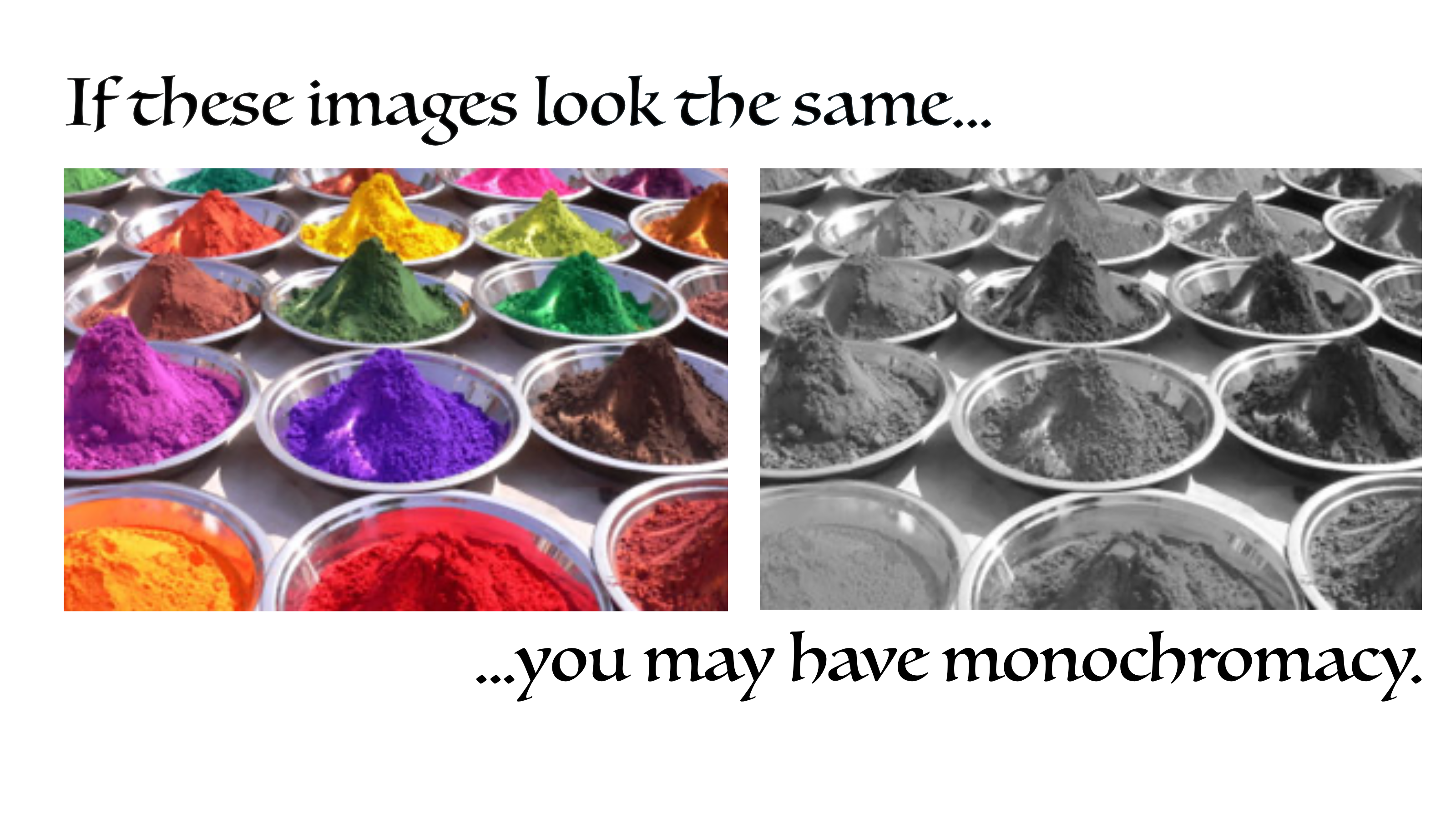
There are several varieties of color vision deficiency, with most people able to perceive some shades of certain colors. The most severe form of the problem involves a failure to see any colors. Only shades of gray distinguish between different hues. It’s called achromatopsia, and is quite rare. 

Achromatopsia is a congenital hereditary condition found in only one birth in every 33,000 to 50,000 births.  Thus less than 10,000 Americans may have achromatopsia. There are two basic forms . . . Rod Monochromatism, . . . is the most common [and] routinely occurs in both men and women. . . .

Blue Cone Monochromatism has an incidence of 1 in 50,000-100,000 births in males and could be as rare as 1 in 10 billion in females.

If you are curious about achromatopsia, you should definitely read about research on a Micronesian Island where ten percent of the people share this affliction.

Many individuals first learned of achromatopsia in 1997, when Oliver Sacks published his classic book, Island of the Color Blind.  This story beautifully chronicles Oliver Sack’s 1994 quest with Knut Nordby and Bob Wasserman to the isolated atoll of Pingelap in Micronesia, where 10% of the population have rod monochromatism. A video of the journey is available here.

Possible Visions of Heaven

Although I am quite wary of so-called near death experiences (with some being spurious, and others, spiritual deception), it is intriguing how color has entered into a number of the stories. The following examples appear in the accounts of several different individuals in Imagine Heaven: Near-Death Experiences, God’s Promises, and the Exhilarating Future that Awaits You.

The entire city was bathed in light, an opaque whiteness in which the light was intense but diffused. In that dazzling light every color imaginable seemed to exist and – what’s the right word? – played. The colors seemed to be alive, dancing in the air. I had never seen so many different colors. It was breathtaking.

Below me lay the purest, most perfect grass, precisely the right length and not a blade that was bent or even out of place. It was the most vibrant green I had ever seen. If a color can be said to be alive, the green I saw was alive, slightly transparent and emitting light and life from within each blade. The iridescent grass stretched endlessly over gently rolling hills upon which were sprinkled the most colorful wild flowers, lifting their soft-petaled beauty skyward, almost as if they were a chorus of flowers caught up in their own way of praising God.

The most gorgeous sky ever seen here on earth cannot even come close to the atmosphere in Heaven.  It is bright because of the glory of our God. . . .  The atmosphere is something you experience, not just see.  It is golden, yellow, white, and had more colors moving throughout it . . . like the Aurora Borealis lights.

The sky [and] the firmament surrounding the heavens, were a wilder and bluer yonder than you would ever believe. . . . The closest shade I can associate this otherworldly blue with is the surreal tones of the water in the Caribbean or off the coast of Hawaii at sunset. . . . That color is waiting for you and me on the other side.

The colors and lights in Heaven were simply sublime. . . . They were the deepest, richest, most gloriously lush colors I had ever seen, and some I had never seen before. Heaven is a dream-come-true for those who love all things colorful, and our home there is lit by the Father of Lights. . . . [There were] robust and bold and vigorous beams that were somehow gentle to my eyes. I simply don’t think those colors and lights exist on earth.

I saw the most dazzling colors, which was all the more surprising because I’m color-blind. I can distinguish the primary colors, but pastels all look the same to me. But suddenly I could see them, all kinds of different shades. Don’t ask me to name them because I lack the necessary experience for that.

Take a Moment to Test Your Own Color Vision

There are a number of simple, free vision tests available online. If you want to assure yourself that you can see all of the normal colors – though not necessarily all of the heavenly colors awaiting us – check out one of the following.

Color Blind Test

EnChroma Color Blind Test

X-Rite Color Challenge and Hue Test

Colorlite Collection of Tests

Final Thoughts

When I described the wonders awaiting the color blind in Heaven, I was referring to all of us. (In this life, as the Scriptures say, “For now we see in a mirror dimly . . .” (1 Corinthians 13).

All who trust in the love of Jesus Christ, and thereby enter Heaven’s environs by the unmerited grace of God’s mercy, will be overwhelmed by its beauty and wonder.

The million or more colors a person with full vision can now see, will be eclipsed by the infinite tapestry of hues in our Creator’s mind. Even those with the scientifically-presumed capability to currently perceive distinctions between up to 100 million will surely be in awe.

C.S. Lewis closes our discussion of Heaven’s colors with a fascinating thought related to the angels who worship God in that divine place. Lewis begins by noting a significant distinction between God’s angels and humanity.

But for our body one whole realm of God’s glory – all that we receive through the senses-would go unpraised. For the beasts can’t appreciate it and the angels are, I suppose, pure intelligences.

They understand colors and tastes better than our greatest scientists; but have they retinas or palates? 

I fancy the “beauties of nature” are a secret God has shared with us alone. That may be one of the reasons why we were made-and why the resurrection of the body is an important doctrine (Letters to Malcolm: Chiefly on Prayer).

C.S. Lewis & Longevity

How long is it good for us to live? That’s a strange question, I know. But, do you have an answer? C.S. Lewis had some thoughts on the subject that you may find provocative.

Aging is on my mind this week. I had never thought about myself becoming a septuagenarian – but this week I became one. Well, I still think of myself as being in my fifties, but that appears to be more common than one would guess. When I entered my fifties, I told my dad (then in his seventies) that “I still picture myself as being in my thirties.”

My dad responded without a moment’s thought: “That doesn’t surprise me at all. I still think of myself as being in my fifties.” 

Many people become preoccupied with age. The only time I recall it mattering to me, was when I turned eighteen – able to vote, and registered for the draft (with Vietnam still a war zone) . . . and when I turned twenty-one, for reasons I prefer not to divulge at this time.

People are living longer, and I’m not convinced that translates into living better. Listen to C.S. Lewis, as he writes in his essay “Is Progress Possible?”

I care far more how humanity lives than how long. Progress, for me, means increasing goodness and happiness of individual lives. For the species, as for each man, mere longevity seems to me a contemptible ideal.

Lewis elaborates on this concept – that long life and happiness do not always intertwine – in the Screwtape Letters. The words which follow are the advice of a senior Tempter (devil) to a less experienced junior.

The truth is that the Enemy [i.e. the true God], having oddly destined these mere animals to life in His own eternal world, has guarded them pretty effectively from the danger of feeling at home anywhere else. That is why we must often wish long life to our patients; seventy years is not a day too much for the difficult task of unravelling their souls from Heaven and building up a firm attachment to the Earth.

While they are young we find them always shooting off at a tangent. Even if we contrive to keep them ignorant of explicit religion, the incalculable winds of fantasy and music and poetry . . . are always blowing our whole structure away. They will not apply themselves steadily to worldly advancement, prudent connections, and the policy of safety first.

So inveterate is their appetite for Heaven, that our best method, at this stage, of attaching them to Earth is to make them believe that Earth can be turned into Heaven at some future date by politics or eugenics or “science” or psychology or what not.

Real worldliness is a work of time. . . . How valuable time is to us may be gauged by the fact that the Enemy allows us so little of it. . . .

We are allowed to work only on a selected minority of the race, for what humans call a “normal life” is the exception. Apparently He wants some – but only a very few – of the human animals with which He is peopling Heaven to have had the experience of resisting us through an earthly life of sixty or seventy years. Well, there is our opportunity. The smaller it is, the better we must use it. (Letter XXVIII).

Sadly, far too many people grow far too attached to this world. They lose sight of the promise of Resurrection (if they had ever known it), and as death approaches crave just one more year, another month, another week, another day, even another hour.

Now, I’m not saying long life is a negative, per se. I agree with C.S. Lewis when he wrote “I must never, like the Stoics, say that death does not matter. Nothing is less Christian than that” (“The Grand Miracle”). The danger is not in enjoying the Lord’s wonderful creation. It is in growing too attached to this fallen version of it – in losing touch with the truth proclaimed by musician Larry Norman, that this sin-stained world is not our ultimate home.

Dying

Having been at the bedside of too many people as they face their mortality, I have witnessed many final days. Some literally go, trembling and cursing. Others depart with grim resignation, and no evidence of hope. And then there are those who die with faith, experiencing true peace and joyous anticipation, despite the pain they may be enduring. 

I wish everyone could die in such a state, at peace and earnestly desiring to see the glory of God unblurred by our mortal eyes (1 Corinthians 13). 

On that day we will enter into the fullness of life, into eternal life. (Dr. Michael Zeigler offers an encouraging sermon you can read or listen to at “The Problem and Promise of Deathbed Conversion.”)

The Screwtape Letters is one of C.S. Lewis’ most imitated books. I have even experimented with his model myself. But, rather than emulate these letters, today I would be so bold as to offer an addition to this demonic epistle. 

My supplement is not intended for Christians, except as a truth they may wish to share with others who are walking through the valley of the shadow of death.

And never, my dear Wormwood, at the risk of your own torment, forget this one dire threat. Even after a long life, lived in hedonistic pleasure, deeply tethered to this decaying world, it is still possible for these wretches to be rescued from our claws.

The Enemy is so blindly compassionate that he will foolishly overlook a magnitude of savory sins sown during a carnal life. The dissolute lives we have toiled so steadfastly to soil with uncountable depravities and unrelenting selfishness, remain vulnerable until the patients’ final breath is exhaled.

The Gordian Knot we have so skillfully twisted can be undone in an instant, if they cry out to the Enemy for forgiveness. That is why we must remain vigilant to the very end. It is ideal to have them railing at the end against a God who has allowed them to suffer.

Yet it is sufficient that they die without that rage. A hopeless resignation to what they foolishly consider the end of their existence, still provides fodder for the insatiable appetite of Our Father Below quite adequately.

Final Encouragement

God’s mercy is beyond our ability to comprehend it. While there is breath, there remains hope. Even at the end of a squandered life, God’s love in Jesus Christ is sufficient to wash away every failing, and usher a penitent soul into the glory of everlasting life. 

Remember that, if you find yourself feeling too defiled to come to Christ at the end, that is a lie of Satan. Every single one of us Christians was in similar straits – “while we were still sinners, Christ died for us.”

And, should you ever have the experience of traveling beside a dying friend who sees only darkness ahead, share with them this gospel hope.

C.S. Lewis and Time’s Meaning

What is time, and why are we subject to its ofttimes harsh burdens? After his conversion from atheism, C.S. Lewis discovered some comforting truths about time, and the limits of time’s constraints.

Each year the four seasons seem to pass more rapidly. Before we know it, our parents have gown old, and we may well have children of our own. In retrospect, it all happens in the proverbial flash.

Ultimately, there will come a day when our lives reach their own “winter,” and even our most precious memories may drift away from us in time’s relentless breeze.

The C.S. Lewis Institute has an interesting article titled “The Point at which Time Touches Eternity.” They quote some wisdom from The Screwtape Letters, and end with a query which can help us live happier lives.

As you think about your own life, do you sometimes think too much about the Past or the Future, and not chiefly attend to the Present and Eternity?

Lewis answers that very question in his essay “Historicism.” He acknowledges that too often we become slaves to the regrets of our past and the dread of challenges awaiting us in the future. He reminds Christians that “God will supply every need of yours according to his riches in glory in Christ Jesus” (Philippians 4).* Therefore, Lewis encourages us to throw off the bondage of past and future, since “where, except in the present, can the Eternal be met?”

Janie Cheaney recently wrote “Eternity in Our Hearts” for World Magazine. Inspired by Saint Augustine and C.S. Lewis, it is subtitled “What if time astonishes us because we are meant to one day live outside of it.”

More of Lewis’ Thoughts about Time

In Mere Christianity, Lewis describes our universal human experience. “Our life comes to us moment by moment. One moment disappears before the next comes along: and there is room for very little in each. That is what Time is like.” He then describes just how limited our perspective is.

And of course you and I tend to take it for granted that this Time series – this arrangement of past, present, and future – is not simply the way life comes to us but the way all things really exist. We tend to assume that the whole universe and God himself are always moving on from past to future just as we do. But many learned men do not agree with that. Almost certainly God is not in Time. His life does not consist of moments following one another . . .

If you picture Time as a straight line along which we have to travel, then you must picture God as the whole page on which the line is drawn. We come to the parts of the line one by one: we have to leave A behind before we get to B, and cannot reach C until we leave B behind. God, from above or outside or all around, contains the whole line, and sees it all.

In Miracles, C.S. Lewis describes God’s transcendence over time as our Creator’s “eternal Now.”

It is probable that Nature is not really in Time and almost certain that God is not. Time is probably (like perspective) the mode of our perception. There is therefore in reality no question of God’s at one point in time (the moment of creation) adapting the material history of this universe in advance to free acts which you or I are to perform at a later point in Time.

To Him all the physical events and all the human acts are present in an eternal Now. The liberation of finite wills and the creation of the whole material history of the universe (related to the acts of those wills in all the necessary complexity) is to Him a single operation. In this sense God did not create the universe long ago but creates it at this minute – at every minute.

That is pretty deep. The sort of stuff that philosophers love to ponder and debate. Even before his conversion to Christianity, while still clinging to his formal atheism, Lewis contemplated time’s role in existence. In 1918 he wrote to his close friend Arthur Greeves about these matters. 

You see the conviction is gaining ground on me that after all Spirit does exist; and that we come in contact with the spiritual element by means of these “thrills.” I fancy that there is Something right outside time & place, which did not create matter, as the Christians say, but is matter’s great enemy: and that Beauty is the call of the spirit in that something to the spirit in us. You see how frankly I admit that my views have changed.

Sheldon Vanauken (1914-1996) was an American author who preserved in A Severe Mercy several of C.S. Lewis’ letters of consolation following the death of Sheldon’s wife. In some ways, the Vanauken story foreshadowed Lewis’ own marriage and widowhood. Pointing toward the Resurrection, Lewis wrote the following.

You say the materialist universe is “ugly.” I wonder how you discovered that! If you are really a product of a materialistic universe, how is it you don’t feel at home there? Do fish complain of the sea for being wet? Or if they did, would that fact itself not strongly suggest that they had not always been, or would not always be, purely aquatic creatures?

Notice how we are perpetually surprised at Time. (“How time flies! Fancy John being grown-up & married! I can hardly believe it!”) In heaven’s name, why? Unless, indeed, there is something in us which is not temporal.

C.S. Lewis writes much more about time, but we will conclude here with two passages that use the metaphor of author to describe God’s nature. The first comes from an essay entitled “The Seeing Eye.”

My point is that, if God does exist, He is related to the universe more as an author is related to a play than as one object in the universe is related to another. If God created the universe, He created space-time, which is to the universe as the metre is to a poem or the key is to music.

To look for Him as one item within the framework which He Himself invented is nonsensical. If God – such a God as any adult religion believes in – exists, mere movement in space will never bring you any nearer to Him or any farther from Him than you are at this very moment.

You can neither reach Him nor avoid Him by travelling to Alpha Centauri or even to other galaxies. A fish is no more, and no less, in the sea after it has swum a thousand miles than it was when it set out.

This final quotation appears in Mere Christianity. It is most certainly true, and my hope is that all who read this post will come to celebrate this joy. Both now, and for eternity.

God is not hurried along in the Time-stream of this universe any more than an author is hurried along in the imaginary time of his own novel. He has infinite attention to spare for each one of us.

He does not have to deal with us in the mass. You are as much alone with Him as if you were the only being He had ever created. When Christ died, He died for you individually just as much as if you had been the only man in the world.


* This gracious, eternal gift is available to all people.

Errors that Seem to be True (Angels)

Many people have been taught so little about biblical Truth that they believe many errors. For example, many people (and no offense intended if you are among them) mistakenly believe that when people die, they become angels.

That connection is so blatantly contrary to the fact that angels who “see the face [of God] who is in heaven” are completely different creations than the Sons of Adam and Daughters of Eve who are actually human beings, created in the image of God.

In his preface to The Screwtape Letters, C.S. Lewis alludes to how this confusion is reinforced by humanity’s lack of familiarity with angels in their true or natural (for them) form. While there are clear examples in the Bible where God has his angels appear in the likeness of human beings (e,g. before Sodom’s judgment and at the empty tomb), there are also times when their celestial radiance is not disguised (i.e. when the shepherds are informed about birth of the Savior or in John’s visions as recorded in the Book of Revelation).

[Angels] are given human form because man is the only rational creature we know. Creatures higher in the natural order than ourselves, either incorporeal or animating bodies of a sort we cannot experience, must be represented symbolically if they are to be represented at all (Screwtape Letters).

Nevertheless, this myth permeates the thinking of our secular culture. Once, some years past, a pastor friend was relating to me that one of his distant relatives had recently died. He said it comforted him to know that she was now an angel. I started to chuckle in response to his humorous way of lightening his own mood, until I realized he wasn’t joking. This poor, genuinely compassionate minister had been tricked by the spirit of this world into buying into a lie.

C.S. Lewis famously said that anything worth reading once is worth reading again. I’m clearing out some magazines from several years ago, and rereading insightful articles as I go. In a short piece about a complex subject, “What Happens to the Dead?” Ryan Pemberton makes a troubling comment.

Pop culture has done more to shape modern views about death than biblical teaching has.

The brevity of the article prevents the author from exploring other subjects, but his observation is applicable to a wide array of concerns.

I’m confident I could state, without fear of contradiction, that contemporary culture has done more to shape modern views about marriage than biblical teaching has. And, adding only a few additional examples, more about . . . justice . . . demons . . . love . . . mental health . . . responsibility . . . heaven . . . labor . . . creation . . . and Jesus himself.

It’s Not All Bad

It should be admitted that not all contemporary insights have been 100% misguided. One area where modern sensibilities have restored balance to truthful thinking is in the area of care for the environment. Ignoring extreme notions about nature being more important than human life, we can applaud the work of Christian environmentalists who have helped restore a biblical (i.e. true) view of the world around us.

Reacting to twisted notions that humanity’s “dominion” over the earth allows for nature’s misuse and abuse, these men and women helped open our eyes to the fact that God calls us to be trustworthy stewards in our care of, and appreciation for, this amazing world he has made.

The Inklings, C.S. Lewis and J.R.R. Tolkien, in particular, possessed a profound love for nature. Their general antipathy to the ugly and polluting trappings of industrialization are grounded in their belief that the world God created was truly “good.” With that came the recognition that man does little to enhance, and much to undermine, that initial goodness.

When two ideas clash, go with the one that is correct. And, when one of those authorities is the Word of the Creator of all that exists, well, isn’t it obvious which is the right choice?

Angels & People

For more on the angelic subject with which we began, check out the provocatively titled “People Aren’t Downgraded to Angels When They Die.” As the author there so rightly explains,

When Christians die, heaven does not “get another angel.” We cannot become angels any more than we can become giraffes or ocean waves or stars. We are people and will remain so after this present life. God did not make a mistake when he made us human.

How Precious, Is Memory

What would you do if tomorrow you awoke never again able to remember the births of your three children? Never to remember your marriage or your college years? How would you rebuild your life with children and a husband you no longer knew?

In Out of the Silent Planet, C.S. Lewis described a fundamental expectation we possess – “Every day in a life fills the whole life with expectation and memory.” this makes the fragility of the human brain and mind all the more sad.

The question above sounds like the plot to some novel or film, but this was a real life experience for Marcy Gregg. She has written a detailed account of the amazing story in Blank Canvas, and an account of the experience is available online at Focus on the Family

Before you rush to read it, though, I would like to share a few thoughts about memory. Today, increasing life expectancies make senility and dementia far too familiar to families. Dismissing such disorders related to causes such as brain injuries or drug abuse, we still hear of so many cases of Alzheimer’s and other neurodegenerative diseases. Many of us have been touched by this pain, as it has destroyed the lives of people we love. 

Happily, there are growing options for residences equipped with skilled nursing care trained especially for “memory care.” The problem, of course, is not just the availability, but also the significant cost. AARP reported that in 2021, “the average memory care monthly rent is $6,935 in the U.S.”

That’s significantly more than assisted living, which averages $5,380 a month, but a lot less than the $10,562 average monthly cost of a nursing home.

Since we identify our personhood so heavily with our minds, we do not like to think about things like the multiple types of amnesia. Some are terrible, and one is nearly universal. WebMD includes six in their list. The woman above experienced anterograde amnesia which they describe as the loss of “your ability to recall events that happened just before the event that caused your amnesia.” Fortunately, though not the case for Marcy, they add, “usually this affects recently made memories, not those from years ago.‌”

One form of amnesia listed by WebMD may come as a surprise to you, as it did to me. It is referred to as infantile or childhood amnesia. It describes how our young brains were not yet developed well enough to consolidate and store memories for retrieval. Many of us lack early memories, and rely on stories and media to fill in that long gap in our lives.‌

A brief article from the University of Queensland describes how “memories aren’t stored in just one part of the brain.” Differing types are stored “across different, interconnected brain regions.”

Cedars-Sinai has “discovered two types of brain cells that play a key role in creating memories.”

“One of the reasons we can’t offer significant help for somebody who suffers from a memory disorder is that we don’t know enough about how the memory system works,” said [a] senior author of the study, adding that memory is foundational to us as human beings.

Human experience is continuous, but psychologists believe, based on observations of people’s behavior, that memories are divided by the brain into distinct events, a concept known as event segmentation.

Forgetfulness is, for most who live long enough, an unavoidable aspect of aging. But it may not be quite so bad as it appears to us, as C.S. Lewis related in a letter written several years before his death.

About forgetting things. Dr. Johnson* said “If, on leaving the company, a young man cannot remember where he has left his hat, it is nothing. But when an old man forgets, everyone says, Ah, his memory is going.”

So with ourselves. We have always been forgetting things: but now, when we do so, we attribute it to our age.

Why, it was years ago that, on finishing my work before lunch, I stopped myself only just in time from putting my cigarette-end into my spectacle case and throwing my spectacles into the fire!

Forgetfulness is a common part of human experience, but clinical amnesia is something altogether different.

Tragically, some suffer from anterograde amnesia. One of the saintly matrons at our church carries this cross, assisted by her loving daughter and son-in-law. This cruel disease prevents the retention of new memories. While it is often linked with geriatric considerations, and can affect all of one’s memories, this article from the National Library of Medicine describes a particularly tragic case in which a child “had an abrupt onset of amnesia due to a respiratory arrest at the age of 8 years.”

Cases such as this move Christians to prayer, and many others to despair. While miracles do happen, they are rarer than we desire. Ultimately the Christian hope is in a Lord who keeps his promises, and one of these is that he will come again and will take us to himself, so that where he is, we may be also (John 14). And, in heaven, we will receive a new body like Christ’s resurrection body (Philippians 3).


* Samuel Johnson (1709-1784), a prolific and influential English writer, was often referred to simply as “Dr. Johnson.” Many volumes of the good doctor’s writings are available as free downloads from Internet Archive. For example, volume 7 of the 1810 collection, includes the following essay discussing human shallowness. He begins by contemplating the ability of animals to remember and to anticipate the future.

The Idler
Numb. 24. Saturday, September 30, 1758.

When man sees one of the inferiour creatures perched upon a tree, or basking in the sunshine, without any apparent endeavour or pursuit, he often asks himself or his companion, On what that animal can be supposed to be thinking?

Of this question, since neither bird nor beast can answer it, we must be content to live without the resolution. We know not how much the brutes recollect of the past, or anticipate of the future; what power they have of comparing and preferring; or whether their faculties may not rest in motionless indifference, till they are moved by the presence of their proper object, or stimulated to act by corporal sensations.

I am the less inclined to these superfluous inquiries, because I have always been able to find sufficient matter for curiosity in my own species. It is useless to go far in quest of that which may be found at home; a very narrow circle of observation will supply a sufficient number of men and women, who might be asked, with equal propriety, On what they can be thinking?

It is reasonable to believe, that thought, like every thing else, has its causes and effects; that, it must proceed from something known, done, or suffered; and must produce some action or event. Yet how great is the number of those in whose minds no source of thought has ever been opened, in whose life no consequence of thought is ever discovered; who have learned nothing upon which they can reflect; who have neither seen nor felt any thing which could leave its traces on the memory; who neither foresee nor desire any change of their condition, and have therefore neither fear, hope, nor design, and yet are supposed to be thinking beings.

To every act a subject is required. He that thinks must think upon something. But tell me, ye that pierce deepest into nature, ye that take the widest surveys of life, inform me, kind shades of Malbranche [Nicolas Malebranche] and of [John] Locke, what that something can be, which excites and continues thoughts in maiden aunts with small fortunes; in younger brothers that live upon annuities; in traders retired from business; in soldiers absent from their regiments; or in widows, that have no children?

Life is commonly considered as either active or contemplative; but surely this division, how long soever it has been received, is inadequate and fallacious. There are mortals whose life is certainly not active, for they do neither good nor evil; and whose life cannot be properly called contemplative, for they never attend either to the conduct of men, or the works of nature, but rise in the morning, look round them till night: in careless stupidity, go to bed and sleep, and rise again in the morning.

Johnson’s essay continues with a discussion of the soul and its distinction from the mental processes themselves. Obviously, he is not considering the subject of amnesia, but he reminds us never to become too doctrinaire, since that “supposes what cannot be proved, that the nature of mind is properly defined.” 

His purpose in the essay is not to discuss the abilities of the brain but, at least in part, to critique those who choose to be unthinking. Those who spend not a moment in reflection or contemplation.

I encourage you to read the entire essay, as it demonstrates Johnson’s brilliance. I close this extended “footnote” with a passage in his concluding section which keenly describes our common human experience with memory.

We every day do something which we forget when it is done, and know to have been done only by consequence. The waking hours are not denied to have been passed in thought; yet he that shall endeavour to recollect on one day the ideas of the former, will only turn the eye of reflection upon vacancy; he will find, that the greater part is irrevocably vanished, and wonder how the moments could come and go, and leave so little behind them.

Timothy Keller & C.S. Lewis

The spiritual legacy of C.S. Lewis continues to bear abundant fruit. And, although his humility would prevent him from accepting it, Lewis shares credit in the blessings being passed on to new generations by those whose lives he directly touched.

Some of these gifted Gospel communicators have publicly praised Lewis for his role in their own conversions or moments of deeper epiphany into the work of our Creator. 

One such Christian leader was Timothy Keller, who recently died at the age of 72. Although he was just a few years older than me, Keller and I shared a number of traits. Raised Lutheran, we accepted the truths about Jesus’s work as kids, but it wasn’t until our young adulthood that we were confronted with the fact that trusting Christ as a loving Savior falls far short of taking up our own crosses and following him as Lord.

It’s no accident that our mutual spiritual awakenings coincided with our introduction to the writings of C.S. Lewis during our collegiate years. Both of us became pastors, although the paths of ministry we followed differed, as befits children of a heavenly Father who guides each of his children as the unique person he has created them to be. 

Keller was ordained in the Presbyterian tradition, and devoted most of his energy to helping the Christian Church establish a far more intentional ministry in cities. I was ordained in the Lutheran branch of the Body of Christ, and served much of my ministry as a military chaplain. Both of us were pastors in evangelical, Scripture-affirming denominations within our respective traditions.

I’m sure there are other parallels, such as both being married since the mid-70s and having three kids, but the last similarity I wish to note is that we both have writing as part of our vocations. Not that I would compare my own modest talents to Keller’s.

Tim Keller was a prolific author. And the influence of C.S. Lewis on his thinking, and writing, is pervasive in Keller’s work. Last year The Evangelical Christian Publishers Association presented him with the prestigious “Pinnacle Award.”

Timothy Keller has written more than 35 books, published by a variety of companies, with some co-authored by his wife Kathy.  His published body of work represents a variety of categories including apologetics, biblical studies, theology, prayer, devotionals, marriage, Bible study, the Church, and cultural engagement – with sales exceeding 7.5 million units and translated into more than 25 languages.

Keller’s prodigious literary output is one reason he has been likened to C.S. Lewis. Another obvious reason is the subject matter, particularly the prominent place occupied by Christian apologetics.

Like Lewis, Keller was an avid reader. This trait provided the foundation for both authors’ literary contributions to Christian thinking. “A Reading List to Understand Tim Keller” includes a number of the works of great importance to him.

Read This Twice, which gathers book endorsements found on the internet, provides a list of 64 books endorsed by Tim Keller. What makes this curious site special is they provide quotations for his recommendations and the sources from which they are gleaned. Oddly, the aggregator appears to lean heavily on contemporary Twitter sources. Consequently, it includes not a single book written by C.S. Lewis himself, belying the Inkling’s seminal influence on Keller.

The endorsement website also offers access to book recommendations on subjects of a visitor’s choice, compliments of Sona. Sona, as a caution to those among us who are wary of artificial intelligence, is an “AI-driven book recommendation assistant that makes it easy for you to discover your next read. Just provide your specific preferences, and [she] will quickly search through a large database of books to offer you options that closely align with your request.” The invitation closes with: “Try ‘Sona’ and enjoy a seamless, personalized book-finding experience.”

In “Remembering Tim Keller – Today’s C.S. Lewis,” the writer plays with his title.

It is often said that Dr. Timothy Keller, who died last Friday at his home in Manhattan, was this generation’s C.S. Lewis. The dust jacket for The Reason for God says so.

Tim would have had none of it. He just wasn’t that kind of person. I remember sitting down with him after yet another remarkable talk that he had delivered, sparkling with ideas and insight, with lots more to explore, and all he wanted to talk about was his kids and how great they were. Tim was a simple child of God with, like all of us, the normal joys and worries in life.

And yet . . . that impact! It was enormous. Although it might be an overstatement to ascribe C.S. Lewis status to his contribution, it would only be a slight overstatement.

Tim Keller certainly shared some of C.S. Lewis’ righteous qualities, but some writers are adamant about acknowledging their distinctions. A fellow Presbyterian pastor has a great post on this subject titled “Tim Keller is NOT this generation’s C.S. Lewis.” The author persuasively argues that their vocations were too different to make such a claim. 

But please, can we not call him another C.S. Lewis?  Any time we call a great person “another” anybody, we are doing disservice to both figures.  Lewis’ vocation was to serve as a man of letters who wove his faith into his writing.  Keller’s vocation is to be a pastor and equipper who employs writing as but one of his tools.

There are even some conservative Reformed authorities who view Keller (and C.S. Lewis) with suspicion. According to Christian Network Europe “Laurens van der Tang . . . wrote in De Wachter Sions (The Watchman of Sion) . . . that the books of Christian writers, such as Lewis, Dietrich Bonhoeffer and Tim Keller” may possess positive elements but are incomplete. “He argues that they did not pay enough attention to man’s death state, the need for repentance and God’s holy wrath on sin.”

He concludes that “distancing is appropriate” and that these “authors cannot replace theologians from the Reformation or the Dutch Second Reformation.” Also, the Dutch Rev. A. Schreuder writes that “whoever reads the works of the Big Three misses the ultimate point of the personal appropriation of salvation.”

Fortunately, such opinions are in the minority. Most Christians find all three writers inspiring. As this very article reports, “the combination of reason, feeling and imagination is also why Christians in many different surveys indicate that they see Lewis . . . as one of the most influential theologians of the 20th century.”

A glance at virtually any one of Keller’s books will reveal at least one reference to the writings of C.S. Lewis. In Shaped by the Gospel, he references four of Lewis’ books and essays. In his book On Death, Keller discusses that when we stand in God’s very presence – a joy he even now knows – and alludes to a powerful metaphor offered by C.S. Lewis in The Weight of Glory.

C.S. Lewis says if these lower reaches of the stream of God’s glory are so intoxicating, what will it be like to drink from the fountainhead?

The Atlantic published a poignant essay by Keller as he faced his impending death. “Growing My Faith in the Face of Death: I spent a lifetime counseling others before my diagnosis. Will I be able to take my own advice?”

The subtitle says it all. It’s a challenge many Christians one day face, and it is particularly sobering for pastors. In the article, Keller relates an acutely tragic conversation.

A significant number of believers in God find their faith shaken or destroyed when they learn that they will die at a time and in a way that seems unfair to them. Before my diagnosis, I had seen this in people of many faiths. One woman with cancer told me years ago, “I’m not a believer anymore—that doesn’t work for me. I can’t believe in a personal God who would do something like this to me.” Cancer killed her God.

Yes, reality and the suffering consequences of the Fall may have shattered the spectral image of her god (lower case “g”), but I hope that through the ministry of Keller and others that unfortunate woman came to know the true God before she stood in his presence.

For I am sure that neither death nor life, nor angels nor rulers, nor things present nor things to come, nor powers, nor height nor depth, nor anything else in all creation, will be able to separate us from the love of God in Christ Jesus our Lord (Romans 8).

Timothy Keller, like C.S. Lewis before him, who served as one of Keller’s mentors, left us with a treasure trove of edifying literature. In the past I’ve often been too busy to read much of Keller’s work. However, as of now I am in the process of rectifying that problem. If you join me in that journey, I’m sure neither of us will be disappointed.

History in Retrospect

This title, “History in Retrospect,” is of course redundant. There is no other way to consider history than by looking back at the past – from our current vantage point.

That is why it’s impossible to view history completely objectively. Since each of us measures things from our personal worldview, the same event means vastly dissimilar things to different people.

When people are hyper-partisan, they are incapable of reasoning with others who view events differently. The history of the United States is currently the subject of intense (too often extremist) debate by its citizens. Balanced people, the type I prefer talking to, admit the shortcomings in our history, and praise the accomplishments.

There are those, sadly, who believe their nation can have done no wrong. There are others who relish condemning the country’s imperfections. Those in the latter camp remind me of the prejudice exhibited by Nathanael, one of Jesus’ future disciples, when he dismissed his brother’s enthusiasm about the Messiah with the words “can anything good come out of Nazareth?” (John 1).

C.S. Lewis was a gifted writer and academic. He was also a historian, especially an expert in literary history. His volume in the Oxford History of English Literature reflects that fact quite clearly.

Lewis was not only brilliant, in many ways he revealed great wisdom. Listen to these remarks about history from a letter he wrote to one of his casual correspondents in 1952.

You are not the kind of correspondent who is a ‘nuisance:’ if you were you would not be now thinking you are one – That kind never does.

But don’t send me any newspaper cuttings. I never believe a word said in the papers.

The real history of a period (as we always discover a few years later) has very little to do with all that, and private people like you and me are never allowed to know it while it is going on.

Educated originally as a “journalist,” I’m forced to agree completely with Lewis. Every word in print today is suspect. Those who do not read critically are on dangerous ground. And, of course, it’s not just newspapers and journals that demand caution. Digital media are even worse.

For that reason, we should never pretend any publication is 100% reliable. However, one magazine that I believe honestly strives toward that goal, is World Magazine. I appreciate the fact that it approaches subjects from my own theistic (Christian) worldview. By default, that makes it makes it untrustworthy to those who possess an anti-Christian worldview.

The open-minded individuals I referred to above, ever a minority, are willing (even eager) to read articles written by people from a range of perspectives. And it is for you, the honest and inquisitive people, that I suggest you consider adding World to your reading list.

Andrée Seu Peterson, recently wrote a provocative article discussing a recurrent historical phenomenon. It is entitled “A gathering in Switzerland: Little-known meetings can have massive outcomes.”

Down through history there have been little conferences attended by small numbers of elites that have quietly changed the world while the rest of mankind was going about its mundane business unawares. . . .

In June of 1494 King Ferdinand II of Aragon, Queen Isabella I of Castille, and King John II of Portugal drew a demarcation line like a vertical knife edge running from North to South poles, trampling established communities as it divided the Western world between Spain and Portugal.

People falling on one side of the line would henceforth speak Spanish and people on the other side would speak Portuguese.

Echoes of C.S. Lewis’ cautions about the “inner ring!”

Considering the “End of History”

History is defined in a variety of ways. To avoid politically charged definitions, let’s turn to a source in that most-neutral nation, Switzerland. In the description of their doctoral program in the field, the Universität Basel says “history examines past events, processes and structures [and] is both a cultural studies and a social sciences discipline.”

The point being that history relates to humanity, rather than our planet as an entirety. Thus, history won’t end with death of our solar system “in about 5 billion years [when] the sun will run out of hydrogen.” Even the most optimistic advocates of a starfaring future for humanity would likely admit history will end long before that.

Christians, on the other hand, foresee a future history without end. Yes, this earth will pass away, but our Creator has promised a new heaven and a new earth that will not echo the perishable nature of our fallen world.

In light of this conviction, Peterson includes a sobering observation in her essay about history.

People living in the Stone Age didn’t know they were living in the Stone Age. People alive at the time the monks in Ireland furiously copied Greek and Latin Bible manuscripts as fast as the Huns and Visigoths could torch the libraries of Europe didn’t know they were living through the near destruction of Western civilization. Such things are clear only in hindsight.

No Christian pretends to know the day of Christ’s return. In fact, Jesus expressly said “concerning that day and hour no one knows, not even the angels of heaven . . . Therefore you also must be ready, for the Son of Man is coming at an hour you do not expect” (Matthew 24).

Speculation about the Day of the Lord has rarely been beneficial. Suffice it to know that we should remain, at every possible moment, “ready.”

C.S. Lewis wrote another letter in 1952 which addresses this principle. His friend Don Giovanni Calabria (1873-1954), who was canonized by John Paul II in 1999, had written to Lewis sharing his impression that the day of the Lord’s return was drawing nearer.

Lewis reminded the priest of something Calabria already knew quite well. And it’s something well worth being reminded of today.

The times we live in are, as you say, grave: whether ‘graver than all others in history’ I do not know. But the evil that is closest always seems to be the most serious: for as with the eye so with the heart, it is a matter of one’s own perspective.

However, if our times are indeed the worst, if That Day is indeed now approaching, what remains but that we should rejoice because our redemption is now nearer and say with St John: ‘Amen; come quickly, Lord Jesus.’

Meanwhile our only security is that The Day may find us working each one in his own station and especially (giving up dissensions) fulfilling that supreme command that we love one another.

Lewis closes his letter with an affectionate prayer and promise, worthy of emulation in our own lives. “Let us ever pray for each other.” A sentiment I share with you.

Resurrection Bodies, Angels & C.S. Lewis

And just what will those heavenly bodies be like..? And what about those angels..?

Among the many things that Christians look forward to, as an unearned gift from God, is a new body. This resurrected body will not be like our old (i.e. former) body… but it will be similar to the bodies of our first parents, Eve and Adam. So, in a sense, one might say it’s a bit like that old, old (i.e. original) body.

Sadly, there’s a lot of unnecessary confusion about what awaits us after death. While the Lord doesn’t give us all the details (which we wouldn’t be able to comprehend right now anyway), he does make the big picture clear. Here are some facts (based on the Scriptures as interpreted for 2,000 years within the orthodox Christian faith).

1.  You can’t do enough good works to deserve to enter heaven. It’s all about God’s mercy and grace.

If you think you can be good enough to get there on your own . . . sorry. If you therefore don’t think it matters at all how you live… you will end up just as sorry.

2. In heaven, God’s redeemed will not be incorporeal spirits. We’ll have bodies, just as our Maker intended from the day he breathed life into Adam’s lungs. Christians affirm belief in the “resurrection of the body.”

As to the nature of the bodies, God doesn’t leave us ignorant. One of the best New Testament descriptions is found in First Corinthians.

Even the Old Testament prophet Job proclaimed the wonders of a bodily resurrection when, in his own flesh, he would see the Lord.

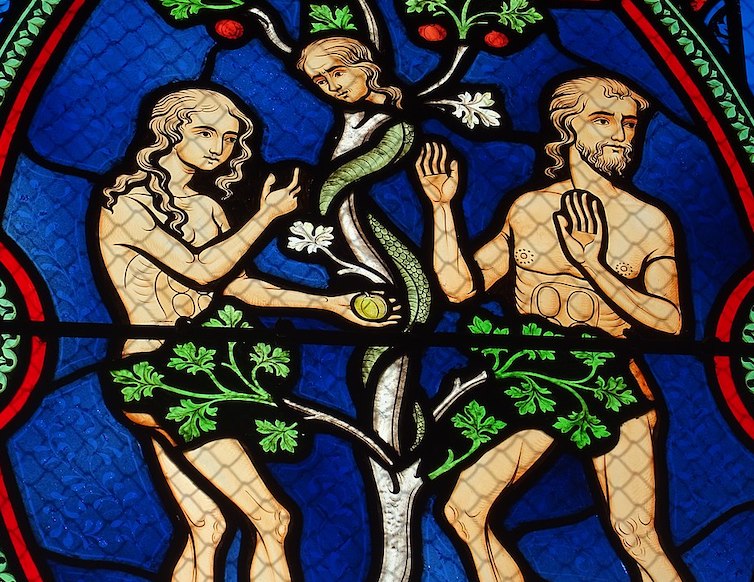
God’s written word includes more about our resurrection bodies. One, from the letter to the Christians in Philippi, says, “the Lord Jesus Christ . . . will transform our lowly body to be like his glorious body.” This verse, like the stained glass image above, inspires me to wonder what that body will be like. Like Jesus’ own resurrection body, we learn.

Perhaps also like humanity’s unfallen human bodies portrayed here in colored glass. If the artist’s vision is accurate, I’m eager to welcome back the hair that once adorned my head, and to enjoy those stunningly defined abs, that I unfortunately never possessed.

Writing to his friend Arthur Greeves, Lewis clarified the biblical definition of resurrection.

I agree that we don’t know what a spiritual body is. But I don’t like contrasting it with (your words) “an actual, physical body.” This suggests that the spiritual body wd. be the opposite of “actual” – i.e. some kind of vision or imagination. And I do think most people imagine it as something that looks like the present body and isn’t really there.

Our Lord’s eating the boiled fish seems to put the boots on that idea, don’t you think? I suspect the distinction is the other way round—that it is something compared with which our present bodies are half real and phantasmal. (19 August 1947)

3. Human beings never become angels. One of most common mistakes about heaven is that people (“good” ones, at least) become angels after they die. They don’t. Period. Angels are angels and people are people – two separate beings, each with their own nature. Angels are majestic, most certainly, but they were not blessed like humanity to be created in the very image of God.

And never forget, not all angels are good. Those fallen ones, in fact, no longer merit their identification as angels. Better to label them as what they’ve become, demons.

As for people being intrinsically distinct from angels, C.S. Lewis wrote a poem that contrasts angelic and human personhood.

On Being Human by C. S. Lewis

Angelic minds, they say, by simple intelligence
Behold the Forms of nature. They discern
Unerringly the Archetypes, all the verities
Which mortals lack or indirectly learn.
Transparent in primordial truth, unvarying,
Pure Earthness and right Stonehood from their clear,
High eminence are seen; unveiled, the seminal
Huge Principles appear.

The Tree-ness of the tree they know – the meaning of
Arboreal life, how from earth’s salty lap
The solar beam uplifts it; all the holiness
Enacted by leaves’ fall and rising sap;

But never an angel knows the knife-edged severance
Of sun from shadow where the trees begin,
The blessed cool at every pore caressing us
– An angel has no skin.

They see the Form of Air; but mortals breathing it
Drink the whole summer down into the breast.
The lavish pinks, the field new-mown, the ravishing
Sea-smells, the wood-fire smoke that whispers Rest.
The tremor on the rippled pool of memory
That from each smell in widening circles goes,
The pleasure and the pang – can angels measure it?
An angel has no nose.

The nourishing of life, and how it flourishes
On death, and why, they utterly know; but not
The hill-born, earthy spring, the dark cold bilberries.
The ripe peach from the southern wall still hot
Full-bellied tankards foamy-topped, the delicate
Half-lyric lamb, a new loaf’s billowy curves,
Nor porridge, nor the tingling taste of oranges.
– An angel has no nerves.

Far richer they! I know the senses’ witchery
Guards us like air, from heavens too big to see;
Imminent death to man that barb’d sublimity
And dazzling edge of beauty unsheathed would be.
Yet here, within this tiny, charmed interior,
This parlour of the brain, their Maker shares
With living men some secrets in a privacy
Forever ours, not theirs.

Heaven will be wondrous. Not only will we get to worship the One who created and redeemed us, there is so much more we have to look forward to. Enjoying a new, unflawed body . . . hobnobbing with angels who sang to celebrate Christ’s Nativity . . . and waiting in line to enjoy a beverage with C.S. Lewis.


The picture above is of a stained glass window in the Basilica of Our Lady of the Children in Châteauneuf-sur-Cher, France. Olive Titus, CC BY 2.0, via Wikimedia Commons

Covid’s Ancillary Destruction (Updated)

Have you severed ties with a friend or relative because you view the question of vaccination policies differently?

Apparently this tragedy is growing in frequency. Just last week, a person very, very dear to me declared that we had “come to a parting of the ways.” I pray for a restoration of the relationship when emotions cool, but for the moment, it seems I am “dead” to my sister.

She is one of the people who find themselves at one end of the vaccination spectrum. There are, of course, some who believe those who receive vaccinations are dupes, endangering their health with possibly unnecessary medicine that may have lasting side effects. At the opposite end, stand those who consider anyone unwilling to be vaccinated as tantamount to being a heartless murderer.

Sadly, those of us who lie midway along said spectrum—who understand precisely how others might arrive at those extreme positions, and call for reasonable, respectful conversation—are typically regarded with contempt by each extreme.

Ironically, my wife and I eagerly received our injections at the first possible opportunity. Yet, because our adult children (intelligent and mature, one and all) have made a different decision, we have suffered this separation from some of our extended family.

A report published this week revealed 14% of vaccinated respondents said “they ended things with friends who refused to get vaccinated.” That suggests that approximately one out of seven people are unwilling to place friendships on pause; they apparently prefer to terminate them.

“Stress from the Pandemic Can Destroy Relationships with Friends—Even Families” describes the tragedy in the following way.

The pandemic’s toll on friendships goes deeper than mere political polarization — the confusion of a mask with support for “big government.” It’s more about discovering personality differences between you and your relatives and friends, including different levels of risk-tolerance and what might seem like irrational optimism on one side vs. hysterical alarmism on the other.

At a time when many of us are losing sleep, picturing ourselves or someone we love gasping for air in a crowded emergency room, these differences are painfully relevant.

Taking these words to heart should help us all be more tolerant of our varying responses to the strain of living during this pandemic.

I hope that you have not experienced the pain of ruined relationships. And, I beg you, if you are inclined to write off friends who disagree with you on this controversial subject, please reconsider. After all, as C.S. Lewis wisely said to those who claim to be followers of Jesus, “to be a Christian means to forgive the inexcusable, because God has forgiven the inexcusable in you” (The Weight of Glory).

You Should Read This

I just finished the best article I’ve read on this subject, and commend it to you. Pastor Peter Leithart authored the provocatively titled “Why I Didn’t Get the Covid Vaccine.”

The title is a little misleading, since Leithart’s rationale is that as a covid survivor he currently has the resulting “natural immunity.”

The article is quite enlightening, however, because it is not an argument for or against the treatment per se. Rather, it is a very brief historical reminder of a perhaps more perilous ailment. He approaches the subject through the work of an Italian philosopher.

As Roberto Esposito put it in Biopolitics, political authority was traditionally the authority to kill. Under the reign of biopolitics, rulers care for and manage life. Once upon a time, the ruler bore a sword; now, a syringe.

“Body politic” is an ancient metaphor, but in biopolitical regimes the body becomes the real place “where the exercise of power [is] concentrated.” Public health takes center stage in a “limitless process of medicalization” as health care is “superimposed” on politics. It’s now the government’s job—its primary job—to keep us safe and healthy.

“Life becomes government business,” Esposito writes, and “government becomes first and foremost the governance of life.” To manage life, governments have to exercise social control, keep populations under surveillance, maintain constantly-updated databases, and, as necessary, isolate and separate sectors deemed dangerous to the corporate body.

In an article written more than a year ago, entitled “Biopolitics in the Time of Coronavirus,” the writer describes the evolution of the concept of biopolitics since the 1970s. He warned then, “Instead of worrying about the increase of surveillance mechanisms and indiscriminate control under a new state of exception, I therefore tend to worry about the fact that we already are docile, obedient biopolitical subjects.” One can only imagine what he might say today.

Back to Relationships

I am no philosopher, and it is not the purpose of this post to answer the big questions. What I believe is simple. The vaccine is good for some, but not all. And disease is terrifying, especially when it can be terminal.

Oh, and I believe one other thing. We should discuss such matters civilly. Graciously, even. Because differences of honest opinion about debatable matters are insufficient grounds for destroying lifelong relationships. After all, true friendships are precious . . . and rare.

C.S. Lewis discerned a little-known truth about the importance of friendships. One that reminds us they should not be discarded in the passion of a moment. Lewis describes here how there are eternal repercussions related to our actions. Refer to salvation, the resurrection and heaven as the “glory” God desires for all people, Lewis writes:

It may be possible for each to think too much of his own potential glory hereafter; it is hardly possible for him to think too often or too deeply about that of his neighbour. The load, or weight, or burden of my neighbour’s glory should be laid on my back, a load so heavy that only humility can carry it, and the backs of the proud will be broken. . . .

All day long we are, in some degree, helping each other to one or other of these destinations [heaven or hell].

It is in the light of these overwhelming possibilities, it is with the awe and the circumspection proper to them, that we should conduct all our dealings with one another, all friendships, all loves, all play, all politics.

There are no ordinary people. You have never met a mere mortal. Nations, cultures, arts, civilisations—these are mortal, and their life is to ours as the life of a gnat.

But it is immortals whom we joke with, work with, marry, snub, and exploit—immortal horrors or everlasting splendours (The Weight of Glory).

Update

[April 2024] When I originally posted this, I expressly shared that “I pray for a restoration of the relationship…” God has answered that prayer. My sister had been under great pressure when we had initially spoken; her youngest grandson was severely ill from the virus. Thus her quite understandable intensity in her concern about the potential role of the unvaccinated at that time.

Our meeting this week was filled with grace and healing. She was wounded not only by my children’s decisions, but also by this post itself. I had no intention to embarrass anyone, but instead to caution others about the dangers of argumentation that substitutes for discourse—which is something that to which both political parties in the United States have inexcusably contributed.

One reason for adding this update is to encourage anyone who reads this column to pursue reconciliation and healing in all of your damaged relationships. Though deeply saddened during the months of estrangement, I knew that God specializes in healing… and the Lord loves each one of us more than we will ever know. As long as you live, don’t give up hope. Keep praying and extending a humble and loving invitation to the friends and loved ones with whom you differ.

Oh, we didn’t discuss vaccinations per se, since that wasn’t the important concern. It was all about relationship.

Delicious Words

Have you ever wondered what colors people see when they read what you write? If so, you are not (necessarily) insane. And we’re not talking about coloring your fonts to evoke certain responses.

The fact is, some people honestly do see colors when they read – or hear – particular words.

Perhaps even more oddly, some people actually taste specific words. And the flavor(s) they sense are not necessarily related in any reasonable way. For example, we might think that if someone heard the word “orange,” or saw an orange color, that some psychological trick might cause them to think they can taste an orange citrus flavor. But that’s not how it works. There may not be any fathomable connection at all.

This phenomena is called “synesthesia.” Healthline describes synesthesia as “a neurological condition in which information meant to stimulate one of your senses stimulates several of your senses.” Although they are rare, “synesthetes” are not unique.

A study entitled “Survival of the Synesthesia Gene: Why Do People Hear Colors and Taste Words?” alleges the condition is experienced by 2% to 4% of the population.

While a proven genetic basis for synesthesia remains elusive, the phenomenon tends to run in families, as ∼40% of synesthetes report a first-degree relative with the condition. Pedigree analyses of synesthesia suggest high transmissibility from parent to offspring . . .

I have a confession to make. Through the years I’ve met a handful of people who told me they could taste colors, or the like. They were describing to me their sincere experiences of synesthesia. Unfortunately, since I’d never read about the validity of the phenomenon, I dismissed it. I assumed that the more playful of the advocates were trying to trick me. And I attributed the other cases to people tricking themselves, due to odd imaginations or to gullibility manipulated by the power of suggestion.

Mea culpa. The awkwardness was my fault. I am sorry for any hurt I may have caused. I, of all people, should have accepted their testimony. You see, for many years I was stunned that people voluntarily ate cilantro. To me, the herb tastes like soap – exactly like picking up a bar of soap and taking a big bite. Everyone laughed and me. But one day I met someone whose eyes widened before they declared “me too!”

Britannica explains the problem: ‘for those cilantro-haters for whom the plant tastes like soap, the issue is genetic. These people have a variation in a group of olfactory-receptor genes that allows them to strongly perceive the soapy-flavored aldehydes in cilantro leaves.” The frequency of this “genetic quirk” varies by ethnicity. Trust me, if you knew what it tastes like to “us,” you would never force the unpalatable cleanser on anyone but your worst enemy.

You see, because of my dismissal of their revelation, I could very well have caused some people to consider themselves defective, or discourage them from being open in their lives after that time. Healthline describes it this way:

On the other hand, some synesthetes feel that their condition isolates them from others. They may have trouble explaining their sensory experiences because they are very different. Finding communities of other synesthetes online may help ease this feeling of isolation.

Fortunately, on the other hand, “many people seem to enjoy perceiving the world in a different way than the general population.” There are even artistic efforts which attempt to replicate the experience of these unique individuals.

For a simple guide to the numerous types of synesthesia experienced by your fellow human beings (which may or may not parallel animal phenomena), check out this article.

There is a short scene from the film Ratatouille that creatively illustrates the experience of the synesthete, who is, in this case, Remy the rat. (We’ll link to it at the end of the post.)

What about the Inklings?

I don’t believe any member of the Inklings experienced synesthesia. It is possible, of course.

Nevertheless, there are echoes of synesthesia in their works. Consider for a moment the following description of Lewis’ work as a literary critic in C.S. Lewis at Poet’s Corner.

What I want to call attention to here is yet another example of what one might call Lewis’s narrative synaesthesia. . . . I am not arguing that this kind of movement between genres is unique to Lewis – far from it, I think we all do it to some extent, if only in our imaginations rather than on paper. . . .

[Lewis] is a writer whose perceptions just jostle against each other, and are so interconnected that it is almost impossible to separate one strand from the next. These are characteristics more common in the poet than the critic, and not for nothing did Lewis see himself as primarily a poet.

C.S. Lewis could also skillfully energize his fiction with synesthetic elements. An excellent example is found in Voyage of the Dawn Treader. An article on Encyclopedia.com describes it in the following way.

As they sail nearer to Aslan’s country, references to Christ and our heavenly home accumulate quickly. Reepicheep discovers that the water is sweet! Caspian describes the phenomenon with synesthesia, using the terms of one sense experience to describe another: “It – it’s like light more than anything else.”

In the novel itself we see Reepicheep being pulled from the sea, after falling overboard.

“Sweet!” he cheeped. . . . “I tell you the water’s sweet,” said the Mouse. “Sweet, fresh. It isn’t salt.” For a moment no one quite took in the importance of this. But then Reepicheep once more repeated the old prophecy:

Where the waves grow sweet,
Doubt not, Reepicheep,
There is the utter East.

Then at last everyone understood. “Let me have a bucket, Rynelf,” said Drinian [the ship’s captain]. It was handed him and he lowered it and up it came again. The water shone in it like glass.

“Perhaps your Majesty would like to taste it first?” said Drinian to Caspian. The King took the bucket in both hands, raised it to his lips, sipped, then drank deeply and raised his head. His face was changed. Not only his eyes but everything about him seemed to be brighter. “Yes,” he said, “it is sweet. That’s real water, that. I’m not sure that it isn’t going to kill me. But it is the death I would have chosen . . .”

“What do you mean?” asked Edmund.

“It – it’s like light more than anything else,” said Caspian.

“That is what it is,” said Reepicheep. “Drinkable light. We must be very near the end of the world now.”

There was a moment’s silence and then Lucy knelt down on the deck and drank from the bucket. “It’s the loveliest thing I have ever tasted,” she said with a kind of gasp. “But oh – it’s strong. We shan’t need to eat anything now.” And one by one everybody on board drank. And for a long time they were all silent. They felt almost too well and strong to bear it, and presently they began to notice another result.

As I have said before, there had been too much light ever since they left the island of Ramandu – the sun too large (though not too hot), the sea too bright, the air too shining. Now, the light grew no less – if anything, it increased – but they could bear it. They could look straight up at the sun without blinking.

They could see more light than they had ever seen before. And the deck and the sail and their own faces and bodies became brighter and brighter and every rope shone. And the next morning, when the sun rose, now five or six times its old size, they stared hard into it and could see the very feathers of the birds that came flying from it.

Synesthetic Rodents

The dashing Reepicheep is not the only cute little rodent who experiences reality synesthetically. That should come as no surprise, since Rodentia such as mice like our hero, Remy the rat chef and their cousins like beavers and porcupines constitute about 40% of all mammal species. God alone knows how many rabbits, prairie dogs and pikas share these sensory delights.

The aforementioned scene from Ratatouille offers a “taste” of what life is like for a synesthete. Enjoy.