God as the Author of Creation

Satan is powerless versus Christians, especially those who know he exists. Yet, vis-à-vis unbelievers, he “prowls around like [an invisible] lion, seeking someone to devour” (1 Peter 5). Christian “immunity” to Lucifer’s power, if not his temptations, is due to the indwelling presence of God’s Holy Spirit.

Still, for every human being, whatever their personal belief, the Devil is no mere cartoon, with whom to be trifled. I discussed this briefly in my previous post, “Only God Can Create,” which you might want to read before continuing here.

As for humanity’s vulnerability to the Devil’s influence, the consensus in paradoxically-labeled “enlightened” cultures is that he doesn’t even exist. Sadly, this cosmic lie even tricks self-described “Christians.”

This illusion plays directly into his purposes, as C.S. Lewis described in The Screwtape Letters. Screwtape, a senior demon, instructs his protégée Wormwood in the preferred method of dispelling human wariness about Evil.

The fact that “devils” are predominantly comic figures in the modern imagination will help you. If any faint suspicion of your existence begins to arise in his mind, suggest to him a picture of something in red tights, and persuade him that since he cannot believe in that (it is an old textbook method of confusing them) he therefore cannot believe in you.

Ironically, the populations of less Westernized cultures possess some immunity to this deception. Even in their traditional religions, there is a keen awareness of the existence of evil presences. In the words of The African Study Bible, “we Africans understand instinctively the stories of angelic visitations, spiritual warfare, and demonic oppression that are in the Bible.”

Christians believe in God, not the Devil. While the Scriptures attest to the personal identity of this fallen angel, acknowledgment of his existence is not salvific (i.e. it is not essential to salvation). Thus, C.S. Lewis is correct in his 1944 essay “Answers to Questions on Christianity” when he writes:

No reference to the Devil or devils is included in any Christian Creeds, and it is quite possible to be a Christian without believing in them. I do believe such beings exist, but that is my own affair.

Supposing there to be such beings, the degree to which humans were conscious of their presence would presumably vary very much. I mean, the more a man was in the Devil’s power, the less he would be aware of it, on the principle that a man is still fairly sober as long as he knows he’s drunk. It is the people who are fully awake and trying hard to be good who would be most aware of the Devil. It is when you start arming against Hitler that you first realize your country is full of Nazi agents.

Of course, they don’t want you to believe in the Devil. If devils exist, their first aim is to give you an anaesthetic – to put you off your guard. Only if that fails, do you become aware of them.

On the Matter of Creative Power

Only God can create. That was the core message of our previous discussion. C.S. Lewis recognized, as do biblically-grounded believers, that Satan is merely a sinful, fallen being, little different from humanity in that regard. This truth shatters the pagan philosophy of dualism, or the misguided notion that two equal and opposite forces (e.g. good and evil) exist in some sort of equilibrium. 

In “The Seeing Eye,” C.S. Lewis described the way in which God is beyond his creation. 

Looking for God – or Heaven – by exploring space is like reading or seeing all Shakespeare’s plays in the hope that you will find Shakespeare as one of the characters . . . Shakespeare is in one sense present at every moment in every play. But he is never present in the same way as Falstaff or Lady Macbeth. . . .

If there were an idiot who thought plays existed on their own, without an author . . . our belief in Shakespeare would not be much affected by his saying, quite truly, that he had studied all the plays and never found Shakespeare in them. . . .

My point is that, if God does exist, He is related to the universe more as an author is related to a play than as one object in the universe is related to another. If God created the universe, He created space-time, which is to the universe as the metre is to a poem or the key is to music.

To look for Him as one item within the framework which He Himself invented is nonsensical. If God – such a God as any adult religion believes in – exists, mere movement in space will never bring you any nearer to Him or any farther from Him than you are at this very moment. You can neither reach Him nor avoid Him by travelling to Alpha Centauri or even to other galaxies.

Mark Twain’s Divinized Satan

I had intended to mention Samuel Clemens in my previous article, as one who advanced the assertion that Satan possesses creative ability. Whether Twain regarded the Devil as an actual entity is certainly debatable. What is undeniable, however, is his devoted defense of Lucifer.

As Twain famously wrote in his autobiographical writings, “But who prays for Satan? Who, in eighteen centuries, has had the common humanity to pray for the one sinner that needed it most?” 

Mark Twain was (in)famous for his atheism, or his agnostic antipathy of the Christian understanding of our Creator. Not content to disbelieve, Samuel Clemens actively worked to undermine Christian faith. One of his books, Letters from the Earth, had to be printed posthumously, due its irreverent (or blasphemous) nature.

It bears a superficial resemblance to C.S. Lewis’ amazing Screwtape Letters – insofar as both fictional works present themselves as demonic correspondence. 

The similarity ends there. While Lewis provides keen insight into Evil’s tactics in wreaking havoc in human lives, Twain’s letters present Satan in a positive, even noble, light.

Letters from the Earth is only one of Mark Twain’s anti-Christian works. The Mysterious Stranger is one of his most bizarre. It evidences his long-term preoccupation with Satan, in that it was composed (in various versions) between 1897 and 1908.

The first serious rendition, The Chronicle of Young Satan, was completed in 1900. I mention it here because there is a scene in which the Devil “creates” a miniature world. Obviously it errs in attributing to Lucifer the power to create life – but to its credit, it does reveal Satan as a capricious, vain, cruel, and compassionless lord.

In 1985 a claymation film was released titled The Adventures of Mark Twain. It features the mock scene from Chronicle of Young Satan. It is quite disturbing. However, if one is curious about the subject, and wishes to be forearmed regarding such deceptions, you can view the excerpt here.

Especially for those who do choose to view Twain’s portrayal of the Devil in his fictional “youth,” I desire to end our current discussion on a positive note.

Claymation was also the medium for a long-lived Christian television series. Davey & Goliath, the story of a regular kid and his dog, ran between 1964 and 1975. Many of the episodes can be seen here.

And finally (and forever), we can celebrate with C.S. Lewis the wonder that this world we currently inhabit will not be God’s sole creation. In fact, because of Jesus’ redemptive sacrifice, we can look forward to a new cosmos, untainted by sin.

The New Testament writers speak as if Christ’s achievement in rising from the dead was the first event of its kind in the whole history of the universe. He is the “first fruits”, the “pioneer of life”.

He has forced open a door that has been locked since the death of the first man. He has met, fought, and beaten the King of Death. Everything is different because He has done so. This is the beginning of the New Creation: a new chapter in cosmic history has opened (Miracles).
Only God Can Create

Satan has many disciples in this world. Some know him by other names, or worship him in spirit without recognizing his actual existence (e.g. Mammon). The irony, of course, is that the Devil is simply a posturer, or in modern parlance, a poser. And the presence of the Holy Spirit makes any single Christian more than his match.

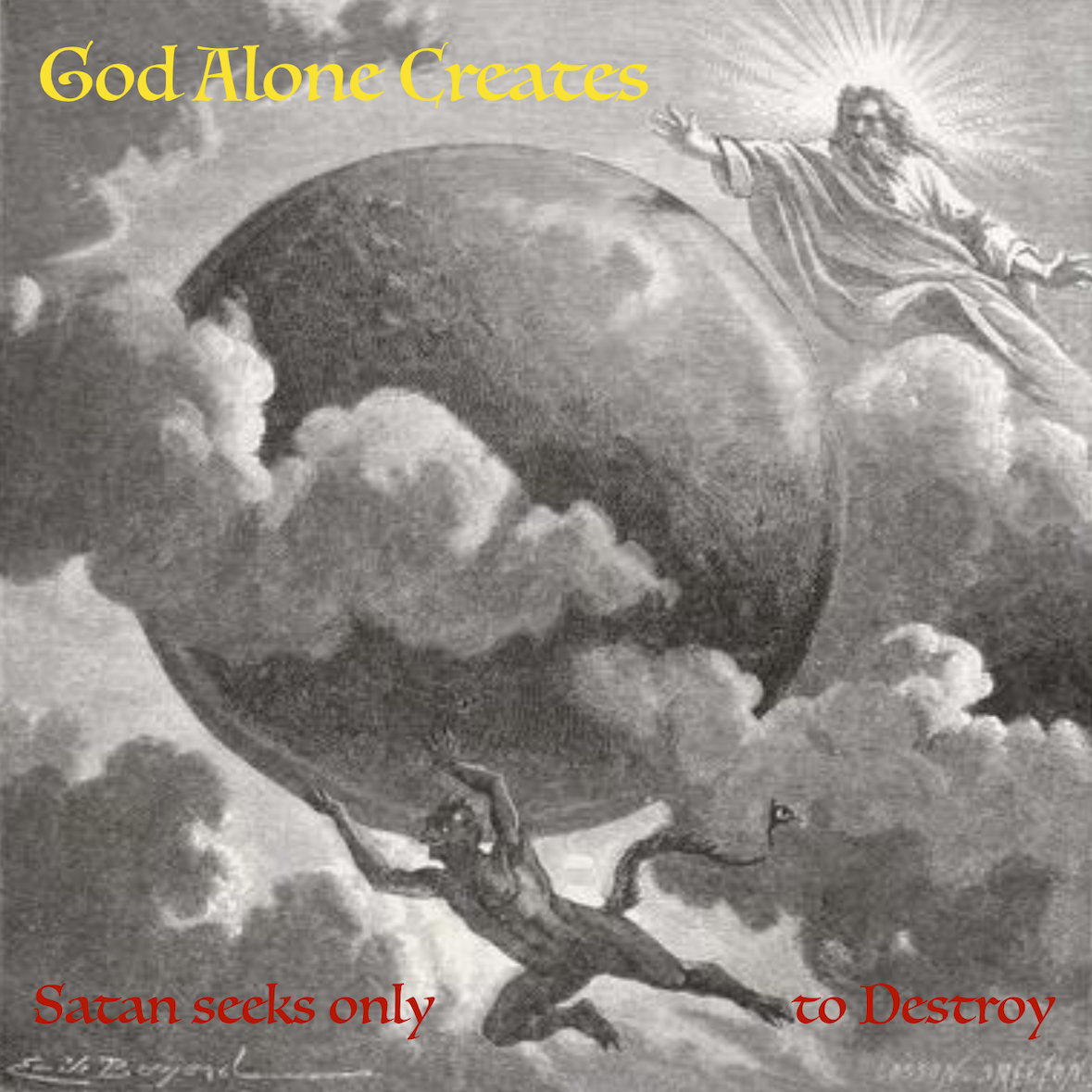
A prime evidence of Satan’s weakness is that he is a mere created being, without any creative powers of his own. Although some would grant the Adversary a glory he does not own, the truth is that since his expulsion from Heaven, he has devolved into the Great Pretender.

C.S. Lewis never pretended to be a theologian (for whatever authority that debatable title might convey). Instead, he was a brilliant disciple of Jesus with a sincere desire to follow the teachings of the Scriptures. Lewis certainly wasn’t infallible (and he has many critics who delight in pointing out that obvious fact).

Nevertheless, Lewis’ private insights on the subject of Lucifer’s noncreative limitation are right on the biblical target. Responding to a question posed by a reader, Lewis offered his opinion. 

Dear Mrs [Belle] Allen, I think it would be dangerous to suppose that Satan had created all the creatures that are disagreeable or dangerous to us for (a) those creatures, if they could think, would have just the same reason for thinking that we were created by Satan. (b) I don’t think evil, in the strict sense, can create.

It can spoil something that Another has created. Satan may have corrupted other creatures as well as us. Part of the corruption in us might be the unreasoning horror and disgust we feel at some creatures quite apart from any harm they can do us. (I can’t abide a spider myself.) (correspondence, 11 January 1954).

No, God alone creates . . . and redeems. The impotent Devil can never create, or rescue. His utter corruption results in an admittedly powerful spiritual being (a fallen angel) who is devoted to twisting, breaking, tainting, warping, spoiling, corrupting, rotting, perverting, and ruining all that God loves.

Granted, in our fallen world, Satan can fashion an abomination from some preexisting thing he corrupts – for example, Ophiocordyceps unilateralis the parasitic fungus that turns ants into zombies – but he can never create something out of nothing. These poor abominations are an excellent example of what Lewis referred to when he described the “horror and disgust we feel at some creatures . . .”

Meanwhile, Human Beings Can Create

Well, not exactly “create” on the creatio ex nihilo (created out of nothing) sense. Only God can do that, as he did when he spoke all things into existence. Just as Aslan echoed, when he sang Narnia into being in Lewis’ Chronicles.

“And God said, ‘Let there be light,’ and there was light” (Genesis 1).

“In the beginning was the Word [Logos], and the Word was with God, and the Word was God. . . . All things were made through him . . .” (John 1)

The Lion was pacing to and fro about empty land and singing his new song. It was softer and more lilting than the song by which he had called up the stars and the sun; a gentle, rippling music. And as he walked and sang the valley grew green with grass. It spread out from the Lion like a pool. It ran up the sides of the little hills like a wave” (The Magician’s Nephew)

As for humans like you and me being able to create, that is one of God’s most precious gifts to us. In truth, we use elements already created by the Lord: clay and stone to sculpt, pigments to paint, quill and ink to write.

The Inklings understood this creative impulse quite well. They not only understood it; they lived it. 

Like Christians before and since, they recognized that our creative capacity is based in the fact that we are created imago Dei, in the image of God.

Many people mistakenly believe J.R.R. Tolkien coined the word subcreation (or sub-creation, for the hyphen-infatuated). He certainly applied it for the first time to the intentional creation of what the Oxford English Dictionary calls “the action or process of creating a fully realized and internally consistent imaginary (or ‘secondary’) world.” 

Subcreation may be considered a form of “creation by a created being.” But even the most talented of writers and artists should remember this truth, stated by a Canadian astrophysicist: “God did not grant to the devil or any of his creatures the power to create.”

There is much more to consider on this subject, but Mere Inkling readers will need to wait until my next post, when we will conclude our discussion of this fascinating matter. 

There are two equal and opposite errors into which our race can fall about the devils. One is to disbelieve in their existence. The other is to believe, and to feel an excessive and unhealthy interest in them.

They themselves are equally pleased by both errors, and hail a materialist or a magician with the same delight. (The Screwtape Letters).


The image above is based on the work of Émile Bayard (1837-1891), a French illustrator who was born in Cairo, Egypt.

C.S. Lewis and Time’s Meaning

What is time, and why are we subject to its ofttimes harsh burdens? After his conversion from atheism, C.S. Lewis discovered some comforting truths about time, and the limits of time’s constraints.

Each year the four seasons seem to pass more rapidly. Before we know it, our parents have gown old, and we may well have children of our own. In retrospect, it all happens in the proverbial flash.

Ultimately, there will come a day when our lives reach their own “winter,” and even our most precious memories may drift away from us in time’s relentless breeze.

The C.S. Lewis Institute has an interesting article titled “The Point at which Time Touches Eternity.” They quote some wisdom from The Screwtape Letters, and end with a query which can help us live happier lives.

As you think about your own life, do you sometimes think too much about the Past or the Future, and not chiefly attend to the Present and Eternity?

Lewis answers that very question in his essay “Historicism.” He acknowledges that too often we become slaves to the regrets of our past and the dread of challenges awaiting us in the future. He reminds Christians that “God will supply every need of yours according to his riches in glory in Christ Jesus” (Philippians 4).* Therefore, Lewis encourages us to throw off the bondage of past and future, since “where, except in the present, can the Eternal be met?”

Janie Cheaney recently wrote “Eternity in Our Hearts” for World Magazine. Inspired by Saint Augustine and C.S. Lewis, it is subtitled “What if time astonishes us because we are meant to one day live outside of it.”

More of Lewis’ Thoughts about Time

In Mere Christianity, Lewis describes our universal human experience. “Our life comes to us moment by moment. One moment disappears before the next comes along: and there is room for very little in each. That is what Time is like.” He then describes just how limited our perspective is.

And of course you and I tend to take it for granted that this Time series – this arrangement of past, present, and future – is not simply the way life comes to us but the way all things really exist. We tend to assume that the whole universe and God himself are always moving on from past to future just as we do. But many learned men do not agree with that. Almost certainly God is not in Time. His life does not consist of moments following one another . . .

If you picture Time as a straight line along which we have to travel, then you must picture God as the whole page on which the line is drawn. We come to the parts of the line one by one: we have to leave A behind before we get to B, and cannot reach C until we leave B behind. God, from above or outside or all around, contains the whole line, and sees it all.

In Miracles, C.S. Lewis describes God’s transcendence over time as our Creator’s “eternal Now.”

It is probable that Nature is not really in Time and almost certain that God is not. Time is probably (like perspective) the mode of our perception. There is therefore in reality no question of God’s at one point in time (the moment of creation) adapting the material history of this universe in advance to free acts which you or I are to perform at a later point in Time.

To Him all the physical events and all the human acts are present in an eternal Now. The liberation of finite wills and the creation of the whole material history of the universe (related to the acts of those wills in all the necessary complexity) is to Him a single operation. In this sense God did not create the universe long ago but creates it at this minute – at every minute.

That is pretty deep. The sort of stuff that philosophers love to ponder and debate. Even before his conversion to Christianity, while still clinging to his formal atheism, Lewis contemplated time’s role in existence. In 1918 he wrote to his close friend Arthur Greeves about these matters. 

You see the conviction is gaining ground on me that after all Spirit does exist; and that we come in contact with the spiritual element by means of these “thrills.” I fancy that there is Something right outside time & place, which did not create matter, as the Christians say, but is matter’s great enemy: and that Beauty is the call of the spirit in that something to the spirit in us. You see how frankly I admit that my views have changed.

Sheldon Vanauken (1914-1996) was an American author who preserved in A Severe Mercy several of C.S. Lewis’ letters of consolation following the death of Sheldon’s wife. In some ways, the Vanauken story foreshadowed Lewis’ own marriage and widowhood. Pointing toward the Resurrection, Lewis wrote the following.

You say the materialist universe is “ugly.” I wonder how you discovered that! If you are really a product of a materialistic universe, how is it you don’t feel at home there? Do fish complain of the sea for being wet? Or if they did, would that fact itself not strongly suggest that they had not always been, or would not always be, purely aquatic creatures?

Notice how we are perpetually surprised at Time. (“How time flies! Fancy John being grown-up & married! I can hardly believe it!”) In heaven’s name, why? Unless, indeed, there is something in us which is not temporal.

C.S. Lewis writes much more about time, but we will conclude here with two passages that use the metaphor of author to describe God’s nature. The first comes from an essay entitled “The Seeing Eye.”

My point is that, if God does exist, He is related to the universe more as an author is related to a play than as one object in the universe is related to another. If God created the universe, He created space-time, which is to the universe as the metre is to a poem or the key is to music.

To look for Him as one item within the framework which He Himself invented is nonsensical. If God – such a God as any adult religion believes in – exists, mere movement in space will never bring you any nearer to Him or any farther from Him than you are at this very moment.

You can neither reach Him nor avoid Him by travelling to Alpha Centauri or even to other galaxies. A fish is no more, and no less, in the sea after it has swum a thousand miles than it was when it set out.

This final quotation appears in Mere Christianity. It is most certainly true, and my hope is that all who read this post will come to celebrate this joy. Both now, and for eternity.

God is not hurried along in the Time-stream of this universe any more than an author is hurried along in the imaginary time of his own novel. He has infinite attention to spare for each one of us.

He does not have to deal with us in the mass. You are as much alone with Him as if you were the only being He had ever created. When Christ died, He died for you individually just as much as if you had been the only man in the world.


* This gracious, eternal gift is available to all people.

Errors that Seem to be True (Angels)

Many people have been taught so little about biblical Truth that they believe many errors. For example, many people (and no offense intended if you are among them) mistakenly believe that when people die, they become angels.

That connection is so blatantly contrary to the fact that angels who “see the face [of God] who is in heaven” are completely different creations than the Sons of Adam and Daughters of Eve who are actually human beings, created in the image of God.

In his preface to The Screwtape Letters, C.S. Lewis alludes to how this confusion is reinforced by humanity’s lack of familiarity with angels in their true or natural (for them) form. While there are clear examples in the Bible where God has his angels appear in the likeness of human beings (e,g. before Sodom’s judgment and at the empty tomb), there are also times when their celestial radiance is not disguised (i.e. when the shepherds are informed about birth of the Savior or in John’s visions as recorded in the Book of Revelation).

[Angels] are given human form because man is the only rational creature we know. Creatures higher in the natural order than ourselves, either incorporeal or animating bodies of a sort we cannot experience, must be represented symbolically if they are to be represented at all (Screwtape Letters).

Nevertheless, this myth permeates the thinking of our secular culture. Once, some years past, a pastor friend was relating to me that one of his distant relatives had recently died. He said it comforted him to know that she was now an angel. I started to chuckle in response to his humorous way of lightening his own mood, until I realized he wasn’t joking. This poor, genuinely compassionate minister had been tricked by the spirit of this world into buying into a lie.

C.S. Lewis famously said that anything worth reading once is worth reading again. I’m clearing out some magazines from several years ago, and rereading insightful articles as I go. In a short piece about a complex subject, “What Happens to the Dead?” Ryan Pemberton makes a troubling comment.

Pop culture has done more to shape modern views about death than biblical teaching has.

The brevity of the article prevents the author from exploring other subjects, but his observation is applicable to a wide array of concerns.

I’m confident I could state, without fear of contradiction, that contemporary culture has done more to shape modern views about marriage than biblical teaching has. And, adding only a few additional examples, more about . . . justice . . . demons . . . love . . . mental health . . . responsibility . . . heaven . . . labor . . . creation . . . and Jesus himself.

It’s Not All Bad

It should be admitted that not all contemporary insights have been 100% misguided. One area where modern sensibilities have restored balance to truthful thinking is in the area of care for the environment. Ignoring extreme notions about nature being more important than human life, we can applaud the work of Christian environmentalists who have helped restore a biblical (i.e. true) view of the world around us.

Reacting to twisted notions that humanity’s “dominion” over the earth allows for nature’s misuse and abuse, these men and women helped open our eyes to the fact that God calls us to be trustworthy stewards in our care of, and appreciation for, this amazing world he has made.

The Inklings, C.S. Lewis and J.R.R. Tolkien, in particular, possessed a profound love for nature. Their general antipathy to the ugly and polluting trappings of industrialization are grounded in their belief that the world God created was truly “good.” With that came the recognition that man does little to enhance, and much to undermine, that initial goodness.

When two ideas clash, go with the one that is correct. And, when one of those authorities is the Word of the Creator of all that exists, well, isn’t it obvious which is the right choice?

Angels & People

For more on the angelic subject with which we began, check out the provocatively titled “People Aren’t Downgraded to Angels When They Die.” As the author there so rightly explains,

When Christians die, heaven does not “get another angel.” We cannot become angels any more than we can become giraffes or ocean waves or stars. We are people and will remain so after this present life. God did not make a mistake when he made us human.

An Evolutionary Fluke

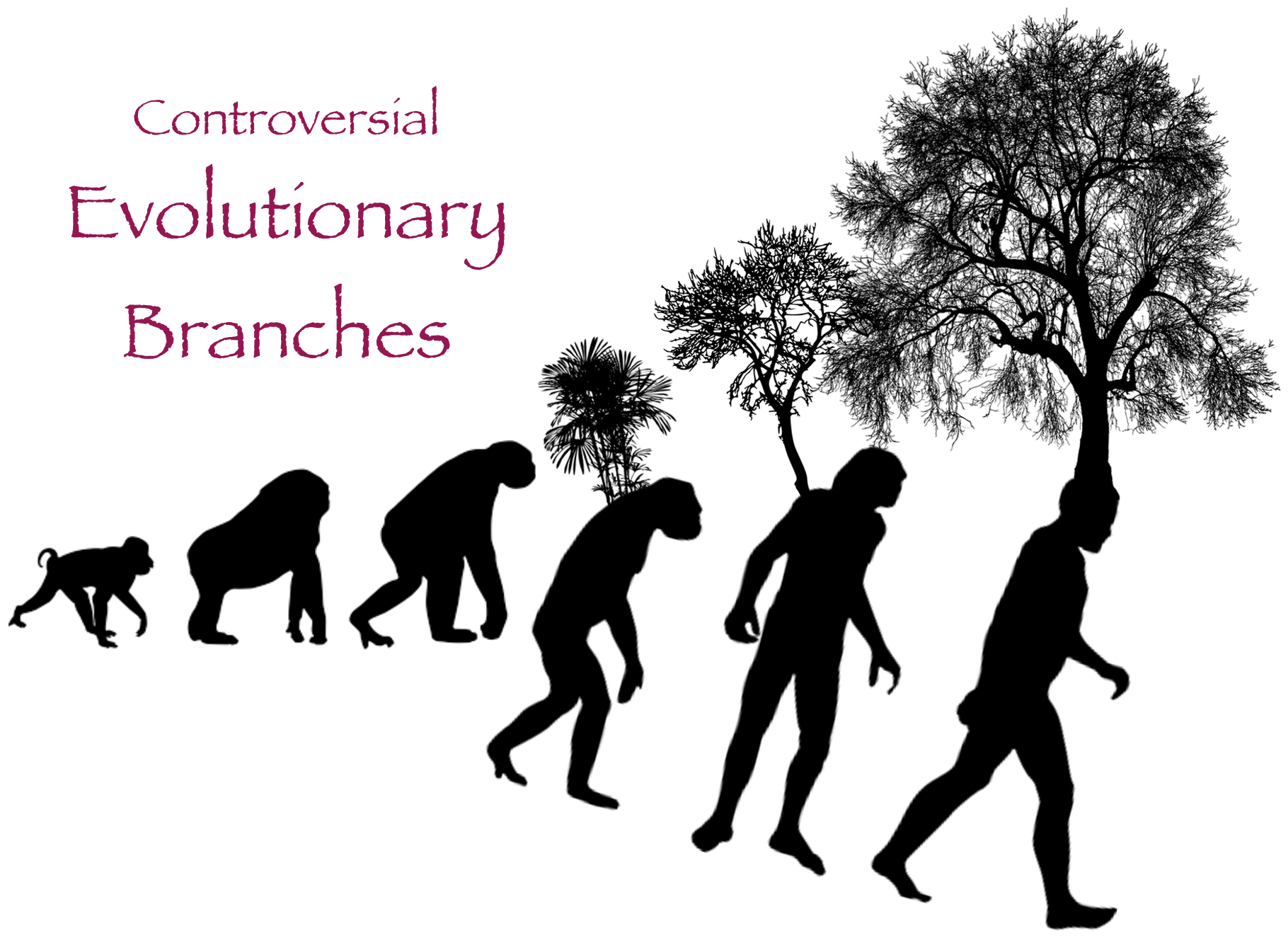
Did trees evolve from apes? An odd question, to be sure, but one humorously posed by C.S. Lewis in a letter to his father.

While this column does discuss the theory of evolution, it’s not doctrinaire. So, whatever your opinion of Darwin’s notions, read on, and you may enjoy a pleasant surprise.

C.S. Lewis, the brilliant Christian apologist was not an ironclad “evangelical” in the American sense of the word. Here in the U.S., that typically requires adherence to a handful of doctrines, usually including the affirmation of the infallibility of the Scriptural autographs and of the creation of humanity in the persons of our first parents, Adam and Eve.

As important as these matters are, very few Christians would deem them salvific, in the sense that people holding less “vigorous” views on these issues will be excluded from heaven.

C.S. Lewis was one of those who focused on the core of the Christian faith, rather than secondary doctrines. He referred to this as “mere Christianity,” and it was based on a trusting relationship with God through the Person of Jesus, God present with us in the Incarnate Word.

As for doctrines per se, like all good defenders of the faith, C.S. Lewis preferred not to get bogged down with secondary matters. This is consistent with the spirit of Paul’s advice to the young pastor, Timothy.

Remind them of these things, and charge them before God not to quarrel about words, which does no good, but only ruins the hearers. . . . Have nothing to do with foolish, ignorant controversies; you know that they breed quarrels. And the Lord’s servant must not be quarrelsome but kind to everyone . . . (2 Timothy 2:14, 23-24).

Lewis’ 1927 Evolutionary Conversation

In March of 1927, C.S. Lewis wrote one of his eclectic letters to his father in Northern Ireland. As usual, he commented on his father’s previous correspondence and shared about his current health and activities. While his relationship with his father grew strained after his mother’s untimely death while he was still a child, Lewis’ letters to his father exude familial respect framed in the context of early twentieth century British sensibilities.

That said, Lewis was always eager to share curious or silly experiences he knew would amuse his solicitor father. He takes a humorous approach, for instance, to advising his father to consult a more skilled doctor to diagnose an ailment, rather than suffering with the incomplete work of the physician he has always known, he will simply be “offer[ing] up several months of pain as a sacrifice on the altar of an old acquaintance.”

At the same time, he acknowledges his personal inclination toward doing the same, stating that “if I lived at home [I] would continue to use Gillespie all my life.” Gillespie, it turns out, ran a taxi service long favored by the family despite his bumpy transportation. “I have never regretted Gillespie and his hexagonal wheel,” Lewis shares.

He returns to his argument, however, by saying his father’s health demands the attention of a competent physician rather than relying on past ties. He concludes with an illustration based on his own brother. “Hang it all, even you wouldn’t suggest that because I’ve known Warnie a long time I ought to trust him as an interpreter on a holiday in Spain.”

C.S. Lewis proceeds to share with his father current events at Magdalen College (“we are putting up a new building”) and a recent nightmare (“it was the sense of being on the moon . . . the complete desolateness, which gave the extraordinary effect”).

The letter includes other fascinating elements, but it is time now to consider the reference to evolution.

An Absurd Age

I absolutely love the way C.S. Lewis invites us to experience the following moment. His story is so vivid, it still lives a century after the described events transpired.

We live in the most absurd age. I met a girl the other day who had been teaching in an infant school (boys and girls up to the age of six) where the infants are taught the theory of Evolution. Or rather the Headmistress’s version of it.

Simple people like ourselves had an idea that Darwin said that life developed from simple organisms up to the higher plants and animals, finally to the monkey group, and from the monkey group to man.

The infants however seem to be taught that ‘in the beginning was the Ape’ from whom all other life developed – including such dainties as the Brontosaurus and the Iguanodon.

Whether the plants were supposed to be descendants of the ape I didn’t gather. And then people talk about the credulity of the middle ages! À propos of this can you tell me who said ‘Before you begin these studies, I should warn you that you need much more faith in science than in theology.’ It was Huxley or Clifford or one of the nineteenth century scientists, I think.

Another good remark I read long ago in one of E. Nesbitt’s fairy tales –‘Grown ups know that children can believe almost anything: that’s why they tell you that the earth is round and smooth like an orange when you can see perfectly well for yourself that it’s flat and lumpy.’

Ironically, immediately after this, Lewis introduces his next subject with the words: “Almost the only interesting thing that has happened to me lately was a visit from a young German.” You see, I wasn’t misleading you when I said his letters are filled with fascinating material.

One must assume that times have changed, and that English children are no longer being taught such simplistic distortions of actual theories. But that’s not the theme of this current post. Rather, I wish to show how wonderfully entertaining a simple family letter can be – especially when it comes from the pen of C.S. Lewis.

Respecting Animals We Kill

Sometimes even a moral sluggard can say something profoundly true. I was recently visiting the uplifting site of a British pet photographer, and came across this wonderful insight:

“Until one has loved an animal a part of one’s soul remains unawakened.”

As I spent a moment reflecting on the quote, having just enjoyed a morning game with our border collie, it dawned on me these words are not only philosophically true. The more I consider them the stronger the case, it seems to me, can be made for their theological truth.

Turn the statement around. Can someone be considered spiritually awake if they have never possessed a moment of genuine affection for an animal, the pinnacle of God’s natural creation? I tend to think not.

Cultural matters certainly influence one’s connection with nature. It may be that people surviving on the edge of food sufficiency would view animals primarily as a resource. Yet even then, the best among us still possess a regard for the creatures whose lives we curtail to extend our own.

An outstanding example of this is found in a common practice among North America’s first peoples. (First Nations is the common term in Canada). Many of these people would include prayer on behalf of the prey they sought.

In the Cherokee legend “The Little Dear, Awi Usdi,” describes how hunters were taught to only take life when necessary, and to “ask pardon when an animal was killed.”

Another site explains how “Coast Salish women were forbidden from stepping over deer meat, and the men had to look away when uncovering it. All bones had to be thrown into the water, and the viscera not consumed were buried so the dogs would not eat it.”

Post-Kill Rituals: Matters of the Heart,” describes how this “ancient reverence” for hunted animals extended beyond the Americas. It concludes with a valuable thought.

Rituals aren’t a bad idea . . . But you show the utmost respect by concentrating on killing the animal quickly. Hunters’ conduct toward wildlife and nature should be consistent with their conduct toward other humans.

While Christians will necessarily overlook the religious elements of these various traditions,* those most attuned to the love of God – a Creator who viewed the “living creatures” he had fashioned and proclaimed, “it was good” – will possess at least a glimmer of reverence or affection for wildlife.

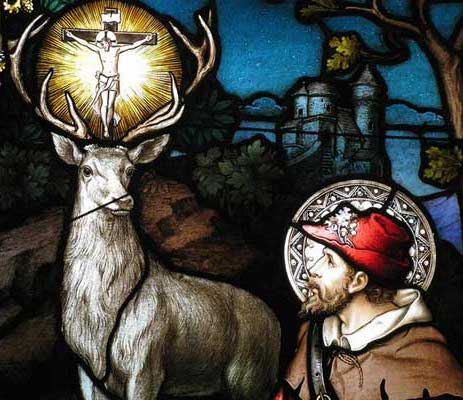
Not that Christians can’t be avid hunters. The Roman Catholic Church even has a Patron Saint for hunting. St. Hubert, pictured above, was (before his canonization, of course) a worldly nobleman. In the seventh century, Hubert had ignored invitations to attend worship on one of the holiest of days, Good Friday. Yet the Lord met him there, in the forest. His conversion occurred when he saw a vision of a crucifix while hunting. Hubert would later use his skill with a bow to draw crowds for his preaching of the Gospel.

C.S. Lewis & the Hunting of Deer

In an essay entitled “The Seeing Eye,” C.S. Lewis turns the analogy of hunting upside down. Using his own life, in which searching for God was the farthest thing from his desires, Lewis describes his conversion in a fascinating manner. It is interesting that while Lewis reveals he wasn’t desirous of faith, he was seeking honesty within his own conscience. He was also seeking truth.

I never had the experience of looking for God. It was the other way round; He was the hunter (or so it seemed to me) and I was the deer. He stalked me like a [hunter], took unerring aim, and fired. And I am very thankful that that is how the first (conscious) meeting occurred. It forearms one against subsequent fears that the whole thing was only wish fulfilment. Something one didn’t wish for can hardly be that.

But it is significant that this long-evaded encounter happened at a time when I was making a serious effort to obey my conscience. No doubt it was far less serious than I supposed, but it was the most serious I had made for a long time.

So, Who was the Author of the Initial Quote?

I began by saying even moral sluggards can occasionally make a good point. The person who drew the connection between our regard for animals and our souls is Anatole France. Not only was he a serial adulterer, he was a devout atheist. (Not all atheists are adulterers, of course, but rejecting the God of the Bible does make it a lot easier to justify one’s immorality.)

Anatole wrote some curious works ridiculing Christianity, and until I was writing this post I had completely forgotten about my 2014 post about his advocacy for Satan.

Returning to Positive Subjects . . . Like Animals

The site that used the great quotation with which we began, is excellent. It is called “Mad about Greys,” and is the work of a British photographer.

Liz Coleman does an amazing job capturing the hearts and – dare I say, souls – of the pets she shoots. Even though Surrey is quite a ways for most Mere Inkling readers to visit her studio, I encourage you to visit her website today.


* There were additional Native American beliefs and taboos. For example, “the Pentlatch and Squamish buried or hid all deer bones. The West Sanetch were not permitted to eat deer meat and fish at the same meal.”

For the Love of Words

Most writers, including the majority of bloggers, share a common affection. We love words, don’t we?

That love extends beyond mere fondness. We can find ourselves in a state of genuine wonder as we ponder definitions, etymologies (evolutions through diverse languages), and phonesthetics (how they sound). As C.S. Lewis once wrote, “Isn’t it funny the way some combinations of words can give you – almost apart from their meaning – a thrill like music?”

This is one aspect of a great article in the current issue of The Lutheran Witness.* In “For the Love of Words,” editor Roy Askins uses C.S. Lewis’ classic The Four Loves to explore the relationship we have with words. He does so from a Christian perspective shared by the Oxford don.

Words shape us in profound ways. God formed creation and continues to sustain it by the Word of His mouth. . . . Words, then, are not incidental to our lives, but form a central part and core of our identity as God’s people. It’s certainly appropriate for us to talk about “loving words.”

The very word for a lover of words – logophile – combines the Greek logos (word) with philia, which Lewis deems priceless, like “that Philia which Aristotle classified among the virtues or that Amicitia on which Cicero wrote a book.”

[Coincidentally, I have an article about ministry to those who are mourning in the current issue of The Lutheran Witness, as well. I assure you, however, that’s not why I’m citing “For the Love of Words.”] Longtime readers of Mere Inkling are well acquainted with my personal fascination with words and wordplay.

Many of you share this predilection. C.S. Lewis describes us in Studies in Words.

I am sometimes told, that there are people who want a study of literature wholly free from philology; that is, from the love and knowledge of words. Perhaps no such people exist. If they do, they are either crying for the moon or else resolving on a lifetime of persistent and carefully guarded delusion.

Literature, Lewis argues, is not simply the sum of its words. It involves the history of the words, their complex shades of meaning, and even what those very words meant to their original writers.

The Uniquely Christian Perspective

God pours out his gifts of writing quite broadly. Countless styluses, quills and pens have been wielded by talented pagans and atheists over the centuries.

Still, as Askins’ article alludes, Christians have a unique connection to words. Not only did God speak all creation into existence through his Word, but that Logos, that Word became incarnate and suffered an innocent death so that humanity might be redeemed. Askins concludes his article with a joyful truth.

When we seek to love words, then, we do not seek to love them as words in themselves. This danger we editors and writers must mark and avoid. No, we love words because in them and by them, we hear of and share God’s love for us in Christ. He alone makes words holy and precious; He alone makes words worth loving.

I love these closing words. And I strongly believe C.S. Lewis would too.


* The Lutheran Witness is the magazine of the Lutheran Church – Missouri Synod.

Glorifying the Evil One

One perplexing behavior of humanity, is seen in the inclination of some to glorify our greatest enemy. Some people sincerely adore a being who desires nothing more than humanity’s suffering and eternal separation from our loving Creator.

I once heard the difference between God and Satan put this way: even when you hate him, God still loves you, and even when you love him, Lucifer still hates you.

Yet some still idealize this fallen angel who has earned many corrupt titles, including Tempter and Father of Lies.

In literature and other media you can readily find positive treatments of the Devil. John Milton’s Paradise Lost presents Lucifer as the classic tragic figure. Even his arrogance and vanity about his beauty are presented in a sympathetic fashion. In “Why Satan’s Character in Paradise Lost is the Original Antihero,” Lisa Ampleman says “at the 350th anniversary of its publication, Milton’s masterpiece seems ever more relevant.”

The Romantic poet William Blake even said that Milton was “of the Devil’s party without knowing it.” For the first few books, the charismatic demon’s concerns are front and center, and God seems authoritarian and legalistic.

Fortunately, Milton does not leave us with this sympathetic portrayal of Lucifer. As the article’s author writes, Satan “is not the absolute evil we may have expected, and a sympathetic devil is a dangerous devil.” In Book IX, the Devil even confesses his grim obsession.

But neither here seek I, no nor in Heaven
To dwell, unless by mastering Heaven’s Supreme;
Nor hope to be myself less miserable
By what I seek, but others to make such
As I, though thereby worse to me redound:

For only in destroying I find ease
To my relentless thoughts; and, him destroyed,
Or won to what may work his utter loss,
For whom all this was made, all this will soon
Follow, as to him linked in weal or woe;

In woe then; that destruction wide may range:
To me shall be the glory sole among
The infernal Powers, in one day to have marred
What he, Almighty styled, six nights and days
Continued making . . .

In his Preface to Paradise Lost, C.S. Lewis astutely describes Milton’s depiction of the Devil’s eternal dilemma.

What we see in Satan is the horrible co-existence of a subtle and incessant intellectual activity with an incapacity to understand anything. This doom he has brought upon himself; in order to avoid seeing one thing he has, almost voluntarily, incapacitated himself from seeing at all.

And thus, throughout the poem, all his torments come, in a sense, at his own bidding, and the Divine judgement might have been expressed in the words “thy will be done.” He says “Evil be thou my good” (which includes “Nonsense be thou my sense”) and his prayer is granted.

Turning to one of America’s most renowned authors, we encounter in Mark Twain an unabashedly positive portrayal of Lucifer. In Letters from the Earth (which was too controversial for publication during his lifetime), Satan remains a trusted member of God’s Grand Council. It is left to Satan to question God’s arbitrary creation of violent and flawed creatures.

After a long time and many questions, Satan said, “The spider kills the fly, and eats it; the bird kills the spider and eats it; the wildcat kills the goose; the — well, they all kill each other. It is murder all along the line. Here are countless multitudes of creatures, and they all kill, kill, kill, they are all murderers. And they are not to blame, Divine One?”

“They are not to blame. It is the law of their nature. And always the law of nature is the Law of God. Now – observe – behold! A new creature – and the masterpiece – Man!”

Far from humanity being created in the Divine image, Twain’s twisted version of the Creator has God throwing together all of the positive, and negative, traits he had bestowed on the imperfect animals.

“Put into each individual, in differing shades and degrees, all the various Moral Qualities, in mass, that have been distributed, a single distinguishing characteristic at a time, among the nonspeaking animal world – courage, cowardice, ferocity, gentleness, fairness, justice, cunning, treachery, magnanimity, cruelty, malice, malignity, lust, mercy, pity, purity, selfishness, sweetness, honor, love, hate, baseness, nobility, loyalty, falsity, veracity, untruthfulness – each human being shall have all of these in him, and they will constitute his nature.

“In some, there will be high and fine characteristics which will submerge the evil ones, and those will be called good men; in others the evil characteristics will have dominion, and those will be called bad men.”

Satan later offered some sarcastic compliments about creation and is exiled briefly to Earth. There, Twain’s hero pens a number of letters to archangels sympathetic to his views. A single passage is adequate to illustrate the whole.

Man is a marvelous curiosity. When he is at his very very best he is a sort of low grade nickel-plated angel; at his worst he is unspeakable, unimaginable; and first and last and all the time he is a sarcasm. Yet he blandly and in all sincerity calls himself the “noblest work of God. . . .”

Moreover – if I may put another strain upon you – he thinks he is the Creator’s pet. He believes the Creator is proud of him; he even believes the Creator loves him; has a passion for him; sits up nights to admire him; yes, and watch over him and keep him out of trouble. He prays to Him, and thinks He listens. Isn’t it a quaint idea?

For an accurate illustration of Satan’s activities and purposes, one need look no further than C.S. Lewis’ Screwtape Letters. In one letter, Screwtape highlights the progress Satan’s minions have made in desensitizing humanity to what was recognized as provocative in an earlier age.

We have engineered a great increase in the licence which society allows to the representation of the apparent nude (not the real nude) in art, and its exhibition on the stage or the bathing beach. It is all a fake, of course; the figures in the popular art are falsely drawn; the real women in bathing suits or tights are actually pinched in and propped up to make them appear firmer and more slender and more boyish than nature allows a full-grown woman to be.

Yet at the same time, the modern world is taught to believe that it is being ‘frank’ and ‘healthy’ and getting back to nature. As a result we are more and more directing the desires of men to something which does not exist – making the rôle of the eye in sexuality more and more important and at the same time making its demands more and more impossible. What follows you can easily forecast!

Artistic Presentations of a Sympathetic Devil

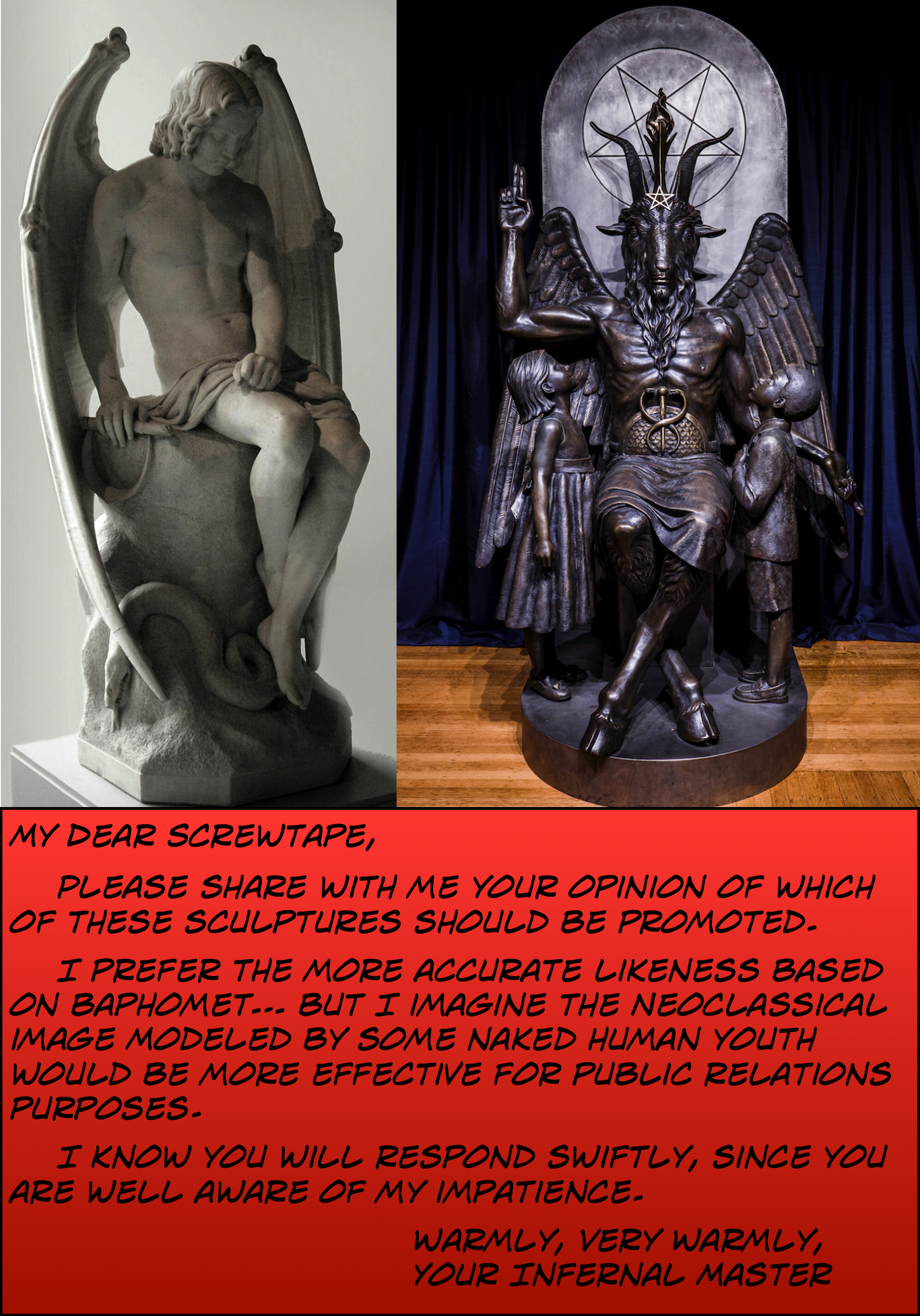
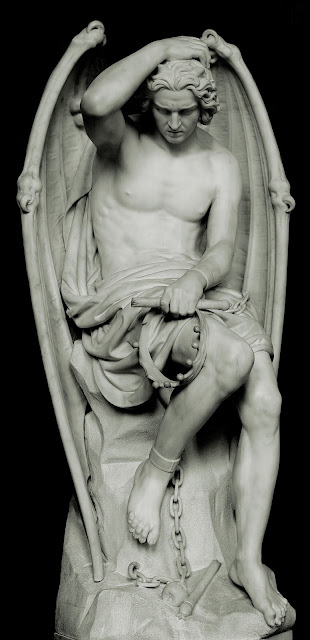
It was actually a nineteenth century Belgian sculpture of Lucifer which is part of the elaborate pulpit of St. Paul’s Cathedral in Liège which inspired today’s reflections. Guillaume Geefs was commissioned to create the piece as part of a general theme of the triumph of religion over evil. The Devil as he portrayed the rebel angel, is rather too appealing for those acquainted with his actual biblical portrait.

Even though his wings have devolved to appear more like those of a bat than a bird, and his foot is chained, the sculpture’s physique is attractive. His apparent regret, evident in his expression and the presence of a tear, invite sympathy. It is regarded as an outstanding example of Romanticism. In a word, it serves as an attractive personification of a vile and malignant being. And this presents a dangerously misleading view of the very real spiritual warfare raging about us.

Curiously, Guillaume’s nude (with a robe safely draped over his lap) was actually a more modest and religious alternative to the image originally intended for the space. Ironically, it was the artist’s younger brother, Joseph, who originally received the commission. Joseph’s sculpture was regarded as even more titillating, and it was replaced. The Royal Museums of Fine Arts of Belgium admits “Joseph created one of the most disturbing works of the period.”

When it was revealed, the initial version of “Le Génie du Mal” (The Genius of Evil) raised questions about its positive portrayal. One publication reported the cathedral’s administrators determined “this devil is too sublime.”

The last thing imperfect human beings living in a fallen world need are sublime and alluring depictions of evil. In the words of C.S. Lewis,

To admire Satan, then, is to give one’s vote not only for a world of misery, but also for a world of lies and propaganda, of wishful thinking, of incessant autobiography. Yet the choice is possible. Hardly a day passes without some slight movement towards it in each one of us.

That is what makes Paradise Lost so serious a poem. The thing is possible, and the exposure of it is resented. Where Paradise Lost is not loved, it is deeply hated. (A Preface to “Paradise Lost”).

Replacement Sculpture by Guillaume Geefs.

Healing Laughter in Our World & Narnia

If you are like me, you could benefit from a rich, genuine laugh right about now. Las year was stressful on all of us, and many are wary the new year may not be dramatically better.

For many of us, humor is an integral part of our lives. In our extended family, it is an ever ready tool for lifting the spirits of others. Just the other day our son and his six-year-old son dropped by, and as they entered the front door I said, “enter, most welcome king and prince.” Without missing a proverbial beat, my grandson responded, “I’m the king, and he’s the prince.” It was a hilarious, spontaneous moment. My wife and I are deeply blessed because our lives are filled with these moments.

We have all heard about the healing powers of laughter. One Mayo Clinic article on the subject, “Stress Relief from Laughter? It’s No Joke,” lists a number of short- and long-term benefits. For example:

Laughter enhances your intake of oxygen-rich air, stimulates your heart, lungs and muscles, and increases the endorphins that are released by your brain. . . . [It can] improve your immune system. Negative thoughts manifest into chemical reactions that can affect your body by bringing more stress into your system and decreasing your immunity.

By contrast, positive thoughts can actually release neuropeptides that help fight stress and potentially more-serious illnesses. [And laughter can] relieve pain . . . by causing the body to produce its own natural painkillers.

Since laughter has indisputable mental—and physical—benefits, promoting it is a worthwhile avocation. That effort is complicated by the fact our individual sense(s) of humor differ significantly. For example, some people find slapstick humor wildly funny. I find it funny (in the sense of “odd”), that they consider it witty.

On the other hand, some people appreciate the “subtleties” of so-called British humor. Many of my relatives have never understood how much I have enjoyed Monty Python. To them, the Python approach is bizarre and unpalatable. Meanwhile, they enjoyed the clumsy stumblings of Jerry Lewis.*

Ricky Gervais, an English comedian who has met great success on both sides of the pond, wrote an interesting piece for Time. He offers very thoughtful observations on “The Difference Between American and British Humour.” Having lived in the United Kingdom, and counting some Brits as friends today, the following comment rings true with me.

There’s a received wisdom in the U.K. that Americans don’t get irony. This is, of course, not true. But what is true is that they don’t use it all the time. It shows up in the smarter comedies but Americans don’t use it as much socially as Brits.

We use it as liberally as prepositions in every day speech. We tease our friends. We use sarcasm as a shield and a weapon. We avoid sincerity until it’s absolutely necessary. We mercilessly [verbally assault] people we like or dislike basically.

And ourselves. This is very important. Our brashness and swagger is laden with equal portions of self-deprecation. This is our license to hand it out.

Perhaps my affinity for British humor comes from a flaw in my personal psyche, I mean, an innate appreciation for irony.

Another consideration is whether laughter is genuine or feigned. The latter presumably produces no positive results. Researchers in Japan conducted some laughter studies. One professor noted that honest laughter reaches down to a person’s diaphragm. He devised a machine to measure it.

Sensors placed near the diaphragm transmit waves to a computer screen, and these waves apparently reflect not only the intensity of a subject’s laughter but also its sincerity. A genuine laugh, straight from the heart, weighs in at 5 or more “aHs” per second –the “aH” (read “aha” in Japanese) being the unit of measurement Kimura devised in his quest to quantify laughter. Fake laughter makes no waves. The sensors ignore it, and the graph-lines on the screen remain unmoved.

Most of us, I suspect, can usually tell the difference between sincere responses, be they simple chuckles or raucous belly laughs, and the fake stuff. Fortunately, the inauthentic laughter is rarely malicious. An interesting dissertation entitled “The Meaningless Laugh,” explores laughter’s use to ease tension and “cover-up,” or mask, true opinions. It seems to me that insincere laughter has much in common with “white lies.”

Humor in the Life of C.S. Lewis

C.S. Lewis had a healthy sense of humor. Laughter abounded at gatherings of the Inklings. In light of Gervais’ comment about the British propensity for “teasing our friends,” check out “C.S. Lewis Compared J.R.R. Tolkien to What?

Our sense of humor is shaped and refined (or dulled) throughout our lives. An interesting letter from 1914, before Lewis was scarred in the trenches of the First World War, reveals his entertainment preferences as a young man.  

Last week I was up with these people to the Coliseum: and, though of course (which by the way I see no prospect of) I had sooner have gone to some musical thing, yet I enjoyed myself. The Russian Ballet–and especially the music to it–was magnificent, and G.P. Huntley* in a new sketch provoked some laughter.

The rest of the show trivial & boring as music halls usually are. At ‘Gastons’ however, I have no lack of entertainment, having been recently introduced to Chopin’s Mazurkas, & Beethoven’s ‘Sonate Pathétique.’

The mature Lewis made a profound observation about humor in Reflections on the Psalms.

A little comic relief in a discussion does no harm, however serious the topic may be. (In my own experience the funniest things have occurred in the gravest and most sincere conversations.)

I have found this to be true in my own life and ministry. In the words of the Mayo Clinic piece, “Laughter can also make it easier to cope with difficult situations. It also helps you connect with other people” even during the most trying of times.

Can Laughter Be Dangerous?

We all recognize that when humor is pursued at the expense of others, it is often destructive. Sarcasm is a dangerous, and often cruel, weapon. Healthy laughter, though, possesses a divine quality.

Laughter can, in fact, be such a positive thing that even the Tempter Screwtape⁂ warns his protégé to undermine it. (Remember, when reading Screwtape, that since Screwtape, the fictional writer of the infernal advice, serves the Devil, and thus the language is reversed.)

I am specially glad to hear that the two new friends have now made [your patient] acquainted with their whole set. All these, as I find from the [infernal] record office, are thoroughly reliable people; steady, consistent scoffers and worldlings who without any spectacular crimes are progressing quietly and comfortably towards Our Father’s house.

You speak of their being great laughers. I trust this does not mean that you are under the impression that laughter as such is always in our favour. The point is worth some attention. I divide the causes of human laughter into Joy, Fun, the Joke Proper, and Flippancy.

You will see the first among friends and lovers reunited on the eve of a holiday. Among adults some pretext in the way of Jokes is usually provided, but the facility with which the smallest witticisms produce laughter at such a time shows that they are not the real cause. What that real cause is we do not know.

Something like it is expressed in much of that detestable art which the humans call Music, and something like it occurs in Heaven—a meaningless acceleration in the rhythm of celestial experience, quite opaque to us. Laughter of this kind does us no good and should always be discouraged. Besides, the phenomenon is of itself disgusting and a direct insult to the realism, dignity, and austerity of Hell (The Screwtape Letters).

As to whether or not laughter can nudge a person towards a negative end, Screwtape singles out flippancy.

But flippancy is the best of all. In the first place it is very economical. Only a clever human can make a real Joke about virtue, or indeed about anything else; any of them can be trained to talk as if virtue were funny. Among flippant people the Joke is always assumed to have been made. No one actually makes it; but every serious subject is discussed in a manner which implies that they have already found a ridiculous side to it.

If prolonged, the habit of Flippancy builds up around a man the finest armour-plating against the Enemy that I know, and it is quite free from the dangers inherent in the other sources of laughter. It is a thousand miles away from joy: it deadens, instead of sharpening, the intellect; and it excites no affection between those who practise it (The Screwtape Letters).

Forewarned about the potential pitfalls of unhealthy humor, we can choose to avoid it. Meanwhile, we can rejoice with laughter that our Creator has bestowed upon us the ability to laugh.

C.S. Lewis celebrated this gift in his echo of our own creation in the story of Narnia’s birth. From the very first day, laughter was meant to resound throughout the world.

“Creatures, I give you yourselves,” said the strong, happy voice of Aslan. “I give to you forever this land of Narnia. I give you the woods, the fruits, the rivers. I give you the stars and I give you myself. The Dumb Beasts whom I have not chosen are yours also. Treat them gently and cherish them but do not go back to their ways lest you cease to be Talking Beasts. For out of them you were taken and into them you can return. Do not so.”

“No, Aslan, we won’t, we won’t,” said everyone. But one perky jackdaw added in a loud voice, “No fear!” and everyone else had finished just before he said it so that his words came out quite clear in a dead silence; and perhaps you have found out how awful that can be—say, at a party.

The Jackdaw became so embarrassed that it hid its head under its wing as if it were going to sleep. And all the other animals began making various queer noises which are their ways of laughing and which, of course, no one has ever heard in our world.

They tried at first to repress it, but Aslan said: “Laugh and fear not, creatures. Now that you are no longer dumb and witless, you need not always be grave. For jokes as well as justice come in with speech.”

So they all let themselves go. And there was such merriment that the Jackdaw himself plucked up courage again and perched on the cab-horse’s head, between its ears, clapping its wings, and said: “Aslan! Aslan! Have I made the first joke? Will everybody always be told how I made the first joke?”

“No, little friend,” said the Lion. “You have not made the first joke; you have only been the first joke.” Then everyone laughed more than ever; but the Jackdaw didn’t mind and laughed just as loud till the horse shook its head and the Jackdaw lost its balance and fell off, but remembered its wings (they were still new to it) before it reached the ground.

Laughter is a gift from God. I believe it is one of his best.


* The warm appreciation of comedian Jerry Lewis (1926-2017) by the French has always been a mystery to me. Talk about different ways to view humor. An interesting discussion of that enigmatic fact is found in “Why France Understood Jerry Lewis as America Never Did.”

Jerry Lewis was always a subject of a deep trans-Atlantic misunderstanding, one that triggered sarcasm in the United States, and bewilderment in France. While some Americans felt embarrassed by this contortionist comic, the French embraced Mr. Lewis’s humor as both an abstract art and social satire of American life.

Americans mocked the French for falling for this crass clown, while the French couldn’t understand why Mr. Lewis’s genius was not obvious to his compatriots.

⁑ George Patrick Huntley (1868–1927) was an Irish actor, known for comic performances in the theatre and the music halls.

⁂ The fictional author of C.S. Lewis’ book, The Screwtape Letters. Screwtape, the senior Tempter serves his master, the Devil. He refers to him as “Our Father Below,” accordingly.


The graphic above comes from the blog of a very talented writer and producer. Mitch Teemley included in a recent post at The Power of Story. I agree with my friend that “laughter has healing properties.” If you believe the same, you absolutely need to spend a few minutes reading his hilarious post.

C.S. Lewis & Cruelty to Animals

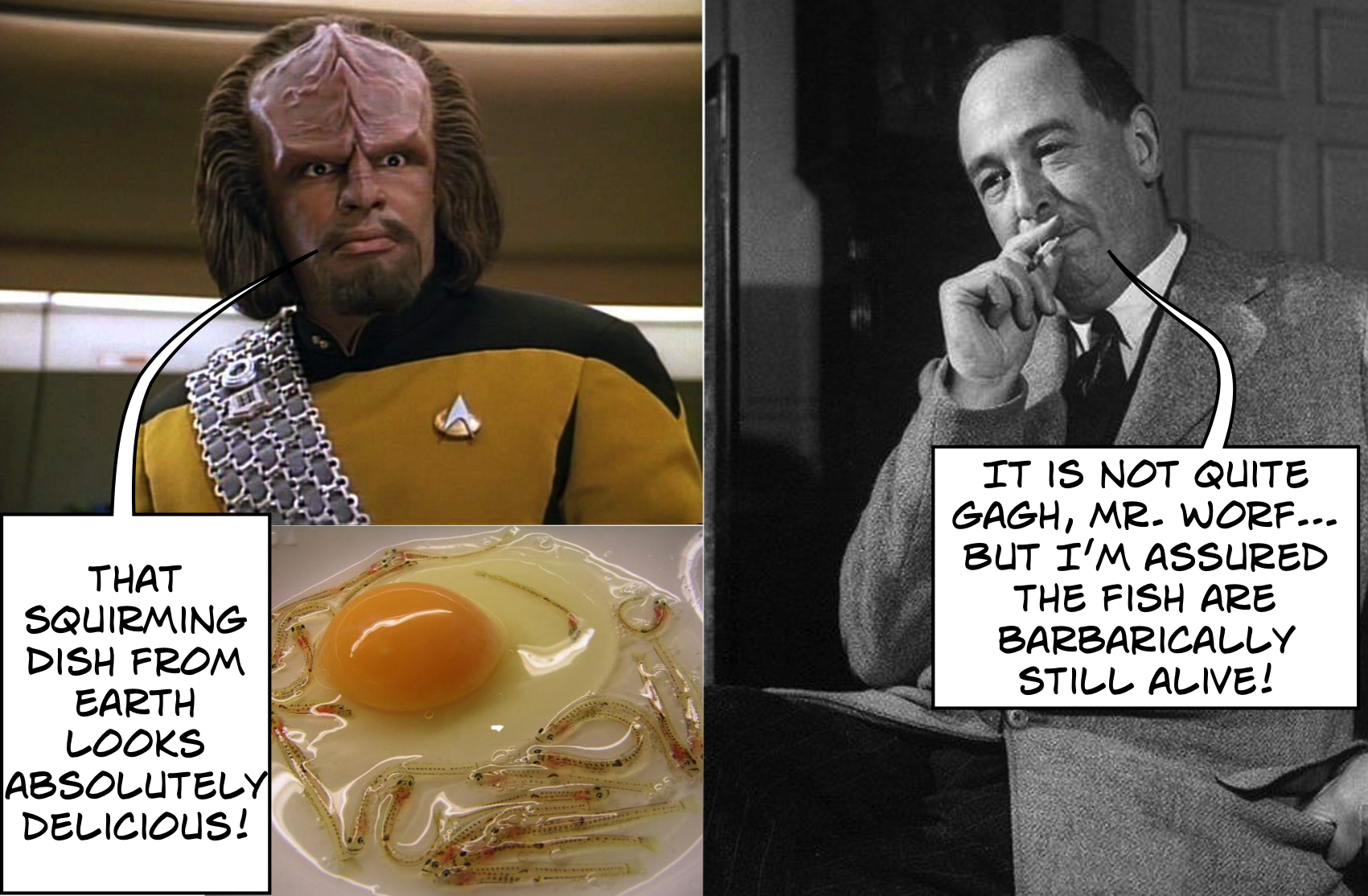
gagh.jpg

I recently read something quite disturbing about human beings. Something that revealed we have in common with Klingons and Ferengis one of their most disgusting traits. These people eat living creatures while they’re still alive (redundancy intentional).

Gene Roddenberry, creator of the Star Trek universe, foresaw a future in which humanity would rise above its omnivorous ways. “Replicated” food could still take the form of meat, but it would just be made of assorted atoms. The epitome of this view is found in Star Trek: The Next Generation. There, Commander William T. Riker declares to a diplomat from a race that consumes living mammals, “we no longer enslave animals for food purposes.”

In Roddenberry’s dream, humans have attained utopia on Earth. One way other races reveal their inferiority is by their diet. In addition to larvae and slugs, a main part of the Ferengi diet consists of squirmy Tube Grubs.* The more aggressive Klingons prefer assorted mollusks and their staple, the appropriately named Gagh. Gagh could be eaten cold or cooked, but the “serpent worms” were preferred live.**

I had deluded myself to think the devouring of living creatures was relegated to science fiction and the predators of the animal world. Sadly I recently learned about two Asian meals that merit the same stigma.

Goong ten is a Thai meal known as “dancing shrimp,” because the crustaceans are devoured alive.

In the Northeast Thailand region of Isaan, cooks often serve meat raw . . . Street vendors sometimes take the uncooked element one step further, selling a dish known as “dancing shrimp” (goong ten) from double-basket carts. On one side, seasonings await. On the other, a heap of small, translucent shrimp try in vain to escape from beneath a cloth. . . .

Those who might be anxious about eating a still-moving snack can opt to eat each bite swathed in a betel leaf. The traditional wrap conveniently prevents diners from accidentally making eye contact with their meal. Should curiosity get the better of you, however, a standard serving offers dozens of creatures you can stare down before eating alive.

In Japan, shirouo no odorigui describes another squirming delight.

Odorigui refers to the feeling of eating live sea creatures, or “dance-eating.” When it comes to shirouo no odorigui, the creatures dancing to their death are minnow-sized, transparent fish. In Japan’s Fukuoka prefecture, diners down these fish, also known as ice gobies, in shot glasses. As they’re served with nothing but a dash of soy sauce, there’s no hiding from the tiny faces of these slippery, still-moving snacks.

Eating Animals

I would be a hypocrite to condemn eating fish and other animals. However, I find myself utterly repelled by the notion of chewing something that is still alive. It seems unnecessarily cruel. I doubt I’ll ever hold membership in PETA, but I agree with their view that the abuse of animals is a grievous wrong.

C.S. Lewis would share this conviction that the abuse of these creatures is immoral. He wrote that “in justifying cruelty to animals we put ourselves also on the animal level. We choose the jungle and must abide by our choice.”

The merciful treatment of animals is one of Scripture’s most overlooked themes.

Judaism places great stress on proper treatment of animals. Unnecessary cruelty to animals is strictly forbidden, and in many cases, animals are accorded the same sensitivity as human beings. This concern for the welfare of animals is unusual in Western civilization. Most civilized nations did not accept this principle until quite recently; cruelty to animals was not outlawed until the 1800s, and even now it is not taken very seriously.

The primary principle behind the treatment of animals in Jewish law is preventing tza’ar ba’alei chayim, the suffering of living creatures. . . . Judaism has always recognized the link between the way a person treats animals and the way a person treats human beings. A person who is cruel to a defenseless animal will undoubtedly be cruel to defenseless people.

Even the slaughtering of animals is intended, under Kosher rules, “to be as fast and painless as possible . . . Hunting for sport is strictly prohibited, and hunting and trapping for legitimate needs is permissible only when it is done in the least painful way possible.

More on the Subject from Lewis

C.S. Lewis possessed a concern for suffering animals. We used to call this regard “humane,” because it reflected a natural compassion that God instills within us. Sadly, in many people it has been all but extinguished.

In 1940, Lewis included a full chapter on “Animal Pain” in The Problem of Pain. There he advocates a compassionate attitude, without being so doctrinaire as the aforementioned PETA. His concern is theological. He desires to explain how animals can suffer despite the “goodness” of God’s creation. Lewis recognizes that, in a word, the suffering of animals is an evil.

The problem of animal suffering is appalling . . . because the Christian explanation of human pain cannot be extended to animal pain. So far as we know beasts are incapable either of sin or virtue: therefore they can neither deserve pain nor be improved by it.

Lewis also confronted a distortion of biblical teaching that is often employed to justify the mistreatment of animals. Some say humanity is intended to lord over creation (including animals) however we see fit. However, in 1956 Lewis wrote to a correspondent that animals should be treasured.

I think God wants us to love Him more, not to love creatures (even animals) less. We love everything in one way too much (i.e. at the expense of our love for Him) but in another way we love everything too little. No person, animal, flower, or even pebble, has ever been loved too much—i.e. more than every one of God’s works deserves.

The Ethics & Religious Liberty Commission of the Southern Baptist Convention offers an excellent article on the positive place of animals in creation. Animals are precious to God. “They aren’t the product of happenstance or fortuitous natural processes any more than humans are.” Their ten biblical observations about animals echo the thoughts of Lewis, and are quite worthy of your consideration.

One of Lewis’ essays, “Vivisection,” upset a number of his contemporaries who had no reservations at all about experimentation on animals. It appears in the collection God in the Dock, but here are a few excerpts.

The vast majority of vivisectors have no such [Christian] theological background. They are most of them naturalistic and Darwinian. Now here, surely, we come up against a very alarming fact.

The very same people who will most contemptuously brush aside any consideration of animal suffering if it stands in the way of “research” will also, on another context, most vehemently deny that there is any radical difference between man and the other animals. On the naturalistic view the beasts are at bottom just the same sort of thing as ourselves. . . .

We sacrifice other species to our own not because our own has any objective metaphysical privilege over others, but simply because it is ours.

Once the old Christian idea of a total difference in kind between man and beast has been abandoned, then no argument for experiments on animals can be found which is not also an argument for experiments on inferior men. . . . The victory of vivisection marks a great advance in the triumph of ruthless, non-moral utilitarianism over the old world of ethical law; a triumph in which we, as well as animals, are already the victims, and of which Dachau and Hiroshima mark the more recent achievements.

In justifying cruelty to animals we put ourselves also on the animal level. We choose the jungle and must abide by our choice.

And what does this human jungle bring into being?

If we cut up beasts simply because they cannot prevent us and because we are backing our own side in the struggle for existence, it is only logical to cut up imbeciles, criminals, enemies, or capitalists for the same reasons.

If you are interested in learning more about Lewis’ view of the ethical treatment of animals, download “C.S. Lewis and Animal Experimentation” by Michael Gilmour.

It appeared in 2015 in Perspectives on Science and Christian Faith. All issues of the journal, going back to its founding in 1949, are accessible for free online.

The older I have grown, the more sympathetic to animals I have become. Admittedly, the live worms and crustaceans concern me less than the agony of mammals, which are far more conscious of their pain. And . . . I sincerely grieve for people who do not feel compassion for their suffering.


* The Ferengi also love their Slug-o-Cola, with its guaranteed “43% live algae in every bottle.”

** There are presumably more than 5- types of gagh, some of which had feet. And if that doesn’t gag you, your gut has a much higher quotient of iron than does mine.

*** For a lively discussion of whether “the human race has gone vegetarian in Star Trek,” check out this site.