Explosive Clergy

What’s with pastors? As one, I probably know more than the typical person does about them – and all too often, they disappoint.

That’s a bit harsh. Most pastors are pretty selfless. That’s fairly evident in their salaries (if they even receive one). And, trust me, trying to be a faithful leader and peacemaker in any group comprised of human beings, is no easy task.

My sainted grandmother, born at the end of the nineteenth century, was the daughter of Norwegian immigrants. She was an authentic follower of Jesus, and when she was young the sermons at Fordefjord Lutheran Church* were preached in the immigrants’ tongue. We occasionally talked about how scandalized she was when one of the ministers serving the congregation pronounced “helvete vil være fullt av pastorer” (hell will be full of pastors).

Well, not “full” perhaps, but in principle he was right. And, sadly, his warning is not at all shocking to us today. We read regularly about clergy who are arrested for violating the trust of the most vulnerable. Likewise, we hear about the outrageous wealth of some ministers (including, it seems, nearly every televangelist). Even pastors in small enclaves with little access to the temptation offered by easily accessible cash, can too often succumb to the sirens of pride and power, twisting their pastoral authority into a weapon to abuse others. (It’s the opposite of the messianic promise found in Isaiah 2:4.)

It’s almost enough to drive a person from the Lord’s house. But that is not the answer, of course. Finding a truly Christian church, with a pastor earnestly (albeit imperfectly) pursuing his holy vocation, is the best course.

The Scriptures say many things about ministry, and Jesus himself provides the perfect example of willingness to lay down one’s life for the sheep.

The letter of James cautions those considering a life of “ministry” that they will face a stricter judgment than the laity (which comes from λαός which refers to the people at large).

Personally, I especially appreciate being reminded of God’s warning to religious leaders from the lips of Jeremiah. (I also appreciate the ironic tone of God’s judgment.)

“Woe to the shepherds who destroy and scatter the sheep of my pasture!” declares the Lord. Therefore thus says the Lord, the God of Israel, concerning the shepherds who care for my people: “You have scattered my flock and have driven them away, and you have not attended to them. Behold, I will attend to you for your evil deeds,” declares the Lord.

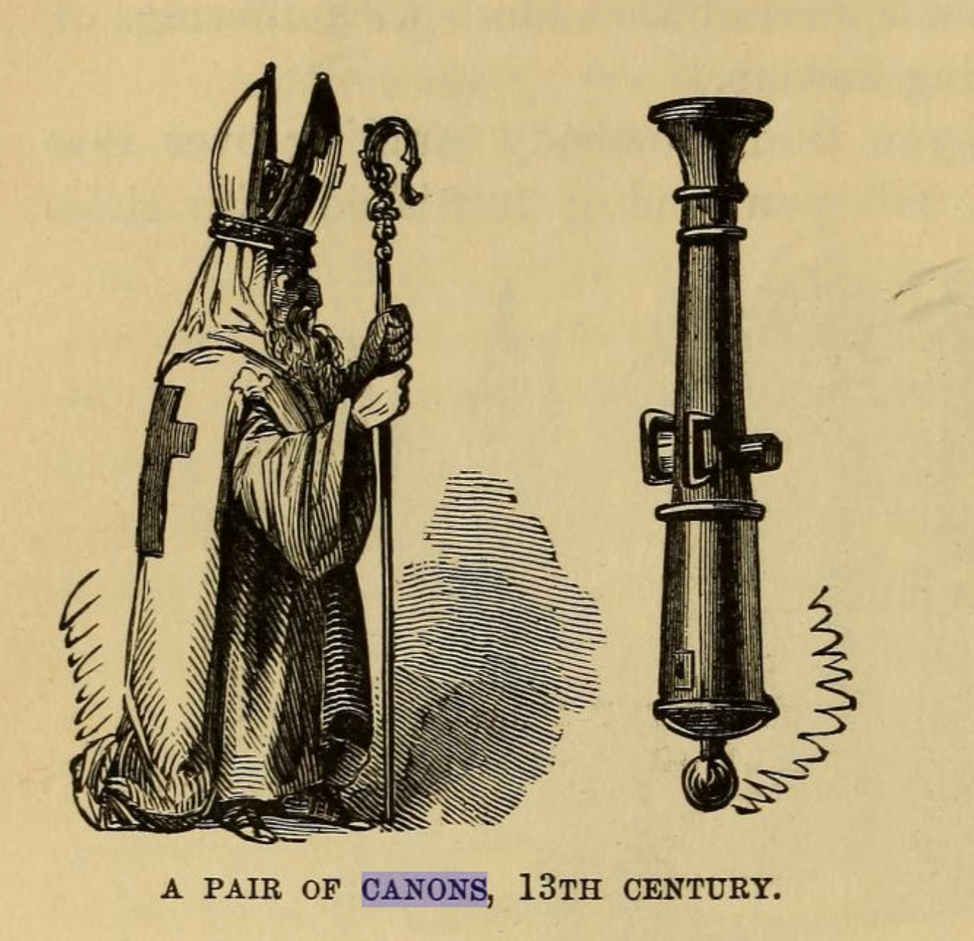
The picture at the top of this column comes from one of Mark Twain’s travelogues. It illustrates the vindictive priest Fulbert, in Twain’s retelling of the story of Abelard and Héloïse, 12th century lovers. More about that momentarily. Abelard was a prominent philosopher who tangled for several years with Saint Bernard of Clairvaux, a significant dispute ably discussed here.

Abelard and the Inklings

Abelard (c. 1079-1142) was a philosopher who, as was common during the Middle Ages, was also a theologian. Among his contributions to religion was revising the Roman Catholic doctrine of limbus infantium (Limbo for unbaptized infants).

In popular culture, Abelard’s love affair with his eventual “wife” is more prominent than his religious pursuits. Although Abelard was a famous figure during the medieval period, he did not feature significantly in C.S. Lewis’ thought. He did, however, exert a prominent influence on Charles Williams’ Place of the Lion, a volume Lewis praised.

In “Friendship in The Place of the Lion,” Dan Hamilton provides a very accessible synopsis of Williams’ book. He describes the experience of a primary character, who is writing her dissertation on “Pythagorean Influences on Abelard.” As she struggles with the appearance of supernatural phenomena, “she encounters the specter of Abelard, a major subject of her studies. But he is dead, and powerless to give her any aid, not even a meaningful word.” The “archetypes” in the story, by contrast, possess genuine power. It is a very unique book.

Returning to Mark Twain’s retelling of the popular medieval tale, we leave the realm of platonic philosophy, and enter the world of sordid human activities. Twain, you see, was not sympathetic to Abelard’s wooing of a young student and his eventual repentance. In his account, Twain desired “to show the public that they have been wasting a good deal of marketable sentiment very unnecessarily.” If you are curious as to his perspective on the events, continue reading.

Twain’s Take on Abelard and Héloïse
(not brief, but well worth reading)

In his own words, Twain’s “faithful” version of their story – but first, he begins with a description of their shared gravesite.

But among the thousands and thousands of tombs in Père la Chaise [cemetery] there is one that no man, no woman, no youth of either sex, ever passes by without stopping to examine. Every visitor has a sort of indistinct idea of the history of its dead, and comprehends that homage is due there, but not one in twenty thousand clearly remembers the story of that tomb and its romantic occupants. This is the grave of Abelard and Heloise – a grave which has been more revered, more widely known, more written and sung about and wept over, for seven hundred years, than any other in Christendom, save only that of the Saviour.

All visitors linger pensively about it; all young people capture and carry away keepsakes and mementoes of it; all Parisian youths and maidens who are disappointed in love come there to bail out when they are full of tears; yea, many stricken lovers make pilgrimages to this shrine from distant provinces to weep and wail and “grit” their teeth over their heavy sorrows, and to purchase the sympathies of the chastened spirits of that tomb with offerings of immortelles and budding flowers.

Go when you will, you find somebody snuffling over that tomb. Go when you will, you find it furnished with those bouquets and immortelles. Go when you will, you find a gravel-train from Marseilles arriving to supply the deficiencies caused by memento-cabbaging vandals whose affections have miscarried.

Yet who really knows the story of Abelard and Heloise? Precious few people. The names are perfectly familiar to every body, and that is about all. With infinite pains I have acquired a knowledge of that history, and I propose to narrate it here, [italics added] partly for the honest information of the public and partly to show that public that they have been wasting a good deal of marketable sentiment very unnecessarily.

Heloise was born seven hundred and sixty-six years ago. She may have had parents. There is no telling. She lived with her uncle Fulbert, a canon of the cathedral of Paris. I do not know what a canon of a cathedral is, but that is what he was. He was nothing more than a sort of a mountain howitzer, likely, because they had no heavy artillery in those days. Suffice it, then, that Heloise lived with her uncle the howitzer, and was happy.

She spent the most of her childhood in the convent of Argenteuil – never heard of Argenteuil before, but suppose there was really such a place. She then returned to her uncle, the old gun, or son of a gun, as the case may be, and he taught her to write and speak Latin, which was the language of literature and polite society at that period.

Just at this time, Pierre Abelard, who had already made himself widely famous as a rhetorician, came to found a school of rhetoric in Paris. The originality of his principles, his eloquence, and his great physical strength and beauty created a profound sensation. He saw Heloise, and was captivated by her blooming youth, her beauty and her charming disposition. He wrote to her; she answered. He wrote again, she answered again. He was now in love. He longed to know her – to speak to her face to face.

His school was near Fulbert’s house. He asked Fulbert to allow him to call. The good old swivel saw here a rare opportunity: his niece, whom he so much loved, would absorb knowledge from this man, and it would not cost him a cent. Such was Fulbert – penurious . . . He asked Abelard to teach her.

Abelard was glad enough of the opportunity. He came often and staid long. A letter of his shows in its very first sentence that he came under that friendly roof like a cold-hearted villain as he was, with the deliberate intention of debauching a confiding, innocent girl. This is the letter :

“I can not cease to be astonished at the simplicity of Fulbert; I was as much surprised as if he had placed a lamb in the power of a hungry wolf. Heloise and I, under pretext of study, gave ourselves up wholly to love, and the solitude that love seeks our studies procured for us. Books were open before us, but we spoke oftener of love than philosophy, and kisses came more readily from our lips than words.”

And so, exulting over an honorable confidence which to his degraded instinct was a ludicrous “simplicity,” this unmanly Abelard seduced the niece of the man whose guest he was. Paris found it out. Fulbert was told of it – told often – but refused to believe it. He could not comprehend how a man could be so depraved as to use the sacred protection and security of hospitality as a means for the commission of such a crime as that. But when he heard the rowdies in the streets singing the love-songs of Abelard to Heloise, the case was too plain – love-songs come not properly within the teachings of rhetoric and philosophy.

He drove Abelard from his house. Abelard returned secretly and carried Heloise away to Palais, in Brittany, his native country. Here, shortly afterward, she bore a son, who, from his rare beauty, was surnamed Astrolabe. . . . The girl’s flight enraged Fulbert, and he longed for vengeance, but feared to strike lest retaliation visit Heloise – for he still loved her tenderly. At length Abelard offered to marry Heloise – but on a shameful condition: that the marriage should be kept secret from the world, to the end that (while her good name remained a wreck, as before) his priestly reputation might be kept untarnished. It was like that miscreant.

Fulbert saw his opportunity and consented. He would see the parties married, and then violate the confidence of the man who had taught him that trick; he would divulge the secret and so remove somewhat of the obloquy that attached to his niece’s fame. But the niece suspected his scheme. She refused the marriage, at first; she said Fulbert would betray the secret to save her, and besides, she did not wish to drag down a lover who was so gifted, so honored by the world, and who had such a splendid career before him. It was noble, self-sacrificing love, and characteristic of the pure-souled Heloise, but it was not good sense.

But she was overruled, and the private marriage took place. Now for Fulbert! The heart so wounded should be healed at last; the proud spirit so tortured should find rest again; the humbled head should be lifted up once more. He proclaimed the marriage in the high places of the city, and rejoiced that dishonor had departed from his house. But lo! Abelard denied the marriage! Heloise denied it! The people, knowing the former circumstances, might have believed Fulbert, had only Abelard denied it, but when the person chiefly interested – the girl herself – denied it, they laughed despairing Fulbert to scorn.

The poor canon of the cathedral of Paris was spiked again. The last hope of repairing the wrong that had been done his house was gone. What next? Human nature suggested revenge. He compassed it. The historian says: “Ruffians, hired by Fulbert, fell upon Abelard by night, and inflicted upon him a terrible and nameless mutilation.”

I am seeking the last resting-place of those “ruffians.” When I find it I shall shed some tears on it, and stack up some bouquets and immortelles, and cart away from it some gravel whereby to remember that howsoever blotted by crime their lives may have been, these ruffians did one just deed, at any rate, albeit it was not warranted by the strict letter of the law.

Heloise entered a convent and gave good-bye to the world and its pleasures for all time. For twelve years she never heard of Abelard – never even heard his name mentioned. She had become prioress of Argenteuil, and led a life of complete seclusion. She happened one day to see a letter written by him, in which he narrated his own history. She cried over it, and wrote him. He answered, addressing her as his “sister in Christ.”

They continued to correspond, she in the un-weighed language of unwavering affection, he in the chilly phraseology of the polished rhetorician. She poured out her heart in passionate, disjointed sentences; he replied with finished essays, divided deliberately into heads and sub-heads, premises and argument. She showered upon him the tenderest epithets that love could devise, he addressed her from the North Pole of his frozen heart as the “Spouse of Christ!” The abandoned villain!

On account of her too easy government of her nuns, some disreputable irregularities were discovered among them, and the Abbot of St. Denis broke up her establishment. Abelard was the official head of the monastery of St. Grildas de Ruys, at that time, and when he heard of her homeless condition a sentiment of pity was aroused in his breast (it is a wonder the unfamiliar emotion did not blow his head off), and he placed her and her troop in the little oratory of the Paraclete, a religious establishment which he had founded.

She had many privations and sufferings to undergo at first, but her worth and her gentle disposition won influential friends for her, and she built up a wealthy and flourishing nunnery. She became a great favorite with the heads of the church, and also the people, though she seldom appeared in public. She rapidly advanced in esteem, in good report and in usefulness, and Abelard as rapidly lost ground. The Pope so honored her that he made her the head of her order.

Abelard, a man of splendid talents, and ranking as the first debater of his time, became timid, irresolute, and distrustful of his powers. He only needed a great misfortune to topple him from the high position he held in the world of intellectual excellence, and it came. Urged by kings and princes to meet the subtle St. Bernard in debate and crush him, he stood up in the presence of a royal and illustrious assemblage, and when his antagonist had finished he looked about him, and stammered a commencement; but his courage failed him, the cunning of his tongue was gone: with his speech unspoken, he trembled and gat down, a disgraced and vanquished champion.

He died a nobody, and was buried at Cluny, A.D., 1144. They removed his body to the Paraclete afterward, and when Heloise died, twenty years later, they buried her with him, in accordance with her last wish. He died at the ripe age of 64, and she at 63. After the bodies had remained entombed three hundred years, they were removed once more. They were removed again in 1800, and finally, seventeen years afterward, they were taken up and transferred to Pere la Chaise, where they will remain in peace and quiet until it comes time for them to get up and move again.

History is silent concerning the last acts of the mountain howitzer. Let the world say what it will about him, I, at least, shall always respect the memory and sorrow for the abused trust, and the broken heart, and the troubled spirit of the old smooth-bore. Rest and repose be his!

Such is the story of Abelard and Heloise. (Innocents Abroad).


* Later Fordefjord was unimaginatively renamed “First Lutheran Church.”

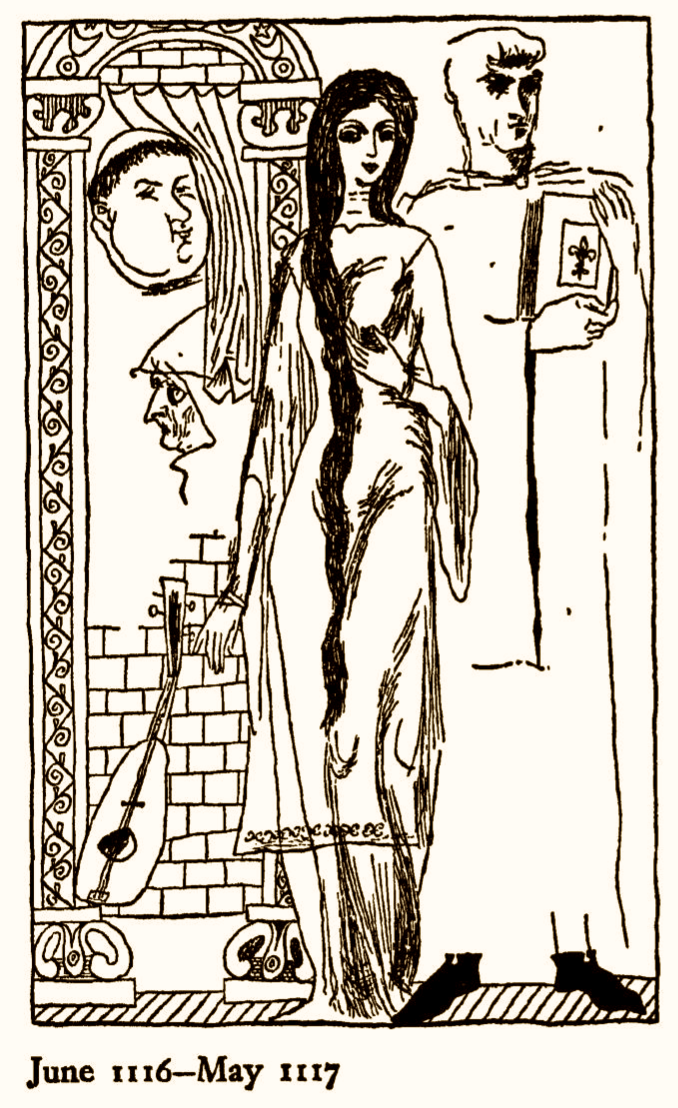
A novel entitled Peter Abelard was published in 1933 by Helen Waddell. It is available at Internet Archive for those who prefer their history via the medium of historical fiction. The illustration below, apparently imitating a fading fresco, comes from that volume.
Tortured Writing & the Inklings

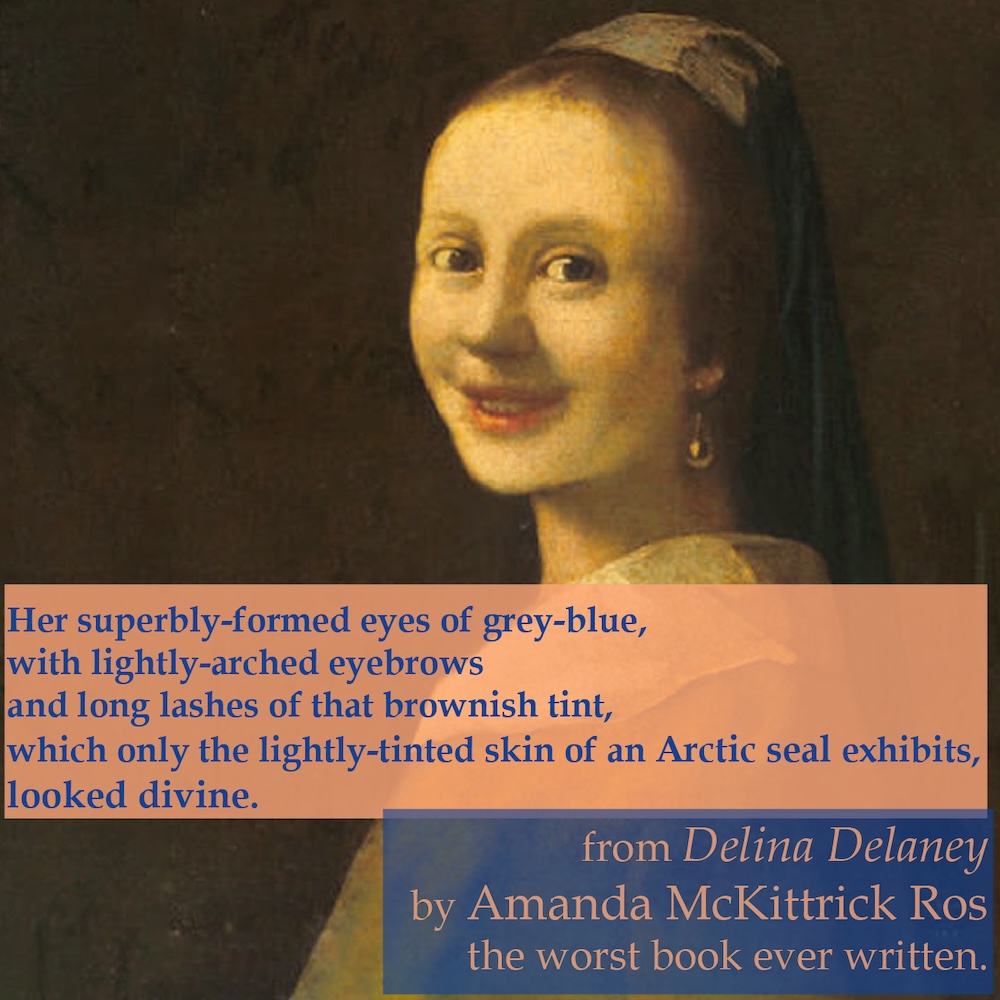
Amanda McKittrick Ros (1860-1939) was an Irish poet and novelist beloved by the Oxford Inklings. “Beloved” here is used in the sense of treasured for its distinctiveness, rather than admired for its artistry.

An article about Ros in Smithsonian Magazine is subtitled: “Amanda McKittrick Ros predicted she would achieve lasting fame as a novelist. Unfortunately, she did.”

So how is it that a writer described by the Oxford Companion to Irish Literature (OCIL) as authoring “unconscious comedy of a very high order” came to occupy a special place within the company of C.S. Lewis, J.R.R. Tolkien and their literary fellows? Why did they begin reading her works as a sort of contest, with the challenge of neither laughing nor smiling as they did so?

It was not because her mother (or she herself) christened her after a character in The Children of the Abbey, published in 1796. (Her initial name was “Anna.”)

No, it was due to an intrinsic element of her frequently alliterative artistry, described by OCIL in the following manner.

She published two sentimental romances, Irene Iddlesleigh (1897) and Delina Delany (1898), both in an idiosyncratic manner that provides unconscious comedy of a very high order. . . .

Most of her published writings appeared posthumously as a result of literary curiosity.

Many writers would agree that writing comedy is quite challenging. Comedy Crowd is devoted to helping writers gain some skill in this arena, and if you take a moment to check out their video about failed puns – after you finish reading this post – you won’t be disappointed. 

As one commenter on SleuthSayers puts it, “. . . writing humor isn’t easy. It’s even dangerous: trying to be funny and failing would be almost as bad as being funny when you’re trying to be serious.” Sadly, the worst of these options proved to be the fortune of poor Amanda.

Even her native Northern Ireland Library Authority confesses that her “writing style can only be described as elaborate, melodramatic, using startling descriptions with mixed metaphors and inappropriate alliteration with the result being unintentionally hilarious.”

In her collection “Poems of Puncture,” I came across a piece titled “Reverend Goliath Ginbottle.” Being a reverend myself, I eagerly listened to a LibriVox recording of the poem (which you can download for free from Internet Archive), and I was not disappointed. Her description of this “viper of vanity” and her joy at his ultimate judgment was delightfully colorful. Or, should you prefer to hear a diatribe against a corrupt lawyer, listen to Mickey Monkeyface McBlear, who bore “a mouth like a moneybox.”

TV Tropes has an article about Ros which attributes a dozen tropes to her pen.

In the Style of: Aldous Huxley noted that Ros wrote in the 16th century style of Euphuism. Susan Sontag decades later stated that Euphuism was the progenitor of camp, which would explain why literary greats found her writing so hilarious.

Those curious about euphuism can read John Lyly’s Euphues: the Anatomy of Wit; Euphues and His England which is filled with delights unnumbered. Originally two volumes, the books were published in the sixteenth century.

C.S. Lewis was a serious enough “fan” of Ros’ writings to share his affection for them with Cambridge Classicist Nan Dunbar. C.S. Lewis scholar Joel Heck has written a worthwhile article about the ongoing friendship between the two professors.

For a detailed study of the literary relationship between Amanda McKittrick Ros and the Inklings, I highly recommend the article by Anita Gorman and Leslie R. Mateer which appeared in Mythlore.

As they describe, even before the Inklings added occasional readings of her work to their gatherings, as early as 1907 there was in Oxford a society devoted to weekly readings of her works. The authors pose, and then proceed to answer, the following question.

What . . . impelled C.S. Lewis and his mates to read aloud Ros’s work? Yes, the improbable plots, silly characters, and nonexistent themes may have played a role, but were those enough to captivate the Inklings and to give rise to Delina Delaney dinners and Amanda Ros societies?

After all, many writers have written improbable plots about improbable people, and these writers have enjoyed short-lived reputations, if any reputations at all. Yet Amanda lives on.

For Those with Stout Constitutions

Mere Inkling offers one final look back at the transcendent poetry of Amanda McKittrick Ros. This infamous selection can be found at the aptly named Pity the Readers: Horribly Excellent Writing website.

“Visiting Westminster Abbey”
(from Fumes of Formation)

Holy Moses! Have a look!
Flesh decayed in every nook!
Some rare bits of brain lie here,
Mortal loads of beef and beer,

Some of whom are turned to dust,
Every one bids lost to lust;
Royal flesh so tinged with ‘blue’
Undergoes the same as you.

These morose words bring to mind another verse, composed in the form of a song by the artists of Monty Python. It appeared on Monty Python’s Contractual Obligation Album as “Decomposing Composers.”

They’re decomposing composers.
There’s nothing much anyone can do.
You can still hear Beethoven,
But Beethoven cannot hear you. . . .

Verdi and Wagner delighted the crowds
With their highly original sound.
The pianos they played are still working,
But they’re both six feet underground.

They’re decomposing composers.
There’s less of them every year.
You can say what you like to Debussy,
But there’s not much of him left to hear.

Yes, similarly morbid verse, but offered here to provide a sharp contrast between types of humor. Monty Python is the epitome of Camp, which according to Susan Sontag,

sees everything in quotation marks. It’s not a lamp, but a “lamp;” not a woman, but a “woman.” To perceive Camp in objects and persons is to understand Being-as-Playing-a-Role. It is the farthest extension, in sensibility, of the metaphor of life as theater.

Although Sontag notes “one must distinguish between naïve and deliberate Camp,” she argues the “pure examples of Camp are unintentional.” She considers self-conscious efforts, such as Noel Coward (and presumably Monty Python as well) as “usually less satisfying.”

Another perspective offers a helpful dichotomy to distinguish between “intentionality: whether camp deliberately cultivated (‘high’ camp) is the same to that of the unintentional kind (‘low’ camp).”

Personally, I often enjoy high (nonvulgar) camp humor – witty silliness that scoffs at life’s peculiarities. As for unintentional, “low” camp such as we find in Ros, I typically feel a flash of guilt at hurting (even posthumously) the feelings of a writer. Most of us writers are, after all, a sensitive and vulnerable breed.


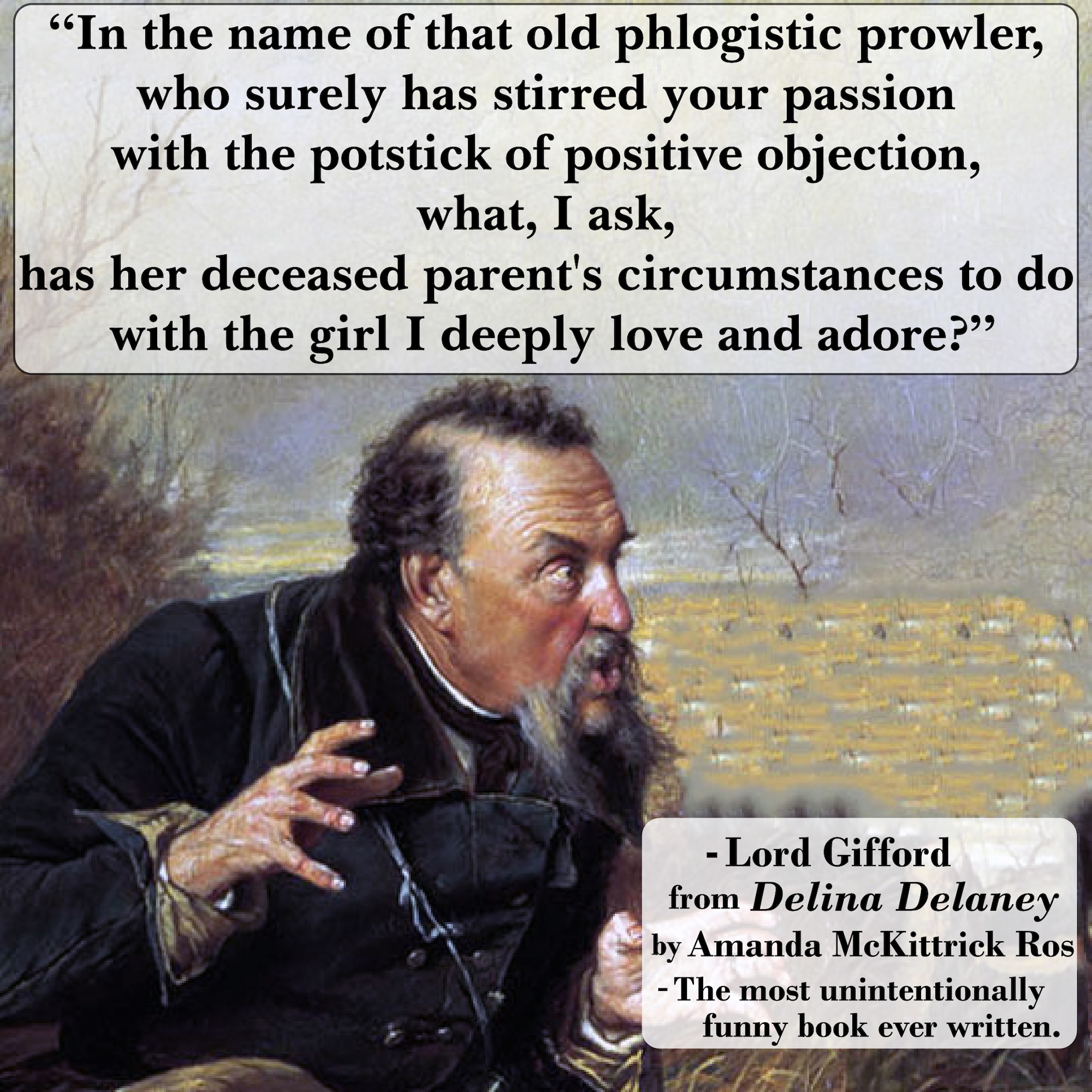
The enlightening illustrations accompanying this article are from Amanda McKittrick Ros Society Promotional Memes, ably captained by Dan Morgan.

Do Lay People Think?

Attending seminary was shocking. Having grown up in Lutheran communities with a high view of the Scriptures, I anticipated entering an environment where I would grow in my knowledge and regard for God’s word. A setting consistent with our Reformation theology which confessed “Sola Scriptura,” the Scriptures alone, as the ultimate authority for doctrine and life.

I was amazed at the theology taught by a few of the faculty who were disciples of Bultmann’s radically skeptical interpretation of Christianity.

One morning I was in the seminary cafeteria – the aptly named Diet of Worms – commiserating over this situation with several other students who shared my astonishment. I said something to the effect of “Is Lutheranism what liberal theologians think, or what the majority of Confessionally-grounded lay people in the pews think?”

Apparently one of the New Testament professors had overheard our conversation. He could not resist walking over, leaning over our table, and asking – “Do lay people think?”

I’ve never forgotten the vanity and unintentional irony in that rhetorical comment. As I recall, it elicited a complicit chuckle from the entourage of liberal students already falling under his spell.

The greatest Christian apologist of the twentieth century, C.S. Lewis, was neither a cleric nor a theologian. Lewis described himself as “a very ordinary layman of the Church of England” (Mere Christianity). In the same work he expressed his lifelong position. Since he was not theologically trained, he was constrained from making authoritative declarations about complex matters.

I am only a layman, and at this point we are getting into deep water. I can only tell you, for what it is worth, how I, personally, look at the matter.

Pastors & Theologians, What are they Good For?

Some will answer that question echoing the words of the 1970 classic by the Temptations: “absolutely nothing.”

In an over-reaction to the errors of the medieval Papacy, some Protestants threw out all of the legitimate practices which had developed in the early church, including the ordination of pastors. The anti-clerical communities vary in their attitudes toward higher education for “teachers and elders,” but rarely regard such studies as necessary, or even a plus.

Most denominations, however, have maintained an awareness that having future pastors devote several years to biblical and theological studies is vital to the church’s wellbeing. Add to that additional subjects such as counseling and homiletics – skills that are essential – and you should get well-rounded pastors. 

Sadly, there are plenty of exceptions. I have written about wolves in sheep’s clothing in the past. Still, discerning students attending trustworthy seminaries invariably become better equipped to fulfill the demands of pastoral ministry. Check out “The Relevance of Theological Education” in the (free) journal Themelios which is published by the Gospel Coalition. Themelios is the Greek word for “foundation.” The article begins:

Most theological students have doubts at some time about the usefulness of their theological training. Some of these doubts are justified, since most theological courses leave plenty of room for improvement. But some of our doubts reflect a lack of understanding of the purpose and function of theological training.

What about Lay People?

Before the word “lay” became associated with distinguishing the mass of people from those within particular professions, it originated to distinguish the believing “laity” who adhere to a faith from clergy of that tradition.

Are clergy holier than laypeople? Definitely not. However, in the Christian faith we acknowledge that they are expected to live with greater moral integrity than those they serve. 

“Not many of you should become teachers, my brothers, for you know that we who teach will be judged with greater strictness” (James 3:1).

It is quite sobering for those who take God’s word seriously. In Paul’s letter to Titus we read a relatively explicit description of the requirements for pastors. 

“This is why I left you in Crete, so that you might . . . appoint elders in every town as I directed you – if anyone is above reproach, the husband of one wife, and his children are believers and not open to the charge of debauchery or insubordination. For an overseer, as God’s steward, must be above reproach.

“He must not be arrogant or quick-tempered or a drunkard or violent or greedy for gain, but hospitable, a lover of good, self-controlled, upright, holy, and disciplined. He must hold firm to the trustworthy word as taught, so that he may be able to give instruction in sound doctrine . . .” (Titus 1).

Different Roles

The inspiration for my post on this subject is an article I read in the 2024 Logos Bible Software Seminary Guide. A PhD theologian wrote “Do Theological Writers Need Theological Education?” which answered its own question in its subtitle: “Yes and No.” The writer states that degrees are most definitely not required.

There is nothing sacrosanct about sitting in a classroom . . . You can be educated through other means, with diligent reading being at the top of the list.

Simultaneously, he defends the values of a solid education. I love the way that he responds to the way some people denigrate theological education (because I’ve met more of these folks than I can number).

Today’s many populists might beg to differ. They mock “edumucation” and deride the arrogant eggheads who get too much of it. They flout the norms of academic discourse . . . they seem proud of their misspellings.

It’s not as if there is no truth at all in their complaints: educated people do indeed often give in to arrogance. But it’s not at all clear to me that arrogance about one’s ignorance is any better.

I concur. I’m against arrogance altogether – along with C.S. Lewis. “Lewis on Intellectual Pride” speaks directly to the question I’ve addressed herein. Discussing Lewis’ warnings about pursuing academia, the author says:

Why is intellectual arrogance so quick to rise within us? It makes us feel important. We understand more than others (we think). That makes us better than the ignorant masses (we boast).

Martin Luther described the centrality of God’s self-revelation in determining who is most fit to teach. And that has nothing to do with an individual’s ecclesiastical status.

The Bible is alive, it speaks to me; it has feet, it runs after me; it has hands, it lays hold of me. . . . A simple layman armed with Scripture is to be believed above a pope or a cardinal without it.

So, returning to the question with which I began, do lay people think? I am as scandalized by those very words as I was when I first heard them voiced. That particular professor is no longer alive. But, sadly, his prideful thinking remains with us today. And it’s not only evident in religion; humanity is plagued by an intelligentsia that dismisses the “lay” views of common people across the board. 

The actual truth is that education has its values, and its limitations. And there are innumerable laymen and women who possess wisdom on nearly every subject which is superior to the supposed “experts.” Yes, esteemed doctor of de-supernaturalized theology, lay people can indeed comprehend and share the wisdom of God.

Theological Humor

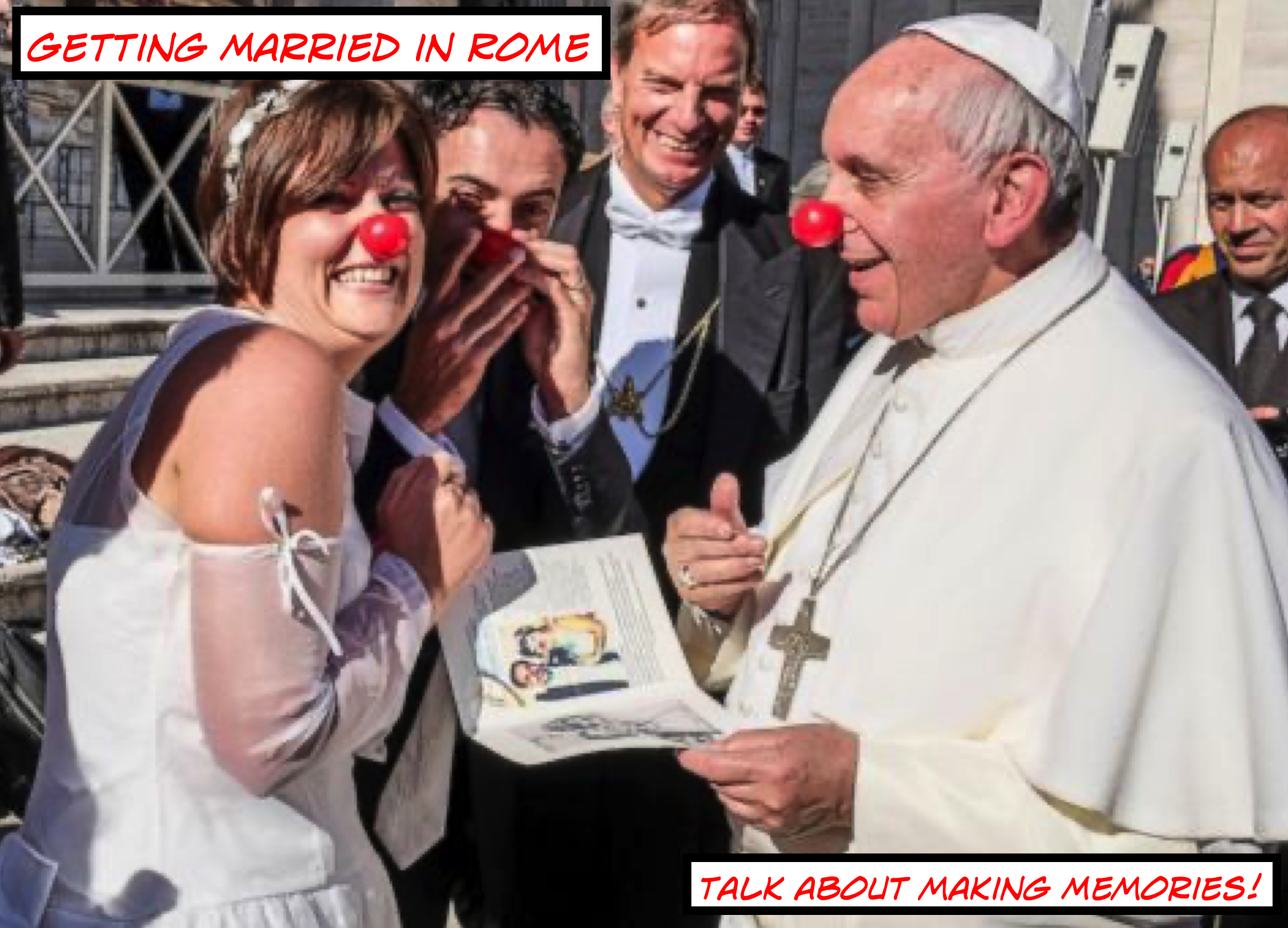
Pope Francis jokes with a newlywed couple in Rome.

Don’t be surprised, but many clergy possess keen senses of humor. Sure, there are staid, grimacing ministers who consider acting dour to be a virtue. (They’re often legalistic.) But most of the pastors and military chaplains I’ve worked beside, love to laugh. I think I’ve written enough about humor to verify that.

C.S. Lewis maintained strong bonds with a number of clergy, from a variety of denominations, and that would hardly have been true if they had lacked a sense of humor. Humor, to Lewis, is an essential part of life. He proclaims this truth from the lips of Aslan himself, as the newly created Talking Animals hear the first (accidental) joke.

“Laugh and fear not, creatures. Now that you are no longer dumb and witless, you need not always be grave. For jokes as well as justice come in with speech.” (The Magician’s Nephew)

I recently read about a fascinating incident one historian described as “perhaps the only really satisfactory practical joke in the whole history of theology.” Allow me to set the scene.

The Byzantine Empire lasted for a thousand years, before being defeated and desecrated* by Islamic armies. During the centuries surrounding its apex, it suffered from the political intrigue and competition with which we are all too familiar.

Photios I was a Byzantine scholar who was twice the Patriarch of Constantinople during the ninth century. Twice is unusual, but it was due to the machinations of emperors and empresses who meddled in the affairs of the church.

He had a troubled relationship with another priest named Ignatius, who also served two times as Patriarch. The good news is that the men were eventually reconciled and both are regarded by Orthodox Christians as saints.

The anecdote comes from the period of their rivalry. Photios, whose brilliance was widely acknowledged, and presumably envied by Ignatius, decided to pull an embarrassing public prank on his nemesis.

Photios devised a bizarre theory that human beings have two souls. His goal was to trick Ignatius into taking it seriously, whereupon Photius withdrew the thesis and admitted he had not been serious. Apparently, everyone unsatisfied with Ignatius’ leadership found it quite entertaining.

Fortunately, among clergy the humiliation of others is rarely the object of humor. Yet, sadly, I have seen it attempted. I personally repent of ever having done so myself, and regard it as sharing, along with vulgarity and blasphemy, the lowest level of “humor.” 

The Wisdom of Lewis

In Reflections on the Psalms, C.S. Lewis relates something I know to be true from my own experience.

A little comic relief in a discussion does no harm, however serious the topic may be. (In my own experience the funniest things have occurred in the gravest and most sincere conversations.) 

Clergy deal with serious topics, like death, quite frequently. Perhaps that is one reason a well-developed sense of humor is common among their ranks.


Skip this footnote if you want to end on a “happy” note.

* “Desecration” may sound like a harsh word to our interfaith-sensitive ears, but it is accurate here. Islam is rarely a gentle master for Christians, and it has been common to see churches and holy places seized and converted to foreign religious uses. For example, in the capital Constantinople (now called Istanbul), Orthodox Christianity’s most magnificent church, Hagia Sophia, saw much of its glorious and historic iconography destroyed when it was converted to a mosque. Many years later, in 1934, an enlightened Turkish government ended the insult, and chose to treat the holy place as a museum. Sadly, the current regressive government under Recep Tayyip Erdoğan, reversed that decision, and in 2020 the Church of Holy Wisdom was returned to its usage as a mosque.

Satirical Scottish Birds

C.S. Lewis has introduced me to many fascinating writers. Authors I never would have learned about without Lewis’ reference to them.

Sometimes Lewis praises their work. At other times, being an honest literary critic, he is compelled to provide a less flattering appraisal. He typically offers the latter evaluation with a novel flair.

In my previous post I shared the sad tale of a blackbird tapping at our window. I promised to discuss today some other curious birds. These creatures, in contrast to the forlorn blackbird, arise from the imagination of a Scottish poet named Sir David Lyndsay* of the Mount. He lived around 1490 to 1555.

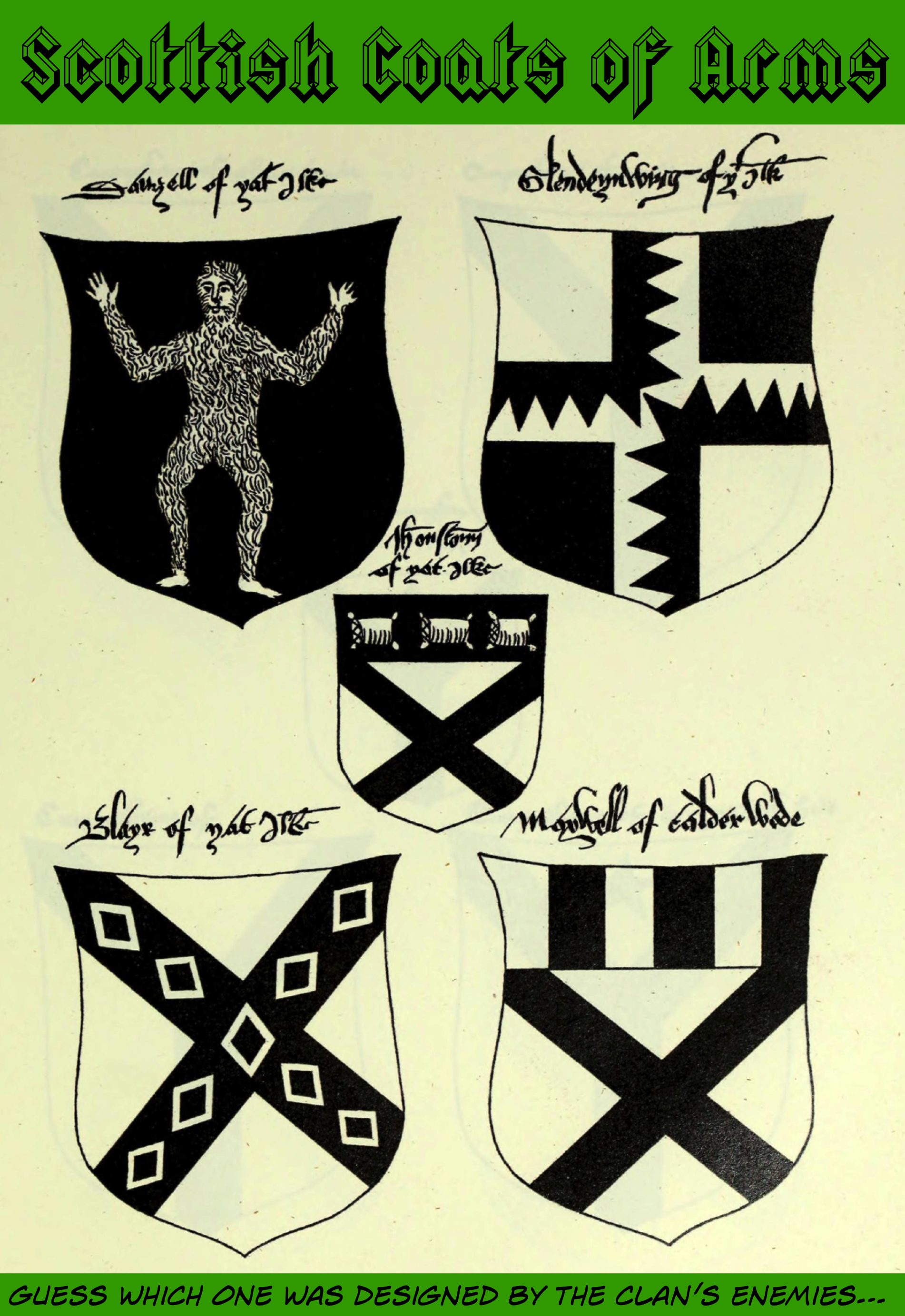
Lyndsay rose to the ceremonial rank of “The Right Honourable the Lord Lyon King of Arms,” which sounds quite impressive. In that capacity, he compiled 400 Scottish coats of arms, which was quite an achievement. You can download a rare facsimile of that document for your personal library from Internet Archive. The central shield may belong to my wife’s ancestors, “Jhonstoun of that ilke.”

Sir Lyndsay was a tutor to James V and served in his Court after his ascendancy to Scotland’s throne. However, it is for his poetry that David Lyndsay is remembered. Which is precisely why C.S. Lewis included him in the volume he wrote for the Oxford History of English Literature. English Literature in the Sixteenth Century Excluding Drama was published in 1944. While this authoritative volume is certainly not casual reading, it is extremely interesting. Just listen to how Lewis introduces Scottish writers of the “close of the Middle Ages.”

Sir David Lyndsay’s Legacy

This academic work is the place our favorite Inkling introduced me to “the last major poet of the old Scotch tradition.” I was on a quest for something interesting about birds, and I learned of a delightful piece of satire written by this Renaissance “Lion King.”

His works are a beautiful example of the ‘single talent well employed.’ The Satyre of the Thrie Estaitis, which holds an important place among our scanty materials for a history of the allegorical drama in Scotland, will be dealt with in another volume of this series . . . stands apart from the rest of Lyndsay’s output by the looseness of the metre and the general popularity of the style, and that it is rich in pathos and low humour.

In his remaining works he everywhere keeps well within the lines marked out for him by his great predecessors, there is no novelty in them . . . But what there is of him is good all through.

I am quite receptive to satire that skewers hypocritical clergy. That’s why the “episcopal ghost”⁑ in The Great Divorce is my favorite example of someone who has rejected the Truth.

This is what appealed to me about Lyndsay’s satire The Testament and Complaynt of our Soverane Lordis Papyngo.

The Complaynt [an earlier work] records, in a brisk, mocking fashion . . . the marked improvement in social order and general well-being throughout the kingdom, except as regards the “spiritualitie.” On the doings of the ecclesiastics he advises [the young king] to keep a watchful eye, and see that they preach with “unfeyneit intentis,” use the sacraments as Christ intended and leave such vain traditions as superstitious pilgrimages and praying to images. . . .

In The Testament and Complaynt of our Soverane Lordis Papyngo (parrot) he exposed more particularly the corruptions and worldliness of the spirituality, and this in a more comprehensive and scathing fashion than in his two previous pieces . . . (Cambridge History of English and American Literature).

And here are the ecclesiastical nemeses of the poem, “religious men, of gret devotioun.”

Here, also, all is pure satire—much of it of a very clever and trenchant character . . . the wise bird [the king’s parrot] with its “holy executors,” who appear in the form of a pyot [magpie] (representing a canon regular), a raven (a black monk) and a gled or hawk (a holy friar). The disposition and aims of these ghostly counsellors are sufficiently manifest; and they act entirely in keeping with their reputed character.

The poor parrot would have much preferred to have, at her death-bed, attendants of a less grovelling type of character, such as the nightingale, the jay, the mavis [song thrush], the goldfinch, the lark, etc.; but, since none of them has come, she has to be content with the disreputable birds who have offered her their services.

After a piquant discussion with them on the growth of ecclesiastical sensuality and greed, she thereupon proceeds to dispose of her personality—her “galbarte of grene” to the owl, her eyes to the bat, her beak to the pelican, her music to the cuckoo, her “toung rhetoricall” to the goose and her bones to the phoenix.

Her heart she bequeaths to the king; and she leaves merely her entrails, including her liver and lungs, to her executors who, however, immediately on her death, proceed to devour her whole body, after which the ged flies away with her heart, pursued by the two other birds of prey.

I can picture the assembled clergy in their avian forms offering their pseudo-comfort to the dying parrot. In English Literature in the Sixteenth Century, C.S. Lewis describes the misbegotten flock in the following manner.

[The parrot’s] testament is made in the unwelcome presence of certain birds of prey who turn out to be monks and friars of the feathered world. The dying parrot inveighs against their hypocrisy and avarice . . . while they vigorously defend themselves by throwing the blame on the secular clergy.

So far, the satire has been ordinary enough; but we find real satiric invention, and even a strange beauty, when the popinjay, having provided for the poor by leaving her gay coat to the owl, her eyes to the bat, and her voice to the cuckoo, and for herself by committing her spirit to the Quene of Farie, is torn in pieces by her carrion executors the moment the breath is out of her body—hir angell fedderis fleying in the air.

It is not without reason an article in Studies in Scottish Literature opens with this praise:

Lindsay’s concern for morality and truthfulness, in an age when political and religious institutions were notoriously corrupt, earned him a considerable reputation in his lifetime. Indeed for later generations of Scottish readers, Lindsay’s name became a byword for reliability and truthfulness, at times even rivalling divine Scripture.

You can read the original poem, along with all of Lyndsay’s other poetic works, in this 1871 collection.


* Just a caution for those looking for more information about Lyndsay: be aware that his surname is also spelled Lindsay, Lindesay and Lyndesay. Also, he should not be confused with Robert Lindsay of Pitscottie, a roughly contemporary author who compiled The Historie and Chronicles of Scotland. (Robert’s family name is also spelled with similar variants.)

⁑ Lewis’ use of the word “episcopal” here does not refer to a denomination. It suggests a churchly, or more accurately, a high-churchly theologian.

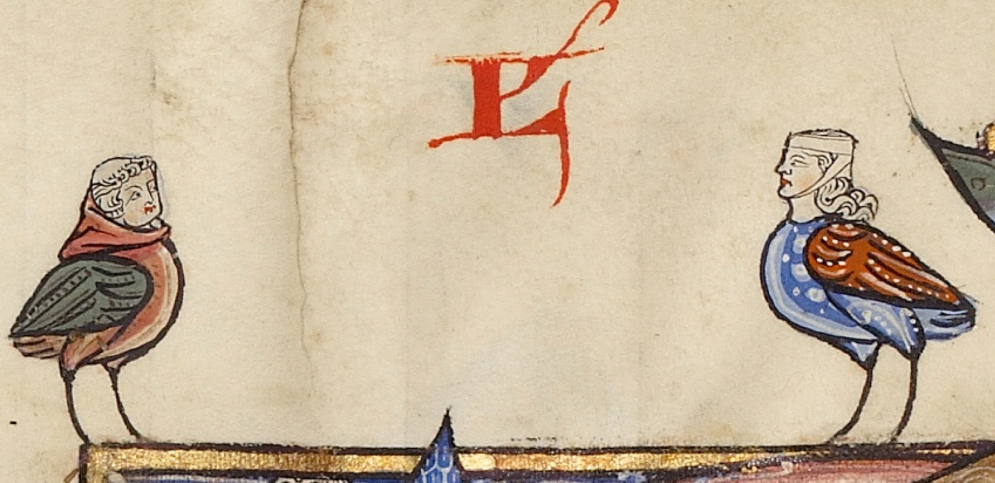
Noble Birds of Aragon, circa AD 1290

Robotic Religion

robot monkClergy can be irritating. I know that better than most . . . because I am one.

While a tiny minority bear some striking similarities to humble saints of the past, far more carry all of the common marks of fallen humanity. They can be argumentative, vain, manipulative, and even vindictive.

It’s not pretty.

Ministers aren’t unique. Being on the “inside” of any community—be it construction workers, educators, soldiers, bankers and politicians—allows one to see unpleasant attributes that are often shielded from the general population.

But, getting back to clergy . . . Since their role is unique in conveying “divine” counsel to others, it is especially important that they be approachable and amicable.

Scientists in China are working on a means of getting around the built-in limitations of the human mediation of divine wisdom.*

They have devised a “robot monk.” It is quite versatile. Not only can it chant Buddhist mantras, something an iPod could do at least as well, it is able to carry on a conversation! Well, the conversation is presently limited to 20 set questions about Buddhism. And the use of a touch screen “held” against his chest makes the comparison with an iPad a bit more accurate.

The automaton’s creator predicts the robot in the yellow robe of a novice will have a major impact, even though he spends most of his day “meditating” on an office shelf.

Enthusiastically agreeing, one worshiper said, “He looks really cute and adorable. He’ll spread Buddhism to more people, since they will think he’s very interesting, and will make them really want to understand Buddhism.”

Now, how can a Christian pastor hope to compete with that. After all, not many are considered to be “cute and adorable.”

What Would C.S. Lewis Think?

That’s a question I sometimes ponder when confronted by particularly odd realities that few of his day could have foreseen.

Lewis was quite respectful of clergy. Read, for example, this account of the way that even religious leaders can succumb to a type of patriotism that is far from biblical.

Patriotism . . . is not a sentiment but a belief: a firm, even prosaic belief that our own nation, in sober fact, has long been, and still is markedly superior to all others. I once ventured to say to an old clergyman who was voicing this sort of patriotism, “But, sir, aren’t we told that every people thinks its own men the bravest and its own women the fairest in the world?”

He replied with total gravity—he could not have been graver if he had been saying the Creed at the altar—“Yes, but in England it’s true.” To be sure, this conviction had not made my friend (God rest his soul) a villain; only an extremely lovable old ass. It can however produce asses that kick and bite. On the lunatic fringe it may shade off into that popular Racialism which Christianity and science equally forbid. (The Four Loves)

Now, it was not the personality or demeanor of this elderly priest that made his comment inappropriate. It was the comment itself. But for a prime example of clerical pride that drives people away from the Gospel, one needs look no farther than the “Episcopal Ghost” in Lewis’ The Great Divorce.

In Mere Christianity, Lewis concisely states the distinctive purpose of clergy. “The clergy are those particular people within the whole Church who have been specially trained and set aside to look after what concerns us as creatures who are going to live for ever.”

Could any other role demand so much integrity and goodwill? I think not. And it is precisely because this role is so unique and significant, that our shortcomings are doubly damning.

Perhaps, given the failings of sinful (i.e. all) ministers, it’s time to consider substituting a robot?

shermanI have no doubt that in no few cases it would be an improvement.

Of course, Christian churches would require a different model. Perhaps one that looks like Sherman on the Mount (minus the bird)?

_____

* You can read a Reuters article about this marvel of Chinese technology here.

The Nones Have It

noneThe arrival of the “post-Christian” Western world is ahead of schedule. Great Britain just passed the point where those with “no religious preference” actually outnumber those who profess to be Christians.

With Europe leading the way, can North America be far behind?

You know what makes this even more shocking? The results come from a survey where all the people claiming to be disciples of Jesus needed to do, was simply check a box. One wonders how many among that 48% would still claim to be Christians if they lived in Iraq.

Ponder for a moment the sobering title of an article in London’s The Spectator.

“Britain Really is Ceasing to be a Christian Country.”

The secularization of the United Kingdom was a matter of great concern to C.S. Lewis. And this erosion was well underway during his lifetime.

The truth is that although Lewis excelled as a Christian apologist (defender of the faith), it was not a role he coveted. He much preferred to write speculative fiction, literary criticism and devotional works.

Yet, because the need to reach people with the simple truth of the Gospel had grown so dire, Lewis felt forced to offer a persuasive rationale for belief. Consider the following description of his self-understanding. These words were written in response to a public attack of his work by a theologian. The final sentence bears directly on the subject of this column.

When I began, Christianity came before the great mass of my unbelieving fellow-countrymen either in the highly emotional form offered by revivalists or in the unintelligible language of highly cultured clergymen.

Most men were reached by neither. My task was therefore simply that of a translator—one turning Christian doctrine, or what he believed to be such, into the vernacular, into language that unscholarly people would attend to and could understand. For this purpose a style more guarded, more nuance, finelier shaded, more rich in fruitful ambiguities . . . would have been worse than useless. It would not only have failed to enlighten the common reader’s understanding; it would have aroused his suspicion. He would have thought, poor soul, that I was facing both ways, sitting on the fence, offering at one moment what I withdrew the next, and generally trying to trick him.

I may have made theological errors. My manner may have been defective. Others may do better hereafter. I am ready, if I am young enough, to learn. Dr. Pittenger would be a more helpful critic if he advised a cure as well as asserting many diseases. How does he himself do such work? What methods, and with what success, does he employ when he is trying to convert the great mass of storekeepers, lawyers, realtors, morticians, policemen and artisans who surround him in his own city? One thing at least is sure.

If the real theologians had tackled this laborious work of translation about a hundred years ago, when they began to lose touch with the people (for whom Christ died), there would have been no place for me. (“Rejoinder to Dr. Pittenger”)

It is the duty of each generation of Christians to share the faith with their neighbors. Likewise, it is the responsibility of each new generation of clergy to teach faithfully . . . and to live a God-pleasing life.

Whenever we fail to tackle the “laborious work of translation,” God is able to raise up another to do it. Still, men and women of the caliber of C.S. Lewis are few and far between.

May God have mercy on Britain, America, and all of those lands where we have taken for granted the heritage of faith bequeathed to us.

_____

If this subject interests you in the least, take a moment to read “Having Pity on Pittenger.” Anglican priest Dwight Longenecker describes a chance encounter with Dr. Pittenger decades after Lewis’ death.

I was alerted to this news account by Gene Veith’s fine blog, Cranach. The good doctor does an outstanding job of bringing newsworthy stories to the attention of those interested in Church and State relations.

C.S. Lewis’ Personality

csl introvertLearning about ourselves is a lifelong quest. And the more actively we pursue self-knowledge, the wiser we become.

A well known sixteenth century Christian mystic wrote:

“Self-knowledge is so important that even if you were raised right up to the heavens, I should like you never to relax your cultivation of it.” (Saint Teresa of Ávila, Interior Castle).

This self-knowledge leads to a greater recognition of our dependence on God. She continues, “so long as we are on this earth, nothing matters more to us than humility. . . . As I see it, we shall never succeed in knowing ourselves unless we seek to know God: let us think of His greatness and then come back to our own baseness; by looking at His purity we shall see our foulness; by meditating on His humility, we shall see how far we are from being humble.”

C.S. Lewis echoes this sentiment.

If anyone would like to acquire humility, I can, I think, tell him the first step. The first step is to realise that one is proud. And a biggish step, too. At least, nothing whatever can be done before it. If you think you are not conceited, it means you are very conceited indeed. (Mere Christianity).

As part of my self-examination, I have recently revisited my “personality type” as assessed by the well known Myers Briggs Personality Indicator (MBTI).

Without over-explaining the MBTI, it measures an individual’s preference related to four ways by which we experience and make sense of the world. (News Flash: Not everyone perceives reality the same way!)

These dichotomies are:

Extraversion (E) or Introversion (I)

Whether your preferred focus is outward or inward.

Sensing (S) or Intuition (N)

How you focus on information and process it.

Thinking (T) or Feeling (F)

Primary preference in your decision-making.

Judging (J) or Perceiving (P)

Your orientation towards making sense of existence.

You can get some additional authoritative information here. There are also numerous “unofficial” websites related to the subject.

Sixteen combinations are possible, and each has its respective strengths. (None are “better” than others, of course, since we’re all created in the image of God.)

Speaking of which, I’ve also been studying the different combinations that are more common to Christian ministers than they are within the general population.

For example, the following types (with their shorthand title) range from two to six times more common for male clergy than the general male American population:

ENFJ (The Teacher)

ENFP (The Provider)

INFP (The Healer)

INFJ (The Counselor)

ENTJ (The Field Marshal)

Which type of pastor do you prefer?

Online Surveys to Visit after you finish this post

There are a number of free MBTI-type tests online. Naturally, they are not as reliable as the official inventory given through a certified provider. Nevertheless, the following sites did render accurate assessments for me, based on my formal scoring.

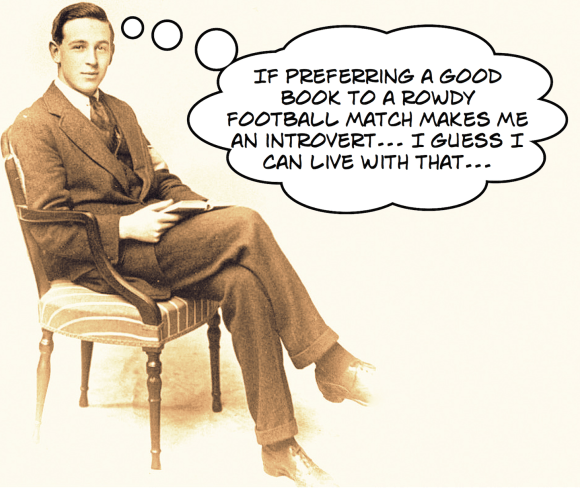
I have mentioned in the past that I am an *NTJ… with the asterisk representing that my I/E preference is too close to call. A previous post shows how that makes me a blend of Middle Earth’s Elrond and Théoden.

Humanmetrics Jung Typology Test

CelebrityTypes Personality Type Test

So, What Is C.S. Lewis’ Personality Type?

This is a subjective question. The MBTI is a self-reported assessment, so guessing the type of another person is by nature dicey.

In Lewis’ case, however, there is a fair degree of consensus. This is due to his openness about his personal life and his extensive writings. The general agreement does not mean though that there are not minority opinions.

The most common argument is that C.S. Lewis was INTJ. I find the reasons persuasive, and not just because it matches my own type!

One student of the subject says “Check out this quote—how INTJ is this?!”

Five senses; an incurably abstract intellect; a haphazardly selective memory; a set of preconceptions and assumptions so numerous that I can never examine more than a minority of them—never become even conscious of them all. How much of total reality can such an apparatus let through? (A Grief Observed)

One blogger writes, “There is no doubt in my mind that Lewis was an INTJ. It seeps off all his writing and is blatant in his behavior in all of his biographies.” She continues:

Highly imaginative child who lived in a dream world? Check.

Someone highly emotional/sensitive but that never showed it on the surface? Check.

A prolific writer who blazed through finishing projects at an astounding rate, who was so successful at everything he did, despite never having done it before, that he quickly rose to the top? Check.

Another site considers both C.S. Lewis and his fellow inkling J.R.R. Tolkien to be INFPs. The aptly titled CelebrityTypes.com offers a brief selection of quotations to illustrate the reasons for their identification.

If the site’s identifications are accurate, the two are in good company. Other writers include John Milton, Augustine of Hippo, Hans Christian Andersen, William Shakespeare, Søren Kierkegaard, George Orwell, A.A. Milne, Edgar Allan Poe, William Blake, J.K. Rowling and George R.R. Martin.

A Warning from Lewis Himself

Understanding ourselves better than we already do, is a good thing.

Being overly curious about the personality of someone who is deceased is another matter. Lewis’ point in the passage that follows is that such concerns must never supersede our regard for others, in the spirit of Matthew 8:22.*

There is a reaction at present going on against the excessive love of pet animals. We have been taught to despise the rich, barren woman who loves her lap dog too much and her neighbor too little. It may be that when once the true impulse is inhibited, a dead poet is a nobler substitute than a live Peke, but this is by no means obvious.

You can do something for the Peke, and it can make some response to you. It is at least sentient; but most poetolaters [worshippers of poets] hold that a dead man has no consciousness, and few indeed suppose that he has any which we are likely to modify. Unless you hold beliefs which enable you to obey the colophons of the old books by praying for the authors’ souls, there is nothing that you can do for a dead poet: and certainly he will do nothing for you. He did all he could for you while he lived: nothing more will ever come.

I do not say that a personal emotion towards the author will not sometimes arise spontaneously while we read; but if it does we should let it pass swiftly over the mind like a ripple that leaves no trace. If we retain it we are cosseting with substitutes an emotion whose true object is our neighbour.

Hence it is not surprising that those who most amuse themselves with personality after this ghostly fashion often show little respect for it in their parents, their servants, or their wives. (The Personal Heresy: A Controversy).

Reflecting on our own nature, and pondering the personalities of those we respect, are worthwhile activities. However, it’s best to remember that all we can see are mere glimpses into the depths of who we truly are.**

_____

* Matthew 8:22 quotes Jesus’ response to a disciple who demurred that he could not follow the Lord until after he attended to his father’s burial. “And Jesus said to him, ‘Follow me, and leave the dead to bury their own dead.’”

** As Paul words in Romans 8:27 are paraphrased in The Message Bible: God “knows us far better than we know ourselves . . .”

Misplaced Trust

trustingWhy do some nurses kill? Most people attracted to the nursing profession possess deep reservoirs of compassion for others. And yet, every once in a while we read about a nurse intentionally taking the life of a patient.

Today’s case comes from Italy, where a forty-two year old nurse is under investigation for thirty-eight possible cases of murder. And we are not talking about the ending of a life that some would term euthanasia.

Poggiali did not overdose them to end their suffering. She did it simply because they irritated her. She, or their relatives, bothered her.

One troubling aspect of the case could only happen today. Authorities have actually found a photograph on her phone where she is standing beside a deceased patient giving a “thumbs up” sign. (The article didn’t indicate whether this was a sickening “selfie,” or if there is another person at the hospital with a similarly demented sense of humor.

When people we implicitly trust violate our faith in them, it is jarring. We struggle to comprehend things when . . .

Medical professionals intentionally cause injury . . .

Clergy behave immorally, particularly when they attempt to justify it from the pulpit . . .

Police victimize rather than protect . . .

Teachers care more about themselves than their students . . .

Soldiers display cowardice rather than courage . . .

There is some good news here. It is precisely because these breaches of our expectations are the rare exception, that we are shocked by them. For the most part, people entrusted by the public with authority or power honor that trust.

(Let’s exclude, for our discussion here, the case of politicians, where that supposition would be hotly debated. As Lewis in his essay “Equality” wrote, “Mankind is so fallen that no man can be trusted with unchecked power over his fellows.”)

Our trust in people who occupy special positions goes so far as to be illogical. For example, we tend to think of actors or actresses as possessing the traits of various characters they have portrayed.

We laugh at the joke, “I’m not a doctor, but I play one on TV.” Yet, we’re still tempted to ask the person how we can best deal with our persistent cough or chronic rash.

We think of television cops as believing in law and order, but if we seriously considered the matter, we would recognize just how foolish that is. They are no more, or less, likely than anyone else in Hollywood to be law abiding.

An ongoing scandal reveals just how disorienting it can be to have our illusions shattered. It is the case of Stephen Collins. In the popular Seventh Heaven series, he played the ideal father. A pastor, no less. We mourn for the lives he has injured, and we subconsciously grieve our own disillusionment.

The solution to the problem is not in ceasing to trust others. Life from that perch would result in paranoia and alienation.

No, I think that it still makes sense to trust—within limits. I am willing to extend my trust to someone in a respected profession who I have just met. That is based on the profession’s self-policing of standards.* Most require minimal education and competence standards, and have mechanisms for decertifying those who violate professional ethics.

Still, when time allows, the best advice is probably to “trust and verify.” The time I take to verify whether the person’s credentials or claims are true corresponds to the importance of what I’m entrusting to them. I would leave my car with a mechanic far sooner than I would entrust my child to a babysitter.

Returning to the case with which we began, we assume that a hospital is one of the safest places to be. And, even in light of the latest tragedy, this remains true.

For every one nurse tempted to end a complainer’s life early, there are a hundred thousand** who are striving to prolong the lives of their charges.

Trusting should not only be viewed as something we extend to others. Each of us would do well to ponder for a few moments just how trustworthy we are. This is especially true for those of us in privileged or respected professions. However, it is no exaggeration to say that the measure of any woman or man is determined by the degree to which they have earned the trust of others.

Lewis writes about the nature of trust, as it relates to friendship. It doesn’t relate to trust imbued in societal roles, but rather in the trust that exists where a relationship is already present. Still, he expertly describes the interplay between mind and heart, when it comes to trust. And this explains, in part, why the betrayal of our trust causes us so much anguish, in mind and soul.

To love involves trusting the beloved beyond the evidence, even against much evidence. No man is our friend who believes in our good intentions only when they are proved. No man is our friend who will not be very slow to accept evidence against them. Such confidence, between one man and another, is in fact almost universally praised as a moral beauty, not blamed as a logical error. And the suspicious man is blamed for a meanness of character, not admired for the excellence of his logic. (“On Obstinacy in Belief”).

_____

* The fact that some “professions” don’t have any mandatory requirements or standards, means that I remain wary when I meet people sporting those titles. For example, in America it’s possible to “ordain” oneself (or buy a meaningless diploma or certificate online). Thus, when someone tells me they are a minister, I am eager to learn more (about their education, congregation, accountability, etc.). There are far too many hucksters out there to take a person’s word for it that they are a genuine minister of God.

** Perhaps a slight exaggeration, but I’d like to continue believing that the ratio is something wonderful like that, 1:100,000. Then again, if I think of it literally, in terms of how many are “tempted” to expedite the passing of an inconsiderate and ungrateful patient, I imagine the numbers might be rather less encouraging.

Who Should We Trust?

staffordshire cross“You can trust me, I’m a pastor.” When I was ordained thirty-three years ago, that might have been sufficient to persuade many people to give me the benefit of the doubt. Not so today.

The latest Gallup poll records the continuing decline of our trust in “clergy.” Relentless negative press (much of it recording genuinely criminal and repellent behaviors) has taken its toll. Today only 47% of Americans trust ministers (of all faiths).

The good news, if you can consider it that, is that clergy still rank as the seventh most trusted group (out of twenty-two vocations considered).

But it remains quite pitiful. And quite understandable. Even being a pastor, there are many people considered clergy who I would not trust. First of all, anyone who purchased their “ordination” over the internet, and has the audacity to pretend to be a minister. I see a credibility gap there. (I would not include those who buy one of the fake diplomas as a “joke” to be untrustworthy . . . only those who pass themselves off as a “real minister.”)

I could go on, but my purpose here is not to trash clergy, since more than enough people already devote themselves to that purpose.

I am curious just who, in our increasingly uncertain and selfish world, we should trust.

I personally am in a rather envious position. I don’t have to rely on hoping people will trust me because I’m a pastor. I am also a sworn officer of the law. Albeit, I merely serve as a volunteer chaplain with my local county Sheriff’s Office, but we honestly do swear an oath to uphold the law, and we proudly wear regular uniforms, complete with our own chaplain badges (stars).

The thing about being in law enforcement is that I can benefit from the fact that it is the sixth most respected institution. So that carries me across the halfway mark all the way to the 54% trustworthiness milestone. I guess that’s fair, since I too place a higher trust in the integrity and professionalism of the average deputy or officer than I do in the average minister.

But, as I already said, I’m in a rather unique position, in that I also qualify for an even more respected category, that of a military officer. The 69% level of trust for military officers ties that of doctors and is only 1% below grade school teachers and pharmacists. So, I guess that if I want to instill confidence in my integrity, I’d best tell people that I’m a (retired) Air Force officer, and not that I am a member of the First Estate.

Trust is important. It’s a key commodity in any relationship, and absolutely essential for intimate relationships such as those shared within a family. Trust takes a great deal of time to build, and it can be shattered in just a moment. Its fragility is the primary reason why it must be treasured and guarded.

Trusted are those who never give others a cause to doubt them. My wife and I made a promise to our children that we would never lie to them. Never. We explained there would be times when we could not tell them something, or where we could only reveal a portion of the facts about a matter . . . but we promised them that whatever we did tell them would be the absolute truth insofar as we were aware.

Because of our honesty with them, our children (all adults now, of course), have been amazingly honest with us the whole of their lives. They trust us. We trust them. And none of us take that amazing gift for granted.

In Surprised by Joy, C.S. Lewis describes his introduction to J.R.R. Tolkien. Although the two would become lifelong friends, there were obstacles that needed to be overcome. One, described by Lewis, was that Tolkien belonged to not one, but two, categories of people who Lewis had been taught to regard as suspect. He was an atheist at the time, but it wasn’t simply Tolkien’s deep faith in Christ that gave him pause.

When I began teaching for the English Faculty, I made two other friends, both Christians (these queer people seemed now to pop up on every side) who were later to give me much help in getting over the last stile. They were H.V.V. Dyson (then of Reading) and J.R.R. Tolkien.

Friendship with the latter marked the breakdown of two old prejudices. At my first coming into the world I had been (implicitly) warned never to trust a Papist, and at my first coming into the English Faculty (explicitly) never to trust a philologist. Tolkien was both.

I’m not sure where philologists ranked on Gallup’s recent poll, but I am quite sure they did not include questions about different denominations or faith groups. Before ending these thoughts I suppose I should share with you the most trusted group in the survey—nurses. Eighty-two percent of Americans trust nurses. And I too would agree with that.

The matter of who we can safely trust is of great importance. In fact, it could be argued that it is the most important question in our lives.

Ultimately, even when we assure one another we will only speak the truth . . . even then we disappoint one another. Being human, we are finite, imperfect. We cannot always be there, even for those we love. Sometimes we fail to live up to our own standards and our promises dispel like a vapor in the wind.

Johnny Cash recorded a powerful song before he died. He had lived a rough and tumble life, and had found peace in a relationship with Christ. That peace, however, did not cure all of the ills or heal all of the scars he had experienced, and his profound familiarity with this world inspired the gritty lyrics of “Hurt.”

I wear this crown of thorns

Upon my liar’s chair

Full of broken thoughts

I cannot repair

Beneath the stains of time

The feelings disappear

You are someone else

I am still right here

What have I become

My sweetest friend

Everyone I know goes away

In the end

And you could have it all

My empire of dirt

I will let you down

I will make you hurt

In a moment, I’ll share a link to his performance of this moving song. But first, the answer to the question with which we began.

Who, exactly, should we trust? Johnny Cash learned the answer to that question, and so did C.S. Lewis. I trust the same Person that they did—someone who will never disappoint. Someone who cannot lie, since he himself is the Truth. As Paul wrote in 2 Timothy 2:

Remember Jesus Christ, risen from the dead, the offspring of David . . . I endure everything for the sake of the elect, that they also may obtain the salvation that is in Christ Jesus with eternal glory. The saying is trustworthy, for:

If we have died with him, we will also live with him;

if we endure, we will also reign with him . . .

if we are faithless, he remains faithful—

for he cannot deny himself.

_____

If you wish to watch the video of Johnny Cash’s musical epitaph, you can see it here.

The pectoral cross show above is part of the Staffordshire Hoard, which is the largest collection of Anglo-Saxon metalwork ever found. It dates from the 7th or 8th century.