Learning is fun. Education can be enjoyable too. But obviously, they are not the same.
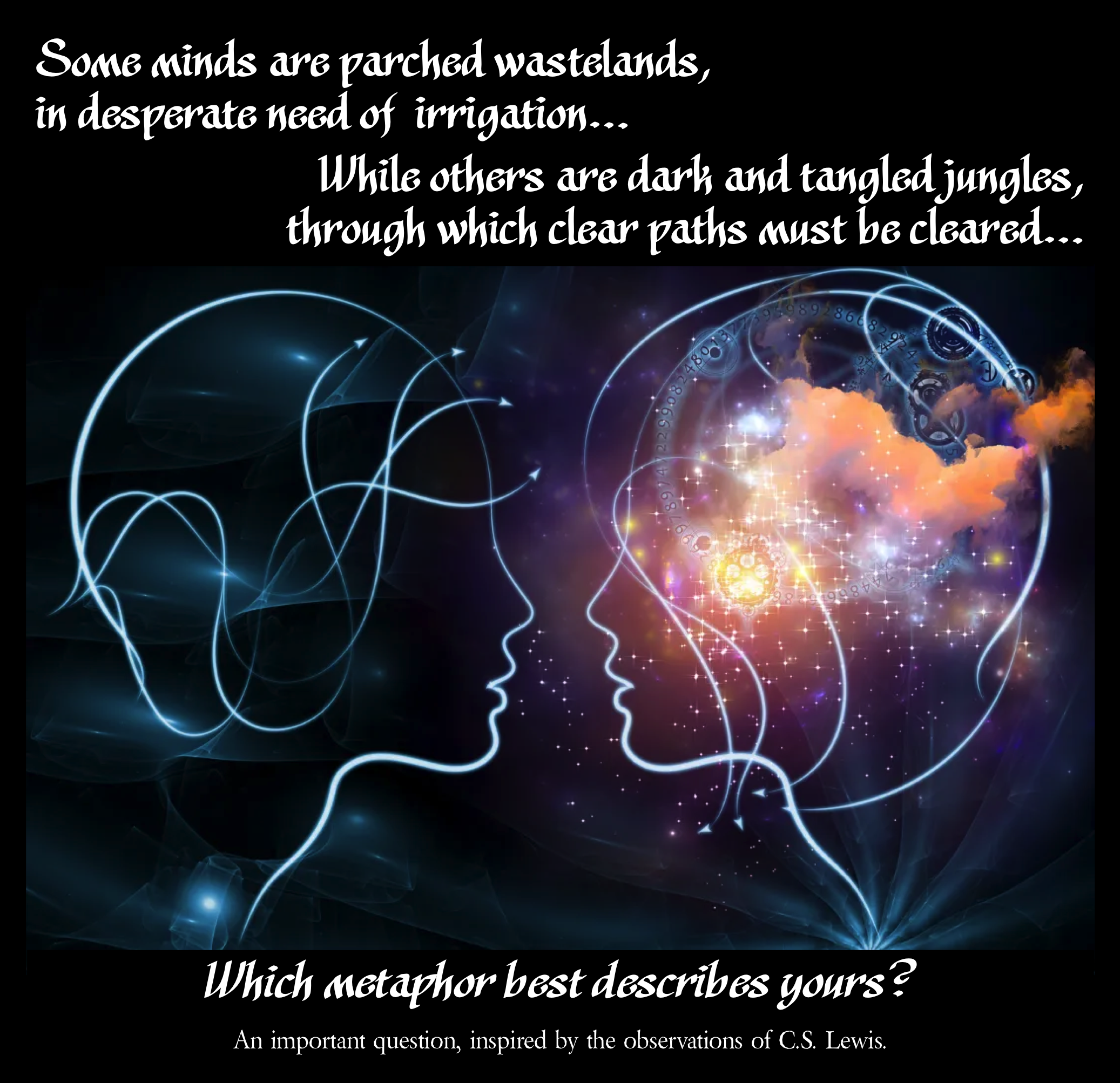
C.S. Lewis wrote a great deal about learning. A master of metaphors, he brilliantly described two distinct challenges faced by educators. In The Abolition of Man, he stated “the task of the modern educator is not to cut down jungles but to irrigate deserts.”
Wheaton professor, Robert McKenzie, offers a concise explanation of Lewis’ keen observation.
‘Cutting down jungles,’ as I understand that phrase, means helping students with passionate convictions to evaluate critically their world views, to examine what lies beneath the personal beliefs they profess.
‘Irrigating deserts,’ conversely, involves nurturing in apathetic or cynical students the hope that there is meaning and purpose in human existence.
Quite true, and I believe Lewis’ insight is more timely today than it was during the past century.
Classical Versus Modern Education
Today I read a passage that reminded me just how dramatically contemporary curricula deviate from the traditional educational materials used before the modern era.
While conducting research for a book about imperial Rome, which I hope to complete this year, I came upon the following passage.
It would have been easy to swell this little volume to a very considerable bulk, by appending notes filled with quotations; but to a learned reader such notes are not necessary; for an unlearned reader they would have little interest; and the judgment passed both by the learned and by the unlearned on a work of the imagination will always depend much more on the general character and spirit of such a work than on minute details.
It appears in Lays of Ancient Rome by Thomas Babington Macaulay, which is available for free download at Internet Archive.
Macaulay (1834-59) was a prominent British historian and politician. His histories were thoroughly researched and widely respected, especially by those on the (liberal) Whig* end of the political spectrum.
A contemporary of Macaulay described his preparation for writing in poetic fashion. According to novelist William Makepeace Thackeray (1811-63), “he reads twenty books to write a sentence; he travels one hundred miles to make a line of description.”
It appears that, like C.S. Lewis, Macaulay possessed a lasting recollection of all he read.
Returning to our beginning dichotomy – jungles versus deserts – both writers were a product of wide and critical literary study. Their minds were, in a sense, like a “rain forest.” Albeit, with C.S. Lewis it was certainly an orderly, well-tended forest. For some less stably grounded and more scatterbrained, the result is a jungle which requires radical clearing.
Alas, today’s more common problem, the unceasing pursuit of entertainment and distraction, leaves many with barren mental landscapes. In consequence, our calling as parents, educators, and friends, becomes one of irrigating the sparse flora and planting healthy new seeds in the hope that they will one day bloom.
* There is an interesting Mythlore article about C.S. Lewis’ view of history you can read here. In it, the author notes that “Lewis rejected a Whig history of unidirectional progress…” For a succinct article on the dangers of Whiggishness, I recommend “Evangelicals and Whig History” at First Things.
⁑ The brain truly can resemble a jungle, as a “digital reconstruction” reproduced on BrainFacts illustrates.
Immediately recognizable by its intricate folds and grooves, the cerebral cortex is the wrinkly, outer layer of the brain responsible for awareness, perception, and thought. Its interconnected neurons are arranged in six layers, a bit like the layers of tropical rainforests. . . . The findings may bring scientists closer to understanding how the complex jungle of cortical neurons interpret sensory information.
He’s no Reepicheep, but the earliest iteration of Mickey Mouse just became public property!
One of the little-heralded New Year’s Day events was the entry of the SteamboatWillie version of Mickey into public domain. Now anyone who desires can use the image without infringing on Disney’s copyrights.
Actually, my headline is not 100% accurate. As I just noted, it’s the earliest version of the most famous mouse in the world. However, the rodent’s name, and his subsequent graphic version remains protected. That’s because while copyrights eventually expire, trademarks don’t.
Therefore, as reported in Fortune magazine, “current artists and creators will be able to make use of Mickey, but with major limits. It is only the more mischievous, rat-like, non-speaking boat captain in ‘Steamboat Willie’ that has become public.”
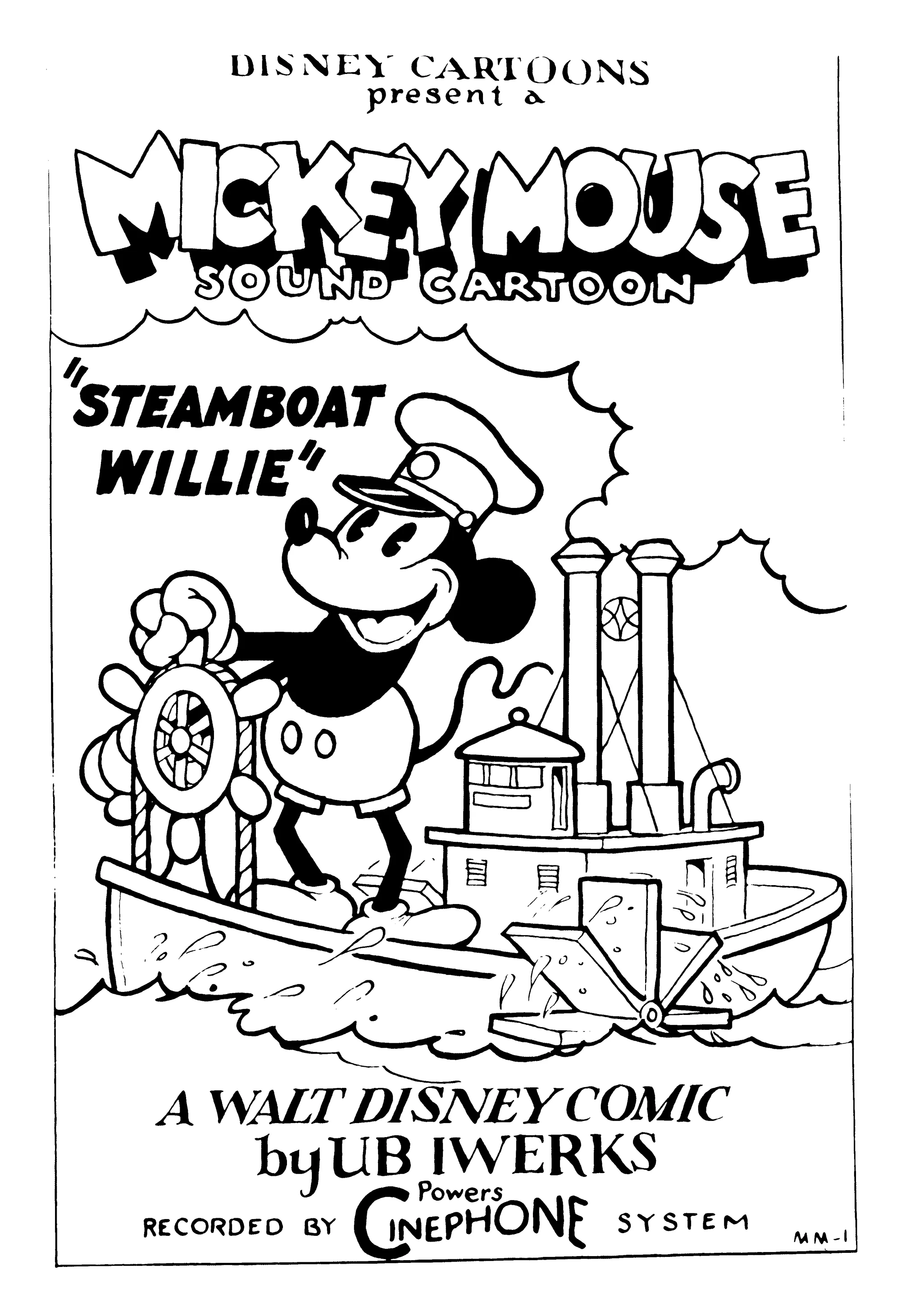
The 1928 poster advertising Mickey’s cinematic debut comes from a great article at Animation Scoop. Without comparing measurements of Mickey’s initial and contemporary snouts, it doesn’t appear to me the public domain version is that much more “rat-like.”
As for differences between the two . . . well, I’m not an attorney, but it appears Mickey’s onscreen persona in 1928 wasn’t wearing his standard white gloves. The poster, nevertheless, shows a Mickey closely resembling the cartoon mouse who was part of many of our childhoods. As noted in the Fortune piece:
Not every feature or personality trait a character displays is necessarily copyrightable, however, and courts could be busy in the coming years determining what’s inside and outside Disney’s ownership.
My question, and perhaps one of you intelligent readers can answer this, is about the image’s “name.” His full name, with his surname “Mouse,” is undebatably trademarked. Can a person legally use the name “Mickey” with the 1928 likeness? My guess is that the first name is not restricted, no matter how much Disney protests.
Speaking of Disney, a company which has become a disappointment in recent years, the Inklings were not big fans. If you are interested in learning more about the Inklings’ opinion about Disney Studios, check out author Jim Denney’s “What C.S. Lewis and J.R.R. Tolkien Thought of Walt Disney.”
After identifying a number of parallels in their lives, he explores the irony that “you might think that, with all that C.S. Lewis and Walt Disney had in common, they might have been mutual admirers—but that was not the case.”
And, there is always another option. As Britannica reminds us, Mickey wasn’t even his original name. Walt’s first choice (vetoed by his wife) was “Mortimer.”
That’s it for today. Now I’m off to write a book about Mickey’s alliance with Reepicheep. Oh wait, Reepicheep won’t be in the public domain until after I’m enjoying heaven with my Lord, and with the Christian members of the Inklings.
And, even if one could pair the two up for an adventure, they wouldn’t prove compatible. The reason should be obvious, but for an enjoyable exploration of that subject, I commend to you, “Reepicheep and Mickey.”
A newly captured image of a supernova remnant in our Milky Way galaxy has me curious about where J.R.R. Tolkien may have gained inspiration for the elegant style of his Elvish scripts.*
America’s NASA has gifted all of Earth’s citizens with an array of stunning, and enlightening images. Recently, the James Webb Space Telescope directed its focus to Cassiopeia A, created thousands of years ago when a star 11,000 light years away went supernova.
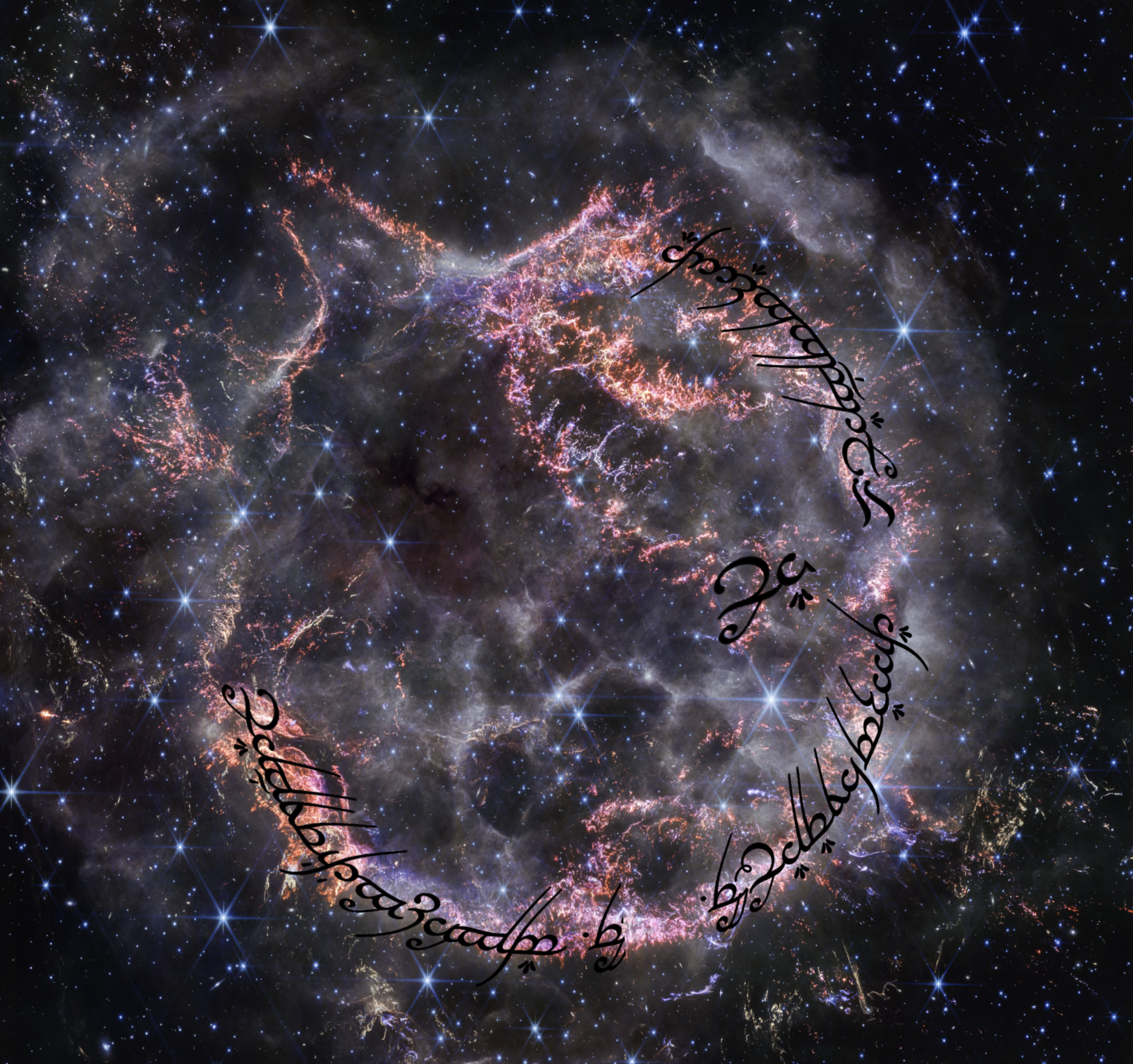
It may be my imagination, or perhaps its an elevated mental talent for “core object recognition,” but for some inscrutable reason, I have recognized in the aftermath of the explosion faint echoes of Elvishscript.
The light from Cassiopeia A (or Cas A, as we pseudo-astronomers refer to it) “first reached us around 340 years ago. As that was approximately 272 years before The Lord of the Rings was published, Tolkien had ample time to analyze the spectacular light source. Even factoring in the fact that the stories were composed between 1937 and 1949, the supernova’s existence had been known for a millennia and a half before LOR was written.
I will leave it to other researchers to determine just how Tolkien was able to gain a detailed view of the explosion’s aftermath. My purpose here is to simply alert the public to the unexplainable parallel between the cosmic residue and Tolkien’s own renditions of Elvish writing as he perceived it.
In a moment, I will allow the self-evident facts to speak for themselves.
Like his friend C.S. Lewis, Tolkien was a student of astronomy. As Professor Kristine Larsen says, “J.R.R. Tolkien based the stars and constellations of his created world of Middle-earth on ‘real world’ astronomy.” Dr. Larsen, a preeminent “Tolkienian Astronomer,” has published widely on the subject.
Of particular interest to readers of Mere Inkling will be “Medieval Cosmology and Middle-earth: A Lewisian Walk Under Tolkienian Skies,” which can be downloaded here. In the essay, Larsen points out,
. . . as is well known in Tolkien scholarship, during and after writing The Lord of the Rings Tolkien made various attempts to more closely align his cosmology with 20th century astronomical knowledge.
Fortunately for those of us who are drawn to the mythological textures of his legendarium, Tolkien never completed this “radical transformation of the astronomical myth” (as son Christopher termed it), but it is important to understand that this tension existed within Tolkien’s mind.
Having narrowly escaped the snare of surrendering to twentieth century astronomical theories, Tolkien preserved the mythical spirit of his cosmology. Larsen’s essay considers “whether or not Tolkien’s subcreation would, in reality, pass muster as a medieval cosmology, as defined by Lewis.” Thesis established, she takes readers on a pleasing journey. “So let us take a stroll under Middle-earth skies, and observe just how well the Dome of Varda matches with Lewis’s challenge.”
Returning to Cas A
As the images below will clearly illustrate, the preservation of the medieval nature of Middle Earth’s heavens does not mean that Tolkien ignored the realities of interstellar space. As I said a moment ago, the visual proof is definitive.
The fluid strokes of Tolkien’s Elven scripts are clearly foreshadowed in the plumes of this cosmic canvas.
This image speaks fluently for itself.
This pair of images from NASA contrasts the Near-Infrared and Mid-Infrared observations. It is quite possible the second influenced J.R.R. Tolkien’s perceptualization of Sauron’s eye. (Admit it, you see the dramatic similarities.)
We may never learn how Tolkien was able vividly see the details of Cassiopeia A with the earthbound telescopes accessible eighty years ago. Nevertheless, the evidence provided herein is irrefutable.
It seems fitting, when pondering the majesty of the stars as echoed in a masterpiece of literary subcreation, to close with an observation by Tolkien’s friend, C.S. Lewis. In an early letter to a close friend, Lewis described the wonder he experienced in reading Dante’sParadise.
Here Lewis lyrically shares an experience of spiritual ecstasy which, this writer humbly suggests, can be shared by many, as we stand in awe of the majestic intricacy of the universe our Creator has fashioned.
[I read] Aristotle’s Ethics all morning, walk after lunch, and then Dante’s Paradiso for the rest of the day. The latter has really opened a new world to me. I don’t know whether it is really very different from the Inferno [Owen Barfield] says it’s as different as chalk from cheese – heaven from hell, would be more appropriate!) or whether I was specially receptive, but it certainly seemed to me that I had never seen at all what Dante was like before.
Unfortunately the impression is one so unlike anything else that I can hardly describe it for your benefit – a sort of mixture of intense, even crabbed, complexity in language and thought with (what seems impossible) at the very same time a feeling of spacious gliding movement, like a slow dance, or like flying. It is like the stars – endless mathematical subtility of orb, cycle, epicycle and ecliptic, unthinkable & unpicturable, & yet at the same time the freedom and liquidity of empty space and the triumphant certainty of movement.
I should describe it as feeling more important than any poetry I have ever read. . . . Its blend of complexity and beauty is very like Catholic theology – wheel within wheel, but wheels of glory, and the One radiated through the Many (The Letters of C.S. Lewis to Arthur Greeves).
Perhaps it was one of these very wheels – or rings – that Tolkien observed so many years ago in the heavens?
* For those who are interested in fonts for your computers, you can download Tolkien-inspired typefaces here.
Many people have been taught so little about biblical Truth that they believe many errors. For example, many people (and no offense intended if you are among them) mistakenly believe that when people die, they become angels.
In his preface to The Screwtape Letters, C.S. Lewis alludes to how this confusion is reinforced by humanity’s lack of familiarity with angels in their true or natural (for them) form. While there are clear examples in the Bible where God has his angels appear in the likeness of human beings (e,g. before Sodom’s judgment and at the empty tomb), there are also times when their celestial radiance is not disguised (i.e. when the shepherds are informed about birth of the Savior or in John’s visions as recorded in the Book of Revelation).
[Angels] are given human form because man is the only rational creature we know. Creatures higher in the natural order than ourselves, either incorporeal or animating bodies of a sort we cannot experience, must be represented symbolically if they are to be represented at all (Screwtape Letters).
Nevertheless, this myth permeates the thinking of our secular culture. Once, some years past, a pastor friend was relating to me that one of his distant relatives had recently died. He said it comforted him to know that she was now an angel. I started to chuckle in response to his humorous way of lightening his own mood, until I realized he wasn’t joking. This poor, genuinely compassionate minister had been tricked by the spirit of this world into buying into a lie.
C.S. Lewis famously said that anything worth reading once is worth reading again. I’m clearing out some magazines from several years ago, and rereading insightful articles as I go. In a short piece about a complex subject, “What Happens to the Dead?” Ryan Pemberton makes a troubling comment.
Pop culture has done more to shape modern views about death than biblical teaching has.
The brevity of the article prevents the author from exploring other subjects, but his observation is applicable to a wide array of concerns.
I’m confident I could state, without fear of contradiction, that contemporary culture has done more to shape modern views about marriage than biblical teaching has. And, adding only a few additional examples, more about . . . justice . . . demons . . . love . . . mental health . . . responsibility . . . heaven . . . labor . . . creation . . . and Jesus himself.
It’s Not All Bad
It should be admitted that not all contemporary insights have been 100% misguided. One area where modern sensibilities have restored balance to truthful thinking is in the area of care for the environment. Ignoring extreme notions about nature being more important than human life, we can applaud the work of Christian environmentalists who have helped restore a biblical (i.e. true) view of the world around us.
Reacting to twisted notions that humanity’s “dominion” over the earth allows for nature’s misuse and abuse, these men and women helped open our eyes to the fact that God calls us to be trustworthy stewards in our care of, and appreciation for, this amazing world he has made.
The Inklings, C.S. Lewis and J.R.R. Tolkien, in particular, possessed a profound love for nature. Their general antipathy to the ugly and polluting trappings of industrialization are grounded in their belief that the world God created was truly “good.” With that came the recognition that man does little to enhance, and much to undermine, that initial goodness.
When two ideas clash, go with the one that is correct. And, when one of those authorities is the Word of the Creator of all that exists, well, isn’t it obvious which is the right choice?
When Christians die, heaven does not “get another angel.” We cannot become angels any more than we can become giraffes or ocean waves or stars. We are people and will remain so after this present life. God did not make a mistake when he made us human.
We live in an age where our courage matters more than ever. With social, cultural and international relationships all in terrible disarray, facing the future is not for the timid.
Courage is essential for living a life of integrity. Without it, we bend and fold whenever the pressure grows too great. Some people even go so far as to compromise their conscience.
In The Screwtape Letters, C.S. Lewis described how it is only when courage is required, that a person’s true values come into focus.
Courage is not simply one of the virtues, but the form of every virtue at the testing point, which means, at the point of highest reality.
A chastity or honesty or mercy which yields to danger will be chaste or honest or merciful only on conditions. Pilate was merciful till it became risky.
Samuel Johnson, an eighteenth century English writer, was highly esteemed by C.S. Lewis. His words on this subject foreshadow Lewis’ own thoughts. “Courage,” according to Johnson, “is the greatest of all virtues, because if you haven’t courage, you may not have an opportunity to use any of the others.”
Two millennia earlier, an influential Greek philosopher described this same truth. Aristotle, who did not look to the Greek pantheon for inspiration, also deduced that courage is a necessary attribute for the virtuous.
You will never do anything in this world without courage. It is the greatest quality of the mind next to honor.
Examining Ourselves
As a boy, I used to imagine myself playing heroic roles. These often involved rescuing innocent people from barbarians or tyrants, often in ancient settings. As a man I shed those imaginations and pondered realities. In the military, I witnessed courage up close, and I became persuaded that Mark Twain was correct when he declared “Courage is resistance to fear, mastery of fear, not absence of fear.”
True courage is not found in the cloying display of heroics, especially when arising from an ignorance of genuine danger. Neither is simple risk-taking an evidence of courage, since it may merely be the mark of an adrenaline junkie.
I haven’t personally been confronted with many situations which required physical courage, and when I have, I’ve been tempted to feel a little like I was “pretending.” But then I recall that truly courageous men and women also need to overcome their fear.
And, I honestly suspect that even those who have done the most selfless and courageous things possible, also recognized their limits. They ventured forth because they were truly courageous, not because they lacked fear. This is precisely what happened in a garden on Jerusalem’s Mount of Olives called Gethsemane.
Although encounters with physical dangers have been rare, my courage has been tested numerous times in the service of maintaining my integrity. I can recall a number of academic, professional, and personal occasions where standing for truth came at a very real cost. And, who knows how many times to which we are oblivious, that enemies have wished (and worked) us ill, because we did not surrender to their coercive manipulations.
Happy are those – I am sure Lewis, Johnson, Aristotle and Twain, would agree – who do not compromise their convictions. It appears that courage is a matter of character, not of the moment.
Two uplifting insights provide a fitting end to our meditation on this subject. While the courageous sometimes feel like they stand alone, Billy Graham reminds us of an encouraging fact.
Courage is contagious. When a brave man [or woman] takes a stand, the spines of others are often stiffened.
And, C.S. Lewis’ dear friend J.R.R. Tolkien provides us with another keen observation. In The Fellowship of the Rings, an elf named Gildor protects the hobbits at the outset of their journey, and observes, “courage is found in unlikely places.” Indeed, it is.
Today, on the sixtieth anniversary of C.S. Lewis’ passing, I offer you a special gift. Well, not a modest gift from my own pen, but a link to an insightful obituary, written by one of Lewis’ students.
The author of the obituary, John Wain, one of Britain’s “angry young men,” is critical of some aspects of Lewis’ work that are most appreciated by others. Yet his unique perspective is valuable.
The Inklings included in their number Charles Williams, a man C.S. Lewis deeply respected. They compiled for him a Festschrift, but since he passed before it was presented, it was published as a memorial collection. Lewis wrote the preface, in which he included this amazing passage.
So, at any rate, many of us felt it to be. No event has so corroborated my faith in the next world as Williams did simply by dying. When the idea of death and the idea of Williams thus met in my mind, it was the idea of death that was changed. (Essays presented to Charles Williams).
The legacy of C.S. Lewis himself, exerts a similar influence on many.
I’ll not say more, other than to extend a sincere “thank you” to Dr. Brenton Dickieson, who transcribed it from a twentieth century literary magazine. Dickieson consistently provides solid, and accessible, Inkling scholarship at A Pilgrim in Narnia.
It seems like a dream, when I recall a college course I took where Jews and Muslims peacefully discussed the turbulent history of the Middle East. And how we discussed that sad story in a cordial, and even sympathetic, manner.
The contrast between that day and 2023 – when people cannot even agree that tiny infants should not suffer for the sins of their parents – is mind-bending.
We assume that all people desire peace. Would that it were so. In his essay “First and Second Things,” C.S. Lewis offers a timely insight.
As far as peace (which is one ingredient in our idea of civilization) is concerned, I think many would now agree that a foreign policy dominated by desire for peace is one of the many roads that lead to war.
I was an undergrad at the University of Washington in the mid-1970s, when I saw a graduate level course with a fascinating title: “Wars that have Shaped the History of the Middle East.” My high school friend and I “begged” the professor to allow us into the class. He cautioned us that he would have the same requirements for us as he did for everyone else; there would be no mercy extended if we failed to meet the syllabus’ demands.
“No problem,” we said . . . although, being young procrastinators, at the end of the quarter we foolishly required a couple of all-nighters to complete our comprehensive term papers.
We, both Christians, were the only undergraduates in the small class. Our professor was Jewish, as were two of the students. One of these, was Israeli. He was, in fact, a veteran of the recent Yom Kippur War, during which he had served as the commander of a tank. I don’t recall which front on which he fought, but when you look at a map of Israel, it’s clear that every part of that small nation is a potential combat zone.
The remaining members of the class consisted of three Muslim students. One was American and a second was Iranian (back when the Shah was still in power). The third Islamic member of the class taught at a Seattle community college. He was Palestinian. And not merely Palestinian – his family was displaced during the 1948 Arab-Israeli War, which is referred to by the Israelis as the War of Independence.
You can imagine that with a group like that, opinions were deeply entrenched. Yet, although the preexisting opinions were indeed fixed, the individuals were not obstinate. Conversations were civil. Disagreements were conducted with reason rather than emotion. And, most surprisingly of all, we were able to socialize together at the end of the course.
It was a different world, apparently. It’s challenging to conceive of partisans today being capable of treating others with such respect. The last half century has marked a steep decline in the humanity of humanity.
Anti-Semitism is a Curse
It is strange to ponder how we’ve come to define antisemitism, confining it to anti-Jewish sentiment. After all, the word Semite refers to all people who speak a Semitic language, including Arabs.
Etymologically, Semite “comes via Latin from Greek Sēm ‘Shem,’ son of Noah in the Bible, from whom these people were traditionally supposed to be descended.”
If you are interested in an excellent article titled “C.S. Lewis’s Anti-Anti-Semitism in The Great Divorce,” simply follow the link embedded here.
Israel’s Wars
There has been no shortage of blood shed on the land the Romans called Judea and Arabia Petraea. And the history of the past seventy-five years have been violent indeed. For a description of all of the wars and military operations involving Israel, see this website.
We students each had to select one of the Middle Eastern regional wars to research in depth. We also had to make a detailed presentation and lead the discussion based on general readings completed by everyone.
As soon as I saw that requirement in the syllabus, my mind was mired in confusion over which of Israel’s wars would be the least controversial. Fortunately, as I read further I discovered that the purview of the course did not begin with the end of the Palestine Mandate, which was administered by Britain. Due to the influence of the Ottoman Empire, which had overshadowed the region until the end of the First World War, the professor elected to begin the course with the relatively nonconfrontational consideration of the Crimean War. I was the first student to raise my hand and voice my preference.
During the Palestine Mandate, C.S. Lewis had a number of former students serving in the Levant. In a 1940 letter to his brother Warnie, he describes a pleasant visit from one of these who went on to serve in a political capacity throughout the region for several more decades. This statesman refers to a fellow student who would go on to teach at East Anglia University.
I had a visit one night last week from Pirie-Gordon back from leave from Palestine, where (and in Egypt and Turkey) he says everything is “as good as gold.” The last riot was quelled by the cavalry regiment in which Rivière serves . . . In fact as P.G. said “I raised the riot and Rivière quelled it.”
I wonder how the members of the class would relate to one another if we were reunited for a discussion of what has transpired since 1975. With members of the American government at each other’s throats on our nation’s response to Hamas’ war, I doubt our discussions would be as respectful as they were back in the twentieth century. Still, conversations – even painful ones – need to happen if people are ever to get along with one another. That’s true not only for nations, but also for neighbors, and families.
I recommend two things to move us in the right direction. Honest communication, where we do a lot of listening. And prayer. The fact we do so poorly with the first, makes the second all that more essential.
Don’t be surprised, but many clergy possess keen senses of humor. Sure, there are staid, grimacing ministers who consider acting dour to be a virtue. (They’re often legalistic.) But most of the pastors and military chaplains I’ve worked beside, love to laugh. I think I’ve written enough about humor to verify that.
C.S. Lewis maintained strong bonds with a number of clergy, from a variety of denominations, and that would hardly have been true if they had lacked a sense of humor. Humor, to Lewis, is an essential part of life. He proclaims this truth from the lips of Aslan himself, as the newly created Talking Animals hear the first (accidental) joke.
“Laugh and fear not, creatures. Now that you are no longer dumb and witless, you need not always be grave. For jokes as well as justice come in with speech.” (The Magician’s Nephew)
I recently read about a fascinating incident one historian described as “perhaps the only really satisfactory practical joke in the whole history of theology.” Allow me to set the scene.
The Byzantine Empire lasted for a thousand years, before being defeated and desecrated* by Islamic armies. During the centuries surrounding its apex, it suffered from the political intrigue and competition with which we are all too familiar.
Photios I was a Byzantine scholar who was twice the Patriarch of Constantinople during the ninth century. Twice is unusual, but it was due to the machinations of emperors and empresses who meddled in the affairs of the church.
He had a troubled relationship with another priest named Ignatius, who also served two times as Patriarch. The good news is that the men were eventually reconciled and both are regarded by Orthodox Christians as saints.
The anecdote comes from the period of their rivalry. Photios, whose brilliance was widely acknowledged, and presumably envied by Ignatius, decided to pull an embarrassing public prank on his nemesis.
Photios devised a bizarre theory that human beings have two souls. His goal was to trick Ignatius into taking it seriously, whereupon Photius withdrew the thesis and admitted he had not been serious. Apparently, everyone unsatisfied with Ignatius’ leadership found it quite entertaining.
Fortunately, among clergy the humiliation of others is rarely the object of humor. Yet, sadly, I have seen it attempted. I personally repent of ever having done so myself, and regard it as sharing, along with vulgarity and blasphemy, the lowest level of “humor.”
The Wisdom of Lewis
In Reflections on the Psalms, C.S. Lewis relates something I know to be true from my own experience.
A little comic relief in a discussion does no harm, however serious the topic may be. (In my own experience the funniest things have occurred in the gravest and most sincere conversations.)
Clergy deal with serious topics, like death, quite frequently. Perhaps that is one reason a well-developed sense of humor is common among their ranks.
Skip this footnote if you want to end on a “happy” note.
* “Desecration” may sound like a harsh word to our interfaith-sensitive ears, but it is accurate here. Islam is rarely a gentle master for Christians, and it has been common to see churches and holy places seized and converted to foreign religious uses. For example, in the capital Constantinople (now called Istanbul), Orthodox Christianity’s most magnificent church, Hagia Sophia, saw much of its glorious and historic iconography destroyed when it was converted to a mosque. Many years later, in 1934, an enlightened Turkish government ended the insult, and chose to treat the holy place as a museum. Sadly, the current regressive government under Recep Tayyip Erdoğan, reversed that decision, and in 2020 the Church of Holy Wisdom was returned to its usage as a mosque.
Artificial intelligence is on the rise. It’s IQ is somewhere above 75, and presumably still climbing. And some very intelligent human beings, are issuing apocalypticwarnings.
“Mitigating the risk of extinction from A.I. should be a global priority alongside other societal-scale risks, such as pandemics and nuclear war,” reads a one-sentence statement released by the Center for AI Safety, a nonprofit organization. The open letter was signed by more than 350 executives, researchers and engineers working in A.I.
Presently, I’m more wary of Russia, China and Iran igniting an end of the world scenario.
But there is one particular aspect of artificial intelligence that intrigues me. And that is the creation of literary works by these programs, which are themselves creations of humankind.
Some people, such as copywriters, feel their livelihoods are being threatened. “My amusement turned to horror: it took ChatGPT 30 seconds to create, for free, an article that would have taken me hours to write.” (And that was clocked way back in January; no telling how quickly the AI could perform the feat today.)
Others – think teachers – are alarmed by how simply this new technology can seduce students to take self-crippling shortcuts. One article refers to this as “the elephant in the room.”
Perhaps all questions centered on AI are inherently questions of ethics, and at the forefront of many teachers’ minds is cheating and plagiarism.
Cheating and plagiarism are two separate concerns, of course. AI is capable of not only drawing together already existing material, and generating new word combinations that cannot be tracked back to any unique original source.
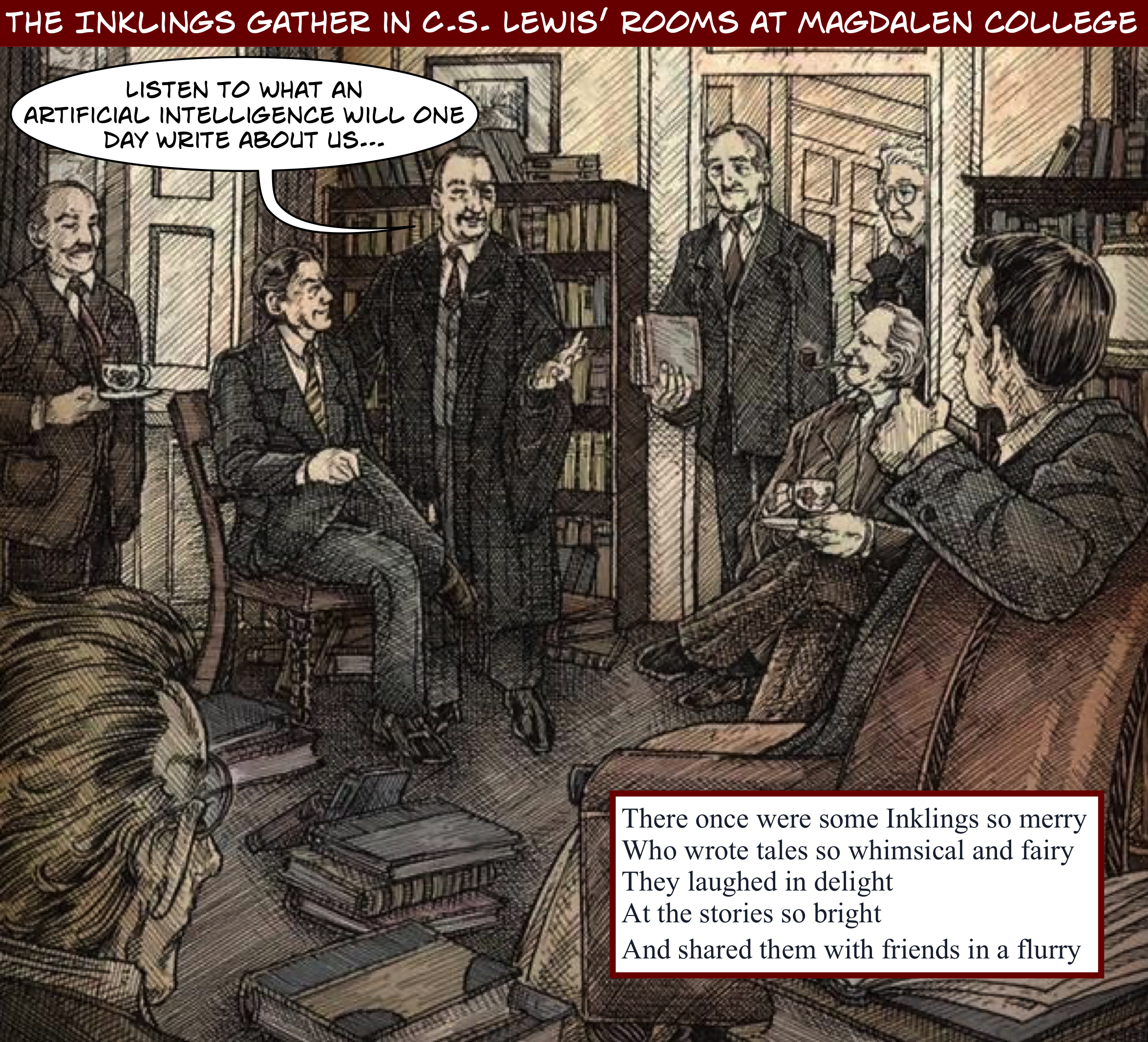
I feel confident that the Inklings would be extremely suspicious of computer-generated “literature.” Yet, at the same time, I think it is a subject they too would find intriguing.
Test-Driving AI
There are a myriad of free sites where a person can enter some basic parameters or directions and await the product of text generated by a synthetic “mind.” I share below some examples of the input—output results of my initial experiment.
I asked Open AI, creators of ChatGPT, to write two limericks, about the Oxford Inklings and C.S. Lewis, respectively.
In Oxford, the Inklings did meet, With words and with wisdom so sweet. Tolkien and Lewis, Their minds in a breeze, Inkling tales made our imaginations fleet.
⁂
C.S. Lewis, a writer so grand, In Narnia’s magical land. With Aslan the Lion, In tales that inspire, He showed us the way to understand.
Next I asked for an Inkling sonnet, followed by two haikus, addressing the Inklings as a fellowship and C.S. Lewis the individual.
In Oxford’s hallowed halls, they gathered ‘round, The Inklings, minds of genius, so profound. With ink-stained fingers, in their fellowship, They wove their tales, from wisdom’s well to sip.
Tolkien, the philologist of ancient lore, In Elvish tongues, his stories did explore. Lewis, the Christian apologist true, In Narnia’s world, he brought God’s message through.
Williams, Barfield, Dyson, and the rest, In literature and faith, they were blessed. Their words a beacon in a world so dark, Igniting minds with sparks from wisdom’s arc.
Oxford’s Inklings, their legacy remains, In timeless tales, where inspiration reigns.
⁂
Inklings’ minds aflame, Oxford’s thinkers left their mark, Words and wisdom’s claim.
⁂
C.S. Lewis penned grace, Faith and fantasy embraced, Words that still embrace.
And finally, I requested: “write a story about C.S. Lewis really traveling to Narnia.” The program has a “regenerate” button to address the same query with a fresh response. Due to their lengths, I’ve included them as “footnotes” below.
Shockingly, to me at least, it took less than 10 minutes to complete all of this. Each response, in fact, took mere seconds . . . not much longer than the time required to type the requests.
There are a growing number of companies offering AI services. Most offer free opportunities to test their wares. I decided to try one such vendor.
WriterHand declares “our tool is 100% free, allowing you to create limitless text and blog content with the assistance of artificial intelligence.” I requested of them a sonnet and haiku, as well. The first follows, with two other variants in the footnotes below.
The Oxford Inklings, a literary group Of J.R.R. Tolkien, C.S. Lewis and more Created stories that still make us droop And have us seeking out their lore.
Their works of fantasy and myth Fill our imaginations with delight We all search for the answers they lit To the depths of our inner sight.
They wrote of worlds we can explore Of knights, dragons and magical things We follow their tales and come back for more And find joy in their musings.
The Oxford Inklings have a special charm Their words bring us together in song And we are forever in their warm Enchanting arms of wonder and long.
⁂
Inklings of Oxford Stories of fantasy told Enchantment forever
As with ChatGPT, I ended by requesting a brief, fictional story. My request was for a story about:
C.S. Lewis Meeting an Actual Talking Marsupial
On a recent summer day, C.S. Lewis, the famed author of the Chronicles of Narnia series, had a very extraordinary encounter. He had the chance to meet an actual talking marsupial.
The marsupial was a small wallaby, and it was found on the grounds of Lewis’ estate. It was not long before the wallaby began speaking to Lewis in a highly sophisticated manner. The wallaby spoke in a dialect that sounded similar to English, and was even able to converse with Lewis about the various topics he enjoyed discussing.
The wallaby was quite curious about Lewis and seemed to be quite eager to learn more about him and his works. It asked numerous questions about the Narnia series and the world that Lewis had created. It seemed to be quite fascinated by the various creatures and wonders that he had described.
The wallaby seemed to be quite intelligent and even asked for Lewis’ advice on certain topics. Lewis found the wallaby’s interest in the Narnia series quite amusing and was quite impressed by its intelligence and wit.
This meeting between Lewis and the talking marsupial was one that Lewis would never forget. It was an experience that he found both fascinating and enlightening. He was amazed by the marsupial’s intelligence and ability to converse on a level that exceeded many humans.
Lewis was quite taken aback by the talking marsupial’s presence and the conversation that ensued. He was quite intrigued by the creature’s intelligence and the fact that it could understand complex topics. This experience would later serve to further inspire Lewis’ writing and help him create some of the most beloved characters in literature.
This experience between Lewis and the talking marsupial was truly extraordinary and one that will never be forgotten. It was a meeting that allowed Lewis to learn more about the creatures that inhabit his beloved Narnia and to gain a better understanding of the power of imagination and creativity.
A Final Thought from C.S. Lewis
One of C.S. Lewis’ countless correspondents was the famous British author Arthur C. Clarke. In 1954, they exchanged letters discussing the human element of literature. I suppose it’s a subject for philosophers to explore, but one wonders how clearly the “humanity” element is communicated through a nonhuman mechanism. Sadly, Lewis’ letter is not so prescient as to address our current question, but it was sufficient to raise the matter in my own thoughts.
Dear Clarke,
Human interest, yes. But that is inevitably present if the fears and hopes and wonders of the astronauts are vividly realised – e.g. as in Bedford & Cavor on the Moon [he refers here to H.G. Wells’ The First Men in the Moon] or even Crusoe on the island. And an author who can’t do that won’t mend matters by dragging in Crooks, Crutches, or Conspiracies: for the sort of story he drags in will be just as lacking in Human interest as his space story.
About ‘escapism,’ never let that flea stick in your ear. I was liberated from it once & for all when a friend said ‘These critics are v. sensitive to the least hint of Escape. Now what class of men would one expect to be thus worked-up about Escape? – Jailers.’ Turn-key critics: people who want to keep the world in some ideological prison because a glimpse at any remote prospect would make their stuff seem less exclusively important.
Fantasy & S-F. is by miles the best. Some of the most serious satire of our age appears in it. What is called ‘serious’ literature now – Dylan Thomas & Pound and all that – is really the most frivolous. All the best. Yours C.S. Lewis
The two brief stories below were generated by ChatGPT in response to the request for a story about Lewis actually visiting Narnia.
In the quiet confines of his cozy Oxford study, C.S. Lewis sat by his flickering fireplace, a manuscript of his latest book on theology resting on his desk. The clock on the wall ticked away the minutes, marking the time as late evening gave way to the inky embrace of night. Lewis’s eyes grew heavy, and he decided it was time to retire to bed.
As he settled into his comfortable bed, he couldn’t shake the feeling of restlessness that had gripped him that evening. He stared at the wardrobe across the room, the same wardrobe that had once belonged to his grandparents and had always fascinated him as a child. He closed his eyes and drifted into a dream, or so he thought.
To his astonishment, Lewis found himself standing before the wardrobe, which now seemed more magnificent than ever. It loomed like a gateway to another world, and he couldn’t resist the urge to open its creaking doors. With a sense of wonder and trepidation, he stepped inside.
Instead of feeling wood beneath his feet, Lewis’s toes sank into soft, cool earth. He looked around and found himself standing in a dense, snow-covered forest. The air was crisp and carried a scent of pine and adventure. He realized that he was in Narnia.
Before him stood a lamppost, its light casting a warm and inviting glow. Lewis recognized it from his own stories. He couldn’t help but smile, realizing that he had somehow stepped into the world he had created through his Chronicles of Narnia.
As he ventured deeper into the forest, Lewis encountered creatures of myth and magic—talking animals, fauns, and even a majestic lion named Aslan. They welcomed him with open arms, for they knew him as the one who had brought their world to life through his words.
Days turned into weeks, and Lewis explored Narnia with childlike wonder. He sailed on the Dawn Treader, encountered the White Witch, and witnessed the coronation of King Caspian. He marveled at the beauty of Narnia’s landscapes, the bravery of its inhabitants, and the profound wisdom of Aslan.
Throughout his journey, Lewis engaged in deep conversations with the creatures of Narnia, discussing matters of faith, morality, and the nature of storytelling. Each encounter enriched his understanding of the Christian faith he had embraced in the real world.
Eventually, Lewis knew that he had to return to his own world. With a heavy heart, he stood before the same lamppost where he had first arrived and closed his eyes. When he opened them again, he was back in his Oxford bedroom, the wardrobe standing silent and ordinary once more.
He sat at his desk, the manuscript still awaiting him, but now with a newfound sense of purpose and inspiration. The memories of Narnia, his journey, and the lessons he had learned would forever shape his writing and his faith.
C.S. Lewis had indeed traveled to Narnia, not in body, but in spirit and imagination, and his stories would continue to transport readers to that magical world for generations to come.
⁂
Using the “regenerate” option with the same command: “write a story about C.S. Lewis really traveling to Narnia.”
Once upon a time in the quiet town of Oxford, C.S. Lewis, the renowned author and scholar, found himself embarking on a remarkable adventure. It was a crisp, autumn evening when he was invited to attend a secret gathering by a mysterious stranger who had slipped an enigmatic note under his door. The note simply read, “Come, Narnia awaits.”
Intrigued and a bit skeptical, Lewis decided to follow the call. He put on his overcoat, grabbed his umbrella, and stepped out into the cool night. The moon was a silvery crescent in the sky, casting an eerie glow on the cobblestone streets.
As he followed the directions given in the note, Lewis found himself walking through an old, secluded part of Oxford that he had never seen before. The air seemed to grow colder, and the world around him took on an otherworldly quality. Suddenly, he stumbled upon a large, ancient wardrobe tucked away in the corner of a park.
With a sense of déjà vu, Lewis remembered writing about such a wardrobe in one of his stories. He cautiously opened the wardrobe door, half-expecting it to be filled with coats and mothballs. To his astonishment, the wardrobe seemed to stretch and expand, and he found himself tumbling headfirst into a land covered in snow and surrounded by towering fir trees.
He had arrived in Narnia.
The moment his feet touched the snowy ground, Mr. Tumnus, the faun, rushed forward with a smile and exclaimed, “Welcome, dear friend! We’ve been waiting for you.”
Lewis was both bewildered and delighted. As he explored Narnia, he met talking animals, dwarves, and even the great lion, Aslan, whom he had created in his own stories. The world he had once imagined had come to life before his eyes.
Days turned into weeks, and Lewis became a beloved member of the Narnian community. He marveled at the beauty and wonder of this magical land. He listened to the tales of its inhabitants, learned from their wisdom, and shared stories of his own.
But as all adventures must come to an end, Lewis knew he couldn’t stay in Narnia forever. With a heavy heart, he approached the wardrobe once more and stepped back into his own world, leaving Narnia behind.
Back in Oxford, Lewis couldn’t help but wonder if his journey to Narnia had been a dream or a product of his imagination. Yet, the memories were vivid, and the lessons he had learned about faith, courage, and the power of imagination remained with him for the rest of his days.
And so, the story of C.S. Lewis’s extraordinary voyage to Narnia remained a secret he carried with him, a testament to the enduring magic of literature and the boundless possibilities of the human imagination.
⁂
Variants of the sonnet and haiku produced by WriterHand follow.
The Oxford Inklings were a group of friends Whose conversations filled the air with wit and wit; Their words of wisdom still live on to this day, Their legacy of literature still stands tall and lit.
From C.S. Lewis to J.R.R. Tolkien They bantered and debated through the night; Their words and stories filled us all with joy, A source of inspiration, both dark and light.
From fantasy to science fiction, The Inklings had a way with words; Their genres and stories still stand the test of time, And their influence still continues to be heard.
The Oxford Inklings and their works Will live on in the hearts of many; Their words will inspire generations to come, A lasting legacy of literary plenty.
⁂
The Inkling’s works shine A legacy of wisdom still In our hearts, forever
⁂
The Oxford Inklings were a unique group Formed in the city of dreaming spires A gathering of friends with a shared goal To explore the depths of their desires
A fellowship of authors, poets, and more Including Tolkien, Lewis, and Williams Discussing literature, theology, and lore In the Eagle and Child’s hidden realms
From the Inklings came works of great fame The Chronicles of Narnia and The Lord of the Rings Legends of Middle Earth and tales of great shame A legacy that will last through the ages
The Oxford Inklings were a brilliant crew Inspiring writers and readers anew.
⁂
Oxford Inklings’ lore In tales of fantasy and truth Lives on forever
It is surprising how inexpensive and accessible DNA testing has become. Many readers of Mere Inkling have submitted samples ourselves. But how many of us have had our pets tested?
The science of genetics is quite recent. Gregor Mendel (1822-1884) is considered the father of such studies. As Britannica describes the history, “The word genetics was introduced in 1905 by English biologist William Bateson, who was one of the discoverers of Mendel’s work and who became a champion of Mendel’s principles of inheritance.”
Molecular genetics did not begin in earnest until 1941 . . . A major landmark was attained in 1953 when American geneticist and biophysicist James D. Watson and British biophysicists Francis Crick and Maurice Wilkins devised a double helix model for DNA structure.
The Human GenomeProject didn’t begin until 1990, and didn’t reach its goal until the new millennia. The astute reader will recognize that C.S. Lewis lived before these genetic studies reached their current status, so we should not expect comment from him on DNA per se. Nevertheless, as Francis Sellers Collins, director of the Human Genome Project (2009-2018), says his work is quite compatible with C.S. Lewis’ writings.
In fact, in a lecture at Cambridge, he described how Mere Christianity was pivotal in his conversion from agnosticism to Christianity. According to this preeminent geneticist, “even in the first few pages, all my arguments about faith just fell apart. It was breathtaking . . . Lewis remains my best teacher.”
There is some question as to whether the DNA testing market has peaked. Unsurprising, since it isn’t like tobacco, coffee or rich desserts that “addict” customers to generate repeated purchases. As Advisory Board says, “given one’s genetic data is unlikely to change, most consumers may not see a reason to purchase another DNA testing kit.”
So, how might these corporations remain profitable? Why, by expanding their offerings to the animal kingdom. One such company called Embark claims to offer the “most accurate dog DNA test available.”
Some people purchase the service to satisfy their curiosity about a pet’s breed (often a blend of several). A more valuable benefit is gaining insights into their health and traits. The oddest aspect of the process appears to be Embark’s boast that they offer “the world’s first canine relative finder.”
Like many of us, C.S. Lewis loved dogs. He didn’t, however, go so far as to worship them. I suspect that C.S. Lewis would opt out of the chance to DNA-define his pets. Best to just love them and savor their companionship.
In his essay “The Personal Heresy,” C.S. Lewis proposes an interesting argument about expressing love only to those capable of receiving it.
There is a reaction at present going on against the excessive love of pet animals. We have been taught to despise the rich, barren woman who loves her lap dog too much and her neighbor too little. It may be that when once the true impulse is inhibited, a dead poet is a nobler substitute than a live Peke, but this is by no means obvious.
You can do something for the Peke, and it can make some response to you. It is at least sentient; but most poetolaters hold that a dead man has no consciousness, and few indeed suppose that he has any which we are likely to modify.*
DNA service businesses are probably licking their lips at the prospects offered by a new market. The French are blazing a new trail for the rest of us. According to Euronews, Béziers will require pet owners to “carry a ‘genetic passport’ for their dog.”
The reason is simple. Too many dog walkers are failing to perform their civic (and humane) duty of cleaning up after their pets.
Dog excrement found on the streets would be collected and tested then sent to the police. They would match the DNA to national pet registers, locate the owner and charge them up to €122 for cleaning up the streets.
Apparently, similar efforts have been attempted in Valencia, Tel Aviv and portions of London.
It sounds like a rather extreme way to address what superficially appears to be a simple problem. But, sadly, in many places, public sanitation has declined to unbelievable depths. In San Francisco, for example, the once picturesque metropolis has voluntarily surrendered many areas to criminals and addicts who feel no compunction about defecating in public. While I can’t speak for European, Asian, African or Latin American countries, in the U.S. a similar story of decay is repeated in many urban centers.
San Franciscans can’t be criticized for not throwing money at the problem. Nevertheless, when progressive Slatemagazine reported last year on the city’s newest public toilet, they said “cities shouldn’t need $1.7 million and years of design review to build a municipal toilet.”
Not that San Francisco treats such facilities with care. One space age toilet lasted only a few days before malfunctioning. But it was expensive, stainless steel, and bore the upgraded title of “kiosk.”
A highly hyped new SF bathroom hailed as “the future of public toilets” lasted only three days into said future, as the high-tech bathroom kiosk quickly had to be relieved of its duty and found itself closed for repairs.
Since these are manufactured by a Paris-based company, perhaps they can design a canine kiosk to solve the Béziers dilemma? After all, the cost might well be equivalent to the sum of all of the DNA tests the citizens are being forced to cover.
A Final Thought about Animal DNA
Many of us, like C.S. Lewis, are pet lovers. And many also care about the suffering of other animals, domesticated and wild. There may come a day when DNA testing offers ways to enhance the lives of these other creations of God.
However, it does seem frivolous, does it not, to apply such advanced (and not inexpensive) processes for the purpose of tracking down derelict dog walkers? Or, in other judicatories, which have not yet embraced that level of surveillance, simply to attempt to track down doggie-relatives?
In the interview, Elinor Karlsson, director of vertebrate genomics at the Broad Institute in Cambridge, Massachusetts says,
With genetic tests for humans, there have been so many studies that look at whether or not a certain mutation in your genes actually leads to you developing a certain disease. There just isn’t this massive body of work on dog genomes. So many of these tests are telling owners that their dog could get a certain disease without any major studies on how likely that is to happen. The science needs to catch up.
In response to the question “what are the dangers of potentially inaccurate test results?” Lisa Moses, a veterinarian affiliated with Harvard Medical School in Boston advises,
In my veterinary practice, I’ve seen more and more people coming in with results that show their dog has a chance of developing conditions like epilepsy, heart disease, and degenerative muscular disorders, and they want to make treatment decisions right away.
They’re ready to pay for more tests or medical interventions that the dog might not actually need, that could be quite expensive, and that could be invasive for the dog. In some cases, people preemptively end their dog’s life if they think their dog is predisposed to a degenerative disease, because don’t they want their pet to suffer.
So once again we see that, as they often do, silly scenarios can lead to serious subjects.
* The passage from “The Personal Heresy” continues:
Unless you hold beliefs which enable you to obey the colophons of the old books by praying for the authors’ souls, there is nothing that you can do for a dead poet: and certainly he will do nothing for you. He did all he could for you while he lived: nothing more will ever come.
I do not say that a personal emotion towards the author will not sometimes arise spontaneously while we read; but if it does we should let it pass swiftly over the mind like a ripple that leaves no trace. If we retain it we are cosseting with substitutes an emotion whose true object is our neighbour. Hence it is not surprising that those who most amuse themselves with personality after this ghostly fashion often show little respect for it in their parents, their servants, or their wives.








 Mere Inkling Press