Is Slowing Down Possible?

snailEons ago, when I was attending college, I suffered from that common plague—a chronic lack of time.

Between my studies, my job and romancing my future wife, I never had enough hours in the day.

So I did what everyone in that situation does . . . I worked harder. It didn’t solve my dilemma and probably worsened my exhaustion.

During that indescribably busy season of my life God spoke to me through a song. It was recorded by an early “contemporary” Christian group called “Love Song.” At the end of this column you can listen to a recording of the song “Slow Down,” by Chuck Girard. (Don’t skip to it now though, since the link won’t work unless you read the entire post.)

It sounds a bit dated now, forty years after it was composed, but it still conveys a powerful calming message. I hadn’t heard it for years until I just uncovered it for this column, but listening to it today has stilled my sense of urgency as I rush to complete this post before our four grandkids arrive for a weekend visit, in just an hour.

The importance of slowing down and resting is never far from my consciousness, since I am always overextended. Like many of you, I find it extremely difficult to say “no,” so I end up committed to more things than I feel I’m able to do well.

This week I received word of another song, which is what actually inspired me to write on this subject. It’s by a delightful young artist and is much peppier than Girard’s more prayerful message. I believe you’ll enjoy watching the music video below (after you finish reading, of course).

In light of this human need for being reminded to rest, I wondered where C.S. Lewis lamented his own overburdened state. His courtesy in responding to all correspondence is legendary. In addition to teaching, writing, corresponding and (near the end of his life) husbanding, Lewis was far busier than I am.

So, I explored some of Lewis’ words. (That’s never “work,” by the way, since it never fails to reinvigorate me, just like physical rest.) I found the following passage delivers a brilliant insight into why many of us are so compelled to work—work—work.

In the following passage, from a 1930 letter, Lewis relates how our drive to succeed can be linked to our personal ambitions. He couches the discussion in the context of his own desire for renown as a writer. And, Lewis declares, it is only when those misdirected impulses are quelled that we can truly find rest and peace.

From the age of sixteen onwards I had one single ambition [to succeed as a writer], from which I never wavered, in the prosecution of which I spent every ounce I could, on which I really & deliberately staked my whole contentment: and I recognise myself as having unmistakably failed in it. . . .

The side of me which longs, not to write, for no one can stop us doing that, but to be approved as a writer, is not the side of us that is really worth much. And depend upon it, unless God has abandoned us, he will find means to cauterise that side somehow or other. If we can take the pain well and truly now, and by it forever get over the wish to be distinguished beyond our fellows, well: if not we shall get it again in some other form.

And honestly, the being cured, with all the pain, has pleasure too: one creeps home, tired and bruised, into a state of mind that is really restful, when all one’s ambitions have been given up. Then one can really
for the first time say “Thy Kingdom come:” for in that Kingdom there will be no pre-eminences and a man must have reached the stage of not caring two straws about his own status before he can enter it.

Think how difficult that would be if one succeeded as a writer: how bitter this necessary purgation at the age of sixty, when literary success had made your whole life and you had then got to begin to go through the stage of seeing it all as dust and ashes. Perhaps God has been specially kind to us in forcing us to get over it at the beginning.

At all events, whether we like it or not, we have got to take the shock. As you know so well, we have got to die. Cry, kick, swear, we may: only like Lilith to come in the end and die far more painfully and later. . . . I would have given almost anything—I shudder to think what I would have given if I had been allowed—to be a successful writer. . . . I am writing as I do simply & solely because I think the only thing for you to do is absolutely to kill the part of you that wants success.

Powerful words to ponder. Now, without further delay, the aforementioned songs. Profound lyrics in both. Listen to them in either order, keeping in mind that Myla Smith’s is energetic and Chuck Girard’s is meditative. Enjoy . . . and slow down!

“Slow Down” by Myla Smith

“Slow Down” by Chuck Girard

Discipline or Abuse?

beltDiscipline is not a bad thing. In fact, it’s a necessary thing, if you understand it in terms of correction or protection (its true purposes).

Sadly, the very word has been contaminated by its association with something diametrically opposed to discipline—abuse. It is extremely common for abusers to try to hide their crimes under the once untainted label of discipline.

Here is biblical wisdom: “My son, do not despise the Lord’s discipline or be weary of his reproof, for the Lord reproves him whom he loves, as a father the son in whom he delights” (Proverbs 3:11-12).

And, a testimony from the Psalmist that discipline’s role is to protect. “Blessed is the man whom you discipline, O Lord, and whom you teach out of your law, to give him rest from days of trouble, until a pit is dug for the wicked” (Psalm 94:12-13).

C.S. Lewis elaborates on this truth in “A Preface to ‘Paradise Lost.’”

Discipline, while the world is yet unfallen, exists for the sake of what seems its very opposite—for freedom, almost for extravagance. The pattern deep hidden in the dance, hidden so deep that shallow spectators cannot see it, alone gives beauty to the wild, free gestures that fill it, just as the decasyllabic norm gives beauty to all the licences and variations of the poet’s verse. The happy soul is, like a planet, a wandering star; yet in that very wandering (as astronomy teaches) invariable; she is eccentric beyond all predicting, yet equable in her eccentricity.

It is precisely because of this, the genuinely noble and affectionate character of genuine discipline that I was so deeply repulsed (and moved) by the following story. It comes from the fine journal, First Things.

A friend who corresponds with prisoners on death row sends one prisoner’s poem describing the horrific abuse he endured as a child. He tells her that most of the men on death row with him suffered that kind of abuse. The poem, titled “Spare the Rod” and addressed to his father, begins with the story of his sister’s beatings, and continues:

Then came a son to intercede,

a five-year-old you caused to bleed;

he would not flee your spit and roar,

you smashed his face into the floor.

And those were just the better years.

It ends:

What shall you find at heaven’s gate?

What shall be a father’s fate

who reveled in his children’s screams

who haunts them still in all their dreams?

You took your children meek and mild,

and beat them feral, stomped them wild.

You’ve now moved on to spar with God,

Who spares the child and breaks the rod.

Whose “Best Books” List?

reading awardsMost readers recognize significant differences exist between British and American literature.

Not only do our literary tastes often differ, there are more than a few differences in the English we use . . . for example, whether we include our punctuation inside, or outside, of “quotation marks.”

With that caveat, it’s interesting to ponder the 2008 list of favorite books in the United Kingdom, as reported in The Telegraph. I’m unsure right now whether there’s a more recent list, but it would probably remain fairly stable a lustrum later. (It would, however, be interesting to see how Rowling’s works rank in fifty or seventy years. Not to mention Pullman’s Gnostic series.)

In their balanced compendium of passages from C.S. Lewis’ works, Martindale and Root point out the transitory nature of literary fads.

A book that is number one on the New York Times Best-seller List for several weeks may be all but forgotten a decade later. Popularity in a moment of history does not guarantee that a book will endure beyond its own time. C. S. Lewis once observed that, like fashions, the more up-to-date a book is, the sooner it is out of date.

One of the peculiarities of the list is that only a single book by any particular author was allowed in the top twenty-one titles.

I read somewhere that the average reader had only read an “average” of six of the books. I’m not sure how that is calculated, since I know a fair number who have not read—if they’re being honest—a single book in the survey (those assigned for coursework included).

And, now that I’ve made that seemingly judgmental statement, I need to be particularly truthful in my own list. That means I can’t check off a title because I saw the movie or read the Classics Illustrated edition . . . even though I think it would be fair to get partial credit for either of those options.*

I’ll reproduce the entire British classics canon in a moment, but since everyone will get distracted while they read it (assessing which titles they themselves have read), I’ll share my brief list first.

I’m not too embarrassed by its brevity, since 80% of my reading is nonfiction, and the list is decidedly not that. Also, I can honestly say that there are another ten or so titles here that I have begun to read, without being sufficiently interested to finish.

The truth is that just as less than a quarter of my reading is devoted to fiction, most of that focuses on my favorite genre, alternative history. And, for some reason unknown to me, none of those titles made the list!

Here is my humble account of British must-reads that I have actually finished.

 1) The Lord of the Rings (Ranked #2).

 2) The Bible** (#6)

 3) Nineteen Eighty-Four (#8).

 4) Catch 22 (#13).

 5) The Hobbit (#16).

 6) The Great Gatsby (#22).

 7) The Chronicles of Narnia (#33).

 8) The Lion, the Witch and the Wardrobe (#36)

 — Isn’t that a tad redundant (in the American, not the British, sense)?

 9) Winnie the Pooh (#40).

10) Animal Farm (#41).

11) Lord of the Flies (#49).

12) Dune (#52).

13) Brave New World (#58).

14) Moby Dick (#70).

15) Dracula (#72).

16) A Christmas Carol (#81).

17) Charlotte’s Web (#87).

18) Heart of Darkness (#91).

Interesting—I thought it would be shorter. Their presence on this short list, by the way, doesn’t indicate my recommendation of all of these. Some were assigned reading. I’ve also read some of Shakespeare and Sherlock Holmes, of course, but neither in their entirety.***

The full list follows. Enjoy going through it yourself to see how you stack up. And, don’t be intimidated if the books you favor keep you too busy to read what others deem the most significant.

_____

* Just joking. I would never consider seeing a movie as the equivalent of reading a book; some of them bear little resemblance to their source. That acknowledged, sometimes the cinematic adaptations are better than the books.

** I know it only has a single Author, but shouldn’t this count as 66 books?

*** My lovely wife, who I sometimes compel to proofread for me, could not resist mentioning that she was able to check off many more titles on this list than I did. I chalk that up to her sharp intelligence (valedictorian, 4.0 in college and grad school, etc.), general perfectionism, speed-reading skills, tolerance for boring literature, and “compulsive” personality. All of that, plus her consuming love of reading.

Here’s the British list.

1 Pride and Prejudice – Jane Austen

2 The Lord of the Rings – JRR Tolkien

3 Jane Eyre – Charlotte Bronte

4 Harry Potter series – JK Rowling

5 To Kill a Mockingbird – Harper Lee

6 The Bible

7 Wuthering Heights – Emily Bronte

8 Nineteen Eighty Four – George Orwell

9 His Dark Materials – Philip Pullman

10 Great Expectations – Charles Dickens

11 Little Women – Louisa M Alcott

12 Tess of the D’Urbervilles – Thomas Hardy

13 Catch 22 – Joseph Heller

14 Complete Works of Shakespeare

15 Rebecca – Daphne Du Maurier

16 The Hobbit – JRR Tolkien

17 Birdsong – Sebastian Faulks

18 Catcher in the Rye – JD Salinger

19 The Time Traveller’s Wife – Audrey Niffenegger

20 Middlemarch – George Eliot

21 Gone With The Wind – Margaret Mitchell

22 The Great Gatsby – F Scott Fitzgerald

23 Bleak House – Charles Dickens

24 War and Peace – Leo Tolstoy

25 The Hitch Hiker’s Guide to the Galaxy – Douglas Adams

26 Brideshead Revisited – Evelyn Waugh

27 Crime and Punishment – Fyodor Dostoyevsky

28 Grapes of Wrath – John Steinbeck

29 Alice in Wonderland – Lewis Carroll

30 The Wind in the Willows – Kenneth Grahame

31 Anna Karenina – Leo Tolstoy

32 David Copperfield – Charles Dickens

33 Chronicles of Narnia – CS Lewis

34 Emma – Jane Austen

35 Persuasion – Jane Austen

36 The Lion, The Witch and The Wardrobe – CS Lewis

37 The Kite Runner – Khaled Hosseini

38 Captain Corelli’s Mandolin – Louis De Bernieres

39 Memoirs of a Geisha – Arthur Golden

40 Winnie the Pooh – AA Milne

41 Animal Farm – George Orwell

42 The Da Vinci Code – Dan Brown

43 One Hundred Years of Solitude – Gabriel Garcia Marquez

44 A Prayer for Owen Meaney – John Irving

45 The Woman in White – Wilkie Collins

46 Anne of Green Gables – LM Montgomery

47 Far From The Madding Crowd – Thomas Hardy

48 The Handmaid’s Tale – Margaret Atwood

49 Lord of the Flies – William Golding

50 Atonement – Ian McEwan

51 Life of Pi – Yann Martel

52 Dune – Frank Herbert

53 Cold Comfort Farm – Stella Gibbons

54 Sense and Sensibility – Jane Austen

55 A Suitable Boy – Vikram Seth

56 The Shadow of the Wind – Carlos Ruiz Zafon

57 A Tale Of Two Cities – Charles Dickens

58 Brave New World – Aldous Huxley

59 The Curious Incident of the Dog in the Night-time – Mark Haddon

60 Love In The Time Of Cholera – Gabriel Garcia Marquez

61 Of Mice and Men – John Steinbeck

62 Lolita – Vladimir Nabokov

63 The Secret History – Donna Tartt

64 The Lovely Bones – Alice Sebold

65 Count of Monte Cristo – Alexandre Dumas

66 On The Road – Jack Kerouac

67 Jude the Obscure – Thomas Hardy

68 Bridget Jones’s Diary – Helen Fielding

69 Midnight’s Children – Salman Rushdie

70 Moby Dick – Herman Melville

71 Oliver Twist – Charles Dickens

72 Dracula – Bram Stoker

73 The Secret Garden – Frances Hodgson Burnett

74 Notes From A Small Island – Bill Bryson

75 Ulysses – James Joyce

76 The Bell Jar – Sylvia Plath

77 Swallows and Amazons – Arthur Ransome

78 Germinal – Emile Zola

79 Vanity Fair – William Makepeace Thackeray

80 Possession – AS Byatt

81 A Christmas Carol – Charles Dickens

82 Cloud Atlas – David Mitchell

83 The Color Purple – Alice Walker

84 The Remains of the Day – Kazuo Ishiguro

85 Madame Bovary – Gustave Flaubert

86 A Fine Balance – Rohinton Mistry

87 Charlotte’s Web – EB White

88 The Five People You Meet In Heaven – Mitch Alborn

89 Adventures of Sherlock Holmes – Sir Arthur Conan Doyle

90 The Faraway Tree Collection – Enid Blyton

91 Heart of Darkness – Joseph Conrad

92 The Little Prince – Antoine De Saint-Exupery

93 The Wasp Factory – Iain Banks

94 Watership Down – Richard Adams

95 A Confederacy of Dunces – John Kennedy Toole

96 A Town Like Alice – Nevil Shute

97 The Three Musketeers – Alexandre Dumas

98 Hamlet – William Shakespeare

99 Charlie and the Chocolate Factory – Roald Dahl

100 Les Miserables – Victor Hugo

Reading to Children

grandparent readingAs a father whose military service required extended separations from my children, I wish technology had been about three decades more advanced than it was while I was in uniform.

As a grandfather who has most of his grandkids living hours away, I’m grateful to be alive during an era when we can still nurture close relationships despite geographic separation.

There are many wonderful ways to keep in touch across the miles. And, a new program adds a wonderful touch to the time proven joy of reading to our children. It’s called Kindoma, and more about it momentarily.

It’s a little known secret that there are few—very few—activities children love more than reading with a loved one. It’s not just about the book, it’s also about relationships and bonding.

C.S. Lewis had an interesting relationship with children. As a bachelor academic, he was not around them all that much. And when he wrote The Abolition of Man in 1943—before becoming a step-father—Lewis confessed “I myself do not enjoy the society of small children . . . I recognize this as a defect in myself—just as a man may have to recognize that he is tone deaf or colour blind.”

Eight years earlier, at the modest age of thirty-seven, he wrote to a good friend, “I theoretically hold that one ought to like children, but am shy with them in practice.” Lewis isn’t alone in possessing this unfortunate trait, which from my observation [political incorrectness alert] is more common among men than women. Of course, in our increasingly equalitarian culture it does seem that character flaw is becoming a bit more gender-balanced.

Then there is the fact that many of us who dearly love our young progeny, enjoy the children of our friends, and hold genuine compassion for young ones suffering in any variety of miserable conditions . . . do not particularly seek out the company of children. From my personal perspective, I feel like I “expend” all of my (admittedly finite) kid-patience with my own kin and the offspring of my friends. I don’t have a surplus left after spending a significant amount of time with the (precious) little ones.

And, like Lewis, “I recognize this as a defect in myself.”

At the same time as I admire teachers who can pour themselves into little ones, and I am absolutely dumbfounded by people who prefer working with young teenagers, I recognize that the world works well when some of us are better equipped to work with adults also . . . so the entire spectrum of learners is served.

Recognizing our own prejudices is a prerequisite to suppressing or evicting them. Lewis, of course, was extremely concerned about children and their upbringing, particularly their education.

Returning to the subject of how to nurture relationships with children through the intercontinental reading of books, technology has made the miraculous possible.

Kindoma is novel in the sense that it allows you to read the book together (either the child or the adult can be the actual “reader”) while you actually turn the pages of the etext together! So you get the genuine experience of reading together.

The creator of the program holds a PhD in Computer Science. So he’s not merely an idea guy (like me) who comes up with a slew of amazing concepts but doesn’t have the scientific skill to make them reality.

The program is currently available for ipod and ipad. I’m sure it’s just a matter of time before it is ported to other operating systems. Since I still use “regular” desk and lap-top computers, I haven’t experimented with it myself. The app itself is free. I’m unsure about their revenue stream, whether it will come from ads, or purchase of access to a specific library, but it’s definitely worth checking out.

The brief link below offers an introduction to the tool. I hope that you will use it if applicable to your situation, and pass it on to others you know who might benefit from it. (In the meantime, I’m thinking about approaching my wife about us making that ipad purchase I’ve been pondering.)

What Children Read

young readerI recently reread C.S. Lewis’ brief essay, “On Juvenile Tastes.” In it he ponders two basic questions.

First, what do children prefer to read? And second, why do they evidence that preference?

Lewis set the stage by discussing the state of children’s literature in 1958, which was of course, more than half a century ago. Nevertheless, like most of Lewis’ observations, there is much that is timeless about his argument.

Not long ago I saw in some periodical the statement that “Children are a distinct race”. Something like this seems to be assumed today by many who write, and still more who criticise, what are called children’s books or ‘juveniles’. Children are regarded as being at any rate a distinct literary species, and the production of books that cater for their supposedly odd and alien taste has become an industry; almost a heavy one.

It seems little has changed during the intervening decades. If anything, this concept has become much more deeply entrenched. No one can doubt that the publication of “juvenile” literature has expanded dramatically. (To maintain the entrenchment allusion, we might say it has “exploded.”)

Lewis, however, does not accept the notion that children have unique—in his picturesque words “odd and alien”—literary interests. His first argument is that their preferences are by no means monolithic.

This theory does not seem to me to be borne out by the facts. For one thing, there is no literary taste common to all children. We find among them all the same types as among ourselves. Many of them, like many of us, never read when they can find any other entertainment. Some of them choose quiet, realistic, “slice-of-life” books . . . Some like fantasies and marvels . . . Some care for little but books of information, and so do some adults. Some of them, like some of us, are omnivorous. Silly children prefer success stories about school life as silly adults like success stories about grown-up life.

So, in Lewis’ opinion, we witness great difference in the tastes of children, as well as adults. He attributes changing literary emphases to human nature, rather than chronological considerations. The difference enters with children’s focus on enjoying literature, which provides them immunity to literary fads.

Surely it would be less arrogant, and truer to the evidence, to say that the peculiarity of child readers is that they are not peculiar. It is we who are peculiar. Fashions in literary taste come and go among the adults, and every period has its own shibboleths. These, when good, do not improve the taste of children, and, when bad, do not corrupt it; for children read only to enjoy.

Of course their limited vocabulary and general ignorance make some books unintelligible to them. But apart from that, juvenile taste is simply human taste, going on from age to age, silly with a universal silliness or wise with a universal wisdom, regardless of modes, movements, and literary revolutions.

Lewis’ critique of the publishing arena follows. Since these literary phases fade in and out, it is here where contemporary literary critics may fairly evaluate things differently.

This has one curious result. When the literary Establishment—the approved canon of taste—is so extremely jejune and narrow as it is today, much has to be addressed in the first instance to children if it is to get printed at all. Those who have a story to tell must appeal to the audience that still cares for storytelling.

The literary world of today is little interested in the narrative art as such; it is preoccupied with technical novelties and with ‘ideas’, by which it means not literary, but social or psychological, ideas. The ideas (in the literary sense) on which Miss Norton’s The Borrowers or Mr. White’s Mistress Masham’s Repose are built would not need to be embodied in “juveniles” at most periods.

Lewis ends his essay by contrasting two disparate approaches to the production of so-called children’s literature. I suspect the two general categories still hold true for most. However, having only dabbled in writing for children, I’m by no means an authority on the subject. As for the creator of Narnia . . . I’m persuaded he possesses the credibility to speak with some modest influence.

It follows that there are now two very different sorts of “writers for children”. The wrong sort believe that children are “a distinct race”. They carefully “make up” the tastes of these odd creatures—like an anthropologist observing the habits of a savage tribe—or even the tastes of a clearly defined age-group within a particular social class within the “distinct race”. They dish up not what they like themselves but what that race is supposed to like. Educational and moral, as well as commercial, motives may come in.

The right sort work from the common, universally human, ground they share with the children, and indeed with countless adults. They label their books ‘For Children’ because children are the only market now recognised for the books they, anyway, want to write.

Right or wrong, like Lewis I cast my lot with those who write for children from their shared humanity with them. After all, they may be slightly less mature than most grown-ups, but they are not truly “alien” (even if they occasionally behave that way).

Government & Baboons

I recently read an interesting article about battling terrorism from an international base in Djibouti. Many African nations have joined those from Europe and North America in trying to protect vulnerable villages from the ravages of violent extremism.

However, as readers of Mere Inkling know, we don’t deal with political matters here. Everyday life, yes. Writing and self-expression, of course. Faith, definitely. Imagination, most certainly. Current events are also on the table for consideration, insofar as they relate to the aforementioned subjects.

Politics though, as a subject in and of itself, is not on the Mere Inkling menu.

With that in mind, I want to share a passage from the Air Force magazine article. In a description of “a recent personnel recovery mission in Ethiopia,” it says,

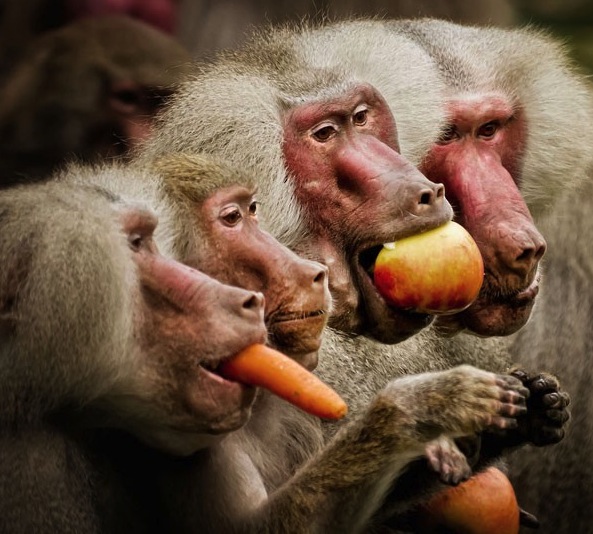
The HC-130s landed at night on a pitch-black airstrip, but first had to make a “clearing pass” to scare a congress of baboons and a pod of hippopotamuses off the runway.

Quite a picture. However, the image itself only made part of the impression left on me by this sentence. More lasting was the reminder of what a group of baboons is called.

C.S. Lewis wrote a fascinating essay about government entitled “Democratic Education.” One of many of its many kernels of wisdom is this: “Democracy demands that little men should not take big ones too seriously; it dies when it is full of little men who think they are big themselves.”

Returning to the subject of animals, the second chapter of Genesis tells us,

Now out of the ground the Lord God had formed[f] every beast of the field and every bird of the heavens and brought them to the man to see what he would call them. And whatever the man called every living creature, that was its name. The man gave names to all livestock and to the birds of the heavens and to every beast of the field.

So, Adam named the animals, and I imagine that after her creation, Eve helped her husband refine some of those appellations. What I don’t know is this—exactly who decided how we label groups of the same species?

I would point out how apropos baboons being referred to as a “congress” is . . . except for two considerations. (1) The connection would be lost on many readers whose governments have parliaments, and (2) It turns out this is actually an error. The actual word for baboon bands is a “troop.” So much for their unfortunate association with an organization that has lost the confidence of nine out of ten Americans.

Here are a few of the familiar and unfamiliar collective nouns for a variety of animals, with some brief comments and questions.

Lions | Pride – Aptly named!

Prairie Dogs | Coterie – I never considered prairie dogs snobbish.

Kittens | Intrigue – I should have learned that from simple observation.

Finches | Charm – They really do, don’t they?

Wombats | Wisdom – Wisdom to Aussies, a mystery to me.

Pekingese | Pomp – Well, perhaps just slightly elitist.

Cobras | Quiver – Logical, given the prospect of meeting a group of vipers.

Peacocks | Ostentation – Much nicer than the “pride” option.

Barracudas | Battery – Same as electric eels, I suppose.

Crows | Murder – A term familiar to most literary folk.

Bullfinches | Bellowing – Huh? Sounds more hippopotamusish.

Cows | Kine – Have to thank the medieval English for this one.

Seabirds | Wreck – Beware when they fly overhead.

Bacteria | Culture – And what kind of civilization have they ever built?

Deer | Gang – Must be the teenagers, before they become a herd.

Cockroaches | Intrusion – Accurate, repulsive and ominous.

Guillemots | Bazaar – What’s a guillemot, and what is it selling?

Cormorants | Gulp – Didn’t their momma’s teach them to chew?

Cheetahs | Coalition – Wouldn’t “a ‘sprint’ of cheetahs” sound better?

Woodpeckers | Descent – Am I missing something here?

Clams | Bed – Not much else to do in the clam-world.

Turtledoves | Pitying – Meaning they take pity on us, not vice versa.

Bobolinks | Chain – Cute, but lost on Americans where they’re known as reedbirds or ricebirds.

Snails | Walk – Someone’s lacking a bit in creativity here.

Ravens | Unkindness – Speaking of unkind, who labeled them this?

Flamingoes | Stand – Come on now, isn’t that a bit obvious?

Giraffe | Tower – I guess the flamingoes aren’t the only ones.

Lice | Flock – That is way too nice a word for those vermin!

Alligators | Congregation – As a pastor, I simply don’t want to go there.

This is way too much fun, but I’d better stop now so I can revisit this theme in a year or so. Until then, if you learn who gave that unkind name to groups of ravens, let me know.

Mensa & C.S. Lewis

crossword puzzleSeveral decades ago, I worked with a Roman Catholic priest, who just happened to be a member of Mensa.

We were good friends, a relationship reinforced by the fact that our bigoted boss thought that both our eternal destinies were in definite jeopardy . . . Pete’s because he was “Catholic,” and mine because Lutherans are “almost Catholic.”

Well, Pete and I got along quite well, although there were two issues we never could resolve. The first was that he smoked large, smelly stogies. Yes, this was long enough ago that you were still allowed to smoke in government buildings.

Even when the rest of the staff successfully begged him to stop parading the halls with his billowing cigars, my friend continued to fill his own office with clouds that would billow out whenever the door was opened.* I had great sympathy for the lungs of the Roman Catholic laity who entered his smoking lounge for counseling.

Aside from the tobacco, there was only a single matter we really disagreed on.

As I mentioned above, Father Pete was a member of Mensa. That’s commendable, in itself. The problem is that he always left his Mensa magazines lying (alone) on the coffee table in the center of his office. He would only smile in a patronizing way when I would (repeatedly) warn him that there could be only two consequences of such brazen self-aggrandizement.

“The first,” I said, “is that they won’t know what Mensa is . . .  and your braggadocio is wasted. The second is worse. They might know what the magazine represents and think to themselves, my, our priest is rather full of himself.” **

At any rate, I have no misconception that I could pass Mensa’s muster. My brain, adequate as it is, simply doesn’t work the way that I guess those of genius’ do. A perfect example of that truth was displayed just a few moments ago, as I read through a few pages of a 2010 Mensa Puzzle Calendar I found among my father’s papers.

I have no doubt that some of you will easily solve this puzzle, but I have to be honest—I missed answering it by a mile.

What do all the words below have in common?

Environment

Bedcovers

Responsibility

Outsource

Confederacy

Slugfest

Jihad

Nunavut

I actually had to look one of the words up. It turns out that “bedcovers” means a bedspread, or anything else one uses to cover a bed. No, seriously, I re-learned that Nunavut is a territory in northern Canada, but I imagine all of you knew that.

Okay, have you taken the time to try to determine what the words have in common? Easy, right?

It turns out that each of them contains a three-letter sequence of adjacent letters in the alphabet, going in reverse. For example, the gfe in “slugfest.”

I doubt I would have been able to figure it out, even if I understood the question, but I must admit my utter ignorance in not even reading the question properly!

I was so enamored by this eclectic collection of words—superficial links between the three combative terms leapt out at me—that I was distracted by seeking bonds between the meanings of the words, rather than in the words themselves. (And, I suspect that may be precisely what those inscrutable devils at Mensa Headquarters intended for simpletons like me.)

Alas, it will take a few days for my bruised ego to rebound. Fortunately, since my memory isn’t as keen as it used to be, I may forget all about this humiliation before the week is out.

C.S. Lewis was a brilliant man. I believe he was a genius. I imagine he could have solved this word puzzle with three-quarters of his mind occupied by higher matters, like watching a wary hedgehog scurry between bushes.

Lewis recognized that our minds are, in fact, a gift from God, to be exercised and celebrated. But, at the same time, he knew better than most the dangers of seeking ultimate meaning in mental pursuits that erect nearly impervious walls to God’s gracious revelation of his love in his only begotten Son.

In The Weight of Glory Lewis explains how those Christians who are blessed with exceptional intelligence owe a duty to their sisters and brothers in the faith. (This, of course, has nothing to do with the subject of holiness or spiritual maturity; there is little or no correlation between piety and intellect.) What he says is, however, worthy of our reflection.

If all the world were Christian, it might not matter if all the world were uneducated. But, as it is, a cultural life will exist outside the Church whether it exists inside or not. To be ignorant and simple now—not to be able to meet enemies on their own ground—would be to throw down our weapons, and to betray our uneducated brethren who have, under God, no defence but us against the intellectual attacks of the heathen.

Good philosophy must exist, if for no other reason, because bad philosophy needs to be answered. The cool intellect must work not only against cool intellect on the other side, but against the muddy heathen mysticisms which deny intellect altogether. Most of all, perhaps, we need intimate knowledge of the past. Not that the past has any magic about it, but because we cannot study the future, and yet need something to set against the present, to remind us that the basic assumptions have been quite different in different periods and that much which seems certain to the uneducated is merely temporary fashion.

A man who has lived in many places is not likely to be deceived by the local errors of his native village: the scholar has lived in many times and is therefore in some degree immune from the great cataract of nonsense that pours from the press and the microphone of his own age. The learned life then is, for some, a duty.

So, let this be a reminder to those of you who qualify for membership in the aforementioned society, but still love Jesus despite your vast intellects. After all, as Jesus once said, from “everyone to whom much was given . . . much will be required” (Luke 12:48, ESV).

_____

* I must confess this is a slight exaggeration, lest I be held accountable for breaking the eighth commandment (or the ninth, if you are Jewish or a Christian of the Reformed persuasion).

** This might not be a verbatim account of the way I said it, although I’m pretty confident that I did use the word “braggadocio.”

A Narnian Madlib

EVO-WWI-064-01060I got to savor one of the joys of being a grandpa today, watching over two of my five lovely granddaughters while their parents traveled to an important business meeting.

Naturally, we had fun playing, drawing, tossing a ball for their German shepherd, building things, cleaning up their room (not quite so “fun”) and—since it’s summer—playing with water balloons (extremely fun, even though I got drenched).

We also did a madlib, one of those “phrasal templates” popularized by Roger Price and Leonard Stern in the 1950s. These simple word games are entertaining and educational. And, even for novice writers, they’re not too challenging to compose. After all, the stories themselves are by nature brief and rather superficial.

Today I even set my granddaughters in front of an episode of The Powerpuff Girls so I could write a short scene from Narnia for them. You’ll find it below.

I had forgotten how much fun we had with madlibs when our own children were young. We made many up on the spur of the moment, and laughed at the silly combinations of word that resulted. The process, as most readers know, involves randomly selecting a series of words for inclusion in the narrative. With a lack of imagination, the readings can fall a bit flat, but typically you end up with some (accidentally) witty wordplay.

One of the benefits of madlibs is how they can be used more than once. While the outline of the story remains the same, of course, the choices made by readers generate amazing diversity.

Most madlibs are admittedly rather juvenile. That’s because they are written for juveniles. They rely on providing specific types of words, such as nouns or adjectives. Theoretically, you could devise a madlib as complex or sophisticated as you desire. For example, an entertaining tale certainly could doubtless be woven by including random selections for the following word choices.

____________ prime number

____________ copular verb

____________ Napoleonic regimental commander

____________ homograph

____________ life stage of a butterfly (other than larva or pupa)

____________ ditransitive verb

____________ type of psychosis

____________ infielder for 1874 Chicago White Stockings

____________ gerund

____________ rare earth mineral

____________ monotransitive verb

____________ early kabbalist (other than Bahye ben Asher ibn Halawa)

____________ type of arachnid with blue coloration

____________ free predictive

____________ reciprocal pronoun

____________ chemical process (other than esterification)

Unfortunately, I don’t have time to write the story accompanying this worthy list, but if you should write it, I’d love to read it.

There are a number of fan sites online that generate madlibs. I won’t recommend any since the ones I’ve glanced at today are merely advertising collections for sale. (I also found the examples I experimented with to be rather feeble . . . even weaker than the story I wrote today in a single hour.)

You will search in vain if you’re seeking a C.S. Lewis reference to madlibs. However, he was a master wordsmith, who recognized well their power, and greatly loved humor. The following passage, from “Prudery and Philology,”
refers to the versatility and weight of language, and includes a valuable caution.

We are sometimes told that everything in the world can come into literature. This is perhaps true in some sense. But it is a dangerous truth unless we balance it with the statement that nothing can go into literature except words, or (if you prefer) that nothing can go in except by becoming words. And words, like every other medium, have their own
proper powers and limitations.

The brief tale below is not pretentious, so you need not fear it exceeding its limitation. It simply is what it is . . . one grandfather’s passing literary adventure with his grandchildren.

It you like “Sharpbeak’s Narnian Adventure,” you’re welcome to download a PDF copy of the story I’ve appended to the end of the column. It’s 100% free, and I’m not trying to sell a collection of madlibs after hooking you. Besides, if I was trying to make a profit off of anything including the word “Narnian,” I have no doubt lawyers would be descending upon me in droves.

The Words You Will Need

____________ adjective

____________ animal

____________ adjective

____________ adjective

____________ something  you drink

____________ color

____________ adverb

____________ adjective

____________ adjective

____________ meal time

____________ adjective

____________ adjective

____________ adjective

____________ adjective

____________ plural noun

____________ plural noun

____________ adjective

____________ adjective

____________ adjective

____________ animal

____________ adjective

____________ food

____________ food

____________ food

____________ place

____________ adverb

____________ adjective

____________ place

____________ number

____________ plural relative

____________ verb

____________ adjective

____________ plural monster

The Story Into Which You Insert Your Words

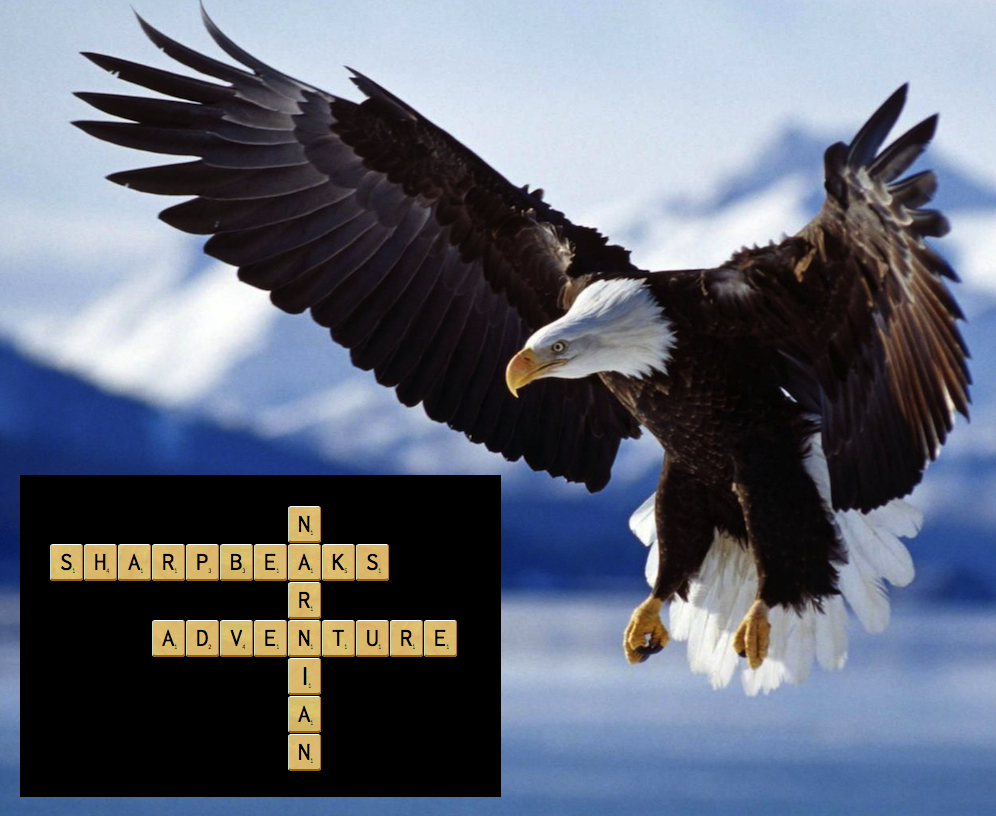
Once upon a time, when Narnia was still young, a/an ____________, young eagle named Sharpbeak decided to set out for an adventure. A wise ____________ climbed his ____________ tree to talk to him before he left. He crawled into the eagle’s ____________ nest and said, “That was a long climb. I’m thirsty. May I have a cup of ____________?”

As the two friends watched the sun set over the ____________ mountains, the eagle said ____________, “I wonder what’s on the other side of those mountains?”

His ____________ companion warned him, “Beware of the ____________ giants in the north. They like nothing better than to eat us Talking Animals for ____________ or even for a snack. Sharpbeak promised he would avoid the giants.

Then his friend said, “Don’t forget that there are also ____________ dragons living on some of the mountaintops. They don’t appreciate ____________ visitors. If you surprise them, they may blast you with a ____________ burst of their ___________ flames. And definitely don’t disturb their treasure of ____________ and ____________.”

The eagle said, “I’ll be sure to watch out for dragons when I go on my ____________ adventure.”

“Oh,” added Sharpbeak’s friend, “I wouldn’t advise you to fly over the ____________ ocean either. What if you flew as far as you could, and you didn’t find a/an ____________ island where you could land?” The eagle looked worried. His wise friend added, “If you ever find yourself in dangerous circumstances, remember that you can call on Aslan to protect you. I heard that once he once allowed a timid ____________ to walk safely across a stormy lake without sinking.”

“My,” said Sharpbeak, “that would be a terrible thing.” He looked up at the ____________ stars, twinkling in the sky. The two friends had spoken long into the night. “I didn’t realize it was so late,” he said. All I have to offer you to eat is ____________ and ____________.”

“That would be nice,” said his friend. He reached into his pocket and said, “and we could have this ____________ for dessert. But, after we eat I had better scurry home to my ____________, since I can’t imagine sleeping in a tree. I mean, if a storm comes up, you have the wind blowing ____________ and ___________ rain pouring down in torrents. I’m much happier living in a ____________ with my ____________ ____________. While you go on your journey, I will stay home and ____________.”

The two friends gave each other a big hug. The eagle’s feathers tickled his friend, who said, “May Aslan watch over you during your travels.”

The next morning the ____________ eagle soared off to begin his adventure. Sharpbeak would be sure to avoid all of the giants, dragons and ____________ along the way. But that’s a story for another day.

Epilogue

Those of you curious about how my granddaughters’ story turned out, should read on.

Once upon a time, when Narnia was still young, a big, young eagle decided to go off for an adventure. A wise deer climbed his pink tree to talk to him before he left. He crawled into the eagle’s fuzzy nest and said, “That was a long climb. I’m thirsty. May I have a cup of juice?

As the two friends watched the sun set over the blue mountains, the eagle said roughly, “I wonder what’s on the other side of those mountains?”

His wide companion warned him, “Beware of the cold giants in the north. They like nothing better than to eat us Talking Animals for breakfast or even for a snack.” Sharpbeak promised he would avoid the giants.

Then his friend said, “Don’t forget that there are also hairy dragons living on some of the mountaintops. They don’t appreciate old visitors. If you surprise them, they may blast you with a soft burst of their speedy flames. And definitely don’t disturb their treasure of trash cans and flowers.”

The eagle said, “I’ll be sure to watch out for dragons when I go on my fun adventure.”

“Oh,” added his friend, “and I wouldn’t advise you to fly out over the heavy ocean either. What if you flew as far as you could, and you didn’t find a dark island where you could land?” The eagle looked worried. His wise friend added, “If you ever find yourself in dangerous circumstances, remember that you can call on Aslan to protect you. I heard that once he once allowed a timid bunny to walk safely across a stormy lake without sinking.”

“My,” said the eagle, “that would be a terrible thing.” He looked up at the watery stars, twinkling in the sky. The two friends had spoken long into the night. “I didn’t realize it was so late,” he said. “All I have to offer you to eat is noodles and cheese.”

“That would be nice,” said his friend. He reached into his pocket and said, “and we could have this snack bar for dessert. But, after we eat I had better scurry home to my fairgrounds, since I can’t imagine sleeping in a tree. I mean, if a storm comes up, you have the wind blowing bravely and messy rain pouring down in torrents. I’m much happier living in a playground with my ten sisters. While you go on your journey, I will stay home and dance.”

The two friends gave each other a big hug. The eagle’s feathers tickled his friend, who said, “May Aslan watch over you during your travels.”

The next morning the brown eagle soared off to begin his adventure. He would be sure to avoid all of the giants, dragons and dinosaurs along the way. But that’s a story for another day.

Downloadable Version

Here’s the story. On the PDF, it is preceded by a list of the type of words required to fill in the various blanks.

Narnian Madlib

Literary Recycling

cecilialevy cupOur last column on providing new homes for neglected books got me thinking about the notion of “recycling” in its broader contexts.

And, even though C.S. Lewis died before the modern concept of environmentalism reached its full bloom, I wondered if he had written anything on related concerns. As prolific as Lewis was, if one is diligent there is a good chance they can find something with a (sometimes admittedly tenuous) correlation to nearly any subject.

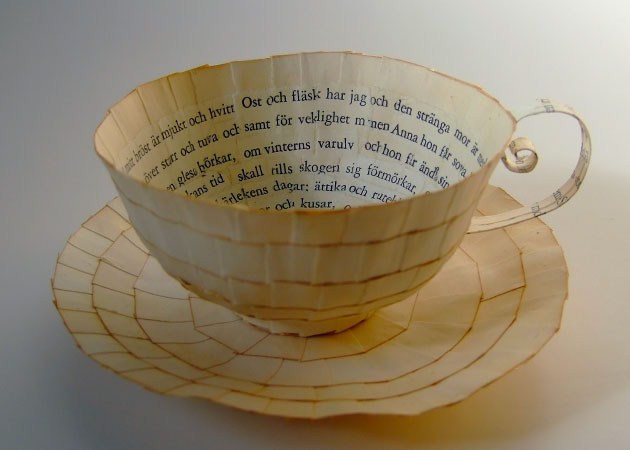
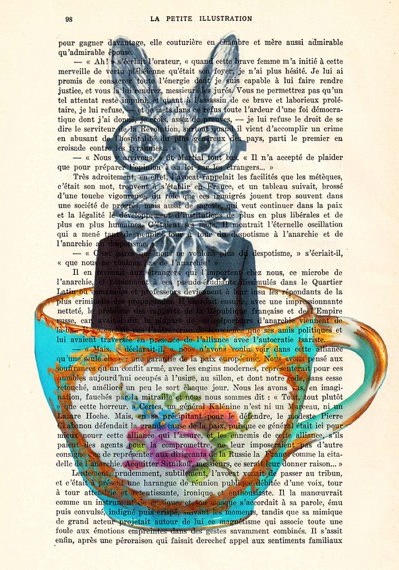
Before proceeding, I have to provide the source of the amazing illustration on this page. It is a graphic example of the creative recycling of literature. This teacup comes from the artistic vision of a Swedish artist, Cecilia Levy. You can view other examples of her artistry at her website here, and if you wish to reproduce them elsewhere, be sure to request permission (just as I did).

Returning to the concept of environmentalism, I wish to avoid political implications here. In general terms, however, I think it is fair to say the Scriptures teach that humanity is a “steward” of creation, which belongs not to us, but to its Maker. As stewards, we have been entrusted to be responsible in our management (use) of nature’s abundance. Wanton destruction should be called what it is—sin.

Now, this general principle manifests itself in a wide spectrum of responses, and attitudes are always subject to change. I vividly recall the very first Earth Day celebrated in the United States. I’m sure that being a high school student in a huge southern California school reinforced the indelible nature of the memory.

My wife and I have been diligent recyclers for many years . . . and that extends far beyond newspapers and aluminum cans. We have used countless items until their usefulness has ended. (Long past when they should have been replaced, in the opinion of our children.) I attribute much of our thriftiness to growing up in low income families where luxuries were few. But it arises not from that background alone. We also have a sense of responsibility to others, and dispatching items that are still usable to landfills just seems wrong.

I imagine Lewis possessed somewhat similar sentiments. He didn’t manifest much of a flair for extravagance. I don’t think he devoted that much thought to material possessions. I once read (but can’t find the source) that his brother and roommate Warnie was a bit frustrated by Lewis’ lack of concern for maintaining articles that were still in decent condition. Major Lewis, being a military man, focused on utilitarian considerations. The specific items of concern in the incident were some dishes or “crockery” that Warnie deemed to still be fit for service.

Both men were seasoned veterans of rationing, of course. Their skills at stretching things to go as far as possible were conditioned by years of deprivation. Americans are typically shocked to learn that rationing persisted in Europe after the end of the war. In an era characterized by excess and waste it’s difficult for us to put ourselves in their mindset.

Ironically, my hunt for a Lewisian passage on ecological concerns had nothing to do with rationing. It was rewarded when I looked at his essay “Willing Slaves of the Welfare State.” (The work is included in the delightful collection, God in the Dock.)

In this essay, Lewis is describing scientific advances as morally neutral. It is the application we choose to put our knowledge to, that determines its rightness. One of his illustrations alludes to care of the world in which we live.

The first is the advance, and increasing application, of science. As a means to the ends I care for, this is neutral. We shall grow able to cure, and to produce, more diseases—bacterial war, not bombs, might ring down the curtain—to alleviate, and to inflict, more pains, to husband, or to waste, the resources of the planet more extensively. We can become either more beneficent or more mischievous. My guess is we shall do both; mending one thing and marring another, removing old miseries and producing new ones, safeguarding ourselves here and endangering ourselves there.

Brilliant. And utterly true.

I also want to pass on an interesting observation made several years ago in another blog. The author references Lewis’ mention of the related concept of “plentitude.” You can read Tim Hagen’s full post here.

Since I’ve been reading a lot of C.S. Lewis lately, I figured I could use (and abuse?) a couple quotes from him in suggesting a philosophy of responsible waste management.  The Discarded Image is a piece that brings to light our modern misconceptions about the “Dark Ages.”  A testimony of medieval literature, for example, is how systematized their view of the universe was.  This organization grew out of classical authors such as Apuleius of Numidia, from whom Lewis draws two principles: the Triad (the idea that two entities – such as soul and body – can only meet each other through a third medium – in this case, the spirit) and Plentitude.  Lewis summarizes Plentitude in stating: “The universe must be fully exploited.  Nothing must go to waste.”  In other words, if something had the capacity to be useful, the medieval mind found a use for it.

The concept of plentitude as described here reminds me of the way people living in harsh environments cannot afford to waste anything. Eskimos, for example, are said to use every part of the seals they harvest . . . meat, blubber, bone, sinew. None of it is cast aside.

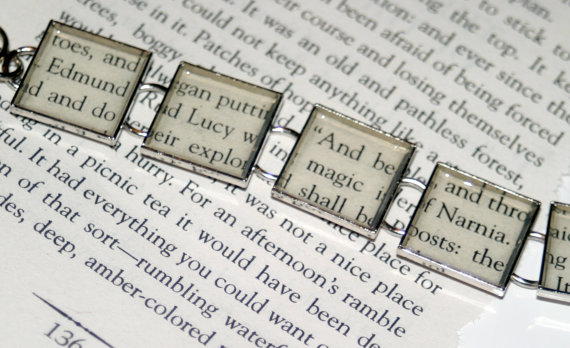
Let’s end these thoughts with another example of artistic creativity. This image shows how pages of a recycled copy of the Chronicles of Narnia can be recycled into jewelry. It comes from this commercial website which offers “one of a kind” items for sale. I don’t know whether this particular piece remains available, but I bet they would be willing to make you one of your very own if you’re interested. Then the cash from your wallet can be recycled into theirs. In exchange you’ll own a unique treasure that may become a wonderful conversation starter for many years to come.

narnia bracelet

Recycling Literature

recycled pageMany subscribers to Mere Inkling share a common trait with C.S. Lewis. Like your humble blogger, you are lovers of books. We don’t need to apologize for it; it’s in our DNA.

We carry that astonishing gene that manifests itself in a passion for the written word. (It’s frequently inherited from a parent who possessed the same ardor.)

If you’re one of this corpus of literary addicts, you just nod your head in agreement whenever you hear Lewis’ oft-quoted, “You can never get a cup of tea large enough or a book long enough to suit me.”

If you love books, if you don’t mind owning copies that others before you have enjoyed, and if you are on a tight budget, you might want to join me in becoming a customer of Better World Books.

[I have no interest in this nonprofit organization other than genuinely commending them to you as a wonderful source of inexpensive books. Most books have been officially removed from library collections . . . and require new homes. The “profits” are directed towards libraries and literacy programs.]

Many of us have enjoyed walking through rows of books on sale in local settings. This is a little like that, except that you can do digital searches and they have tons more titles available. (Literally.)

One of my recent purchases was Latin for the Illiterati. I purchased it the same day I bought The Anchor Book of Latin Quotations (for a secret project I’m working on).

Latin for the Illiterati includes “common phrases and familiar sayings,” that the reader is now able to decipher when encountered in classical literature. References do not have to be ancient to be included. For example, “salus populi suprema lex esto,” which means “the welfare of the people is the supreme law.” (But I didn’t need to translate that for you residents of Missouri, since it’s your own state motto.)

Quick test, which state has this as its motto? “Vox audita perit, litera scripta manet,” which means “the voice that is heard perishes, the letter that is written remains.” Actually, I cheated a bit, I don’t think it is any government’s motto, but it certainly is a truism that will resonate with readers!

C.S. Lewis valued rereading good books. In a 1915 letter, he wrote, “There is something awfully nice about reading a book again, with all the half-unconscious memories it brings back.”

In that same spirit, the following year he wrote to the same friend, “You really lose a lot by never reading books again.”

As I said, he was explicitly referring to revisiting a work already read. Nevertheless, I believe he would agree with the broader sense of his words . . . that it is a sad thing to see a book destined never to be read again.

Whether or not I am correct is irrelevant. The fact is that there are hundreds of thousands of books awaiting new homes. I don’t doubt that many of them “deserve” to be recycled for their raw materials. However, I also believe that the majority of them remain capable of teaching and inspiring. After all, litera scripta manet, right?