Literary Translators Beware

Translating literature from one language to another is a valuable, yet often undervalued, skill. It breaks the linguistic shackles restricting the benefits of good books to those literate in the language in which they are composed.

You can think of it this way. Without the dedicated efforts of translators, someone familiar only with English – e.g. as is, sadly, the case with most Americans – could never read the works of ancient Greeks or Romans. Asian philosophy such as the Four Books and Five Classics of Confucianism would be virtually unknown in the West.

Even contemporary literature from most of the world would be beyond our access. And, obviously, God’s written Word would only be accessible to those who mastered Hebrew, Aramaic, and Greek.

While C.S. Lewis is seldom thought of as a translator, it was indeed one of his talents. That doesn’t mean he devoted serious energy to translation. That was not his vocation. On the contrary, in 1945 he wrote: “People praise me as a ‘translator,’ but what I want is to be the founder of a school of ‘translation.’” (I discussed this a number of years ago in “C.S. Lewis’ School of Translation.”)

Dedicated translators have played an invaluable role throughout recorded history. A number of people still make translation their life’s labor. Yet, there are dark clouds on their horizon.

Is there a Future for Translation by Human Beings?

A recent literary journal alerted me to advances in artificial intelligence, which now jeopardize the future of professional translators. 

Back in 2023, an article in Forbes compared the respective advantages and challenges of the two methods. They accurately identified one distinction between a truly fluent human and an artificial substitute.

Language is complex, and culturally specific expressions such as idioms and metaphors, as well as ambiguous or ungrammatical sentences and other context-dependent word choices, can be challenging for AI algorithms.

Unsurprisingly, that same year the American Translators Association offered a more critical opinion in “Machine Translation vs. Human Translation: Will Artificial Intelligence Replace the World’s Second Oldest Profession?

We already mentioned that computers don’t possess our human capacity to comprehend meaning. The creative process, especially when it comes to translation, is the pinnacle of meaning. Human translators translate meaning, not words. The art of translation is understanding the meaning of the original text and then transforming it into something that communicates the same message (or evokes the intended emotion) but might not superficially look like an exact equivalent. . . .

But both now and then, professional translators are here to stay. Equipped with unique human skill and a toolbox full of tech, they’re ready to continue helping the world navigate the tricky business of multilingual communication – transporting messages appropriately, creatively, consistently, and securely to whatever audience you aim to reach. 

In short: machine translation can help when it doesn’t count, but professional human translation is there for you when it does.

Related to expressly literary translations, in contrast to mundane subject matter, the current issue of Poets & Writers contains a piece titled “AI Threatens Literary Translation.” When a European subsidiary of Simon & Schuster announced they would begin limited use of AI for this purpose,

Reactions rose in a flurry: Writers, publishers, and translators contended that AI would produce “bland” work. They lamented the possibility of lost jobs. The European Council of Literary Translators’ Associations resisted the standardization of an idiosyncratic process, stating that the imagination, understanding, and creativity that translation demands are “intrinsically human.”

This informative essay acknowledges that “AI isn’t new to translation either. Literary translators sometimes input segments of their source text into AI-based technologies . . . to generate ideas for particularly thorny passages. But these tools have to be used ‘very carefully . . . because the translations it produces are error-ridden and devoid of flow or beauty.’”

A Quick Experiment with AI Translation

Before completing this post I took a brief (less than ten minute) excursion to ChatGPT to experiment with their translation tool.

The results appear below (all produced in a mere handful of minutes). First I asked the AI to compose a sonnet on the subject of translation. Then I requested translations of that sonnet in five different languages. I have included the sonnet and the final two lines of each translation below.

You can perform a more elaborate experiment yourself, especially if you are familiar with more than one language. This would enable you to compare the accuracy of the translation. Or, perhaps one might take a translated version and translate that back into the original language, to see how closely it relates to the starting point.

In my experiment, the AI was constrained by needing to maintain the original’s form as a sonnet. I assume that if it were simply a literal translation, it may have modified the vocabulary and grammar. Each translation included footnotes. To illustrate how elaborate some of these notes were, I’ve reproduced those which appeared with the translation into Aramaic.

Frankly, if this is what these early AI prototypes are capable of, it appears to me that professional translators may truly have something to be worried about.

The Sonnet

In languages vast, where meanings hide and shift,
A translator’s art gives voice to what is known.
Through words, they bridge the gap, a timely gift,
To carry thought from one to others’ throne.

The rhythm, tone, and essence all must stay,
Though words may bend, they still must hold their grace.
A careful hand must guide the text’s relay,
To keep its heart while moving through time and space.

Yet oft the meaning’s lost in fleeting sound,
Or tangled in the strings of foreign speech.
But still they strive, where words and thoughts are bound,
To bring the message close, within our reach.

A translation’s not just words that blend –
It’s worlds revealed, with meaning without end.

~ Latin ~

Translatio non est solum verba iuncta –
Sed mundi patent, et mens non est puncta.

~ Old English ~

Nis anginn of wordum gemenged anum –
Ac worulda onwreah, and andgit ne swylt.

~ Classical Greek ~

Οὐ γάρ μόνον λέξεις αἱ μεταφράσεις,
ἀλλὰ κόσμοι φαίνονται, ἄνοια οὐδέποτε.

~ Middle Egyptian ~

𓏏𓂋 𓅓𓏏 𓊪 𓏏𓏤 𓆑𓏏 𓊵𓏤,
t r mt ḏbꜥ t ft ḏbꜥ
(“A translation’s not just words that blend –”)

𓂋 𓅓𓏏 𓆑𓏏 𓊵𓏤 𓏏𓏏𓀀.
r mt ft ḏbꜥ t t
(“It’s worlds revealed, with meaning without end.”)

~ Classical Aramaic ~

ܬܪܓܡܐ ܠܐ ܗܘܐ ܒܠܚܘܕ ܡܠܐ ܕܡܬܚܠܛܢ,
ܐܠܐ ܥܠܡܐ ܡܬܓܠܝܢ، ܘܡܕܡ ܠܐ ܚܒܠ.

Notes on the Translation:
1. Classical Aramaic Grammar & Style: The sentence structure follows Classical Aramaic syntax as used in ancient texts. Some phrases had to be adapted poetically since direct translations of modern concepts do not always exist.
2. Vocabulary Adjustments: “Translator” = ܡܬܪܓܡܢܐ (metargemana), a direct and historically accurate term. “Translation” is expressed as ܗܫܬܘܪܬܐ (hishtorta), meaning “interpretation, explanation.” “Essence” is translated as ܡܗܘܬܐ (mehutā), meaning “nature, essence.” “To bridge the gap” = ܡܫܬܪܝܢ ܓܦܐ (meshatrin gapé), literally meaning “to stretch wings” (a poetic expression).
3. Preserving the Poetic Flow: The rhythm and parallel structure of the original sonnet were carefully kept. Adjustments were made for metrical and phonetic balance in Aramaic.
4. This version captures the spiritual and poetic depth of the original while remaining faithful to the Classical Aramaic linguistic style.
5. Would you like an audio recording or a version in Syriac script for authenticity? Let me know how you’d like to refine it!

And all of this in ten minutes. Unfathomable . . .

C.S. Lewis & Tattoos

How is this for an odd New Year resolution? Getting a new tattoo—with a connection to the writings of C.S. Lewis.

I suppose I’m betraying my age here. Being a retired pastor, my body remains a totally uninked canvas. Not that I’ve never considered getting a tattoo. In fact, if I end up making a pilgrimage to Jerusalem before I journey to the New Jerusalem, I may still opt to get inked. In Jerusalem there is a tattooist whose family traces their art back for 700 years to when their Coptic family lived in Egypt.

Our ancestors  used tattoos to mark Christian Copts with a small cross on the inside of the wrist to grant them access to churches . . and from a very young age (sometimes even a few months old) Christians would tattoo their children with the cross identifying them as Copts. . . .

One of the most famous of Christian types of tattoos, however, is still in use today—that of the pilgrimage tattoo. At least as early as the 1500s, visitors to the Holy Land . . . often acquired a Christian tattoo symbol to commemorate their visit, particularly the Jerusalem Cross.

In Bethlehem, another Christian tattooist practices his art “near the Church of the Nativity, offering pilgrims ink to permanently mark their visit.” He offers designs featuring scriptural texts in Hebrew and Aramaic, the language spoken by Jesus.

Tattoos have a fascinating history, and it should be noted some people consider Torah prohibition to bar even religious tattoos. “You shall not make any cuts on your body for the dead or tattoo yourselves: I am the Lord” (Leviticus 19:28). However, most Christians* and increasing numbers of Jews do not agree that the passage forbids the current practice.

That doesn’t mean all tattoos are appropriate, of course. Most tattoos are innocuous. Some are humorous. A small number are actually witty. Yet some tattoos can be downright malevolent.

Like so many human activities, the significance of a tattoo depends in great part on the intention of the person asking for this permanent mark. For example, my wife and I approved of our son and his wife having their wedding rings tattooed in recognition of God’s desire⁑ that a marriage will last as long as both individuals live.

What has this to do with C.S. Lewis?

Precious few writers have penned more inspiring and enlightening words than Lewis, that great scholar of Oxford and Cambridge. Because of this, it should come as no surprise that there are many Lewis-inspired tattoos gracing bodies. There is even a website devoted to C.S. Lewis-inspired body ink.

I imagine that Lewis himself would regard this as quite peculiar. I don’t believe he had any tattoos of his own, but it’s quite possible his brother Warnie—a retired veteran of the Royal Army—may have sported one or more.

In 1932, Lewis wrote to Warnie about his recent walking trip. Warnie was his frequent companion, when he was not elsewhere deployed. In this fascinating piece of correspondence, Lewis described his most recent excursion. I include a lengthy excerpt (comprising the first half of the journey) not because of its single passing mention of tattoos. Rather, because of the portrait it paints of the young and vigorous scholar in the prime of life. If you would prefer to skip to the mention of inking, see the sixth paragraph.

Since last writing I have had my usual Easter walk. It was in every way an abnormal one. First of all, Harwood was to bring a new Anthroposophical Anthroposophical member (not very happily phrased!) and I was bringing a new Christian one to balance him, in the person of my ex-pupil Griffiths. Then Harwood and his satellite ratted, and the walk finally consisted of Beckett, Barfield, Griffiths, and me.

As Harwood never missed before, and Beckett seldom comes, and Griffiths was new, the atmosphere I usually look for on these jaunts was lacking. At least that is how I explain a sort of disappointment I have been feeling ever since. Then, owing to some affairs of Barfield’s, we had to alter at the last minute our idea of going to Wales, and start (of all places!) from Eastbourne instead.

All the same, I would not have you think it was a bad walk: it was rather like Hodge who, though nowhere in a competition of Johnsonian cats, was, you will remember, ‘a very fine cat, a very fine cat indeed.’

The first day we made Lewes, walking over the bare chalky South Downs all day. The country, except for an occasional gleam of the distant sea—we were avoiding the coast for fear of hikers—is almost exactly the same as the Berkshire downs or the higher parts of Salisbury Plain. The descent into Lewes offered a view of the kind I had hitherto seen only on posters—rounded hill with woods on the top, and one side quarried into a chalk cliff: sticking up dark and heavy against this a little town climbing up to a central Norman castle.

We had a very poor inn here, but I was fortunate in sharing a room with Griffiths who carried his asceticism so far as to fling off his eiderdown—greatly to my comfort. Next day we had a delicious morning—just such a day as downs are made for, with endless round green slopes in the sunshine, crossed by cloud shadows. The landscape was less like the Plain now. The sides of the hill—we were on a ridgeway—were steep and wooded, giving rather the same effect as the narrower parts of Malvern hills beyond the Wych.

We had a fine outlook over variegated blue country to the North Downs. After we had dropped into a village for lunch and climbed onto the ridge again for the afternoon, our troubles began. The sun disappeared: an icy wind took us in the flank: and soon there came a torrent of the sort of rain that feels as if one’s face were being tattooed and turns the mackintosh on the weather side into a sort of wet suit of tights.

At the same time Griffiths began to show his teeth (as I learned afterwards) having engaged Barfield in a metaphysico-religious conversation of such appalling severity and egotism that it included the speaker’s life history and a statement that most of us were infallibly damned. As Beckett and I, half a mile ahead, looked back over that rain beaten ridgeway we could always see the figures in close discussion. Griffiths very tall, thin, high-shouldered, stickless, with enormous pack: arrayed in perfectly cylindrical knickerbockers, very tight in the crutch. Barfield, as you know, with that peculiarly blowsy air, and an ever more expressive droop and shuffle.

For two mortal hours we walked nearly blind in the rain, our shoes full of water, and finally limped into the ill omened village of Bramber. Here, as we crowded to the fire in our inn, I tried to make room for us by shoving back a little miniature billiard table which stood in our way.

I was in that state of mind in which I discovered without the least surprise, a moment too late, that it was only a board supported on trestles. The trestles, of course, collapsed, and the board crashed to the ground. Slate broken right across. I haven’t had the bill yet, but I suppose it will equal the whole expences of the tour.

Wouldn’t it have been amazing to join C.S. Lewis on one of these walking trips? A Lewisian tattoo is no substitute, to be sure, but I imagine it does offer certain people a sense of connection to the great author. Perhaps, if I were a younger man . . .


* Two recent converts to Christianity, Kanye West and Justin Bieber have made public their recent religious additions to their vast tattoo collections.

⁑ As Jesus said, “So they are no longer two but one flesh. What therefore God has joined together, let not man separate.”

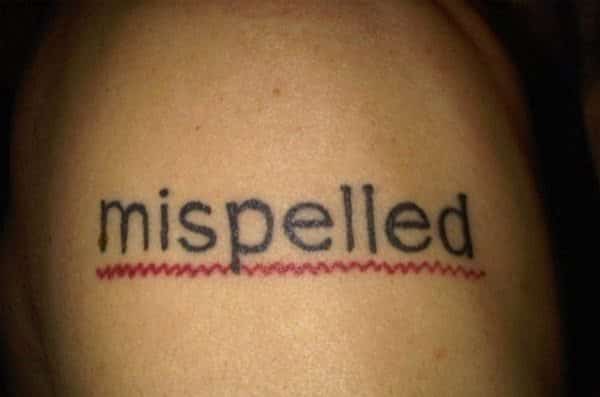
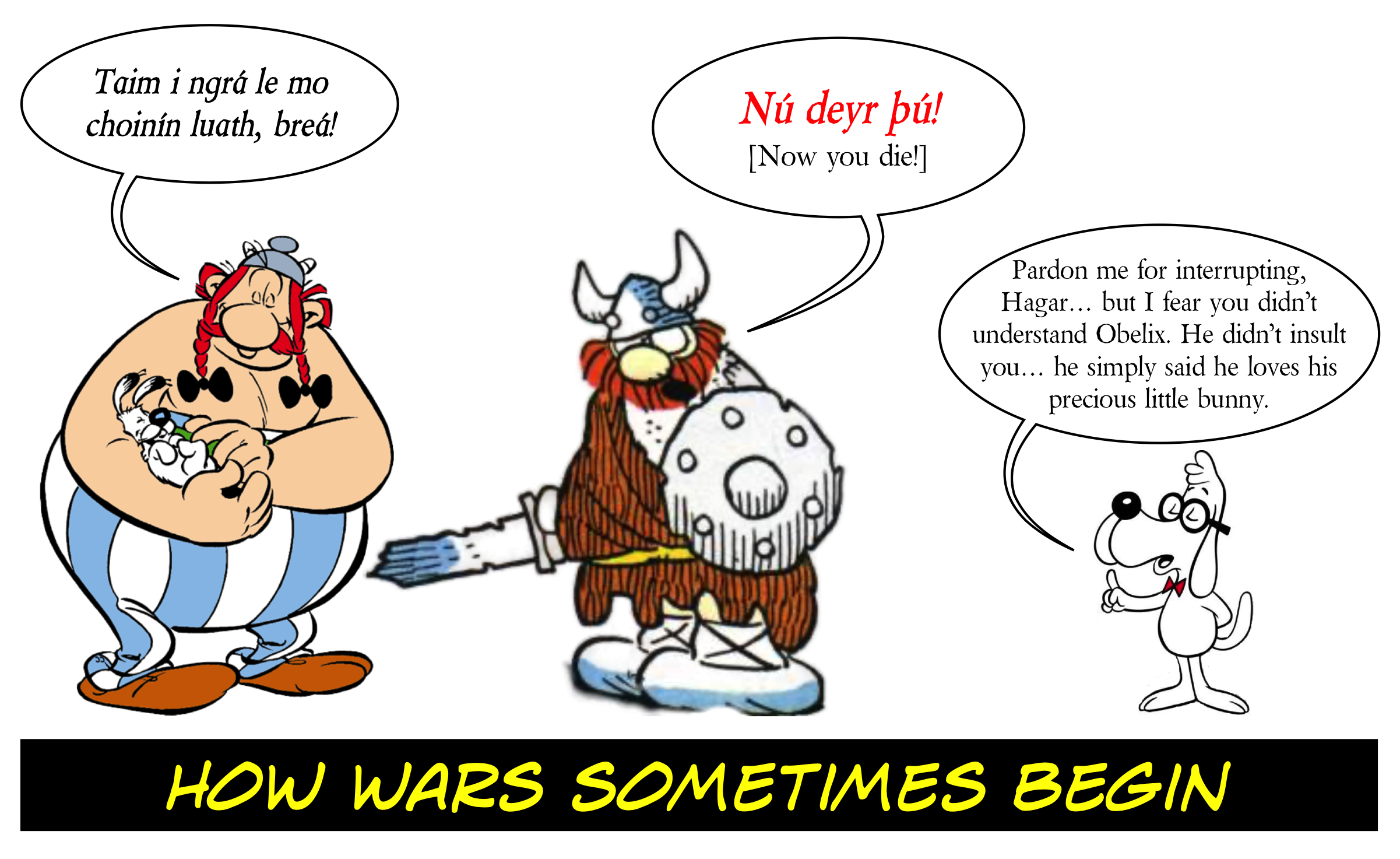
The motivational poster above was created by Mere Inkling, and represents only an infinitesimal number of the misspelled tattoos adorning human bodies. What a travesty . . . one that may have been prevented by remaining sober. The tattoo below, on the other hand, strikes me (being a writer) as quite clever.