Gathering Palms & Preparing for War

The Christian church has just celebrated Palm Sunday, and I recalled one of my favorite memories in preparing for the journey through Holy Week.

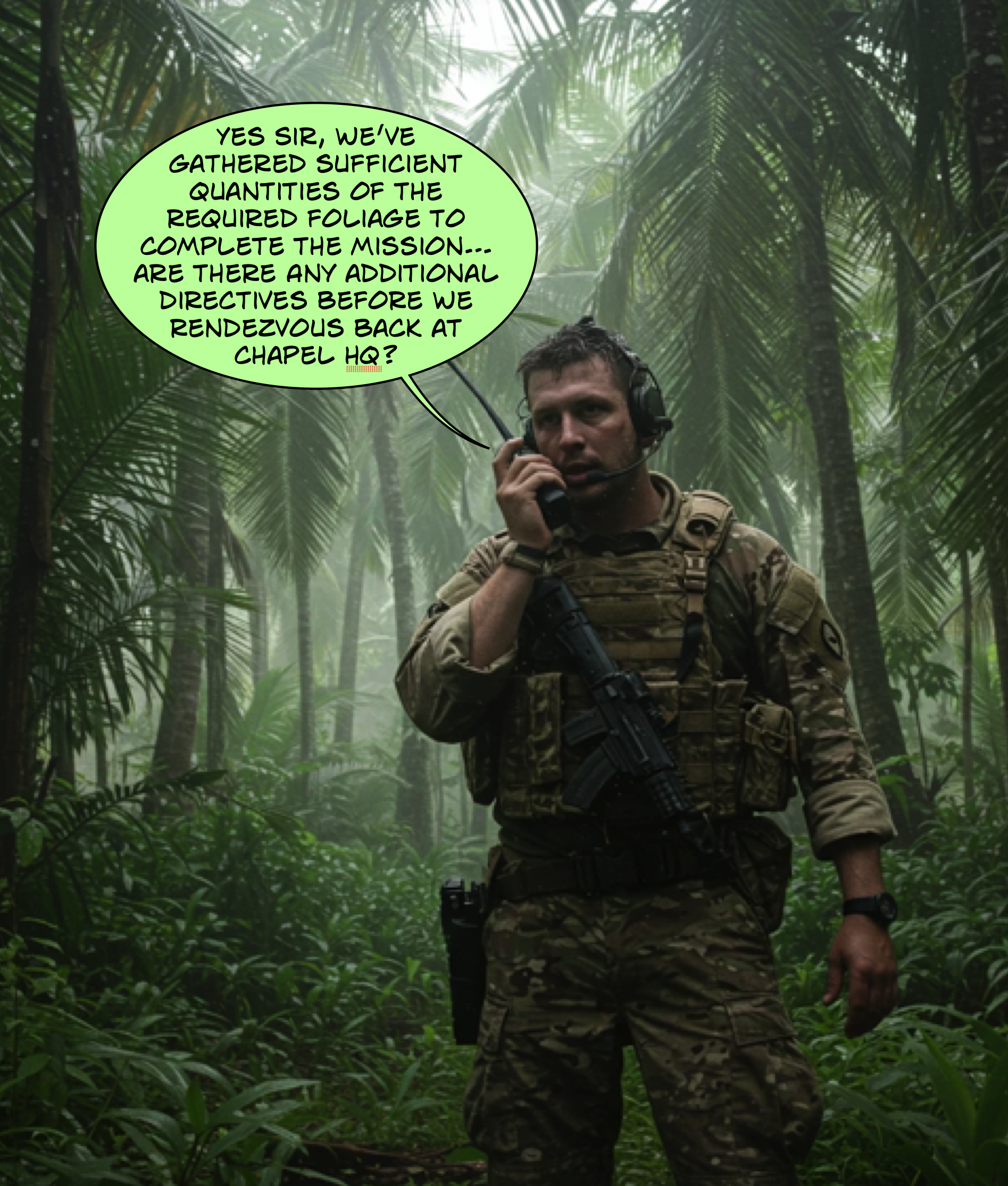
When I was stationed in Guam a few years ago (in the nineties), I enjoyed the annual tradition of gathering all of the palms to decorate the chapel and provide for worshippers in our very own jungle. Each year the chaplains and chaplain assistants, our whole team, would spend half a day gathering leaves that would put to shame any stateside palms.

Taking place in a tropical jungle, the event was sweaty, but fun. Good fellowship and even some seasonal early-Easter music. Fortunately, this didn’t take place during the typhoon season, as when the island was smashed by Super Typhoon Paka during our residency.

Jungles are fascinating places. Because the word possesses some rather ominous and even threatening overtones, a number of years ago they were rechristened “rainforests.” Even though most are tropical, there are temperate rainforests, such as in the Olympic National Forest, whose mountains I admire daily from our backyard.

C.S. Lewis alluded to the negative connotation of jungles in his study of “Vivisection,” with its repudiation of animal cruelty.

In justifying cruelty to animals we put ourselves also on the animal level. We choose the jungle and must abide by our choice.

A Modern Use for Jungles

In recent years, the jungles of Guam have been put to a military use. Unsurprisingly, soldiers and their Marine, Navy and Air Force cousins, must be prepared to do their jobs in a wide range of environments. That results in the existence of a variety of training settings, tuned to the specific needs of particular career fields.

For example, I served as the Wing Chaplain at Fairchild AFB where the USAF trains its pilots and aircrew members how to survive when they find themselves in unfriendly settings. Survival, Evasion, Resistance and Escape (SERE) training saves lives.

Anyway, not long ago the Air Force established a Jungle Agile Combat Employment (JACE) Course in, of all places, Guam.

This new course took knowledge from the U.S. Marine Corps Jungle Warfare Training Center and the Lightning Academy in Hawaii and tweaked it for non-combatant career fields to be prepared under the USAF’s Agile Combat Employment (ACE) concept.

This is part of America’s shift in focus to the threats in the Pacific theater. China has never renounced, and constantly proclaims, its intent to force the Republic of China (Taiwan) into their fascist empire. Of course, the fate of Hong Kong reveals just how unbenevolent the so-called People’s Republic is when it comes to maintaining any semblance of democratic freedoms. 

C.S. Lewis, of course, had much to say about the tragedies of fascism and war. However, that is not the focus of this reflection. Instead, the theme of this post reflects two thoughts. 

The less important idea, to which I have paradoxically devoted the most space, is the value of memories. Guam occupies a very special place in my family’s history, in part because all three of our kids were there during their teens. Lifechanging events occurred there.

And it was the wonderful people, military friends and wonderful Chamorro residents that made the most lasting impressions. Remembering the harvesting of palms, and recently learning about the jungle training course turned my thoughts back to that Micronesian paradise.

What’s Truly Vital

The infinitely more important message in this post is to acknowledge the holiest of seasons in which we find ourselves. Beginning with Palm Sunday’s celebration of the joy experienced by God’s people as they welcomed their Messiah into Jerusalem, we have the opportunity now to also join together with Jesus and our brothers and sisters in the faith as we:
~ commemorate the institution of the Lord’s Supper on Maundy Thursday,
~ contemplate the despair of the disciples as they stood at the foot of the cross as Jesus breathed his last mortal breath on Good Friday, and
~ celebrate in awe and wonder how our Savior rose from the grave and encouraged his disciples before ascending to Heaven and resuming his place at the right hand of God the Father. 

Christ’s atoning death, and his glorious resurrection, give us hope in the depths of our despair. And his promised return ensures us that there truly will come a day when we need never again prepare for war – or ever taste the pain of death.

We do well to heed C.S. Lewis’ encouragement to his friend Don Giovanni Calabria in 1948, when the priest was distraught over the troubles transpiring around the world.

Tomorrow [Easter] we shall celebrate the glorious Resurrection of Christ. I shall be remembering you in the Holy Communion. Away with tears and fears and troubles!

United in wedlock with the eternal Godhead Itself, our nature ascends into the Heaven of Heaven. So it would be impious to call ourselves “miserable.”

On the contrary, Man is a creature whom the Angels – were they capable of envy – would envy. Let us lift up our hearts! At some future time perhaps even these things it will be a joy to recall.
Following C.S. Lewis’ Military Example

Like his friend J.R.R. Tolkien, and many of the British men of their generation, C.S. Lewis served in the grim battlefields of the First World War. (However, since Lewis was actually Irish, he could not be drafted, and instead volunteered to serve.)

In recent years a number of books have appeared related to the military service of the Inklings. In A Hobbit, a Wardrobe, and a Great War, the author introduces his discussion with a succinct summary.

For a generation of men and women, [WWI] brought the end of innocence – and the end of faith. Yet for two extraordinary authors and friends, J.R.R. Tolkien and C.S. Lewis, the Great War deepened their spiritual quest. Both men served as soldiers on the Western Front, survived the trenches, and used the experience of that conflict to shape their Christian imagination. . . .

By the time of the Armistice, more than nine million soldiers lay dead and roughly thirty-seven million wounded. On average, there were about 6,046 men killed every day of the war, a war that lasted 1,566 days. In Great Britain, almost six million men—a quarter of Britain’s adult male population – passed through the ranks of the army. About one in eight perished. Tolkien and Lewis might easily have been among their number.

In 1939, a correspondent inquired if Lewis was going to reassume his commission in the army for the new conflict, and he responded with sentiments I have heard voiced by a number of other combat veterans.

No, I haven’t joined the Territorials. I am too old. It would be hypocrisy to say that I regret this. My memories of the last war haunted my dreams for years.

C.S. Lewis proceeded to graphically explain the cost of serving under such pressure. 

Military service, to be plain, includes the threat of every temporal evil: pain and death which is what we fear from sickness: isolation from those we love which is what we fear from exile: toil under arbitrary masters, injustice and humiliation, which is what we fear from slavery: hunger, thirst, cold and exposure which is what we fear from poverty.

I’m not a pacifist. If it’s got to be, it’s got to be. But the flesh is weak and selfish and I think death would be much better than to live through another war.

A new announcement from the United States’ Department of Defense brought Lewis’ situation to mind. It appears that due to a number of factors – not least of which the emphasis on Diversity, Equity and Inclusion,* which (imo) has discouraged veterans from encouraging their children to serve in the armed forces – some services are repeatedly falling short of their recruiting goals. 

In light of the fact that the world is inarguably growing more dangerous – the Doomsday Clock is set at “90 seconds to midnight” – it is alarming that we are unable to fully staff our shrunken military.

Just today my sixteen year old grandson expressed concerns about the resumption of a draft. I could not muster a persuasive argument that it won’t happen. Ironically, the last time the U.S. involuntarily conscripted troops was 1972, the year I turned eighteen. Oh, in the process of including a link to the Selective Service Sytem, I was surprised to learn that a “Medical Draft is in Standby Mode.” 

It is designed to be implemented in connection with a national mobilization in an emergency, and then only if Congress and the President approve the plan and pass and sign legislation to enact it. . . .

[The plan will] provide a fair and equitable draft of doctors, nurses, medical technicians and those with certain other health care skills if, in some future emergency, the military’s existing medical capability proved insufficient and there is a shortage of volunteers. . . .

[If implemented, the plan will] begin a mass registration of male and female health care workers between the ages of 20 and 45. . . . HCPDS [the innocuously named Health Care Personnel Delivery System] would provide medical personnel from a pool of 3.4 million doctors, nurses, specialists and allied health professionals in more than 60 fields of medicine.

No Draft Yet

Since we are not currently at war, the specter of a draft remains ephemeral. Still, the shortage of volunteers has led to a variety of initiatives, such as lowering service qualification standards. These efforts have proven inadequate, resulting in the aforementioned announcement.

Both the Army and the Air Force have begun Retiree Recalls. Yes, that is just what it sounds like. People who have actually retired from the armed forces, normally after 20+ years of active duty, are being recalled to serve again. 

When I heard this news I was stunned. It is legally possible for the military to recall former members via a tiered process, but the first thing that came to my mind was my favorite high school teacher. He had served in Viet Nam as a draftee and finished his enlistment. He once told me that he felt safe, having survived, because now he was in the same call-up status as a “pregnant nun.” (Rather hyperbolic, but comforting to him.)

Fortunately, the current recalls are all voluntary. Only retirees whose personal circumstances make the offer appealing, will respond. As the Air Force Times reports, “Regret retiring? Here’s your shot at a second chance in the Air Force.”

I suspect that even vets who enjoyed their military service will be inclined to consider redonning the uniform as “too much of a good thing.” And if they witnessed the bloody horrors of war, as seen by C.S. Lewis, returning to the ranks would be even less tempting.

Since I, myself, have no desire to resume the demands of military life, I haven’t researched the age requirements for the Air Force recall program. Like Lewis, “I am too old.” 

But amazingly, depending on individual factors, the Army is willing to recall retired volunteers up to the age of seventy. That’s not a typo. As someone reaching that very milestone this summer, I can’t imagine returning to work side-by-side with troops half a century younger than me. 

Now, I pray for peace, knowing that being prepared for war is one way to increase that likelihood. So, I hope the military can throw off some of its political shackles and return to its necessary focus.

Furthermore, like C.S. Lewis, I have a pragmatic view of the effects of war. In “Learning in War-Time,” Lewis summarized the effects of military service during a war. As always, his insights are profound.

What does war do to death? It certainly does not make it more frequent: 100 per cent of us die, and the percentage cannot be increased. . . . Does it increase our chances of painful death? I doubt it. . . .

Does it decrease our chances of dying at peace with God? I cannot believe it. If active service does not persuade a man to prepare for death, what conceivable concatenation of circumstances would?


* This reference is to the convoluted and inequitable DEI philosophy and program(s) being mandated today. In truth, most people value diversity, and all people of goodwill believe in the importance of equity and inclusion. Along with Martin Luther King, Jr., they long for a day when people are not “judged by the color of their skin, but by the content of their character.”

An Allied War Crime

During the Second World War, Germany and Japan (leaders of the Axis) committed many loathsome acts. But at least one Allied country was also guilty of an unnecessary atrocity. Genocide and the mass murder of civilians were only part of the Axis’ evil agenda. Germany and Japan also performed horrific medical “experiments” on their innocent captives. No one defends these acts.

The Second World War ended rather abruptly. At the war’s conclusion, a new weapon persuaded the Empire of Japan to surrender unconditionally. The Potsdam Declaration which called on the Emperor to yield offered a grim alternative.

We call upon the government of Japan to proclaim now the unconditional surrender of all Japanese armed forces, and to provide proper and adequate assurances of their good faith in such action. The alternative for Japan is prompt and utter destruction.

Before the use of the two atomic bombs, plans were well underway for Operation Downfall, the invasion of Japan. Massive Allied casualties were anticipated—but due to the nature of warfare, these were dwarfed by the number of Japanese who would have perished.

While few ever praised the total destruction of Hiroshima and Nagasaki, nearly all objective minds recognized that the swift conclusion which followed saved far more lives. This opinion is not only the “military” consensus. It is also shared by those Japanese who were being trained, with bamboo poles, to resist the impending invasion of their islands. (I have had personal conversations with several Japanese citizens who were part of this civilian army.)

Operation Ketsugō (決号作戦), called for the nation’s entire population to resist the invasion. The Japanese Cabinet “essentially called the entire population to military service, while propagandists began ‘The Glorious Death of One Hundred Million’ program to whip up enthusiasm for dying for the Emperor” (A War to Be Won).

While the need for the bombing of Nagasaki is debatable, the use of the atomic bomb in ending the war, saved countless lives. Some have called its use a war crime. They are wrong.

That does not mean, however, that the Allied hands were innocent. In the European theater of the war, the British responded to Germany’s bombing of their civilian populations with terror bombing of their own. Air Chief Marshal Arthur Harris embodied this vile strategy and, as head of the Royal Air Force Bomber Command, he could wage a war of retribution. And, as a leader of the winning army, his criminal behavior would be overlooked.

“Bomber Harris” justified raining fire on civilians because it would abbreviate the war. He said, in my opinion to his lasting shame, “I do not personally regard the whole of the remaining cities of Germany [i.e. all of the citizens abiding in them] as worth the bones of one British Grenadier.”

Air Force Magazine has an informative article available online which addresses Harris’ strategy. It cites Churchill’s acknowledgement that “we hoped to shatter almost every dwelling in almost every German city.” Only with the utter destruction of the city of Dresden, did Churchill admit that “the moment has come when the question of bombing of German cities simply for the sake of increasing the terror, though under other pretexts, should be reviewed” (“The Allied Rift on Strategic Bombing”).

War is a Terrible Thing

Ernest Hemingway was a talented, but deeply troubled, writer. A Boston University article describes his religious outlook in this way: “While raised by devout Christian parents, Hemingway converted to Catholicism at the age of twenty-eight for marriage and proved religiously indifferent throughout his lifetime, despite a preoccupation with biblical themes in many of his works.”⁑

Hemingway addressed the subject of this post in a sober, profound and honest manner. “Never think that war, no matter how necessary, nor how justified, is not a crime.” Even people such as myself, advocates of Just War Theory, can agree with this.

War is a crime against humanity itself, an activity that was never part of our Creator’s original design. War represents a battle in which even the victor is often left scarred, as one of my fellow chaplains describes in his newly released book, Nailed! Moral Injury: A Response from the Cross of Christ for the Combat Veteran.*

Yet, as horrible as war is, it is sometimes necessary. G.K. Chesterton astutely noted the proper motive for soldiers. They don’t seek personal conquest. Nor is the pursuit of personal glory a proper justification. According to Chesterton, “The true soldier fights not because he hates what is in front of him, but because he loves what is behind him.” In the same light, he wisely described war in the following manner in his Autobiography.

The only defensible war is a war of defence. And a war of defence, by its very definition and nature, is one from which a man comes back battered and bleeding and only boasting that he is not dead.

C.S. Lewis was just such a man. Deeply acquainted with the bloody toll of war, he did not glorify combat. In 1939 he wrote in a letter, “My memories of the last war haunted my dreams for years.” Yet, that very same year, Lewis described moments when war was truly unavoidable, saying “if war is ever lawful, then peace is sometimes sinful” (“The Conditions for a Just War”).

Chivalry is the Imperfect Response to War

Chivalry may sound like an archaic word and an obsolete concept. It may be the former, but is definitely not the latter. For C.S. Lewis, it was the principle that could reduce the anguish caused by war.

C.S. Lewis recognized the profound cost of war and acknowledged short of Christ’s return, it will remain unavoidable. The only way its violence can be tempered is through a principle like chivalry, which naturally arises from the belief that though some wars cannot be avoided, all wars can be restrained by humane guidelines. This notion even inspires the Geneva Conventions.

Mere Inkling has discussed the Inkling concept of chivalry in the past, so I will not repeat that discussion here. Instead, allow me to refer you to an excellent article I recently read on this vital subject, “C.S. Lewis, War, and the Christian Character.”

Addressing the familiar canard that C.S. Lewis glorifies war, particularly in the Chronicles of Narnia, Marc LiVecche declares.

For Lewis, the Narnian stories are all about love—not about love despite the battles and wars, but about love that, because it is love, reveals itself in the rescue of the innocent, the defense of justice, and the punishment of evil even, in the last resort, by war and, most crucially, in the character of the warriors who wage those wars.

In a candid manner that could possibly cause the prudish to blush, LiVecche describes how Botticelli’s Venus and Mars illustrates the view that in a fallen world, war can be harnessed to serve positive ends. This painting is significant, in that “a facsimile of the Botticelli masterwork hung in Lewis’ Oxford rooms in Magdalen College.”

In any case, whether through the influence of Venus or the two-aspects of his internal character, Lewis’ Mars—and the martial character he influences in others—is about much more than war and violence. For Lewis, the fullness of the martial character is best communicated by the chivalric idea of “the knight—the Christian in arms for the defence of a good cause,” which Lewis called “one of the great Christian ideas.” This chivalric ideal, in turn, is best understood through those words addressed to the dead Launcelot, the greatest of all the knights, in Malory’s Morte D’Arthur: “Thou wert the meekest man that ever ate in hall among ladies; and thou wert the sternest knight to thy mortal foe.”

Lewis expounds: “The important thing about this ideal is…the double-demand it makes on human nature. The knight is a man of blood and iron, a man familiar with the sight of smashed faces and the ragged stumps of lopped-off limbs; he is also a demure, almost a maidenlike guest in hall, a gentle, modest, unobtrusive man. He is not a compromise or happy mean between ferocity and meekness; he is fierce to the nth and meek to the nth.”

LiVecche discusses how Lewis’ thought reflects the Christian just war tradition. It is a crucial damper to unbridled war, since “human beings are motivated both by love and kindness as well as selfishness and cruelty [requiring that] the use of force must be viewed with skepticism and deployed within carefully prescribed constraints.”

War crimes are criminal precisely because they fall outside the boundaries of what is just and necessary. These offenses should never be ignored or minimized, no matter who commits them . . . be they Nazi bureaucrats, genocidal Japanese commanders, or sophisticated British baronets who serve as military marshals.


* Chaplain Mark Schreiber’s book is available from Amazon and its kindle version will be available soon.

C.S. Lewis and Military Service

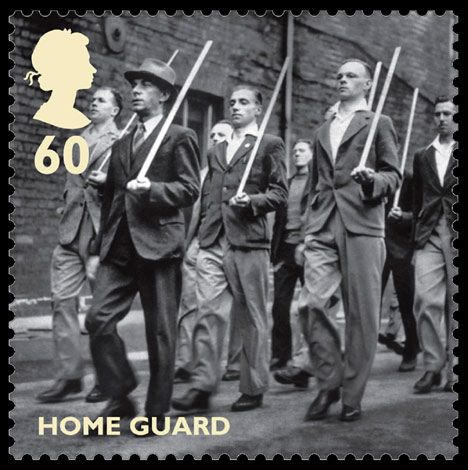
home guard stamp

If you were going to enlist in the military, which branch of the armed forces would you choose? And why?

The choice would have great consequences. The simple fact is that despite their similar charters, not all branches are created equal. Your choice will influence countless aspects of your life, including your post-military employment options and even the likelihood of whether or not you’ll survive your enlistment.

Gallup recently completed research into which branch of the armed forces most Americans would encourage someone to join. The Air Force came out on top.

Americans hold all branches of the U.S. military in high regard, but that does not necessarily translate into a desire to see their loved ones enlist. Fewer than half would be likely to recommend joining the Coast Guard (48%), Marines (43%) or Army (41%) to their children or grandchildren, while a majority would be likely to recommend the Navy (53%) or Air Force (64%).

As a chaplain, I heard some amazing reasons for people’s choice of service. One Army NCO told me, “I was leaning toward the Air Force until the Army recruiter pulled out this huge poster covered with every imaginable weapon, and said, ‘we’ll teach you how to use all of these.’” Not a bad technique for persuading testosterone-fueled eighteen-year-olds to sign on the dotted line.

One young woman who had served a tour in the Marines told me she didn’t even consider another option. “It was the Corps or nothing,” she said, before shouting “Semper Fi!” The USMC has the advantage of requiring fewer recruits and has brilliantly fostered a reputation as “the most prestigious of the military branches.”

A common motivator for Navy recruits seems to be the exotic locations of many of their installations. Can’t argue with that. Most of them are located on or near coasts, while the Air Force strategically places its bases where a falling aircraft would have the smallest chance of injuring someone on the ground. Places like Lubbock, Texas, where I served my first active duty tour at Reese AFB. [The people in Lubbock are amazing patriots.]

The Coast Guard, a sometimes-military organization, attracts people interested in their search and rescue ethos. This despite the fact that most of their mission involves enforcing laws and protecting the nation’s borders.

The Air Force draws lots of recruits who are interested in pursuing technical fields. The other services have similar career paths, of course, but the clear perception is that the Air Force offers the most. Still, it’s a bit embarrassing to share here the reason one friend of mine chose the USAF. Actually, it was his reason for choosing the chaplain assistant career field in particular. “I told them at basic training that I would take any job where I worked in a climate-controlled environment.” He was serious, but the last laugh was on him. When we deploy to the field, chaplain assistants are not only responsible their own safety, they have to protect their noncombatant chaplains as well (in any weather).

The different branches of the military go to war against their nation’s enemies—but they also maintain intense rivalries with their sister services. This competition is usually fun to observe . . . as long as alcohol is not in the vicinity.

C.S. Lewis’ Military Service

In the United Kingdom, the Navy is the senior service. Seems fitting for an island nation. That doesn’t mean that the Army traditions, which date back to historic militias, lack prestige.

During the First World War, C.S. Lewis was exempt from the draft. This, because he was from Northern Ireland. Despite this, he followed his brother Warren into the Royal Army.

Warnie was a career officer, graduating in 1914 from an expedited course at the Royal Military College, Sandhurst. Jack, in contrast, was one of many young college students who were subjected to a far more rapid training regimen, commissioned, and shipped off to the front.

In 1918 C.S. Lewis was severely wounded. One writer summarizes this event quite effectively.

The Lewis who crawled away from the carnage was not yet the C.S. Lewis of The Chronicles of Narnia, The Space Trilogy, The Screwtape Letters and Mere Christianity. Then, he was like so many others who fought in World War I—just another wounded soldier desperate not to bleed to death.

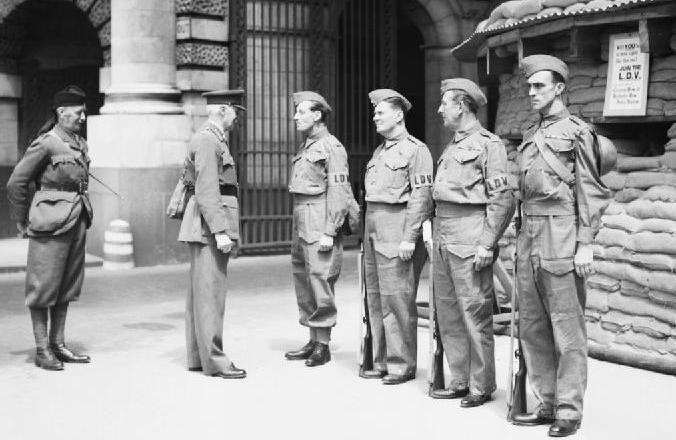
Eventually Lewis would wear another “military” uniform during the Second World War—that of the Home Guard (originally called the “Local Defence Volunteers”). But that is a curious story for another day. Lewis patrolled Oxford in a uniform similar to those portrayed in the photos on this page.

Lewis did not have formal personal ties to the Navy, although his maternal grandfather, a Church of Ireland priest, had served as chaplain in the Royal Navy.

During WWII Lewis developed a warm relationship with members of the Royal Air Force. He offered lectures at a number of installations and taught at the RAF Chaplain School. Although his first lecture began rather inauspiciously, his work with the airmen proved extremely fruitful.

Lewis is a fine example of the man of gentle demeanor who “does his duty” when called upon by his country. Had his lifetime not overarched two global conflicts, he would have been utterly content to remain a civilian and wear the “uniform” of an Oxbridge professor.

home guard


Parachute Optional

c141Under what circumstances would you tell an airman that pulling their rip cord if they exit the plane is optional? I never knew of any until I read an article about resupply missions to the South Pole.

The current issue of Air Force Magazine includes a fascinating article about resupplying McMurdo Station and a second temporary site at the Pole itself. Because of the extreme cold, 100 degrees below zero Fahrenheit (that’s -73.333 degrees Celsius), any airman who accidentally fell from the plane as the pallets were dropped, could not expect to be rescued before freezing to death.

Parachute-laden crewmen standing near open doors of a C-141B Starlifter during a midwinter Antarctic airdrop in 1983 were told they could pull the D-ring ripcord if they fell overboard—or just not bother. The chance of being safely recovered in the darkness and [bone-freezing] temperatures was practically nonexistent.

Putting things in historical perspective, we can consider the fate of WWI pilots in Germany. Theirs was the first nation to provide standard parachutes, and during the first 70 bail outs, a third of the pilots perished. With those statistics, one wonders how many airmen followed the “just not bother” course of action and chose to remain with their plunging aircraft.

C.S. Lewis had a friend named Leo Baker who had served in France as a pilot of the 80th Squadron of the Royal Air Force. The two combat veterans hit it off because of shared interests, including their mutual love of poetry. Here is how Lewis initially described Baker to his lifelong friend, Arthur Greeves, in 1920.

You ask about Baker, and I hardly know how to describe him. He was at a mixed school of a very modern type, where everyone seems to have written, painted and composed. He is so clairvoyant that in childhood “he was afraid to look round the room for fear of what he might see.” He got a decoration in France for doing some work in an aeroplane over the lines under very deadly fire: but he maintains that he did nothing, for he was “out of his body” and could see his own machine with “someone” in it, “roaring with laughter.” He has a bad heart.

He was a conscientious objector, but went to the war “because this degradation and sin might be just the very sacrifice which was demanded of him.” He maintains that everything in Algernon Blackwood [writer of ghost stories] is quite possible: and though the particular cases may be fictitious, “things of that sort” are quite common. He is engaged to be married.

In appearance, he is about my height, with very fair hair, glasses, remarkable eyes and according to the Minto [Janie Moore], rather like you. I like and admire him very much, though at times I have doubts on his sanity.

Like Lewis, Baker had been seriously wounded during the war. He was awarded the Distinguished Flying Cross. Fortunately, it appears he did not have to rely on a primitive parachute. Or, if he did, he was one of the fortunate survivors.

Returning to Antarctica for just a moment, it seems that South Pole mission would have been an exciting adventure in which to share. Terrifying too, perhaps. Fortunately, like Lewis and Baker (and Tolkien, as well), all of the service members returned home safely, mission accomplished.

_____

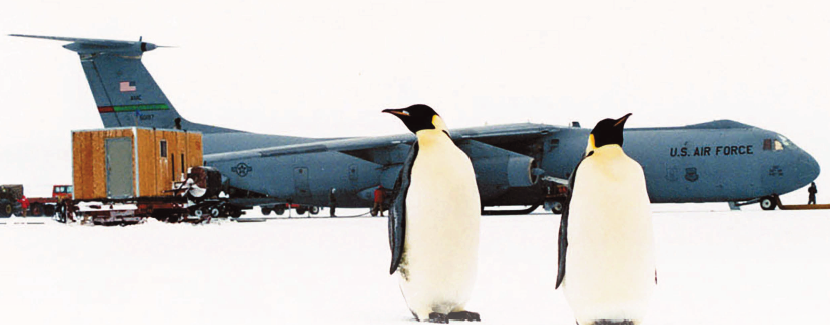
The picture above is a military photograph of a pair of Emperor penguins observing an American C-141 resupply mission during the summer months.

Convoluted Language

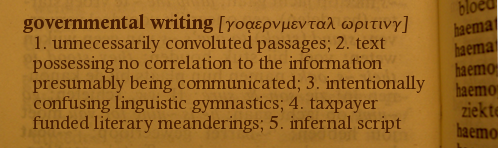
govwritingAre you a skilled reader? Do you pride yourself on possessing a knack for making sense of challenging prose?

Even if you consider yourself a proficient interpreter of text, there is one genre of literature that may still cause you to tremble. Government documents.

Even the most experienced lexical navigators find it challenging to traverse governmental communications. This despite the fact that in 2010 the United States actually passed the Plain Writing Act.

And I’m not even referring to legislation—where seeking sanity and clarity is virtually hopeless. And, it doesn’t matter how simple the source message is. Government scribes are capable of making a document about how to obtain a building permit read like a manual for constructing an orbital weapons platform.

I am not sure whether or not the United States is typical of other nations when it comes to this literary tradition. However, I suspect every nation, aside perhaps from those with populations under 10,000, is plagued by convoluted governmental documents. (There are thirteen such, potentially exempt, communities.*)

A prime example of institutional gobbledygook comes from this question, posed to the Chicago Manual of Style:

Q. Can you please help settle a disagreement? In the following sentence, should “instead of” be replaced with “rather than”? Overpayments occurred because facility purchased care staff processed payments using the local VA Fee schedule instead of the technical component of RBRVS.

A. Let me get this straight: in that nearly unreadable sentence (“because facility purchased care staff processed payments”?), the disagreement centers on whether to use “instead of” or “rather than”?  (Oh, wait—I see from your e-mail address that this is a government office.) Replace the phrase if you are certain that (1) there is a significant difference in meaning, and (2) the current wording does not express the meaning intended. If you cannot reach agreement on these points, you might have to fund a study.

C.S. Lewis offered much sage advice about writing. Sadly, nearly every principle he proposed is utterly alien to governmental documents. His 1956 advice (to a child) should be the required background and screen saver for all government computers:

“Always try to use the language so as to make quite clear what you mean and make sure your sentence couldn’t mean anything else.”

It’s not that I don’t have sympathy for civil servants who write official documents. After all, I edited Air Force Recurring Periodical 52-1 for three years. But I sometimes wonder whether there might be an eccentric psychological disorder that afflicts many government-funded writers . . .

So, it appears, I have made an unintentional confession. The regular readers of Mere Inkling may now know the source of some of the peculiar aspects of these columns.

I have asked my children to have me institutionalized if I ever use the phrase “care staff processed payments.” Short of that, however, these brief conversations are likely to continue for many years to come.

_____

* The following nations and “dependent territories” boast populations under ten thousand, in ascending order:

Pitcairn Islands

Cocos Islands

Vatican City

Tokelau

Niue

Christmas Island

Norfolk Island

Svalbard and Jan Mayen

Falkland Islands

Saint Helena, Ascension and Tristan da Cunha

Montserrat

Saint Pierre and Miquelon

Saint Barthelemy

Nauru barely misses the list due to an excess of eighty-four citizens, according to their 2011 census.

Lemming Legends

lemmingThe closest camaraderie I ever experienced in my life, was on the staff of the USAF Chaplain School. A sign of our esprit de corps was seen in the nicknames we gave one another. Mine was Lemming. (Not too dashing, I know, but read on and you’ll see why it was bestowed with affection and respect.)

Those of us who worked on “Air Staff” projects (for the Chief of Chaplains) were in the Resource Division. Probably because we were always rushing (scurrying?) around responding to emergencies, the other chaplains called us the “Resource Rats.” We were close indeed, and our energies and creativity was magnified by our synergy . . . just like the Inklings.

We embraced the label, and before we knew it each of us had been identified as a particular member of the rodent family. We had a rabbit, hamster, beaver, squirrel and fudged a bit with a ferret and a weasel. Among assorted other “rats,” I was nicknamed—you didn’t choose your identity, your friends awarded it to you—Lemming.

They called me Lemming because I had a unique duty on the team. One of my duties was to do a little bit of “ghostwriting” for the Chief of Chaplains. Some would consider it an honor, but trust me, due to the general for whom I wrote the first year, it was anything but.

Why a Lemming? Well, because whenever a tasking came down I would dutifully march off in obedience . . . even if it meant marching right off of a cliff. Like the humble Lemming, I accepted my fate, and made the best of it.

We all know their tragic story. When the Lemming burrows become overcrowded, a large number of them will sacrificially gather together and march to the sea. There, those who did not perish in catastrophic falls, nobly swim out to sea so that their relatives back in the warren can once again devote themselves to overpopulating their habitat.

I was proud of the appellation. I wore the name (literally, on the shirt logo pictured above) as a badge of honor. Until . . . until I discovered it was all based on a lie.

Lemmings, we have learned, do not suffer from periodic mass suicidal impulses. The common myth is based on an insidious 1958 “nature film” made by Disney. I have no idea why they would compromise their flawless reputation for scientific accuracy in their naturalist media, but in White Wilderness, they cast all integrity aside. (And now I know why C.S. Lewis and J.R.R. Tolkien were wary of the machinations and shadowy motives of Walt Disney Studios.)

With utter disregard to the reputation of these clever arctic creatures, the film showed (supposed) members of the Scandinavian clans eagerly casting themselves to their deaths. However, their bizarre behavior was manipulated by cinematic chicanery.

It turns out that not only did Disney pull the lemmings out of their normal habitat for filming—since they were too intelligent to voluntarily leap to their death, they were thrown off of the cliff from a modified turntable! Ghastly.

Learning that lemmings will not march knowingly (and stupidly) to their own demise has actually made me a bit prouder to bear the title. I mean, it’s one thing as a member of the armed forces to risk your life in the defense of your nation. It’s quite another to commit suicide because a general thought one of your commas was in the wrong place. But that’s a story for another day.

Undue Honor

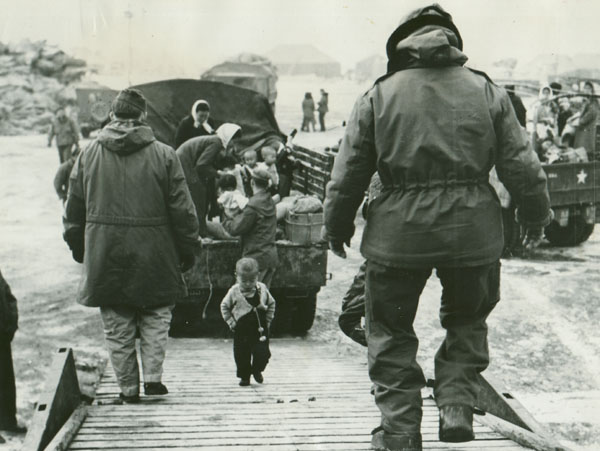
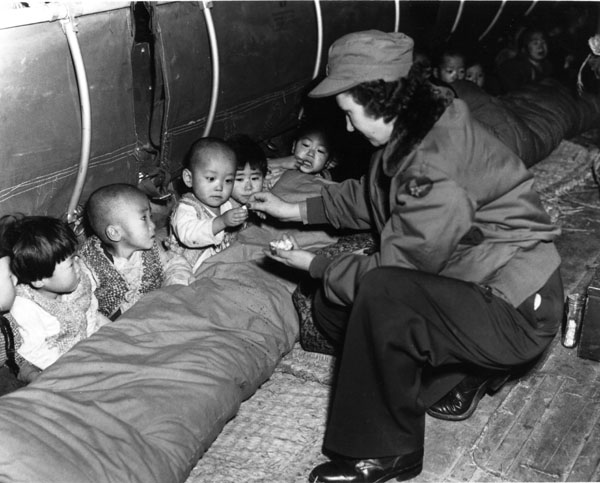
orphan flightHow should we respond when someone else receives all of the praise and accolades for something we actually accomplished? I confess my natural, human reaction is to resent them for it. The example of one outstanding Korean War chaplain, however, clearly reveals how it is much more noble to simply reject resentment and move forward in life.

This column continues a story introduced in my last post, so if you missed it, you may find it helpful to pause and read that piece before continuing. It’s available here.

In discussing the plight of the orphans during the Korean War, I mentioned the name of Chaplain Russell Blaisdell. He and his ministry partner, Staff Sergeant Mike Strang, saved nearly a thousand orphans during a single heroic action in December of 1950.

The full story of the Kiddy Car Airlift can be found on the website of the Korean War Children’s Memorial.

Here are the highlights. For months Chaplain Blaisdell and Sergeant Strang had been rescuing homeless children from the streets of Seoul. Due to the rapid advance of Communist forces, the fall of the capital city became imminent.

The military was rapidly attempting to redeploy its assets, to minimize the resources which were destined to fall into the hands of the enemy. Transporting noncombatants to safety fell far down the long list of urgent missions. The children were nonessential. To everyone, that is, except these two men.

The details of their heroic effort are the stuff of movies. And a movie that included this great escape was indeed made. The only problem is that it did not reflect the true story, and neither of the true heroes received their due.

The story of this injustice is related online here. Briefly, another Air Force officer, a pilot who assisted Blaisdell with finding quarters for the refugees behind friendly lines, received the credit due to the ministry team. So, exactly how did this travesty come about?

Colonel Dean Hess wrote a book, entitled Battle Hymn. It sold well, and included many significant actions in which the author had presumably been directly involved. However, the most significant event, in which he was involved only indirectly, was a focal point of book and its subsequent film (starring Rock Hudson, no less).

Only in very recent years, and unfortunately after Strang had died, has the story been set straight. Blaisdell has received overdue recognition from the Air Force and the Republic of Korea. Strang’s recognition has necessarily been posthumous.

Dr. George Drake wrote an article on this unfortunate tale, and although he entitles it “Hess: Fraudulent Hero,” he does offer a less critical rationale for how misperceptions may have been carried so far.

Once the movie was released it seemed impossible for Hess to say “This is not a true portrayal of what happened.” Hess had become a captive of his own earlier mis-statement of the facts of the rescue. Recently Hess has privately, but not publicly, stated that he was upset with the way the movie distorted the story of the rescue but the truth of the matter is that his concern for that distortion of the facts did not prevent him from accepting the honors due someone else.

Drake reproduces correspondence between Strang and Blaisdell related to the matter. In 1957, Strang wrote his friend about having dinner with Hess in California, in the hopes that he might get a role in the film. “I went out there and he met me one night for dinner and asked me a few questions about what happened on Kiddy Car Operation and I never heard from him after that, as a matter of fact I called him any number of times and he never even had the courtesy to return my call or even leave a message for me.”

Blaisdell’s response brings us back to the question with which I began this column. Based on how the two of them had been overlooked, and especially in light of Strang’s disappointment at failing to get a break in a hoped for civilian career, what should the two of them do? Blaisdell took the high ground and wrote to his comrade in arms:

In regard to doing anything about it, I have decided in the negative. Although I agree with you in principle, the goal of our efforts, in regard to the orphans and also in the evacuation of the Koreans by convoy, was the saving of lives, which would otherwise have been lost. That was accomplished.

In a sense, Mike, well-doing has its own reward, which is not measured in dollars, prestige, or good will . . . This does not mean that I would not be willing to state the facts as they existed to anyone who might properly request them to substantiate your story.

Strang joined his chaplain on the high moral ground, and did not create a scandal. I hope that, had I been in their combat boots, I would have joined them there.

There is something quite alluring about fame. Not everyone is vulnerable to it—we all have our own weak links in our personal armor—but many are. Writers, I suspect are particularly susceptible to the wounds pride and renown can inflict. After all, who among us who writes does not desire a large audience? (Or at least a small but clearly “devoted” one.)

Even C.S. Lewis was not impervious to the assault of fame. In a letter to his friend Don Giovanni Calabria, Lewis describes how personal concerns prevented him from doing much writing at the time. With great personal insight and wisdom, he adds that this may not be such a bad thing.

As for my own work, I would not wish to deceive you with vain hope. I am now in my fiftieth year. I feel my zeal for writing, and whatever talent I originally possessed, to be decreasing; nor (I believe) do I please my readers as I used to. I labour under many difficulties. . . .

These things I write not as complaints but lest you should believe I am writing books. If it shall please God that I write more books, blessed be He. If it shall please Him not, again, blessed be He. Perhaps it will be the most wholesome thing for my soul that I lose both fame and skill lest I were to fall into that evil disease, vainglory.

Like Lewis, we are well served when we ponder the effects of fleeting fame and worldly success on our lives and souls. And, like Strang and Blaisdell, we should carefully weigh our own motivations whenever we desire to seize the recognition we believe we deserve.

orphan airliftAfter all, in the end what is untrue will be dispelled like the morning mists . . . and when that bright Light shines upon us all, only what is true and selfless will glow with the reflection of God’s own glory.

Misinterpreted Symbols

finn planeFew symbols evoke the intense reaction caused by the swastika. Regardless of the color in which it is rendered, it is inescapably associated with the Nazi insanity of the Third Reich.

And yet, for millennia it meant something else. And even today, in many lands it is recognized as representing something completely different.

I recently read a fascinating article* about the 1939-40 Winter War between the Soviet Union (Hitler’s “ally” at the time!) and tiny Finland. The Finns fought valiantly, and although in the peace settlement they forfeited territory to the insatiable communists, they inflicted terrible casualties on the aggressors.

Finnish bitterness toward the Soviets, due to their invasion, led them to ally with the Germans once the nonaggression pact between Germany and the Soviet Union ended. Without any sympathy for Nazi beliefs, they naturally hoped to regain the land they had been forced to surrender in 1940.

Prior to the Finnish alliance with Germany, the swastika already served as the official symbol of their small but talented Air Force. Ironically, they had adopted it in homage to the Swedish noble who donated one of the first foreign planes imported to fight the Russians.

The plane pictured above is the modest aircraft donated by Count Eric Von Rosen. The symbols adorning it are based on his personal crest, which was in turn based upon ancient Viking runes. It represented good luck.

After the decisive defeat of the National Socialist Party, the offensive symbol was virtually wiped away. However, as one writer says, “Although de-Nazification was enforced throughout Scandinavia, it was taken rather lightly in Finland, where the symbol had become an integral symbol for their Air Forces.

This is understandable because in Finland, the symbol meant something completely different than the common association linked to Hitler’s mania.

This should serve as an important lesson for those of us who work with words (which in large part are symbolic). A meaning we may consider patently obvious might turn out to be missed entirely by a reader for whom the “symbols” mean something else entirely. In Mere Christianity C.S. Lewis provides an entertaining illustration of this.

There is no need to be worried by facetious people who try to make the Christian hope of “Heaven” ridiculous by saying they do not want “to spend eternity playing harps.” The answer to such people is that if they cannot understand books written for grown-ups, they should not talk about them.

All the scriptural imagery (harps, crowns, gold, etc.) is, of course, a merely symbolical attempt to express the inexpressible. . . . People who take these symbols literally might as well think that when Christ told us to be like doves, He meant that we were to lay eggs.

The fact that we know the swastika has an ancient pedigree, and that it continues to mean something completely different than Nazism in some locales today, is unlikely to calm the minds of the vast majority of people who will never become comfortable with it.

Turning to Lewis once more we find a dynamic image that is perfectly apropos to our discussion of the swastika as a symbol. Symbols, he reminds us, are inherently powerful. Although written in a different context (“Williams and the Arthuriad”), Lewis could easily have had in mind the preeminent symbol of Nazism and the Holocaust when he wrote:

A symbol has a life of its own. An escaped metaphor—escaped from the control of the total poem or philosophy in which it belongs—may be a poisonous thing.

_____

* You can download a copy of “The Winter War” from Air Force magazine at this link.

Obstreperous Language

obstreperous

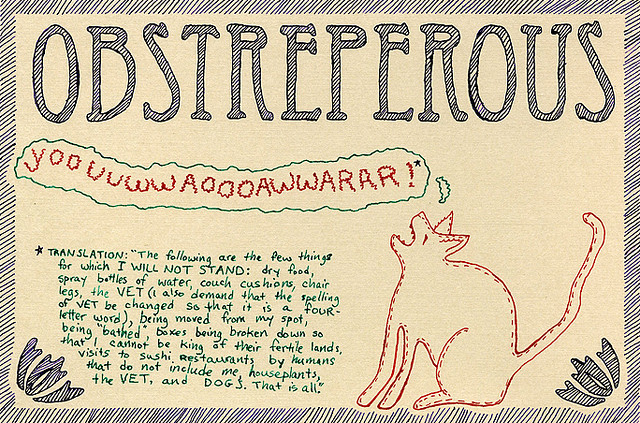
© Stella Belikiewicz and used by permission.

Despite my many shortcomings, I do “pride” myself on possessing a rather considerable vocabulary. My 97th percentile score of the GRE* reinforced my impression that I knew a lot about words.

One technique which has increased my vocabulary is to never let an unknown word pass by without making an effort to learn its meaning. This is simple when I’m working at the computer. If I’m unsure of a definition, I immediately look it up in an online dictionary such as this.

Very rarely do I “guess” at a meaning, based upon its context. This mainly occurs if I’m listening to the radio while I’m driving, and I don’t have recourse to a dictionary. Even then I try to impress the new word on my memory so that I can research it when I return home.

The word in this column’s title motivated me to discuss the importance of accurately understanding word definitions. When I encountered “obstreperous,” it rang vague bells of recollection. And, I was able to discern the word’s general meaning from the context of the article. While some readers of Mere Inkling are already familiar with its meaning—and perhaps use it in daily conversations—allow me to share the context in which I encountered it.

I was reading an article in a military journal about the “battle over ballistic missiles” which was fought inside the Air Force as the manned-bombers-only mindset had to be breached so the United States could advance into the ICBM age. The champions of the two positions were two successive Air Force Chiefs of Staff, Thomas White and Curtis LeMay.

White struggled with how to control the obstreperous LeMay. He knew he didn’t have the political power to force LeMay out, nor could he outwait his [Strategic Air Command] chief. LeMay received his fourth star in 1951 at age 44, which made him the youngest four-star U.S. general since Ulysses S. Grant.**

I’m rarely content with possessing an amorphous definition of a word, so I looked it up. My general impressions of its meaning were confirmed, and I added another word to my personal vocabulary. (The fact that I may never use it beyond its appearance in this post is irrelevant.) Here’s the dictionary entry:

ob·strep·er·ous [uhb-strep-er-uhs]

adjective

1. resisting control or restraint in a difficult manner; unruly.

2. noisy, clamorous, or boisterous: obstreperous children.

Parents give their children a precious gift by encouraging the growth of their own vocabularies. In the pre-computer days, we had a dictionary not far away when we had dinner, and it wasn’t uncommon for it to find its way to the table during our conversations.

Consciously adding new words to our vocabulary is a skill especially vital to writers.

C.S. Lewis wrote about how common usage of familiar words requires no contextual definition. However, he warns of the danger of accepting subjective “definitions” offered outside the context of credible dictionaries.

When we leave the dictionaries we must view all definitions with grave distrust. It is the greatest simplicity in the world to suppose that when, say, Dryden defines wit or Arnold defines poetry, we can use their definition as evidence of what the word really meant when they wrote.

The fact that they define it at all is itself a ground for scepticism. Unless we are writing a dictionary, or a text-book of some technical subject, we define our words only because we are in some measure departing from their real current sense. Otherwise there would be no purpose in doing so. . . .

The word wit will illustrate this. We . . . find old critics giving definitions of it which are contradicted not only by other evidence but out of the critics’ own mouths. Off their guard they can be caught using it in the very sense their definition was contrived to exclude.

A student who should read the critical debate of the seventeenth century on wit under the impression that what the critics say they mean by wit is always, or often, what they really mean by wit would end in total bewilderment.

He must understand that such definitions are purely tactical. They are attempts to appropriate for one side, and to deny to the other, a potent word. You can see the same “war of positions” going on today.

A certain type of writer begins “The essence of poetry is” or “All vulgarity may be defined as,” and then produces a definition which no one ever thought of since the world began, which conforms to no one’s actual usage, and which he himself will probably have forgotten by the end of the month. (Studies in Words)

I find it rather fitting to include this passage from Lewis, with its martial imagery, in a column inspired by a description of a surly advocate of massive nuclear bombing as the best deterrence of World War III.

Writers, particularly those attempting to be persuasive, are wise to ponder Lewis’ wise counsel. We cannot surrender the battlefield to those who would revise the clear and historic meanings of words in an effort “to appropriate for one side, and to deny to the other, a potent word.”

_____

* The Graduate Record Exam is a standardized test used as part of the admission process for many university graduate programs in the United States. We won’t be discussing my mathematics score here . . .

** If the source article interests you, you can read it at Air Force Magazine.

The artwork above is copyrighted by its creator, Stella Belikiewicz, and used with her permission.