
Parachute Optional

c141Under what circumstances would you tell an airman that pulling their rip cord if they exit the plane is optional? I never knew of any until I read an article about resupply missions to the South Pole.

The current issue of Air Force Magazine includes a fascinating article about resupplying McMurdo Station and a second temporary site at the Pole itself. Because of the extreme cold, 100 degrees below zero Fahrenheit (that’s -73.333 degrees Celsius), any airman who accidentally fell from the plane as the pallets were dropped, could not expect to be rescued before freezing to death.

Parachute-laden crewmen standing near open doors of a C-141B Starlifter during a midwinter Antarctic airdrop in 1983 were told they could pull the D-ring ripcord if they fell overboard—or just not bother. The chance of being safely recovered in the darkness and [bone-freezing] temperatures was practically nonexistent.

Putting things in historical perspective, we can consider the fate of WWI pilots in Germany. Theirs was the first nation to provide standard parachutes, and during the first 70 bail outs, a third of the pilots perished. With those statistics, one wonders how many airmen followed the “just not bother” course of action and chose to remain with their plunging aircraft.

C.S. Lewis had a friend named Leo Baker who had served in France as a pilot of the 80th Squadron of the Royal Air Force. The two combat veterans hit it off because of shared interests, including their mutual love of poetry. Here is how Lewis initially described Baker to his lifelong friend, Arthur Greeves, in 1920.

You ask about Baker, and I hardly know how to describe him. He was at a mixed school of a very modern type, where everyone seems to have written, painted and composed. He is so clairvoyant that in childhood “he was afraid to look round the room for fear of what he might see.” He got a decoration in France for doing some work in an aeroplane over the lines under very deadly fire: but he maintains that he did nothing, for he was “out of his body” and could see his own machine with “someone” in it, “roaring with laughter.” He has a bad heart.

He was a conscientious objector, but went to the war “because this degradation and sin might be just the very sacrifice which was demanded of him.” He maintains that everything in Algernon Blackwood [writer of ghost stories] is quite possible: and though the particular cases may be fictitious, “things of that sort” are quite common. He is engaged to be married.

In appearance, he is about my height, with very fair hair, glasses, remarkable eyes and according to the Minto [Janie Moore], rather like you. I like and admire him very much, though at times I have doubts on his sanity.

Like Lewis, Baker had been seriously wounded during the war. He was awarded the Distinguished Flying Cross. Fortunately, it appears he did not have to rely on a primitive parachute. Or, if he did, he was one of the fortunate survivors.

Returning to Antarctica for just a moment, it seems that South Pole mission would have been an exciting adventure in which to share. Terrifying too, perhaps. Fortunately, like Lewis and Baker (and Tolkien, as well), all of the service members returned home safely, mission accomplished.

_____

The picture above is a military photograph of a pair of Emperor penguins observing an American C-141 resupply mission during the summer months.

Engage Brain

brainsWhen I attended the University of Washington, we had to learn the old-fashioned way—by studying. Now they are anticipating downloading information directly into students’ brains.

Literal brain dumps are actually still in the future . . . but researchers have documented the first indisputable brain-to-brain interface between humans!

My first paragraph is not an exaggeration of what researchers think may one day happen.

The project could also eventually lead to “brain tutoring,” in which knowledge is transferred directly from the brain of a teacher to a student.

The student would view this shortcut as advantageous. (It could also save a great deal in tuition expenses, if each course only took, say, an hour or two of brain interfacing.)

The university sees another advantage—circumventing limited teaching skills.

“Imagine someone who’s a brilliant scientist but not a brilliant teacher. Complex knowledge is hard to explain – we’re limited by language,” said co-author Chantel Prat, a faculty member at the Institute for Learning & Brain Sciences and a UW assistant professor of psychology.

My main question is, what will the teacher do, once their knowledge has been transferred to a student?

Presumably they will be able to retain a semblance of their knowledge, unlike the experience of the unfortunate Orbanians. They rely on a nanite technology, and it leaves the brilliant brain in a childlike state after the knowledge is siphoned out of it. You can learn more about them in “Learning Curve,” a documentary about the Stargate project.

C.S. Lewis had a great deal to say about education. He was a popular professor, despite the fact many of his students were intimidated by his brilliance. It is possible that if his students were able to download his knowledge, it might have caused their crania to explode.

In one essay, Lewis explains the differences between education and training, declaring “If education is beaten by training, civilization dies.” (“Our English Syllabus”).

Lewis continues, arguing that learning itself, is something distinct. It is not marked by a transfer of knowledge, but by a hunger to grow.

Now learning, considered in itself, has, on my view, no connexion at all with education. It is an activity for . . . all [who] desire to know. . . .

Societies have usually held a belief . . . that knowledge is the natural food of the human mind: that those who specially pursue it are being specially human; and that their activity is good in itself besides being always honourable and sometimes useful to the whole society.

Oh, and if you are waiting to “learn” when they can download knowledge directly into your skull, consider this wise advice from Lewis.

The only people who achieve much are those who want knowledge so badly that they seek it while the conditions are still unfavourable. (“Learning in Wartime”).

_____

The picture above shows two UW guinea pigs transferring brain waves to one another. (I am uncertain whether two-way transfer is already possible, or if one brain is forced to serve in a receptacle role.)

The article announcing the results can be seen here.

Oxymoronic Misunderstanding

guardian angelOxymoron is a great word. Too bad so few people understand what it means.

In America, at least, nine times out of ten you will hear it misused. Most folks seem to think it means a “contradiction in terms.”

One common example is “military intelligence.” Perhaps I am sensitive to it, being a veteran, but I would enjoy never again hearing people guffaw at that term.

In actuality, the oxymoron is a much more sophisticated rhetorical device.

An oxymoron is the combination of two incongruous words or images to create a unique effect. Often it hints of irony. For example, “she was a poor little rich girl.”

Further examples suggest complex circumstances. “Cruel kindness” and “making haste slowly,” are quite intriguing. The context would provide greater illumination, but these phrases suggest a painful treatment given in love . . . and urgency, tempered by caution.

Another example, apropos for an age in which zombies have become so popular, is the phrase “living death.” Reanimated corpses aside, this oxymoron is extremely powerful.

It evokes the sense of a person’s life having become deathlike in some way. Perhaps it is physical, emotional, psychological or spiritual. In any case, drawing together life and death in this epigram is provocative.

In his most vulnerable work, A Grief Observed, C.S. Lewis describes humanity itself as an oxymoron. Most certainly, he uses the word appropriately.

Sometimes, Lord, one is tempted to say that if you wanted us to behave like the lilies of the field you might have given us an organization more like theirs. But that, I suppose, is just your grand experiment. Or no; not an experiment, for you have no need to find things out. Rather, your grand enterprise. To make an organism which is also a spirit; to make that terrible oxymoron, a ‘spiritual animal.’

Lewis’ point is well taken. That the Creator of the cosmos would make flesh bound human beings with a spiritual nature that allows him to describe as made in his own image, is incomprehensible.

Animals are animals. That is what modern secularists argue that we are. Yet it is evident to the vast majority of humans throughout all times and cultures, that we are unlike beasts. For we possess a spirit. And we are, accordingly, that unique thing among all beings—a spiritual animal.

So peculiar are we in the universe that even the angels themselves—spirits, never “animals”—are curious about the nature of our redemption. As Peter writes in his first epistle:

Concerning this salvation, the prophets who prophesied about the grace that was to be yours searched and inquired carefully, inquiring what person or time the Spirit of Christ in them was indicating when he predicted the sufferings of Christ and the subsequent glories.

It was revealed to them that they were serving not themselves but you, in the things that have now been announced to you through those who preached the good news to you by the Holy Spirit sent from heaven, things into which angels long to look.

From one oxymoron to another, I hope that this new year brings you many blessings. Most especially, I pray that if you have not already experienced this wondrous miracle which amazes even the angels of heaven . . . that you would come to know God’s love.

Sanctified Languages

petrusOne major difference between Christianity and Islam is their view of language. For the Muslim, Arabic is the language by which the Quran is to be known. For the Christian, there is a great impulse to translate the Scriptures into every tongue in the world.

In Islamic worship, the Quran is properly recited only in Arabic, whether the individual understands Arabic or not. This is similar to the way that most Hindus chant mantras in ancient Sanskrit.

A parallel can be drawn with the medieval practice in the Western branches of Christianity where Latin continued to be used for worship, even after it lost its role as the shared language.

The fact, however, that the Bible had even been translated into Latin was due to the Christian desire to make God’s word accessible to all people. Jerome, an early Christian theologian, became a linguistic scholar with the goal of translating the Vulgate, into the common language of his day.

It would have been a great shock to him, and to Pope Damasus I who commissioned his effort, to see the Latin so ingrained in the church’s usage that their heirs in leadership lost sight of the desire to bring the Lord’s words directly to the people so that all could understand them.

One of the great successes of the Reformation was the successful translation and distribution of the Scriptures into the vernacular of various language groups. Martin Luther’s translation, in fact, standardized the German language which had evolved into several different dialects.

Coincidentally, Lutherans have remained at the forefront of Bible translation, and Lutheran Bible Translators continue that vital work today. They currently have twenty-two Bible translations in process. LBT works in conjunction with Wycliffe Bible Translators, which is an even larger organization.

C.S. Lewis delivered a lecture at the University of London entitled “The Literary Impact of The Authorised Version.” In one portion he addressed the influence of the King James translation on the English language. While not nearly so pronounced as Luther’s on German, it is measurable.

The history of the Authorised Version has been told so often that I will not attempt to re-tell it, and its beauties praised so lavishly that I will not praise them. Instead, I will proceed at once to its influence as an English book. I shall attempt to define that influence, for I think there has been misunderstanding about it and even a little exaggeration.

Lewis’ argument is that the Bible has a profound influence on English literature, the particular translation, less so.

Ideally, all Christians would understand Hebrew and Greek, and be able to read the Scriptures in their original languages. However, there is no stigma in reading a translation. In fact, there are small pockets of people who do not understand the history of the Bible who believe that one particular translation (i.e. the King James Version) is the only authoritative text.

Sadly, I once saw an advertisement in a newspaper inviting worshipers that read: “Are you tired of people changing the Authorized Version of God’s Word with Greek and other languages? If so, come and join us at . . .”

Fortunately, the vast majority of Jesus’ disciples celebrate the translation of God’s word of life into every language spoken today.

Meanwhile, memorization of the Quran in Arabic (even when that is not the reciter’s actual language) remains highly regarded in Islam. Arabic has been regarded as so holy, in fact, that there was great reluctance to contaminate the Quran by using a printing press.

During the Ottoman Empire, until 1729, printing anything in Arabic was a crime. Somewhat ironically, the first printing utilizing Arabic movable type was done by Pope Julius II in the first decade of the sixteenth century. It was created for the benefit of Christians living in Arabic lands.

To provide a powerful illustration of a Christian validation of the authentic inspiration and power of God’s words—in any language—we turn once again to the German reformer.

Since it becomes Christians then to make good use of the Holy Scriptures as their one and only book and it is a sin and a shame not to know our own book or to understand the speech and words of our God, it is a still greater sin and loss that we do not study languages, especially in these days when God is offering and giving us men and books and every facility and inducement to this study, and desires his Bible to be an open book. . . .

In proportion then as we value the gospel, let us zealously hold to the languages. For it was not without purpose that God caused his Scriptures to be set down in these two languages alone—the Old Testament in Hebrew, the New in Greek. Now if God did not despise them but chose them above all others for his word, then we too ought to honor them above all others. St. Paul declared it to be the peculiar glory and distinction of Hebrew that God’s word was given in that language, when he said in Romans 3, “What advantage or profit have those who are circumcised? Much indeed. To begin with, God’s speech is entrusted to them. . . .”

Similarly, the Greek language too may be called sacred, because it was chosen above all others as the language in which the New Testament was to be written, and because by it other languages too have been sanctified as it spilled over into them like a fountain through the medium of translation. (Martin Luther, “To the Councilmen of Germany”).

_____

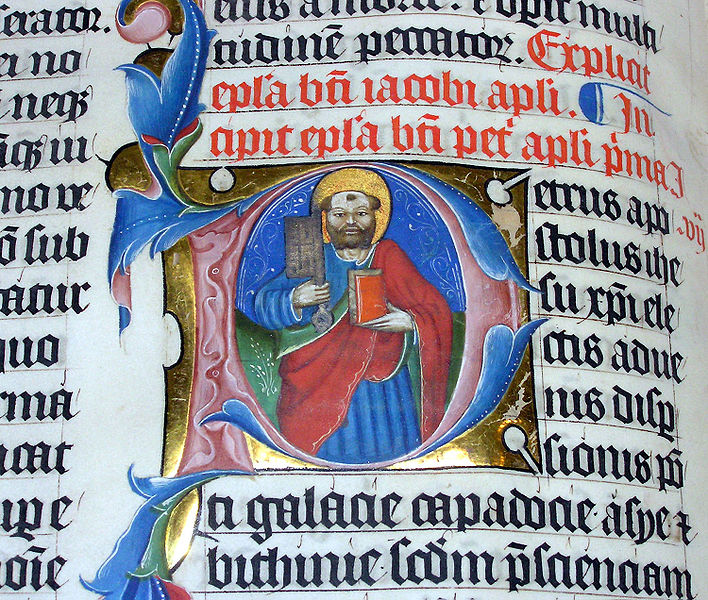
The image above is an illuminated “P” which begins the name Petrus (Peter). The manuscript is displayed in Malmesbury Abbey in England, but was originally transcribed in Belgium circa 1400.

Literary Martial Arts

nonficOne of the lowest moments in my writing life occurred when a creative writing professor advised me to “stick with nonfiction.” Oh, she said it gently, but it still struck me with the power of a mixed martial arts (MMA) hammerfist.

I was majoring in editorial journalism at the University of Washington. Attempting to expand my scope, I took a short story writing course. It was a mistake.

I thought I had done adequately during the course. I was even moderately pleased with a couple of my stories. The instructor, on the other hand, well let’s just say she was not impressed with my effort.

She was right. At the time, my ear for good fiction was quite immature. I do not claim that it’s particularly well developed today, but I have written a story about a medieval pilgrimage that I hope to unveil in a year or two.

I was reminded of my literature professor’s grim assessment as I recently read an interview with a pastor, who is also a lawyer, and happens to be a writer as well. His name is Randy Singer.

Singer describes the similarity of his professions by saying “They all require skills in persuasion, in telling stories to illustrate things.” I guess he’s right.

The difference being that pastors tell true stories, authors of fiction write imaginary stories, and attorneys weave tales that lie somewhere in between.

The part of the interview, which appeared in World Magazine, that I found particularly insightful was this:

When your only desire is to tell the story so people don’t even notice the wording, at that point you’ve become a fiction author.

Singer’s description struck me with the force of an MMA ridge hand (a reverse knife-hand). When I came to, I finally knew why composing fiction does not come naturally to me.

I love words too much. Too much to sacrifice them simply for the sake of the story. Oh, I value the message also, but getting there is half the fun.

Although I don’t love words to the degree many poets lust after them, I still possess an affection that does not allow me to view them through purely utilitarian lenses.

To add insult to his literary injury, Singer adds the following, in response to the question of what he learned while writing several successful novels.

Third, to be less verbose and let the action carry the story instead of thinking, “What are some really flowery and cool phrases and words that I can weave into this?”

That’s enough, friend. You made your point. I would have responded a bit more colorfully and fragrantly, but I hear you.

Singer doesn’t cite C.S. Lewis in the interview, but his counsel is consistent with that of the Oxford don. Lewis advised using clear and concrete language, “so as to make quite clear what you mean and make sure your sentence couldn’t mean anything else.” (Personal Correspondence, 1956).

Similarly, Lewis would always argue for the words not to draw attention to themselves. Essentially, they need to get out of the way so the message can come through. “Don’t use adjectives which merely tell us how you want us to feel about the things you are describing. I mean, instead of telling us a thing was “terrible,” describe it so that we’ll be terrified.”

It’s wisdom like that which causes us to recognize C.S. Lewis as the brilliant, gifted, creative, versatile and anointed writer that he was.

As for Singer, perhaps I’ll have to check out one of his legal thrillers. The latest is set in antiquity, with a Roman jurist defending Paul before Nero. Should be quite interesting. Not so good as a nonfiction account of such a trial would be . . . but probably worth reading.

Adopting a Puppy

calliI recently described Henri III’s torture of puppies during his reign. The clown actually wore them, as an adornment!

In that same column, I mentioned that we were adopting a new puppy . . . and she has arrived in our home!

Getting a puppy marks a departure from our normal pattern. Our last three border collies (including the mature lady who still graces our manse) were all “rescues.”

However, we did not feel that Foxy was up to adjusting to another mature dog, since she lost Lyric last winter and her other (long-lived) sister, Tanner.

In my post about Henri III, I shared comments from two letters that C.S. Lewis wrote a century ago to one of his closest friends. Arthur Greeves had gotten a puppy, and Lewis reminded him of the responsibilities of the human member of that relationship.

Lewis wrote that it was cruel, “Unless you are a person with plenty of spare time and real knowledge, it is a mistake to keep dogs . . .”

In a subsequent letter, Lewis advised Greeves on how to choose a name for his puppy.

How’s the poor, miserable, ill-fated, star-crossed, hapless, lonely, neglected, misunderstood puppy getting along? What are you going to call him, or rather, to speak properly, how hight he? Don’t give him any commonplace name, and above all let it suit his character & appearance. Something like Sigurd, Pelleas or Mars if he is brisk and warlike, or Mime, Bickernocker or Knutt if he is ugly and quaint.

We had already chosen the name for our puppy before I found this quotation. But I think Lewis would have approved.

We named our new little girl after one of the Greek Muses, who inspired literature and the arts. Her name is Calli.

If you’re knowledgeable in mythological matters, you will recognize that it’s our nickname for Calliope, the Muse of epic poetry.

Being more of a historian than a poet, I wanted to use the name Clio, who is the Muse of History. Calli fits her better though.

Calliope is a wonderful, musical name though, since she was the chief Muse, and her name literally means “beautiful-voiced.” What a lovely name. I hope Calli learns to sing, like our first border collie, Lady. Lady would accompany my wife as she played the piano. It was quite entertaining.

If you have read this far, you too are likely a pet lover. If you have a dog, cat, rabbit, lemur or whatever, of your own, may the Lord bless it with a long and healthy life . . . just as we pray for our own little Calli.

Similes & Metaphors

agdeiSimiles are wonderful literary tools. Being able to compare two dissimilar things in a way that brings out subtle nuances and insights is quite enjoyable.

Here are a couple of examples off the top of my head. (I don’t pretend others haven’t written these things, but I didn’t plagiarize them.).

A politician is like a weathervane.

Arguing theology is like having indigestion.

Disliking Narnia is like hating a feast.

Metaphors, of course, are far more powerful than similes. When we consider a metaphor we are pondering how two different things actually share some fundamental quality.

Comprehending metaphors requires the ability to think abstractly. A child—confined to a world of concrete concepts—cannot begin to think of their nation as a “motherland” or “fatherland,” as the case may be. Yet, those are powerful nurturing and bonding words that countless patriots have embraced throughout the centuries.

A simile might say “our country is like a family.” A metaphor suggests far more. In this case, it might convey that one’s allegiance to their nation should exceed their loyalty to their biological kin.

Nowhere is the magnificence of metaphors more manifest than in the way we talk about God. One of the most famous biblical passages is a straight forward example. “God is love” (1 John 4:8).

Jesus the Christ said of himself, “I am the Way, the Truth and the Life” (John 14:6). He also called himself the “Light of the world. Whoever follows me,” he added, “will not walk in darkness, but will have the light of life” (John 8:12).

It is a sad thing when a symbol loses its meaning. There is a prime example of that phenomenon in Oxford. And you can see it in the sign that hangs above a pub frequented by the Inklings.

No, not the Eagle and Child, which they affectionately referred to as the Bird and Baby.

After renovations to the Eagle and Child eliminated their privacy, the writers transitioned across the street to the Lamb and Flag. Both pubs trace their history back to the seventeenth century, and the latter is actually owned by St. John’s College. (It’s profits fund student scholarships.) In a 1963 letter, Lewis colorfully described the move thusly:

Mon 11 March it is. But note that our causeries de lundi are now permanently transferred to the Lamb & Flag. We were sorry to break with tradition, but the B & B had become too intolerably cold, dark, noisy, and child-pestered.

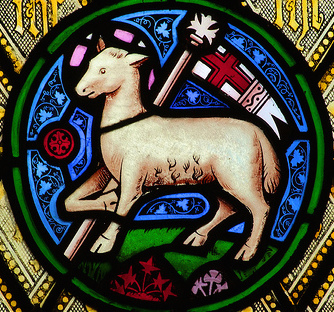
Sadly, when many people look at the Lamb on the pub’s sign, they fail to recognize it’s significance. The lamb carrying a cross-emblazoned banner is nothing other than the Agnus Dei, the Lamb of God.

What, some may wonder, is the Lamb of God? The better question is “who” is the lamb. The symbol represents Jesus Christ himself. It hearkens to the declaration of John the Baptizer as Jesus approached the Jordan: “Behold, the Lamb of God, who takes away the sin of the world!” (John 1:29).

To understand what it means to say “Jesus is the Lamb,” requires two things. First, a recognition that it is more than a simile; it is not simply that he possesses some of the attributes we would naturally associate with a lamb, such as gentleness. The second requisite is that we understand something about the Jewish sacrificial system.

For, Jesus being the Lamb of God means nothing less than that he is the true, complete, ultimate and final sacrifice for the sins of humanity.

And that is a wonder definitely worth pondering during this Christmas season.

Martian Tribute to C.S. Lewis

Malacandra CraterMere Inkling recently named a crater on Mars, in honor of C.S. Lewis. The crater’s name is Malacandra, which was the name for the red planet in the first volume of Lewis’ Space Trilogy, Out of the Silent Planet.

The naming of Malacandra Crater was done through an organization preparing the map which will be used by the Mars One Mission. Mars One is the optimistic international effort to establish a permanent human settlement on the red planet, beginning in 2024.

The über-adventurous (or foolhardy) are able to apply today for consideration to become an astronaut.

The crater naming project is not sponsored by the International Astronomical Union (IAU). Instead, it is coordinated by Uwingu, a for profit company that has a goal of raising $10,000,000 for grants to scientists and educators promoting space exploration.

Due to its limited* budget, Mere Inkling was only able to name a small crater. However, it’s not the expense, it’s the thought that counts.

In addition to Malacandra Crater, I named the impact mark directly to its south in honor of my grandchildren. The process allows one to include a dedication for each named crater. For theirs, I wrote:

Stroud Crater is named in honor of the brilliant grandchildren of Rob & Delores Stroud. Andrew, Ariana, Dominic, Arabelle, Rachel, Rebecca, Kaelyn & Asher. Whether they grow up to be astrophysicists, veterinarians or educators, we know they will all make this world a better place. Soli Deo Gloria.

The tiny basins named above lie in Aurorae Chaos. It’s a rugged neighborhood, but there are surprisingly few craters in the immediate vicinity. I’m always seeking opportunities to encourage my grandchildren to study science, and I hope this will pique their interests, both now and in the years to come.

C.S. Lewis is not primarily known today as a writer of science fiction, but his series (also known as the Cosmic Trilogy, or the Ransom Trilogy, after its protagonist) is quite good. In fact, it was the very first of Lewis’ works I ever read. I was introduced to them by a Christian friend during my college years.

Several influences converged to move Lewis to venture into science fiction. In 1938, he thanked a friend for his praise of Out of the Silent Planet, and wrote:

You are obviously much better informed than I about this type of literature and the only one I can add to your list is Voyage to Arcturus by David Lyndsay (Methuen) which is out of print but a good bookseller will probably get you a copy for about 5 to 6 shillings. It is entirely on the imaginative and not at all on the scientific wing.

What immediately spurred me to write was Olaf Stapledon’s Last and First Men and an essay in J. B. S. Haldane’s Possible Worlds both of which seemed to take the idea of such travel seriously and to have the desperately immoral outlook which I try to pillory in Weston.

I like the whole interplanetary idea as a mythology and simply wished to conquer for my own (Christian) point of view what has always hitherto been used by the opposite side. I think Wells’ 1st Men in the Moon the best of the sort I have read.**

Lewis then appends a comment referring to the other planets in our solar system, but intriguing in light of the recent discovery of numerous planets throughout the galaxy. “The more astronomy we know the less likely it seems that other planets are inhabited: even Mars has practically no oxygen.”

One of Lewis often overlooked science fiction short stories, “Ministering Angels,” is set on Mars. It begins in the following way.

The Monk, as they called him, settled himself on the camp chair beside his bunk and stared through the window at the harsh sand and black-blue sky of Mars. He did not mean to begin his ‘work’ for ten minutes yet. Not, of course, the work he had been brought there to do. He was the meteorologist of the party, and his work in that capacity was largely done; he had found out whatever could be found out.

There was nothing more, within the limited radius he could investigate, to be observed for at least twenty-five days. And meteorology had not been his real motive. He had chosen three years on Mars as the nearest modern equivalent to a hermitage in the desert.

He had come there to meditate: to continue the slow, perpetual rebuilding of that inner structure which, in his view, it was the main purpose of life to rebuild. And now his ten minutes’ rest was over. He began with his well-used formula. ‘Gentle and patient Master, teach me to need men less and to love thee more.’ Then to it. There was no time to waste.

There were barely six months of this lifeless, sinless, unsuffering wilderness ahead of him. Three years were short . . . but when the shout came he rose out of his chair with the practised alertness of a sailor.

The Botanist in the next cabin responded to the same shout with a curse. His eye had been at the microscope when it came. It was maddening. Constant interruption. A man might as well try to work in the middle of Piccadilly as in this infernal camp. And his work was already a race against time. Six months more . . . and he had hardly begun.

The flora of Mars, these tiny, miraculously hardy organisms, the ingenuity of their contrivances to live under all but impossible conditions—it was a feast for a lifetime. He would ignore the shout. But then came the bell. All hands to the main room.
(“Ministering Angels,” Of Other Worlds: Essays and Stories).

Malacandra Crater may be a small feature on a vast and curious planet, but it is a tribute to an author of immense and lasting talent.

_____

* i.e. nonexistent

** The following titles mentioned by Lewis are available for free digital download:

Voyage to Arcturus

Last and First Men

The First Men in the Moon

Abusing Puppies

henriPuppies are cute and cuddly, but leave it to a French king to carry that fact to absurd lengths.

One might think owning 2,000 lap dogs is a bit overmuch. Not so Henri III (1551-1589). It would seem that after the first thousand, it might become difficult to recall all of their names, but that didn’t deter Henri.

He so loved his puppies that he used them as a form of adornment, regularly wearing them in a small basket suspended around his neck.

And, amazingly, it appears none of his courtiers mentioned that it looked quite silly. Who knows, he may have established a temporary fad, not unlike the purse puppies used by some modern celebrities to increase attention to themselves.

Puppies are on my mind now, because my wife and I have “reserved” a border collie from a recent litter.

Some readers will recall the grief we experienced when a dog we rescued a year ago, died due to an onslaught of seizures, one after the other. Lyric’s tragic passing, at a young age, was so much more difficult than the loss of our previous three who had lived well into their geriatric years.

It’s taken us a year to be willing to consider adding another dog to our family. We still have Foxy, who we rescued about eight years ago, during our final military tour in California. We decided it would be much easier for her if we added a puppy to our family this time.

I’ll write more about our puppy in the future. For now I’ll end with the “teaser” that we’re naming her after one of the Greek Muses.

C.S. Lewis loved dogs, although apparently not enough to wear them like jewelry.

In 1916, he corresponded with his friend Arthur Greeves about adding a puppy to the latter’s family. His first mention, as Greeves was contemplating the decision, reveals Lewis’ emphasis on the wellbeing of the dog over its master’s preferences.

I think you are very wise not to take that puppy from K. Unless you are a person with plenty of spare time and real knowledge, it is a mistake to keep dogs–and cruel to them.

Greeves proceeded with the adoption, as Lewis appends a postscript to his next letter, written a week later.

Poor puppy!! What a life it’ll have! I shall poison it in kindness when I come home!

In a subsequent letter, the same month, Lewis offers advice about naming the puppy that I was delighted to read. It suggests that he would approve of our decision for the name of the new addition to our family.

In the meantime, whatever name we bestowed on our new puppy, she would never need to worry about being traipsed around on display like a fashion accessory. We’ll leave that to French kings and egocentric divas.

Marrying a Writer

museA recent episode of the series Castle illustrated something all of the spouses of writers know—they are wed to peculiar people.

The premise for the program, currently in its seventh season, is that a mystery novelist accompanies homicide detectives in New York City on their investigations.

Despite his frequently outlandish theories, Richard Castle often contributes significantly to solving the crimes. His counterpart is Kate Beckett, the senior detective who leads the team.

The two of them recently wed, which led to the following exchange while they were on their honeymoon, which doubled as a homicide investigation at a frontier “dude ranch.”

Faced with complex evidence, Castle says, “That’s why we approach this as writers.”

Beckett responds with a comment representative of literary spouses. “So we procrastinate and we make things up?”

Ouch.

That strikes a bit close to home. The second element—making things up—can be construed by our nimble minds as an actual compliment. Yes, we do think creatively and out of the mundane box. Thank you very much.

On the other hand, the procrastination label . . . well, speaking for myself, it fits far too well.

Writing, after all, is not simple. Even poor writing requires effort. And, if one hopes to write well . . . it requires time, skill and practice.

Few can sit down at the keyboard and imperiously command their “muse” or inspiration to be at hand. This is true for all authors, including Christian writers who seek guidance from the Holy Spirit.

The simple fact is, however, that if we waited until we felt fully inspired, most of us would accomplish little.

In my own case, I sincerely attribute anything good that I might write to the Lord. The chaff comes from me. I won’t presume to guess what small percentage of the words are wheat, but I will confess that I am most productive when I discipline myself to write. And, this discipline typically involves a self-imposed deadline.

Thus the reason for the graphic at the head of the page. I have recognized in the fall of life, as I seek to pursue my writing avocation more seriously, that “The deadline is my Muse.”

Beckett knows very well that her fictional husband often requires a deadline to complete his novels.

My wife sees the same principle at work when I request her urgent proofreading of something I’ve waited too long to complete.

C.S. Lewis had ample experience with deadlines himself. And he knew well that even a required submission date could not guarantee literary production. In 1958 he wrote to his editor, Jocelyn Gibb, saying that he may, or may not, be able to provide a contribution to an upcoming edition of The Psalms as Poetry.

Dear Gibb, Thanks for the book, a very nice bit of work. I’ll try to re-read Miracles for mis-prints while I’m in Ireland, where my wife and I go tomorrow. When is deadline for your Fifty-Two? Not that I’m sure I can pump anything up anyway.

He did manage to provide a contribution, which he later included as part of the introductory chapter for Reflections on the Psalms.

I’m not certain whether Lewis wrote those pages simply because inspiration compelled him to . . . or if the issue deadline provided a little supplemental motivation. I suspect it was the latter.

To any writers out there who never require the encouragement of a deadline—consider yourself uniquely blessed!

To the masses who share my battle with the plague of procrastination, you have my sympathy. Still, after pausing for just a moment to commiserate, let’s get back to the pleasant labor of writing, and the thrill of “making things up.”