Convoluted Language

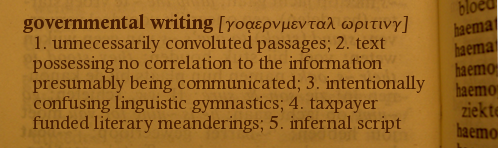
govwritingAre you a skilled reader? Do you pride yourself on possessing a knack for making sense of challenging prose?

Even if you consider yourself a proficient interpreter of text, there is one genre of literature that may still cause you to tremble. Government documents.

Even the most experienced lexical navigators find it challenging to traverse governmental communications. This despite the fact that in 2010 the United States actually passed the Plain Writing Act.

And I’m not even referring to legislation—where seeking sanity and clarity is virtually hopeless. And, it doesn’t matter how simple the source message is. Government scribes are capable of making a document about how to obtain a building permit read like a manual for constructing an orbital weapons platform.

I am not sure whether or not the United States is typical of other nations when it comes to this literary tradition. However, I suspect every nation, aside perhaps from those with populations under 10,000, is plagued by convoluted governmental documents. (There are thirteen such, potentially exempt, communities.*)

A prime example of institutional gobbledygook comes from this question, posed to the Chicago Manual of Style:

Q. Can you please help settle a disagreement? In the following sentence, should “instead of” be replaced with “rather than”? Overpayments occurred because facility purchased care staff processed payments using the local VA Fee schedule instead of the technical component of RBRVS.

A. Let me get this straight: in that nearly unreadable sentence (“because facility purchased care staff processed payments”?), the disagreement centers on whether to use “instead of” or “rather than”?  (Oh, wait—I see from your e-mail address that this is a government office.) Replace the phrase if you are certain that (1) there is a significant difference in meaning, and (2) the current wording does not express the meaning intended. If you cannot reach agreement on these points, you might have to fund a study.

C.S. Lewis offered much sage advice about writing. Sadly, nearly every principle he proposed is utterly alien to governmental documents. His 1956 advice (to a child) should be the required background and screen saver for all government computers:

“Always try to use the language so as to make quite clear what you mean and make sure your sentence couldn’t mean anything else.”

It’s not that I don’t have sympathy for civil servants who write official documents. After all, I edited Air Force Recurring Periodical 52-1 for three years. But I sometimes wonder whether there might be an eccentric psychological disorder that afflicts many government-funded writers . . .

So, it appears, I have made an unintentional confession. The regular readers of Mere Inkling may now know the source of some of the peculiar aspects of these columns.

I have asked my children to have me institutionalized if I ever use the phrase “care staff processed payments.” Short of that, however, these brief conversations are likely to continue for many years to come.

_____

* The following nations and “dependent territories” boast populations under ten thousand, in ascending order:

Pitcairn Islands

Cocos Islands

Vatican City

Tokelau

Niue

Christmas Island

Norfolk Island

Svalbard and Jan Mayen

Falkland Islands

Saint Helena, Ascension and Tristan da Cunha

Montserrat

Saint Pierre and Miquelon

Saint Barthelemy

Nauru barely misses the list due to an excess of eighty-four citizens, according to their 2011 census.

Getting Fresh

freshenIt’s possible for blogs to get stale. That’s no surprise, to regular readers.

Like everything else in life, same old same old (American slang) gets old.

I’ve never been one to desire change for its own sake. C.S. Lewis satirizes such notions in his poem, “Evolutionary Hymn.”

Lead us, Evolution, lead us

     Up the future’s endless stair:

Chop us, change us, prod us, weed us.

     For stagnation is despair:

Groping, guessing, yet progressing

     Lead us nobody knows where.

Still, for some time I have felt like I wanted to freshen up the look of Mere Inkling.

I’ve taken the plunge and purchased the package where I can tailor colors and fonts. I’ve also decided to move some of my old websites here to Mere Inkling.

First of all, I have added The Odes of Solomon. If you’re interested in learning about the most ancient Christian hymnal, check it out. I have included paraphrases of five of the Odes.

Next I will either move my C.S. Lewis Chronicles pages here, or the information that I’ve assembled online for two of our family’s ancestors who served in the American Civil War. I have also added a link to the military chaplaincy journal I edit.

Those will all be static pages, of course. The main feature of Mere Inkling will continue to be the regular columns, or posts.

I hope you enjoy the new format. I think it is an improvement, and enabling me to get all of these efforts under a single digital “roof,” will certainly help me stay better organized.

In expanding the offerings of Mere Inkling, I have maintained the valued past and am importing material that will be of interest to some. My goal has been to have the site “grow,” in the sense used by C.S. Lewis in “Hamlet: The Prince or the Poem.”

Mere change is not growth. Growth is the synthesis of change and continuity, and where there is no continuity there is no growth.

Lemming Legends

lemmingThe closest camaraderie I ever experienced in my life, was on the staff of the USAF Chaplain School. A sign of our esprit de corps was seen in the nicknames we gave one another. Mine was Lemming. (Not too dashing, I know, but read on and you’ll see why it was bestowed with affection and respect.)

Those of us who worked on “Air Staff” projects (for the Chief of Chaplains) were in the Resource Division. Probably because we were always rushing (scurrying?) around responding to emergencies, the other chaplains called us the “Resource Rats.” We were close indeed, and our energies and creativity was magnified by our synergy . . . just like the Inklings.

We embraced the label, and before we knew it each of us had been identified as a particular member of the rodent family. We had a rabbit, hamster, beaver, squirrel and fudged a bit with a ferret and a weasel. Among assorted other “rats,” I was nicknamed—you didn’t choose your identity, your friends awarded it to you—Lemming.

They called me Lemming because I had a unique duty on the team. One of my duties was to do a little bit of “ghostwriting” for the Chief of Chaplains. Some would consider it an honor, but trust me, due to the general for whom I wrote the first year, it was anything but.

Why a Lemming? Well, because whenever a tasking came down I would dutifully march off in obedience . . . even if it meant marching right off of a cliff. Like the humble Lemming, I accepted my fate, and made the best of it.

We all know their tragic story. When the Lemming burrows become overcrowded, a large number of them will sacrificially gather together and march to the sea. There, those who did not perish in catastrophic falls, nobly swim out to sea so that their relatives back in the warren can once again devote themselves to overpopulating their habitat.

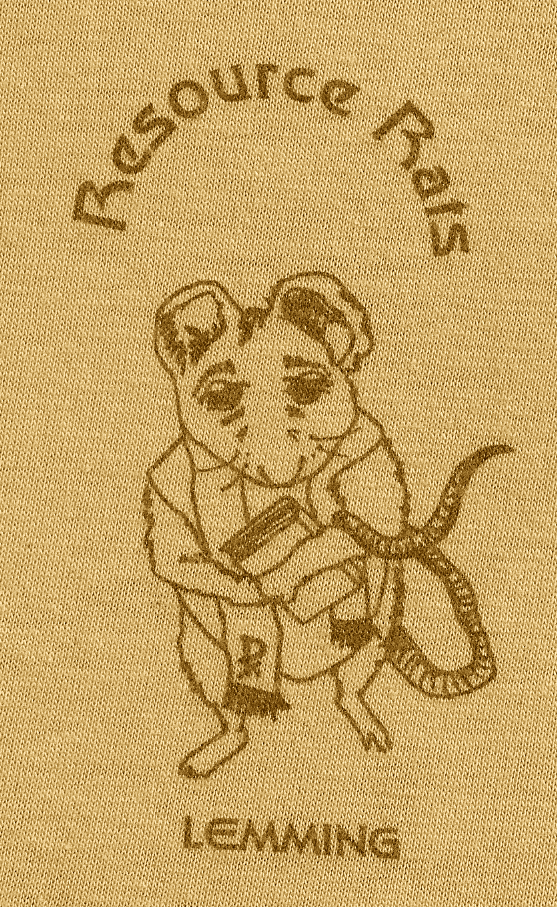
I was proud of the appellation. I wore the name (literally, on the shirt logo pictured above) as a badge of honor. Until . . . until I discovered it was all based on a lie.

Lemmings, we have learned, do not suffer from periodic mass suicidal impulses. The common myth is based on an insidious 1958 “nature film” made by Disney. I have no idea why they would compromise their flawless reputation for scientific accuracy in their naturalist media, but in White Wilderness, they cast all integrity aside. (And now I know why C.S. Lewis and J.R.R. Tolkien were wary of the machinations and shadowy motives of Walt Disney Studios.)

With utter disregard to the reputation of these clever arctic creatures, the film showed (supposed) members of the Scandinavian clans eagerly casting themselves to their deaths. However, their bizarre behavior was manipulated by cinematic chicanery.

It turns out that not only did Disney pull the lemmings out of their normal habitat for filming—since they were too intelligent to voluntarily leap to their death, they were thrown off of the cliff from a modified turntable! Ghastly.

Learning that lemmings will not march knowingly (and stupidly) to their own demise has actually made me a bit prouder to bear the title. I mean, it’s one thing as a member of the armed forces to risk your life in the defense of your nation. It’s quite another to commit suicide because a general thought one of your commas was in the wrong place. But that’s a story for another day.

Impromptu Poetry

eye

I had to endure a to and fro transcontinental trip this week. Endure is the right word, when flying miles above what would otherwise be a scenic, albeit lengthy, journey.

One positive thing about flying is that I have time to catch up on some of my “pleasure” reading. This week it included an article about cinquains.

A quintain is a poem with five verses. A cinquain is a specific form which has the following number of syllables in each of the lines: two, four, six, eight, and two.

I took a break from my reading and drafted a few of these small poems. I found it quite simple, and it’s likely you may as well.

I make no promises about the quality of my verse, but perhaps you’ll find one or more of them interesting. Or, at least they may inspire you to write some of your own.

Springtime
Narnian hope
Delayed by the White Witch
Borne by Aslan’s Resurrection
New dawn

Pilgrim
Traveling through
This world is not my home
Destined for a new creation
With Christ

True hope
He died for us
Emancipation now
Washed clean by the blood of the Lamb
New life

Inklings
Lewis, Tolkien
Friends rounded out the group
Imaginations unfettered
Wonder

Choosing Patience

patient bearI got up very early this morning to attend a meeting that had been rescheduled from its regular monthly date. I was happy with myself for remembering the change in date, as I drove to the sunrise gathering of a group of fellow chaplains.

I felt great—until I learned after arriving that our rescheduled meeting had been rescheduled. There I was, all alone . . . and primed for a bit of unseemly disappointment with having risen more than two hours earlier my normal routine, for an aborted purpose.

Because that sort of reaction is not foreign to my nature, I was pleasantly surprised when I didn’t feel that way. Oh, for the briefest of moments (literally, less than a half a minute) I experienced what some might consider a mild case of “upset,” but it immediately gave way to my thoughts of how I could most constructively use the “extra hours” I had received.

The most amazing part of all is that I did not even have to consciously think, how can I put the best construction on this? It just happened.

Now, I’m uncertain whether this positive response was due to my increasing age, or to my growing sanctification. I suspect it’s a combination of the two. It’s such a calm and healthy way to respond to unwelcome events that I wish everyone was able to enjoy it as their norm. Thank you, Lord, for gracing me with this gift for the fall and winter decades of my life.

Being able to see the good in a seeming disappointment, is akin to possessing the virtue of patience. I once made the mistake of praying for “patience.” It was during my college days, and learning to be more patient proved quite painful; it was primarily taught to me by being deluged with a near-infinite number of things which demanded my patience. Quite painful.

In a letter C.S. Lewis wrote to Don Giovanni Calabria in 1948, he says, “We ought to give thanks for all fortune: if it is ‘good,’ because it is good, if ‘bad’ because it works in us patience, humility and the contempt of this world and the hope of our eternal country.”

This is precisely the attitude I wish to experience in my own life.

And, sometimes its fruit is easy to recognize. For example, the cancellation of today’s meeting gifted me with the time required to compose this post itself. And, for that, I am genuinely grateful.

Having Our Writing Criticized

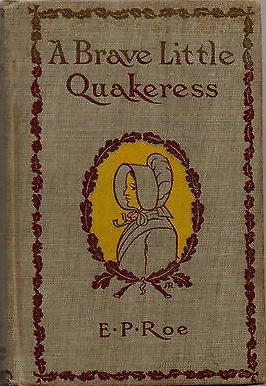
roeShould literary critics look down on authors whose work proves popular with “common” people? Is it appropriate for the literary elite to smirk dismissively whenever the prose of a writer outside their circle resonates with the masses?

These, my friends, are rhetorical questions. The answer to both is “no,” and if you believe otherwise, you probably won’t find yourself too comfortable with the opinions shared here at Mere Inkling.

I believe each piece of literature, regardless of its source, should be judged on its own merits. Not all genres appeal to all people. And not all writers compose their works with equal skill. Nevertheless, it is possible for even a poor miner to strike gold.

Likewise, an accomplished writer is not infallible. Even a master wildcatter can sink a dry well.

I’ve been writing an article about Civil War chaplain who became one of America’s most popular writers during the nineteenth century. In fact, many years his novels outsold the works of Samuel Clemens himself.

And yet, despite his success—or possibly, because average people enjoyed his stories—he received an extraordinary amount of criticism from the literary establishment.

I’m going to share his insights about writing in a moment, but  before doing so, I want to draw a parallel with one of the twentieth century’s most gifts authors. C.S. Lewis was loved by common women and men of Britain and other English-speaking countries. And yet, this very popularity undermined his standing in the world of academia and, I daresay, literary snobbery.

Lewis describes this condescending mindset in a 1939 essay entitled, “High Brows and Low Brows.”

The great authors of the past wrote to entertain the leisure of their adult contemporaries, and a man who cared for literature needed no spur and expected no good conduct marks for sitting down to the food provided for him.

Boys at school were taught to read Latin and Greek poetry by the birch, and discovered the English poets as accidentally and naturally as they now discover the local cinema. Most of my own generation, and many, I hope, of yours, tumbled into literature in that fashion.

Of each of us some great poet made a rape when we still wore Eton collars. Shall we be thought immodest if we claim that most of the books we loved from the first were good books and our earliest loves are still unrepented? If so, that very fact bears witness to the novelty of the modern situation; to us, the claim that we have always liked Keats is no prouder than the claim that we have always liked bacon and eggs. For there are changes afoot.

I foresee the growth of a new race of readers and critics to whom, from the very outset, good literature will be an accomplishment rather than a delight, and who will always feel, beneath the acquired taste, the backward tug of something else which they feel merit in resisting.

Such people will not be content to say that some books are bad or not very good; they will make a special class of “lowbrow” art which is to be vilified, mocked, quarantined, and sometimes (when they are sick or tired) enjoyed. They will be sure that what is popular must always be bad, thus assuming that human taste is naturally wrong, that it needs not only improvement and development but veritable conversion.

For them a good critic will be, as the theologians say, essentially a “twice-born” critic, one who is regenerate and washed from his Original Taste. They will have no conception, because they have had no experience, of spontaneous delight in excellence.

I confess I’ve sometimes felt slightly embarrassed when in the presence of a group of people singing the praises of authors of fiction popular among the well-educated. Sometimes I don’t even recognize their names, much less have an idea of what they have written.

Part of my “handicap” rises from the fact that I’m by and large a non-fiction sort of guy. As seminary I was less enraptured by abstract “systematic theology” than the time-proven lessons learned during the Church’s two millennia history. Likewise, I found “practical theology” far more beneficial. After all, I was being equipped not to be a theologian per se, but to become a shepherd entrusted with the cura animarum (the cure of souls).

In that spirit, valuing history and lessons I could put into practice as a pastor and writer, I have been researching the legacy of Edward Payson Roe (1838-1888). He was a Presbyterian pastor who served as a chaplain in the Union cavalry, and later as a military hospital chaplain.

After the war, Roe served a congregation, and eventually turned his energies to writing wholesome fiction. He played a key role in helping many suspicious Protestants realize that, like manna, fiction was neither good nor bad. It’s effects depended on the use to which it was put. Roe proved quite popular with readers. Less so with the literary establishment.

The following account comes from an essay about his life solicited by one of the prominent magazines of his day. It is well worth reading, touching as it does on a broad range of subjects, including international copyrights and the vagaries of publishing in the late 1800s. Most precious, though, are the echoes of Roe’s humility and his realistic understanding of the vocation of writing.

“While writing my first story, I rarely thought of the public, the characters and their experiences absorbing me wholly. When my narrative was actually in print, there was wakened a very deep interest as to its reception. I had none of the confidence resulting from the gradual testing of one’s power or from association with literary people, and I also was aware that, when published, a book was far away from the still waters of which one’s friends are the protecting headlands.

“That I knew my work to be exceedingly faulty goes without saying; that it was utterly bad, I was scarcely ready to believe. Dr. Field, noted for his pure English diction and taste, would not publish an irredeemable story, and the constituency of the New York ‘Evangelist’ is well known to be one of the most intelligent in the country.

“Friendly opinions from serial readers were reassuring as far as they went, but of course the great majority of those who followed the story were silent. A writer cannot, like a speaker, look into the eyes of his audience and observe its mental attitude toward his thought. If my memory serves me, Mr. R.R. Bowker was the earliest critic to write some friendly words in the ‘Evening Mail;’ but at first my venture was very generally ignored.

Then some unknown friend marked an influential journal published in the interior of the State and mailed it so timely that it reached me on Christmas eve. I doubt if a book was ever more unsparingly condemned than mine in that review, whose final words were, ‘The story is absolutely nauseating.’ In this instance and in my salad days I took pains to find out who the writer was, for if his view was correct I certainly should not engage in further efforts to make the public ill.

“I discovered the reviewer to be a gentleman for whom I have ever had the highest respect as an editor, legislator, and honest thinker. My story made upon him just the impression he expressed, and it would be very stupid on my part to blink the fact. Meantime, the book was rapidly making for itself friends and passing into frequent new editions. Even the editor who condemned the work would not assert that those who bought it were an aggregation of asses. People cannot be found by thousands who will pay a dollar and seventy-five cents for a dime novel or a religious tract.

“I wished to learn the actual truth more sincerely than any critic to write it, and at last I ventured to take a copy to Mr. George Ripley, of the New York ‘Tribune.’ ‘Here is a man,’ I thought, ‘whose fame and position as a critic are recognized by all. If he deigns to notice the book, he will not only say what he thinks, but I shall have much reason to think as he does.’ Mr. Ripley met the diffident author kindly, asked a few questions, and took the volume. A few weeks later, to my great surprise, he gave over a column to a review of the story. Although not blind to its many faults, he wrote words far more friendly and inspiring than I ever hoped to see; it would seem that the public had sanctioned his verdict

“From that day to this these two instances have been types of my experience with many critics, one condemning, another commending. There is ever a third class who prove their superiority by sneering at or ignoring what is closely related to the people. Much thought over my experience led to a conclusion which the passing years confirm: the only thing for a writer is to be himself and take the consequences. Even those who regard me as a literary offender of the blackest dye have never named imitation among my sins.

“As successive books appeared, I began to recognize more and more clearly another phase of an author’s experience. A writer gradually forms a constituency, certain qualities in his book appealing to certain classes of minds. In my own case, I do not mean classes of people looked at from the social point of view. A writer who takes any hold on popular attention inevitably learns the character of his constituency. He appeals, and minds and temperaments in sympathy respond. Those he cannot touch go on their way indifferently; those he offends may often strike back. This is the natural result of any strong assertion of individuality.

“Certainly, if I had my choice, I would rather write a book interesting to the young and to the common people, whom Lincoln said ‘God must love, since He made so many of them.’ The former are open to influence; the latter can be quickened and prepared for something better. As a matter of fact, I find that there are those in all classes whom my books attract, others who are repelled, as I have said.

“It is perhaps one of the pleasantest experiences of an author’s life to learn from letters and in other ways that he is forming a circle of friends, none the less friendly because personally unknown. Their loyalty is both a safeguard and an inspiration. On one hand, the writer shrinks from abusing such regard by careless work; on the other, he is stimulated and encouraged by the feeling that there is a group in waiting who will appreciate his best endeavor.

“While I clearly recognize my limitations, and have no wish to emulate the frog in the fable, I can truthfully say that I take increasing pains with each story, aiming to verify every point by experience—my own or that of others. Not long since, a critic asserted that changes in one of my characters, resulting from total loss of memory, were preposterously impossible. If the critic had consulted Ribot’s ‘Diseases of Memory,’ or some experienced physician, he might have written more justly.

“I do not feel myself competent to form a valuable opinion as to good art in writing, and I cannot help observing that the art doctors disagree woefully among themselves. Truth to nature and the realities, and not the following of any school or fashion, has ever seemed the safest guide. I sometimes venture to think I know a little about human nature. My active life brought me in close contact with all kinds of people; there was no man in my regiment who hesitated to come to my tent or to talk confidentially by the campfire, while scores of dying men laid bare to me their hearts. I at least know the nature that exists in the human breast.

“It may be inartistic, or my use of it all wrong. That is a question which time will decide, and I shall accept the verdict. Over twelve years ago, certain oracles, with the voice of fate, predicted my speedy eclipse and disappearance. Are they right in their adverse judgment? I can truthfully say that now, as at the first, I wish to know the facts in the case. The moment an author is conceited about his work, he becomes absurd and is passing into a hopeless condition. If worthy to write at all, he knows that he falls far short of his ideals; if honest, he wishes to be estimated at his true worth, and to cast behind him the mean little Satan of vanity. If he walks under a conscious sense of greatness, he is a ridiculous figure, for beholders remember the literary giants of other days and of his own time, and smile at the airs of the comparatively little man. On the other hand, no self-respecting writer should ape the false deprecating ‘’umbleness’ of Uriah Heep. In short, he wishes to pass, like a coin, for just what he is worth.

“Mr. Matthew Arnold was ludicrously unjust to the West when he wrote, ‘The Western States are at this moment being nourished and formed, we hear, on the novels of a native author called Roe.’ Why could not Mr. Arnold have taken a few moments to look into the bookstores of the great cities of the West, in order to observe for himself how the demand of one of the largest and most intelligent reading publics in the world is supplied? He would have found that the works of Scott and Dickens were more liberally purchased and generally read than in his own land of ‘distinction.’ He should have discovered when in this country that American statesmen (?) are so solicitous about the intelligence of their constituents that they give publishers so disposed every opportunity to steal novels describing the nobility and English persons of distinction; that tons of such novels have been sold annually in the West, a thousand to one of the ‘author called Roe.’

“The simple truth in the case is that in spite of this immense and cheap competition, my novels have made their way and are being read among multitudes of others. No one buys or reads a book under compulsion; and if any one thinks that the poorer the book the better the chance of its being read by the American people, let him try the experiment. When a critic condemns my books, I accept that as his judgment; when another critic and scores of men and women, the peers of the first in cultivation and intelligence, commend the books, I do not charge them with gratuitous lying. My one aim has become to do my work conscientiously and leave the final verdict to time and the public. I wish no other estimate than a correct one; and when the public indicate that they have had enough of Roe, I shall neither whine nor write.”

_____

If you are interested in learning more about E.P. Roe, check out my article in the new issue (4.2) of Curtana: Sword of Mercy which was published online just last week.

Annual Encouragement

2013Our grandparents never dreamed a single person could touch as many other people as we now take for granted in our digital age. If you had told them that in a single year, you could interact with people from 140 different nations—and all from the comfort of your own home—they would have had you institutionalized.

Yet, that’s precisely what we do today. And what may be even odder, we consider it commonplace.

Readers who are familiar with the “wordpress community” know that the arrival of the new year includes a welcome ritual. We receive a congratulatory note on our blogging accomplishments during the previous year.

In addition to various statistical notes, the report identifies particularly successful posts. For example, a couple of years ago I wrote “Lessons Taught by Onions,” and for some peculiar reason it continues to draw visitors every single month.

At the top of this post I have reproduced what many of us regard as the most intriguing aspect of the report–revealing where your readers reside. As a novice blogger it’s a wonderful feeling when we first see something we’ve written read by people in a foreign land.

Over the years it’s fascinating to see how the list of visitors grows.

Some countries are tough to reach. This year I finally had a visitor or two from the People’s Republic of China and Mongolia . . . a couple of those challenging lands.

I still haven’t been able to penetrate North Korea. But then, that’s no surprise since they only have one computer with international access, and I don’t publish the type of material that would be of interest to the resident of the presidential palace.

As the new year begins, it’s good to be encouraged by others for one’s past performance. Most of us require a bit of encouragement now and then.

Speaking of encouraging, in a 1956 letter, C.S. Lewis expresses appreciation to a writer who enjoyed his book, Till We Have Faces.

It was nice of you to write about Till We Have Faces (I originally called it Bareface, but the publishers vetoed that because they said people would think it was a ‘Western’!), and a most needed encouragement to me, for it has so far had a more hostile reception from the critics than any book I ever wrote. Not that critics really matter very much. The real question is how the book goes 10 or 15 years after publication.

Encouragement is always welcome, and never more so than in the wake of abundant discouragement.

And then, of course, there is the feigned or teasing sort of encouragement that can only be offered by someone we trust. Someone we know regards us with affection. In that light, I couldn’t resist including the following passage from a letter Lewis wrote in 1951.

All well here except myself, who have a bad cold; but I’m off to Ireland I hope on Friday for a fortnight, which may shift it. (Warnie in his usual way of encouragement, reads me paragraphs from the paper at breakfast about liners wind bound in the Mersey and waves 6 ½ feet high off the Irish coast.)

I must confess that with a large and literate family, I receive more than my share of just this sort of “encouragement.” And I welcome it.

In the meantime, however, the annual report of Mere Inkling’s popularity does inspire me to press on with my self-imposed pace of two columns a week. I warmly invite you to continue the journey alongside me.

Hitler Versus C.S. Lewis

hitler“Meme.” A ubiquitous word among younger generations, but a concept still rather foreign to many who are slightly more “mature.”

The word was introduced by Richard Dawkins in 1976 and means an idea or social behavior that is transmitted by repetition “in a manner analogous to the biological transmission of genes.” Dawkins echoed the sound of “gene,” using the Greek word mimeisthai (to imitate).

Some memes are quite comical. Other quickly grow wearisome (remember the “dancing baby?”).

One I find particularly creative is a scene of Hitler in his bunker during the final days of the Third Reich. The dialog is in German, and the ingenuity is manifest in all of the hilarious subtitles that people create to coincide with the actions of the characters.

I’m sure there are many tasteless examples (to be avoided), but during the last few years I’ve viewed a couple of dozen and found most quite entertaining.

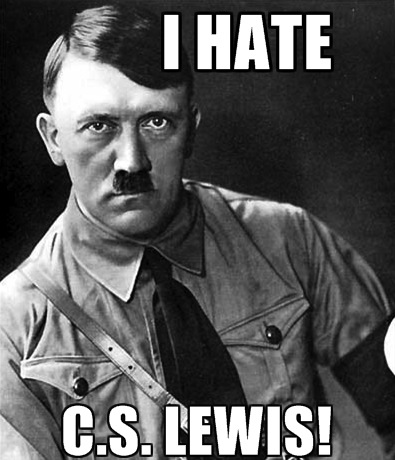
When I discovered a website that allows you to create your own version, I couldn’t resist. And, of course, I could think of no subject better suited to coinciding with Hitler’s demise than the heroic work of C.S. Lewis. In just a moment I’ll share a link to my film “adaptation.”

Lewis, of course, was a patriot who volunteered for the British army and served on the frontlines. He was seriously wounded. (He was not a Christian at the time.)

During the Second World War, Lewis supported the war effort from home. He provided tremendous encouragement to his countrymen via well-received talks broadcast on BBC. And this is the inspiration for my “take” on the Hitler Bunker meme.

His sequel to The Screwtape Letters, “Screwtape Proposes a Toast,” mentions the madman by name. Portraying the demons at the banquet as feasting on the souls of the damned, Screwtape complains:

. . . it would be vain to deny that the human souls on whose anguish we have been feasting tonight were of pretty poor quality. Not all the most skilful cookery of our tormentors could make them better than insipid.

Oh to get one’s teeth again into a Farinata, a Henry VIII, or even a Hitler! There was real crackling there; something to crunch; a rage, an egotism, a cruelty only just less robust than our own. It put up a delicious resistance to being devoured.

Curiously, in English Literature in the Sixteenth Century, Lewis mentioned how Hitler could be viewed in a humorous light.

The mixture of farce and terror would be incredible if we did not remember that boys joked most about flogging under Keate, and men joked most about gallows under the old penal code. It is apparently when terrors are over that they become too terrible to laugh at; while they are regnant they are too terrible to be taken with unrelieved gravity. There is nothing funny about Hitler now.

Lewis’ point, accurate I believe, is that in the terror of the experience itself, humor can provide some relief. Laughing in ridicule at the source of the horror can help to preserve our sanity. Only in the aftermath—once the threat has been dispatched—can we allow the true magnitude of the carnage to be comprehended. And, in that moment, there is nothing at all that is funny.

Of course, years later, when the sights and smells of Dachau are no longer recalled by the living, things shift once again. (Very few of those tragic victims or liberating heroes remain.) When the scarred battlefields have been covered with velvet grass, and it was no longer even “dad’s war,” but now “grandpa’s” or even “great-grandpa’s,” the bitterness has grown stale.

Today, it is natural to scorn and laugh at the tragic dictator who caused so much sorrow. He was a pitiful human being, and without minimizing his crimes, it is fitting that he be ridiculed once again.

History Proves Lewis True

The fact that at a certain point it becomes acceptable to ridicule a monster, is the premise behind the hilarious film “The Producers.” If you’ve never seen it, by all means take a moment to watch the theme song, “Springtime for Hitler.” For a cinematic example of Hitler-ridicule, there may be none finer than that “musical” (overlooking the tasteless burlesque costumes).

Of course, true to Lewis’ maxim, ridicule was also heaped upon the “Bohemian Corporal” during the war itself.

The classic example would be Charlie Chaplin’s celebrated “The Great Dictator.” (In addition to starring in the film, Chaplin wrote, directed and produced the movie. Oh, and he also co-composed the music.) The film was made in 1940, while war already raged, but prior to the entry of the United States.

Chaplin’s movie confirms Lewis’ contention that we should not joke about such matters while the wounds are raw. We learn from Chaplin’s My Autobiography, that in the post-war realization of the depth of Hitler’s evil, he regretted treating him with such levity. “Had I known of the actual horrors of the German concentration camps, I could not have made The Great Dictator, I could not have made fun of the homicidal insanity of the Nazis.”

[Best if viewed in the order presented, beginning with the external link to my parody.]

A Visit to the Cinema

Hitler Versus C.S. Lewis (by Mere Inkling)

Click this link: http://meemsy.com/v/12897

Springtime for Hitler and Germany” from The Producers

Charlie Chaplin’s Version of the German Dictator

The Three Stooges actually beat Chaplin to the screen with their short, “You Nazty Spy!” The sequel, “I’ll Never Heil Again” was released the following year.

A Scene from Nazty Spy

A Brief Clip from I’ll Never Heil Again

And finally, returning full circle to the original meme in which I participated, I was surprised to discover a version of it in which Hitler views the trailer for the 2012 Three Stooges movie. (Apparently, despite their rather disrespectful treatment of him, according to this meme der fuhrer was a fan!) And with that, today’s Hitler cinema will close.

The Bible’s Songbook

psalmistI experienced an embarrassing moment many years ago while taking a broadcasting media course at seminary. I had used a passage from the Psalms as the basis for an assigned devotional, and when the professors (from several different seminary faculties) critiqued it, a distinguished professor dismissively pointed out that I had mispronounced the word “psalm” itself!

I had foolishly pronounced the “l” sound in the word (the way I’d always heard it pronounced). I don’t know whether any of the other students were as ignorant as I, but no one denied that the condescending correction was correct.

The first thing I did upon returning home was grab my dictionary to see if the doctor of theology was right. It turned out, of course, that he was right with how to pronounce the word [i.e. sahm] . . . but he was definitely wrong about how to properly correct a student.

On a more positive note, the Psalms are the foundation and epitome of worship music for Jews and Christians alike. One could read a Psalm each day and since there are one hundred and fifty, when you returned to the first psalm five months after beginning, it would be utterly fresh.

C.S. Lewis enjoyed the Psalms. The following passage comes from a letter written in 1940.

My enjoyment of the Psalms has been greatly increased lately. The point has been made before, but let me make it again: what an admirable thing it is in the divine economy that the sacred literature of the world should have been entrusted to a people whose poetry, depending largely on parallelism, should remain poetry in any language you translate it into.

And glorious poetry it is. The beauty of the songs extends far beyond the family “Lord is my shepherd . . .” And yet, it would be impossible to comprehend the number of grieving souls that have been comforted with the words “Even though I walk through the valley of the shadow of death, I will fear no evil, for you are with me; your rod and your staff, they comfort me.”

Most Christian traditions greatly value the Psalms, and many include them as a portion of the regular service or liturgy. And individuals who include them in the personal devotions are never disappointed.

C.S. Lewis included them in his prayer and devotion. In fact, he enjoyed the Psalms so much that in 1958 he wrote a book entitled Reflections on the Psalms. There he proclaims, “The most valuable thing the Psalms do for me is to express that same delight in God which made David dance.”

The Church has added an immense repertoire to the Psalms during the past two millennia, but they will never be replaced. In fact, many inspired songs owe a major debt to the Psalms themselves. This includes the Odes of Solomon, the first (post-Psalms) Christian hymnal (composed circa 100 A.D.).

Speaking of the Odes, I wrote a thesis on them many years ago, and have been considering writing a book about these treasures. Perhaps I’ll share more about them in the future.

_____

The lovely window pictured above is from a church in Fringford, England. David was likely a bit younger when most of the psalms he composed were written.

The Purpose of Punctuation

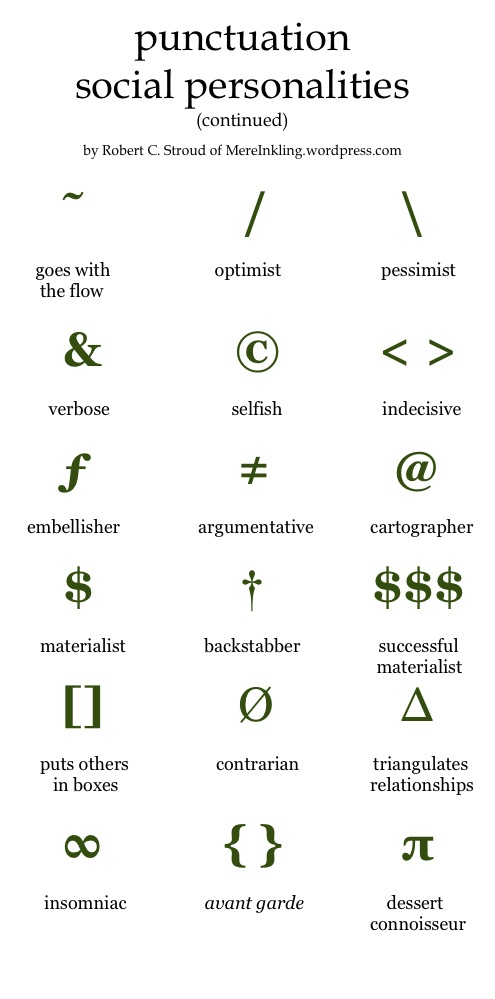
punctuation personalitiesWordsmiths love wordplay.

In fact, they love to toy with everything related to language, including punctuation. The entertaining illustration to the left was created by Carrie Keplinger and inspired me to produce my own supplement to her study.

The idea behind the graphic is to play on the meaning of different punctuation symbols and describe the type of personality they represent.

I took the notion a step further, and based some of my psychological diagnoses on the appearance of the images themselves. I also fudged a bit and included a couple that are common symbols, albeit not punctuation.

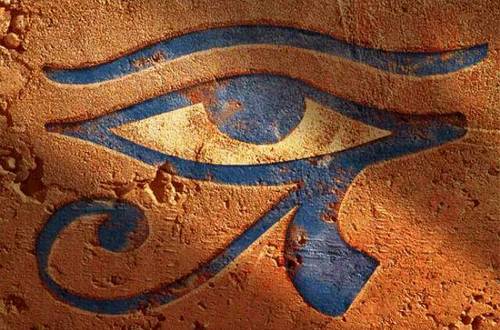
In the past I’ve shared here my fascination with fonts. This extends to pictographic languages like Egypt’s hieroglyphs. Consider this example:

horus

One may not know this particular image is associated with the Egyptian god Horus, but it’s immediately apparent it represents a familiar part of human anatomy.*

If you find the subject of hieroglyphics interesting, you may enjoy reading this article I recently discovered. The author briefly compares the thought of C.S. Lewis with that of the ancient philosopher Plotinus. He writes:

The Hieroglyphs are visible mirrors of the invisible, to use Jean-Luc Marion’s language, the recognition of which brings immediate awareness and experience of meaning rather than strict syllogistic definition. For Lewis, “thinking along” cannot be reduced to concepts.

For Plotinus, Nature cannot be reduced to analysis. As Marion says, when faced with the visible mirror of the invisible one must look beyond the physical and experience the infinite gaze. Although the sunbeam is a physical reality I think it is a great example of “looking along” because it stirs us up to contemplate Beauty itself. Indeed God is Beauty for Lewis and for Plotinus (though not the Christian God for the latter).

Returning to the Subject of Punctuation

Punctuation is a fundamental tool of writers. And, like the broader subject of grammar, it is incumbent on us to do our best to use it properly.

“Improper” usage is not necessarily wrong, however. On numerous occasions we may intentionally make an “error” to achieve a specific purpose. Or, we may object to certain conventions and challenge the ever-evolving status quo. For example, I avoided unnecessarily capitalizing “internet” long before it became acceptable. I also dropped the hyphen from email, etc. prior to that becoming fashionable.**

Naturally, when we are seeking publication of our work, we need to conform to whatever stylistic standards the venue follows. However, in our “personal” writing, I long ago learned there is no value in being enslaved to “official” literary conventions. After all, these seemingly rigid rules themselves are fluid, shifting with ever more frequent speed.

I began with the declaration that lovers of words inherently enjoy wordplay. I certainly do. One evidence of that is found below, in my supplemental list to the chart at the top of this column.

Immediately upon reading “punctuation social personalities,” my own mind, unbidden, began to consider additions. A moment later I had pen in hand, and the rest is history.

Belated Warning: You may experience a similar irresistible response. 

punctuation personalities 2

_____

* A variation of the eye of Horus is actually found on American currency . . . at the peak of the pyramid that adorns the one dollar bill. (It’s officially called the “Eye of Providence,” but its association with the pyramid makes that title rather unconvincing.) It is actually reproduced on America’s money because it is found on the reverse of Great Seal of the United States. Yes, it’s portrayed on the hidden side of the extremely familiar eagle clutching an olive branch and arrows that we see all of the time.

** I’m not suggesting I am a trendsetter . . . merely that I anticipated the eventual elimination of these superfluous elements early on. Well, it’s due to that prediction combined with my own typographical prejudices, such as disliking the over-hyphenation of the English language.