A Trivial Windstorm

bellsIt’s amazing what we can accomplish during a multi-day power outage. Over the Thanksgiving holiday I learned a few new religious tidbits you may find interesting as well.

Several years ago I obtained a copy of Catéchic, “the Catholic trivia game” by Tyco®. While the power was out, I read all 1,000 trivia questions. It proved to be an interesting diversion.

The question of whether or not considering trivialities is a waste of time was addressed by C.S. Lewis at the outset of WWII.

Every Christian who comes to a university must at all times face a question compared with which the questions raised by the war are relatively unimportant. He must ask himself how it is right, or even psychologically possible, for creatures who are every moment advancing either to heaven or to hell, to spend any fraction of the little time allowed them in this world on such comparative trivialities as literature or art, mathematics or biology. (The Weight of Glory)

Lewis’ point is well made. When we contrast the matters which occupy our minds and energies with the things we ignore—including our eternal destiny and whether we are drawing closer to our Creator or drifting farther from him—the things of this world grow dim.

Perhaps that will be slightly less true in the case of trivia gleaned from the history of the largest denomination in the Christian Church.

Test Your Knowledge

A few questions were dated, not surprising I suppose, since the game was copyrighted in 1991. What was surprising is why they would choose to include questions about the names of prominent American archbishops of that decade, knowing it would date the product.

Question: Who is the Archbishop of San Antonio, Texas?

Answer: Archbishop Patrick Flores

Comment: He was historic, being the first Roman Catholic bishop of Mexican American heritage, and service as archbishop was lengthy (1979-2004), but the question as posed has passed its expiration date.

Name the Native American woman who may soon be canonized.

Blessed Kateri Tekakwitha

Tekakwitha (1656-1680) was canonized in 2012 and led a tragically short but interesting life. She was an Algonquin-Mohawk, the first Native American to be canonized.

Most other questions remain valid.

What is the name of Emperor Constantine’s decree that legalized Christianity in the Roman Empire in 313 A.D.?

The Edict of Milan

Bravo. As a student of ancient history and a Constantinian numismatist, I am pleased to see this vital moment in church history acknowledged.

Was St. Francis of Assisi a priest?

No

Good one! Most of us who’ve studied medieval history would probably get that right, but I assume the majority of Christians (Protestants, Catholic and Orthodox) would likely err on the side of ordaining Francis.

Which pope authorized the use of torture during the Inquisition?

Innocent IV

The irony of his chosen papal name is almost torturous. Admittedly, it was an improvement on his given name, Sinibaldo Fieschi.

A fair number of questions about ecclesiastical paraphernalia appear. To advance in the game, it helps to know your patens, piscina, and cinctures from your purificators, pyxes and cruets.

Is a “stermutatory” a piece of furniture found in a church?

No. A stermutatory is something that makes you sneeze.

That said, if some of the pews have grown so musty that they aggravate worshipers’ allergies, wouldn’t they qualify?

Some of the trivia provides arcane information sure to surprise one’s peers.

What is a cardinal who observers believe may have a chance of becoming pope called?

Papabile.

Nice to know . . . Now I just have to think of a way to work that into a typical conversation.

Seriously, using a word like this to show off one’s knowledge of obscure things reminds me of a passage I read many years ago attributed to St. Hereticus.* It offers satirical advice on how to upstage others in religious conversations.

The Superior Knowledge Gambit (not for beginners). Easier to illustrate than explain:

Opponent: I think my interpretation of the church has full historical precedent in Augustine.

Self: (starting hesitantly, but gradually gaining assurance until the final words are spoken with complete authority, in an ex cathedra tone of voice): But surely, much as I admire your exposition, really now, which interpretation of Augustine’s do you mean? There are at least five (eyes to the ceiling for a brief moment of counting), yes five . . . (pause, then confidently) There are at least five interpretations of the church in Augustine’s extant writings. (Give ever so slightly more emphasis to the word “extant.”)

. . .

Help from St. Augustine. A quiet yet forceful way of demonstrating superiority when Augustine is under discussion is to pronounce his name in contrary fashion to the pronunciation of Opponent. Make a point of emphasizing the contrast, so that it will be apparent that you know you are right, and that not even for politeness’ sake will you pronounce the name incorrectly as Opponent is doing. Either,

Opponent: . . . leading ideas in Augustine.”

Self: Augustine may have said that on one or two occasions, but . . .

Or,

Opponent (usually an Anglican in this case): . . . leading ideas in Augustine.

Self:Augustine may have said that on one or two occasions, but the whole Augustinian tradition, following, as I believe, the essential Augustine himself . . .

In this second gambit, it is advisable to maneuver the conversation into a discussion of “the Augustinian tradition” as indicated, so that when Opponent refers to it, as he must, without pronouncing it “the Augustinian tradition,” you can smile deprecatingly, to indicate your point has been made.

Well, that is enough trivia for one day. In my next post I’ll discuss some more substantial literary and theological concerns that emerge in the questions. Until then, one final trifle to entertain.

What 1975 film tells the story of King Arthur’s search for the Holy Grail as a comedy?

Monty Python and the Holy Grail

Some Python humor is too irreverent (or even blasphemous**) for my tastes, but this historic fantasy is one of my guilty pleasures. (I especially love the Killer Rabbit of Caerbannog which can only be dispatched by the “holy hand grenade of Antioch.”)

_____

* The Collected Writings of St. Hereticus by Robert McAfee Brown. An irreverent look at many aspects of ecumenical life in the mid twentieth century.

** Some (perhaps much) of the Python corpus leans towards vulgarity, but if you still enjoy the humor—and you are offended by blatant blasphemy, avoid reading the lyrics to their song, “All Things Dull and Ugly.”

There is a more positive connection between Monty Python and C.S. Lewis, however. John Cleese recorded The Screwtape Letters in 1995, lending his voice to the devilish “author” of the correspondence.
Free C.S. Lewis Course

hillsdaleA free college course about C.S. Lewis? Too good to be true? No, it’s for real . . . and it’s offered by a well respected American College that traces its roots back more than 170 years. (Note, for the Europeans reading this, that makes it quite mature here in North America.)

Hillsdale college is currently offering its online course, “An Introduction to C.S. Lewis: Writing and Significance” at no charge. Here is the link to the enrollment page.

In addition to being a first class college today, Hillsdale has a very distinguished past. Founded in 1844, its leadership in the anti-slavery cause allowed it to host two speeches by Frederick Douglass. The first was delivered during the Civil War itself.*

C.S. Lewis offered a fascinating twist on the injustice of slavery. In an essay entitled “Equality,” written 80 years after Douglass decried slavery at Hillsdale, Lewis advocated democracy as an imperfect philosophy. I agree with his inference that despite its shortcomings, it is the least-flawed form of government.

I am a democrat because I believe in the Fall of Man. I think most people are democrats for the opposite reason. A great deal of democratic enthusiasm descends from the ideas of people like Rousseau, who believed in democracy because they thought mankind so wise and good that everyone deserved a share in the government. The danger of defending democracy on those grounds is that they’re not true. . . . I find that they’re not true without looking further than myself. I don’t deserve a share in governing a hen-roost, much less a nation. Nor do most people—all the people who believe advertisements, and think in catchwords and spread rumours.

The real reason for democracy is . . . Mankind is so fallen that no man can be trusted with unchecked power over his fellows. Aristotle said that some people were only fit to be slaves. I do not contradict him. But I reject slavery because I see no men fit to be masters.

This is the barest example of C.S. Lewis’ keen mind. Enrolling in the course will certainly introduce participants to much, much more.

Like most online resources, this class is offered for personal growth. While a certificate is offered to those who complete the course, it doesn’t result in formal college “credit.” That said, the course could also be of great benefit to a motivated high school student.

Formal studies, even those like this one for which we set a personal pace, are worthwhile. Not only do we profit from the wisdom of the team of professors. Most of us also benefit from the discipline a course offers. Left to our own devices, most of us would not end up with the well-rounded familiarity with Lewis’ work that this class promises.

Shared Wisdom from Douglass and Lewis

One contemporary author noted a parallel thought in the writings of these two men. Thomas Sowell is a distinguished thinker and a talented writer. (Traits he shares with these two gifted authors.) On his website** Sowell has an extremely selective collection of quotations, on which he pairs the following. The first was written by Frederick Douglass and the second by C.S. Lewis.

Everybody has asked the question. . . “What shall we do with the Negro?” I have had but one answer from the beginning. Do nothing with us! Your doing with us has already played the mischief with us. Do nothing with us! If the apples will not remain on the tree of their own strength, if they are wormeaten at the core, if they are early ripe and disposed to fall, let them fall! I am not for tying or fastening them on the tree in any way, except by nature’s plan, and if they will not stay there, let them fall. And if the Negro cannot stand on his own legs, let him fall also. All I ask is, give him a chance to stand on his own legs! Let him alone! (Frederick Douglass, “What the Black Man Wants”).

Of all tyrannies, a tyranny sincerely exercised for the good of its victims may be the most oppressive. It would be better to live under robber barons than under omnipotent moral busybodies. The robber baron’s cruelty may sometimes sleep, his cupidity may at some point be satiated; but those who torment us for our own good will torment us without end for they do so with the approval of their own conscience. (C.S. Lewis, “The Humanitarian Theory of Punishment”).

I think Sowell’s connection of these two excerpts is quite perceptive. Although he is an economist by PhD, I regard him as a brilliant sociologist as well.

Education is a worthwhile pursuit. It is one embraced by Douglass, Lewis and Sowell. Hillsdale’s invitation to enroll in this course allows all of us to engage in the same meaningful exercise. After all, learning is one of the pleasures that makes life truly worth living.

_____

* You can read about Douglass’ speeches at Hillsdale College here.

** This link will take you to Sowell’s website.

Using Your Entire Brain

Brain1
Have you ever wondered just how much of your own brain you effectively use?

Unfortunately, the percentage of our brains harnessed for daily work remains a bit of a mystery, based upon unproven theories.

One thing is certain though—the frequently repeated notion that human beings only utilize 10% of their brains is nonsense. Despite the fact that this myth has never been supported by scientists, it has gained a proverbial life of its own.

Though an alluring idea, the “10 percent myth” is so wrong it is almost laughable, says neurologist Barry Gordon at Johns Hopkins School of Medicine . . .*

Another neurologist adds another interesting perspective.

Although it’s true that at any given moment all of the brain’s regions are not concurrently firing, brain researchers using imaging technology have shown that, like the body’s muscles, most are continually active over a 24-hour period. “Evidence would show over a day you use 100 percent of the brain,” says John Henley, a neurologist at the Mayo Clinic . . .

Which Half Runs the Show?

Assuming you use nearly all of the gray and white matter stuffed in your cranium, there is another question that begs an answer. Which hemisphere is dominant?

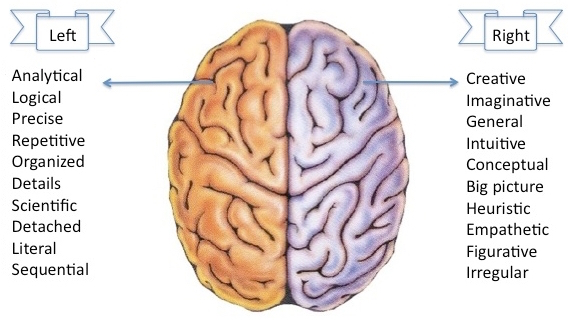
Medical scientists have identified numerous mental functions with particular regions of the brain. As the illustration above suggests, because of that the human mind relies on different hemispheres for different activities.

Most of us have already determined whether we are “right-brained” or “left-brained.” And, since we often know ourselves rather well, we’re probably correct in our assessment.

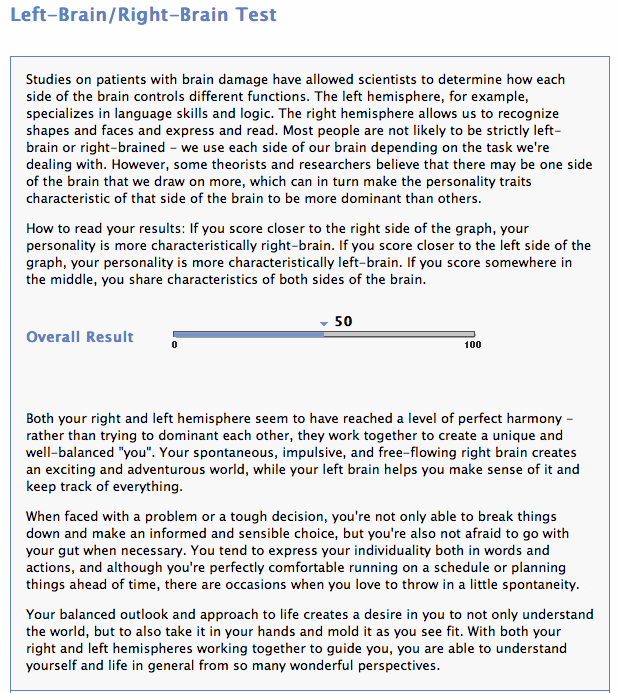
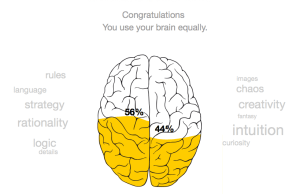
Still, there are some online tests capable of answering the question of just how well balanced we are in using whatever portion of our minds to which we have access. I recently took two of the assessment instruments and learned that I am a reasonably balanced individual.

You just may be more balanced than you think. Not that “balanced” is better than having one or the other side dominant. In fact, it feels a bit like being a “jack of all trades.”

Brain 2The first test—available for you to take here—gave me the wonderful news that my “right and left hemispheres seem to have reached a level of perfect harmony.”

It sounds almost like attaining Nirvana, if one believes in such things.

It was amazing what they were able to discern about my deepest being with twelve simple questions.

Brain 3

The second test—available here—gave me the following result. It reveals the mental equilibrium I have achieved with this informative graphic.

I really enjoyed the image (yellow is my second favorite color) . . . until I realized the uncolored portions of my brain suggested they were dormant. (I suspect the very fact that I’m concerned about the possibility implies it might be true.)

Lewis on the Human Mind

C.S. Lewis wrote about many aspects of human nature. That included, of course, the least understood organ, the brain. In the following passage from a 1921 letter, he describes the way our memories possess the power to transform the realities of the past.

I still feel that the real value of such a holiday is still to come, in the images and ideas which we have put down to mature in the cellarage [cellar or basement] of our brains, thence to come up with a continually improving bouquet.

Already the hills are getting higher, the grass greener, and the sea bluer than they really were; and thanks to the deceptive working of happy memory our poorest stopping places will become haunts of impossible pleasure and Epicurean repast.

The following argument is found in 1944’s “Is Theology Poetry?” His thoughts on how the human brain supports the existence of a Creator are well worth considering.

When I accept Theology I may find difficulties, at this point or that, in harmonising it with some particular truths which are imbedded in the mythical cosmology derived from science. But I can get in, or allow for, science as a whole. Granted that Reason is prior to matter and that the light of that primal Reason illuminates finite minds. I can understand how men should come, by observation and inference, to know a lot about the universe they live in.

If, on the other hand, I swallow the scientific cosmology as a whole, then not only can I not fit in Christianity, but I cannot even fit in science. If minds are wholly dependent on brains, and brains on bio-chemistry, and bio-chemistry (in the long run) on the meaningless flux of the atoms, I cannot understand how the thought of those minds should have any more significance than the sound of the wind in the trees.

And this is to me the final test.

This is how I distinguish dreaming and waking. When I am awake I can, in some degree, account for and study my dream. The dragon that pursued me last night can be fitted into my waking world. I know that there are such things as dreams: I know that I had eaten an indigestible dinner: I know that a man of my reading might be expected to dream of dragons. But while in the nightmare I could not have fitted in my waking experience. The waking world is judged more real because it can thus contain the dreaming world: the dreaming world is judged less real because it cannot contain the waking one.

For the same reason I am certain that in passing from the scientific point of view to the theological, I have passed from dream to waking. Christian theology can fit in science, art, morality, and the sub-Christian religious. The scientific point of view cannot fit in any of these things, not even science itself.

Even with my limited mind, which too often seems to run on only six of its eight cylinders, I recognize the wisdom of Lewis’ contrast between dreaming and waking. He is brilliant.

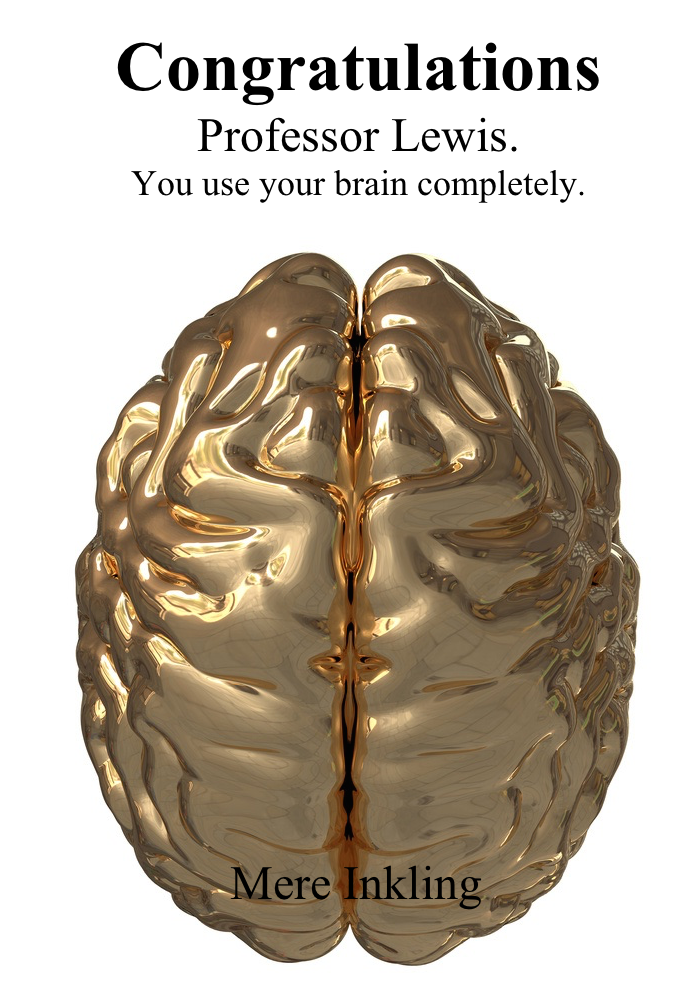
I imagine that our favorite Oxford dean’s online results might have looked something like this.

Lewis Brain

_____

* This quotation, and the one which follows it, come from Scientific American.

I have blogged in the past about the human brain. You might find one of the following posts interesting:

Engage Brain

Distant Fathers

Mensa & C.S. Lewis

Malapropistic Entertainment

Life in Middle Earth

theodenIf you resided in Middle Earth during the Third Age,* which of the major characters might you have been? Boromir,** Pippin, or perhaps Gandalf himself?

And, we’re only talking about the “good guys and gals.” We’ll have no one identifying with villains like Saruman, the Nazgûl ringwraiths or Grima Wormtongue here at Mere Inkling!

In a moment, I’ll help you answer that question.

Unfortunately, the internet abounds with time-consuming black holes. Pouring minutes and hours of our lives into the abyss of mindless videos or addictive games is the sad result.

Some entertaining diversions, however, possess merit. Case in point, an analysis of the leaders of Lord of the Rings, arranged according to their personality types.

Visiting a website such as this is not only fun, it offers insight into human differences. And, for the unwary, it may even reveal some new insights into our own nature.

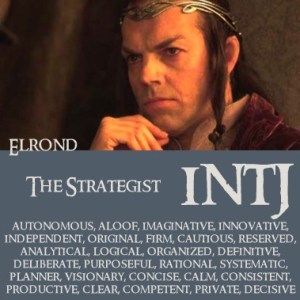
I believe in the general validity of the best known personality inventory, the Myers-Briggs Type Indicator. I have posted in the past about C.S. Lewis’ (likely) personality type being an INFP. That appropriately identifies him with none other than Frodo, “the idealist.”

elrondMy own type is ENTJ, which matches with King Théoden above. As I age, however, I am finding myself less extraverted and more desirous of solitude. That means I am progressively becoming an INTJ, and that aligns me with Elrond. Frankly, both of the characterizations suit me quite well.

A person’s type is determined by which of four polarities is dominant.

Extraversion/Introversion

Sensing/Intuition

Thinking/Feeling

Judging/Perceiving

If you don’t know your type, and have the time to take an online assessment now, you can do so for free here.

You don’t need to do it to enjoy the Lord of the Rings chart though. So, which are Middle Earth leader are you? Find out here.

A Note of Caution

While instructive, tools such as this should never be used to put people into boxes (which is ironic, since the MBTI is graphically presented in that fashion).

The last thing we need is someone thinking they are defined by a psychological instrument such as this. After all, today’s Gimli may just well be tomorrow’s Bilbo.

_____

* The complete timeline of Middle Earth is available here.

** I have written in the past about the hero Boromir.


We’re All Valedictorians

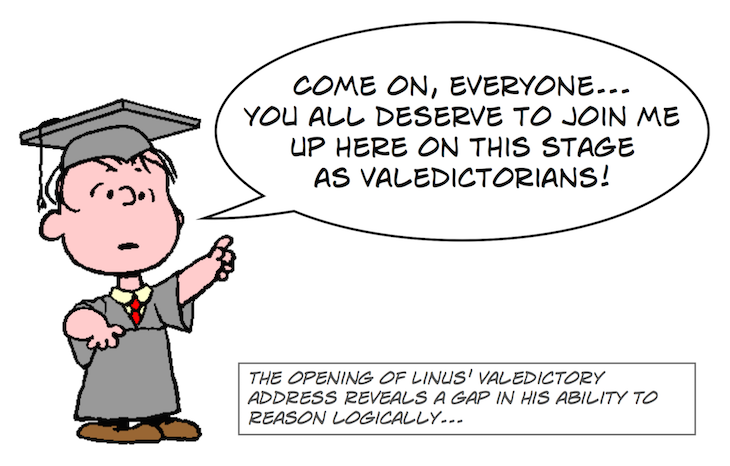
valedictoriansWell, not quite. But, if you just graduated from Washington and Lee High School in Arlington, Virginia, there is a fair chance you might be.

That’s because W&L named one hundred and seventeen—that’s right, 117—as valedictorians. And that was out of a class of 457. That means that each of W&L’s graduates had better than a 25% chance to be the/a valedictorian.

Congratulations.

I graduated 22 out of a class of 224. I thought that was a pretty solid accomplishment (especially since military moves meant I attended three different high schools, with both transitions occurring midyear).

My true brilliance was evidenced not in my own academic performance, but the fact that I was smart enough to marry a valedictorian!

Technically the valedictorian does not need to have the top grade point average in their class, although that is the usual custom. In fact, they simply need to be chosen to deliver the valedictory. (Yes, it is a noun, as well as its more familiar appearance as an adjective.)

Apparently, at our afore-celebrated high school, over a hundred students shared in this honor. (Must have been a protracted ceremony.)

It seems that in the modern era, we are so compelled to boost children’s self-esteem, that we feel compelled to exaggerate their accomplishments. Many have argued that this misguided effort has the reverse effect.

On the United States’ opposite coast, Long Beach Polytechnic opted for a measly thirty valedictorians (presumably out of a class of more than sixty).

Julia Jaynes, 17, who shared the valedictorian title with 29 others, said that if her school chose only one, it would destroy collegiality among her classmates. “If everyone wants to be the best, I feel like there’d be less collaboration,” she said. “It makes it so you’re only out for yourself.”

Unfortunately, poor Julia is likely to encounter more competition than collaboration in the world she is entering.

I found the following fact disturbingly humorous. The “dean of admissions at Swarthmore College in Pennsylvania, recalled an applicant whose Midwestern high school reported that every student finished in the top half of the class.”*

Okay. Can we get a little remedial education in mathematics for the administration of that school?

Screwtape lauded this elevation of the average. (Mind you, there is nothing wrong with being average; that’s why it’s called the average.) Screwtape, of course, is the devil whose correspondence fell into C.S. Lewis’ hands and was published to warn humanity of some demonic strategies for harming us.

The basic principal of the new education is to be that dunces and idlers must not be made to feel inferior to intelligent and industrious pupils. That would be “undemocratic.” . . . Children who are fit to proceed to a higher class may be artificially kept back, because the others would get a trauma . . . by being left behind.

The bright pupil thus remains democratically fettered to his own age group throughout his school career, and a boy who would be capable of tackling Aeschylus or Dante sits listening to his coeval’s attempts to spell out A CAT SAT ON A MAT.

In a word, we may reasonably hope for the virtual abolition of education when I’m as good as you has fully had its way. All incentives to learn and all penalties for not learning will vanish. The few who might want to learn will be prevented; who are they to overtop their fellows? And anyway the teachers—or should I say, nurses?—will be far too busy reassuring the dunces and patting them on the back to waste any time of real teaching.

We [i.e. demonkind] shall no longer have to plan and toil to spread imperturbable conceit and incurable ignorance among men. The little vermin themselves will do it for us.

_____

You can read more about the peculiar story of Washington and Lee High School here.


Food that Bites

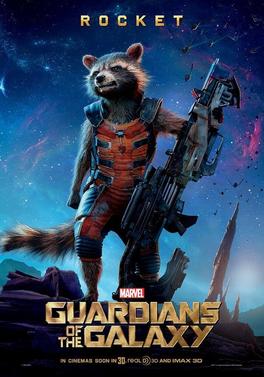
Guardians_of_the_Galaxy_Rocket_movie_posterMany peculiar delights are eaten in Los Angeles County, but diners might want to reconsider the fare offered at The Metro Supermarket. While it’s apparently not illegal to sell raccoons for consumption, it could become dangerous when the Guardians of the Galaxy learn of the practice.

In one of the year’s most successful blockbusters, Guardians of the Galaxy, we were introduced to Rocket Raccoon. Rocket is a genetically altered Procyon lotor designed to be a deadly fighting machine. Not only is he a brilliant tactician, the genetic manipulations have left him with one bad attitude.

Which makes it all the more important for the customers who purchase the ten-dollar-a-pound frozen raccoon carcasses to be cautious.

On a more serious note, the question of what we eat is not merely academic.

I’m not referring to modern insights into healthy diets. I’m talking about international, and potentially intergalactic, relations!

World travelers are often introduced to foods that seem, to put it gracefully, exotic. On such occasions, some respond enthusiastically—eager to sample alien delights. Others are somewhat more wary—reluctant to place in their mouths things they cannot quite identify.

Back in the 1980s I resided for a year in the Republic of Korea. I declined to eat gaegogi, not because I assumed dog meat would be unpalatable, but because I could not imagine contributing in any way to the slaughter of dogs for their flesh.

Another time that year, a sergeant who worked at our chapel purchased a paper cone full of toasted rice during an outing. When he was done with the rice (burned, he thought, rather than “toasted”), his Korean girlfriend clarified that he had just devoured a cup of rice beetles.

Military members stationed abroad are encouraged to be respectful of the cultures they encounter. And those cultures included different foods.

We need not travel to other nations to experience this diversity. I grew up in a family which considered processed “fish sticks” to be seafood. Combined with canned tuna fish and an occasional canned salmon “patty” it constituted the whole of my exposure to the abundance of the sea.

While I have since that time expanded my tastes to include many types of fresh fish, I must admit that crustaceans are not among my favorite foods. And, well, let’s not even talk about those creatures that have tentacles . . .

Not that I’m a culinary snob. In Texas I sampled rattlesnake. In South Carolina I ate alligator. (I preferred the rattlesnake, but I don’t reserve a regular spot for reptiles on my menu.)

To Eat, Or Not to Eat

Showing respect to others by dining as they do, is not a new concept. The early Christians were advised to eat without reluctance food that may have been sacrificed in a pagan temple, without questioning their hosts as to its source. “If one of the unbelievers invites you to dinner and you are disposed to go, eat whatever is set before you without raising any question on the ground of conscience” (1 Corinthians 10:25, ESV).

C.S. Lewis enjoyed a good meal. And he wrote many times about eating. Here are two of his insights on the subject.

For eating and reading are two pleasures that combine admirably. Of course not all books are suitable for mealtime reading. It would be a kind of blasphemy to read poetry at table. What one wants is a gossipy, formless book which can be opened anywhere. (Surprised by Joy).

Contrasting humility and pride, he wrote:

A man who is eating or lying with his wife or preparing to go to sleep in humility, thankfulness and temperance, is, by Christian standards, in an infinitely higher state than one who is listening to Bach or reading Plato in a state of pride. (Letters of C.S. Lewis).

Those interested in learning more about how Lewis approached the subject of meals in his fiction should download a copy of a doctoral thesis on the subject. Lower Sacraments: Theological Eating in the Fiction of C.S. Lewis is available for free here.

We’ll close with the following words from the newly minted “doctor’s” abstract to his dissertation, citing some of the subjects he explores.

For years, critics and fans of C. S. Lewis have noted his curious attentiveness to descriptions of food and scenes of eating. Some attempts have been made to interpret Lewis‘s use of food, but never in a manner comprehensively unifying Lewis‘s culinary expressions with his own thought and beliefs.

My study seeks to fill this void [proposing] ecclesiastical themes appear whenever Lewis’s protagonists eat together. The ritualized meal progression, evangelistic discourse, and biographical menus create a unity that points to parallels between Lewis’s body of protagonists and the church. . . .

Lewis’s meals which are eaten in the presence of the novel’s Christ figure or which include bread and wine in the menu reliably align with the Anglo-Catholic doctrine of the Eucharist. . . . sinful eating affects the spiritual states of Lewis’s characters.

The author ends his introduction with a particularly intriguing thesis that makes sense with my own reading of Lewis. He argues “Lewis’s culinary language draws from Edenic sources, resonating with a very gastronomic Fall of Humanity, then examines how the progressively sinful eating of certain characters signifies a gradual alienation from the Divine. . . . Lewis’s portrayal of culinary desire and pleasure ultimately points to an eschatological theme”

I love that phrase, “gastronomic Fall of Humanity.” I’m not sure I can work it into a sermon someday, but only time will tell.

Until then, I have to be content to regard the eating of dogs—and probably raccoons as well—as consequences of humanity’s Fall. And I will look forward to the new creation when all such things will have passed away.

Engage Brain

brainsWhen I attended the University of Washington, we had to learn the old-fashioned way—by studying. Now they are anticipating downloading information directly into students’ brains.

Literal brain dumps are actually still in the future . . . but researchers have documented the first indisputable brain-to-brain interface between humans!

My first paragraph is not an exaggeration of what researchers think may one day happen.

The project could also eventually lead to “brain tutoring,” in which knowledge is transferred directly from the brain of a teacher to a student.

The student would view this shortcut as advantageous. (It could also save a great deal in tuition expenses, if each course only took, say, an hour or two of brain interfacing.)

The university sees another advantage—circumventing limited teaching skills.

“Imagine someone who’s a brilliant scientist but not a brilliant teacher. Complex knowledge is hard to explain – we’re limited by language,” said co-author Chantel Prat, a faculty member at the Institute for Learning & Brain Sciences and a UW assistant professor of psychology.

My main question is, what will the teacher do, once their knowledge has been transferred to a student?

Presumably they will be able to retain a semblance of their knowledge, unlike the experience of the unfortunate Orbanians. They rely on a nanite technology, and it leaves the brilliant brain in a childlike state after the knowledge is siphoned out of it. You can learn more about them in “Learning Curve,” a documentary about the Stargate project.

C.S. Lewis had a great deal to say about education. He was a popular professor, despite the fact many of his students were intimidated by his brilliance. It is possible that if his students were able to download his knowledge, it might have caused their crania to explode.

In one essay, Lewis explains the differences between education and training, declaring “If education is beaten by training, civilization dies.” (“Our English Syllabus”).

Lewis continues, arguing that learning itself, is something distinct. It is not marked by a transfer of knowledge, but by a hunger to grow.

Now learning, considered in itself, has, on my view, no connexion at all with education. It is an activity for . . . all [who] desire to know. . . .

Societies have usually held a belief . . . that knowledge is the natural food of the human mind: that those who specially pursue it are being specially human; and that their activity is good in itself besides being always honourable and sometimes useful to the whole society.

Oh, and if you are waiting to “learn” when they can download knowledge directly into your skull, consider this wise advice from Lewis.

The only people who achieve much are those who want knowledge so badly that they seek it while the conditions are still unfavourable. (“Learning in Wartime”).

_____

The picture above shows two UW guinea pigs transferring brain waves to one another. (I am uncertain whether two-way transfer is already possible, or if one brain is forced to serve in a receptacle role.)

The article announcing the results can be seen here.

Beware the Tablet

tabletDid the ancient wax writing tablet of the Romans possess the power to terrorize enemies? Two ancient texts suggest that under some circumstances, carrying these humble wax tablets could cost someone their life.

I love history. I love writing. When you combine the two, I’m in a literary paradise. I just read a journal article that took me there. I recently joined a fascinating online organization called Academia.edu, where international scholars freely share their research.

It’s like stumbling into a free four-star buffet for the mind.

I do not only love words themselves. I’ve long been interested in the physical or mechanical aspects of writing, as well. Along this line, I’ve written here in the past about typewriters and the printing press.

I do not recall, however, writing about one of the most fascinating literary devices used by both common and gifted writers for century upon century. I am referring to the wax tablets of Rome, and the often elaborate styluses used to write on them.

I read a captivating article today that related a pair of historical incidents—one ancient, the other medieval—in which modest tablets such as these were mistaken for weapons. Deadly consequences followed.

In a Welsh journal entitled Studia Celtica, there appears “Tírechán on St. Patrick’s Writing Tablets,” by David Woods of University College, Cork. Cork is, of course, in Ireland, that enchanted isle from which the sainted C.S. Lewis also sprang. In fact, in a letter written to a child, Lewis once wrote: “I was born in Holy Ireland where there are no snakes because, as you know, St. Patrick sent them all away.

The purpose of the article was to explain how writing tablets being carried by Saint Patrick and his party could be mistaken (from a distance) as swords. The author is persuasive in revealing the historic scene and the potential for misunderstanding. In doing so, he appeals to an ancient incident in which Octavius (who would become Caesar Augustus) unjustly executed a political enemy he suspected had posed a threat.

When Quintus Gallius, a praetor, held some folded tablets under his robe as he was paying his respects, Augustus, suspecting that he had a sword concealed there, did not dare to make a search on the spot for fear it should turn out to be something else; but a little later he had Gallius hustled from the tribunal by some centurions and soldiers, tortured him as if he were a slave, and though he made no confession, ordered his execution, first tearing out the man’s eyes with his own hand.

The incident with Saint Patrick was not quite so gruesome, although it may have easily turned bloody, if the pagan’s hoping to instigate a bloodbath had succeeded.

Patrick came from Mag Arthicc to Drummut Cérrigi . . . and people saw him with eight or nine men, holding written tablets in their hands like Moses. The pagans shouted as they saw them, demanding that one should kill the holy men, and said: “They have swords in their hands for killing people. In their hands they look wooden by day, but we believe they are swords of iron for shedding blood.”

The big crowd was on the point of doing harm to the holy men; but there was a man among them who felt pity, Hercaith by name, of the race of Nothe, the father of Feradach. He believed in Patrick’s God, and Patrick baptized him and his son Feradach.

Fortunately, reason prevailed, and Patrick continued to spread the gospel in the land to which he had originally been carried as a slave.

The article also references occasions where the stylus, rather than the innocuous tablet, was used as a weapon. “For example, when his assassins confronted Julius Caesar in the senate in 44 BC, he sought to defend himself with his stylus, and stabbed one of them, Casca, in the arm with it.”

The pen, (the original) Caesar’s weapon of last resort.

This delightful article offered a wealth of knowledge. It alerted me to the fact that it is not only wax tablets that are threatening. Those who are wise will exercise extreme caution, whenever they are confronted by any and all writing tools.

Discordant Dictionaries

dictionary 1Most “word people” like dictionaries. Some writers go so far as to love dictionaries, but I don’t wish to quibble about where one rests on the affection spectrum in terms of these repositories of words.

This guy, though, has to be pegged on the extreme (idolatry) end of the meter. Ammon Shea wrote Reading the OED: One Man, One Year, 21,730 Pages after having done just that. The Oxford English Dictionary, you may know, comprises 25 volumes, and Shea warns that reading it at such a rapid pace took a toll on his eyesight. It’s not surprising, that he admits he is not your typical reader.

One could say that I collect word books, since by last count I have about a thousand volumes of dictionaries, thesauri, and assorted glossaries. . . . I do not collect these words because I want to impress friends and colleagues with my erudition. . . .

My friends know that I read dictionaries for fun, and have come to accept this proclivity with relative good grace, but they are not terribly interested in or impressed by my word collection.

Pierre Jules Théophile Gautier advised his fellow poets to read the dictionary. No better way to enrich one’s language, he claimed, although he also read cook books, almanacs and the like. In fact, his biographer offered this fascinating observation.

He found pleasure in the most indifferent novels, as he did in books of the highest philosophical conceptions, and in works of pure science. He was devoured with the desire to learn, and said: “No conception is so poor, no twaddle so detestable that it cannot teach us something by which we may profit.”

C.S. Lewis indicated that so-called “definitions” offered outside the ordinances of the dictionary must be approached warily. “When we leave the dictionaries we must view all definitions with grave distrust” (Studies in Words). He offers a very sensible reason for such precautions.

It is the greatest simplicity in the world to suppose that when, say, Dryden defines wit or Arnold defines poetry, we can use their definition as evidence of what the word really meant when they wrote. The fact that they define it at all is itself a ground for scepticism.

Unless we are writing a dictionary, or a text-book of some technical subject, we define our words only because we are in some measure departing from their real current sense. Otherwise there would be no purpose in doing so (Studies in Words).

Dictionaries are, of course, their own genre. Lectionaries, collections of words and meanings, are different than any other type of written composition. For example, glossaries may draw together specialized vocabulary—say for medical or theological purposes—but by their very nature they are not intended to blaze any new literary pathways.

There is, invariably, an exception to this rule. Some “dictionaries” are creative exercises. They are works of fiction, and some are entertaining indeed.

The most famous of these satirical works is Ambrose Bierce’s Devil’s Dictionary (originally published as The Cynic’s Word Book). The volume is not expressly irreverent, although people of faith will encounter some offensive examples in its pages. However, a number of the entries are brilliant.

Kilt

  1. A costume sometimes worn by Scotchmen in America and Americans in Scotland.

Rank

  1. Relative elevation in the scale of human worth.

He held at court a rank so high

That other noblemen asked why.

“Because,” ’twas answered, “others lack

His skill to scratch the royal back.”

Emancipation

  1. A bondman’s change from the tyranny of another to the despotism of himself.

He was a slave: at word he went and came;

     His iron collar cut him to the bone.

Then Liberty erased his owner’s name,

     Tightened the rivets and inscribed his own.

Goose

  1. A bird that supplies quills for writing. These, by some occult process of nature, are penetrated and suffused with various degrees of the bird’s intellectual energies and emotional character, so that when inked and drawn mechanically across paper by a person called an “author,” there results a very fair and accurate transcript of the fowl’s thought and feeling. The difference in geese, as discovered by this ingenious method, is considerable: many are found to have only trivial and insignificant powers, but some are seen to be very great geese indeed.

Another Frenchman, Gustave Flaubert, composed his Dictionary of Received Ideas, which found humor in peculiarities of common understandings.

Absinthe

Extra-violent poison: one glass and you’re dead. Newspapermen drink it as they write their copy. Has killed more soldiers than the Bedouin.

Archimedes

On hearing his name, shout “Eureka!” Or else: “Give me a fulcrum and I will move the world.” There is also Archimedes’ screw, but you are not expected to know what it is.

Omega

Second letter of the Greek alphabet. [Note: this would only apply to biblically literate societies.]

The earliest such example of a satirical dictionary was that by the Persian writer Nezam od-Din Ubeydollah Zâkâni. I have not located a copy of his 14th century lexicon, but it apparently includes entries that are still understandable in our modern world.

Thought

What uselessly makes people ill.

Orator

A donkey.

Word lovers can easily get caught up in conversations like this. In fact, I’m certain more than one Mere Inkling reader has contemplated compiling their own creative dictionary! It’s not an insurmountable project, since it’s accomplished one word at a time.

_____

For those desiring to create their own dictionary “entries” such as the one that graces the top of this blog, there a free meme generator you can use online. Available here, it’s a fun little tool. It’s also suitable for creating a little self-deprecating humor.

dictionary 2

Beware of Moths

mothI try not to hate moths. They’re obviously not so pretty as butterflies, but I remind myself that’s not their fault. They’re a nuisance around the porch lights on summer evenings, but that’s instinct, not choice.

I strive to see the best in moths, like C.S. Lewis, who was able to capitalize on their impulsiveness in his 1933 poem, “The Naked Seed.”

Oh, thou that art unwearying, that dost neither sleep

      Nor slumber, who didst take

All care for Lazarus in the careless tomb, oh keep

      Watch for me till I wake.

If thou think for me what I cannot think, if thou

      Desire for me what I

Cannot desire, my soul’s interior Form, though now

      Deep-buried, will not die,

—No more than the insensible dropp’d seed which grows

      Through winter ripe for birth

Because, while it forgets, the heaven remembering throws

      Sweet influence still on earth,

—Because the heaven, moved moth-like by thy beauty, goes

      Still turning round the earth.

I really want to give moths the benefit of the doubt . . . but that’s become virtually impossible since I learned some of them are vampiric!

Before we consider their blood-sucking rituals, I want to share a traumatic moth encounter my wife and I experienced several years ago when we lived in Eastern Washington.

We had a huge fragrant collection of plants that ran across nearly the whole of the front of our house. There was a bush at the far end, and some delightful quail nested there. The flowers brought us other welcome guests. Hummingbirds would crowd around them as sun was setting, and savor their nectars.

We loved watching them hover near the blooms, and wondered precisely what species of hummingbirds they were, since they were slightly smaller than the ones we were accustomed to.

One day I was getting a close up view of their activity and I saw something that shattered my sense of reality. Instead of a beak, these hummingbirds had tongues that curled and uncurled, not unlike those “party horns” that children blow at celebrations.

My wife said I had to be imagining what I’d seen. I assured her that I hadn’t seen anything like this in the scifi shows I regularly watched, and I was pretty sure that these abominations weren’t hummingbirds.

Eventually I persuaded her to look for herself, and she too was aghast at the question of what they might be. Some of you already know, because you’ve had the misfortune of growing up where these creepy things thrive. For the rest of you—the fortunate ones who’ve been spared the curse of hemaris sphinx moths—let me assure you, their maladapted proboscises are grotesque.

I thought they were the worst thing the world of the moths had to offer. (Well, aside from the 1961 Japanese film “Mothra.”)

That’s what I thought, until recently, when I learned that some misbegotten moths had followed mosquitoes in their descent into parasitical evil by drinking the blood of other creatures.

The calyptra moths are another proof of the fall. No longer do they flutter around from plant to plant, seeking sustenance as a proper herbivore. The aptly named “vampire moth” has chosen to adapt its proboscis to pierce the skin of other animals such as buffaloes . . . and human beings.

In the equal opportunity world of the corruption of the natural order, while female mosquitoes drink blood, it is male moths that do so. Apparently, they’ve already infested Malaysia, the Urals and Southern Europe. Now they are adjusting to the climate of Scandinavia. The question arises, where can be we safe from these monsters?

Returning to C.S. Lewis, he records an incident that occurred in Narnia involving mistaken identity.

It is a very funny thing that the sleepier you are, the longer you take about getting to bed; especially if you are lucky enough to have a fire in your room. Jill felt she couldn’t even start undressing unless she sat down in front of the fire for a bit first. And once she had sat down, she didn’t want to get up again. She had already said to herself about five times, “I must go to bed,” when she was startled by a tap on the window.

She got up, pulled the curtain, and at first saw nothing but darkness. Then she jumped and started backward, for something very large had dashed itself against the window, giving a sharp tap on the glass as it did so. A very unpleasant idea came into her head—“Suppose they have giant moths in this country! Ugh!”

But then the thing came back, and this time she was almost sure she saw a beak, and that the beak had made the tapping noise. “It’s some huge bird,” thought Jill. “Could it be an eagle?” She didn’t very much want a visit even from an eagle, but she opened the window and looked out. Instantly, with a great whirring noise, the creature alighted on the window-sill and stood there filling up the whole window, so that Jill had to step back to make room for it. It was the Owl. (The Silver Chair).

Fortunately for Jill, and the rest of the children who visited Narnia, there is no record of them ever encountering giant moths . . . vampire moths . . . or moths deceptively impersonating hummingbirds.

_____

Note: The monster moth pictured above is not (to my knowledge) a blood or flesh eater. But I still wouldn’t want one that size landing on my shoulder.