Any Name But That

jesus nameThis week I read one of the clearest descriptions of the gospel I have ever heard. It appeared in an article written by the most (how do I put this mildly?) daunting professor I have encountered in my Doctor of Ministry studies. “Intimidating” would also work . . .

But his brilliance and rapid fire delivery of thought-provoking concepts is not the reason for me mentioning him here. It is his ability to cut through the confusion, and express simply the essence of the good news, the Christian hope, the gospel.

I’m not pandering to him, mind you, because my grade for his systematics course was filed long ago. It is simply that Joel Biermann said extremely succinctly, something that I have always attempted to emphasize in my own ministry.

The Gospel is the good news, but it is not just any good news. The Gospel is a word of liberation and encouragement, but it is not just any word of liberation and encouragement. The Gospel is a wonderful event and a joyful experience, but it is not just any wonderful event and joyful experience.

In other words, when it comes to defining the Gospel, it is vitally important that we move past vague ideas or general notions and grab hold of the central thing. The central thing is Jesus.

This is a truth too many fail to understand. Sadly, this is true for some “inside” the Church as well as outside of its doors.

Goodness is good. Generosity is wonderful. Encouragement is precious. Courage is noble. Love is (almost) divine.

Yet none of these are the Gospel. The Gospel is Jesus. In him the world discovers every good thing from the hand of God the Father, our Creator.

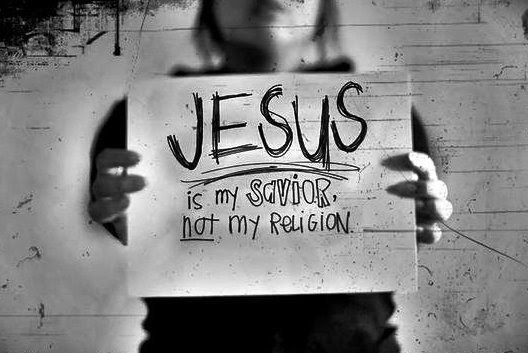
Jesus is indispensable. Without his holy name, the “faith” would simply be a praiseworthy “religion.” Without Jesus, it could instruct how to live, but it could not redeem.

It is precisely this point—the name of Jesus—that makes the Gospel objectionable to some. “Care for the sick,” some say, “just don’t mention that name.” On other lips we hear “The Church does lots of things that benefit the community, but please don’t mention that name that offends people.”

They arrested the apostles and put them in the public prison. But during the night an angel of the Lord opened the prison doors and brought them out, and said, “Go and stand in the temple and speak to the people all the words of this Life. . . .”

And someone came and told [the High Priest], “Look! The men whom you put in prison are standing in the temple and teaching the people. . . .”

And the high priest questioned them, saying, “We strictly charged you not to teach in this name, yet here you have filled Jerusalem with your teaching, and you intend to bring this man’s blood upon us.”

But Peter and the apostles answered, “We must obey God rather than men. The God of our fathers raised Jesus, whom you killed by hanging him on a tree. God exalted him at his right hand as Leader and Savior, to give repentance to Israel and forgiveness of sins. And we are witnesses to these things, and so is the Holy Spirit, whom God has given to those who obey him.” (Acts of the Apostles, chapter five).

C.S. Lewis knew quite well that Christianity is all about Jesus. Without him, the person Jesus the Christ, whatever passes for the “Church” would merely be a noisy gong. Lots of “religious” talk would remain . . . but the Gospel would be absent.

“What are we to make of Christ?” There is no question of what we can make of Him, it is entirely a question of what He intends to make of us. You must accept or reject the story. The things He says are very different from what any other teacher has said. Others say, “This is the truth about the Universe. This is the way you ought to go,” but He says, “I am the Truth, and the Way, and the Life.” He says, “No man can reach absolute reality, except through Me. Try to retain your own life and you will be inevitably ruined. Give yourself away and you will be saved. . . .”

“Come to Me everyone who is carrying a heavy load, I will set that right. Your sins, all of them, are wiped out, I can do that. I am Re-birth, I am Life.” (1950 essay, “What Are We to Make of Jesus Christ?”).

In the same way as the apostles, C.S. Lewis, my seminary professor, and all of those who have entrusted themselves to the grace of God in Christ, know the name of Jesus is not optional. In fact, it is all about the name.

For it is Jesus, and him alone, who is the alpha, omega and the whole of the Gospel.

Introducing Anatole France

papeThere’s always a new author to meet. Some are more worth meeting than others.

I was introduced to Anatole France (1844-1924) when I saw him listed on the “must read” list of F. Scott Fitzgerald.

I’m not a big Fitzgerald fan, but as an amateur literary historian, I was curious about how this particular list was recovered. Apparently, he had dictated it to one of his nurses, several years before his death. However, the list only turned up last year, having lain unnoticed in the nurse’s effects.

The France title that Fitzgerald deemed essential was The Revolt of the Angels. Its importance to him is highlighted by the fact that this relatively short list only included twenty-two titles. And one of that mere score of selections was The Revolt of the Angels.

The angelic dimension of the work is what intrigued me. Angels, of course, are real beings. They’re distinct from people (contrary to the pervasive contemporary notion that when people die they “become” angels).

There actually was an angelic revolt, and there are several references to it in the Scriptures. “How you are fallen from heaven,
O Day Star, son of Dawn!” (Isaiah 14:12).

I was curious whether France was writing about this ancient event. I was also intrigued by Fitzgerald’s interest in the volume, given its subject.

I was disappointed.

It turns out that, like Mark Twain, France was sympathetic to the Devil. I’m sure he thought himself quite the wit when he wrote, in reference to the Bible, “We have never heard the devil’s side of the story, God wrote the whole book.”

I don’t have time to read texts like this—when there is more than enough good literature to keep me occupied for several lifetimes. However, it appears to be based on Gnostic concepts with God (the Creator of this world) viewed as an imperfect demiurge. His incompetence, it seems, justifies the heavenly revolt.

Suffice it to say, the book is commended for reading by the Freedom From Religion Foundation. That sort of endorsement speaks volumes.

Here, however, is a random paragraph. It may be illustrative of the tone of the work, even though pulled from its context. The speaker is, I believe, one of the positive characters in the book. While France himself was an atheist, his sympathetic character summarizes a pagan cosmology quite elegantly.

Young Maurice’s guardian angel [said] “I argue, like you, in the language of human beings. And what is human language but the cry of the beasts of the forests or the mountains, complicated and corrupted by arrogant anthropoids. How then . . . can one be expected to argue well with a collection of angry or plaintive sounds like that?

Angels do not reason at all; men, being superior to the angels, reason imperfectly. I will not mention the professors who think to define the absolute with the aid of cries that they have inherited from the pithecanthropoid monkeys, marsupials, and reptiles, their ancestors! It is a colossal joke! How it would amuse the demiurge, if he had any brains!”

That is actually a rather provocative quote, and I’m sure it may lead some to explore the text even further. I certainly don’t object to that, and would be curious to hear back from anyone familiar with the book. I would especially like to see the reaction of Christians to The Revolt of the Angels.

If you are interested in a more creative fictional treatment of fallen angels, be sure to read C.S. Lewis’ The Screwtape Letters. While the presentation is truly groundbreaking, Lewis’ take on the motives and nature of these defeated beings is actually based on reality. Cast from the heavens they are consumed with rage and hatred of God.

A positive note about Anatole France

Whatever I think about the writer’s theology, I did read several wise quotations attributed to him. I’d like to close with these, as they may be more edifying than our discussion of Gnostic cosmology.

“Nine tenths of education is encouragement.”

“Some succeed because they are destined to; most succeed because they are determined to.”

“If 50 million people say a foolish thing, it is still a foolish thing.”

“When a thing has been said and well said, have no scruple; take it and copy it.”

And my favorite:

“Until one has loved an animal, a part of one’s soul remains unawakened.”

_____

The illustration above is the work of Frank C. Papé (1874-1972) an English book illustrator. It comes from another of France’s “religious” works.

Suspicious Séances

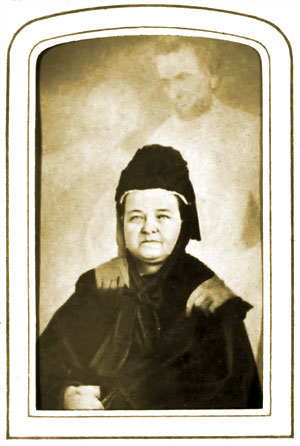
lincolnsDid you hear about the séances that were held at the White House? It’s true, but it’s not recent news. They were conducted for Mary Todd Lincoln, and her husband, the president, apparently joined in attendance at some of them.

The Lincoln’s had lost their eleven year old son Willie to Typhoid in February 1862. Nearly all historians describing Mary’s grief accurately use the word “inconsolable”.

Since the Lincoln’s were not Christian, Mary sought the illusion of comfort in spiritualism, a thriving movement in the mid-nineteenth century. Spiritualism typically contends that the spirits of the dead survive in a manner where they can, and do, communicate with the living. This interchange is typically facilitated by a “medium,” someone particularly attuned to the “spirit world.”

Mediums sometimes allow themselves to become physical vessels for these spirits.

Christians either dismiss such experiences as fraud, or as demonic possession. Which depends on their own worldview. Some Christians dismiss the spiritual realm, while others recognize it is quite real.

C.S. Lewis would be in the latter camp, as his preface to The Screwtape Letters amply illustrates.

There are two equal and opposite errors into which our race can fall about the devils. One is to disbelieve in their existence. The other is to believe, and to feel an excessive and unhealthy interest in them. They themselves are equally pleased by both errors and hail a materialist or a magician with the same delight.

Christians who acknowledge the spiritual warfare which is waged beyond our physical senses understand the meaning of Paul’s words: “For we do not wrestle against flesh and blood, but against the rulers, against the authorities, against the cosmic powers over this present darkness, against the spiritual forces of evil in the heavenly places” (Ephesians 6:12).

Returning to the 1800s

The reason I have been thinking about Mary Lincoln—who would later be institutionalized and attempted suicide—is because I’m finishing up an article for the online journal I edit about the military chaplaincy. It’s called Curtana: Sword of Mercy, and the new issue will be posted by the end of the month.*

The specific article relates the story of Ellen Elvira Gibson (Hobart),** who was the first woman chaplain in the American military. She served a Wisconsin regiment, and her story is nothing short of fascinating.

Hobart was a spiritualist, and “ordained” by a group of the same who banded together to provide just such credentials. Interestingly, although she gave hundreds of (paid) lectures in a spiritual “trance” state, she would ultimately reject spiritualism. She turned to a more radical and secular “freethinking” as spiritualism was waning in popularity, but still a formidable presence.

Chaplain Hobart would gain renown in anti-Christian circles for her book The Godly Women of the Bible by an Ungodly Woman of the Nineteenth Century. Numerous atheist websites cite a quotation from the volume. “The abominable laws respecting [women in the Bible] . . . are a disgrace to civilization and English literature; and any family which permits such a volume to lie on their parlor-table ought to be ostracized from all respectable society. . .”

Contemporary readers will find it odd that one of the reasons spiritualism received a warm welcome in Europe and America was precisely because it seemed to offer measurable, “scientific” evidence of the afterlife. In This Republic of Suffering: Death and the American Civil War, Drew Faust writes:

To an age increasingly caught up in the notion of science as the measure of truth, spiritualism offered belief that seemed to rely on empirical evidence rather than revelation and faith. If the dead could cause tables to rise, telegraph messages from the world beyond, and even communicate in lengthy statements through spirit mediums, an afterlife clearly must exist. Here was, in the words of one popular spiritualist advocate, ‘proof palpable of immortality’” (180-81).

Returning to the Inklings

One of Lewis’ dearest friends was Owen Barfield. Sadly, the two remained separated throughout life by their religious beliefs. Barfield had helped Lewis come to believe in God (i.e. theism) but could not journey with Lewis on to Christianity. Barfield, instead, became one of the greatest of Anthroposophist evangelists.

Anthroposophy possesses elements of philosophy, but is also inarguably a religion in its own right. It also holds a view of the afterlife distinct from both Christianity and historic spiritualism.

But the nature of the religion created by Rudolf Steiner (which evolved from his involvement in Theosophy) is not the subject of our reflections here. However, if one is interested in learning more about Owen Barfield, a 1992 documentary can be viewed here.

_____
The image above is a famous example of “spirit photography” taken by William Mulmer, who made it popular. He was once placed on trial for fraud, but the case was dismissed for lack of evidence.

* I may delay publication of this particular article since the issue will already carry the biography of another chaplain.

** The reason “Hobart” is bracketed, is because it was her married name at the time of her military service. However, the marriage was short lived, and most of her life she went by “Ella E. Gibson.”

Navy Nerds

nerdEvery once in a while, the military has a good idea. Sure, they have a knack for technological breakthroughs in warfare . . . but what about other fields? The NAVY NeRD answers that question in the affirmative.

NeRD stands for Navy eReader Device.

Well-informed readers of Mere Inkling are already aware of the growing intensity of international cyberwarfare. It is no joke, and lives are at stake.

Draconian policies are in place to avoid the contamination of the military computer system by innocently transferred viruses. Since virtually all digital platforms allow for the transfer of data, they are potentially dangerous.

Because of that, even ereaders have been off limits in certain environments. Now, however, someone has thought outside the proverbial box and come up with a solution to that problem.

The United States Navy has devised a novel ereader that comes loaded with 300 titles, but has no ports or wireless connectivity to allow for inadvertent viral transfers.

The selection of books sounds pretty well rounded. Some public domain classics, and a number of contemporary best sellers like A Game of Thrones. Fans of J.R.R. Tolkien will be delighted to know the readers also include The Lord of the Rings.

Reading is a productive way to spend one’s free time during a lengthy period at sea. Even for those not prone to opting for it when faced with all the distractions ashore.

During WWII, C.S. Lewis wrote a letter to a former student who was serving in the Navy, “out of reach of libraries.” It acknowledges the perennial problem of sailors—lack of space for personal property. The letter was written in response to a request from Michael Rayner Thwaites for reading recommendations. Thwaites was an Australian poet and military intelligence officer.

A man who has already your linguistic training might well, I think, begin the Anglo Saxon on his own. You will need E. Wardale Old English Grammar. . . . For texts, the ordinary beginning is first Sweet’s Anglo Saxon Primer and then his Old English Reader. But you, being a classic might well, after a dip in the Primer go on to King Alfred’s trans. of Boethius De Consolatione Philosophiae . . .

Whether you can begin O.E. poetry on your own I don’t know. But try getting . . . Beowulf: and with it Clark Hall’s trans. ed. by Wrenn with preface by Tolkien . . . This edition is essential for it is Tolkien’s part of metre wh. is essential. (O.E. verse uses both quality and accent, and your ear is prob. ruined, as mine was, by the false way they teach Latin metre at schools–drastic re-education is required. . . .

As to modern literature. You must not start out to study it ‘as it reveals man’s hesitant advance to the idea of a God-created world’. Don’t you see you are laying down in advance what a phenomenon is to reveal before you have examined the phenomenon? It may reveal that: it may not. You have to find out. I don’t think I can lay down any v. definite course of reading.

All I can point out is that while you are in the navy and out of reach of libraries and new publications, this is the proper time for solid reading through the big (i.e. long) authors, critical works and histories of lit. can come later. Now is the time for Chaucer, Malory, Spenser, Sidney, Shakespeare, Dryden, Pope, Swift, Johnson, Fielding, Richardson, Cowper, Scott, Wordsworth, Byron, Dickens etc etc.

If you usually keep two books of widely different period and type going together (e.g. Faerie Queene & Tom Jones) you won’t get bored. I myself always index a good book when I read it for the first time noting (a) Linguistic phenomena. (b) Good & bad passages. (c) Customs: meal times, social classes, what they read etc. (d) Moral ideas.

All this reading, tho’ dedicated ad Dei gloriam in the long run must not be infected by any immediate theological, ethical, or philosophic reference. Your first job is simply the reception of all this work with your imagination & emotions. Each book is to be read for the purpose the author meant it to be read for: the story as a story, the joke as a joke.

Back to the NeRD

The Navy is making 385 devices at first, with more to follow, with five being sent to each submarine in the Navy to be shared among the crew.

That’s only the start, of course. One would anticipate that even for a military crew (for example, 155 personnel on a Trident sub), a mere five mini-libraries would prove insufficient. (No offense intended; yours truly is a veteran himself.)

Impromptu Poetry

eye

I had to endure a to and fro transcontinental trip this week. Endure is the right word, when flying miles above what would otherwise be a scenic, albeit lengthy, journey.

One positive thing about flying is that I have time to catch up on some of my “pleasure” reading. This week it included an article about cinquains.

A quintain is a poem with five verses. A cinquain is a specific form which has the following number of syllables in each of the lines: two, four, six, eight, and two.

I took a break from my reading and drafted a few of these small poems. I found it quite simple, and it’s likely you may as well.

I make no promises about the quality of my verse, but perhaps you’ll find one or more of them interesting. Or, at least they may inspire you to write some of your own.

Springtime
Narnian hope
Delayed by the White Witch
Borne by Aslan’s Resurrection
New dawn

Pilgrim
Traveling through
This world is not my home
Destined for a new creation
With Christ

True hope
He died for us
Emancipation now
Washed clean by the blood of the Lamb
New life

Inklings
Lewis, Tolkien
Friends rounded out the group
Imaginations unfettered
Wonder

Married, or Not?

unificationShould a wedding ceremony during which the bride forgets the groom’s name be considered valid? That question may sound slightly preposterous, but I just witnessed it happening.

One of the network news programs just did a story on the latest “Holy Marriage Blessing Service” conducted by the Unification Church. This is the religion founded by Sun Myung Moon, whose disciples believe to be the second coming of Jesus. (Moon died in 2012, but his wife continues to lead the religion, and officiate at these regular ceremonies.)

Many of the couples who marry in these ceremonies are matched by their parents or, if they are determined to be especially blessed, they are “randomly” matched by the church leader (presently the widow of their messiah). Reportedly, each match takes about thirty seconds as the prophets place the hands of men and women together in divinely appointed relationships.

Officially, a person can decline their match after they’ve had a little time to talk with their future spouse, but it’s evident that contradicting the action of one’s savior would require immense courage.

That said, I have no doubt that—due to the earnest commitment and efforts of both parties—many of these marriages end up happy. After all, as C.S. Lewis wrote in Mere Christianity:

Knowledge can last, principles can last, habits can last; but feelings come and go… But, of course, ceasing to be “in love” need not mean ceasing to love. Love in this second sense — love as distinct from “being in love”—is not merely a feeling. It is a deep unity, maintained by the will and deliberately strengthened by habit; reinforced by (in Christian marriage) the grace which both partners ask, and receive, from God. . . . “Being in love” first moved them to promise fidelity: this quieter love enables them to keep the promise. It is on this love that the engine of marriage is run: being in love was the explosion that started it.

In the case of Unification Church members, even if the relationship lacked an emotional stage of “being in love,” it doesn’t mean that it is destined to fail. Far from it, since, as Lewis wisely points out, true love isn’t about feelings.

In the aforementioned case, the bride was from a French-speaking African nation. The husband, I believe, was from Japan. Her English was quite good, but his was poor. They were essentially unable to communicate. Then, when the interviewers revisited them immediately before the ceremony was to begin, they asked the beautifully-gowned bride what her husband’s name was. And she had forgotten.

Another peculiar thing about Unification marriage practices is that, following the wedding, there is a 40+ “separation period,” during which they are required to refrain from intimate relations. While Christians are called to practice premarital chastity, I’m unfamiliar with any other group that requires a post-wedding purification.

One last comment about the Unification marriage blessings. As if they could not be more bizarre. In 1997 the Moons presided over a ceremony in Washington, D.C. While only 2,000 of the 30,000 couples were actually being married, among the other 28,000 couples having their marriage “blessed” by the Unification messiah included a prominent American political figure—none other than Al Sharpton.

At least he and his wife, Katherine, probably knew each other’s names.

_____

The picture above comes from one of the group weddings. This young bride has to be content with the photograph of her absent groom. One wonders if the two have yet to meet.

Rescuing Orphans

orphansWar is a terrible thing. It should be avoided at (nearly) all costs. As C.S. Lewis wrote during Hitler’s atrocities, “If war is ever lawful, then peace is sometimes sinful” (“The Conditions for a Just War”).

I was writing this weekend about one of the sad consequences of war—the creation of orphans. As an adopted child of God, I possess deep compassion for children without parents in this world. Over a decade ago I was privileged to represent the United States Air Force at the dedication of the Korean War Children’s Memorial.

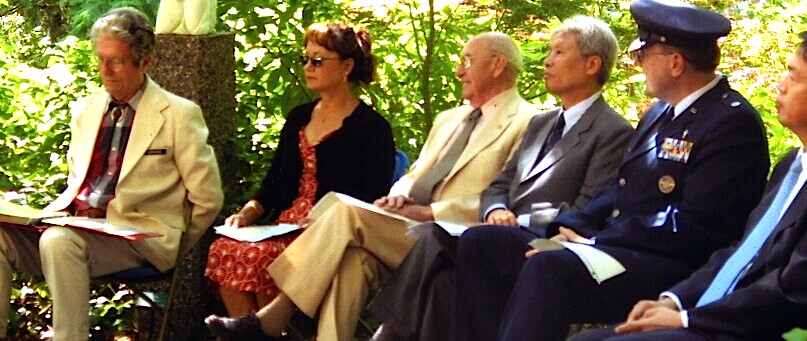
When I contacted the coordinator of that event, Dr. George Drake, he provided me with the photograph above, which shows the speakers that day. Drake appears to the left, and yours truly is in uniform, to the right. The primary speaker was Chaplain Russell Blaisdell, center, who saved the lives of at least a thousand Korean orphans during the war, delivering them from almost certain death as Seoul fell to the Communists. (My next post will reflect on his heroism and humility.)

The war in Korea was horrific. The frontlines swept across the peninsula, leaving desolation and tragedy in their wake. The number of orphans created by the violence was legion. In the cruel ebb and flow of the conflict, many perished. Still, even in the crimson terror there were expressions of mercy and grace.

Chaplains often led the way in reaching out to the children, but their efforts would have accomplished little if the compassion of the common Soldier, Marine, Sailor and Airman had not moved them as well to make sacrifices to care for the children.

Chaplains who serve in Korea today have maintained the strong bonds of support for orphanages that was so vital to the wartime chaplains represented by Blaisdell.

During my year in Taegu (Daegu), I coordinated the ministry of the airmen at Taegu Air Base in partnership with Love and Hope Orphanage. Love and Hope has a unique role, caring for the least of the least . . . children with serious physical and/or mental handicaps. There is little room for them in most societies, and Korea is no exception.

Orphans are made not by war alone, of course, but by a variety of tragic confluences of suffering. Some lose parents to accident or disease. Today, we find the greatest number of orphaned children in various parts of Africa where AIDS has devastated local adult populations. Similarly, following natural disasters such as major earthquakes and tsunamis, many orphans are left alone in the rubble or receding waters.

Some children flee abusive homes, or are rescued from dangerous environments; in one sense these were orphans even before their legal bonds with cruel predators were severed.

Many causes account for the existence of orphans. And, as long as we live in this fallen world, orphans will be among us. This is why we must never forget that, “Religion that is pure and undefiled before God, the Father, is this: to visit orphans and widows in their affliction, and to keep oneself unstained from the world” (James 1:27, ESV).

C.S. Lewis was well acquainted with the sorrow of wartime violence and the shattering of families. A veteran of World War I, he saw many friends perish just as they were embarking on adulthood. After World War II, one of his many correspondents was Don Giovanni Calabria, who operated an orphanage in devastated Italy

In 1951, Lewis sent his friend a newly translated copy of the first book in his Chronicles of Narnia. He invited the priest (who would be canonized by the Roman Catholic Church less than fifty years later) to pass the book on to one of the orphans in his care.

I am sending you my tale recently translated into Italian in which, frankly, I have rather played than worked. I have given my imagination free rein yet not, I hope, without regard for edification—for building up both my neighbour and myself. I do not know whether you will like this kind of trifle. But if you do not, perhaps some boy or girl will like it from among your “good children.”

While I imagine the volume remained close to the future “saint,” I trust that Lewis’ powerful tale delighted many of the young children in his care.

As Chaplain Blaisdell says about caring for innocent children, the act itself provides more than sufficient reward. Formal recognition is not required, and may in fact detract from the intrinsic satisfaction that accompanies the giving of oneself in service. Ninety-nine percent of those who sacrifice for the widow and orphan remain essentially anonymous to all but God, and this is just fine. (You can read more about the Kiddy Car Airlift and who received credit for it here.)

Words of Death

joseyOne of the cinema’s most powerful scenes occurs in a film many might disregard due to its genre. In “The Outlaw Josey Wales,” a man trying to rebuild his war-shattered life, rides out to face a Comanche chieftain.

Josey: You be Ten Bears?

Ten Bears: I am Ten Bears.

Josey: I’m Josey Wales.

Ten Bears: I have heard. You’re the Gray Rider. You would not make peace with the Blue Coats. You may go in peace.

Josey: I reckon not. Got nowhere to go.

Ten Bears: Then you will die.

Josey: I came here to die with you. Or, live with you. Dying ain’t so hard for men like you and me, it’s living that’s hard; when all you ever cared about has been butchered or raped. Governments don’t live together, people live together. With governments you don’t always get a fair word or a fair fight. Well I’ve come here to give you either one, or get either one from you. I came here like this so you’ll know my word of death is true. And that my word of life is then true. The bear lives here, the wolf, the antelope, the Comanche. And so will we. Now, we’ll only hunt what we need to live on, same as the Comanche does. And every spring when the grass turns green and the Comanche moves north, he can rest here in peace, butcher some of our cattle and jerk beef for the journey. The sign of the Comanche, that will be on our lodge. That’s my word of life.

Ten Bears: And your word of death?

Josey: It’s here in my pistols, there in your rifles . . . I’m here for either one.

Ten Bears: These things you say we will have, we already have.

Josey: That’s true. I ain’t promising you nothing extra. I’m just giving you life and you’re giving me life. And I’m saying that men can live together without butchering one another.

Ten Bears: It’s sad that governments are chiefed by the double-tongues. There is iron in your word of death for all Comanche to see. And so there is iron in your word of life. No signed paper can hold the iron, it must come from men. The word of Ten Bears carries the same iron of life and death. It is good that warriors such as we meet in the struggle of life . . . or death. It shall be life.

This conversation has always caused me to stop and think—even as I typed it out now. It contains many profound thoughts about honesty, commitment, respect and even peace. Most captivating to my thoughts, though, is the contrast between words of death and words of life.

“There is iron in your word of death . . . And so, there is iron in your word of life.”

People say all sorts of things, often without much regard as to whether or not they are true. They often speak without thinking about the words before they leave their lips. Most daily conversation is superficial, and immediately forgotten.

That changes, when we speak of death. Sure, comedians joke about it, but when people discuss actual death—often in the wake of someone’s passing—our words become more measured, our tempo slows, and we more consciously ponder what we are saying.

I recall a conversation with a fellow chaplain who described his father’s dying. He contracted a terminal disease, which would take some time to extinguish his life, and he told his children: “As you have grown up, I’ve done my best to teach you how to live. Now I will do my best to teach you how to die.”

It doesn’t require faith in God to die with dignity, but those of us who know the resurrected Jesus, face death with a confidence that death does not have the final word.

The truly wise live all of their days in the knowledge that we all will someday (barring the parousia) experience physical death. In light of that, our words should not be careless, or even frivolous. That’s true for our life words, as well as our death words.

By this I do not mean that we should not play with language or engage in humor. After all, humor is inarguably one of God’s most precious gifts to us. Nor should we allow the cloud of death that hangs over all mortal flesh rob us of the many joys life brings.

C.S. Lewis would have understood the essence of the conversation quoted above. (The movie was made thirteen years after his own death.) When grieving the death of his wife, Lewis wrote:

You never know how much you really believe anything until its truth or falsehood becomes a matter of life and death to you. It is easy to say you believe a rope to be strong and sound as long as you are merely using it to cord a box. But suppose you had to hang by that rope over a precipice. Wouldn’t you then first discover how much you really trusted it? . . . Only a real risk tests the reality of a belief. (A Grief Observed).

What I am trying to capture is more than simply the notion that our words of life, our day to day conversations, should be just as sincere and thoughtful as our words of death. It’s more in line with what Lewis was referring to. That our words, thoughts, and hopes have been tested and proven true . . . because they are based not on the fancy of the moment, but on the final, concluding whole of the testimony of our lives.

In other words, it is precisely because one’s word of death (ultimate, naked honesty) is true, that you can trust their word of life.

That’s a message that echoes both the sound of a hammer driving nails on a Judean hill, and a heavy stone rolling away from the entrance to a sealed tomb, two days later.

Common People

narnia shieldNone of us like to be considered “common.” No surprise; it’s not a complimentary adjective. We prefer to think of ourselves as exceptional . . . and, if not extraordinary, at least special.

In our democracies, with the possible exception of monarchies where the terminology may still exist, we’re no longer referred to a “commoners.” In fact, in the United States we can even design our own coats of arms!

If you want to add a “title” to your legal name, you can follow the example of some Americans who actually name their sons “Sir.” (Believe it or not, in 2012 it was the 998th most popular male name in California. Then there’s also “Prince Michael ‘Blanket’ Jackson II,” but let’s not go there.)

Owning a noble name is no prerequisite to possessing value. A well known quotation from C.S. Lewis dispels the misassumption that any human being is common or lacking in value. Every person is precious. Every person. And, no matter how tiny you ever feel on your most dejected day, you are special . . . precious . . . and (literally) unique!

There are no ordinary people. You have never met a mere mortal. Nations, cultures, arts, civilisations—these are mortal, and their life is to ours as the life of a gnat. But it is immortals whom we joke with, work with, marry, snub, and exploit—immortal horrors or everlasting splendours.
(The Weight of Glory).

As I was considering this subject I came across a less familiar, but equally true, comment from Lewis. He was writing during an age when class distinctions in Europe were still implicit. He turned the matter on its head in a wartime essay entitled “Private Bates.” Here Lewis says that the very things the “elite” esteem reveal just how slavishly they follow appearances.

We must get rid of our arrogant assumption that it is the masses who can be led by the nose. As far as I can make out, the shoe is on the other foot. The only people who are really the dupes of their favourite newspapers are the intelligentsia. It is they who read leading articles: the poor read the sporting news, which is mostly true.

There’s much truth, I think, to Lewis’ observation. Or, perhaps that is merely my blue-collar upbringing speaking.

Let’s close our thoughts on “common folk” with a rarely read piece of poetry from Lewis’ Spirits in Bondage. (This was a pre-conversion collection, and is the only work of C.S. Lewis that is currently in the public domain.)

Thank God that there are solid folk . . .

Who feel the things that all men feel

And think in well-worn grooves of thought

Whose honest spirits never reel

Before man’s mystery, overwrought.

Yet not unfaithful nor unkind

With work-day virtues surely staid

Theirs is the sane and humble mind

And dull affections undismayed.

O happy people! I have seen

No verse yet written in your praise

And, truth to tell, the time has been

I would have scorned your easy ways.

But now thro’ weariness and strife

I learn your worthiness indeed

The world is better for such life

As stout, suburban people lead.

“In Praise of Solid People”

Spirits in Bondage

Who Should We Trust?

staffordshire cross“You can trust me, I’m a pastor.” When I was ordained thirty-three years ago, that might have been sufficient to persuade many people to give me the benefit of the doubt. Not so today.

The latest Gallup poll records the continuing decline of our trust in “clergy.” Relentless negative press (much of it recording genuinely criminal and repellent behaviors) has taken its toll. Today only 47% of Americans trust ministers (of all faiths).

The good news, if you can consider it that, is that clergy still rank as the seventh most trusted group (out of twenty-two vocations considered).

But it remains quite pitiful. And quite understandable. Even being a pastor, there are many people considered clergy who I would not trust. First of all, anyone who purchased their “ordination” over the internet, and has the audacity to pretend to be a minister. I see a credibility gap there. (I would not include those who buy one of the fake diplomas as a “joke” to be untrustworthy . . . only those who pass themselves off as a “real minister.”)

I could go on, but my purpose here is not to trash clergy, since more than enough people already devote themselves to that purpose.

I am curious just who, in our increasingly uncertain and selfish world, we should trust.

I personally am in a rather envious position. I don’t have to rely on hoping people will trust me because I’m a pastor. I am also a sworn officer of the law. Albeit, I merely serve as a volunteer chaplain with my local county Sheriff’s Office, but we honestly do swear an oath to uphold the law, and we proudly wear regular uniforms, complete with our own chaplain badges (stars).

The thing about being in law enforcement is that I can benefit from the fact that it is the sixth most respected institution. So that carries me across the halfway mark all the way to the 54% trustworthiness milestone. I guess that’s fair, since I too place a higher trust in the integrity and professionalism of the average deputy or officer than I do in the average minister.

But, as I already said, I’m in a rather unique position, in that I also qualify for an even more respected category, that of a military officer. The 69% level of trust for military officers ties that of doctors and is only 1% below grade school teachers and pharmacists. So, I guess that if I want to instill confidence in my integrity, I’d best tell people that I’m a (retired) Air Force officer, and not that I am a member of the First Estate.

Trust is important. It’s a key commodity in any relationship, and absolutely essential for intimate relationships such as those shared within a family. Trust takes a great deal of time to build, and it can be shattered in just a moment. Its fragility is the primary reason why it must be treasured and guarded.

Trusted are those who never give others a cause to doubt them. My wife and I made a promise to our children that we would never lie to them. Never. We explained there would be times when we could not tell them something, or where we could only reveal a portion of the facts about a matter . . . but we promised them that whatever we did tell them would be the absolute truth insofar as we were aware.

Because of our honesty with them, our children (all adults now, of course), have been amazingly honest with us the whole of their lives. They trust us. We trust them. And none of us take that amazing gift for granted.

In Surprised by Joy, C.S. Lewis describes his introduction to J.R.R. Tolkien. Although the two would become lifelong friends, there were obstacles that needed to be overcome. One, described by Lewis, was that Tolkien belonged to not one, but two, categories of people who Lewis had been taught to regard as suspect. He was an atheist at the time, but it wasn’t simply Tolkien’s deep faith in Christ that gave him pause.

When I began teaching for the English Faculty, I made two other friends, both Christians (these queer people seemed now to pop up on every side) who were later to give me much help in getting over the last stile. They were H.V.V. Dyson (then of Reading) and J.R.R. Tolkien.

Friendship with the latter marked the breakdown of two old prejudices. At my first coming into the world I had been (implicitly) warned never to trust a Papist, and at my first coming into the English Faculty (explicitly) never to trust a philologist. Tolkien was both.

I’m not sure where philologists ranked on Gallup’s recent poll, but I am quite sure they did not include questions about different denominations or faith groups. Before ending these thoughts I suppose I should share with you the most trusted group in the survey—nurses. Eighty-two percent of Americans trust nurses. And I too would agree with that.

The matter of who we can safely trust is of great importance. In fact, it could be argued that it is the most important question in our lives.

Ultimately, even when we assure one another we will only speak the truth . . . even then we disappoint one another. Being human, we are finite, imperfect. We cannot always be there, even for those we love. Sometimes we fail to live up to our own standards and our promises dispel like a vapor in the wind.

Johnny Cash recorded a powerful song before he died. He had lived a rough and tumble life, and had found peace in a relationship with Christ. That peace, however, did not cure all of the ills or heal all of the scars he had experienced, and his profound familiarity with this world inspired the gritty lyrics of “Hurt.”

I wear this crown of thorns

Upon my liar’s chair

Full of broken thoughts

I cannot repair

Beneath the stains of time

The feelings disappear

You are someone else

I am still right here

What have I become

My sweetest friend

Everyone I know goes away

In the end

And you could have it all

My empire of dirt

I will let you down

I will make you hurt

In a moment, I’ll share a link to his performance of this moving song. But first, the answer to the question with which we began.

Who, exactly, should we trust? Johnny Cash learned the answer to that question, and so did C.S. Lewis. I trust the same Person that they did—someone who will never disappoint. Someone who cannot lie, since he himself is the Truth. As Paul wrote in 2 Timothy 2:

Remember Jesus Christ, risen from the dead, the offspring of David . . . I endure everything for the sake of the elect, that they also may obtain the salvation that is in Christ Jesus with eternal glory. The saying is trustworthy, for:

If we have died with him, we will also live with him;

if we endure, we will also reign with him . . .

if we are faithless, he remains faithful—

for he cannot deny himself.

_____

If you wish to watch the video of Johnny Cash’s musical epitaph, you can see it here.

The pectoral cross show above is part of the Staffordshire Hoard, which is the largest collection of Anglo-Saxon metalwork ever found. It dates from the 7th or 8th century.