God as the Author of Creation

Satan is powerless versus Christians, especially those who know he exists. Yet, vis-à-vis unbelievers, he “prowls around like [an invisible] lion, seeking someone to devour” (1 Peter 5). Christian “immunity” to Lucifer’s power, if not his temptations, is due to the indwelling presence of God’s Holy Spirit.

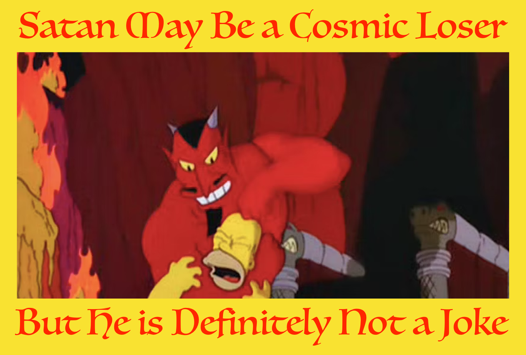
Still, for every human being, whatever their personal belief, the Devil is no mere cartoon, with whom to be trifled. I discussed this briefly in my previous post, “Only God Can Create,” which you might want to read before continuing here.

As for humanity’s vulnerability to the Devil’s influence, the consensus in paradoxically-labeled “enlightened” cultures is that he doesn’t even exist. Sadly, this cosmic lie even tricks self-described “Christians.”

This illusion plays directly into his purposes, as C.S. Lewis described in The Screwtape Letters. Screwtape, a senior demon, instructs his protégée Wormwood in the preferred method of dispelling human wariness about Evil.

The fact that “devils” are predominantly comic figures in the modern imagination will help you. If any faint suspicion of your existence begins to arise in his mind, suggest to him a picture of something in red tights, and persuade him that since he cannot believe in that (it is an old textbook method of confusing them) he therefore cannot believe in you.

Ironically, the populations of less Westernized cultures possess some immunity to this deception. Even in their traditional religions, there is a keen awareness of the existence of evil presences. In the words of The African Study Bible, “we Africans understand instinctively the stories of angelic visitations, spiritual warfare, and demonic oppression that are in the Bible.”

Christians believe in God, not the Devil. While the Scriptures attest to the personal identity of this fallen angel, acknowledgment of his existence is not salvific (i.e. it is not essential to salvation). Thus, C.S. Lewis is correct in his 1944 essay “Answers to Questions on Christianity” when he writes:

No reference to the Devil or devils is included in any Christian Creeds, and it is quite possible to be a Christian without believing in them. I do believe such beings exist, but that is my own affair.

Supposing there to be such beings, the degree to which humans were conscious of their presence would presumably vary very much. I mean, the more a man was in the Devil’s power, the less he would be aware of it, on the principle that a man is still fairly sober as long as he knows he’s drunk. It is the people who are fully awake and trying hard to be good who would be most aware of the Devil. It is when you start arming against Hitler that you first realize your country is full of Nazi agents.

Of course, they don’t want you to believe in the Devil. If devils exist, their first aim is to give you an anaesthetic – to put you off your guard. Only if that fails, do you become aware of them.

On the Matter of Creative Power

Only God can create. That was the core message of our previous discussion. C.S. Lewis recognized, as do biblically-grounded believers, that Satan is merely a sinful, fallen being, little different from humanity in that regard. This truth shatters the pagan philosophy of dualism, or the misguided notion that two equal and opposite forces (e.g. good and evil) exist in some sort of equilibrium. 

In “The Seeing Eye,” C.S. Lewis described the way in which God is beyond his creation. 

Looking for God – or Heaven – by exploring space is like reading or seeing all Shakespeare’s plays in the hope that you will find Shakespeare as one of the characters . . . Shakespeare is in one sense present at every moment in every play. But he is never present in the same way as Falstaff or Lady Macbeth. . . .

If there were an idiot who thought plays existed on their own, without an author . . . our belief in Shakespeare would not be much affected by his saying, quite truly, that he had studied all the plays and never found Shakespeare in them. . . .

My point is that, if God does exist, He is related to the universe more as an author is related to a play than as one object in the universe is related to another. If God created the universe, He created space-time, which is to the universe as the metre is to a poem or the key is to music.

To look for Him as one item within the framework which He Himself invented is nonsensical. If God – such a God as any adult religion believes in – exists, mere movement in space will never bring you any nearer to Him or any farther from Him than you are at this very moment. You can neither reach Him nor avoid Him by travelling to Alpha Centauri or even to other galaxies.

Mark Twain’s Divinized Satan

I had intended to mention Samuel Clemens in my previous article, as one who advanced the assertion that Satan possesses creative ability. Whether Twain regarded the Devil as an actual entity is certainly debatable. What is undeniable, however, is his devoted defense of Lucifer.

As Twain famously wrote in his autobiographical writings, “But who prays for Satan? Who, in eighteen centuries, has had the common humanity to pray for the one sinner that needed it most?” 

Mark Twain was (in)famous for his atheism, or his agnostic antipathy of the Christian understanding of our Creator. Not content to disbelieve, Samuel Clemens actively worked to undermine Christian faith. One of his books, Letters from the Earth, had to be printed posthumously, due its irreverent (or blasphemous) nature.

It bears a superficial resemblance to C.S. Lewis’ amazing Screwtape Letters – insofar as both fictional works present themselves as demonic correspondence. 

The similarity ends there. While Lewis provides keen insight into Evil’s tactics in wreaking havoc in human lives, Twain’s letters present Satan in a positive, even noble, light.

Letters from the Earth is only one of Mark Twain’s anti-Christian works. The Mysterious Stranger is one of his most bizarre. It evidences his long-term preoccupation with Satan, in that it was composed (in various versions) between 1897 and 1908.

The first serious rendition, The Chronicle of Young Satan, was completed in 1900. I mention it here because there is a scene in which the Devil “creates” a miniature world. Obviously it errs in attributing to Lucifer the power to create life – but to its credit, it does reveal Satan as a capricious, vain, cruel, and compassionless lord.

In 1985 a claymation film was released titled The Adventures of Mark Twain. It features the mock scene from Chronicle of Young Satan. It is quite disturbing. However, if one is curious about the subject, and wishes to be forearmed regarding such deceptions, you can view the excerpt here.

Especially for those who do choose to view Twain’s portrayal of the Devil in his fictional “youth,” I desire to end our current discussion on a positive note.

Claymation was also the medium for a long-lived Christian television series. Davey & Goliath, the story of a regular kid and his dog, ran between 1964 and 1975. Many of the episodes can be seen here.

And finally (and forever), we can celebrate with C.S. Lewis the wonder that this world we currently inhabit will not be God’s sole creation. In fact, because of Jesus’ redemptive sacrifice, we can look forward to a new cosmos, untainted by sin.

The New Testament writers speak as if Christ’s achievement in rising from the dead was the first event of its kind in the whole history of the universe. He is the “first fruits”, the “pioneer of life”.

He has forced open a door that has been locked since the death of the first man. He has met, fought, and beaten the King of Death. Everything is different because He has done so. This is the beginning of the New Creation: a new chapter in cosmic history has opened (Miracles).
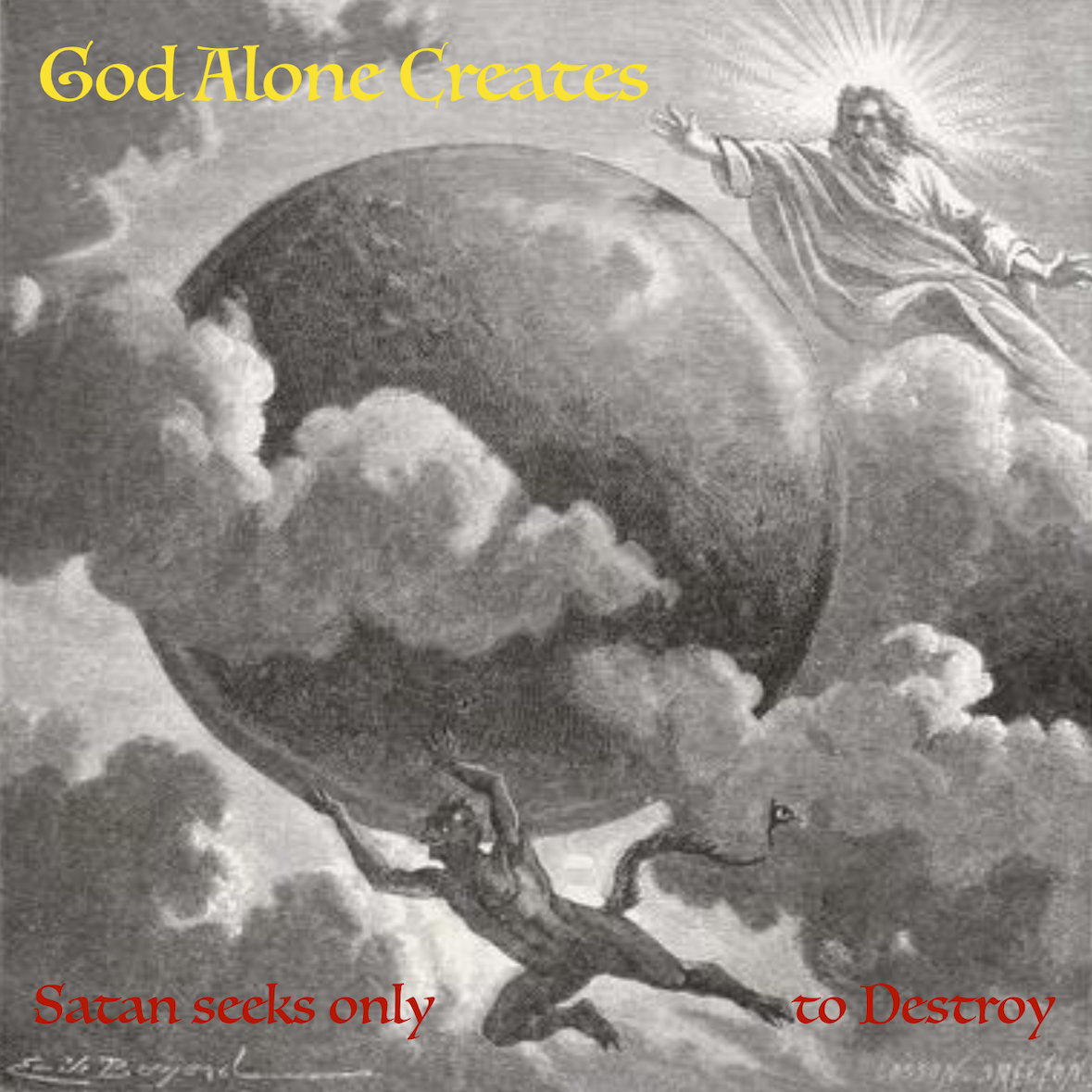

Only God Can Create

Satan has many disciples in this world. Some know him by other names, or worship him in spirit without recognizing his actual existence (e.g. Mammon). The irony, of course, is that the Devil is simply a posturer, or in modern parlance, a poser. And the presence of the Holy Spirit makes any single Christian more than his match.

A prime evidence of Satan’s weakness is that he is a mere created being, without any creative powers of his own. Although some would grant the Adversary a glory he does not own, the truth is that since his expulsion from Heaven, he has devolved into the Great Pretender.

C.S. Lewis never pretended to be a theologian (for whatever authority that debatable title might convey). Instead, he was a brilliant disciple of Jesus with a sincere desire to follow the teachings of the Scriptures. Lewis certainly wasn’t infallible (and he has many critics who delight in pointing out that obvious fact).

Nevertheless, Lewis’ private insights on the subject of Lucifer’s noncreative limitation are right on the biblical target. Responding to a question posed by a reader, Lewis offered his opinion. 

Dear Mrs [Belle] Allen, I think it would be dangerous to suppose that Satan had created all the creatures that are disagreeable or dangerous to us for (a) those creatures, if they could think, would have just the same reason for thinking that we were created by Satan. (b) I don’t think evil, in the strict sense, can create.

It can spoil something that Another has created. Satan may have corrupted other creatures as well as us. Part of the corruption in us might be the unreasoning horror and disgust we feel at some creatures quite apart from any harm they can do us. (I can’t abide a spider myself.) (correspondence, 11 January 1954).

No, God alone creates . . . and redeems. The impotent Devil can never create, or rescue. His utter corruption results in an admittedly powerful spiritual being (a fallen angel) who is devoted to twisting, breaking, tainting, warping, spoiling, corrupting, rotting, perverting, and ruining all that God loves.

Granted, in our fallen world, Satan can fashion an abomination from some preexisting thing he corrupts – for example, Ophiocordyceps unilateralis the parasitic fungus that turns ants into zombies – but he can never create something out of nothing. These poor abominations are an excellent example of what Lewis referred to when he described the “horror and disgust we feel at some creatures . . .”

Meanwhile, Human Beings Can Create

Well, not exactly “create” on the creatio ex nihilo (created out of nothing) sense. Only God can do that, as he did when he spoke all things into existence. Just as Aslan echoed, when he sang Narnia into being in Lewis’ Chronicles.

“And God said, ‘Let there be light,’ and there was light” (Genesis 1).

“In the beginning was the Word [Logos], and the Word was with God, and the Word was God. . . . All things were made through him . . .” (John 1)

The Lion was pacing to and fro about empty land and singing his new song. It was softer and more lilting than the song by which he had called up the stars and the sun; a gentle, rippling music. And as he walked and sang the valley grew green with grass. It spread out from the Lion like a pool. It ran up the sides of the little hills like a wave” (The Magician’s Nephew)

As for humans like you and me being able to create, that is one of God’s most precious gifts to us. In truth, we use elements already created by the Lord: clay and stone to sculpt, pigments to paint, quill and ink to write.

The Inklings understood this creative impulse quite well. They not only understood it; they lived it. 

Like Christians before and since, they recognized that our creative capacity is based in the fact that we are created imago Dei, in the image of God.

Many people mistakenly believe J.R.R. Tolkien coined the word subcreation (or sub-creation, for the hyphen-infatuated). He certainly applied it for the first time to the intentional creation of what the Oxford English Dictionary calls “the action or process of creating a fully realized and internally consistent imaginary (or ‘secondary’) world.” 

Subcreation may be considered a form of “creation by a created being.” But even the most talented of writers and artists should remember this truth, stated by a Canadian astrophysicist: “God did not grant to the devil or any of his creatures the power to create.”

There is much more to consider on this subject, but Mere Inkling readers will need to wait until my next post, when we will conclude our discussion of this fascinating matter. 

There are two equal and opposite errors into which our race can fall about the devils. One is to disbelieve in their existence. The other is to believe, and to feel an excessive and unhealthy interest in them.

They themselves are equally pleased by both errors, and hail a materialist or a magician with the same delight. (The Screwtape Letters).


The image above is based on the work of Émile Bayard (1837-1891), a French illustrator who was born in Cairo, Egypt.

Brilliant New Course on C.S. Lewis

Fans of C.S. Lewis who would relish a month-long journey through his work must consider a brand new course designed by Dr. Brenton Dickieson of Signum University. 

Ink Spots and Tea Stains offers the very best of combinations: “academically serious but . . .  focused purely on the love of learning and the joy of studying the material.”

And what an amazing subject you will explore – a unique view of C.S. Lewis’ archival treasures (many still unpublished), in the context of his more familiar works. And there is no need to feel intimidated. According to Signum

No specific knowledge or background is necessary, though it is recommended that students have a general knowledge of Lewis’s writings.

Writers should be especially intrigued by the course which will discuss the literary imagination and the shape of personal discipline in the writing process.

I enthusiastically commend Ink Spots and Tea Stains to you. I also encourage you to share this news with your friends who are fans of C.S. Lewis’ work.

In fact, you might also wish to pass the invitation on to all of the writers you know who would enjoy an inspired exploration into the writing processes of one of the most respected authors of the twentieth century.

All of our lives are busy, but consider giving yourself this uplifting gift this autumn. If you do, I’m confident you’ll not regret it.

C.S. Lewis, Stereotypes & Polarization

Do you think in terms of stereotypes? Be careful before answering, since nary an adult is free of them. (Case in point, you may well have preconceptions or prejudices about a writer who would use the word “nary” in an opening sentence.)

Stereotyping is common, despite the fact most of us would disavow its use. Most of us would agree with C.S. Lewis who described how stereotypes bar us from embracing new knowledge. In his inaugural lecture on the faculty of Cambridge University, he cautioned that “a stereotyped image can obliterate a man’s own experience” (“De Desciptione Temporum”).

Oddly, while most of us would intuit that thinking stereotypically is a pattern for “the less intelligent,” it appears the reverse is true. According to one study,

Superior cognitive abilities are often associated with positive outcomes, such as academic achievement and social mobility . . . However, our work shows that some cognitive abilities can have negative consequences – specifically, that people who are adept at detecting patterns are especially quick to learn and apply social stereotypes.

Fortunately, although “people with better pattern detection abilities are at greater risk of picking up on and applying stereotypes about social groups,” there is still hope for those “afflicted” with cognitive skill. Fortunately, “these individuals are better able to diminish their stereotyping when presented with new patterns that challenge existing stereotypical associations.”

Another study argues that “our brains want our expectations to be supported . . . Because of that reward engagement, we can start becoming addicted, in a way, to stereotyping.” The researchers offer this suggestion for combatting the addiction: “simply understanding that this happens is an important way to check those assumptions and not let them influence your judgment.”

Generalizing by way of stereotypes can indeed be addictive, if its endemic presence in western culture is any indication. In America, for example, if there is ever a season when nasty stereotypes run unbridled, it is during political campaigns. Especially during presidential elections, where a person of faith would hope to witness the greatest amount of compassion and earnest intercession for God’s guidance.

Stereotypes give way to even uglier projections when we come to despise others. Several years ago I wrote an article about how wartime propaganda often strives to portray a nation’s enemies as evil, and unworthy of treatment in a humane way. It is titled “Demonizing Our Enemies & Dehumanizing Ourselves.”

When nations war, it is in the interests of the leaders of the opposing causes to engage their people in that effort heart, mind and (if possible) soul. A soldier who cognitively recognizes the need for fighting, but does not  possess a visceral animus for the foe, will only be a half-hearted warrior.

On the other hand, if rulers can generate a mental and emotional disgust, or even hatred, for the enemy, they have a winning formula. Soldiers who not only understand their cause, but also desire the utter destruction of their opponent, are single-minded in their purpose. Such fighters win wars.

You can see this sort of us/them polarization during peacetime too, even in non-election years. Sadly, it seems to be manifesting more and more frequently. And, surprisingly, it appears to have become just as common within national populations, as in international contexts. The results can be catastrophic, which is why First Lady Eleanor Roosevelt pled: 

Pit race against race, religion against religion, prejudice against prejudice. Divide and conquer! We must not let that happen here.

Stereotyping the Inklings

Although none of the Inklings have been spared, I believe C.S. Lewis has been the subject of the worst stereotyping. (I have an educated suspicion why that is true.)

Diana Pavlac Glyer has an excellent article which addresses this injustice head on.

There’s a rumor going around that C. S. Lewis was an irritable introvert, isolated and lonely and scared to death of girls. Maybe it all comes from some grim stereotype of smart people or college professors or, maybe, published writers.

That whole image is completely wrong. Lewis wasn’t an introvert. Or a loner. No – he was a large man with a booming voice, a hearty laugh, a robust enjoyment of everyday life. And that is why he was a man with friends.

At A Pilgrim in Narnia, Brenton Dickieson dispels another common misperception of the great author – that he was narrow-minded. 

So much of C.S. Lewis’ uniqueness comes down to his sheer love of diversity. He loved variability, colour, the exchange, the alienation of encounter and unity with others. His weird dystopia That Hideous Strength was, in many ways, a protest against the tendency of totalitarianism to create monoculture by erasing the individual. . . .

Lewis loved difference and diversity and freedom of expression–doctrines in danger in today’s culture war. It doesn’t take long within any of today’s major social movements to find out that diversity is fine and great as long as everyone acts like us or looks like us or thinks like us or uses the same secret words we use.

Most readers of Mere Inkling would be exceptions to the rule that human beings (especially those with “superior cognitive abilities”) default to stereotyping. Most of you, I sincerely believe, share my appreciation for respectful conversation and debate with others who do not share my opinions. 

Such interaction – with unique individuals, and not cardboard caricatures – often result in my own growth. And I dare to hope that those with whom I dialog might also feel the same.

C.S. Lewis, Liturgy & a Dash of Theology

C.S. Lewis wrote: “There is no subject in the world (always excepting sport) on which I have less to say than liturgiology” (Letters to Malcolm: Chiefly on Prayer).

In Christian usage, the word “liturgy” – derived from leitourgia, and translated “work of the people” or “work for the people” – corresponds to the public worship service.

For some, “liturgy” is regarded as a negative word. It may evoke, in such cases, a sense of sterile ritual or what the Scriptures refer to (in the King James Version) as “vain repetitions” (Matthew 6). The irony is that human beings generally prefer familiarity, and almost all worship is essentially liturgical. 

Nondenominational churches sometimes claim they do not possess a liturgy. In truth, every nonspontaneous worship experience possesses liturgical elements. They may be simple – a welcome or greeting followed by music, prayer, the reading of a Bible passage, often followed by some form of sermon or reflection. Oh, and for American Protestants at least, it appears most consider “announcements” are essential to worship services.

The particular elements vary, but the “liturgical” aspects, normally occur in the same sequence at regular services.

C.S. Lewis was a faithful member of the Church of England. He was also respectful of tradition, and genuinely content with the Book of Common Prayer. While he did not prefer conventional church hymnody, he acknowledged that it blessed others. In “The Classical Anglicanism of C.S. Lewis,” the author says Lewis challenged “the assumptions of a liberal theology which undermined the Church’s confidence in its proclamation” of the Gospel. However, he continues, Lewis “was no reactionary.”

C.S. Lewis loved the simplicity of church worship in its unostentatious form. That was one reason he faithfully attended services at his modest local parish. He referred to himself as a “very ordinary layman.” This was his humble confession, although there was precious little about the scholar that was “ordinary.” Still, he was reticent to comment on ecclesiastical subjects where he possessed no expertise. Thus his complacency with time proven liturgical matters, and his academic disinterest in commenting on them formally.

This, of course, did not apply to theological truths such as the doctrinal core of “Mere Christianity.” C.S. Lewis was deeply troubled by challenges to historic Christian orthodoxy. His devotion to the faith he had once rejected forced him to come to its defense when theologians diverged from “the path of life” (Psalm 16).

In 1959, C.S. Lewis delivered an address now entitled “Fern Seed and Elephants.” It is profound. [You can listen to a reading of “Fern Seed and Elephants” at C.S. Lewis Essays.]

Invited to speak to some clergy about the threat of liberal theologies undermining the Christian faith, Lewis begins by acknowledging his lack of formal theological training.

I am a sheep, telling shepherds what only a sheep can tell them. And now I begin my bleating.

Many of us who have attended seminary, can attest to his fear that what passes for illumination is too often the opposite.

I find in these theologians a constant use of the principle that the miraculous does not occur. Thus any statement put into our Lord’s mouth by the old texts, which, if he had really made it, would constitute a prediction of the future, is taken to have been put in after the occurrence which it seemed to predict.

This is very sensible if we start by knowing that inspired prediction can never occur. Similarly in general, the rejection as unhistorical of all passages which narrate miracles is sensible if we start by knowing that the miraculous in general never occurs.

Now I do not here want to discuss whether the miraculous is possible. I only want to point out that this is a purely philosophical question. Scholars, as scholars, speak on it with no more authority than anyone else. The canon ‘If miraculous, then unhistorical’ is one they bring to their study of the texts, not one they have learned from it.

If one is speaking of authority, the united authority of all the biblical critics in the world counts here for nothing. On this they speak simply as men; men obviously influenced by, and perhaps insufficiently critical of, the spirit of the age they grew up in.

In Lewis’ The Great Divorce, he describes just such a theologian. If you would like to read my article on this subject, “Confused Clerics: The Landlord’s Stewards in C.S. Lewis’s The Pilgrim’s Regress,” just click on the article’s title.

C.S. Lewis ends his essay “Fern Seeds and Elephants” with a sort of apology. Yet, despite his reluctance to venture into the ecclesiastical realm, he shares the compulsion of the Prophet Jeremiah to speak truth. The prophet, who suffered greatly for his faithfulness, said “If I say, ‘I will not mention [God], or speak any more in his name,’ there is in my heart as it were a burning fire shut up in my bones, and I am weary with holding it in, and I cannot” (Jeremiah 20).

Missionary to the priests of one’s own church is an embarrassing role; though I have a horrid feeling that if such mission work is not soon undertaken the future history of the Church of England is likely to be short.

More Liturgical Wisdom from C.S. Lewis

C.S. Lewis did not begin his vocation as a voice of reason for the clergy when he wrote this essay. On the contrary, his concern for the erosion of sound theology began much earlier. A decade earlier he weighed in on a public discussion of arbitrary liturgical changes in the church. Lewis’ concerns at that time remain valid, more than seventy years later.

Sir,– I agree with Dean Hughes that the connection of belief and liturgy is close, but doubt if it is ‘inextricable.’ I submit that the relation is healthy when liturgy expresses the belief of the Church, morbid when liturgy creates in the people by suggestion beliefs which the Church has not publicly professed, taught, and defended.

If the mind of the Church is, for example, that our fathers erred in abandoning the Romish invocations of saints and angels, by all means let our corporate recantation, together with its grounds in scripture, reason and tradition be published, our solemn act of penitence be performed, the laity re-instructed, and the proper changes in liturgy be introduced.

What horrifies me is the proposal that individual priests should be encouraged to behave as if all this had been done when it has not been done.

One correspondent compared such changes to the equally stealthy and (as he holds) irresistible changes in a language. But that is just the parallel that terrifies me, for even the shallowest philologist knows that the unconscious linguistic process is continually degrading good words and blunting useful distinctions. Absit omen!

Whether an ‘enrichment’ of liturgy which involves a change of doctrine is allowable, surely depends on whether our doctrine is changing from error to truth or from truth to error. Is the individual priest the judge of that? (Church Times, 1 July 1949).

In The Screwtape Letters, an experienced devilish tempter is training a subordinate. In Letter XVI, he discusses attending a church with which his target “is not wholly pleased.”

Laying aside the matter of the futility of ever finding a perfect church – after all, they are made up of people – the letter cautions us about some of the criticisms related to the topic at hand. Since many aspects of Screwtape’s vile advice relate to our own vulnerabilities, I will close with an admittedly lengthy excerpt from the correspondence.

My dear Wormwood, You mentioned casually in your last letter that the patient has continued to attend one church, and one only, since he was converted, and that he is not wholly pleased with it. May I ask what you are about? Why have I no report on the causes of his fidelity to the parish church? Do you realise that unless it is due to indifference it is a very bad thing?

Surely you know that if a man can’t be cured of churchgoing, the next best thing is to send him all over the neighbourhood looking for the church that ‘suits’ him until he becomes a taster or connoisseur of churches. The reasons are obvious. In the first place the parochial organisation should always be attacked, because, being a unity of place and not of likings, it brings people of different classes and psychology together in the kind of unity the Enemy [in Screwtape’s case, the Enemy to whom he refers, is God] desires. The congregational principle, on the other hand, makes each church into a kind of club, and finally, if all goes well, into a coterie or faction.

In the second place, the search for a ‘suitable’ church makes the man a critic where the Enemy wants him to be a pupil. . . . [One nearby congregation boasts a] Vicar is a man who has been so long engaged in watering down the faith to make it easier for a supposedly incredulous and hard-headed congregation that it is now he who shocks his parishioners with his unbelief, not vice versa. He has undermined many a soul’s Christianity. His conduct of the services is also admirable. In order to spare the laity all ‘difficulties’ he has deserted both the lectionary and the appointed psalms and now, without noticing it, revolves endlessly round the little treadmill of his fifteen favourite psalms and twenty favourite lessons. . . .

[While encouraging church shopping], all the purely indifferent things – candles and clothes and what not – are an admirable ground for our activities. We have quite removed from men’s minds what that pestilent fellow Paul used to teach about food and other unessentials – namely, that the human without scruples should always give in to the human with scruples.

You would think they could not fail to see the application. You would expect to find the ‘low’ churchman genuflecting and crossing himself lest the weak conscience of his ‘high’ brother should be moved to irreverence, and the ‘high’ one refraining from these exercises lest he should betray his ‘low’ brother into idolatry.

And so it would have been but for our ceaseless labour. Without that the variety of usage within the Church of England might have become a positive hotbed of charity and humility.

A New Source of Oxygen

Most of us have a basic affinity for oxygen. And, air quality being what it is in many places, it is probably good news that there is a newly discovered source on the bottom of the sea.

This morning I asked my ten year old grandson what I should blog about. I said it could be even something like a new discovery (since C.S. Lewis was such a renaissance man that I can find some link to diverse subjects in his writings).

Since it’s summer, and school’s on hiatus, I was surprised when he said something of which I was unaware. “I think they found oxygen coming from some minerals in the ocean.” Odd, I thought, but since he often surprises me with his knowledge, I checked it out. 

It’s true. Not only does the ocean produce huge amounts of oxygen via algae and the like, but they have recently discovered a source of “dark oxygen.” According to Smithsonian Magazine,

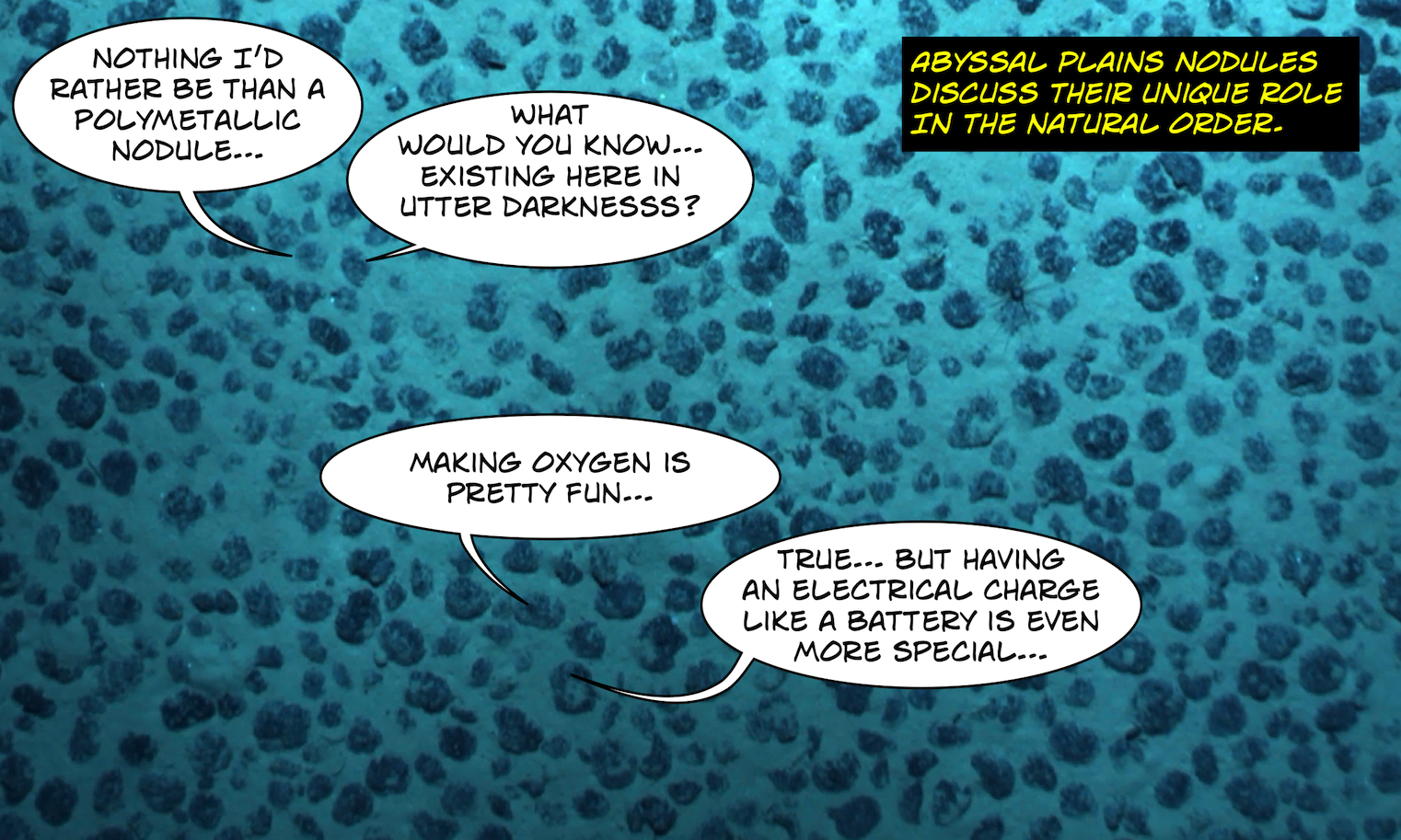
Twelve thousand feet under the ocean surface is a world of eternal midnight. No sunlight can penetrate to this depth to promote photosynthesis, so no plants are producing oxygen there.

Yet, the life-supporting gas is abundant in this darkness-cloaked region, thanks to an unlikely oxygen factory: potato-sized, “battery rocks” on the seafloor.

Those eager to learn more about this wonder can read the entire study, “Evidence of Dark Oxygen Production at the Abyssal Seafloor”  for free in Nature Geoscience.

The necessity of ready access to oxygen is obvious to everyone who knows basic biology. Actually, it isn’t the oxygen molecules [O], which we require, it is actually dioxygen [O2]. We also recognize our primary partners in this gloriously balanced process of exchange (where we trade off our carbon dioxide [CO2] in exchange for the O2) are the various plants God has distributed throughout our world. 

Curiously, oxygen only makes up a small portion of our atmosphere. According to the National Institute of Medicine,

The composition of environmental air is approximately 78% nitrogen, 21% oxygen, 1% argon, and trace percentages of other gases, such as carbon dioxide, neon, methane, helium, krypton, hydrogen, xenon, ozone, nitrogen dioxide, iodine, carbon monoxide, and ammonia.

I’m no scientist, but personal experience with pneumonia, and with training in a military Hypobaric (Altitude) Chamber, have taught me not to take the availability of oxygen for granted.

This fact was reinforced for C.S. Lewis during the final days of his life, as is true for many people. American Nathan Comfort Starr (1896-1981) was an Arthurian scholar. He would later write an Introduction and Commentary for Lewis’ Till We Have Faces in the Religious Dimension in Literature series. Shortly before Lewis’ death, Starr asked if he might be up to a visit from a friend. Lewis’ response evidenced a peaceful resignation to his own passing.

Term will never again begin for me. Last July I was thought to be dying, oxygen-tent and Last Unction and everything en règle.

I am now retired and immobilised on one floor of this house. But glad to be visited (an hour or so) if such an extinct volcano as I now am is worth visiting (4 September 1963).

In Out of the Silent Planet, the first volume of C.S. Lewis’ space trilogy, the protagonist travels to the planet MalacandraPhilologist Edwin Ransom is kidnapped before the voyage and his captors refuse to answer any of his questions.

“Don’t talk,” he said. “We have discussed all that is necessary. The ship does not carry oxygen enough for any unnecessary exertion; not even for talking.”

After landing, Ransom escapes and flees as far as his air lasts in the planet’s thin atmosphere. Nearing the end, a member of one of the intelligent species (Hnau) inhabiting Malacandra, rescues him. Presumably other races also sometimes require supplemental oxygen.

Stretching back into the cave, it took from the wall what looked like a cup. Then Ransom saw that it was attached to a length of flexible tube. The sorn put it into his hands.

“Smell on this,” it said. “The hrossa also need it when they pass this way.” Ransom inhaled and was instantly refreshed. His painful shortness of breath was eased and the tension of chest and temples was relaxed. . . .

“Oxygen?” he asked; but naturally the English word meant nothing to the sorn.

Oxygen is a precious gift to us from our Creator. So too is the scholar and atheist-turned-apologist, C.S. Lewis. 

Just as the revelations of natural creation are ceaselessly amazing, the lessons learned from C.S. Lewis’ life and works continue to inspire others. And, sometimes a little child’s awareness of recent news will lead others into new knowledge.

C.S. Lewis & the Colors of Heaven

What wonders await the color blind in Heaven! That thought recently occurred to me out of the proverbial blue. 

I was sitting on my patio, tossing a ball to my border collie, when she decided to explore some of the local forest scents, as she is wont to do. As I normally do, I used that peaceful, shalom moment, to pray.

I don’t recall whether I closed my eyes, or gazed at the brilliantly white clouds dancing above me. In either case, my mind and spirit were focused on prayer. Prayer for those I love, and for strangers I have never met.

What wonders await the color blind in the presence of God. Too profound for me to take credit for thinking, but perhaps one of those serendipitous epiphanies God offers unexpectedly to his children.

In The Great Divorce, C.S. Lewis describes an excursion to the foothills of Heaven. The sheer reality of Heaven exceeds fallen humanity’s ability to comprehend it.

Before me green slopes made a wide amphitheatre, enclosing a frothy and pulsating lake into which, over many-coloured rocks, a waterfall was pouring.

Here once again I realised that something had happened to my senses so that they were now receiving impressions which would normally exceed their capacity. On Earth, such a waterfall could not have been perceived at all as a whole; it was too big. Its sound would have been a terror in the woods for twenty miles. Here, after the first shock, my sensibility ‘took’ both as a well-built ship takes a huge wave. I exulted. . . .

Near the place where the fall plunged into the lake there grew a tree. Wet with the spray, half-veiled in foam-bows, flashing with the bright, innumerable birds that flew among its branches, it rose in many shapes of billowy foliage, huge as a fen-land cloud. From every point apples of gold gleamed through the leaves.

When the Narnians sail to the “edge of the world,” they are greeted by a wonder that hints at the beauty of Heaven beyond. Barring their way into that place it rose “between them and the sky, a greenish-gray, trembling, shimmering wall.”

Then up came the sun, and at its first rising they say it through the wall and it turned into wonderful rainbow colors. Then they knew that the wall was really a long, tall wave – a wave endlessly fixed in one place . . . (Voyage of the Dawn Treader).

At the end of the Chronicles of Narnia, C.S. Lewis ushers his heroes into Heaven. They too experience the overwhelming awe inspired by their divine surroundings. 

It is as hard to explain how this sunlit land was different from the old Narnia as it would be to tell you how the fruits of that country taste. Perhaps you will get some idea of it if you think like this. You may have been in a room in which there was a window that looked out on a lovely bay of the sea or a green valley that wound away among mountains.

And in the wall of that room opposite to the window there may have been a looking-glass. And as you turned away from the window you suddenly caught sight of that sea or that valley, all over again, in the looking-glass. And the sea in the mirror, or the valley in the mirror, were in one sense just the same as the real ones: yet at the same time they were somehow different – deeper, more wonderful, more like places in a story: in a story you have never heard but very much want to know.

The difference between the old Narnia and the new Narnia was like that. The new one was a deeper country: every rock and flower and blade of grass looked as if it meant more. I can’t describe it any better than that: if you ever get there you will know what I mean (The Last Battle).

I find Lewis’ fictional visions of Heaven inspiring in their self-confessed inadequacies. Heaven, no doubt, is profoundly more glorious than any human being can imagine.

The Bible employs brilliant colors to help describe Heaven’s beauty. In John’s vision of Heaven we find these descriptions:

And he who sat [upon the throne] had the appearance of jasper and carnelian, and around the throne was a rainbow that had the appearance of an emerald. Around the throne were twenty-four thrones, and seated on the thrones were twenty-four elders, clothed in white garments, with golden crowns on their heads.

From the throne came flashes of lightning, and rumblings and peals of thunder . . . and before the throne there was as it were a sea of glass, like crystal (Revelation 4).

[An angel] showed me the holy city Jerusalem coming down out of Heaven from God, having the glory of God, its radiance like a most rare jewel, like a jasper, clear as crystal. . . .

The wall was built of jasper, while the city was pure gold, like clear glass. The foundations of the wall of the city were adorned with every kind of jewel. The first was jasper, the second sapphire, the third agate, the fourth emerald, the fifth onyx, the sixth carnelian, the seventh chrysolite, the eighth beryl, the ninth topaz, the tenth chrysoprase, the eleventh jacinth, the twelfth amethyst. And the twelve gates were twelve pearls, each of the gates made of a single pearl, and the street of the city was pure gold, like transparent glass (Revelation 21).

The Power of Color

Colors are not merely aesthetic. Their influence on human perception has been studied for many years. One key researcher, Faber Birren (1900-88), served as a respected consultant on the subject for numerous businesses and even the United States government itself. 

Shades of Meaning” relates that “in 1939, Walt Disney invited Birren to work as a color consultant. He ended up advising Disney animators on the design of BambiFantasia, and Pinocchio.” 

In Color Psychology and Color Therapy, Birren begins his discussion of the subject with the proposal that “it is perhaps a mistaken notion that man in his love of color was impelled by some aesthetic urge.” He contends that:

The greatest weight of evidence points to the fact that color was involved with the supernatural and therefore had significance that went beyond what might be thought of as mere sensuous delight. . . .

Color, being a manifestation of light, held divine meaning. Historical records of color show little interest in the physical nature of color, nor yet in its abstract beauty, but in a symbolism that attempted to resolve the strange workings of creation and give it personal and human meaning.

If this spiritual aspect of color is actual, then being colorblind carries a liability beyond simply missing out on one of life’s simple pleasures.

Color Blindness Among Humanity

You may not know anyone who is color blind. That’s not surprising, since it isn’t a common subject of conversation. Nevertheless, in the general population, approximately eight percent – or 1 in 12 – men suffer from some form of it. Meanwhile, the rate of this condition, which is most frequently genetic, for women is far lower. Only about one in two hundred.

There are several varieties of color vision deficiency, with most people able to perceive some shades of certain colors. The most severe form of the problem involves a failure to see any colors. Only shades of gray distinguish between different hues. It’s called achromatopsia, and is quite rare. 

Achromatopsia is a congenital hereditary condition found in only one birth in every 33,000 to 50,000 births.  Thus less than 10,000 Americans may have achromatopsia. There are two basic forms . . . Rod Monochromatism, . . . is the most common [and] routinely occurs in both men and women. . . .

Blue Cone Monochromatism has an incidence of 1 in 50,000-100,000 births in males and could be as rare as 1 in 10 billion in females.

If you are curious about achromatopsia, you should definitely read about research on a Micronesian Island where ten percent of the people share this affliction.

Many individuals first learned of achromatopsia in 1997, when Oliver Sacks published his classic book, Island of the Color Blind.  This story beautifully chronicles Oliver Sack’s 1994 quest with Knut Nordby and Bob Wasserman to the isolated atoll of Pingelap in Micronesia, where 10% of the population have rod monochromatism. A video of the journey is available here.

Possible Visions of Heaven

Although I am quite wary of so-called near death experiences (with some being spurious, and others, spiritual deception), it is intriguing how color has entered into a number of the stories. The following examples appear in the accounts of several different individuals in Imagine Heaven: Near-Death Experiences, God’s Promises, and the Exhilarating Future that Awaits You.

The entire city was bathed in light, an opaque whiteness in which the light was intense but diffused. In that dazzling light every color imaginable seemed to exist and – what’s the right word? – played. The colors seemed to be alive, dancing in the air. I had never seen so many different colors. It was breathtaking.

Below me lay the purest, most perfect grass, precisely the right length and not a blade that was bent or even out of place. It was the most vibrant green I had ever seen. If a color can be said to be alive, the green I saw was alive, slightly transparent and emitting light and life from within each blade. The iridescent grass stretched endlessly over gently rolling hills upon which were sprinkled the most colorful wild flowers, lifting their soft-petaled beauty skyward, almost as if they were a chorus of flowers caught up in their own way of praising God.

The most gorgeous sky ever seen here on earth cannot even come close to the atmosphere in Heaven.  It is bright because of the glory of our God. . . .  The atmosphere is something you experience, not just see.  It is golden, yellow, white, and had more colors moving throughout it . . . like the Aurora Borealis lights.

The sky [and] the firmament surrounding the heavens, were a wilder and bluer yonder than you would ever believe. . . . The closest shade I can associate this otherworldly blue with is the surreal tones of the water in the Caribbean or off the coast of Hawaii at sunset. . . . That color is waiting for you and me on the other side.

The colors and lights in Heaven were simply sublime. . . . They were the deepest, richest, most gloriously lush colors I had ever seen, and some I had never seen before. Heaven is a dream-come-true for those who love all things colorful, and our home there is lit by the Father of Lights. . . . [There were] robust and bold and vigorous beams that were somehow gentle to my eyes. I simply don’t think those colors and lights exist on earth.

I saw the most dazzling colors, which was all the more surprising because I’m color-blind. I can distinguish the primary colors, but pastels all look the same to me. But suddenly I could see them, all kinds of different shades. Don’t ask me to name them because I lack the necessary experience for that.

Take a Moment to Test Your Own Color Vision

There are a number of simple, free vision tests available online. If you want to assure yourself that you can see all of the normal colors – though not necessarily all of the heavenly colors awaiting us – check out one of the following.

Color Blind Test

EnChroma Color Blind Test

X-Rite Color Challenge and Hue Test

Colorlite Collection of Tests

Final Thoughts

When I described the wonders awaiting the color blind in Heaven, I was referring to all of us. (In this life, as the Scriptures say, “For now we see in a mirror dimly . . .” (1 Corinthians 13).

All who trust in the love of Jesus Christ, and thereby enter Heaven’s environs by the unmerited grace of God’s mercy, will be overwhelmed by its beauty and wonder.

The million or more colors a person with full vision can now see, will be eclipsed by the infinite tapestry of hues in our Creator’s mind. Even those with the scientifically-presumed capability to currently perceive distinctions between up to 100 million will surely be in awe.

C.S. Lewis closes our discussion of Heaven’s colors with a fascinating thought related to the angels who worship God in that divine place. Lewis begins by noting a significant distinction between God’s angels and humanity.

But for our body one whole realm of God’s glory – all that we receive through the senses-would go unpraised. For the beasts can’t appreciate it and the angels are, I suppose, pure intelligences.

They understand colors and tastes better than our greatest scientists; but have they retinas or palates? 

I fancy the “beauties of nature” are a secret God has shared with us alone. That may be one of the reasons why we were made-and why the resurrection of the body is an important doctrine (Letters to Malcolm: Chiefly on Prayer).

C.S. Lewis & Assassinations

The brilliant author C.S. Lewis died on the same day that an American president was assassinated. The violent death of John F. Kennedy in November of 1963 eclipsed Lewis’ own passing, so many people were unaware of it for some time. Yet on that autumn day, both Camelot and Narnia lost their inspirations.

Unfortunately, Kennedy’s shooting was not the only political assassination that was connected in a manner to C.S. Lewis’ life. Archduke Franz Ferdinand Carl Ludwig Joseph Maria of Austria was the heir apparent to the throne of Austria-Hungary. A nineteen year old political activist cold-bloodedly murdered the archduke and his wife, Sofie.

Franz and Sophie had married for love, despite her inadequate social rank, which resulted in a morganatic marriage. In recent years such unions have become more common, but at the time, it was a serious matter. The archduke was forced by his uncle, the emperor, to accept that their descendants would never have a right to the throne.

In a convoluted fashion, Ferdinand’s death nearly led to C.S. Lewis’ own. The 1914 assassination was the spark that set the globe on fire during the First World War. And, during that grim conflict, C.S. Lewis was severely wounded by an artillery shell that killed friends standing nearby.

The Causes and Impact of Political Assassinations” was published by the Combating Terrorism Center at West Point. It begins with the fact that “political assassinations have been part of social reality since the emergence of communal social frameworks . . .” And so, since social frameworks will forever exist, they continue.

Humanity’s Violent History

Assassination has been a relatively common practice throughout human history. This shouldn’t surprise anyone who knows the sad story of Abel and his angry brother, Cain. 

Philip II of Macedon, the father of Alexander the Great, was killed attending the wedding of his daughter Cleopatra (no, not that Cleopatra). Later Cleopatra, as a widow, would be assassinated herself by one of her unsuccessful suitors.

Three centuries later, Julius Caesar was murdered by the political elite of Rome, who feared his growing influence. And in 453, one of Rome’s greatest enemies, Attila the Hun, was arguably murdered on his wedding night by his new bride, Ildico.

Several assassinations are recorded in the Bible. Over such a lengthy and turbulent historical period, that is unsurprising. The two excerpts below have links to the fuller accounts.

[Canaanite general] Sisera fled away on foot to the tent of Jael, the wife of Heber the Kenite, for there was peace between Jabin the king of Hazor and the house of Heber the Kenite. And Jael came out to meet Sisera and said to him, “Turn aside, my lord; turn aside to me; do not be afraid.” So he [entered] the tent, and she covered him with a rug. . . . And he said to her, “Stand at the opening of the tent, and if any man comes and asks you, ‘Is anyone here?’ say, ‘No.’” But Jael the wife of Heber took a tent peg, and took a hammer in her hand. Then she went softly to him and drove the peg into his temple until it went down into the ground while he was lying fast asleep from weariness (Judges 4).

Joab took Amasa by the beard with his right hand to kiss him. But Amasa did not observe the sword that was in Joab’s hand. So Joab struck him with it in the stomach and spilled his entrails to the ground without striking a second blow, and he died (2 Samuel 20).

As a sort of counterbalance to these “positive” instances – elimination of Israel’s enemies – you may want to read about King David’s condemnation of the assassinations of his political rivals, men to whom he would have extended mercy. When two brothers sought a reward for murdering King Ish-bosheth, Saul’s son, David declared “when wicked men have killed a righteous man in his own house on his bed, shall I not now require his blood at your hand and destroy you from the earth?” (2 Samuel 4).

All told, however, there was much violence in the ancient world. As C.S. Lewis’ wife, Joy Davidman, wrote in Smoke on the Mountain: An Interpretation of the Ten Commandments in Terms of Today:

How the ancient Jews did slaughter! They killed in hot blood and in cold; they killed for loot, for God, and for fun. . . . The tribes killed . . . by political assassination as when Ehud stabbed King Eglon in his fat belly . . . [The graphic story of Eglon’s assassination is detailed in Judges 3.]

Another historically consequential assassination occurred in the year 661, when Muhammad’s son-in-law Ali ibn Abi Talib was slain with a poison-coated sword while praying in the Great Mosque of Kufa. This incident caused Islam to separate into two major denominations, and Sunni-Shia relations continue to be contentious.

In the modern era, political murders remain unabated. Vladimir Putin  may be the current master of the deadly art. Even discounting the growing number of “suicides” among his advisers and generals following his ill-advised invasion of Ukraine, we have the case of Alexei Navalny. Navalny was one of Putin’s critics who in 2020 survived poisoning with Novichok nerve agent. Nevertheless, imprisoned in the arctic, he later died under extremely suspicious circumstances. 

In the western hemisphere, the recent attempted assassination of former President Donald Trump invites a review of the danger of serving in that particular office. Despite the (obvious) risk of inviting non-Americans to mock the United States, consider a few facts.

  • Since 1789 (when the office was established) we have had 45 presidents
  • Four sitting presidents have been assassinated while in office
  • Three other presidents (one while in office) were wounded in assassination attempts

Assassination During the Protestant Reformation

In C.S. Lewis’ landmark tome English Literature in the Sixteenth Century, recalls a peculiar passage from the History of the Reformation of Religion within the Realm of Scotland. The author, John Knox refers to the murder of Scotland’s last pre-Reformation Roman Catholic cardinal. It would be more than four centuries before the Pope appointed another.

In the cast of [Knox’s] mind, too, there is something not unlike Tacitus’ sombre pungency, though Knox’s humour, as becomes a countryman of Dunbar, is more boisterous and ferocious.

Sometimes, indeed, it is so ferocious that we should not recognize it at all if we were not told; as when after describing the murder of Cardinal Beaton down to the last grim detail of packing the corpse in salt (‘the wether was hote’) he proceeds, ‘These things we wreat mearelie: but we wold that the reader should observe Goddis just judgementis.’

He was apparently afraid lest the fun of the thing might lead us to forget that even an assassination may have its serious side.

Quite true. An assassination, even of a despised ruler such as Adolf Hitler, remains a serious matter.

Military Hymns & Ents

The United States is schizophrenic about its religious heritage, and the armed forces provide us with today’s example. Most people, including veterans themselves, are unaware of the fact that while we have official songs for the different branches of the armed forces, we don’t have any official hymns.

C.S. Lewis and J.R.R. Tolkien, both combat veterans, were quite familiar with martial music. However, as members of a (nominally) Christian kingdom, neither would have been uncomfortable with explicitly Christian elements in their military’s hymnody. Across the ocean in the former colonies, it’s a different matter. 

Here, the confusion about the “official” status of religious military hymns abounds because spiritual hymnody has been part of our nation’s martial history ever since the colonies decided to band together and seek independence. Yet, some consider that to be unlawful.

The rejection of music expressing faith in God can be attributed to the modern crusade against such hymns by strident anti-theists. Many in this camp are practicing atheists, who misinterpret the two clauses of the First Amendment which the nation’s founders did not consider mutually exclusive. 

Congress shall make no law respecting an establishment of religion, or prohibiting the free exercise thereof . . .

Since most of the creators of the Constitution – and the majority of American citizens up to this day – have been theists (believing in a Supreme Being), it is self-evident that they did not intend to exorcise all expressions of faith from the public forum. Some states, in fact, already had their own “established churches when the First Amendment was ratified.”

Up until this generation, generic references to a heavenly Father or a benevolent Creator have traditionally remained welcome at civic events.

Even the non-Christian Thomas Jefferson (who argued against religious establishment) was essentially a Deist, acknowledging “the god who gave us life, gave us liberty at the same time . . .”

Jefferson even edited the New Testament Gospels, deleting “objectionable passages” and producing his personally-sanctioned Life and Morals of Jesus of Nazareth

So, What about the Music?

My goal is not to discuss the First Amendment per se – though I included the introductory note above for the benefit of the many international readers who find their way to Mere Inkling.

Rather, I wish to discuss the premise above, that America celebrates generally secular martial music, while remaining wary of military hymnody with religious themes. 

Ironically, soldiers throughout the nation’s history passively assumed that the songs they heard at rallies and civic events had the government’s tacit imprimatur, that was questionable. Take the “Battle Hymn of the Republic,” for example. Composed in 1861 by abolitionist Julia Ward Howe, Union soldiers would have been shocked to learn that some would deem its use in the ranks as a violation of the First Amendment.

Mine eyes have seen the glory of the coming of the Lord;
He is trampling out the vintage where the grapes of wrath are stored;
He hath loosed the fateful lightning of His terrible swift sword:
His truth is marching on.

I have read a fiery gospel writ in burnished rows of steel:
“As ye deal with My contemners, so with you My grace shall deal;”
Let the Hero, born of woman, crush the serpent with His heel,
Since God is marching on.

Modern Military Hymns

The Department of Defense hosts a website titled Guide to U.S. Military Bands and Music. It describes the wide repertoire of military musicians. 

Whether you like jazz music, a marching band or orchestra music, the U.S. military has you covered. Each branch of the military boasts a diverse offering of musical talent that serves for ceremonial purposes but also for entertainment and outreach. Check out these bands to stay in tune with military music.

One Christian hymn has deep roots in the military community. The song traditionally referred to as “The Navy Hymn” in America, originated in Britain. It is also used by the French. Its maritime themes make it popular in civilian communities as well. 

Eternal Father, strong to save,
Whose arm does bind the restless wave,
Who bids the mighty ocean deep
Its own appointed limits keep;
O hear us when we cry to Thee
For those in peril on the sea.

O Savior, whose almighty word
The winds and waves submissive heard,
Who walked upon the foaming deep,
And calm amid the rage did sleep;
O hear us when we cry to Thee
For those in peril on the sea.

“There exist a myriad of alternate verses to the hymn. One, for example, was written by David B. Miller in 1965 and specially dedicated to naval submariners.”

Musicians were not just present for official ceremonies and off-duty entertainment. They could also inspire the troops in the violent din of battle. More common in distant ages, even in twentieth century Europe, we find a dramatic illustration.

In the military archives of the Irish Republican Army, Michael J. Crowley described the inspiration provided by the brigade’s musician in the heat of the battle called the “Battle of Crossbarry” and the “Crossbarry Ambush,” by the IRA and the Brits respectively.

From the opening shot of the engagement, our piper, Florrie Begley of Brandon, played warlike airs on the bagpipes until the last shot was fired.

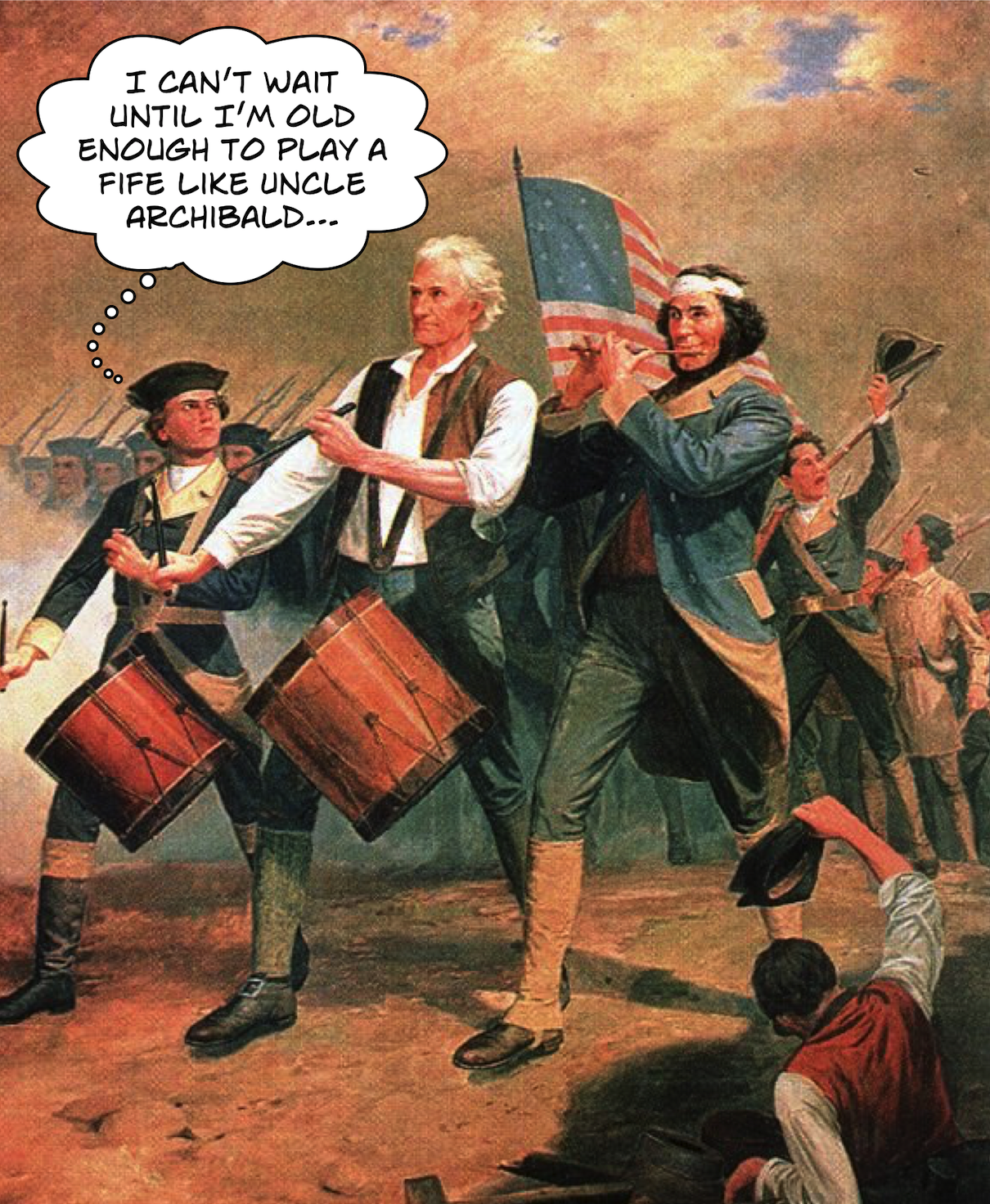
The illustration above provides an idealized portrait of military musicians bravely facing enemy fire. “The Spirit of ’76,” painted for the centenary of the American Revolution, met with tepid enthusiasm during the 1876 Centennial Exposition in Philadelphia. However, it rose in popularity when it subsequently toured the country.

For centuries, armies used music as the means to communicate the military orders of the day to soldiers. The high pitch of the fife and the sharp sound of the drum allowed messages to be heard at great distance . . .

Leaping from the Revolution to the twenty-first century, the recently birthed United States Space Force now has a hymn. Well, sort of. It is an unsolicited hymn composed by a former Air Force officer. You can hear “Creator of the Universe” here.

For more space music, check out the official anthem of “the mighty watchful eye.” Some consider this proposed anthem far more inspiring.

My personal favorite is the version of the Space Force Anthem proposed by its original, cinematic commander, General Naird, played by Steve Carell. (Carell even plays his own fife in the episode.)

The Middle Earth Military March

Howard Shore composed a powerful soundtrack for Lord of the Rings. Yet he wasn’t the first to create music for the great saga. One Tolkienist writes:

My first contact with Tolkien-inspired music dates back to the late 1980s . . . I was watching TV with my parents seeing a performance of Military Bands. Later I would discover that it was the Dutch composer Johan de Meij’s Symphony No. 1 (The Lord of the Rings) I’d heard.

From among the ranks of the Inklings, only one writer wrote an explicit military song. J.R.R. Tolkien provided the timeless Ents with a somber marching song as they face the powers of Isengard.

We come, we come with roll of drum: ta-runda runda runda rom!
We come, we come with horn and drum: ta-rūna rūna rūna rom!

To Isengard! Though Isengard be ringed and barred with doors of stone;
Though Isengard be strong and hard, as cold as stone and bare as bone,
We go, we go, we go to war, to hew the stone and break the door;
For bole and bough are burning now, the furnace roars – we go to war!
To land of gloom with tramp of doom, with roll of drum, we come, we come;
To Isengard with doom we come!
With doom we come, with doom we come!

If you have a moment, you will likely enjoy the performance of this song as arranged by Clamavi De Profundis.

Pilfering Tolkien Linguistics

When a great author, say of the magnitude of J.R.R. Tolkien, creates ingenious new words, and even entire languages, there are several common reactions. Most readers simply respond with silent awe. Others are inspired to emulate their efforts. A small number reuse those very words as a sincere homage

And a handful of “admirers” go so far as to “appropriate” the words themselves, for their personal benefit.

C.S. Lewis, no mean linguist himself, recognized his friend Tolkien’s brilliance. In his preface to That Hideous Strength he praised Tolkien’s yet-to-be-published Silmarillion. In a 1951 letter he mentions misspelling the word Numenor.

My Numinor was a mispelling: it ought to be Numenor. The private mythology to which it belongs grew out of the private language which Tolkien had invented: a real language with roots and sound-laws such as only a great philologist could invent.

He says he found that it was impossible to invent a language without at the same time inventing a mythology.

J.R.R. Tolkien was an internationally renowned philologist, and his impressive skill is one of the great wonders we encounter in Middle Earth. A number of words from his created languages – particularly his ethereal Elvish tongues – have been lifted to be used in commercial activities unconnected to Tolkien’s interests.

For example, Palantir. This was the word for the “seeing stone,” which played a prominent role in The Two Towers. In light of Tolkien’s love of nature, and corresponding suspicion of technological advancement, it is especially odd that the company adopting this label is on the leading edge of Artificial Intelligence.

Perhaps Tolkien’s dread would have been dispelled by one of Palantir’s disarming mottos: “We believe in augmenting human intelligence, not replacing it.”

A combat veteran of WWI, like his fellow Inkling C.S. Lewis, Tolkien was appalled by war’s horrors. Even in the War of the Rings, with its moments of glorious heroism and sacrifice, the bloody heart of Mars remains nearly invincible. Because of this mixed attitude toward war, some have wondered how he would have felt about a defense (i.e. military) corporation adopting one of his creations.

Andúril was the name of the most important weapon forged in Middle Earth. It was actually reforged from the broken fragments of Narsil, the longsword which defeated Sauron by severing the One Ring from his hand.

While this description from the Anduril company resonates with our modern ear, I am not convinced that it sounds very Tolkienesque. Anduril: “Transforming defense capabilities with advanced technology. The battlefield has changed. How we deter & defend needs to change too.”

For an article about a billionaire investor who is consumed by mining Tolkien’s tomes for the businesses he founds (PayPal excepted), check out “The hidden logic of Peter Thiel’s ‘Lord of the Rings’-inspired company names.”

C.S. Lewis’ Unconscious Sharing

In a 1965 letter, written after Lewis’ death, Tolkien commented on how his friend had used subtle variations of several Elvish words in several of his fictional works.

Tolkien says Lewis “had the peculiarity that he liked to be read to. All that he knew of my ‘matter’ was what his capacious but not infallible memory retained from my reading to him as sole audience.” Thus, he surmises that:

C.S. Lewis was one of the only three persons who have so far read all or a considerable part of my ‘mythology’ of the First and Second Ages, which had already been in the main lines constructed before we met. . . . His spelling numinor is a hearing error, aided, no doubt, by his association of the name with Latin nūmennūmina, and the adjective ‘numinous.’

Lewis was, I think, impressed by ‘the Silmarillion and all that,’ and certainly retained some vague memories of it and of its names in mind. For instance, since he had heard it, before he composed or thought of Out of the Silent Planet, I imagine that Eldil is an echo of the Eldar; in Perelandra ‘Tor and Tinidril’ are certainly an echo, since Tuor and Idril, parents of Eärendil, are major characters in ‘The Fall of Gondolin,’ the earliest written of the legends of the First Age. But his own mythology (incipient and never fully realized) was quite different.

An Entertaining Diversion

Years ago I linked to an entertaining game that plays on the linguistic eloquence and mystery Tolkien exhibited in naming his characters. I was delighted to see now that it is still available online.

Antidepressants or Tolkien challenges players – you can play solo, but it’s more fun with others – to guess if a given word is an antidepressant drug or the name of one of Tolkien’s characters. Don’t expect to score 100%, but do expect to smile at some of the examples.