Literary Recycling

cecilialevy cupOur last column on providing new homes for neglected books got me thinking about the notion of “recycling” in its broader contexts.

And, even though C.S. Lewis died before the modern concept of environmentalism reached its full bloom, I wondered if he had written anything on related concerns. As prolific as Lewis was, if one is diligent there is a good chance they can find something with a (sometimes admittedly tenuous) correlation to nearly any subject.

Before proceeding, I have to provide the source of the amazing illustration on this page. It is a graphic example of the creative recycling of literature. This teacup comes from the artistic vision of a Swedish artist, Cecilia Levy. You can view other examples of her artistry at her website here, and if you wish to reproduce them elsewhere, be sure to request permission (just as I did).

Returning to the concept of environmentalism, I wish to avoid political implications here. In general terms, however, I think it is fair to say the Scriptures teach that humanity is a “steward” of creation, which belongs not to us, but to its Maker. As stewards, we have been entrusted to be responsible in our management (use) of nature’s abundance. Wanton destruction should be called what it is—sin.

Now, this general principle manifests itself in a wide spectrum of responses, and attitudes are always subject to change. I vividly recall the very first Earth Day celebrated in the United States. I’m sure that being a high school student in a huge southern California school reinforced the indelible nature of the memory.

My wife and I have been diligent recyclers for many years . . . and that extends far beyond newspapers and aluminum cans. We have used countless items until their usefulness has ended. (Long past when they should have been replaced, in the opinion of our children.) I attribute much of our thriftiness to growing up in low income families where luxuries were few. But it arises not from that background alone. We also have a sense of responsibility to others, and dispatching items that are still usable to landfills just seems wrong.

I imagine Lewis possessed somewhat similar sentiments. He didn’t manifest much of a flair for extravagance. I don’t think he devoted that much thought to material possessions. I once read (but can’t find the source) that his brother and roommate Warnie was a bit frustrated by Lewis’ lack of concern for maintaining articles that were still in decent condition. Major Lewis, being a military man, focused on utilitarian considerations. The specific items of concern in the incident were some dishes or “crockery” that Warnie deemed to still be fit for service.

Both men were seasoned veterans of rationing, of course. Their skills at stretching things to go as far as possible were conditioned by years of deprivation. Americans are typically shocked to learn that rationing persisted in Europe after the end of the war. In an era characterized by excess and waste it’s difficult for us to put ourselves in their mindset.

Ironically, my hunt for a Lewisian passage on ecological concerns had nothing to do with rationing. It was rewarded when I looked at his essay “Willing Slaves of the Welfare State.” (The work is included in the delightful collection, God in the Dock.)

In this essay, Lewis is describing scientific advances as morally neutral. It is the application we choose to put our knowledge to, that determines its rightness. One of his illustrations alludes to care of the world in which we live.

The first is the advance, and increasing application, of science. As a means to the ends I care for, this is neutral. We shall grow able to cure, and to produce, more diseases—bacterial war, not bombs, might ring down the curtain—to alleviate, and to inflict, more pains, to husband, or to waste, the resources of the planet more extensively. We can become either more beneficent or more mischievous. My guess is we shall do both; mending one thing and marring another, removing old miseries and producing new ones, safeguarding ourselves here and endangering ourselves there.

Brilliant. And utterly true.

I also want to pass on an interesting observation made several years ago in another blog. The author references Lewis’ mention of the related concept of “plentitude.” You can read Tim Hagen’s full post here.

Since I’ve been reading a lot of C.S. Lewis lately, I figured I could use (and abuse?) a couple quotes from him in suggesting a philosophy of responsible waste management.  The Discarded Image is a piece that brings to light our modern misconceptions about the “Dark Ages.”  A testimony of medieval literature, for example, is how systematized their view of the universe was.  This organization grew out of classical authors such as Apuleius of Numidia, from whom Lewis draws two principles: the Triad (the idea that two entities – such as soul and body – can only meet each other through a third medium – in this case, the spirit) and Plentitude.  Lewis summarizes Plentitude in stating: “The universe must be fully exploited.  Nothing must go to waste.”  In other words, if something had the capacity to be useful, the medieval mind found a use for it.

The concept of plentitude as described here reminds me of the way people living in harsh environments cannot afford to waste anything. Eskimos, for example, are said to use every part of the seals they harvest . . . meat, blubber, bone, sinew. None of it is cast aside.

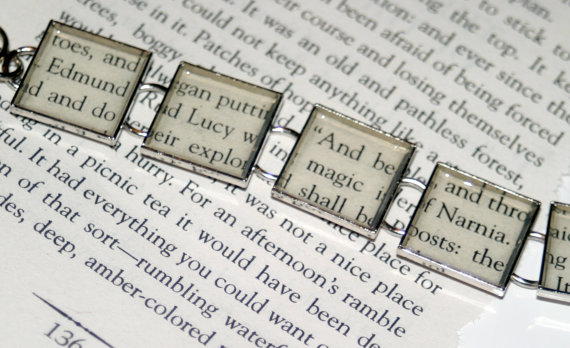
Let’s end these thoughts with another example of artistic creativity. This image shows how pages of a recycled copy of the Chronicles of Narnia can be recycled into jewelry. It comes from this commercial website which offers “one of a kind” items for sale. I don’t know whether this particular piece remains available, but I bet they would be willing to make you one of your very own if you’re interested. Then the cash from your wallet can be recycled into theirs. In exchange you’ll own a unique treasure that may become a wonderful conversation starter for many years to come.

narnia bracelet

Newest Pet Craze

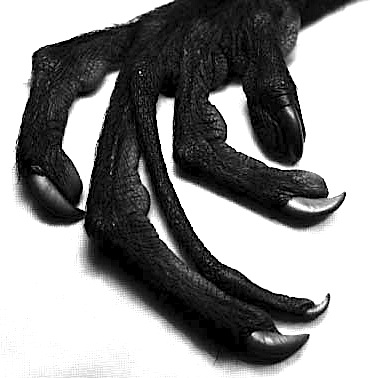
aye-aye 1Have you seen pictures of these delightful little creatures? They’re called Aye-ayes, and they are widely distributed across the jungles of Madagascar. (Any genetic link between aye-ayes and Gollum remains unconfirmed.)

The International Union for Conservation of Nature has classified these harmless mammals as “Near Threatened.” So, helping them reproduce, as an aye-aye breeder, may also keep the species from becoming extinct.

Actually, I don’t believe you can import Aye-ayes as pets—unless you’re one of those rich or famous people to whom the laws for regular people don’t apply. But, if it is possible to adopt an aye-aye, I offer the following pros and cons for your consideration.

Pro: Some people think they look cuddly.

Con: Some people think they look creepy.

Pro: They don’t demand attention all day long.

Con: They’re nocturnal and might keep you up at night.

Pro: People will think you’re on the cutting edge.

Con: People will think you’re one odd cookie.

Pro: They have tiny mouths.

Con: They are omnivores, and eat other animals.

Pro: Most people consider them exotic animals.

Con: They clearly resemble devilish gremlins.

Pro: Daubentonia madagascariensis are lemurs.

Con: They’re not nearly as cute as their lemur cousins.

Pro: In an emergency, they’re edible.

Con: In an emergency, they’re edible.

Pro: Aye-ayes may reveal God’s imagination & humor.

Con: Aye-ayes just may have a less heavenly origin.

aye-aye 3The picture to the right, a close up view of the aye-aye’s “hand” lends credence to the last conjecture, above. It also evokes nightmarish memories of a story that traumatized my youth, “The Monkey’s Paw.”

You can either read it here, or view a recent treatment of it here.

C.S. Lewis acknowledges the danger posed by possessing too much love—an idolatrous affection—for pets. Of course, there are other things we can love that way with even less justification than an animal.

There is a reaction at present going on against the excessive love of pet animals. We have been taught to despise the rich, barren woman who loves her lap dog too much and her neighbor too little. It may be that when once the true impulse is inhibited, a dead poet is a nobler substitute than a live Peke, but this is by no means obvious.

You can do something for the Peke, and it can make some response to you. It is at least sentient; but most poetolaters hold that a dead man has no consciousness, and few indeed suppose that he has any which we are likely to modify. Unless you hold beliefs which enable you to obey the colophons of the old books by praying for the authors’ souls, there is nothing that you can do for a dead poet: and certainly he will do nothing for you.

He did all he could for you while he lived: nothing more will ever come. I do not say that a personal emotion towards the author will not sometimes arise spontaneously while we read; but if it does we should let it pass swiftly over the mind like a ripple that leaves no trace. If we retain it we are cosseting with substitutes an emotion whose true object is our neighbour.

Hence it is not surprising that those who most amuse themselves with personality after this ghostly fashion often show little respect for it in their parents, their servants, or their wives. (“The Personal Heresy: A Controversy”).

Yes, as Lewis so ably points out, it’s far more important to care about the personhood of our neighbor today . . . rather than a departed writer. (Coincidentally, Lewis would object with equal eloquence to Lewisolatry.)

If we cannot express our goodwill to other people, it’s better directed towards dogs and aye-ayes than someone departed from this world.

Which brings us back to the subject at hand. These furry little creature may not be the objects of the latest pet craze now, but it may be possible for you to initiate a new fad!

To make that possibility a bit more likely, allow me to close this column with a picture of a lovely aye-aye in its natural habitat. Now, that’s an animal one could easily consider cute and cuddly (as long as it keeps its paws to itself).

Ksukol ocasatý (Daubentonia madagascariensis)

A Song Joined Our Family

lyricLast night a new member joined our family. Her name is musical. We didn’t choose it; her previous family did. But we think it fits and she’ll live up to it.

Her name is Lyric.

We adopted Lyric through the agency of DRAW Rescue.

The picture above shows black and white Lyric at her first meeting with her new sister, Foxy. (We didn’t name Foxy either; she joined our family when we “rescued” her from a California shelter six years ago.)

The two girls are getting along quite well their first full day together, but those of you with more than one pet know that it takes a little bit of time to sort things out when a new member joins the family.

Lyric is our third consecutive rescue pet. Although she’s younger than the others who came to us in the past, adopting a rescue dog isn’t the same thing as getting a puppy. You don’t enjoy the same cuddly acceptance. Many rescued dogs are quite wary of human beings—especially men.

It takes time and patience to bond. To let them know that they’re safe and they are now in their “forever home.” Some, like Lyric, benefit from interim stays with gracious foster parents. But their move to your home is still just part of their unstable life until the day when they “forget” about all the previous transitions and just know they are home.

C.S. Lewis talks about this longing for a home in Till We Have Faces. Psyche is describing her desire to find that place where she truly belongs.

Somewhere else there must be more of it. Everything seemed to be saying, Psyche come! But I couldn’t (not yet) come and I didn’t know where I was to come to. It almost hurt me. I felt like a bird in a cage when the other birds of its kind are flying home. . . .”

The sweetest thing in all my life has been the longing— to reach the Mountain, to find the place where all the beauty came from . . . my country, the place where I ought to have been born. Do you think it all meant nothing, all the longing? The longing for home? For indeed it now feels not like going, but like going back.”

Although the myth he’s retelling in this book has nothing to do with adopting pets, the following passage also relates (by dramatic extension) to the situation of “rescued” animals who join you with a legacy of previous relationships (not all of them good).

“Where shall we ever be safe if we’re not safe here? This is my home, Maia. And you won’t understand the wonder and glory of my adventure unless you listen to the bad part.

If you are in a position to share your home with a pet, I probably don’t need to tell you there are many, very many of them who need homes today. If you’re up to the extra challenge of adopting a rescued animal who comes with often unknown “baggage,” just contact one of your local rescue agencies.

These organizations are almost always run by volunteers who are motivated solely by their compassion for these innocent creatures who can no longer be cared for by their owners or—more tragically, have been discarded by those who should have cared for them. (Some, of course, are strays who were never in a human family.) I’m proud to say my nephew and his wife provide a foster home for rescued dogs in Seattle.

Whatever their background . . . the “bad part” of their story, you can be instrumental in “rehabilitating” them. And, trust me, they will reward you with more love than you could ever imagine.

Now, even if you’re not prepared to take in one of these lovely creatures, you can still help. Your local rescue organizations and shelters welcome any contributions you make—either in kind or in cash. You can check your phonebook for local rescues. Or, check out one of these websites which can connect you to many of these groups.

Adopt a Pet

Petfinder

Rescue Me (Dogs)

This column turned into more than I intended it to be. Originally I set out to simply celebrate Lyric’s entrance to our family. Now I realize that her blessing just may encourage the adoption of another cat or dog. And that would be a wonderful thing indeed.

In closing, let’s consider another passage from C.S. Lewis, the creator of Narnia. In a letter he wrote in 1955, he mentions the importance of home.

As Dr. [Samuel] Johnson said, “To be happy at home is the end of all human endeavour.” (1st to be happy to prepare for being happy in our own real home hereafter; 2nd in the meantime to be happy in our houses.)

These words remind us that the happiness we know in our earthly homes is only a foretaste of the joy we can know when we ultimately take our place in the eternal home prepared for us by our Creator.

Perhaps on that day we’ll be welcomed not only by our loved ones who have preceded us, but also by the pets we have loved during this mortal life. That would certainly be a magnificent thing . . . but that’s a discussion for another day.

The Power of Names

babyC.S. Lewis was a man who recognized the power of a name. In fact, that awareness made the opening line of The Voyage of the Dawn Treader one of the most memorable in all of Christian literature: “There was a boy called Eustace Clarence Scrubb, and he almost deserved it.”

Names are used, of course, for identification. Throughout history, different countries have had different naming conventions. A rather common one featured the giving of a personal name to a child, with the patronym added to distinguish between individuals of the same name.

This led to distinctions such as James ben Zebedee of the Christian gospels or Leifr Eiríksson the first millennium explorer of North America. Hearkening back to my own Scandinavian roots, I favor the innovative example Ole Olson, or more commonly Ole Olsen. (The only problem with this name was that it failed to distinguish one Ole from the thousands of other Ole Olsons who dotted the steep coastlines of the Viking fjords.)

God too reveals the importance of names. In the Gospel according to Matthew we read:

But as he considered these things, behold, an angel of the Lord appeared to him in a dream, saying, “Joseph, son of David, do not fear to take Mary as your wife, for that which is conceived in her is from the Holy Spirit. She will bear a son, and you shall call his name Jesus, for he will save his people from their sins. (Matthew 1:20-21).

In one of the most powerful prophecies ever recorded, we hear various titles—in essence, names—of the Messiah Jesus.

For to us a child is born,

   to us a son is given;

and the government shall be upon his shoulder,

    and his name shall be called

Wonderful Counselor, Mighty God,

   Everlasting Father, Prince of Peace.

                                                             (Isaiah 9:6).

The reason that names are on my mind is because recent research has revealed that in America (well, California precisely, and assuming that data can be applied to the entire country) . . . the choice of baby names can even evidence the political leanings of the parents. Now, we’re not talking about parents who name their children directly in honor of a particular politician; it’s much more subtle than that.

Here are a couple of interesting facts gleaned from the study.

The results revealed that overall, the less educated the parent, the more likely they were to give their child either an uncommon name (meaning fewer than 20 children got the same name that year in California), or a unique name (meaning only one child got that name in 2004 in California). When parents had less than a college education, there were no major ideological differences in naming choice.

However, among college-educated whites, politics made a difference. College-educated moms and dads in the most liberal neighborhoods were twice as likely as college-educated parents in the most conservative neighborhoods to give their kids an uncommon name. Educated conservatives were more likely to favor popular names, which were defined as names in the top 100 in California that year.

The sounds of liberal and conservative names varied, too. For both boys and girls, liberals tended to pick more feminine-sounding choices, such as Liam, Ely and Leila names that include lots of L sounds and soft-A endings, including popular choices Ella and Sophia. Conservatives, on the other hand, tend to pick names with more masculine-sounding Ks, Bs, Ds and Ts, such as Kurt.

Beware of the temptation of attempting to jump aboard a naming fad. “Unique baby names can sometimes grate, however. In 2011 . . . an informal survey of hated baby names found that Nevaeh, or ‘heaven’ spelled backward, was the most commonly cited as a hated name. The name was invented in the 1990s and became the 31st most popular in the United States in 2007.”

My wife and I are surely in a minority. We chose the names for all three of our children based upon their meanings . . . a practice quite common in the Scriptures.

C.S. Lewis knew well the power of a name.

Perhaps it has sometimes happened to you in a dream that someone says something which you don’t understand but in the dream it feels as if it had some enormous meaning—either a terrifying one which turns the whole dream into a nightmare or else a lovely meaning too lovely to put into words, which makes the dream so beautiful that you remember it all your life and are always wishing you could get into that dream again. It was like that now.

At the name of Aslan each one of the children felt something jump in his inside. . . . Susan felt as if some delicious smell or some delightful strain of music had just floated by her. And Lucy got the feeling you have when you wake up in the morning and realise that it is the beginning of the holidays or the beginning of summer. (The Lion, the Witch and the Wardrobe).

It comes as no surprise to any Narnian sojourner that the very name of Aslan should so move his followers. After all, we too understand Who the great Lion is. For, as he once said to Lucy and Edmund, when asked if he was here in our world as well,

“Are—are you there too, Sir?” said Edmund.

“I am,” said Aslan. “But there I have another name. You must learn to know me by that name. This was the very reason why you were brought to Narnia, that by knowing me here for a little, you may know me better there.” (Voyage of the Dawn Treader).

Honor Your Parents . . . Or Else!

parentsThere are a variety of reasons for expressing affection and care for one’s parents. Many feel gratitude for the sacrifices their parents made while providing for them. Others treasure memories of never doubting their parents’ love for them. Some enjoyed less idyllic childhoods, but honor their parents out of a sense of duty.

C.S. Lewis described the last type of family in The Four Loves. Rather than giving cause for their children to appreciate them, some parents raise obstacles to their affections.

We hear a great deal about the rudeness of the rising generation. I am an oldster myself and might be expected to take the oldsters’ side, but in fact I have been far more impressed by the bad manners of parents to children than by those of children to parents.

Who has not been the embarrassed guest at family meals where the father or mother treated their grown-up offspring with an incivility which, offered to any other young people, would simply have terminated the acquaintance?

Dogmatic assertions of matters which the children understand and their elders don’t, ruthless interruptions, flat contradictions, ridicule of things the young take seriously—sometimes of their religion—insulting references to their friends, all provide an easy answer to the question “Why are they always out? Why do they like every house better than their home?” Who does not prefer civility to barbarism?

Yes, there are several reasons for honoring our parents, even when they have not “earned” that respect. And now we can add another incentive to do so—because you might be sued in court if you do not honor them! While this statute has not arrived in the Western world, it is a relatively new law in the world’s most populous nation.

The recently revised law requires that adult children visit their parents “often” . . . without defining the specific frequency. Apparently, too many children have become preoccupied with their own concerns. (Shades of Harry Chapin’s “Cats in the Cradle.”)

Traditional Chinese culture is renowned for the value it places on revering elders in general, and parents specifically. In the Analects of the philosopher Confucius, an entire section is devoted to “filial piety.”

58. Confucius said: “When at home, a young man should serve his parents; when away from home, he should be respectful to his elders. He should always be earnest and truthful, express love to all, and follow men of virtue. Then, if he has the time and energy, he should study literature and the arts.” [1.6]

71. Confucius said: “When your father is alive, obey him. When your father has passed on, live as he did. If you do so for [at least] three years after your father’s death, then you are a true son.” [1.11]

72. Tzu Lu asked about the meaning of filial piety. Confucius said: “Nowadays filial piety means being able to support your parents. But we support even our horses and dogs. Without respect, what’s the difference between the two kinds of support?” [2.7]

73. Tzu Hsia asked about filial piety. Confucius said: “What matters is the expression you show on your face. ‘Filial piety’ doesn’t mean merely doing physical tasks for your parents, or merely providing them with food and wine.” [2.8]

74. Confucius said: “In serving your parents, you may disagree with them from time to time and seek to correct them gently. But if they will not go along with you, you must continue to respect and serve them without complaining.” [4.18]

75. Confucius said: “Never ignore your parents’ ages, which are both a source of joy (because they are still living) and a source of anxiety (because their deaths are coming nearer).” [4.21]

The Judeo-Christian tradition, of course, also demands respect for one’s parents. “Honor your father and your mother, that your days may be long in the land that the Lord your God is giving you (Exodus 20:12, ESV). And from the Letter to the Church in Ephesus: “Children, obey your parents in the Lord, for this is right. ‘Honor your father and mother’ (this is the first commandment with a promise), “that it may go well with you and that you may live long in the land.”

It is challenging to discern what it means to honor a parent who does not merit gratitude. Indeed, destructive (abusive) parents may well disqualify themselves from receiving honor, since they tacitly reject the very essence of what it means to be a mother or father.

Aside from these extreme cases, where only a biological relationship exists, we must be honest. None of our parents are perfect. But then the corollary is also true—none of their children are, either. It is in these common, shaded cases where our own character is tested.

C.S. Lewis lost his mother at a young age. His father remained distant, and sent his sons to distant boarding schools. During the First World War, Lewis was severely wounded and shipped from the front lines to a London hospital where he recuperated. While a patient he wrote the following to his father in Ireland.

Wherever I am I know that you will come and see me. You know I have some difficulty in talking of the greatest things; it is the fault of our generation and of the English schools. But at least you will believe that I was never before so eager to cling to every bit of our old home life and to see you.

I know I have often been far from what I should be in my relation to you, and have undervalued an affection and generosity which an experience of “other people’s parents” has shown me in a new light. But, please God, I shall do better in the future. Come and see me, I am homesick, that is the long and the short of it.

Sadly, Lewis’ father did not make the trip to visit his son at the hospital. Such is the nature of real life relationships . . . and such is the reason why honoring our parents sometimes needs to assume the form of a law, or even a Commandment.

May it not be so in your family. If your parents still live, I pray God will grant you great joy in honoring them. And, if you have children, I pray that the Lord will fill them with well-deserved affection for you.

_____

If you have never heard the song “Cats in the Cradle,” you owe it to yourself to ponder its powerful message today. You can view it here.

Sinister Initiations

fumieSomething unbelievable just happened in America. Something offensive, abusive, and utterly intolerant.

At Florida Atlantic University, one of the professors taught a lesson so distasteful that, had it maligned any faith other than Christianity, it would have led to his dismissal. Instead, the student who challenged it was suspended from the course.

The class is entitled “Intercultural Communication,” and the instructor happens to be the county vice-chair of one America’s major political parties.

So, what was the malicious class exercise? The students were instructed to write the name “Jesus” in large letters on a piece of paper which they laid on the floor in front of them. Then, they were directed to stomp—yes, stomp—on the name of the person millions of people throughout the world regard as their Savior.

It’s difficult to comprehend anyone would design such an offensive “lesson,” let alone that they would actually attempt to implement it. And, since lessons are created to teach someone, one wonders precisely what Deandre Poole wanted his students to learn by encouraging their blasphemy . . .

C.S. Lewis would not be surprised by this event. He foresaw precisely where the wholesale rejection of God within academia would lead. There is a passage in his book That Hideous Strength that seems almost prescient. In this scene the protagonist, a sociology professor named Mark Studdock, is being initiated into an elite and secretive inner circle at the Institute where he has come to work. The organization has global plans and great influence. Studdock is a confirmed agnostic, yet he is disturbed by something his mentors describe as a “minor” portion of the initiation process.

Meanwhile, in the Objective Room [where candidates are taught to think properly], something like a crisis had developed between Mark and Professor Frost. As soon as they arrived there Mark saw that the table had been drawn back. On the floor lay a large crucifix, almost life size, a work of art in the Spanish tradition, ghastly and realistic.

“We have half an hour to pursue our exercises,” said Frost looking at his watch. Then he instructed Mark to trample on it and insult it in other ways.

Now whereas Jane had abandoned Christianity in early childhood, along with her belief in fairies and Santa Claus, Mark had never believed in it at all.

At this moment, therefore, it crossed his mind for the very first time that there might conceivably be something in it. Frost who was watching him carefully knew perfectly well that this might be the result of the present experiment. He knew it for the very good reason that [he had briefly experienced, and dismissed, the same thought during his own initiation].

“But, look here,” said Mark.

“What is it?” said Frost. “Pray be quick. We have only a limited time at our disposal.”

“This,” said Mark, pointing with an undefined reluctance to the horrible white figure on the cross. “This is all surely a pure superstition.”

“Well?”

“Well, if so, what is there objective about stamping on the face? Isn’t it just as subjective to spit on a thing like this as to worship it? I mean— damn it all— if it’s only a bit of wood, why do anything about it?”

“That is superficial. If you had been brought up in a non-Christian society, you would not be asked to do this. Of course, it is a superstition; but it is that particular superstition which has pressed upon our society for a great many centuries. It can be experimentally shown that it still forms a dominant system in the subconscious of many individuals whose conscious thought appears to be wholly liberated. An explicit action in the reverse direction is therefore a necessary step towards complete objectivity. It is not a question for a priori discussion. We find it in practice that it cannot be dispensed with.”

The parallels are evident. I can readily imagine Dr. Poole justifying his own exercise in similar language. However, that something like this could happen in a civilized land is sobering indeed.

This incident reminded me of powerful scene in the book and miniseries Shogun. [Appended below.]

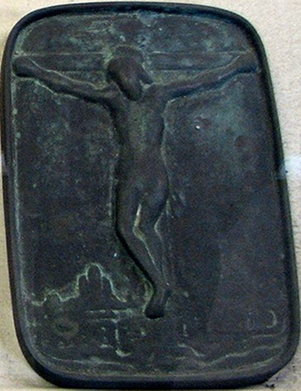
Christianity had been embraced by a number of provinces early in Japan’s history, but the rising ruler had vowed to extinguish it. The Shogun required that samurai suspected of being “Kirishitan” prove they were not by stepping on holy images of Christ or Mary. The Christians (all Roman Catholic in the seventeenth century) would not abuse holy images and were arrested on the spot. Fumi-e were images created for the sole purpose of desecrating, and some examples (like the tile shown above) have survived to this day.

If the individual failed to recant their faith in Jesus, they would be tortured and ultimately martyred. As recently as 2008, the Roman Catholic Church beatified a new group of 188 Japanese Christians. They joined 45 saints and 395 previously beatified martyrs. They represent only a small segment of the estimated 35,000 believers who accepted death rather than denying their Lord.

The newly beatified include 183 lay people, four priests and one monk. The laity included thirty samurai warriors, as well as farmers, artisans, civil servants, teachers, painters, writers, former slaves, pregnant women and even children as young as three.

If Dr. Poole was historically-informed, he would recognize that the odious ritual he thrust upon his vulnerable students carried a significant deal of baggage. And that’s not to mention the direct affront it poses to those who believe Jesus’ claim that he “is the way, the truth, and the life.” Ultimately, all people of goodwill—believers and atheists alike—will find his behavior repugnant.

Excerpt from Shogun:

In James Clavell’s book, it is the English protagonist who ironically desires to weed the [Roman Catholic] Christians out of his samurai contingent. (Their loyalties rest in a cause other than his own.)

. . .

“Can’t it wait until tomorrow?”

“No, Sire, so sorry.” Uraga was looking up at him in front of the assembled samurai vassals, the Dutch crew gathering into a nervous knot near the quarterdeck railing. “Please excuse me, but it is most important you find out at once. You are their most enemy. Therefore you must know, for your protection. I only wish to protect you. Not take long, neh?”

“Are they all on deck?”

“Yes, Sire.”

Blackthorne went closer to the railing and called out in Japanese, “Is anyone Christian?” There was no answer. “I order any Christian come forward.” No one moved. So he turned back to Uraga. “Set ten deck guards, then dismiss them.”

“With your permission, Anjin-san.” From under his kimono Uraga brought out a small painted icon that he had brought from Yedo and threw it face upward on the deck. Then, deliberately, he stamped on it. Blackthorne and the crew were greatly disquieted by the desecration. Except Jan Roper. “Please. Make every vassal do same,” Uraga said.

“Why?”

“I know Christians.” Uraga’s eyes were half hidden by the brim of his hat. “Please, Sire. Important every man do same. Now, tonight.”

“All right,” Blackthorne agreed reluctantly.

Uraga turned to the assembled vassals. “At my suggestion our Master requires each of us to do this.”

The samurai were grumbling among themselves and one interrupted, “We’ve already said that we’re not Christians, neh? What does stamping on a barbarian god picture prove? Nothing!”

“Christians are our Master’s enemy. Christians are treacherous—but Christians are Christian. Please excuse me, I know Christians—to my shame I forsook our real gods. So sorry, but I believe this is necessary for our Master’s safety.”

At once a samurai in front declared, “In that case, there’s nothing more to be said.” He came forward and stamped on the picture. “I worship no barbarian religion! Come on, the rest of you, do what’s asked!”

They came forward one by one. Blackthorne watched, despising the ceremony.

Van Nekk said worriedly, “Doesn’t seem right.”

Vinck looked up at the quarterdeck. “Sodding bastards. They’ll all cut our throats with never a thought. You sure you can trust ’em, Pilot?”

“Yes.”

Ginsel said, “No Catholic’d ever do that, eh, Johann? That Uraga-sama’s clever.”

“What’s it matter if those buggers’re Papist or not, they’re all . . . samurai.”

“Yes,” Croocq said.

“Even so, it’s not right to do that,” van Nekk repeated.

The samurai continued to stamp the icon into the deck one by one, and moved into loose groups. It was a tedious affair and Blackthorne was sorry he had agreed to it, for there were more important things to do before dusk. His eyes went to the village and the headlands. Hundreds of the thatch lean-tos of the Musket Regiment camp spotted the foothills. So much to do, he thought, anxious to go ashore, wanting to see the land, glorying in the fief Toranaga had given him which contained Yokohama. Lord God on high, he told himself, I’m lord of one of the greatest harbors in the world.

Abruptly a man bypassed the icon, tore out his sword, and leaped at Blackthorne. A dozen startled samurai jumped courageously in his way, screening the quarterdeck as Blackthorne spun around, a pistol cocked and aimed. Others scattered, shoving, stumbling, milling in the uproar. The samurai skidded to a halt, howling with rage, then changed direction and hacked at Uraga, who somehow managed to avoid the thrust. The man whirled as other samurai lunged at him, fought them off ferociously for a moment, then rushed for the side and threw himself overboard.

Four who could swim dropped their killing swords, put their short stabbing knives in their mouths, and jumped after him, the rest and the Dutchmen crowding the side.

Blackthorne jumped for the gunwale. He could see nothing below; then he caught sight of swirling shadows in the water. A man came up for air and went down again. Soon four heads surfaced. Between them was the corpse, a knife in his throat.

“So sorry, Anjin-san, it was his own knife,” one called up over the roars of the others.

“Uraga-san, tell them to search him, then leave him to the fish.”

The search revealed nothing. When all were back on deck, Blackthorne pointed at the icon with his cocked pistol. “All samurai-once more!” He was obeyed instantly and he made sure that every man passed the test.

Then, because of Uraga, and to praise him, he ordered his crew to do the same.

Saintly Newspaper Clippings

stfrancisMy brother, sister and I have nearly finished the somber task of going through my father’s possessions. We distributed many items to various family members, but the local charities have probably benefited most, as we cleared out the three bedroom home.

Sadly, my mother died nearly twenty years ago. My sister inherited her cedar chest, but had left it in our father’s house. As she prepared to take it home, we discovered some interesting items, including forty pictures my father had sent home during his 1967-68 tour in Vietnam.

We also found a Bible my mother had used when she attended studies. She was born in the generation which would never dare to highlight passages or scribble in the margins. Thus, the Bible bears no evidence it ever belonged to her . . . aside from some inspiring bookmarks, and a few newspaper clippings she had found meaningful.

One of the quotations that I too found particularly edifying, came from the pen of a Roman Catholic priest named Francis de Sales:

Do not look forward to what might happen tomorrow; the same everlasting Father who cares for you today will take care of you tomorrow and every day. Either He will shield you from suffering or he will give you the unfailing strength to bear it. Be at peace, then, and put aside all anxious thoughts and imaginations.

Francis was a post-Reformation Bishop of Geneva who was noted for his gentle approach toward religious divisions—in an era when such moderation was extremely rare. He is known for writings on spiritual growth (in Roman Catholic parlance, “spiritual formation”).

Although I have not read it, his book Introduction to the Devout Life comes highly recommended, and is available for free download here. I suspect even agnostics could enjoy it for its historical value.

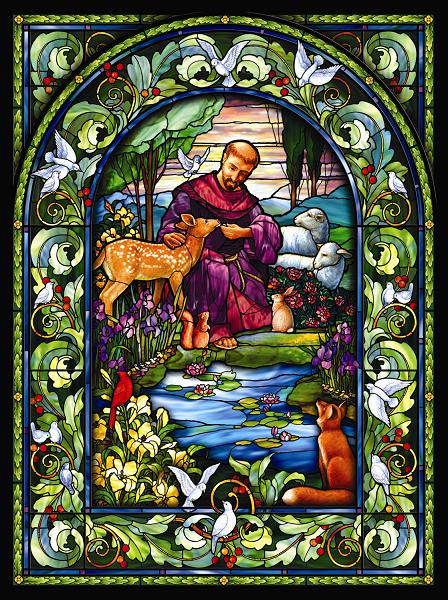
By all accounts, Francis led a chaste and humble life, much like his namesake, Francis of Assisi. (Both men were canonized by their Church.)

Speaking of the first St. Francis, I have always wondered why no Pope ever honored his legacy by assuming his name. I suppose this is because his most prominent characteristics are not those most Popes seek to emulate. The assumption of Francis’ name by the new Pope, I believe, bodes well for his papacy. If he follows in the footsteps of Francis of Assisi, he cannot stray too far afield.

C.S. Lewis appreciated the thirteenth-century saint who began life as a self-indulged soldier and ended it living under a strict vow of poverty. Francis’ celebrated affection for animals—he is considered their “patron saint”—could not help but endear the monk to the creator of Narnia. Each year, many Christians participate in Roman Catholic and Anglican ceremonies for the blessing of animals on Saint Francis’ feast day.

In The Four Loves, Lewis discusses the nature of our physical body. He notes that there are several competing perspectives about our corporeal constitution, with the extremes either demeaning or glorifying humanity’s material nature. Lewis suggests that a metaphor created by Saint Francis provides a more biblical view.

Man has held three views of his body. First there is that of those ascetic Pagans who called it the prison or the “tomb” of the soul, and of Christians like Fisher to whom it was a “sack of dung,” food for worms, filthy, shameful, a source of nothing but temptation to bad men and humiliation to good ones. Then there are the Neo-Pagans (they seldom know Greek), the nudists and the sufferers from Dark Gods, to whom the body is glorious.

But thirdly we have the view which St. Francis expressed by calling his body “Brother Ass.” All three may be—I am not sure—defensible; but give me St. Francis for my money. Ass is exquisitely right because no one in his senses can either revere or hate a donkey. It is a useful, sturdy, lazy, obstinate, patient, lovable and infuriating beast; deserving now the stick and now a carrot; both pathetically and absurdly beautiful. So the body. There’s no living with it till we recognise that one of its functions in our lives is to play the part of buffoon.

Yes, I have to live for a while yet in this donkey of a shell, which illustrates daily the wisdom of the Apostle Paul who wrote that the spirit is willing but the flesh is weak . . . and short-sighted . . . and lazy . . . and stubborn . . .

This body, my flesh, argues that I should spend my day worrying about tomorrow. But the Holy Spirit speaks a more hopeful word. A promise. As God inspired Francis de Sales to eloquently proclaim: “Do not look forward to what might happen tomorrow; the same everlasting Father who cares for you today will take care of you tomorrow and every day.”

Echoes of Narnia

garrelsI just met an amazing new artist. Well, not literally.

I met him, figuratively speaking, through his innovative music. And, although he is “new” to me, he’s been recording for more than a decade. His name is Josh Garrels, and in a moment, I’ll introduce you to two examples of his lyrical poetry.

The reason I first checked out his work was because I received word that he is giving away his music! Amazing, isn’t it? Right now you can download any of his albums for free. However . . . oh, there’s a string attached, you’re thinking . . . he is requesting that you make a donation to aid the suffering in the war-ravaged Democratic Republic of the Congo. So there’s really no string at all, since it’s merely a suggestion, and the gift would be tax deductible anyway. The albums are free. Garrels doesn’t want a penny from us. But he does want us to consider aiding the 70 million struggling people of the Congo.

Despite the Congo being the eleventh largest country in the world, few Westerners follow the terrible news flowing from the wounded nation. For the next two weeks, one hundred percent of the “tips” received for Garrels’ albums will go to World Relief—for their work saving precious lives and bringing peace to the hopeless.

In listening to some of Garrels’ music, I was reminded of the versatility of C.S. Lewis, who wrote so skillfully in so many different genres. I’m not sure how to describe Garrels’ songs; perhaps they defy categorization. It’s not the music I typically listen to . . . but the depth of his lyrics have won me over. Consider the following two songs. I’ll share the lyrics here, and then offer links to each of them below. I encourage you to read the words first and then listen to the music.

“Slip Away”

Hold on, before I slip away

The flames gone dark, I am afraid

How strong is flesh and blood

I cannot can take back what I’ve done

To you, my sweetest friend

I betrayed you, I walked away again

Hold on, before I slip away

The flame’s gone dark, I am afraid

How strong is flesh and blood

I cannot take back what I’ve done

To you, my sweetest friend

I betrayed you, I walked away again

Now all that’s left, is what might have been

Please forgive me, before we reach the end

Please forgive me, before we reach the end

And—for a delightful tale composed in the spirit of Narnia, be sure to listen to “Rabbit and the Bear.” Much of its imagery is shared with the homeland of the Chronicles of Narnia, but it’s clearly the Bible that provides both “composers” with their strongest inspiration.

“Rabbit & the Bear”

Run, run so fast

Over fields and grass

At last, at last

We escaped from the trap

With the rabbit and the bear

And the sparrows of the air

Come one, come all

The hunter is gone

And this is our chance

To crawl under the wire

Through the darkest wood

On up to the mountain of fire

Where everything is free

In the light of the sun

Where every creature sings

Oh Lord, you rescued us all

Don’t listen to the snake

For he lies and he takes

Your hope, your faith

Away from you

But when the lion comes around

With his claw and his crown

Follow, follow

His every move

After you’ve listened to these two pieces, I encourage you to visit this site and download his albums—for free. And, if you feel so inclined, I add my voice to Garrels’ in encouraging you to support World Vision’s vital work in the Congo.

On Burying One’s Father

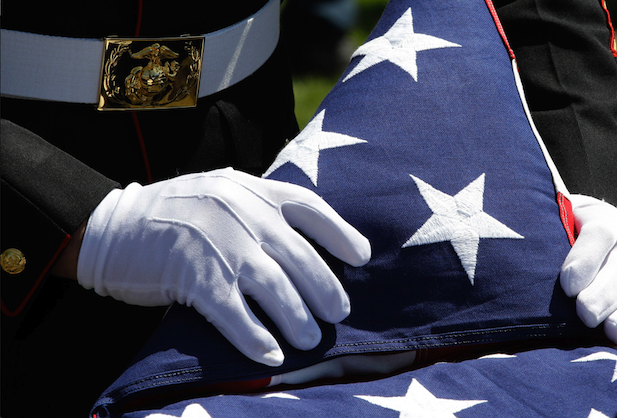
marine flagI just buried my father yesterday. Well, not literally, since the service was held in a chapel at the cemetery, but my family and I said goodbye to him in a traditional Christian service. Because he was a combat veteran Marine Corps sergeant major, he received also very impressive military honors at graveside.

It was quite nice. Although he had passed rather quickly, and completely unexpectedly, he had lived a long and full life. That sounds cliché, but during his 84 years he had a successful career in the Corps, enjoyed a long and peaceful retirement, was blessed with a loving and faithful wife, and found great joy in his three children, nine grandchildren and ten great-grandchildren.

Best of all, though, after what some would call a rather misspent youth, he became a good man . . . and ended his days with faith in Christ and with virtues such as repentance, forgiveness and charity evident in his life.

As the day of the funeral was approaching, I recalled one of Jesus’ conversations with several prospective disciples.

As they were going along the road, someone said to [Jesus], “I will follow you wherever you go.” And Jesus said to him, “Foxes have holes, and birds of the air have nests, but the Son of Man has nowhere to lay his head.” To another [Jesus] said, “Follow me.” But he said, “Lord, let me first go and bury my father.” And Jesus said to him, “Leave the dead to bury their own dead. But as for you, go and proclaim the kingdom of God.” (Luke 9:57-60, ESV).

To some, Jesus’ words here sound harsh. However, the Messiah was not encouraging people to cease honoring their parents. After all, that would be in direct disobedience to the Commandments God delivered to us through Moses. No, Jesus affirmed our call to respect and care for our parents. What he was condemning was the excuses we make to delay accepting his invitation to follow him.

While we might offer a truly important reason for our procrastination, we often push back the spiritual “season” of our life with far more lame reasoning. “I’ll settle down after I get married, but right now I just need some time to “enjoy” life.” or “I’ll start going to church once I have kids and they can benefit from it.”

On Sundays we rarely think twice about disobeying another of the Commandments by ignoring the Sabbath and not preserving it’s holiness. Years ago Keith Green wrote a song “Asleep in the Light,” which featured the convicting lyrics:

How can you be so dead

When you’ve been so well fed

Jesus rose from the grave

And you, you can’t even get out of bed.

Most of us live long enough to suffer the loss of a parent. It’s something, perhaps, that you don’t really understand until you experience it yourself. Even then it’s difficult to console others by saying we’ve shared their loss. After all, every relationship is unique, and each human being processes grief in a unique manner.

C.S. Lewis knew well what it was like to lose his parents. His beloved mother died when he was quite young. In Surprised by Joy, he describes the pain. With my mother’s death all settled happiness, all that was tranquil and reliable, disappeared from my life. There was to be much fun, many pleasures, many stabs of Joy; but no more of the old security. It was sea and islands now; the great continent had sunk like Atlantis.

Alas, Lewis does not describe his father’s passing in his too-brief autobiography. What he does say, reminds me of my own father’s vast reservoir of humor and encouragement as his health waned. Lewis simply writes: “My father’s death, with all the fortitude (even playfulness) which he displayed in his last illness, does not really come into the story I am telling.”

Many of you who have lost your parents can empathize with me, and with the journey I am facing as I adjust to life without either of my parents. Because I loved them, I miss them. And the love makes the pain worth it. Besides, as Paul reminded young Christians in his first letter to the Church in Thessalonica, we “do not grieve as other do who have no hope.” Our hope is secure, resting in the very One who said, “I am the resurrection and the life.”

Irradiated Once Again

alfredhitchcock_bw_bI had to make a whirlwind trip to San Diego this weekend. Yes, I know . . . San Diego in January—I don’t expect any sympathy.

I don’t expect any empathy related to my destination, but I do know others who share my concern about the “full-body scanners” used at many terminals, such as my own SeaTac Airport.

Naturally, as an older retired military officer, I’m always a prime candidate for being directed to pass through the scanner. And that’s the part that I don’t mind. I want the Transportation Security Administration to be thorough. I enjoy the prospect of landing safely at the end of an uneventful flight. And, because of my desire to be protected from terrorists, I don’t mind having to submit to an additional search.

What I am concerned about is my health. I’m not greatly comforted by claims that these “extremely high frequency radio waves” emitted by millimeter wave scanners are not harmful. And the sister technology, “backscatter x-ray” doesn’t sound any healthier. I’m no scientist, but I recall having heard that many types of radiation are cumulative, and when you add traveling to medical and dental x-rays, cell phones, law enforcement radar guns, and the radon that permeated the military housing my wife and I shared for two years in Illinois . . . well, I am slightly concerned.

Health matters aside, the concern which elicits most criticism relates to the scanners as a violation of “privacy.” Truth is, the images they produce leave little to the imagination. However, there’s no possible way for that “faceless” person to actually be associated with you. Regulations, in fact, do not allow for the images to be preserved at all. So, while inspectors in a shielded room may make some passing ribald remark about the “naked” image on their screen, they have no idea what the person’s face even looks like. Thus, I’m not bothered at all by the so-called privacy concern.

Not that privacy is unimportant. It is crucial to life in a free society. We experience precious little privacy in our lives. C.S. Lewis talked about how our lives are enmeshed in a world of crowds and clamor. The following comes from The Four Loves.

Our imitation of God in this life—that is, our willed imitation as distinct from any of the likenesses which He has impressed upon our natures or states—must be an imitation of God incarnate: our model is the Jesus, not only of Calvary, but of the workshop, the roads, the crowds, the clamorous demands and surly oppositions, the lack of all peace and privacy, the interruptions. For this, so strangely unlike anything we can attribute to the Divine life in itself, is apparently not only like, but is, the Divine life operating under human conditions.

The Irony about Privacy in the Modern Age

This fact makes our willingness to reveal ourselves so openly in social media rather ironic. We need privacy—and the less we experience, the more valuable it becomes. Yet, we also desire to be known by others—for in some twisted way this has become synonymous in the modern world with “important.” Yes, the more hits my Facebook page has, the more likes my post receives, the more followers my blog has, the more important I am. And, the more important I am, the less lonely and forgotten I feel.

Loneliness feels terrible. Human beings were created to be in relationships. First with our Father in heaven. And then with our family, friends and neighbors. There is nothing quite so comforting as having someone who knows our imperfections and shortcomings and still loves us. God loves us that way. And, if we are fortunate, we find others willing to overlook our failings and still love us. We can’t find that kind of deep affection in shallow channels like the internet. When we cast wide the net in social media, so to speak, if we are fortunate we’ll catch a rare treasure in the form of a genuine relationship that enriches our life.

Back to the Status of the Invasive Scanners

Apparently, the complaints of those who feel violated by scanners producing a naked image of the travelers passing through them, have been heard. Apparently the TSA intends to replace them with “less invasive” models. In fact, the generic images the new machines produce have been likened to stick figures or cartoons. Presumably they’ll still be able to detect the foreign objects secreted in or on a criminal’s body.

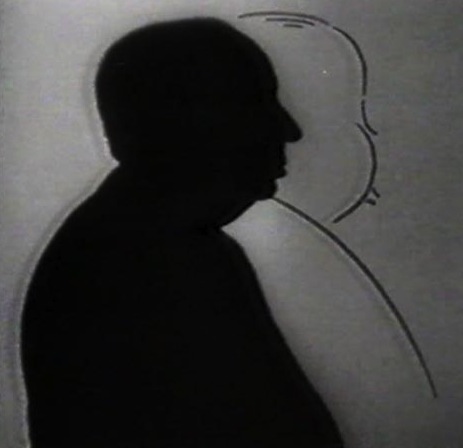
In the meantime, we don’t have to worry about having our naked likeness published on the internet. Instead we’ll all look like cartoons or, perhaps, famous personages. That’s what inspired me to use the Alfred Hitchcock image above. I can visualize my next visit to the airport and almost overhear the hidden inspectors saying, “nothing to ogle here, just another Hitchcock passing through the scanner.”