Poet-olatry: Poetry Misperceived

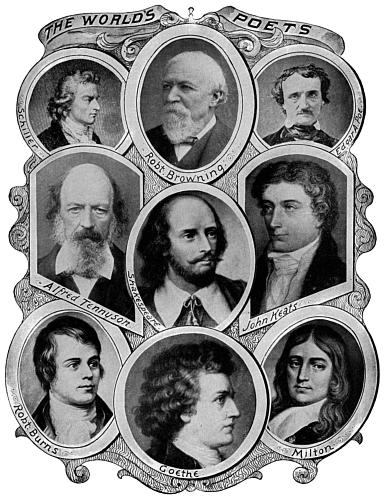
poetsWhen does our appreciation of a particular writer border on literary idolatry? Well, not idolatry proper, since even shrines like Poet’s Corner at Westminster Abbey don’t endorse “worship.”

We naturally appreciate the memory of those whose work has contributed to our lives. And that’s fine. But when we begin to focus more on them, than on the real, breathing people around us, our priorities are skewed.

In 1989, Hollywood released a film entitled “Dead Poet’s Society.” It was nominated for an Oscar for Best Picture, and ironically won the Oscar for Best Writing. In the movie, an English teacher awakens his moribund students to literature, and the more reflective aspects of life.

At last week’s writers meeting, we were introducing ourselves to a visitor, and as part of that process, mentioned the type of writing each of us pursues. I listed several genres and concluded with the words “but I’m not a poet.”

A member of the group immediately “corrected” me, since I have, in fact, written several poems during the past couple of years. Well, I guess I should get used to saying something like, “I don’t consider myself a poet.”

Poetry, some poets insinuate, carries a more artistic air than other, pedestrian genres. Fiction, of course, has its own advocates, and they too occasionally look down on folks like me who typically muddle around in the nonfiction worlds history and religion.*

In the following paragraphs, C.S. Lewis offers some provocative thoughts about how we should rightly feel toward departed writers. His argument is really about how we must not neglect our duty to living humanity by focusing on those who are “gone.”

A special treat in the selection is his coining of the word which inspires the title of this post.

There is a reaction at present going on against the excessive love of pet animals. We have been taught to despise the rich, barren woman who loves her lap dog too much and her neighbor too little.

It may be that when once the true impulse is inhibited, a dead poet is a nobler substitute than a live Peke, but this is by no means obvious. You can do something for the Peke, and it can make some response to you. It is at least sentient; but most poetolaters hold that a dead man has no consciousness, and few indeed suppose that he has any which we are likely to modify.

Unless you hold beliefs which enable you to obey the colophons of the old books by praying for the authors’ souls, there is nothing that you can do for a dead poet: and certainly he will do nothing for you.

He did all he could for you while he lived: nothing more will ever come. I do not say that a personal emotion towards the author will not sometimes arise spontaneously while we read; but if it does we should let it pass swiftly over the mind like a ripple that leaves no trace.

If we retain it we are cosseting with substitutes an emotion whose true object is our neighbour. Hence it is not surprising that those who most amuse themselves with personality after this ghostly fashion often show little respect for it in their parents, their servants, or their wives. (The Personal Heresy).**

Lewis alleges our emotional “bonds” with departed writers are fruitless, imaginary, and perhaps even detrimental. I agree that when they displace our connections with living people, it is tragic.

While I rarely disagree with the Magister Lewis, I will in this case. I would make an exception to his argument—in a single sense. For Christians, our filial affection for a departed Christian writer, is a unique case. The distinction being the fact, that in light of the resurrection, and the gift of eternal life, we are not talking about others who are permanently severed from a genuine relationship with us.

On the contrary, there are many other disciples of Jesus living today who feel a powerful connection to writers like Lewis himself. And, with all eternity ahead, there should be ample time for each of us to enjoy his company, and thank him for the blessing he bequeathed to us through his work.

Postscript:

I recognize that it may be in questionable taste, but the subject of departed artists reminds me of a humorous song from Monty Python’s Flying Circus. It’s called “Decomposing Composers,” and the modestly disconcerting lyrics are rendered in a somber, classical manner. If interested, you can listen to it here.

_____

* I intentionally refer to “religion” as nonfiction, since I regard it to be just that. (And also because I know that pushes some people’s buttons.)

** Last year I approached this same passage by Lewis from a different perspective. If you would like to read some thoughts related to pet fads, check them out here.

Vampire Poetry

vpoetryI was afraid to read it. I had just listened to the poem during an online newscast, and it included it so many jarring and disturbing images that I thought I must have misheard it.

Then again, it was written by a successful Hollywood star, so it certainly must be worthy of publication.

So, motivated by two impulses, I sought out the text. My first reason was that I did not wish to misjudge the writer, based on my shallow initial impression. The second was that I really did want to discover if it was as odd as I perceived it to be.

It is from the heart and pen of Kristen Stewart, who played the leading role in the Twilight series. It is described as a “love poem,” which is helpful to know in advance . . . since that might not be how one might inadvisably approach it.

I reared digital moonlight

You read its clock, scrawled neon across that black

Kismetly . . . ubiquitously crest fallen

Thrown down to strafe your foothills

. . . I’ll suck the bones pretty.

Your nature perforated the abrasive organ pumps

Spray painted everything known to man,

Stream rushed through and all out into

Something Whilst the crackling stare down sun snuck

Through our windows boarded up

He hit your flint face and it sparked.

And I bellowed and you parked

We reached Marfa.

One honest day up on this freedom pole

Devils not done digging

He’s speaking in tongues all along the pan handle

And this pining erosion is getting dust in

My eyes

And I’m drunk on your morsels

And so I look down the line

Your every twitch hand drum salute

Salutes mine . . .

Overwhelming. I was actually tempted to use the word “pretentious,” until I read the following note about the magazine interview during which she shared the verse.

Before reading the poem, Kristen told the mag, “I don’t want to sound so f—ing utterly pretentious…but after I write something, I go, ‘Holy f—, that’s crazy.’ It’s the same thing with acting: If I do a good scene, I’m always like, ‘Whoa, that’s really dope.’”

After seeing that comment, with its sadly limited vocabulary, I can picture her composing her poetry dictionary and thesaurus in hand.

The poem’s significance takes a moment to sink into one’s mind . . . even if our brains are not clouded by being drunk on someone’s morsels. The poem is, in fact, so rich in meaning that it required two distinct titles: “Freedom Pole” and “My Heart is a Wiffle Ball.”

I dabble in poetry, but don’t consider myself a poet. So, I’m probably not the one to judge.

I would be curious to know what the newest addition to the Poet’s Corner at Westminster Abbey would think of Stewart’s work. C.S. Lewis wrote poetry himself, of course, although he is much better known for his other literary contributions.

In English Literature in the Sixteenth Century, Lewis describes the poetry of Samuel Daniel. “Though Daniel’s poetry is often uninspired, sometimes obscure, and not seldom simply bad, he has two strong claims on our respect.” I wonder if Lewis’ gracious nature might lead him to discern two strengths in Stewart’s poetic corpus.

In contrast to the previous evaluation, Lewis considered the poetry of Dante Alighieri to be masterful. In Studies in Medieval and Renaissance Literature, Lewis writes:

I think Dante’s poetry, on the whole, the greatest of all the poetry I have read: yet when it is at its highest pitch of excellence, I hardly feel that Dante has very much to do. . . . I draw the conclusion that the highest reach of the whole poetic art turns out to be a kind of abdication, and is attained when the whole image of the world the poet sees has entered so deeply into his mind that henceforth he has only to get himself out of the way, to let the seas roll and the mountains shake their leaves or the light shine and the spheres revolve, and all this will be poetry, not things you write poetry about.

Dare I confess that after Dante even Shakespeare seems to me a little factitious? It almost sounds as if he were “just making it up.” But one cannot feel that about Dante even when one has stopped reading him.

That’s the sort of verse that poets should always strive for—“the highest reach of the whole poetic art [which] turns out to be a kind of abdication.” Word dabblers such as myself are unlikely to ever attain such a lofty goal.

It may be that Stewart has kismetly attained these heights. But then again, perhaps she still has a little farther to travel before she reaches Marfa.

The Lion’s Command

crowned lionI recently had a few free moments while waiting for a flight, and I decided to revisit that enjoyable childhood treasure, Aesop’s Fables. It had been many years since I explored them, and I found the following tale particularly entertaining.

Aesop may have been a fable himself. Aristotle refers to him as an historical figure, but since Aesop supposedly lived three centuries before the philosopher’s day, he had already transformed into a legend.

Plutarch describes Aesop’s death as occurring when he was thrown from a cliff during a failed diplomatic mission. Presumably after insulting the city of Delphi, they accused him of stealing some temple items. (Perhaps he tried to be too witty for his own good.)

Whether he was an actual person or not, the anecdotes that have accreted around his name have entertained countless generations. On now to the story that captured my imagination.

The Kingdom of the Lion

The beasts of the field and forest had a Lion as their king. He was neither wrathful, cruel, nor tyrannical, but just and gentle as a king could be. During his reign he made a royal proclamation for a general assembly of all the birds and beasts, and drew up conditions for a universal league, in which the Wolf and the Lamb, the Panther and the Kid, the Tiger and the Stag, the Dog and the Hare, should live together in perfect peace and amity.

The Hare said, “Oh, how I have longed to see this day, in which the weak shall take their place with impunity by the side of the strong.” And after the Hare said this, he ran for his life.

The Moral: Saying something does not make it so. (Aesop’s Fables).

Although Aesop’s Lion bears a resemblance to C.S. Lewis’ own vision, he is no Aslan. Both are the kings of their respective domains. Both dictate that there be peace among their subjects.

Aslan alone, though, can make this pacific vision reality. And, because sin had entered Narnia, he had to do it by creating a new Narnia. The amazing story of the conclusion of the temporary and inauguration of the eternal is told in The Last Battle. The original plan, recorded in The Magician’s Nephew, was that the creatures live in divine harmony.

The chosen beasts who remained were now utterly silent, all with their eyes fixed intently upon the Lion. The cat-like ones gave an occasional twitch of the tail but otherwise all were still. For the first time that day there was complete silence . . .

The Lion, whose eyes never blinked, stared at the animals as hard as if he was going to burn them up with his mere stare. And gradually a change came over them. The smaller ones— the rabbits, moles, and such-like— grew a good deal larger. The very big ones— you noticed it most with the elephants— grew a little smaller. Many animals sat up on their hind legs. Most put their heads on one side as if they were trying very hard to understand.

The Lion opened his mouth, but no sound came from it; he was breathing out, a long, warm breath; it seemed to sway all the beasts as the wind sways a line of trees. Far overhead from beyond the veil of blue sky which hid them the stars sang again; a pure, cold, difficult music. Then there came a swift flash like fire (but it burnt nobody) either from the sky or from the Lion itself, and every drop of blood tingled in the children’s bodies, and the deepest, wildest voice they had ever heard was saying:

“Narnia, Narnia, Narnia, awake. Love. Think. Speak. Be walking trees. Be talking beasts.”

Such love and harmony would not last. Just as in our own world, selfishness and idolatry came to reign. Lewis recognized sin’s corruption cannot be bandaged. It needs to be excised. A broken vessel can be repaired, but it can never regain the purity of its origin without miraculous intervention.

That’s why Christians—who believe in the “resurrection of the (physical) body”—know that these restored bodies will be new.

There are heavenly bodies and earthly bodies, but the glory of the heavenly is of one kind, and the glory of the earthly is of another. There is one glory of the sun, and another glory of the moon, and another glory of the stars; for star differs from star in glory.

So is it with the resurrection of the dead. What is sown is perishable; what is raised is imperishable. It is sown in dishonor; it is raised in glory. It is sown in weakness; it is raised in power. It is sown a natural body; it is raised a spiritual body. . . . The first man [Adam] was from the earth, a man of dust; the second man [Christ] is from heaven.

As was the man of dust, so also are those who are of the dust, and as is the man of heaven, so also are those who are of heaven. Just as we have borne the image of the man of dust, we shall also bear the image of the man of heaven. (First Corinthians 15:40f).

Just as Aesop’s lion commanded, and Lewis’ Aslan ordained, the Messianic age will one day arrive. And when it does, “The wolf and the lamb shall graze together; the lion shall eat straw like the ox, and dust shall be the serpent’s food” (Isaiah 65:25).

The Moral: When God says something, that does make it so.

Following Your Heart

trust your heartI read a lot. That’s no surprise, and it’s true of most readers of Mere Inkling. We read a lot.

It is not easy to resist the temptation to pass on many more of the profound insights I encounter on my literary meanderings. I am encouraged there are so many brilliant people in the world who understand what it means live life with integrity and influence in this new millennium.

I want to share a comment taken from a recent interview with Steven James.* He has authored more than thirty books, and won a number of awards. Since most of my reading is nonfiction, I confess I’m not familiar with his writings, but based on the interview I am quite intrigued about his work.

James was asked: “Are non-Christian books and movies more often either manic or depressant?”

That’s a nicely provocative question. There are certainly many examples that could justify either response. In his response, James identifies one of the lies that has come to dominate Western thinking—that there is no ultimate, objective truth.

Building upon that underlying premise, we see the inevitable consequence. Today’s governing philosophy has become one of personal freedom and choice. Nothing (certainly not a nonexistent agreement on right and wrong) can stem the resultant  moral and ethical chaos.

“To thine own self be true,” reads one of Shakespeare’s best recalled lines. Its power arises from the fact it resonates with our deepest desires. Don’t impose your standards on me, our flesh cries out, I will be the master of my own destiny. Of course we wouldn’t want to be untrue to our own conscience. The part that is so often left out here, is the need to pursue truth (Truth).

The Book of Proverbs includes the following maxim: “Every way of a man is right in his own eyes . . .” (We prefer to dispense with the second part of the wisdom saying: “. . . but the Lord weighs the heart.”)

What, you may be wondering, was James’ response to the interview question. Trust me, it was worth the wait.

Some movies and books say life is just terrible now: Slit your wrists. Disney on the other hand is: Follow your dreams and everything will be wonderful in the end. This whole idea of follow your heart—that’s not Christian either. Rapists follow their hearts. Pedophiles are true to themselves.

Nazis pursued their dreams. The Bible says that the heart’s deceitful above all things. Why would you want to follow something deceitful? We believe you should follow something greater than your heart, that you need Someone else to inform your dreams. We turn to God.

Point made. Nihilistic films aside, even the sentimental, idealistic, “positive” types of entertainment are fundamentally flawed. Neither reflects reality. And, while the poisoned fruit of the former may be more apparent in its corruption than the latter, the produce of unrealistic optimism is also tainted.

C.S. Lewis describes the untrustworthiness of personal desires, consciences and hearts.

“If our heart condemn us, God is greater than our heart.” And equally, if our heart flatter us, God is greater than our heart.

I sometimes pray not for self-knowledge in general but for just so much self-knowledge at the moment as I can bear and use at the moment; the little daily dose. Have we any reason to suppose that total self-knowledge, if it were given us, would be for our good?

Children and fools, we are told, should never look at half-done work; and we are not yet, I trust, even half-done. You and I wouldn’t at all stages, think it wise to tell a pupil exactly what we thought of his quality. It is much more important that he should know what to do next. . . . The unfinished picture would so like to jump off the easel and have a look at itself! (Letters to Malcolm).

This isn’t all bad news, of course. As Lewis says, we are freed from depending on our hearts—the emotions of the moment—for our understanding. We no longer need to be “tossed about by the waves” of circumstance.

In the scriptural passage Lewis cites, we are reminded that “God is greater than our hearts.” He alone deserves to be the “Someone else” who “informs our dreams” and reveals to us reality. And, the wonderful result is that when we listen to God, we learn just how deeply he loves us.

_____

* The interview was entitled “Truth Teller,” and appears in the 14 December 2013 issue of World magazine.

Having Our Writing Criticized

roeShould literary critics look down on authors whose work proves popular with “common” people? Is it appropriate for the literary elite to smirk dismissively whenever the prose of a writer outside their circle resonates with the masses?

These, my friends, are rhetorical questions. The answer to both is “no,” and if you believe otherwise, you probably won’t find yourself too comfortable with the opinions shared here at Mere Inkling.

I believe each piece of literature, regardless of its source, should be judged on its own merits. Not all genres appeal to all people. And not all writers compose their works with equal skill. Nevertheless, it is possible for even a poor miner to strike gold.

Likewise, an accomplished writer is not infallible. Even a master wildcatter can sink a dry well.

I’ve been writing an article about Civil War chaplain who became one of America’s most popular writers during the nineteenth century. In fact, many years his novels outsold the works of Samuel Clemens himself.

And yet, despite his success—or possibly, because average people enjoyed his stories—he received an extraordinary amount of criticism from the literary establishment.

I’m going to share his insights about writing in a moment, but  before doing so, I want to draw a parallel with one of the twentieth century’s most gifts authors. C.S. Lewis was loved by common women and men of Britain and other English-speaking countries. And yet, this very popularity undermined his standing in the world of academia and, I daresay, literary snobbery.

Lewis describes this condescending mindset in a 1939 essay entitled, “High Brows and Low Brows.”

The great authors of the past wrote to entertain the leisure of their adult contemporaries, and a man who cared for literature needed no spur and expected no good conduct marks for sitting down to the food provided for him.

Boys at school were taught to read Latin and Greek poetry by the birch, and discovered the English poets as accidentally and naturally as they now discover the local cinema. Most of my own generation, and many, I hope, of yours, tumbled into literature in that fashion.

Of each of us some great poet made a rape when we still wore Eton collars. Shall we be thought immodest if we claim that most of the books we loved from the first were good books and our earliest loves are still unrepented? If so, that very fact bears witness to the novelty of the modern situation; to us, the claim that we have always liked Keats is no prouder than the claim that we have always liked bacon and eggs. For there are changes afoot.

I foresee the growth of a new race of readers and critics to whom, from the very outset, good literature will be an accomplishment rather than a delight, and who will always feel, beneath the acquired taste, the backward tug of something else which they feel merit in resisting.

Such people will not be content to say that some books are bad or not very good; they will make a special class of “lowbrow” art which is to be vilified, mocked, quarantined, and sometimes (when they are sick or tired) enjoyed. They will be sure that what is popular must always be bad, thus assuming that human taste is naturally wrong, that it needs not only improvement and development but veritable conversion.

For them a good critic will be, as the theologians say, essentially a “twice-born” critic, one who is regenerate and washed from his Original Taste. They will have no conception, because they have had no experience, of spontaneous delight in excellence.

I confess I’ve sometimes felt slightly embarrassed when in the presence of a group of people singing the praises of authors of fiction popular among the well-educated. Sometimes I don’t even recognize their names, much less have an idea of what they have written.

Part of my “handicap” rises from the fact that I’m by and large a non-fiction sort of guy. As seminary I was less enraptured by abstract “systematic theology” than the time-proven lessons learned during the Church’s two millennia history. Likewise, I found “practical theology” far more beneficial. After all, I was being equipped not to be a theologian per se, but to become a shepherd entrusted with the cura animarum (the cure of souls).

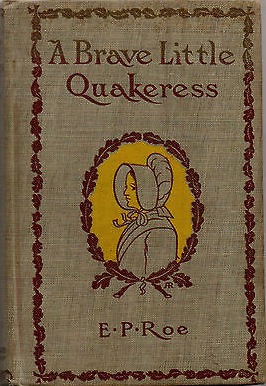
In that spirit, valuing history and lessons I could put into practice as a pastor and writer, I have been researching the legacy of Edward Payson Roe (1838-1888). He was a Presbyterian pastor who served as a chaplain in the Union cavalry, and later as a military hospital chaplain.

After the war, Roe served a congregation, and eventually turned his energies to writing wholesome fiction. He played a key role in helping many suspicious Protestants realize that, like manna, fiction was neither good nor bad. It’s effects depended on the use to which it was put. Roe proved quite popular with readers. Less so with the literary establishment.

The following account comes from an essay about his life solicited by one of the prominent magazines of his day. It is well worth reading, touching as it does on a broad range of subjects, including international copyrights and the vagaries of publishing in the late 1800s. Most precious, though, are the echoes of Roe’s humility and his realistic understanding of the vocation of writing.

“While writing my first story, I rarely thought of the public, the characters and their experiences absorbing me wholly. When my narrative was actually in print, there was wakened a very deep interest as to its reception. I had none of the confidence resulting from the gradual testing of one’s power or from association with literary people, and I also was aware that, when published, a book was far away from the still waters of which one’s friends are the protecting headlands.

“That I knew my work to be exceedingly faulty goes without saying; that it was utterly bad, I was scarcely ready to believe. Dr. Field, noted for his pure English diction and taste, would not publish an irredeemable story, and the constituency of the New York ‘Evangelist’ is well known to be one of the most intelligent in the country.

“Friendly opinions from serial readers were reassuring as far as they went, but of course the great majority of those who followed the story were silent. A writer cannot, like a speaker, look into the eyes of his audience and observe its mental attitude toward his thought. If my memory serves me, Mr. R.R. Bowker was the earliest critic to write some friendly words in the ‘Evening Mail;’ but at first my venture was very generally ignored.

Then some unknown friend marked an influential journal published in the interior of the State and mailed it so timely that it reached me on Christmas eve. I doubt if a book was ever more unsparingly condemned than mine in that review, whose final words were, ‘The story is absolutely nauseating.’ In this instance and in my salad days I took pains to find out who the writer was, for if his view was correct I certainly should not engage in further efforts to make the public ill.

“I discovered the reviewer to be a gentleman for whom I have ever had the highest respect as an editor, legislator, and honest thinker. My story made upon him just the impression he expressed, and it would be very stupid on my part to blink the fact. Meantime, the book was rapidly making for itself friends and passing into frequent new editions. Even the editor who condemned the work would not assert that those who bought it were an aggregation of asses. People cannot be found by thousands who will pay a dollar and seventy-five cents for a dime novel or a religious tract.

“I wished to learn the actual truth more sincerely than any critic to write it, and at last I ventured to take a copy to Mr. George Ripley, of the New York ‘Tribune.’ ‘Here is a man,’ I thought, ‘whose fame and position as a critic are recognized by all. If he deigns to notice the book, he will not only say what he thinks, but I shall have much reason to think as he does.’ Mr. Ripley met the diffident author kindly, asked a few questions, and took the volume. A few weeks later, to my great surprise, he gave over a column to a review of the story. Although not blind to its many faults, he wrote words far more friendly and inspiring than I ever hoped to see; it would seem that the public had sanctioned his verdict

“From that day to this these two instances have been types of my experience with many critics, one condemning, another commending. There is ever a third class who prove their superiority by sneering at or ignoring what is closely related to the people. Much thought over my experience led to a conclusion which the passing years confirm: the only thing for a writer is to be himself and take the consequences. Even those who regard me as a literary offender of the blackest dye have never named imitation among my sins.

“As successive books appeared, I began to recognize more and more clearly another phase of an author’s experience. A writer gradually forms a constituency, certain qualities in his book appealing to certain classes of minds. In my own case, I do not mean classes of people looked at from the social point of view. A writer who takes any hold on popular attention inevitably learns the character of his constituency. He appeals, and minds and temperaments in sympathy respond. Those he cannot touch go on their way indifferently; those he offends may often strike back. This is the natural result of any strong assertion of individuality.

“Certainly, if I had my choice, I would rather write a book interesting to the young and to the common people, whom Lincoln said ‘God must love, since He made so many of them.’ The former are open to influence; the latter can be quickened and prepared for something better. As a matter of fact, I find that there are those in all classes whom my books attract, others who are repelled, as I have said.

“It is perhaps one of the pleasantest experiences of an author’s life to learn from letters and in other ways that he is forming a circle of friends, none the less friendly because personally unknown. Their loyalty is both a safeguard and an inspiration. On one hand, the writer shrinks from abusing such regard by careless work; on the other, he is stimulated and encouraged by the feeling that there is a group in waiting who will appreciate his best endeavor.

“While I clearly recognize my limitations, and have no wish to emulate the frog in the fable, I can truthfully say that I take increasing pains with each story, aiming to verify every point by experience—my own or that of others. Not long since, a critic asserted that changes in one of my characters, resulting from total loss of memory, were preposterously impossible. If the critic had consulted Ribot’s ‘Diseases of Memory,’ or some experienced physician, he might have written more justly.

“I do not feel myself competent to form a valuable opinion as to good art in writing, and I cannot help observing that the art doctors disagree woefully among themselves. Truth to nature and the realities, and not the following of any school or fashion, has ever seemed the safest guide. I sometimes venture to think I know a little about human nature. My active life brought me in close contact with all kinds of people; there was no man in my regiment who hesitated to come to my tent or to talk confidentially by the campfire, while scores of dying men laid bare to me their hearts. I at least know the nature that exists in the human breast.

“It may be inartistic, or my use of it all wrong. That is a question which time will decide, and I shall accept the verdict. Over twelve years ago, certain oracles, with the voice of fate, predicted my speedy eclipse and disappearance. Are they right in their adverse judgment? I can truthfully say that now, as at the first, I wish to know the facts in the case. The moment an author is conceited about his work, he becomes absurd and is passing into a hopeless condition. If worthy to write at all, he knows that he falls far short of his ideals; if honest, he wishes to be estimated at his true worth, and to cast behind him the mean little Satan of vanity. If he walks under a conscious sense of greatness, he is a ridiculous figure, for beholders remember the literary giants of other days and of his own time, and smile at the airs of the comparatively little man. On the other hand, no self-respecting writer should ape the false deprecating ‘’umbleness’ of Uriah Heep. In short, he wishes to pass, like a coin, for just what he is worth.

“Mr. Matthew Arnold was ludicrously unjust to the West when he wrote, ‘The Western States are at this moment being nourished and formed, we hear, on the novels of a native author called Roe.’ Why could not Mr. Arnold have taken a few moments to look into the bookstores of the great cities of the West, in order to observe for himself how the demand of one of the largest and most intelligent reading publics in the world is supplied? He would have found that the works of Scott and Dickens were more liberally purchased and generally read than in his own land of ‘distinction.’ He should have discovered when in this country that American statesmen (?) are so solicitous about the intelligence of their constituents that they give publishers so disposed every opportunity to steal novels describing the nobility and English persons of distinction; that tons of such novels have been sold annually in the West, a thousand to one of the ‘author called Roe.’

“The simple truth in the case is that in spite of this immense and cheap competition, my novels have made their way and are being read among multitudes of others. No one buys or reads a book under compulsion; and if any one thinks that the poorer the book the better the chance of its being read by the American people, let him try the experiment. When a critic condemns my books, I accept that as his judgment; when another critic and scores of men and women, the peers of the first in cultivation and intelligence, commend the books, I do not charge them with gratuitous lying. My one aim has become to do my work conscientiously and leave the final verdict to time and the public. I wish no other estimate than a correct one; and when the public indicate that they have had enough of Roe, I shall neither whine nor write.”

_____

If you are interested in learning more about E.P. Roe, check out my article in the new issue (4.2) of Curtana: Sword of Mercy which was published online just last week.

Poetry for Geeks

csl ipadThe word “Geeks,” we know, is no longer an insult. It often refers to those über-intelligent folks who author the invisible “codes” that make computer software work.

Their mystical incantations make the modern world go round.

Two years ago some creative programmers decided to invent a new genre of poetry. It’s called “code poetry,” and they’ve published a collection entitled code {poems}.

It’s an intriguing genre, but the examples I’ve read suggest that you need to have at least an elementary understanding of programming languages to truly appreciate the poems. Consider “Dailygrind.”

DAILYGRIND

by Paul Illingworth (// Java)

import java.util.Date;

public class DailyGrind {


   public static final void main(String[] args) {


        boolean its_time_to_go_home = false;


         boolean away_the_hours = true;


        while (away_the_hours) {


              Date now = new Date();


               its_time_to_go_home = now.getHours() > 17


                         && now.getMinutes() > 30;


              if (its_time_to_go_home) {


                   break;


               }


      try {


                   Thread.sleep(60000);


               } catch (InterruptedException e) {


                   // ignore


               }


          }


     }


}

As I understand it, the code needs to (1) be functional (i.e. it has to actually work on a computer), and to (2) possess a lyrical essence.

Boasting no programming skills, I find it rather confusing. Then again, I’ve been confused by other examples of atypical poetry. I guess I’m a poor judge on the matter.

C.S. Lewis, on the other hand, was an expert on nearly all things literary. Although he died before the development of the internet, I would be curious to see how he would measure this novel approach to verse.

Although he was little praised for his poetic forays, Lewis penned a number of poems. Some are sprinkled throughout his writings, and others were compiled after his passing by Walter Hooper. The collection Poems is quite enjoyable. And Hooper’s preface to the collection is very informative.

He relates a delightful example of Lewis’ poetic admission that he found a particular poetic image particularly inappropriate.

The fact that he did not publish these poems during his lifetime suggests that Lewis was hesitant about their publication. He knew his poems were very unlike most contemporary verse. Because of this, he could not be certain of the reaction of his readers. The answer is not far to seek. In the poem, “A Confession,” Lewis says with ironical disappointment:

I am so coarse, the things the poets see

Are obstinately invisible to me.

For twenty years I’ve stared my level best

To see if evening—any evening—would suggest

A patient etherized upon a table;

In vain. I simply wasn’t able.

Lewis found Mr Eliot’s comparison of an evening to a patient on an operating table unpleasant, one example of the decay of proper feelings. He mistrusted, in fact, the free play of mere immediate experience. He believed, rather, that man’s attitudes and actions should be governed by, what he calls in the same poem, Stock Responses (e.g. love is sweet, death bitter, and virtue lovely).

Man must, for his own safety and pleasure, be taught to copy the Stock Responses in hopes that he may, by willed imitation, make the proper responses. He found this perfectly summed up in Aristotle’s “We learn how to do things by doing the things we are learning to do.”

Returning to the question of what Lewis might have thought of code poetry, I suspect he would be just as mystified as I am. Still, depending on how each individual poem resonates with the stock responses to which Hooper alludes . . . perhaps Lewis would embrace some of them as worthy expressions of a genuinely poetic heart.

_____

The T.S. Eliot poem to which Lewis was responding, “The Love Song of J. Alfred Prufrock,” was published in 1915. If you are up to the challenge of interpreting it, you can read it here.

Confusing Creeds

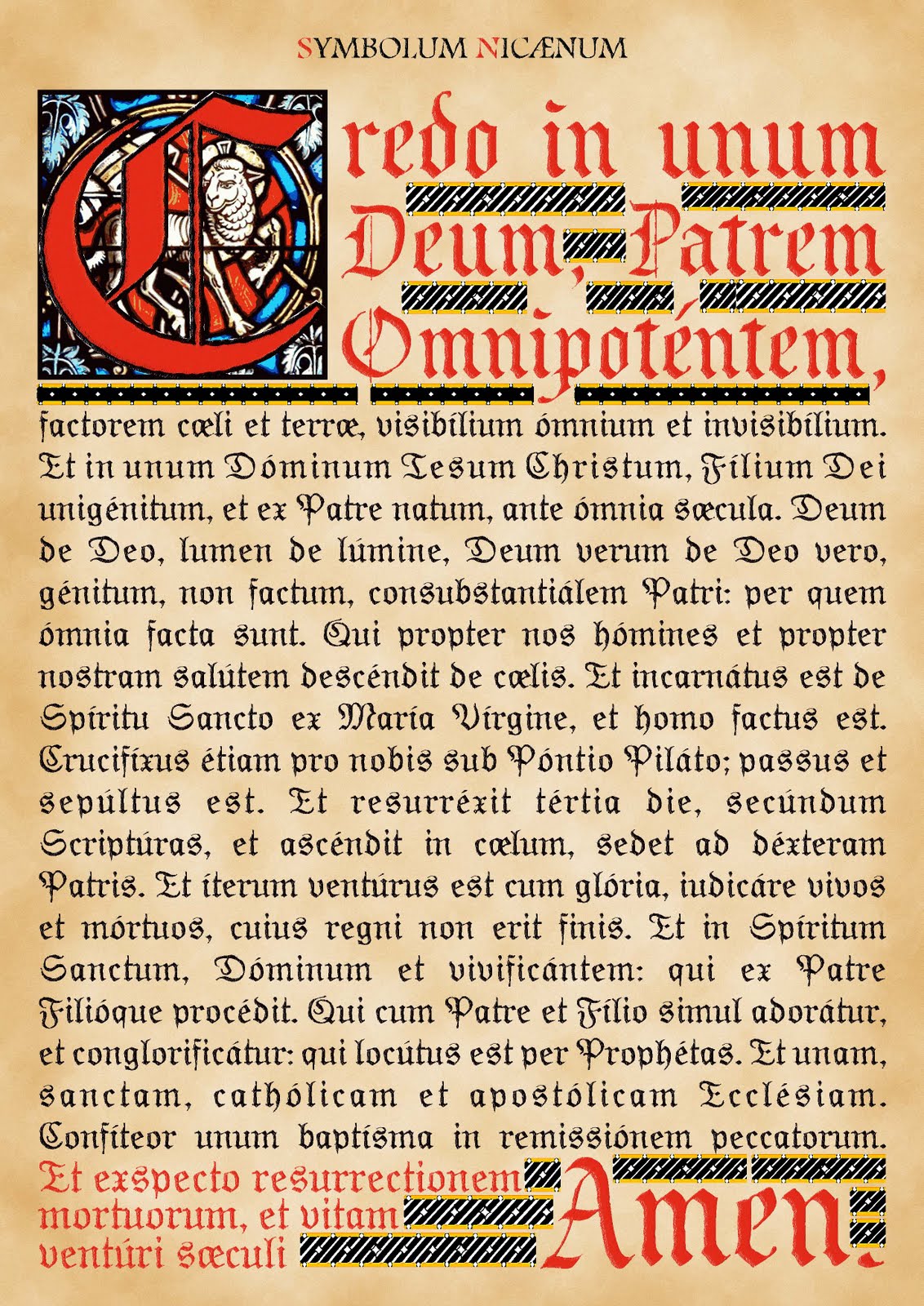
Nicene CreedThere are a couple of sentences in the traditional translation of the basic Christian creeds (statements of faith) that lead to confusion.

Due to the literary examples below, Christian readers may find the following discussion more interesting than non-Christians—but everyone interested in clarity versus confusion should find something intriguing.

The creeds offer a prime example of why it is absolutely crucial to ensure that gradual shifts in language do not undermine or blur the intended meaning of a given sentence. To illustrate, consider this line from the Nicene Creed.

. . . [Jesus] who for us men and for our salvation came down from heaven and was incarnate by the Holy Spirit of the virgin Mary and was made man. (1662, Anglican Book of Common Prayer).*

The potential confusion here lies in the archaic usage of the word “of.” Whose Holy Spirit are we referring to? Mary’s innate holiness and purity? The educated Christian may stumble over that dated phrase—which is still used in some denominations—but a person not acquainted with the doctrine of the Trinity might easily misinterpret it as a Maryological, rather than Christological, confession.

Let’s consider two more recent translations, and note how the first restores the intent of the original writers. The second of these commonly used translations reflects the hand(s) of “politically correct” revisers.

For us and for our salvation he [Jesus] came down from heaven: by the power of the Holy Spirit he became incarnate from the Virgin Mary, and was made man. (1975 International Consultation on English Texts version).

For us and for our salvation he came down from heaven, was incarnate of the Holy Spirit and the Virgin Mary and became truly human. (1988, English Language Liturgical Consultation version).

We will consider a second example momentarily, but let’s first look at something C.S. Lewis wrote about reflecting on the importance of the creeds. He noted that too often we rattle through the words without considering their significance. This is unfortunate.

In an essay entitle “On Forgiveness,” Lewis describes a personal epiphany and offers counsel to those tempted to take familiar words for granted.

We say a great many things in church (and out of church too) without thinking of what we are saying. For instance, we say in the Creed “I believe in the forgiveness of sins.” I had been saying it for several years before I asked myself why it was in the Creed. At first sight it seems hardly worth putting in. “If one is a Christian,” I thought “of course one believes in the forgiveness of sins. It goes without saying.”

But the people who compiled the Creed apparently thought that this was a part of our belief which we needed to be reminded of every time we went to church. And I have begun to see that, as far as I am concerned, they were right. To believe in the forgiveness of sins is not so easy as I thought. Real belief in it is the sort of thing that easily slips away if we don’t keep on polishing it up.

As usual, the Oxford don was correct. However, just as good translations possess the power to inspire, so too poor or antiquated translations exercise the ability to confuse.

Here is the promised second example.

And the third day he rose again according to the Scriptures . . . (1662).

Ah, I understand, think the uncatechized, the Bible teaches us that Jesus rose from the dead on Easter. Well, yes it does, but that is not the sense in which the second phrase is intended. Here, “according to the Scriptures,” means that Jesus’ life, death and resurrection were all accomplished in accordance with the promises of the Word of God.

In other words, “just as was promised in the Garden of Eden and foretold by the prophets, Jesus won victory when he rose from the grave in accordance with the loving plan of God the Father.” The newer versions make that fact only slightly clearer.

On the third day he rose again in accordance with the Scriptures . . . (1975 and 1988).

Perhaps a future revision will replace “in accordance with,” using something like “as foretold in” or “fulfilling the scriptural promises.”

Some of us worship in congregations using a variant of the seventeenth century creed, but at least we can take comfort in the fact that most of them have at least replaced “And he shall come again with glory to judge both the quick and the dead” with “both the living an the dead.” After all, we wouldn’t want people to think that one’s salvation is dependent upon their speed.

_____

* This slightly contemporized version of the creed has already remedied the terribly confusing term “Holy Ghost,” which evokes images of disembodied souls and hauntings.

Chinese Complexity

Chinese ChroniclesSome people consider “writing” difficult. It’s not. When you add the adverb “well,” it does become much rarer. Still, writing in English is not challenging at all when you compare it to the hurdle traditional Chinese authors face.

One of the most popular television programs in the People’s Republic of China is essentially a “spelling bee.” During a recent episode the studio audience was embarrassed by the fact only one-third of them were able to correctly write “gan ga,” which means “embarrassed.”

Chinese ComplexThe problem is apparently two-fold. First, Chinese characters are “complex.” That’s why I selected that very word to include here.

The most comprehensive Chinese dictionary, Zhonghua Zihai, was compiled in 1994. It includes 85,568 characters. When compared to the Latin alphabet of 26 characters, it’s no surprise that a poll in China found 99% of the population admitting they forget how to write words. (To be fair, I’m not sure we could find even 1% in the West claiming that they never forget how to spell a word.)

The second reason for the growing national writing crisis in China is the amazing phenomenon called pinyin. Pinyin is the official phonetic system for transcribing the sound of Chinese characters into Latin script. It was created in 1958 by mainland China and has been adopted by the Republic of China as well.

The influence of pinyin has grown dramatically with the advent of computing, and many young Chinese have become dependent on the shortcut. Some educators have labeled the crippling practice “a type of social disease.”

Fortunately for aspiring Chinese authors, knowing a meager 4,000 distinct characters makes one “functionally” literate. Still, even that seems rather daunting. I’ll no longer take for granted my good fortune in having a mere 26 characters to strive to master.

C.S. Lewis offered some fascinating observations about the Chinese worldview. While he discussed the subject in a variety of places, he presents his thoughts most extensively in The Abolition of Man. He finds the concept of “Tao” a useful corollary to what Christians usually refer to as Natural Law.

The Chinese also speak of a great thing (the greatest thing) called the Tao. It is the reality beyond all predicates, the abyss that was before the Creator Himself. It is Nature, it is the Way, the Road. It is the Way in which the universe goes on, the Way in which things everlastingly emerge, stilly and tranquilly, into space and time. It is also the Way which every man should tread in imitation of that cosmic and supercosmic progression, conforming all activities to that great exemplar.

“In ritual,” say the Analects, “it is harmony with Nature that is prized.” The ancient Jews likewise praise the Law as being “true.” This conception in all its forms, Platonic, Aristotelian, Stoic, Christian, and Oriental alike, I shall henceforth refer to for brevity simply as “the Tao.”

Some of the accounts of it which I have quoted will seem, perhaps, to many of you merely quaint or even magical. But what is common to them all is something we cannot neglect. It is the doctrine of objective value, the belief that certain attitudes are really true, and others really false, to the kind of thing the universe is and the kind of things we are.

Although the following story does not relate to C.S. Lewis directly, it offers an interesting insight into the subject of this post. It appears in the book Remembering C.S. Lewis: Recollections of Those who Knew Him, and refers to J.A. Smith, one of Lewis’ fellow professors at Magdalen.

“At the Breakfast Table” was written by another member of the faculty, Adam Fox. Both men knew Lewis well, since they were part of a breakfast foursome in the Common Room at the college.

Now J.A. had fallen into the way of speculating on odd little problems, which apparently assailed him in bed when sleep deserted him. I remember him coming down one morning and telling us that he had been thinking in the night what a dreadful thing it would be for a learned Chinese to go blind. I do not know if the other members of the party knew why it would be more dreadful for a Chinese than for any other learned person.

I had no idea, but I knew my place, and when I asked why this was so, it appeared, according to J.A., that many of the ideograms that make Chinese writing so beautiful conveyed meaning to the eye but had no sound attached to them. Reading in Chinese was in part at least like looking at a picture book, and for that reason, of course, a blind man is fatally handicapped.

As an epilogue of sorts, I can’t resist including one of my favorite Chinese characters. Perhaps you’ll enjoy it also.

Chinese Verbose

Ironically, since it required sixty-four strokes, the word zhé fell from common usage around the fifth century.

Free C.S. Lewis Book

bookshelvesC.S. Lewis has encouraged innumerable prominent individuals in their own faith and writing journeys. I know of no others who offer at no cost a book about his influence.

John Piper is a pleasant exception to that. In a moment I’ll provide the link where you can download a free copy of Alive to Wonder: Celebrating the Influence of C.S. Lewis.

The volume includes a number of extended excerpts from Piper’s fifty-plus books . . . passages where Lewis’ imprint is particularly vivid. For example:

The synthesis of mind and heart was embodied in C.S. Lewis. Lewis became for me in my college days what Jonathan Edwards became in my seminary days. He was a “romantic rationalist”—that was the name of a small book about Lewis that got me very excited because it summed up what I thought I was (which may be very akin to “pastor-scholar”). Lewis has had a tremendous influence on me in several ways.

Lewis embodied the fact that rigorous, precise, penetrating logic is not inimical to deep, soul-stirring feeling and vivid, lively—even playful—imagination. He combined what almost everybody today assumes are mutually exclusive terms: rationalism and poetry, cool logic and warm feeling, disciplined prose and free imagination. In shattering these old stereotypes, he freed me to think hard and to write poetry, to argue for the resurrection and to compose hymns to Christ, to smash an argument and to hug a friend, to demand a definition and to use a metaphor.

The author is chancellor of Bethlehem College & Seminary. It was founded by Bethlehem Baptist Church in Minneapolis, where Piper served as pastor for several decades.

The writer’s desiringGod website actually offers free PDF copies of many of his books and articles, even though most remain in print and available for regular purchase.

As delightful as Alive to Wonder is, most students of Lewis will find the materials from the 2013 desiringGod National Conference even more welcome. This year’s theme was “The Romantic Rationalist: God, Life, and Imagination in the Work of C.S. Lewis.”

Piper’s website includes ten keynote presentations plus an informative panel discussion, all of which are available for download in audio files. Best of all, the lineup of speakers is first-class, featuring a number of familiar names.

And, since we’re on the subject of “free books,” allow me to share another interesting website.

Forgotten Books offers approximately a million volumes, to which “subscribers” have unlimited access. What sets them apart from other “public domain aggregates,” is that they (unlike books.google.com) provide a searchable text, in a variety of epub formats.

For those who are not interested in purchasing a subscription, they offer a Free Book of the Day option in which you receive the link to one of their texts which is good for twenty-four hours.

I recently used it to add Pure English: A Treatise on Words and Phrases, or Practical Lessons in the Use of Language to my kindle library. I find the reading of dated literary books to be:

Entertaining

Educational

and, occasionally, even

Inspiring

Here are a few sample passages from Pure English. The first sounds remarkably contemporary:

The abuse to which the English language is so generally subjected must be a source of sincere regret to all who appreciate its beauties. Ours is an age of progress and civilization, and it ought to be remembered that language, is also progressive.

In a section entitled “Objectionable and Obsolete Words” we read:

Banister is a common barbarism. The proper word is baluster, or balustrade.

— Noted. In the future I will alternate between baluster and balustrade.

“Disremember,” often employed in the sense of do not remember, although given in Webster, is condemned by the critics as a low vulgarism.

— Apparently so vulgar as to have fallen out of usage completely.

Hence, authoress and poetess are superfluous. So, also, are such words as conductress, directress, inspectress, waitress, etc., all of which have recently come into current use. Perhaps the next edition of our dictionaries will, if the custom continues, be enriched by the addition of such words as writeress, officeress, carpenteress, manageress, secretaryess, treasureress, singeress, walkeress, talkeress, etc.

— How did “waitress” survive, especially in the wake of such witty sarcasm?

It is questionable taste to call a coffin a casket. The pleasing name applicable to a case for jewels does not lessen the dread of death and burial.

— I hadn’t known before the sentiment behind the adoption of the word “casket,” since it’s become so thoroughly associated with this usage that was apparently at one time novel.

If you are interested in the books I’ve mentioned above, you You can download a free copy of Alive to Wonder here, and you can sign up for the free book of the day here.

The Bible’s Songbook

psalmistI experienced an embarrassing moment many years ago while taking a broadcasting media course at seminary. I had used a passage from the Psalms as the basis for an assigned devotional, and when the professors (from several different seminary faculties) critiqued it, a distinguished professor dismissively pointed out that I had mispronounced the word “psalm” itself!

I had foolishly pronounced the “l” sound in the word (the way I’d always heard it pronounced). I don’t know whether any of the other students were as ignorant as I, but no one denied that the condescending correction was correct.

The first thing I did upon returning home was grab my dictionary to see if the doctor of theology was right. It turned out, of course, that he was right with how to pronounce the word [i.e. sahm] . . . but he was definitely wrong about how to properly correct a student.

On a more positive note, the Psalms are the foundation and epitome of worship music for Jews and Christians alike. One could read a Psalm each day and since there are one hundred and fifty, when you returned to the first psalm five months after beginning, it would be utterly fresh.

C.S. Lewis enjoyed the Psalms. The following passage comes from a letter written in 1940.

My enjoyment of the Psalms has been greatly increased lately. The point has been made before, but let me make it again: what an admirable thing it is in the divine economy that the sacred literature of the world should have been entrusted to a people whose poetry, depending largely on parallelism, should remain poetry in any language you translate it into.

And glorious poetry it is. The beauty of the songs extends far beyond the family “Lord is my shepherd . . .” And yet, it would be impossible to comprehend the number of grieving souls that have been comforted with the words “Even though I walk through the valley of the shadow of death, I will fear no evil, for you are with me; your rod and your staff, they comfort me.”

Most Christian traditions greatly value the Psalms, and many include them as a portion of the regular service or liturgy. And individuals who include them in the personal devotions are never disappointed.

C.S. Lewis included them in his prayer and devotion. In fact, he enjoyed the Psalms so much that in 1958 he wrote a book entitled Reflections on the Psalms. There he proclaims, “The most valuable thing the Psalms do for me is to express that same delight in God which made David dance.”

The Church has added an immense repertoire to the Psalms during the past two millennia, but they will never be replaced. In fact, many inspired songs owe a major debt to the Psalms themselves. This includes the Odes of Solomon, the first (post-Psalms) Christian hymnal (composed circa 100 A.D.).

Speaking of the Odes, I wrote a thesis on them many years ago, and have been considering writing a book about these treasures. Perhaps I’ll share more about them in the future.

_____

The lovely window pictured above is from a church in Fringford, England. David was likely a bit younger when most of the psalms he composed were written.