Typing is Not Writing

chimp

How is this for an absurd waste of time? A foolish man wanted “to feel what it was like to write like F. Scott Fitzgerald.” So, what did he do? Take writing classes? No, he had a better idea. He sat down at the keyboard and proceeded to type out a verbatim copy of The Great Gatsby.

Some of you may have heard this story, from the life of Hunter S. Thompson. He founded the “gonzo journalism” movement which dispenses with the pretense of objectivity. Sarcasm, humor and even profanity abound in this type of writing.

Thompson was apparently well suited to gonzoism, summarizing his life philosophy in this way: “I hate to advocate drugs, alcohol, violence, or insanity to anyone, but they’ve always worked for me.” Which is, presumably, a personal endorsement, rather than advocacy.

Apparently, typing the same words as literary icons also “worked” for Thompson. He also retyped Hemingway’s A Farewell to Arms to learn how to emulate his style.

I wonder what C.S. Lewis and his fellow Inklings would think of this approach to learning how to write. Lewis, of course, treasured good writing and recognized wide reading as a valuable inspiration for successful writing.

Nevertheless, if Lewis and Tolkien heard about Thompson’s exercise, I imagine they would enjoy a good laugh.

Reproducing typed facsimilies cannot be considered writing. Even an utterly illiterate person (or probably even a chimpanzee) could be trained to reproduce an original, key stroke by key stroke. (The monkey would probably benefit from a keyboard tailored to its particularly physiology.)

Emulating is Writing

When a lesser writer seeks to imitate the style of a renowned author, using their own creative skills and not plagiarizing, they are composing something original. There are several considerations to keep in mind.

Copyright restrictions may bar the work from publication. For example, it’s not yet legal for people to publish new Narnia stories.

Trademarks can also limit options for such works. Speaking of which, you don’t need to register a trademark to use TM in the United States, as we at MereInkling(TM) recently learned.

If registered with the USPTO, use the ® symbol after your mark.  If not yet registered, you may use TM for goods or SM for services, to indicate that you have adopted this as a “common law” trademark or service mark.

Works written as an homage—without any compensation or profit—is typically allowed. Thus we see innumerable variations on the Screwtape Letters. I have contributed to that mountain myself.

Basing a piece on the themes or voice of a masterpiece is altogether different from plagiarism.

There is one more critical point to make about a legitimate literary “tribute.” It can be based on the most anointed writing of the most impressive author . . . and still not be worth reading at all.

Which returns us to the typescripts reproduced by Thompson. Assuming he reproduced them faithfully, he is immune at least to the charge that the product of his typewriter is inferior to the original text.

That said, I find the two minutes I just invested in writing the following modest haiku more beneficial to my creativity than the hundreds of hours I might have spent literally copying a book I prize.

Retyping fixed words

Rather than shaping one’s own

Is a game for fools.

C.S. Lewis and Punditry

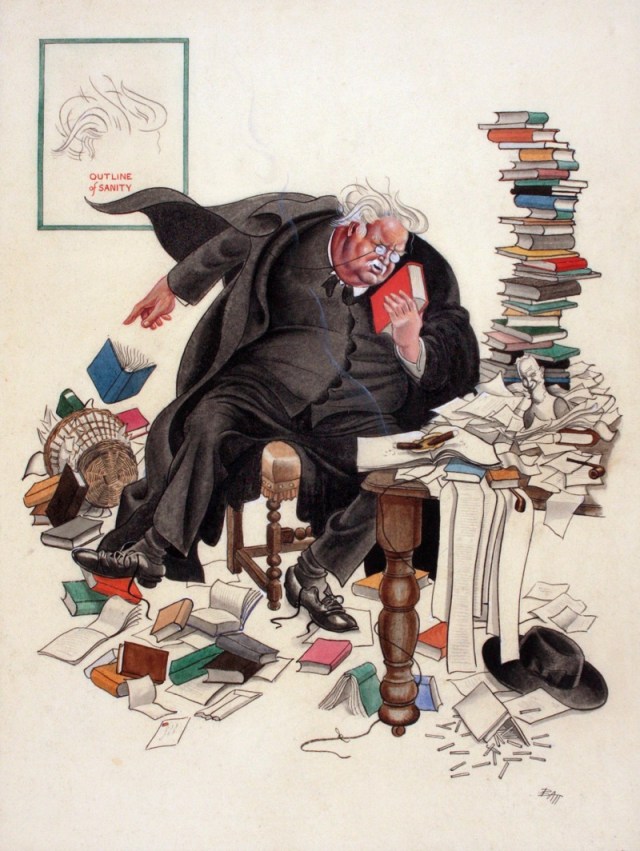
chesterton-sanity

Odds are that you, kind reader of Mere Inkling, are a pundit. While the overpaid professionals who overpopulate the media would like for us to think being a pundit requires possessing special knowledge or expertise, that’s simply not true.

Any of us who make comments or pass judgments in an authoritative manner can rightly be deemed a pundit. If you are simply a commonplace critic, you probably qualify for the title. All the more so if you publish your thoughts.

If the recent elections proved anything, they revealed there may well be more pundits per cubic acre in the modern world, than there are bees.

Recently I came across a peculiar essay, written by a writer with whom I’m totally unfamiliar. David Harsanyi is a senior editor of The Federalist, although this article appeared in National Review. Presumably he is a conservative, but of the atheist variety. (No wonder I haven’t read any of his work.)

At any rate, he’s a journalist who describes his “line of work” as “punditry.” Punditry as we have noted, has become all the rage in our modern era. I’m debating though whether adding it to one’s resume would be beneficial. It appears that receiving the validation of a punditry paycheck is the best gauge for making that determination.

As soon as people had the leisure time to develop their senses of humor, the seeds of punditry were planted, and many a silver tongued cynic has reaped the harvest. The past has known people who offered social criticism with a dash of wit (typically of the sarcastic variety).

An admirable example of such was G.K. Chesterton (1874-1936). Chesterton differed from Harsanyi in that he was also a philosopher and poet, not merely a journalist. Most notably, Chesterton was also a Christian.

C.S. Lewis held Chesterton in very high regard, and included his book The Everlasting Man among the top ten titles which had influenced his professional and philosophical thought. You can download an audio copy of that text here.

There is a great essay here that explores the influence of Chesterton’s essay “Ethics of Elfland” on the Inklings.

Jerk Logic

Returning to the article with which I began, “Jerk Logic” is the title of Bersanyi’s essay. He began with a question that more people should probably ask themselves.

Am I a jerk? You may find this an odd question for a person to ask himself. But when you’re in my line of work—which, broadly speaking, is called punditry—complete strangers on social media have little compunction about pointing out all your disagreeable character traits.

I found his article interesting for several reasons. He’s candid about some of the booby traps that endanger those who dare to write about controversial subjects. He offers a confession about just how soul-scarring the past election has been for some who have followed its permutations closely.

The 2016 election, I’m afraid, has convinced me that the joke is definitely on me. But after taking meticulous inventory of my actions over the past year or so, I am forced to acknowledge that perhaps, on occasion, some of my behavior might be construed as wantonly unpleasant. Long story short, I am a jerk . . . with an explanation.

Another thing I enjoyed in the brief piece is how he turned to a personality inventory (similar to the Myers Briggs Type Indicator) to assess his potential jerk quotient.

As I learned more about my personality type, I began feeling sorry for everyone in my almost certainly beleaguered family. While we pride ourselves on “inventiveness and creativity” and “unique perspective and vigorous intellect,” Logicians can also be “insensitive,” “absent-minded,” and “condescending.”

The essay concludes with a justification for a modest amount of jerkiness when living the life of a journalist, and especially a pundit.

As a writer, it’s incumbent on me to be clinically unpleasant and prickly when focusing on self-aggrandizing do-gooders or abusers of power or those who pollute our culture with garbage. One can make arguments in good faith while still being downright disagreeable. So I make no apologies for being disliked. There’s nothing wrong with being hated by the right people.

There are, in fact, far too many journalists overly concerned about being shunned. As a young critic writing his first reviews for a wire agency, I sometimes wrestled with an existential question: “Who am I to say these horrible things about people who are far more successful and powerful than I am?” Nowadays I ask myself: “How exactly can I say more horrible things about these people who shouldn’t be more successful or powerful than any of us?”

A skeptical and contrarian disposition is not only useful if you want to be a decent pundit, but indispensable if you want to be a good journalist on any beat.

I wonder whether Chesterton would think of this as an indispensable journalistic trait. He did, after all, have an honest view of the overall profession. “Journalism largely consists in saying ‘Lord Jones is dead’ to people who never knew Lord Jones was alive.” (The Wisdom of Father Brown)

I did find a fascinating description of the press provided by Chesterton in “The Boy.” It was published in 1909 in All Things Considered . . . and echoes true a century later.

But the whole modern world, or at any rate the whole modern Press, has a perpetual and consuming terror of plain morals. Men always attempt to avoid condemning a thing upon merely moral grounds.

If I beat my grandmother to death to-morrow in the middle of Battersea Park, you may be perfectly certain that people will say everything about it except the simple and fairly obvious fact that it is wrong.

Some will call it insane; that is, will accuse it of a deficiency of intelligence. This is not necessarily true at all. You could not tell whether the act was unintelligent or not unless you knew my grandmother. Some will call it vulgar, disgusting, and the rest of it; that is, they will accuse it of a lack of manners. Perhaps it does show a lack of manners; but this is scarcely its most serious disadvantage.

Others will talk about the loathsome spectacle and the revolting scene; that is, they will accuse it of a deficiency of art, or æsthetic beauty. This again depends on the circumstances: in order to be quite certain that the appearance of the old lady has definitely deteriorated under the process of being beaten to death, it is necessary for the philosophical critic to be quite certain how ugly she was before.

Another school of thinkers will say that the action is lacking in efficiency: that it is an uneconomic waste of a good grandmother. But that could only depend on the value, which is again an individual matter.

The only real point that is worth mentioning is that the action is wicked, because your grandmother has a right not to be beaten to death. But of this simple moral explanation modern journalism has, as I say, a standing fear. It will call the action anything else—mad, bestial, vulgar, idiotic, rather than call it sinful.

Amen. Evil acts today are nearly always attributed to some shortcoming or flaw such as insanity (e.g. individual acts) or delusional indoctrination (e.g. jihadism). While these are sometimes contributing factors, Chesterton rightly assessed the base cause.

Sadly, by affirming that fact, I expect that I too will be going on some people’s “jerk” list. They may consider me contrarian, but I’m simply striving to be honest.


C.S. Lewis and his Secretary

hooper

Upon Lewis’ death, Walter Hooper assisted Inkling Owen Barfield (1898-1997) in overseeing Lewis’ literary estate. He continues to serve as a literary advisor to the estate. Hooper’s Lewisian contributions have grown in magnitude over the years.

He began by co-authoring a biography of Lewis in 1974, written jointly with Roger Lancelyn Green (1918-87). Green had been a student of Lewis, and a member of the Inklings. After writing several other works through the years, in the late nineties he penned C.S. Lewis: A Companion and Guide and C.S. Lewis: A Complete Guide to His Life and Works. Priceless resources!

The list of material edited by Hooper is quite impressive. He dutifully, and brilliantly, edited many of Lewis’ writings. The world should be particularly grateful for the three-volume compilation of Lewis’ correspondence. A humble man, Hooper writes sincerely in the preface to the volumes: “The eight years I have spent editing the letters would not have been as fruitful nor as pleasant were it not for the help of many others. My debts are numerous, and nothing I can say can adequately reflect my gratitude.”

Hooper’s meeting with Lewis was providential, coming as it did so near the end of the great author’s life. The following letter describes their arrangement. It reveals how much Lewis appreciated the initial assistance provided by Hooper, and how hopeful he was that Hooper would be able to resume his secretarial duties in the summer of 1963. Lewis remained, however, concerned about how he would meet all of his financial responsibilities in the wake of his medical retirement.

[The Kilns] 20 Sept 63

My dear Walter

We get on reasonably well, tho’ we all greatly miss, not only your utility, but your companionship. No one has ever so endeared himself to the whole household.

The noble Arthurian volumes continue to arrive, but are not yet on the shelves. The work of arranging all my books in their new homes, tho’ delightful, goes on v[ery] slowly, for I am not strong enough to do more than a little each day.

Now, about the future. It is entirely reasonable that you shd have a salary and a darn good one, and I feel I have been rather sponging on your kindness. But what it may be proper for you to ask may also be impossible for me to do.

I dare not at present increase my expenses. In this country one is taxed each year on the income of the previous year. One’s first year in retirement is therefore very alarming. And if, on top of the drop in income, there are the expenses of an illness, and some rather heavy and unexpected expenses for David–well you see.

I am v. ashamed, not of confessing the situation, but of refusing the wholly just demand from a man to whom I already owe more than any money could repay.

But you see, having you as a paid secretary wd. be a luxury, and I’ve no right to imperil those who depend on me for the sake of a luxury to myself.

On other grounds, I couldn’t recommend you to come in January. Mrs Miller and I talked it over and both concluded that an English house in an English winter wd. be misery for you. Our central-heating apparatus is v. primitive (nothing like yours) and we can afford to use it only during very cold snaps.

If you can afford to come in June, you will be thrice welcome. W. is still away. I fear he’ll kill himself if this goes on much longer.

Our plums are splendid this year. With all our loves. Yours Jack

A Wonderful Interview with Hooper

Walter Hooper has been very content to remain behind the scene, and deep in the shadow of the man whose memory he preserves.

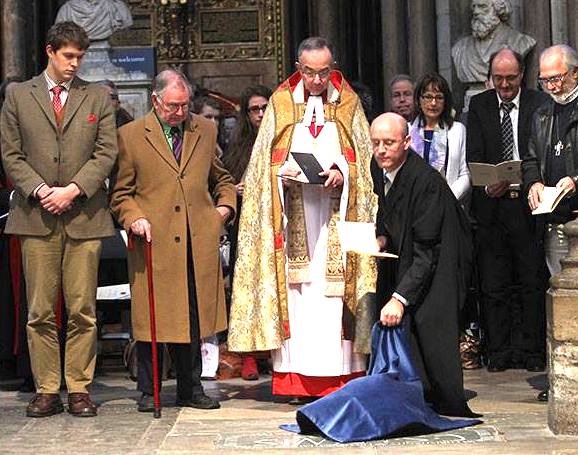
Fortunately, in addition to his personal writings and editorial work, Hooper has been willing to speak in various settings. The photograph at the top of the page comes from the unveiling of Lewis’ memorial in Westminster Abbey’s Poets’ Corner.

We owe a debt of gratitude to “Socrates in the City: Conversations on the Examined Life,” which is produced by Eric Metaxas, a Christian writer and syndicated radio host.

Metaxas took his program from the city of New York, to the city of Oxford to avail himself of the wealth of brilliant speakers accessible there. Among those he interviewed in this casual setting is Walter Hooper. Wonderfully, the Hooper interview was substantial enough that it is presented in three parts. Do check it out.

Narnia, Oz & an Odd Link Between the Two

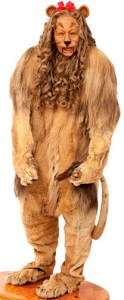
oz-lionFew people know this peculiar fact about The Wizard of Oz. And this oddity shares an interesting link to one of C.S. Lewis’ most familiar novels.

Filmmaking has changed greatly since 1939 when Dorothy first tapped together her ruby slippers. One of those modifications involves the treatment of animals.

Some of us are old enough to remember the initial appearance of the disclaimers: “No animals were injured in the making of this film.” Those announcements disappeared long ago, as people have long supposed the humane treatment of animals required.

As far as I know, no one has alleged the mistreatment of animals in The Wizard of Oz. But the odd fact mentioned above refers to one of the costumes worn by a major character in the film.

Bert Lahr played the Cowardly Lion, who continued acting until he died during the filming of The Night They Raided Minsky’s in 1968. Fortunately, he was in his prime while traipsing across Oz, because his costume weighed at least sixty pounds.

Apparently the costume designer was going for accuracy—in the case of the Cowardly Lion, if not for the citizens of Munchkinland. He opted for using an actual lion pelt. At least two, in fact, since there was a least one backup.

Cinema memorabilia often provides unbelievable dividends. MGM sold the primary costume in 1970 for a mere $2,400. In 2005, after some restoration by a taxidermist, the costume sold for $826,000. Nine years later, in 2014, it became the highest valued male performer’s costume, selling for $3,100,000.

It is quite fitting that Leo the Lion is the mascot for Metro-Goldwyn-Mayer film studio. While there have been seven “Leos” since 1916, it is doubtful that any of them contributed their hide to costuming the Cowardly Lion.

What Has Oz to do with Narnia?

Oz and Narnia resemble one another in the obvious sense that both are fantasy lands. I’m ill-equipped to compare the two beyond that, having no desire to read about the former. Here you’ll find an interesting article that offers some insights into the realm of the Wizard. The literary critics of The Telegraph offer the following contrast.

Even so, [Oz is] a strangely amorphous creation, originally reached by cyclone but in later books by shipwreck (twice), by earthquake and by simply getting lost. As a fantasy land, it has none of the depth or authority of Tolkien’s Middle Earth nor even the physicality of CS Lewis’s Narnia.

Reaching back to the turn of the millennia, you might enjoy reading “Oz vs. Narnia.” Comparing the promotion of the two realms on their respective hundredth and fiftieth anniversaries, the author finds Narnia’s treatment by HarperCollins wanting.

But however much the tribute to Oz exceeds the tribute to Narnia in sumptuousness, it can’t disguise the superiority of Lewis’ book. As a child, I loved Oz’s endless cavalcade of strange creatures and, especially, John R. Neil’s trippy art nouveau illustrations and extravagant marginalia; I still like the books today. But the first time I read “The Lion, the Witch and the Wardrobe” in second grade, I knew that I’d stumbled into a whole new league.

A Tale of Two Lions

The odd overlap in the two stories is not due to the prominent presence of lions in each world. The Cowardly Lion and Aslan have nothing in common, save perhaps, compassion for others.

But the real life costume of Oz’s lion does relate directly to one of Lewis’ most amazing fictional creations.

In the final Chronicle, The Last Battle, we find many people are led astray by a false prophet. There is a liar masquerading as the true king. The horror that he is able to mislead so many vulnerable souls is magnified by the fact that he too wears an obvious costume—the pelt of a lion.

Lewis’ account of the deception is skillful. One of the most brilliant aspects is that the “king” himself (a donkey) is actually tricked into playing the role by the true deceiver (an ape).

“All the same, Shift,” said Puzzle [the donkey], “even if the skin only belonged to a dumb, wild lion, oughtn’t we to give it a decent burial? I mean, aren’t all lions rather— well, rather solemn? Because of you know Who. Don’t you see?”

“Don’t you start getting ideas into your head, Puzzle,” said Shift. “Because, you know, thinking isn’t your strong point. We’ll make this skin into a fine warm winter coat for you.”

“Oh, I don’t think I’d like that,” said the Donkey. “It would look—I mean, the other Beasts might think—that is to say, I shouldn’t feel—”

“What are you talking about?” said Shift, scratching himself the wrong way up as Apes do.

“I don’t think it would be respectful to the Great Lion, to Aslan himself, if an ass like me went about dressed up in a lion-skin,” said Puzzle. “Now don’t stand arguing, please,” said Shift.

“What does an ass like you know about things of that sort? You know you’re no good at thinking, Puzzle, so why don’t you let me do your thinking for you?”

Obviously, a comparison between real and fictional characters wearing lion skins can only go so far. Still, I assume some readers will find the use of a lion’s pelt to camouflage a completely different species, to be a rather peculiar parallel between Oz and Narnia.

Slipping into Illiteracy

no-readingIs it worse to be illiterate, or simply to not take advantage of your ability to read? Mark Twain is errantly credited with this wise statement: “The person who does not read has no advantage over someone who cannot read.”*

I would take this a step further. It seems to me that illiteracy need not mean the inability to read. It can also be used to describe those who choose not to read.

And, in the United States at least, we’re on a downhill slide when it comes to how much time people spend reading each day. Reading that’s not related to their jobs or educational requirements.

The data comes from the Bureau of Labor Statistics, which examines in minutiae how citizens spend their time. The most recent American Time Use Survey reveals the disturbing trend.

reading-graphicThe descent begins at the precipice, where those who are seventy-five years old or older enjoy reading for an average one hour and forty-eight minutes each day. It slams to the ground for those fifteen to nineteen who devote only thirteen minutes to leisure reading.

Amazingly, that group is not the worst. Those who are twenty to twenty-four read nearly 8% less than they do, clocking in with a mere twelve minutes. The grim details are available here.

Obviously, we may assume that older people have more leisure time. A second consideration may be that their constitutions are not up to some more physically demanding activities. To minimize the effect of the “workday” influences, the numbers cited above come from weekends or holidays

But even combined, these factors cannot account for the radical differences we see. Younger people are simply not reading.

Too Little Reading

C.S. Lewis wrote a great deal about reading. He regarded it as one of the essential joys of life. He may not have been surprised by these statistics, but he would certainly have been aghast. I have written in the past about Lewis’ views on literacy in “Knowing Our ABCs.”

For Lewis and, I suspect, many readers of Mere Inkling, the desire was always to find more time for reading. In a 1919 letter to his friend Arthur Greeves, he cited the inescapable dangers of reading too little.

If only one had time to read a little more: we either get shallow & broad or narrow and deep.

Lewis was also familiar with demands of responsibilities that devour our time and leave little for leisure of any sort. In another letter to Greeves, written eleven years later, he describes this predicament. I share it here at length because it also offers an insight into the role of reading in nurturing his reawakening faith.

All private reading has ceased, except for 20 minutes before bed (if alone) when I drink a cup of cocoa and try to wash the day off with MacDonald’s Diary of an Old Soul. I shall soon have finished it and must look round for another book.

Luckily the world is full of books of that general type: that is another of the beauties of coming, I won’t say, to religion but to an attempt at religion—one finds oneself on the main road with all humanity, and can compare notes with an endless succession of previous travellers. It is emphatically coming home: as Chaucer says “Returneth home from worldly vanitee.”

Reading can clearly be good for the soul. And it has another benefit that even unbelievers celebrate. It breaks through the isolation that plagues human life. Technology, it appears, is not delivering on its promise to dispel loneliness.

Reading, in contrast, possesses for many that very power. And a quotation frequently misattributed to Lewis,** but clearly consistent with this beliefs, captures this truth.

We read to know that we are not alone.

_____

* Although Twain is commonly cited as the originator of this phrase, the earliest written parallel appears to be a 1910 publication in which the Virginia Superintendent of Public Instruction wrote: “Who can see the barely perceptible line between the man who can not read at all and the man who does not read at all? The literate who can, but does not, read, and the illiterate who neither does nor can?”

** On the internet you will frequently find these words attributed to Lewis, and in a sense they do come from his lips. It comes from the television film Shadowlandswritten in 1985 by William Nicholson for BBC.

The image at the top of the page comes from this interesting video with a unique contemporary twist on reading:

C.S. Lewis and Metaphors

hobbit-quoteLearn how to effectively wield metaphors, and you will be powerful indeed. They are one of the most creative and intrinsically rewarding tools used by communicators.

Metaphors are not simply ornamental. Nor are they limited to abstracts subjects. The following description comes from C.S. Lewis’ book, Miracles.

It is a serious mistake to think that metaphor is an optional thing which poets and orators may put into their work as a decoration and plain speakers can do without. The truth is that if we are going to talk at all about things which are not perceived by the senses, we are forced to use language metaphorically.

Books on psychology or economics or politics are as continuously metaphorical as books of poetry or devotion. There is no other way of talking, as every philologist is aware. . . . All speech about supersensibles is, and must be, metaphorical in the highest degree.

To effectively communicate—especially about deep or profound subjects—metaphors need to be part of a readers’ or speakers’ core vocabulary. That’s what Lewis meant by saying “we are forced to use language metaphorically” when speaking about things that transcend our senses.

Former Time editor James Geary has echoed Lewis’ description of the universality of metaphors.

Metaphor is not just confined to art and literature but is at work in all fields of human endeavor, from economics and advertising, to politics and business, to science and psychology. . . .

There is no aspect of our experience not molded in some way by metaphor’s almost imperceptible touch. (I Is an Other: The Secret Life of Metaphor and How It Shapes the Way We See the World)

Without being conscious of it, we all use metaphors more frequently than we realize it. Geary claims “We utter about one metaphor for every ten to twenty-five words, or about six metaphors a minute.” Granted, most of these are routine like the four appearing in this sentence he quotes from an economic report.

“Britain’s recovery from the worst recession in decades is gaining traction but confused economic data and the high risk of a hung parliament could yet snuff out its momentum.”

Metaphors Versus Similes

Envisioning fresh metaphors may seem challenging, but it is a skill which can be practiced. One need not feel embarrassed if they find the subject of metaphors confusing. In their simplest form, they are like especially meaningful similes.

In a simile we compare two distinctly different things and declare that they are similar. For example, someone might say about the sleek new stealth destroyer, “the USS Zumwalt is like a Porsche.” This simile suggests a number of attributes and the statement contains the familiar phrase “is like.”

By contrast, a metaphor is not merely “like” something else. Using a metaphor implies that the two different things share, in a true sense, some common nature or element. So, a person might write, “the current election season is a nightmare.” Certainly, a less confident writer might weaken the power of this sentence, by diluting it into a simile, it’s “like” a nightmare.

But the bold speaker or writer recognizes how much more sharply the metaphor communicates their message. They want to state that the experience is not just nightmarish. It is a nightmare. It is (to many) horrific, frightening, and something from which we wish we could awaken to resume our lives in a world that still makes sense.

Like any rhetorical or literary tool, metaphors can be misused. They can be stretched so far that they don’t make sense, or they only appeal to individuals who share some narrow interpretation of existence.

While metaphors can be used in an ostentatious or overdone way, that simply weakens their effect. The judicious application of metaphors is a skill well worth practicing.

The Scriptures as a Treasure Trove

The subtitle above can itself be viewed as a similar or a metaphor. But that’s beside the point, since it simply introduces our discussion of the fact that the Bible is filled to overflowing with metaphors.

This is unsurprising, since almost the entire text deals with the story of an infinite Creator’s love for his fallen creation.

Put another way, our God, whose nature is utterly incomprehensible to the beings he fashioned from the earth (adamah), longs to communicate his love for we whose lives in this world are so very brief. How could the Lord accomplish this without metaphors? Thus he describes himself in this fashion:

“I am the alpha and the omega.”

“I am the bread of life.”

“I am the light of the world.”

“I am the vine; you are the branches.”

“I am the resurrection and the life.”

Metaphors are not reserved for God in the Scriptures. On the contrary, they abound, like radiant dandelions in the early days of summer.

“The teaching of the wise is a fountain of life . . .”

“The Lord is my shepherd . . .”

“O Lord . . . we are the clay, and you are our potter . . .”

“If anyone is in Christ, he is a new creation.”

All of us, “new creations” in particular, have much to learn from C.S. Lewis about metaphors. A good place to start is the brief essay “C.S. Lewis and the Apt Metaphor.”

After reflection, you may want to try your hand at creating a novel metaphor. After all, a thought-provoking metaphor is a refreshing breath in any conversation.

_____

I’ve written about metaphors in the past posts, including this one. I also wrote a a column which includes George Orwell’s advice for writers: “Never use a metaphor, simile, or other figure of speech which you are used to seeing in print.”

Roy Campbell and the Inklings

african-steerWho was the mysterious poet whose quiet, brim-shrouded attentiveness to C.S. Lewis in a pub inspired J.R.R. Tolkien to describe the hero Aragon in a similar pose?

Being neither a poet nor a literature major, I’m not ashamed to admit I have been unfamiliar with the interesting story of Roy Campbell. While his friendship with the Inklings of Oxford most intrigues me, his life itself is a fascinating story.

A South African who offered his deepest emotional devotion to Spain, his early years were influenced by the license of London’s bohemian underworld. He did, however, end up criticizing the excesses of the Bloomsbury Group.

Later, he and his wife would convert to Roman Catholicism, and even risk their lives to protect the letters of Saint John of the Cross from murderous Spanish revolutionaries who sought to burn them. They accepted responsibility for the documents shortly before the seventeen monks at the monastery were rounded up and shot in the street while their library burned.

Several days later the Campbells were visited by a search party of militiamen. Expecting such an intrusion, Roy and Mary had already taken the precaution of removing all crucifixes and religious pictures from the walls. Their main fear was that the trunk containing the Carmelite archives, including the personal letters of St John of the Cross, would be discovered.

The search, however, was not particularly thorough. At one stage some of the militiamen even leaned their rifles on the trunk without thinking of opening it. (Joseph Pearce, “The poet who saved a saint’s priceless letters”)

C.S. Lewis & Roy Campbell

C.S. Lewis considered Campbell’s championing of the Spanish fascists (who protected the Roman Catholic Church from the Leftist rebels) to be naïve. He even wrote a poem in direct response to Campbell’s lengthy “Flowering Rifle,” which is included in issue 4.2 of Curtana: Sword of Mercy.

I happen to edit the military chaplaincy journal Curtana, which is currently on hiatus. In the same issue I included another Campbell poem, “Christ in Uniform” (see pages 78-79).

In a second article, Joseph Pearce who was quoted above provides a lengthy exploration of the relationship between the two men. Its subtitle, “The Best of Friends and Enemies” reveals its theme. While Lewis remained critical of his acceptance of fascists, the two eventually became friends.

In spite of such an unpromising encounter, Lewis warmed to Campbell and invited him to meetings of the Inklings. He even offered to put Campbell up when he was in Oxford, offering him “dinner, bed and breakfast” at his home. They would exchange correspondence about the poetry of Milton, which both men admired, and settled into an altogether affable relationship.

Another peculiar thing about their friendship is how Lewis based a satirical character on Campbell in The Pilgrim’s Regress. When a song is requested, it is a one of the most savage of the men who first takes the stage.

“I will,” cried thirty voices all together: but one cried much louder than the others and its owner had stepped into the middle of the room before anyone could do anything about it.

He was one of the bearded men and wore nothing but a red shirt and a cod-piece made of the skins of crocodiles: and suddenly he began to beat on an African tom-tom and to croon with his voice, swaying his lean, half-clad body to and fro and staring at them all, out of eyes which were like burning coals.

This time John saw no picture of an Island at all. He seemed to be in a dark green place full of tangled roots and hairy vegetable tubes: and all at once he saw in it shapes moving and writhing that were not vegetable but human.

The passage continues, but it’s best read in context. Especially since it precedes an accusation that John, the pilgrim in the tale, is so unsophisticated as to be unable to distinguish between art and pornography.

The Making of a Poet

Lewis and Campbell were both poets. Campbell was successful in this pursuit, and admired by many. Lewis . . . much less so. But it was my recent reading of one of Campbell’s poems on the subject of poetry that set me to researching for this column. So it’s only fitting that I close now with his poem entitled, “The Making of a Poet.”

It’s quite visceral, evoking the savage imagery of his native Africa, and hints at what inspired Lewis to caricature him in the way we read a moment ago.

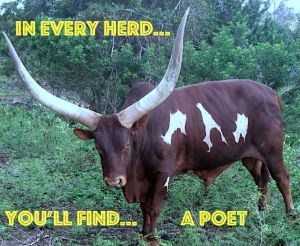
In every herd there is some restive steer
Who leaps the cows and heads each hot stampede,
Till the old bulls unite in jealous fear
To hunt him from the pastures where they feed.

Lost in the night he hears the jungles crash
And desperately, lest his courage fail,
Across his hollow flanks with sounding lash
Scourges the heavy whipcord of his tail.

Far from the phalanxes of horns that ward
The sleeping herds he keeps the wolf at bay,
At nightfall by the slinking leopard spoored,
And goaded by the fly-swarm through the day.

You can read more of Campbell’s poetry here.

The Artistry of Nature

flamingoes
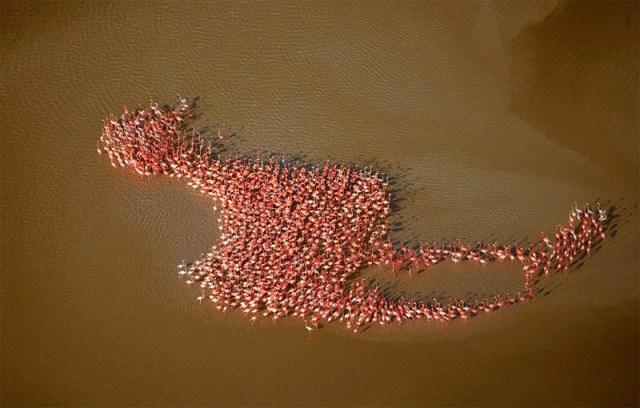
This picture of flamingos is delightful. That they “randomly” arranged themselves into a silhouette of themselves is amazing. Or, perhaps a divine hand painted this glorious portrait?

“What a fanciful thought,” poets muse.

“How absurd!” atheists groan.

“Is he serious?” realists wonder.

“Now that’s something to ponder…” people of faith think.

“Of course God has fashioned nature’s beauties with his hands,” the eremite smiles.

I happen to believe God was speaking literally when he said through the Psalmist:

For every beast of the forest is mine, the cattle on a thousand hills. I know all the birds of the hills, and all that moves in the field is mine (Psalm 50).

It was on the fifth day of creation that the Lord spoke into existence for the first time “every winged bird according to its kind.”

And God blessed them, saying, “Be fruitful and multiply and fill the waters in the seas, and let birds multiply on the earth” (Genesis 1:22).

And, to reveal God’s concern for the creatures he has made did not end with their genesis, allow me one more biblical citation . . . a familiar one. In reminding us of how precious we are to our Father, Jesus describes that God’s concern extends even to the least of his creation.

Are not two sparrows sold for a penny? And not one of them will fall to the ground apart from your Father (Matthew 10:29).

C.S. Lewis touches on the preciousness of creation in a 1956 letter to one of his regular correspondents.

I think God wants us to love Him more, not to love creatures (even animals) less. We love everything in one way too much (i.e. at the expense of our love for Him) but in another way we love everything too little. No person, animal, flower, or even pebble, has ever been loved too much—i.e. more than every one of God’s works deserves (Letters to an American Lady).

Now, does God’s concern for his creatures, in this case flamingoes, mean that he takes the time to direct their flight, their nesting, and the shape of their earthly “congregations?” Of course not. But even in saying that, it is wise to note that if he chose to do so, he could. And there are, of course, some scriptural examples of his using animals in specific ways.

It’s possible, and even likely, that this was a mere coincidence. Like the clouds whose shapes sometimes mirror actual things, even in minute detail. While there are rather odd people who believe cloud shapes can foretell the future, I don’t believe there are any Christians who would base their decisions upon the physical arrangements of a flock, colony, gaggle, or flamboyance (with is fancy name for a group of flamingos).

That said, I still believe that the divine Artist is not above occasionally enjoying some playfulness with the tapestry he has fashioned here on earth, and in the heavens.

Lewis & Flamingos

On 12 July 1956, C.S. Lewis attended a garden party at Buckingham Palace hosted by Queen Elizabeth II. Below you will find excerpts from two letters mentioning the subject. They were written to Ruth Pitter (1897-1992), a well-regarded poet with whom Lewis enjoyed a strong friendship.

Lewis wondered if she might be attending the same event, and suggested they might accompany one another, if so. Less than a week later, following the event, he shares with her his delightful observations of the teeming gathering.

Dear Ruth

Do you play croquet with the Queen on Thursday? (Croquet is not mentioned in the invitation but I am well-read enough to know that a royal garden party will involve hedgehogs, flamingos, soldiers, Heads-man, and the grin of a Cheshire cat). If so are you coming via Oxford? I was thinking of going up by 1.58 and returning by the 6.45 or 7.35 on either of which we could dine. You are an experienced courtier and it would give me great moral support to arrive in your company!

Apparently Pitter was not in attendance at this particular outing, also she had been the first woman to receive the Queen’s Gold Medal for Poetry the previous year. Two decades later the Queen would appoint her a Commander of the Order of the British Empire (CBE) for her contributions to English literature. Two days after the extravaganza, Lewis wrote again.

Dear Ruth

You were well out of it. I learn from the papers that I was one of 8000 guests and also that the Queen was present, a fact of which I had no evidence from my own experience. One could not even get a cup of tea for the crowd round the refreshment tables was reminiscent of Liverpool Street station on an August bank holiday. Most people didn’t know one another. One saw many married couples pathetically keeping up between themselves a dialogue which was obviously wearing very thin. If I hadn’t run across Archbishop Matthew I’d have been in a vast solitude.

There are flamingoes: metal silhouettes of them round the lake—a tasteful device which we perhaps owe to Prince Albert. In a word, it was simply ghastly. Two pints at the little pub on Praed St. were necessary afterwards.

A Postscript on Pitter

Ruth Pitter was a talented poet, but because she was a traditionalist—something quite agreeable to Lewis—she has not been accorded the respect she merits. One scholar who published her letters in 2014 writes:

Pitter, in contrast to T.S. Eliot, Ezra Pound, and W.H. Auden, is a traditional poet in the line of George Herbert, Thomas Treharne, Thomas Hardy, A.E. Housman, W.B. Yeats, and Philip Larkin. Unlike the modernists, she rarely experiments with meter or verse form, nor does she explore modernist themes or offer critiques of modern English society.

Instead, she works with familiar meters and verse forms, and her reluctance to alter her voice to follow in the modernist line explains in part why critics have overlooked her poetry. She is not trendy, avant-garde, nor, thankfully, impenetrable.

As mentioned above, their friendship was deep. Lewis’ friend George Sayer says Lewis once volunteered that if he had not been a confirmed bachelor, Pitter was just the sort of woman to whom he could be happily married.

They influenced one another professionally, sharing poetic advice and critique. Pitter also attributed her spiritual reawakening, her conversion to Christianity, to Lewis’ influence. In 1948 she wrote to a friend:

Did I tell you I’d taken to Christianity? Yes, I went & got confirmed a year ago or more. I was driven to it by the pull of C. S. Lewis and the push of misery. Straight prayer book Anglican, nothing fancy . . . I realize what a tremendous thing it is to take on, but I can’t imagine turning back. It cancels a great many of one’s miseries at once, of course: but it brings great liabilities, too.

In 1985 she wrote to a correspondent about the same subject.

As to my faith, I owe it to C. S. Lewis. For much of my life I lived more or less as a Bohemian, but when the second war broke out, Lewis broadcast several times, and also published some little books (notably The Screwtape Letters), and I was fairly hooked. I came to know him personally, and he came here several times. Lewis’s stories, so very entertaining but always about the war between good and evil, became a permanent part of my mental and spiritual equipment.

Since we have been introduced to this unique woman now, it’s fitting to close with one of her poems. A poem inspired by another of the avian wonders created by our artistic God.

stormcock

Stormcock in Elder

In my dark hermitage, aloof

From the world’s sight and the world’s sound,

By the small door where the old roof

Hangs but five feet above the ground,

I groped along the shelf for bread

But found celestial food instead:

For suddenly close at my ear,

Loud, loud and wild, with wintry glee,

The old unfailing chorister

Burst out in pride of poetry;

And through the broken roof I spied

Him by his singing glorified.

Scarcely an arm’s-length from the eye,

Myself unseen, I saw him there;

The throbbing throat that made the cry,

The breast dewed from the misty air,

The polished bill that opened wide

And showed the pointed tongue inside;

The large eye, ringed with many a ray

Of minion feathers, finely laid,

The feet that grasped the elder-spray;

How strongly used, how subtly made

The scale, the sinew, and the claw,

Plain through the broken roof I saw;

The flight-feathers in tail and wing,

The shorter coverts, and the white

Merged into russet, marrying

The bright breast to the pinions bright,

Gold sequins, spots of chestnut, shower

Of silver, like a brindled flower.

Soldier of fortune, northwest Jack,

Old hard-times’ braggart, there you blow

But tell me ere your bagpipes crack

How you can make so brave a show,

Full-fed in February, and dressed

Like a rich merchant at a feast.

One-half the world, or so they say,

Knows not how half the world may live;

So sing your song and go your way,

And still in February contrive

As bright as Gabriel to smile

On elder-spray by broken tile.

_____

The Bible verses quotes above are taken from the ESV, the English Standard Version.

The “stormcock” in whose humble honor Pitter dedicates this poem is also called the Mistle Thrush. Its informal nickname arises from its eagerness to sing its songs in every sort of weather.

One Weakness of Modern Books

mayanC.S. Lewis offered one of his keen insights into literature when he wrote: “The more ‘up to date’ the book is, the sooner it will be dated.” (Letters to Malcolm)

The racks of clearance titles at bookstores provide ample evidence of that truth. It’s particularly evident with nonfiction works dealing with technology. Their shelf life can be counted in months (if they are fortunate).

But the short lifespan of modern writing is not restricted to science-driven topics. It also relates to the literary “fads” that come and go like mists dispelled by the afternoon sun.

There appears to be a direct correlation between touting the modernity or timeliness of a book and it imminent obsolescence. Many readers of Mere Inkling vividly recall the deluge of books warning about the dangers posed by Y2K. The new millennium was guaranteed—in the eyes of publishers milking the rare event—to bring momentous change, perhaps including catastrophic disasters.

When that crisis failed to materialize, there was a slightly less voluminous—but equally ominous—discussion of the threat of Armageddon heralded by the end of the Mayan calendar in 2012. It was newsworthy enough that NASA posted this message the day after “doomsday.”

News flash: the world didn’t end on Dec. 21, 2012. You’ve probably already figured that out for yourself. Despite reports of an ancient Maya prophecy, a mysterious planet on a collision course with Earth, or a reverse in Earth’s rotation, we’re still here.

The Mayan connection “was a misconception from the very beginning,” says Dr. John Carlson, director of the Center for Archaeoastronomy. “The Maya calendar did not end on Dec. 21, 2012, and there were no Maya prophecies foretelling the end of the world on that date.”*

It is unfair, though, to single out time sensitive publications as doomed to pass quickly into the recycling bin. After all, it wasn’t technological or calendar-focused texts Lewis was referring to.

What Lewis was critiquing is books that consciously attempt to catch the latest wave of popularity . . . without recognizing that only a small fraction of such movements are of lasting value.

He despised books that lacked substance and were utterly transient in their “value.”

Lewis knew from personal experience about the varying quality and potential lifespan of books. The following passage from his autobiography describes vividly how in his childhood he was exposed to books of all sorts, even though some had been purchased only because of his parents’ “transient” interests.

I am a product of long corridors, empty sunlit rooms, upstairs indoor silences, attics explored in solitude, distant noises of gurgling cisterns and pipes, and the noise of wind under the tiles.

Also, of endless books. My father bought all the books he read and never got rid of any of them. There were books in the study, books in the drawing room, books in the cloakroom, books (two deep) in the great bookcase on the landing, books in a bedroom, books piled as high as my shoulder in the cistern attic, books of all kinds reflecting every transient stage of my parents’ interest, books readable and unreadable, books suitable for a child and books most emphatically not.

Nothing was forbidden me. In the seemingly endless rainy afternoons I took volume after volume from the shelves. I had always the same certainty of finding a book that was new to me as a man who walks into a field has of finding a new blade of grass. (Surprised by Joy)

Lewis believed that any good book was worth rereading. As a relatively young man he wrote in 1916, “You really lose a lot by never reading books again.” Sixteen years later he would write to Arthur Greeves once again and say, “I can’t imagine a man really enjoying a book and reading it only once.” And, without belaboring the subject, in 1933 he would once again voice this conviction to his lifelong friend. “Clearly one must read every good book at least once every ten years.”

The “good books,” of course, were those that had proven themselves over the passage of time. They were polar opposites to the shallow, insipid writing Lewis derided.

In An Experiment in Criticism, Lewis elaborates on this notion. He argues that no truly worthwhile text can be fully digested in a single reading.

The sure mark of an unliterary man is that he considers “I’ve read it already” to be a conclusive argument against reading a work. . . . Those who read great works, on the other hand, will read the same work ten, twenty or thirty times during the course of their life.

It is honest to acknowledge that a book only recently published is not inherently of lesser value than something that has remained of sufficient value to have been preserved over the centuries. After all, every book was at one time new.

Lewis offers a persuasive rationale for his position reading outside one’s own historical context is beneficial.

Every age has its own outlook. It is specially good at seeing certain truths and specially liable to make certain mistakes. We all, therefore, need the books that will correct the characteristic mistakes of our own period. And that means the old books. (“On the Reading of Old Books”)

It should be noted that Lewis did offer an exception to his rule about revisiting texts. He regarded it as feasible that a volume of facts or “information” could be processed in one reading.

No book is really worth reading at the age of ten which is not equally (and often far more) worth reading at the age of fifty—except, of course, books of information. The only imaginative works we ought to grow out of are those which it would have been better not to have read at all. (“On Stories”)

Lewis could exclude “books of information” from requiring rereading due to his prodigious memory which made that unnecessary. Lesser minds, such as that of the writer of this column, often benefit from returning to even these books.

Lewis, however, was absolutely convinced that the classics (using the term in a broad sense) were vital to developing the mind. He even proposed a specific ratio for one’s literary consumption.

It is a good rule, after reading a new book, never to allow yourself another new one till you have read an old one in between. If that is too much for you, you should at least read one old one to every three new ones. (“On the Reading of Old Books”)

One reason for alternating one’s reading is to ensure we don’t ingest too much mental “junk food.” After all, as Lewis writes in “Learning in War-Time,”

You are not, in fact, going to read nothing . . . if you don’t read good books you will read bad ones. If you don’t go on thinking rationally, you will think irrationally.

The Classics as Curricula

Recent years have witnessed a revival of interest in reading what Lewis called “old books,” as the essential foundation for an excellent education. He would certainly have applauded this movement.

Numerous American colleges and universities offer Great Books programs. The Association for Core Texts and Courses tracks them here.

One Roman Catholic university describes theirs in this way:

Our students immerse themselves in the Great Books (the Western Canon), the Good Book (the Bible), and God’s “First Book” (nature)—all of which we consider necessary for a true liberal education. Our humanities curriculum starts our freshmen off in Homeric Greece and brings our seniors through modernity and postmodernity. In a time of cultural amnesia, this deep study in the sweep of Western literature, history, politics, and philosophy cultivates the intellect and the heart.**

The Great Books Foundation is an organization established to provide resources for younger students. It’s never too early, supporters believe, to undertake this approach to grounding one’s education.

The C.S. Lewis Society, which operates the Study Center at the Kilns where Lewis resided, has been attempting to fund C.S. Lewis College in the States. They have a grand dream, inspired by the worldview of their namesake. “C.S. Lewis College will be a college of the Great Books and the Visual and Performing Arts.”

God-willing, in the future, more and more enlightened readers, taught from their youth to value quality literature, will echo Lewis’ words, saying, I too “am a product . . . of endless books.”

_____

* The full article is here and offers an interesting insight in to Mayan religion. According to Carlson,

“If we could time warp a Maya to the present day, they would say that Dec. 21, 2012, is a very important date. Many Maya believed that their gods who created the world 5125 years ago would return. One of them in particular, an enigmatic deity named Bolon Yokte’ K’uh, would conduct old rites of passage, to set space and time in order, and to regenerate the cosmos.” The world would be refreshed, not destroyed.

** “Mother Church or Uncle Sam” by Kevin Roberts (unfortunately not available in full online).


Tolkien, Lewis & Barth on Myth

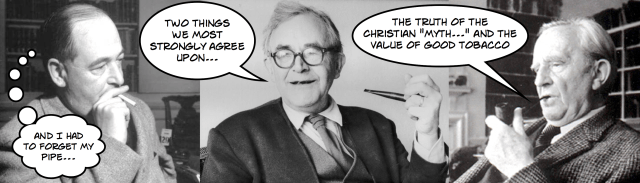
barthOne wonders what sort of fireworks might have erupted if J.R.R. Tolkien and C.S. Lewis had spent an evening with theologian Karl Barth. Although their lives overlapped, and all three were Christian academics, it is questionable how much they would have agreed upon.

And yet, there were several subjects where I think they would have enjoyed firm consensus.

Tolkien (1892-1973) was a devout Roman Catholic. Lewis (1898-1963) was a committed “low church” Anglican. Barth (1886-1968) was a Reformed theologian who rejected the liberalism that had become dominant in European academies. All three thus believed in the reality of the Christian gospel of salvation through Jesus Christ.

All three men hated war, and the two Brits had served in the trenches of WWI. All opposed Nazism and Barth was the primary author of the Barmen Declaration which challenged the Christian faith of all who supported the Nazi government.

And we’ll consider another shared attribute in just a moment.

First, though, we need to acknowledge that presumably the Inklings never met the Swiss clergyman. Their circles did not overlap. I have not been able to uncover any evidence of Tolkien referring to Barth, or of Barth mentioning either of the Inklings.

Lewis did, however mention Barth in his prolific correspondence. From his exposure to Barth it’s clear he did not share the opinion of Pope Pius XII that he was “the greatest theologian since Thomas Aquinas.” Heady praise . . . especially coming from a Roman Catholic.

In a 1940 letter to his brother Warren, Lewis reacted against what he perceived as legalism in some quarters of Protestantism that was alien to his understanding of the liberty of the Christian.

I am afraid the truth is . . . that the world, as it is now becoming and has partly become, is simply too much for people of the old square-rigged type like you and me. I don’t understand its economics, or its politics, or . . . Even its theology—for that is a most distressing discovery I have been making these last two terms as I have been getting to know more and more of the Christian element in Oxford.

Did you fondly believe—as I did—that where you got among Christians, there, at least, you would escape (as behind a wall from a keen wind) from the horrible ferocity and grimness of modern thought.

Not a bit of it. I blundered into it all, imagining that I was the upholder of the old, stern doctrines against modern quasi-Christian slush: only to find that my ‘sternness’ was their ‘slush.’ They’ve all been reading a dreadful man called Karl Barth, who seems the right opposite number to Karl Marx. ‘Under judgment’ is their great expression.

They all talk like Covenanters or Old Testament prophets. They don’t think human reason or human conscience of any value at all: they maintain, as stoutly as Calvin, that there’s no reason why God’s dealings should appear just (let alone, merciful) to us: and they maintain the doctrine that all our righteousness is filthy rags with a fierceness and sincerity which is like a blow in the face.

Sometimes the results are refreshing: as when Canon Raven (whom you and Dyson and I sat under at Ely) is sharply told in a review in Theology that ‘it is high time persons of this sort learned that the enjoyment of a chair of theology at Cambridge does not carry with it a right to criticise the Word of God’—that’s the kind of rap on the knuckles which has not been delivered for a hundred years!

Comparing Their Thoughts on the Nature of Myth

Many readers of Mere Inkling will know Tolkien and Lewis were deeply influenced by the significance of myth. They were also, in the creation of Middle Earth and Narnia, active in the act of mythopoeia, creating imaginary lands whose stories convey profound meaning.

But, despite the fact their literary products are fictional, that does not mean that all myth is “untrue,” in the sense of being unhistorical. Myth, for these great thinkers, is something far more complex and wonderful.

Without going into depth on this involved subject, I offer here the familiar story of how Lewis’ epiphany about true myth was key to his conversion.

I was by now too experienced in literary criticism to regard the Gospels as myths. They had not the mythical taste. And yet the very matter which they set down in their artless, historical fashion . . . was precisely the matter of the great myths. If ever a myth had become fact, had been incarnated, it would be just like this. And nothing else in all literature was just like this.

Myths were like it in one way. Histories were like it in another. But nothing was simply like it.

And no person was like the Person it depicted; as real, as recognizable, through all that depth of time, as Plato’s Socrates . . . yet also numinous, lit by a light from beyond the world, a god.

But if a god—we are no longer polytheists—then not a god, but God. Here and here only in all time the myth must have become fact; the Word, flesh; God, Man. This is not “a religion,” nor “a philosophy.” It is the summing up and actuality of them all. (Surprised by Joy)

This epiphany took place in 1931, during an all-night discussion (it lasted until 4:00 am) with Tolkien, and other Inkling, Hugo Dyson. Here’s how Lewis related the moment to his lifelong friend, Arthur Greeves.

It was really a memorable talk. We began (in Addison’s walk just after dinner) on metaphor and myth–interrupted by a rush of wind which came so suddenly on the still, warm evening and sent so many leaves pattering down that we thought it was raining.

We all held our breath, the other two appreciating the ecstasy of such a thing almost as you would. We continued (in my room) on Christianity: a good long satisfying talk in which I learned a lot . . .

A month later he elaborated on how the insights gained that evening were gestating in his mind and heart.

Now what Dyson and Tolkien showed me was this: that if I met the idea of sacrifice in a Pagan story I didn’t mind it at all: again, that if I met the idea of a god sacrificing himself to himself (cf. the quotation opposite the title page of Dymer) I liked it very much and was mysteriously moved by it: again, that the idea of the dying and reviving god (Balder, Adonis, Bacchus) similarly moved me provided I met it anywhere except in the Gospels.

The reason was that in Pagan stories I was prepared to feel the myth as profound and suggestive of meanings beyond my grasp even tho’ I could not say in cold prose ‘what it meant.’

Now the story of Christ is simply a true myth: a myth working on us in the same way as the others, but with this tremendous difference that it really happened: and one must be content to accept it in the same way, remembering that it is God’s myth where the others are men’s myths: i.e. the Pagan stories are God expressing Himself through the minds of poets, using such images as He found there, while Christianity is God expressing Himself through what we call ‘real things.’

Therefore it is true, not in the sense of being a ‘description’ of God (that no finite mind could take in) but in the sense of being the way in which God chooses to (or can) appear to our faculties. The ‘doctrines’ we get out of the true myth are of course less true: they are translations into our concepts and ideas of that which God has already expressed in a language more adequate, namely the actual incarnation, crucifixion, and resurrection.

Does this amount to a belief in Christianity? At any rate I am now certain (a) That this Christian story is to be approached, in a sense, as I approach the other myths. (b) That it is the most important and full of meaning. I am also nearly certain that it really happened.

In a different setting, Barth argued for the very same truth. His context was a theological environment greatly influenced by the liberal doctrines of Rudolf Bultmann, who dismissively regarded anything miraculous in the Scriptures as primitive and ignorant thinking.

The Christian Church confesses that [what the world calls] “myth” is history itself. She recognizes herself by this myth, she recognizes her life, her true reality. She is the witness of witnesses, she recognizes through the Holy Spirit that this is the one really interesting story.

Then she turns back the historians’ weapon: She says to them: What you call “myth,” that is history! She will also add: What you call history, that is a myth! A myth, a made-up history, that fancies the fate of man as depending on his earthly vicissitudes, a myth, a made-up history, that confuses the immediate success of a cause with its truth, and so on.

The only true history is the history of Christ, in which the Church participates, and which is already the secret reality of all history, since it is history itself. (The Faith of the Church)

Now, there’s an argument the Inklings could truly have appreciated.

A Bonus, for Fans of Dietrich Bonhoeffer

Barth was not the only Christian seminary professor who rejected the heresies of Bultmann, who sought to “demythologize” the Scriptures. Dietrich Bonhoeffer, a fellow German, repudiated Bultmann’s rejection of the supernatural in God’s Word. In a recent book, Taking Hold of the Real, Barry Harvey writes:

In a prison letter [Bonhoeffer] criticizes Rudolf Bultmann for excising the “mythological” elements in an attempt to reduce Christianity to its “essence.” “My view,” he writes, “is that the full content, including the ‘mythological’ concepts, must remain—the New Testament is not a mythological dressing up of a universal truth, but this mythology (resurrection and so forth) is the thing itself.”

Bonhoeffer thus acknowledges that describing a way of seeing the world as mythic thus does not summarily dismiss it either as deceptive or as an archaic and feeble attempt at doing “science.” Indeed, a truthful description of the world and especially of human existence ultimately requires mythic form.

The tales that women and men have fashioned and passed down through the centuries to discern the overall sense and significance of their existence are “never just ‘lies,’” says Tolkien, as “there is always something of the truth in them.”