C.S. Lewis and Typos

typos

Who among us has lived a life free of typographical errors? When we learned to type (or “keyboard”), our typing speed was influenced by the number of incorrect characters we included.

Even worse, some infernal source birthed the idea of “autocorrect,” which is occasionally useful for documents, but just as frequently deadly for emails and texts.

Lewis’ own books have included a number of typographical errors. Arend Smilde, a Dutch scholar and translator, has noted a fair number of them on his valuable website.

The truth is, it is possible for errors to creep in whenever original manuscripts are copied.

Even with the Scriptures, existing manuscripts include various minor variations, since the autographs have been lost to history.

This fact necessitates the need for “textual criticism,” and many earnest biblical scholars have devoted their lives to discerning the original text. (“Criticism” in this use, does not connote negativity. It simply refers to study, such as with “literary criticism.”)

Textual criticism diverges significantly from the so-called “higher criticisms” which frequently result in confusion and doubt.* Comparing actual texts is fundamental to the study of all literary creations.

C.S. Lewis wrote a brilliant essay entitled “Modern Theology and Biblical Criticism,” which is currently known as “Fern-Seed and Elephants.” In it, he distinguishes between the various types of criticism and affirms textual examination as utterly valid.

We think that different elements in this sort of theology have different degrees of strength. The nearer it sticks to mere textual criticism . . . the more we are disposed to believe in it. And of course, we agree that passages almost verbally identical cannot be independent. It is as we glide away from this into reconstructions of a subtler and more ambitious kind that our faith in the method waivers; and our faith in Christianity is proportionally corroborated.

The sort of statement that arouses our deepest scepticism is the statement that something in a Gospel cannot be historical because it shows a theology or an ecclesiology too developed for so early a date. For this implies that we know, first of all, that there was any development in the matter, and secondly, how quickly it proceeded.

When books are published, errors slink in. This generates errata, which are presumably corrected in any subsequent editions of the work. (It dawns on me that I’ve never seen an erratum, noting there is only one mistake in the work.)

The Genesis of Today’s Thoughts

Curiously, the article that led me to think about textual errors involves the substitution of an i for an e. The result is that for centuries, people mistakenly believed that Rome had a “Little Temple of Ridicule.” The notion was that the ancient Romans so loved humor, that they “went so far as to erect a ridiculi aedicula, or chapel of laughter.” This curious article is well worth reading (hint: it has something to do with Hannibal’s retreat).

It’s not that the idea of humor shouldn’t be celebrated. On the contrary, laughter features broadly in C.S. Lewis’ works. In a letter written shortly after his marriage to Joy, he alludes to Dante’s portrait of heaven. It is an image Lewis affirmed, and one that I happily anticipate.

Of course Heaven is leisure (“there remaineth a rest for the people of God”): but I picture it pretty vigorous too as our best leisure really is. Man was created “to glorify God and enjoy Him forever.”

Whether that is best pictured as being in love, or like being one of an orchestra who are playing a great work with perfect success, or like surf bathing, or like endlessly exploring a wonderful country or endlessly reading a glorious story—who knows? Dante says Heaven “grew drunken with its universal laughter.”


* For an informative discussion of the different forms of criticism, see this conversation. In response to the question “How is it, then, that the Higher Criticism has become identified in the popular mind with attacks upon the Bible and the supernatural character of the Holy Scriptures?” the author writes:

Some of the most powerful exponents of the modern Higher Critical theories have been Germans, and it is notorious to what length the German fancy can go in the direction of the subjective and of the conjectural. For hypothesis-weaving and speculation, the German theological professor is unsurpassed.

Some of the men who have been most distinguished as the leaders of the Higher Critical movement in Germany and Holland have been men who have no faith in the God of the Bible, and no faith in either the necessity or the possibility of a personal supernatural revelation.

C.S. Lewis’ Nemesis: F.R. Leavis

leavis.png

When C.S. Lewis died, one of his Cambridge colleagues uttered a shocking statement—to his Cambridge students.

“C.S. Lewis is dead,” announced F.R. Leavis to his English literature students at Cambridge University a few days later, while the world mourned for Kennedy (the President was assassinated the same day).

American novelist and essayist D. Keith Mano, then studying at Cambridge, remembers Leavis continuing his brief commentary on Lewis’ passing as follows: “They said in the Times that we will miss him. We will not. We will not.

Who knew the world of literary criticism could be so ill-mannered?

In my readings about C.S. Lewis and his life I’ve noted references to a fellow English professor at Cambridge who waged a lengthy academic argument with Lewis over the heart of English education.

The challenger to Lewis’ history-oriented approach advocated a critical position, which diluted concern for the intentions of the original writers. I’m not a lit major, so I’ll leave the description at that.*

F.R. Leavis, a dynamic influence at Cambridge, dreaded the arrival of Lewis when he moved from Oxford to a distinguished chair tailor-made for him. The two scholars shared several traits which might have disposed them to friendship.

Both were veterans of the Great War.** One difference between the veterans is curious. Leavis declined to join the Officers’ Training Corps while a student, and chose ambulance service when conscription began. Lewis, on the other hand, voluntarily joined the OTC, even though he (as an Irishman) was exempt from the conscription.***

Another similarity between the two was that they inspired many students. Far from the caricature of droning academicians, Lewis and Leavis drew fans and even disciples from the student body. (In a recent post I mentioned the affectionate nickname some of the former’s students had for him: Papa Lewis.)

The Problem

Most writers believe this second “similarity” factored into the strained relationship between the two. Both had strong personalities, and bold convictions. They did not, however, share a common temperament. Lewis was normally respectful of his philosophical adversaries. Leavis, not so much. The following comes from “C.S. Lewis and the Art of Disagreement.”

The fact that Lewis could approve of atheists [and] liberals . . . reinforces Brewer’s point that Lewis would not allow disagreement to become personal. He could always distinguish the man from the man’s opinion, and he knew the difference between an argument and a quarrel. He would not allow himself to be betrayed into aggression, but would, where necessary, draw rein on a dispute with a wry smile and an agreement to disagree.

His public written controversy on literature with E.M.W. Tillyard (later published as The Personal Heresy) was conducted with pugnacity but without personal animus. And though Lewis laid into the arguments of another colleague, F.R. Leavis, with great forcefulness in the pages of An Experiment in Criticism, he never named Leavis within those pages, but covered his opponent in a thoughtfully woven cloak of pseudonymity.

Contrast that to Leavis’ comment with which we began, in which he “celebrates” Lewis’ passing.

Lewis was quite aware of Leavis’ animosity. In a 1961 letter to the publisher of The Screwtape Letters and Screwtape Proposes a Toast, the author strikes the Cambridge Review from the publications scheduled to receive review copies.

I’ve not additions to make, but one subtraction. Delete Cambridge Review. It’s mainly in the hands of Leavisites who will blackguard any book of mine, and I don’t know why we should let them have a free copy for their sport!

Lewis scholar Brenton Dickieson wrote a column about George Watson’s critique of Lewis. Watson met Lewis at Oxford and later joined him on the faculty at Cambridge.

Here are George Watson’s first evaluative words of Lewis: “Like F.R. Leavis, he was an offensive critic.” Awesome. I think it is an evaluation that would have made Lewis chuckle, particularly in his positive comparison with Leavis, the closest thing Lewis ever got to having a Sherlockian arch-nemesis.

However, Watson (note the name) is careful to remind us that Lewis “reveled in diversity as much as Leavis detested it.” That diversity in Lewis is one of the features that (I believe) most draws and repels readers today.

In the aforementioned article, “Lewis and Cambridge,” Barbour candidly describes the disparity between the spirit of the two nemeses.

“[Lewis’] controversies were always impersonal and often ended with the participants finding a good deal of common ground, whereas Leavis’s controversies . . . tended to end in anathematizing and deeply personal wounding.”

Leavis’ reputation for engendering conflict was so pronounced The Guardian actually included the following in his obituary:

Perhaps the most telling counter-assault on him was by C.S. Lewis, who said that the use of subliminal code words like “maturity” and “relevance” smuggled in an entire value system that was never made explicit for scrutiny. Others accused him of being a crypto-Marxist.

Leavis never replied, which was a pity, but then his weapons during his long career of humiliations in the Cambridge English faculty also included silence, internal exile and cunning.

His most murderous and underestimated weapon was ridicule, which he deployed in lectures with the virtuosity of a music-hall star and with an insensitivity verging on paranoia.

The Essence of Their Differences

Exploding English: Criticism, Theory, Culture includes a chapter entitled “Leavis, Lewis, and Other Oppositions.” It’s précis suggests one reason Lewis’ criticisms have possessed a longer lifespan than those of Leavis.

Lewis and Leavis . . . were the dominant figures in literary study in the middle decades of the twentieth century. . . . it is Lewis’s arguments and assumptions that seem to be the more challenging and which have something to contribute to contemporary debates.

This assessment echoes Lewis’ own view that the Leavis tsunami may have crested. Just a month before his death, he wrote to Basil Willey about his retirement. Willey would retire from his own chair two years later.

My dear Basil . . . I have an idea that Cambridge ten years’ hence might suit us both [better] than the Cambridge we have known. . . .

I hope your success will follow you . . . [if not], then our English school, with its neglect of language, becomes purely a school of literary criticism. And criticism, thus isolated, seems to me a positively mischievous instrument of education.

In “C.S. Lewis, Literary Critic: A Reassessment,” which appeared in Mythlore, William Calin describes Lewis’ passionate defense of English authors whose reputations were in jeopardy.

A Preface to Paradise Lost does for Milton what The Allegory of Love did for Spenser, and Lewis does for epic what he had previously done for allegory and fin’ amor [courtly love]. . . . In sum, Lewis defends his authors language from the strictures of Eliot and Leavis; he defends his worldview and its artistic embodiment from the prejudice of 1930s agnostic university faculty in English. . . .

When he tells students “Don’t read criticism” [Lewis] alludes again to Leavis and his disciples, who fetishized the term “critic.” Lewis would have called himself a scholar or an historian.

The following passage from A Preface to Paradise Lost is telling. Leavis is the unnamed standard bearer for the worldview he rejects. It reveals Lewis’ keen discernment in understanding of his unbridgeable difference with Leavis.

It is not that [Leavis] and I see different things when we look at Paradise Lost. He sees and hates the very same that I see and love. Hence the disagreement between us tends to escape from the realm of literary criticism.

We differ not about the nature of Milton’s poetry, but about the nature of man, or even the nature of joy itself.

The Apostle Paul described this difference in his correspondence with the Corinthians.

Now we have received not the spirit of the world, but the Spirit who is from God, that we might understand the things freely given us by God. . . .

The natural person does not accept the things of the Spirit of God, for they are folly to him, and he is not able to understand them because they are spiritually discerned. . . . But we have the mind of Christ.

In an excellent article entitle “Three Great Critics: F.R. Leavis, T.S. Eliot, and C.S. Lewis,” Michael Aeschliman**** closes with a gospel-oriented thought.

It is pleasing to conclude by imagining C.S. Lewis, T.S. Eliot, and F.R. Leavis now conversing together amicably, recollecting emotion in tranquility, in another and better and more luminous realm, toward which all three of them were fervent pilgrims throughout their embattled but noble lives.


* There are ample online sources available to describe the contrast in detail. For example, Brian Barbour’s Modern Philology essay, “Lewis and Cambridge,” provides a superb explanation of the struggle in its broader context.

** Lewis served in the trenches, where he was seriously wounded. Leavis was fortunate enough to avoid frontline combat by serving in the Friends Ambulance Unit. This site provides a helpful account of his service on an Ambulance Train which shuttled the wounded to ports.

*** There is no record of which ambulance train carried Lewis homeward after his injury, but wouldn’t it be ironic he and Leavis had unknowingly encountered one another at that time?

**** Aeschliman is the author of The Restitution of Man: C.S. Lewis and the Case Against Scientism.

Recalling Information Like C.S. Lewis

csl forgetica

Do you have trouble remembering what you read? Read on for a solution to your problem.

C.S. Lewis possessed an amazing memory of what he had read. While eidetic memory remains theoretical, many attributed a “photographic memory” to the Oxford don. Owen Barfield, Lewis’ close friend, described this gift.

He had that very pictorial imagination. I know when we used to go on walks, I used to envy him that. . . . He had what I think is called by some people an “eidetic memory,” when your imaginative pictures are almost photographic. (Owen Barfield on C.S. Lewis edited by G.B. Tennyson)

Describing Lewis’ earnest patience with others, however “ignorant or naïve” (Barfield’s opinion) the person, Barfield describes how readily Lewis recalled pertinent facts.

First he would speak as one simple man exchanging experiences with another, and only afterward (if the occasion seemed to call for it and always without the least nuance of didacticism) would he bring to bear, out of his wide reading and phenomenal memory, some pithy utterance—it might be from Aristotle’s Ethics, it might be from an Icelandic saga, it might be from George MacDonald—that contained the very substance of what the two of them had just discovered they had in common.

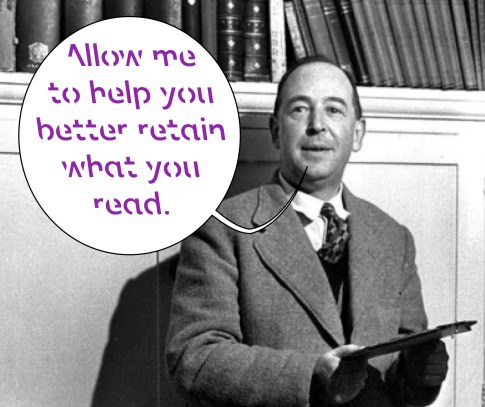
There appears to be hope on the horizon for those of us who are not blessed with Lewis’ talent for recalling what we read. RMIT University (formerly the Royal Melbourne Institute of Technology) has devised a new font that uses a psychological principle called “desirable difficulty” to help readers retain more.

Take a look at Sans Forgetica in its own font. forgetica


The “difficult” part is evident in the lacunae that force one’s mind to fill in the gaps and make sense of each letter and word. The “desirability” comes with the way that our brains are able to decipher with just enough effort to imprint the material more deeply in our minds.

This principle reminded me of something written by Richard Foster, author of Celebration of Discipline. He describes the importance of concentration on our spiritual growth, as we seriously examine and process whatever is worthy of thinking upon. (Philippians 4:8)

I have mentioned the disciplines of service and worship. There are many others. Inward disciplines, like meditation, prayer, fasting, and study, cultivate our heart and mind toward the way of Christ. Meditation is the ability to hear God’s voice and obey his word.

Prayer is ongoing dialogue with the Father about what God and we are doing together. Fasting is the voluntary denial of an otherwise normal function for the sake of intense spiritual activity.

Study is the process through which we bring the mind to conform to the order of whatever we are concentrating upon. (Becoming Like Christ)

On the Elegance of Fonts

Longtime readers of Mere Inkling are well aware of my personal fascination with fonts. This link will reveal posts I’ve tagged with the subject. It reveals that different fonts exist for more than aesthetic reasons.

While some are simply created for decorative or mood-setting purposes—such as typefaces that mimic monastic scripts or the text created for the first Narnia film—others are devised for more practical purposes. The latter collection includes one created to aid those who suffer from dyslexia (Dyslexie). The intentionally useful category will now include Sans Forgetica.

Sans Forgetica is available for free. As evidence of either its merit or the promotional skills of its creators, they have already created an extension for the Chrome browser. It allows users to convert internet text on their screens to the memorable font.

I would suggest that such an application be used sparingly. Most of what we read on the internet is not worth recalling, much less clogging our brains with trivia and worse. Still, if applied selectively, it could be useful. After all, if it only moves us a centimeter in the direction of retaining information like C.S. Lewis, that’s a move in the right direction!


The Ugliest Book

mayan image.png

Every reader knows “not all books are created equal.” This fact has two applications. Most importantly, since books are built from words, the comparison refers to comparing the content or message of different works. In a totally distinct sense, it may distinguish between the differing presentation or physical aspects of the book itself.

Fifty-four years after its discovery, the oldest surviving Mayan text has been officially authenticated. One of the reasons for the delay was that “for a long time, critics of the codex said the style wasn’t Mayan and that it was ‘the ugliest’ of them in terms of figures and color.”

What does that mean? It means that just because the tree bark pages were composed by a less skilled artist . . . in a more primitive age . . . living in a relatively impoverished region . . . with a smaller pallet of colors available . . . its authenticity was questioned.

Not quite what I would consider top flight analysis. Fortunately, Mexico’s National Institute of History and Anthropology has finally righted that wrong. They declared, “The Mayan Codex is authentic and the oldest, legible pre-Hispanic manuscript in the Americas,”

Seriously, the only flaw I can find in the facsimile of the pictograph portrayed above is the attachment of a right hand to a left arm. Then again, if Mark Twain could make the very same mistake roughly eight centuries later, I can forgive the ancient Mayan illustrator.

Illustrative Options

Frankly, the more one learns about the publishing industry, the less responsible we can hold authors for the final look of their works. Rarely do they even get to choose the cover art for their books, although sometimes particularly prominent authors such as J.R.R. Tolkien or C.S. Lewis are granted that privilege. That is how the artwork of Pauline Baynes became intimately associated with the two Oxbridge giants.

The lucky few may even be able to select their own fonts, with many wisely opting for the more trustworthy serif families.

For the common woman or man, we are lucky if our publishers even let us have a veto over the artwork that they commission. The exception to this comes with the nature of the self-publishing industry, where the author possesses sole authority in choosing their cover, illustrations, fonts and format.

Still, those hoping for “traditional” publication should recognize in advance how much control over their book they will forfeit to editors and publishers.

With Paper at a Premium

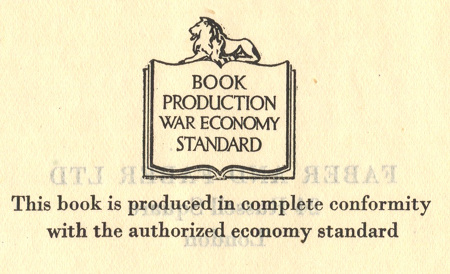
Even with influence in the selection of artwork, some aspects of publishing lie outside the control of writers. A perfect example of this is found in rationing of paper in Britain during the Second World War. The British War Economy Standard meant books visually declined in production quality.

Paper was rationed, beginning in March 1940, when publishers were allowed only 60 percent of what they had used in 1938-39. The proportion fell to 37.5 percent by January 1, 1942, when the Book Production War Economy Agreement took effect.

rationing

The scheme mandated smaller type, less white space, and inferior papers and bindings. It resulted in some remarkably ugly books, but it conserved raw materials. (“Modernity and Print I: Britain 1890-1970” by Jonathan Rose)

A number of Lewis’ books appeared in these wartime editions. They are quite collectible.

Scarce first impression of the true first edition, produced on wartime economy standard paper, and thin boards, published during the Second World War, especially hard to find in its complete original dustwrapper in collectable condition.

Let’s consider an unlikely scenario. In eight centuries, C.S. Lewis’ writings have been forgotten. Then, one archaeologist stumbles across a rare physical copy of a book, that survived the universal “grand purging” following the transfer of such items to some post-digital, post-electronic format.

What would historians assume about the value placed on Lewis’ work if it was a wartime edition compared to other “regular” books by other authors? They could not be faulted for assuming that the people of our day valued the inferior publication less than the “nicer” editions. (This is assuming that the acid-laden paper of the war years would not simply flake apart in their hands.)

The quality of the paper and print make a strong impression on readers. Just as we often judge books by their cover.

C.S. Lewis, a true bibliophile, illustrates how even a modest book (in terms of content) can be deemed “exquisite.” In a 1935 letter to his friend Arthur Greeves, he humorously describes the impending publication of The Allegory of Love.

I have finished my book which is called The Allegorical Love Poem, and is dedicated to Barfield. The Clarendon Press have accepted it and hope to have it out by May.

As I am to get 12 free copies (Dents only give one 6) you and Tchanie shall each have one and save your silver: and whatever you think of the matter, I hope, from experience of the Clarendon Press, that binding, paper etc will be—in our old formula—excellent, exquisite, and admirable.

In other words, if you can’t read it, you will enjoy looking at it, smelling it, and stroking it. If not a good book, it will be a good pet! It will be about 400 pp, they say. (It will be funny, after this, if they do it in double columns and a paper cover.)

Returning to the Mayan pages with which we began, we sadly are unable to judge them by their original codex in its pristine state. However, the extant pieces possess great historical value, even if scholars took a long time determining the fact . . . and whether or not they would ever consider it to be “a good pet.”


In case you are interested, Mere Inkling has explored Mayan books before, in “One Weakness of Modern Books.”


A Suggestion for Your Personal Library

prayer

I just added a rare C.S. Lewis book to my library for a very reasonable price, and you can too. But you might want to hurry, since this volume will probably never be reprinted.

The small book is entitled Beyond the Bright Blur. It’s contents will be familiar to you if you have read Lewis’ final book, Letters to Malcolm: Chiefly on Prayer. That is because the former is a prepublication printing of chapters fifteen through seventeen from Letters to Malcolm.

It was published under unique circumstances, and it is thought that only 350 copies were printed in 1963 by Harcourt, Brace & World.

The title of Beyond the Bright Blur is taken from what would appear as letter fifteen in the complete volume. The “bright blur” to which Lewis refers is our imperfect, abstract and remote impression of “God.” He argues that to engage in genuine conversation with our Creator, we must dispel this fabrication.

What happens to me if I try to [approach prayer] “simply,” is the juxtaposition of two “representations” or ideas or phantoms. One is the bright blur in the mind which stands for God. The other is the idea I call “me.”

But I can’t leave it at that, because I know—and it’s useless to pretend I don’t know—that they are both phantasmal. The real I has created them both—or, rather, built them up in the vaguest way from all sorts of psychological odds and ends.

Very often, paradoxically, the first step [in genuine prayer] is to banish the “bright blur”—or, in statelier language, to break the idol.

Lewis’ candid sharing about his personal pilgrimage in prayer is just part of the treasure that is Letters to Malcolm. It is must reading. But, its priceless message is not the subject of this post.

Beyond the Bright Blur, this modest yet sturdy (hardback) tome, stands complete as it is. And it was expressly designed for a small audience. As the flyleaf states, “This limited edition is published as a New Year’s greeting to friends of the author and his publisher.”

The complete book would not be published until 1964, after Lewis had joined his wife Joy in the presence of our Lord. It is quite fitting that the final pages describe the author’s thoughts about the nature of heaven. It concludes with his final glorious epiphany that “Joy is the serious business of Heaven.”

Consider Adding this Gem to Your Own Library

I know that most readers of Mere Inkling share my affection for literature . . . along with my own affection for literature incarnated in its own natural state, physical books.

The wonderful thing is that adding this particular treasure to your personal collection is within your reach. While the price varies due to the respective booksellers and the condition of each copy, AbeBooks.com often include copies for less than forty dollars.

Occasionally an inscribed volume appears on the market, with a corresponding surcharge in the price. As I write this, the copy presented to the poet John Ciardi (1916-86) is available for purchase. While he’s most famous for his translation of The Divine Comedy, he also co-authored a collection of limericks with Isaac Asimov!

The posting says the volume includes his signature on the front end paper and “a paragraph [underlined] in the text in red ink.” Still, a truly unique volume such as this is quite a bargain at less than two hundred dollars—especially if you are a fan of Ciardi.

I suspect Ciardi received his copy as a gift from the publisher. I haven’t found any evidence that he and C.S. Lewis were acquainted. I did, however, uncover one utterly trivial connection between the two. It appears the two shared an illustrator for some of their American editions. Roger Hane, the cover illustrator for the 1970 Collier-Macmillan edition of the Chronicles of Narnia, also illustrated Ciardi’s undated The Morality of Poetry.


Books on the Battlefield

war book.png

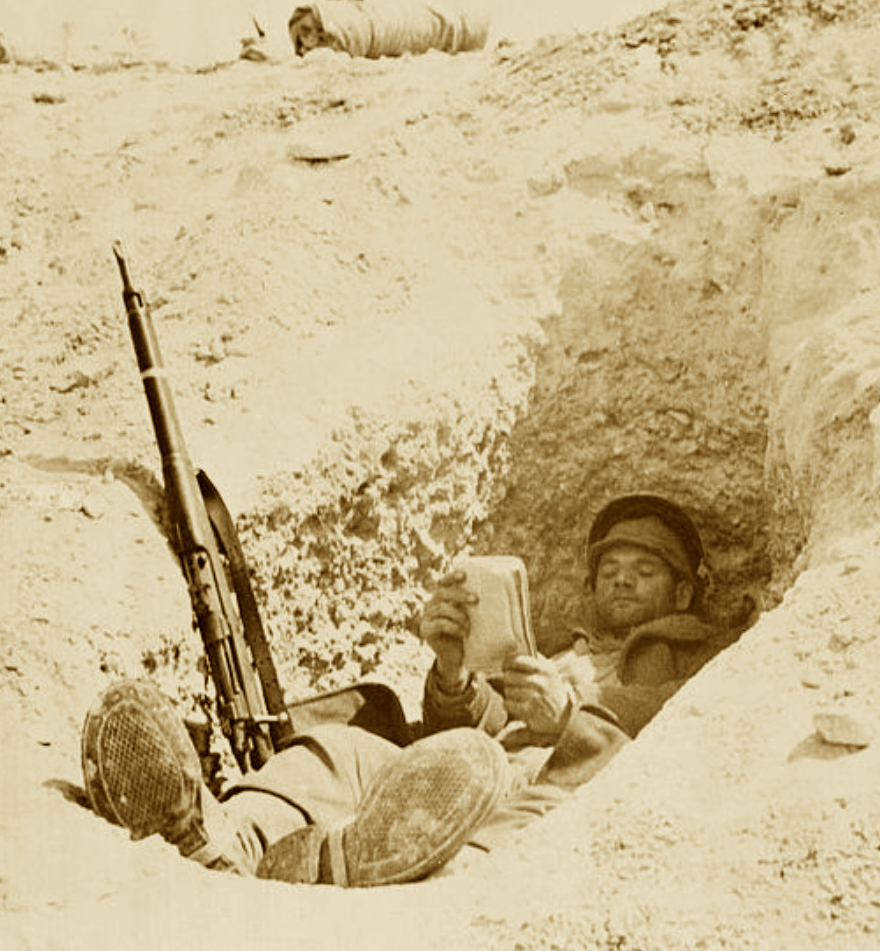
Some would say “only a fool would bring a book to a gunfight.” That might be true if the person carried the book in lieu of a firearm, but the fact is many varieties of literature accompany soldiers to war.

When Edward Bulwer-Lytton wrote “the pen is mightier than the sword,” he offered a powerful insight into how ultimate victory hinges more on knowledge and ideas than on direct violence. Of course, he didn’t mean that in a personal conflict between two combatants a quill could best a saber.

Even those who’ve never been to war realize warriors need to have their bodies, minds and spirits renewed in order to be at their best when their lives hang in the balance. Bodies are taken care of by providing healthy sustenance, swift medical attention, and opportunities to remain fit.

Minds and spirits overlap somewhat, but for the latter, most of the world’s militaries send chaplains to accompany the men and women “in harm’s way.” Spiritual encouragement often comes even more readily from their fellow military members.

Wartime is, surprising no one, an optimal time for people to consider their spiritual wellbeing and contemplate their eternal destiny. Still, that does not make true the adage “there are no atheists in foxholes.”

That said, war zones are places where the fields are literally “white unto harvest” (Luke 4).

It is no accident copies of the Bible have accompanied Christians to war since the first printed copies were available.

During the American Civil War, personal Bibles and religious tracts were widely distributed. It was not uncommon for a soldier to send a particularly meaningful tract home to his family. In addition to chaplains, numerous ministries today work to ensure no service member who desires a Bible is without one.

Reading for the Mind

It would be wrong to think religious works dominate the literature available to military members dispatched to war. Most locations offer access to numerous publications, and even the internet. The Department of Defense even provides access to the nonpartisan Stars and Stripes, which offers some of its headline articles here.

And then there are books. Books of all genres, though perhaps, tilted towards thrillers and sports subjects. Soldiers pass their books around, and for many lucky enough to serve in a garrison type of setting, there is often a library.

Yes, a real library—except that the books are typically all available for free. This is due in large part to the generosity of publishers. During the Second World War, the Council on Books in Wartime, founded by publishers and others, provided over 120 million paperbacks in their Armed Services Editions. (The classic titles sold for an average of six cents.) The Council’s slogan was, “books are weapons in the war of ideas.”

So, military folks read lots of books overseas. In fact, here is a photo of yours truly reading one of my favorite authors (David Drake) while I was on a flight between Pakistan and Afghanistan back in 2002.

I was delighted recently when rereading C.S. Lewis’ autobiography to see that I was following in his footsteps. Lewis is discussing how actual books, and not merely periodicals, can accompany us on our journeys. He refers briefly to his war experiences.

Soon too we gave up the magazines; we made the discovery (some people never make it) that real books can be taken on a journey and that hours of golden reading can so be added to its other delights.

(It is important to acquire early in life the power of reading sense wherever you happen to be. I first read Tamburlaine while traveling from Larne to Belfast in a thunderstorm, and first read Browning’s Paracelsus by a candle which went out and had to be relit whenever a big battery fired in a pit below me, which I think it did every four minutes all that night.) (Surprised by Joy)

I would not equate our two situations. After all, a comfortable C-130 (even when making “combat” landings and take-offs) can hardly be compared to a muddy WWI trench.

But, like nearly all of Mere Inkling’s audience, I do share C.S. Lewis’ joy at knowing books need never be far from our hand. Whether it be on holiday, in the hospital, or even in prison (God forbid), we can always find some pleasure and peace in reading.


Postscript:

During Desert Storm, I helped ship thousands of donated books to troops on the front lines. Unfortunately, there was a problem with the clothing worn by most of the women on the covers. We learned the Saudis were destroying some of the books, deeming them pornography.

As a result, our book processors began tearing the cover off of every book featuring a woman. As a compromise, I offered to become an informal “Saudi censor.” With a large black marker, I was able to suitably cover up elements of the female anatomy that would have presumably offended our Middle East allies.

Despite my misgivings about “defacing” the covers, I felt it was less destructive than removing the entire cover. I’ll leave it to you to be the judge.

Mark Twain’s Editorial Sketches

editor 0

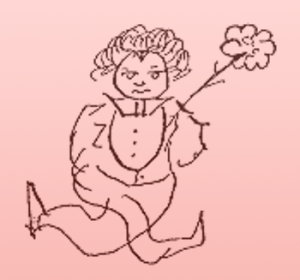
Mark Twain  drew a number of sketches that he (hopefully) never intended for publication. Four of them appear here.

Perhaps Twain drafted them as a starting point for a one-day illustrator. It’s odd to think they were intended to appear in their initial, rough state. However, since “How to Make History Dates Stick” was published posthumously, Harper’s Monthly Magazine decided to capitalize on the use of the author’s own “illustrations.”

Calling the scribblings “illustrations” is quite generous. The manuscript drawings remind one of the quick drawings that C.S. Lewis sometimes included in his correspondence.

In this essay, Twain says the key to learning and remembering key historical dates is associating them with pictures.

These chapters are for children . . . Dates are difficult things to acquire; and after they are acquired it is difficult to keep them in the head. But they are very valuable.

They are like the cattle-pens of a ranch—they shut in the several brands of historical cattle, each within its own fence, and keep them from getting mixed together.

Dates are hard to remember because they consist of figures; figures are monotonously unstriking in appearance, and they don’t take hold, they form no pictures, and so they give the eye no chance to help.

Pictures are the thing. Pictures can make dates stick. They can make nearly anything stick—particularly if you make the pictures yourself. Indeed, that is the great point—make the pictures yourself. I know about this from experience.

Setting aside the merits of Twain’s suggestion, the final encouragement to personally draw the illustrations is intriguing. It suggests that Twain may have honestly desired that these very sketches would be included in the published text. In this scenario, the writer would be setting the illustrative bar so low that no one could doubt their ability to draw at least as well as the author of Tom Sawyer.

Twain’s Antipathy Towards Editors

Many writers sympathize with how Twain wielded the blade of his wit against unsympathetic editors. “I hate editors,” he declared, “for they make me abandon a lot of perfectly good English words.” (Abroad with Mark Twain and Eugene Field)

He also praised the French emperor for committing a misguided murder. “How often we recall, with regret, that Napoleon once shot at a magazine editor and missed him and killed a publisher. But we remember with charity, that his intentions were good.” (Correspondence, 1906)

Editors played a major (usually unwelcome) role in Twain’s existence. Thus, it is unsurprising that a major digression in “How to Make History Dates Stick” involves these denizens of the publishing world.

Incorporating editors into his study requires a bit of a stretch, and each sketch is associated in the text with a British monarch. You can see them in that context at TwainQuotes.

I’ve culled the four editors from Twain’s work, and provided a portion of his description about each. They appear here out of order since I wish to end with the one I find most entertaining . . . because it evokes the image of an impish helper in Screwtape’s sulfurous scriptorium.

editor 2

That is an editor. He is trying to think of a word. He props his feet on a chair, which is the editor’s way; then he can think better. I do not care much for this one; his ears are not alike . . .

I could make him better if I had a model, but I made this one from memory. But it is no particular matter; they all look alike, anyway. They are conceited and troublesome, and don’t pay enough.

editor 3

That is a society editor, sitting there elegantly dressed, with his legs crossed in that indolent way, observing the clothes the ladies wear, so that he can describe them for his paper and make them out finer than they are and get bribes for it and become wealthy.

That flower which he is wearing in his buttonhole is a rose—a white rose, a York rose—and will serve to remind us of the War of the Roses, and that the white one was the winning color when Edward got the throne and dispossessed the Lancastrian dynasty.

editor 1

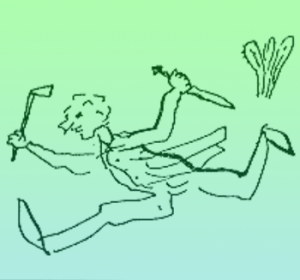
This editor is a critic. He has pulled out his carving-knife and his tomahawk and is starting after a book which he is going to have for breakfast.

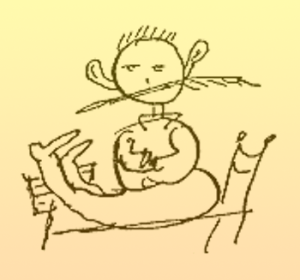
This one’s arms are put on wrong. I did not notice it at first, but I see it now. Somehow he has got his right arm on his left shoulder, and his left arm on his right shoulder, and this shows us the back of his hands in both instances. It makes him left-handed all around, which is a thing which has never happened before, except perhaps in a museum.

That is the way with art, when it is not acquired but born to you: you start in to make some simple little thing, not suspecting that your genius is beginning to work and swell and strain in secret, and all of a sudden there is a convulsion and you fetch out something astonishing.

This is called inspiration. It is an accident; you never know when it is coming. I might have tried as much as a year to think of such a strange thing as an all-around left-handed man and I could not have done it, for the more you try to think of an unthinkable thing the more it eludes you; but it can’t elude inspiration; you have only to bait with inspiration and you will get it every time.

Look at Botticelli’s “Spring.” Those snaky women were unthinkable, but inspiration secured them for us, thanks to goodness.

It is too late to reorganize this editor-critic now; we will leave him as he is. He will serve to remind us. [One can only imagine what a delightful time an editor would enjoy, chopping up that stream of consciousness writing?]

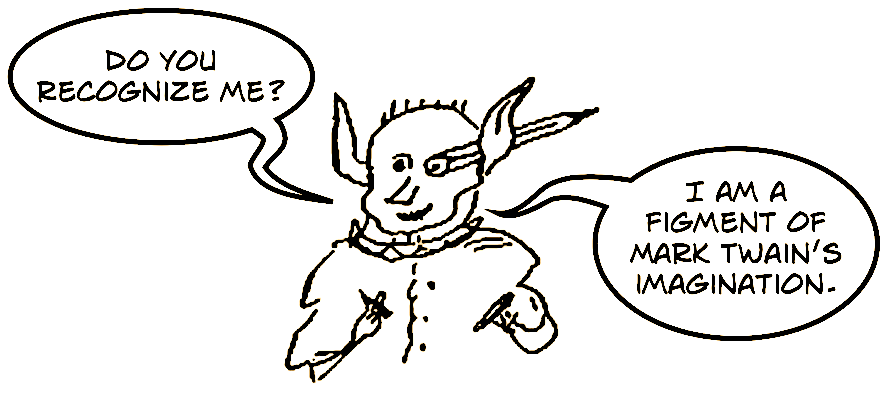
And now for the goblinesque editor. It offers Twain’s most artistic element, which was most likely an accident. Note how the end of the pencil serves to substitute for the eye which may or may not reside behind it.

editor 4

Another editor. That thing behind his ear is his pencil. Whenever he finds a bright thing in your manuscript he strikes it out with that. That does him good, and makes him smile and show his teeth, the way he is doing in the picture.

This one has just been striking out a smart thing, and now he is sitting there with his thumbs in his vest-holes, gloating. They are full of envy and malice, editors are.

Hopefully, if you are a writer who has submitted your work to an editor, you have been fortunate enough to have avoided these characters.

Editors are, after all, our friends. Well, that may be a bit of an exaggeration, but good editors can certainly help make our work better. May God graciously lead you to editors of that sort.


Communicating with Conviction

bold cmu.png

It is sad that a lie spoken with conviction can often mislead, while truths communicated timidly are frequently overlooked or doubted.

It was 20 July 1940. C.S. Lewis wrote to his brother Warnie about his thoughts after listening to one of Hitler’s many speeches. The German Army had already occupied the Bailiwicks of Jersey and Guernsey in the Channel Islands.

Unbeknownst to the two veterans of World War One, just four days before Lewis wrote this letter, Hitler issued Führer Directive #16, setting into motion Operation Sea Lion—initiating planning for the invasion of Britain itself.

The fact that both men recognized the malignancy* that was Adolf Hitler, makes Lewis’ candid comment which follows, all the more powerful.

Humphrey came up to see me last night (not in his medical capacity) and we listened to Hitler’s speech together. [The BBC offered a running translation.] I don’t know if I’m weaker than other people: but it is a positive revelation to me how while the speech lasts it is impossible not to waver just a little.

I should be useless as a schoolmaster or a policeman. Statements which I know to be untrue all but convince me, at any rate for the moment, if only the man says them unflinchingly.

The same weakness is why I am a slow examiner: if a candidate with a bold, mature handwriting attributed Paradise Lost to Wordsworth, I should feel a tendency to go and look it up for fear he might be right after all.

Lewis recognized as a flaw his particular susceptibility to implicitly trusting boldly made statements.

This human vulnerability lies at the heart of the infamous declaration of another demagogue, Vladimir Lenin, that “a lie told often enough becomes the truth.”

I suspect many of us share this inclination to trust words we hear spoken with conviction. At the same time, we are probably much less vulnerable to their manipulation than Lewis was, if for no other reason than because our modern ears have become dulled to the incessant and strident lies flooding the public forum.

A Note for Christian Writers

Skillfully treading the line between the modern deities of Pluralism and Tolerance becomes more challenging each day.

The temptation is to temper our message, to timidly whisper what we know to be true. Thus, we dilute Jesus’ clear declaration that he is the Truth (John 14:6), by adding qualifiers such as “at least, he’s the truth for me.”

Speaking boldly is not arrogant. It has been a vital quality of apostolic preaching since the beginning. Peter and John were seized for preaching the Gospel.

Now when they saw the boldness of Peter and John, and perceived that they were uneducated, common men, they were astonished. . . . So they called them and charged them not to speak or teach at all in the name of Jesus. But Peter and John answered them, “Whether it is right in the sight of God to listen to you rather than to God, you must judge, for we cannot but speak of what we have seen and heard.”

[After their release, they prayed:] “Lord, look upon their threats and grant to your servants to continue to speak your word with all boldness . . .” (Acts 4, ESV).

Just so, we who know Christ “cannot but speak” about how he is at work in the world and in our lives.

Though our boldness is tempered by humility arising from our awareness that we have no righteousness of our own, we must still offer the truth we know, with confidence. “For God has not given us a spirit of timidity, but of power and love and discipline.” (2 Timothy 1:7, NASB).


* There is evidence Adolf Hitler did not appreciate C.S. Lewis’ wartime service.


Enriching Your Writing

lit crit

Writers find literature inspiring. That sounds self-evident—and cliché—when we think of the statement aesthetically. It seems to me, however, that the words are also true in a literal sense. The very act of reading inspires us to fashion our own creations, each of which is consciously or unconsciously indebted to all that we have read and learned during our lives.

This activity is sometimes called bricolage. I wrote about it recently. Skilled writers frequently use devices to enrich their work. Quotations, allusions, pastiche and parody are obvious examples. Some critics would even include plagiarism as an intertextual exercise, and in the strictest sense, it is. While unacknowledged direct quotations are inappropriate, many readers savor reading volumes filled with well-done allusions.

Our minds are a composite of all that to which we have been exposed. When we come up with fresh ideas, they are seldom “new” in a true sense. When they are genuinely novel, at best they offer a unique take on a subject. Still, our expression relies in many aspects on what we ourselves have read in the past. After all, there is nothing new under the sun.*

When we owe a large debt to another source, it is right to offer credit. Not doing so invites people who recognize the source to question our integrity. The exception being when the source is so familiar to the anticipated reader, that it would be redundant. For example, the final sentence in the previous paragraph did not require a citation. If it is not known from its original biblical source, it is recognized as a common proverb . . . or, perhaps, from the Pete Seeger song, “Turn! Turn! Turn!”

One of the striking things about C.S. Lewis is his powerful grasp of the vast breadth of literature he had read. As I wrote in the aforementioned post, “Lewis was generous in thanking thinkers to whom he was indebted, and only failed to do so when he assumed any educated reader would recognize the source of an image or phrase.”

So, what about those times when we have forgotten a source, or don’t even recall that a particular idea came from anywhere other than our own cranium?

Unintentional Bricolage

While teaching at Oxford and Cambridge, Lewis taught many individuals who achieved notoriety in their own right. J.A.W. Bennett, studied under Lewis at Oxford, and eventually replaced him as professor of Medieval and Renaissance literature at Cambridge.

In “The Humane Medievalist: An Inaugural Address,” Bennett describes how Lewis’ vast familiarity with diverse literature meant that his own creative work was permeated by the wisdom of others.

The whole man was in all his judgements and activities . . . and a discriminating zest for life, for “common life,” informs every page he wrote. “Grete Clerke” as he was, he was never wilfully esoteric: Quotations and allusions rose unbidden to the surface of his full and fertile mind, but whether they are to Tristram Shandy or James Thurber they elucidate, not decorate. His works are all of a piece: a book in one genre will correct, illumine or amplify what is latent in another.

As a reader who relishes allusions (especially to the Scriptures), I approach Lewis knowing I’ve been invited to a feast. With C.S. Lewis we find bricolage at its richest and most refined.

In An Experiment in Criticism, Lewis describes two types of readers, literary and unliterary. He says the measure of a book is the extent to which it entices its literary readers to reread it.

In the following excerpt, Lewis mentions how the talented writer weaves together an elegant tapestry (via bricolage). Because literature is so complex and intricate, we benefit from rereading it. He also discusses how literature interacts with our preexisting thoughts and sometimes reshapes them.

Nevertheless, we have already seen that the literary sometimes fall into what I think bad modes of reading, and even that these are sometimes subtler forms of the same errors that the unliterary commit.

They may do so when reading poems. The literary sometimes ‘use’ poetry instead of ‘receiving’ it. They differ from the unliterary because they know very well what they are doing and are prepared to defend it. ‘Why,’ they ask, ‘should I turn from a real and present experience—what the poem means to me, what happens to me when I read it—to inquiries about the poet’s intention or reconstructions, always uncertain, of what it may have meant to his contemporaries?’

There seem to be two answers. One is that the poem in my head which I make from my mistranslations of Chaucer or misunderstandings of Donne may possibly not be so good as the work Chaucer or Donne actually made.

Secondly, why not have both? After enjoying what I made of it, why not go back to the text, this time looking up the hard words, puzzling out the allusions, and discovering that some metrical delights in my first experience were due to my fortunate mispronunciations, and see whether I can enjoy the poet’s poem, not necessarily instead of, but in addition to, my own one?

If I am a man of genius and uninhibited by false modesty I may still think my poem the better of the two. But I could not have discovered this without knowing both. Often, both are well worth retaining.

Do we not all still enjoy certain effects which passages in classical or foreign poets produced in us when we misunderstood them? We know better now.

We enjoy something, we trust, more like what Virgil or Ronsard meant to give us. This does not abolish or stain the old beauty. It is rather like revisiting a beautiful place we knew in childhood. We appraise the landscape with an adult eye; we also revive the pleasures—often very different—which it produced when we were small children.

Admittedly, we can never quite get out of our own skins. Whatever we do, something of our own and of our age’s making will remain in our experience of all literature.

Equally, I can never see anything exactly from the point of view even of those whom I know and love best. But I can make at least some progress towards it. I can eliminate at least the grosser illusions of perspective.

Literature helps me to do it with live people, and live people help me to do it with literature. If I can’t get out of the dungeon I shall at least look out through the bars. It is better than sinking back on the straw in the darkest corner. (An Experiment in Criticism)

An Experiment in Criticism may not be Lewis’ simplest essay to understand, but it is a rich one. In fact, I can almost guarantee that if you should reread the passage quoted above, you will gain new insights that you missed during your first reading.

And that dynamic interplay between our thoughts and the literature we read is exactly what Lewis is explaining, and illustrating.

When it comes to choosing between what we personally receive from a work, and what the author originally intended to say, I love Lewis’ solution: “why not have both?”

_____

* “What has been is what will be, and what has been done is what will be done, and there is nothing new under the sun. Is there a thing of which it is said, ‘See, this is new?’ It has been already in the ages before us” (Ecclesiastes 1:9-10).


Civil Atheism and C.S. Lewis

bennett

Some Christians are obnoxious. Well, okay, quite a few Christians are insufferable when they persistently “witness” to those who are deaf to their appeals. But, truth be told, many atheists are becoming increasingly obnoxious in their attitudes towards Christians as well. Let’s consider which group is worse.

First, some definitions. By Christians I don’t mean people who have some vague deistic notion that there is a God, and Jesus is somehow connected to this divinity because he was such a holy prophet.

By Christian I mean someone who has placed their faith and trust in Jesus the Christ, the only begotten Son of God who declared he was the Way, the Truth and the Life… The Logos (Word) through whom the universe was created.

By Atheist, I don’t mean people who do not share that faith, but who consider it an unprovable thesis. Most people with this viewpoint are ambivalent about whether or not others “believe.” The majority of these folks, many of whom do not feel threatened by religious conversations, are better understood as Agnostics.

By Atheist I mean people who are so convinced that Christianity is fallacious that they feel they must do what they can to stamp it out. They are so emotionally engrossed in the matter that they are genuinely unable to recognize that their own belief is based on nothing other than faith itself.

I can respect the fact that Atheists have historically been mistreated by “Christendom.” By my definition, this institutional entity is not synonymous with actual Christianity. In fact, it’s persecuted far more Christians of different denominational allegiances, than it has unbelievers who simply kept their mouths closed. But that’s a subject for another day.

Christians do not hate agnostics, or even atheists. Their motivation for sharing the Gospel inclines them towards the opposite attitude. Certainly they do it in obedience to their Lord’s command. Most possess a genuine concern and compassion for those they consider to be lost and facing eternal separation from God.

On the other hand, an increasing number of Atheists are insultingly dismissive of Christians who they consider—as a group—to be ignorant and prejudiced.

An Atheist columnist acknowledged this fact, and the discomfort it causes him, in a recent essay. David Harsanyi wrote the following in “Political Idols,” an article about a broader subject.

Unlike many of my fellow non-believers, I don’t feel especially enlightened or rational for my apostasy; I feel kind of unlucky, actually.

The typical non-believer sees the strictures of Christianity or Judaism [the faith in which Harsanyi was raised] as a punishment—mythical limitations set to inconvenience him—but I see people who take profound comfort in a beautiful fate that awaits them as long as they treat people as they would want to be treated themselves.

As a man who believes his story ends in a pile of dirt rather than celestial salvation, I have many reasons to be envious.

Yet, for my entire atheistic life, I’ve been nudged to mock the believer. The unifying doctrine of atheism is a reflexive antagonism toward faith and all the ideas it has dragged along with it through the centuries.

If all Atheists recognized this, and all Christians acknowledged that they are no more deserving of God’s mercy than their neighbor, oh what wonderful conversations about matters of eternal significance we could have!

C.S. Lewis’ Comment about an Atheist Writer

In a 1916 letter to his friend Arthur Greeves, Lewis comments on a book that Greeves had mentioned. He says the particular volume is of little value, without remarking on the author’s work in fiction, for which he as better known.

What is most significant about this particular letter is Lewis’ reference to the writer’s atheism, and the allusion to his own. It must be remembered that Lewis would not experience his conversion to Christianity for another fifteen years!

The book you refer to is ‘How to Form a Literary Taste’ by Arnold Benett: the edition is pretty but the book is not of any value. The very title—as if you set out to ‘learn’ literature the way you learn golf—shews that the author is not a real book-lover but only a priggish hack.

I never read any of his novels & don’t want to. Have you? By the way, he is a rather violent atheist, so I suppose I shall meet him by

‘The fiery, flaming flood of Phlegethon,’ as good old Spenser has it.

Before we look at Arnold Bennett (1867-1931), the author Lewis is describing, let us take a moment to consider the literary allusion Lewis includes in this passage.

“The fiery, flaming flood of Phlegethon” comes from The Faerie Queene, an epic poem which was the masterpiece of Edmund Spenser (1552-1599). Various editions of the fantasy poem are available.

In Spenser’s poem, the Phlegethon is a river found in Hell. The name itself means “flaming,” and it initially appears in Greek mythology as one of the Underworld’s five rivers. In The Faerie Queene, the terrible place where “the damned ghosts in torments fry.”

While his agnosticism assumes there is no afterlife, he acknowledges he may be wrong. And, if so, it is precisely to this tragic, fiery end that the unbelieving Lewis delivers Bennett . . . and himself.

So, who was Arnold Bennett?

Bennett was a versatile writer, and found success not only as a novelist, but also in theater and journalism. He even served as the Director of Propaganda for France during WWI, even though he was English. (He had resided in France since 1903.)

He was outspoken in his view that religious faith was not for the wise. Ironically, he died of typhoid after ignoring a French waiter’s counsel not to drink the “ordinary [tap] water from a carafe,” which was unsafe.

In 1932, Bennett’s widow began editing and publishing his journals. In a review that year, a literary magazine noted his antagonism towards Christianity.

Through it all one gets the impression of a terribly self-centered personality. Perhaps the artist is necessarily self-centered, though I cannot believe that Shakespeare was.

There have been artists like Dante, like Milton, whom it would be absurd to call selfish in the usual sense of the term because, colossal as their egos were, they yet consecrated themselves and all their pride of art and pride of soul to something for which, in the final analysis, their inmost spirits cared immensely more than they cared for self or for art or for any other thing on the earth below or in the heavens above it. . . .

Probably he was as great an artist as a man can be without religion, and the measure of his greatness is to be found in his straining against the limitations he so needlessly imposed upon himself. . . .

He had nothing of the mystic in him. In a moment of illumination he declares that “there is no such thing as ugliness in the world,” but this is as far as he gets. Yet he holds out against Christianity as he holds out against what he thinks of as sentimentalism, and his wife was probably right in her feeling that he might have made a very good Christian if he had only been willing to let himself go.

Civil Atheism

It would be a good thing for us individually and as members of a pluralistic world, to treat one another with civility. As a Christian, I can confess for my brothers and sisters that we do not always do so. Let us strive to do better.

And, as for those who identify themselves as Atheists, perhaps there is some room for improvement in this area as well. If more people resisted atheism’s “reflexive antagonism toward faith,” the world would definitely become a more friendly place.

A final note for those who would read more about Bennett. G.K. Chesterton wrote an essay about morality and punishment, in which he responds to a proposal offered by Bennett that society should not “judge” criminals. You can read “The Mercy of Mr. Arnold Bennett” here.

Since it relates to our discussion here, I must share a portion of Chesterton’s witty introduction to his essay.

Mr. Arnold Bennett recently wrote one of his humorous and humane “causeries” pleading very properly for social imagination and the better understanding of our fellows. He carried it, however, to the point of affirming, as some fatalists do, that we should never judge anybody in the sense of condemning anybody, in connexion with his moral conduct.

Some time ago the same distinguished writer showed that his mercy and magnanimity were indeed on a heroic scale by reviewing a book of mine, and even saying many kind things about it.

But to these he added a doubt about whether true intelligence could be consistent with the acceptance of any dogma. In truth there are only two kinds of people; those who accept dogmas and know it, and those who accept dogmas and don’t know it. My only advantage over the gifted novelist lies in my belonging to the former class.

I suspect that his unconsciousness of his dogmas extends to an unconsciousness of what he means by a dogma. If it means merely the popular idea of being dogmatic, it might be suggested that saying that all dogmatism is unintelligent is itself somewhat dogmatic.

And something of what is true of his veto on dogma is also true of his veto on condemnation; which is really a veto on vetoes.


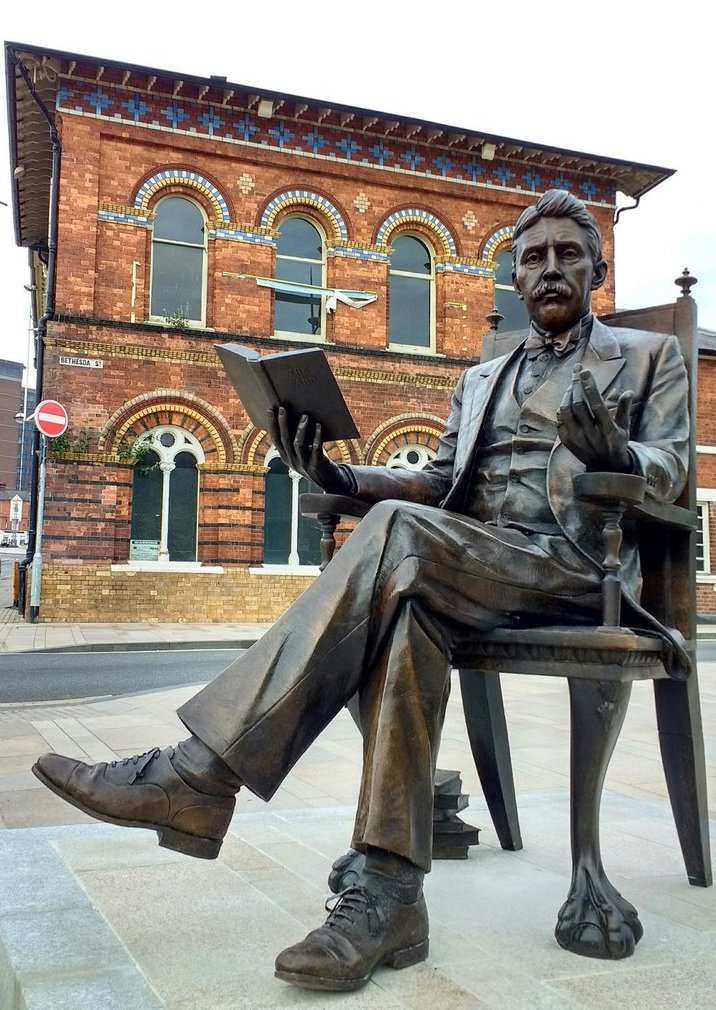
The photograph above is of a statue of Arnold Bennett unveiled this summer in his home town of Stoke-on-Trent.