Not Wholly Contemptible

cornwallisEveryone loves a compliment. Allow me to rephrase that. Most people appreciate a sincere compliment when it is genuinely flattering.

Actually, “flattering” isn’t a good word choice here. Flattery has a bad rep. The way it’s currently used, it hints of exaggeration and manipulation.

So let’s return to the concept of “compliments” in general. Most, we know, are welcome. It’s nice to have someone tell us we did a commendable job or had a good idea.

Then there are those less sincere “compliments” that require a bit of intelligence or wit to offer. The go by different names, but are commonly referred to as “left-handed compliments” or “backhanded compliments.”

This type of statement might sound on its surface like a compliment, but includes an element that undermines the praise. The Urban Dictionary offers the following example:

“Boy, you’re pretty hot . . . for a fat (or skinny) chick!”

Now, that is nothing but an insult. And it’s an insult of the crassest variety. One that demands no wit at all.

The British, on the other hand, are often capable of offering highly refined backhanded compliments.

I just came across a delightful one, delivered by the commander of the King’s forces during America’s War of Independence. What makes this exquisite is that it was offered in the wake of the general’s defeat at the close of the war.

When finally brought to heel at Yorktown, Lord Cornwallis reported, “I will not say much in praise of the Militia of the Southern Colonies, but the list of British officers and Soldiers killed or wounded by them since last June, proves but too fatally that they are not wholly contemptible.”

You can read more about the context for that statement in an excellent article about the American legacy of “citizen soldiers” published in Hallowed Ground magazine. This excellent journal is published by the Civil War Trust, which works diligently to preserve battlefields from the Civil War. They have recently expanded those efforts to include the Revolutionary War.

C.S. Lewis & Compliments

Lewis included backhanded compliments in his fictional works. Two simple examples follow. The first is found in The Screwtape Letters, where the tempter frequently commends the skill of God (“the Enemy”) in redeeming the lost.

Never forget that when we are dealing with any pleasure in its healthy and normal and satisfying form, we are, in a sense, on the Enemy’s ground. I know we have won many a soul through pleasure. All the same, it is His invention, not ours.

Here is an offhanded compliment that Lewis places on the lips of Prince Corin in The Chronicles of Narnia. He is asked where Queen Susan is, on the eve of a battle and he responds like a typical young boy (which he still is at the time). He praises the martial spirit of her sister, Queen Lucy, who is a young adult at this point in the series.

At Cair Paravel. She’s not like Lucy [her sister who is in the ranks of the archers], you know, who’s as good as a man, or at any rate as good as a boy. Queen Susan is more like an ordinary grown-up lady. She doesn’t ride to wars, though she is an excellent archer. (The Horse and His Boy).

The late Bruce Edwards described how C.S. Lewis offered H.G. Wells a backhanded compliment. He did so by following the structure of Wells’ works, but devoting them to a vastly different philosophical purpose.

In Out of the Silent Planet (1938), Lewis adapted the general plot outline from H.G. Wells’s First Men in the Moon in order to tell an essentially anti-Wellsian tale. In Perelandra, Lewis pays a similar backhanded compliment to the man he admired as a speculative writer, but not as a philosopher.

The broad narrative structure of Perelandra resembles another novel by H.G. Wells, The Time Machine (1895). . . . In Wells’s novel, this narrative outline provides the basis of a quasi-Marxist fable about effete bourgeoisie and surly proletariat. In Lewis’s hands, a similar story structure tells a very different tale, one in which the ultimate battles are not economic and political, but rather cosmic and spiritual. (C.S. Lewis: Fantasist, Mythmaker, and Poet).

Compliments: the Good & the Bad

Lewis’ use of Wells’ science fiction template was not meant to slight him. It was actually a tribute. Likewise, in the examples from his fiction, Lewis is simply representing (effectively) the attitudes of the speakers.

Returning for a moment to the abject General Cornwall, we recognize as well the grudging nature of his praise of the enemy. They were certainly rabble—possessing no great military skill, in his estimation. Yet, in terms of bringing the army of the greatest power in the world at that time to its surrender, “they are not wholly contemptible.”

And that, when it came to winning the war, apparently proved quite sufficient.

Misplaced Values

lewis penAn elderly church usher just left his home as a bequest to his church. That isn’t uncommon, but the fact that his home was filled with a vast collection of toy cars accumulated during a lifetime, was rather unusual.

The church will doubtless reap unexpected treasure from the collection’s sale, along with that of a couple of well restored classic autos. That’s nice news for them, and for the other collectors who will find some rare treasures “recycled” into the hobby during the months ahead.

What disturbed me, was the first comment offered on the website in response to the story.

“I throw everything away, even photos people hand me. Keeps me living in the present.”

That comment is disturbing on several levels. First of all, it reveals an utter disregard for the people who give gifts, “even photos,” to the writer. I hope the person has the integrity to tell their acquaintances not to waste their time and money on offering him (or her) tokens of their concern.

Second, if taken literally, the statement that he (I’ll assume it’s a guy, since I have a difficult time picturing a woman this crass) “throw[s] everything away,” is criminal. While things like photographs rarely have value to anyone but those who know the people in them, virtually any other sort of item possesses some tangible value. To toss them in the garbage—presumably for one’s selfish convenience—is terrible, when every community has charities that could use unwanted possessions to generate support for worthy enterprises.

The third thing that offends me about this comment is the inference that people who do not dispose of things in a similar manner become incapable of “living in the present.” What an impoverished view of the power of images and objects to evoke powerful and valuable memories and sentiments!

We are not talking here about someone who is afflicted with “compulsive hoarding,” that has been recognized as a psychiatric disorder. We are talking about a collector with an innocent interest. Or, removing the comment from this specific context, we would be referring to anyone who bothered to retain a photograph of their nephew or niece they received from a sibling.

I love history. But I don’t expect others to share my interest in the same sorts of artifacts that I have gathered through the years. Still, holding a coin with the image of Constantine the Great, or a civil war token with the USS Monitor adorning the obverse, don’t confine me to the distant past.

Studying history does just the opposite. It enables me to live with greater wisdom and insight in the present. C.S. Lewis summarized this truth quite eloquently.

To study the past does indeed liberate us from the present, from the idols of our own market-place. But I think it liberates us from the past too. I think no class of men are less enslaved to the past than historians. (Selected Literary Essays, “De Descriptione Temporum”).

Another observation about history’s importance from the pen of Lewis is found in The Weight of Glory. He reveals how only through the study of history can we be delivered from the danger of believing that “living in the present” is being held prisoner to current cultural conventions.

We need intimate knowledge of the past. Not that the past has any magic about it, but because we cannot study the future, and yet need something to set against the present, to remind us that the basic assumptions have been quite different in different periods and that much which seems certain to the uneducated is merely temporary fashion. A man who has lived in many places is not likely to be deceived by the local errors of his native village: the scholar has lived in many times and is therefore in some degree immune from the great cataract of nonsense that pours from the press and the microphone of his own age.

Thank God that you are not one of those whose vision is restricted to the current age, with its cacophony of reality television and unbridled hedonism. (I can confidently make that observation based on your reading this column to its end.)

Obviously, it’s not necessary to handle or possess actual artifacts to appreciate history . . . although I occasionally take my civil war sabre down from the wall and think about how my great-grandfather wielded one just like it.

That said, who among us would not love to have in their personal library the very copy of a book that had come from C.S. Lewis’ own?

For an excellent exploration of the current disposition of C.S. Lewis manuscripts and legacy, check out the current post at the always excellent A Pilgrim in Narnia.

_____

The image above of pipe and pen is from a display at The Wade Center, at Wheaton College.

Governmental Coersion

bookThe title of the book is provocative. And it’s message is sure to offend some. But at the same time, its theme will provide encouragement to those who resist the pressure to conform to the spirit of this age.

You Will be Made to Care is due for release this week. It’s subtitle describes its focus: The War on Faith, Family and Your Freedom to Believe. The authors are evangelical Christians who have also been active in the political realm.

I’ve never offered a formal “book review” on this blog, and this will sound decidedly “Christian,” so fair warning for whether or not you wish to read on.

Like the majority of evangelical Christians in the United States, Erick Erickson and Bill Blankschaen advocate what are commonly called “traditional” values. In essence, that means their position reflects the one that was normative in the country until the past couple of decades.

I must acknowledge up front that in light of my review, I will be offered a signed copy of the book itself. I mention that fact because integrity requires me to do so. At the same time, I assure you that my own integrity would not allow me to offer an insincere recommendation, for any inducement. (Besides, having written book reviews for several military and civilian publications in the past, I am aware of the fact that receiving gratis copies of the texts is not uncommon.)

The initial chapter of the book describes the rapid shift in American moral values during the recent past.

After decades of culture wars, failed leadership in both parties, and almost eight years of a progressive president committed to fundamentally transforming America, there’s a sense that we are no longer slouching toward Gomorrah, as Robert Bork famously put it, but rushing headlong toward inevitable decline.

The authors make a persuasive argument that not only are citizens now pressured to tolerate lifestyles with which they disagree (something we understand is a fact of life in a democracy) . . . they are increasingly being pressured to act affirmatively to support and promote those very alternatives. They will be made to care!

My Personal Experience

I served twenty-four years as an Air Force chaplain, with twenty two of that on active duty. The armed forces are considered a bastion of conservative culture. That’s a good thing when it comes to patriotism (something becoming less common in the general culture). It can have some downsides also, but they are outweighed by the stability that is provided for this community that discharges the most important responsibility of any government, protecting the nation (i.e. the people, and in the case here in the United States, of the Constitution itself which enshrines their rights).

Because the president is the commander in chief, and the executive branch controls the military, it is vulnerable to excessive interference. One form of this comes in “social engineering,” where the political powers impose revisions they deem appropriate, with little or no regard for the utility or ethics of that intervention.

In some cases this is a good thing. The Republican dictate that African-Americans should be allowed to serve in the military was one such triumph. Another came more than eighty years later, when President Truman desegregated the armed forces in 1948.

In 1994, President Clinton implemented a “don’t ask, don’t tell” policy to allow homosexuals to serve in the military. This simply formalized the existing reality. However, in 2011 President Obama removed the ban to public practice of this previously “alternative” lifestyle. But this has not proven adequate for those who would “make others care.”

Through aggressive indoctrination and ruthless suppression of any competing voices, social engineers press forward their goal of eradicating any “traditional” voice on this subject.

And here is where Erickson’s and Blankschaen’s warning becomes most frighteningly accurate. When they have stilled any contrary voices, they notch the pressure up one more degree and say it is no longer sufficient to tolerate a given activity, now you must actively support or even celebrate it.

The pressure is being ratcheted up on chaplains even as you read this. The goal of some would be to purge all evangelicals from the ranks, and replace them with clergy from religious bodies that affirm the new policies. Either that, or dispense with chaplains altogether. After all, to many inquisitors of the new age the very notion of the world having a Creator is itself archaic and regressive.

Do Not Despair

This book would not be worth the read if it merely diagnosed the disease. But the authors also offer a remedy.

Now is not the time for quitting. Now is the time for engaging culture strategically with an understanding of the times in which we live and a reinvigorated faith in God. Now is the time for building up our own faith and intentionally surrounding ourselves with a community that shares our beliefs. These may well be “times that try men’s souls . . . Such times can produce a new generation of heroes because they offer an opportunity for clarity, authentic community, and courageous leadership.

C.S. Lewis, whose words and thoughts frequent the columns here at Mere Inkling, waged a cultural battle during his life. He paid a price for his defense of the Gospel and of traditional values. He was ridiculed for his “simple” faith that trusted the words of Jesus and the Scriptures.

Lewis knew the truth of the Lord’s warning. “If the world hates you, know that it has hated me before it hated you. If you were of the world, the world would love you as its own; but because you are not of the world, but I chose you out of the world, therefore the world hates you. Remember the word that I said to you: ‘A servant is not greater than his master.’ If they persecuted me, they will also persecute you.” (John 15:18-20)

Lewis did not bemoan this fact. Rather than be shunned into silence he championed the truth. This book advises we follow the same course (and even includes a couple of pertinent Lewis quotes). The following sounds like something that Lewis would have written if he were alive today (in either Europe or America).

In addition to supporting live-and-let-live legislation and leaders who demonstrate the courage to stand for your freedom of conscience, there is really something much more basic to Christianity that each of us should do as citizens—love your neighbor. I don’t mean love them in some sort of philosophical or esoteric way, but really and truly connect with the people in the community in which you live and do good to and for them.

Right now the publishers are offering a special incentive to preorder the book. By going to this link, You Will Be Made to Care, you will find details about the bonus materials. It’s quite an eclectic list, including a collection of devotions, a sermon entitled “The Believer in the Public Square,” an audio collection, and a PDF cookbook. (Invite me over if you decide to make some of the cappuccino knots; they look delicious.)

A Final Lewis Thought on Government Oppression

I recently read some correspondence between C.S. Lewis and fellow writer Idrisyn Oliver Evans in 1954. Apparently Evans had taken a government job that involved the oversight of some government publications. Lewis’ fictitious titles are entertaining and insightful.

You inflict, as well as suffering, the punishment of Tantalus in your description of your new job. I can’t imagine what sort of books that library contains. Is it titles like Seven Ways of Spoiling a Landscape, The War Against Agriculture, Amenities are Bunk and Liberty: Its Cause and Cure? But I expect you would commit the sin of Tantalus if you told me.

Liberty: Its Cause and Cure. Brilliant!

Lewis was not able to preserve the letter he received, but we do have a copy of this subsequent letter to his friend. I was taken aback by his comment about the civil service. Lewis must certainly have been writing in the context of governmental bureaucracy and the growth of regulations restricting freedom.

The previous criticism, quoted above, is referred to in passing, but Lewis hastens to note it included a “grain of seriousness.”

The words are sobering, especially for those of us who align with civic institutions. And they provide a fitting close for the review of a book warning about the government’s growing predilection to use its coercive power so that we would all be made to care . . .

There was a grain of seriousness in my rally against the Civil Service. I don’t think you have worse taste or worse hearts than other men. But I do think that the State is increasingly tyrannical and you, inevitably, are among the instruments of that tyranny . . .

A Mastery of Words

ben franklinOh the curse of so many fascinating things to read . . . and so little time. The following pieces of wisdom come from a free volume, The World’s Famous Orations, by William Jennings Bryan.*

Bryan (1860-1925) was one of the most prominent American orators and politicians. In his study of rhetoric he collected a wide range of speeches given throughout Western history.

The collection is fascinating. It includes moments from well known historical events and from obscure yet intriguing occasions. For example, you can hear the words of Hannibal spoken to his army after its successful crossing of the Alps, or the republican speech offered by the falsely condemned Algernon Sidney from the scaffold.**

Public speaking used to be a cornerstone of education. In colleges today, “speech” is often merely an elective.

C.S. Lewis relates a funny story about one of his first experiences speaking in a formal setting. The occasion was the annual Encaenia at Oxford University, which commemorated founders and benefactors. Honorary degrees were given and excerpts from prize compositions were recited.

Lewis wrote to his father about the event. “I had almost forgotten, if I had ever known, that ‘prizemen’ have to read portions of their compositions at our ceremony of the Encaenia.”

After the honorary degrees [one of which was received by Georges Clemenceau], the Professor of Poetry made an ‘oration’ in Latin, chiefly about colleagues who had died during the last year: this was my first experience of spoken Latin and I was pleased to find that I could follow and enjoy it. The performance of us prizemen was of course very small beer after all this. We had been instructed to read for about two minutes each: I had some difficulty in finding a short passage which would be intelligible by itself. I was, of course, nervous: I am also told that I was the first of our little band whom Clemenceau looked at: but as I do not know with what expression he looked, nor whether he speaks English, we must remain in doubt whether this was a compliment or not.

I have had a good lesson in modesty from thus seeing my fellow prize men. I was hardly prepared for such a collection of scrubby, beetle-like, bespectacled oddities: only one of them appeared to be a gentleman. Any I spoke to sounded very like fools, perhaps like Goldsmith, they ‘writ like an angel and talked like poor Poll’. 76 It brings home to one how very little I know of Oxford: I am apt to regard my own set, which consists mainly of literary gents, with a smattering of political, musical and philosophical–as being central, normal, and representative. But step out of it, into the athletes on one side or the pale pot hunters**** on the other, and it is a strange planet.

The World’s Famous Orations combines a number of separate volumes that run from classical Greece and Rome, on through most of the European nations, including their “colonies” in the Western Hemisphere. President Teddy Roosevelt is the final orator whose words are included.

I invite you to sample some of the rich banquet included in this volume. The speeches themselves are fairly short, and these excerpts the more so. Mere teasers. If you perchance become bored, skip to the final passage—Benjamin Franklin provides his fellow Americans a warning that we sadly failed to heed.

Socrates (470-399 BC) upon being condemned wittily insults his judges.

For the sake of no long space of time, O Athenians, you will incur the character and reproach at the hands of those who wish to defame the city, of having put that wise man, Socrates, to death. For those who wish to defame you will assert that I am wise, though I am not. If, then, you had waited for a short time, this would have happened of its own accord; for observe my age, that it is far advanced in life, and near death. . . .

But if, on the other hand, death is a removal from hence to another place, and what is said be true, that all the dead are there, what greater blessing can there be than this, my judges? For if, on arriving at Hades, released from these who pretend to be judges, one shall find those who are true judges, and who are said to judge there. . . . At what price would you not estimate a conference with Orpheus and Musæus, Hesiod and Homer? I indeed should be willing to die often, if this be true. For to me the sojourn there would be admirable, when I should meet with Palamedes, and Ajax son of Telamon, and any other of the ancients who has died by an unjust sentence.

The comparing my sufferings with theirs would, I think, be no unpleasing occupation. But the greatest pleasure would be to spend my time in questioning and examining the people there as I have done those here, and discovering who among them is wise, and who fancies himself to be so but is not.

“Enough with the insults, philosopher; drink the hemlock.”

Seneca (the Younger, 4 BC-AD 65) before being ordered to commit suicide by Nero, whom he had tutored.

This is the fourteenth year, Cæsar, since I was summoned to train you for your high destiny; and the eighth since your advancement to the empire. During the intervening period, you have showered such honors and riches upon me, that nothing is wanting to complete my felicity but the capacity to use them with moderation. . . .

But both of us have now filled up our measure— you, of all that the bounty of a prince could confer upon his friend; I, of all that a friend could accept from the bounty of his prince. Every addition can only furnish fresh materials for envy; which, indeed, like all other earthly things, lies prostrate beneath your towering greatness, but weighs heavily on me. I require assistance. Thus, in the same manner as, were I weary and faint with the toils of a warfare or a journey, I should implore indulgence; so in this journey of life, old as I am, and unequal even to the lightest cares, since I am unable longer to sustain the weight of my own riches, I seek protection.

Order your own stewards to undertake the direction of my fortune, and to annex it to your own; nor shall I by this plunge myself into poverty, but having surrendered those things by whose splendor I am exposed to the assaults of envy, all the time which is set apart for the care of gardens and villas, I shall apply once more to the cultivation of my mind.

“Did you forget, noble tutor, that I Nero am insane enough to demand both your wealth and your life?”

Thomas Cranmer (1489-1556) at his execution, following his renunciation of a forced recantation. (Yes, that sounds confusing, but under duress he had bent to the will of bloody Queen Mary.)

And now I come to the great thing which so much troubleth my conscience, more than anything that ever I did or said in my whole life, and that is the setting abroad of a writing contrary to the truth—which now I here renounce and refuse, as things written with my hand contrary to the truth which I thought in my heart, and written for fear of death, and to save my life if it might be—and that is, all such bills and papers which I have written or signed with my hand since my degradation, wherein I have written many things untrue.

And forasmuch as my hand hath offended, writing contrary to my heart, therefore my hand shall first be punished; for when I come to the fire, it shall be first burned.

“Darn that troublesome archbishop! That wasn’t the speech we approved in advance for him to give.”

Maximilien François Marie Isidore Robespierre (1758-94) denying King Louis was entitled to a trial.

Louis was king and the Republic is founded; the great question which occupies you is decided by these words alone. Louis has been dethroned for his crimes; Louis denounced the French people as rebels; to chastise them he has invoked the arms of his brother tyrants. Victory and the people have decided that he was the rebel: hence Louis can not be judged; he is judged already. He is condemned, or the Republic is not absolved.

To propose a trial for Louis XVI. in any way whatever is to retrograde toward royal and constitutional despotism; it is a counter-revolutionary idea, for it is putting the revolution itself on trial.

“We’ll see how you feel about allowing trials for tyrants two years into your reign of terror, when we take you to the guillotine.”

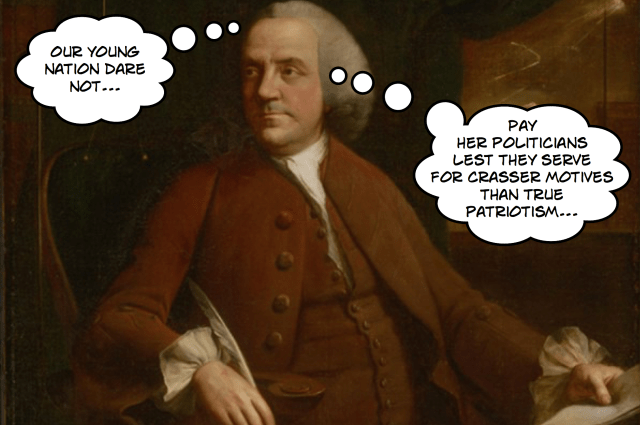
Benjamin Franklin (1706-90) warns about the dangers of providing salaries to bureaucrats.

I think I see inconveniences in the appointment of salaries [for those in the Executive Branch]; I see none in refusing them, but, on the contrary, great advantages.

Sir, there are two passions which have a powerful influence in the affairs of men. These are ambition and avarice—the love of power and the love of money. Separately, each of these has great force in prompting men to action; but, when united in view of the same object, they have, in many minds, the most violent effects.

Place before the eyes of such men a post of honor, that shall, at the same time, be a place of profit, and they will move heaven and earth to obtain it.

The vast number of such places it is that renders the British government so tempestuous. The struggles for them are the true source of all those factions which are perpetually dividing the nation, distracting its councils, hurrying it sometimes into fruitless and mischievous wars, and often compelling a submission to dishonorable terms of peace.

And of what kind are the men that will strive for this profitable preeminence, through all the bustle of cabal, the heat of contention, the infinite mutual abuse of parties, tearing to pieces the best of characters? It will not be the wise and moderate, the lovers of peace and good order, the men fittest for the trust.

It will be the bold and the violent, the men of strong passions and indefatigable activity in their selfish pursuits. These will thrust themselves into your government and be your rulers.

“Oh that we had listened to your sage counsel. Now we are reaping what we have sown in our political machinations.”

_____

* You can download a personal copy of the book in a variety of versions here.

** Algernon Sidney (1622-83) fought honorably for the republican cause in the English Civil War. The fact that he opposed the execution of Charles I did not deliver him from the vengeance of the hedonist Charles II.

*** Georges Clemenceau (1841-1929) was the French prime minister who helped set the stage for World War II by demanding excessive concessions with Germany during the Versailles peace talks.

**** A “pothunter” is someone who hunts game without a concern for rules of sport. Lewis is likely applying it here in the sense of a person who participates in competitions primarily with the goal of accumulating prizes.


From Ear to Quill

anglo saxonConsider how one humble Anglo-Saxon poet can teach us about the ancient transition from the oral to written delivery of poetry.

In recent study about the transition from aural to literary communication I came upon the following fascinating fact.

In an essay entitled “Oral to Written,” J.B. Bessinger writes:

As literate authors learned to assimilate oral materials to pen-and-parchment composition, and since cultural life and centres of writing were controlled so largely by the Church, it was inevitable that the oral transmission of pagan verse would die out, or at best leave few records of an increasingly precarious existence. Meanwhile the invasion of bookish culture into an oral tradition proceeded.

Amid the overwhelming anonymity of the period, Cynewulf was the only poet who troubled to record his name, not from motives of a new literary vanity, but against the Day of Judgement:* “I beg every man of human kind who recites this poem to remember my name and pray . . .”

I’ve read elsewhere that the names of a dozen Anglo-Saxon poets were recorded, although only four have any work that has survived. I understand, however, why Cynewulf is so well recognized—several thousand lines of his poetry are extant. You can access copies of his work for free at Project Gutenberg and Internet Archive.

Curiously, we know no details about Cynewulf other than his name. This he included in his manuscripts, spelled in runic characters.

Cynewulf’s poetry was familiar to the Inklings.

In his diary during the 1920s, C.S. Lewis describes reading Cynewulf and Cyneheard while he bemoaned that Old English Riddles continued to represent an obstacle to him.

I set to on my O.E. Riddles: did not progress very quickly but solved a problem which has been holding me up. [Henry] Sweet is certainly an infuriating author . . .

[Following afternoon tea, Lewis] retired to the drawing room and had a go at the Riddles. I learned a good deal, but found them too hard for me at present.

J.R.R. Tolkien paid an unimaginable tribute to Cynewulf. He attributed to the ancient poet no less than the original inspiration for his mythopoeic conscience.

In the summer of 1913 Tolkien . . . switched course to the English School after getting an “alpha” in comparative philology. At this time he read the great eighth-century alliterative poem Christ, by Cynewulf and others.

Many years later from the poem he cited Eala Earendel engla beorhtost (“Behold Earendel brightest of angels”) from Christ as “rapturous words from which ultimately sprang the whole of my mythology.”**

Cynewulf was an inspired poet. And, it is possible to discern some Anglo-Saxon words which have made it into contemporary English when passages are lined up, side by side.

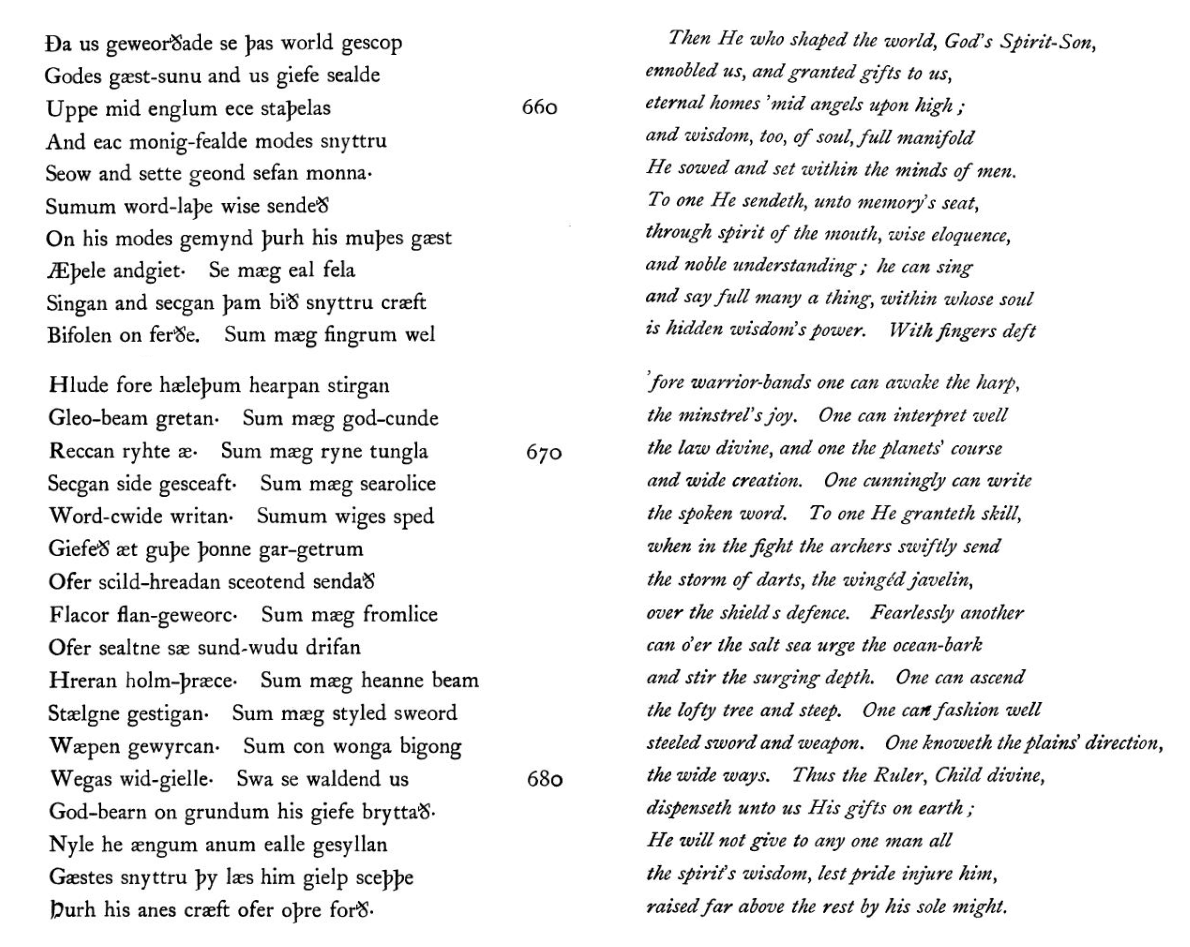
We’ll close now with a passage from his poem, Christ. These words come from the beginning of Part II (Ascension) and comprise the beginning of chapter four. For those who would like to compare the texts, a parallel version follows.*** (Just click on the image to enlarge it.)

Enjoy Cynewulf’s celebration of God’s abundant gifts, extended to poets, musicians, and all others.

Then He who shaped the world, God’s Spirit-Son,

ennobled us, and granted gifts to us,

eternal homes ’mid angels upon high;

and wisdom, too, of soul, full manifold

He sowed and set within the minds of men.

To one He sendeth, unto memory’s seat,

through spirit of the mouth, wise eloquence,

and noble understanding; he can sing

and say full many a thing, within whose soul

is hidden wisdom’s power. With fingers deft

’fore warrior-bands one can awake the harp,

the minstrel’s joy. One can interpret well

the law divine, and one the planets’ course

and wide creation. One cunningly can write

the spoken word. To one He granteth skill,

when in the fight the archers swiftly send

the storm of darts, the wingéd javelin,

over the shields defence. Fearlessly another

can o’er the salt sea urge the ocean-bark

and stir the surging depth. One can ascend

the lofty tree and steep. One can fashion well

steeled sword and weapon. One knoweth the plains’ direction,

the wide ways. Thus the Ruler, Child divine,

dispenseth unto us His gifts on earth;

He will not give to any one man all

the spirit’s wisdom, lest pride injure him,

raised far above the rest by his sole might.

cynewulf

_____

* Please don’t correct me regarding the misspelling of “judgment;” this quotation comes from a British text. ;)

** From Tolkien and C.S. Lewis: The Gift of Friendship by Colin Duriez.

*** This image is derived from the 1892 translation of Cynewulf’s Christ by Israel Gollancz.

The lovely Anglo Saxon cross at the top of this page was discovered several years ago in the grave of a young teenage girl who had been buried near Cambridge.

I have blogged about Anglo Saxon legacy in the past . . . here and here.

Africa Comes to America

saharaYes, you read the title correctly; it’s no typo. Africa itself arrived in America this summer—and it’s an event that apparently takes place every year!

In a recent post by one of Mere Inkling’s earliest subscribers, I learned about the annual Saharan Air Layer. It is an enormous dust cloud that transits the entire Atlantic Ocean and is vital to the western hemisphere, especially the Amazonian rain forests. More about the SAL below.

I find this phenomenon fascinating. It reveals how intricately balanced and interconnected God has created this amazing ecosystem we call earth.

I appreciate this fact, even though I don’t consider myself an environmentalist. That doesn’t mean, of course, that I don’t recycle. What’s more, I would actually like to see brazen polluters incarcerated and tasked with personally cleaning toxic waste dumps . . . but that’s not the theme of this reflection.

It seems to me that part of being truly human, is possessing an appreciation—or even a love—for the world in which our Creator has allowed us to dwell. By love, I mean a deep affection for the flora and fauna, and even the mountains and valleys themselves.

I am not proposing idolatry.

I am in good company in valuing nature. C.S. Lewis found time spent walking in the countryside to be invigorating. It was renewing, for body, mind and soul.

Several years back a book was published with the peculiar subtitle, The Environmental Vision of C.S. Lewis.

The authors of Narnia and the Fields of Arbol explores the way Lewis displays his “ecological” concerns, particularly in his fiction. They also consider J.R.R. Tolkien’s similar attitude.

It is no coincidence that these two men, as soldiers during the Great War, had seen the worst violence humanity could do to nature. The ravages wrought by the orcs surrounding Isengard were echoes of the lifeless terrain of shell-shattered Western Front.

Writing this now, I recall a poem I wrote for Curtana: Sword of Mercy.

“A Foreshadowing of Epics” begins:

Filthy trenches greeted the novice soldiers’ eyes,

their two imaginations envisioned greener lands.

Crimson combat splashed red their vision,

and colored portraits one day painted with their words.

The frontlines were barren,

scarred earth stripped of all life.

Fallen trees mimicked casualties,

not even the smallest of creatures escaped death.

It may seem ironic to some that those very fields now are green, and teeming with life. It is the mercy of God that restores the scarred and heals the broken. And, as impressive as those miracles are evident in nature, they are far more wondrous when it is human lives that are transformed and resurrected.

So it is that I find the wonder of the barren and seemingly lifeless Saharan dust bringing nutrients to hungry forests on the other side of the earth amazing. No mere accident that.

If Jesus delays his return and this globe continues to spin for more centuries still, I would not be surprised to see the Americas returning to Africa a similar gift of life.

_____

Weather.com has a short video about the Saharan Air Layer here.

Who is Your Muse?

reposeWhich Muse provides your inspiration? Poetry, history, music, dance, epic?

I’ve always been fascinated by the Greek & Roman concept of the Muse. While I don’t regard these personifications as true “beings,” they provide wonderful insight into the multifaceted nature of inspiration.

The Muses were personifications (representations of abstract concepts in human form). It’s not the same thing as believing in a “god,” although devotional exercises could be offered in “their” honor. (The simple people, in fact, may have regarded them as minor deities.)

The number of Muses—who represented the arts and fields of knowledge—varied in the ancient world. However, nine constituted the final Roman tabulation.

Possessing a historical nature, my “matron” Muse would necessarily be Clio (History).

Sadly, I’ve learned Muses don’t always fulfill their promises. At my suggestion, my wife agreed to name our puppy Calli, abbreviated from Calliope, the Muse of epic poetry. Unfortunately, at ten months her raucous barking sounds anything but poetic.

In his biography, Surprised by Joy: The Shape of My Early Life, C.S. Lewis includes an interesting reference to Muses. It relates to one of their secondary qualities, civility. In the following passage, Lewis had been sent to the Headmaster of his school for review due to “bad work” (i.e. inadequate academic performance).

The Headmaster misunderstood Smewgy’s report and thought there had been some complaint about my manners. Afterward Smewgy got wind of the Head’s actual words and at once corrected the mistake, drawing me aside and saying, “There has been some curious misunderstanding. I said nothing of the sort about you. You will have to be whipped if you don’t do better at your Greek Grammar next week, but naturally that has nothing to do with your manners or mine.”

The idea that the tone of conversation between one gentleman and another should be altered by a flogging (any more than by a duel) was ridiculous. His manner was perfect: no familiarity, no hostility, no threadbare humor; mutual respect; decorum. “Never let us live with amousia” was one of his favorite maxims: amousia, the absence of the Muses. And he knew, as Spenser knew, that courtesy was of the Muses.

For Lewis’ instructor, the concept of the Muse meant more than simply inspiring some form of art or literature. The influence of the Muses flowed into the broader culture. In a sense, it reflected the distinction the Greeks held between themselves and the barbarians. Surely the uncivilized savages had no Muses of their own!

Sources of Inspiration

It isn’t uncommon today for people to use muse (lower case) as a shorthand for a person who inspires them. Pablo Picasso, for example, considered his favorite model (and mistress) to be his muse. The portrait of Marie-Thérèse Walter above, entitled “Repose,” surely conveys the profound vision she provided him.

In cinema, there was the 1999 movie aptly named The Muse, which posits a deflated screenwriter seeking the aid of the supposed “daughter of Zeus.”

Speaking of Christians . . . they too identify a source for their inspiration. In addition to other human beings, who may offer wisdom, insight or encouragement, the preeminent source of inspiration is the Holy Spirit.

There is a danger in considering God himself to be the source of one’s inspiration. When taken to an extreme, it results in God being blamed for a lot of maudlin prose and gross violations of grammar.

Fortunately, few Christians believe their own writing is infallible. That divine quality is reserved for the Scriptures themselves.

Editors at Christian publishing houses would probably argue with my statement that few Christian authors are so presumptuous as to claim God “breathed” into them every word found in their manuscripts.

So, who is your Muse? When I said Clio is mine, it is because History—the story of humanity and especially God’s hand in it—fascinates me more intensely than any other subject. For you, it could be music or poetry.

Even astronomy has its own Muse, Urania. And, gazing at the boundless heavens God spoke into existence, it is no wonder that many would find their inspiration there.

A Classical Lewisian Poem

C.S. Lewis wrote a number of poems that are satires of Greek and Roman poetry. Some of them are quite witty.

For those interested in reading one such poem, I am pleased to offer “A Cliche Came Out of Its Cage.” In C.S. Lewis: Fantasist, Mythmaker, and Poet, Bruce Edwards describes it as “a sharp attack upon moderns who believe they are heralds of a return to the ‘golden age’ of paganism.” Included in his critique are F.R. Leavis and Bertrand Russell whose philosophy he rejected.

A Cliche Came Out of Its Cage

You said ‘The world is going back to Paganism.’
Oh bright Vision! I saw our dynasty in the bar of the House
Spill from their tumblers a libation to the Erinyes,
And [F.R.] Leavis with Lord Russell wreathed in flowers,
heralded with flutes,
Leading white bulls to the cathedral of the solemn Muses
To pay where due the glory of their latest theorem.
Hestia’s fire in every flat, rekindled, burned before
The Lardergods. Unmarried daughters with obedient hands
Tended it. By the hearth the white-armed venerable mother
Domum servabat, lanam faciebat. At the hour
Of sacrifice their brothers came, silent, corrected, grave
Before their elders; on their downy cheeks easily the blush
Arose (it is the mark of freemen’s children) as they trooped,
Gleaming with oil, demurely home from the palaestra or the dance.
Walk carefully, do not wake the envy of the happy gods,
Shun Hubris. The middle of the road, the middle sort of men,
Are best. Aidos surpasses gold. Reverence for the aged
Is wholesome as seasonable rain, and for a man to die
Defending the city in battle is a harmonious thing.
Thus with magistral hand the Puritan Sophrosune
Cooled and schooled and tempered our uneasy motions;
Heathendom came again, the circumspection and the holy fears …
You said it. Did you mean it? Oh inordinate liar, stop.

Or did you mean another kind of heathenry?
Think, then, that under heaven-roof the little disc of the earth,
Fortified Midgard, lies encircled by the ravening Worm.
Over its icy bastions faces of giant and troll
Look in, ready to invade it. The Wolf, admittedly, is bound;
But the bond will break, the Beast run free. The weary gods,
Scarred with old wounds the one-eyed Odin, Tyr who has lost a hand,
Will limp to their stations for the Last Defence. Make it your hope
To be counted worthy on that day to stand beside them;
For the end of man is to partake of their defeat and die
His second, final death in good company. The stupid, strong
Unteachable monsters are certain to be victorious at last,
And every man of decent blood is on the losing side.
Take as your model the tall women with yellow hair in plaits
Who walked back into burning houses to die with men,
Or him who as the death spear entered into his vitals
Made critical comments on its workmanship and aim.
Are these the Pagans you spoke of? Know your betters and crouch, dogs;
You that have Vichy water in your veins and worship the event
Your goddess History (whom your fathers called the strumpet Fortune).

_____

You can read about my true Muse here.


Great Grandparent or Great-Grandparent?

ggfI have never been more glad to have a birthday than I was this year. After all, at a mere sixty, I would have been far too young to become a great-grandfather. Now, at sixty-one, I feel adequately prepared for the momentous event which transpired just under an hour ago.

Tobin (meaning “God is Good”) is the child of my grandson and his wife, who currently reside in Texas where dad handles munitions for B-1 bombers.

Age and offspring do not always line up the way that we ourselves would plan. Yet every precious child is a miraculous gift from God.

Our grandson was born to our precious daughter-in-law while she was in high school. We didn’t get to meet him until he was ten, but we’ve done our best to make up for lost time. Our grandson, early on began calling us his “great grandparents.” That didn’t make us feel old, just special.

When my wife worked in a residential care facility for severely handicapped children, one of the aides arrived one morning with joyous news. “I’m a great-grandmother!”

Because the woman seemed too young, Delores responded, “Congratulations, you look so young for being a grandmother.”

The lady laughed and said, “No, a great-grandmother!” It turns out she was not yet forty . . . having been 13 when she had a daughter who was 13 when she had her own daughter who now had birthed her own baby. (I don’t recall the gender of the child.)

As I wrote this, it dawned on me that this all took place thirty-seven years ago, so it’s quite possible there are now several more generations in that particular family tree.

Some people will scoff at the thought of celebrating such early and assumedly unintended pregnancies. But, that caregiver knew the truth—every young life is a gift from God.

As an imperfect parent and grandparent, I recognize all too well that I won’t be the great-grandfather Tobin should have. I do pray, though, that God would grant that my mistakes with him would be few, and the memories forged during this life will help this little one grow into the finest man that he can become.

Most importantly, I pray that he will see Christ in my life and recognize the value of faith. Only the Lord knows what the future will bring, and I will not be here to share too many decades of life with my grandchildren and great-grandchildren. But my hope is that the time we do have will leave a lasting legacy of encouragement, faith, and compassion.

The letters of C.S. Lewis provide insights into the influence of his grandparents on his young life.

In a 1905 letter to his brother Warnie, he describes family festivities on Halloween. They even persuaded his grandfather to join in.

On Halow-een we had great fun and had fireworks; rockets, and Catherine wheels, squbes, and a kind of thing that you lit and twirled and then they made stars. We hung up an apple and bit at it. We got [his paternal] Grandfather down to watch and he tried to bite.

In a 1916 letter to his father, he refers to his grandmother’s declining health. (She died two weeks after he wrote.) Lewis refers to the common sentiment that we should have tried harder to spend time with family while they were with us. “I am sorry to hear what you say about [Lewis’ maternal] Grandmother: I feel that we ought to have seen more of her, but it was not easy.”

I should dearly love to get away for a bit, but, as you say, for so short a time, the expense and the interruption of work is hardly worth it. The Colonel must have had an unpleasant journey: I wish he would keep a diary which we could compare with that of Grandfather Hamilton in the same waters. Two generations of sub-tropical Atlantic and Hamilton temperament would be worth studying!

The diaries left by C.S. Lewis’ grandfather, and by his brother Warnie, provide a reminder to us that a written legacy will outlast our voices. If we have something important to say to our descendants, perhaps that is something we should keep in mind.

C.S. Lewis and Supermen

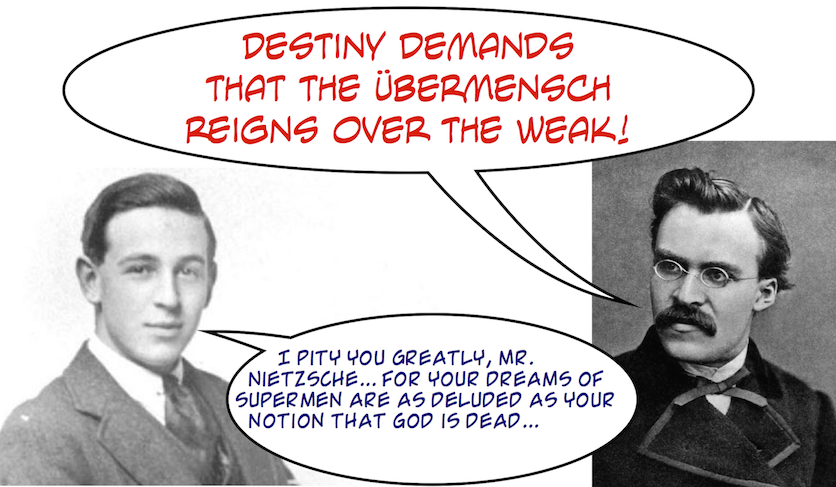
NietzscheI unexpectedly encountered C.S. Lewis while unpacking a box today.

I’m ashamed to admit it, but five years after moving into our retirement home, I have yet to unpack half of my library.

The text that stood out among the two score volumes restored to the light today is called The Cult of the Superman. It was written in 1944 by Eric Bentley.

The 1969 edition which I possess includes “An Appreciation” by C.S. Lewis. Before emigrating to the United States, Bentley had studied under Lewis at Oxford. He spent his own professorial career at Columbia University.*

I have yet to find the time to read the volume, but it’s subtitle clarifies the profound subject it addresses: A Study of the Idea of Heroism in Carlyle and Nietzsche, With Notes on Other Hero-Worshippers of Modern Times. Thomas Carlyle and Nietzsche, in elevating the exceptionality of the hero or superman who “shapes history,” diminish the value of the vast majority of human beings who seek no such domineering role.

This view, so warmly embraced by the Nazis, is directly opposed to the Christian worldview.

The news that God lifts the lowly will come as a disappointment to any supermen or superwomen who are reading this.

However, to those of us who do not yearn to rule over the masses, it is joyous news. “Blessed are the poor in spirit, for theirs is the kingdom of heaven.”

In Jesus’ own words, “Whoever exalts himself will be humbled, and whoever humbles himself will be exalted.”

Nietzsche would revile those words, yet his knee too will one day bow before the One who “emptied himself, by taking the form of a servant, being born in the likeness of men.”

In his “Appreciation,” Lewis declares that Bentley is the right man to address this challenging topic.

The Author, though sternly critical, has a sympathy which I cannot emulate with those elements in Heroic Vitalism which really deserve a serious answer, and this enables him to make a constructive book out of what might easily have become a mere chamber of horrors.

Sheep or Wolves?

This aggrandizement of those who seize their self-ordained right to lord over others can certainly lead to horrors. One example I recently saw was a violent criminal’s justification for his actions. “There are sheep and there are wolves. I’m a wolf. The sheep only exist for my benefit.”

Those of us who comprise the lambs find it inconceivable that evil people believe we exist only to be preyed upon. Yet, this is precisely what predators think. And this Nietzschean notion can justify any atrocity, based as it is upon the maxim that “might makes right.”

Coincidentally, as I was writing this column, “Fishers of Men” by The Newsboys began playing. The first lyrics in the song coincide perfectly with the biblical promise above that every single person—including you—is precious to God.

Seven billion people on a spinning ball,

And they all mean the world to You.

So much for those who would consider themselves super-men . . .

_____

* Lewis’ praise for Bentley’s work is also found in a letter included as an expression of appreciation in ‪The Play and Its Critic: Essays for Eric Bentley.

For an interesting assessment of Lewis’ influence on Bentley’s vocation as a drama critique, Donald Cunningham writes in his Ph.D. dissertation:

Dissent and debate were seen by Lewis as a method for testing ideas, and so he felt that discussion of an ideological sort could only strengthen a grasp on truth. . . . It is possible, then, that Bentley’s positive attitude toward conflict and its necessary presence in a pluralistic, growth-oriented world was learned at Oxford.

The Devil’s Printing Press

pressIf the devil has used the printing press so effectively to advance his purposes, one can only imagine how easily the internet can be twisted to his purposes.

Whether or not you believe Satan is an actual (fallen angelic) person, we all recognize the web provides a ready conduit for unimaginable evil. Recent discussions of the traffic that occurs on the Dark Web is sobering. Actually, not “sobering,” but frightening.

While a small fraction of the data is innocent, the majority deals with criminal and dehumanizing material. Some investigators suggest more than half of the data transfers involve pedophilia.

I’ve been doing some personal research into parallels between the advent of the printing press and the rise of the internet. I’m approaching it from the perspective of how each has provided access to competing faith claims.

Martin Luther viewed the “recent” invention of Gutenberg’s press as divinely appointed to coincide with what would come to be known as the Reformation.

Roman Catholics also published treatises and pamphlets opposing the calls for institutional change within the church. The persuasiveness of arguments aside, one reason for their lack of success against the evangelical leaders was simple.

Rather than writing for the German people in their own tongue, they directed nearly all of their initial energies at writing for the elite, in Latin. While only a minority of sixteenth century Germans were literate, only a small percentage of these were able to read Latin.

During the first half century of the existence of movable type for the press, the majority of published titles were religious. Only later did popular and secular titles eclipse them.

However, they did. Many were wonderful. Scientific and literary knowledge blossomed.

Foremost among the good fruits disseminated by the press, we would have to include the works of the Inklings, especially C.S. Lewis and J.R.R. Tolkien. (Consecrated imaginations are capable of wondrous creations!)

Eventually, of course—given humanity’s imperfect nature—this neutral device was harnessed to baser purposes.

This would lead a nineteenth century minister to write an essay with the title of this column, “The Devil’s Printing Press.” Thomas Green described the dilemma vividly.

The first book printed in Europe had six hundred leaves, and it took nearly ten years to make it. Now books are written, printed, sold, read and forgotten in one-fourth the time. A single century ago, and a man well to do, thought himself fortunate if he had one book in this wild western world.

Today there are books in well kept rank upon almost every cottage shelf It is little wonder that the powers of evil should have invaded the province of the influence of the book shelf and bound up in attractive colors and insidious page the poison of wickedness and sin.

Later in his address, available to read at your leisure here, he contrasts the noble and corrupt purposes for which the press (or internet) might be used.

There are papers of every shape and for every use; daily, tri-daily and almost hourly, weekly and semi-weekly, monthly and quarterly, and filled with everything. You have no idea unless you have given it especial attention, of the magnitude and wondrous dimensions of the newspaper as a factor in civilization. You have little idea, unless you have studied it, of the influence, the formative power of this outwardly ephemeral agency upon human life.

You have little idea, unless you have sought it, of the labor, the enterprise, the energy, the talent, the outlay necessary to plan and execute this gigantic result. You have little conception of the influence of the printing press, as an enlightener, as a pioneer of civilization, as a promoter, a creator, a conservator of purity and virtue; and you have little idea of the magnitude of the devil’s work through this mighty agency, as in a thousand ways he uses it for pollution and ruin.

Green’s florid and dated verbiage may weaken the impact of his argument. Likewise the revivalist tones of his message. Still, as the existence of the dark web reminds us, even the good can be touched by corruption. Perhaps our vigilance can reduce this danger.

We will close now with another description by the author of the lurid material which preceded the pornography which abounds today. Would that our dulled sensitivities remained innocent enough to “blush” at explicit material, as he says.

But the devil has a channel by which he ruins life and character, in a specialty in the newspaper line that panders to the low and more bestial part of man’s being. Broadcast over the land there are sown every day almost countless thousands of papers filled with the corrupt, lascivious, the impure, gathered from all the fact and fancy that a filthy mind can contrive.

Facts that transpire often in the lowest slums of life are here placarded with all the embellishment of illustration and seductive coloring; language and recitals no man would read without a blush are hidden in its folds. It is a slimy, salacious mosaic of filth and wickedness, and yet go up and down the city streets and in every news-dealer’s window and on every corner stand they are spread out for inspection and sale.

_____

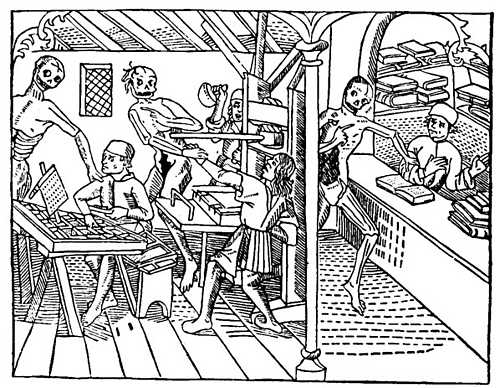
The woodcut illustration above comes from a book entitled The Dance of Death, and is the first representation of a printing press. The point being made was not to associate death with printing, but to reveal how death comes to all, unanticipated, regardless of who they are.