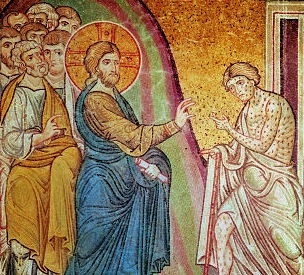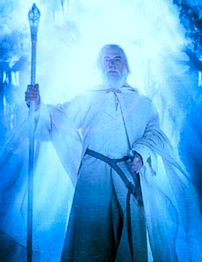
A Trivial Windstorm

bellsIt’s amazing what we can accomplish during a multi-day power outage. Over the Thanksgiving holiday I learned a few new religious tidbits you may find interesting as well.

Several years ago I obtained a copy of Catéchic, “the Catholic trivia game” by Tyco®. While the power was out, I read all 1,000 trivia questions. It proved to be an interesting diversion.

The question of whether or not considering trivialities is a waste of time was addressed by C.S. Lewis at the outset of WWII.

Every Christian who comes to a university must at all times face a question compared with which the questions raised by the war are relatively unimportant. He must ask himself how it is right, or even psychologically possible, for creatures who are every moment advancing either to heaven or to hell, to spend any fraction of the little time allowed them in this world on such comparative trivialities as literature or art, mathematics or biology. (The Weight of Glory)

Lewis’ point is well made. When we contrast the matters which occupy our minds and energies with the things we ignore—including our eternal destiny and whether we are drawing closer to our Creator or drifting farther from him—the things of this world grow dim.

Perhaps that will be slightly less true in the case of trivia gleaned from the history of the largest denomination in the Christian Church.

Test Your Knowledge

A few questions were dated, not surprising I suppose, since the game was copyrighted in 1991. What was surprising is why they would choose to include questions about the names of prominent American archbishops of that decade, knowing it would date the product.

Question: Who is the Archbishop of San Antonio, Texas?

Answer: Archbishop Patrick Flores

Comment: He was historic, being the first Roman Catholic bishop of Mexican American heritage, and service as archbishop was lengthy (1979-2004), but the question as posed has passed its expiration date.

Name the Native American woman who may soon be canonized.

Blessed Kateri Tekakwitha

Tekakwitha (1656-1680) was canonized in 2012 and led a tragically short but interesting life. She was an Algonquin-Mohawk, the first Native American to be canonized.

Most other questions remain valid.

What is the name of Emperor Constantine’s decree that legalized Christianity in the Roman Empire in 313 A.D.?

The Edict of Milan

Bravo. As a student of ancient history and a Constantinian numismatist, I am pleased to see this vital moment in church history acknowledged.

Was St. Francis of Assisi a priest?

No

Good one! Most of us who’ve studied medieval history would probably get that right, but I assume the majority of Christians (Protestants, Catholic and Orthodox) would likely err on the side of ordaining Francis.

Which pope authorized the use of torture during the Inquisition?

Innocent IV

The irony of his chosen papal name is almost torturous. Admittedly, it was an improvement on his given name, Sinibaldo Fieschi.

A fair number of questions about ecclesiastical paraphernalia appear. To advance in the game, it helps to know your patens, piscina, and cinctures from your purificators, pyxes and cruets.

Is a “stermutatory” a piece of furniture found in a church?

No. A stermutatory is something that makes you sneeze.

That said, if some of the pews have grown so musty that they aggravate worshipers’ allergies, wouldn’t they qualify?

Some of the trivia provides arcane information sure to surprise one’s peers.

What is a cardinal who observers believe may have a chance of becoming pope called?

Papabile.

Nice to know . . . Now I just have to think of a way to work that into a typical conversation.

Seriously, using a word like this to show off one’s knowledge of obscure things reminds me of a passage I read many years ago attributed to St. Hereticus.* It offers satirical advice on how to upstage others in religious conversations.

The Superior Knowledge Gambit (not for beginners). Easier to illustrate than explain:

Opponent: I think my interpretation of the church has full historical precedent in Augustine.

Self: (starting hesitantly, but gradually gaining assurance until the final words are spoken with complete authority, in an ex cathedra tone of voice): But surely, much as I admire your exposition, really now, which interpretation of Augustine’s do you mean? There are at least five (eyes to the ceiling for a brief moment of counting), yes five . . . (pause, then confidently) There are at least five interpretations of the church in Augustine’s extant writings. (Give ever so slightly more emphasis to the word “extant.”)

. . .

Help from St. Augustine. A quiet yet forceful way of demonstrating superiority when Augustine is under discussion is to pronounce his name in contrary fashion to the pronunciation of Opponent. Make a point of emphasizing the contrast, so that it will be apparent that you know you are right, and that not even for politeness’ sake will you pronounce the name incorrectly as Opponent is doing. Either,

Opponent: . . . leading ideas in Augustine.”

Self: Augustine may have said that on one or two occasions, but . . .

Or,

Opponent (usually an Anglican in this case): . . . leading ideas in Augustine.

Self:Augustine may have said that on one or two occasions, but the whole Augustinian tradition, following, as I believe, the essential Augustine himself . . .

In this second gambit, it is advisable to maneuver the conversation into a discussion of “the Augustinian tradition” as indicated, so that when Opponent refers to it, as he must, without pronouncing it “the Augustinian tradition,” you can smile deprecatingly, to indicate your point has been made.

Well, that is enough trivia for one day. In my next post I’ll discuss some more substantial literary and theological concerns that emerge in the questions. Until then, one final trifle to entertain.

What 1975 film tells the story of King Arthur’s search for the Holy Grail as a comedy?

Monty Python and the Holy Grail

Some Python humor is too irreverent (or even blasphemous**) for my tastes, but this historic fantasy is one of my guilty pleasures. (I especially love the Killer Rabbit of Caerbannog which can only be dispatched by the “holy hand grenade of Antioch.”)

_____

* The Collected Writings of St. Hereticus by Robert McAfee Brown. An irreverent look at many aspects of ecumenical life in the mid twentieth century.

** Some (perhaps much) of the Python corpus leans towards vulgarity, but if you still enjoy the humor—and you are offended by blatant blasphemy, avoid reading the lyrics to their song, “All Things Dull and Ugly.”

There is a more positive connection between Monty Python and C.S. Lewis, however. John Cleese recorded The Screwtape Letters in 1995, lending his voice to the devilish “author” of the correspondence.
From Ear to Quill

anglo saxonConsider how one humble Anglo-Saxon poet can teach us about the ancient transition from the oral to written delivery of poetry.

In recent study about the transition from aural to literary communication I came upon the following fascinating fact.

In an essay entitled “Oral to Written,” J.B. Bessinger writes:

As literate authors learned to assimilate oral materials to pen-and-parchment composition, and since cultural life and centres of writing were controlled so largely by the Church, it was inevitable that the oral transmission of pagan verse would die out, or at best leave few records of an increasingly precarious existence. Meanwhile the invasion of bookish culture into an oral tradition proceeded.

Amid the overwhelming anonymity of the period, Cynewulf was the only poet who troubled to record his name, not from motives of a new literary vanity, but against the Day of Judgement:* “I beg every man of human kind who recites this poem to remember my name and pray . . .”

I’ve read elsewhere that the names of a dozen Anglo-Saxon poets were recorded, although only four have any work that has survived. I understand, however, why Cynewulf is so well recognized—several thousand lines of his poetry are extant. You can access copies of his work for free at Project Gutenberg and Internet Archive.

Curiously, we know no details about Cynewulf other than his name. This he included in his manuscripts, spelled in runic characters.

Cynewulf’s poetry was familiar to the Inklings.

In his diary during the 1920s, C.S. Lewis describes reading Cynewulf and Cyneheard while he bemoaned that Old English Riddles continued to represent an obstacle to him.

I set to on my O.E. Riddles: did not progress very quickly but solved a problem which has been holding me up. [Henry] Sweet is certainly an infuriating author . . .

[Following afternoon tea, Lewis] retired to the drawing room and had a go at the Riddles. I learned a good deal, but found them too hard for me at present.

J.R.R. Tolkien paid an unimaginable tribute to Cynewulf. He attributed to the ancient poet no less than the original inspiration for his mythopoeic conscience.

In the summer of 1913 Tolkien . . . switched course to the English School after getting an “alpha” in comparative philology. At this time he read the great eighth-century alliterative poem Christ, by Cynewulf and others.

Many years later from the poem he cited Eala Earendel engla beorhtost (“Behold Earendel brightest of angels”) from Christ as “rapturous words from which ultimately sprang the whole of my mythology.”**

Cynewulf was an inspired poet. And, it is possible to discern some Anglo-Saxon words which have made it into contemporary English when passages are lined up, side by side.

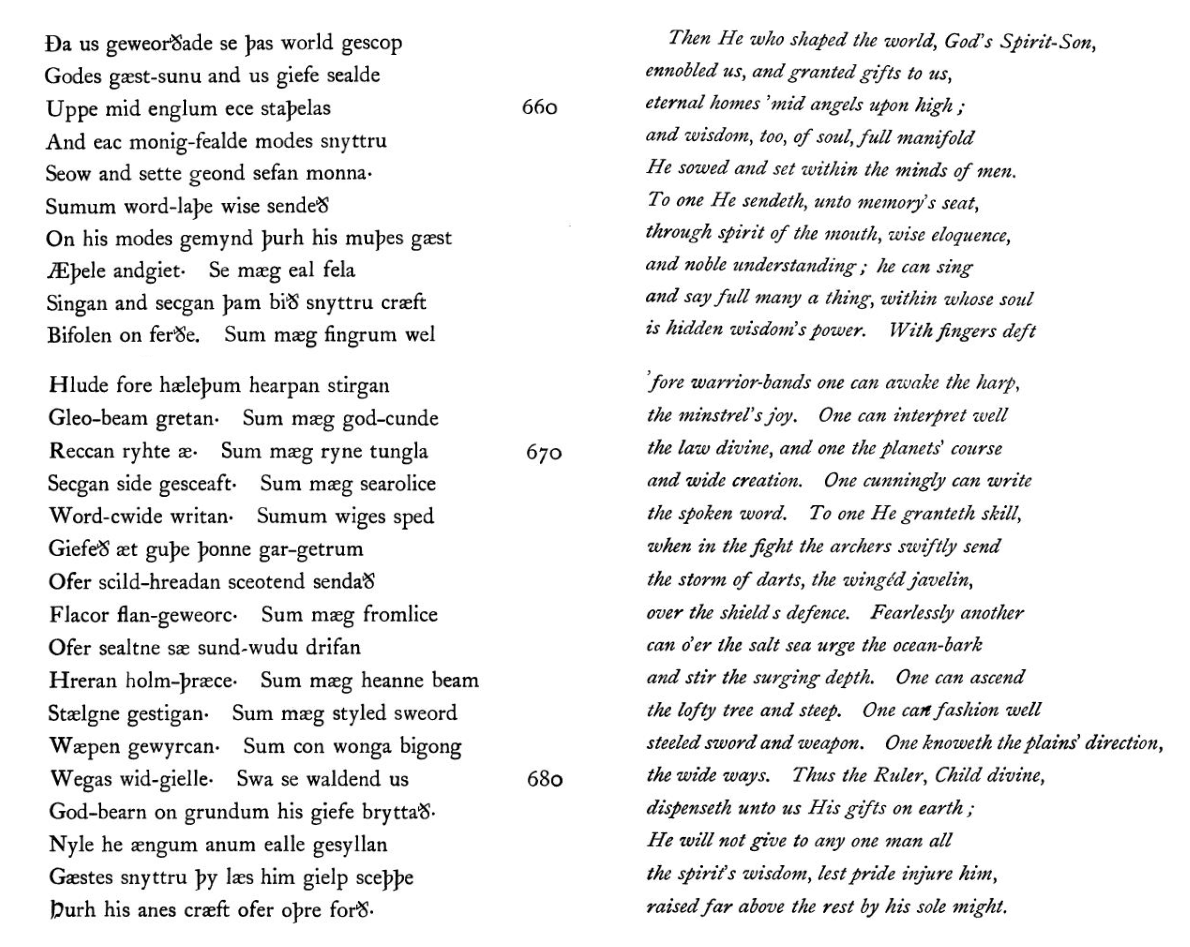
We’ll close now with a passage from his poem, Christ. These words come from the beginning of Part II (Ascension) and comprise the beginning of chapter four. For those who would like to compare the texts, a parallel version follows.*** (Just click on the image to enlarge it.)

Enjoy Cynewulf’s celebration of God’s abundant gifts, extended to poets, musicians, and all others.

Then He who shaped the world, God’s Spirit-Son,

ennobled us, and granted gifts to us,

eternal homes ’mid angels upon high;

and wisdom, too, of soul, full manifold

He sowed and set within the minds of men.

To one He sendeth, unto memory’s seat,

through spirit of the mouth, wise eloquence,

and noble understanding; he can sing

and say full many a thing, within whose soul

is hidden wisdom’s power. With fingers deft

’fore warrior-bands one can awake the harp,

the minstrel’s joy. One can interpret well

the law divine, and one the planets’ course

and wide creation. One cunningly can write

the spoken word. To one He granteth skill,

when in the fight the archers swiftly send

the storm of darts, the wingéd javelin,

over the shields defence. Fearlessly another

can o’er the salt sea urge the ocean-bark

and stir the surging depth. One can ascend

the lofty tree and steep. One can fashion well

steeled sword and weapon. One knoweth the plains’ direction,

the wide ways. Thus the Ruler, Child divine,

dispenseth unto us His gifts on earth;

He will not give to any one man all

the spirit’s wisdom, lest pride injure him,

raised far above the rest by his sole might.

cynewulf

_____

* Please don’t correct me regarding the misspelling of “judgment;” this quotation comes from a British text. ;)

** From Tolkien and C.S. Lewis: The Gift of Friendship by Colin Duriez.

*** This image is derived from the 1892 translation of Cynewulf’s Christ by Israel Gollancz.

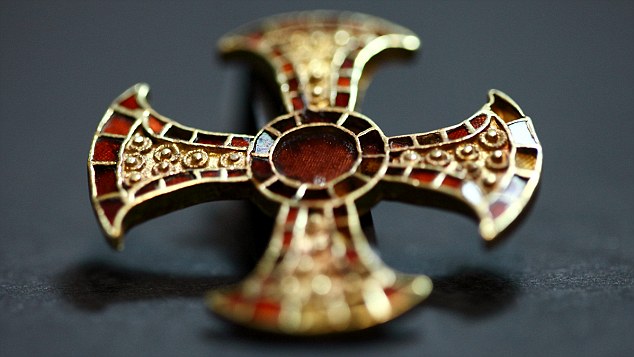
The lovely Anglo Saxon cross at the top of this page was discovered several years ago in the grave of a young teenage girl who had been buried near Cambridge.

I have blogged about Anglo Saxon legacy in the past . . . here and here.

Confusing Creeds

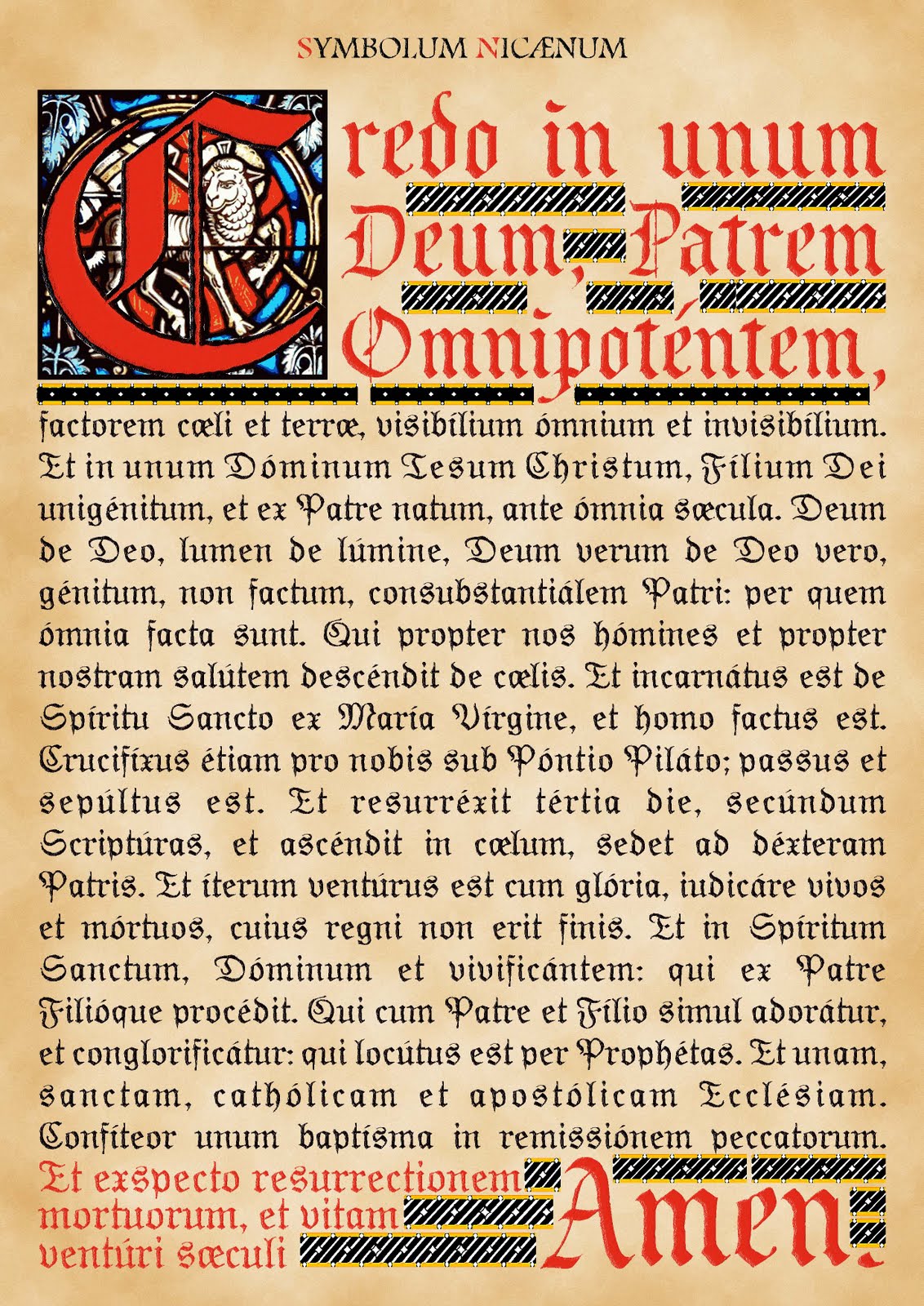
Nicene CreedThere are a couple of sentences in the traditional translation of the basic Christian creeds (statements of faith) that lead to confusion.

Due to the literary examples below, Christian readers may find the following discussion more interesting than non-Christians—but everyone interested in clarity versus confusion should find something intriguing.

The creeds offer a prime example of why it is absolutely crucial to ensure that gradual shifts in language do not undermine or blur the intended meaning of a given sentence. To illustrate, consider this line from the Nicene Creed.

. . . [Jesus] who for us men and for our salvation came down from heaven and was incarnate by the Holy Spirit of the virgin Mary and was made man. (1662, Anglican Book of Common Prayer).*

The potential confusion here lies in the archaic usage of the word “of.” Whose Holy Spirit are we referring to? Mary’s innate holiness and purity? The educated Christian may stumble over that dated phrase—which is still used in some denominations—but a person not acquainted with the doctrine of the Trinity might easily misinterpret it as a Maryological, rather than Christological, confession.

Let’s consider two more recent translations, and note how the first restores the intent of the original writers. The second of these commonly used translations reflects the hand(s) of “politically correct” revisers.

For us and for our salvation he [Jesus] came down from heaven: by the power of the Holy Spirit he became incarnate from the Virgin Mary, and was made man. (1975 International Consultation on English Texts version).

For us and for our salvation he came down from heaven, was incarnate of the Holy Spirit and the Virgin Mary and became truly human. (1988, English Language Liturgical Consultation version).

We will consider a second example momentarily, but let’s first look at something C.S. Lewis wrote about reflecting on the importance of the creeds. He noted that too often we rattle through the words without considering their significance. This is unfortunate.

In an essay entitle “On Forgiveness,” Lewis describes a personal epiphany and offers counsel to those tempted to take familiar words for granted.

We say a great many things in church (and out of church too) without thinking of what we are saying. For instance, we say in the Creed “I believe in the forgiveness of sins.” I had been saying it for several years before I asked myself why it was in the Creed. At first sight it seems hardly worth putting in. “If one is a Christian,” I thought “of course one believes in the forgiveness of sins. It goes without saying.”

But the people who compiled the Creed apparently thought that this was a part of our belief which we needed to be reminded of every time we went to church. And I have begun to see that, as far as I am concerned, they were right. To believe in the forgiveness of sins is not so easy as I thought. Real belief in it is the sort of thing that easily slips away if we don’t keep on polishing it up.

As usual, the Oxford don was correct. However, just as good translations possess the power to inspire, so too poor or antiquated translations exercise the ability to confuse.

Here is the promised second example.

And the third day he rose again according to the Scriptures . . . (1662).

Ah, I understand, think the uncatechized, the Bible teaches us that Jesus rose from the dead on Easter. Well, yes it does, but that is not the sense in which the second phrase is intended. Here, “according to the Scriptures,” means that Jesus’ life, death and resurrection were all accomplished in accordance with the promises of the Word of God.

In other words, “just as was promised in the Garden of Eden and foretold by the prophets, Jesus won victory when he rose from the grave in accordance with the loving plan of God the Father.” The newer versions make that fact only slightly clearer.

On the third day he rose again in accordance with the Scriptures . . . (1975 and 1988).

Perhaps a future revision will replace “in accordance with,” using something like “as foretold in” or “fulfilling the scriptural promises.”

Some of us worship in congregations using a variant of the seventeenth century creed, but at least we can take comfort in the fact that most of them have at least replaced “And he shall come again with glory to judge both the quick and the dead” with “both the living an the dead.” After all, we wouldn’t want people to think that one’s salvation is dependent upon their speed.

_____

* This slightly contemporized version of the creed has already remedied the terribly confusing term “Holy Ghost,” which evokes images of disembodied souls and hauntings.

Unflattering Likenesses

Nero 1We tend to caricature those we dislike. We usually do it with words, either dismissive or insulting. Sometimes we do it with images.

I wrote an essay once entitled “Demonizing Our Enemies,” and in this world of constant turmoil it includes a message we cannot afford to forget. If you’re interested in reading it, it’s on page fifty-four of the first issue of Curtana: Sword of Mercy, and you can read (or download) it for free here.

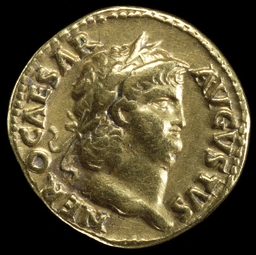
Sometimes, however, what appears on the surface to be an insult . . . may simply be a reflection of accuracy. That, I think, is the case in the coin pictured above. It displays a portrait of the Emperor Nero, in all of his porcine grandeur. It is, in a single word, grotesque.

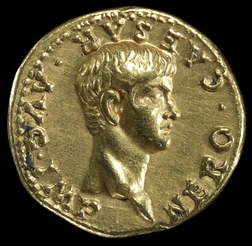
Nero 2Consider this image, of the emperor in his youth. It’s rather disgusting to see what he had become. But the fruits of unrelenting debauchery and murder do take a toll.

Still, one wonders how an image like this ever came to be. What emperor, in his right mind, would allow us a graphic reproduction of his ugliness? Especially when it would have been a simple thing to circulate at the mints an idealized portrait for official use. (That, of course, has been a common practice throughout history.)

As a bit of a numismatist, I was curious as to how it came to be. My first impression upon seeing the bizarre likeness of the imperator was that it must be a “barbarous” imitation of a Roman coin. Such counterfeits became fairly common in the fourth century, and they are usually identified by terribly garbled legends (inscriptions).

After doing enough research to determine this was a genuine imperial issue, I wondered if the celator (die-carver) might have been put to death for his presumption. No evidence of that, though it may have happened.

I have to assume that Nero was so self-consumed that he was oblivious to the way the corpulent image must have invited silent ridicule. He was, after all, despised by virtually everyone for his countless excesses.

So, ultimately, the doomed emperor unintentionally played the proverbial joke upon himself. By allowing an accurate portrayal of the imperial profile, he preserved for all time a true testimony to himself. He may have falsely blamed the Christians for Rome’s terrible fire, but he had no one other than himself to indict for his metallic legacy.

For those curious as to how I might work a Lewisian theme into this unusual post, allow me to include the following passing reference to the self-acclaimed master of the lyre. It appears in the essay “Learning in War-Time”

A University is a society for the pursuit of learning. . . . At first sight this seems to be an odd thing to do during a great war. What is the use of beginning a task which we have so little chance of finishing. . . Is it not like fiddling while Rome burns?

Now it seems to me that we shall not be able to answer these questions until we have put them by the side of certain other questions which every Christian ought to have asked himself in peace-time. I spoke just now of fiddling while Rome burns. But to a Christian the true tragedy of Nero must be not that he fiddled while the city was on fire but that he fiddled on the brink of hell.

And—lest any of us smugly nod in agreement that such an evil man most assuredly deserved his searing fate—here is another passage from Lewis that offers a sobering truth.

In the long run the answer to all those who object to the doctrine of hell, is itself a question: “What are you asking God to do?” To wipe out their past sins and, at all costs, to give them a fresh start, smoothing every difficulty and offering every miraculous help? But He has done so, on Calvary. To forgive them? They will not be forgiven [editor: they will not accept God’s forgiveness]. To leave them alone? Alas, I am afraid that is what He does.

One caution, and I have done. In order to rouse modern minds to an understanding of the issues, I ventured to introduce in this chapter a picture of the sort of bad man whom we most easily perceive to be truly bad. But when the picture has done that work, the sooner it is forgotten the better.

In all discussions of Hell we should keep steadily before our eyes the possible damnation, not of our enemies nor our friends (since both these disturb the reason) but of ourselves. This chapter is not about your wife or son, nor about Nero or Judas Iscariot; it is about you and me. (The Problem of Pain).

Beware of Zoolatry

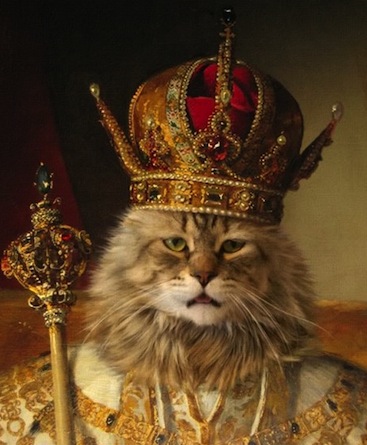
royal catWhen my wife and I dated, I praised her beautiful cat when I visited her home. The cat maintained that imperial posture and attitude that is common in virtually all felines. And that came as no surprise, since she was an Egyptian Mau, one of the most ancient of breeds. She passed on long decades ago, but her haughty, regal bearing is etched in my memory.

I thought of her today when I read the following in the December issue of First Things, in the executive editor’s column.

Wandering around the American Kennel Club’s big “Meet the Breeds” event with my two youngest children recently, I saw a big banner in the cat section proclaiming that a particular breed had been considered a god by an ancient civilization. Of course, our understanding of the genuine religious impulses of ancient religions has increased, but still, one of the gifts the Jewish people have brought the world is that no one who knows about the God of Abraham, Isaac, and Jacob is the least bit tempted to worship cats.

I mean, would you want to worship a murderous narcissistic psychopath? This is not an image of God to make anyone happy. If you’re going to worship an animal, why not the Border Collie, frantically eager to please, or the loving, soulful-eyed Lab? Or the alert and protective German Shepherd? Or the indomitable Saint Bernard? Or the classic loyal and even-tempered mutt?

I don’t intend to offend any cat lovers by repeating this observation—my son has an affectionate tabby he rescued as a kitten while a senior in high school, that’s welcome in our home anytime. Still, as an unrepentant dog person, and “papa” to a rescued border collie, the words above brought a smile to me.

C.S. Lewis painted a graphic image of one animal-headed deity. It was Tash, the god of the Calormenes. In The Last Battle, we see that in Narnia, the reality behind the lifeless image can be most terribly revealed.

In the shadow of the trees on the far side of the clearing something was moving. It was gliding very slowly Northward. At a first glance you might have mistaken it for smoke, for it was grey and you could see things through it. But the deathly smell was not the smell of smoke. Also, this thing kept its shape instead of billowing and curling as smoke would have done. It was roughly the shape of a man but it had the head of a bird; some bird of prey with a cruel, curved beak. It had four arms which it held high above its head, stretching them out Northward as if it wanted to snatch all Narnia in its grip; and its fingers—all twenty of them—were curved like its beak and had long, pointed, bird-like claws instead of nails. It floated on the grass instead of walking, and the grass seemed to wither beneath it. . . .

The others watched it for perhaps a minute, until it streamed away into the thicker trees on their right and disappeared. Then the sun came out again, and the birds once more began to sing. Everyone started breathing properly again and moved. They had all been still as statues while it was in sight. “What was it?” said Eustace in a whisper. “I have seen it once before,” said Tirian. “But that time it was carved in stone and overlaid with gold and had solid diamonds for eyes. It was when I was no older than thou, and had gone as a guest to The Tisroc’s court in Tashbaan. He took me into the great temple of Tash. There I saw it, carved above the altar.”

“Then that—that thing—was Tash?” said Eustace.

In our world, idolatry has certainly evolved since it’s pantheistic and zoolatrous beginnings. Today we are tempted by material indulgences and corruptions aplenty. While few of us impute divinity to animals or objects of stone or wood, we don’t have to look far to find something we deem worthy of adoration.

Our favorite idol is neither beast nor mammon. It is ourselves. As C.S. Lewis wrote in The Problem of Pain:

This act of self-will on the part of the creature, which constitutes an utter falseness to its true creaturely position, is the only sin that can be conceived as the Fall. For the difficulty about the first sin is that it must be very heinous, or its consequences would not be so terrible, and yet it must be something which a being free from the temptations of fallen man could conceivably have committed. The turning from God to self fulfils both conditions. It is a sin possible even to Paradisal man, because the mere existence of a self—the mere fact that we call it “me”—includes, from the first, the danger of self-idolatry. Since I am I, I must make an act of self-surrender, however small or however easy, in living to God rather than to myself. This is, if you like, the “weak spot” in the very nature of creation, the risk which God apparently thinks worth taking.

Now, this is a sin to which I frequently find myself succumbing. I far too often think first about my own desires and appetites . . . only later (if ever) becoming concerned with the needs of my neighbor.

No, it’s neither cat nor dog that needs to be evicted from the throne in my soul reserved for my Creator—it’s me.

It’s Still Christmas

nativity iconMerry Christmas!

One of the sad things about living in a secular nation is that people understand very little about the real meaning of Christmas. For example, many people take their trees down on 26 December, mistakenly thinking Christmas is “over.” In reality, the Christian celebration of the Nativity of Jesus only begins on Christmas Day!

The commercial world celebrates the season of Advent and deceptively calls it “Christmas.” These weeks, which should mark a spiritual preparation akin to Lent, are instead transformed into a frantic race to accumulate the perfect gifts to show others just how much we value each of them. And, since we love our family and close friends, there is a constant temptation to be far more extravagant in our gift giving than we can afford.

Returning to the season of Christmas, in which we find ourselves this day . . . we discover a brief occasion to focus our spiritual reflections on the singular Christmas miracle, the Incarnation. God becoming a human being. The Word through whom all things were created, becoming a mortal like the sons of Adam and daughters of Eve fashioned in his own likeness.

Christmas is, indeed, a glorious season.

C.S. Lewis had many insights into the Incarnation miracle. It is most certainly worthy of our serious attention. If it did not actually happen, Jesus should be dismissed altogether, for he claimed to be one with our heavenly Father. However, as Lewis declared in Miracles, “If the thing happened, it was the central event in the history of the Earth.”

One of the great literary treasures of the world is a precious book written before the year Anno Domini 318. Athanasius of Alexandria wrote a treatise called “On the Incarnation,” which makes great reading and is readily available online. A fairly modern translation was written by Sister Penelope Lawson, an Anglican nun.

Sister Penelope prevailed upon C.S. Lewis to write an introduction to her translation, in which he said, “This is a good translation of a very great book.” The full volume, complete with Lewis’ outstanding preface, is available. Here is just one of his gems:

Every age has its own outlook. It is specially good at seeing certain truths and specially liable to make certain mistakes. We all, therefore, need the books that will correct the characteristic mistakes of our own period. And that means the old books. All contemporary writers share to some extent the contemporary outlook—even those, like myself, who seem most opposed to it. Nothing strikes me more when I read the controversies of past ages than the fact that both sides were usually assuming without question a good deal which we should now absolutely deny. They thought that they were as completely opposed as two sides could be, but in fact they were all the time secretly united—united with each other and against earlier and later ages—by a great mass of common assumptions.

Still, as wonderful as Lewis’ introductory comments are, the greatest treasures here are the bishop’s teachings about Jesus. To whet your appetite, taste the following wisdom from Athanasius’ own introduction to his work:

You must understand why it is that the Word of the Father, so great and so high, has been made manifest in bodily form. He has not assumed a body as proper to His own nature, far from it, for as the Word He is without body. He has been manifested in a human body for this reason only, out of the love and goodness of His Father, for the salvation of us men. We will begin, then, with the creation of the world and with God its Maker, for the first fact that you must grasp is this: the renewal of creation has been wrought by the Self-same Word Who made it in the beginning. There is thus no inconsistency between creation and salvation for the One Father has employed the same Agent for both works, effecting the salvation of the world through the same Word Who made it in the beginning.

You can read the entire work at this site. Have a blessed Christmas season!

Compassionate Care

In my last column I shared how I had been drafted into service as my wife’s nurse.

The duties are not onerous, in part because she’s become quite ambulatory with her crutches . . . but even more, due to the fact that I truly love her. To care for those you love is a natural thing, and it would be the opposite path—to ignore the suffering of those about whom you care—that would be contrary to human nature.

This is why we are also so deeply stunned when we see spouses doing harm to one another, or (far worse) injuring children in their care. These are inhuman acts contrary even to that universal Natural Law which governs even those who take no notice of religious codes.

But, returning to my nursing experience . . . I am not a total stranger to such matters. My first assignment as an Air Force chaplain was in a “Contingency Hospital” which was part of the Reserve. As part of my active duty tours I frequently included hospital visitation and service.

In fact, years ago during a five week Joint military exercise in Thailand, I served for a season as the chaplain of a Mobile Army Surgical Hospital. (Yes, I was an honest to goodness M*A*S*H chaplain!)

Returning to my initial point, caring for my wife is not burdensome. I readily confess I would hardly bring the same enthusiasm and selflessness to caring for a stranger.

But that’s not the man, the disciple of Jesus, I desire to be. And so, I pray for greater compassion, exercise and “stretch” my concern for others, seek forgiveness for my failings . . . and repeat the cycle.

C.S. Lewis writes brilliantly about the great significance of each and every human life. In The Weight of Glory he reminds us that we have the potential to influence their lives either positively or negatively, and assisting them to follow the path to “glory” is central to our reason for being.

It is hardly possible for [us] to think too often or too deeply about [the future destiny] of [our] neighbor. The load, or weight, or burden of my neighbour’s glory should be laid on my back, a load so heavy that only humility can carry it, and the backs of the proud will be broken. . . .

All day long we are, in some degree, helping each other to one or the other of these destinations [glorified resurrection in the presence of our Creator or eternal corruption apart from God].  It is in the light of these overwhelming possibilities, it is with the awe and the circumspection proper to them, that we should conduct all our dealings with one another, all friendships, all loves, all play, all politics. There are no ordinary people. You have never met a mere mortal. Nations, cultures, arts, civilizations—these are mortal, and their life is to ours as the life of a gnat.  But it is immortals whom we joke with, work with, marry, snub, and exploit—immortal horrors or everlasting splendours.

One of my favorite books was written by Calvin Miller. He’s the author of numerous classics, and I most recently enjoyed his The Path of Celtic Prayer. However, because of my interest in the early church, and my affection for keenly wielded wit, it is The Philippian Fragment which ranks in my personal “top ten.” (And, great news, despite being out of print for some time, it’s now available in a Kindle edition!)

The following quotation is from one of the epistles gathered in pseudepigraphical Philippian Fragment. The letters are written by a pastor named Eusebius of Philippi to another shepherd, “Clement, pastor of Coos.” It illustrates precisely the spirit we should have within us. If we were all like Eusebius, this world would be a far more wonderful place.

I am not sure that I can survive the new hostility I have engendered by missing church merely to pray for a dying man. I was foolish to assume that the church would see the glory of my ministry to Publius and excuse the absence of my sermon. Through pain I have learned that it is still wrong to heal on the sabbath—at least during the eleventh hour. . . . Is the yet-paralyzed Publius worth the cancellation of my morning sermon? I have betrayed a tradition to furnish forth a single act of compassion. Oh, the institutional cankers that do fester when traditions are unserved! . . . It is time for the evening vigil now, and I have just received word that one of the lepers is at death’s door and has called for me to come. Shall I go to tend the dying, or shall I go to church and keep my place?

I had planned to talk tonight about how we must minister to our world before we seek each other’s consolations. I am still unforgiven by most for healing the paralytic. Now I must go to the leper and seal my fate. 26. Grief is seldom convenient to our scheduled worship.

I had a dear mentor, Constantinus, who was shepherd of the congregation in Antioch. His church’s meeting house was near a busy road. One day, five minutes before his well-packed service was to begin, a Roman chariot ran over a beggar and left him dying before the church house. How grieved was the pastor that most of his members stepped over the bleeding man to carry their prayer scrolls on into the sanctuary. Constantinus was a gentle pastor and full of the love of Christ. He scooped up the emaciated old man and carried him to his grieving widow.

In the process of his ministry to this victim of Roman traffic, his hands and togas were fouled with blood. There was no time to go home and change clothes, so he entered his pulpit besmirched by the gore of his own compassion. 31. Clement, many in that congregation never forgave Constantinus his bloody toga. Ministry must ever be willing to face tradition. Somewhere a leper is dying. Tonight I shall act out a sermon. I can preach next week when human suffering is more remote. (Calvin Miller, The Philippian Fragment).

Agnostic or Atheist: Does It Matter?

I haven’t forgotten. Well, I have forgotten far too many things in recent years, but I didn’t forget my recent “promise” to address the challenging subject of the distinction between agnosticism and atheism. Last week I wrote: “I suspect that the intimately personal nature of God’s love for us is one of the things that moves some people from agnosticism to atheism.”

It’s not my desire to offend anyone with the discussion which follows. After all, God loves the “lost” just as much as he loves those who have surrendered their lives to him. In fact, there’s an amazing passage that hints at how the rescue of one of those who has “strayed” is even more exciting to the hosts of heaven than the faithfulness of his dedicated disciples. (Check out verses 12-14 in chapter 18 of the Gospel according to Matthew . . . and remember what I have said in the past about how eager any of your Christian acquaintances will be to provide you with a copy of the Bible if you don’t already have one.)

Every soul is precious to God. And yet, many don’t recognize that fact. Many worship false gods (religious and secular). Among those who deny the existence of supernatural deities, there are essentially two camps. Agnostics who (technically) do not deny God’s existence, but merely profess that it is unknowable. Thus they personally remain unpersuaded. Atheists, on the alternative hand, are more adamant about denying God’s existence. Some, in fact, make a living by stridently refuting God himself and all things holy.

Intuitively, most people assume agnostics are not quite as distant from faith as are atheists. After all, agnostics are generally more polite and respectful toward those of us who naively cling to such superstitions . . . right? Atheists, by contrast, tend to ridicule those who would worship a God who laid down his very life, and died a human death.

Take, for example, what is arguably the earliest surviving illustration of Christ’s crucifixion. The illustration above was carved on an ancient plaster wall near Palatine Hill.

It’s a bit difficult to discern, but historical consensus sees the graffito as a pagan insult directed towards a Greek Christian. The scribbled inscription reads: “Alexamenos worships [his] god.” The crucified figure on the cross clearly bears the head of a donkey. The Church Father Tertullian wrote in the second century of slanders alleging Christians followed just such a deity.

Would something like this be likelier to come from the mind of an agnostic, or an atheist?

Agnostics would rarely summon the energy to rail against God like this. However, atheists sometimes feel so imposed upon by God’s children that they lash out with invectives.

So, as I noted above, the gut feeling of most observers would be to say vocal atheists are farther from God than their kindred disbelievers. However—I am convinced that is not the case!

Ironically, it is the tepid individual who lacks any serious conviction who is in greater danger of perishing without seeing God. This is due to the fact that agnostics have, as a rule, come to grips with the fact that there may or may not be a God . . . but they are content to proceed through life without caring much either way. To them the issue is rather trivial, in a sense, since they rarely lose sleep over it.

This is not true of the atheist, who recognizes that the matter is of the utmost importance; that’s why he is not content to simply ignore it. If God truly exists—they comprehend in the core of their being—nothing could be of greater significance.

Agnostics typically have an unreasoned impression that if there is a God, he is probably benevolent, and most likely more concerned with other elements of the universe he created than their small life. They echo the thinking of liberal “Deists” who imagined God as a distant “watchmaker” who set creation in motion and then left it forgotten on the shelf. This Great Watchmaker is not threatening. He isn’t angry at us, because he doesn’t even deign to notice us. He remains oblivious to humanity, just as we presumably live out our lives anonymous to him.

Atheists don’t want to believe in God, because of their overwhelming doubt. Simultaneously, they recognize that the stakes of the gamble are enormous. Eternal, in fact. And they resent God for placing them in this difficult predicament. Why can’t he just make his existence undeniably evident? Faith is the leap they are unwilling to take. But, by the same rational premise, the wise among them realize that in opting against theism, they are actually placing their faith in an equally unprovable tenet. And this has a tendency to make some of them mildly cranky.

Which brings us back to my suspicion that “the intimately personal nature of God’s love for us is one of the things that moves some people from agnosticism to atheism.” You see, when someone deeply ponders the mystery of whether there is a Creator, they understand he would never have created a sentient being with this yearning to cleave to him, without possessing a compassion for them in return.

Agnostics walk about like spiritual zombies, pursuing their various interests. Atheists, though, are tormented by the nagging “fear” that a loving God just may exist. Certainly, they do whatever they can to exorcize the notion, and they publicly celebrate their liberation from ancient and medieval superstitions, but unlike their unaffected agnostic relations, they have recognized the enormity of their choice. Oh to be a blissfully ignorant agnostic, the more thoughtful might muse.

Sadly (from their present perspective), the lot of the atheist is to be closer to God than the agnostic. Atheists may rail against their Maker, but the agnostic’s spiritual indifference causes them to drift farther and farther from the Truth.

The Scriptures offer a parallel to this distinction in the description of one of the early Christian churches. Apparently the believer in Laodicea had grown lackadaisical about their faith and lived lives that differed little from their pagan and agnostic neighbors. The Lord’s judgment of them begins: “I know your works: you are neither cold nor hot. Would that you were either cold or hot! So, because you are lukewarm, and neither hot nor cold, I will spit you out of my mouth.”

Strange, it seems to us, that God might prefer a militant atheistic mindset to an aimless agnostic worldview. But the amazing truth is that, in most cases, atheists are closer to the kingdom of God than their disinterested peers.

In Surprised by Joy, C.S. Lewis describes his own pre-Christian disposition. The grandson of an Anglican priest, he had consciously rejected the faith. Yet, as the possibility of its truth grew more real to him as an adult, he reacted against it. He clearly describes his condition as differing from that of the lukewarm agnostics I’ve described above.

Amiable agnostics will talk cheerfully about “man’s search for God.” To me, as I was then, they might as well have talked about the mouse’s search for the cat.

In the same volume he elaborates on the sentiments I’ve been describing.

I was at this time living, like so many Atheists or Antitheists, in a whirl of contradictions. I maintained that God did not exist. I was also very angry with God for not existing. I was equally angry with Him for creating a world.

So, if you consider yourself “angry with God for not existing,” you may be closer to meeting him than you ever imagined. If you do follow C.S. Lewis’ example, heaven will host a more resounding celebration for you than it does for the ninety-nine who have always remained part of his flock. And, if you’re a dispassionate agnostic who is weakly amused by this thought . . . my sincere prayer is that you, my friend, would become either hot or cold!

Jesus & Gandalf

Today Christians celebrated our Lord’s Transfiguration. (If you attend a church that doesn’t follow the historic “Church Year,” ask your pastor about it. It can be a healthy and educational spiritual discipline.)

The Transfiguration took place on a mountaintop where God the Father brought Moses and Elijah to speak with Jesus. During this encounter, Jesus and his garments shined with a pure, clear light that dazzled the eyes.

It was quite likely the Transfiguration that inspired J.R.R. Tolkien to include one powerful image in his Lord of the Rings tale. (The Lord of the Rings is often referred to as a trilogy, although it is actually a single intricate novel which consists of six “books” plus appendices.)

In the Middle Earth myth, the heroic Gandalf dies in battle with a champion of evil . . . only to be resurrected with even greater power and focus. In this point, the two events differ, since Jesus’ nature never changed. He was incarnate and born as both God and human being. The Transfiguration merely revealed momentarily a portion of his divine identity which was masked, in a sense, by his human flesh.

The aspect in which the accounts are similar comes in the appearance of the glorified Savior and the resurrected Wizard . . . they exude a holy radiance so powerful it even affects their garb.

Thus, Tolkien’s beloved Gandalf the Grey is transformed into the triumphant Gandalf the White.

The Transfiguration of Jesus was one small piece of evidence that he was who he claimed to be. It wasn’t given to the disciples to persuade them of his divinity; in fact, those who witnessed it were enjoined not to share the miracle with others until much later.

Ultimately, what one believes about Jesus does not come down to adding up his miracles and weighing them against the claims of other faiths. Jesus claimed to be the Son of God, the promised Messiah, and humanity’s Savior. If he wasn’t exactly that, he should be condemned and his memory forgotten. As the brilliant C.S. Lewis wrote:

Christians believe that Jesus Christ is the Son of God because He said so. The other evidence about Him has convinced them that He was neither a lunatic nor a quack. (C.S. Lewis, “The Language of Religion”)

Those familiar with Lewis’ writings may recognize how this quotation echoes others where he discusses his divine trilemma.

The world is full of hypocrites who want to force Jesus into their warped pantheons as a “prophet” or “teacher.” Jesus doesn’t allow himself to be embraced as anything other than who he is—God’s Son. Since he made that claim so clearly, he is either precisely that, or he is a liar. Or, it’s possible as Lewis points out, that he may have been insane. In which case he also falls short of being someone who should be followed.

For those who do not presently know Christ, simply pray in humility that God would open your eyes in a personal epiphany. God desires that no one would remain separated from him. And then, one day we can all look forward to seeing our Lord in the fullness of his glory.

Alone—With God

“In prayer God shows himself to us. That he answers prayers is a corollary—not necessarily the most important one—from that revelation.” (C.S. Lewis, “The Efficacy of Prayer”)

Most people think of prayer primarily as a (frequently formal) conversation in which we appeal to God for particular blessings—followed by his response with a “yes,” “no,” or “not yet.” The formulation might look like this: Human Petition = Divine Response.

While prayer truly is a conversation with our Creator . . . this simplistic view is incomplete. In focusing on the answer, it misses out on the holy awe of being in the presence of God itself. C.S. Lewis grasps this precious truth. “In prayer God shows Himself to us.”

I was chatting with my grandson the other day. He’s home on leave from his assignment at Kadena Air Base in Okinawa. Andrew was describing how his Christian lifestyle has isolated him from many of his fellow airmen. They sometimes ridicule him for his chastity and can’t fathom his choice not to squander his time at the club.

But Andrew also shared with me how the ostracism has positively impacted his spiritual life. He’s discovered deep joy in spending time alone with the Lord. He’s active in church worship too, of course, but he also enjoys his time alone. And that is a spiritual epiphany for a gregarious young man who is intensely social by nature.

He shared with me this verse from a song by a contemporary Christian band we both enjoy:

“Loneliness and solitude are two things not to get confused ’cause I spend my solitude with You.” (Reliant K, Lyrics from “Therapy”)

I hear in these words an echo of Lewis’ insight. As Christians, we are never alone. And sometimes in “solitude” we experience the most amazing intimacy a human being can ever know.

Addendum:

True . . . God is ever with us. As Saint John Chrysostom, Patriarch of Constantinople, said: “Quietude in solitude is no small teacher of virtue.”