Knowing Our ABCs

Most readers are familiar with the amazing story of Jeanne D’ Arc (Joan of Arc). She was a French peasant who received visions which proved accurate. She foresaw victory for a humbled nation which had not experienced a major military victory for an entire generation.

Jeanne led the army of the Dauphin (the heir to France’s throne who would reign as Charles VII) to unimaginable victories. She was seriously wounded but inspired her troops with her swift return to battle. She counseled, and prayed for mercy, but recognized England could only be repulsed from French shores by force.

Tragically, she was captured and the English, following a sham trial, judged her guilty of heresy. Jeanne was only nineteen when she perished in flames in an English blaze. Just twenty-five years later, a special court convened by the Pope found her “not guilty” of the crime, and proceeded to declare her a martyr. She was canonized in 1920, nearly five centuries after her brief but brilliant life.

Recently, while reading more about her life I was reminded of something startling she said during her first “inquisition.” When she originally presented herself to the Dauphin, no one could believe a modest young farm girl could be France’s rescuer. A commission of inquiry, comprised of a number of senior clergy, offered the Dauphin a “favorable presumption” that she might, indeed, have divine sanction.

During that “trial,” she was vigorously questioned. The following account comes from Medieval History by Israel Smith Clare.

It is very interesting to see how she evaded the difficulties, overcame the objections, and quietly set aside the learned cavils of the doctors by the simplicity and directness of her replies. They first asked her what signs she could show them to prove her mission. She answered: “I have not come to Poitiers to show a sign. Give me some men-at-arms and lead me to Orleans, and I will then show you signs. The sign I am to give is to raise the siege of Orleans.” One of the [theological] doctors responded thus: “But if God wished to deliver the city he could do it without soldiers.” Jeanne replied: “The soldiers will fight, and God will give them the victory.” Brother Seguin of Limousin asked her, in his provincial dialect, in what idiom her angels spoke. She answered: “In a better idiom than yours.” Said he, somewhat angrily: “Do you believe in God?” Jeanne replied: “I have more faith in God than you have.” The sharp man was thus silenced.

Still the doctors proceeded with their examinations, asking repeated questions and suggesting many learned difficulties. Said Jeanne: “Why do you ask me all these things? I do not know even my A, B, C; but I have come, by God’s command, to raise the siege of Orleans and crown the king.” Having nothing more to say, the doctors finally decided in the maiden’s favor, to which they were somewhat influenced by the great reverence which she inspired among the people of Poitiers by her holiness and piety . . .

Jeanne’s final comment which stands out. The fact that she was illiterate was, to her, no disgrace. She was confident God had chosen her to accomplish the historic events which surely followed.

We live in an era where nearly all adults in the industrialized world are literate. Even in less privileged lands, literacy rates hover around fifty percent.

We—especially those of us who love words and write—tend to look down on those who are not as eloquent as we consider ourselves to be. A woman like Jeanne reminds us that one need not be educated to be truly eloquent. She put the ecclesiastical patricians in their proper place. And rubbed their proverbial noses in it, when she emphasized her illiteracy. Devout, courageous, humble . . . and sarcastic toward condescending clerics—I’m eager to one day meet her!

While knowing one’s ABCs bears little correlation to personal virtue or merit, literacy is essentially a good thing. How impoverished our lives would be if books were sealed to us and we could not be transported to novel places and new epiphanies in their pages.

C.S. Lewis shared this awareness that illiteracy was something that could bar some from experiencing life’s most important treasures. In The Pilgrim’s Regress, he draws a wonderful picture of the relationship between the image and the word. In this allegory, the Landlord represents God.

“. . . The Landlord has circulated other things besides the Rules. What use are Rules to people who cannot read?”

“But nearly everyone can.”

“No one is born able to read: so that the starting point for all of us must be a picture and not the Rules. And there are more than you suppose who are illiterate all their lives, or who, at the best, never learn to read well.”

“And for those people the pictures are the right thing?”

“I would not quite say that. The pictures alone are dangerous, and the Rules alone are dangerous. That is why the best thing of all is to find Mother Kirk at the beginning, and to live from infancy with a third thing which is neither the Rules nor the pictures and which was brought into the country by the Landlord’s Son. That, I say, is the best: never to have known the quarrel between the Rules and the pictures. But it very rarely happens. The Enemy’s agents are everywhere at work, spreading illiteracy in one district and blinding men to the pictures in another. . . . As often as men become Pagans again, the Landlord again sends them pictures and stirs up sweet desire and so leads them back to Mother Kirk even as he led the actual Pagans long ago. There is, indeed, no other way.”

“. . . The Landlord succeeded in getting a lot of
messages through.”

“. . . These pictures woke desire.”

“. . . And then the Pagans made mistakes. They would keep on trying to get the same picture again: and if it didn’t come, they would make copies of it for themselves. Or even if it did come they would try to get out of it not desire but satisfaction.”

Elsewhere, in the essay “Some Thoughts” in God in the Dock, Lewis expressly (and correctly) declares literacy itself as one of the things for which Europe should be grateful to the Church.

[One looking at] Christian activities which are, in a sense directed toward this present world . . . would find that this religion had, as a mere matter of historical fact, been the agent which preserved such secular civilisation as survived the fall of the Roman Empire; that to it Europe owes the salvation, in those perilous ages, of civilised agriculture, architecture, laws, and literacy itself. He would find that this same religion has always been healing the sick and caring for the poor; that it has, more than any other, blessed marriage; and that arts and philosophy tend to flourish in its neighbourhood.


Fatherhood as Modeled by Two Historical Giants

Thanksgiving is a very special holiday. In truth, it’s a “holy-day” for all those who offer their thanks to a benevolent God.

Like all holidays, it can be good or bad, depending on the way it is perceived by each individual, and the unique circumstances in which they find themselves. Most of us are thankful, for example, for our loving families. And, even if we can’t be together at these special times, we draw warmth and strength from their love. Tragically, others have been victimized by those who should have protected them, and “family” in their eyes is not something to be thankful for at all.

I was not a perfect son. I strove to be a better father. And, now that I’m blessed with seven grandchildren, I’m trying to be the best grandfather I can be

Many years ago, shortly after having our first child, I gave myself a Father’s Day gift. (That’s not a typo. I purchased for myself a modest plaque with a priceless message.) It reads: “the greatest gift a man can ever give his children is to love their mother.”

I displayed this proverb in my office through the years, as a reminder to myself and others of this profound truth. It’s easy to love one’s spouse as a newlywed in the hot flush of youth. It’s also easy, I’m learning, to love my wife in the snug and warm autumn of life. For many, however, the trials and tribulations that are a natural part of all relationships appear insurmountable. Between the newlywed and maturelywed days, it’s not all easy. While our hormones still surge and familiarity breeds corrosive contempt, we may take for granted the person we once vowed to cherish above all others.

The desire to be a decent father greatly amplifies the importance of being a devoted husband. Knowing this made my reading of a recent article quite painful. I had known for years that President John F. Kennedy was rather promiscuous. Yet a recent article in The Atlantic reveals just how debauched the man was. The article, if you have the stomach for it, praises the strength of his wife Jackie, and is available online here.

It describes just a few of his disease spawning liaisons, and noted that he often traveled with one of his so-called secretaries, should there be “any trouble scaring up local talent.” One imagines the dirtiness felt by the Secret Service agents tasked with protecting him during his sordid escapades in the White House pool. The saddest tale for me was his deflowering of a sophomore intern from Wheaton “right there on his wife’s bed.” I won’t sully you with any more accounts.

When I read the article, it nearly made me sick. He was a vile husband. I recalled the numerous famous pictures of him playing with his children—the doting father, one would think. Yet, in reality, just because he was such a malignant husband, he was also an appalling father. To mistreat his wife so badly, was to dishonor his children as well.

The image that came to me as I looked again at the pictures of Kennedy’s glorious Camelot brought to mind Jesus’ words about whitewashed sepulchers “which outwardly appear beautiful, but within are full of dead people’s bones and all uncleanness.” (Matthew 23:26-28, ESV). The verse which follows could be JFK’s epitaph: “So you also outwardly appear righteous to others, but within you are full of hypocrisy and lawlessness.”

A More Godly Alternative

C.S. Lewis experienced neither the normal, nor ideal, form of fatherhood. While he loved and respected his own father, theirs was not a close relationship. And then, at the end of his life, the death of his beloved Joy caused him to transition from the already tentative role of stepfather into the fullest demands of single parenthood. Lewis loved his two sons. He was the best father he knew how to be.

Despite being ill equipped, he did the honorable and right thing—he could do no other. He provided for all the physical needs of his sons, and did his best to meet their emotional needs as well. In Lenten Lands, his son Douglas Gresham describes how painful it was to be at The Kilns following his mother’s passing.

In cowardice and self-pity, I deserted the home and the two men whose company and loving support had for so long been all that had preserved my sanity. When at home from school, I was rarely at home. I know now that I could have done far more than I did to help both Jack and Warnie to bear the burdens which were their lot, but with the blind selfishness which is characteristic of egocentric teen-aged boys, I was too wrapped up in myself to spare time for others.

Strangely, Jack and I had, through these difficult years, become very close, and I think that he understood quite well the reasons for my reluctance to be a part of The Kilns at that time. At first, after Mother’s death, with almost unbelievably naïve complacency, I never doubted that The Kilns and Jack would always be there for as long as I needed them. Then, when it began to dawn on me that there was an increasing likelihood of Jack being snatched away, and with him The Kilns, I reacted by rejecting The Kilns entirely and by not daring to love Jack any more than I already irrevocably did.

For his part, Lewis comprehended just how important understanding fatherhood was. In his tribute George MacDonald: An Anthology, he says this about his mentor:

An almost perfect relationship with his father was the earthly root of all his wisdom. From his own father, he said, he first learned that Fatherhood must be at the core of the universe. He was thus prepared in an unusual way to teach that religion in which the relation of Father and Son is of all relations the most central.

Lewis concurred with MacDonald that “Fatherhood must be at the core of the universe.” And, if this is indeed true, our emulation of it in this life possesses even more importance than I ever imagined.

Humor & Health

I had to have blood drawn today for an upcoming physical exam. It’s not one of my favorite things to do, but I consciously try not to allow my feelings to negatively affect the caregivers who provide these essential procedures for our wellbeing. (Trust me, dentists especially are sorely in need of our appreciation.) I often try to add a little smile to their day employing a touch of light humor.

Today, for example, I was repeating a blood test I had already accomplished earlier this week. When the corpsman (Naval hospital) asked which arm I said, “you better take it out of my left arm . . . they weren’t happy with the numbers in the sample they got from my right.”

Now, a modest joke like that won’t make it into any comedians’ monologues, but it did inspire a chuckle from the four of us in the lab at that moment.

It reminded me of getting my flu shot last year and having my choice of four different corpsmen to administer it. Each had a waiting line. I could only imagine what it was like to be puncturing one anonymous arm after another for eight hours. Most “victims” silent, but many grimacing and some feeling compelled to describe to you just how much they hate shots.

Three of the corpsmen were normal sized human beings. But the fourth was a behemoth. The seams of his uniform were near to bursting due to his extraordinary musculature. I doubt he was on steroids, but his massive figure could have fit into the offensive line of any team in the NFL. And, for some mysterious reason, his waiting line was the shortest.

When I approached him to receive my vaccination, I ventured (in a voice loud enough for his companions to hear): “I chose you because you look like you’re gentle.” Everyone got a laugh out of that, and I felt pleased at having momentarily brightened their day.

My kids are always wary when I make comments like this. They recognize that every time we open our mouths, it’s a gamble. We can achieve our goal, and elicit someone’s precious smile . . . or we can make a fool of ourselves.

As a grandfather, I have the added “protection” of not having too much expected of me, in the wittiness department. By the grace of God, I’m still in possession of the bulk of my mental capacities. I imagine that, should I live long enough, most of my attempts at humor may grow rather lame. But, if there remains any cultural respect for our elders, even these attempts will be recognized for what they are—goodwill. And, as such, there are those from whom they will still elicit a smile.

We should not be afraid of humor, especially in its most humble and intimate forms. Woven amidst the threads of our daily conversations, it enriches life.

C.S. Lewis recognized this quite well. In The Magician’s Nephew, which recounts the creation of Narnia, Aslan says to the newly anointed animals: “Laugh and fear not, creatures. Now that you are no longer dumb and witless, you need not always be grave. For jokes as well as justice come in with speech.”

Lewis notes something in Reflections on the Psalms that I too have found to be true. “A little comic relief in a discussion does no harm, however serious the topic may be. (In my own experience the funniest things have occurred in the gravest and most sincere conversations.)”

Because of this, it’s not uncommon when we sit with those who have lost a loved one, to find that the conversation often drifts towards those happy and humorous moments that were shared with the departed. I’ve heard much healing laughter in the still sorrowing presence of the grieving. And, whether the words or thoughts evoke bold laughter or simple smiles, I tend to consider them a good thing indeed.

Theological Training

I’m proud I graduated from a well-respected seminary. And I’m proud of following that Master of Divinity degree with an advanced Master of Theology degree in Patristics. And that’s precisely the problem . . . I’m proud.

As a Christian, I recognize that pride is one of the most destructive and insidious sins. As a pastor and chaplain, I have seen all too frequently how pride expressly targets members of the clergy. Our vulnerability to the temptation to be proud is one of the common chinks in the armor of the ordained.

C.S. Lewis recognized this fact. In A Severe Mercy, he wrote:

I think there is a great deal to be said for having one’s deepest spiritual interest distinct from one’s ordinary duty as a student or professional man. St. Paul’s job was tent-making. When the two coincide I shd. have thought there was a danger lest the natural interest in one’s job and the pleasures of gratified ambition might be mistaken for spiritual progress and spiritual consolation; and I think clergymen sometimes fall into this trap. . . .

In fact, the change [to a Christian ministry] might do good or harm. I’ve always been glad myself that Theology is not the thing I earn my living by. On the whole, I’d advise you to get on with your tent-making. The performance of a duty will probably teach you quite as much about God as academic Theology wd. do. Mind, I’m not certain: but that is the view I incline to.

Lewis understood that “advancement” in ecclesiastical contexts can mask the inner heart and be mistaken as a form of holiness when it is in actuality vanity. I was reminded of this weakness in clerical armor recently, when I read a tribute to a Chinese Christian whose name is little known beyond his homeland. Dr. Sun Yi-yin, known in America as “Freddie Sun,” died in August at the age of 76. A professor of Geology, he lost his faculty position for failing to deny Christ.

Like thousands of other Christians living under the atheist regime, he was imprisoned for his work in establishing churches and Bible schools. He raised the funds to start no fewer than 154 of these training centers, and was key to the equipping of approximately 60,000 underground pastors and teachers. The “underground” Church in China is distinguished from the government-controlled “Three-Self Patriotic Movement.”

For his labors, Sun endured a decade in a Chinese labor camp. (His wife, Dorothy Chang, was also imprisoned. Rather than reducing his faith, during his sojourn in the harshest of conditions, Sun experienced a personal revival and his zeal increased.

His story is amazing, but here is the aspect that hit the mark in the center of my conscience. In his autobiography, The Man in the Fiery Furnace, Sun described his imprisonment as his “seminary” experience: “Instead of learning homiletics, hermeneutics, Greek, and Hebrew, I was being taught the greater lessons of obedience, submission, forgiveness, love, endurance, and patience.”

Now, I am grateful that God has preserved me from the “fiery furnace,” but I do long to experience the fruit of the spirit that Sun so richly harvested in prison. While not dismissing the importance of the classical subjects of homiletics and hermeneutics, as the Apostle says, “If I speak in the tongues of men and of angels, but have not love, I am a noisy gong or a clanging cymbal. And if I have prophetic powers, and understand all mysteries and all knowledge, and if I have all faith, so as to remove mountains, but have not love, I am nothing. If I give away all I have, and if I deliver up my body to be burned, but have not love, I gain nothing.” (I Corinthians 13:1-3, ESV).

In The Problem of Pain, Lewis’ treatise on suffering, he addresses how God can redeem terrible things such as unjust punishments. For those desiring to understand how an omnipotent God can allow evil to occur, Lewis’ presentation is quite helpful. And, the life example of Dr. Sun provides a superb example of its validity.

I advance six propositions necessary to complete our account of human suffering which do not arise out of one another and must therefore be given in an arbitrary order. 1. There is a paradox about tribulation in Christianity. Blessed are the poor, but by ‘judgement’ (i.e., social justice) and alms we are to remove poverty wherever possible. Blessed are we when persecuted, but we may avoid persecution by flying from city to city, and may pray to be spared it, as Our Lord prayed in Gethsemane.

But if suffering is good, ought it not to be pursued rather than avoided? I answer that suffering is not good in itself. What is good in any painful experience is, for the sufferer, his submission to the will of God, and, for the spectators, the compassion aroused and the acts of mercy to which it leads. In the fallen and partially redeemed universe we may distinguish (1) the simple good descending from God, (2) the simple evil produced by rebellious creatures, and (3) the exploitation of that evil by God for His redemptive purpose, which produces (4) the complex good to which accepted suffering and repented sin contribute.

Now the fact that God can make complex good out of simple evil does not excuse—though by mercy it may save—those who do the simple evil. And this distinction is central. Offences must come, but woe to those by whom they come; sins do cause grace to abound, but we must not make that an excuse for continuing to sin. The crucifixion itself is the best, as well as the worst, of all historical events, but the role of Judas remains simply evil.

I thank God for the life and testimony of Sun. I pray God will reap an abundance of believers in China, and elsewhere, due to his faithfulness. And I thank God for using Sun’s words to cause me to stop in the midst of my busy activities and take the time to examine my own heart and motives.

The Glory of Storge (Love)

Storge, noun: Parental affection; the instinctive affection which animals have for their young.

Some of you will recall when I wrote about attending my wife as her nurse while she recuperated from surgery this past summer. Well, I just completed a remotely similar familial duty with my daughter and her husband the past two weeks.

We’ve all been anticipating the arrival of their fourth child and Grandpa is the on call childcare provider of choice. Well, Grandma is actually first choice . . . but since she’s a teacher, that’s not feasible. (She’ll be down here for a week to help out soon, while her husband is home recuperating from two exhausting but wonderful weeks with our inexhaustible grandchildren!)

A few days ago, our newest granddaughter breathed her first breath. I contemplated writing “entered the world,” but far less accurate. She’s beautiful, of course. And we’ll continue to pray that her inner and spiritual beauty, rather than her external appearance, will define her life.

This has gotten me thinking about C.S. Lewis’ wonderful book, The Four Loves. The following passage describes humanity’s natural love for family.

I begin with the humblest and most widely diffused of loves, the love in which our experience seems to differ least from that of the animals. Let me add at once that I do not on that account give it a lower value. Nothing in Man is either worse or better for being shared with the beasts. When we blame a man for being ‘a mere animal’, we mean not that he displays animal characteristics (we all do) but that he displays these, and only these, on occasions where the specifically human was demanded. (When we call him ‘brutal’ we usually mean that he commits cruelties impossible to most real brutes; they’re not clever enough.)

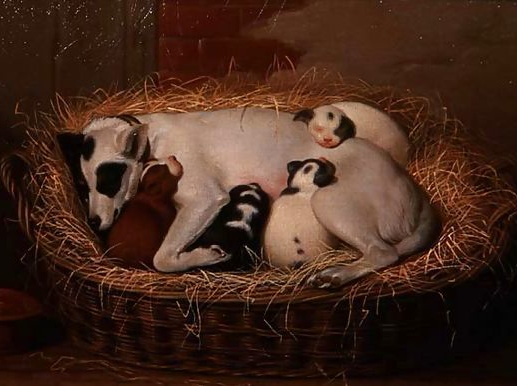
The Greeks called this love storge (two syllables and the g is ‘hard’). I shall here call it simply Affection. My Greek Lexicon defines storge as ‘affection, especially of parents to offspring’; but also of offspring to parents. And that, I have no doubt, is the original form of the thing as well as the central meaning of the word. The image we must start with is that of a mother nursing a baby, a [dog] or a cat with a basketful of puppies or kittens; all in a squeaking, nuzzling heap together; purrings, lickings, baby-talk, milk, warmth, the smell of young life.

The importance of this image is that it presents us at the very outset with a certain paradox. The Need and Need-love of the young is obvious; so is the Gift-love of the mother. She gives birth, gives suck, gives protection. On the other hand, she must give birth or die. She must give suck or suffer. That way, her Affection too is a Need-love. There is the paradox. It is a Need-love but what it needs is to give. It is a Gift-love but it needs to be needed.

As Lewis says, this storge love is a natural affection, instilled within the entire animal kingdom. That is what makes reports of people’s crimes against their own children so terribly shocking. These barbaric acts go against natural law itself. They are inhuman in the absolute sense. And witnessing them among humanity and various animal species reminds us of just how far we have fallen.

By God’s grace, such outrageous acts are the rare exception. Storge is so deeply engrained in nature’s order that we see it in nearly every direction we look. No family is perfect, but most of us are blessed with parents, siblings or other relatives who love us by virtue of our innate bonds.

However, if you are one of the unfortunates who were not loved by your father or mother . . . if you were rejected by your family, I am praying for you. Praying that you will come to know storge in its wonderful fullness through surrogate parents and siblings. After all, it’s not blood that forges these bonds—it is love. Storge is something we readily share with our spouses and our intimate friends. It is a sort of “kinship by choice.”

As I thank God for the most recent addition to our family’s number, I encourage you to thank the Lord as well for the storge love he allows you to give, and receive.

The painting above was created by Samuel De Wilde (1751-1832). And for you cat lovers who were disappointed by my selection of an image of puppies, enjoy this fine portrait of feline storge.

Searching for Water

Have you ever been truly, deeply thirsty? Parched all the way from your lips to your loins . . . scorched like a desiccated crustacean who didn’t quite scurry back to the retreating tides quickly enough.

If you have, you know how savory—how gloriously life giving—a simple drink of water can be. In fact, when you experience thirst like this and take that first quenching swallow, there is nothing else like it in the world.

In those rare moments of dire yearning and satisfaction, we understand how water is utterly vital to life. All the treasures and honors of this world would be meaningless, if they were intended to substitute for that most basic human necessity.

I was pondering the importance of water as I examined the photograph above. The Mars rover Curiosity took it. NASA considers the outcrop here to be the edge “of an ancient streambed.” Rounded rocks, which would presumably have been shaped as they tumbled along “vigorous” creeks or rivers, support that notion. The quest transpiring across our solar system this very hour is nothing less than a search for evidence of life on that arid planet

Water, of course, is necessary to life “as we know it.” Thus the vast significance of the discovery.

Jesus of Nazareth was talking one day with a woman of Samaria. He brashly said of the water she was drawing from a well that dated back to the days of the Patriarch Jacob: “Everyone who drinks of this water will be thirsty again, but whoever drinks of the water that I will give him will never be thirsty again. The water that I will give him will become in him a spring of water welling up to eternal life.”

Because we are inescapably bound to water, it carries tremendous power as a simile or metaphor. C.S. Lewis used it quite effectively in the following passage. In it, he is discussing the true value of performing religious exercises, even when they do not bring us joy or a conscious sense of renewal. As usual, Lewis uses vivid imagery to communicate profound truth.

When we carry out our “religious duties” we are like
people digging channels in a waterless land, in order that when at last the water comes, it may find them ready. . . . There are happy moments, even now, when a trickle creeps along the dry beds; and happy souls to whom this happens often. (C.S. Lewis, Reflections on the Psalms).

I’m saddened by the number of people (especially those with a family legacy of faith) who succumb to the secular philosophies of our materialistic world. They surrender to the world’s hedonistic proclamation that personal happiness is the greatest good! They are ultimately destined to find their souls withered and wasted by the waterless doctrines they embrace.

The worst part of it all is that the water is right in front of us all, offered freely to each of us. We don’t need to commission any expensive interplanetary projects to seek it out. We don’t need to try to be “good enough” to deserve it. All we need do is accept the gift, priceless though it is.

Travel Weary

I enjoy traveling. Cross country car trips are exciting adventures that have created some of my fondest memories. Flying to other countries has been the equivalent of stepping through a looking-glass; one moment you’re surrounded by the familiar and only a “few moments” after, you are immersed in utterly foreign environs.

Admittedly, traveling by air is a bit less enjoyable now, given the necessary security precautions. And, my 75 inch frame has never savored being wedged into the standard airline seat. Still, being able to cross to the opposite slide of the planet within a day borders on the amazing. I would have used the word “unbelievable,” but for the fact that imminent breakthroughs in low orbit travel will likely make today’s flight durations seem protracted.

While travel is often invigorating, there is an annual journey that I do not look forward to. Each year I travel to Saint Louis—a lovely city in America’s heartland—as a member of my church’s commission for military ministry. The problem arises from the fact that we fly in on a Thursday, begin with an informal gathering around dinner, and then rise early for business meetings that last into the late afternoon. Then, we fly home on an early evening flight that gets us home (in my case) about midnight.

While the clock says midnight, that is on a day when we got up in a different time zone, which means we’ve been on the run for twenty hours . . . and a ninety minute drive home from the airport is still ahead. It becomes a bit of a safety concern when you haven’t napped at all. Why not, you might wonder? Well, the truth is that I am one of the many people with sleep apnea, and the decibel level of my snoring could constitute assault. My exhaustion is an inevitable consequence of my consideration of others.

I know I’m not alone in having to take trips like this. What I’m describing is probably familiar to many of you. It’s just that spending nearly twenty-four hours over two days traveling to and from approximately eight hours of meetings leaves me exhausted.

Then there is the consideration that we don’t always make the best decisions when we are tired. There’s an intriguing passage in Prince Caspian where C.S. Lewis describes a decision facing the Narnian heroes. Young Lucy, pure of heart, has informed the group that Aslan would have them follow a particular route. However, in a wonderful portrayal of religious democracy, the band decides to put the matter to a vote! And, just as in church bodies today, we learn that not all ballots result in divinely inspired decisions.

There’s nothing for it but a vote,” said Edmund.

“All right,” replied Peter. “You’re the eldest, D.L.F. What do you vote for? Up or down?”

“Down,” said the Dwarf. “I know nothing about Aslan. But I do know that if we turn left and follow the gorge up, it might lead us all day before we found a place where we could cross it. Whereas if we turn right and go down, we’re bound to reach the Great River in about a couple of hours. And if there are any real lions about, we want to go away from them, not toward them.”

“What do you say, Susan?”

“Don’t be angry, Lu,” said Susan, “but I do think we should go down. I’m dead tired. Do let’s get out of this wretched wood into the open as quick as we can. And none of us except you saw anything.”

“Edmund?” said Peter.

“Well, there’s just this,” said Edmund, speaking quickly and turning a little red. “When we first discovered Narnia a year ago—or a thousand years ago, whichever it is—it was Lucy who discovered it first and none of us would believe her. I was the worst of the lot, I know. Yet she was right after all. Wouldn’t it be fair to believe her this time? I vote for going up.”

“Oh, Ed!” said Lucy and seized his hand.

“And now it’s your turn, Peter,” said Susan, “and I do hope—”

“Oh, shut up, shut up and let a chap think,” interrupted Peter. “I’d much rather not have to vote.”

“You’re the High King,” said Trumpkin sternly. “Down,” said Peter after a long pause. “I know Lucy may be right after all, but I can’t help it. We must do one or the other.”

At many times in our life journeys we may find ourselves “dead tired” like Susan. But we need to keep our wits about us so we don’t make decisions that lead us down paths destined to bring even more suffering and fatigue.

The following passage from Lewis’ Mere Christianity illustrates how we often justify our poor decisions and inconsiderate actions with our tiredness. I certainly do. Perhaps you’ll see a little of yourself in the following words.

I hope you will not misunderstand what I am going to say. I am not preaching, and Heaven knows I do not pretend to be better than anyone else. I am only trying to call attention to a fact; the fact that this year, or this month, or, more likely, this very day, we have failed to practise ourselves the kind of behaviour we expect from other people. There may be all sorts of excuses for us. That time you were so unfair to the children was when you were very tired. That slightly shady business about the money—the one you have almost forgotten—came when you were very hard-up. And what you promised to do for old So-and-so and have never done—well, you never would have promised if you had known how frightfully busy you were going to be. And as for your behaviour to your wife (or husband) or sister (or brother) if I knew how irritating they could be, I would not wonder at it—and who the dickens am I, anyway? I am just the same.

That is to say, I do not succeed in keeping the Law of Nature very well, and the moment anyone tells me I am not keeping it, there starts up in my mind a string of excuses as long as your arm. The question at the moment is not whether they are good excuses. The point is that they are one more proof of how deeply, whether we like it or not, we believe in the Law of Nature. If we do not believe in decent behaviour, why should we be so anxious to make excuses for not having behaved decently? The truth is, we believe in decency so much—we feel the Rule of Law pressing on us so—that we cannot bear to face the fact that we are breaking it, and consequently we try to shift the responsibility. For you notice that it is only for our bad behaviour that we find all these explanations. It is only our
temper that we put down to being tired or worried or hungry; we put our good temper down to ourselves.

Well, I’m too tired to write any more on this subject now, so those of you who have remained with me to this point, can count yourselves blessed!

Recycling Seasons

Fall has arrived, and with it (in many nations) a new “school year.” The traditional academic year has been modified in various locales, but for most the end of summer and beginning of fall herald the beginning of the latest season of learning.

The irony is, of course, that even those long “graduated” from any personal learning goals remain subject to this academic cycle. The “back to school” advertising is pervasive, and simultaneous “commencements” such as football and new television programming also reinforce that sensation that something familiar is returning for a fresh beginning.

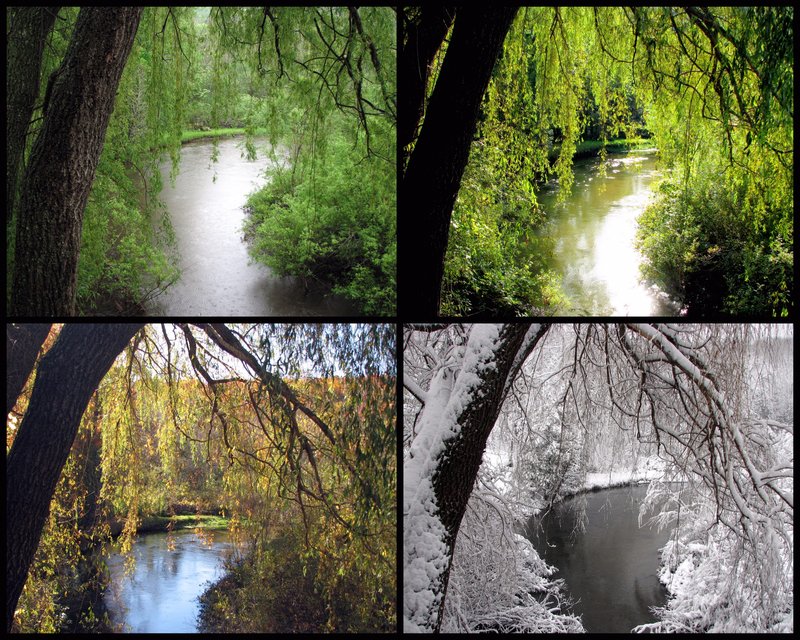
Families with children in traditional schools are anchored in this academic cycle. It is so intimately an aspect of life that the world would be disorienting without it. Fall, winter, spring and summer—each with their unique traits and holidays—create an ongoing cycle that is as comfortingly familiar as it is renewed and invigorating.

This is particularly true in families such as my own where my wife and son teach in public and private schools, respectively. We also have children embracing the challenges and potential rewards of homeschooling. Yet, even after my immediate family retires from teaching and our youngest grandchild (due to be born in less than a month) has received her college diploma . . . the academic cycle will still be part our lives.

As Christians, the significance of this annual cycle is reinforced by the celebration of the Church Year. It begins in the winter, on the first Sunday of December, with the season of Advent. Then we are carried delightfully through the momentous “white water” events in the life of Jesus Christ until the current slows and we drift serenely through the long season of Pentecost which spans the summer months.

As I wrote above, this cycle is wonderfully familiar and remarkably new. It is a gift of God. And, like all divine beneficences, the Adversary desires to corrupt its meaning and destroy its value. C.S. Lewis addresses this expertly in The Screwtape Letters, where the tempter is advising a fellow devil to make his “patient” bored with the recurring nature of this pattern. In the passage which follows, Screwtape is complaining how God (whom he refers to as “the Enemy”) has so skillfully balanced creation to meet the needs of his children.

The horror of the Same Old Thing is one of the most valuable passions we have produced in the human heart—an endless source of heresies in religion, folly in counsel, infidelity in marriage, and inconstancy in friendship. The humans live in time, and experience reality successively. To experience much of it, therefore, they must experience many different things; in other words, they must experience change. And since they need change, the Enemy (being a hedonist at heart) has made change pleasurable to them, just as He has made eating pleasurable.

But since He does not wish them to make change, any more than eating, an end in itself, He has balanced the love of change in them by a love of permanence. He has contrived to gratify both tastes together in the very world He has made, by that union of change and permanence which we call Rhythm. He gives them the seasons, each season different yet every year the same, so that spring is always felt as a novelty yet always as the recurrence of an immemorial theme. He gives them in His Church a spiritual year; they change from a fast to a feast, but it is the same feast as before. . . . We pick out this natural pleasantness of change and twist it into a demand for absolute novelty.

“Absolute novelty,” can never satisfy the human heart. Ultimately, if each moment is new and possesses no connection with the past, we would be living in chaos. Sadly, some people do choose that path. But, as for me and my household (as Joshua once alluded), we choose to bask in the rich cycle of life that God has designed for us. And, if your own life has been short on predictability, stability and joy, I commend this choice to you as well.

The Brevity of Life

O Lord, make me know my end and what is the measure of my days; let me know how fleeting I am! Behold, you have made my days a few handbreadths,
and my lifetime is as nothing before you. Surely all mankind stands as a mere breath! Surely a man goes about as a shadow! (Psalm 39:4-6, ESV).

I was reminded this week of that terrible cloud that hangs over all humanity . . . the brevity of our lives.

The Psalmist David lived a long life. Yet, during it he experienced great trials, some of which he failed. In this Psalm, he describes the vast gap between God and his creation.

Even human beings, created in the Lord’s very image so that we might worship him and live in fellowship with him for all time . . . even we human beings, because of sin, are destined to perish. We all die.* It is one of very few certainties that exist; as Benjamin Franklin famously wrote: “In this world nothing can be said to be certain, except death and taxes.”

The Bible can sound almost depressing when touching on the theme of life’s swift passage. But if we begin to despair, we have entirely missed the purpose of these verses. They are simply there to remind us of our utter dependence on God.

We must not trust in the pagan wishful thinking of the “immortality of the soul,” apart from its Creator. Nor should we deny God’s presence and surrender to the belief that there is no existence beyond this life. The latter is a particularly sad “religion,” or worldview. And like all beliefs, it requires “faith” (trust) to believe there is no afterlife. C.S. Lewis described that fact in a 1956 epistle included in Letters to Children.

People do find it hard to keep on feeling as if you believed in the next life: but then it is just as hard to keep on feeling as if you believed you were going to be nothing after death. I know this because in the old days before I was a Christian, I used to try.

The message of the Scriptures is not for us to bemoan the fact that we will die, and that our days in this world are brief. On the contrary, God’s word paints this picture vividly, with the sharp colors of reality (rather than numbing pastels of euphemisms) because it is vital that we understand how this life is merely a prelude to the life that follows.

I began this post by saying I’d recently been reminded of death’s immanence. Last year I had written a brief letter to Calvin Miller, the anointed author I quoted in my previous meditation. He graciously responded. Well, it dawned on me that he might enjoy reading my comments about The Philippian Fragment, so I wrote him again four days ago. I had not heard back, and eagerly awaited his reaction . . . only to learn yesterday that Dr. Miller had passed away two days after I wrote to him.

While I was saddened (on behalf of his family and fans) to hear of his death, I recognize that he is already experiencing a more abundant and true life this very moment, than any he could ever know here. Still, I wish I’d written to him just a few days earlier, since I’m curious what he might have thought about my modest words on the subject of compassionate ministry.

Since we began with a Psalm of David despairing about the brevity of human life, it is fitting to end with another song penned by the same royal composer. Once again he acknowledged the shortness of our lives. But here, he makes it very clear that due to God’s immeasurable love for his children, we have an “everlasting” destiny, which will never end. His children by faith, who have trusted in his only begotten Son, already possess the gift of eternal life. And we will experience it fully after the resurrection, when we have discarded this fallen shell and been clothed in our new body.

As for man, his days are like grass; he flourishes like a flower of the field; for the wind passes over it, and it is gone, and its place knows it no more. But the steadfast love of the Lord is from everlasting to everlasting on those who fear him, and his righteousness to children’s children, to those who keep his covenant and remember to do his commandments. The Lord has established his throne in the heavens, and his kingdom rules over all. (Psalm 103:15-19, ESV).

* For theological clarification, it is possible for God to raise someone to heaven without dying (e.g. Elijah), and those who are still living when Christ returns in the Parousia, will not have to experience physical death.